XXVII. LUCRETIA RUDOLPH GARFIELD.
Reading edition
A woman who had known Mrs. Garfield for a number of years previous to the election of her husband to the Presidency said of her, in reply to a question regarding her fitness for the place she was to fill:
“She will have a most beneficent influence upon society in Washington. She loves truth and despises shams. She is a woman of exceeding good sense, and will perform her entire social duty when called upon.”
“Will she be popular with what is called the fashionable world?”
“Mrs. Garfield is not what would be termed a fashionable woman in Washington, but she will command the respect of all classes. She inclines to retirement, and is very quiet and serious, naturally.”
“A home-body, then!”
“Yes, a home-body; and a lady whose refinement, attainments and fine character the people will like.”
Mrs. Garfield went to the White House under the most advantageous circumstances, but it was the common remark of her friends that she was not likely to make as much of her opportunity, as the First Lady of the Land, socially, as some of her predecessors had. “I hope I shall not disappoint you,” she said to several women who called upon her during the inauguration 666week. She seemed to feel that more was expected of her than she was likely to perform, and her eyes were full of tears when she made this remark. Had no circumstance occurred to call into prominence the finest characteristics of her nature, she would probably have been slow in producing upon the general public the appreciation she deserved. Her qualities of heart and mind are those that pass for less than their value in what is termed society life. She is not a woman of showy attainments; is not given to the saying of sharp things that sound clever when repeated, but generally hurt those to whom they are addressed. She had no ambition to shine as the leader of Washington society, as the public discovered during the few months of her life in the President’s House. The newspapers overpraised her accomplishments, and this troubled her, as all exaggerations did. She remarked the injustice inaccurate publications did her predecessors, but she could do nothing more than pursue the even tenor of her way, performing what she knew to be her duty. The earlier months of the Administration passed quietly away, the social season being over and her health being poor, and it was remarked that she kept herself secluded from public gaze. By and by her severe illness was announced, and the public sympathized with her husband, who seemed to be borne down by anxiety and dread lest she should be taken from him.
It was evident to those who came in contact with the new Lady of the White House that, though fragile in 667appearance, she possessed great powers of endurance, and her deliberate and thoughtful utterances gave assurance of a mind and heart that could but prove a blessing to her in her new field of action. The qualities for which she was praised on every side had characterized her through life, but the full opportunity for their display came to her for the first time as the President’s wife. She was found to be undemonstrative and self-contained, and showed by her words and her acts that she valued the place she occupied mainly because it reflected her husband’s greatness and could be made a help to him. Beyond her duties she had no inclinations or aspirations. Her influence had never been exerted selfishly, and she was not likely to change in any respect, because she was greater in herself than she was in the place she had been called to fill for a time. Her husband’s interests were her chief concern, and she lived at his side, aiding and blessing him. She was to him an inspiration—a perpetual joy and solace. He was her rock of strength—her ever-present refuge and rest. He was hers, she was his, and the two were one in their children.
The story of their two lives is well known in this country. Both were born in Ohio; he was the son of a widowed mother, she the daughter of a home full of children. Neither was well-to-do in worldly ways, and he was very poor, and with nothing but a stout heart and a mother’s love to depend upon in the beginning of his career.
668When the little girl, Lucretia Rudolph, met James Garfield, her senior by a few years, he was in the same school she attended, Geauga Seminary, and was a strong, healthy boy who was working assiduously to fit himself for college. She was a studious girl who had no very definite plans until she became acquainted with him, and imbibed his taste for books. For several years they were at this school, and then young Garfield entered Hiram College, just completed. In a short time, through the illness and retirement of one of the tutors, he became a teacher, and into his class-room came the reserved young girl, who for two years recited Latin to him. He evidently taught her well, for twenty years later she instructed her boys in Latin, preparatory to their entering college.
Her father, Mr. Zebulon Rudolph, was a farmer living near Garrettsville, and was one of the founders of Hiram College. Her mother was a daughter of Elijah Mason, of Lebanon, Connecticut, and a descendant, on her mother’s side, of General Nathaniel Greene.
Her parents reared their daughter in a practical manner, early imbuing her with ideas of self-restraint and self-government that admirably fitted her for her after career.
After she was graduated from Hiram College she taught school in order to relieve her parents of her support and lift herself above dependence upon them. When Mr. Garfield went to Williams College to continue his education, she went to Cleveland, to teach in one of 669the public schools. Both studied: she, with a view to self-improvement that she might be a fitting companion for her ambitious lover; he, that he might be prepared for the place among men he aspired to take. They loved each other, and were engaged to be married before their departure from Hiram.
At the end of the year they met at Hiram, and when he had graduated and returned there, she was still teaching. She taught for a year after, though not in Cleveland, and in a letter written by the Hon. A. M. Pratt, of Bayou, Ohio, is given this picture of the two:
“Twenty-three years ago Mrs. Garfield sought and taught scholars in painting and drawing in this then very insignificant village, and not getting very large classes, living meantime in my house, the guest and friend of my then wife. The future President was frequently entertained at my table; he, a young, strong, green, great-hearted, large-headed youth, but two years from college, hopeful, full of life and push; she, graceful, sweet, amiable, retiring, with a disposition as lovely as a star-lit sky—both poor. Their fortune was their youth, health, hearts, intellects, hopes, and, glad am I to say, love.”
The marriage took place at the house of the bride’s parents, November 11, 1858. Mr. Garfield had been made Principal of Hiram College, and considered himself fairly started in life, so that there was no reason for longer deferring the union. He was not rich enough to give his bride a home, and for some years they 670boarded. Pupils of his during that time knew his wife as a quiet, retiring person, who always welcomed them kindly and showed real interest in their school work and progress. She was an admirable school-teacher’s wife, because of her acquaintance with the work and her appreciation of the responsibility as such. They were a poor couple and lived much within themselves; but they were happily united and congenially employed. She had been taught by her parents—to whom she owes much for such instruction—to be a truth-speaking, right-thinking young woman, and added to this rare training were her excellent school advantages and her practical use of them. She was the outgrowth of this fine family government, and such womanhood as she has developed is a credit to her and an encouragement to other parents.
The husband she selected was eminently fitted by his rearing to appreciate her worth, and it was with genuine satisfaction that their friends saw them unite their two lives.
Of General Garfield’s career much could be written, did the limits of this sketch admit. After his election to the Presidency, considerable was said of his ancestry, but the people of this country cared little for genealogical records in his case. The story of his mother’s struggles to rear her young children, the success achieved in her labors, and her own personal worth, added to what is known of the character of his early lost father, were enough to convince his country people that he came of good stock and had a glorious heritage.
671When the father of James Garfield lay dying, he pointed to his children, and said to his wife, “Eliza, I have planted four saplings in these woods; I leave them to your care.” He was buried in a corner of a wheat field on his little farm, and the mother and her boys worked in the fields together. James was her baby. When he was four years old he went to the district school. He was sent thus early that he might learn to read and write before he became old enough to assist on the farm. The three elder children were at work, and when the mother could spare time from her indoor duties she helped them to gather hay, plant corn, and, with her eldest boy’s aid, she cleared new land and fenced it in. Little James learned to spell and read, and imbibed with every passing day the inspiration of purpose and reverence for work that came by-and-by to be second nature to him. His mother early saw that he loved study, and she determined to help him gratify his taste. She could not send him to school in winter, because it was too far for his little feet to plod alone, and she offered to give a corner out of her farm if her neighbors would put up a school-house. It was done, and James became a pupil. He carried home a New Testament at the close of the first term for being the best boy in school.
When he was sixteen he walked sixteen miles to offer his services to a farmer who wanted laborers. He was asked what pay he expected, and replied, “A man’s wages—a dollar a day.” It was refused, and then he 672volunteered to mow hay by the acre, with the help of a boy older than himself. The offer was accepted, and he earned his dollar before four o’clock in the afternoon.
Who does not know the story of his life? The tow-boy on the Erie Canal; the steersman; the labor-loving and industrious widow’s son whose respect for women all through his life was founded on his respect for his mother. He was not long from home at any time, because she could not bear it, and when he talked about being a sailor she told him of a better life to lead. She was no drudge whose poverty had quelled ambition. She was a true mother, and lived over her life in her children. To her persevering persuasions her boy owed his opportunity for study. Had she possessed riches she could not have done more for him and might have done less. Her youngest born, whom the neighbors, looking at in the cradle, thought would be better off out of the world than in it, followed the way she led, and gave up his desire to work in order to get an education. She was helped in her effort by a spell of sickness he had, and which kept him in the house with her. To that attack of ague, and the opportunity it gave his mother, he largely owed his future career.
If anybody in the day of his power was surprised at the extreme and enthusiastic devotion he paid his mother, it was from a lack of knowledge of how he loved her. The sons of widows are, as a rule, far more appreciative of their mothers than are other 673boys. It needs not a very extended outlook of history to be able to recall numerous instances of this truth, and among the Presidents themselves are several notable examples of the influence of widowed mothers over ambitious sons. And it is well to observe that great men who have owed their training directly to their mothers have never failed to be the strictest observers of the fifth commandment. It is not possible in the limits of this sketch to trace all the struggles of the youth to get an education. His history is one that should be studied by the young of both sexes in this country. The life-work of Mother Garfield is written in the worthy lives of all her children, and imperishably in the fame of her “baby” boy, the twentieth President of the United States.
Mr. and Mrs. Garfield resided in Hiram until 1860, when he was elected to the State Senate, and went to Columbus. He had previous to this time made up his mind that he would become a lawyer, and was admitted to the bar. His intention was to settle in Cleveland and practise his profession, and he doubtless would have done so but for the breaking out of the war. In 1861 he left the Senate to become Colonel of the Forty-second Ohio Regiment. At an earlier period of his life, and while a teacher, he had become a preacher of the Church of the Disciples—a sect known as the Campbellites. His ministerial work was, however, incidental, and not at any time a regular pursuit, though his friends desired him to adopt it as such.
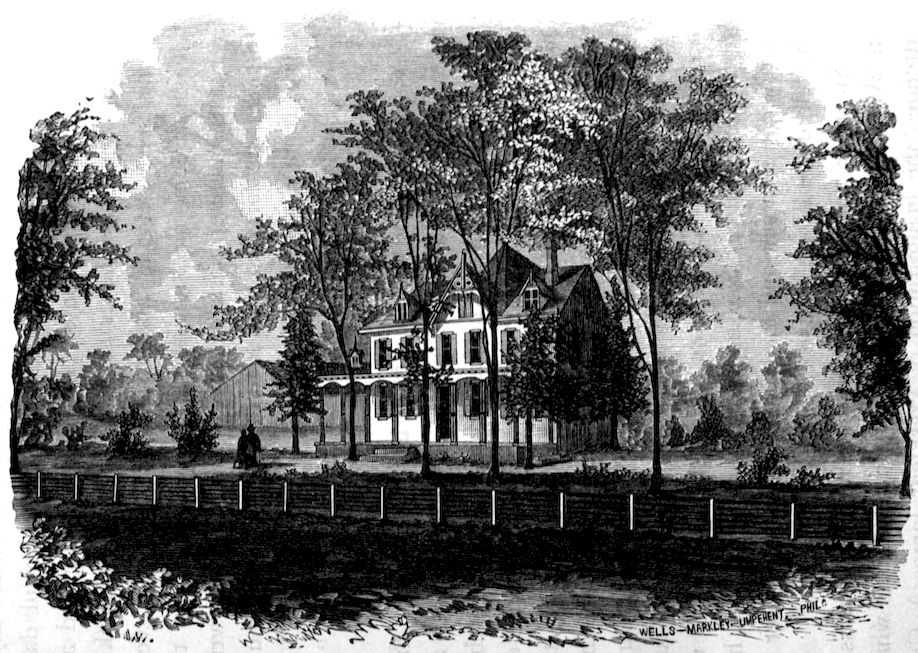
674Mr. Garfield went to the war a poor man, not even owning a home, and it was with money saved while in the service that his wife bought a house and lot at Hiram, for which $800 was paid. His wife and children lived in that modest little cottage, which he greatly improved, and owned no other house until, in 1870, after several years of Congressional life, he built himself a dwelling in Washington. When he went to the Senate his salary of $5,000 a year was the largest amount of money he had ever earned, and with a feeling of lessened pecuniary cares was entertained the desire of owning a farm in Ohio, where his fast-growing boys could spend their vacations, and where he could give his wife and himself the rest they required after the busy winters in Washington. Lawnfield, a place now historic, was purchased, and Mrs. Garfield designed the house, which was erected in 1880, and into which the family moved that summer.
The long years of the war were spent by Mrs. Garfield at her home in Hiram. Her parents were living not far away, and the absence of the husband and father was as far as possible atoned for by the presence of relatives and the companionship of Mother Garfield, whose home was with her son from the time he had one to offer her. The months dragged slowly by, until after the battle of Corinth, when Mrs. Garfield was gladdened by the return of her husband, now Brigadier-General, who remained at home for six months suffering from fever and ague, contracted on the tow-path when 675a boy, and from the effects of which he was never able to completely rid himself.
On his return to the front he joined General Rosecrans as Chief of Staff, and at the battle of Chickamauga he won his Major-General’s stars.
It was during this absence that he lost his infant daughter, and when the news reached him he hastened home to attend the funeral. His dead child was photographed in his arms, and this picture is among the treasures cherished of him now. He was greatly attached to his children, and in speaking of his lost one and the circumstance mentioned, he said to his friend, President Hinsdale: “As I sat with that dead child in my arms my eyes rested upon my bright blue uniform, so recently bestowed upon me, and I thought: ‘How small are all the honors of this life—how insignificant are all its struggles and triumphs!’ I am grieved and broken in spirit at the great loss which has been inflicted upon me, but I can endure almost anything so long as this brave little woman is left me.”
While at the front the people of his district elected him to Congress; and, in 1863, his career in Washington began, and for eight terms he was re-elected. Afterward he was chosen to succeed Mr. Wade in the Senate. The first years General Garfield lived in Washington, whether in boarding-houses or in rented dwellings, his wife and himself were people of no great prominence socially, because they were poor; both were busy and their children absorbed their evenings. Their circle of 676friends was a charming one, however, because their quiet tastes and studious habits made them attractive to really accomplished people.
When Mrs. Garfield moved into her own house she was as happy as a woman could be, and her husband was not less pleased that he could at last shelter his children under his own roof and at his own fireside. Doubtless, this time spent in their modest home was as free from care as any they ever knew. But wherever they were they were happy together. The mother had her heart’s desire in giving her children the careful home training she could not have bestowed without such a home as she possessed. Her house was a real home because her husband was one with her in all things, and his life and hers were not separated in pleasure or in duty. She was as fond of books as he, and he was always her teacher. It was beyond doubt due to his influence over her life in its formative period that she became a teacher. Her appreciation of his ability and their kindred tastes made them comrades in study and in work. They were united in more than in their domestic relations, and grew nearer together as the years passed.
It is rarely that two people marry, who have known each other so long and so well as did this couple, and it is one of the causes of congratulation that their example has been so prominently set before the world. Men and women of the nobler sort, who appreciate the need there is in public life of notable examples of happy 677marriages will never regret that the opportunity was given this man and woman to discover their home-life to the people of this country, however much they may deplore the terrible calamity that was the means of unveiling the sacred side of their lives to the world. The comfort it is to the American people—in view of the world-wide publicity given the slightest circumstance connected with their career—that these two people were so admirable in their personal characters and in their home-life, has not been fully realized generally; but it is undeniably true that it was the one sweet strain that sang itself into the wounded hearts of a nation in their time of grief and pain.
Ten years before Mrs. Garfield went into the White House, and during one summer when the family were in Ohio, she was compelled to do much of her own work. In the temporary absence of her husband from home, she wrote him a letter, which, intended for no other eye than his, fell into the hands of President Hinsdale, who made an extract from it for the use of his pupils, as showing the character of the President’s wife and her views upon the subject of woman’s work. It is appropriate here, and is as follows:
“I am glad to tell that out of all the toil and disappointments of the summer just ended, I have risen up to a victory; that silence of thought since you have been away has won for my spirit a triumph. I read something like this the other day: ‘There is no healthy thought without labor, and thought makes the labor 678happy.’ Perhaps this is the way I have been able to climb up higher. It came to me one morning when I was making bread. I said to myself, ‘Here I am compelled by an inevitable necessity to make our bread this summer. Why not consider it a pleasant occupation, and make it so by trying to see what perfect bread I can make?’ It seemed like an inspiration, and the whole of life grew brighter. The very sunshine seemed flowing down through my spirit into the white loaves, and now I believe my table is furnished with better bread than ever before; and this truth, old as creation, seems just now to have become fully mine—that I need not be the shrinking slave of toil, but its regal master, making whatever I do yield me its best fruits. You have been king of your work so long that maybe you laugh at me for having lived so long without my crown, but I am too glad to have found it at all to be entirely discontented even by your merriment. Now, I wonder if right here does not lie the ‘terrible wrong,’ or at least some of it, of which the woman suffragists complain. The wrongly educated woman thinks her duties a disgrace, and frets under them or shrinks them if she can. She sees man triumphantly pursuing his vocations, and thinks it is the kind of work he does which makes him grand and regnant; whereas it is not the kind of work at all, but the way in which he does it.”
In this letter is discovered the quality for which Mrs. Garfield is distinguished—self-discipline. She is a woman fitted for emergencies, and it requires them to show her 679real worth. The control she has over her emotional nature gives her an immense advantage in meeting a trying exigency. She withstands surprises, shocks and disasters with a steady courage that commands respect, and long ago made her a heroine in the eyes of her husband. In speaking to a friend, a few months before he was inaugurated, while remarking upon some public man whose domestic affairs had crippled his course of usefulness, he said of her:
“I have been singularly fortunate in marrying a woman who has never given me any perplexity about anything she has said. I have never had to explain away words of hers. She has been so prudent that I have never been diverted from my work for one minute to take up any mistakes of hers. She is perfectly unstampedable. When things get worse and there is the most public clamor and the most danger to me and to us, then she is the coolest. Sometimes it looks a little blue before me, but I get courage from her perfect bravery.”
A Washington correspondent, in writing of Mrs. Garfield, paid her this tribute:
“She was in Washington City during the years of extravagance, and almost every Congressman’s wife had a carriage and every house competed for brilliant visitors. She lived through that time as if she belonged to a different social scale. She would not refuse to see anybody, but was seldom dressed as if ready for company. She never apologized for her appearance, and 680she made visits about twice or three times a year, generally calling on foot, but never failing to please with the sweetness of her countenance, the beauty of her eyes, and a self-restraint and reserve perfectly natural.”
Another correspondent, in referring to the same period, says:
“Quietly, but with the truest kindness, has Mrs. Garfield presided over her modest house at the corner of Thirteenth and I streets, in this city, during the years since General Garfield purchased it. In it she has entertained, often in the simplest style, but ever with old-fashioned, true-hearted hospitality, all of wit, wisdom, beauty that Washington has had during the years she has been here. She is an accomplished hostess as well as an accomplished woman—they’re two very different things. Living as the Garfields have had to live, in the most economical way, doing without elegant clothes, fine furniture, sumptuous food, good, new, and rare old books, dearer than all else to them, they have contributed more to make Washington winter life pleasant and profitable than many other families who have supplemented less taste and culture with more money. Mrs. Garfield’s receptions have been the largest ever held by the wife of a mere Representative. They have far surpassed those of more ambitious Senators’ wives, and have approximated those of the ladies of the Supreme Court and Cabinet families in size merely. In attractions they have stood abreast of any of them. This simply because Mrs. Garfield is a sweet-tempered, 681cultured, refined woman, in whose smile it is a pleasure to bask.
“When we consider that, without allowing her manifold cares to interfere with the performance of her social duties, she has managed her establishment alone, and personally conducted the training of her boys for college, we can conceive her superiority, with all her social success, to the mere ‘society leader.’ General Garfield is the president of our literary society, and during the past year it has met at his house. It was more pleasantly entertained there than it had ever been before. Mrs. Garfield exerted even her latent social powers that night, and it was difficult for her guests to break away from her delightful parlors.”
The summer preceding the Chicago Convention, the Garfield family went to Mentor rather late in the season, and remained there through the fall and winter. It had been their intention to return to Washington as usual before the reassembling of Congress, but the result of the Convention changed previous plans, and the household continued there until the week before the inauguration. During that time the crowds continually visiting Mentor left Mrs. Garfield but little time for relaxation and rest. She was in the midst of excitement of a political kind constantly, and to it were added the onerous duties of hostess—a position scarcely to be desired, under such circumstances. She shrank from the publicity which the nomination of her husband to the highest gift in the nation subjected her, though she met the requirements 682of the position with a pleasant demeanor and quiet reserve natural to her.
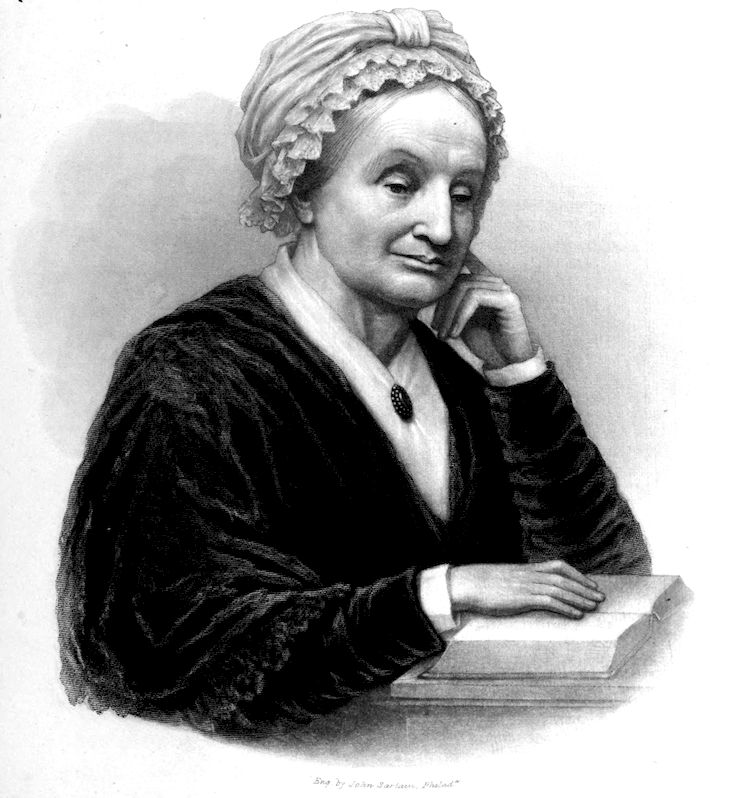
The newspapers abounded in personal allusions to the family, and many efforts were made to obtain her photograph for publication in the illustrated periodicals. This she would not permit, either during the canvass or after the election. It was not in her power, however, to prevent those who had her picture from showing it to their friends, and finally she recognized the natural desire of the public to see the photograph of the Lady of the White House, and she sat for one that was approved by herself and husband. The engraving accompanying this sketch is from that photograph, and is a correct likeness of her, as she appeared at that time.
Though the newspapers could not obtain her photograph, the correspondents made pen-pictures of herself and her home. One of them (writing to the Detroit Evening News) gave so pleasant a picture of her that it is reproduced in part. It was written shortly after the election:
“The historic orchard and pumpkin-fields were lying peacefully now under their snowy covering, and giving no signs of the recent scenes of devastation. Crossing the wide veranda, the solitary pilgrim rang the bell, and was ushered by a wonderfully patient-looking colored man-servant into the reception-room, although that is quite too formal a name to give a room combining such an air of comfort with its elegance; it is the 683emanation of an artist and a fireside genius in one, and you are not surprised to learn later that the mistress of the mansion is an artist of considerable skill. A royal grate-fire burns brightly at one end of the room, over which is a Queen Anne mantel, with cabinet photographs of Garfield and Arthur, painted candles, and numerous articles of bric-a-brac. At the opposite end of the apartment stands a fine upright piano, adorned with photographs of Hancock, Marshall Jewell and Ole Bull. Over this is a French picture in bright watercolors, on one side of which hangs a copy of Meissonier’s Napoleon, on the other a little landscape, painted and given her, Mrs. Garfield relates, by her old drawing teacher, of whom she tells some interesting reminiscences.
“The quiet tinted walls of the reception-room are further adorned with large portraits of the General and his mother, one of Alexander Campbell, the founder of the faith which Garfield indorses, and a number of other pieces, among them a copy of Miss Ransom’s ‘Hagar and her Son,’ from—‘let me see if I can remember the name,’ Mrs. Garfield said, turning the picture and spelling out the Italian name from a card on the back. ‘Miss Ransom put the card there so that I shouldn’t forget the name, because he was not one of the best known painters.’
“‘And this,’ pointing to a little gilt frame decorated with pansies, ‘was sent to the General by a little Vermont girl, her own work, and the verse inscribed on it was written for her by Whittier.’
684“In this interest in her pictures and their histories Mrs. Garfield showed constantly the artistic element in her nature, as well as in a hundred touches about the rooms.
“A small-figured dark carpet covered the floor, a Smyrna rug lay before the fire, in the glow of which sat the famous grandmother, a quaint little figure, making with her snowy hair and cap, and her knitting-work, a fitting adjunct to an ‘interior’ charming enough for anybody’s pencil. There were easy-chairs and lounges, speaking of solid comfort, and a little centre-table piled up carelessly with all kinds of books, school-books, story-books, a gay-colored copy of Chic, a life of the President-elect, and ‘Bits of Talk,’ by H. H., being among them. And there were also upon that table—yes, actually, dear prim housekeepers—the well-known slouch hat of the General’s, and a roll of red flannel, with a thimble beside it.
“Everywhere—in every nook and corner—there are books. A case in the parlor contains editions of Waverley and Dickens, French history in the original, old English poets and dramatists richly bound in black and gold, and a choice collection of miscellaneous works; in the little hallway leading to the dining-room are books, and in the dining-room itself more books. The last is a cheery room with its handsome tiled mantle, open fire, pictures and shining silver. There is everywhere evidence of the dainty housekeeper.
“The pilgrim wandered out through the back regions 685of the house where the tin wash-basin and milk-cans, which were really seen, would no doubt be deemed objects of sacred interest to the enthusiastic adorer, and crossed over to the detached office, whose walls are lined with ponderous volumes, and where busy clerks and a peculiar hum of the wires gives one some idea of the work done there. A peculiarity of the telegraph wires running into General Garfield’s office is that the sound of Cleveland’s church bells is conveyed distinctly over them, thirty miles.
“Under a tree near the office was a spirited picture. The two youngest scions of the house and the great Newfoundland dog, all three in a state of frantic delight, were chasing a coon which had been sent the General by train that morning, a sample of the odd and incongruous quality of the presents which are showered upon the family. Returning to the parlor, the visitor found Mrs. Garfield seated before the fire, and received her pleasant and cordial consent to the sketching of her home for the benefit of the public, who have a natural and loyal interest in it. To those who would wish to see a brilliant society leader in the White House, Mrs. Garfield will perhaps be a disappointment; but those who have been led to think of her as a retiring, mere domestic woman, inadequate to the position, will also be disappointed. She is a lady of admirable self-poise, dignity and thorough culture, reserved yet affable, and with the distinguishing trait of genuineness. There is not a trace of affectation about her. A Mentor 686gentleman remarked, ‘There isn’t a family in town, apparently, so little set up by the situation as the Garfields.’
“When asked if she dreaded the coming responsibilities (so much has been said of her retiring nature), she said, slowly, with her brown eyes fixed thoughtfully on the fire: ‘Yes, in many ways; but it has always been my experience, so far, that one grows fitted for responsibility as it comes. My greatest fear is that the time will slip by, and when it is over I shall have it to look back to with regret for the many things that ought to have been done.’
“With such a spirit it will be safe to trust the woman influence in the next administration. That it is going to be an influence that will be felt, no one who is acquainted with Mrs. Garfield doubts....
“Her youth was spent quietly at Hiram, and there were struggles connected with it, in obtaining her education, which have doubtless aided in developing her self-reliant spirit. Since marriage her life has been devoted to her family, but she has always given up a great deal of time to the rites of hospitality.
“‘Bless you,’ said a local gossip, ‘they have always been overrun with visitors. Why, Mrs. Garfield hasn’t had a chance to get acquainted, hardly, with people here.’ The same oracle said: ‘Mrs. Garfield is wonderfully firm; if she once makes up her mind to a thing nothing can turn her. Now, the general can be coaxed, but they both have splendid family government.’... The pilgrim boarded 687the train, with a good-bye, for Mentor, and an uncommonly pleasant picture tucked away in his memory of a charming home, and of the future mistress of the White House. The latter picture is in personnel a slender, graceful lady, with a transparently clear complexion, with delicate features, and clear, penetrating, brown eyes; hair the same shade of brown, worn in a braid at the back, and frizzed quite in conventional style in front. A dark blue dress, simple lace tie, and little or no jewelry, completed the lady’s home appearance.
“A gentleman, well acquainted with the family, remarked: ‘Mrs. Garfield looks a little worn now, and no wonder. She has changed a good deal within the last year. When she got the telegram announcing the nomination the tears came into her eyes, and when she was asked if she was not glad and proud to hear it, she said: “Oh, yes; but it is a terrible responsibility to come to him and to me;” but I tell you she has put her shoulder to the wheel bravely so far, and she will continue to the end.’”
The allusion to Miss Ransom, the artist, in this extract, recalls the fact that a year or more previous to the election, General Garfield commissioned her to paint a portrait of Mrs. Garfield. The two were old Cleveland friends, and had been intimately associated for years. The portrait was painted, and during the week of the inauguration it was seen by many strangers in Washington who visited her studio. She told a characteristic thing of Mrs. Garfield in connection with this portrait. Miss 688Ransom for a background sketched a beautiful view from the Soldiers’ Home, showing the Capitol, and the Potomac, like a thread of silver, in the far distance. Mrs. Garfield objected to it, saying, “That will do for a President’s wife who resides at the Soldiers’ Home a part of each year, but not for me.” The artist argued and pleaded, but in vain. Mrs. Garfield was decided in her mind, and refused to have it. She however added to her objection the remark, that she would be pleased if there could be introduced into the picture a view of Franklin Park—“the corner opposite my window, where I have so often watched my children at play,” she said. The artist still demurred, on the ground that the park was so near and so shut in that it was impossible to get the perspective requisite for a good background, but the children and the General were delighted with Mrs. Garfield’s idea, and Miss Ransom yielded to their united request, and the portrait was finished accordingly. General Garfield was greatly pleased with the result, and would not let the portrait be taken from Washington to the artist’s studio in Cleveland, where she proposed to complete it, lest something might befall it in the transportation.
ELIZA BALLOU GARFIELD.
689Of the mother of General Garfield much was said previous to the inauguration, and has been since. She is the first mother of a President who has lived in the White House, and by reason of the deference and distinction her son showed her has been the recipient of exceptional attentions. No one who ever saw her in his company but felt that an unusual tie bound them. They were the ideal mother and son, and were so recognized years before he had grown into a public man. “You never see General Garfield at church without his wife and mother,” was the remark of a resident of Washington who lived near the Church of the Disciples. “He goes by here almost every Sunday with his wife on one arm and his mother on the other.”
People who called at the house saw the bright old lady, who was “grandma” to so many children, and knew by her sunshiny manner that she was an honored member of the family—not a mere guest or an inmate of the house. She was “mother” to Mrs. Garfield as well as to her son, and the two women loved each other because their hearts were centred in him.
Many incidents are related of her sterling worth and integrity of character. Few women of to-day have known such rugged experiences with poverty as she had for long years after she lost her young husband. She must have been possessed of intense force of will, or she would have failed in the work she accomplished. All her children were blessings to her, and honored her absolutely. She lived for years a life of toil, and in the neighborhood of the old home are told many circumstances creditable to her. Her eldest son was a little boy when his father died, and was not able to wield an axe. She wanted fences made, and her neighbors offered to do the job for her, as they did for each other. The custom was a common one, and all that was expected 690in return was a supply of whiskey. She refused to furnish liquor to them—she the widow, with fatherless boys about her, watching her example and knowing no other guide. She wielded her maul and split her own rails, without subjecting her boys to temptation or perilling their future by any act of hers. Widow Garfield would not open her door to an enemy too strong for women to cope with in strangers and the bitterest of foes to encounter in the home circle, and wisely decided to save her young at whatever sacrifice. If people occasionally wondered at the depth of her children’s love, and the jealous care they bestowed upon her, it was because she had earned such riches for herself and was wearing the crown that was of her own making.
The scene at the inauguration of her son—when he stood in the presence of the most distinguished men and women of the land, and saw a sea of human beings before him such as no man could count, and turning from them all kissed his old mother first and then his wife—will never be forgotten. The people could talk of nothing else then, and cannot now recall the event without dwelling upon it. The new President might well have overlooked his mother at such a time and been formal with his wife, but he was husband and son first, and the young men who witnessed the spectacle were benefited and blessed by it.
Such filial and husbandly devotion won President Garfield the respect of wives and mothers throughout the land—a respect which kindled into affection in the 691time that came. A speedy illustration of the effect of this act was given by a young school-girl who had been an eye-witness to it, and whose enthusiasm was checked by her companion. “It was done for effect,” he teasingly remarked. “It was done because he is a knight—a real Sir Galahad!” she replied, the bright eyes sparkling, the rosy cheeks flushing, as she defended her hero. That little act was the tie that bound the women of this country to those two women as nothing else could, and it was an assurance of a happy home which aroused generous American sentiment for the new White House occupants.
Mrs. Garfield was eighty years of age when her youngest child entered upon the performance of the highest office in his country, and very naturally she was the object of much sincere interest. When the Presidential party reached Washington, she was escorted from the car by her son and placed in the carriage of President Hayes, which awaited her coming. She was driven to the White House direct, and was there to welcome her son and daughter when they came over from the Riggs House in the evening to see her. Her heart must have throbbed with thankfulness and delight that night as she looked back over the years that lay behind her, thought of the husband dead for fifty years, and dwelt upon the career of her boy, who had grown up by her side, and was the first in the land and ruler of a nation.
Incidents of her early life are rare, and from a relative, 692an aged man, who knew her in girlhood, these facts are obtained:
“Eliza Ballou and a sister, about 1820, by the death of their parents, were left alone in the world and unprovided for, so far as the inheritance or possession of property was concerned. Preferring to live among relatives, one went to reside with an uncle in northern Ohio, and the other, Eliza, came to another uncle, the father of Samuel Arnold, who then lived on a farm near Norwich, Muskingum county, Ohio. There Eliza Ballou made her home, cheerfully helping at the house or in the field, as was then sometimes the custom in a pioneer country. Having something more than what at that day was an ordinary education, Eliza procured about twenty pupils and taught a summer school. The school-house was one of the most primitive kind, and stood in the edge of a dense and heavily-timbered woods. One day there came up a fearful storm of wind and rain, accompanied by thunder and lightning. The woods were badly wrecked, but the wind left the old log school-house uninjured. Not so the lightning. A bolt struck a tree that projected closely over the roof and then the roof of the building itself. Some of the pupils were greatly alarmed, and no doubt thought it the crack of doom or day of judgment. The teacher, as calm and collected as possible, tried to quiet her pupils and keep them in their places. A man who was one of the pupils, in speaking of the occurrence, says that for a little while he remembered nothing, and then he looked around and saw the 693teacher and all the pupils lying dead on the floor, as he thought. Presently the teacher began to move a little, and rose to her feet. Then, one by one, the pupils got up, with a single exception. Help, medical and otherwise, was obtained as soon as possible for this one, and, though life was saved for a time, reason had forever fled. This was a fearful experience for a young female teacher, and it probably ended her career as an instructress.
“Eliza Ballou’s sister married in northern Ohio, and while on a visit to her the former made the acquaintance of Abram Garfield, and subsequently married him. When James was about sixteen years old, he and his widowed mother visited Muskingum county in search of a school for the young man. They visited the family of the elder Arnold, at Norwich, and also the family of Samuel Arnold, now a citizen of New Lexington, and before referred to. The unusual intelligence of the boy and the astonishing affection between mother and son were what chiefly impressed itself upon the minds of those who entertained the poor humble boy who was to become a future President of the United States, and die a martyr to the high official position, more widely lamented than any other man had ever been. There appeared to be no opening for a school in the neighborhood of Norwich, and mother and son went to Uncle Ballou’s, in another part of the county, where James got a school and taught a single term. The money thus earned he applied in further educating himself. And this was why he and his mother were hunting a school.”
694Forty-five years later the proudest day of that mother’s life had come, and she went forth to meet it, treading lightly, forgetting that she was old, and remembering that it was “her baby” who was to be made President of the United States. “There is the President’s mother,” was whispered among the throng, as a small, elderly lady, dressed in black silk, with her white head covered with a close-fitting bonnet, stepped into the Senate gallery. It was the woman in her that made her so calm and composed as she looked down upon the scene before her; it was the mother in her that caused her withered cheeks to flush and the tears to start as she saw her son come upon the floor, surrounded by the chief officers of the nation.
She was the first to receive him as he entered the Executive Mansion, and a sweeter picture has rarely been seen on earth than this little mother presented as she advanced, with a proud step and eyes full of tears, to greet her son. What mattered it to her if the grandest civil and military procession ever seen in Washington had escorted him there and was awaiting his presence impatiently! She was his mother by right of royal reverence as by ties of nature, and she was not disappointed in the honor paid her. She could walk under his outstretched arm thirty years before without stooping; but he paid her the same deference he gave her when he was a little son and not a great man—when she was a hard-toiling and strong-armed woman, and not the mother of the Chief Magistrate of the country.
695Despite her fatigue she wanted to see all that was done in her son’s honor, and when the party left the lunch-table and went to the reviewing-stand on the avenue in front of the Mansion, Mother Garfield was one of the number, and for a long while sat near her son enjoying the sight. The vast multitude that filed in front of that stand scarcely had time to note the presence of the venerable woman before them, but the people about her watched her with a satisfaction almost undefinable to themselves and never to be forgotten now, in view of all that has transpired.
A few days after she was established in the White House she wrote a letter to a relative in the West which, as here given, does not show the handwriting tremulous with age, yet exhibits all the beautiful spirit of the writer:
“White House, March 7, 1881.
“My Dear Cousin:—I received your good letter and your picture also, and would have answered sooner, but waited to get my picture. I have some, and will send you one, though they are not good. I am happy to tell you that we are all pretty well, but a good deal tired out. We have passed through the greatest rush of people for the last six months that I ever saw. Since the Inauguration it is one steady stream of old friends calling. It takes pretty much all of the time to entertain them; they want to see the President’s mother. I am the first mother that has occupied the White House and her son President, but I feel very thankful for such 696a son. I don’t like the word proud, but if I must use it I think in this case it is quite appropriate. How many times my mind goes back to our girlhood school days! but changes take place. I have seen sorrowful days and have seen happy days. I was once young and am now old, but I have never seen the righteous forsaken or his seed begging his bread. I have got a very pleasant room, nice furnished, and waited on in the very best manner possible. Now I want you to write to me. Our folks all send love to you; with very much love, I remain your aged cousin,
“Eliza Garfield.”
Notwithstanding the novelty of her position, the first instance of the kind in the history of the Presidents, although her son was not the first President whose mother was living during his term of office, she was at once established as a great favorite, and her short stay in the White House was as happy as worldly honors and human affection could make it. When the summer came she longed for the country and old friends in Ohio, and accompanied by her two youngest grandsons, she returned to Mentor. She expected her son to visit her during the summer, and to return with her daughter in the fall to the White House.
MENTOR—THE HOME OF PRESIDENT GARFIELD.
697No more imposing ceremonies were ever witnessed in Washington, or in this country, than those which attended the inauguration of President James A. Garfield. Thousands of National Guardsmen and scores of civic associations were in the procession, which, with the exception of the famous review in 1865, was the finest pageant the country has yet seen. Twenty thousand men were in line, and the cortege occupied two hours in passing the review-stand. From the White House to the Capitol there was a mass of people, and the decorations of the historic avenue were profuse and handsome. The snow lay on the parks and terraces about the Capitol, and the day was raw and disagreeable, though the sun shone at noonday and dispelled the sombre clouds that hung heavy over the city after the storm of the preceding night and early morning.
In the front row of the Senate gallery the wife and mother of General Garfield sat beside Mrs. Hayes, and with them were the only daughters of the incoming and outgoing Presidents. The galleries were very soon crowded with a brilliant audience, and on the floor of the Senate were many distinguished men. General Hancock, the Democratic candidate for the Presidency, was among the number, and the ovation tendered him was second only to that bestowed upon the President-elect. The ceremony of introducing his successor was performed by Vice-President Wheeler; and after the oath of office had been administered to Vice-President Arthur, and Mr. Wheeler had said his farewell to the Senate, the assembly adjourned to the eastern portico to witness the taking of the oath of office by President Garfield. The spectacle was a grand 698one. A vast multitude of people gazed upon the immense platform upon which were seated General Garfield, with Chief-Justice Waite on his right and Sergeant-at-Arms Bright on his left. Immediately back of the three, who were directly in the centre of the platform, sat President Hayes, Mrs. Hayes and Mrs. Garfield and the mother of General Garfield. Still behind them stood Mollie Garfield and Fanny Hayes, and to their right sat the Speaker of the House of Representatives, Mr. Randall. The gentlemen sat with their heads uncovered. The Chief-Justice rose from his seat, and instantly the noise and din died away, and the oath of office was administered. Then followed the inaugural address, after which Mr. Hayes shook hands with the new President, as did the Chief-Justice. Turning from them, President Garfield tenderly kissed his mother and then his wife. This being the first incident of its kind, the people noted it with great gratification, and the throng rent the air with huzzas, while the President received the congratulations of those about him as he slowly made his way back to the head of the procession. The ladies of the party returned first, and were at the White House before the procession got under way from the Capitol. The President’s carriage was drawn by four horses, and the escort were the Cleveland troops, in showy uniforms. General Sherman rode at the head of the procession. The reviewing-stand in front of the White House was occupied by a distinguished company, which awaited the coming of the 699Presidential party from the White House, whither they had gone to lunch. At half-past two the President and ex-President walked down to the stand, followed by their families and the entire White House party. The President stood with his wife and his mother on his right, and ex-President and Mrs. Hayes on his left, with General Hancock immediately behind and above him, and surrounded by the members of the Cabinet, Senators, Congressmen and a numerous company of ladies.
President Hayes and his family became the guests of Secretary and Mrs. Sherman, and after the procession had passed they returned to the door of the Mansion, took leave of the President and Mrs. Garfield, and with their son, who welcomed Mrs. Garfield as she crossed the threshold, were driven away.
The city was brilliantly illuminated at night, and the inauguration ball in the Museum Building was attended by nearly every person of distinction in Washington. Mrs. Garfield was arrayed in a magnificent dress of lavender satin, with trimmings of point lace and a corsage bouquet of pansies. Mrs. Hayes wore a white satin de Lyons trimmed with pearl passementeries. Both costumes were elegant and were worn without jewels. In a ball-room thronged with ladies whose superb diamonds were resplendent and glittered with reflected light, their simplicity was all the more charming.
The National Museum is a building designed in the form of a Greek cross, the arms diverging from a central octagonal, surmounted by a dome, and the temporary 700decorations were magnificent, consisting of statues, tropical plants, flowers and the national colors, draped with evergreen, and coats-of-arms. The President and Mrs. Garfield received on a raised dais. The gallery above them was for the use of Mrs. Garfield and Mrs. Hayes and their invited guests. Another was occupied by General Hancock, who was the guest of the committee, surrounded by a distinguished party of military officers. The scene, viewed from the balcony near the rotunda, had the appearance of a series of halls, separated by arches, and affording an extended and varied vista. The view was enchanting and bewildering. The picture was a never-to-be-forgotten one. With all the adjuncts of famous people, gorgeous in apparel and surrounded by music and flowers, the ball-room is remembered as a fairy place and recalled as a bright dream.
Succeeding the inauguration were days of bustle and excitement for the new inmates of the White House. They had many friends in the city where they had lived so long and entertained so hospitably, and all were anxious to see them. So likewise were the hundreds of strangers who had visited the Capitol to witness the inaugural ceremonies, and the Saturday evening following the event the President and Mrs. Garfield received. In the matter of dress Mrs. Garfield came up to the requirements of her position. At this reception she wore a rich ruby velvet, made in princess style, the facings of the long bow and loops that fastened the fullness at the back being of Sultan red satin. The open neck and the 701half-long sleeves were ornamented with elegant lace. Her hair was simply arranged after the prevailing style, and she wore no jewels.
Several afternoon receptions were held during the spring, and many invited guests were informally entertained, but there was no opportunity for social gayeties, and the anticipations were all the brighter for the coming winter. The ladies of the Cabinet numbered several long accustomed to official life in Washington, and it was anticipated that the receptions and State dinners the coming winter would be rendered brilliant by the circle immediately about the President. Mrs. Blaine, Mrs. MacVeagh, Mrs. James, Mrs. Lincoln, and in fact all, were well known in Washington society, and were united in their desire to make the Administration, socially, as successful as it promised to be officially.
The spring wore away, and the summer came, bringing with it the two elder sons of the President, who had been away at school.
The five children of the President and Mrs. Garfield attracted much attention while in the White House, particularly the two eldest boys, Harry and James, just developing into manhood, and Mollie, the only daughter. Two younger lads, Irwin and Abram, were less before the public than the elder children, and were in Washington but a short time, having returned to Ohio in the early summer. The elder boys were at their studies, and the daughter was too young to participate in the few public receptions given by the President.
702The family were all together for a time in the spring, and this description of a dining-room scene is given by a Washington correspondent:
“In the cosy family dining-room the President’s seat is midway the length of the table on its west side, and Mrs. Garfield sits opposite, with Harry, her eldest, a decided ‘mother boy,’ as near her as the presence of almost constant guests will permit, while Jimmie sits correspondingly near his father, where also ‘Grandma’ Garfield has an honored place. She is always waited on first, whoever else may be present. Mollie sits at the north end of the table, and the two younger boys are disposed a little promiscuously, according to the exigencies of the case. Harry is eighteen, tall and graceful, with the regular features of his mother. The down of manhood appears on his cheeks. Jimmie, sixteen years old, is nearly or quite as tall as his brother and broader shouldered, with the Saxon hair and large features of his father, whom he bids fair to resemble strongly in person and intellect. Mollie, aged fourteen, has the dark-brown hair of her mother and the lineaments of her father not unhandsomely reproduced. When womanhood has softened the charm of her face she will be very fine-looking. She is a great pet with her father. Irwin, aged eleven, and Abram, aged nine, you already know through descriptions, especially the former, who is the eccentric one, possibly the genius of them all. He is named for General McDowell, and insists that his name must be always written, not Irwin M., but Irwin 703McD. Meal-time is almost the only time the President has lately had with his children, and he devotes himself in great part to them at that time, after asking questions on some interesting point of Harry or James or Mollie to draw them out, and then explaining it at considerable length, instructing by the Socratic method as it were.”
The eldest and the youngest of the household are dead; the latter, an infant son, having died in Washington four years before the President’s election. It is related of General Garfield that he suffered intense grief at the loss of his children, and his friends frequently during his last months of life recalled the sorrow he manifested at the time of his little child’s death in Washington.
In June the public was startled with the news of Mrs. Garfield’s illness, and it was with great concern that the announcements from the sick-room were learned. The President gave up all public matters, and for days watched over her, giving her the medicines prescribed and remaining at her bedside day and night. Happily, her life was saved, and so soon as she could be conveyed from Washington, she was taken to Long Branch, where it was hoped the sea air would restore her. She was so weak when she got there that she had to be carried to her room, and was but beginning to grow strong when the President left her and returned to Washington, preparatory to making a trip to New England and the White Mountains. He was daily cheered by the news of his wife’s steady improvement, and was anticipating a happy visit to Williams College, his Alma Mater. The party 704were to leave Washington on the third of July, and be joined by Mrs. Garfield and her friends at New York. The trip was all arranged, and the morning of the eventful day came. Mrs. Garfield at Long Branch was anticipating a reunion with her husband, and was making final preparations to start from the hotel to the train when the news that startled the nation reached there and was in part tenderly broken to her. She was taken from Washington, at a leisurely gait, a helpless invalid, but the telegram that shocked her that July morning sent her back at the rate of fifty miles an hour. Even that seemed slow to the anxious wife and the suffering husband. The event was the never-to-be-forgotten, never-to-be-forgiven tragedy of the shooting of President Garfield, the particulars of which are briefly told here.
On the morning of Saturday, July 2d, when it was supposed that the President was on his way from Washington to New York, accompanied by all his Cabinet, their wives and several friends, this news was flashed over the wires: “President Garfield was shot before leaving on the limited express train this morning!”
The brief announcement, made in two lines, that the President of the United States had been shot by an assassin, excited great incredulity, then amazement, and finally a feeling of horror that rendered suspense almost intolerable. The second despatch followed speedily, and it conveyed the intelligence that Colonel Corbin had returned to the President with a physician. This was meagre enough, and the third was waited with intense 705excitement. It said: “President Garfield was shot this morning at the Baltimore and Potomac depot by an assassin. It is reported that he is mortally wounded. The assassin was caught.”
The fourth despatch, dated half an hour later, was to the effect that Dr. Bliss had said that the President’s wound was not a mortal one, and that concerning the assassin nothing was known except that he was under arrest. A subsequent message announced that the physicians attending the President were holding a consultation. Soon came the particulars of the shooting:
The President and Mr. Blaine rode from the White House to the depot in the Secretary’s carriage. Reaching the entrance on B street, the President and the Secretary left it and entered the ladies’ waiting-room, walking arm-in-arm. Just at the moment that they were passing through the door into the main room, two shots were fired. Mr. Blaine saw a man run through the room at that instant, and started toward him, but turning to the President and seeing that he had fallen he sprang to his side, as did several others, and raised his head from the floor. One shot passed through the arm, and the other took effect in the lower part of the back. There were few people in the room when the shots were fired. The members of the President’s party were on the platform beyond the waiting-room, or in the car that was ready to start the moment the President was aboard. Secretaries Windom and Hunt were promenading on the platform, Postmaster-General 706James stood at the side of the car in which were seated the ladies of the party. They were all chatting as they watched for the coming of the President. Colonel Jamison, of the Post-office Department, ran out of the depot immediately after the shots were fired and exclaimed, “The President is shot!” One of the party made a doubting reply, but when their informant answered “I saw it,” they rushed back and found the President on the floor, his head supported by Mrs. White, the woman in charge of the waiting-room, who had witnessed the shooting. The entire party hastily quitted the car and followed them to the scene, and a large crowd gathered about the prostrate form. Shortly after a mattress was brought in and the President was removed to the upper floor of the depot. Within an hour an ambulance had arrived and the President, who had grown very weak, was removed to it and conveyed to the White House. The news spread like wildfire, and those who at first doubted the report became convinced that something had happened by the rapid driving of a carriage through Pennsylvania avenue, clearing the way for the ambulance which followed driven at a rapid pace, and surrounded by mounted police. An excited throng followed. The President bore the removal with great fortitude, and in fact, after the first paroxysm of pain and faintness had passed, he seemed not again to lose his self-control. His first thought after the shock of the shooting had passed was of his wife, and from speaking reassuringly to his son James, 707who was beside him, he dictated to Colonel Rockwell this despatch to her:
“The President wishes me to say to you from him that he has been seriously hurt. How seriously he cannot yet say. He is himself, and hopes you will come to him soon. He sends his love to you.”
The ladies of the party hurried to the White House to make preparations for the reception of the President, and when the sad procession reached the Mansion, everything was in readiness for him. As he was lifted from the ambulance he saw some familiar faces at the windows, and with a smile, which those who saw it will never forget, he raised his right hand and gave the military salute. His face was ghastly white, and it was thought that his moments were numbered. He was carried into the “southwest chamber,” that he had recently occupied as a sleeping room, and was soon surrounded by the physicians. The events that transpired in that room during the day were made known throughout the land, and are familiar to all readers of the newspapers.
It is not needful in a sketch of Mrs. Garfield to recite the painful history of the creature who shot the President, or to give any of the particulars of his case. His name is execrated wherever it is heard, and the world would be glad to bury it in eternal oblivion. The only emotion of a human kind exhibited by him was his hesitation to shoot the President when he went to Long Branch with Mrs. Garfield. In his confession he stated that he was at the depot for that purpose, but noticing 708that Mrs. Garfield was pale and ill, and clung tenderly to her husband’s arm, he decided not to take his life then.
It was seven o’clock in the evening when the train dashed at express speed into Washington. Shortly afterward the President heard the wheels of a carriage on the drive, and speaking to Mrs. James, who sat beside him, said, “That is my wife.” Alighting from the carriage she was accompanied up the stairs by her son James and Attorney-General MacVeagh. She hurried to the bedside of the President, and greeted him with a cheerful smile. Her self-control and quiet demeanor were noted by the doctors, who returned to the room and terminated the interview for the time being. She was escorted out of her husband’s presence, and then broke down, weeping piteously. Shortly afterward she returned to the bedside and had a second private interview with him. From that time he manifested favorable symptoms and hope was revived. Later in the evening, as Mrs. James sat beside him watching him as he slept, he suddenly awoke, and said to her: “Do you know where Mrs. Garfield is now?”
“Oh, yes,” Mrs. James answered; “she is close by, watching and praying for her husband.”
He looked up to the lady with an anxious face, and said, “I want her to go to bed. Will you tell her that I say if she will undress and go to bed, I will turn right over, and I feel sure that when I know she is in bed, I can go to sleep and sleep all night? Tell her that I will sleep all night if she will only do what I ask.”
709Mrs. James went immediately with the message to Mrs. Garfield, who quickly replied: “Go back and tell him that I am undressing.” She returned with the answer, and the President turned over on his right side and dropped asleep almost instantly.
Throughout the night he was cheerful, and to Dr. Bliss, who, in replying to his question as to his condition, had told him that there was a chance of recovery, said hopefully, “We will take that chance.”
The people, impressed with this remark and the cheerfulness it indicated, renewed the hope which had well nigh been extinguished by the repeated assurances of the physicians that he could not live through the night. The Fourth of July, the saddest ever known in this country, passed; the news from the bedside of the nation’s patient was less cheering, and the gloomy tide of a great sorrow ran a strong current under the ordinary occupations and duties of every-day life. No gathering of people was possible where it was not the dominant subject, and it took weeks of weary anxiety to quell the spirit of revenge that was universal in the hearts of men against the wasp that had stung the President and had poisoned his life-blood. The sympathy of other countries soothed this feeling in time, and the demeanor of the President was such an example to the country that it was impossible to express hostile feelings with such a pattern of submission before them. Great as had been President Garfield’s services in the past, his heroic bearing in affliction was of more value 710to the people, and his influence did more to bring about harmony of feeling, brotherly love and the obliteration of party bitterness than any work he had done in his days of health and activity.
As he lay on his bed of sickness, he thought of his mother, whose absence from him troubled him. He hoped at first to go to her soon and to recuperate his strength at Mentor, but while waiting for the strength that never came he wrote her this letter:
Washington, D. C., August 11th, 1881.
Dear Mother:—Don’t be disturbed by conflicting reports about my condition. It is true I am still weak and on my back, but I am gaining every day, and need only time and patience to bring me through.
Give my love to all the relatives and friends and especially to sisters Hetty and Mary. Your loving son,
James A. Garfield.
Mrs. Eliza Garfield, Hiram, Ohio.
Telegrams of sympathy reached his bedside from all parts of the earth, and wherever the news had gone in other lands there came back gratifying evidences of world-wide sorrow.
As the days passed the alternations of hope and despair kept the feeling of the people at its highest tension, and during this time of anxious waiting, Mrs. Garfield was the recipient of countless messages, letters and assurances of every kind of the sentiment of her countrymen and women. She appreciated all that was felt and said; and on one occasion, when some unusual 711incident had received her attention, she said in a voice broken with emotion and with tears in her eyes: “If it were possible for my husband and me to go around and see all those dear people who have been so grateful in their remembrance for us here of late days, I would be so happy; and I know he would, too. I want to thank them—to tell them all how kindly I feel toward them for what they have said to me. I never could understand anything about politics, and if I liked a person it made no difference whether they were Republicans or Democrats; and now I have grown to think that there is not much difference between the two great parties, for one says just as kind words in our present affliction as the other. It makes me feel like forming an opinion as to what I would do were women permitted to vote as well as men. I believe I would get two tickets, fold them together so as to look like one, and drop both in the ballot-box.”
The love and respect for her womanly attributes and fine self-government increased as time passed; and it was evident that her conduct under the most trying circumstances that could come to a woman had aroused the enthusiasm of the entire country. From the various organizations, without respect to their nature or object, were received at the White House kind wishes for the President and earnest assurances to him that his family was not forgotten in his time of helplessness and suffering. The practical spirit of the people was aroused, and the question was repeatedly asked: “What can we 712do to make it easier for the President?” Presents of all descriptions, from the rich and the poor, the great and the humble, patriarchs and little children, were sent to the White House in great numbers. Everybody wanted to do something, and it was painful that so little could be offered that would be of use. Sick-room appliances reached the physicians in such quantities that the basement of the mansion was crowded, and the slightest intimation of a change in the nourishment or treatment of the distinguished sufferer sent numberless articles for trial. That he might have the richest Alderney milk, an eager owner of an imported cow quickly forwarded the animal, and he was repaid many times over with the knowledge that the patient saw from the window the fine creature that had been sent to minister to his comfort, and spoke of it. Little children sent their tributes, and the gift of a pet squirrel from two little people who had learned that the President had expressed a desire for such food, brought tears to the eyes of all who knew of the circumstance. The tender, constant and ever deepening feeling of the people for their sick President must have helped him immeasurably, for he was borne up and cheered daily by the affection that went out from all human hearts toward him. It seemed to the people that he must get well, that the prayers of a nation would be answered; that the assassin’s work would fail; that love would conquer death, and that into the weary pain-worn body of the sufferer would be renewed the strong life-currents. Who 713can ever forget, though long years may dim other memories, the daily and nightly watch over that sick-chamber! When the relapse came weeks after the crisis was thought to be passed, the excitement and interest grew terrible in its intensity. Those who had the dissemination of the news aged under it as the bulletins that came from their hands banished hope. The day of saddest gloom, Saturday, August 27, was given up to prayer, and when Sunday came, and word went forth that the President was better, the people called it resurrection, and said in their joy that God had given back to them in answer to their petitions him who was thought to be dead.
Through it all stood Mrs. Garfield, eager and watchful, but steady and strong in heart. When the doctors told her of their fears she did not sink down or show dismay. She bade them do their best, and never to give up, and leaving them she went back with a cheerful face to her husband and resumed her place at his bedside. Too weak and weary to give thought to others, the heroic sufferer watched her face and was understood by her when to others his wishes were unintelligible. If he held on to life with a tenacity that surprised every one, his strength in large measure was drawn from her. She was more to him than all else, and she furnished the strongest motive he felt for his recovery. The thought that was agitating many minds, that he be given assurance that his family would be taken care of in case he died, was voiced by Mr. Cyrus W. Field, of New York, who proposed 714that a fund of $250,000 be raised for Mrs. Garfield and her children, and settled upon her. He started the fund with a large subscription, and the amount subscribed before and after the death of the President reached nearly $350,000. Though no public acknowledgment was made of the gift, it is a fact that the President’s mind was greatly relieved by this considerate act, and his last days were not troubled with dread of the future for his wife and children. When the sultry August days had tried his strength beyond endurance, and it was apparent that a removal from the malarial atmosphere of the capital was imperative, the journey to Long Branch was undertaken. Many plans had been suggested and the practicability of all considered; but Mrs. Garfield, who knew of her husband’s love for the sea, and of the benefit that she had derived from her stay there, insisted upon this trip. The journey was undertaken after careful preparation, and the details of the trip from Washington to Elberon were read with thrilling interest at the time. At every station and wayside crossing the people gathered, and stood with uncovered heads as the train with its precious freight passed by. The sympathy with which every heart was overflowing was deep but voiceless; all felt the need the sufferer had of silence and repose. Bulletins were thrown off the cars at different points, and it was with unspeakable relief that the arrival at the Francklyn Cottage was announced. For days before, workmen had been busy preparing a roadbed 715for a track from the Elberon station to the cottage, and four hundred men spent the night before his arrival in laying the track. In this work the hundreds of guests at the various hotels and cottages of Long Branch took great interest, an interest touchingly expressed in the request of a little boy, who with his father was watching the progress of the workmen. He desired to do something for the President, and leaving his father’s side he approached a man who was driving a pile and asked to be permitted to help. The man carelessly said to him that he was too small, and could not lift the maul. “Let me try,” he urged; the heavy weight was given him, and with the workman’s assistance the pile was put down in place. The task completed, the child returned with a radiant face, saying, “There, papa, I have done something for the President.” Happy child, to have relieved his feelings by striking a blow in the service of the sufferer! How many thousands upon thousands of people would have accomplished herculean tasks, if by so doing they could have been of service to the President! Mr. Francklyn, whose beautiful summer home was tendered Mrs. Garfield, and accepted, was kindly envied by the public whose houses would gladly have been given up for a like purpose.
The room into which the President was taken was Mrs. Francklyn’s own boudoir, on the southeast corner of the second story, overlooking the sea; and his pleasure in beholding the broad Atlantic from his bed gave hope that he would get well. It was expected that 716he would revive rapidly under the combined influences of a cooler atmosphere, the sight of the sea, and the change of scene. That he did not mend rapidly troubled the people, and they murmured. Then remembering Mrs. Garfield’s remark, made in reply to the physician who told her at the time of the relapse in Washington that only a miracle could save her husband—“Then that miracle will be performed: he will live”—they redoubled their earnestness in prayer, and believed that the bitter cup would be taken from unwilling lips.
The gloom of the September days deepened and the reluctant warning was sent out—“Hope no more, hope is dead.” Still the people hoped, relying upon the faith of Mrs. Garfield, the wonderful vitality and heroic demeanor of the invalid. They believed in the impossible, and prayed yet more fervently. Never in the world’s history was any one so universally prayed for. It seemed like doubting God’s goodness to despair of the President’s life. Still the same anxious waiting was continued, and with each telegram that was sent came a knell to the hopes of millions. He must die, they said, and that last Monday was like the funeral day of a race. People sought their homes that night oppressed with sad forebodings, and their petitions were for strength to meet the impending calamity.
He died September 19th, 1881, the first news reaching the people in the cities through the tolling of the bells. When the strokes commenced, those who listened thought it was the striking of the hour, but soon they realized 717the meaning of the slow tolling, and as the church bells began to give out their dissonance on the night wind, the hearts of the listeners sank within them. “’Tis he,” they said, and their eyes overflowed with tears as they thought of the stricken mourner who would now watch no more at his bedside. From out their homes the people hurried, and the streets of the cities were crowded with a restless throng surging aimlessly along, seemingly panic-stricken and unnerved.
All that day the watchers at the bedside counted the hours with feverish dread, for the physicians had foretold the end and the brave wife had gathered her strength to meet the inevitable. Much of the time she had watched at his bedside, and at intervals when she could be spared had sat alone at a window overlooking the water, white and still, making no complaint, causing no unnecessary anxiety on her account. At last, utterly weary, and believing that her husband was resting quietly, she retired to her room, leaving him without a thought of immediate death. A summons to come quickly was made shortly after ten o’clock, and when she hurried into the room, seeing the change that had come over the beloved face, she exclaimed, “What does this mean?” and then, realizing the situation, cried, “Oh, why am I made to suffer this cruel wrong!” That was all the outburst made by her then or after. The death-damp was on her husband’s brow, and the end had come. She sat upon the bed beside him, holding his hand in hers and gazing into the eyes no longer able to return her look.
718The history of the dying scene can be told in a few words. General Swaim was watching, when the President, who had been sleeping, suddenly awoke and said, “Oh, Swaim! this terrible pain!” indicating its locality by placing his hand on his breast over the region of the heart. “Oh, Swaim!” he exclaimed again later, “this terrible pain! Press your hand on it! Oh, Swaim!” The eyes were set in death a moment later, and no other words were spoken. “Dan,” the colored man, came into the room at that moment and was hurriedly despatched for Dr. Bliss. The latter was sitting at a table over his letters. Colonel Rockwell had just left the room and joined his wife and daughter on the piazza. The moment Dr. Bliss glanced at the face of the President, before he had touched his pulse he said, “Swaim, he is dying. Call Drs. Agnew and Hamilton, and send for his wife.”
When Mrs. Garfield entered the room, the President was quite unconscious. There was no sound except the occasional heavy breathing of the President, and an occasional whisper between the doctors. The light which had been burning behind the screen was carried nearer the bed, and the group, which comprised Dr. Bliss, who stood at the head of the bed noting the pulse of the patient, Mrs. Garfield, who sat on the bed, Drs. Agnew, Hamilton and Boynton, Col. Rockwell, Gen. Swaim, and Dan, waited in silence. Mollie Garfield, who was by her mother’s side, put her arms about her neck and asked, “Is it death?” The mother clasped her to her heart, saying 719convulsively, “My daughter.” Soon the President’s breathing ceased, his head fell back on the arm of Dr. Bliss, and the latter whispered, “It is all over.” Mrs. Garfield arose and went from the room, the fixed lines about her face showing the effort she was making to control herself. At the door of her room she broke quite down and sobbed aloud. She was alone but a few minutes and then returned to the bed where her dead husband lay. The eyelids had been closed and the seal of death was set upon the rigid limbs. She sat by the bed for three hours, the tears raining down her face and her form shaking violently. The cold hand she held returned no answering pressure, and she stroked the arm mechanically as she looked upon the face of her dead.
When it was necessary for the last service that the living could ever pay to the departed to be performed, she was led to her room, where Dr. Bliss from an adjoining apartment heard her pacing the floor all night long. She did not forget the broken-hearted mother in her distant home, and General Swaim was commissioned to telegraph her.
When the aged woman came from her room early in the morning, she asked for the telegram that was expected every day, but was induced to have her breakfast first and then read the news.
“Grandma,” said her granddaughter, in reply to a request that she be given the telegram that she knew must be there, “would you be surprised to get bad news this morning?”
720“Well, I don’t know,” she answered slowly.
“Grandma,” she said, “there is bad news.”
“Is he dead?” asked the old lady tremulously.
“He is.”
The tears started as she asked, “Is it true? Then the Lord help me, for if he is dead what shall I do? I have no further wish to live, and I cannot live if it is so.”
The tolling of the bells had not wakened her in the night, and every care was taken to keep her from excitement; but she was rendered nervous and weak, and those about greatly feared the result of the shock. Several times she retired to her room, and later in the day it was evident that she had brought herself into a composed state. Alone in her grief she had found strength to meet the blow, and she read the telegram which said, “James died this evening at 10.35. He calmly breathed his life away.” Then after a long silence she slowly said, “I can firmly believe that God knows best, and I must not murmur.”
At Mentor the two younger sons were staying with Mrs. Garfield’s brother, and in the early morning they were told of their loss. At Williams College were Harry and James, the latter ill of malaria contracted in Washington. The eldest son reached his mother’s side the next day, leaving his brother behind.
At Elberon preparations were making for the removal of the body to Washington, and Mrs. Garfield was surrounded by the ladies of the Cabinet and others. After the autopsy, which revealed the nature of the wound 721and showed that the President could not have recovered, and that had he lived he would have been a hopeless invalid, the brave, suffering woman grew calmer, and with unfailing courage met the demands made upon her. She saw President Arthur, who called with General Grant, and refused herself to none whose presence was warranted by right of official rank or personal friendship.
It was Mrs. Garfield’s wish that there should be a religious service held at the cottage before the start was made for Washington. At half-past nine on Wednesday morning the doors were closed to the public, and the Rev. Charles J. Young, of Long Branch, stepped to the head of the bier to begin the service. The audience gathered about him comprised the highest officials of the land and their wives, together with all who had been in attendance upon the President. At the moment when all was in readiness, Mrs. Garfield leaned towards Colonel Rockwell, who stood near her, and spoke in a whisper to him. He raised his hand to bid the minister wait, and said in a low tone that Mrs. Garfield wished to look into the coffin before the service. Immediately she arose and taking her daughter by the hand went to the side of it. Both stood hand in hand, the daughter weeping violently, the mother looking down into the coffin, showing no emotion beyond a face like marble. She stood motionless for what seemed a very long time to the anxious friends about her. There was not a dry eye in the room, and strong men wept as they gazed upon the touching scene.
722The mournful procession that moved out of the cottage was led by Mrs. Garfield, who leaned upon the arm of her son Harry. She was clad in heavy mourning, her veil almost entirely concealing her face from view. As the train moved slowly away, a passing glimpse of her face was seen as she gazed upon the windows of the room where her husband had died. Loving hearts were all about her, but she was thinking of him: there was no panacea for her pain. Had there been, the touching demonstrations of sorrow at every point along the road to Washington would have brought it. The school-children gathered in groups at the various stations, weeping as they stood with uncovered heads; the country people gathered in groups, with bared heads; the tolling of bells and emblems of mourning everywhere moved the observers to tears. At Princeton Junction the College students scattered flowers along the track. At Washington, where the feeling was intense, and where every possible expression had been given to the grief of the people, the funeral train was received by the army and navy officials and thousands of citizens.
Mrs. Garfield and her children became the guests of Attorney-General MacVeagh, and remained there during her stay in Washington. She went to the White House the day preceding her departure to remove her husband’s papers, her friends having packed her possessions for her the preceding day. Upon entering the room in which her husband so long lay ill she grew deathly pale, but maintained her self-composure, and 723gratefully noticed the flowers with which some kind soul had decorated the bed in anticipation of her coming.
The body of the President lay in state in the Capitol from Wednesday morning until the following Friday afternoon. Mrs. Garfield visited it there on Thursday, and viewed the face for the last time. When the throngs of people pressing about the entrances from every side understood the reason for which the doors had been closed, they waited in silence and patiently until they were opened again.
Leaning on General Swaim’s arm, and followed by her son and daughter, Mr. MacVeagh and others, Mrs. Garfield entered the building, the guards concealing themselves behind the columns and draperies or standing with their faces to the wall. When the rotunda was reached she entered it alone, those with her waiting outside until she returned. For twenty minutes she remained with her dead, and when she came out she carried in her hand a flower she had taken from the coffin. On the casket rested the magnificent wreath presented by Queen Victoria through the British Legation, and about it on all sides were countless designs. The wreath from the Queen was composed of white and Marshal Niel roses, on a base of smilax, and the inscription was, “Queen Victoria to the memory of the late President Garfield; an expression of her sorrow and sympathy with Mrs. Garfield and the American nation.”
Tributes were there from old friends, from organizations and municipal authorities, and all were taken at 724Mrs. Garfield’s request to Mentor to be preserved for her children, for whom she desired to keep them. Some of the devices were of great beauty and fine workmanship, but none seemed to touch the emotions of the people so deeply as the offering of England’s Queen to America’s widow.
The start to Cleveland was made Friday afternoon, after the funeral in the Capitol. President Arthur, the two ex-Presidents Grant and Hayes, and the Cabinet of President Garfield, together with former members of Cabinets, General Hancock, who accompanied the remains to Cleveland, as did General Sherman and thousands of the residents of Washington, followed the hearse to the depot. The Capitol gave up all that was mortal of President Garfield with manifestations of sorrow that showed how deeply he had been loved and honored during his life there.
Through every town and hamlet that the mourning train passed, the beautiful affection of the people was shown. Mrs. Garfield, more composed than on the journey from Long Branch, looked out upon the crowds and the sable draperies, and expressed herself as thankful for the sympathy manifested. At one town, where the train stopped, some one offered to pull down the curtain, but she declined the service, saying she loved to look at the dear people.
The scenes at Cleveland on the arrival of the train, during Sunday, and on Monday, the 21st, the day of the funeral, can never be pictured by pen. The mother 725of the dead President, his sisters and brother, and the relatives and old neighbors, were waiting for the coming of the cortege, and Mrs. Garfield was reunited to her three sons, James having reached Cleveland from Williams College previous to her arrival. The reception procession through the streets to the pavilion catafalque erected upon Monument Square was an imposing one. Thousands of people viewed the coffin as it rested upon the structure appropriately draped from base to dome with black and white crape. The two carloads of flowers that decorated the interior of the pavilion were sent from Cincinnati, and this temple for the dead was an honor to the willing hands and loving hearts that had fashioned it. No more beautiful structure ever held the body of the revered dead.
Mrs. Garfield, who had not attended the funeral at the Capitol in Washington, had expressed her desire to take part in the last honors paid to her husband, and the committee having in charge the arrangements had assigned to her use the interior of the temple beside the coffin, and well screened by the flowers from the public gaze. She rode in the procession to the catafalque and was seated there between the only brother of the President and his aged mother. Her children were about her, and the members of the Cabinet and their wives, General Swaim and wife, Colonel Rockwell and wife, Secretary Brown, ex-President and Mrs. Hayes and others. After all had been given seats, the mother, supported by a lady friend, walked up to the 726coffin, and laid her face upon the fastened lid. She stood there for a short time weeping and praying softly, while the people about stood in silence, uncovered, and with sympathy in every heart. After the funeral services, performed by Dr. Errett, Bishop Bedell, and Dr. Houghton, Dr. Errett preaching the funeral oration at the request of Mrs. Garfield, in accordance with an old compact made between himself and General Garfield, the long procession moved to the cemetery. The streets were filled with people; the crossings were decorated with mourning emblems of all descriptions; superb flowers, the offerings of various towns and cities, outlining many beautiful designs. At the cemetery the troops formed in a half diamond in front of the vault, and into the space between them and the vault, the funeral car, drawn by twelve coal-black horses, was driven. The ground was covered with flowers and evergreens. Mrs. Garfield’s carriage was driven into the centre of the court formed by the troops, and in it were seated the widow and mother of the President, Harry, James and little Abe Garfield. The two eldest sons alighted and stood at either end of the vehicle. Miss Mollie Garfield and her brother Irwin were in the next carriage, and Secretary Blaine’s came next and took up a position near Mrs. Garfield’s carriage. A number of prominent gentlemen, Secretary Blaine, ex-President Hayes, ex-Secretary Evarts, General Swaim, Colonel Corbin, and others, and the officiating clergymen, were grouped about the vault door. The marines bore upon their shoulders 727the coffin, and as they passed in front of the carriage, a stifled sob broke from Mrs. Garfield. Rev. J. H. Jones made an address; President Garfield’s favorite ode, the 22d ode of Horace, was sung; a prayer was offered, and General Swaim and Colonel Rockwell escorted Harry and James into the vault to look for the last time upon the casket containing all that was earthly of their father. The door was closed and all was over.