VII. RACHEL JACKSON.
Reading edition
The cruel misrepresentations of political opponents had crushed the heart of Rachel Jackson, and ended her days before her husband took possession of the Home of the Presidents. She was denied the gratification of accompanying him to Washington, and of gracing the White House, but she was even in death the President’s wife, and as such is ranked. In his heart she lived there, the object of the most deathless and exalted affection, the spiritual comforter and companion of his lonely hours. The friends and visitors of the new President saw her not, nor was she mentioned by the throng; but to him she was ever present in the form of memory and eternal, undying love.
The day of party strife and bitterness toward General Jackson has passed away forever, and the nobility and refined sensibility of his nature are at last appreciated. The slanders and falsehoods which embittered his earthly life, have been eclipsed by the sunlight of truth, and over the lapse of years comes ringing the prophetic assertion of the immutability of right. He is avenged. Once it was the fashion to revile him, and multitudes in this country who had no independent judgments of their own, took up the gossip of the day and pursued their congenial calling, even after death had taken him from their sight forever.
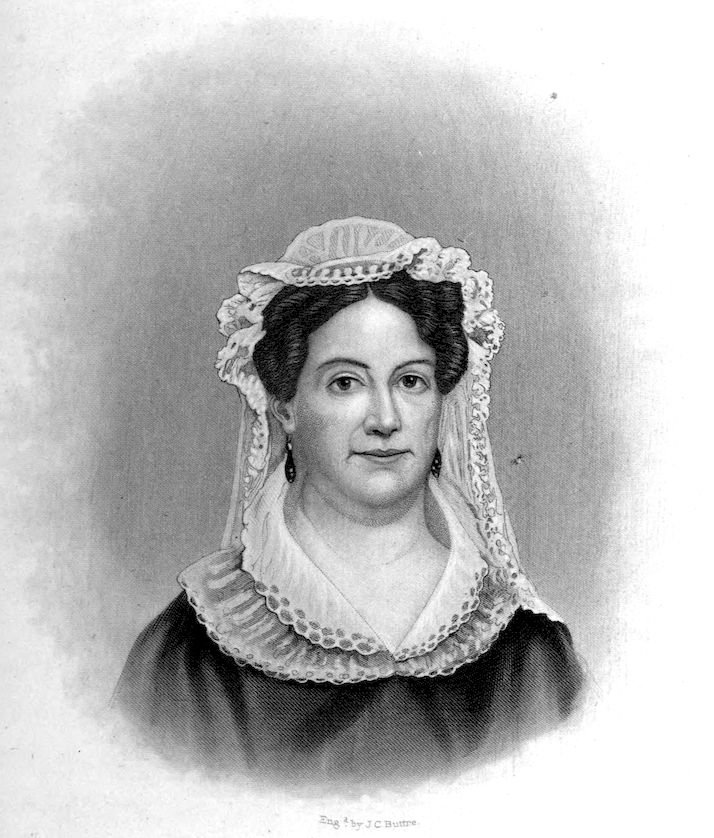
Mrs. ANDREW JACKSON.
273Down from the canvas beams his speaking eye upon us, and its meaning seems to say, justice to her is honor to me. With feelings an American only can appreciate, the task is undertaken, and whatever its defects may be, its merit is its truthfulness.
In 1779 Colonel John Donelson, a brave and wealthy old Virginia surveyor, started to the banks of the Cumberland with a party of emigrants. He had been preceded by Captain James Robertson and his companions, nine sturdy pioneers, who had engaged to build huts, plant corn, and make as comfortable a home as possible for the band that was to follow. This consisted of families, and among them the families of several of those adventurous pioneers.
The country was full of Indians, the forests deep, wild and unexplored, and the perils very great. In order to escape the toil and danger of travelling through the wilderness, Colonel Donelson accomplished the journey by water. It was a distance of more than two thousand miles, and never before had any man been bold enough to project such a voyage. They sailed down the Holston river to the Tennessee, down the Tennessee to its junction with the Ohio, up the Ohio till they reached the Cumberland, and up this stream to the French Salt Springs, on the spot where now stands the city of Nashville. Colonel Donelson kept an account of this remarkable and perilous voyage, entitled, 274“Journal of a voyage, intended by God’s permission, in the good boat Adventure, from Fort Patrick Henry on Holston river, to the French Salt Springs on Cumberland river, kept by John Donelson,” and the thrilling incidents and remarkable personal adventures are deeply interesting.
They were four months on the journey, the sufferings and privations of which can scarcely be appreciated by the more fortunate who now travel the same way amid quiet woods, green fields, and peaceful country homes. To those adventurers, the dangerous points of the rivers were unknown, and many were the accidents that befell them. They started in the depths of winter, and were obliged to encounter excessive cold and frosts. But worse than all, the Indians were ever on the watch to entrap them. The journal says, “we still perceived them, marching down the river in considerable bodies, keeping pace with us.” The wildest, most romantic, and lonely spot on this continent is the “Whirl,” in the Tennessee river, where the river is compressed within less than half its usual width by the Cumberland mountain which juts in on both sides. Its beauty is only equalled by its danger. In passing through this place, a large canoe, containing all the property of one of the emigrants, was overturned and the little cargo was lost. The family had gone into a larger boat for safety. “The company,” says Colonel Donelson, “pitying their distress, concluded to halt and assist in recovering the property. We had landed on the northern shore, at a level spot, and were 275going up to the place, when the Indians, to our astonishment, appeared immediately over us on the opposite cliffs, and commenced firing down upon us, which occasioned a precipitate retreat to the boats. We immediately moved off.”
One of this intrepid little band of emigrants, sharing in its hardships and dangers, was Rachel Donelson, the daughter of Col. John Donelson. She was then a bright-eyed, black-haired, sprightly, pretty child of about twelve years. On the 24th of April, 1780, they reached the little settlement of log-cabins that Captain Robertson and his band had made ready for them. But perils and privations were not past. The Indians were wily and untiring in laying their crafty ambushes, and many were the victims that fell within their deadly grasp, and were despatched by their murderous weapons. With all these troubles, however, the settlement grew in numbers and in strength; such was the intrepidity and the persevering energy which inspired these heroic men and women. As Colonel Donelson was one of the most influential, he became one of the wealthiest of the settlers. He had owned extensive iron works in Pittsylvania County, Virginia, which he had sold when he started to the West. Prior and subsequent to the revolution, he was a member of the House of Burgesses, and had repeatedly represented the counties of Campbell and Pittsylvania. Thomas Jefferson and Patrick Henry were his personal friends; he held commissions under each of them to execute important trusts, such as the survey 276of State lines, the negotiating of treaties with Indians, or establishing the authority of the State over distant territory. His confidence in General Washington was implicit, and the earnestness with which he spoke his sentiments had a most happy and conservative influence over the people of the West. The little colony soon began to suffer from the insufficient supply of corn and of powder and lead, and as the family of Colonel Donelson numbered many children and servants, he concluded to remove with them to Kentucky. He had in that State, moreover, land claims which he could more easily attend to and secure by being there. During his residence there, his daughter Rachel was married to Lewis Robards, a man of good family. She had grown up amid the trials and dangers of a frontier life, but the examples that she daily saw of noble fortitude, of calm bravery, and of heroic labor were worth many a tamer and weaker lesson of more civilized life. She grew up accomplished in the higher art of making home attractive and relatives happy. She was at the same time lively and gentle, gifted with patience and prudence, and winning in her simple and unaffected manners.
Soon after his daughter’s marriage, Colonel Donelson returned to Tennessee with his family. In the fall of 1785, while surveying in the woods far from home, this brave and gallant gentleman was pierced by bullets from an unseen foe, and died the same night. Judge John Overton, then a young lawyer, in the fall of 1787, went to Mercer County, Kentucky, and became a boarder in 277the family of Mrs. Robards, where Lewis Robards and his wife were living. Judge Overton was not long in discovering that they lived very unhappily, because Captain Robards was jealous of a gentleman named Short. His disposition was extremely unfortunate, and kept the whole family in uneasiness and distress. This unpleasant state of affairs continued to increase until Captain Robards wrote to his mother-in-law, the widowed Mrs. Donelson, requesting that she would take her daughter home, as he did not intend to live with her any longer. Some time in the latter part of 1788, Samuel Donelson came and started away with his sister. Judge Overton says, “my clear and distinct recollection is, that it was said to be a final separation, at the instance of Captain Robards; for I well recollect the distress of old Mrs. Robards on account of her daughter-in-law Rachel going away, and on account of the separation that was about to take place, together with the circumstance of the old lady’s embracing her affectionately. The old lady always blamed her son Lewis, and took the part of her daughter-in-law.”
Judge Overton further remarks that he never heard any of the family censure young Mrs. Robards on account of the unhappy difference between her husband and herself; but that he frequently heard them express the most favorable sentiments regarding her.
As stated in his narrative, published in 1827, Judge Overton, deciding to fix his residence in Tennessee, left old Mrs. Robards, with the promise that he would use 278his best endeavors to effect a reconciliation between her son Lewis and his wife, particularly as her son seemed unhappy, and regretful of what had occurred. The Judge took occasion to speak with him upon the subject, and he said he was convinced that his suspicions were unfounded, and that he wished to live with his wife. Upon arriving at his destination in Tennessee, by a remarkable and romantic coincidence, the Judge again became a boarder in the same house with Mrs. Lewis Robards. Mrs. Donelson, her mother, was not only willing to accommodate him, but was glad to add to the number of her protectors against the Indians. Another lawyer, Andrew Jackson, became a boarder with Mrs. Donelson at the same time, being introduced by Judge Overton. “Soon after my arrival,” continues the Judge in his narrative, “I had frequent conversations with Mrs. Lewis Robards, on the subject of living happily with her husband. She, with much sensibility, assured me that no effort to do so should be wanting on her part; and I communicated the result to Captain Robards and his mother, from both of whom I received congratulations and thanks.
“Captain Robards had previously purchased a preemption in this country on the south side of the Cumberland river, in Davidson county, about five miles from where Mrs. Donelson then lived. In the arrangement for a reunion between Captain Robards and his wife, I understood it was agreed that Captain Robards was to live in this country instead of Kentucky; and that until 279it was safe to go to his own land, he and his wife were to live at Mrs. Donelson’s.” They became reunited in the year 1789.
“Not many months elapsed before Robards became jealous of Jackson, which, I felt confident, was without the least ground. Some of his irritating conversations on this subject with his wife, I heard amidst the tears of herself and her mother, who were greatly distressed. I urged to Robards the unmanliness of his conduct, after the pains I had taken to produce harmony as a mutual friend of both families, and my honest conviction that his suspicions were groundless. These remonstrances seemed not to have the desired effect. As much commotion and unhappiness prevailed in the family as in that of Mrs. Robards, in Kentucky. At length I communicated to Jackson the unpleasant situation of living in a family where there was so much disturbance, and concluded by telling him that we would endeavor to get some other place. To this he readily assented.
“Being conscious of his innocence, Jackson said he would talk to Robards. What passed between them I do not know. Mrs. Donelson related that Robards became violently angry and abusive, and said that he was determined not to live with Mrs. Robards. Jackson retired from the family and went to live at Mansker’s Station. Captain Robards remained several months with his wife, and then went to Kentucky. Soon after this affair, Mrs. Robards went to live at Colonel Hays’, who married her sister.
280“Some time in the fall of 1790, there was a report afloat that Captain Robards intended to come down and take his wife to Kentucky. This created great uneasiness both with Mrs. Donelson and her daughter, the latter of whom was much distressed, being convinced after two fair trials, as she said, that it would be impossible to live with Captain Robards; and of this opinion was I, with all those I conversed with, who were acquainted with the circumstances. During the winter of 1791, Mrs. Donelson told me of her daughter’s intention to go down the river to Natchez, to some of their friends, in order to keep out of the way of Captain Robards, as she said he had threatened to haunt her. Knowing, as I did, Captain Robards’ unhappy disposition, and his temper growing out of it, I thought she was right to keep out of the way, though I do not believe that I so expressed myself to the old lady or to any other person.
“The whole affair gave Jackson great uneasiness. In his singularly delicate sense of honor, and in what I thought his chivalrous conceptions of the female sex, it occurred to me that he was distinguishable from every other person with whom I was acquainted. About the time of Mrs. Donelson’s communication to me respecting her daughter’s intention of going to Natchez, I perceived in Jackson symptoms of more than usual concern. Wishing to ascertain the cause, he frankly told me that he was the most unhappy of men, in having innocently and unintentionally been the cause of the loss of peace and happiness of Mrs. Robards, whom he believed to be a 281fine woman. It was not long after this before he communicated to me his intention of going to Natchez with Colonel Stark, with whom Mrs. Robards was to descend the river, saying that she had no friend or relation that would go with her, or assist in preventing Stark and his family and Mrs. Robards from being massacred by the Indians, then in a state of war and exceedingly troublesome. Accordingly, Jackson, in company with Mrs. Robards and Colonel Stark, a venerable and highly esteemed old man and friend of Mrs. Robards, went down the river from Nashville to Natchez, in the winter or early spring of 1791. It was not, however, without the urgent entreaties of Colonel Stark, who wanted protection from the Indians, that Jackson consented to accompany them.
“Previously to Jackson’s starting, he committed all his law business to me, at the same time assuring me that as soon as he should see Col. Stark and his family and Mrs. Robards situated with their friends, he would return and resume his practice. He descended the river, returned from Natchez to Nashville, and was at the Superior Court, in the latter place, in May, 1791, attending to his business as a lawyer and solicitor-general for the government. Shortly after this time, we were informed that a divorce had been granted by the Legislature of Virginia.
“The divorce was understood by the people of this country to have been granted in the winter of 1790–1791. I was in Kentucky in the summer of 1791, remained 282at old Mrs. Robards’, my former place of residence, a part of the time, and never understood otherwise than that Captain Robards’ divorce was final, until the latter part of the year 1793. In the summer of 1791, General Jackson went to Natchez, and, I understood, married Mrs. Robards, then believed to be freed from Captain Robards, by the divorce in the winter of 1790–1791. They returned to Nashville, settled in the neighborhood of the city, where they have lived ever since, esteemed and beloved by all classes.
“About the month of December, 1793, after General Jackson and myself had started to Jonesborough, in East Tennessee, where we practised law, I learned for the first time that Captain Robards had applied to Mercer Court, in Kentucky, for a divorce, which had then recently been granted; and that the Legislature had not absolutely granted a divorce, but left it for the Court to do. I need not express my surprise, on learning that the act of the Virginia Legislature had not divorced Captain Robards. I informed General Jackson of this, who was equally surprised; and during our conversation, I suggested the propriety of his procuring a license on his return home, and having the marriage ceremony again performed, so as to prevent all future cavilling on the subject.
“To this suggestion, he replied that he had long since been married, on the belief that a divorce had been obtained, which was the understanding of every person in the country; nor was it without difficulty he could be induced to believe otherwise.
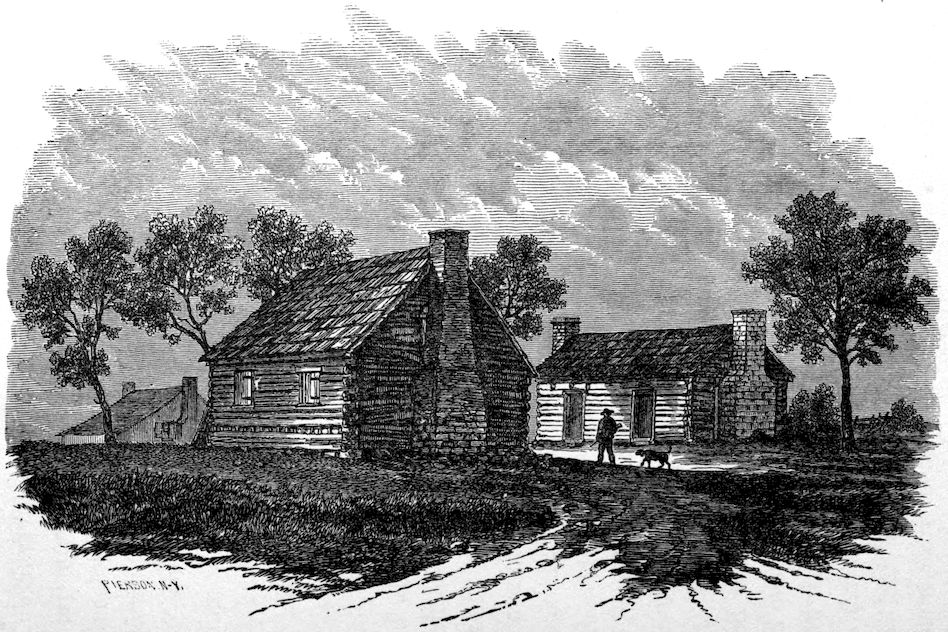
THE FIRST RESIDENCE OF ANDREW JACKSON.
283“On our return home from Jonesborough, in January, 1794, to Nashville, a license was obtained, and the marriage ceremony again performed.
“The slowness and inaccuracy with which information was obtained in Tennessee at that time, will not be surprising when we consider its insulated and dangerous situation, surrounded on every side by the wilderness, and by hostile Indians, and that there was no mail established until about 1797.”
Subsequent events proved this marriage to be one of the very happiest that was ever formed. A romantic person would say that it was made in Heaven, and certainly it had the requisites of a heavenly union. Nothing could exceed the admiration, and love, and even deference of General Jackson for his wife. Her wish to him was law. It was a blessed ordering of Providence that this kind, good heart should find at last, after so many troubles, a tender and true friend and protector, understanding her perfectly, and loving her entirely.
Mrs. Jackson was a noble woman, and abundantly blessed with superior sense. She was a good manager, a kind mistress, always directing the servants, and taking care of the estate in her husband’s frequent absences, and withal a generous and hospitable neighbor.
She had a great many nieces and nephews, some of whom were nearly all the time staying with her. She was very lively in her manners, well knowing how to tell stories, and amuse the young people of the neighborhood, who were much attached to her, all calling her 284affectionately Aunt Rachel, as her nieces and nephews did.
About the year 1804, General Jackson fixed his residence upon a superb estate of a thousand acres, twelve miles from Nashville, which he named the Hermitage. They lived at first in an ordinary frame building, sufficiently comfortable, but rather small. No lack of space in the house, however, could contract the liberal and hospitable spirit of the master and mistress of the Hermitage. When the Marquis de Lafayette visited Nashville on his return to America, there was an entertainment given in his honor at the Hermitage, to which many ladies and gentlemen were invited. At this banquet, and during his stay in Nashville, General Lafayette was particularly respectful and attentive to Mrs. Jackson; and after his return to France, he never failed, in writing to General Jackson, to send her his compliments.
But the General was the “prince of hospitality,” as one of his neighbors said, “not because he entertained a great many people, but because the poor belated pedlar was as welcome as the President of the United States, and made so much at his ease that he felt as though he had got home.”
One who often visited General Jackson’s house wrote that “it was the resort of friends and acquaintances, and of all strangers visiting the State; and the more agreeable to all from the perfect conformity of Mrs. Jackson’s character to his own. She had the General’s own warm heart, frank manners, and hospitable temper, and no two 285persons could have been better suited to each other, lived more happily together, or made a house more attractive to visitors. She was always doing kind things in the kindest manner. No bashful youth or plain old man, whose modesty set them down at the lower end of the table, could escape her cordial attention, any more than the titled gentlemen at her right and left.”
She had no children of her own, and it was a source of regret to both; but a fortunate circumstance threw a little child across her pathway, and she gladly took the babe to her home and heart. Her brother had twin boys born to him, and wishing to help her sister in a care which was so great, took one of them to the Hermitage when it was but a few days old.
The General soon became extremely attached to the little guest, and adopted him, giving him his own name, and treating him from that time with unremitting kindness and affection, as if he were indeed his only son. A traveller, who arrived at the Hermitage one wet, chilly evening in February, says: “I came upon General Jackson in the twilight, sitting alone before the fire, a lamb and a child between his knees. Seeing me, he called a servant to remove the two innocents to another room, and said that the child had cried because the lamb was out in the cold, and begged him to bring it in, which he had done to please the child—his adopted son, then not two years old.” This son, Andrew Jackson, jr., was the sole heir of the General’s large estate. His widow resides yet at the Hermitage, at the request of the 286State of Tennessee, which purchased the homestead at the close of the war.
A few days after the battle of New Orleans, Mrs. Jackson arrived in that city with a party of Tennesseeans, bringing with her the little Andrew, then about seven years old. She participated in the attentions that were showered upon the General, who showed her, himself, the most marked respect and deference. The ladies of New Orleans presented her with a valuable and beautiful set of topaz jewelry. In her portrait, at the Hermitage, Mrs. Jackson wears the dress which she appeared in at the grand ball given in New Orleans, in honor of the General. It is white satin, ornamented with lace, and jewelry of pearls. This portrait was painted by Earl, an artist who married a niece of Mrs. Jackson’s and resided many years in General Jackson’s family.
In 1816 Mrs. Jackson joined the church, while attending the ministry of the Rev. Gideon Blackburn, a Presbyterian divine, whom she ever after regarded with the deepest veneration. To gratify her, General Jackson built a little church on the estate, a quarter of a mile from the house. It was plain and simple, and small, but very dear to Mrs. Jackson, who spent in it many happy hours. It was a blessing to the neighbors, who found it convenient and pleasant to send their children to Sunday-school, and to attend church themselves when it was impossible to go farther.
A new house was built during the summer of 1819. It was erected expressly for Mrs. Jackson, and everything 287regarding it was done exactly in accordance with her wishes. Major Lewis, who visited the site, recommended a more elevated position to the General. “No, Major,” said he, “Mrs. Jackson chose this spot, and she shall have her wish. I am going to build this house for her; I don’t expect to live in it myself.” He was at the time very feeble and exhausted from the severe illness succeeding his return from the Seminole war, and was, as he supposed, not long for this world.
The house is situated in a level place, rather lower than the avenue which leads to it, and from the gate only glimpses of it can be obtained. The surrounding country is exceedingly beautiful. The long stately avenue of cedars ends in an oval-shaped lawn in which stands the mansion. Both in front and in the rear of the house there are grand double piazzas, with stone floors supported by large fluted columns, round which cling and bloom beautiful rose vines. Under the shade of these drooping tendrils, General Jackson and his cherished wife were wont to saunter, occasionally stopping to more distinctly hear the rich notes of the southern songsters, or to catch the mournful cry of the ringdove in the distant cotton-field.
The walls of the hall are covered with scenes from Telemachus, which was formerly so fashionable for papering. The fairy beauty of Calypso’s enchanted island, with its sparkling fountains, its flowery groves, its elegant pillared palaces, its dancing nymphs, its altars of incense and votive wreaths, its graceful groups of statues on the 288sea-shore, and, above all, its lovely queen and the noble youth and his wise Mentor, lend an air of interest and beauty to this cool hall which is delightful. There is hanging here a handsome portrait of Columbus. The furniture is old-fashioned and dignified, and there are several busts of distinguished men. That of General Jackson was taken by Mr. Persico, made in Italy and presented to the General.
The parlors are large, pleasant rooms, in which there are many curiosities, and various odd and exquisite pieces of furniture that were presented at different times to General Jackson. The house is spacious and handsome. When first built, it was the most elegant one in all the country around. It was a gift of love from the General to his beloved wife, when he did not expect to survive her; and it was arranged to suit her slightest wish, that nothing might be wanting to her satisfaction, which it was possible in his power to provide. The extensive and carefully-ordered garden was tended and overlooked by her, and contains a great many sweet shrubs and evergreens and beautiful flowers, a large number of which she planted herself.
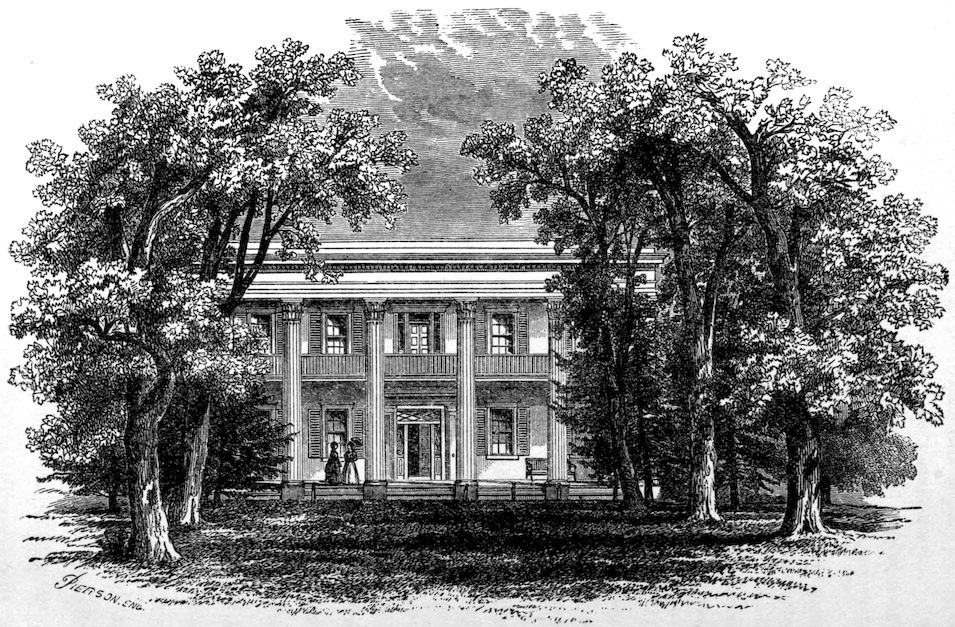
THE HERMITAGE—THE HOME OF ANDREW JACKSON.
289In 1821 General Jackson was appointed Governor of Florida, and left the Hermitage the 18th of April, accompanied by Mrs. Jackson and the “two Andrews,” the adopted son and nephew—Andrew Jackson Donelson.[12] The following September she wrote to a friend at Nashville: “The General, I think, is the most anxious man to get home I ever saw. He calls it a wild-goose chase, his coming here. He tells me to say to you and Captain Kingsley, that in the multiplicity of business, if he had or could have seen any advantages for your better prospects, he would have written Captain Kingsley long since. You are in the best country in America. O, how has this place been overrated. We have had a great many deaths; still I know it is a healthy climate. Amongst many disadvantages, it has few advantages. I 290pity Mr. J., he will have so much fatigue. Not one minister of the gospel has come to this place yet; no, not one; but we have a prayer-meeting every Sabbath. The house is crowded so that there is not room for them. Sincere prayers are constantly sent up to the Hearer of prayer for a faithful minister. Oh, what a reviving, refreshing scene it would be to the Christians, though few in number. The non-professors desire it. Blessed be God, he has a few even here that are bold in declaring their faith in Christ. You named, my dear friend, my going to the theatre. I went once, and then with much reluctance. I felt so little interest in it, however, I shall not take up much time in apologizing. My situation is a peculiar one at this time. I trust in the Lord my dear child, Andrew, reached home in safety. I think you all must feel a great deal for me, knowing how my very heart recoiled at the idea of what I had to encounter. Many have been disappointed. I have not. I saw it as plain as I now do when it is passing. O Lord, forgive, if thy will, all those my enemies that had an agency in the matter. Many wander about like lost sheep; all have been disappointed in offices. Crage has a constable’s place of no value. The President made all the appointments and sent them from the City of Washington.”
General Jackson, in a letter to Captain John Donelson, Sr., speaks thus of his wife:
“I hope we will be able to leave here by the 1st of October for home. Mrs. Jackson’s health is not good, 291and I am determined to travel with her as early as my business and her health will permit, even if I should be compelled to come back to settle my business and turn over the government to my successor. I am determined to resign my office the moment Congress meets, and live near you the balance of my life. * * * Before this reaches you, Colonel Butler and our little son will be with you, I hope. I trust you will extend your care over him until we are where he has gone. You may be sure your sister will not remain long behind. We all enjoy tolerable health at present, but I am wearied with business and this hot weather.”
Mrs. Jackson sighed for her quiet home and her little church during her stay in Florida. Pensacola was so different, and the people so entirely divided in all their tastes and pursuits from the devout Christian matron, that she could not be satisfied. “Three Sabbaths,” she says, “I spent in this house before the country was in possession under American government. The Sabbath profanely kept, a great deal of noise and swearing in the streets; shops kept open, trade going on I think more than on any other day. They were so boisterous on that day I sent Major Stanton to say to them that the approaching Sunday would be differently kept. And must I say, the worst people here are the outcast Americans and negroes! Yesterday I had the happiness of witnessing the truth of what I had said. Great order was observed; the doors kept shut; the gambling houses demolished; fiddling and dancing not heard any more on the Lord’s day; cursing not to be heard.
292“Pensacola is a perfect plain: the land nearly as white as flour, yet productive of fine peaches, oranges in abundance, grapes, figs, pomegranates, etc. Fine flowers grow spontaneously, for they have neglected the gardens, expecting a change of government. The town is immediately on the bay—the most beautiful water prospect I ever saw; and from 10 o’clock in the morning until 10 at night we have the finest sea-breeze. There is something in it so exhilarating, so pure, so wholesome, it enlivens the whole system. All the houses look in ruins, old as time. Many squares of the town appear grown over with the thickest shrubs, weeping-willows, and the Pride of China: all look neglected. The inhabitants all speak Spanish and French. Some speak four or five languages. Such a mixed multitude you nor any of us ever had an idea of. There are fewer white people far than any other, mixed with all nations under the canopy of heaven, almost in nature’s darkness.”
On the 3d of November, General and Mrs. Jackson arrived at the Hermitage, delighted to be again at that home within whose doors the angels, Peace and Happiness, awaited their return, and sat with folded wings.
General Jackson set out for Washington, accompanied by his wife, in 1824, going all the way in their own coach and four, and being twenty-eight days on the journey. In a letter to a friend in Nashville she says: “We are boarding in the same house with the nation’s 293guest, General Lafayette. When we first came to this house, General Jackson said he would go and pay the Marquis the first visit. Both having the same desire, and at the same time, they met on the entry of the stairs. It was truly interesting. At Charleston, General Jackson saw him on the field of battle; the one a boy of twelve, the Marquis, twenty-three.”
A great many persons paid their respects to Mrs. Jackson. She says, “there are not less than from fifty to a hundred persons calling in one day.” While wondering at “the extravagance of the people in dressing and running to parties,” she speaks with enthusiasm of the churches and the able ministers.
Soon after their return home, Mrs. Jackson’s health began to decline, and in the succeeding years of General Jackson’s campaign for the Presidency, it continued delicate. She went with the General to New Orleans, in the beginning of the year 1828, and witnessed his splendid reception there. “She was waited on by Mrs. Marigny and other ladies, the moment she landed from the Pocahontas, and conducted to Mr. Marigny’s house, where refreshments had been prepared, and where she received the salutations of a large and brilliant circle. The festivities continued four days, at the end of which, the General and Mrs. Jackson and their friends re-embarked on board the Pocahontas and returned homeward.”
Mrs. Jackson’s health continued to fail, and no excursions or remedies were found availing. She had 294suffered from an affection of the heart; a disease which, increased and heightened by every undue excitement, was, in her case, exposed to the most alarming extremes and continually liable to aggravation. The painful paragraphs in regard to her character with which the papers of the country abounded, wounded and grieved her sorely. The circumstances of her marriage, so easily misconstrued and so lamentably misunderstood by many whom distance and meagre information had kept in ignorance, were used by the political enemies of General Jackson as lawful weapons wherewith they might assail his fair fame and obstruct his rapid progress to the highest place in the land. Considered in all its bearings, there is not in the whole world a position more honorable, more important, or more responsible, than that of the President of the United States. Well were it needful to choose with circumspection the Chief Magistrate of a country so vast, of a people so intelligent and brave, and possessing the elements of such greatness and glory; who holds in his grasp such a multitude of destinies; and who is able, by his decisions, to continue the sunshine of prosperity, or to bring the bitter blasts of adversity and discord. Hence the ardor and even the desperation of the struggles for victory in each Presidential campaign. The same enthusiasm which actuated the friends of General Jackson, actuated also his enemies; and nothing could exceed the earnestness and rancor with which they attacked him. Not content 295with reviling him, they must needs drag before the public the long-forgotten circumstances of his marriage, and wrest them to suit their unworthy purposes. The kind heart of Mrs. Jackson, though wrung with mortification and grief, prompted no utterance of impatience. She said very little, but was often found in tears. Meanwhile, her health continued to decline. It was too hard to bear that he to whom she had devoted the affections and energies of her long life, should be taunted, for her sake; that he should, for her sake, be considered unworthy of the trust of that nation for whose defence and honor he had undergone unnumbered fatigues and conflicts and perils. This silent suffering told upon her spirits, but anxiety to know the event sustained her.
When the news arrived of General Jackson’s election to the Presidency, it was received with rejoicings and hilarity in Nashville as everywhere else, but with calmness by him and her who were so highly honored. Her gratification must have been too deep and heartfelt to be expressed with noise and mirth. Despite the calumnies which their enemies had heaped upon her and the General, the nation had bestowed upon him its highest gift; and had confided, for a time, the keeping of its honor and well-being into his hands. The sorrows through which she had passed, those clouds that had hung over her thorny way, had been dispersed by the favoring wind of truth, and the bright rays of peace shone upon her heart. But she was not 296dazzled by the new prospects opening before her. The splendors and gayeties of a life in the White House could offer her no attractions. Her domestic and simple tastes found more pleasure in her own home and family circle at the beloved Hermitage. “For Mr. Jackson’s sake,” said she, “I am glad; for my own part, I never wished it.” She seemed to regret the necessity of a residence in Washington, and remarked to a friend with an expression of the utmost sincerity, “I assure you that I would rather be a door-keeper in the house of my God, than to live in that Palace in Washington.”
Mrs. Jackson always purchased all the clothing and household articles, both for her own and the servants’ use. Desiring to arrange everything comfortable during the winter, for she knew that General Jackson would have many friends at the Hermitage, she made frequent visits to Nashville, and on one occasion heard the thoughtless remarks of persons who probably forgot a moment afterward the words which broke the heart of their victim. It was her custom usually to go to one of her most intimate friends on reaching the city, and have the horses and carriage put in the stable, and then go out shopping; but on this occasion she went early in her cumbrous coach, and as she had many places to visit, determined to send the driver to a livery stable and meet it in the afternoon at the Nashville Inn, then the principal hotel in the city.
Weary and exhausted after a tedious day’s shopping, she went at the appointed hour to the parlor of the 297hotel, and while waiting there, she heard her name called in the adjoining room. It was impossible for her not to hear, and there she sat, pale and excited, listening to a repetition of calumnies which political strife had magnified and promulgated. The bare truthful outlines of her early unfortunate marriage were given, but so interwoven with false misrepresentations, that she could hardly believe herself the subject of remark. All she did hear was never known, but on her death-bed she told the circumstance to her husband, and then he understood the cause of her violent attack. He had tried to keep every paragraph and abusive line out of her sight, and hoped that now, after the election was decided, this unhappy subject of “her marriage before a divorce was granted,” would be dropped forever. She had acted as she thought was the best, and indeed in every act of her life she discovered the fine sense she displayed in her conduct towards her first husband. But the malicious envy of people who could not bear her elevation, caught at every straw to revile her pure and blameless life. Had she lived unhappily with General Jackson, there might have been some excuse for considering her a weak woman; but her long, happy and beautiful existence as his wife, was a convincing proof of her affectionate nature, and religious, high-minded soul. The fatal error of her youth, in marrying a man her intellectual and moral inferior, was more than atoned for in the miserable years she spent as his unappreciated wife. She was sensitive and refined, and her nature revolted 298at his coarseness. She had acted rashly in marrying him, but she was loth to part with him. Was she to blame that she did not know his character thoroughly before her marriage? The sigh that heaves from the hearts of thousands of women as they recall a similar experience, attests her innocence. Was she to blame for marrying again, when she and every one who knew her believed her free? He had never provided a home for her, she had always been compelled to live either with her mother or his, thereby sealing her doom, for no wife, however kind her husband may be, can be as happy in the home of her parents as she could in one of her own, be it ever so lowly. Captain Robards never tried to make her comfortable or contented, but augmented the sorrows of her young heart by a course of conduct revolting in even the most degraded of men, and inexcusable in him, since he was of a respectable family, and supposed to be somewhat cultivated.
But her offence was the acceptance of a companion and friend, who would shield her from poverty and unhappiness, and add to her life, what she had never known, a husband and a home. The bonds of a civil marriage had been dissolved, not by her efforts, but by her ungenerous, narrow-minded husband, and she had become the wife of a man eminently suited to her. With all the bitter experience of her short married life, she trustingly confided her happiness into the keeping of one who never betrayed it, and who made her existence a continued source of joy. In the higher courts, in her conscience, 299but one marriage tie was recognized, and but one possessed the entire affection of her young and chastened heart.
It had been arranged that a grand dinner and ball should be given on the 23d of December, to General and Mrs. Jackson, that day being the anniversary of the night-battle below New Orleans; a day rendered celebrated in the annals of his country by his own heroic achievements.
A week previous to this intended festival, and a few days after her visit to Nashville, Mrs. Jackson was seized with a spasmodic affection of the muscles of the chest and left shoulder, attended with an irregular action of the heart, and great anxiety of countenance. The suspense and uneasiness occasioned by the late political strife being at an end, and the uncertainty of the event no longer torturing her, she could bear up no further. One of the physicians in attendance upon her, gives the following minute and interesting account:
“Being hastily sent for, I lost no time in rendering her all the assistance in my power. Finding she had been bled before my arrival, without any manifest abatement of the symptoms, I repeated the operation, which was again had recourse to in the evening, on the arrival of Dr. Hogg, an eminent physician of Nashville, who had been sent for simultaneously with myself. These successive bleedings, together with other treatment, produced great relief, and an entire subsidence of all the alarming symptoms. The three following days she continued 300to improve; she was cheerful, and could sit in her chair and converse with her friends. On Monday night, however, she sat up too long, caught cold, and had slight symptoms of pleurisy. These soon yielded to the proper remedies, a profuse perspiration ensued, which it was thought proper to encourage with mild, diluent drinks; everything promised a favorable issue. In this situation, after Dr. Hogg and myself had retired to an adjoining room, our patient unfortunately got up twice and sat by the fire. The perspiration became suddenly checked. She cried out, ‘I am fainting,’ was placed in bed, and in a moment afterwards she was a lifeless corpse!
“All our efforts for her restoration were vain and fruitless. No blood could be obtained either from the arm or the temporal artery. Sensibility had ceased, life had departed; and her meek and quiet spirit sought that rest with her God and her Redeemer, which a cruel world refused to grant.
“From a careful review of the case, there seems to be no doubt but that there was a sudden reflux of the blood from the surface and the extremities, upon the heart and other organs, producing an engorgement and consequent spasm of that important viscus. That her death is to be attributed to this cause, rather than to an effusion of the brain, seems to be inferable from the fact of the total and instantaneous cessation of the functions of the heart. Not a pulsation could be perceived; her lungs labored a minute or two, and then ceased.
301“How shall I describe the agony—the heart-rending agony—of the venerable partner of her bosom? He had, in compliance with our earnest entreaties, seconded by those of his wife, left her chamber, which he could seldom be persuaded to do, and had lain down in an adjoining room, to seek repose for his harassed mind and body. A few minutes only had elapsed, when we were hastily summoned to her chamber; and the General, in a moment, followed us. But he was only in time to witness the last convulsive effort of expiring nature. Then it was that all the feelings of the devoted husband burst forth. His breast heaved, and his soul seemed to struggle with a load too oppressive for frail humanity. Nor was he the only mourner on this melancholy occasion. A numerous train of domestics crowded around the bed of their beloved mistress, and filled the room with their piercing cries. They could not bring their minds to a belief of the painful reality that their mistress and friend, for such indeed she was, lay before them a lifeless corpse. ‘Oh! is there no hope?’ was their agonizing question; and vainly would they flatter themselves with the belief, that perhaps ‘she was only fainting.’
“The distressing event spread with the rapidity of the wind; and neighbors and relatives thronged the house from midnight until late the following morning. Soon the painful tidings reached Nashville, twelve miles distant, and a fresh concourse of friends pressed forward to show their respect for the dead and to mourn with the living.”
302Early on the morning of the 23d December, while active preparations for the expected banquet were going on, and many bright eyes and gay hearts were already, in anticipation, beginning the pleasures of the day, the afflicting news reached the city, of the President’s unlooked-for and terrible bereavement. This sad paragraph appeared in the papers and cast a gloom over the breakfast-tables where so many had assembled in joy. “In the midst of preparations for festivity and mirth, the knell of death is heard, and on the very day which it was arranged and expected that our town should be a scene of general rejoicing, we are suddenly checked in our career, and are called on to array ourselves in garments of solemnity and woe. Mrs. Rachel Jackson, wife of General Andrew Jackson, President-elect of the United States, died last night, at the Hermitage, in this vicinity. The intelligence of this awful and unlooked-for event has created a shock in our community almost unparalleled. It was known, a few days since, that Mrs. Jackson was violently attacked by disease; which, however, was supposed to have been checked, so as to afford a prospect of immediate restoration to health. This day, being the anniversary of an interesting and important event in the last war, was appropriately selected to testify the respect and affection of his fellow-citizens and neighbors to the man who was so soon to leave his sweet domestic retirement, to assume the responsibilities and discharge the important duties of Chief Magistrate of 303the nation. The preparations were already made; the table was well-nigh spread, at which all was expected to be hilarity and joy, and our citizens had sallied forth on the happy morning with spirits light and buoyant, and countenances glowing with animation and hope,—when suddenly the scene is changed, congratulations are converted into expressions of condolence, tears are substituted for smiles, and sincere and general mourning pervades a community where, but a moment before, universal happiness and public rejoicing prevailed. But we have neither time nor room, at present, to indulge in further reflections on this melancholy occurrence. Let us submit with resignation and fortitude to the decrees, however afflicting, of a just and merciful, though mysterious and inscrutable Providence.”
The preparations making for the festivity were immediately stopped, upon the arrival of the melancholy information; and, in their stead, the committee of arrangements, together with the Mayor and Aldermen of the city, recommended to the citizens, as an evidence of their deep regret and sympathy for the calamity which had befallen their honored fellow-citizen, to suspend for one day the ordinary business of life, which was cordially observed. In the course of the morning, a card eight inches long and six inches wide, with a mourning border one-third of an inch in width, was printed, containing the following announcement:
“The committee appointed by the citizens of Nashville to superintend the reception of General Jackson 304on this day, with feelings of deep regret, announce to the public that Mrs. Jackson departed this life last night, between the hours of ten and eleven o’clock.
“Respect for the memory of the deceased, and a sincere condolence with him on whom this providential affliction has fallen, forbid the manifestations of public regard intended for the day.
“In the further consideration of the painful and unexpected occasion which has brought them together, the committee feel that it is due to the exemplary virtues and exalted character of the deceased, that some public token should be given of the high regard entertained towards her while living. They have, therefore, resolved,
“That it be respectfully recommended to their fellow-citizens of Nashville, in evidence of this feeling, to refrain, on to-morrow, from the ordinary pursuits of life.
“Josiah Nichol, Chairman.
“December 23d.”
The city authorities also passed suitable resolutions, the last of which reads as follows:
“Resolved, That the inhabitants of Nashville are respectfully invited to abstain from their ordinary business on to-morrow, as a mark of respect for Mrs. Jackson, and that the church bells be tolled from one until two o’clock, being the hour of her funeral.”
These proceedings were signed by Felix Robertson, Mayor, and attested by E. Dibbrell, Recorder.
305About a fortnight before her death, she remarked to a friend, that although she had lived with Mr. Jackson nearly forty years, there had never an unkind word passed between them, and the only subject on which they ever differed, or where there was the slightest opposition, was his acceptance of appointments when conferred upon him; she being always unwilling for him to enter upon public life. Such was the woman whom General Jackson was called upon to separate from, at a moment of all others the most trying.
Although the weather was unfavorable, her friends assembled from every point, to pay the last tribute of respect to one who could befriend them no more. Every vehicle in Nashville, and there were more at that day than now, in proportion to the population, was put in requisition. The road to the Hermitage had not been macadamized, and it was, consequently, at that season of the year almost impassable; yet an immense number of persons attended the funeral.
When the hour of interment drew near, the General, who had not left the beloved remains, was informed that it was time to perform the last sad rites. The scene that then ensued is beyond description. There was no heart that did not ache, no eye that did not weep. Many of the officers present, who had shared with the General his difficulties and dangers; who had seen him in the most trying situations; who had eyed him when his gallant soldiers were suffering for food to sustain life, and he unable to relieve them; who had witnessed him 306on the battle-field, when the wounded and the dying were brought before him, and every muscle seemed moved, and his very frame agonized with sorrow; yet had seen no suffering, however poignant or excessive, affect the General like this great affliction. When he bade his final adieu to the last kindred link that bound him to earth, his Roman fortitude seemed for a time to be completely overcome. It was a soul-rending sight to see an old veteran, whose head was whitened by the hardships he had endured for his country, bending over the lifeless form of an affectionate wife, whose death was hastened by the cruelty of those whose rights he had so nobly defended. By a muscular and almost superhuman effort, he endeavored to check the current of his grief; and, waving his hand to the afflicted company, begged them to weep no more. “I know,” said he, “it is unmanly, but these tears were due to her virtues. She shed many for me.” But one wish pervaded the assembly, that the individuals who had hastened this scene by their relentless attacks on an unoffending woman, could be brought to witness the saddest spectacle that any present had ever beheld.
But they were not there to witness the effects of their calumnies. She was dead, and they were vanquished. Ever after that funeral, his opponents complained that his personal feelings were allowed to govern his public acts, and that to be suspected by him of having believed aught of slander against his wife, was the unpardonable crime which he never forgave. Brave old Hero! how 307deathless was the feeling which to the latest hour of his life displayed the strength made manifest from its inception! Silent and grave he was on the subject, but forgetfulness or indifference did not occasion such a course of action, as too many found to their sorrow. A dangerous look in his flashing eye satisfied any one of the sacred ground, and few braved his anger by recalling an unpleasant recollection connected with her. The inhumanity of the world robbed him of his treasure, and darkened his life, but while he lived her name was a hallowed sound breathed in the darkened recesses of his bruised and lonely heart, which cheered him on to the portals of the tomb through which she had passed to immortality.
The dear remains were interred in a corner of the Hermitage garden; and thither the afflicted General was supported by General Coffee and Major Rutledge. The following gentlemen were pall-bearers: Governor Sam Houston, Col. Ephraim H. Foster, Col. George Wilson, Gen. Robert Armstrong, Col. Sam. B. Marshall, Col. Allen, Mr. Solomon Clark, and Major G. W. Campbell.
A resident of Nashville, writing to his brother in Philadelphia, said: “Such a scene I never wish to witness again. I never pitied any person more in my life than General Jackson. I never before saw so much affliction among servants on the death of a mistress. Some seemed completely stupefied by the event; others wrung their hands and shrieked aloud. The woman that had waited on Mrs. Jackson had to be carried off the ground. After the funeral, the General came up to me and shook 308my hand. Some of the gentlemen mentioning my name, he again caught my hand, and squeezed it three times, but all he could utter was ‘Philadelphia.’ I shall never forget his look of grief.”
Through the kindness of Sarah Jackson, the widow of General Jackson’s adopted son, I am in possession of a book compiled by Mr. Earl, under the direction of the General himself, entitled in gilt letters on the back, “Obituary Notices of Mrs. Jackson.” It contains the funeral card before mentioned; a great number of eulogies taken from the papers of the day; innumerable paragraphs expressive of respect and sympathy; and a synopsis of the funeral sermon, in manuscript. It was preached by the Reverend William Hume, of Nashville, and has never heretofore been published. It will be found interesting, not only as the funeral discourse of so eminent a lady, but as a specimen of a sermon delivered forty years ago, in a country so undeveloped as Tennessee was in those days.
“The righteous shall be in everlasting remembrance.”
Psalm cxii., 6th verse.
“These words might be applied to that venerable matron, with much propriety, as she gave every reasonable evidence that she was among the righteous. Indeed, as her name is indissolubly connected with that of the President of the United States, it shall be held in remembrance while the page of history displays the memorable actions of General Jackson. The words of 309the Psalmist, however, are applicable to her in a much nobler sense.
“The death of this worthy lady is much deplored, not only by her distinguished husband and immediate relations, but by a large majority of the people of the United States of America. Her character was so well known to multitudes who visited the Hermitage, the abode of hospitality, that the following remarks will readily be acknowledged as true:
“With respect to her religious principles, they were such as are held sound by all religious denominations that are commonly called evangelical. Convinced of the depravity of human nature, as taught in the Holy Scriptures, she relied on the Spirit of God alone, to illuminate, renovate and purify that nature that it might be qualified for the unspotted society of heaven. Believing with the inspired Paul, that by the works of the law, no flesh can be justified in the sight of God, her dependence for eternal life was placed on the merits and mediation of Jesus. Fully persuaded that the law is holy and the commandment holy, and that God will not acquit the sinner from condemnation, in a way that will conceal the dignity of His government, the purity of His nature, the truth of His threatening, or the glory of His unchangeable justice, she derived all her hope of acceptance with God from Him who ‘bore our sins in His own body on the tree; who suffered, the just for the unjust, that He might bring us to God.’
“While, however, her whole dependence for acceptance 310with God was founded upon the atonement of the Son of God, through whom grace reigns unto eternal life, she knew that this doctrine did not tend to immorality. She was taught by Paul that holiness is always inseparably connected with this dependence on the merits of the Saviour, and that every motive to holiness arising from interest or gratitude or the pleasures of religion remains in full force; she therefore abounded in good works. Assured by the infallible testimony of her Lord and Master, that every branch of the true vine, as it derives its verdure, beauty, vigor, and sap from the vine is fruitful, she, a genuine branch, was so too. In acts of piety, as adoration, thanksgiving and praise, she took delight. Her seat was seldom empty in the house of God. Though very often surrounded with company from every State in the Union, neither she nor her illustrious husband neglected the house of God on that account. The tears of genuine penitence were often shed by her in the temple of the Lord. She had a tender and a feeling heart, and sometimes I have seen the tears bedewing her cheeks while she was speaking of the dangerous condition of those around her, who seemed to be entirely careless about a future state. Indeed, her devotional spirit was manifest in all her conduct. She meditated on the wonders of redeeming love with much delight, as the source of her present joy and future hope of glory. Indeed, her piety was acknowledged by all who knew her, as it manifested itself by the most unequivocal proofs; a reverential awe, a supreme 311love and profound veneration for the incomparable excellences of God, and a cordial gratitude to Him as the source of all her mercies. Her love to God was displayed by an unusual obedience to His commands and by an humble submission to His providence.
“As a wife, connected with one who stood so high in the estimation of his fellow-citizens, she was, as a Christian, exposed to some peculiar temptations; for who can resist the fascinations of honor and of power? While she rejoiced in the honor of a nation of freemen spontaneously given to a husband so dear to her heart, yet no unbecoming elation of mind, no haughtiness, no overbearing conduct, could ever be seen, even by an inimical eye, in this amiable lady. She was adorned with the ornament of a meek and quiet spirit, in an eminent degree. Esteem and affection were so mixed in her bosom for her husband, that her respectful behavior to him, in her house and among her connections and acquaintances, struck every beholder as the soft impulse of the sweetness of her disposition; so that by her kindness and affability, her husband was more happy in his own family than in the midst of his triumphs. In consequence of her amiable manners, his own house was the chief place of his enjoyment.
“The tears and lamentations of the servants are proofs of the most unequivocal kind of her excellence as the mistress of her household. Never did children seem to mourn more sincerely for a mother than the household servants lament for her. The cordial regard 312of her servants may well be attributed to the gentleness of her commands, the calmness of her temper, and her tenderness in treating them in health and in sickness. She was, indeed, a mother to her family.
“The widow and the orphan will long lament the death of Mrs. Jackson. In the circle of the widows and orphans her benevolence accompanied with the most substantial acts of beneficence, shone with distinguished splendor. To her the words of Job may be properly applied: ‘When the ear heard her, then it blessed her; and when the eye saw her, it gave witness to her, because she delivered the poor that cried, and the fatherless, and him that had none to help him. The blessing of him that was ready to perish came upon her, and she caused the widow’s heart to sing for joy. She put on righteousness, and it clothed her. Her judgment was a robe and a diadem. She was eyes to the blind, and feet to the lame, and a mother to the poor.’ Blest with affluence, she had a heart to feel and a hand to relieve the poor and the needy. She viewed the bounties of Providence not only to refresh herself and her family, but as designed by her Benefactor to flow in channels leading to the doors of those who were perishing of thirst, that they, also, might quaff and be satisfied.
“Some, indeed, during the Presidential struggle, with unfeeling hearts and unjustifiable motives, exerted all their powers to throw her numerous virtues into the shade. It was, no doubt, the intention of the defamers to arouse the indignation of her husband that he might 313perpetrate some act to prevent his elevation to that high station to which the American people resolved that he should be raised. Under this cruel treatment Mrs. Jackson displayed the temper of a disciple of Him who was meek and lowly of heart. Her meekness was conspicuous under all the injuries and provocations which were designed to provoke and exasperate her. Seldom, indeed, has the busy tongue of slander and detraction been more gratuitously and basely employed; never was it put to silence with more helplessness and confusion than in the case of this amiable and pious lady. Influenced by the religion that she professed, she restrained all immoderate sallies of passion and harsh language on that trying occasion. She felt, indeed, the injustice of the warfare. Her compassionate heart was wrung with sorrow. Her tears flowed, but there was no malevolence in her bosom. She could have received no pleasure in giving pain to her detractors. Confiding in God, that He would bring forth her righteousness as the light, and her salvation as a lamp that burneth, she was not disappointed.
“She was permitted to live until the people of America, by their unbiased suffrage, asserted their full conviction of her innocence in a manner calculated to shame and confound the most furious and unprincipled of her defamers. Yes, she lived to see every cloud of calumny blown away by the united breath of the American people; and found herself and her beloved husband in the enjoyment of an unclouded sky, favored with 314the smiles and the esteem of a people uninfluenced by detractors and qualified to form their own opinions.
“While we cordially sympathize with the President of the United States, in the irreparable loss he has sustained in the death of his amiable lady, whom he deemed so worthy, as he said, of our tears; we, from our long acquaintance with Mrs. Jackson, and our many opportunities of seeing her virtues displayed, cannot doubt but that she now dwells in the mansions of glory in company with the ransomed of the Lord, singing the praises of that Saviour whom she loved and served while she was a pilgrim on earth. In heaven, she drinks of the pure stream of the river of life, issuing from the throne of God and of the Lamb.”
Various newspapers, and among them, the Mercury of Philadelphia, clothed their columns in the badge of mourning; which was “alike merited,” says the Mercury, “by his services and fame and her virtues and piety.”
The ladies of Abingdon, Virginia, met and entered into resolutions to transmit to General Jackson a letter “assuring him of the sincere regard they bore the character and person of his deceased lady, and the sorrow they feel at his afflictive bereavement,” and also to wear mourning badges on their dresses for thirty days. The following is a copy of the letter of condolence to General Jackson:
“January 5th, 1829.
“Dear Sir: We have heard, with the deepest sorrow, 315of your late afflictive bereavement in the death of your truly pious and amiable wife; and we have met to mingle our tears with yours for the irreparable loss you have sustained. To weep on such an occasion is not blamable; it is but a becoming tribute to departed worth; yet, at the same time, we should bow with submission to the will of Him who ‘gives and who takes away at his pleasure.’ She has gone, we trust, to those mansions ‘where the wicked cease from troubling and the weary are at rest,’ where the voice of malice cannot reach her or the tongue of calumny disturb her.
“On such an occasion, when religion is deprived of one of its brightest ornaments, and society of one of its most valuable members, we consider it our duty to offer to her memory the tribute of esteem which is due to her worth; and to give you, Sir, our sincerest condolence for this late afflictive dispensation. At the same time, we offer our fervent prayer to the Almighty disposer of human events, that your administration of the high office to which you have lately been elected may be as wise and happy as your military career was brilliant and successful.
“Sarah P. Preston.”
This effusion expressive of womanly feeling does infinite credit to the highly esteemed authoress. She was a daughter of General William Campbell, who so gloriously commanded the Virginia militia, and afterwards a gallant corps in the battle of Guilford Court House, who, 316in the language of the historian, were “the first engaged and the last to quit.”
The Board of Mayor and Aldermen of Knoxville, Tennessee, unanimously adopted a preamble and resolutions in regard to the death of Mrs. Jackson. Joseph C. Strong was Mayor, and William Swan, Recorder. Colonel Jacobs offered the paper, and we annex the resolutions:
“Resolved, That while we deeply regret the death of Mrs. Jackson, we cannot but express our gratitude to the Supreme Governor of the universe, that she was not taken from time to eternity until the people of the Union had given a clear and distinct manifestation of the high estimation in which they held the reputation of herself and husband.
“Resolved, That in consequence of the death of Mrs. Jackson, the Mayor be directed to request the Rev. Thomas H. Nelson to preach a sermon suitable to the occasion, in the First Presbyterian Church, at eleven o’clock A. M., on Thursday, the first day of January next.
“Resolved, That the inhabitants of Knoxville be respectfully requested to attend church, and abstain from their ordinary business on Thursday, the first day of January next, as a tribute of respect to the memory of the deceased. Dec. 29th, 1828.”
In accordance with the request contained in the second resolution, the Reverend Thomas H. Nelson preached a funeral sermon on Thursday the first day of January, 1829.
317The Common Council of the city of New York passed resolutions of condolence to mark their “deference for her domestic virtues, her benevolence and her piety.” An authenticated copy of these resolutions was forwarded to General Jackson.
A public gathering assembled at the Vine Street Meeting House, Cincinnati, Ohio; at which a very large committee was appointed to draft resolutions which they did, in honor of “a lady in whom by universal consent, the practical charities of the heart were gracefully blended with the purest and most unaffected piety.”
On the 8th of January, throughout the country, instead of the customary firing of cannon commemorative of the day, a solemn silence was maintained, as a token of respect for the deceased. At various public dinners on that day, Mrs. Jackson’s death was alluded to in the most gentle and sympathetic terms. As an illustration of the tone and spirit of these allusions, we copy the following. At Boston, this toast was offered by S. Fessenden, Esq.: “The memory of Mrs. Jackson—sadness to our joy, but for the bright hope that the event which hath wrought for him whose praise we celebrate a cypress chaplet, hath introduced her whose memory we revere and whose death we deplore, to a crown of unfading glory.”
In New Orleans the following toast was offered: “The memory of Mrs. Jackson—an example of piety, benevolence, and every Christian virtue. ‘The only amaranthine flower on earth is virtue.’”
318In Nashville, Captain Parrish presented this—“The memory of Mrs. Jackson.”
In Harrisburg, Pennsylvania, at the celebration of the members of the Legislature, the following toast was drunk:—“The memory of Mrs. Jackson—the amiable wife of the slandered hero. The grave now shrouds her mortal remains, but her virtues will shine in brilliant purity, when her unprincipled slanderers are lost to the memory of man.”
A touching reference to the sad event was made in the House of Representatives by the Hon. Pryor Lea, of the Tennessee Delegation.
And so hundreds of pages of eulogies published in every section of the Republic might be copied.
Many pieces of poetry mourning the death of Mrs. Jackson appeared in the papers, one of which, from the Cincinnati Advertiser, is subjoined:
MONODY
ON THE DEATH OF MRS. JACKSON.
“As wintry blasts succeed the summer’s bloom,
And summer suns give place to winter’s gloom;
As to morn’s radiance o’er creation spread,
The night succeeds, when every ray is fled;
Or as the heart, but erst with joy elate,
To sorrow turns beneath some stroke of fate;
So a joy’d nation Fate has bid to turn
Its smiles of joy to tears o’er Virtue’s urn.
Sacred the numbers breathed in Virtue’s name.
Dear still to goodness, if unknown to fame.
Be thine the grateful task, O humble muse
(Virtue’s thy theme, and thou canst ne’er refuse),
319Be thine the task that goodness to deplore,
Which Death, relentless, bids to be no more;
To sing th’ unspotted life, unknown to blame.
But every virtue dear to woman’s name;
The meek-eyed charity, the guileless heart,
The long enduring under sorrow’s smart;
The ready friend to comfort in distress;
The hand as willing as the heart to bless;
The every charm exalted virtue lends,
Conferring blessings as its means extends;
The mind sincere, unknown to pious guile;
Which ne’er deceit, dishonest, could defile,
But still intent religion to obey,
And as she taught its precepts, led the way;
To all its active impulses awake,
And virtuous only for fair virtue’s sake.
“Scarce was the contest o’er, the victory won,
Mysterious Fate! But half thy will was done.
From that first hour a nation made its choice
Of him in whose great name its sons rejoice,
From the first hour the grateful news was hailed,
Even from that hour her gentle spirit failed.
While o’er the land loud peals of triumph rang,
Her milder nature felt the mortal pang
Which still protracted, nought availed to save
Her suffering nature from an honored grave.
“Eternal Providence! Whate’er thy ways,
’Tis still our duty to adore and praise.
Lo, the bright virtues from her earliest time,
Which souls ungenerous slandered into crime.
Lo, her loved husband’s fame, by foes assailed,
Impotent still. And while each effort failed,
Behold them turn with most dishonest arts,
Against domestic Peace their venomed darts.
Nor sex, nor purity, nor honored age
Could save them from the shafts of blinded rage.
320Yet she but lived to triumph and to see
Her fame proved pure as ’twas designed to be,
When Nature, in her great and high behest,
Formed, of her daughters, her among the best.
Yet shall her cherished memory long endure,
To still assuage the grief it may not cure.
As when the glorious sun retires to rest,
He leaves a golden twilight in the west,
Where the mild radiance of his thousand rays
Illumes the skies and gladdens every gaze;
So the remembrance of her virtues dear
Shall o’er the hearts of those who loved her here
Shed the mild radiance of that tranquil joy,
Which death, nor fate, nor ill can e’er destroy.”
Until a few days before his death, the General wore always around his neck and hidden in his bosom a miniature of Mrs. Jackson, on the back of which is a pretty little wreath made of his and her hair. The chain to which it is attached is curiously wrought of black beads intermingled with a flower-work of bright gold ones, into which these words are skilfully introduced: “Presented to General Andrew Jackson as a token of esteem, from Caledonia M. Gibson. May blessings crown thy hoary head.” Every night he placed this miniature on a little table by his bedside, leaning against his Bible, with the beloved face towards him, so that the kind, familiar smile should be his first greeting when he waked. His granddaughter, now Mrs. Lawrence, bears the honored name of his wife, Rachel Jackson, and was an especial favorite of his. His eyes were often fixed upon her during his last illness with peculiar interest and affection. One morning within a few days of his death, when she came 321to bid him good-bye, before starting to the city to school, he threw the chain around her neck and asked her to wear, for his sake, the miniature he had loved and worn so long.
In a corner of the garden at the Hermitage there is a simple elegant monument raised over the vault in which lie the remains of General Jackson and his wife. The steps run around the circular area, eighteen feet across. From this platform spring eight fluted columns of the Doric order, surmounted by a handsome entablature supporting the dome, which is crowned with a funereal urn. On the interior, a plain cornice of vaulted ceiling, stuccoed in white, gives an air of purity and comeliness, well suited to a tomb. From the centre of the platform rises a pyramid on a square base. On the floor, on each side of this pyramid, lie the tablets which contain the inscriptions. The one on the left is the General’s, which bears only his name, and the record of his birth and death. The hand of an undying affection has covered the other with a long and tender testimony to her worth. It runs thus:
“Here lie the remains of Mrs. Rachel Jackson, wife of President Jackson, who died the 22d of December, 1828, aged 61. Her face was fair, her person pleasing, her temper amiable, and her heart kind; she delighted in relieving the wants of her fellow-creatures, and cultivated that divine pleasure by the most liberal and unpretending methods; to the poor she was a benefactor, to the rich an example; to the wretched a comforter, to 322the prosperous an ornament; her piety went hand in hand with her benevolence, and she thanked her Creator for being permitted to do good. A being so gentle and yet so virtuous, slander might wound but could not dishonor. Even death, when he tore her from the arms of her husband, could but transport her to the bosom of her God.”
Here in the freshness and greenness of the garden they planted, surrounded with climbing vines and fragrant blooms, the General and his beloved wife sleep their last sweet sleep. Across a garden path lie the remains of Mr. Earl, the artist, “friend and companion of General Andrew Jackson.” Beside him lies Andrew Jackson, the adopted son of the General; and near are two of his infant sons, and a grown son, Samuel, who fell in battle.
General Jackson survived his wife more than sixteen years, and, unto the end, his love for her burned as brightly as in the hey-day of his youth. Though aged and suffering greatly, he was remarkably energetic and kept up his correspondence with his old and dear friends. The last letter that he ever wrote, only two days before his death, was addressed to the Hon. Mr. Polk, President of the United States, expressing confidence in his judgment and ability to guard well and truly the interests of his country.
323