III: “It was bare and hilly ground where once the bread-corn grew.”
Reading edition
In the evening of May 11 the King passed from Belgium into France on his way to Vimy, which had been chosen as the resting-place for the night. As the train arrived at Hazebrouck, the first stop after crossing the frontier, the Prefect of the Nord, together with the Maire of Hazebrouck, received His Majesty. The Maire (M. l’Abbé Lemire) is a figure known to every soldier who passed through Hazebrouck during the war; not only had he been a constant friend to all ranks of the British Army, but his courageous and imperturbable control of his townspeople during the early days of 1914 will always be remembered in the history of the war.
The journey through the stricken area of French Flanders was full of memories of heroic resolution and accomplishment. Those fields yonder were tilled during the war by the French—the old men, women, and children—under the guns of the enemy, the plough-share’s orderly cutting of the soil now and again interrupted as exploding shells dug their pits, but the stubborn peasants going on with their toil. Those same fields, later, knew at its best the practical heroism of the British soldier (is not that the dominant characteristic of the British race, its power to bring the highest courage to the common labour of life?). The German onrush had brought areas (which the French had cultivated under shell fire) within the zone of the front line and the civilians had to be sent back. Since every ear of wheat was precious at that time, the British Army organized to save this part of the French harvest, and actually reaped the product of eighteen thousand acres. It was gallant work, chiefly done by fighting men between their turns in the trenches. When an area was under the direct fire and close observation of the enemy the crop was cut at night. When the enemy used gas shells to prevent the work, the soldier reapers went on with their task in gas masks. One area of six acres of corn was so close to the enemy trenches that the idea of saving it seemed desperate. But one night seventeen volunteers with hand scythes cleared the whole of it in the three hours of darkness that were available. This, more perhaps than any deeds done in the heat and ardour of battle, impressed the French farmers and set in their minds an imperishable memory of the gallant friendliness of the British.
········
Coming to Vimy and looking out on its ridge, the King bethought of the great battle in which his Canadian troops had won this key-position, and telegraphed to Lord Byng, the present Governor-General of Canada, and before in command of the Canadian Corps, the following message of thankfulness and congratulation:—
“I have just spent the night at Vimy. My thoughts are with you.”
It was a right royal remembrance which delighted Canada.
········
The first act of the King on May 12 was to pay his homage to the dead of the armies of France, and he passed through the torn and shattered country at its base to Notre Dame de Lorette, the great bastion hill which was the centre of the Allies’ resistance in the North. Noticing that his train would pass by it, he had written personally to Marshal Foch asking him to meet him there, so that the great commander might be at his side when he paid his homage.
To the French people Notre Dame de Lorette is la colline sacrée of the Great War. It was the key for the defence of Flanders and Artois, the most bitterly contested strong point on French soil, not excepting Verdun. For twelve continuous months, without a day’s interruption, one battle raged round the hill. Every yard of its soil bears shell scars and has been dyed with noble blood. Altogether, over 100,000 men gave up their lives around this hallowed hill, and it was the most fitting place for the King to pay his homage to the noble dead of the French Army.
Nor is Notre Dame de Lorette without its proud memories for the British Army, which held for long the Artois line of defences. Hardly one of the many thousands of British officers who served in the Royal Regiment of Artillery during the Great War but who has at one time “observed” for his guns from Lorette. All the batteries, field and heavy, for miles around were directed from the observation posts on the hill, which gave a great range of view, north and south, so far behind the enemy lines that the housing of his balloons and the movements of his railways could be followed.
As it stands to-day, Lorette has been cleared of much of its timber and is thicketed with the clustering crosses of the French cemeteries. It is intended to erect upon it a memorial to the dead of the Artois and Flanders fronts. The design by M. Louis Cordonnier, an architect of Lille (which was shown by him to the King), provides for a Basilica on the spot where once was built the chapel of Notre Dame de Lorette. One hundred metres from the Basilica will be built a beacon tower which will show a perpetual light visible for fifty miles around, reminding the miner and agriculturist and trader of future generations with what great sacrifice their country was held free.
········
The King, reaching Notre Dame de Lorette, walked up the steep slope of the hill to a little plateau, in the centre of the thickly clustered French graves, where he was met by Marshal Foch, General Weygand (the Marshal’s Chief of Staff), General Lacapelle, commanding the First Army Corps, and M. Cauzel, Prefect of the Pas-de-Calais.
“I have come,” said the King as he took Marshal Foch by the hand, “to lay a wreath in homage on the tombs of French heroes who have fallen for their country.”
The trumpets sounded a salute as the King arrived and inspected the French Guard of Honour, and then with Marshal Foch he walked along the lines of white wooden crosses of the cemetery.
The King came back to the centre of the hill, where will be erected the memorial to the dead, and, addressing Marshal Foch, said: “I am happy, M. le Maréchal, that you are by my side at this moment, when I come to place this wreath in deserved homage to the heroic soldiers of France.” On a mound over which flew the French flag he placed his chaplet of red roses, palm and bay, bearing the simple inscription, “From King George V,—12th May, 1922,” then stood for two minutes silent at the salute, Marshal Foch and Field-Marshal Earl Haig on either side.
Deeply moved was the King and those around him. All the tragedy and all the heroism which Notre Dame de Lorette symbolizes rose up before the mind. At the King’s feet stretched, in row after row, the tombs of the French, who lost almost a complete generation of their glorious youth in defence of their country. Beyond the line of tombs showed for miles and miles devastated France—the ruins which had been great manufacturing towns, the wastes which had been fertile fields, the dusty stains on the landscape which had been smiling villages, the tangles of splintered stumps which had been fruitful trees. Here was the record of the scientifically considered, the systematically prepared, the meticulously executed ruin of France; and these graves were of those who stemmed the wave of that hideous desolation.
Leaving the cemetery and walking on a little distance, the King, Marshal Foch, and Earl Haig took their stand on a commanding point of the hill and discussed the strategy of the campaign. Marshal Foch and Earl Haig talked over some of the great actions of the war, pointing out to the King various points the names of which are household words to-day—Souchez, Vimy, the Labyrinth, Loos, Lens, and those betraying dumps of the coal pits which caused the loss of so many a soldier.
The King listened with keen interest and was clearly delighted at the cordial comradeship of the two great soldiers. He turned to them at one point with the confident query: “Toujours bons amis, n’est ce pas?” Marshal Foch replied with fervour: “Toujours, toujours, pour les mêmes causes et les mêmes raisons,” and grasped Earl Haig’s hand. As the two Marshals clasped hands in the grip of comradeship the King placed his hand over theirs.
A scene to be remembered for all time, the making of that pledge and its sealing with the King’s hand on the sacred hill of Notre Dame de Lorette.
Leaving the hill, the King and his party proceeded by car in the direction of Albert, going through the mining villages, still mostly ruins, but busy now again with useful industry. The route followed passed such well-known places as Souchez and Mont St. Eloy. The day being a crowded one, there was no time to stop in the ruined town of Arras, but with the thought which characterized all the arrangements which the French had made, the Prefect had detailed a guard of cyclists to meet the cars at the entrance to the town. They conducted the King’s car through Arras, passing all the chief points in the town which had suffered from the enemy’s fire.
From thence the King went on to Bapaume, Warlencourt, and Le Sars, seeing again the Somme battle-field, the scene of the first great British offensive attack in the summer of 1916. It was there the New Armies were put to the crucial test and proved that they were worthy to take up and guard the tradition of the old Regular Army. In many hundreds of thousands of British homes to-day the Battle of the Somme is the greatest memory of the campaign, for it marked the end of the wearisome trench war, the first move to drive the enemy from out of the land he had invaded, though he had made of it, as he thought, an invincible fortress. They can remember the joy they had in the heartening roar of our guns as they prepared the attack, the multitudinous clamour of the field guns, the sharp scream of the 12-inch guns which reared their monstrous throats by street corners of Albert, the deep note, as of a giant’s cough, of the 15-inch howitzers, pushing out shells as big almost as mines.
Bitter was the fighting on the Somme, most bitter when in moving to the attack the infantry encountered rain and the chalky downs became as grease under their feet. But there was the exultant feeling of advancing, of winning back day by day a little bit of France. The Somme heartened the British soldier with the knowledge that impregnableness had lost its meaning, heartened them, too, with the knowledge that our Air Force had won supremacy in the air, and now could blind the enemy at will by driving his aeroplanes and observation balloons out of the sky.
Passing by several cemeteries and battle exploit memorials erected by both home and Dominion units, the party reached Albert, from the ruined cathedral tower of which a great statue of the Virgin and Child hung perilously through years of the war. It was said that, when it fell, the war would end; and in truth it did not fall until the end was near. A halt at Albert had not been arranged, but the King, noting a party of workers of the War Graves Commission in a camp there, stopped and talked with the men.
The afternoon was occupied in visiting cemeteries in the surrounding districts.
········
For the Somme victories we paid heavy price, as the crowding Somme cemeteries show. The King visited of these:—
Warlencourt.—This cemetery is 500 yards north of the Butte de Warlencourt, across the Albert-Bapaume road. It is entirely a concentration cemetery, begun towards the end of 1919. It includes the graves brought from the original cemeteries at Hexham Road, Le Sars, and Seven Elms, Flers, as well as over 3,000 British graves due to the fighting which took place around the Butte de Warlencourt from the autumn of 1916 to the spring of 1917, and again in the German advance and retreat of 1918.
Warloy-Baillon.—There are two cemeteries at the village of that name. The Communal Cemetery is on the east of the village and the Extension is in an apple orchard on the eastern side of the cemetery. The apple trees around the graves, in blossom on this spring day, made the burial ground very beautiful. All the cemeteries of France and Belgium have in common a noble simplicity of design, but each one has some particular feature. One is beautiful with orchard trees; another is graced with rose trees; of another sentinel poplars are a feature; of another the shroud-like cypresses. In every case the planning of a cemetery, its alignment, the site of the Cross of Sacrifice, and the Stone of Remembrance, its plantations and walls, are designed by the architects to harmonize with the natural features of the country. Not often on the French and Belgian sites has it been possible to attain the supreme loveliness of some of the Italian cemeteries, but all are beautiful. The first British burial took place in the Warloy-Baillon Communal Cemetery in October, 1915, and the last on July 1st, 1916. By that date field ambulances had come to the village in readiness for the attack on the German line, five miles away, and the Extension was begun. There are buried in the Extension 857 soldiers from the Home Country, 318 from Australia, 152 from Canada, and 3 unknown. The Communal Cemetery records 46 British burials.
Forceville.—This cemetery is to the west of the village of Forceville, about twelve miles from Doullens and six miles from Albert. In 1915 British troops of the Third Army took over the area from the French. In February, 1916, a field ambulance was established in the village, and it was followed by others until the end of July, 1916. Early in August, 1915, additional land to the south of the Communal Cemetery was enclosed to provide space for military graves. This land is enclosed by a low wall and a hedge. Some of the old poplar trees have been preserved and fragrant lime trees planted (the lime-tree avenues of Amiens will be recalled by the troops on whom they showered their perfume as they went forward for the first Battle of the Somme).
Louvencourt.—The Military Cemetery here is south-east of the village, which is midway between Albert and Doullens. The French soldiers’ graves dated June and July, 1915, mark the end of the French occupation of the Allied front on the Somme. The British graves cover the period from July, 1915, to July, 1918. Louvencourt Military Cemetery is enclosed by a great stone wall and the paths are stone paved. The Cross of Sacrifice is placed at the entrance. The Stone of Remembrance is at the east side of the cemetery, and the steps of it command a wide view over the north country. The cemetery holds 151 British dead.
Picquigny.—There are here a communal cemetery and a British military cemetery. The historic town (where a treaty of peace between France and England was signed in 1475) lies in the valley of the Somme River, on the main road between Abbeville and Amiens. During the first four years of the war Picquigny was on lines of communication, and the ten British soldiers who died in or near the town were buried in the Communal Cemetery. At the end of March, 1918, casualty clearing stations were brought to Picquigny, and the British Cemetery was opened a little west of the town. It shelters 94 soldiers from the Home Country, 29 from Australia, one from Canada and one unknown, and one French soldier.
Crouy.—The British Cemetery here is about half a mile south of the village, near the Amiens-Abbeville main road. It was opened in April, 1918, when the enemy advance sent two casualty clearing stations to the village. In October, 1919, the graves from the British Cemetery at Riviere, a few miles nearer Abbeville, were brought to Crouy. There are now buried in Crouy 281 soldiers from the Home Country, 275 from Australia, 179 from Canada and one of the British West Indies Regiment, 2 labourers of the Indian Labour Corps, and 6 French soldiers.
Longpré-les-Corps Saints.—The village owes its name to relics sent from the Holy Land by the founder of the church in the twelfth century. In April, 1918, there was opened a British cemetery. It was closed before the end of the month, and the present cemetery opened about half a mile south of the village. In May, 1919, the graves from the first cemetery were moved to it. The cemetery now contains 56 British graves, 20 Australians, and one French.
········
On this day, during the morning and afternoon, the only bad weather occurred, but the rainstorms did not in any way deter the King from carrying out the programme which he had determined on. At all the cemeteries visited in the afternoon there were striking demonstrations of affection by the country people. The smaller cemeteries were surrounded by the villagers, five or six deep, the children standing on the low walls, the King as he inspected the graves passing close to them. All maintained an attitude of sympathetic reverence. The King, who was evidently moved, showed on many occasions how he felt himself among friends and was visibly interested in the little children who stared round-eyed at “the King of the British soldiers.”
As the train steamed into Picquigny Station, the Bishop of Amiens was seen standing with his clergy on the platform, having come out from Amiens, specially and without interfering with the privacy of the pilgrimage, sympathetically to greet our King. The Bishop reminded His Majesty that the last time a King of England had come to Picquigny was in 1475, when Edward IV agreed there on a treaty of peace with the French King. King George V must have been interested to remember the piquant contrast between then and now, for when in 1475 Edward met Louis at Picquigny a close fence was built across a bridge “with no longer intervals than would allow the arm to pass,” and the two Kings came from opposite sides to meet and confer under those precautions of mistrust. Now a British King moved among the people of France with no guard but their respect and love for him and his Army.
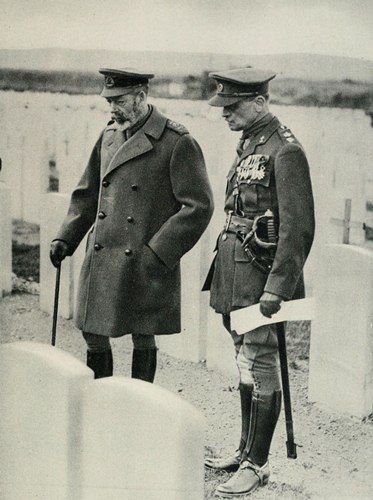
ETAPLES
INSPECTING SOUTH AFRICAN GRAVES
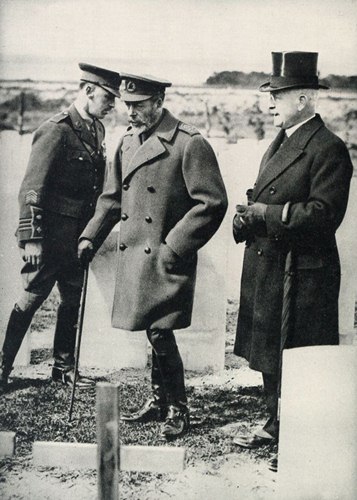
ETAPLES
INSPECTING NEWFOUNDLAND GRAVES
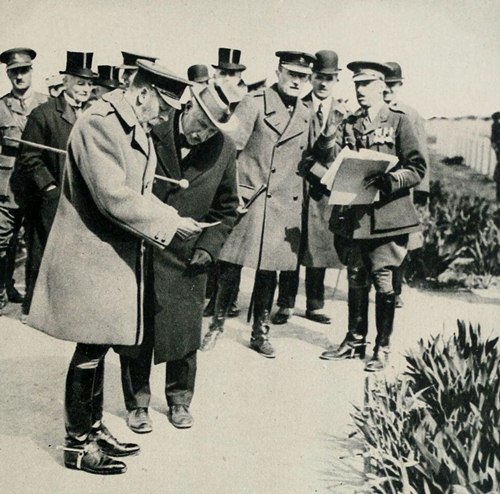
ETAPLES
THE KING READING THE LETTER FROM A BEREAVED MOTHER ASKING THE QUEEN TO PLACE A BUNCH OF FORGET-ME-NOTS ON HER SON’S GRAVE
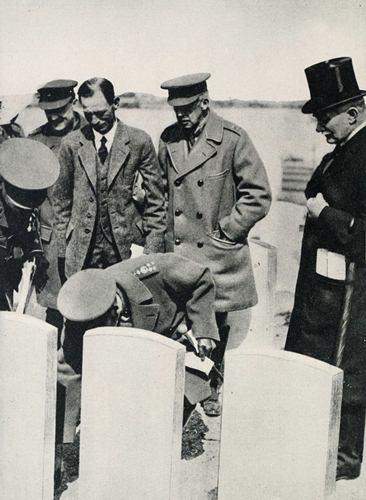
ETAPLES
THE KING PLACING THE FORGET-ME-NOTS ON THE GRAVE
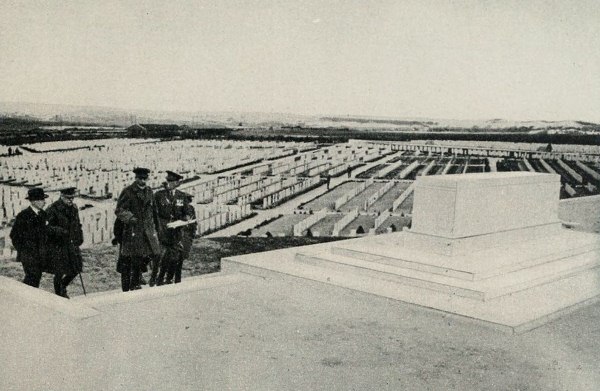
ETAPLES
AT THE STONE OF REMEMBRANCE
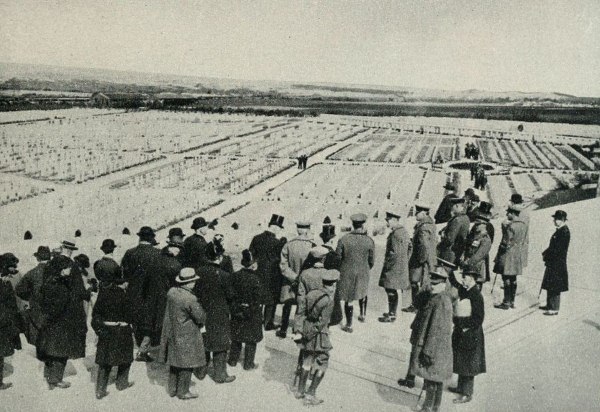
GENERAL VIEW OF ETAPLES
THE KING AND DOMINION REPRESENTATIVES
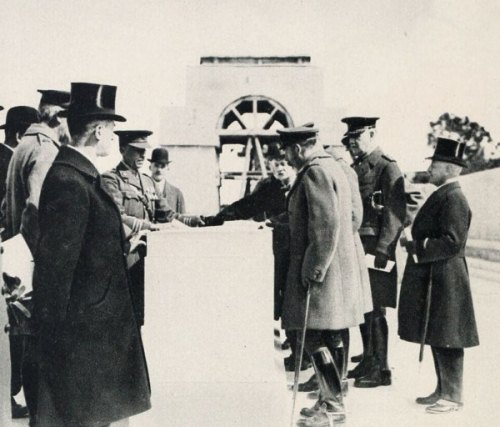
ETAPLES
EXAMINING PLANS OF CONSTRUCTIONAL WORK
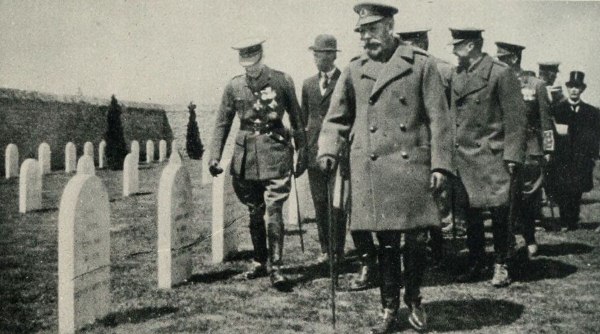
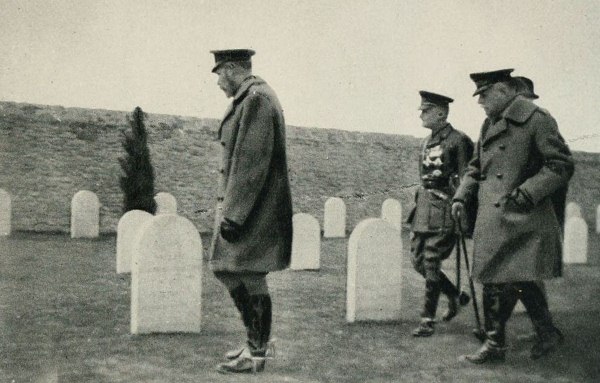
MEERUT INDIAN CEMETERY
INSPECTING INDIAN GRAVES
Larger Image
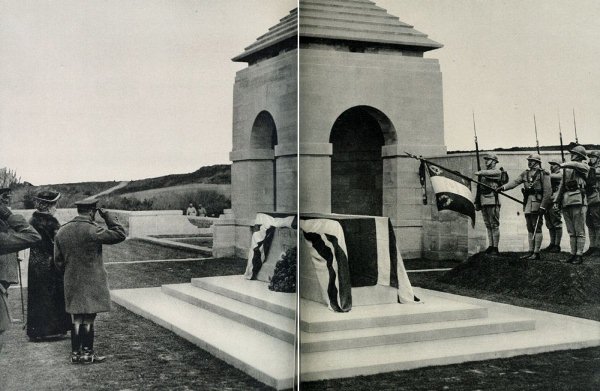
TERLINCTHUN THE LAST POST
“They lie in the keeping of a tried and generous friend, a resolute and chivalrous comrade-in-arms, who, with ready and quick sympathy has set aside for ever the soil in which they sleep, so that we ourselves and our descendants may for all time reverently tend and preserve their resting-places.”
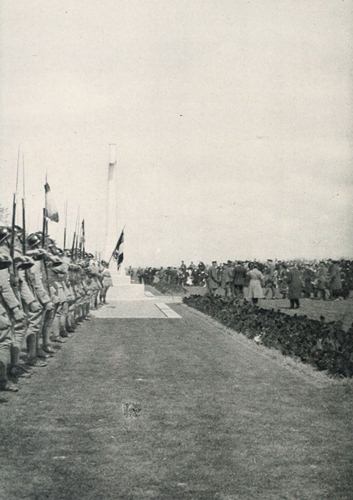
TERLINCTHUN
THE FRENCH GUARD OF HONOUR AT THE CROSS OF SACRIFICE
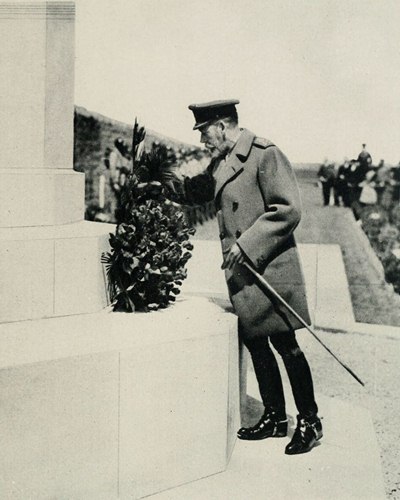
TERLINCTHUN
THE KING PLACING A WREATH ON THE CROSS OF SACRIFICE
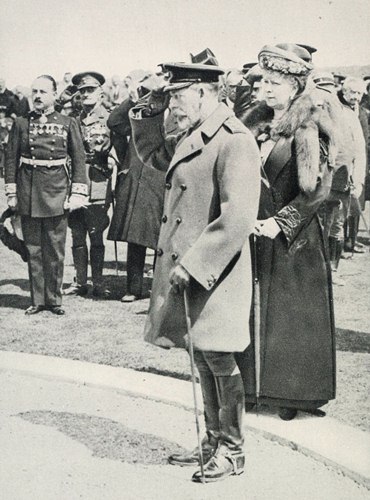
TERLINCTHUN
THE SILENCE AND THE SALUTE AT THE CROSS
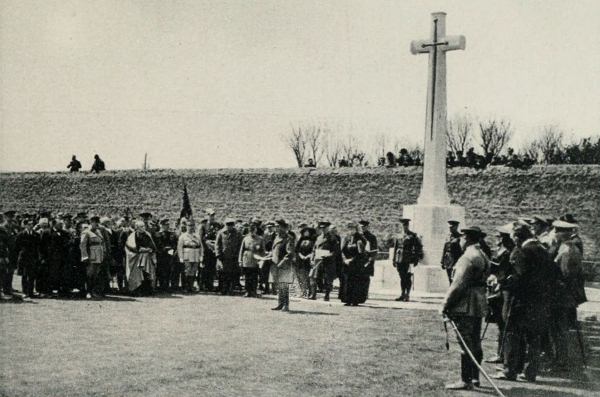
TERLINCTHUN
THE KING’S ADDRESS
“And the last land he found it was fair and level ground About a carven stone, And a stark sword brooding on the bosom of the cross Where high and low are one.”
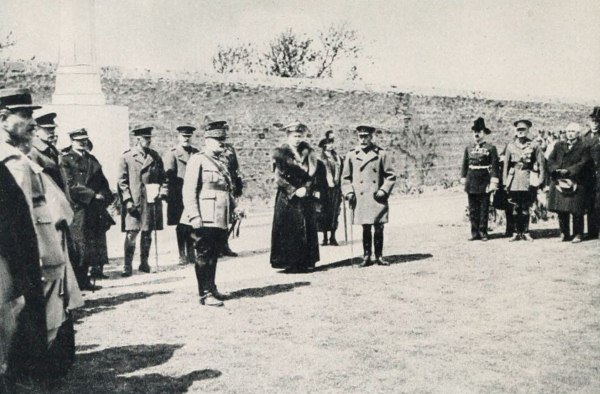
TERLINCTHUN
GENERAL DE CASTELNAU’S REPLY
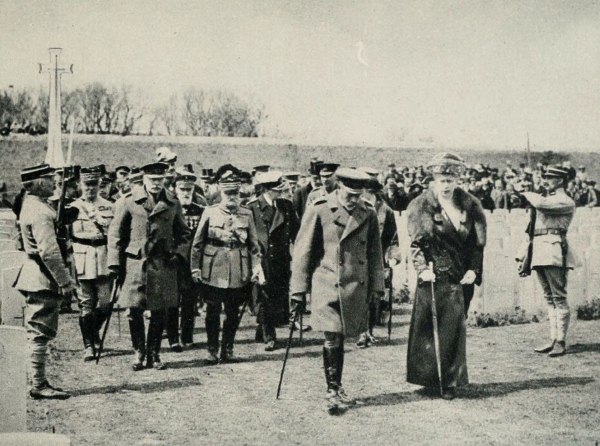
TERLINCTHUN
PROCESSION TO THE STONE OF REMEMBRANCE
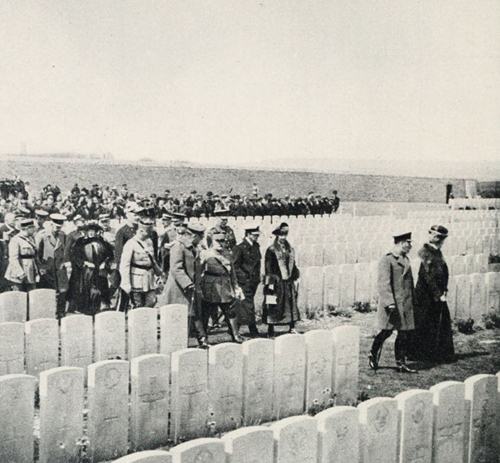
TERLINCTHUN
PROCESSION TO THE STONE OF REMEMBRANCE
“All that they had they gave—they gave”
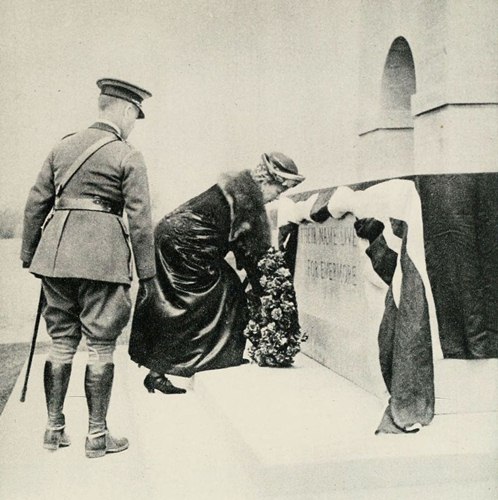
TERLINCTHUN
THE QUEEN LAYING A WREATH ON THE STONE OF REMEMBRANCE
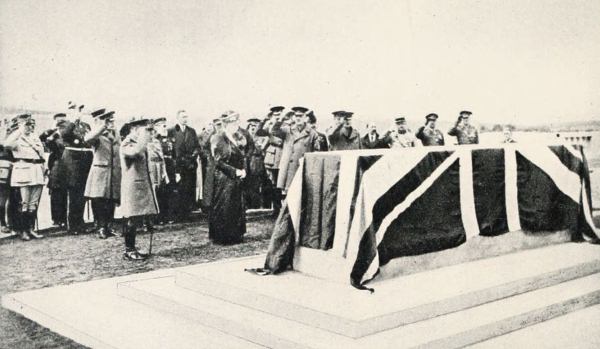
TERLINCTHUN
THE SALUTE AT THE STONE OF REMEMBRANCE
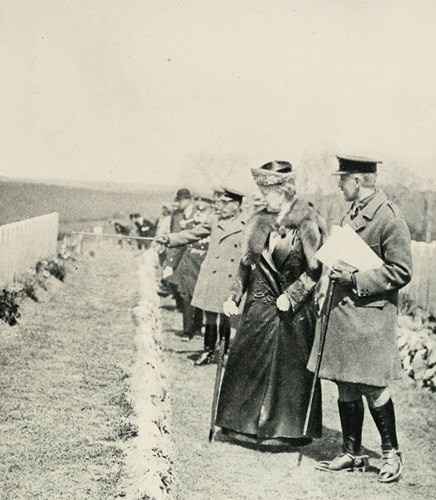
TERLINCTHUN
THE QUEEN AT THE GRAVES
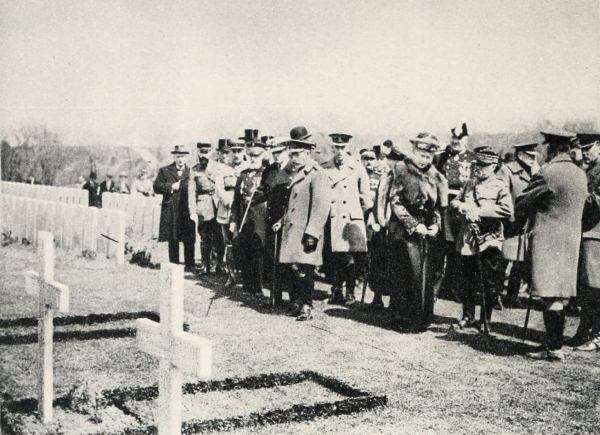
TERLINCTHUN
THE QUEEN AT THE GRAVES
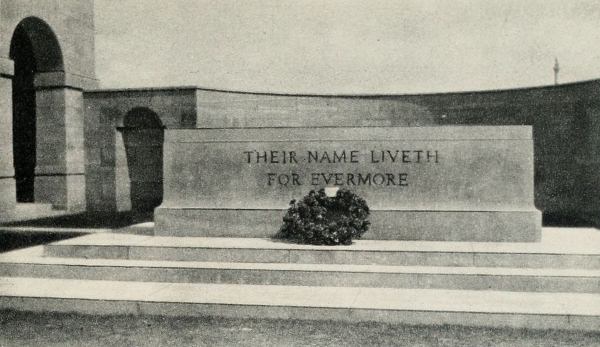
TERLINCTHUN
THE STONE OF REMEMBRANCE WITH THE QUEEN’S WREATH
“Their name liveth for evermore”
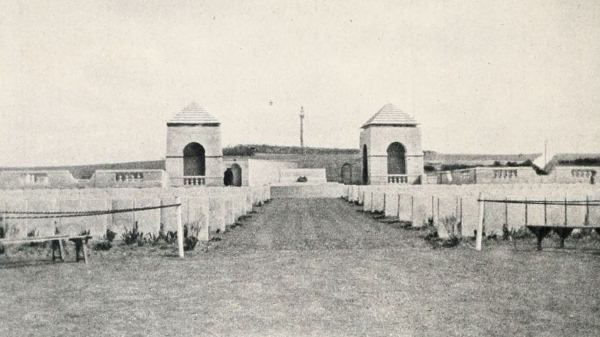
TERLINCTHUN
NAPOLEON’S COLUMN IN THE BACKGROUND
“And here ... the shadow of his monument falling almost across their graves, the greatest of French soldiers—of all soldiers—stands guard over them”
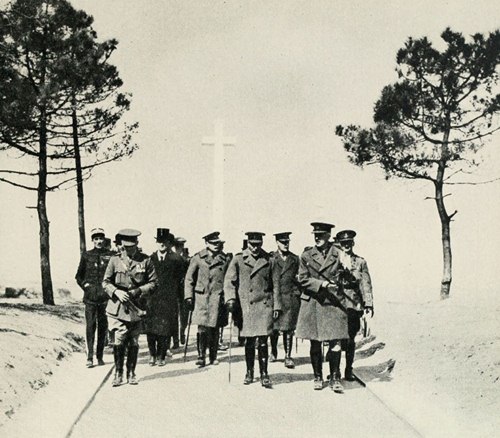
LEAVING ETAPLES
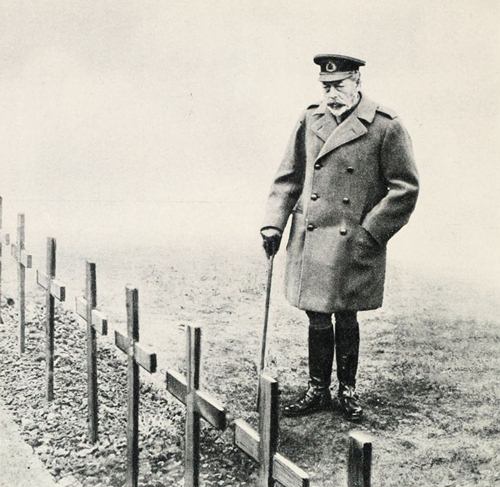
“In the course of my pilgrimage I have many times asked myself whether there can be more potent advocates of peace upon earth through the years to come than this massed multitude of silent witnesses to the desolation of war”