II: “It was low and hollow ground where once the cities stood”
Reading edition
The King’s route after leaving Tyne Cot Cemetery brought him to the salient where the British Army held Ypres as the gate guarding the Channel ports. The enemy rush to Paris had failed, and he was seeking a way to victory by a rush to seize the French side of the English Channel as a prelude to the invasion of England. In the first Battle of Ypres the enemy sought with enormous superiority of numbers to overwhelm the British force which barred the Calais Road. To hold Ypres was vital, and yet Ypres was, humanly speaking, indefensible, within a saucer-shaped salient dominated on three sides by the German artillery.
The attack was pushed on with fierce energy from October 21st, 1914, onwards, and was met with heroic stubbornness by a woefully thin khaki line. At one stage there was no question of reliefs. Every man practically in the British Force, including cooks and batmen, was in the front line, and these men held to the trenches day after day, night after night, without sleep, with little food, with no intermission from rifle and shell fire.
During the second Battle of Ypres, in the spring of 1915, the war took on a new phase with the enemy use of asphyxiating gas as a weapon. Of this odious and unexpected form of warfare the Canadians were the first victims, but withstood the surprise with a cool heroism which saved the day.
There were other battles of Ypres, and all the land around was saturated with the blood of heroes. So this “low and hollow ground,” stiffened with our dead, is holy soil to the British race. The King chose fitly to render there his homage to the dead of the Belgian Army who on the Yser held the left flank of the line through all the years of bitter fighting for Ypres.
On his way to the Menin Gate of Ypres city, the King directed the cars to turn aside to the Town Cemetery, that he might stand silent for a few moments by the graves of Prince Maurice of Battenberg, Lord Charles Mercer-Nairne, Major the Hon. W. Cadogan, and other officers, some of those of his own personal friends whom the war claimed, and whose graves lie among those of their men, marked by the same simple memorials.
········
Ypres to-day is no longer a mass of shell-shattered ruins. The work of reconstruction has been carried on earnestly, and thousands of new houses have been built. But nothing can ever restore the mediæval beauty of the city which grew like a noble wood in carved stone on the Flanders Plain. The ruins of the Cloth Hall will remain as the monument of the old city which was once a world’s capital for those who wove wool into fine cloth. The old ramparts at the Menin Gate—stout walls which provided security for the British signallers even in the most furious bombardments—will remain as another monument, an effective symbol of the British Army at Ypres, very sorely battered, but still holding secure.
It is proposed by the Imperial War Graves Commission that at the Menin Gate there should be a memorial to those of the Empire’s Armies who fell in this area but have no known graves. It will crown these ramparts with a great double arch, enclosing a vaulted hall, in which will be recorded the names of all those lost in the neighbouring battle-fields whose bodies have not been recovered and identified. The design provides that the arch facing Menin, where once the foe was drawn up, will be surmounted by the great figure of a lion alert in defence, the arch facing Ypres by some other symbolical sculpture.
········
The King was met at the Menin Gate by representatives of the Belgian Government and Army, by Major Michelet and M. Lorel of the Belgian Graves Services, and by the Burgomaster of Ypres. The industrious re-builders of Ypres paused from their work for an hour and assembled to give him a hearty greeting. The King entrusted a chaplet of palms and bay leaves with a spray of red roses in memory of the Belgian dead to Major Michelet. He then congratulated the Burgomaster on the progress his citizens were making with the work of reconstruction. Sir Reginald Blomfield, architect of the memorial at the Menin Gate, submitted to the King the designs and plans of the monument. His Majesty emphasised the need that the names inscribed should be clear to all to read.
········
Leaving the Menin Gate, the King passed by the ruins of the Cloth Hall and of the Cathedral, noting the irreparable loss to the world through the destruction of these magnificent examples of Flemish architecture. It was observed that the drivers found it somewhat difficult to find a way through the new Ypres which is growing up under the industrious hands of the Belgian population. Ypres, the “Museum City” of 1914, is known to many. The “Wipers” of 1918, a tumble of desolation through which the soldiers passed under constant shell fire by burrowed paths, became familiar to almost every British regiment. But this new, re-building Ypres is a stranger.
The route of the pilgrimage went from Ypres to Vlamertinghe, passing on the way the British cemetery behind Ypres Reservoir, the Asylum British Cemetery, the cemetery on the Dickebusch Road, and the Railway Château Cemetery. At Vlamertinghe Military Cemetery the King stopped and, as has already been noted, visited the Canadian graves with the High Commissioner for Canada, as well as paying his tribute to the many British buried there. This cemetery, between Poperinghe and Ypres, was begun by the French troops, then holding part of the line here. It contains 1,114 graves of British soldiers, 52 of Canadian, 4 of Australian, 2 of South African, 2 of soldiers of the Royal Newfoundland Regiment, one of an Indian soldier, and one of an unknown soldier. Very many of the British graves are of Territorial dead. There are, for example, nearly 250 Lancashire Territorials buried there: those splendid men who proved, both in Gallipoli and France, that the town-bred population of the Mother Country was fit, in courage and endurance, to rank with the historic regiments of the line and with the young giants from the Oversea Dominions.
········
From Vlamertinghe, along the granite-set roads which were for years pounded by our ammunition wagons and supply trains, but the dust arising from which now proclaims the works of peace as the country-folk drive their carts loaded with bricks and timber for re-building, the King went on to the Hop Store Cemetery, greeted everywhere with cordial sympathy. Hop Store village was used from time to time as headquarters both by our heavy artillery and by our field ambulances. The site of the cemetery is on a marshy patch of ground, but it was drained by the Royal Engineers early in 1917, and recently a moat has been constructed on three sides. It holds 247 of our dead.
From Hop Store the King went on to Brandhoek, which was a comparatively safe area during the war, and therefore a post for field ambulances. The old Military Cemetery, which the King visited, was opened in May, 1915, in a field adjoining the Dressing Station, and was closed in July, 1917. It shelters the bodies of 601 soldiers from the Home Country, 62 from Canada, 4 from Australia, and 2 of the Bermuda Volunteer Rifle Corps. In July, 1917, the Military Cemetery was opened 300 yards away, and in August, 1917, a third cemetery was opened.
Poperinghe was next visited. This agricultural town on the road between Ypres and Hazebrouck, situated among hopfields and dairy farms, was a haven of rest in the early days of the war. Although occasionally bombarded at long range, it was the nearest town to Ypres which was reasonably safe. It was at first a casualty clearing station centre. Later, in 1916, when shell fire increased, it was decided to move back the casualty clearing station to a safer zone, and Poperinghe became a field ambulance station. The earliest British graves at Poperinghe are in the Communal Cemetery, a walled graveyard at the entrance to the town. The old Military Cemetery was made in the course of the first Battle of Ypres, and was closed (so far as British burials were concerned) in May, 1915. The New Military Cemetery was made in June, 1915. It contains the graves of 596 soldiers from the Home Country, 55 from Canada, 20 from Australia, 3 from New Zealand, and 2 of the British West Indies Regiment.
Lijssenthoek was the last of the cemeteries on Belgian soil visited. This cemetery is at Remy Siding, on the south side of the Hazebrouck-Ypres railway line, between Poperinghe and Abeele. The site was first used for burials by a French military hospital, and there is a group of French graves on what is now the eastern boundary of the cemetery. The earliest British burial dates from June, 1915. This cemetery had to be repeatedly enlarged as the campaign levied its toll on our forces. It now contains 9,795 British and Dominion graves, 892 French, 2 Belgian, 52 American, and 32 Chinese. The majority of burials took place from the Canadian casualty clearing stations at Remy. Of the French graves, 10 are those of unknown soldiers and 689 will remain in the cemetery.
········
Going out of Belgium to France the sun was shining and the graciousness of Nature, covering with herb and blossom the ulcers of the old battle-fields, made this corner of Flanders seem a fair and human country. For those who now saw the district for the first time, the concrete forts lying like the bleached skeletons of strange monsters in the fields, and the serried ranks of the graves, coming up in line after line to give their mute witness, told something of what it cost to hold the Ypres Salient. But the King knew all that it had been in the long dark winters of the war, when the very abomination of desolation brooded over it, and in its pools of slime his soldiers struggled and choked that the fields of England might be kept free of the foe. He did not hide from those with him that the memory of it weighed heavy on him and that in his mind, with pride in the thought of such superhuman devotion, there was a passionate hope that never again in the world’s history would men be called upon to suffer as these men had suffered.
Speaking, too, of the cemeteries, where general and private rest side by side beneath the same simple stones, equal in the honour of their death for duty’s sake, he agreed that this was the only possible way.
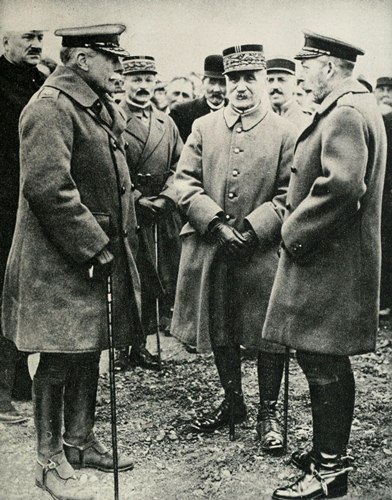
NOTRE DAME DE LORETTE
THE KING MEETING MARSHAL FOCH
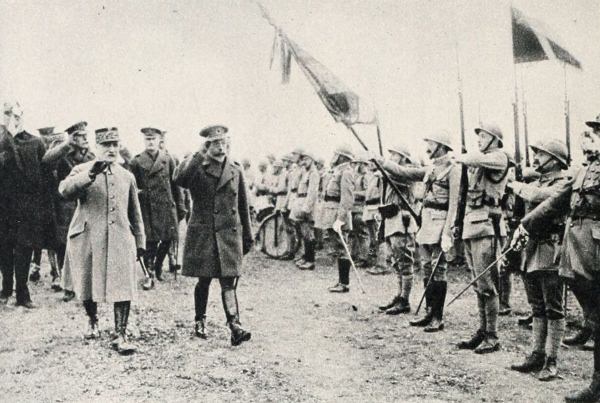
NOTRE DAME DE LORETTE
SALUTING THE FRENCH COLOUR PARTY
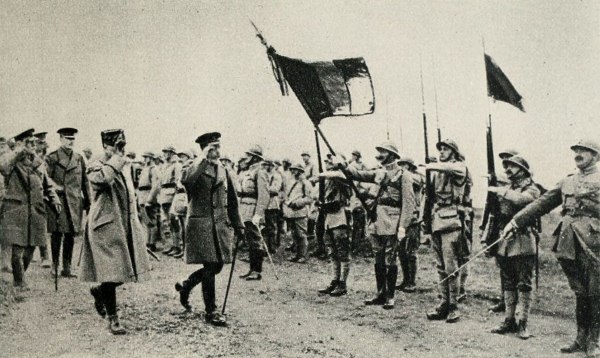
NOTRE DAME DE LORETTE
SALUTING THE FRENCH COLOUR PARTY
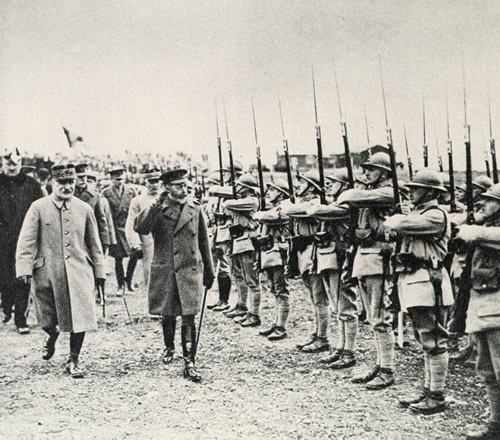
NOTRE DAME DE LORETTE
THE FRENCH GUARD OF HONOUR
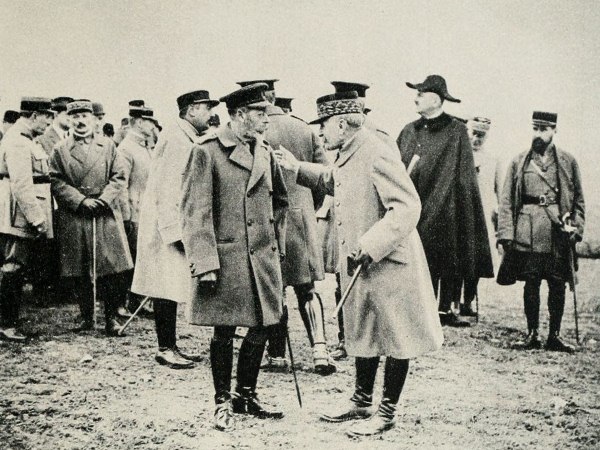
NOTRE DAME DE LORETTE
THE KING AND MARSHAL FOCH
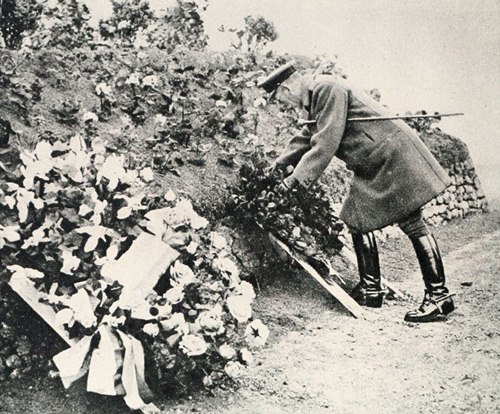
NOTRE DAME DE LORETTE
“I have come to lay a wreath in homage on the tombs of French heroes who have fallen for their country”
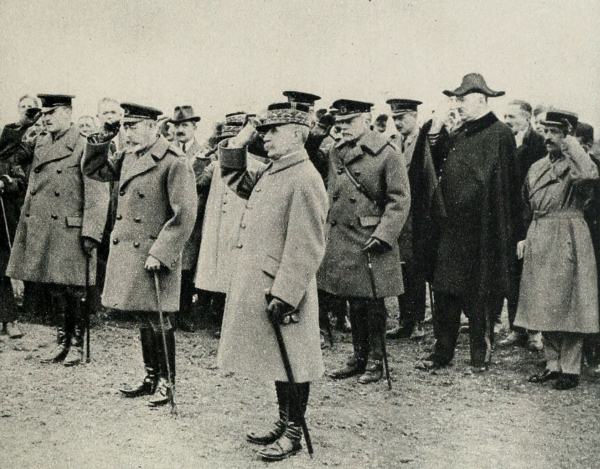
NOTRE DAME DE LORETTE
THE SILENCE AND THE SALUTE TO THE DEAD
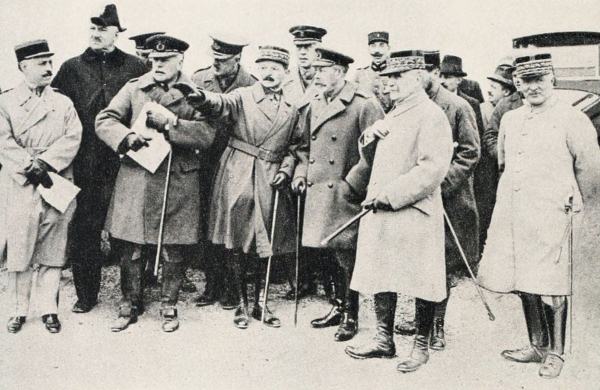
NOTRE DAME DE LORETTE
THE BROW OF THE HILL OVERLOOKING THE RIDGE
THE KING WITH MARSHAL FOCH, GENERAL WEYGAND AND FIELD-MARSHAL EARL HAIG
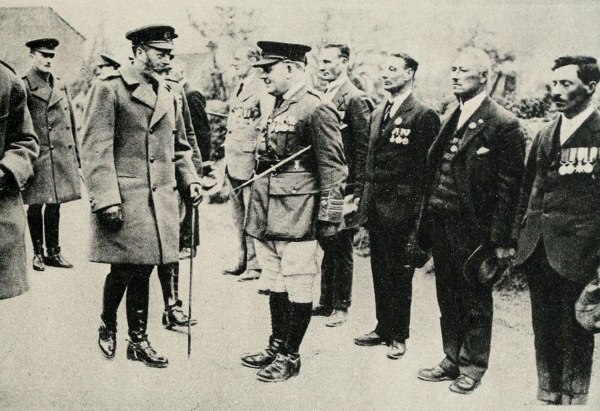
INSPECTION OF GARDENERS
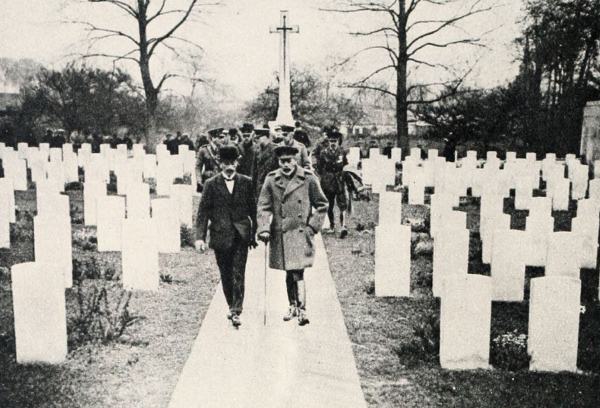
FORCEVILLE CEMETERY
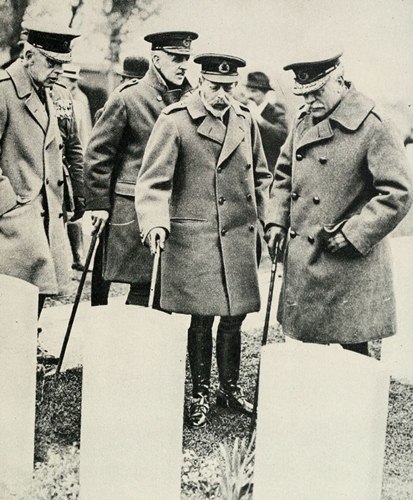
FORCEVILLE
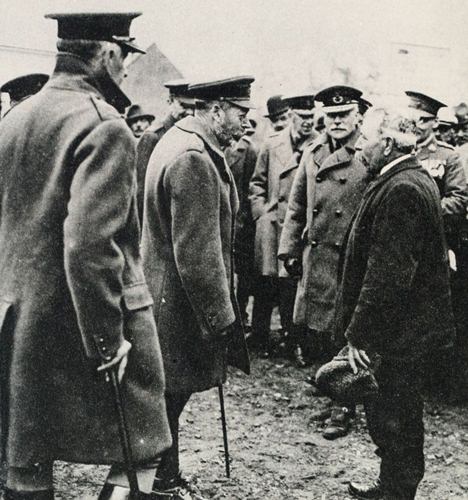
FORCEVILLE
THE KING SPEAKING TO THE MAYOR
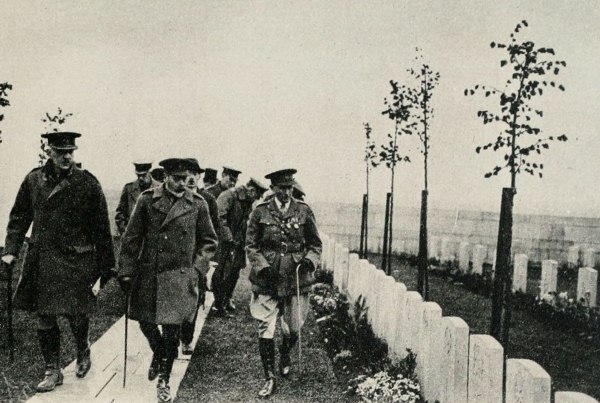
LOUVENCOURT
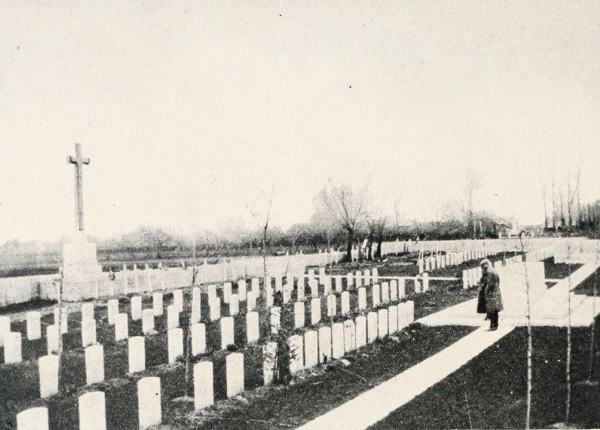
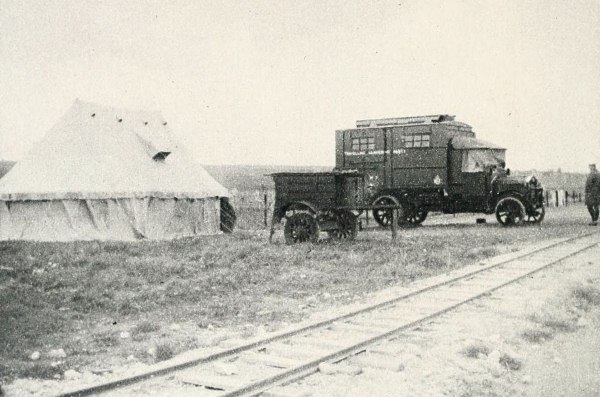
LOUVENCOURT
A TRAVELLING GARDENING PARTY
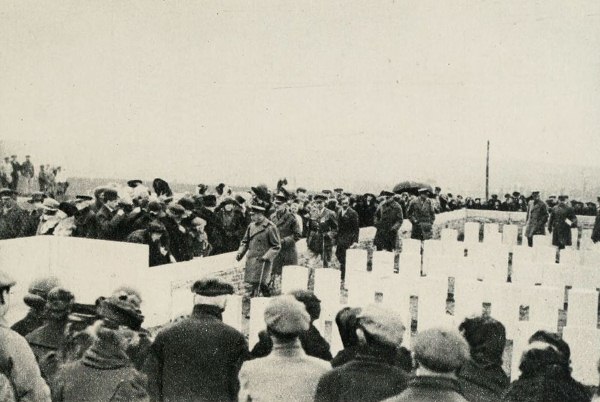
PICQUIGNY
WHERE A NUMBER OF AUSTRALIANS LIE
CROUY BRITISH CEMETERY
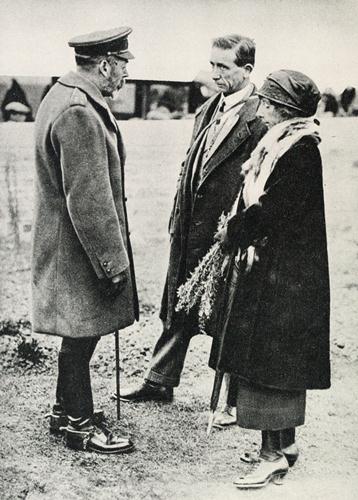
THE KING TALKING TO TWO BEREAVED AUSTRALIAN RELATIVES