JOY with TRANQUILLITY.
Reading edition
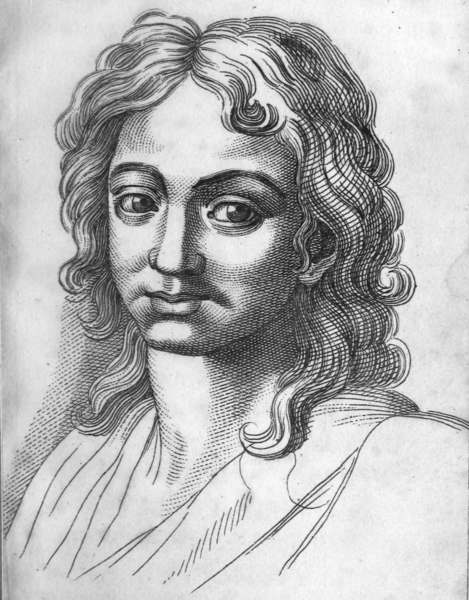
“You will observe here, that very little alteration is remarked in the face of those who feel within themselves the sweetness of Joy. The forehead is serene; the eyebrows without motion, elevated in the middle; the eye pretty open, and with a laughing air; the eyeball lively and shining; the corners of the mouth turn up a little; the complexion lively; the cheeks and lips red.
“Joy is a delightful sensation, and gives health to the body as well as to the mind; when we feel joyful, with what alacrity, what spirit, do we move and act! It is Joy that you taste of, when the time arrives for you to return home from school, to see your friends in vacation. When Joy is felt, the mind is occupied with every thing that is pleasant; all care is for the time obliterated from your recollection; you jump, and dance, and sing, and spring about like young fawns, from place to place. But this is not Joy with Tranquillity, like that in the picture. Joy with Tranquillity is more lasting, and is less violent. I will attempt to describe the passion to you by an example.
The Story of Matthieu and Gerrard, the two Fishermen, who each found a treasure.
“Two fishermen, named Matthieu and Gerrard, who lived in a small village near the Mediterranean, and who had each of them large families, and were very poor, were out one day drawing their nets, when one of them, Gerrard, called out to the other, that he had drawn ashore a small casket, which was extremely heavy; and he begged the other to assist him to force it open, when he found it full of precious stones, carefully inclosed in cotton. The fisherman who had found the treasure, very fairly and justly told the other that he should go shares; and overjoyed, ran home directly to his wife, to tell her the good news. The other fisherman, who was older and more careful, staid to put his nets in order before he followed, and was very kindly doing the same office for his friend, when he discovered another casket among the meshes of the net, which his comrade had overlooked, full of the like treasure, and which he put in his pocket.
“When the old fisherman returned to the village, which was no great way from the sea-shore, he found the house of his comrade surrounded by people. In short, poor Gerrard’s rapture had occasioned him to tell every creature he met of his good fortune, and they had followed him in a mass. One gave him a piece of advice; another put in a claim for favour; a third offered to get him a market for the diamonds of a friend. In short, he was almost torn to pieces by the officious kindness of his neighbours; and in his perplexity, he sold his treasure for less than half its value, to an old Jew, who, on hearing the news, had hastened all the way from Marseilles to the spot, to make a good bargain.
“The old fisherman said nothing about his luck until night, when he was at supper with his wife; and she being a prudent woman, though she felt a great deal of joy that her dear children would be better cloathed and fed, yet it was Joy with Tranquillity. They neither of them suffered their good success to run away with their reason. It was therefore determined between themselves, that Matthieu should go the next day to Marseilles, where dwelt a respectable Armenian merchant, and get a fair price from him for the precious stones he had had the luck to find.
“The next day, the old fisherman set out on his journey, without saying a word to any body, and returned home laden with louis d’ors, in addition to the small sum which was the moiety of what the other fisherman had honestly shared with him.
“In a very few months it happened, that the younger fisherman, Gerrard, owing to his excess of joy, which made him insensible of what he was about, and the folly of his young wife, who spent a great deal in dress, while he was giving, lending, and throwing away his money, was reduced at length to poverty, and had nothing left to do but to take to business again.
“He was lamenting one morning not having sufficient to purchase nets, and was mending the old ones to go out a fishing, when his neighbour Matthieu came to the gate. ‘I thought,’ cried he, ‘that you had left off fishing, and that you lived upon the interest of the money you got for your pearls and diamonds; or, perhaps, you are going out for pleasure.’—‘Alas,’ cried Gerrard, ‘it is not so; I have given away and spent all that I had.’—‘Well, but,’ said he, ‘those you have done service to will never let you want a little money to purchase nets; they have had plenty from you.’—‘I have but little hopes of them,’ answered Gerrard.—‘Well,’ said the old fisherman, ‘at any rate, give them the trial; invite all these your neighbours and friends to a feast, and after they have regaled themselves, I will open the whole business of your necessities, and ask them to subscribe to put you into business again.’ Gerrard followed the advice of his neighbour, and a feast was prepared, at which every one took care to be present. After dinner was over, the old fisherman opened the business, and asked each of them to subscribe a something; but they had all of them an excuse ready. ‘Well,’ cried he, ‘in that case, I must do all by myself,’ when he pulled out two large bags full of louis d’ors, which he opened before them, and placed one of them before Gerrard. ‘Now, sirs,’ said Matthieu, turning to the guests, ‘we will not trouble you any further; we shall not want your assistance to count them out this time.’
“The guests departed one after another, not a little chagrined at this unexpected turn; and Matthieu explained to Gerrard that the money was his right; that he had kept it for him, that it might not fall into such bad hands as his former treasure. All now was joy, but it was Joy with Tranquillity; and Gerrard, delighted with the wisdom, as well as with the honesty of his friend, begged him to keep it for him, and that he would draw for what he might have occasion.
“Matthieu and Gerrard continued neighbours and friends; their little fortunes increased; and at length their children intermarried, to the satisfaction of the old people, who, undisturbed by any excess of passion, felt only Joy with tranquillity.”
“Oh dear! what a funny face!” cried Henry, as Mr. Willock turned over the leaf.
“It is, my dear,” said he,“the face of