JOURNAL.
Reading edition

Vide note as to pruning down on outside.—C. G. G.
September 10.—Colonel Stewart, MM. Power and Herbin, left during the night for Dongola, viâ Berber.
Spy came in from south front, and one from Halfeyeh reports Arabs will not attack, but will continue the blockade.
Sent off two sets of telegrams by a spy, who will go to Shendy.
Yesterday, when the messenger went out to deliver my answer to the Arabs, in response to Mahdi’s letter, though he had a white flag, they fired on him, and tried to capture him. They use the white flag, and find it respected by us, and that we let their men go back. They chain any men we send to them.
It is wonderful how the people of the town, who have every possible facility to leave the city, cling to it, and how, indeed, there are hundreds who flock in, though it is an open secret we have neither money nor food.[7] Somehow this makes me feel confident in the future, for it is seldom that an impulse such as this acts on each member of a disintegrated mass without there being some reason for it, which those who act have no idea of, but which is a sort of instinct. Truly I do not think one could inflict a greater punishment on an inhabitant of Kartoum than to force him to go to the Arabs.
Halfeyeh reports that Faki Mustapha, who was in command of the Arabs on the west or left bank of the White Nile, wishes to join the Government. He is informed we are glad of it, but wish him to remain quiet, and to take no active part till he sees how the scales of the balance go; if we rise, then he can act, if we fall he is not to compromise himself; but what we ask him is to send up our spies, which he can do without risk.[8] The same advice was given to the people of Shendy, who wished to issue out and attack Berber.
The runaways of Tuti[9] wish to come back, which is allowed.
The “matches” used for the mines are all finished, and we are obliged to go back to powder hose, and unite the mines in families of ten.
Rows on rows of wire entanglement are being placed around the lines. General Gordon’s horse was captured by the Arabs in the defeat of El foun; the other staff horse got a cut on the head, but is now all right.
The Mahdi is still at Rahad.[10] The answer to his letter (vide Colonel Stewart’s journal) was sent open, so that the Arab leaders could read its contents.
With respect to letters written to the Mahdi and to the Arab chiefs, commenting on the apostacy of Europeans, they may, and are, no doubt, hard, but it is not a small thing for a European, for fear of death, to deny our faith; it was not so in old times, and it should not be regarded as if it was taking off one coat, and putting on another. If the Christian faith is a myth, then let men throw it off, but it is mean and dishonourable to do so merely to save one’s life if one believes it is the true faith. What can be more strong than these words, “He who denies Me on earth I will deny in heaven.” The old martyrs regarded men as their enemies, who tried to prevent them avowing their faith. In the time of Queens Mary and Elizabeth, what men we had, and then it was for less than here, for it was mainly the question of the Mass, while here it is the question of the denial of our Lord and of his passion. It is perhaps as well to omit this, if this journal is published, for no man has a right to judge another. Politically and morally, however, it is better for us not to have anything to do with the apostate Europeans in the Arab camp. Treachery never succeeds, and, however matters may end, it is better to fall with clean hands, than to be mixed up with dubious acts and dubious men. Maybe it is better for us to fall with honour, than to gain the victory with dishonour, and in this view the Ulemas of the town are agreed; they will have nought to do with the proposals of treachery.
No doubt the letters to the Arabs will make the Arab chiefs work on the Europeans with them, to take an active part against us, by saying to those Europeans, “You are cast out;” but the Arabs will never trust them really, so they can do little against us.
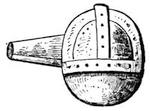
We had a regular gaol delivery to-day, letting out some fifty, and are sending to the Arabs about nine prisoners whom it is not advisable to keep in the town. A donkey quietly grazing near the north fort, exploded one of the mines there (an iron alembic which belonged to the time of Mahomet Ali, and had been used for the reduction of gold; it held some 10 lbs. of powder); the donkey, angry and surprised, walked off unhurt! These alembics are of this shape, braced by iron straps together. It is extraordinary that after a good deal of rain, and three months’ exposure, the domestic matchbox should have retained its vitality.
The school here is most interesting, as the scholars get a certain ration. It is always full, viz., two hundred. Each boy has a wooden board, on which his lesson is written, and on visiting it the object of each boy is to be called out to read his lesson, which they do with a swaying motion of body, and in a sing-song way, like the Jews do at the wailing place at Jerusalem and in their synagogues, from which we may infer this was the ancient way of worship, for the lessons are always from the Koran. Little black doves with no pretension to any nose, and not more than two feet high, push forward to say the first ten letters of the alphabet, which is all they know.
We have completed the census (vide Colonel Stewart’s Journal),[11] and have 34,000 people in the town.
September 11.—Stewart’s steamers, which had been delayed at Halfeyeh[12] owing to some machinery accident, left last night for Berber.[13] Spy reports that one of captured steamers at Berber is disabled by the Arabs.
When Cuzzi[14] came to the lines yesterday, the officer Hassan Bey made him walk over on his knees in order to pass into lines, pointing out to him that the lines were thickly spread with fearful mines. Cuzzi asked what one would do when the Nile fell, and was told that these new mines would be put down as the river fell. Hassan Bey put Cuzzi into a hut, and questioned him as to the whereabouts of the Mahdi. He said first he was at Duem,[15] and when pressed he agreed the Mahdi was in Kordofan, and had not moved. He said the Mahdi had not more than two regiments; that he had lost heavily in fighting the mountain tribes of Nubia, and had not much ammunition left; that Waled a Goun had some 200 regulars with him, 10 mountain guns, and 2 Krupps, but only 5 boxes of mountain gun ammunition, and 3 boxes of Krupp, and 5 boxes of Remington. (The Arabs captured at our defeat at El foun 75,000 rounds, so that will help them.) Waled a Goun wanted to go to Giraffe, where Abou Gugliz was defeated, but Abou Gugliz said it would never do. Cuzzi looked pretty miserable. Outside the lines were three Arabs and Zarada (a Greek); they waited for Cuzzi. Soon after Cuzzi had left for the Arab camp, two dervishes came in with the Mahdi’s letter (vide Colonel Stewart’s Journal), and a dervish dress from the Mahdi to me. They were given the letters I had received for Slatin for Cairo, and my answer to the Arabs; also the horse head-stall which Abou Gugliz had lost, at which they were amused, and went off to the Arab camp. I sent out my letter in answer to the Mahdi (vide Colonel Stewart’s Journal) with a slave, upon whom they fired. Talataween and Bordeen left for Sennaar this morning to bring down dhoora.[16] Letter written to the Sheikh el Obeyed[17] proposing “we should mutually remain quiet, &c., &c., with relation to one another, as we are rendering the country a desert.”
Jer. xvii. 5. “Cursed (thus saith the Lord) is the man that trusteth in man, and maketh flesh his arm, and whose heart departeth from the Lord;” therefore cursed is he of the Lord, who hopes by any arrangement of forces, or by exterior help, to be relieved from the position we are in. Jer. xvii. 7. “Blessed (thus saith the Lord) is he that trusteth in the Lord, and whose hope the Lord is,” therefore blessed is he “of the Lord” who makes all his arrangements of forces, without any reliance on such arrangements, or on any exterior help, but trusts in the Lord.[18] How impossible for man alone to accept these views, for with what heart can he make his arrangements if he does not trust in their success! Curious verses, Ezekiel xxix. 10-14,[19] as to Egypt being waste for forty years from the Tower of Syene (Assouan) to frontier of Ethiopia; it is certainly the Soudan which is meant, and it is in a fair way of being a desert.
A Dervish came in with a letter from Abdel Kader, the Sheikh on the White Nile, which, with answer, is annexed;[20] he also brought a letter from the messengers who brought in the Mahdi’s letter on 9th September (vide Col. Stewart’s journal). They said they had not received my answer, which it will be remembered was sent out by a slave, whom they fired upon. This man also brought in a letter from a Greek, Calamatino,[21] who begs to come in and tell me important news for all Europe. His letter and my answer are annexed.
It will be noticed that Cuzzi adds “he is going to Berber to-day,” so he may meet with Stewart. They might have gone down together had they mutually have known of one another’s departure.
A soldier captured at Obeyed came in, and reports that his comrades would come in en masse if we would let them come at night. Abou Gugliz denies that the head-stall I sent to him is his.
I put down our defeat on the Dem or headquarters of Sheikh el Obeyed to two things—1. A lot of Kartoum pedlars went out to loot, and they broke the square. 2. Mahomet Ali Pasha captured a lad of twelve or fourteen years of age, and the little chap spoke out boldly, and said he believed Mahomet Achmet was the Mahdi, and that we were dogs. He was shot! Before I heard of our defeat I heard of this, and I thought “that will not pass unavenged.” There was an old belief among old Christians that every event which happens on earth is caused by some action being taken in heaven; the action in heaven being the cause of the event on earth, vide Revelations, when at the opening of seals the trumpet sounds, &c., &c., all events exercised in heaven are followed by events on earth. This being the case, how futile are our efforts to turn things out of their course. Vials are poured out on earth whence events happen. To me, it seems little what those events may be, but that the great object of our lives is how we bear those events in our individuality. If we trust in the flesh, thus saith the Lord, we are cursed; if we trust in Him we are blessed. I cannot think that there are any promises for answers to prayer made for temporal things; the promises are to hear prayer, and to give strength to bear with quiet what may be the Will of God. A vial is poured on earth; events happen; one is furious with the British Government for these events; but if we were logical, we should be furious with the pourer out of the vial, and that we shrink from being, for He is the Almighty who pours out the vial.
This afternoon another mine blew up at Tuti; the victim was another donkey, who, however, did not get off so well as his colleague of the North Fort, for he lost his hind quarters, and was killed.—R.I.P.
We cannot help thinking something has happened in Europe of a startling nature, and which is known to the Arabs in an indistinct way, for they evidently look on the game as theirs, and that without fighting, of which they show no sign. Abou Gugliz (in remonstrating with Waled a Goun, who wished to descend the river) told him “that his forts were better than any at Cairo, but that the soldiers came over them, like afreets;”[22] so says the Dervish who came in to-day.
We decided to-night to send out a letter to Arabs, saying that though we will not admit any European into the place we will permit an interview, with any European they may wish to send to a flag placed in front of lines, with the Greek Consul and Greek Doctor.
September 12.—It is most dispiriting to be in the position I am, if it was not good for me, when I think that, when I left, I could say, “no man could lift his hand or foot in the land of the Soudan”[23] without me (Gen. xli. 44)[24] and now we cannot calculate on our existence over twenty-four hours. The people are all against us, and what a power they have; they need not fight, but have merely to refuse to sell us their grain. The stomach governs the world, and it was the stomach (a despised organ) which caused our misery from the beginning. It is wonderful that the ventral tube of man governs the world, in small and great things.
One of Seyd Mahomet Osman’s family, come in from Shendy, reports Osman Digma, as writing to Berber, reporting the arrival of the English at Suakin, their purchase of camels, and advance. The Arab chief of Berber assembled his subordinates and told them this, also of the advance of the troops from Debbeh commanded by English (Wood’s force) and recommended them to collect their men. The two captured steamers at Berber are on opposite sides of river.
Sent out letter to the Arabs to-day, saying I would let the Greek Consul come out and meet the Greek who had written to me; the Arabs, this time, did not fire on the flag of truce.
Church parade of Arabs on south front, but very far off.
The man from Shendy reports that all the right bank of the Nile is quiet. We have sent out an escort to try and capture Cuzzi, who is on his way to Berber.
It certainly is a curious exemplification of how very lightly religions sit on men, and to note the fearful apostacy of both Mussulmans and Christians, when their lives or property are menaced. There is scarcely one great family of the Soudan, families who can trace their pedigree for five hundred years, who have not accepted Mahomet Achmet as Mahdi, to save their property, though they laugh at the idea afterwards. I am using this argument with them, in saying, “You ask me to become a Mussulman to save my life, and you yourself acknowledge Mahomet Achmet as the Mahdi, to save your lives; why, if we go on this principle, we will be adopting every religion whose adherents threaten our existence, for you know and own, when you are safe, that Mahomet Achmet is not the Mahdi.”[25]
One of our captured soldiers from Obeyed came in from Waled a Goun, and four others with a woman came in from Faki Mustapha (two of the last were men slaves of the unfortunate Hassan Pasha Ibrahim, who was executed); they report food scarce in the Arab camp, and that many are striving to run away, owing to the way they are bullied.
Ulemas are writing letters to Arab chiefs, protesting against their acts, as being contrary to Muslim religion.
The Greeks and other prisoners in Obeyed, &c., complain bitterly of their privations and ill-treatment by the Arabs, in the letters they sent in here to other Greeks.
I was awakened this morning by a woman crying out, “My son has been murdered, and I demand justice.” Her little only boy had, it appears, been in one of the Arab water-wheels, which are moved by oxen, and a man had pushed him off; his skull was partially fractured, but he had been in hospital for some days, and we hoped for his recovery, when inflammation set in, and he died. He was a nice little bright-eyed, chocolate-coloured child of eight years old—the mother is a widow. One is drawn towards the children of this country, both browns and blacks—the former are of a perfect bronze colour.
The browns and blacks bear their wounds without a murmur; the poor fellaheen soldiers yell upon the slightest touch to their wounds.
One of the Arab chiefs came to the Shoboloha defile, and tried to raise the people to occupy the passage; the people refused, and the Arab chief went off.
There is a negro soldier in hospital with a cut on the nose from a sword; the cut has entered the nostrils, giving him four openings instead of two—it is on the bridge of the nose (if a negro nose can be said to have a bridge), and the man’s cheeks are untouched.
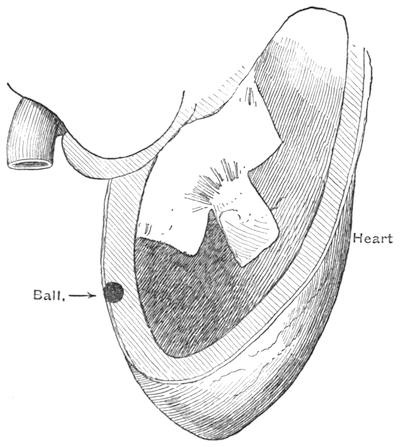
One man received a wound in the chest; he lived eleven days, and died. The doctor found a bullet lodged in the centre of his heart, in wall of ventricle. The doctor has this heart in spirits. It was a ball weighing the same as our Martini-Henri bullet.
The negro soldiers are wonderfully clean, while the fellaheen and Turkish lot are just the reverse; the former have the gloss of a well-cleaned and polished boot, such as the little London shoeblack loves to turn out for a penny.
A Greek came in from the Arabs to-night; I sent the Greek Consul to see him on the lines, where he will stop for the night.
I saw the Ulemas[26] to-day, and lamented to them the degeneracy of the Faith, when Christians become Mussulmans to save their lives, and Mussulmans become the followers of the False Prophet, to save their property. They are going to preach against this, but I fear much that when it is a question between Allah and their goats, &c., they will be inclined to look after their goats, as a rule. I am afraid we are much the same, and would prefer 50,000 men at our backs, than any Scripture promises; it is only when we are pushed into a corner, and cannot get the 50,000 men, that we turn to the promises—at least, that is so to a great extent with me. There is no doubt that success makes men hard on their fellows, while misfortune makes them soft. (One has only to study the demeanour of a Cabinet Minister, or a Colonel while in office, or out of office, to be convinced of this truth.)
I do not believe that fanaticism exists as it used to do in the world, judging from what I have seen, in this so-called fanatic land. It is far more a question of property, and is more like communism under the flag of religion, which seems to excite and to give colour to acts which men would otherwise condemn.[27]
I am sure it is unknown to the generality of our missionaries in Muslim countries, that in the Koran no imputation of sin is made on our Lord, neither is it hinted that He had need of pardon, and, further, no Muslim can deny that the Father of our Lord was God (vide Chapter III. of Koran, “the Family of Touran”), and that He was incarnated by a miracle. Our bishops content themselves with its being a false religion, but it is a false religion professed by millions on millions of our fellow creatures. The Muslims do not say Mahomet was without sin, the Koran often acknowledges that he erred, but no Muslim will say “Jesus sinned.” As far as self-sacrifice of the body, they are far above Roman Catholics, and consequently above Protestants. It is positive trouble when one calls one’s servant to be continually told he is at his prayers, and one cannot think that this is an excuse, for it can be no pleasure to be in a constrained position for a considerable time, unless one had some faith in those prayers. The God of the Muslims is our God. And they do not believe that Mahomet exercises any mediatorial office for them. They believe they will stand and fall by their own deeds: in fact they are as much under the law as the Jews.
During our blockade, we have often discussed the question of being frightened, which, in the world’s view, a man should never be. For my part I am always frightened, and very much so. I fear the future of all engagements.[28] It is not the fear of death, that is past, thank God; but I fear defeat, and its consequences. I do not believe a bit in the calm, unmoved man. I think it is only that he does not show it outwardly. Thence I conclude no commander of forces ought to live closely in relation with his subordinates, who watch him like lynxes, for there is no contagion equal to that of fear. I have been rendered furious, when, from anxiety, I could not eat, I would find those at same table were in like manner affected.
The Greek Consul came back from seeing the Greek, who brought a letter[29] from Waled a Goun, asking me to surrender. I answered as per margin,[30] saying I did not see it. The Greek’s object was to get us to surrender. He says: Lupton,[31] of Bahr Gazelle has come down to Shaka, with his men to surrender, and that Emin Bey of the Equator is said to be also captured. The Greek says, “Cuzzi left yesterday for Berber. Slatin Bey[32] was in Kordofan. The Mahdi was on his way here.” According to the Greek Consul, this man came in to get money for the Greek prisoners, and for little else. I have left the Greek Consul to do what he likes with regard to this.
There was an earthquake, lasting some seconds, at 9 p.m. to-night; like the other ones, it was from south to north.
When one thinks of the enormous loss of life which has taken place in the Soudan since 1880, and the general upset of all government, one cannot help feeling vicious against Sir Auckland Colvin, Sir Edward Malet, and Sir Charles Dilke, for it is on account of those three men, whose advice was taken by Her Majesty’s Government, that all these sorrows are due. They went in for the bondholders, and treated as chimerical any who thought differently from them ... by letting Sir Auckland Colvin and Sir Edward Malet stay in Egypt when he went there, got let into their ways. Time has shown the result of their policy, and we shall hear of them no more. In a minor degree the Times correspondent at Cairo and Alexandria is a sinner, for he backed them. We are an honest nation, but our diplomatists are conies, and not officially honest.
September 13.—Sent out notifications to all the authorities in Egypt and the Soudan to search Cuzzi closely, for I think he is an emissary of the Mahdi; this can be done under pretence of customs. I am inclined to think that Cuzzi betrayed Berber to the Arabs, for how else can the different treatment he received from the Mahdi from all other Europeans be accounted for?
Five of our soldiers captured at Obeyed came in to-day; they report the Arabs not strong, and not meditating immediate action (they brought their arms with them); they say the Arabs knew of our expedition to Berber.
The Ulemas sent a letter[33] to the Mahdi to-day; these letters are interesting, for they show the views of these people.
The steamers are reported to have passed the Shoboloha defile safely; they ought to be at Berber to-day.
Note that I do not call our enemy rebels, but Arabs, for it is a vexed question whether we are not rebels, seeing I hold the firman restoring Soudan to its chiefs.
The Greek who came in yesterday told the Greek doctor here that the superior of the mission at Obeyed alone has kept his faith; his name is “Luigi Bonorni;” the other priests and nuns all have become Muslims (so he says); the nuns have nominally married Greeks to save themselves from outrage. He says Cuzzi received two horses, a wife, a slave, and $60[34] from the Mahdi, with whom he was on the closest terms of intimacy. He says, Slatin had 4000 ardebs[35] of dhoora and 1500 cows, and plenty of ammunition when he surrendered; he has been given eight horses by the Mahdi (all this information must be taken with reserve). The Greeks here made up £38 for their compatriots in captivity, and the Austrian Consul sent $100 to the mission at Obeyed.[36] I gave the Greek $5, which I expect was wasted, and I doubt if the Greek will not keep all the money he has received. I grudge the $20 I gave Cuzzi, for I expect he is a vile traitor. I expect he gave the Mahdi all the cyphers; fortunately he had not the Foreign Office cypher, which Stewart has carried off. Had I known this information about Cuzzi I ought to have decapitated him, but it is as well I left him to his fate.
If what the Greek says is true about the apostacy of all but Don Luigi, what a spectacle! for certainly these people came to this country with more faith than those that stay at home; they could not expect any comforts in it, but much self-denial. Some of those nuns had as much as £1000 a year, which they left to come here. Of course the Greek’s statement is open to much doubt.
Slatin’s name is Abdel Kadi; Cuzzi’s name is Mahomet Yusuf. Mahdi proposes I should put myself, on my surrender (?) under Abou Gugliz, who is a notorious breaker of the Dervish rules. I forgot in my letter to remark on this. It appears each of these men have a spiritual adviser with them, who acts as a spy as well.
Two more of the Obeyed soldiers escaped this afternoon; they say the Arabs meditate putting a gun on the Blue Nile above Bourré, and another in front of south front of lines, with the idea of bombarding the town.
Psammitichus[37] besieged Azotus or Ashdod for twenty-nine years (according to Herodotus). What a life for the people of Azotus! One is tired enough of this, and we have only had six months of it. Azotus or Ashdod is a miserable little village between Jafa (which, by the way, is called after Japhet, the son of Noah) and Gaza.
The black soldiers who come in are generally old acquaintances of mine, i.e. they know me, while their black pug faces are all alike to me. I like the Chinese best, then the pug-faced blacks, then the chocolate Soudan people. I do not like the tallow-faced fellaheen, though I feel sorry for them.
Ezekiel xxix. and xxx. are interesting, for they show Egypt to be doomed to be the basest of kingdoms, the slave of kingdoms, never possessing a ruler of its own race (Mahomet Ali was a Sandjak[38] of Salonica, and an alien to this land). The judgments on this land are on account of its cruelties in respect to the slave trade. Berber (which Colonel Stewart ought to pass to-night) is 200 miles from Merowé, where the cataracts cease, thence there is open water to Dongola, 150 miles distant from Merowé; he ought there to find the telegraph open, and so on the 20th of September he ought to be in communication with Cairo and Europe.
One thing puzzles me is, if it was really determined to abandon the Soudan to its fate, why the people of Dongola and of Senheit were not withdrawn, when the determination was taken; there could be no possible object for keeping the peoples in those places. I think if, instead of ‘Minor Tactics’ or books on art of war, we were to make our young officers study ‘Plutarch’s Lives,’ it would be better; there we see men (unsupported by any true belief, pure pagans), making, as a matter of course, their lives a sacrifice, but in our days it is the highest merit not to run away. I speak for myself when I say I have been in dire anxiety, not for my own skin, but because I hate to be beaten, and I hate to see my schemes fail; but that I have had to undergo a tithe of what any nurse has to undergo, who is attached to a querulous invalid, is absurd, and not to be weighed together. When I emerge all are complimentary; when the invalid dies the question is, what should be given to the nurse for her services. We profess to be followers of our Lord, who, from His birth, when He was hunted, till His death, may be said to have had no sympathy or kindness shown Him, yet we (and I say myself especially) cry out if we are placed in any position of suffering, whereas it is our métier, if we are Christians, to undergo such suffering. I have led the officers and officials the lives of dogs while I have been up here; it is spurs in their flanks every day; nothing can obliterate this ill-treatment from my memory. I may say that I have not given them a moment’s peace; they are conies, but I ought to have been more considerate. It is quite painful to see men tremble so when they come and see me, that they cannot hold the match to their cigarette. Yet I have cut off no heads; I only killed two Pashas, and I declare, had it not been for outside influences, those two Pashas would have been alive now; they were judicially murdered.[39] Happy, as far as we can see, are those men who swing in small arcs; unhappy are those who, seeking the field of adventure, swing from the extremes of evil and good. The neutral tint is the best for wear.
What a contradiction is life! I hate Her Majesty’s Government for their leaving the Soudan after having caused all its troubles; yet I believe our Lord rules heaven and earth, so I ought to hate Him, which I (sincerely) do not.
I hear Hansall, the Austrian Consul, is disposed to go with his seven female attendants to the Arabs. I hope he will do so.
Heaps of cattle come in every day, but very little grain. Seyd Mahomet Osman has sent word to his people to go to Kartoum for refuge; this is pleasant for us! but it shows his confidence in our future, and it is a great honour to me, who (thank God) am given faith to outspeak “I am a Christian,” to have obtained such confidence from a man, who would, in the times of my glory, scarcely look at me.
One of his (Seyd Mahomet Osman’s) men going down to Shendy (where his sister, a very plucky woman lives) was taking down a pair of slippers for her, and he brought them here; I wrote my name on the inside of each, and told him to tell the “Sitt,” or lady, when she put them on, she put her claw on my head; the man came back the other day, and said the “Sitt” was delighted with the idea.
What a row the Pope will make about the nuns marrying the Greeks! It is the union of the Greek and Latin churches.
September 14.—Yesterday evening the Arabs fired four cannon shots towards lines on south front, but they did not reach the fortifications.
Halfeyeh[40] reports the assembly of the Arabs, with a view to attacking that place. A party has gone out to see what truth there is in this report.
Four other men came in from the Arabs to-day; they had little to say, beyond that the Arabs meant to maintain a blockade, and not to attack directly.
The Arabs killed four soldiers who tried to escape, but those who came in say this will not stop their coming.
A man I sent out to Waled Mocashee, who fought with Waled a Goun (vide Stewart’s journal), was caught with my letters by Arabs, and was on the eve of being hung, when my letter arrived, in which I remonstrated with the Arabs for ill-treating my messengers, on which they pardoned him, and let him go. This man says the Greek, who came into the lines yesterday, was sent off to Kordofan on his return to the Arab camp. The Arabs would have been quite justified in executing the man above alluded to, for he was a genuine spy; my remonstrance to them was with respect to their treatment of direct messengers I sent to them; there is considerable doubt that even Waled Mocashee ever did fight with Waled a Goun.
In my letter to Sheikh Abdel Kader, I proposed to him to come in and see me; the Arab chiefs asked him to go, but he would not; it is well known we have refused to give in.
If it is possible to get rid of the bitter feelings existing between the two great sections of the Soudan people,[41] it will go a great way to pacify the country; by degrees this may be done.
Meat has fallen from 10s. per lb. to 2s. per lb.
The steamer Towfikia, which went up the Blue Nile to Giraffe, fell on the Arabs, and drove them off from collecting grass and wood (one is thankful for small mercies in these times).
The word “Islam” means the resigning or devoting oneself entirely to God and His service, i.e. self-sacrifice: consequently a true Christian is of the Islam religion, as far as the name goes (this is Sale’s translation of the word Islam).
It is curious how quick the people forget their disasters and losses; it is only ten days ago that we lost in killed nearly one thousand men, yet no one speaks of it now; it takes about four or six days to obliterate the bitterness of a disaster.
The old bugbear of the defection of the Shaggyeh has sprung up again. Saleh Pasha, who is a prisoner with the Mahdi, has written to his brother to say he and the Mahdi are coming, and that he is not to join me. These sort of things, which are taken up as gospel truth by those around me, are one of the most disagreeable parts of my position; those who will one day declare that the Shaggyeh are faithful, will two days after urge one to take the sharpest measures of repression against them, which is, to my mind, just the way to push them into rebellion, if they had any tendency that way (I mean by rebellion, joining the Arabs).
Saleh Pasha’s brother came in to-day to see me; he has heard that his brother is with the Mahdi at Schatt, a place inland from Duem, on White Nile. He seems to think this is authentic; if so, we shall have the Mahdi here ere long; he has been there nine days.
The news of the near approach of the Mahdi has not troubled me, for if he fails he is lost, and there will be no necessity for an expedition to Kordofan; if he succeeds, he may, by his presence, prevent any massacre. I have always felt we were doomed to come face to face ere the matter was ended.
I toss up in my mind, whether, if the place is taken, to blow up the palace and all in it, or else to be taken, and, with God’s help, to maintain the faith, and if necessary to suffer for it (which is most probable). The blowing up of the palace is the simplest, while the other means long and weary suffering and humiliation of all sorts. I think I shall elect for the last, not from fear of death, but because the former has more or less the taint of suicide, as it can do no good to any one, and is, in a way, taking things out of God’s hands.
Schatt is twenty miles inland from Duem, which is one hundred miles from here, on left bank of White Nile.
The Greek who came in told the Greek Consul that the Mahdi puts pepper under his nails, and when he receives visitors then he touches his eyes and weeps copiously; that he eats a few grains of dhoora openly, but in the interior of the house he has fine feeding and drinks alcoholic drinks.
The Greek says the Mahdi has lots of letters from Cairo,[42] Stamboul, and India; that his constant conversation is Kartoum, and his chance of its capture.
After this pepper business! I think I shall drop any more trouble in writing him letters, trying to convince or persuade him to reasonable measures.
The Greek told the Greek Consul that the Mahdi was perplexed to know what on earth I was doing up here, as I had no part or lot in the Soudan. I expect this question is more perplexing for others than the Madhi (myself included). I must confess that the pepper business has sickened me; I had hitherto hoped I had to do with a regular fanatic, who believed in his mission, but when one comes to pepper in the finger nails, it is rather humiliating to have to succumb to him, and somehow I have the belief that I shall not have to do so. One cannot help being amused at this pepper business. Those who come in, for pardon, come in on their knees, with a halter round their neck. The Mahdi rises, having scratched his eyes and obtained a copious flow of tears, and takes off the halter! As the production of tears is generally considered the proof of sincerity, I would recommend the Mahdi’s recipe to Cabinet Ministers, justifying some job. The nails (so say the Greeks) must be long! to contain the pepper.
September 15.—Another escaped soldier came in this morning; reports that they are waiting orders of the Mahdi, and do not mean to attack the lines. Charity thinketh no evil. She was not in the Soudan, for I declare, what with the tricks of the officials here, Charity would have had a bad time of it.
They say the Mahdi, when he goes out and sees a woman carrying a jar of water, rushes at her and begs to be allowed to carry the water. He rushes up to the Sitt[43] even as I do, only I have not tried the water-carrying.
It appears that the pepper business is of old date in the Soudan, and not invented by the Mahdi.
The strength of eastern potentates is the seclusion they live in; they are sacred. Once they are known, they are done for, and perhaps the Mahdi coming here will do for him. As long as he could put the misdeeds of his subordinates on them, he was all right, but when the people see that he does nothing to rectify wrongs, his prestige ought to go.
This afternoon one of Seyd Mahomet Osman’s family came up from Shendy; he reports the Stewart expedition having passed Shendy,[44] that they captured a large boat with grain and twenty-four slaves, which was collecting taxes for the Arabs. He reports as true the arrival of troops at Dongola; that the Mudir of Dongola has quieted his province; that the Arab chief Mahomet el Khair, of Berber, on hearing troops had come to Dongola, sent round to collect the Arabs, promising them $20 a month, half responded to the call, and came to Berber and asked for their pay. Mahomet el Khair sent them to a house where he said the money was (the Government money, the celebrated £60,000 which was given to me at Cairo!) When they entered the house, no money was found, and Mahomet el Khair explained it by saying the devil had caused it to enter the earth! He then pretended that the Mahdi had sent for him, and bolted. He seems to have seen he could not hold out. If he goes to the Mahdi, and does not account in some better way for the disappearance of the money, I fear it will go hard with him, for the Mahdi, although he allows certain freedom in miraculous events, is likely to be chary in allowing such events among his followers, especially when they affect his pocket.
Another captured soldier escaped and came in. He says the Arabs begin to notice these diminutions of their men, and to be very strict. Nearly all the soldiers knew me personally in Darfour.
As for the £60,000 which has been lost and stolen by Soudan Arabs, it is only a tithe of what has been stolen from the Soudan by the Egyptian Pashas, that effete race, so I do not regret it.
We hope to finish another of those small steamers in twenty days, like the Abbas (which went down to Dongola with Stewart), and in another forty days to complete another one, this will complete the four steamers bought by Colonel Prout[45] in 1878; one of them, the Mahomet Ali, is in the hands of the Arabs, having been surrendered by Saleh Bey.
I should not be surprised if Berber surrendered to Stewart’s expedition. It was a miserable defence it made, and the people were never very much inclined for the Mahdi. I cannot help thinking Cuzzi was at the bottom of its surrender.
The Towfikia steamer went up above Giraffe to-day, fired on some Arabs and captured a cow. Four of the captured soldiers of Obeyed escaped here; they had little to say, beyond that they had been very miserable, and that the Arabs hoped we would surrender.
I sincerely hope that Berber will surrender to Stewart’s party; it would be a great feather in his cap.
The majority of the soldiers who come in bring their rifles.
Haunting the palace are a lot of splendid hawks. I often wonder whether they are destined to pick my eyes, for I fear I was not the best of sons.[46]
“Enough for the day is the evil thereof,” but I cannot help feeling appalled at what is to happen; even if we do manage to extricate Kartoum from its troubles, we will have to quiet down all the countries around Sennaar and Kassala, and to withdraw from the Bahr Gazelle, and Equator (for I do not believe the Greek’s story about those lands being evacuated). Then comes the question of whether the prisoners in Kordofan are to be left to their fate. If Her Majesty’s Government has entered the field this is impossible, and if Her Majesty’s Government prevent Egypt extricating them, then it is virtually Her Majesty’s Government who leaves them to their fate. Besides this, there is the terrible outlay of money (which has to be met) for current expenses. Also who is to govern the country. All idea of evacuation en masse must be given up, it is totally impossible, and the only solution is to let the Turks come in, or else to leave me here, the very thought of which makes me shudder, or to send up Zubair Pasha;[47] in both cases a subsidy of £100,000 is needed per annum.
September 16.—The man left in charge of the Roman Catholic Mission’s garden is furious with the Austrian Consul for taking those $100 he sent to the captives at Obeyed. He says that had he known they had become Muslim he would have sent them poison. The $100 came from the sale of produce of the garden. Whether his anger is owing to his bigotry, or to the having to give up the $100, is a question. He says he cannot leave, for he is in charge of the Bishop’s robes. I expect he holds on to the garden, whose dates alone sold for over $1600.
A woman escaped from the Arabs this morning.
The notes to Sale’s Koran, chapter xix., entitled “Mary,” are very interesting, as containing the Muslim view of our Lord’s conception. The sixteenth chapter of Koran, entitled “the Bee,” is considered to allow Muslims to apostatise, if forced by violence to do so (vide Sale’s notes with regard to Moseilama), though it is more meritorious not to do so. So the Muslim here are well off in this respect, vis-à-vis, the Mahdi.
Faki Mustapha, who commanded on the left bank of the White Nile, and who retired into the interior, was expected to come over to us. He however has written a letter[48] in abusive terms to Cassim el Mousse, in which he maintains that Mahomet Achmet is the Mahdi. Another soldier came in with two rifles. Towfikia went up the Blue Nile, and took on board two runaway slaves. Another man came in with a letter from a man who is a prisoner with the Arabs, which letter says positively that 22,000 troops are at Dongola, and that the Mudir of Dongola is at Merowé, and is pushing on his men.
The soldier who brought in two rifles accounts for it by saying he started with his companion to come; that his companion got frightened and dreaded to delay, so they sat down and his companion went to sleep; so my friend thought it was time to be off, and that it was as well to take his comrade’s rifle with him!!
September 17.—I have the strongest suspicion that these tales of troops at Dongola and Merowé are all gas-works, and that if you wanted to find Her Majesty’s forces you would have to go to Shepheard’s Hotel at Cairo.[49]
The reports of the advance which we get from Seyd Osman are never supported by any written evidence from Dongola, and I expect they are invented. Whether the resurrection of Stewart, Power, and Herbin will have any effect remains to be seen, but, ill-natured or not, it is my firm impression that Her Majesty’s Government will be most disagreeably surprised by their emerging.
If Stewart gets down, he ought to be in communication with Europe on the 22nd of September, and Power’s telegrams ought to be in Times 23rd September. It makes me laugh to think of the flutter in the dovecot which will follow. “That beastly Soudan again!” (Africa has indeed been a “beast” to our country, as one of Dickens’s characters called it.)
Egerton’s telegram,[50] carefully written in cypher (and equally carefully without date, but which we ascribe to June), respecting the contracts to be entered into with the Bedouin tribes to escort us down (“and be sure to look after yourself”!) might have been as well written in Arabic, it would have produced hilarity with the Mahdi. Two escaped soldiers came in with little news, they came with their arms.
A man came in from visiting the Sheikh el Obeyed. He says that the Arabs lost very few in their attack on Mahomet Ali Pasha; that they will wait till the river falls ere they try and close in on Kartoum.
The righteous indignation, expressed on the publication of that slave circular, which did nothing more than say “that the treaty of 1877 (declaring that the slaves would not be allowed to be sold after 1887) would not be put in force,” is rather amusing to think over (a pact with the devil, as, I dare say, some called it), when one thinks that the probability is the whole country will be a nest of slave hunters and banditti.
They say the Mahdi means to take up his quarters on the left bank of the Nile, so as to have his retreat clear to Kordofan in case of accidents.
The Towfikia steamer went up the Blue Nile, and found the Arabs near Giraffe, with three guns, which fired five or six rounds at the steamer, but did no harm.
The pomp of Egerton’s telegram, informing me “that Her Majesty’s Government would (really!) pay on delivery so much a head for all refugees delivered on Egyptian frontier, and would (positively, it is incredible!) reward tribes with whom I might contract with, to escort them down.”
It was too generous for one to believe! Egerton’s chivalrous nature must have got the better of his diplomatic training when he wrote it! The clerks in my divan, to whom I disclosed it, are full of exclamations of wonder at this generosity! Egerton must consider that I was a complete idiot to have needed such a permission. I hope he will get promoted, and will not be blamed for his overstraining his instructions!
Another soldier escaped with his wife; he says: The Arabs brought three guns down to cover their foraging party, and have taken them back, which is a relief to me.
I own to a great fear that Stewart’s journal will not be published in extenso, but will be doctored; if so, it is a great pity, for there are lots of nice things in it. For really it is my journal as much as Stewart’s, though he wrote it.
When the escaped soldiers come in, they pay me a visit, and are given a dollar, made to look at their black pug faces in the mirrors, which are in the palace, and asked their opinion of the reflections. Some stare with wide open eyes, for they have never seen themselves before. They generally approve of the reflections, especially the black sluts, who think themselves “Venuses,” and shove their hands into their mouths, which is a general sign among blacks of great modesty, like the casting down of the eyes with us.
Faki Mustapha’s letter[51] caused great commotion among the Ulemas, for he says, “He will destroy the Korans, and shut the mosques, and listen only to the Mahdi.”
There is a tone in Egerton’s telegram[52] which grates on me; it is, to me, as if he said “You have got into a mess, and although you do not deserve it, I am willing to stretch a point in your favour, and authorize you,” &c. And in the previous part (the author unknown) of the telegram, it is as if I was enjoying this wretched fighting up here. I declare it is Egerton and Co., who made the mess, and would like to hang its fabrication and solution on me, not that I mind the burthen, if they did not send such telegrams (the Co. are Malet and Colvin).[53]
I must say I do not love Diplomatists as a rule (and I can fancy the turning up of noses at my venturing to express an opinion of them), I mean in their official attire, for, personally, the few I know are most agreeable (and I specially except Alston, the chief clerk, and Weller, the hall porter, who has, of late years, become quite amiable); but taking them on their rostrums, with their satellites, from their chiefs down to the smaller fry, no one can imagine a more unsatisfactory lot of men to have anything to do with. I have seen ——, ——, ——, ——, at different times, and when one left their august presences, one marvelled at the policy of Great Britain being in such hands. Lord Hammond was a Tartar, and one knew he was to be respected.
One would not so much mind if they did not inoculate with their virus those who get employed by them, but I have found Stokes of the Suez Canal, Wilson of Anatolia, and many others (I may say Stewart), all impregnated with their ideas of sun worship and expediency. I own to having read with pleasure the ‘Queen’s Messenger’ till Lord Carrington stopped its publication, and Marvin’s work on Public Offices.
A man has come in who says Stewart and his steamers have captured a large convoy of two hundred camel-loads of stuff belonging to the Arabs. They had passed Shendy, and had not been fired upon.
The Mahdi will be furious.
I do not think the resources of this place are known. We can turn out 50,000 rounds of Remington ammunition a week, there are some 10,000 rounds of mountain-gun ammunition in store, and if the Mahdi takes Kartoum (which will entail the fall of every town in Soudan) it will need a large force to stay his propaganda. According to the Greek he meditates an invasion of Egypt and Palestine, where they are all ready to rise.[54] All the steamers on the Nile, even below Assouan, are but crockery, if struck by a mountain-gun shell; consequently, if the people rose at Esneh they could, by the Mahdi sending down two guns, stop the river. The further the Mahdi is off from the people who rise, the stronger he is; here we are near him, and hear all about his festivities and pepper business; at Esneh this would be lost in the mists of distance, still more so at Cairo and in Palestine. What have we done in Lower Egypt to make them like us? Not a single thing. We have foisted Europeans on them to the extent of £450,000 a year; we have not reduced taxes, only improved the way of extorting those taxes. The Mahdi says, “I will take one-tenth of your produce, and I will rid you of the ‘dogs’”—a most captivating programme! If well led, and once he takes Kartoum, the combined forces of France and England will not be able to subdue him, unless they go at his nest. From a professional military point of view, and speaking materially, I wish I was the Mahdi, and I would laugh at all Europe. Query (believing all the above as I do)—would I be justified in coming to terms with Mahdi, on the understanding that he should let down all refugees (on the Egerton contract arrangement), while I should give over to him, unhurt, all warlike material in Kartoum?
Certainly, according to the letter, I would be justified in so doing; and then what! of what I feel sure will happen, i.e., a rising in Egypt occurs, what will my nation say? (for Egerton will disappear by some appointment in Chili) they will say it is my fault; but (D. V.) they shall not say so, for I will not give up the place except with my life. It cannot be too strongly impressed on the public that it is not the Mahdi’s forces which are to be feared, but the rising of the populations by his emissaries. I do not believe he had four thousand men when he defeated Hicks. We have to think what would a garrison of ten thousand men do in Cairo if the population rose.
Had Zubair Pasha been sent up when I asked for him, Berber would in all probability never have fallen, and one might have made a Soudan Government in opposition to the Mahdi. We choose to refuse his coming up because of his antecedents in re slave trade; granted that we had reason, yet as we take no precautions as to the future of these lands with respect to the slave trade, the above opposition seems absurd. I will not send up A. because he will do this, but I will leave the country to B., who will do exactly the same.
September 18.—Men came to Halfeyeh from Shendy, and report in further detail, the attack on the market of Metemma,[55] and capture of a lot of things. They report also the arrival of troops at Dongola, and their advance towards Berber (saying that a reconnaissance was just pushed out to ascertain if Kartoum had fallen or not). Three escaped soldiers came in from Arabs; they report that a lot of troops are at Fashoda.[56] I suppose those from Equator or Bahr Gazelle; it appears they have been at Fashoda some little time, and have lots of cows, &c. They did not like to come on, for they did not know if Kartoum existed.
10 a.m.—A fight is going on between the Towfikia steamer and five hundred of our men and the Arabs, near Giraffe. The Arabs are retiring towards the White Nile. I sent out the men to get wood, &c. The Arabs did ditto, thence the collision.
The three men who came in to-day, say the Arabs, seeing the numbers who desert them, take the rifles from the men at night, and give them out by day.
These men say the Mahdi knows of the advance of the troops on Berber, and is in a way about it.
Yesterday, previous to hearing the news of to-day, I had arranged for the departure of the Greek Consul and subjects to the Equator, and then their retreat, viâ Zanzibar, but it will now be held in abeyance, till we see the corroboration or not, of this advance of troops to Berber.
The following meditations as to the future, may save a good deal of talking: therefore I write them. Supposing it to be true, an expeditionary force comes to Berber, composed of partly British troops. What will result? The Mahdi’s people will retire still further into the interior, and some of his people will come in. The chief of the expeditionary force will say “Now the road from Kartoum to Berber is open, retire the garrison.” He may say, “I will give you three months to do it in.” Well, we send up steamers to the Equator and Bahr Gazelle, and the garrison of Kartoum marches on Sennaar and we get down the refugees, and garrisons from those places. Of course the moment it is known we are going to evacuate, we drive all neutrals, and even friendlies of the country into the arms of the Mahdi, for they will calculate “We are going to be left, and consequently we must, for our own interests, do something for the Mahdi, in order to hedge our position.” This means that arrayed against our evacuation will be the mass of those living in our midst, and who are now with us. This is disagreeable, but one cannot help seeing that it is quite impossible to keep British troops after January. Therefore I maintain we must install Zubair with a subsidy or give over country to the Sultan with a subsidy. There is no option. If it is determined to do neither, but to evacuate purely and simply, then when the Sennaar garrison is brought down, give me the steamers, and the black troops, who are willing to go, and let me take them up to Equator, while the expeditionary force goes down to Berber. I must say I think this will be a mistake, to leave the prisoners in Obeyed, and to let the Mahdi gain Kartoum.
As for Kassala, it must be relieved, by a separate expedition from Massowah and Senheit. Supposing the evacuation, and non-establishment of a regular government (under Zubair or the Turks) is determined upon, the Mahdi would, on taking Kartoum, think twice of moving on Egypt, if I was on his rear at Equator, with all the steamers.
No one can feel more strongly than I do, that January must see any British troops, who may come up on their way down to Egypt, coute que coute. This must be so, therefore I keep on, about giving the country to Sultan, or installing Zubair, with subsidies.
In the serail, we have a Turkey cock and five Turkey hens. They were all very tame, but having put the Turkey cock’s head under his wing, and swung him into sleep, on one occasion, he is now shy to come near me; however, if one goes to his wives and scratches them he is furious, and comes up with his neck of all colours, but keeps out of range. I am sorry to say that one of his wives, having sat with patience for three weeks on eggs, and brought forth two chicks, he killed them; such is the accusation lodged against him by the cook. I think a Turkey cock, with every feather on end, and all the colours of the rainbow on his neck, is the picture of physical strength; his eye is an eye of fire, and there is no doubt of his being angry when he sees his wives touched. I am one of those who believe in the fore and future existence of what we call animals. We have the history of man, shaped in the image and likeness of God. He had breathed into him the breath of God, and became alive, while the waters and earth were told to bring forth animals that had life already (Gen. i. 20). “That hath life.” Take Psalm viii. “What is man, Thou hast put all things under his feet.” What a fall there is in the next verse, “All sheep and oxen” and turn to Hebrews ii. 8, where the same Psalm is quoted, and where all things are subject to Him. All principalities, powers, and every existence are under Him. Why did the Psalmist go out of his way to quote “sheep and oxen,” unless they were (so to say) the incarnation of those powers and principalities? Man, however much he has fallen, has the grand pre-eminence over all creatures, he was shaped (the word is the same as is used for a potter making a clay vessel) in God’s image and likeness, and it is only God who could have so shaped him, as it is only God who knew His own likeness. Also when our Lord took our form (which he still keeps) as man, in Him dwelt the fulness of the Godhead, so that there is no doubt (as he differed only from us in being sinless) that man is capable of containing the fulness of the Godhead. Our belief is that as man our Lord governs heaven and earth, not a sparrow falling without His permission; this being so, the capacity of man must be such as to allow of his being so endowed as to rule all events in heaven and earth, for it is distinctly said our Lord was incarnated in a similar body to ours, except without sin. Our Lord, who is now man for ever and ever, is not likely to have taken a form which contained any hindrance to His fulness of His Godhead, therefore the form He took must be perfect, and as our difference between Him and us is our sin (which He has taken away), we, in our turn, must be capable of realising His fulness of Godhead, and my belief is that our future happiness is in being finite intelligences. We will keep on to all eternity, grasping the infinite knowledge of God which we are so formed as to be able to do, but which will last for ever inasmuch as He is infinite. When one gets on these subjects, and has to come down to this dreadful Soudan question, it is depressing; so also is the thought that misery here is our lot, for if we will be with our Master, we must be like Him, who from His birth to His death may be said to have been utterly miserable, as far as things in this world are concerned: yet I kick at the least obstacle to my will.
I certainly will, with all my heart and soul, do my best if any of Her Majesty’s forces come up here or to Berber, to send them down before January, and will willingly take all the onus of having done so. Truly the people are not worth any great sacrifice, and we are only bound to them because of our dubious conduct in Egypt, to which bond there is a limit, which I fix in January. As for the Kordofan Europeans, with one exception, they have denied their Lord, and they deserve their fate in some measure.
September 19.—The ex-Khedive always said that the great difficulty of governing the Soudan, was the want of means of easy access, so he went into a great scheme of railways; he always said that the Government was bad, because of the immunity which Governors enjoyed, owing to his being unable to control them. The Soudan, if once proper communication was established, would not be difficult to govern. The only mode of improving the access to the Soudan, seeing the impoverished state of Egyptian finances, and the mode to do so, without an outlay of more than £10,000, is by the Nile.

Take this section to be the bed of Nile from Kartoum from Assouan, a b c d e f g the cataracts; place steamers on the open spaces between cataracts, build small forts at cataracts, and a sure and certain road is open for ever.
The same crews would do for these steamers, for a weekly service would suffice. Camels should be placed at the cataracts for the transhipment of goods from steamer to steamer.
After the first outlay, which certainly would not be more than £10,000, for we have the steamers (I think £5000 would be enough), the thing would pay itself. Of course, it would be better to make loop tramways worked by animals, than to keep camels at the cataracts. I worked at this idea quietly for the time[57] I was in the Soudan before. Colonel Mason went down and examined the cataracts between Hannek and Wady Halfa, and he found one space of open water forty miles in length. The Wady Halfa railway might be produced some nine kilometres, and brought down to river bank. The mass of the misfortunes of the Soudan arose from this idea of utilising the Nile not having been carried out, but one had to work at it quietly, for Cairo was bent on the Wady Halfa railway over which such sums had been spent. I even took one steamer up from Wady Halfa to Dongola (i.e., Mr. Baird, C. E., did so), to begin the chain of steamers.
No church parade to speak of; Arabs are now visible only on the south front, four or five miles distant. Arabs did not bring their gun down to the Blue Nile to-day, and no escaped prisoners came in. To-day is the Muslim Sabbath, and there is no office work. (Not that there is much on other days; however, one never sees anyone from morning till night).
This has given me time to think over the outburst of indignation in re the slave circular. We did not see the papers, so can only guess what they said, but expect that this diabolical fact caused upraised hands in horror, “Was the world coming to an end?” What complete rubbish! Was it not announced openly that the Soudan was going to be abandoned, and consequently that the Soudanese were to be allowed to follow their own devices (which are decidedly slave-huntingly inclined)? What possible influence could my saying that that feeble Treaty of 1877 was not going to be enforced, have on people who were going to be abandoned? The sole and only object of my mission was to get out the garrisons and refugees without loss of life. And in saying what I did I merely told the people a platitude.
Baring deigned to say he would support me! Of course, that was an enormous assistance, to have his approbation. I expect that my asking for Zubair to come up was the last drop in the cup, and henceforth I was a complete pariah, yet, in reality, if the Soudan was to be abandoned, what difference could it possibly make whether Zubair or the Mahdi carried on slave-hunting, for, according to all accounts, the Mahdi is most active in this direction (so says the Greek). We had decided to abandon the Soudan, and to leave it to its own devices; the only obstacle to this were those horrid garrisons; once we could get them out, then chaos might reign, for all we cared. The Arabs, foolishly, would not let us return, consequently the present position. Zubair’s coming up, when I asked for him, would have, I think, saved Berber, and greatly facilitated the getting down of those garrisons, which we only care for, because it is a palpable dishonour to abandon them, “they ought to have surrendered at once, troublesome people that they are, giving so much bother!”
Stewart will bear witness that my whole efforts have been, and will be, directed to carry out my instructions, viz., the withdrawal of the garrisons and refugees, and had it not been for the defeat of Mahomet Ali Pasha, I should have got out at least two-thirds of those at Kartoum and Sennaar. I was engaged in a certain work, i.e., to take down the garrisons, &c. It suited me altogether to accept this work (when once it was decided on to abandon the Soudan), which, to my idea, is preferable to letting it be under those wretched effete Egyptian Pashas. Her Majesty’s Government agreed to send me. It was a mutual affair, they owe me positively nothing, and I owe them nothing. A Member of Parliament, in one of our last received papers, asked “whether officers were not supposed to go where they were ordered?” I quite agree with his view, but it cannot be said I was ordered to go. The subject was too complex for any order. It was “Will you go and try?” and my answer was, “Only too delighted.” As for all that may be said of our holding out, &c., &c., it is all twaddle, for we had no option; as for all that may be said as to why I did not escape with Stewart, it is simply because the people would not have been such fools as to have let me go, so there is an end of those greatcoats of self-sacrifice, &c. Place before men the chance of success by holding out, and the certainty of death, or miserable captivity, if they give in, there is not much credit in holding out. I must add in re, “the people not letting me go,” that even if they had been willing for me to go, I would not have gone and left them in their misery. I think I say truly, I have never asked for a British expedition. I asked for two hundred men to be sent to Berber at a time when, Graham having beaten Osman Digma, one might have supposed there was no risk for those two hundred men, and I asked for Zubair.[58]
Baring offended Cuzzi, who revenged himself by betraying Berber. Baring openly announced “that no troops would come up to Berber,” which was a gratuitous act on his part. We may be sure Cuzzi (who loves Baring) did not fail to tell this to the Mahdi, yet Baring pitched into me for indiscretion in asking openly for Zubair,[59] which I did on purpose, in order to save Her Majesty’s Government the odium of such a step! As for Zubair’s refusing to come up (as Cuzzi says he did), I put it down to some palace intrigue, and consider (if it is true) he was forced into saying so. If any Expedition comes up, I am grateful officially for the people’s sake, but I consider that it is a right they possess, for, had not Egypt been interfered with, somewhat more than seven persons would have come up here, as reinforcements, between 21st November, 1883, when Hicks’ defeat was known, and 19th September, 1884. I am grateful personally, because, as surely as the chief of that expedition comes up, I will put on him the burthen of the Government (doing what I can to help him). I am unable to forget the sufferings of these peoples, owing to our want of decision in re Zubair, and no soft words will obliterate those sufferings from my memory. It is not over praiseworthy if one holds out, when, if you do not, your throat is cut.
I am deeply grateful to those who have prayed for us.
Any expeditionary force that may come up comes up for the honour of England, and England will be grateful, and I can hang the yoke of Government on some one else, for the solution of the problem.
Any one reading the telegram[60] 5th May, Suakin, 29th April, Massowah, and without date, Egerton saying, “Her Majesty’s Government does not entertain your proposal to supply Turkish or other troops in order to undertake military operations in Soudan, and consequently if you stay at Kartoum you should state your reasons,” might imagine one was luxuriating up here, whereas, I am sure, no one wishes more to be out of it than myself; the “reasons” are those horridly plucky Arabs.
I own to having been very insubordinate to Her Majesty’s Government and its officials, but it is my nature, and I cannot help it. I fear I have not even tried to play battledore and shuttlecock with them. I know if I was chief I would never employ myself, for I am incorrigible. To men like Dilke, who weigh every word, I must be perfect poison. I wonder what the telegrams about Soudan have cost Her Majesty’s Government? It has been truly a horrid question. There is the Town El Obeyed and the Sheikh El Obeyed; there is the Haloman of Cairo and the Haloman of Kartoum. Sanderson must have a hard time of it. “The city moves about!” “Why, if Haloman is attacked, Cairo must be in danger! Send for Wolseley! Kartoum forces defeated by Sheikh el Obeyed! Why, the town must have moved! Is not El Obeyed the place Hicks went to take? Most extraordinary! Send for Wolseley!”
“Eureka, I have found it out; there is a man called El Obeyed and a town called El Obeyed. When a movement occurs, it is the man, not the town, which has moved!” After this I shall hesitate to ask for any appointment from Foreign Office, and I shall get no more crisp bank-notes, as I used to do from old Cunnynghame in 1858-59 (when Alston was a boy, so to say), in those dingy rooms in Downing Street, now pulled down. One can fancy them saying “That brute of a Mahdi!” “That horrid resurrection of Stewart, Power, and Herbin at Dongola!” It will destroy all the well earned repose of Her Majesty’s Government. As Sir Wilfrid Lawson (he is an irregular) said, “One day you will groan when you hear of Tel el Kebir.” I think of all the pusillanimous businesses which happened in 1882 the flight of the Europeans from Alexandria before these wretched fellaheen troops, was the worst. Why, had they barricaded their streets, they would have held Alexandria against 50,000 of these poor things (like Abbot did his hotel and the Egyptian bank their offices). A more contemptible soldier than the Egyptian never existed. Here we never count on them; they are held in supreme contempt, poor creatures. They never go out to fight; it would be perfectly iniquitous to make them. We tried it once, and they refused point blank to leave the steamers. We are keeping them in cotton wool to send down to Baring (if he has weathered the storm?)
“Blessed is the man who does not sit in the seat of the scornful” (Ps. i. 1). I own it is not right to scoff at one’s superiors, but I do not do it in malice, and I hope those who are remarked upon will not be offended. Life is a very leaden business, and if any one can lighten it, so much the better. Because I criticise Baring, Egerton, and the Foreign Office, it is not that I think I am their superior, but because I would like them to see how others, outside themselves, view things. Because I may differ with them it is no reason why they may not be right, and acting uprightly, and I may be utterly wrong. I am sure the “Siren” Malet is conscientiously sure all he did in Egypt was right; if visited in Brussels one will see, at a glance, he is plainly content.
One of the most amusing things which struck me in Palestine, exemplifying how little worth the world’s praise is, was an article in the Times describing the making of a D.C.L. at Oxford. Sir Charles Wilson received this honour. The Times, in remarking on the affair, mixed Wilson, R.E., up with Rivers Wilson of National Debt Office, and spoke of his “financial capacities” in Egypt. Of course Wilson, R.E., could not help thinking he had been robbing Wilson of National Debt Office of his renown, while Rivers Wilson felt hurt at being robbed of it. Two people were accordingly put out; while the innocent writer in the Times, when penning his article, was thinking how he could meet his rent (this is pure supposition). We may be quite certain, that Jones cares more for where he is going to dine, or what he has got for dinner, than he does for what Smith has done, so we need not fret ourselves for what the world says. The article in the Times was a Mordecai to Wilson, R.E., and quite destroyed the pleasure of receiving the D.C.L.; yet the writer in the Times did all he could to exalt Wilson, R.E. I think the Press is first-rate, to ventilate articles; but when “we” come out, and praise or blame, I do not care a bit for “we”; for I have seen the “We’s,” and found them much as myself. I would never muzzle the press or its correspondents; they are most useful, and one cannot be too grateful to them (I own this more than any one), but I certainly think, that their province does not extend to praising or blaming a man, for by praising, or blaming, an assumption is made of superiority, for the greater only can do that, to the inferior; and no newspaper can arrogate that its correspondent is superior to the General (though I declare I think, sometimes, it may be the case).
Take for instance our defeat here, on the 16th March, which is put down to the treachery of the Pashas. Ten thousand articles in the Times will not make me think that their execution was not a judicial murder, yet probably the Times may say, I was justified: it alters not the affair with me, it is simply my intelligence against that of their correspondent; if the Times saw this in print, it would say, “Why, then, did you act as you did?” to which I fear I have no answer.
September 20.—Six escaped soldiers came in this morning with their arms; they say that the others meditate a general rush for the lines to escape, that the Arabs are quite astonished at our being so quiet, and believe a mine is being driven under them. The men who came to-day said the Mahdi is still at Rahad! not at Schatt. One of these men was a perfect peacock with the patches on his dervish dress. Yesterday evening, while a gale was blowing, Waled a Goun took out the Krupp, meaning to bombard us, but he then took it back on Abou Gugliz’ remonstrances, who said that we had stayed quiet for months, that he had made splendid fortresses, and that on one day we had burst on him, and broken him up.
A curious letter[61] was found written, just before Hicks’ forces perished, by a high officer; it is in the terms, “Stranger, go tell the Lacedemonians we lie here, in obedience to their laws.”
I have in a previous page abused the Egyptian soldier, but it is not just, for what possible interest can they take in warlike operations in the Soudan? The English beat them in Egypt, and then sent them up here to be massacred in detail. One may say the massacred ten thousand of Hicks’ army, at any rate, showed they could die, if they could not fight.
When we got hemmed in, a lot of slaves belonging to masters in Kartoum got cut off. They have been coming in in driblets ever since, and we made the men soldiers, and the women were freed; this of course bore hard on their masters, who thus lost their slaves, so I have determined to compensate these masters, at rate of £7 per man, £5 per woman, being an inferior article. Certainly I would make ‘Plutarch’s Lives’ a handbook for our young officers; it is worth any numbers of ‘Arts of War’ or ‘Minor Tactics.’
Some accounts in the Gazette, describing reasons for giving the Victoria Cross, are really astounding, such as a man who, with another, was sent out on a reconnaissance, this other was wounded, and his companion waited for him, and took him on his horse, saving his life! What would we have said, had he left his companion? Lots of these cases pass by unheeded, which, if read by ‘Plutarch’s Lives,’ would be simply a man’s duty. A soldier is bound entirely to his work as a soldier, he can never do more than his duty, and his métier is the Field; therefore he deserves nothing, for he is already paid for that métier, and not for garrison or home life. The original idea of the Victoria Cross was to give the subaltern officers, non-commissioned officers, and men a decoration, which would take the place of the Bath, to ranks below that of Major, which by the statutes of the Bath could not be done; then came the mistake to give the Victoria Cross for deeds of éclat, and so now it is. I like that old Iron Duke with his fearful temper: he told a friend of my father, who was bewailing his long and meritorious service, “That he ought to be —— glad the country had kept him so long.” I wish Wolseley would take up this line, and get some quixotic chivalry into us: that it is possible I feel sure, for we are the same men as before. In three campaigns, out of four of late years, no officer or soldier has gone through such privations or dangers, as are gone through by our naval officers and sailors in gunboats, in various parts of the world, yet these latter would be scoffed at if they pleaded these privations, in order to get reward. A man defends a post, if he loses it his throat is cut; why give him a Victoria Cross? and if given, why not give it to all who were with him? they equally with him defended their throats. The men I should like to see cross-questioned on the country they are in are our Generals, whose whole time is taken up in their offices with courts-martial, &c., &c., an occasional day being devoted to moving men about in formations, which are never put into execution in the Field? The métier of a General is the Field, not the office; it is as if all their time is to be taken up with the horse in the stable, not in the country, whereas the latter is the most important. I should like to see Wolseley trot out the generals over their districts; ask them the routes, their proposed distribution of men in case of attack, and water-supply to Forts. I do not think it is generally known that if a gunboat cut the sea-wall near Cooling on Thames, the Cliffe and Shornemead Forts are cut off from main land, and that the Thames would come up to high lands, and be ten miles wide. There is one man only that I know who has the gift of questioning, because he knows every part of the coast, Sir W. Jervois; and if Wolseley has not the time, he would do schoolmaster. Of course, this is all fearful treason and presumption.
Spy in Halfeyeh states Stewart’s steamers have recaptured the two steamers I had lost at Berber, and had no fighting to speak of; that the English troops are advancing on Ambukol,[62] half way between Debbeh and Merowé, and had defeated the Arabs.
A young black soldier has just escaped from the Arabs; he was pursued by three horsemen and some footmen, and he kept blazing away at them till he got into the lines. He says he killed two of his pursuers.
I wrote a letter[63] to Abdel Kader, the old sheikh on South Front, and sent him a packet of soap with the letter, as he had lamented to one of our men, who had escaped, that he had none. I daresay he will think the packet is a mine!
I have ordered the sale of five hundred ardebs of Government dhoora: no one family to purchase more than two ardebs.
The capture of the steamers at Berber cuts off the Arabs of Berber from those on other side.
With the young soldier who escaped were three others, but their hearts failed them, and they were recaptured. I fear they will suffer, but no physical suffering will change the heart, hence I do not believe in purgatory.
The Towfikia steamer went up to Giraffe, and as the Arabs had a sort of sneaking affection for the place, we put down twenty self-exploding mines, to deter them from going there. The worst of it is, our domestic matches have run out, and we cannot make any substitute, so we have to fall back on the powder-hose, connecting groups of ten. I think good wire entanglements, with mines, will defend any place, if one has anything like moderate troops behind the parapet. Wire entanglement ought to be twenty yards in depth, mixed with it the earthmines. No field artillery will neutralize their effects, and only a continuous bombardment of days would destroy them.
A man has come in from Shendy, who corroborates the advance of the expeditionary force and the defeat of the Arabs. Another came in, who says the Abbas passed down safely, and that the steamers Mansowrah and Saphia are on their return, but says nothing of capture of the two steamers at Berber.
Another escaped soldier came in.
The Arabs took the man with the flag of truce (I sent out with letter to Abdel Kader, the old sheikh) into their lines; he took a letter from the Ulemas to the Mahdi.
Tolerably good information says that the Mahdi has written to the tribes about here, telling them to submit to our authority, and to fight no more, to pay taxes, &c.; that if he is the Mahdi, then Turks and all men will eventually acknowledge him, without any more fighting, &c. We have this from two separate sources. I think he feels that to fail here would lead to his fall, and so he will come to terms in order to keep Kordofan, as I originally proposed to him.
Faki Mustapha (the man who commanded Arabs on left bank), has sent in to say he never wrote the impertinent letter E,[64] to which his seal was not.
The doctor took a stone as big as a swan’s-egg from a man to-day.
There is nothing like a civil war to show what skunks men are. One of my greatest worries are the Shaggyeh, who are continually feathering towards me, or towards the Mahdi. I expect both sides despise them equally. According to history, the same thing went on during the reign of James II. When William of Orange landed, Queen Anne’s husband the Prince of Denmark did not show well in the affair, and I expect that the Empress Eugenie could say a good deal for “Rats,” during her time. I must say I cordially hate them, and if I had my way, I would smite the Shaggyeh, but policy says “give them rope.” I have told them distinctly, that I know it is self-interest alone which rules them, which however is a platitude, for it governs most of us.
September 21.—Six more escaped soldiers came in with their rifles to-day. They say the Arabs are furious at losing their Peacock dervish (who was one of their officers) yesterday, and also at the constant desertions, and have written to the Mahdi to ask whether they are to kill these blacks or not. The Mahdi hired one thousand camels at $3 a head, to bring dhoora to the Arab camp, but the people who engaged to do this, bolted with the money and the camels into the interior. The Mahdi is at Schatt.[65]
Messengers have arrived at Omdurman, saying that mixed force of British and Indian troops at Debbeh, on the Nile, north of Dongola, and that they had defeated a party of dervishes.
The Greek, who came in a few days ago from the Arabs, said the Mahdi had given Cuzzi an ointment to rub on his body, which would keep him in odour of sanctity!
Halfeyeh reports a foraging party of Arabs between Halfeyeh and Shoboloha.[66]
The three messengers from Dongola came in with two cipher telegrams from Egerton of same import, not legible, for want of cipher, which Stewart carried off. Some photograph letters which I could only partially make out, and notes from Floyer,[67] and Kitchener[68] saying forces were coming up. Letter from Mudir Dongola saying he had beaten the Arabs four times before the British advance! I have made him Pasha, and asked for the Order of St. Michael and St. George for him from the Khedive. I have ordered three guns to be fired from all the guns at 4 p.m. as a salute, and to warn the Arabs something is up. I shall send down spies to-morrow. I gave the three £50, and gave them each £10, with promise they will be paid £10 more when they get to Dongola. They say they had nothing given them on starting! which is curious if true.
Three more escaped soldiers came in this afternoon. They say the Arabs have disarmed all the black troops, and have told them to go where they liked, so I expect we will have a lot in to-morrow.
We fired a salute of three rounds from each gun on lines, to let the Arabs know of the advance expeditionary force. The men who came in say the Arabs were fully expecting an attack, and were in a great way.
I send down to-morrow a telegram to Cairo, which will settle the business as far as I am concerned. It is thus couched: “If you remove me from being Governor-General then all responsibility is off me; but if you keep me as Governor-General then I will, at the cost of my commission in Her Majesty’s Service, see all refugees out of this country.”
The Arabs in reply to this salute of three guns fired nine shots against the lines to-night, two of which passed over our lines—a sort of revenge for our salute.
The man who went up with the letter came back with two letters[69] and the soap, which was refused.
Our salute, which was replied to by the Arabs by shotted guns, made us fire shotted guns in reply; and the “man who came in with the soap” says our guns killed twenty men, which I fear is an exaggeration. This man says the Arabs are in a bad state, with little food. They threatened to kill him. I sent out letter[70] in answer.
September 22.—One escaped slave came in to-day. The Berber steamers are said to be coming up river. Sent out two hundred men from Halfeyeh to drive off foraging parties of Arabs investing roads from that place to Shoboloha.
The Saphia and Mansowrah have returned from Berber. They passed the Abbas, that is about all, and I am grateful for that. They carried out my orders. Colonel Stewart’s letter reports in detail. The steamers lost three killed, and had four wounded. They saw the two captured steamers under the bank.
N.B.—When self-acting mines are placed, it is as well to connect them with twine to facilitate taking them up.
September 23.—The men who went out to drive back the marauders between Halfeyeh and Shoboloha have come back. They drove back the Arabs and captured a lot of things.
During the blockade here, viz., from say March 12th till to-day September 22nd we have expended—
3,240,770 Remington } cartridges.
1,570 Krupp gun
9,442 Mountain gun
Of the Remington cartridges perhaps 240,000 may have been captured by enemy, so that we fired 3,000,000 away; and I expect the Arabs lost perhaps 1000 in all. Each Arab killed needed 3,000 cartridges. We have left here—
2,242,000 Remington } cartridges.
660 Krupp gun
8,490 Mountain gun
and we turn out 50,000 Remington cartridges a week.
Fifty Arab horsemen came down on our foraging party who were outside Bourré, but the steamer drove them back.
No escaped soldiers came in to-day. I expect they are all close prisoners.
There are fifty nuggars at Berber with the Arabs.
I am sure I should like that fellow Egerton. There is a light-hearted jocularity about his communications, and I should think the cares of life sat easily on him. Notice the slip in margin. He wishes to know exactly “day, hour, and minute” that he (Gordon) expects to be in “difficulties as to provisions and ammunition.”[71]
Now I really think if Egerton was to turn over the “archives” (a delicious word) of his office, he would see we had been in difficulties for provisions for some months. It is as if a man on the bank, having seen his friend in river already bobbed down two or three times, hails, “I say, old fellow, let us know when we are to throw you the life buoy, I know you have bobbed down two or three times, but it is a pity to throw you the life buoy until you really are in extremis, and I want to know exactly, for I am a man brought up in a school of exactitude, though I did forget(?) to date my June telegram about that Bedouin escort contract.”
Turn to page 59, “Send for Wolseley,” &c. I see that they did send for him just a month before; “nasty moving cities, and very nasty Soudan.”
Egerton’s cipher telegram,[72] which I cannot decipher through Stewart having taken the book, is short, but I feel sure is weighty, and I regret deeply I cannot get at its contents, which I think would afford matter for amusing comment.
The Mudir of Dongola sent me a telegram which is on other side.[73] He tells me of the extreme anxietude which pervaded Cairo (when they heard Berber had fallen, and it was rumoured Kartoum had ditto), for the retirement of the Dongola people. “Throw things into the river,” &c., “but come away,” “we are very fond of you,” “useless to stay,” &c., &c. The Mudir laughs over it, I think, and saw the kind instruction, “raise barrier on barrier between Kartoum and its sister beleagured cities and Cairo; let us hear the last of these moving cities and Halomans.” What awful disgust at this resurrection! I made the Mudir a Pasha; he was an old officer of mine. When I came up I ordered him down, as my orders were to organize country with Soudanese employés, not that he was bad. Cairo (how they must wring their hands over it now) remonstrated and asked me to leave him, which I did, and he saved Dongola, and indirectly Kartoum, for had I put a native in he would have gone over to the Mahdi, like Hussein Pasha Khalifa did, and then I really think that the tomb would have been securely sealed, and R. I. P. to all of us. When one thinks that Cairo saved us by interfering with my removal of this man, it must add bitterness to the cup they have to drink! The telegrams about this man’s reinstatement, and my answer, are in Stewart’s journal about the month of March.