JOURNAL.
Reading edition

EVENTS AT KARTOUM.
November 5.—Steamer Bordeen left this evening for Metemma. According to all accounts the presence of the steamers at Shendy and Metemma cause the Arabs great annoyance, for the Arab chief of Berber keeps calling for them to come down and help him; while they say, “If we do, then the steamers will pillage our houses.” I cannot get out of my head the Abbas catastrophe; that the Abbas (with her 970 bullet marks on her, her gun, and her parapets, which were bullet-proof), could be captured by force, seems impossible; that she ran upon a rock seems unlikely, for she had her sides defended by buffers, sunk one foot in water. I also had warned them against ever anchoring by the bank, also to take wood from isolated spots; in fact, as far as human foresight goes, I did all my possible. Why did you let them go? The matter was thus. I determined to send the Abbas down with an Arab captain. Herbin asked to be allowed to go. I jumped at his offer. Then Stewart said he would go, if I would exonerate him from deserting me. I said you do not desert me. I: I cannot go; but if you go, you do great service. I then wrote him an official; he wanted me to write him an order. I said “No, for though I fear not responsibility, I will not put you in any danger in which I am not myself.” I wrote them a letter, couched thus: “Abbas is going down; you say you are willing to go in her, if I think you can do so in honour—you can go in honour, for you can do nothing here, and if you go you do me service in telegraphing my views.” You will notice the number of Greeks. They were a bodyguard I ordered and paid highly, to prevent any treachery on the part of the crew. Thus the question of treachery was duly weighed by me and guarded against, as far as I could—both on the part of the crew and on the part of the inhabitants—and I told them to anchor mid stream, and not to take wood except in isolated spots.[188]
I escorted them by two steamers past every place where danger could be apprehended, viz., Berber and Shendy. They appear to have been captured in a comparatively thinly populated place, below Abou Hamed. I feel somehow convinced they were captured by treachery—the Arabs pretending to be friendly—and surprising them at night. I will own that, without reason (apparently, for the chorus was, that the trip was safe) I have never been comfortable since they left. Stewart was a man who did not chew the cud, he never thought of danger in prospective; he was not a bit suspicious (while I am made up of it). I can see in imagination the whole scene,[189] the sheikh inviting them to land, saying, “Thank God the Mahdi is a liar”—bringing in wood—men going on shore and dispersed. The Abbas with her steam down, then a rush of wild Arabs, and all is over! A spy said something of a chief having pretended to be friendly, and when the Abbas was near, rushing on her, but then he said the Abbas turned on them, and killed seventy-two or seventy-three (see back page of this Journal).[190] It is very sad, but being ordained, we must not murmur. I look on it as being a Nemesis on the death of the two Pashas.
I do sincerely hope you will have a strict examination into the question of Stewart, Power, and Herbin going down. What makes me think so much of the capture being by treachery is, that the two sailing-boats which went with the Abbas have not arrived at Debbeh, for if the Abbas struck on a rock, why could not the boats come on? I expect they were all caught at one coup. 11 p.m. last night Arabs fired twelve shells into the town from their Krupps on the South Front, they did not frighten us and did no harm. At midnight they fired two or three volleys of musketry with no effect. Four soldiers came in from the Arabs at Omdurman. They state the Mahdi sent a party of Arabs to Sennaar, the garrison sallied out and killed nearly all of them. Also that the Baggara Arabs, under pretence of getting better pasturage for their cattle, asked the Mahdi to let them go from his camp some distance, he agreed, and they the people no longer regard the Mahdi as before. Hussein Pasha Khalifa is good friends with the Mahdi. The Arabs came near Bourré and fired a few shots, and then went back. I expect that the Arabs sent the regulars out, and go through this as a mere form, one of these men[191] was with Slatin Bey when he surrendered, and says he did so when he had plenty of food and ammunition, and that he (Slatin) is on the best terms with the Mahdi. We shall not know the truth until the other Europeans get out of the Mahdi’s clutches.
Stewart had about £60 in gold with him, and every paper connected with our mission. I purposely kept none here, for one did not know what one day would bring forth; when he left on the 10th of September we had lost over 800 men killed, and 978 Remingtons, with a lot of ammunition on 4th of September, only six days before he left. Baker tells me news, he says Clifford Lloyd has left on account of row with Nubar, and that China and France have come to terms.
One shell from the Arabs went over the town and fell in the river.
I have mentioned that Stewart’s journal contained all events from 1st March, 1884, to 10th September, and if lost there is only the journal of the Doctor, which begins 7th March, 1884.
I wish the correspondent of the Times to know this, and to be told that the Doctor has promised me that the Times shall have the first offer of that journal. Stewart was wounded near the Palace, at 6 a.m. on Sunday, 25th May, in the arm (flesh wound). If Sennaar has beaten back the Arabs a second time I cannot see how it is possible to abandon the garrison, and if they are to be relieved, I see at least a delay of four months; all this could be avoided by handing the Soudan over to the Sultan with a subsidy. When Stewart left we were at the lowest ebb, the Arabs from Kordofan had arrived with their guns, and our three steamers were just in from Sennaar, with seven shot holes in them.
Hansall, the Austrian Consul, has a daily journal; Power and Herbin had one also.
I have captured[192] all the European telegrams which we sent and which we received. I shall hand them over to you, as they are in cipher, and as you may have the F. O. cipher books, you can peruse them. Stewart (as I have said) carried off the cipher books with him; he had two copies of the journal, but I did not like to ask him to leave one here, as I said, have bolted—they are his best horsemen—also that “you can send one home, while you keep the copy to refer to.”
I send with this the Firman of Towfik and the letters[193] respecting the troops withdrawing, which I received at Cairo on the 23rd January, 1884, and which have not been promulgated.
If Stewart, Power, and Herbin died because they would not change their religion, they are as much martyrs as Peter or Paul.
A black boy of ten years was caught by the Arabs outside of the Lines this morning, collecting grass, and he escaped from them this evening and came back to the town; he is a smart boy.
If the Abbas is taken, the Mahdi has the small seal I used in my former time, and he captured at fall of Berber my large seal, so he has both. If it is true, the Abbas must have been captured between Abou Hamed and Merowé, on or about the 18th September. Now, on the 18th September the Arabs must have known of Kitchener being at Debbeh, since he wrote to me from that place on 31st August. Probably Stewart was lulled into security in feeling himself so near Merowé, and on account of the news the Sheikh gave him of the advance of the expedition.
Abou Hamed is one hundred miles from Merowé, which, with the current, the Abbas could do in twelve hours, and there is only one small cataract to pass, which is, by all accounts, an easy one. Stewart had a supreme contempt for the Soudanese people, and for their courage, which I do not share. That our men are not heroes, I agree, but we had against us the feeling that the Arabs were ten times our numbers, while we had received no reinforcements whatever.[194] If he (Stewart) has fallen, it is because he was carried away by the idea the Arabs would not dare to do anything. Power had the same defect, viz., over-rashness in not considering the material they had to support them. You may be very strong yourself, but your strength is of no avail if you are supported by weaker vessels. The rate of progress of a fleet is decided by the speed of the slowest vessel, so up here one ought to work as if the whole mass was as cowardly as the greatest coward in the force. If the Abbas went on a rock she had two boats (which I expressly mentioned to Stewart were to be taken in case of such an accident), and they could have got into them, and, with the current, got down easily. I sent, in 1878, a boat with a large tank, in which were four hippopotami (infants); it got down to Cairo in fifty days from here, and Stewart had the Reis, or pilot of that boat, in the Abbas. Humanly speaking, when Stewart left here the condition of Kartoum was desperate; while, on the other hand, when once the Abbas passed Berber, which we escorted her past, the certainty was she would reach Dongola, and even we discussed whether Dongola might not have fallen, and agreed that the Abbas even in that case could have got down to Wadi Halfa, in which case I told Stewart to go on with her to Cairo. Men may not remember the case of Captain ..., who took a middy up against Taepings with him, which middy was killed. Middy’s father ... made a great row about this. Why did ... take the middy up, &c. I say, in defence of my letting Stewart go, that both he, Power, and Herbin felt our situation here was desperate after the defeat at El foun—that I had, over and over again, said it was impossible for me to go, physically impossible, because even my servants would have betrayed me (even if I had felt inclined to leave), and I would die here (even going so far as to have two mines brought to the palace with which to blow it up if the place fell). These three men’s ideas were that it was shabby to leave me, but when I showed them they could do no possible good by being prisoners, and when I said I shall send the Abbas with the journal, then, first, Herbin, then Stewart, and then Power, said they would go in her. A long conversation took place between me and Stewart, he wishing me to order, I declining to do so, on account of eventualities which might arise: it ended in my writing the letter I alluded to in former pages of the journal. I avow I was glad they went, 1. because I thought it was quite safe; 2. because I knew if Europe knew of the state of affairs the Government would be shamed into action.
Remember that this was when the last telegram[195] from Egerton was to the effect that “Her Majesty’s Government would pay on delivery for all who came down, if I contracted with Arabs.” Stewart’s idea was that every order of Her Majesty’s Government, or wish that they expressed, was indisputable. We often discussed the nuisance we must have been to Her Majesty’s Government in being sent up here, and I think he was, to some degree, actuated by a desire to aid Her Majesty’s Government when he went down, for then it only left one nuisance (myself), and I had so completely exonerated Her Majesty’s Government by my letters, and the notes in his journal, that they might, as far as I was concerned, have let the garrison fall. On my part, I do not think I could have done Her Majesty’s Government a better service than to have, at any rate, tried to send Stewart down with Power and Herbin, for certainly it only left a small remnant here of Europeans (one of whom is mad), and the French government could no longer say a word. Next, Stewart knew everything, and could tell Her Majesty’s Government the pros and cons, from their point of view, and with feelings akin to theirs, which they would accept from Stewart, and never without suspicion from me (in which they are justified, for I do not look on things from their point of view). I told Stewart also, “I know you will act conscientiously and honourably; but I know your opinions, and, therefore, as you have all my views on the Soudan in your journal, I beg you will, in answering queries of Her Majesty’s Government, make extracts from the journal, and state ‘General G. says this, or that,’ while you are at full liberty to give your opinion, even if it differs from mine, but let Her Majesty’s Government know when I answer and when you answer.” Stewart, the night he left, wrote at my dictation a series of questions, which I answered on half-margin of the same paper, and in which I said, “If Her Majesty’s Government have not acted up to time when you get down, then it is too late, and it is no use doing anything.”
A curious thing has happened; my friend Kitchener sent up the post; he wrapped the letters in some old newspapers (he gave me no news in his letter), the old newspapers were thrown out in the garden: there a clerk who knew some English found them blowing about, and gave them to the apothecary of the hospital, who knows English. The doctor found him reading them, saw date 15th September, and secured them for me; they are like gold, as you may imagine, since we have had no news since 24th February, 1884!
These papers gave us far more information than any of your letters. Did K. send them by accident or on purpose? Abyssinian ambassadors in London, Walmer Castle, &c.; my black troops beating back Ras Aloula at Keren, not recognizing the Hewitt Treaty, and killing 194 of the Abyssinians, at Keren, vide Standard, 1 and 15 September. Lord Wolseley seen off at Victoria Station, for the Gordon relief expedition!! NO! for the relief of Soudan garrisons. Khedive expressing delight at seeing Lord N., while during the audience the Khedive displayed great cordiality towards Lord N. Abdel Kader saying you would have four hard fights. I do not believe it.[196]
It appears that these newspapers were chucked out of the Palace; but that a man saw the papers were thrown out, and said to the cavass, “Give me those papers to wrap up tobacco.” The cavass gave them, and the doctor’s assistant going to the shop saw them, and seeing the date, took them, and then the doctor got them.
I think that the defeat of Ras Aloula, at Keren, if true, is splendid; when the Abyssinian Ambassadors were being entertained at Walmer Castle. The Hewitt Treaty, instead of aiding us, appears only to have added to our enemies.
It does seem wonderful if Her Majesty’s Government have made a treaty with King John to give over Bogos, i.e. Keren, i.e. Senheit, to him (with other places), that orders were not sent to the fortress to evacuate; but if the papers we secured are true, that Ras Aloula was beaten back, it is evident no such orders were given. What an extraordinary state of affairs! Mitzakis, in his letter to Greek Consul here of date 25th of August, says, that possession will be taken of Keren (i.e. Senheit, i.e. Bogos) at once, and then we have the telegram from Massowa that Ras Aloula has attacked Keren, and lost heavily (vide the Standard of 1st September). By these papers, miraculously secured, I see we have made Minister of Interior Abdel Kader Pasha; according to all accounts up here, he is “Abdel Kader and the Forty Thieves in one.”[197]
November 6.—Three horsemen and four footmen (Arabs) came opposite Bourré to-day on right bank of the Nile, and fired a few shots, and went off on our firing two shots from Krupp. Also, the Arabs came down with their guns to the White Nile end of Lines, and fired on the Santals. A soldier of ours came in from Sheikh el Obeyed with his wife and child; he says Sheikh el Obeyed died four days ago (to the great relief of Sanderson), now we have only the city to deal with. Two more soldiers came in from Arabs at Omdurman. The Arabs fired seven rounds from their guns on the Lines near the White Nile. A post was captured by Sheikh el Obeyed (with European letters, coming from Kassala) just before his death; the porter of these letters was killed.
I expect that the naming of the expedition the Gordon Relief Expedition is because the fiction “that Her Majesty s Government has no responsibility towards the Soudan and its garrisons” is going to be held to, and that the object of the expedition thus named, will be considered as accomplished, if Kartoum is reached; but in that case, how can the sending up Stewart and me be explained? It was certainly because our Government thought they were responsible that we were sent; also if Her Majesty’s Government has no responsibility, why did the troops attack Osman Digma, and relieve Tokar?[198]
The Sheikh el Obeyed’s death will be a heavy blow to the Arabs, for his following will no longer hold together.
Another soldier, with his wife, has come in at Omdurman.
These men report Sheikh el Obeyed dead, and that he is succeeded by his son Achmet, and that not more than 1000 or 1500 are with him; the Mahdi and the Arabs are against any attack on the Kartoum Lines. A good many Baggara are still with Mahdi, who is daily losing followers.
A soldier was severely wounded this morning at Bourré.
They say Sheikh el Obeyed died of chagrin. He would not go and see the Mahdi, who sent him word to give up all his property.
What a fury King John will be in, if it is true Keren has fired on and killed his men; he will swear it is Towfik’s treachery. I wonder who are the Treaty Powers—Towfik and King John, or our Government and King John? Keren is only three days from Massowah, and it is not likely they would invent this telegram. It makes one laugh, to think of this addition to our enemies kindly given us.
The soldier (who came in with his wife and two children) says that Sheikh el Obeyed captured a post with the Arab and European letters; that he sat for some time in a comatose state, and then died; that his people are all dispersing. This is a great comfort, for we will have (D.V.) no fighting there. A soldier and his mother have come in. They say the Mahdi moved his camp to-day four hours further off. This evening the Arabs fired six times, with their guns, on the Lines near the White Nile.
I knew Harrison[199] would come. Extract A[200] on the other side shows you, A, if you cannot protect dhows now, how will you do so if all the Soudan falls into hands of the Mahdi? Also extract B respecting rebellion in Hedjaz, will show all their lands are in a fermenting state, and will be well worked up by the Mahdi if he ever gets to Kartoum. Another man who came in says the Mahdi has drawn closer to Omdurman, and has not gone further off. I have an idea the Arabs will make a try to take the place. A soldier was wounded on the Lines near the White Nile this evening; he was fishing, and got hit. It certainly does seem most miraculous that Suakin should be besieged[201] and dhows captured close to it; no lesson has yet been taught these Arabs.
November 7.—We captured two cows to-day at Bourré. Mahdi’s camp is now alongside of Faki Mustapha’s, which is one hour and a half from the Fort Omdurman.
A large body of Arabs left, with caravan, the Dem of Faki Mustafa, in a north-west direction, towards the Gabra Wells, the Kababish headquarters. The Dem of the Mahdi is not far from the river, by which I conjecture he has his Krupps in position near there. Church parade going on, average size. I am anxious for the flank of the lines ending on the White Nile,[202] and have sent up a steamer to stay there. Four soldiers, one slave and two women came from the Arabs to Omdurman. The Mahdi means to attack Omdurman; he has received 120 camels of ammunition; Slatin is in chains. These men say the Mahdi and the Arabs have not the least intention of risking their skins against the fort, but will shove on the Black Regulars they have captured. It is like fighting one’s own flesh and blood; it is not fair warfare.[203]
If I am inclined to be vicious I have some little excuse, with women yelling for dhoora, under the Palace windows! Church parade to-day, and the approach nearer to us of the Mahdi’s camp, and his sending for and getting 120 camel loads of ammunition, does not show he is wanting in confidence, for if he did fear, he would never have sent for 500,000 rounds of ammunition; or if he had sent for it, he would have stopped its coming, had he feared the advance. The fact is that the Tokar affair, with the non-following up of the victory,[204] has given him great confidence, which is strengthened by his Arabs capturing dhows and firing on the lines of Suakin with impunity. Perhaps the non-firing on Suakin for three days (August 30) means that the Hadendowa Arabs have gone to assist Berber! I wonder whether it has not been observed, that Suakin is perfectly useless if the Soudan is in the hands of the Mahdi. I declare I think he (the Mahdi) has a fair chance of getting to Mecca, if the rebellion in the Hedjaz goes on, and he gets Kartoum.
The Mahdi may, and I daresay has good information from Cairo, as to the intention of the expedition, or he may reason, “They will relieve Kartoum, leave me alone in my camp, and go back.” If the Government instructions are definite, and going to be carried out at any cost, and if they are to the effect that a Rapid Retreat is to take place, then nothing more is to be said. All I ask for then, is to be put out of my place here,[205] to go on my way, and be no more employed. That is not an unreasonable demand, for my mission here was a special one, and not obligatory, like a military duty, and in my position of Governor-General I am quite justified in having said and done everything for the people over whom I was placed by Towfik (following the “fiction” that he was independent) that I thought would secure them safety. If it is determined to abandon Sennaar and Kassala (following the fiction that the King of Abyssinia will look after them), also the Equator, to their fate, after their gallant defence, there is nothing more to be said, and the sooner this action is performed the better, if it is to be performed at all. To execute the operation, if it is confined to the evacuation of Kartoum, I can be of no possible use, and I do not care to wait and see the Mahdi walk in on your heels into Kartoum, which we have held against him for so many months; neither do I wish to see Her Majesty’s forces dogged by these Arabs all the way to Wady Halfa, or to receive the remonstrances of those who have stuck to me. I am sure I have now written so fully on all these subjects that there can be little room for further discussion: you have to make up your mind and act. I have fully expressed my views and desires, and shall take, or try to take, very philosophically your decision; though I do most emphatically protest against this abandonment, which will lead to greater disasters, and is unworthy of our country.
The men who came in to-day say the Mahdi will attack Omdurman to-morrow. The following decisions have to be taken if the rapid retreat is carried out:—
1. Are the Government stores to be destroyed?
2. Are you prepared to supply transport for all who wish to go down?
3. Will you disarm the Shaggyeh ere you leave?
4. What will you do with the steamers?
I declare I should tremble to give these orders. As Governor-General I never would do it.
5. Will you write to Sennaar and Kassala, and inform them of what you mean to do, and exonerate me?
(A slave came in from the Arabs. He says the Arabs will not attack the lines; that the regulars are all over with the Mahdi on the left bank.)
6. Will you negotiate with the Mahdi (no use, I expect) in re the deliverance of the prisoners (European) he has with him?
7. Would you object to aiding the black troops to go to Sennaar and to fight out the question, with the view of saving Sennaar and Kassala garrisons?
Two soldiers and one slave came in from Arabs at Omdurman; they say the Mahdi will not attack directly, that Slatin is in chains for writing to Kartoum; also Saleh Pasha. The Arabs fired two rounds from their guns towards the lines near the White Nile this evening. They fell short.
Supposing Kartoum evacuated, then Sennaar and Kassala fall. The Arabs now fire on the lines at Suakin, and capture dhows in the Red Sea, and there is a revolt in the Hedjaz. What is to prevent the Mahdi’s adherents gaining Mecca, where there are not 2,000 men. Once at Mecca, we may look out for squalls in Turkey, &c.
If decision is taken on the Rapid Retreat proceeding, the consuls should be warned on your arrival.
If the British Government had only given us Zubair Pasha in March, when I asked for him, we would not have lost Berber, and would never have wanted an expedition. We would have beaten the Mahdi without any exterior help; it is sad, when the Mahdi is moribund that we should by evacuation of Kartoum, raise him again. The defect I laboured under has been that I presented no rallying point to the people, not being of their nation or creed.[206]
The Arabs began musketry fire on Bourré at 1 p.m., and before this morning. It was quite like old times, when it used to go on for months. I never got accustomed to it, for I knew what troops we had, and it always murdered sleep.
November 8.—It must be obvious that if Zubair was with you, and installed as Governor-General, with a semi-independent position and a subsidy, in the present decaying position of the Mahdi, and your temporary presence, he would rally around him a huge following, who are now disgusted with the Mahdi and his dervishes, but who will be obliged to hold to him, because you evacuate; even those people with us, we per force oblige to join the Mahdi. Zubair’s installation would save you all the bother of the Sennaar evacuation. You would have only to stay up here a couple of months, and perhaps have to keep a detachment at Berber and Dongola (in order that Zubair might get up more munitions) for a time. You have now boats fitted for the communication by the Nile, via Abou Hamed, and Zubair could soon put them along the Nile in a chain. As for the slave trade,[207] the Mahdi will be ten times worse than Zubair, and you could make the payment of the subsidy (to Zubair) contingent on his not doing it on any vast scale. The Zubair solution is the sort of half-way house between rapid retreat and continued occupation, either by Turks or yourself.
The Mahdi could never get the people to rise against Zubair; it will be only because they are presented with no rallying point, and per force they will join him if you leave. They never would have joined the Mahdi if Zubair had come up. It is only because Zubair was not here that Berber fell.
6.30 a.m.—Arabs streaming across from the White Nile to Bourré. Some Arabs on the right bank of the Blue Nile look as if they are coming down that bank to the North Fort. I have ordered up the steamers Ismailia and Husseinyeh. The Arabs have found our weak point, i.e. prolongation of our lines at Bourré, but the steamers will drive them out.
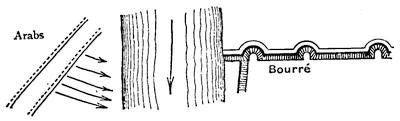
7.30 a.m.—Fight still going on, steamer coming up the river. 8.30 a.m.—Steamers went up and drove the Arabs off the right bank of the Blue Nile, who were enfilading our lines. The firing, which has been continuous for four hours, has pretty well ceased. Up to this we have had no killed or wounded, I am glad to say. During the night the Arabs on the left bank of the White Nile (Mahdi’s camp) fired three shells against the lines ending on right bank of the White Nile. A soldier fellaheen is thought to have deserted to the Arabs last night. 9 a.m.—The Arabs have collected in the vicinity of Omdurman Fort a heap of cows, who seem drawing down towards the fort. I have ordered Ismailia to go down. I expect they will drive the cows on to the fort, and try and explode the mines. The Arabs on the White Nile are firing on the lines with their Krupp. 10 a.m.—Arabs are leaving the vicinity of Bourré, and going back to their Dem near the White Nile. The Arabs near Omdurman village are firing across the river towards Mogrim.
The Austrian Consul when taking his morning ride was surprised at seeing two balls strike the water near, and so he returned. 10.45 a.m.—The battles are over, and all is quiet. What a worry all this is! The rockets from Omdurman drove back the advance of the cows; it was an ingenious attempt, if meant.[208]
I expect the Arabs fired away 30,000 rounds to-day. We had one man killed in small steamer, and one wounded; in the fort we had two wounded, and one man was wounded by bursting of rocket tube at Omdurman. I hate these rockets with sticks. Hale’s are the only decent ones; not that the sticks have anything to do with their bursting. The composition in these climates shrinks away from the case, and the fire flares up the whole of the exterior and interior of the rocket. I expect we are going to have a series of these festivities, which are so wearisome. In the Abbas there was a heap of money orders, &c., connected with the merchants here, so sure did they think she would get down. Six soldiers came in from the Arabs, also four slaves, who report the Arabs are thinking of putting a post at Halfeyeh. (I hope they will not.) The Mahdi has about 8,000 men of sorts with him. Slatin is in chains, also Saleh Pasha. Hussein Pasha Khalifa is great friends with the Mahdi. Omdurman captured sixteen cows when they came near the fort, also one slave. They killed one Arab. The men who came in say the Arabs mean to continue this day’s festivities every day. They do not seem to care much about the advance of the expedition, or are uncommonly confident or ignorant. I do not at all enjoy the thought of these daily festivities, they are “abrutissant,” as the Austrian Consul says.
It is very curious what a very little effect all our immense preparations at Dongola, &c., has had on the course of events; one may say they have not had up to the present the least, while I have weakened myself by sending down my steamers[209] and four hundred men (not, however, of the best quality). I expect we will have the festivity to-morrow on the White Nile end of the Lines, which is our weakest part. I must not be blamed at looking forward to a repetition of the past miseries; we truly have had a wearisome time for 241 days! Another soldier has come in; he says the Mahdi thought Kartoum could be bombarded from his new camp, but finds it cannot be done. If Lord Wolseley did say he hoped to relieve Kartoum before “many months,” he must have a wonderful confidence in our powers of endurance, considering that when he is said to have made this utterance, we had been blockaded six-and-a-half months, and are now in our ninth month. I am quite sure of one thing, that the policy followed up till lately (and the policy which may be carried out, of abandoning Sennaar, etc.) is one which will act detrimentally on our army; for what officer, if he was in a fortress, could have any confidence that it might not be thought advisable to abandon him. Her Majesty’s Government told me, or rather my friend Baring told me[210] I was not to leave Kartoum for the Equator until I had permission. I have his telegram (so that if it was possible, or if I could do it) if I did leave Kartoum, I should be acting against orders. This Soudan business will cost me £3000[211] beyond my pay, at least, which I will not ask them or allow them to pay. I shall get it from others, and I shall get another £1000 to buy Stewart’s journal, if he has been killed or captured.
Another soldier is in from the Arabs at Omdurman which fort has captured four more cows, that is twenty to-day (a cow is worth £20 in town!) £400! There is one thing which is quite incomprehensible. If it is right to send up an expedition now, why was it not right to send it up before? It is all very well to say one ought to consider the difficulties of the Government, but it is not easy to get over a feeling, that “a hope existed of no expedition being necessary, owing to our having fallen.” As for myself, personally, I feel no particular rancour on the subject, but I own I do not care to show I like men, whoever they may be, who act in such a calculating way, and I do not think one is bound to act the hypocrite’s part, and pretend to be friendly towards them. If a boy at Eton or Harrow acted towards his fellow in a similar way, I think he would be kicked, and I am sure he would deserve it. I know of no sort of parallel to all this in history, except it be David with Uriah the Hittite, and then there was an Eve in the case, who, I am not aware of, exists in this case. Remember, also, that I do not judge the question of abandoning the garrisons or not: what I judge is the indecision of Government. They did not dare say “abandon the garrison,” so they prevented me leaving for the Equator, with the determination not to relieve me, and the hope (well! I will not say what their hope was) (“March, April ... August, why! he ought to have surrendered, he said, six months”)—there is my point of complaint. The second is the FICTION that it is the Egyptian Government which governs Egypt; it is a silly story, for every one sees through it. Can one imagine a greater farce, than Lord Northbrook asking Towfik for the “assistance of Egyptian Government to carry out this, or that.” I expect the two roared with laughter over it (sorry I cannot manage a sketch of the scene). (Baring would never laugh, it is too serious, like jesting in church). The third grievance is that Treaty with Abyssinia, under the screen of the “FICTION,” (if it is true it has been made); however it is a dead letter, I am glad to say.
November 9th.—Four soldiers, five slaves, of whom two are women, came in, from the Arabs to-day. Desultory firing on and from the Arabs at Omdurman, and the White Nile Lines.
Of the men who came in, one is a slave of Slatin Bey. The Mahdi does not mean to fight direct; the Khalifas[212] and the Arabs want to fight direct. Omdurman killed some of their men; the Arabs have munitions; Slatin is in chains. These men brought in their rifles. The Arabs lost at Bourré heavily, some bodies came floating down the river to-day. A soldier came in from the Arabs. A few Arabs came and fired on the fort at Omdurman, and wounded a slave in it.
The people up here would reason thus, if I attempted to leave: “You came up here, and had you not come, we should have some of us got away to Cairo, but we trusted in you to extricate us; we suffered and are suffering great privations, in order to hold the town. Had you not come we should have given in at once and obtained pardon; now we can, after our obstinate defence, expect no mercy from the Mahdi, who will avenge on us all the blood which has been spilt around Kartoum. You have taken our money and promised to repay us; all this goes for nought if you quit us; it is your bounden duty to stay by us, and to share our fate; if the British Government deserts us that is no reason for you to do so, after our having stood by you.”[213] I declare positively, and once for all, that I will not leave the Soudan until every one who wants to go down is given the chance to do so, unless a government is established, which relieves me of the charge; therefore if any emissary or letter comes up here ordering me to come down, I will not obey it, but will stay here, and fall with the town, and run all risks. These remarks are produced by the extraordinary confidence of the Arabs, combined with the Abyssinian Treaty and other significant remarks in the newspaper Kitchener sent me—Gordon Relief Expedition—who, I expect knows more than I do, and that “that more is that the Expedition has come up for me personally.” I hope, if things do come to the worst, and that the Expedition goes back, my steamers (after abstraction of the Fellaheen troops) will be sent back to this place, with £150,000 which Baring promised me! (or as much as I wanted), and as much provisions as can be possibly spared; also a gun to replace the one lost (or said to be lost) in the Abbas trying to communicate with Europe and Cairo. Unless Zubair is absolutely required at Cairo, I would also like him to come up, or (to save appearances) allowed to escape. I hope that Stewart’s supposed death, if by treachery, will be avenged in a signal way, on the way down.[214]
A boy was captured, during the cow business at Omdurman, but he said his father was with the Arabs, so I let him go back.
I have now got all the “telegrams,” European, “sent from” and “received in Soudan” for “1883-84,”—splendid collection, full of interest. What would the Standard give for them? However, I think I can afford to be generous, and so I shall send them down with this Vol. VI.[215]
The fort at Omdurman captured twenty-one cows this evening; this is splendid—forty-one cows in two days.
The only original document I kept here, and which I was as near as possible giving to Stewart, is the Firman I have already mentioned, which I send with this,[216] proclaiming the abandonment of the Soudan by Towfik.[217] If the Mahdi had got this he would have crowed, though he may know of it, for I showed it, not knowing well its contents, to Hussein Pasha Khalifa (vide Stewart’s Journal, which went down, and in which I criticise my having done so). I felt inclined to give it to Stewart, who, I felt confident, would get down, because I thought if found with me the Mahdi might say, “Why, you had the order to give up the country from Towfik, and you did not”; but, then, I thought as I shall be killed ere he takes the town it does not make much difference if here or with Stewart, so I kept it. I call attention to the fact that every document (except above-mentioned telegrams, of which Stewart had taken copies) went down with him (Stewart), and that will show how sure I felt that he and Power would get down, for otherwise, if I had doubted, I would never have let my original instructions go; now I have not a single paper. I cannot quote textually: all went with Stewart; but I have my memory, and I even give you the Telegrams. I have not written any dispatch concerning Stewart or Power. I dare not, with my views, say their death is an evil;[218] if true. I am sorry for their friends and relations. Stewart was a brave, just, upright gentleman. Can one say more? Power was a chivalrous, brave, honest gentleman. Can one say more? Herbin, I liked very much; he was a most agreeable and gentlemanly Frenchman, and very sharp. The diplomatic ... called him names in a telegram; but I found him fairly just,[219] though naturally with a French bias. For my part I cannot see what harm the French can do us if they had a voice in Egypt; and I can see much good arising from it. I declare if they had had a voice in Egypt the present state of affairs would never have existed. If you can find no chivalry in your own house, you had better borrow it from your neighbour. We fired yesterday 41,000 rounds of Remington ammunition, and we fired less than the Arabs.
November 10.—This morning forty Arabs came down near Omdurman Fort, and fired on it—angry about the capture of cows last evening.
One soldier and one slave came in from the Arabs at Omdurman. Seven Arabs on camels went across from the Blue Nile towards Halfeyeh. I fear a reconnoitring party, previous to their putting a post there. To day is the day I expected we should have had some one of the Expedition here. Hicks’ defeat was known at Cairo on the 21st or 22nd November, since which reinforcements to extent of nine persons reached this place (up to date) from Cairo—“for which the Egyptian Government” (according to the fiction) “is solely and entirely to blame”!!!!!
The man who was wounded by the mine is dead. If man knew what the future would bring forth he would be pretty miserable. Look at the telegram on other side, written in December 1883.[220] I would not read those telegrams, or Stewart’s Journal, for a good deal, when I think how we kept feeding on delusions for so many months. A soldier and slave have come in from the Arabs at Omdurman; five more soldiers and three slaves came in later on in the day; they say Slatin is released from his chains; that there is a rumour of the advance of the Expedition direct on Kartoum from Debbeh; that Luigi and Yusef, two priests, are still in Obeyed, having refused to become Muslim; that the Arabs lost heavily at Bourré the day before yesterday. Why Kitchener[221] did not tell me the route the Expedition would take is inexplicable, for it could have done no possible harm, seeing the Mahdi has his spies everywhere, and it was easy to have couched this information in terms I could have understood, and the Mahdi could not have understood. The Fellaheen soldier did go to the Mahdi.[222]
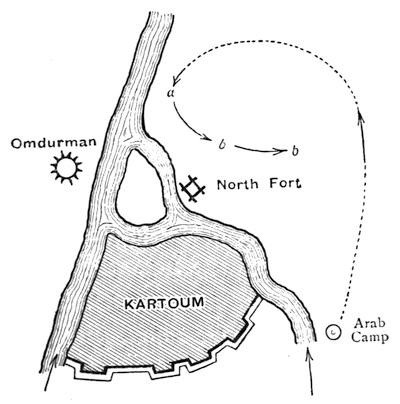
November 11.—This morning, 6 a.m., 200 Arabs came to north of Omdurman Fort, and fired vollies towards the village of Tuti and the Fort; the Fort answered, and the footmen of the Arabs retreated; then the Arab horsemen made the footmen go back again, and so on, four or five times; at last they retired. We had three soldiers and one woman wounded; only one wound was at all serious. Arabs must have fired five thousand rounds; evidently they do not wish much to fight. Nineteen Arabs came along the right bank of the White Nile from Halfeyeh to Goba, and captured a donkey, this even the Shaggyeh could not stand, and so I suppose one hundred sallied out and some fifteen horsemen; then came a running fight across the plain, but it was evident the horsemen would not head the Arabs; however, from the roof, it was evident four or five Arabs were killed, and the pursuit is still going on. You may imagine the Arabs have a good deal of confidence, for their nineteen men were distant at least ten miles of desert from their camp and were at a. They were going along b b when they were discovered with the captured donkey. Five at least of these Arabs got away. The Arabs are sure to come down to avenge this. Noon.—Arabs coming down from their camp. Ismailia getting steam up. North Fort reports (?) “Captures, 3 Remingtons! 3 spears! 3 swords! and the killing of 20? 5 got away?” The Arabs are halted on the sand hills. Five soldiers and one woman came in from the Arabs at Omdurman, report, “Arab rocket-tube broken; carriage of gun broken; the Arabs deserting; rumoured advance of the expedition; quarrels going on; Slatin in chains.” The Shaggyeh say they killed twenty Arabs, but they only say they captured nine arms, so eleven must have been unarmed!!!
It appears 93,000 okes + 166,000 okes = 259,000 okes of biscuit have been stolen in the last year, only found out now; however, we have now quarter of a million okes, which will see us only for a month or so. It appears that more than thirty of the principal merchants are engaged in the above robbery of biscuit. The process is not finished. One of the greatest problems will be what to do with those Shaggyeh, those Cairo Bashi Bazouks and fellaheen soldiers, whose courage is about equal,—perhaps the palm is due to the Shaggyeh. The twenty cows I mentioned as captured by the men of Omdurman Fort (making up forty-one captured cows, page 309) were driven in by five soldiers escaping from the Arabs and were not captured. They do not stick at a lie (and, in this, resemble some people in high places I know). 259,000 okes of biscuit was a good haul, nearly 2½ million pounds: worth £26,000 now, or £9000 in ordinary times.[223]
November 12.—Last night three slaves came into Omdurman. At 11 p.m. they reported Arabs meant to attack to-day at dawn. It was reported to me, but the telegraph clerk did not choose to tell me till 7 a.m. to-day. We had been called up at 5.30 a.m. by a violent fusillade at Omdurman. The Arabs came out in considerable force, and, as I had not been warned, the steamers had not steam up. From 5.30 a.m. to 8.30 Arabs came on and went back continually. All the cavalry were out; the expenditure of ammunition was immense. The Arabs had a gun or guns on the bank. Details further on, as the firing is still going on.
10.20 a.m.—For half-an-hour firing lulled, but then recommenced, and is still going on. The Ismailia was struck with a shell, but I hear is not seriously damaged. The Husseinyeh is aground (I feel much the want of my other steamers at Metemma). 11.15 a.m.—Firing has lulled; it was very heavy for the last three-quarters of an hour from Ismailia and Arabs; it is now desultory, and is dying away. Husseinyeh is still aground. The Ismailia is at anchor. What a six hours of anxiety for me, when I saw the shells strike the water near the steamers from the Arabs; imagine my feelings! We have £831 in specie and £42,800 in paper; and there is £14,600 in paper out in the town! I call this state of finance not bad, after more than eight months’ blockade. The troops are owed half a month’s pay, and even that can be scarcely called owed them, for I have given them stores, and beyond the regulations. Noon.—The firing has ceased, I am glad to say. I have lived years in these last hours! Had I lost the Ismailia, I should have lost the Husseinyeh (aground), and then Omdurman, and the North Fort! And then the Town! 1 p.m.—The Arabs are firing on the steamers with their two guns. The Husseinyeh, still aground; that is the reason of it. Firing, 1.30 p.m., now has ceased. The Ismailia, struck by three shells, had one man killed, fifteen wounded on board of her; she did really very well. I boxed the telegraph clerk’s ears for not giving me the telegram last night (after repeated orders that no consideration was to prevent his coming to me); and then, as my conscience pricked me, I gave him $5. He said he did not mind if I killed him—I was his father (a chocolate-coloured youth of twenty). I know all this is brutal—abrutissant, as Hansall calls it—but what is one to do? If you cut their pay, you hurt their families. I am an advocate for summary and quick punishment, which hurts only the defaulter. Had this clerk warned me, of course at daybreak, the steamers would have had their steam up, and been ready. We have a Krupp at Mogrim Fort. Ferratch Pasha reports he has dismounted one of the Arab guns. The Arabs had a show of four hundred horsemen, who kept far off. Telegraph was, and is, interrupted between this and the Omdurman Fort (whether by bullet or otherwise is not known as yet). Considering that the Arab mountain gun can (and has) made holes two feet square in the steamer, my anxiety is not to be wondered at. (I feel as if I had walked thirty miles.) We fired eighty-three rounds of Krupp at the Arabs from Mogrim, forty-three rockets. The Arabs fired three hundred and seventy rounds from their guns at the steamers. As for ammunition (Remington), we fired from our steamers, forts, &c., fifty thousand rounds; and I certainly think the Arabs fired as much, Omdurman certainly was “over-eager to fire on the enemy”[224] in the early dawn, and consequently wasted ammunition. This ends the greatest battle (as yet) of our second blockade. Spies (of last night) say it was undertaken against the Mahdi’s wish, by his Khalifa or Vizier, who persuaded him to allow it. During all through, the Arabs of the South and East never moved a peg. Like the Chinese, one may calculate, they will never assist one another.
This is our first encounter with the Mahdi’s personal troops. One tumbles at 3 a.m. into a troubled sleep; a drum beats—tup! tup! tup! It comes into a dream, but after a few moments one becomes more awake, and it is revealed to the brain that one is in Kartoum. The next query is, where is this tup, tupping going on. A hope arises it will die away. No, it goes on, and increases in intensity. The thought strikes one, “Have they enough ammunition?” (the excuse of bad soldiers). One exerts oneself. At last, it is no use, up one must get, and go on to the roof of the palace; then telegrams, orders, swearing, and cursing goes on till about 9 a.m. Men may say what they like about glorious war, but to me it is a horrid nuisance (if it is permitted to say anything is a nuisance which comes on us). I saw that poor little beast the Husseinyeh (a Thames launch) fall back, stern foremost, under a terrific fire of breechloaders. I saw a shell strike the water at her bows; I saw her stop and puff off steam, and I gave the glass to my boy, sickened unto death, and I will say my thoughts turned on ... more than on anyone, and they are not beneficent towards him. My boy (he is thirty) said, “Husseinyeh is sick.” I knew it, but said quietly, “Go down and telegraph to Mogrim,[225] ‘Is Husseinyeh sick?’” Answer, “No.” I asked again; answer, “No.” Then telegraph said, “She was aground.”
2.45 p.m. The Ismailia tried to take Husseinyeh off, and got struck twice, in addition to the three times before mentioned, with shells, so she desisted from the attempt. The Arabs are firing on the Husseinyeh. I have ordered the Krupp of Mogrim to play on the Arab guns, and shall wait till night to take off the Husseinyeh. She is nearer to the left bank than to the right bank; it is not clear if she is aground or half sunk (equally a trouble). 3.30 p.m. The Arabs are bringing their guns nearer to the aground or half-sunken Husseinyeh. The Ismailia reports that the two last shells have done her no material damage. 4.30 p.m. The Arabs have now three guns bearing on the Husseinyeh. 6 p.m. The firing has ceased. I hope to get the Husseinyeh off at night. 7 p.m. The Arabs keep up a dropping fire on the Husseinyeh, who, I hear, has two shell holes in her, and has six men, including the captain, wounded. I must say the Arabs to-day showed the greatest of pluck; over and over again they returned to the attack, though overwhelmed with the musketry fire of the castellated Ismailia. I think they must have lost heavily, for at times they were in dense groups. I believe that by the Arabs we may understand our own regulars captured in Kordofan and Darfur, &c. We are going to get the Husseinyeh off to-night if we can. No Royal Navy vessels would have behaved better than the Ismailia to-day; she passed and repassed the Arab guns upwards of twenty times, when any one well-placed shell would have sunk her. Whether the crew knew it or not does not matter. I did, and felt comfortable accordingly. The Arab guns were not 1,200 yards distant from her, and even less at times. She was struck five times with shell. Remember that the Ismailia, is only a superior penny boat, and that the Egyptian mountain gun is as superior to our wretched seven-pounders as a three-pounder is to a twelve-pounder Howitzer, both for range and for effect. You want a gun to make a hole, not a gimlet-hole, which these seven-pounders do, and what wearisome work to carry them!
All this worry is (humanly speaking) due to that chocolate-coloured clerk of the telegraph not warning me. This evening there was an ominous sign that the Arabs on the Blue Nile knew of our troubles with the Husseinyeh. They came up against Bourré, but two gunshots drove them off. At 4 p.m. the Arabs on the right bank of the White Nile fired twelve shells against the Lines, and opened a fire of musketry for a short time, but did no harm. I have given half a month’s pay to the Ismailia and to the Husseinyeh crews, and $2 for the men who have gone to get the latter off; she is not half sunk, but is aground. There is (8 p.m.) a fire on the left bank of the White Nile, opposite to Halfeyeh. The Arabs got into the ditch of the entrenched camp at Omdurman, which is theirs. We only occupy the fort x. Hicks’ army were in this entrenched camp. Arabs came to y.
8.15 p.m. The Arabs have still their guns on the river bank, and are firing at the Husseinyeh, whom I am trying, by my men, to get off. Evidently they are not cowed, for generally they take their guns back at night to their camp. Report from Husseinyeh steamer:—-10.20 p.m., Wounded, 6; killed, 3; efforts as yet are ineffectual as to taking off the steamer Husseinyeh.
November 13.—The Ismailia, 2 a.m., got struck by two shells (?)[226] going to take off the Husseinyeh, so we took her gun out, and her crew, and have left her. At 5.30 a.m., the Arabs commenced firing on the Lines at Bourré, and 7 a.m. I see they are coming across to Goba, bringing a gun with them. The Arabs at Omdurman are quiet. The Arabs have fired five times with their gun at the Omdurman Fort. The Arabs have got their gun at the village outside Sheikh Ali, near the end of the Lines on the White Nile, and have fired shells at the Lines. Our telegraph was cut yesterday evening with Omdurman Fort, and cannot be repaired (8 a.m.), for the Arabs are shelling that fort. The Arabs, on the North Side, have their gun on the low sandhills some 4,000 yards off, and are shelling us; musketry firing going on at Bourré. The Arabs had their guns last night defending the approach to the Husseinyeh. We are repairing the Ismailia; the barricade of the steersman of the Husseinyeh got struck by a shell. We raised a parapet on the river bank to defend any approach of the Arabs to Husseinyeh. Omdurman had yesterday a quarter of a million cartridges—Remington.
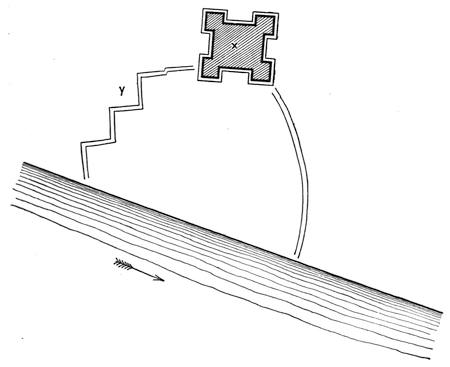
Omdurman Fort has one and a half month’s supply of food and water; it was a fault to place it so far from the river;[227] yesterday it had not its flag up; to-day it has. The Arabs have sent 250 men to Goba; but the village Hogali, which was the one close to the palace, having been levelled, they are too far off to do us any harm. There is a report in town, the Arabs say they will enter it to-morrow, and say their prayers in the mosque on Friday. The Arabs at Goba are wasting a lot of ammunition (Remington), their bullets do not reach us.[228] They will be bothered for water, for we filled up all the wells in Goba. 9.15 a.m. The Arabs have returned from Goba. 10 a.m. They have made a long détour,[229] and have gone to the prolongation of our lines at Bourré, on the right bank of the Blue Nile, where they are firing heavily. I expect we fired 50,000 rounds yesterday, and the Arabs rather more, while to-day the Arabs have fired a great deal. We calculate that with Hicks’ army was lost 1,000,000 cartridges, and now it is a year ago, during which time, with the firing there and elsewhere during a year, two-thirds of that million must have been expended, and they have no means to renew the cartridges; they cannot have much more than 300,000 rounds.
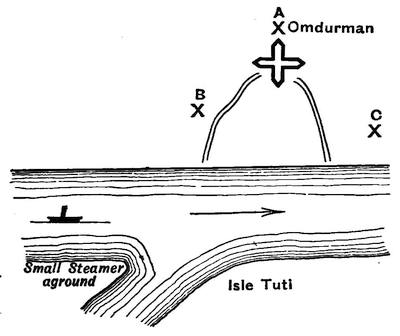
The Arabs have now gone from opposite Bourré (11 a.m.), having fired a nice lot of ammunition, and hurt no one in the fort. Omdurman Fort is still cut off from us; Arabs at a b c. The Arabs certainly got the best of it yesterday, though I expect they paid for it. It appears the Husseinyeh got aground through the captain, who was afterwards wounded, not doing what the Reis told him. Fortunately I had foreseen the likelihood of the fort at Omdurman being cut off, and had provisioned it. If the expedition comes at all, it ought to be here before long. We had fifteen men wounded yesterday, three rather dangerously, and seven were killed. I never feel anxious about any of the fights, except when the steamers are engaged, and then I own I am on tenterhooks as long as they are out. 1 p.m. The Arabs have got four guns down on the river, and are firing across the river at the Mogrim Fort, which is answering by Krupp and rockets. We are not fortunate with the little steamers I had brought out in sections from England; we have lost, at any rate temporarily, one, the Husseinyeh; another, the Abbas, where is she? And the Arabs have the third, the Mahomet Ali, on the Blue Nile. The Arabs fired four guns on the lines near the White Nile this morning (they fired sixty rounds). Musketry (3 p.m.) going on across river between our men and the Arabs. Certainly we have been left to almost the very last extremity, and I declare I think the year will be complete, from the time Cairo heard of Hicks’ defeat, to the time of the relief expedition arriving here!!! And I am sure, if an enquiry was made, it would be made out no one was to blame.
The Arabs have eighteen boats plying as ferry from one side of the White Nile to the other. They may try with these boats to get hold of the Husseinyeh, or else to board her; there are only some bags of biscuits on board; but as the steamer is blinded, if Arabs once get on board, it would be very difficult to dislodge them, unless we sink the steamer, for they will find the biscuit and so have plenty to eat. Fifteen shells fell into the town this morning, but did no harm.
Nearly all the Arab force which came on the north side to-day were slaves, with them perhaps forty horsemen Arabs. Eventually the Arabs will find out the inconvenience of these Mamelukes.[230] Four bullets came from the Arabs to the Palace to-day—2800 yards—and came with a good force. A native of Kartoum came and complained he had had nothing to eat for himself and family for four days; they found eight ardebs of dhoora in his house; in another house forty ardebs were found.
November 14.—8 a.m. The Arabs on both sides of the Blue Nile began firing on Bourré at 5.30 a.m., and it is going on now. They kept up for more than quarter of an hour a continuous roll of fire, and have wasted a precious lot of ammunition. They brought down one of their guns and fired a few rounds. Up to this time no one is wounded at Bourré.
Two men crossed from Omdurman, and report Ferratch Ullah as all right, and as having no men wounded in the fort. The Arabs fired their guns on the fort this morning.
An Arab tried to swim off to the Husseinyeh, whom (they say?) our men shot.
I wonder where King John is, with his 200,000 soldiers?
I argue thus: 1. It would be impossible for the Expeditionary Force, once having come to Dongola, not to move up to Metemma, or to the vicinity of Berber. 2. That once at Metemma, or at Berber, they will find the steamers, and consequently must communicate with Kartoum. 3. Once they communicate with Kartoum they must assume the responsibility of the government of that place (of course, when once that responsibility is assumed, the decision as to what they will do rests with them).
4. It is impossible for them to loiter long on the road between Dongola (or Debbeh) and Metemma.
5. It will be impossible for them, owing to the events of the last few days,[231] to avoid collision with the Arabs around Kartoum. A week ago it might have been possible, but now the Arabs are too close to the town to avoid it. Omdurman Fort being cut off will oblige action being taken to re-open communications. The Arabs may run away, but, somehow, since a few days, I doubt it.
A soldier came in from the North Fort from the Arabs this morning.
Another fib—they told me that they had got everything out of the Husseinyeh but the biscuit: it appears that the ammunition is still in her.
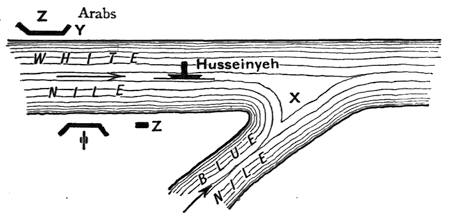
No church parade on the right bank of Nile (Kalakla), but one is going on at Giraffe on the Blue Nile. It appears last night that a boat went off to the Husseinyeh, that the men in this boat got frightened at the challenge of our own men and jumped into the water, and left their boat. I went down to Mogrim, and found the Ismailia has been struck by seven shells, and is pockmarked with bullets all over. The Arabs (some 400 rifles) line a long trench opposite the Husseinyeh: we have erected a parapet on our side opposite her. The Arabs have four guns, from which they kept up a desultory fire, doing no harm. The Arabs’ rifle-fire is continuous and futile, ours is less heavy, but I expect equally futile, for the Arabs keep under cover. The Arabs fired regular volleys, upwards of five, while I was there: they appear to delight in the noise. The Husseinyeh is about 1,200 yards from the point x, 800 yards from y, and 1,000 yards to z, where my trench is.
Husseinyeh lies just off the end of the entrenchment of Omdurman entrenched camp.
She has her stern to the Arabs.
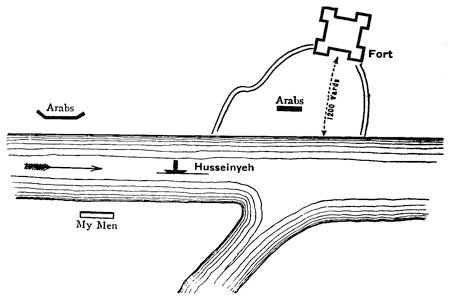
A soldier came in to the North Fort from the Arabs on the Blue Nile, and reports that a man with letters came the night before last to the fort of Omdurman and called out to the sentries, but before they could let him into the fort the Arabs captured him and the letters. I hope to be able to-night to communicate by bugle sounds with Omdurman Fort.
Revised list of the robbery; 172,000 okes of biscuit they change every day. We have to-day in the magazine 240,000 okes of biscuit, 1,326 ardebs of dhoora. Have ordered 1000 okes to be given away, and 4000 okes to be sold.
The Omdurman Fort is ill placed, as it cannot see the ground down to the river, and is distant 1200 yards from the river. The Arabs on left bank of the White Nile opposite Husseinyeh number 500 (I expect all are my soldiers), and they are so far away from any reserve that it would be easy to crush them before they were aided, if we dared to try, which we do not. I was at Mogrim Fort for half an hour, during which time the Arabs fired, as I calculated, fifteen shells and 8000 rounds, and no one was touched; indeed, where their bullets went I could not see nor hear. No stores could stand that, and up to sundown they were still at it with rifles and guns. Bourré, in spite of all the heavy firing, has no casualties; 80,000 rounds would scarcely cover our united expenditure to-day.
Reports from the Arabs at different times said the Mahdi had brought 200 (some say 120) camel loads of ammunition (Remingtons) from Obeyed—say 200, and say that each camel carried 2 boxes, each box 1000, so that he had, before he began, 800,000 rounds; he must have expended in the last week 250,000 to 300,000 rounds, and has left 550,000 rounds or 500,000 rounds. I do not expect he has 200,000 rounds left, which is his weekly expenditure if he goes on at the rate he is going now. We turn out on an average 40,000 rounds a week, and are well ahead of our requirements. Looking at the Arab gunners with my telescope, they never seem to bother themselves about aim, but just to load and fire. It is, of course, different when the steamers are in action. The officer in command of Mogrim Fort was wounded in the arm at sundown. The captain of Husseinyeh died to-day. We suppose that on board the Husseinyeh, are the men I mentioned as having jumped out of the boat last night on the challenge of the sentry, also a soldier of Omdurman who swam off to her with letters from Ferratch Bey, commandant of the fort, so we are sending off a boat to Husseinyeh to take them off. A workman in the arsenal was wounded to-day by a ball from Bourré, distant 2300 yards. The Arab fire on Bourré renders the vicinity of the palace far more dangerous than Bourré, the balls fall so plentifully around the Mudirat, which is close by, that the Greek consul was obliged to lay to for some time till the firing ceased: it is at least 2500 to 3000 yards from the palace to the place the Arabs fire from.
We have put the gun of the steamer Ismailia on the bank of the Nile, to cover the approach to the Husseinyeh; the Greek consul says “the balls fall like water” on the road leading to the palace. I believe a good deal, if you have the ammunition, in the dropping fire of rifles, even at three thousand yards; the balls that fell on the palace are fairly flattened, showing they have plenty of life to kill. The buglers have communicated with Fort Omdurman, who are all well. 8 p.m. to-morrow we will have signals with flags. Out of evil comes good—if Husseinyeh was not aground, the Arabs, instead of concentrating their force and attention on her, would have devoted it on the fort, which, cut off, would suffer; as it is now, the fort is unmolested. Bullets rained on the hospital yesterday and to-day, but did no harm! I calculate that the Ismailia has two thousand bullet marks on her.
November 15.—Last night we sent off a boat to the Husseinyeh, and took off the soldier of Ferratch Ullah Bey, who had come from Omdurman, also the ten men who jumped into the water from their boat the night before. Ferratch Ullah writes he is all well; he wants ammunition!!! he had 230,000 rounds three days ago: he says he has now 150,000 rounds, also he has regulars, 470, each 100 rounds, 47,000; he has irregulars, 170, each 200 rounds, 34,000 altogether; in magazine of fort, 150,000 rounds, and with the men 81,000; total ammunition in fort, 231,000 rounds: yet he calls for ammunition!!! Hicks took 1,000,000. The buglers communicated well with the fort at Omdurman; buglers then spoke the soldiers on Mahdi’s side, but they did not answer; we invited them to come over to us.
The five feluccas, which took the men off the Husseinyeh, were not seen by the Arabs. I sent an engineer to take off the steam-valves of the Husseinyeh; the five feluccas took off, this time, everything from Husseinyeh, biscuit, ammunition, &c., &c. It appears that the Arabs, who were watching the Husseinyeh, had gone off to Kerowé, opposite Halfeyeh; but this is doubtful.
At dawn the Arabs opened a heavy fire with the usual futile efforts on Bourré, also they fired with gun and musketry on Omdurman Fort.
At Omdurman Fort they have had, in the last few days, four killed and sixteen wounded.
A shell from the Arabs struck Husseinyeh yesterday, but did no harm, for she is well aground. No wounded at Bourré to-day by the Arab fire.
The Bimbashi, who was wounded in the arm yesterday evening, was lying on his angarep[232] when he was wounded: he thought it a secure place; he died to-day.
The Arabs from Omdurman side of the river have kept up a desultory fire of guns and musketry all day; but at sundown the fire was much heavier, and if the Arabs go on like that for many days, they will be out of ammunition, both gun and rifle.
It has turned out a benefit for us the Husseinyeh going aground, for the attention of the Arabs is devoted to her, and they fire scarcely at all on the fort at Omdurman; even if we had her, she could do little good: the other little steamer will be completed in twelve days.
I think I have been rather unjust towards the fellaheen soldier, for though he is not brave enough to take the field, he has done good work on board the steamers, and a good many of their officers and men have been killed and wounded (thanks to the policy that has been followed elsewhere) in a quarrel which does not concern them. These remarks are produced by a visit I made to the hospital to-day, when I saw the mass of the wounded were fellaheen soldiers, whom I put in the steamers, because, when in action, they could not run away, while I kept the blacks for the defence of the Lines. As I was leaving the hospital to-day, a dead man was carried out by four men in chains (convicts) on a stretcher, accompanied by two soldiers with fixed bayonets—to be buried as a dog! This is part of the glory of war! According to the demands for ammunition, we are firing away 40,000 rounds per diem; the officers ask for fresh Remingtons, as by the constant firing those they have are out of order. I feel quite indifferent, for, if not relieved for a month, our food supply fails, and even at the above rate of expenditure of ammunition we have fifty days’ cartridges. I like to go down with our colours flying. The Arabs are quite equalling us in expenditure, and they have no reserve of ammunition, or means of repairing their arms. I am going to call the new steamer the Zubair, after Zubair Pasha Rahama;[233] the town wanted it called after me, but I said, “I have put most of you in prison and otherwise bullied you, and I have no fear of your forgetting me.”
November16.—The Arabs quiet, little firing at Mogrim; I expect the Mahdi has found out that his men have been making away with his ammunition too fast, even as I have found it out. A small fantasie or church parade is going on near the Mahdi’s camp this morning.
The Arabs at the Mahdi’s camp have moved the camp further inland; they did this at sundown yesterday. It is on the tapis that they may retire altogether; if so it will be glorious. The camp opposite the Lines on South is much diminished, not more than five or six tents. The Arabs there have gone to Giraffe and El foun on the Blue Nile. With the exception of the Arab guns firing on Mogrim, and our guns answering, everything is quiet to-day. In a couple of hours the Arabs fired sixteen shells without the least effect. Their gun ammunition must be nearly expended. A woman was slightly wounded at Bourré this morning. The Arabs work on a regular principle with the captured black troops. They know that they will escape to us if they can, in the first instance, so they keep them on short rations, and promise them full rations if they fight us. They then force them into contact with us for (at first) appearance sake and to get the full rations; when in contact with us we fire on and kill some of them, then their black blood gets up, and they retaliate en bonne volonté, and are egged on by the Arabs, who say to them, “Now you have fired on the Government troops you are in for it; the Government will never pardon you,” and so thus we get no more deserters. It was the same way at Bourré, before we fired on the Arabs we got plenty of deserters, but when once we gave them a slating no more came in; they are compromised with the Mahdi’s cause, and afraid of us if they come in. The Janissaries were the children of Christian parents captured when young, and they fought with vigour against the Christians when they grew up. Scarcely ever is the true Arab in the front, so they say.
We have ninety men in hospital at present, of which fifty-four are wounded. We had one man killed, and one wounded at Mogrim to-day. A woman was wounded in the town yesterday. Report in town says seventy of our captured soldiers have deserted and have entered the fort at Omdurman.
Having been assured by my officers that it was a most terrible risk even to go along the bank near the Husseinyeh, even by night, owing to the Arabs’ rifle fire, and being extremely sceptical of the past (putting down the information given me as an excuse for doing nothing towards taking off the Husseinyeh the first night she got aground; and also as an effort to enhance the danger and daring of those men who did take off the ammunition, &c., the night before last), I went down to-night at 11.30 and found it was all a myth, and that if I wished I could take her off without any risk. However, as she is a target and occupies the attention of the Arabs, who leave the fort at Omdurman alone in consequence of her, I shall leave her as she is. Of course, needless to say, I found all the officers in charge absent; they had gone home to bed! However, I am not put out at it. They are, as a rule, the very feeblest of the conies, and nothing will change their nature. The Husseinyeh lies close to the junction of the White and Blue Niles, and one may say is within our lines.
I daresay this is a repetition, but if we do get out of this mess it is a miracle, for I do not think a slacker lot of officers ever could be found, but a bad workman always complains of his tools. A good workman turns out good work however rotten his tools may be.
November17.—It is really amusing to find (when one can scarcely call one’s life one’s own) one’s servant, already with one wife (which most men find is enough), coming and asking for leave for three days, in order to take another wife. Yet such was the case, a few days ago, with one of my servants.
The Arabs this morning fired from their guns from Bourré, from the White Nile, and from Omdurman; they are also keeping up a musketry fire. At the Mahdi’s camp they had another “church parade” to-day. I suppose they are working up their fanaticism. The Arabs have a Nordenfeldt opposite the little steamer Husseinyeh. The town people are pleased at the new steamer being called the Zubair; the Anti-Slave Society will be furious.[234] If Zubair had come up, I should have had news long before now.[235] It does seem ridiculous that when our apparent policy is to hand over the Soudan to the Mahdi, who with his people are far more slave hunters than Zubair ever would be, we should not have utilized this man in this expedition. There are about two hundred people on the Isle of Tuti, yet last night an Arab came over, killed a man and carried off three donkeys; they do not deserve the name of men. How Zubair would touch up these fellows; he would go to Tuti and give all the men between eighteen and fifty at least thirty blows of Kourbatch. I am obliged to content myself with lamentations.
(“Count the months—March, April, May, June, July, August, September, October, and half November! Why, I declare, it is a breach of contract.”[236])
If it be true about the repulse of the Abyssinians at Keren, I expect there were roars of laughter in Downing Street at the greenness of His Majesty the Emperor John (as Mitzakis calls him). It is very odd, but we have had no news of Kassala for months, not since September ... to .... “You said it was too dreadful; what will you say when I tell you he has made sketches of you and ME? and how, horrible to relate, put them in his demi-official journal; and we can do absolutely nothing, for if he is attacked as being a British officer, he says he made the sketches as Governor-General, and vice versâ.”
Independent of my regret for Stewart, the loss of his journal affects me, for there were lots of things in it of interest. All the powers (including the Pope, and excluding England and France) were appealed to in a touching memo., to raise an auxiliary force under Baker, &c., &c., and to stop the wave of Dervish fanaticism. I also wrote to the Sultan. I do not know if these appeals ever got through, but Stewart had them all copied in his journal. Events and my discourses had almost made him latterly, as vicious as I am. Baring’s ears ought to have burned, for the last eight months, he was nicely dissected by us all (Power aiding). If Herbin, the French Consul, had got down Baring would have had a time of it, for Herbin says that Barère, the French minister, went to Baring before Herbin left, and Baring did not tell (Barère) any thing about the evacuation of the Soudan. Of course Baring will shelter himself under the “fiction” that he, as British minister, had nothing to do with it. What a farce, if it did not deal with men’s lives.
When one thinks that Baring works harder than a galley slave for such wretched results, one ought to pity him.
I have sent 150 of these superior troops (the Shaggyeh), to the Isle of Tuti, in consequence of the outrage of last night (which I do not believe in, for that one man came over and killed another man, and carried off three donkeys in a small boat is absurd). However, the Shaggyeh are safer in the Isle of Tuti than in the North Fort. At 7 p.m. the Arabs came down and fired on Bourré from the left bank of the Blue Nile. The officer (a full colonel of my creation), asks me “Is he to fire back?” I said, “Better not ask me that question, unless you want to catch it.” 7.15 p.m. Omdurman Fort is firing away. I certainly lay claim to having commanded, more often than any other man, cowardly troops, but this experience of 1884 beats all past experiences; the worst of the matter is, that you cannot believe one word the officers say. With respect to the major who was absent from the Fort Mogrim last night, he says he was in the telegraph station, which is a direct falsehood. However, I did nothing to him, more than call him a liar, which he probably considers a compliment. A sort of adjutant-major, whom I had borne with for a long time, told me two cold lies in two days, so I bundled him out. Can it be wondered at that, after nine months and more of this sort of military worry, and ditto of civil worry, I am heartily sick of the whole affair, and provided I am not made a party (and I will not be) to a shabby retreat, I should be glad to be out of this place.
The Arabs fired fifteen shells against the Fort of Omdurman; only one seemed to strike the keep; one man was wounded at Mogrim with the splinter of a shell. The Arab gun-carriages must be in bad state of repair, for our carpenters are continually at work making new ones, and the Arabs have no means of so doing. The Husseinyeh lies just off the division of the White and the Blue Niles, and not as I showed her position, page 327. All the scratched out portion is abuse of Baring.[237] Some one said, “If you feel angry, then write your angry letter, and then tear it up.” It certainly does relieve the mind to write one’s bile, and it is good also to scratch it out, for I dare say Baring is doing his duty better than I am; he is certainly more patriotic, if patriotism consists in obedience to the existing Government of one’s country.[238]
Doctor reports that the shells and bullets of the Arabs fell all around the hospital this morning, but did no harm, they came from Bourré.
November 18.—Everything quiet all round the place; they fired a few shots with their guns at the lines near the White Nile.
11.30 a.m. The Arabs on the right bank of the Blue Nile have moved towards the north, and, from the number of porters, I expect they are going to form a camp to the north.
It may be turned as one likes; three prominent undeniable facts exist. Her Majesty’s Government refused to help Egypt with respect to the Soudan, refused to let Egypt help herself, and refused to allow any other power to help her: this cannot be disputed or explained away. Lord Dufferin’s despatch was “hands off.”[239] The resignation of Cherif was the prohibition of allowing Egypt to help herself. This tardy succour under pressure, and Baring’s despatch, establishes the unwillingness to help.
The Arabs have settled down in the old Dem they occupied in March last!! opposite the palace, and which they evacuated in August; their vicinity will give us more spies, which we have lacked hitherto; this proceeding does not show as if they were much appalled at the advance of the expeditionary force. On the 12th March they pitched their tents on the very spot they are pitching them now—251 days ago—during which we have night and day been in hostilities with them, and been obliged to keep on the alert “because of?” “because of?”—“What?” The answer has been worn threadbare.
The Arab guns on Omdurman side firing 1.30 p.m. on Mogrim. They have expended a lot of gun ammunition in last few days. 3.30 p.m. They are still firing; one can distinguish the Nordenfeldt. I remember how, when Hicks left for the Soudan, papers wrote of the great effect that the Nordenfeldts were to have upon Arabs, like the French before the Franco-Prussian war with their mitrailleuses. At 4 p.m. they fired for a quarter of an hour quickly. This was caused by five cows which approached the Fort, the men of which killed three (so to-night they will have meat). The Arabs fired fifteen shells one after the other against the Fort, for the outrage on their property. I shall have to move these superior troops (the Shaggyeh) out of the North Fort, for the approach of the Arabs has filled them with dismay. I have kept moving them from every place the Arabs came near. It is really absurd that one should have to pay and keep such troops. I will say Ferratch Pasha (however irritating he is in some ways) is always the gentleman, which I am sorry to say I am not, with the fury I get in on state occasions. A woman came in from the south front; she says they were all my old soldiers who are fighting on the left bank of the Nile, and that they lost heavily on the day Husseinyeh got aground. I am moving these Shaggyeh to the lines; it is no use exposing them to be attacked. The Arabs now on the north front opposite the palace are the men of the Mahdi, not as before the men of the Sheikh el Obeyed, who do not seem to have entered cordially into the second blockade of Kartoum. We had to-night the Arab forces all around us, and are regularly hemmed in, but the town does not care a bit, and are fighting questions of pay with me, for I am paying in paper the three months’ backsheesh I promised them.
The major who was shot when lying on his angarep, and who died of his wound, was 3,000 yards distant from the Arabs. We do not know yet the effect of the rifle in a dropping fire. I offered, in paying the three months’ backsheesh to the troops, to give orders for bulk sums £120, £130, but they refused to accept them; they want the regular paper money, so I have issued £10,000 more in £50 notes. In this paper money notes I am personally responsible for the liquidation, and any one may bring an action against me, in my individual capacity, to recover the money, while in the orders it might be a query whether they (the authorities of Cairo) might not decline to pay the orders. Paper money now cannot be bought at a discount. People have tried to buy it up, but they failed.[240] I consider this is very satisfactory for one’s credit. Her Majesty’s Government, as well as the Soudan people, will not need to name a vessel after me in order to remember me, even if they felt so disposed, which I very much doubt. We shall get lots of spies in now the Arabs have hemmed us in. In these deserts, if you leave a space unguarded you see at once any one moving over it; but if you surround it entirely, there is the usual going to and fro, and thus a spy slips in. I do not think it is realised what happened in Hicks’ defeat a year ago. 10,000 soldiers, including 2,000 cavalry, 4,000 camp-followers, 7,000 camels, perished in two days from thirst;[241] 1700 rifles, 1,000,000 rounds Remington ammunition, were captured; 7 Krupps, 6 Nordenfeldts, 29 mountain guns, with 500 rounds each, were captured (perhaps 300 men were spared out of the host). Eight Englishmen and 8 Germans were killed, and, according to all accounts, they were so exhausted that they were unable to move. Stewart took great pains to get all the details, and wrote them in his journal. The Arabs have made a pyramid of the skulls. The major who was wounded at Mogrim was sleeping in the telegraph station in the Fort. He found it hot, and went out and got struck and died. If you went to the Fort at Mogrim you would (on seeing the position whence the Arabs fire) say you were as safe there as in Regent Street. This man was a very timorous man, and had avoided every service of the least danger. It is of no use fighting against your destiny. The doctor described to me to-night the state of the town a year ago, when they heard of the defeat of Hicks; and one compares it to our present state, when one may say perfect confidence exists in the town, and every one has gone comfortably to bed—it is a lesson to man to never despair.
November 19.—The Arabs came down, 7 a.m., to Goba, opposite the Palace, and fired, but did no harm; they are pulling down Seyd Mahomet Osman’s house, which was spared. Ferratch Ullah did not dare to go out for the three cows killed last night. The Arabs had a bugler of ours with them at Goba; he bugled a call “1st Regiment!” and then was apparently stopped, he then bugled “We are strong! We are strong!” I have packed up and addressed to the chief of staff, Soudan Expeditionary Force, “all European telegrams sent from and received in the Soudan for years 1883-84,” and send the box with this portion of the Journal.[242] The Arabs have put a gun in the breastwork on the left bank of the White Nile below Omdurman Fort, so as to bar the entrance to Kartoum on the north.
We have communicated with Omdurman Fort with flags, it is all right. The Arabs are not firing to-day (since 8.30 a.m.). Twelve days have to elapse ere the month’s rations become due; this evening it is reported to me that those utterly useless troops—some fifty Bashi Bazouks—began crying that they had nothing to eat, and even went so far as to throw down their arms; now this is rather too much, considering that they are receiving the full rations of soldiers, and also the pay of men who are supposed to find themselves, so that it is a perfectly gratuitous gift to give them rations at all, or if I do so, I should cut their pay; the best of it is, that I have given them full rations for the month, which has twelve days yet to run ere that month is out. I do not know if ever the expeditionary force will come here, and I do not know the policy which will be pursued; but there is one thing I think I am justified in demanding, that is the disbandment of these brutes, to whom only yesterday I gave a gratuity of fifty dollars to erect their breastwork—a totally unnecessary proceeding on my part. Of course if I can hand over the government to the Expeditionary Forces’ Leader I have nothing to say; he can do as he likes. What irritates me is, that a row like this is aided and abetted by every officer, inasmuch as it is to me the row is brought, they daring not to decide; of course, it must be seen, that situated as we are, if one corps can take rations for a month and eat them in a fortnight, and then get more, it is virtually giving double rations to the troops, for if you gave to one part, all the rest would want it.
November 20.—A caravan of 300 men and twenty camels came up the left bank of the White Nile, from the direction of Metemma. 7 a.m. A soldier who came in from the Arabs, says, “The Mahdi sent 2,000 men down towards Metemma on account of the advance of the Expedition, who are near Berber.” Also “reports the advance of King Johannes” (which I doubt). I expect the caravan seen to-day is a caravan with the money from Berber. Report in the town says the Arabs have been repulsed three times by the Expeditionary Force. The Arabs are very quiet to-day; their Nordenfeldt kept on grunting at intervals this morning. Four of those precious troops the Shaggyeh (one a Bashi Bazouk), have deserted to the Arabs; it was never reported to me. I have a suspicion that more have gone. We communicated with Omdurman Fort by flag-signals; they are all right. The Arabs fired from their guns on the White Nile, and from the Omdurman side, a few rounds this evening.
It is rather astonishing to find that the row about the rations the night before last, was made by the Cairo Bashi Bazouks, who are completely at one’s mercy, for the Arabs would never look at them;[243] they even went so far as to throw down their arms! A volley of lies was told about this affair, trying to prevent me hearing the truth. However, I got at the bottom of it, and have noted my friends. A merchant here had a partner in business, who went to the Arabs eight months ago with £3,000 belonging to this merchant, who coolly asks me to pay the £3,000!!!