THE PHILADELPHIA COUNTY PRISON AT HOLMESBURG.
Reading edition
The Philadelphia County Prison, located at Holmesburg, between the Philadelphia and New York Railroad and Torresdale Avenue, about 6 miles north of the City Hall, and known as the new jail, was erected some 15 years ago. It occupies a plot of land containing about 21 acres. The wall which encloses the buildings sets back from the outer line of the property about 30 feet, so that the acreage of the interior is about 18 acres. The stone walls are 35 feet in height above ground and 12 feet under the surface, so that the entire height of the masonry is 47 feet. The wall is 6 feet wide at the top and about twice that width at the base, and entirely enclosing four sides of the tract. The cost of this wall, including labor and materials, was $835,000.
In the center of the building is a rotunda 80 feet in width and about 70 feet in height, surmounted by a lantern. From this center six one-story corridors, or blocks, radiate like the spokes of a wheel. These vary somewhat in length, but average about 330 feet, and there is an average of about 70 cells in each. The floor space of each cell is 8×18 feet and the ceiling height is 13 feet, surmounted by a skylight. Of these corridors, A, B, C, and D are occupied by white prisoners, and two of the corridors, E and F, by colored. The number of prisoners at this date, February 1st, 1912, is 715, about ninety less than at this time last year. About 60 per cent. are white and 40 per cent. colored. All the prisoners are men. All women convicts are sent to the Moyamensing Prison.
The total number of cells is 440, and usually each cell is occupied by two prisoners. Every cell is provided with a wash basin with running water, a closet, two iron bedsteads, a table and one or two stools. Each bedstead is provided with a mattress stuffed with 25 pounds of hand-picked corn husks and a 7-pound pillow of the same material. Beside a pair of sheets and pillow cases each prisoner has two 4-pound blankets of excellent quality.
When a prisoner enters he undergoes a careful examination and a very complete record is made of all his personal characteristics. He then goes to the bathing room. An entirely new suit of clothing is given him, and the clothing with which he entered the prison is tied up in a sack, to which his name is attached by a tag. The sack is then placed in a room provided for that purpose, where it remains until his discharge from the jail.
Wednesday and Thursday are bathing days, and each prisoner is required to take a bath at least once a week unless the physician certifies that the condition of the prisoner’s health would render bathing inexpedient. A change of bedding and underclothing is supplied to each prisoner on every Saturday.
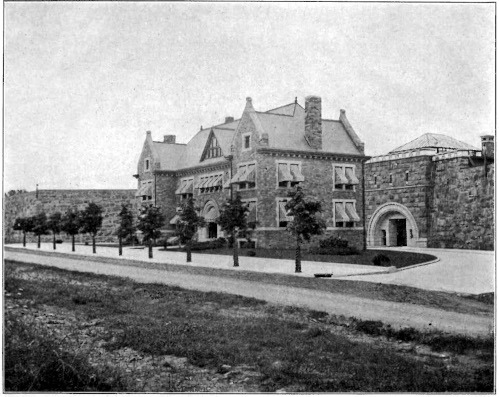
Office of Administration, Philadelphia County Prison for Convicts, at Holmesburg
About 200 of the prisoners are employed in various trades, in carpentering 7, on tin work 2, making mattresses 2, as tailors 14, shoemakers 20, making brushes 10. These all occupy separate apartments. In one additional apartment there are 15 hand looms, on which are made the muslin used for sheets, etc. About 18 men are employed in connection with this weaving. There are in the same apartment 24 stocking weaving machines, employing one man each. About 20 find employment in the laundry, and beside these there are about 70 men employed in various duties, to wit: 14 men in cooking, 14 in the bake house, 6 in the boiler room, etc. The men employed in these various engagements have their meals in a dining room apart from the other prisoners, a room having 6 tables, seating 12 each.
The kitchen for this great establishment is a very spacious one and very complete and convenient in all its appointments. There are 6 large steam heated copper boilers intended for making soups. In these boilers 250 gallons of soup are made per day during 4 days of the week and an equal quantity of what is known as Irish stew on the other 3 days. The basis of the soup and stew is fresh beef or mutton.
From 700 to 800 pounds of fresh meat is furnished to the jail every day and is hung in a cold storage room, ready for use as wanted. There is in addition another storage room in which are stored a great quantity of canned tomatoes, barrels of rice, barley, etc., etc.
The bakery is also very spacious with 4 arched ovens and 4 kneading troughs. Eight barrels of flour are converted into bread every day, excepting on Sunday, a double quantity being baked on Saturday. The number of loaves baked averages about 900 daily, the weight of each being 2 pounds, this being a proportion of something more than one loaf a day to each prisoner, and it is worth while to add that the bread is uniformly baked and of unimpeachable quality.
Still another large room is used for the production of chocolate and what is called coffee. It is necessary to state that no coffee is used, but the article which passes by that name is rye, which is roasted and ground and boiled in copper boilers; 25 pounds of this material is used every morning and suffices to furnish about 3 half pints to each prisoner.
An equal quantity of chocolate is furnished for the supper. A dessert of prunes is furnished each prisoner on every Friday.
The boiler room, some 30×80 feet in dimensions, requires the attention of 6 men, and from this room an extensive system of steam piping permeates every portion of the buildings and furnishes the power for the engine and for the electric lighting. Electric lights are throughout all the premises, including each cell.
An ample supply of filtered water is furnished by the Holmesburg and Tacony Water Co., for which the jail pays $2,000 per annum.
The city had under consideration a proposal to purchase this water company, but the price at which it was valued, $146,000, seemed to the authorities too high.
There are in the prison at this date 9 cases of tuberculosis. These occupy cells entirely apart from the other prisoners, cells which open out on one side to the open air. The patients have liberty within and without, as their own pleasure and convenience suggests, and when the weather is suitable most of their time is spent in walking or lounging in the prison yard. Besides this, there are but few cases of sickness in the prison at this time.
Up to within a recent period, the prisoners all wore striped clothing, but on June 1st of last year this mark of distinction was abolished and the prisoners were all given new suits free from any distinctive mark. The striped clothing is now worn only as a punishment for misdemeanor and for which purpose there has been so far only little occasion. The exhibition of a suit of striped clothing to a prisoner or the mere mention of a possibility of his being compelled to wear one, has been found sufficient in most cases to subdue and bring the most obdurate prisoners to terms.
There is a library of about 5,000 volumes. Each prisoner being furnished with a catalogue is permitted to select as many as 2 or 3 books a week, the keepers often kindly assisting in making suitable selections. Two or three men are constantly employed in the care of the library and in rebinding the books, which become much soiled or in need of rebinding.
There are religious services in each corridor on Sunday afternoon, and at the close of that service the choir of colored men, numbering about 20, give sacred singing from the center of the rotunda, much to the enjoyment of the prisoners, all of whom can hear distinctly, even from the farthest extremity of the corridors.
A very interesting and commendable condition of the Holmesburg Jail is that the use of tobacco is prohibited. This prohibition includes the use of chewing or smoking tobacco or cigars, and extends not to the prisoners only, but to all the keepers. It is said that although this is a hard experience to a large majority of the prisoners on entering, they soon adapt themselves to it, and from the standpoint of health are undoubtedly better off for this abstinence.
The entire cost of the maintenance of this jail after deducting about $5000 each year for sales of manufactured articles or of waste materials, is a little less than $100,000, which money is appropriated by City Councils.
If the chief aim in the erection of this prison was to secure a place of confinement from which there would be but the remotest possibility of escape, the end has certainly been attained, but no one could go through the buildings and observe their harmonious and intelligent adaptation to all requirements without the conviction that the health and physical comfort of the prisoners had been made the chief consideration. The visitor, however, will have much occasion for dissatisfaction on finding that the majority of the convicts are without employment, but this is no fault of the Inspectors, who are charged with the administration of the affairs of the prison; the law of the State is at fault in that it limits to 35 per cent. of the whole number of convicts those who may be employed in any of the trades, and, as a consequence, the greater number of men are compelled to remain idle.
Notwithstanding this very much to be regretted condition, too much cannot be said of the good order and effective discipline which prevails at the Holmesburg Prison. A striking example of that was had at the time of a great storm which occurred in the summer of 1911, which overturned a tall chimney stack and unroofed a portion of the buildings. No effort was made by any prisoner to escape or in any way to take advantage of the unfortunate circumstances, but the utmost good order and propriety was observed by all of them.
J. L. B.