Western Indians
Reading edition
With an introduction, copious Historical Notes, and Maps of the Battle-field of Newtown and Groveland Ambuscade
BY GEN'L JOHN S. CLARK
And parts of other Journals never before published.
Also a Biographical Sketch
BY REV. CHARLES HAWLEY, D.D.
President of the Society.
AUBURN, N.Y. 1879.
TWO HUNDRED AND FIFTY COPIES. Number 7
KNAPP & PECK, Book, Job and Commercial Printers, Auburn, N.Y.
CONTENTS.
Pages.
Biographical, 7 to 19
Introduction to Journals, 20 to 22
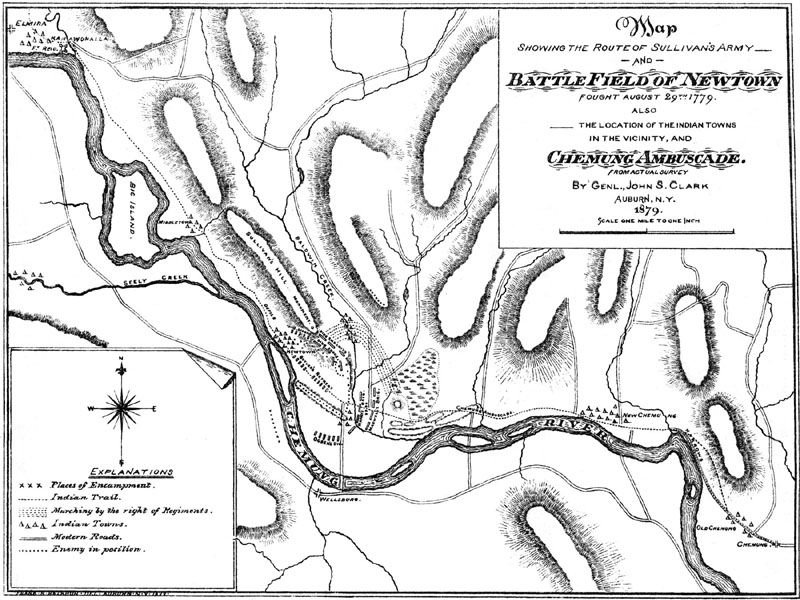
Battle of Newtown, Map, 44 to —
Hardenbergh's Journal and Notes, 23 to 59
General James Clinton's March, 60 to —
Beatty's Journal and Notes, 61 to 68
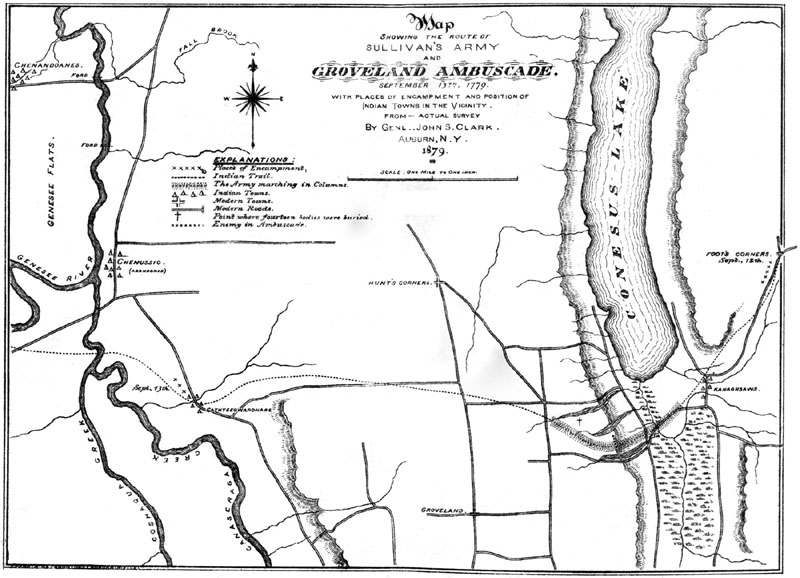
Groveland Ambuscade, Map, 50 to —
Expedition against the Cayugas, 69 to 70
Thomas Grant's Journal and Notes, 70 to 73
George Grant's Journal and Notes, 73 to 75
Colonel Dearborn's March, 76 to 77
Dearborn's Journal and Notes, 77 to 81
Indian Towns Destroyed, 82 to 87
List of Journals and Narratives, 88 to 94
BIOGRAPHICAL.ToC
John Leonard Hardenbergh, the author of the following Journal, was a native of Rosendale, Ulster County, in the Province of New York, born in the year 1748. He was the son of Leonard and Rachel Hardenbergh, and the youngest of seven children. The family name is one of the oldest in the State, and is prominent both in its colonial and revolutionary annals. As early as 1644, Arnoldus van Hardenbergh a "free merchant" emigrated from Holland to New Amsterdam "with a cargo of wares for sale in the colony." He was soon after selected as one of the original Nine Men of New Netherland, and served in this board from 1647 to 1650.[1] He was followed in, or about, the year 1652, by his brother Johannes van Hardenbergh, also a merchant from Amsterdam, who at this date was purchaser of "a house, lot and garden" on Manhattan Island. (Calendar, Hist. MSS. in office of the Secretary of State, Albany, Part I, vol. iii).
The branch of the family that was subsequently settled at Rosendale, is traced to the year 1706, when Johannes Hardenbergh, with six others, obtained from the crown of Great Britain a grant of land which comprised, as computed at the time, 1,500,000 acres, located in Northern Ulster, then including a portion of the present county of Sullivan,—the western boundary extending to, or near the head of, the Delaware river. The terminal syllable of the name, bergh, indicates that the earlier ancestors in Holland were from the hills; and it was quite natural that their descendants should have found permanent location in the hilly districts of Shendaken and Shawangunk, stretching westward from the valley of the Hudson; neither is it surprising that they should have loved freedom and have given their best efforts for its establishment in their adopted land.
At the outbreak of the Revolution, Col. Johannes Hardenbergh, Jr. was placed at the head of the Committee of Safety for Ulster County—Kingston, its chief town, being at the time the seat of the New York Provincial Congress of which he was also a member. He had ranked as Colonel in the English colonial service, and been active in military affairs as early as 1748, when Sir William Johnson was in command of the New York troops for the defence of the frontier against the French and Indians. He was also given command by the Provincial Congress of one of the earliest regiments raised for the immediate defence of the Hudson above the Highlands, at the opening of the war of Independence, and from his experience and position was enabled to render distinguished service at that critical period. In 1786, three years after the return of peace, he removed from his farm in Rosendale to New Brunswick, N.J., to spend the remnant of his days with his son, Rev. Dr. Jacob R. Hardenbergh, the first President of Rutger's College.
Leonard Hardenbergh, a younger brother of Col. Johannes, Jr., and the father of the subject of this sketch, died July 7, 1776, only three days after the adoption of the Declaration of Independence, and as his neighbors of the hardy yeomanry of Ulster, were leaving their harvests ungathered and marching to the defence of Fort Montgomery, one of the principal fortifications guarding the passes of the Hudson. In the official returns for the same month (July) the name of John L. Hardenbergh appears as First Lieutenant in the Second New York Militia under command of Col. Morris Graham, and assigned to the Brigade of Gen. George Clinton, who had remained in the Continental Congress to vote for the Declaration, when he hastened home to his command. Having served several months in this regiment raised under special call, Hardenbergh was commissioned Nov. 21, 1776, First Lieutenant in the Second New York Continental Regiment, under Col. Rudolphus Ritzema,[2] who was superseded Nov. 30, 1776, by the appointment of Col. Philip Van Courtlandt, a gallant officer and a personal friend of Washington whose confidence he shared to an unusual degree.[3] The regiment had the previous month been in the battle of White Plains, under Lieutenant-Col. Weissenfels, where it did some hard fighting; and was ordered by Washington to Fishkill for the winter, to be recruited and disciplined, and thus ready for active service in the Spring. But few enlistments, however, were obtained, though several recruiting parties were sent out for the purpose; and in the Spring of 1777, it was ordered to Peekskill, a point for the collection of military stores, and where at this time large quantities had been gathered under protection of General McDougall's brigade. Soon after, a fleet of ten British ships or transports appeared in Peekskill Bay, and landed a force of five hundred men with four pieces of artillery, which compelled Gen. McDougall, who had scarcely half that number of troops, to retreat to Gallows Hill, about ten miles in the rear, leaving what stores could not be removed, in the hands of the enemy, who remained in possession of the town until McDougall was reinforced, when they retired to their ships and returned to New York.
After several weeks of hard and perilous service, Col. Van Courtlandt with his regiment, was ordered to Albany and thence to the relief of Fort Stanwix, then besieged by Colonel St. Leger with a party of Indians; but on information that the enemy had retired, he joined General Poor, then on the advance to Stillwater, to whose brigade the regiment became attached, and thus made a part of General Arnold's command, forming a portion of the left wing in the first battle of Stillwater, which was fought on the 19th of September. The loss of killed and wounded of the Second New York was two out of eleven, which was a larger proportion than of any other regiment engaged, the next largest being that of Col. Cilley's First New Hampshire, which was one out of seven, all of General Poor's Brigade.[4] At the second battle, which occurred on the 7th of October, the regiment sustained its reputation for determined bravery and hard fighting, and thus bore an honorable part in the most important engagement, thus far, of the war, the results of which changed the whole aspect of the American cause.
After the battle of Stillwater, which compelled the surrender of Burgoyne, and rendered fruitless the previous successes of the enemy along the Hudson, the regiment returned to Fishkill, and soon joined the army under Washington, then confronted by the British forces under General Howe, in the vicinity of Philadelphia. It shared the privations and sufferings of the terrible winter encampment at Valley Forge, (1777-8) the march to which of the half naked, half-starved, shoeless army might be tracked in blood through the December snows. It appears from an orderly book[5] found among the papers of Colonel, afterwards Gen. Henry Dearborn, also in the Sullivan expedition, that at Valley Forge, Hardenbergh was Lieutenant and Adjutant of his regiment and often served as Adjutant of the Day at Head Quarters. The whole encampment consisted of about eleven thousand troops; and when it was broken up the following Spring, upwards of three thousand men unfit for duty were left behind, under charge of Colonel Van Courtlandt, while his regiment proceeded with the main army, and participated in the battle of Monmouth, June 28, 1778, winning commendation for bravery and good behavior in that hotly contested engagement.
While at camp with the main army at White Plains the same season, the Second New York Regiment was sent to guard the frontiers in Ulster County against the depredations of the Indians under Brant, who had already destroyed several houses and murdered men, women and children. It remained in the neighborhood of Laghawack, on this duty, during the winter of 1778-79; and in the Spring while on the march to surprise Brant stationed on the Delaware with about one hundred and fifty Indians, an express from General Washington overtook the regiment with orders to proceed to Fort Penn, there to await orders from General Sullivan. It is at this point that the Journal of Lieutenant Hardenbergh, herewith published, dates.
On its return from the Expedition, the regiment proceeded to Easton, Pennsylvania, and from thence to Morristown, N.J., where it was hutted for the winter. In the spring of 1780 it was sent to Fort Edward for temporary service, and in June proceeded to West Point, and in expectation of an attack from the enemy, was posted on the mountain west of Fort Putnam. This proved, however, to be a feint to cover an invasion of the Jerseys. During the treason of Arnold the regiment was at Tappan, whither Andre was taken after his capture, and where he was tried and executed.
From the autumn of 1776 to the winter of 1780, Lieutenant Hardenbergh was identified with the Second New York, sharing its fortunes, and participating in the important battles in which it was engaged, when the five New York regiments were consolidated into two, in which arrangement he fell into that class of officers who were retained in service but not attached to any battalion. But in July 1782 he was made Captain of Levies under Lieut. Col. Weissenfels, in which capacity he continued for the remainder of the war.
In the summer of 1781, he is accredited in the chronicles of the time, with a daring exploit, which indicates the kind of service in which he was engaged after he ceased to be attached to the Second New York. A body of three hundred Indians and ninety Tories under Captain Cauldwell, an officer in Butler's Rangers, appeared on the frontier of Ulster County, in the neighborhood of Warwasing, having passed unobserved the stockade forts at the north of Lackawaxen and Neversink, expecting to surprise the settlements and repeat the scenes of massacre which had desolated other regions in the vicinity. Captain Hardenbergh, at the time, was stationed with a guard of nine[6] men, near the house of J.G. Hardenbergh,[7] and at a point some three miles distant from a small fortress at Warwasing. As the enemy passed the fort just before the break of day they were fired upon by the sentinel. The report alarmed Captain Hardenbergh, who with his little band proceeded immediately in direction of the sound, and on his way met the enemy directing their course toward the settlement, which is now called Rochester. Nothing daunted he gave them battle; but being closely pressed he soon discovered that his retreat was cut off by a party of Indians who had gained his rear. In this dilemma the Captain resorted to stratagem which admirably answered the purpose. It was as yet barely light, and turning aside in the woods with the little company, to conceal the smallness of his force, he took off his hat and huzzaed with all his might, at the same time advancing toward a small stone house near by, and in face of the Indians, who supposing that the troops were coming up from Pinebush, took the alarm and skulked off in every direction. But no sooner had Hardenbergh and his company reached the house, when the Indians discovering the ruse, poured a shower of bullets after them just as they were safely within the door. Here they found six militia men besides, making sixteen in all, and being well armed, made all preparations to hold their position against the invaders. With an ax they broke a series of loop-holes in the rear of the house and through the sides of the steep roof, thus commanding its approaches on all sides. The enemy advanced several times to carry the house by assault, but as some of their number were doomed to fall at every onset, they as often gave way, and at length were compelled to relinquish the attack, leaving thirteen dead upon the field. In the meanwhile the firing had aroused the neighborhood, and Col. Henry Pawling with a detachment of State Levies, stationed about six miles from the scene of action, hastened forward, but arrived too late to have a brush with the enemy, and only in season to capture a straggler, who had lingered for fruit, near an apple orchard. Cauldwell was in full retreat, and though pursued by Colonel Pawling with his regiment of Levies and Colonel Cantine with a regiment of State Militia, for some days, finally escaped. The enemy, however, suffered severely and besides losing a number of men, were so near starvation that they were obliged to eat their dogs before they reached Niagara, the point from which they had started on their errand of pillage and murder. This was the last attempt of the kind made upon the frontier settlements, which had suffered so severely from repeated invasions of Indians and Tories during the Revolution. It was designed to be a finishing blow upon that region, and as we have seen, it was largely due to the bravery and military tact of Captain Hardenbergh that the stroke was averted.[8]
At the close of the war, during the entire period of which he had been in active service, he returned to his native place, to share the fruits of Independence with peace, which he had done so much to secure. He had justly acquired the reputation of a brave and skillful officer, and his name still appears on the Roll of Honor in the cabinet of Revolutionary memorials kept at Washington's Head-Quarters at Newburgh. He was for a time on Washington's staff; and his whole record is that of a devoted patriot and a faithful soldier, at a time when the country needed every heart and hand for its defence.
In 1789, the Indian titles to most of the lands in the State of New York, having been extinguished, the Legislature provided for the survey of a certain portion of these lands, already set apart for the soldiers of the State, who had served in the war of the Revolution. This tract embracing 1,680,000 acres, and denominated the Military Tract, included the present counties of Onondaga, Cayuga, Seneca and Cortland, also the larger part of Tompkins with portions of Oswego and Wayne. It was surveyed into twenty-eight townships, containing each one hundred lots of six hundred acres. Each private soldier and non-commissioned officer had one lot assigned him. The officers received larger shares in proportion to their rank. Colonel Hardenbergh was appointed on this survey, in immediate association with Moses Dewitt, brother of Simeon Dewitt, at the time Surveyor-General of the State, and was occupied in this work during the years 1789-90. His field books, neatly kept and carefully preserved, are now in possession of the Cayuga County Historical Society, one of several valuable donations from the family to the Society's archives. The lands which fell to him on the assignment of military bounties, were located in Onondaga, disposing of which, he purchased lot Forty-Seven, within the present limits of Auburn, from Ogden and Josiah Hoffman, and originally patented to Captain Thomas Doughty also of the Second New York. The deed bears date Feb. 16, 1792, and the consideration was one hundred and eighty pounds N.Y. currency. Colonel Hardenbergh was familiar as a surveyor with its comparative advantages, for a settlement, and especially with its superior water power, and had already indicated the lot on his map of survey as a "good mill site." He came on to his lands the same year (1792) bringing with him several negro slaves, and built a bark shelter near the site of the present Hardenbergh mansion, and on the spot where the City Hall now stands. He made a visit in the fall or winter of that year, to Rosendale and was united in marriage to Mary Bevier, also of one of the most substantial and prominent families of that part of the State, and soon after returned to make further preparations for a permanent home. This year also he received a commission as Major in the Battalion of Herkimer County, having previously been appointed a Captain in a Battalion for Montgomery, which until 1791 included the counties of Herkimer and Tioga. He was also appointed, in 1793, by Governor George Clinton, his old Brigade commander on the Hudson in the beginning of the war, an Associate Justice for Herkimer County, and designated the same year as one of the three Commissioners to lay out and construct the Genesee Turnpike. His last military promotion was that of Lieutenant Colonel of a regiment of Militia in Onondaga County, in April, 1796, by Governor John Jay, and gave him the title of Colonel, by which he is most commonly known in the early annals of Auburn.
In 1794 he had completed a saw and grist mill, on the Owasco Outlet, near where the Stone Mill now stands, opposite the junction of Genesee and Market Streets, thus forming the nucleus of a settlement known as Hardenbergh's Corners until 1805, when it took the name of Auburn.
The death of his wife occurred in the Spring, a little more than a year after their marriage, leaving an infant daughter, and before his arrangements were complete for bringing them to their new home in the wilderness.
In 1795 a colony of ten families from Gettysburgh, Pa., made a settlement about three miles up the Owasco Lake, and at once organized a Reformed Protestant Dutch Church, which subsequently took corporate form and title, Sept. 23, 1796, at a meeting held at the house of Colonel Hardenbergh, who identified himself with this society in the faith and order of which he had been educated. His copy of the New Testament with the Psalms in a single volume, and in the Dutch language, is still preserved; and bearing on the fly-leaf, under his own signature, the same date with that of his first army commission, it shows the signs of ordinary use not only, but the unmistakable marks of the exposure and hardships incident to a soldier's life.
His second marriage, in 1796, was with Martina, daughter of Rœliff Brinkerhoff, one of the first deacons of the Owasco church, and the names of his two children by this marriage, Maria and John Herring, appear on the baptismal register of that church for the years 1798 and 1800. The only son, John H. Hardenbergh, was in subsequent years one of Auburn's most prominent and public spirited citizens. As the heir to the landed estate of his father, originally covering a large section of the territory now occupied by the city, his wise and generous policy toward purchasers of lots and tenants, contributed much to its growth and prosperity. The lot, in the centre of the city, on which stands the First Presbyterian church, one of the most substantial and elegant structures of the kind in the State, if not in the country, was his gift, before he had become of age; as were also eight acres of land comprised in the spacious grounds occupied by the Auburn Theological Seminary. These and similar deeds of generous foresight, together with an amiable character and a blameless Christian life, preserve in esteem and honor the name so closely identified with the origin of our favored city.
Colonel Hardenbergh died after a brief illness, on the 25th of April, 1806, in the 59th year of his age, and was buried with military honors in the North Street Cemetery. The Rev. David Higgins, then pastor of the Congregational Church of Aurelius, and the founder of the First Presbyterian Church of Auburn, preached the funeral sermon from the Epistle to the Philippians, iii; 20, 21: For our conversation is in heaven; from whence also we look for the Saviour, the Lord Jesus Christ, who shall change our vile body that it may be fashioned like unto his glorious body according to the working whereby he is able even to subdue all things unto himself. The horse bearing the sword and uniform of the deceased officer, was led by Harry Freeman, one of the Colonel's slaves to whom he had given his freedom. A long procession of military and citizens followed the remains to the grave. The whole scene was imposing, as a sincere tribute of the respect and esteem cherished for the man who had braved the perils of the then recent struggle for national independence, and with generous hand had laid the foundations, in the wilderness, of a well-ordered community. He had passed thirty years of his life as a soldier, a surveyor, and a pioneer settler, and had occupied the most responsible trusts in the rising settlement which owed to him its origin. He was moreover a great favorite with his fellow pioneers, and with all who were seeking new homes in the immediate vicinity, ambitious rather for the thrift of the place than for personal gains, or the promotion of selfish ends—forward and generous in all plans to establish religion, education, justice and good order, with whatever tended to the permanent prosperity and true character of the infant settlement. He was not always careful of his own interests, and was sometimes imposed upon by those in whom he confided as if they were as trustworthy as himself. If a neighbor wanted a bushel or two of grain, he might be trusted to measure it himself and render his own account. In this way and in others characteristic of him, he doubtless now and then lost pecuniarily, but they gave him a strong hold upon the better and larger class of his co-pioneers, and a leading influence at this forming period in our history. Indeed, Auburn owes very much to the spirit, foresight and enterprise of its founder.
In person, Colonel Hardenbergh was tall, of swarthy complexion, robust frame, and is said to have been a most commanding figure on horseback, in his regimentals, on military occasions. He took an active part in the politics of the day, and was decided and open in the expression of his opinions. He was a warm friend and ardent supporter of Governor George Clinton, under whom he had served in the first year of the war, and whose confidence he largely shared in the distribution of military promotions and civil appointments. A sturdy patriot, a brave soldier, a civilian, honored and trusted in public station and in private life, he has fairly won the gratitude with which communities are wont to remember their founders.
FOOTNOTES:
INTRODUCTION TO JOURNALS.ToC
The following is printed from the original manuscript, in possession of the family, in the hand-writing of Lieutenant Hardenbergh, undoubtedly an original journal made by him during the campaign of General Sullivan against the Indians.
The route covered by the Journal, begins at Wawarsing, in Ulster County, New York, passing south-westerly along the Mine road and Delaware river to Stroudsburg, Penn.; thence westerly over the mountains, by the Sullivan road to Wilkesbarre; thence up the Susquehanna river to Tioga Point near present Athens, where General Clinton's brigade on August 22d, joined the main army; thence up the Chemung river to present Elmira, and northerly to Havana; thence along the east shore of Seneca lake to present Geneva, and by way of Canandaigua, Honeoye, and Conesus to the Genesee river near present Cuylerville, in Livingston county, where was found the great Seneca town of Chenandoanes, or Genesee Castle, the most westerly point reached by the expedition.
The return was over nearly the same route to Easton, and thence up the Delaware to Morristown, N.J., where the regiment went into winter quarters.
In addition to Lieutenant Hardenbergh's journal, will be found that part of the journal of Major Erkuries Beatty, which relates to the march of General Clinton's brigade from the valley of the Mohawk, down the Susquehanna river to join General Sullivan at Tioga Point.
On the return march, Sept. 20th, when the army reached Kanadasega, an Indian town near present Geneva, Lieutenant Colonel William Butler commanding the Fourth Pennsylvania regiment, was detached with six hundred men, with orders to proceed around the north end of Cayuga lake, and devastate the Indian settlements on the east side. Thomas Grant accompanied this detachment; that portion of his journal which relates to the operations of this force, is also presented.
On the next day, September 21st, Lieutenant-Colonel Henry Dearborn commanding the third New Hampshire regiment, with two hundred and fifty men, was detached to proceed along the west shore of Cayuga lake to complete the destruction in that quarter. That part of Colonel Dearborn's journal describing his operations on this march, also appears. The journals of Lieutenant Hardenbergh, Major Beatty and Colonel Dearborn, have not hitherto appeared in print.
Notes have been added mostly from cotemporary writers illustrating the text, and giving descriptions of events and places mentioned, also introducing, at the proper place, descriptions of important matters referred to and described in other journals, but not appearing in any of the preceding.
Especial attention has been given to the descriptions of Indian towns, and it is confidently believed, that here for the first time, can be found, at least, an approximation to a complete list, and the exact location of the entire number destroyed. The descriptions in nearly all cases are from personal knowledge obtained by actual survey; the evidences of aboriginal occupation being plainly apparent.
The maps and descriptions of the battle field of Newtown, and of the Groveland ambuscade, it is believed will be an important addition to the literature of the campaign, and a valuable aid to those engaged in its study; and will present a more correct description of these important matters than has hitherto appeared in print. The conclusions reached, are the result of a most patient examination of all authorities accessible, and will be likely to stand the test of the most intelligent and critical scrutiny. The list of journals and narratives relating to this campaign, though not as perfect as might be desired, will be found useful to those who wish to obtain authentic sources of information, and undoubtedly, many will be surprised to learn that so much original material is in existence and accessible.
The text of the several journals, has been followed literally, from the original manuscript when possible. Proper names, especially those of Indian towns, even in the same manuscript, are often found with material variations in spelling, and in many instances, different authors give entirely different names for the same place; in other cases wrong names are applied, and frequently are transposed. The great Seneca town, on the Genesee river, is honored with several distinct names, one of which has seventy variations in spelling; and Appletown has three distinct locations, several miles distant from each other. Care has been taken, to avoid confusion as much as possible, by explanations in the notes, and in the use of names most in accord with those in modern use.
JOURNAL OF THE CAMPAIGN OF THE YEAR 1779, COMMENCING MAY 1st.ToC
Saturday, May ye first.—Drew out of our Winter Quarters at Wawasink[9] and encamped in a field near Jacobus Brown's at that place.
Sunday, May 2nd.—Laid still in camp.
Monday 3d.—Drew provisions and prepared for a march.
Tuesday, 4th.—Struck our tents. Loaded our baggage in order to proceed on our march for Weyoming, but being alarmed by an express that the savages were murdering the inhabitants at Fantine Kille,[10] about five miles in our front, Coll. Cortlandt marched to their assistance, but before we arrived at the place they were gone. At 4 in the afternoon returned to Wawasink and remained in houses.[11]
Wednesday, 5th.—Remained in the Quarters of yesterday.
Thursday, 6th.[12]—At 7 in the morning loaded baggage, marched to Lurenkill[13] and halted at Broadhead's[14] for refreshment about two hours, and marched for Mamacotting,[15] where we arrived at 7 o'clock at night.
Friday, 7th.—At 4 struck tents, marched at 5, halted at Bashesland[16] for refreshment for about two hours, proceeded on our march. Crossed Denanasink[17] Creek at Dewitt's[18] and arrived at Major Decker's, crossed the creek with wagons and encamped in the field near Decker's house.
Saturday, May 8th.—Drew provisions; marched at about 11 o'clock and encamped at Haurnanack.[19]
Sunday, 9th.—Discharged four wagons which we had taken from Wawasink; loaded our provisions on board the canoes, sent them down the Delaware. At 8 o'clock in the morning began our march; marched to Esquire Vancamp's;[20] the weather very hot, we rested ourselves and marched for Decker's Ferry[21] on Delaware, where we arrived at sundown and encamped.
Monday, 10th.—Laid still for refreshment and washing.
Tuesday, 11th.—Struck tents and marched at 7 in the morning; got over the ferry, proceeded on our march; rested for refreshments, at Smithfield at or near Depew's,[22] at 5 P.M.; marched for Fort Penn where we arrived at dusk of the evening.
May 12th and 13th.—Laid still at Fort Penn[23] on account of rainy weather.
Friday, May 14th, 1779.—The weather clear, we received orders to march at 1 o'clock in the afternoon. Struck tents, marched for Learn's;[24] marched about five miles and encamped in the wood.
Saturday, 15th.—About 7 in the morning struck tents and marched to Learn's; pitched camp, and proceeded with a party to mend the road to Weyoming.[25]
Sunday, 16th.—Our camp remained, and were joined by Coll. Spencer's[26] regiment; we continued making the road. At night seven men deserted from our regiment.[27]
Monday, 17th.—Decamped from Learn's about 7 in the morning, and encamped at about 7 o'clock in the afternoon, just on the west side of a small creek called White Oak Run.[28]
Tuesday, 18th.—Our camp remained; we continued working on the road; I was ordered to remain in camp with the guard.
Wednesday, 19th.—Last night about 11 o'clock, an alarm happened by the firing of one of the sentinels, but soon found it to be false alarm.[29] The weather being wet, we remained in camp all day.
Thursday, 20th.—Rainy weather with some thunder; we remained in camp.
Friday, 21st.—Foggy, rainy weather with thunder and lightning; remained in camp. This day Ensign Swartwout[30] arrived in camp from the State of New York, brought news that the Indians were lurking about Rochester and Wawasink; and the inhabitants chiefly moved off their families.
Saturday, 22nd.—The weather continued rainy. Remained in camp. At sunset the weather cleared off.
Sunday, 23d.—The morning fair and clear. Received orders to march. At 8 o'clock the General beat; struck tents, proceeded on our march till over a creek in the Great Swamp[31] called Tackhanack, the road very bad, the baggage could not come up; went back and mended the road and encamped where the baggage was. In the evening, Sergeant Jonas Brown[32] with five men, was sent off to Weyoming with letters from General Sullivan to General Hand.[33]
Monday, 24th.—About 9 o'clock in the morning struck camp, marched across the Tackhanack[34] and encamped on a hight, about half a mile from the creek, but continued making the road which was very bad about that place.
Tuesday, 25th.—Left our camp standing, and continued making the road; built a bridge and causeway at Tobehanna[35] of one hundred and fifteen paces in length. The creek is considerable large and abounds with trout.[36] Some good land along the creek; the road very difficult to make.
Wednesday, 26th.—Laid still in camp on purpose to refresh the men, and washing. Sergeant Brown returned from Weyoming.
Thursday, 27th.—Went out to work.
Friday, 28th.—Finished the bridge across the Tobehanna and returned to camp.
Saturday, 29th.—John Curry and Michael Sellers were tried at the drum-head, for stealing rum from the commissary,[37] found guilty, and sentenced to receive, Curry seventy-five lashes, and Sellers fifty, which was directly put in execution. Our camp remained; we continued work on the road. After we returned from fatigue, Gen. Sullivan and Col. Hoopes[38] arrived in our camp.
Sunday, 30th.—In the morning Gen. Sullivan and Col. Hoopes returned to Easton. At 7 o'clock in the morning struck tents, the regiment marched to Locust Hill and encamped there;[39] myself was ordered to remain with the Commissary stores which could not move with the baggage for want of teams.
Monday, 31st.—The Coll. sent the wagons back to fetch the stores. We loaded them on the wagons and proceeded to Camp and arrived there at 2 o'clock in the afternoon. The troops worked on the road.
Tuesday, June 1st.—Worked on the road. The Camp remained on Locust Hill.
Wednesday, June 2d.—Lt. Weissenfels[40] of our regiment was sent to Weyoming as an escort to guard a number of pack horses. The troops continued working the road. I was ordered on court martial, of which Captain Graham was President.
Thursday, June 3d.—The troops did not work for want of provision.
Friday, June 4th.—The camp remained on Locust Hill. Captain Graham, myself, and two other officers were ordered to inspect pork which was chiefly Condemned on account of its being Spoiled.[41] On the 3d of June, John Ten Eyck, soldier in Captain French's company of light infantry was drowned in the Lehi by accident.
Saturday, 5th.—The regiment was ordered on fatigue with three days provisions, that night lay out in the woods.
Sunday 6th.—I was relieved by Lt. Fairlie[42] and went to Camp, this day we worked through the great Swamp.
Monday, 7th June.—At about 8 in the morning decamped from Locust Hill, crossed the Lehi and encamped on the side of a Swamp called the Shades of Death,[43] about six miles from Locust Hill.
Tuesday, 8th June.—About 2 o'clock in the afternoon, struck our tents, marched through the Shades of Death, and encamped at night about one mile from the Shades.
Wednesday, 9th.—The Camp remained.
Thursday 10th.—The Camp remained. The troops worked on the road.
Friday, 11th.—The regiment decamped and marched within seven miles from Weyoming. Capt. Wright and I remained behind to guard the Commissary Stores.
Saturday, 12th.—The guard and Commissary Stores came up to Camp.
Sunday, 13th.—Laid still.
Monday, 14th.—At six o'clock the General beat, struck tents and marched to Weyoming[44] and arrived there at about 12, and pitched Camp.
June 15th and 16th.—Laid still.
Thursday, 17th.—Moved the camp about four miles up the River, to a placed called Jacob's Plains.[45]
18th and 19th.—Laid still.
Sunday, June 20th.—I was ordered to go down the River Sisquehannah with a party in boats[46] under the command of Captain Graham. Left Weyoming about 7 o'clock in the morning and arrived with the boats at Fort Jenkins[47] at sunset and stayed that night.
Monday, 21st.—Left Fort Jenkins in the morning, proceeded down the River and arrived at Northumberland town,[48] dined there, and proceeded to Sunbury and arrived there at 7 o'clock at night.
Tuesday, 22nd.—Laid still at Sunbury and loaded the boats with flour and beef.
Wednesday, 23d.—At 9 o'clock in the morning left Sunbury, proceeded up the River about eight miles.
Thursday, 24th.—Proceeded up the River till night and lodged on board the boat. In the night lost my hat.
Friday, 25th.—Proceeded up the River as far as Fort Jenkins and lodged there.[49]
Saturday, 26th.—Left Fort Jenkins and arrived at the falls.[50] Got half the boats up the falls, which were drawn up by ropes.
Sunday, 27th.—Got up the rest of the boats, and proceeded up the River and halted along shore over night. Coll. Ogden's regiment from Jersey was sent down as a guard to us from Weyoming.
Monday, 28th.—At Revelle beat proceeded up the River to the upper falls. Got all the boats up, (one of which overset in going up) and arrived at Shawny flats about 4 miles from Weyoming.
Tuesday, 29th.—Left Shawny flats in the morning and arrived at Weyoming[51] about 7 o'clock in the morning, unloaded the boats and went up to camp in the afternoon to Jacob's Plains.
Wednesday, 30th June.—The regiment was mustered in camp at Jacob's Plains. While I was out on my voyage down the river, Gen. Sullivan arrived at Weyoming with troops to be employed on the expedition.[52]
Thursday, July 1.—Laid still.
Friday, July 2d; Saturday, July 3d.—Remained at Jacob's Plains.
Sunday, July ye 4th.—Decamped from Jacob's Plains, crossed the river Sisquehannah and encamped on the west side the River, near forty fort[53] on a fine plain called Abraham's Plains.
Monday, 5th July.—Went out on a scouting party in order to hunt. Went up the River as far as Laghawanny Creek and returned at sunset. Met with no success.
During our stay at Weyoming we had nothing to do but to keep guard, and disciplining our troops; only a few that were employed in boating to carry provisions[54] up the River from Sunbury to Weyoming.
(From July 5th to July 31st no entry was made in the Journal).
Saturday, the 31st of July.—About 3 o'clock in the afternoon we left Weyoming on our expedition. Our baggage being carried on pack horses, the provisions and artillery in boats, we marched as far as Lackawannick,[55] ten miles from Weyoming, and encamped.[56]
Sunday, Aug. first.—At 1 o'clock in the afternoon struck our tents and marched 7 miles to a place called Quialutimack.[57] The road was very difficult, the baggage did not arrive till towards day.
Monday, August ye 2d.—Laid still at Quialutimack.
Tuesday, Aug. 3d.—At 7 o'clock in the morning struck our camp, loaded our baggage, proceeded on our march and encamped at night in the wood.
Wednesday, Aug. 4th.—At 7 o'clock in the morning the General beat, struck our tents, proceeded on our march and encamped at night at Venderlips[58] Plantation. This day's march was very fatiguing. Our regiment was on the Rear Guard, the road very mountainous and difficult. We had the care of all the pack horses and cattle, which was very troublesome.
Thursday, Aug. 5th.—About 10 o'clock decamped, proceeded on our march and arrived at Wyalusing[59] and encamped there.
Friday, Aug. 6th.—Laid still at Wyalusing for refreshment.
Saturday, Aug. 7th.—Laid still on account of rainy weather.
Sunday, August 8th.[60]—At six o'clock in the morning struck camp, moved from Wyalusing and encamped at evening at a place called Standing Stone.[61]
Monday, Aug. 9th.—At six o'clock in the morning struck our tents, proceeded on our march and arrived at Sheshehung flats[62] and encamped there.
Tuesday, Aug. 10th.—Laid still at the Flats.
Wednesday, Aug. 11th.—At 6 o'clock in the morning struck tent, marched at 7 o'clock for Tyuga.[63] Our regiment and the 2d New Jersey regiment was ordered to cross the River at our encampment and proceed up the River on the opposite side, to take possession of the ground at Tyuga to cover the fording place for the army and horses to cross the River, arrived at Tyuga about 11 o'clock in the morning.[64] At night Gen. Sullivan sent off a small scout[65] to discover Shemung[66] (of one Captain and seven men,) which lay about twelve miles up the Tiyuga branch.
Aug. 12.—The scout returned with news that the enemy seemed to be in great confusion and seemed to be moving off. The Gen'l left a guard at Tiyuga sufficient to guard the camp and marched with the rest of the army under cover of the night for Shemung, marched all night, the weather very dark, and nothing but an Indian path through the wood made it difficult.[67]
Friday, Aug. 13th.—About six o'clock in the morning we arrived at Shemung and found the enemy had left the town. On our approach we burnt the town, destroyed the corn, &c., and returned to Tiyuga. A small party of the Indians who had concealed themselves in the wood, fired on a small party of Gen'll Hand's Brigade, killed six men and wounded two without loss on their side.[68] A party of Gen'l Poor's Brigade was destroying corn, were fired upon by the enemy, killed one and wounded one.
Saturday, Aug. 14th.—Laid at Tiyuga waiting for the arrival of Gen'l Clinton's Brigade, who came down the Susquehanna from the Mohawk River. A large detachment from the army was ordered up to join him.[69] The remainder of the army were employed in building a garrison at Tiyuga.[70] On the 22nd day of Aug't we were joined by Gen'l Clinton's Brigade.
Monday, Aug't 23d.—Laid still. Capt. Kimble of Col. Cilley's Regiment, Gen'l Poor's Brigade, was killed in his tent by accident with a gun being snapped by a soldier.
Tuesday, 24th Aug't.—The disposition was made and everything got in readiness for marching. The army encamped that evening agreeable to the order of march,[71] myself being drafted on the right flank, which was commanded by Col. Dubois.
Wednesday, 25th.—Laid still not being able to get ready to march on account of our pack horses.
Thursday, 26th.—Struck tents at 1 o'clock and marched about 3 miles up the Tiyuga Branch and encamped.
Friday, Aug't 27.—At 8 o'clock in the morning the Gen'l beat, struck tents at 9 o'clock marched off and encamped that night about 3 miles below Shemung by a large cornfield.[72]
Saturday, Aug't 28th.—At 3 o'clock in the afternoon marched as far as Shemung and encamped.[73]
Sunday, 29th Aug't.—At 8 o'clock in the morning the signal for march was given. We marched about 4 miles when our Light corps fell in with the enemy on the opposite side of a defile with some slight works thrown up in their front. The light troops exchanged some shots with them and amused them whilst Gen's Clinton's and Poor's Brigades with the right flank were ordered to file off by the right and gain the enemy's rear, which to effect, we had to ascend a very steep hill which the enemy had possessed themselves of. Whilst we were gaining the rear, Col. Proctor with the artillery kept up a brisk fire on their works. On our ascending the hill they began to attack us. Our men undauntedly pushed on and gained the hill. The enemy went off in confusion, left their dead on the ground.[74]—About sunset we encamped on the enemy's ground.[75] We had one major, one Capt. and one Lt. wounded. The Capt. and Lieut. died of their wounds, also a few men wounded.[76]
Aug't 30.—Remained on the ground of yesterday. The greatest part of the army were employed in destroying corn which was in great abundance.
The Heliotype Printing Co. 220 Devonshire St. Boston.ToC
Tuesday, 31st Aug't.[77]—At 9 o'clock in the morning marched off; marched ten miles above Newtown and encamped on a large pine plain, forming a square with our camp to secure our pack horses and cattle.
Wednesday, Sept. 1st.—The signal gun fired at 8 o'clock in the morning. We marched at half past nine, marched about 6 miles through a flat level road at the end of which we entered a dark pine swamp, which continued four miles with almost impassable hills and valleys and arrived at 11 o'clock at night at Catharine's town.[78]
Thursday, 2d.—Laid still. Our line of march being confused by the badness of the road the day before.
Friday, Sept 3d.—The signal gun fired at 7 o'clock, the army marched off at 8 o'clock, marched about twelve miles and encamped in the wood on the east side of the Seneca Lake.[79] The land good and well timbered.
Saturday, ye 4th Sept.—The Gen'l beat at 9 o'clock in the morning. The army marched at 10 o'clock, marched 4 miles and halted.[80]
Sunday ye 5th.—The Gen'l beat at half past 9 o'clock, the army marched at 10 o'clock and encamped in a town called Candaya,[81] or Appletown.
Monday, Sept 6th.—At two o'clock in the afternoon left Appletown and marched about three miles and encamped in the wood.[82]
Tuesday ye 7th.—At 8 o'clock in the morning struck tents, marched off and crossed the outlet of the Ceneca Lake, where we expected to meet some opposition, but the enemy had left the town. We entered it, found a white child[83] in the town, supposed to be about 4 years old, it was supposed they had taken away from the frontiers, where they had destroyed and burnt. The Ceneca Lake is supposed to be thirty-six miles in length from south to north. The land along the east side appears to be a rich soil and well timbered. At the north end is the outlet which is a continual stream and considerable large. About three miles and a half from the outlet is the town Cannadasago or Ceneca Castle.[84]
Wednesday ye 8th Sept.—Laid still at Cannadasago.
Thursday ye 9th.—Marched from Cannadasago about 8 miles and encamped in the wood.[85]
Friday 10th.—At 7 o'clock marched off about 7 miles and crossed the outlet of a small lake, a few miles from which stood a Town called Canandagui,[86] about 15-½ miles from Ceneca Castle, which we entered, and encamped at 3 o'clock, about a mile north of the town in a large cornfield.
Saturday ye 11th Sept.—Struck our tents at 9 o'clock and marched about 9 miles through an open country, halted at 11 o'clock for refreshment, moved at one o'clock, and arrived at a small town called Honyuga.[87] At this town we left a small garrison of one Capt., one Lieut. and fifty men, exclusive of invalids, with some flour, horses and cattle.
Sunday 12th.—Left Haunyuga at 12 o'clock, marched about 11 miles and encamped in the wood.[88]
The Heliotype Printing Co. 220 Devonshire St. Boston.ToC
Monday, 13th.—At five o'clock in the morning marched about two miles to a small town called Adjutoa,[89] from this place the Gen'l sent out a scout of one Sub. and 19 men to reconnoitre a town that was in front. On his return he was attacked by about 100 Indians and were all killed but 2 men who had the good fortune to make their escape.[90] The army remained in town till about 12 o'clock. Some were employed in destroying corn and some in building a bridge (across a mirey swamp and creek) for the artillery to pass. While we were so employed the surveyor[91] had advanced a little in front of the advanced guard, was fired upon by the Indians and had one of his party wounded.[92] At 12 o'clock we left the town, and arrived at a town called Cassawauloughly[93] 7 miles from Adjutoa, which we entered at sunset.[94]
Tuesday, 14th Sept.—At one o'clock left the town crossed the Chenesee flats and forded the River which was about four feet deep and about thirty yards wide and arrived at the capital town of the Chinisees, called the Chinisee Castle.[95] We entered the town about 6 o'clock, found Lieut. Boyd and one soldier[96] whom they had murdered in an inhuman manner. Said Boyd was one of the party that was sent to reconnoitre a town as is mentioned before. The Chinisee Castle consisted of about one hundred commodius dwelling houses compactly built and pleasantly situated.
Wednesday, 15th Sept.—The whole army[97] (except the guards to which I belonged) were employed in destroying corn from 6 o'clock in the morning till two in the afternoon. In the meantime a white woman[98] with a small child came to us who had been taken prisoner at Weyoming. At about 3 o'clock in the afternoon, we set the town on fire, marched off, re-crossed the River and encamped after sunset on the Chinicee flats.
Thursday, 16th Sept.—Decamped at 11 o'clock, marched six miles and encamped at the town of Adjutoa at half past five P.M.
Friday 17th.—Decamped at 6 o'clock, marched off and arrived at the town of Haunyuga at one o'clock P.M.
Saturday, 18th Sept.—At 5 o'clock in the morning marched, at 7 o'clock crossed the outlet of a Lake at Cannandagui,[99] and encamped at sunset on the east side of the outlet.
Sunday 19.—At seven o'clock in the morning struck tents, marched at 8 o'clock and arrived at sunset at Canadasago.[100]
Monday, 20th Sept.—At two P.M. struck tents, marched off at 3 o'clock from Canadasago, crossed the outlet of Ceneca Lake and encamped at sunset near the lake.[101] Previous to our march from Canadasago Col. Butler of the 4th Pennsylvania Regiment was sent with a detachment to the Kiyuga[102] Lake to destroy some Indian settlements that were there. Col. Gansevort sent with one hundred men to fort Stanwix[103] in order to send down some baggage which was left on the Mohawk River by troops that had been stationed there the preceding year.
Tuesday, 28th.—Struck tents at 8 o'clock, marched at 9, left Candaya[104] or Appletown about two miles in the rear, and encamped in the wood, along the east side of the Ceneca Lake, about 4 o'clock in the afternoon.
Wednesday 22d.—At 6 o'clock the Gen'l beat; marched at 8, halted at one o'clock, about one hour for refreshments, and encamped at sunset along the east side Ceneca Lake.
Thursday, 23d Sept.—Marched at 8 o'clock, left French Catharine about 3 miles in the rear, and encamped at sunset.[105]
Friday, 24th.—About 6 o'clock in the morning the Gen'l beat, marched at 8 o'clock and arrived at the forks of the Tiyuga or Newton. At this place there was a post established by order of General Sullivan, and provision for the army at their return.[106]
Saturday, 25th Sept.—Laid still. An ox and 5 gallons of rum was given to the officers of each Brigade.[107] A fu-de-joy was held in consequence of the arrival of the news of Spain declaring us Independent[108] with 13 rounds of cannon was discharged, followed by two round of musketry interspersed with cannon. The evening was celebrated in our camp with much joy and gladness.[109]
Sunday 26th.—Laid still.
Monday, 27th Sept.—A detachment under the command * * * was sent out and returned at night.[110]
Tuesday 28th.—A detachment under the command of Col. Cortlandt was sent up the Tiyuga[111] branch on purpose to destroy some corn. Col. Butler with his detachment joined us. The invalids were sent to Tiyuga in boats.
Wednesday, 29th Sept.—The Gen'l beat at 8 o'clock in the morning, marched at 9 o'clock and encamped in the afternoon three miles below Shemung.
Thursday 30th.—At nine o'clock in the morning marched off and arrived at Tiyuga at 5 o'clock in the afternoon. At our arrival we were saluted with a discharge of 13 cannon from the Garrison, and an elegant dinner was prepared for the officers.
Friday, Oct. 1, 1779.—Laid still at Tiyuga.[112]
Saturday 2d.—Laid still. Orders were given to load the boat with stores, artillery, &c., and to demolish the fort[113] the next day.
Sunday, ye 3d Oct.—Agreeable to the orders of the preceding day the boats were loaded, the fort demolished and every thing got in readiness to march the next morning.
Monday, 4th Oct.—At 7 o'clock in the morning the Gen'l beat, struck our tents, the army marched at nine from Tiyuga. The boats with the stores, artillery and sick set off at the same time, and encamped at evening at Wysaukin creek.
Tuesday, the 5th Oct.—The main part of the army embarked on board the boats, the best were mounted on horses, left Wysaukin about 7 o'clock in the morning and arrived at Vanderlips'[114] farm, and stayed at night.
Wednesday ye 6th Oct.—At 6 o'clock in the morning set off and arrived at sunset at Lechawauny[115] about 10 miles from Weyoming.
Thursday, 7th Oct.—At 9 o'clock in the morning left Lechawauny and arrived at Weyoming[116] about 1 o'clock in the afternoon.
Friday, Oct. ye 8th.—Laid still.
Saturday, ye 9th.—Remained at Weyoming, but received orders to march at 6 o'clock the next morning.
Sunday, Oct. 10th.—At 6 o'clock next morning were ordered to march, but on account of our pack horses being strayed we did not march till 2 o'clock in the morning, when we left Weyoming and arrived at Bullock's[117] at dark.
Monday, 11th Oct.—At 9 o'clock in the morning decamped from Bullock's and encamped about two miles through the Shades of Death.[118]
Tuesday, 12th Oct.—At 7 in the morning proceeded on our march. The after part of the day rainy and windy weather, we arrived at White Oak Run[119] at evening and encamped.
Wednesday 13th.—Decamped from White Oak Run at 8 o'clock in the morning and arrived at Brinker's Mills[120] and encamped.
Thursday 14th.—Decamped from Brinker's Mills, marched from thence, and arrived within 11 miles from Easton and encamped[121] on the side of the road in a wood.
Friday, 15th Oct.—Decamped at 7 o'clock, marched for Easton[122] and arrived there about 2 o'clock in the afternoon.
Saturday 16th.—Laid still.
Sunday 17th.—Laid still.
Monday, 18th Oct.—Capt. Bevier and myself set out from Easton at 11 o'clock for Marbletown,[123] traveled about twenty miles and put up at the Widow Sweezer's.
Tuesday, 19th Oct.—At half past 7 o'clock in the morning, traveled about 27 miles and put up at Cary's Tavern.
Wednesday 20th.—At 7 o'clock A.M., left Cary's, dined at Bard's in Warick,[124] set out from thence and put up at Bruster's Tavern about 11 miles from New Windsor.[125]
Thursday, 21st.—Left Bruster's at 8 o'clock in the morning and arrived at Newburgh, at 2 o'clock in the afternoon.
Friday 22nd.—Set out from Newburgh at 8 o'clock in the morning and arrived at the Poltz[126] and staid that night.
Saturday, 23d Oct.—At three o'clock in the afternoon set out and arrived home the same night.
From the 23d Oct., 1779, I remained home till the 9th of Dec., when I set out to join the Reg't, which I did on the 15th, and found them employed in building huts for winter quarters, about 3 miles from Morristown.
(The Hardenbergh Journal here closes. The Nukerck Journal continues the history of the regiment for the year 1780 and until the five regiments were consolidated near the close of that year.)
FOOTNOTES:
GENERAL CLINTON'S MARCH DOWN THE SUSQUEHANNA.ToC
General James Clinton was born in Orange County, New York, August 9th, 1736. He was third son of Colonel Charles Clinton, brother of Governor George Clinton, and father of Governor DeWitt Clinton, of New York. During the French and English war, in 1756, he distinguished himself at the capture of Fort Frontenac, where he was a Captain under Bradstreet. Seven years later he commanded the regiments raised to protect the frontiers of Orange and Ulster counties against Indian incursions. In 1775, with the rank of Colonel, he accompanied the chivalric Montgomery to Quebec. He was appointed a brigadier, August 9th, 1776, and commanded Fort Clinton when it was attacked in October, 1777, by Sir Henry Clinton; his brother, George Clinton, at same time being in command of Fort Montgomery. After a gallant defense against superior numbers, the forts were carried by storm, Gen. Clinton being the last man to leave the works. He was stationed at West Point during the greater part of 1778. In 1779 he commanded the brigade of New York troops under General Sullivan. With a force of 1600 men he ascended the Mohawk to Canajoharie, and thence across to Otsego lake. Here he collected a large number of batteaux, and erecting a dam at the foot of the lake, raised the water several feet. By tearing away the dam, an artificial flood was made, on which the batteaux floated to the place of meeting at Tioga, the army marching alongside by land. The Journals of Lieut. Van Hovenbergh and Major Beatty give an account of this march.
Major Erkuries Beatty.
Major Erkuries Beatty, was born October 9, 1759, son of Rev. Charles Beatty, who came to America from Ireland in 1729. He was an apprentice in Elizabethtown, N.J., at the beginning of the revolution, and served with the Jersey troops; was at Long Island Aug. 9, 1776, under General Sterling, and served as a sergeant at White Plains, Oct 28. He was commissioned an Ensign in the 4th Penn. regiment, with rank from Jan. 3, 1777; was promoted to Lieutenant May 2, and was engaged in the battle of Brandywine, Sept. 11th of same year. He was badly wounded at Germantown, but rejoined his regiment at Valley Forge in January, 1778. He was at Monmouth June 28 of that year, and shortly after accompanied his regiment to Schoharie, N.Y. He was with Col. Van Schaick in his expedition against the Onondagas in June, 1779, and with his regiment accompanied Gen. Clinton down the Susquehanna to participate in Sullivan's campaign, during which he wrote a Journal covering the period from June 11 to Oct. 22 of that year, of which the following is a part, the original of which is now in the archives of the New York Historical Society, to whose courtesy we are indebted for permission to make a copy. He was at the surrender of Cornwallis Oct. 19, was mustered out of service Nov. 3, 1783, and died at Princeton, N.J., Feb. 23, 1823.
Part of Beatty's Journal, 1779.
Monday, Aug. 9.—Agreeable to yesterday's order the Gen'l beat at 6 o'clock, the troops marched about 8, excepting 3 Men which was to remain in each boat to take them down the River. The Infantry march in front which I now belong to, and the Remainder of Battalions next, marched on 16 miles within 5 miles of Yorkham's[127] where we encamped on a small improvement called Burrows'[128] farm where there was a great many Rattlesnakes and very large, there was one killed with 15 rattles on.
Tuesday 10.—Rained, a little last night and this day till 10 o'clock—marched off the ground at 3 o'clock and went 5 miles to Yorkham's where we encamped, the men in the Boats encamped on the farm which lies on the East side of the River and the Remainder on the other side opposite, went on guard to-night.
Wednesday 11.—Marched off this morning at Sunrise and proceeded on 14 miles down the River where we encamped on a small farm, passed several farms to-day with very poor houses on them and some none, the Riflemen in front saw fresh Indian tracks to-day on the Path and found a * * * at one of their * * * To-day we crossed a large creek called Otego, and passed several Indian encampments, where they had encamped when they were going to destroy Cherry Valley or returning, likewise we passed one of their encampments yesterday, we encamped to-night at Ogden's farm and very bad encamping ground.
Thursday 12.—Marched off this morning 7 o'clock, had the advanced Guard to-day, proceeded down the West side of the River as usual, 12 Miles came to a small Scotch settlement called Albout[129] on the other side of the River 5 miles from Unadilla which we burnt, but the people had gone to the Enemy this last Spring, went on to Unadilla, crossed the River to the East side and encamped, the River was about middle deep when we waded it. This settlement was destroyed by our detachment last fall excepting one house which belonged to one Glasford who went to the enemy this Spring, his house was immediately burnt when we came on the ground to-day. We passed several old Indians encamp'ts where they encamped when they destroyed Cherry Valley, the road middling hilly.
Friday 13th.—This morning very foggy and a great deal of dew. Marched off at 6 o'clock, went 2 miles, waded the River about 3 foot deep, proceeded on to Conihunto[130] a small Indian village that was, but was Destroyed by our Detachment last fall, its 14 miles from Unadilla.[131] A little below this town there is 3 or 4 Islands in the River where the Indians raised their corn. On one of those Islands our troops encamped with the boats and cattle, the light Infantry went 2 miles from Conihunto where they encamped a little after 3 o'clock in the woods. Middle good Road to-day.
Saturday 14th.—Marched this morning at 8 o'clock, very hilly road for the Right flank, arrived at the fording 2 miles from Onoquaga[132] about 2 o'clock which is 8 from where we started, the ford being too deep to wade, crossed in our Boats to the East Side, went over a high hill and got to Onoquaga at 3 o'clock where we encamped on very pretty ground. This town was one of the neatest of the Indian towns on the Susquehanna, it was built on each side of the River with good log houses with stone chimneys and glass windows, it likewise had a church and burying ground and a great number of apple-trees, and we likewise saw the Ruins of an Old Fort which formerly was here many years ago. The Indians abandoned this town last fall when they heard of our detachment coming to destroy it, they had but just left it when we came in it, but we did not catch any of them, but burnt their town to ashes, and the detachment returned. This evening we fired an evening gun.
Sunday 15th.—Very heavy dew this morning, went on Guard, the Army Remain at Onoquago to-day quiet, no news stirring as I hear of particular.
Monday 16th.—This morning a very heavy dew and fog, which is very customary in this country, was relieved of my Guard and the day proved exceedingly warm, a heavy shower of rain this afternoon, at 12 o'clock Major Church with the 4th P. Regt. went out 5 or 6 Miles to meet 4 or 500 Militia[133] who we expected to join us here, but he returned in the evening and saw nothing of them.
Tuesday 17th.—Marched off from Onoquaga this morning 8 o'clock, proceeded down the river 3 miles to one of the Tuscarora towns, which was burnt by one of our Detachments last fall, here waded the river about 4 feet deep to the west side, went on one Mile when we came to another of the Tuscarora towns called Shawhiangto[134] consisting of 10 or 12 houses which we burnt, then marched on over a very barren mountainous country 10 or 12 Miles, came to a Tuscarora settlement called Ingaren[135] consisting of 5 or 6 houses, but a good deal scattered, encamped at the lower end of the settlement after burning the houses, here they had planted a good deal of corn, potatoes, &c., which we destroyed, a few yards in front of our comp'ys encamping ground there was a tanfat farm with several Hides at a tannery which the soldiers got, and close by it they discovered in a little hole, a man which was laid there and a little dirt thrown over him just to cover him. We had his head uncovered, but he was too putrified, we could not discover whether he was a white man or Indian but supposed to be a white man, as there was a Scotch Bonnet found near him. Marched to-day 15 miles.
Wednesday 18th.—Marched off from Ingaren 7 o'clock through a very fine rich country very well timbered but poorly watered, scarce any; arrived at Chinango River at 4 o'clock where we forded it about 4 feet deep, and almost as wide as the Susquehanna but not so deep, as soon as we got over we halted and Major Parr with 100 men went up the River to destroy the Chinango town[136] which lay 4 miles up the River, but when we came there, we found the town was burnt, which consisted of about 20 houses. It seems when the Indians evacuated it last winter they destroyed it, therefore we Returned and found the army encamped 2 Mile below the Chinango River. Marched to-day 22 miles, and burnt several Indian houses on the road. This evening came up the River 2 Runners who informed us that Gen'l Poor with 1000 Men was within 9 miles of us coming to meet us and that Genl. Sullivan lay at the mouth of the Tyoga and that he had sent part of his army up to Shamong which they had destroyed, and had returned to Gen'l Sullivan with the loss of 9 men killed and some more wounded, which was in small skirmishing. The Indians had taken off all their [property] from Shamong, except a few cattle which our people got.
Thursday 19th.—Marched this morning 7 o'clock, went 2 Miles where we burnt 7 or 8 houses on the East side of the River, 4 miles further at the Chuggnuts[137] we fell in with Gen'l Poor's army who was ready to march, they had burnt this settlement which lies on the East side of the River about 20 houses, made no halt here but went on 4 mile, Gen'l Clinton's army in front and Gen'l Poor's in the rear. Came to a middling large Creek where we made a halt for one hour, then marched on 12 Miles without halting and arrived at Owego[138] about sundown after a very fatiguing march of 22 Miles. This afternoon fell a small shower of Rain.
Friday 20th.—Rained a little last night, and successively all this day therefore did not move, went a party down to Owego town which lies one mile lower down and burnt it, consisted of about 20 houses.
Saturday 21.—Clear weather this morning but a very heavy fog, marched a little after 7 o'clock, forded Owego creek which is about * * * one third of the Susquehanna, at this place it was about three feet deep and about 50 yards wide—Went thro. the * * * of Owego town, crossed a pretty large brook, went 12 miles, halted at a small brook one hour for refreshment. Proceed on 3 Miles further when we encamped at 4 o'clock opposite Fitzgerald's farm[139] in the woods, it is a very fine farm but no house on it, nor any body living on it. On this ground where we encamped Mr. Sawyers a man who was made prisoner by Indians, along with his Neighbor Mr. Cowley who both lived on the head of the Delaware, after the Indians having them so far on their Journey, they rose in the Night killed the Indians which was 3 or 4 and made their escape, we saw the * * * of the Indians * * * when we came on the ground. To-day we met with a bad accident, two of our Boats of Ammunition overset in the River and Damaged a good many boxes of cartridges and a few casks of powder, to-night went on Guard.
Sunday 22d.—Marched off this morning 7 o'clock, proceeded on, we crossed two middling large brooks. Arrived at Tyoga 11 o'clock, where we found Genl. Hand's Brigade encamped one Mile above the mouth of the Tyoga where they was building 4 Block houses, the other troops was encamped over the point which was Gen'ls Poor's and Maxwell's Brigades, we encamped on the Right of the whole. On our coming into camp we was saluted by 13 Pieces of cannon which was Returned by our two little pieces on the River. We found Gen'l Hand's Brigade under arms with a Band of Music which played Beautiful as we passed by them, We encamped on a very * * * pretty piece of ground and spent the Remainder of the day in seeing our friends in the different Regiments, likewise when we arrived here our Infantry was disbanded and ordered to join their respective Regts. Very heavy shower of rain this afternoon. Marched 7 miles to-day.
FOOTNOTES:
EXPEDITION AGAINST THE CAYUGAS.ToC
March of Colonel Butler Along the East Side of Cayuga Lake.
On the return march, when the army reached Kanadaseaga on September 20, Lieutenant Colonel Butler commanding the Fourth Pennsylvania regiment was detached with six hundred men, with orders to proceed around the north end of Cayuga lake, and devastate the country of the Cayugas on the east side of the lake. At the same time a force under Lieutenant Colonel Henry Dearborn was ordered to move along the west side, the two detachments to unite at the head of the lake and from thence to join the main army at Catharinestown.
William Butler was the second of five brothers, all of whom served with distinction in the Revolution and the succeeding wars. Their names were Richard, William, Thomas, Percival and Edward. Thomas, the third brother, is said to have been born in Pennsylvania in 1754, and Richard the elder in Ireland, so that William was either born in America, or came here from Ireland when very young. He was commissioned Lieutenant Colonel October 25, 1776, on the organization of the Fourth Pennsylvania Regiment. Immediately after the battle of Monmouth, in which he bore an important part, his regiment and six companies of Morgan's riflemen were sent to Schoharie County, New York, where he was actively engaged in protecting the frontier settlements from the marauding parties of tories and Indians. After the Wyoming massacre in 1778, as a part of the aggressive policy determined on by Washington, he marched to the Delaware, and descended that stream for two days, and from thence moved across the country to the Susquehanna at Unadilla in pursuit of the enemy, who fled at his approach. From here he moved down to Onoquaga, which was a well built town, with many good farm houses in the vicinity belonging to the tories, located on both sides of the river. He destroyed Onoquaga, and a Tuscarora town lower down, Conihunto eight miles above, and Unadilla, with the grist and saw mill there, the only ones in the valley, and forced the enemy to remove westward to the Chemung where they were found by Sullivan the next year. He was in garrison in the Middle fort of Schoharie during the winter, and in August, 1779, accompanied Clinton down the Susquehanna to Tioga point where he was transferred to General Hand's Brigade August 23d of that year. This was the Colonel Butler to whom General Sullivan entrusted the responsible duties of conducting this important expedition, second only in importance to that of the main army. Two journals give an account of Colonel Butler's march, viz., Thomas Grant, who appears to have been one of the surveying party under Captain Lodge, and George Grant, Sergeant Major of the Third New Jersey regiment, the latter evidently copied from some other journal.
Part of Thomas Grant's Journal.
Sept. 20.—This day a detachment of six hundred men with a sufficiency of officers under the command of Col. Wm. Butler were sent into the Cayuga country, with which detachment I was ordered. They marched from Cannadesago at 3 o'clock P.M. Marched this day 8 miles to an Indian town by the name of Scawyace[140] where about 8 acres of corn was destroyed.
Sept 21.—The detachment marched this morning at 7 o'clock A.M. 16-½ miles to a small Indian settlement[141] 1-½ miles short of Cayuga Castle, where we encamped for the night. At 8-½ miles crossed the outlet of Cayuga, which in breadth was about 70 perches, and more than middle deep to the men. Near the outlet we destroyed two Indian houses. The name of the place Choharo[142] and destroyed on the lake in different places * * * houses and * * * acres of corn, but saw no enemy. The general course since we crossed the outlet, nearly south, the road not more than half a mile from the lake at furthest, the land middling.
Sept. 22, 1779.—Marched this day at 6 o'clock A.M. 2 miles to the Cayuga Castle,[143] an Indian town of that name containing in number about 15 very large square log houses. I think the building superior to any yet have seen. [Here] cattle were killed and three days beef issued to the troops. The fatigue parties were sent to destroy the corn to the amount of about 110 acres, though not all destroyed this day. Two other towns were discovered, one 23-½ miles from the Seneca Lake, which we called Upper Cayuga,[144] containing 14 large houses, the other about two miles east of the Castle which we called Cayuga,[145] containing 13 houses. The troops were all employed this day in destroying corn till after dark. We found at this town apples, peaches, potatoes, turnips, onions, pumpkins, squashes, and vegetables of various kinds and great plenty.
Sept. 23, 1779.—This day the troops were employed till 3 o'clock P.M. in finishing the destruction of the corn and burning the aforementioned towns within. Marched 5 miles to an Indian town by the name of Chandot[146] or Peach Town, remarkable for a large Peach orchard containing * * * hundred fine thriving peach trees, likewise * * * acres of corn. This town contained about 12 or 14 houses chiefly old buildings. Part of the corn was destroyed this evening.
Sept. 24, 1779.—This morning the troops were employed in finishing the destruction of the corn and peach trees. At 10 o'clock A.M. fire was set to this town and the detachment went off the ground. Marched this day 16-½ miles and encamped on a pleasant hill[147] near a fine creek about one hour after dark. The land we passed this day well timbered, and the soil very good, but very scarce of water. 9 miles from Chondote we crossed a stream of water which fell over rocks 80 feet perpendicular. 3 miles from [this] we crossed a second stream[148] which fell about 50 feet perpendicular, which empty themselves into Cayuga lake. Saw no enemy this day. The general course S. 30° E.
Sept. 25, 1779.—Marched this morning about 6 o'clock and encamped at an Indian town 3-½ miles above Cayuga Lake. The town appeared to be just consumed, supposed to be burnt by a detachment from Gen'l Sullivan's army.[149] The town was situated on a rising ground in a large, beautiful valley. The soil equal to or rather superior to any in the country, through which runs several fine streams of water, the first a creek about 4 poles wide, which falls from the mountain on the east side of the valley about 120 feet perpendicular into which creek three other fine streams empty, the second creek is the principal supply of the Cayuga Lake navigable for large canoes or boats to the town.
[The journal here ends abruptly]
Part of George Grant's Journal.
Sept. 20, 1779.—I return to the 20th to follow Col. Butler, who left us at Kanadasago, and proceeded along the outlet of Seneca Lake for 8 miles and halted at Schoyerre, formerly destroyed by Col. Harper.
Sept. 21.—Early this morning a party of 200 men under the command of Maj. Scott was despatched to destroy corn, &c., the remainder with Col. Butler, proceeded on forward. Seven miles of the road was very bad, the land poor and barren, and no water. They then entered on an excellent swamp which produces fine timber, the soil exceeding rich and fertile. This extends for 4 miles, when they reached Caiuga Lake. This they crossed at a place wading it to their breasts in water, where they halted waiting for Maj. Scott and his party. As soon as they had joined, they proceeded along the side of the lake side, the land excellent, the timber large and the country level and well watered. Came to a habitation within one mile of Caiuga town and encamped 18 miles from Scoyerre.
Sept. 22.—Marched to Caiuga[150] one mile distant. This town is large and commodius, consisting of 50 houses mostly well built. The party went immediately to destroying corn, &c., with which this place abounds, but the water very bad and scarce. Here was found some salt of the Indians making from the Salt Springs[151] which are in this country. Found several muskets here, branded with the brand of the United States; also a few Regimental coats, blue, faced with white.
Sept. 23.—The most part of the day taken up in destroying scattering towns, corn, &c., within 2 or 3 miles all around this town. About 4 o'clock marched for another town[152] distant 4 miles but could not learn any name for it, and here halted for the night.
Sept. 24.—This morning went to destroying corn, beans, and orchards. Destroyed about 1500 Peach Trees, besides apple trees and other fruit trees. This town consisted of 13 houses. Then marched for 18 miles, the first 12 the land exceeding good, the other six not extraordinary.
Sept. 25.—Marched for 10-½ miles the road mostly bad, having to ascend and descend extreme steep and difficult mountains, then through thick and difficult swamps. Passed the end of Caiuga Lake and halted at De-ho-riss-kana-dia[153] which they found burnt and the corn partly destroyed. Here was found the Rev. Dr. Kirkland's horse, supposed to be left here by the party who destroyed the corn, &c.
Sept. 26.—Marched for 8-½ miles through the Great Swamp.
Sept. 27.—Marched for 17 miles, 15 of which was through the above swamp. Most part of the way, they had to steer by the sun, there not being the least semblance of a road or path. A man of this party died suddenly.
Sept. 28.—Marched for one mile and crossed the outlet (inlet) of Caiuga Lake, and came upon ground occupied by the army on the night of the 31st of August, from there to Kanawaholee,[154] where they joined the main body of Sullivan's army.
FOOTNOTES:
MARCH OF COLONEL DEARBORN ALONG THE WEST SIDE OF CAYUGA LAKE.ToC
On the return march, after crossing the outlet of Seneca Lake east of Kanadaseaga, the army encamped on the high ground at Rose Hill, near the east shore of the lake. Here Lieutenant Colonel Henry Dearborn commanding the Third New Hampshire regiment, was detached with two hundred men and ordered to march along the west shore of Cayuga lake to co-operate with Colonel Butler in devastating the country of the Cayugas.
Colonel Dearborn was born in Hampton, N.H., in March, 1751. He was a captain at Bunker Hill, and accompanied Arnold in the march through the woods against Quebec, in which expedition he was captured. He was exchanged in 1777, and soon after was appointed Major of Scammel's regiment. At Saratoga he commanded a separate battalion under General Gates, and was afterwards at Monmouth, where he distinguished himself and the regiment by a gallant charge. In 1779 Colonel Scammel was acting as Adjutant General of the army, leaving Lieut. Colonel Dearborn in command of the regiment during Sullivan's campaign. He was at the siege of Yorktown in 1781, and afterward on garrison duty at Saratoga and West Point until 1784. He served two terms in Congress, was for eight years secretary of war under Jefferson, and in the war of 1812 was senior Major General of the army. In 1822 he was minister to Portugal, from whence he returned after two years' service, and died in Roxbury, Mass., June 6, 1829. After his death, his son, Henry Alexander Scammel Dearborn, collected and arranged the valuable papers of his father, transcribed the journals, which extended through the entire period of the revolution, and added important historical sketches, the whole making forty-five large volumes handsomely bound in morocco, the exterior approximating in elegance to the inestimable value of the material within. On the death of the son, all of these, excepting seven volumes, were taken apart, and the contents, made up of valuable autograph letters of the revolutionary period, scattered to the four winds by a sale at public auction. The original manuscript Journal of Sullivan's campaign fell into the hands of Dr. John H.S. Fogg, of Boston. The manuscript Orderly Book of Valley Forge, was purchased by John H. Osborne, Esq., of Auburn. The seven volumes, containing no autographs, were reserved at the sale and remain intact In one of these is the Journal kept during Sullivan's campaign, as transcribed by the son, of which the following is an extract:
Part of Colonel Dearborn's Journal, 1779.
Sept. 21.—I was ordered with 200 men to proceed to the west side of the Cayuga Lake, from thence down the side of the lake to the south end, to burn and destroy such houses and corn as might be found and to intercept the Cayugas if they attempted to escape Col. Butler. At 8 o'clock I marched, proceeded an east course about 8 miles and found 3 wigwams in the woods[155] with some small patches of corn, squashes, water-melons and cucumbers and 15 horses which we could not take. Destroyed this village, proceeded 4 miles to the lake where we found a very pretty town of 10 houses[156] and a considerable quantity of corn, all which we burnt. We discovered another small town about a mile above this, we likewise destroyed. This place is called Skannautenate.[157] After destroying this town I marched on one mile, and came to a new town[158] consisting of 9 houses which we destroyed, and proceeded one mile and found one large house which we set fire to, and marched 2 miles and encamped. The land we marched over this day is exceeding fine.
Sept. 22.—I marched ½ an hour before sunrise, proceeded 5 miles and came to the ruins of a town which a part of our army burnt when it was advancing who missed their way and happened to fall in with it, ½ a mile distant found a large field of corn and 3 houses. We gathered the corn and burnt it in the houses. This town is called Swahyawana.[159] Moved on 5 miles and came to a wigwam with 3 squaws and one young Indian who was a cripple. I took 2 of the squaws who were about 40 years of age and marched on 3 miles and found 1 hut and a field of corn which was burnt. Went 4 miles further and encamped.
Sept. 23.—Marched at sunrise, proceeded without any path or track, or any person who was ever in this part of the country before to guide us, and the land so horribly rough and brushy that it was difficult to advance, however with great labor and difficulty we proceeded 8 miles to the end of a long cape[160] which I expected was the end of the lake. We then marched off 2 or 3 miles from the lake, and went by a point of compass 8 miles to the end of the lake and encamped. This lake is 40 miles in length and from 2 to 5 miles in width, and runs nearly No. and So. parallel to the Seneca lake which is from 8 to 10 miles distant.
Sept. 24.—Marched at sunrise, proceeded 3 miles on the high land and came to an old path which led us to 2 huts and some cornfields, which we burnt. I then sent several parties in different directions to look for a large town that I had been informed was not many miles from the end of the lake. The parties found 10 or 12 scattering houses and a number of large cornfields on and near the stream that falls into the lake. After burning several fields of corn and houses they discovered the town, 3 miles from the lake, on the above mentioned stream, which contained 25 houses and is called Coreorgonel[161] and is the capital of a small nation or tribe. My party was employed from 9 till sunset in destroying the town and corn. I expected to have met Col. Butler with his party at this town.
Sept. 25.—Marched at sunrise for Catherine's Town, where I was ordered to join the main army. Proceeded a due west course over a very rough, mountainous country 18 miles, and at 4 o'clock reached the town, but the army was gone forward. Advanced 6 miles in what is called the Bear Swamp and encamped.
Sept. 26.—Marched at sunrise and at 12 o'clock joined the main army at Kanawalahola which is 4 miles from where we fought the enemy on the 29th of August. The army had a day of rejoicing here in consequence from the news of Spain.
Sept. 27.—Some detachments were sent up the Teago river to destroy such houses and corn fields as they might find.
Sept. 28.—The same parties that were sent out yesterday were sent again further up the river to destroy a Tory settlement which was discovered yesterday, and a large detachment was sent off to complete the destruction of the corn, &c., at and about New Town. At 12 o'clock Col. Butler and his party arrived in Camp. In their route round the lake they destroyed several towns and a vast quantity of corn.
FOOTNOTES:
RECAPITULATION.ToC
Indian Towns Destroyed in Sullivan's Campaign, 1779.
1. Newtychanning, an Indian town of about 20 houses, located on the west side of the Susquehanna, near North Towanda, Bradford County, Pa. Destroyed by Col. Proctor, Aug. 8, 1779. See note 60.
2. Old Chemung, an Indian town partially abandoned, located on the north bank of Chemung river, half a mile above present Chemung village. Destroyed Aug. 13, 1779. See note 66.
3. New Chemung, an Indian town of fifty or sixty houses, located on the left bank of the Chemung river, three miles above the present village of Chemung, in Chemung County. Destroyed Aug. 13, 1779. See note 66.
4. Newtown, an Indian town of about 20 houses, located on the north bank of Chemung river, five miles below Elmira. It gave the name to the battle fought near it Aug. 29, 1779. Destroyed August 31, 1779. See note 74.
5. A village of 20 to 30 new houses, located on both sides of Baldwin's creek, about a mile and a half from Chemung river, at the exact point where Gen. Poor commenced the ascent of the hill. Destroyed Aug. 29, 1779. See note 74.
6. A small village on Baldwin's creek, near the works of the enemy, at Newtown, the timbers of which were used in the construction of the fortifications. See note 74.
7. A small village on Seely creek, near present Southport, south of Elmira. Destroyed Aug. 30, 1779. See note 74.
8. Albout, a Scotch, tory settlement on the east side the Unadilla, about five miles above Unadilla. Burned August 12, 1779, by Gen. Clinton. See note 129.
9. Shawhiangto, a small Tuscarora town, four miles below Onoquago, of ten or twelve houses, located on the west side of the Susquehanna, near present Windsor, in Broome County. Burned August 17, 1779, by Gen. Clinton. See note 134.
10. Ingaren, a Tuscarora town of five or six houses, sometimes called Tuscarora, at Great Bend, Susquehanna county, Penn. Destroyed Aug. 17, 1779, by Gen. Clinton. See note 135.
11. Otsiningo or Chenango, an important Indian town abandoned and destroyed by the Indians in the winter of 1778-9, located four miles north of Binghamton in Broome County. See note 136.
12. Choconut, or Chugnutt, an important Indian town of fifty or sixty houses mostly on the south side of the Susquehanna river, at the mouth of Big Choconut creek, in Broome County. Destroyed by Gen. Poor Aug. 19, 1779. See note 137.
13. Owagea, an Indian town of about twenty houses, on Owego creek, about a mile from the Susquehanna river, in the north part of present Owego,—was a small hamlet, also near the river. Destroyed August 19, 1779. See note 138.
14. Manckatawangum, or Red Bank,—an Indian town on the south side of the Susquehanna river, nearly opposite the present village of Barton, in Tioga county,—near Fitzgerald's Farm, according to Beatty. See note 139.
General Sullivan under date of Aug. 30th, says: "The number of Indian towns destroyed since the commencement of the expedition, including those burnt by General Clinton previous to the junction, is, I think, fourteen, some of them considerable, others inconsiderable."
15. Middletown, an Indian hamlet of eight houses, located on the north bank of Chemung river, between Newtown and present Elmira. Destroyed Aug. 31, 1779. See note 77.
16. Kanawlohalla or Canaweola, on the site of present Elmira in Chemung county. George Grant says it contained twenty houses. This was the site of Fort Reid. Destroyed while the army was on the march, August 31, 1779. See note 77.
17. Big Flats, on the north bank of Chemung river, eight miles above present Elmira. An early French map calls a village at this point Runonvea, Destroyed by a detachment under Col. Dayton Aug. 31, 1779. See note 77.
18. Sheoquaga or Catharine's Town, an Indian village of thirty houses, located on the site of present Havana in Schuyler County. Destroyed Sept. 2, 1779. See note 78.
19. Peach Orchard, an Indian town of an unknown name on the site of present Peach Orchard, ten miles north of Havana, on east shore of Seneca lake. Destroyed Sept. 3, 1779. See note 79.
20. Condawhaw, a small Indian town on the east shore of Seneca lake, at present site of North Hector, so called by Luke Swetland in 1778. Destroyed Sept. 4, 1779. See note 80.
21. Kendaia, or Appletown, located on lot 79, Romulus, on the east side of Seneca lake. It contained about twenty houses. Destroyed Sept. 6, 1779. See note 81.
22. Butler's Buildings, so called, consisting of a few buildings, located near present canal bridge in the village of Geneva. Destroyed while on the march Sept. 7, 1779. See note 84.
23. Kanadaseaga, the grand village, and capital of the Senecas, located one and a half miles north-west of present Geneva. It contained about sixty well built houses. Destroyed Sept. 9, 1779. See note 84.
24. Gothseungquean or Shenanwaga, a village of twenty houses located on both sides of Kershong creek, near the west shore of Seneca lake, seven miles south of Geneva. Destroyed by a detachment under Major Parr, Sept. 8, 1779. See note 84.
25. Kanandaigua, an Indian town of twenty-three houses, located about a mile from the lake, in west part of present village of Canandaigua. Destroyed Sept. 10, 1779. See note 86.
26. Hanneyaye, an Indian town of twenty houses, located at foot of Honeoye lake, east of the outlet. One house was occupied as a fort by Capt. Cummings. Destroyed Sept. 11, 1779. See note 87.
27. Kanaghsaws, also called Adjutoa, an Indian town of eighteen houses located three-fourths of a mile south-east of the head of Conesus lake on the farm of Dr. McMillen. Destroyed September 13, 1779. See note 89.
28. Gathtsegwarohare or Cassawauloughly, an important Indian town of twenty-five houses, located on the east side of Canaseraga creek, about two miles from its confluence with the Genesee, at the "Hermitage," formerly owned by Judge Caroll. Destroyed Sept. 14, 1779. See note 93.
29. Chenandoanes or Great Genesee Castle, sometimes called Little Beard's Town,—contained one hundred and twenty-eight houses, located on the west side of Genesee river, mostly on the north side of Beard's creek, north-east of Cuylerville. Destroyed Sept. 15, 1779. See note 95.
Towns Destroyed by Lieut. Col. Butler.
30. Scawyace, or Long Falls, an important Indian town on the north bank of the Seneca river on present site of Waterloo, in Seneca County,—was partially destroyed by a volunteer force under Col. Harper, Sept. 8, 1779,—destruction completed Sept. 21, by Major Scott, of Colonel Butler's detachment. See note 140.
31. Choharo, a hamlet of two houses at the foot of Cayuga lake, where Colonel Butler's detachment forded the river. This was the ancient Tichero of the Jesuit Relations. Destroyed Sept. 21, by Colonel Butler. See note 142.
32. Gewauga, a small hamlet located on the east side of Cayuga lake, on the site of present Union Springs in Cayuga County. Destroyed Sept. 22, 1779. See note 141.
33. Goiogouen, of the Jesuit Relations, made up of three separate towns, viz:
(1). Cayuga Castle, containing fifteen very large houses built of squared logs, located near the south line of the town of Springport in Cayuga County, on the north bank of Great Gully Brook, from one to two miles from the lake. See note 143.
(2). East Cayuga, Old Town, containing thirteen houses, located in the south-east corner of the town of Springport, from three to four miles from Cayuga lake. A site in the south-west corner of Fleming, was probably a site of this clan. Destroyed Sept. 22. See note 145.
(3). Upper Cayuga, containing fourteen large houses, located near the north line of the town of Ledyard in Cayuga County, on the south bank of Great Gully Brook, from one to two miles from Cayuga Lake. Destroyed Sept. 22. See note 144.
George Grant describes the three preceding towns as one town containing fifty houses, with many scattering towns within two or three miles. Gen. Sullivan's official report says that "Colonel Butler destroyed five principal towns and a number of scattering houses,—the whole making about one hundred in number." Capt. Lodge's Map designates three towns by name.
34. Chonodote or Peach Tree Town, also called Chandot, a town containing fourteen houses, located on the site of present Aurora, in Cayuga County. This town contained 1500 peach trees. Destroyed Sept. 24th by the detachment under Col. William Butler. See note 146.
Towns Destroyed by Lieut. Col. Dearborn.
35. A small hamlet of three houses, on the Shankwiller farm, in town of Fayette, Seneca County, four miles from Cayuga lake. Destroyed by Colonel Dearborn Sept. 21. See note 155.
36. A small town of ten buildings on the west shore of Cayuga lake, one mile north of Canoga Creek. Destroyed by Col. Dearborn's detachment Sept. 21, 1779. See note 156.
37. Skannayutenate, an Indian village of ten houses, located on the south bank of Canoga creek, on the west shore of Cayuga lake, a half mile north-east of Canoga village in Seneca County. Destroyed by Lieut. Col. Dearborn Sept. 21, 1779. See note 157.
38. Newtown, an Indian village of nine houses, located one mile south-east of village of Canoga, on the west shore of Cayuga lake, a mile south of Skannayutenate. Destroyed Sept. 21, 1779 by Lieut. Col. Dearborn. See note 158.
39. Swahyawana, an Indian town located on the west shore of Cayuga lake, on the farm of Edward R. Dean, in the north-east corner of the town of Romulus in Seneca County. Destroyed Sept. 22, 1779, by Lieut. Col. Henry Dearborn. See note 159.
40. Coreorgonel, an important Indian town of twenty-five houses, located on the west side of Cayuga inlet, about two miles south of Ithaca, and three miles from the head of Cayuga lake. It appears as Todevighrono, the name of the tribe on the Gay Johnson Map of 1771. Destroyed by the detachment under Lieut. Col. Dearborn Sept. 24, 1779. See note 161.
LIST OF JOURNALS.ToC
The following Journals are those of officers actively engaged in Sullivan's campaign:
I.—Anonymous. From June 18 to Sept. 13, 1779. Printed in Hill's New Hampshire Patriot, at Portsmouth, September 16, 1843. An imperfect copy of Norris' Journal, with several omissions, and many important errors.
II.—Barton, William, Lieutenant in the Jersey Brigade. From June 8 to October 9, 1779. Published in the Transactions of the New Jersey Historical Society, Vol. II, 1846-7, p. 22.
III.—Beatty, Erkuries, Lieutenant in the Fourth Pennsylvania Regiment. From June 11 to October 22, 1779, in Sullivan's Campaign. Also from April 6 to April 29 of same year in the campaign against the Onondagas. The original manuscript in the Archives of the New York Historical Society. Has never been published.
IV.—Blake, Thomas, Lieutenant in Second New Hampshire Regiment. From May 19 to October 15, 1779. Published in Ridder's History of the First New Hampshire Regiment.