PREFACE TO THE JOURNAL, &c.
Reading edition
GIVING SOME ACCOUNT OF MR. FREDERICK HORNEMAN; OF THE PREPARATIONS FOR HIS VOYAGE; AND OF EVENTS PREVIOUS TO HIS LEAVING CAIRO.
At the time that Mr. Mungo Park, engaged in the service of the Society instituted for the purpose of exploring the Interior of Africa, was prosecuting discoveries eastward from the river Gambia, it was thought proper to extend their researches in another line of direction, and engage an emissary to explore that great continent, proceeding westward from the city of Cairo.
Early in the year 1796, Mr. F. Horneman offered himself to the Committee of the Society for this service; he appeared to be young, robust, and, in point of constitution and health, suited to a struggle with different climates and fatigues: in his manner and conversations he displayed temper, acuteness, and prudence: he was well apprized of the dangers and difficulties of the enterprize he was to engage in, and shewed a spirit and zeal for the undertaking, which strongly recommended him as a proper person to be employed for the carrying it into effect.
The Committee accordingly engaged his services; and observing in him such foundation of good ordinary education, as further attainments might readily be engrafted upon, they sent him, at the expense of the Society, to Gottingen; there to study the rudiments and writing of the Arabic language, and, generally, such sciences as (in the result of due application of the knowledge acquired), might render any account of his future travels more interesting and useful to his employers, and to the public.
F. Horneman pursued the requisite studies for several months with great assiduity, under the tuition of Professors Blumenbach, Heeren, Hoffman, Tyschen, and Heyne; and in May, 1797, returned to England, properly instructed for his intended voyage. He was then introduced to a general meeting of the Society, when his engagement was approved of, and he was directed to proceed to Egypt with all convenient dispatch.
Passports from Paris were applied for, and granted, permitting him to pass through France; and in July, 1797, he left London on his way to Paris.
He was furnished with letters of introduction to several persons of literary distinction in that capital; and, on arrival, his reception was liberal and friendly, and proportionate to the lively interest which was every where taken in his scheme of enterprize, and in the means of promoting its success. He was invited to a meeting of the National Institute. The first members of that learned society tendered their patronage, encouragement, and assistance: Mr. Lalande furnished him with copies of his “Memoire sur L’Afrique.” Mr. Broussonet recommended him to Mr. Laroche, appointed Consul for Mogadore; and by this latter gentleman’s means he made a further and most useful acquaintance with a Turk of distinction (a native of Tripoly), then resident at Paris. This Mussulman entered into the motives and plan of his travels with a liberal approbation, and a zealous interest in the success; which was little to have been expected from one of such persuasion and character. He gave Mr. Horneman letters of introduction, strongly recommending him to the friendship and protection of several leading Mahommedan merchants at Cairo, who were in the habits of trade with people of the remotest regions of Africa; and he added his own advice, and instructions for the journey.
Thus provided, Mr. Horneman, in August, left Paris for Marseilles, where he embarked the end of the month, and arrived at Alexandria the middle of September: he staid at Alexandria but a few days, and then went to Cairo, where he purposed residing some time, to study the language and manners of the Mograbins, or western Arabs, with whom he was to associate in his future travels. His own letter will best describe his further progress.
(Translation.)
“Sir, Cairo, August 31, 1798.
“In my last letter I mentioned my intentions of leaving Cairo about the end of May. The plague beginning to rage in the month of April, it became a proper and necessary precaution not only to defer my journey, but absolutely to shut myself up in my house. My zeal for the undertaking I have engaged in, would have led me to break through this confinement and leave the city, with a view to join the merchants at their place of rendezvous, whence they were directly to depart for Fezzan, had not obstacles arising from the difficulty of procuring the necessary credits for my equipment prevented my immediate procedure.
“As soon as from abatement of the pestilence, I could safely go abroad, I met and renewed my acquaintance with several of the caravan, who remained in the city, expecting the return of others from Mecca. A French commercial house, on whom I had no letters of credit or other claim to confidence, than what arose from private friendship and esteem, having handsomely offered such advance of monies as I might require, I was enabled to prepare for my journey, and set out with this caravan, as soon as complete and ready for departure. All these designs were suddenly frustrated by the arrival of the French on the coast of Egypt. Those who formed the caravan at Cairo quickly dispersed; that from Mecca coming to join it was not yet arrived: myself and other Europeans were seized and confined in the castle, rather as a place of refuge from the indignation and fanaticism of the populace, than as a prison, and we remained there until the arrival of the French at Cairo.
“Soon after their coming, I made acquaintance with two of their learned men, Berthollet and Monge, they liberated and presented me to the Commander in Chief, and he received me with every mark of attention and goodness. His regard for science, and esteem of learned men are too well known to render it necessary for me to expatiate on these high qualities. He promised me protection, he offered me money or whatever was requisite to my undertaking, and he directed the necessary passports to be prepared for me.
“I lost no time in seeking out my friends, the merchants of Fezzan, and renewing my connections with them. Gradually as the public tranquillity became assured, they returned, one by one into the city, till the whole were again assembled; and fifteen days have now passed, since we have been making preparations for our final departure, actually fixed for the day after to-morrow.
“Commonly those who engage in an extraordinary enterprise, consider means yet more extraordinary, as requisite to the success of the undertaking: my opinion, and therewith procedure will be founded on directly the contrary proposition. The plan which I have chalked out for my journey will be simple and easy to pursue. You shall have it in a single line, “it is to travel as a Mahommedan merchant of the caravan.” I am assured that under such character, I can travel with the same surety as the natives of the country.
“Many of the caravan having been at Mecca, are aware that there are numbers of good Mussulmen from various countries who speak not Arabic, and who have different usages and customs; and thus simply attaining a knowledge of certain religious ceremonies and prayers, there is no difficulty in passing generally as a Mahommedan; for as to a certain less equivocal criterion of a personal nature, the delicacy of Mahommedan manners precludes any danger of inquiry.
“To travel as a Christian, will perhaps be impracticable for at least five years to come, for it is incredible how deep and strong an impression the expedition of the French has made on the minds of the pilgrims to and from Mecca: dispersed to their several homes they will carry an aggravated prejudice against Christians far and wide, and to the very heart of Africa.
“Should it be objected to me, that I risk a similar fate with that of Major Houghton, by travelling as a trader, my answer is, “that by travelling as a Mahommedan trader, I shall never travel alone; and with those too of the caravan, considered as one of the least of its merchants.
“In respect to my astronomical instruments, I shall take special care never to be discovered in the act of observation; should those instruments, however, attract notice, the answer is ready, “they are articles for sale;” nor is there fear that I should be deprived of them, whilst master of my price. My comrades know the value of gold at least better than myself. In a word, the merchants of our Fezzan caravan, are men of wealth, integrity, and enterprise; but Mahommedans, the most prejudiced and fanatic.
“I have not yet fixed or methodized my design, as to further journey into the interior of Africa; but I have made acquaintance with a man who has been at Bornou and Cashna, a place, from every account which I can collect, and particularly from the Jalabs, deserving my immediate attention after arrival at Fezzan.
“I expect to be at Fezzan by the beginning of November, and I should propose in the next year, setting out for the Agades and Cashna, residing in and exploring those countries during ten months, and then returning viâ Mecca or Senegambia. Should any necessity of the case oblige me to return to Tripoly, I should not consider my tour as complete, but (with permission of the Society,) hold myself in readiness for a further undertaking.
“I will write again from Fezzan, if I can do so without danger; the safest plan that occurs, is to pack up some bale of goods with an ordinary letter of advice in Arabic, making my real dispatch the package or covering of some article of trade.
“Pray write to and direct the English Consul at Tripoly, or elsewhere, never to make inquiry after me of the traders from Fezzan, and particularly when conveying any thing from me consigned to you. These people are of a very jealous and inquisitive temper, and any inquiries made after me by a Christian, might raise a thousand suspicions, and prove even of fatal consequence to me.
“Nay, should yourselves not hear of me these three years, make no inquiry. Under such precaution, my danger will not be that I travel as a trader and Mahommedan, but such only as results from climate and ordinary perils of voyage in these countries; which I trust successfully to oppose, with a good constitution and strength of body, and with courage and suitable temper of mind.
“It remains only for me to recommend to the Committee, the man whom I mentioned in a former letter. I met with the person in question, Joseph Frendenburgh, who was born in Germany, just on the eve of his intended departure from Cairo for his native country. I engaged and employed him as interpreter; and, pleased with the office, he offered to continue in my service, and attend me in my expedition. He had been ten or twelve years past forced to embrace the Mohammedan religion; had three times made the voyage to Mecca, and spoke perfectly both the Arabic and Turkish languages; in short, he was precisely the man that suited me. The connection with him will ensure me character and confidence from others, and indeed, without him, I should scarcely be able to pursue my journey, without actually embracing and professing Mahommedanism myself, I now well know him on ten months experience, and in just reliance on him, have no apprehension of the calamity incident to travellers, of being robbed by their servants.
“I shall consign to him the care of my camels and my horses, (for we merchants of the caravan all go armed, and on horseback,) he will further have the care of my merchandize, and altogether, I shall have leisure for my inquiries, and for attending to the general objects of my undertaking. The demands of this man are far from exorbitant, and I request of the Society, the attending to a just remuneration of his services, and specially, if in case of my death, he should faithfully preserve my journals and papers, and proceed with them to England.
“I have been in some doubt as to the means of sending this letter, but on my request, General Bonaparte has with great goodness, himself condescended to take charge of its safe conveyance.
“I hope my next will be from Fezzan, and that after three years, I shall be enabled to give account of the interior of Africa.
“I am, &c. &c. &c.
“FREDERICK HORNEMAN.”
To Mr. Edwards, Secretary to the Society, instituted for exploring the interior of Africa.
The above letter was transmitted to the African Committee, under the seal of General Bonaparte, who in addition to other marks of favour and protection shewn to the enterprise of Horneman, took on himself the care of forwarding his dispatches, as above stated.
Mr. Horneman’s Journal of his Travels from Cairo to Fezzan commences five days after the date of this letter. It was by him written in German, and in that language transmitted to the Committee of the African Society. Under their direction, a translation of it was made by a native of Germany, sufficiently versed in the English language, to render the sense of the original with truth and perspicuity; and, on collating his version, it appears to have been executed with fidelity and care. Some correction of foreign idioms and style was yet required: the Secretary, in performing this duty of Editor, has been attentive to the preserving not only the genuine descriptions, remarks, and precise meaning of the traveller, but likewise the spirit, and (at the same time) simplicity of narrative which characterizes his Journal; and, it is presumed, that on reference to the original, the translation offered in its present form will yet appear to be as nearly literal, as the different idioms and context of the English and German languages will admit of.
To the Journal now printed is added an Appendix, containing,
1st. A Note, on Mr. Horneman’s Description of the Country and Antiquities of Siwah; with Reference to ancient Accounts of the Oasis and Temple of Ammon; by the Secretary, Sir William Young, Bart. F. R. S.
2d. A Memoir, containing various informations respecting the interior of Africa, transmitted from Mourzouk, in 1799, by F. Horneman.
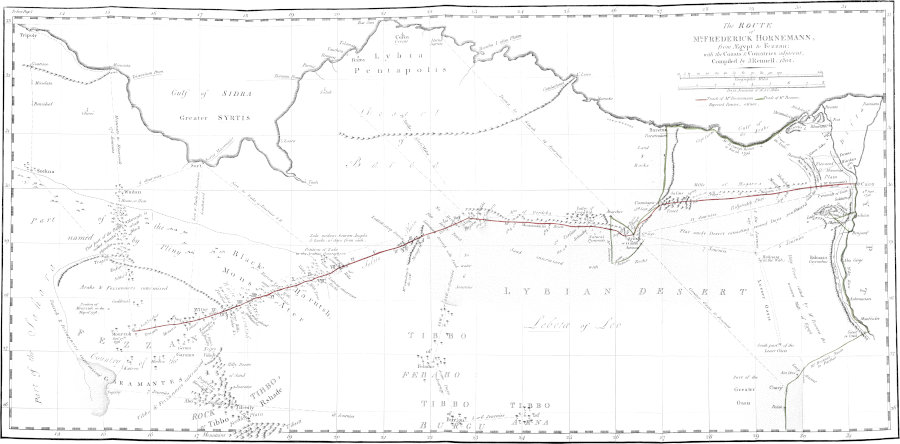
3d. Geographical Elucidations of the Travels and of the Informations of F. Horneman, with Maps, by Major James Rennell, F. R. S.
4th. Remarks on the Language of Siwah, in a Letter to the Right Hon. Sir Joseph Banks, P. R. S. by William Marsden, Esq. F. R. S.
The Route of Mr. Frederick Hornemann, from Ægypt to Fezzan; with the Coasts & Countries adjacent, Compiled by J. Rennell, 1802. Published according to Act of Parliament by J. Rennell, April 5th. 1802. J. Walker Sculpt. (Large-size)
TRAVELS IN THE INTERIOR OF AFRICA.