INTELLIGENCE CONCERNING THE INTERIOR PART OF NORTH AFRICA.
Reading edition
SECTION I.
Westward from Fezzan, and to the south and south-west, the country is inhabited by the Tibbo, who command also the country from Fezzan towards Egypt, from which it is said to be separated by a large desert. The nearest inhabited places north of Tibbo are Augila and Siwah. On the south they are bounded by wandering Arabs; and on the west beyond Fezzan, by the dominions of the Tuaricks.
The Tibbo are not quite black; their growth is slender; their limbs are well turned; their walk is light and swift; their eyes are quick, their lips thick, their nose is not turned up, and not large; their hair is not very long, but less curled than that of the Negroes. They appear to have much natural capacity, but they have too few opportunities of improving it, being surrounded by barbarous nations, or Mahometans. Their intercourse with the Arabs, to whom they convey slaves, has probably corrupted them; they are accused of being mistrustful, treacherous, and deceitful. The Fezzanians do not travel singly with them, for they are afraid of being surprised and murdered at the instigation of the company with whom they travel. The language of the Tibbo is spoken with extraordinary rapidity, and has many consonants, particularly the L and S. They number thus:
One, Trono.
Two, —.
Three, Agesso.
Four, Fusso.
Five, Fo.
Ten, Markum.
Their cloathing consists of sheep-skins, which they dress with or without the wool; the former for winter, the latter for summer; but the inhabitants of the principal places, or others, when they go to Fezzan, clothe themselves like the Burmuans, in large blue shirts; their head is wrapt in a dark blue cloth in such a manner, that their eyes only are seen. Their weapons are a lance about six feet long, and a knife from fifteen to twenty inches long, which they carry on their left arm, the sheath being fastened to a ring of leather about three inches wide, which they bear on their wrist.
The Tibbo are divided into several tribes, the principal of which are, the Tibbo of Bilma, whose chief resides at Dyrke, about one day’s journey from Bilma. This tribe is a good deal mixed, having established itself forcibly among the Negroes who lived in that district: to this day, the inhabitants of Bilma are mostly Negroes; in Dyrke, on the contrary, they are Tibbo. This tribe carries on a commerce between Fezzan and Burnu, and apparently with great safety to themselves; for they travel in small companies of six or eight men; but on account of their bad character, the slaves of either sex, from Burnu, who have been freed, do not return with them, as the poor people are afraid of being plundered and sold again, or murdered by them.
The religion of the Tibbo of Bilma, is the Mahometan; but it is said they hold it very cheap.
The tribe of the Tibbo Rschade, or the Rock Tibbo, is so called from their houses being built under rocks, and they frequently live even in caves, before which they build huts of rushes in a very coarse manner, for their summer residence. The chief of this tribe lives in Abo; next to which Tibesty is the largest place. The Tibbo Rschade go in multitudes to Fezzan, at which time they clothe themselves like the Tuarick; however, I have seen several wearing their sheep-skins. This tribe is reported to be good Mahometans.
The Tibbo Burgu are said to be still Pagans: the district which they inhabit, abounds in dates, corn, and grass.
A company of Fezzanians having this year been plundered by some of the people of Burgû, as they were travelling from Bergami to Mourzouk, the sultan of Fezzan sent a small army into their country: it consisted of thirty-two men on horseback, seventy Arabs on foot, and about two hundred Tibbos of the Rschade tribe. The Arabs went from Mourzouk into Gatron, fifty-four miles south of that place; to Fegherie thirty-three miles south-south-east of Gatron; then to Abo seven days, and Tibesty three days, in an easterly direction; then to Burgu eighteen days, (reckoning a day’s journey eighteen miles.) They stole about two hundred people, the greatest part of whom were sold in a treacherous manner.
The women of the Burgu tribe, wear their hair in plaits, which hang down from their heads, but the hair on the fore-part of their heads is cut off. The girls are accused of becoming pregnant by their brothers. The slave of one of my friends, who spoke the Tibbo language, assured me, that he had questioned a young woman who was with child, and that she did not deny it.
Farther towards the east lies Arna, the principal place of another Tibbo tribe, at the distance of five or six days.
South-south-west of Augila dwell the Febabo, who are exposed to the yearly depredations of the Arabs of Bengasi, who go out with the Arabs of Augila, to steal men and dates; and for that purpose, they convey with them several hundred camels.
The distance to Febabo was stated to me by the Augilarians to be ten days journey, (twenty-one miles per day,) and that during the first six days no water is to be found. The most southerly of the Tibbo tribes are the Nomadic Tibbo, who live in the Bahr-el-Gasel, which is said to be a long and fruitful valley, seven days journey from Bergami northward.
SECTION II.
The west and south of Fezzan is inhabited by the Tuarick, a mighty people, who border south-west on Burnu; south on Burnu, Soudan, and Tombuctoo; eastward on the country of the Tibbo and Fezzan; northward on part of Fezzan, and the Arabs who live behind the regions of Tripoly, Tunis, and Algiers; and westward on the great empire of Fez and Morocco, of whom a few colonies are found in Sockna, (in the dominion of Fezzan), Augila, and Siwah; in which places the language of the Tuarick is the only one spoken by the inhabitants.[13]
The Tuarick are divided into many nations and tribes, who all speak the same language; but, by their colour and manner of living, it is probable that they differ widely in their origin. As I will give only certain informations, on this account I confine myself, in the following relation, to the Tuarick of the nation of Kolluvi and the tribe of Hagara. These are thin in growth, rather tall than short; their walk is swift but firm; their look is stern, and their whole demeanour is warlike. Cultivated and enlightened, their natural abilities would render them, perhaps, one of the greatest nations upon earth. Their character (particularly that of Kolluvi,) is much esteemed. The western tribes of this nation are white, as much as the climate and manner of living will admit. The Kolluvians who reached the region of Asben and conquered Agades, and mixed with the nations, are of different colours; many of them are black; but their features are not like those of Negroes. The Hagara and Matkara are yellowish, like the Arabs; near Soudan there are tribes entirely black. The clothing of this nation consists of wide dark-blue breeches, a short narrow shirt of the same colour, with wide sleeves, which they bring together and tie on the back of their neck, so that their arms are at liberty. They wind a black cloth round their head in such a manner that at a distance it appears like a helmet, for their eyes only are seen. Being Mahometans, they cut off their hair, but leave some on the top of the head, round which those who wear no cap, contrive to fold their black cloth, so that it appears like a tuft on their helmet. Round their waist they wear a girdle of a dark colour; from several cords which fall from their shoulders, hangs a koran in a leather pouch, and a row of small leather bags containing amulets. They always carry in their hands a small lance, neatly worked, about five feet long. Above the left elbow, on the upper part of the arm, they wear their national badge, a thick, black or dark-coloured ring, of horn or stone.
Their upper dress is a Soudanian shirt, over which a long sword hangs from the shoulder. The travelling merchants of this nation carry fire-arms; the others use only the sword, the lance, and the knife, which they carry on their left arm, like the Tibbo, but the handle is finely worked; for they have the art of giving to copper as bright a colour as the English artists, and this art they keep very secret.
They carry on a commerce between Soudan, Fezzan, and Gadames. Their caravans give life to Mourzouk, which, without them, is a desert; for they, like the Soudanians, love company, song and music.
The Tuarick are not all Mahometans. In the neighbourhood of Soudan and Tombuctoo live the Tagama, who are white, and of the Pagan religion. This must have occasioned the report, to which my attention has been called, by several learned men, that there are white Christians in the neighbourhood of Tombuctoo. I am convinced that the fable arises solely from the expression Nazary (i. e. Christians), which the Arabs and Mahometans use in general for unbelievers.
The greatest part of the eastern Tuarick lead a wandering life. A place, for instance, under the government of Hagara consists of about twenty-five or thirty stone houses only; but at the time of their markets (which are said to be very considerable), many hundred men assemble there with their leathern tents.
SECTION III.
Behind these countries lies Tombuctoo, of which I shall say nothing, as I could not get any well-founded and certain accounts, for there is little intercourse between this region and Fezzan; however, it certainly is the most remarkable and principal town in the interior of Africa.
Eastward from Tombuctoo lies Soudan, Haussa, or Asna; the first is the Arabic, the second is the name used in the country, and the last is the Burnuan name. Of these three names I choose the second, as being the most proper, and understood by the Arabs below Soudan, and all the land southward from Ghaden. The Burnuan name means properly only Kano and Kashna, and the country lying eastward from that region Asna, but incorrectly spoken, it comprehends also Tombuctoo.
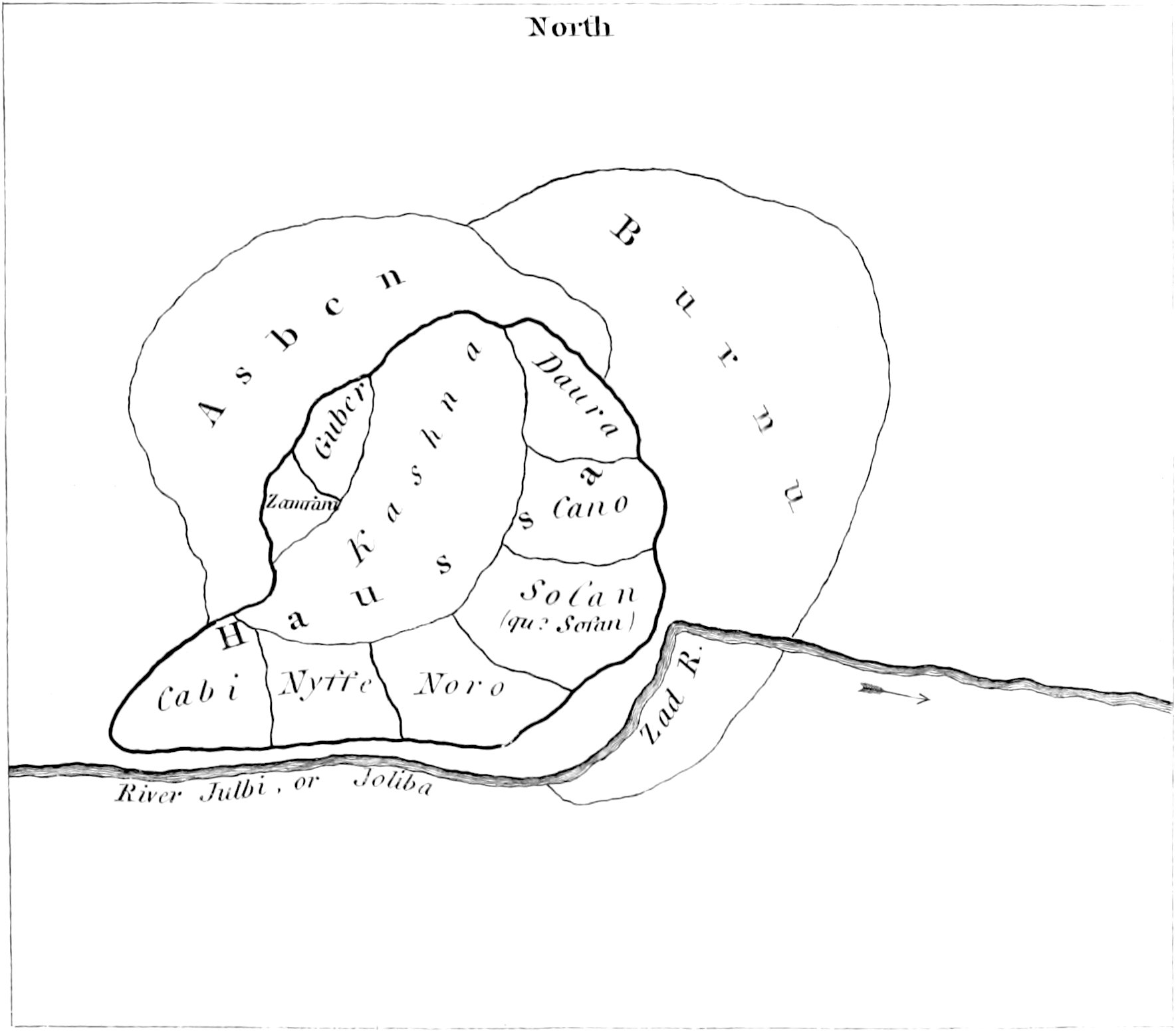
As to what the inhabitants themselves call Haussa, I had, as I think, very certain information. One of them, a Marabut, gave me a drawing of the situation of the different regions bordering on each other, which I here give as I received it. (See the Sketch opposite.)
The land within the strong line is Haussa; my black friend had added Asben.
These regions are governed by Sultans, of whom those of Kashna and Kano are the most powerful; but they all (either by constraint or policy) pay tribute to Burnu, except Cabi or Nyffé, their districts being at too great a distance. Guber pays, moreover, a tribute to Asben. Zamtara is united with Guber; the Sultan of the latter having taken possession of it, killed the Sultan, and sold all the prisoners he could take.
The Haussa are certainly Negroes, but not quite black; they are the most intelligent people in the interior of Africa; they are distinguished from their neighbours by an interesting countenance; their nose is small and not flattened, and their stature is not so disagreeable as that of the Negroes, and they have an extraordinary inclination for pleasure, dancing, and singing. Their character is benevolent and mild. Industry and art, and the cultivation of the natural productions of the land, prevail in their country; and, in this respect, they excel the Fezzanians, who get the greatest part of their clothes and houshold implements from the Soudanians. They can dye in their country any colour but scarlet. Their preparation of leather is as perfect as that of the Europeans, although the manner of doing it is very troublesome. In short, we have very unjust ideas of this people, not only with respect to their cultivation and natural abilities, but also of their strength and the extent of their possessions, which are by no means so considerable as they have been represented. Their music is imperfect, when compared to the European; but the Haussanian women have skill enough to affect their husbands, thereby even to weeping, and to inflame their courage to the greatest fury against their enemies. The public singers are called Kadanka.
SECTION IV.
Eastward from Haussa are situated the dominions of the Sultan of Burnu (i. e. the city). It appears to be much increased since the time of Leo Africanus, as other regions belong to it, which he considered as independent; for example, Wangara, also Edrisi’s Cauga, &c. belong to it.
The Sultan of Burnu is reckoned the most powerful in that district; all the neighbouring states pay him tribute. He certainly possesses an extensive tract of land, but he gains more by his authority in the unceasing animosity of his neighbours.
The Burnuans are blacker than the Haussanians, and completely Negroes; they are stronger, and very patient of labour; their constitution is in the greatest degree phlegmatic; they are, altogether, much more rude and uninformed than the Haussanians. Their men are fond of women only of a large size; the Soudanians, on the contrary, prefer those of a slender form.
A paste made of flour and flesh is the only food of the Burnuans; the liquor they drink is an intoxicating kind of beer, which is very nourishing. The best natural production of Burnu is copper, which is said to be found in small native pieces. That which is gold in Tombuctoo and Haussa, is answered by copper in Burnu; the value of all their commodities is fixed by pounds of this metal.
Northward from the principal town of that district lies Kanena, which is inhabited by the nation Kojam, so called from their food, which is cow’s milk and beef.
Towards the north-east lies Begarmé, the capital of which is called Mesna. Both these territories are dependants of Burnu. Begarmé is famous for its slave trade, perhaps particularly so, as at that place the greatest number of boys are mutilated.
Southward from Burnu lie Margi and Couga; westward, Ungura, (Wangara); they are under the dominion of governors appointed by the Sultan.
SECTION V.
Towards east by north lies Lussi; by the natives it is called Fiddri, and by the people who dwell eastward, Cougu. The dominions of the Sultan of Fiddri are situated round a lake which bears the same name. This realm was formerly one of the most powerful, now it is considerably diminished, by the treachery of the Sultans of Begarmé and Wadey. The natives live in small huts, which they prefer to houses; they are said to be in a very low degree of civilization. There is not any salt in their country, but they procure it in the following manner: they burn a great heap of straw of gassab, gather the ashes and put them in a basket, pour water on them, and collect it as it runs through; this water they boil until the salt settles.
Towards the south-east of Fiddri lies Metko, a small independent district in a mountainous country. Eastward lies Wadey, which formerly consisted of several small states, but was conquered by the Arabs, who united and made them one realm. The principal language is Arabic; but above ten other languages are spoken in the district. Wandering Arabs occupy the space from Wadey to Begarmé northward.
Eastward from Wadey lies Darfoor; from whence flows a river, the banks of which are very rich in sugar canes: it runs through Wadey, and falls into the lake Fiddri above-mentioned. I had very different accounts of the circumference of this lake, as in the rainy season it swells to double the extent, which, ordinarily, is from four to eight days journey.
SECTION VI.
The river that was seen by Mr. Park on his journey to Tombuctoo, flows southward from Haussa. It waters Nyffé and Cabi, where it is called Julbi; and runs eastward into the district of Burnu, where it takes the name of Zad, which means the great water; in some parts of Haussa, it is called Gaora, or the great water.
All the Burnuans and Haussans whom I questioned about the distant regions of this river, agreed in telling me, “that it ran through the land of Majies, (i. e. Heathens;) by Sennaar: others affirmed that it passes Darfoor, in its course eastward, and flows to Cairo, being one stream with the Egyptian Nile.”
A native of Egypt from Osuit, who had travelled several times to Darfoor, and southward from that place to collect slaves, and lately returned through Wadey, Fiddri, and Begarmé, to Fezzan, informed me, that the river called Bah-el-Abiad, is this river. I could get no intelligence about a great inland lake, although I made every possible inquiry.
Besides these two great rivers here described, there are seven small streams in Haussa, which fall into the Julbi near Berva. Northward from Burnu, there is a river which disappears among the mountains, and is said to rush into the earth. All these rivers are very low in the dry season, and swell amazingly during the rainy season. The breadth of the Zad was given me for one mile, (others said two); but in the rainy season, the breadth is said to be a day’s journey, (i. e. eight hours). The Budumas always keep themselves in the middle of this stream; they are a very savage, heathenish nation.
These few informations are the best that I have been able to collect, on the interior of Africa. In this relation, I pass over men with tails, without necks, and without hair, without land, and living only on the great sea. It would be an easy matter for me to write you many letters on the interior state of Africa; but I might thereby convey information inaccurate or untrue. Besides, am I not returning to England? and if I do return, should I not reserve something new and interesting to plead my excuse for returning?
If I do not perish in my undertaking, I hope in five years, I shall be able to make the Society better acquainted with the people, of whom I have given this short description.
(Signed) FREDERICK HORNEMAN.
1798.
Extracts from a Letter accompanying the above Informations, dated Tripoly, 19th of August, 1799.
“After a journey of eleven days from Siwah, four of which we travelled eighteen hours each day, through a desert, we arrived at Augila, a small miserable town belonging to Tripoly; and after a journey of sixteen days more, we reached Temissa, the first village of Fezzan. Seven of these sixteen days, I was passing a black rocky desert, certainly the worst of all routes in the world; and which has doubtless been formed by some volcanic revolution. It is called Harutsch, and extend very far to the south-west.
“From Temissa, I came by way of Zuila, Tuila, and Tragan, to Mourzouk, (which is also called Fezzan, and by the people of Burnu, Zela). Mourzouk is situated in 25° 54′ 15″ north latitude.
“With regard to the interior of Africa, I have made all the inquiries possible, and will send you the result of them by the first opportunities. Accept for the present the following notices on that subject.
“The river you call Niger—in Soudan, Gulbi, or Gaora; in Burnu, Zad; is a very large river, into which fall more than twelve other rivers. It comes from Tombuctoo, as I am told, runs to the south of Haussa (or Soudan), in the empire of Burnu; here it takes a more southern direction, and falls (at least I could not find a single man who said to the contrary), south of Darfoor into the Nile. There is another river coming from Darfoor, which passes by Wadey and Metko, and terminates in a large lake called Fiddri, in a kingdom called by the inhabitants Fiddri; by the people to the east of them, Cougu; and by those on the west, Lussi. The lake of Fiddri is four days in circumference, but in the time of the rains much more extensive, inundating the surrounding country, which, after the waters are withdrawn, is sown and cultivated.
“Near to Mesna, the capital of Bergamé, is another large river; but it is considerable only in the rainy season. Bahr of Gazelles, or Wad-el-Gazelles, is not a river, but a long and fertile valley, inhabited by Nomadian Tibbo, whose houses are made of skins.
“Burnu is the most powerful kingdom in the interior of Africa. The next to it is the sultan of Asben, who resides at Agades. The kings of the countries of which Haussa consists, all pay tribute to Burnu; these are Kashna, Daura, Keeno, Sofau, Noro, Nyffé, Gaauri, Cabi, Guber, (Zanfara belongs to Guber.) Kashna pays every year 100 slaves, &c. Some of them pay to Burnu and Asben. The king of Asben with the greatest part of his nation are Tuaricks of the tribe Kolluvi. Many of the Tuaricks near to Tombuctoo, are white; and another tribe near to Burnu, are also white, like the Arabs of the northern coast of Africa.
“Begarmé pays tribute to Burnu; Ungura, (doubtless Wangara, Leo. Afr.) and Cougu, are governed by officers of that sultan.
“There is a general opinion of all Burnu and Fezzan people, that Burnu and Fezzan, according to our manner of speaking, lie under the same meridian. Burnu is distant from Kashna 15 days, by travelling very slow 20 fisturnees, or about 330 English miles. Fiddri from Burnu E by N 25 days. The people of Fiddri have no salt in their country, but what they prepare from straw ashes.
“A great part of the people of Wadey, together with their king, are Arabs.
“In the direction of south by west from Augila, distant ten days, or about 200 miles, are the Febabo, and some days more to the south the Birgu, nations of the Tibbo, whose country is very fine and fertile: they are said to be Pagans. It is singular, that the people of Augila, in speaking of these tribes, make much the same comparison which Herodotus (Melpom. c. 183.) does, when speaking of the Ethiopian Troglodytæ, hunted by the Garamantes, ‘that their language is like the whistling of birds.’
“The most interesting nation of Africa, is the Tuarick. (Leo Afr. calls them Terga, طرجي.) They are in possession of all the country between Fezzan, Gadames, the empire of Morocco, Tombuctoo, Soudan, Burnu, and the country of the Tibbo. They are divided into several nations, of which the Kolluvi in Asben, and the Hagara near to Fezzan, are the chief.
“Christians and tailed men, I suppose, never will be found in the interior of Africa. The Mahometans call Nazari (which is properly the name for Christians) not the Christians only, but also every other people who are not of their religion. Of tailed men I heard no accounts, except from one person, (but not a testis fide dignissimus,) who placed them ten days south of Kano; he called them Yem Yem, and said that they were cannibals. In ten months I shall be near to that direction.
“I shall now, Sir, conclude this letter, which I hope will find you in good health. I am, &c. &c.
“FREDERICK HORNEMAN.”
FOOTNOTES: