Volume 2 — JOURNAL OF ELIZABETH LADY HOLLAND (continued 2)
Reading edition
North,[75] the Bishop of Winchester’s son, Ld. H.’s old friend, brought his wife to dine here some days ago. She is pretty rather, but looks sour-tempered.
Bread is 17 pence the quartern loaf, coals six guineas the chaldron, turkeys 16 shillings, capons 8s. 6d., meat dearer than usual. During this scarcity, be it natural or artificial, we adopt the regulations of the H. of Lords; each person in the family is limited to a quartern loaf per week, no pastry, no fine bread for breakfast.
19th March, 1800.—A satirical poem called The Campaign is just published; it abuses the Duke of York and the Dutch Expedition. It is imputed to Mr. Courtenay,[76] an old member of Opposition, a man of great coarseness, but some wit. In the House of Commons some supporter of Mr. Pitt’s Administration complimented him on having conducted the machine of Government with such success, in spite of the drag chain of Opposition. Mr. Courtenay, in his reply, remarked upon the beauty and correctness of ye metaphor, since the machine was confessedly going downhill.
22nd March.—Erskine and Mr. Lattin (and a foolish, handsome Irishman, Mr. Henry) dined, and were extremely entertaining yesterday. Erskine, I have always found hitherto far from agreeable, but yesterday was an exception. He talked strangely upon religion; he pretends to Christianity, but the Mother Church would not take him into her bosom. Bishops and churches, he declares, have destroyed true religion; had he the power of Christ he would drive the doctors out of the Temple as he did, and out of Lincoln’s Inn besides. The Church Establishment he maintains to be the total ruin of the simple, primitive worship. The Trinity he explains with ingenuity, and reprobates the Incomprehensible Mystery of three separate and individual persons.
The little Monk Lewis has behaved like a great fool, and made himself highly ridiculous. He sent to the Duke of Somerset and desired he would wait upon him the next day at 1 o’clock. The Duke obeyed the summons, and did wait upon him. ‘I understand, D. of Somerset, that you have exposed me to the contempt of being again blackballed by the New Club. I think the part you have acted by so doing unbecoming the character of a friend; thus I desire our acquaintance may drop here.’ He rung the bell, and bid the servant open the door for the D., and thus dismissed him. The D. of S. is remarkably good-natured, and most certainly did what he thought Lewis would like, but, poor little man, he is very irritable and quarrelsome, and will shortly be left not only friendless, but without many acquaintances.
THE ROYAL INSTITUTION
This Institution[77] of Rumford’s furnishes ridiculous stories. The other day they tried the effect of the gas, so poetically described by Beddoes; it exhilarates the spirits, distends the vessels, and, in short, gives life to the whole machine. The first subject was a corpulent, middle-aged gentleman, who, after inhaling a sufficient dose, was requested to describe to the company his sensations; ‘Why, I only feel stupid.’ This intelligence was received amidst a burst of applause, most probably not for the novelty of the information. Sir Coxe Hippisley was the next who submitted to the operation, but the effect upon him was so animating that the ladies tittered, held up their hands, and declared themselves satisfied. The experiment to remove the popular prejudice in favour of silver teapots failed, as the thermometer gave the lie to the Professor’s learned dissertations, but it must have been from the malice of his evil genius, for the fact is in his favour.
The Bishop of Killala’s[78] narrative of what passed in the town and neighbouring district whilst the French were in possession of it in ’98 under Humbert, is extremely interesting. It is written simply, with a great appearance of truth and feeling. His palace was the headquarters of the General and his officers. He speaks with highest admiration of their humanity, civility, and incredible discipline. There is even humour in his description of some of the scenes, particularly that in which he describes the mixture of mirth and contempt with which the French officer thrust indiscriminately upon the noddles of the Irish the gaudy helmets. He yields the palm of superiority to the English for their dexterity in pillaging and in plunder; indeed compared with every European army, save the Papal one, it is the only excellence in candour we can admit them to lay claim to.
Great embarkations are making at Plymouth of the Guards and other troops. Their destination is not known, but rumour says they go to the Mediterranean. Were I not satisfied how harmless an English military force is against an enemy in battle array, I should wish contrary winds to waft them leagues out of their course, if they are destined for Egypt; but they inspire as little alarm to their enemies as they do confidence in their countrymen, for they are, as one of their commanders in Ireland said publicly of them, ‘Formidable only to their friends.’
PICTURES BY VAN DYKE
This house[79] has contained many remarkable and interesting persons; there are curious stories about its origin. Some say it was a nunnery, others, that it was built by a Cope in the reign of Philip and Mary. It came by marriage into the possession of Rich, Earl of Holland.[80] He was a most accomplished and gallant cavalier, and so amiable that Charles I. conceived a jealousy against him, probably not totally without foundation. In consequence of this he was confined by order to his house, but his Royal mistress refused to cohabit with the King until her favourite chamberlain was at large. During his residence here Van Dyke passed a year with him, and probably painted some of those portraits which now decorate most of the best collections in England.[81] There is a very fine portrait of ye Earl of Holland, done by this celebrated artist, in the possession of Lord Breadalbane, at Taymouth.[82] It represents him in the prime and beauty of manhood, arrayed in the apparel of a bridegroom, such as he was when he represented his Royal Master at the Court of France to the lovely Henrietta Maria. His left leg is covered with white satin, it being the one put into bed to the bride when Royal marriages are made by proxy. He held employments of considerable trust, but was accounted wavering in his politics and irritable in his temper. He retired here just when the Civil war broke out, in disgust. Clarendon says, ‘He was visited by all the disaffected Members of Parliament, who held frequent meetings at Holland House.’ Some time after, when the Civil war was at its height, he offered to join the King’s party at Oxford, but being coldly received he returned to the Parliament forces. On 6th August, 1647, ‘The Members of Parliament who were driven from Westminster by tumult met General Fairfax at Holland House and subscribed to the declaration of the Army, etc.’[83] Some ascribe his desertion of the Royal cause to his hatred of Ld. Strafford. He gave a proof of his wish to restore it; in consequence of which he was taken prisoner, confined to his house, and dragged to execution the 9th of March, 1648–9. His body is buried in Kensington Church. In the July following, Lambert, then General of the army, fixed his headquarters here. It was restored to the family of Rich. When the Puritans shut up public theatres, the actors used to act at the houses of the nobility, and this house is mentioned as having frequently been the scene of much dramatic mirth and festivity.
ADDISON
Addison was tutor to the Earl of Warwick.[84] He married the Countess, his mother, a marriage which made no addition to his happiness; it neither found them nor made them equal. She always remembered her own rank, and thought herself entitled to treat with very little ceremony the tutor of her son. Rowe’s ballad of despairing love is said to have been written either before or after marriage upon this memorable pair, and it is certain Addison has left behind him no encouragement for ambitious love. There is a pretty little poem by Rowe upon the occasion of his first visit to Holland House to see the Countess of Warwick. It is said by some author, “Holland House is a large mansion, but could not contain Mr. Addison, the Countess of Warwick, and one guest, Peace.” During his residence here the house was frequented by the wits and poets of the time, Pope, Tickell, Steele. Upon his deathbed he sent for Gay, with whom he had had little previous intercourse. He told him he had injured him, but would recompense him if he recovered: ‘What the injury was, he did not explain.’ Lord Warwick was a disorderly young man, and had received without heed the advice of Addison, who used his utmost to reclaim his morals and mend his life; when he found himself dying he sent for him, ‘That he might see how a Christian can die.’[85] He expired under this roof in 1719.
Thou hill, whose brow the antique structures grace Rear’d by bold chiefs of Warwick’s noble race, Why, once so loved, whene’er thy bower appears, O’er my dim eyeballs glance the sudden tears! How sweet were once thy prospects fresh and fair, Thy sloping walks and unpolluted air! How sweet the glooms beneath thy aged trees, Thy noontide shadows, and thy evening breeze! His image thy forsaken bowers restore; Thy walks and airy prospects charm no more; No more the summer in thy glooms allay’d Thy evening breezes, and thy noonday shade. Tickell, on the death of Addison.
And again in his Kensington Garden:—
Where now the skies high Holland House invades And short-lived Warwick sadden’d all the shades.
Johnson repeats with great indignation Mandeville’s observation upon Addison. It was that he appeared to him like a parson in a tye wig: a laughable and, I daresay, a true remark.
In 1762, Henry Fox, Secretary of State (afterwards Lord Holland), inhabited, and shortly after purchased this house.[86] During his life it was frequently the resort of the great politicians. Sir Robert Walpole, unless he died before, was certainly a frequent visitor, at least he was a friend; Lds. Bute and Chatham, etc. Lady Sarah Lennox resided with her sister Ly. H.[87] at the period of the present King’s love, a love that might have elevated her to the throne, but for her levity and total disregard for appearances. Both Ld. and Ly. Holland died here. During his long illness he one day forbade admittance to all his friends who might call, with the exception only of George Selwyn, ‘For if I am alive I shall be very happy to see him, and if I am dead he will be very glad to see me,’ alluding to George Selwyn’s extraordinary passion for beholding death in any shape. He rarely missed the sight of an execution. He was supposed to have incensed George II. extremely by having indulged this curiosity about Queen Caroline, to obtain a sight of whose corpse he concealed himself under the bed, and during the absence at night of the attendants examined the body. George II. had such an aversion to him that he always called him ‘That rascal George.’ Selwyn once overheard him and exclaimed, ‘What can that mean? Rascal! Oh! I forgot that it was a hereditary title of the Georges.’ The King (George III.) the year after he had been at G. Selwyn’s house at Matson (famous in history for the escape of Charles I.) went mad. G. Selwyn upon this observed, ‘that it was odd enough that the only two Kings that had visited Matson had both lost their heads.’
LORD ABERCORN’S MARRIAGE
This singular marriage of Lady Ann’s is going on rapidly, nay, the nuptials are to take place in the course of this week; but till the holy knot is tied, I confess such mystery hangs upon the affair that I shall continue withholding my full belief. He consults Ly. B. about the equipages, fêtes that are to be given upon the occasion, etc., and yet insists upon her keeping her promise of secrecy, and even goes so far as to beg she will contradict the report if she hears it. He was always supposed to be a little cracked, and his pride is beyond belief. When travelling in Italy during the life of his uncle and he was only Mr. Hamilton, to distinguish himself he left upon his cards, ‘D’Hamilton, Comte Héréditaire d’Abercorn.’ His language is so outré from the manners of common life that it would appear caricatured and chargé’d even upon the stage. Should the union really take place, the first step will be a rupture between Ly. Ann, his daughters, and Miss Copley their aunt, as Ly. A. is both violent and peevish, and little disposed to submit to the gêne of bienséance with regard to them.
I hear from my dear Webby frequently. The others I know are well, but poor Harriet is placed in a cheap school, and will be educated among people and with ideas that certainly are not adapted to her way of life I hope and trust in future.
17th April, 1800.—Abbé de Lille to-day shone. He aimed not at proving himself a political prophet: he contented himself with being a pleasant companion and a poet unique. In conversation he was very amusing; he told several stories about Voltaire, with whom he had been intimate in the early part of his life. The Collège de Montaigne was remarkable for its filthiness; the régent of it, when the écoliers were to act a play, was puzzled at their choice. It was Mérope. The female name offended him, and he altered it to Méropus: upon which Voltaire said it was in compliment of the place to call it Mère au puce, it being the foyer of dirt. Necker’s conduct in France, he said, was exactly like that of a Curé, who at a jovial dinner heard the bell ringing to Vespers, upon which he immediately chanted the Psalm of Deus in adjutorium meum intende, etc.; the people made the response Gloria Patri et Filio et Spiritui sancto; a man next to the Curé gave him a soufflet, saying if he had not begun the people would not have sung. The application to Necker was that he first sounded the alarm and roused the people of France. At the beginning of the Revolution, when things that now seem insignificant were looked upon as of great importance, two men were overheard talking of the calamities of the country in the Thuileries. One said, ‘Ah! bon Dieu, c’est la fin du monde.’ ‘Bah! bah!’ replied the other, ‘Comment donc, Monsr., il y a des exemples?’
He recited his translation of the fourth book of the Aeneid; the tender passages prove his ignorance of the sentiment he expresses. The famous tirade is admirably rendered.
LORD ABERCORN’S MARRIAGE
Lord Abercorn’s singular union has at length taken place contrary to every plausible speculation. A few days before it was declared he confided to a friend his intended marriage, without naming the lady. ‘The world will be surprised, do not contradict the report, nor deny it.’ As soon as the event was public the Queen sent Ly. Ely to Miss Copley[88] to desire her to come to Buckingham House. ‘I hear that in consequence of this business, that you intend quitting Ld. A.’s house; remember, Miss Copley, that the worse the affair is, the stronger is the necessity of continuing with your nieces, and remember you have my advice and sanction.’ This maternal, majestic speech had its effect. Sir Lionel Copley told me both of these anecdotes.
The day of the marriage Ly. A. was sitting with Ly. Bess. talking of the event that was fixed for 8 o’clock in the ensuing eve., when their conversation was interrupted by the entrance of the porter to inform them, ‘That Lord Abercorn had just called and left word that Ly. Ann must make haste, as she was to be married at 4.’ This intelligence so communicated surprised them, but compliance and punctuality are indispensable qualities where Ld. A. is concerned, therefore they obeyed. As soon as the ceremony was over, which was performed at Lord Sudley’s,[89] Ld. A. made the Marchioness a low bow, handed his eldest daughter out to his carriage, and went and dined with his own family, whilst the Marchioness went and dined in Cavendish Square. He came with a cavalcade of servants and flambeaux to bear off his prize to the Priory.
He is haughty and capricious, with enough of vanity to make him do a generous action, and with a dash of madness to make him do a lively one. Ly. Bess. went down for a few days; she described an evening between the new married pair, which was an exact reproduction of a scene in The Taming of the Shrew. To cure a headache he made her play blindman’s buff, and the more she complained the more violent he made the sport. A person remarked the livery, which is the same as the younger branches of the Royal Family, and said, ‘I suppose your family took it from them.’ ‘My family took it from them? No, it was the livery of the Hamiltons before the House of Brunswick had a servant to put it on.’ When he told the Dowager Lady Warwick that Sir Wm. Hamilton (her brother) was to marry Mrs. Hart, and that he should give her away, she said it was a disgrace to the family, but if done by any of them the deed was fitted to the one who had the blot in his escutcheon and a crack in his skull.
The Duke of Somerset is to marry Ly. Charlotte Hamilton;[90] his mother withholds her consent. She is much older than the Duke. Her superior coquetry has obtained the palm, for his love began with her younger sister, Lady Susan.
A circumstance, half ridiculous, half distressing, embarrassed me last Saturday at Lansdown House. I met an old lover whom I had not set eyes on for 14 years; the last time I beheld him was when he solicited an interview to propose marriage. His mode of making the overture was singular at least. He began by approaching his chair close to mine, and followed this close-quartering with an endearing embrace round my waist; he then complimented me upon my love of literature, and said, ‘I love books as much as you do, and we may fairly hope to have a very literary little family.’ Tho’ barely fifteen years old, the ridicule of the man’s proceeding struck me so much that I could scarcely contain my laughter, and my mother did for me that which my own timidity prevented, for he immediately received his final congé. He used to write verses upon me, and sent me a copy, with a dog, the turn of which was that as I was afraid of thieves this cur would protect me until I ‘a bolder guardian took,’ meaning his precious self.
A FORMER SUITOR
22nd April, 1800.—Ld. Thurlow yesterday in the House of Lords, with every expression of contempt, animadverting upon the folly of the Bills now brought before Parliament, the one for protecting bull baiting, the marriage of a divorced woman with the culprit, etc., addressed himself sarcastically to Lord Auckland, and said, ‘And pray, my Lord, why do you not bring in a Bill against ingratitude,’ alluding to Ld. A.’s desertion of Ld. North.[91] The reproof was coarse and uncalled for. The Union was debated last night in both Houses. Mr. Grey, in spite of secession, attended and made a very able speech.
The above story of Ld. Thurlow’s sarcasm is murdered. The sting lies in the absurdity of attempting to correct moral vices by law, which makes the sneer wittier.
Ly. Ann’s change from poverty and dependence to stately grandeur reminds me of the pretty Epître des Vous et des Tu, in which Voltaire sketches the delights of his youthful mistress, contrasted with the dull pomp she was surrounded by after a splendid alliance:—
Philis, qu’est devenu ce temps Où dans un fiacre promenée Sans laquais, sans ajustements, De tes grâces seules ornée, etc.
I invited Mr. Lattin to dine here to-day, and as an inducement mentioned that it was to meet Dr. Parr. He wrote a gallant reply, accompanied by the following verses, which he says are the first he ever wrote in French:—
L’Histoire nous apprend, que pour être écoutée La Sagesse eut recours Aux grâces, aux amours, Et même de la Fable, à la voix empruntée. Mais pour nous persuader, c’est la première fois Que la beauté s’adresse A la froide sagesse, Où Vénus de Minerve ait employé la voix.
27th April.—On Wednesday, ye 23rd, Dr. Parr dined and slept here. He was pleasant enough and not too full of grammatical niceties. I overheard him and Knight condemn various corrupt pronunciations and agree in saying, ‘You and I can never pass them: we can never call Xenophon otherwise than Xenopho.’
THE CZAR PAUL
The French army under Kléber, by a convention between it, Sir Sidney, and the Turks, is to quit Egypt; the Turks are to furnish transports. The Governt. here are incensed against Sir Sidney; they complain of the terms, and wish the French had been necessitated to remain and perish from the plague, etc.[92] The plausible objection is, that the Austrians have just come to be dissatisfied at the augmentation of 17,000 efficient, hardy troops to their enemy just at the beginning of the campaign. The magnanimous Emperor of all the Russias is in a passion; he has written to our Court to insist upon the recall of Sir C. Whitworth,[93] who has committed the unpardonable offence of visiting Count Cobenzel, the Austrian Minister; and his Imperial Majesty has besides withdrawn his Russians in our pay. The high pay may however tempt him to relent.[94] About a month ago he sent to Mr. Pitt, Ld. Grenville, and Mr. Huskisson, 3 crosses of the Order of Malta, of which order he has constituted himself the head, altho’ one of the fundamental rules requires that every knight should be a Catholic and a bachelor. He is of the Greek Church, and husband to a prolific Empress. The great source of his wrath is about the island of Malta, which he wants to possess, and which we will not agree to his having.
Mr. Grey made his annual motion for reform last Friday.[95] He made it so moderate by softening down the rough edges that Wilberforce and Dr. Laurence voted with him. Sheridan, Sir F. Burdett, Jones,[96] etc., were deterred from attending, as he was what they called too moderate. After the debate he came and supped, and slept here. He lamented his own precipitation and bad judgment in urging the measure of secession, and very distinctly declared that whatever blame might attach to it, he was responsible for, as it was pressed upon Mr. Fox against his opinion and inclination. I conveyed to him very cautiously, that his attendance, unless he had an explicit and a sort of public declaration from Mr. Fox that he wished himself to be considered as null, would not be looked upon as fair; he assured me that Fox had oftentimes urged him to attend.[97] I implied that such an assurance was of course all his conscience could require, yet that public opinion demanded more publicity to be given to the wish of Mr. F. than the report of a private conversation; to which he said he never could ask Mr. Fox to declare himself for ever withdrawn from public affairs.
I dined on Saturday, 26th, at L. H. In the morning Ld. Wycombe called upon me; we were standing in the porch just as Ld. Lansdown drove into the iron gate, upon which this dutiful son flew off in a tangent, and exhibited a scene before my servants and his father’s.
The following verses are written by Lewis, a pretty address from Friendship to Youth:—
Turn, Wanderer, turn, and rest with me, Let not yon glittering fane allure you: My temple shall your shelter be, My sacred fire from cold secure you. Nor scorn it, though your dazzled sight No burst of lustrous flame surprises As with mild warmth and lambent light It gently from the altar rises. More vivid fires gild yonder shrine, More heat and radiance round them casting, But trust me, Youth, though bright they shine, Their rage is fierce, their power is blasting. Ah! pilgrim, shun the fatal blaze, Thy forward steps forbear to number; The blaze which on my altar plays Gives genial warmth and gentle slumber. Here Reason as the priestess stands, Here Tranquil Pleasure often lingers; At Friendship’s fire then warm thy hands, At Love’s thou’lt surely burn thy fingers! ‘Friendship,’
A PARODY
I showed them to Tierney, who parodied them almost offhand as an address from a Warming-Pan to Old Age:—
Turn, dotard, turn, and rest with me, Let not yon glittering fane allure you: My presence shall your comfort be, My sacred fire from cold secure you. Nor scorn it, though your dazzled sight No burst of lustrous splendour meets, As with mild warmth each chilly night It gently glides between the sheets. More vivid fires gild yonder shrine, Their blaze, ’tis true, more fiercely rages, But, know, they give, unlike to mine, More smoke than heat at certain ages. Ah! shun then their delusive blaze, Thy forward steps forbear to number, The flame which on my altar plays Gives genial warmth and gentle slumber. Turn, turn, from love and such repose, Nurse what of life within thee lingers, With me at least thou’lt warm thy toes, With Love thou’lt only burn thy fingers. ‘Warmingpan.’
5th May.—Last week Ld. H. made a motion in the H. of Lords in favour of the Catholics, to obtain what they call their emancipation.[98] Lord Lansdown, like a sly old politician, was glad of an opportunity of saying something on behalf of the Catholics, mingled with a praise of the Union, so that should the Union fail, he may say, ‘I foresaw that ye measure, without granting the Catholics their demands, would prove a mischievous one’; and if it should succeed he may say, ‘I supported Ministers on it.’ In his speech he made several heartfelt compliments to Ld. H. He said that whenever he differed in opinion from him he doubted the rectitude of his own judgment; for of his excellent abilities, he added, the House were competent to judge, but of the goodness of his heart those only who had the happiness of knowing him in private could estimate the value. He went on in this strain for near ten minutes. The whole debate was flat, none were in spirits; Ld. H. was unwell, and more than usually chilled by the deadness of his audience. Tierney declares that accustomed as he is to act singly in the H. of Commons, yet he could not bear up in the H. of Lords; there is a palsied indifference in the hearers that checks all spirit.
LORD LANSDOWN
It was essential to Ld. Lansdown to preserve the attachment of —— during his Administration. But —— confided to Ld. L. that his health was injured by an irregularity of life. One should have thought from the austerity of Ld. L.’s manners and private character that he was a singular person to select for such a confidence, but so it was. ‘Indeed, I am not surprised, the calamitous state of the country, the imbecility of Ministers, the augmentation of the debt, and the increased influence of the Crown is such that I own to you very frankly for dissipation I plunge myself into the lowest debauchery.’ He then, after this prelude, administered friendly relief. This is very characteristic of him; the sort of jumble of ideas, and the overstrained civility of adapting his own conduct to that of the person he wishes to please, however repugnant it might be to him in reality.
‘Comment, mon ami,’ cried a wife to her drunken husband. ‘Vous vous perdez, vous laissez toujours votre esprit au cabaret.’ ‘Ne craignez rien, ma chère, j’irais la chercher dimanche.’
People are very much occupied with this Divorce Bill.[99] Ld. H. has felt a shyness in attending the progress of it in the H. of Lords. A Bishop, full of the subject, last week began talking to him; he expressed his approbation of its becoming a criminal proceeding, and added, ‘And do you not think, my Lord, that it would diminish the frequency of the vice, if parties were condemned to imprisonment for five years?’ Ld. H. was, of course, puzzled how to answer. The Bishop was B. of Chichester.
8th May.—D. of Bedford, who is just returned to town, dined here; Ld. H. was detained at the H. of Lds. Fortunately I had Francis, and the day went off pleasantly. We talked of Mr. Fox’s history, to which he has written the introduction. It was lamented that instead of taking the period of which he could say so much from personal knowledge, he should go to one distant and well known. The Duke said his reason was extreme indignation against Hume, whom he had been reading last autumn; who very artfully pleads the cause of the House of Stuart, and in a way to interest his reader about the private virtues of Charles I., ‘Who, by-the-bye,’ added he, ‘is a most amiable man when viewed in his domestic capacity.’ Upon this Francis, with his usual impetuous vivacity, burst forth against him, denying him every qualification that constitutes a gentleman or a man of feeling. He quoted two stories out of Carte’s Life of ye D. of Ormond, a writer who is allowed to have a strong bias to the Stuarts. One was, that in the Palace at Whitehall there were etiquettes, ‘similar to those established by that fop Louis XIV.,’ about certain apartments, which could only be entered by men of distinguished quality. Hampden, by accident, and through ignorance of these courtly rules, got into one. Suddenly a noise announced the entrance of the King; to conceal himself he sculked behind a screen. His friends with whom he was conversing were in a bustle; the King upon entering perceived their disorder, and insisted upon knowing the cause. He explored behind the screen, and upon finding Hampden, he shook his cane over his head, and threatened to beat him and worse, if he ever broke through bounds again. The other was, his receiving a petition on horseback, which was presented to him by Sir T. Fairfax and a deputation kneeling; he made his horse curvet, kicked the knight, and endangered his life. Clarendon’s style, he said, was grave and slow. He told Dr. Parr here at dinner the other day that Swift’s style was clear and shallow, perfectly pellucid. The fact is he admires no style but his own, and that is worthy of admiration, as it is much the best now.
NEW BILLS
D. of B. means to go down about this new Divorce Bill; he is very eager against it. He says it will reverse the present system, for if a circumstance of the sort occurs to a husband who is high-spirited, he generally fights the lover, whereas the lover will now threaten the husband by saying, ‘If you make an éclat and get me whipped at the cart’s tail, by G——, I will kill you.’
A Bill is to be brought forward in the H. of Commons by Sir H. Mildmay to check the increase of Catholicism, by preventing the nuns at Winchester from giving the veil. An attempt to make a proselyte will become penal. Mr. Fox, when he heard of these Bills, the one against celibacy and the other, said, ‘Aye, the poor women, they will not let them do one thing or the other.’
11th May.—Parr entertained us uncommonly; he was in full force. We gratified him highly by going into the room into which he retreated to smoke. His vanity is such that the slightest attention elates him, and more particularly, when it comes from a person whom he would denominate a woman of quality. Mr. Knight’s love of pedantry got him too frequently upon verbal criticism, and when they did fall upon a doubtful Greek word, they pulled at it like hungry curs. When they returned to the library he talked upon literature. His praise of Middleton’s style was that a man of strong feelings and vigorous conceptions ought to study it to abate the ardour and rigidity of style, and he recommended it to Bobus. He asserted that Middleton was an unbeliever in Christianity, and read several passages, which put it out of all doubt, from his Defence of the Free Enquiry. Of Warburton he expressed the utmost admiration; his opponents, he said, who had attacked him, were snarling hounds; ‘mine was the froth of a mastiff.’ He said of Burke’s first book upon the French Revolution that it was ‘the effervescence of rage’; the second was ‘the bitter sediment of malignity.’
On Tuesday I went to Money Hill; Miss Fox, Drew, and Charles went with us. I returned on Friday. The two mornings I passed there we drove about in the sociable to see the country.
We drove through Cassiobury, Lord Essex’s; to The Grove, Ld. Clarendon’s, and so on to Russell Farm, the Ladies’ Capel. Pretty ground and fertile country. Ld. H. fished, and caught a few trout. Beauclerk did not articulate ten words; he seems happy, but it is the bliss of torpor. She resides reluctantly in the dignified solitude of a guinguette in the skirts of a petty town. From Beauclerk’s practice one should think his precept was that conversation spoilt society; he rarely incurs that risque. It is to be regretted, as he has a most acute perception, and an uncommon degree of subtilty in his argument. No person is clearer on the obscure subject of abstract metaphysics; his definitions are ingenious and brilliant. Finance is also a branch of political economy he is profound in, and had he entered Parliament he would have distinguished himself. At present he is lost; shyness, indolence, and a sort of content deprive society of his exertions and his friends of his company.
THE KING SHOT AT
The papers on Friday announced a singular accident which happened to the King at the Review on Thursday in Hyde Park; a musket ball wounded a Mr. Ongley standing near him. The question was whether it was from design or chance—the chance of an unloaded musket. When I came home, the first question I asked the porter in getting out of my carriage was whether there was anything new; he replied with eager alarm that the King had been shot at from a pistol at the play. I thought this story an exaggeration of the former one, but to my surprise found that the evening of the day on which he had escaped the bullet, he was deliberately aimed at from the pit. The ball lodged in the upper boxes, and the King escaped unhurt. His behaviour was like that of a hero of antiquity; he was in full possession of all his faculties, and was cool enough to tell the Queen, who was not in the box when the pistol was fired, that the report was from a squib. He remained on during the play with the utmost sang-froid. He told a person that he observed the fiddlers expected another shot as they covered their heads with their cremonas. The enthusiasm was boundless; additional verses were added by Sheridan to God Save the King.[100] The King was so delighted with Sheridan’s behaviour to the Princesses, for he prevented them going into their box by saying that a pickpocket was taken in the pit which made a riot and his presence was required, and begged their R.H. to wait in the room. He shall feel gratitude to the latest hour of his life, he says, to him for this sensibility. Sheridan, Mrs. S., and Tom are all to go to Court, both to-morrow and Thursday. Mr. Fawkener[101] dined with us on Friday; he had attended the examination of the man at the Privy Council, and he said he was certainly mad. He was dismissed the army for insanity a few months ago, and he has since worked as a silver-smith; his name is Hadfield. I was vexed at not being present. I never much liked Money Hill, but this has disgusted me, for had I been at home I should have gone in my own box, from where I should have seen the whole representation, and with safety.
Ld. Morpeth was to have come to Money Hill on Wednesday; he came to tell me on Saturday that his carriage was at the door at one o’clock to convey him thither, but that he was at White’s, not returned from Tuesday evening’s occupation; he owned to losing two thousand pounds. He will grow a decided gambler.
My old friend and admirer, Ld. Berkeley, gave Lord Chesterfield a reproving repartee. Ld. B. has killed two or three highwaymen, and it is known that he is distressed when the occurrence is alluded to. Ld. C., meaning to annoy him, asked him ‘When he had last killed a highwayman?’ ‘It was, my Lord, as well as I can recollect, just at the time when you hung your tutor,’ alluding to the unfeeling and wicked transaction about Dr. Dodd, who, though deserving of punishment, should not have met with it from his pupil, who from youth and gratitude ought to have felt more indulgence for the errors of Dodd.[102]
The Prince of Wales has notified his Royal pleasure of dining here. He grew quite angry at not being invited; he even spoke to my mother about it. He comes on Saturday, and Prince Augustus.[103] The latter came home to England without the knowledge and against the consent of their Majesties. He arrived at the house of Lady Augusta.
MRS. FITZHERBERT
I went last night to the Opera. The Princess of Wales glanced many an inquiring look towards Mrs. Fitzherbert’s box, in which the Prince was as usual. This old amour is revived. The opinion of the world is so whimsical. Every prude, dowager, and maiden visited Mrs. F. before, and the decline of her favour scarcely reduced her visitors; but now they all cry out shame for doing that which she did notoriously five years ago. There is a sort of morality I can never comprehend.
Ld. H. took a fancy for about a week to write me some verses every night after he went to undress; I complained of his keeping me up late, he wrote immediately:—
That his labours have set you asleep, is allowed The severest reproach to a bard you can make. Have not I then great cause to be proud— Your objection to mine is they keep you awake.
Ld. H. went to the Levée on Wednesday with Ld. Ossory to congratulate the King upon his escape; he went also on Thursday to the Drawing Room, and on Friday he went in a cap and gown with the Oxford Address. Mr. Marsh came to town as a delegate; he arrived on Thursday and stayed till this morning.
The Ministers have not attempted to convert this mad freak of Hadfield’s into a Jacobinical plot; they let the affair stand plainly as it is. When Erskine heard of the shot from a man in the pit, he said, ‘I thought the Pitt-ites would do the King mischief at last.’ Should the poor lunatic be condemned, I think the King will feel a qualm at signing the warrant, as it is proved that the man was only insane in consequence of a severe wound in his head received while fighting in the King’s cause.[104] As a confirmation of the opinion of the man’s acting without any concert with other people, what happened to Mr. Tierney will acquit the soldier who fired in the Park. On Thursday, riding from hence through the Park, he went by some soldiers who were reviewing, and a musket ball whizzed close by his ear. He told the story to Ford, the justice, and it is clear that the cartridges have been made improperly, that those which used to be for exercising with powder only, and in a particular coloured paper, are now loaded with ball.
The Prince of Wales, Prince Augustus, and a very numerous party dined here on Saturday; it went off very pleasantly. Prince Augustus is much altered from what he was at Rome; his mind and body are thickened.
The Divorce Bill, with the abominable clause, has passed the H. of Lords, the purport of which is to prevent the woman marrying the man on whose account the divorce takes place, and in addition to pecuniary damages to the husband, the offence is to be treated as a misdemeanour, and the punishment of fine and imprisonment rests solely with the judge.
Some persons were boasting before Mr. Fox of the excellence of the English laws, which he said certainly were excellent, but that there were objections at present. ‘How?’ replied the other person. ‘The law is equally open to the peasant and the peer.’ ‘Yes,’ said Fox, ‘so is the London tavern,’ meaning that to benefit by them one must pay dearly.
MR. FOX
The following quotation from Carlyle’s[105] translation of Arabic poetry has been very happily applied by General Fitzpatrick to Mr. Fox, who is the life and soul of the Whig party, both from the opinion entertained by them of his ability, and the esteem and friendship they bear to his person:—
With conscious pride I view the band Of faithful friends that round me stand, With pride exult that I alone Can join these scattered gems in one; For they’re a wreath of pearls, and I The silken cord on which they lie. ’Tis mine their inmost souls to see, Unlocked is every heart to me, To me they cling, on me they rest, And I’ve a place in every breast; For they’re a wreath of pearls, and I The silken cord on which they lie.
Lord Wycombe has never passed the threshold of our doors since the day he saw his father drive into the gates, whilst he was in the porch. Whether he imagined the rencontre was the effect of design or that he chooses to have the air of appearing to think so, I cannot guess; but the effect, from some cause or other, has been his absence.
The campaign does not advance as swimmingly as was expected by the allies. Melas, when he took the Bocchetta, expected Genoa could not hold out long after the loss of that important pass, but Masséna is determined to maintain himself till the last gasp, and now he is certain of being relieved, as Bonaparte has taken the command in person of the army of Italy.[106]
30th May.—The last date of his dispatch was ye 18th of May at Martigny, but Berthier with the advanced division has crossed the Mt. of St. Bernard, and has reached Aost. The French have a pied-à-terre only at Genoa and Savona; Mantua, Milan, etc., are at present in the possession of the Austrians. Melas has taken Nice, but must quit it immediately to meet Bonaparte in Piedmont. Moreau has advanced to within a short distance of Ulm. Knay, the Austrian commander, is very obstinate, and strongly addicted to the old system of carrying on war by posts.
The Emperor Paul is grown quite mad. The French have made a caricature of him with order in one hand, counter-order in the other, and on his head disorder. Sir Charles Whitworth will feel happy when fairly off his territory, as he is capable of proceeding to personal violence against those with whom he is incensed. The English who inhabit Petersburg are detained as hostages for his 15,000 men in Jersey and Guernsey. Woronzow,[107] the Russian Minister, who has resided in this country many years, is suddenly recalled, as his dispatches have not been sufficiently abusive of this Government to please the Imperial taste; he is quite wretched, for besides breaking up all his old habits, he is not without apprehension of some punishment being inflicted upon him when he returns.
Parr says of the Bishop of Rochester’s sermon, which was quoted so ludicrously and well by the Duke of Clarence, that it contains ‘the precepts of the Koran, conveyed in the language of the Stews.’[108] The sermon was preached at the Magdalen, and Mr. Grey assured me without any joke that the doctrine and the language are both so extraordinary that no modest woman would read it, or own to having done so.
LADY GEORGINA CAVENDISH
The D. of Bedford has been living here a great deal; he likes Ld. H. very much, and has grown to vanquish his prejudice against me, enough almost to like me. He would be ungrateful if he did not in some degree, as he is one of the very few persons of whom I think thoroughly well: he is honourable, just, and true. Lady John Russell[109] has been here several times, and is remarkably gracious. This I owe to the Duke’s frequent visits, as she is curious to ascertain what object attracts him here, and politic enough to adapt her taste to his. The probability is that, without her caution even, he will not marry, unless indeed he should fix upon Ly. Georgiana Cavendish,[110] an alliance long arranged for him by the world. Ly. G. is a most charming girl—sensible, pleasing, full of information and totally without a particle of affectation, and if she bestows herself upon a man equal to her in situation, I have no doubt she will make a most delightful wife. Little Lewis is upon the eve of making himself a great fool about her, and, as he is not séduisant in person or manner, will not gain her heart, and a bundle of sonnets in lieu of title deeds will not operate in his favour with the elders of ye family.
Ld. H. brought Sheridan and Ld. John Russell home from the H. of Commons to a late dinner here at 8. By some accident Sheridan happened to be out of the House just at the moment when a division might have been made with advantage, as Sir Wm. Scott’s[111] speech made so much impression against the Bill. Sr. Wm. denied the fact asserted in the preamble to the Bill, as to ye increased frequency of divorces. He, who is the head of the Ecclesiastical Court, spoke with weight when he declared that the crime was diminishing, as there had been fewer suits from ’90 to 1800 than from ’80 to ’90, or from 1770 to 1780. The whole tenor of his speech was full of tenderness and right feeling towards women.
I went on Monday evening to Mrs. Walker’s masquerade. I chatted pleasantly enough with some of my old acquaintances. Mr. Grey introduced Mrs. Grey to me,[112] as did Mr. Whitbread his wife, Grey’s sister. Mrs. Grey is pretty and gentle, without looking so; she is handsome Ponsonby’s sister. Mrs. W. has something pleasing in her appearance, but ill-health and the hereditary irritability of the Grey temper gives a certain fractious expression to her countenance: au reste, she is a very worthy, excellent woman.
THE KING SHOT AT
Sheridan entertained us with a circumstantial account of the whole affair at the theatre on the night of the assassination. He was in the Royal box when the pistol was fired, and saw most plainly the man take aim. Ld. Chesterfield advised His Majesty to retire to the back of the box, but the King said, ‘Not an inch, not an inch,’ and upon the Queen’s entrance he waved his hand to make her keep behind, upon the pretext of her fear of squibs. S., as soon as the poor wretch was dragged out of the orchestra, examined him. He declares his answers were collected and distinct, until Sr. Wm. Addington[113] questioned him, who was extremely drunk, and suggested to the man ye plea of insanity by his mode of examining—a plea the man craftily availed himself of.
When Sheridan went to Court, the King spoke to him upon indifferent subjects and seemed undecided whether or not he should notice the occurrence. At length he said how much he was struck with the behaviour of the audience, which gave S. an opportunity of saying they only followed His Majesty’s example. After a few such flourishes the King ended by saying he should despise himself if he had acted otherwise, for every man ought to feel his duty, and his was to stay quiet and not add to the alarm.
Mr. Abbot[114] has brought forward a Bill respecting Public Debtors, which alarmed us until it was explained, but it seems fair in principle, tho’ ultimately we may be affected to a degree. All who have balances in hand will hereafter pay interest upon such sums. The debt from this family now due to Government is 53,000l.; the assets are near 46, the odd thousands Ld. H. must supply. The difference of the Bill taking effect will be that the interest must go to Governt., instead of making an accumulating fund, which in a few years would pay off the whole. Mr. Moore is afraid from rumour that a clause is to be moved by Mr. Baker to make the operation of the Bill retrospective. In that case, to the last shilling of Ld. H.’s property must go, as the amount would be enormous, but it seems so unjust that the alarm is, I trust, groundless.
SIR G. WEBSTER’S DEATH
Early on Wednesday morning last, ye 4th of June, we were roused by a loud rapping at the bedroom door opening into the drawing-room. My mother cried out that she had brought great news, that Sir Godfrey Webster was dead; that he expired the evening before in a fit. He had been indisposed for some days, which made the event more natural. I could not hear of his death without emotion, and was for some time considerably agitated. But, my God! how was I overcome when Drew showed me a hasty note written to him by Hodges to apprise me of the manner of his death. He shot himself, he added, in consequence of heavy losses at play. With him dies all resentment, and, great as my injuries have been, willingly would I renounce all that may accrue to me from this dreadful event to restore him again to existence, with the certainty of his paying the natural debt of nature. Unhappy man! What must have been the agony of his mind, to rouse him to commit a deed of such horror. Peace to his soul, and may he find that mercy I would bestow.
His confidential servant gave the following details: that he had appeared frequently disordered in his mind in the course of the winter, and that latterly his spirits were gone, and a physician attended him for a slow fever. But the malady was deeper; it was on his mind. Twice within the last weeks he had attempted to destroy himself by laudanum, but each time his man interposed, once by wrenching the phial out of his hand, and the other by compelling him to swallow an emetic. On Saturday he despatched his relation, a Mr. Whistler, to fetch from Sussex titledeeds of some estates, merely a device to get him out of the way. On Tuesday he went out at nine o’clock, and purchased at Egg’s a brace of pistols, and after various devices and stratagems to get his servants out of the way, he but too fatally succeeded, and at half past four shot himself in his front drawing-room in Tenterden Street. Have mercy on him, Oh heaven!
Business compelled me to go to town, and my coachman drove me to the square; the shock of being almost within sight of those mangled remains was too much, of him, unhappy man, who now lies a melancholy proof of feelings too acute for existence. I would not have the self-reproach of having added one particle to the agony he endured, and am thankful that this sad catastrophe did not arise two years ago, altho’ I should have been as guiltless a cause as now; but the world and my own readiness to upbraid myself would have assigned my quitting him as the cause. Ld. Egremont,[115] with whom he had lately lived in habits of social intercourse, called at his door just after the perpetration of this dreadful act; he was excessively shocked, and went three times that night in great agitation to Ld. Ossory’s. He declared his intention of sending for the boys from school, and is now gone to Petworth with Webby. Henry is with my mother. The dear girl remains at school. Hitherto no will subsequent to that of ’86 has been found; perhaps upon a strict examination one may be discovered. The funeral went down this morning to Battle, very privately attended. Mr. Plummer was with me, and told me he was a creditor to the amount of seventeen thousand pounds.
8th June, 1800.—The average produced by my estates is estimated at seven thousand pr. anm. We shall not touch a stiver for these 18 months, and only till then incur trouble and expense. To recover the money to fulfil the complement dictated by my grandfather’s will, I must go to the seizure of his personal property. The sound is at first repugnant, seize the property to which my son is heir, but, in fact, it is only ascertaining my right, by which I shall prevent his coming upon the Holland estates after my death.[116]
I have abstained from seeing company since this horrid business, chiefly from feeling unfit for society; and, besides that, I would not that any person should say that I exulted in an acquisition so obtained, and I think, if I did not feel strongly myself, it would be judicious to do nothing that might be reported to my children as offensive. The anxiety about their guardianship is great; it does not yet appear to whom the charge devolves. I wait quietly till the will is found, or the one of ’86 acted upon. If none is found, the verbal injunctions laid upon his family to exclude me from the happiness of seeing my children will operate but slightly. I shall openly seize every occasion of making them know how near an object it is to my heart to be loved by them, and opinion will side with me, however the Chaplins may act to annoy me. If the will of ’86 is to be in force, then nothing will be done but by the advice of the executors.
‘LEGAL RECLUSES’
There is a curious but violent quarrel carried on between Lord Carlisle and Lord Kenyon; they abuse each other bitterly in their different courts, publicly and separately. On the night of the debate upon the Divorce Bill, in favour of which the lawyers are very eager, Lord Carlisle, in adverting to the various arguments, said that lawyers were from their sedentary occupations and retired habits incapable of judging the offences and punishments of the upper classes, and he applied to the corps of lawyers the term of ‘legal recluses.’ Ld. Eldon, who officiated for the Chancellor, took up the expression and was indignant at its being applied to the enlightened body who from their employment in human affairs were generally supposed to understand mankind. The Bishop of Rochester was furious, and said many cutting things to Ld. Carlisle, such as, he supposed that he would have the offence decided upon by those only who had committed, and in a marked manner showed he thought Ld. C. in that case entitled to judge. The next day, Ld. Kenyon, in the Court of King’s Bench, in summing up a charge to the jury, contrived to introduce the expression of ‘cloistered recluses’ as having been used in the H. of Lds., and again declared his knowledge of human life to be equal to his wishes, and thanked his God he had not the knowledge of it which was acquired by ‘titled adulterers at Newmarket, in Bond Street, and in the Stews.’ Ld. C. has taken notice of this reference to his speech in Parliament as unparliamentary, and means to move some resolution against the printer. He has been with Ld. Holland this morning, who has advised him to adopt another mode, and furnished him with the words; accordingly he will follow his advice.
9th June.—Erskine came unexpectedly to dinner yesterday. He is, as I could not help telling him, by far the most extraordinary man I ever met with. An incomprehensible compound of wit, ability, absurdity, folly, vanity, and sagacity. He repeated to me some lines he had written in court upon Serjeant Lens,[117] who was examining a witness with some pertinacity:—
The Lenses that common opticians have Are plano convex, or plano concave; But the Lens of the law being formed to perplex, At no time is plain, but concave and convex; Convex his own case to enlarge and expound, Concave his opponents t’obscure and confound.
He can pun in rhyme, but to harmony of verse he has no pretence. He wrote the following epigram upon a very parsimonious lady, a Mrs. Wharton, when at Tunbridge:—
Oft has my soul, puft up with pride, The truth of sacred writ denied, And to myself I still have said, ‘Sure mankind ne’er of dust was made;’ Till thou, dear Peg, revers’d my creed And showed me we were dust indeed.
BILL AGAINST PUBLIC DEBTORS
The clause in Abbot’s Bill was not designed by him to have a retrospective operation upon those who have balances in bond due to Governt., but it was worded with such ambiguity that it threw persons so circumstanced into the power of the Auditors of the Exchequer. Ld. H. begged some confidential friends to attend to get it otherwise worded, and employed Adam as counsel to get Abbot and Baker to alter it. Tierney promised zeal and attention; Sheridan undertook it warmly. When the day came I grew afraid of Tierney’s candour, and thought he might yield to Abbot’s assurance of the harmlessness of the words; for Tierney would sacrifice the interests of anybody to obtain the occasional popularity of conciliating an opponent. I therefore enjoined Mr. Moore to rely solely upon Sheridan, who tho’ never punctual and not famously steady, yet would, I was persuaded, exert himself where he thought his services material. I was right. Tierney acquiesced in all Abbot alleged in behalf of the clause, and it was just going to pass into the Bill, when Sheridan arrived breathless from haste, examined the words, declared the sentence neither grammar, logic, or sense, and employed near two hours to convince the Committee that the ambiguous words should be expunged. They were so. The difference lay between ‘shall have been declared,’ and ‘shall be.’ I provoked Tierney by telling him before Whitbread, that my instructions to Moore were to shun the honest, candid man, as he would never help a friend at a pinch, too timid to essentially serve, too timid to commit himself by an opinion against any man, were the grounds not public and popular.
Interest commences from the enacting of this Bill, thus the interest cannot be reserved as usual to make a fund, and thus pay off the whole of the debt in a few years without touching us. But the principle is just, and nothing can be said against it with any decorum: and as it now stands it is certainly an expense, yet compared to what it might have been I am satisfied.
11th June.—D. of Bedford dined with us, and gave an account of the debate last night. Ld. Carlisle was to have made his motion against Kenyon, but a shuffling sort of compromise made it go off tamely; he agreed to withdraw it if Grenville desired it. A languid, half shabby business. The Duke spoke. It is comical how eagerly these seceding gentlemen embrace every opportunity of speaking; on the most unimportant subjects unconnected with politics they attend, and say their say. Last night the Divorce Bill was thrown out in the Commons: not even admitted into a Committee. The mortification of its rejection thus will be double to Ld. Auckland; such marked contempt. Sheridan made an admirable speech, and did not mar the effect of it by too much wit; his matter was excellent. Ld. H. supplied him. At his request he wrote a little treatise which is full of sound reason and practical good sense. I have a copy of it.
Ld. H.’s epigrams on Horsley[118] were lying upon my table; Ld. G. Leveson, in rummaging over the papers upon it, found them and took them. Ld. H. being jokingly angry, wrote this:—
Though in private my Muse in a profligate humour Her nakedness never withheld from your view, Yet she liked not that all who at tea in the room are Should have the same privilege too, and would you?
The following he said would suit ——, an impotent husband, to his wife:—
As women wish to be who love their lords You wish to be, and ask why it delayed is. Because I’m not (what need of many words), As husbands ought to be that love their ladies!
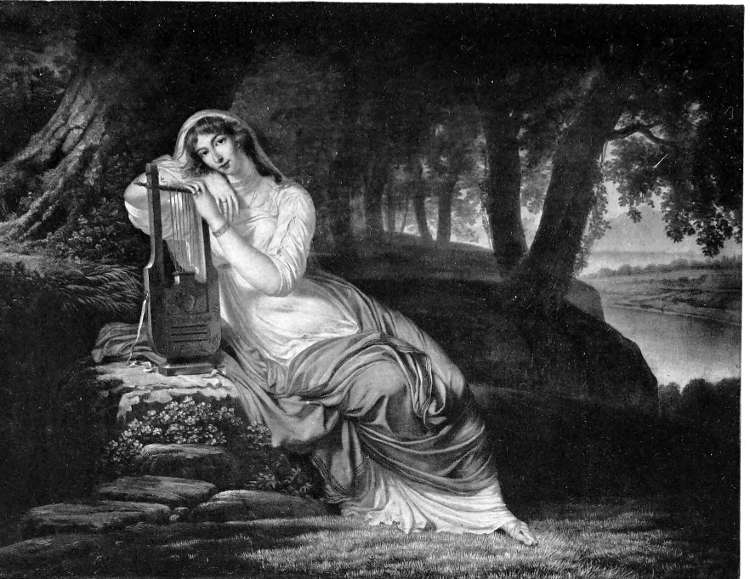
Louis Gauffier, pinx.
Emery Walker Ph.sc.
Henrietta, third Countess of Bessborough
CHIRAC
Dumont mentioned a curious anecdote of Chirac, the celebrated physician of Louis XIV.,[119] told to him by Condorcet. At 84 years old he fell into a violent illness, which was his last. He lay for two days in a state of insensibility; he suddenly jumped up and sat upright in his bed, felt the pulse of his left hand with his right, shook his head, and in a loud voice cried, ‘On m’a appelé trop tard, le malade est mourant,’ He immediately fell back, verified his own prediction, and expired. He was the man roused in the night to attend a dying Cardinal, a person of very profligate life and infamous character. To hasten the physician, the messenger said, ‘Venez donc, il souffre comme un damné.’ ‘Comment déjà?’—a bitter sarcasm in one word. He was present at a dispute upon the Resurrection of Christ; some thought it was impossible that he should have arisen after death. Chirac only said, ‘Si il était mort de ma façon,’ implying without levity, his own incredulity.
We have had a consultation with three lawyers, Piggott, Erskine, and Richards, upon the propriety of taking out a licence, or getting an Act of Parliament for my name, as it is particularly enjoined by my grandfather’s will that the person to whom the estate goes by descent should bear his name. There is some nicety in ye question, because, tho’ I am only just come into the profits of it, yet I was virtually possessed of it when that unhappy man compelled me to renounce it to him, and it may lead to an examination as to our signatures. This would be troublesome, as out of accommodation to him I signed two bonds without the name of Vassall. Ld. H. has only a marital dominion over it, and cannot be subject to forfeiture. Richards and Erskine think the title of honour supersedes all, and that no mischief has been yet incurred. It is not yet decided. Ld. H. went yesterday to Plummer’s. I wrote to Ld. Ossory, and begged him to accompany him—a proposal certain of pleasing, not only as it showed confidence and attention, but that it gratified his curiosity.
It appears that the average of the net produce, deducting outfit, annuities, mortgage, jointure, insurance, and, in short, every expenditure, is within a hundred or two of six thousand pr. anm., an ample acquisition, but as yet must not be anticipated or enjoyed. Sir G. W. has left property, however, to answer all debts. Webby must have 1000l. pr. ann. certain; that accumulating for ten years and half will be something. Henry and Harriet five thousand each.
Canning is immediately to be married to Miss Scott;[120] she has an immense fortune. He has just been made a Privy Councillor and Joint Paymaster; if ever a man was born with a silver spoon in his mouth, surely it was him.
Ld. H. was telling us to-day of the whimsical effect produced by a droll manner of compressing the substance of a man’s speech. A Mr. Robson, who is neither witty nor clever by-the-way, gave his whole attention to one of Windham’s speeches; he did not listen to the other debating, and when it came to voting he rose and said that ‘The Honourable Gentleman had declared that we were not fighting for the Restoration of the Bourbons, but that we should fight till they were restored, therefore he should give his vote against him.’ This done with gravity would get the laugh on his side, and provokingly perplex his adversary.
AN UNJUST WILL
Erskine told us a singular cause that he was called to at Uxbridge. It was to decide upon a will supposed to have been made whilst the testator was under the influence of some morbid, mad affection of the mind. He was the elder brother of a man with whom he had lived in the closest habits of friendship, and to whom he was sincerely attached. One day he came home heated and fatigued, complained of the colic, and was advised by his brother to go to bed and drink warm rum and water. He followed his advice, but whether the disease was naturally fever, or that the rum created it, is not known; but the effect was raging madness, during which he furiously inveighed against his brother for having poisoned him in the drink. The frenzy continued, and he was put under a mad doctor. In a few months he recovered his reason to all intents and purposes, acted as a magistrate, fulfilled all the functions of his station, gave law opinions, and betrayed no tokens of insanity. But some years after when he died, it was found by the will that he had excluded his brother, upon the old accusation of his having administered poison to him. It came out that the man, in favour of whom the younger brother had been disinherited, used to listen and rather encourage his rhapsodies. Erskine substantiated the will, but made the heir by will share alike with the lawful heir.
This story of rational madness reminded Ld. H. of one which Fontana was fond of telling, because it squares with the common definition of madness, and proves that a man may reason logically upon false premises. A very intelligent Jesuit went mad, and his predominating madness was that he believed himself to be a Cardinal. He was a loss to their community, and being a very subtle logician two or three of the cleverest of the Order undertook to argue with him, and convince by reason that he laboured under an illusion, which he might dissipate by force of mind. They asked him several questions as to the ceremonies necessary to be undergone previous to the instalment of a man in the College of Cardinals, to all of which he pleaded ignorance. ‘Why then,’ said one, ‘how can you imagine yourself to be a Cardinal?’ He replied, ‘I tell you that I am a Cardinal, and if you do not believe me such when I assure so, you must suppose me to be mad, and if I am mad, how can you be so mad as to try to convince by reason one who in that case must be labouring under an alienation of it?’ This syllogism posed the Reverend Brothers.
Wm. Lamb is returned from Glasgow quite bitten with a Scotch mania. He thinks the Scotch have outdone in moral philosophy and ethics all who have gone before them. To use his own expression, ‘They have gone far beyond Locke and Paley,’ ‘Yes,’ replied Ld. H., ‘so far, that they are unintelligible,’ He was under Professor Millar,[121] a friend of Ld. Lauderdale’s, a man who has written upon Governt., and who is the greatest enemy of all belles lettres and poetry; the latter he calls a mere jingle which proves no facts. Lamb is very clever and pleasing, and will improve when he gets out of his love for singularity.
LORD HENRY PETTY
Ld. Henry Petty unites to a sound, strong understanding a pleasant vein of cheerful humour, with talents and advantages far beyond his years. His simplicity and unassuming manner is the most winning of his qualifications. His character is very like Ld. H.’s, only he has less playfulness of imagination, and less vivacity; his turn of mind is rather serious, but in temper, artlessness, and integrity they are more nearly allied even than by blood. Ld. Lansdown idolises him, and with pleasure I perceive that his tenderness is bestowed upon an object that will reward him with interest; poor old man, he wants filial comfort.[122]
Bonaparte in his passage through Switzerland went to Coppet to see Necker; some imagine that he proposed to him to accept the post of Minister of Finance. Madame de Staël greeted the hero, and made a political tirade for full twenty minutes; when she ceased she expected a complimentary eulogism, all he said was, ‘Madame, a-t-elle nourri ses enfants?’ A cutting rebuke.[123]
Dumont one evening read to us Rousseau’s description, in his Promenades solitaires, of the Isle de St. Pierre, in which he describes the felicity he enjoyed and his regrets at having quitted his delicious retirement. Ld. H., who is no admirer of Rousseau in any way, grew tired, and wrote this:—
Rousseau was so charmed in his island St. Pierre With walking and rowing about; I agree with him heartily when he was there ’Twas a pity he ever came out.
Ld. H. told me this morning a piece of slyness of the Jacobinical party towards him. About two years ago a man of the name of Gurney, a solicitor, on behalf of the manufacturers entreated Ld. H. to speak against a Bill, which involved their interests, then brought before Parliament. It was entitled, a Bill to prevent unlawful combination among the workmen. He spoke, and distinguished himself; his speech was printed at Manchester and Liverpool, and distributed among the manufacturers. It seems Burdett and Ld. Stanhope[124] grew jealous of his popularity among their friends, and have now contrived to get the petitions given to them, and have, now that resistance to it is become a little popular, espoused the cause. Ld. Stanhope told Ld. H. that he had made himself ‘many friends among the most valuable part of the community.’ Ld. H. of course does not care a straw upon the occasion one way or the other; it only makes him laugh.
Ld. Thanet quitted his captivity on Monday last; he is delighted at regaining his freedom, but a little annoyed at walking the streets where he is shown as a sight, ‘There he goes: aye, that is him.’ He says all rooms appear immense, his eye having been so long accustomed to the straitened little apartment he occupied. Madame Bonawitz latterly shared his confinement: she is reckoned clever, she writes English verses.
Our planet must have got out of its orbit and flown off further from the sun, as the cold is very remarkable. Fires are indispensable, and I, who have within these four years said the only place where a fire was useful was the kitchen, am perishing. This is the 11th June, and the servants continue fires, which is the more singular, as they in general lay more stress upon the calendar than upon their feelings. Bread is 17½d. the quartern loaf, butcher’s meat from one shilling to 14d. pr. lb.; poultry, enormously dear; and every other article of consumption in proportion. How the labouring poor subsist and suffer their hardships patiently, are both problems.
1800 LORD ELLENBOROUGH
Burke observed upon Mrs. Hastings’s[125] reception at Court, that the Queen had but one vice, avarice, and but one virtue, decorum; but when accident had brought them to contend, the vice had proved the stronger.
I dined with the Smiths on Saturday, where I met Serjeant Law,[126] a man whose abilities are rated high in his profession, but who by a singular piece of misfortune, has never yet had a fair opportunity of distinguishing himself. He has a brief, clear way of expressing himself, with a portion of causticity: he puts me in mind of Mr. Wm. Fawkener. He dined here the next day. Our party consisted of almost all the rising talents at the Bar, Bobus Smith, Mackintosh, Mr. Scarlett, Sturges, Mr. Brand who, tho’ only an amateur, yet studies the law. Fergusson, who is just liberated from the captivity of a year, called so near the moment of dinner that it was impossible, with the most adverse dispositions towards him, not to invite him. He accordingly accepted the proposal. His beauty is much praised, I did not admire him; about his mouth he has a mean expression. My accueil was not flattering or warm; as a guest he had my civility, otherwise a particle of notice would not have been bestowed. I neither like the man nor his cause. On Sunday the Beauclerks came to stay a day or two only.
I made, through my mother, to Mr. Frogatt a proposal to be laid before the guardians who may be appointed for my children by Chancery, the substance of which is an offer to take upon myself the whole expense of the maintenance and education of Harriet, that her fortune, which is but five thousand pounds, may be allowed to accumulate until she marries or is of age. I also wrote to him myself, adding that what I asked was solely for the girl’s benefit, and that she would be equally under the superintendence and control of her guardians. To this offer I this day received an answer, merely to signify to me, that Mr. Chaplin, in pursuance of the earnest desire of ye late Sir G. Webster, had applied to Chancery for the guardianship of the children: a very improbable story, because if Sir G. Webster had recommended his children to Chaplin, there would have existed a suspicion of his intention of destroying himself; and, on the other hand, if it had been his steady wish, he would at least have made a will in case of a death as sudden and more unexpected. Sir Gilbert Affleck called upon Chaplin yesterday, to propose to join in the application for the guardianship, but Chaplin rejected the offer in a manner that Sir Gilbert told me it was a force upon his feelings not to resent as it merited.
GUARDIANSHIP OF THE CHILDREN
Whilst Webby was at Petworth with Ld. Egremont, I wrote him a letter under cover to Ld. E., in which, after inquiring how he was, I conveyed my sense of Ld. E.’s kindness, adding that it was such that it claimed the gratitude of all his family. Before this letter reached Petworth Ld. E. had brought him to town to his grandmother’s and the Chaplins, and I have not received a word of acknowledgment, which seems unnecessarily harsh. This behaviour in Chaplin is the more remarkable, as he has uniformly assured me that he would use his utmost endeavours to persuade Sir G. to let me see the children. This assurance I have under his hand and signature. Besides, he was quite cordial when I married Ld. H., wished me joy, and wound up his congratulatory sentence with a sort of prophecy that I should be happy, as my disposition was of a domestic turn, and that I had never hitherto had a fair opportunity of showing the real goodness of my heart. He visited Ld. H. and me, the year after, when he came to town, and, in short, rather affected a sort of intimacy of intercourse. I shall set every engine to work to counteract these unjust projects.
A few days ago I asked Ld. Stair[127] just to mention, the first occasion he could find naturally, to Ld. Egremont how grateful I felt for his tenderness to my child. He did, and brought back a civil reply. I consulted Ld. S. about asking Ld. E. to do something towards getting me the facility of seeing my children. He told me he was a real good-hearted man, but one who was habitually indolent and to a degree timid as to meddling in other people’s concerns, but that tho’ he would do nothing for me, yet he was incapable of doing anything against. However, yesterday, to my great delight, Ld. Stair told me he had de son chef had a conversation with Ld. E., who not only was not averse to me, but offered to call and explain all he knew about my children’s concerns, and would undertake to advise Chaplin to be more tractable. Ld. Stair advised me to write a letter of acknowledgment to Ld. E., which I did last night. Thus I have the sanction of one of the most respectable and worthy persons in my favour.
Sheridan dined with us last Friday; Mrs. S.[128] was to have come, but she was ill from having sung too much. He was in a very playful vein of humour, and, without any marked trait of wit, all he said was pleasant. Lewis was a self-invited guest, to prove to me that he and William Lamb were cordial friends, who he knew dined with us; but he failed in that attempt, as Lamb complained that he followed him like his shadow, and bored him insufferably. Sheridan told a story of a sale of plants near his house. The trees were ticketed with their names. Two country gentlemen read a ‘Dacious cypress,’ ‘This must be wrong,’ said one, ‘there is no such word: I will make it right,’ and with his pencil he wrote ‘Audacious.’ When the little, puny deciduous cypress appeared with such a tremendous name, the whole auction room shouted with laughter. He said formerly the managers of the two theatres used to send people to hiss and disturb the actors at new plays. One night an actor complained to Garrick that the new tragedy was interrupted and would get damned, as a Covent Garden man was in the pit laughing. ‘Never mind,’ said Garrick, ‘I shall be revenged, for I have a man fast asleep at their new comedy.’
Bedford House is pulling down, and the Duke is building a new square.[129] He has some idea of erecting a statue of Ld. Russell; I advised him to get Mr. Fox to write the prose inscription, Fitzpatrick the verse, and Dr. Parr the Latin. If he should raise the monument he will adopt my hint. Serjeant Lens surprised me by saying that should this statue be erected, the populace would in all probability pull it down. If so, public opinion has undergone a strange revolution, as he was a martyr whom patriots worshipped,—‘That cause for which Russell and Sidney bled.’
19th June.—I went yesterday to Hampton Court, where I slept. Ld. H. rode over to St. Anne’s, and joined me at night. In a small corner of the Palace erected by William now lives the Stadtholder[130] and the Princess of Orange, fugitives from those dominions their ancestor quitted to govern these: a reflection that must be accompanied with pangs of regret and mortification.
On the 19th, I went by water to Kingston Bridge, where I found my mother, Sir Gilbert, Henry,[131] and Mr. Francis. In the evening we all went to the Opera.
STATE OF THE WAR
Genoa is taken, Melas seems to have changed positions with Masséna. Bonaparte is beyond Milan and restoring the Cisalpine Governts.
Francis says whilst the French armies are performing prodigies of valour, traversing impossible mts., dragging artillery over steep crags, disposing of empires, extending conquests, etc., we hear our own exploits, performed by an immense fleet sailing up and down the Channel, to be a descent upon France, and the victor’s spoil ‘three pieces of iron cannon and twenty-five cows.’ Maitland[132] commands the expedition which has been directed again against Quiberon; the most he can do will be to singe here and there the coast of France.
On Thursday, ye 10th July, we quitted home to make an excursion for two or three months upon the Continent. Our party consists of Ld. Duncannon,[133] Mr. Marsh, Dr. Drew, Charles, Hortense, Charles, 4 maids, and five men. We manage to stuff all into a coach and postchaise. We set off at five o’clock in the afternoon, slept at Epping Place; began our journey the next day at 7. At Newmarket I saw D. of Queensberry: he wanted us to dine with him. He was violent at the continuance of the war, and spoke roundly against Ministers. He told Ld. H., upon the Dutch business, that if he had not made a determination never to vote against Government he would have voted with him upon that question. Mr. Vernon also came and sat by me whilst I eat: he envied my stomach that could digest and relish cold meat and porter. We stopped at Thetford. The D. of Bedford thought our coming so uncertain, that he did not hear even of our arrival until 10, and it was then too late to join us at supper, for we went to bed at ½ past nine. This morning we were up at 4 o’clock, off at 6, and passed through Norwich (where Ld. D. overtook us), and got here (Yarmouth) at about 2. Ld. Spencer wrote to order a convoy, but there is some difficulty about getting a better than a cutter. The Admiral (Dickson) has just been with me; he promises two cutters, but the lugger in port is better.
We were landed upon terra firma within fifty hours after we had sailed from Yarmouth, a surprisingly quiet passage. Met on our way from the jettée at Cuxhaven, Mr. Arbuthnot; he now is attached to Prince Augustus. I knew him formerly at Naples when he travelled with Ld. Digby.
The party set off that day, and slept at Basbeck, where there was no inn. ‘Ld. H. and self lay upon the ground in the room we supped in; the gentlemen, Charles, and the maids lay in a large room together.’ They took the road to Hamburg by Cranz, crossing the Elbe at Blankenese. ‘The wind rose and the water was rough; we were about forty minutes in the passage.’
HAMBURG
We came through Altona to this place (Hamburg) where we are very tolerably lodged at Kaysershoff. Mr. Berchemeyer, a great merchant, called to offer us every civility, as did Mr. Parish, the son of the late American Consul; he belongs to a great house of commerce. In the evening of the 18th we drove about the ramparts, and went to the French comedy, a neat theatre with a tolerable troupe.
During our stay at Hamburg we received much hospitality and civility. On the Sunday after our arrival we dined with Mrs. Parish at their country house upon the banks of ye Elbe. She is a sensible, voluble Scotchwoman. The party consisted chiefly of merchants; Symons, his wife and sisters, Flemings and relations of the famous coachbuilder of that name at Bruxelles. The ladies were recently returned from Paris, but their attire was such as Bonaparte would have corrected. We returned early, as the gates shut always at nine, the only one which is left open until eleven is only attainable by crossing the Alster, a sort of lake.
Bourgoing,[134] the traveller and author, on his way to his mission to Copenhagen, demanded of the Senate of Hamburg two French emigrants, who are conductors of a journal called the Censeur, in which Bonaparte is virulently and clumsily abused. Paul’s Minister, on behalf of his master, claimed them, and the business is not settled. This is merely a pendant to our claiming Napper Tandy, for one injustice begets another.[135] Dumouriez is extremely out of spirits, indeed well may he be from the absurdity and inconsistency of his conduct. All that are busy and idle assemble at Hamburg, merchants and sharpers—Major Semple,[136] Mr. Holcroft,[137] Dr. Maclean,[138] etc. On Wednesday we dined at Monsr. Mathison’s[139]; he is a wealthy merchant married to Henriette, one of Mde. Genlis’s élèves, and in consequence of her connection with Ly. Edward[140] is become one of her most cordial and useful friends. Ly. Ed. lives in his house.
MADAME DE GENLIS
Mde. Genlis was just arrived from Berlin; I felt great curiosity to see a woman so justly celebrated for cleverness. Her countenance denotes talent and mischief; more of the latter than real vice. She has just published a new novel, Les Mères Rivales; there are some good things in it, but it is rather tedious from its length. She gives her political and religious creed, which are curious from the novelty of her having any. Bourbon monarchy and Papal Catholicism she now holds to be indispensable to the benefit and salvation of mankind. Permission has been granted for her return; her own account is that Bonaparte has ordered her into France from regret that so great an ornament should seek repose in a foreign country.
On Thursday Dumouriez and Berchemeyer dined with us. In the morning we went to see Klopstock, the father and founder of German poetry. He is now near 90 years of age, full of vivacity and as strong in intellect as he probably ever was. His writings are known throughout Germany, but are difficult to translate, as they are in the sublime, incomprehensible style. His Messiah is his greatest work. He talked to us of English literature, especially of Pope’s Homer.
In the evening we went with Mrs. Parish to the Syndic Dormanne’s house in the country. It was a day of festivity, being an annual commemoration of a charitable institution. We laughed at Marsh, who endeavoured to make a compliment to the Syndic about his house, and began praising it as a town house, whereas the Syndic had been pointing out to us the champêtre appearance and the point de vue pittoresque which it enjoyed. But Marsh persisted in his original idea, and dwelt upon its excellence considering it was in a populous town. The truth is the house, tho’ two miles from the city, is one in a sort of row upon the Alster.
They left Hamburg on July 24, to go by Hanover to Berlin, crossing the Elbe at Tollenspicker. ‘The carriage came over in the regular ferry boat, which is of a singular construction considering that the waves are sometimes high; the ends are both open. Marsh and Duncannon bought a horse between them, which keeps up with German travelling, a proof of its rapidity!’ They slept the first night at Lüneburg. The road to Zell lay through a stretch of forest land, but sparsely inhabited, ‘not more than three villages sprinkled over an extent of thirty miles.’ Lady Holland says, ‘On the whole it is the worst country I ever saw, and naturally so incapable of improvement that it would baffle the agricultural skill of our English improvers.’
From Zell to Hanover two posts: we were eight hours. Saw nothing but forests of diminutive firs, deep sands, and barren wastes. In fifty years there may perhaps be a tolerable road; at present all that appears is that probability. The chaussée is marked out, trees were planted, and even in some places stones are collected in heaps, but only here and there for about a hundred yards are any laid on the road; and where there is that small portion of pavé, it seems merely to be a pretext for a heavy toll. Well may these Hanoverian surveyors boast, as did one of the French patriots, that they labour for posterity!
Arrived at Hanover ye 27th July, 1800.
28th.—The King’s stables, or rather stud, are very fine. It is from hence he is supplied with the white and cream-coloured horses which draw his state coach; they are beautiful animals, but have a diseased, unhealthy look, especially about the eyes, which have a reddish hue. The breed of horses and men are alike, and I could trace a likeness to my liege Lord and Sovereign among his coach horses. They breed good-sized mules from Italian asses. I was surprised at finding them so good in this cold climate, for tho’ as hot as Italy now, the cold in winter is insufferable. The riding house is large and grand; one or two riding masters were busy dresser these manège horses. It is a graceful action, a man on a well-dressed horse, and it is much to the loss of our young men that the slouching fashion of riding gets the better of the manège method. The boys hoot at Duncannon and Marsh, and abuse them for their ignorance of riding, calling out jeeringly ‘Englander.’
HANOVER
Saw a beautiful palace built by the D. of York, sold by him to one Eckhart, an army commissary, and repurchased by the King; and now occupied by Prince Adolphus.[141] It is exactly like a Paris hotel; the whole was executed under the direction of a French architect, and the furniture and decorations brought from Paris and Lyons. The Electoral Palace is old, irregular, and vast. One of the inner courts was destroyed by fire, and rebuilt by George II. In his private apartment they showed us the altar he commonly used, which had been rescued from the flames; it was very much scorched. His common walking cane the concierge kissed with veneration, adding, ‘He loved us, he lived among us.’ The Hanoverians are short-sighted enough to regret not having their Sovereign among them; they long for the splendour of a Court, without taking into account that his residence would entail taxes, burthens of various sorts, and perhaps wars.
A dark passage between the ball-room and the Electress’s private apartments is shown as the spot where Königsmark was murdered. He had slipped out from the festive scene to indulge in the softer delights of love in the arms of the Electress; on his return he was rushed upon by the guards with their halberds, and dispatched. Various stories were invented, some that he was put into an oven and suffocated, another that he was thrust into a reservoir and drowned, another that the Elector (George I.) kept him to enjoy ye sight of his torture, etc. True it was that he disappeared, and that the Electress was banished her husband’s presence and exiled to a castle at All or Aller.[142] She was never permitted to go to England, or assume the title of Queen. Some time afterwards B. Hoadly to satisfy the royal suspicions wrote the play of The Suspicious Husband, which proves that a gentleman may be in a lady’s bedroom at night most innocently. Königsmark was but a mauvais sujet; he had run off from England for murder. He shot Mr. Thynne in Hyde Park to prevent his marrying an heiress he had designs upon.[143]
In the evening we went to drink tea with P. Adolphus at Montbrilliant. He is remarkably handsome and pleasing in his manner, and since the decline of the Prince’s beauty, is certainly the best looking of the Royal Family. He complains of being exiled. He left England when he was 12 years old, and since that time has only been there for four months. I renewed my acquaintance with Count Münster and Tatter, two Hanoverians whom I had formerly known at Rome when they were attached to Prince Augustus.
When we arrived at Brunswick we found the inns filled with Jews and infidels on account of the Fair, which is a great epoch in German festivity. We, however, obtained a tolerable lodging. Mr. Kinnaird is living in a Swiss pension, imbibing Genevan principles; these upon a Scotch fond will produce a useful man to himself and family.
BRUNSWICK
A most gracious invitation from the Court immediately on our arrival being known; we dined there the next day. The Duke is a worthy nephew of the great Frederick’s; but for the unfortunate invasion of France, he would have been in addition to the best general of his time the most successful.[144] His countenance marks a man of great talent. He is reckoned reserved, but his good breeding prevents it from falling into coldness. The Dss. is a most excellent, prating, good-hearted woman, very like her brother the King, full as talkative and inquisitive, but much less discreet. She rattled away upon all subjects. She put many distressing questions to me about the P. and Pss., especially as to the renewal of the amour with Mrs. Fitzherbert, about which I expressed the most profound ignorance. She could not conceal her dislike of the Queen, whom she called haughty and proud of her station, as she was but the daughter of an inferior Prince of Mecklenburg, an appanage of the family.
After dinner the Dss. desired I would join her to pass the eve. at Mde. Deodati’s, a dull card assembly. The weather was very hot. Poor Drew fell ill, and kept his bed; a fever and spasms. On Thursday we dined again at Court. In the evening went to the French comedy: a very pretty theatre; afterwards to Mr. Des Arte, merely to please Mr. Kinnaird, who is living with him. Mr. Ridley, a good-humoured young man, K.’s fellow-traveller. On Friday received another invitation to dine at Court; I wrote a letter of acknowledgment and apology to the good Duchess. Drew was better, and we set off to Helmstadt. On the right-hand side of the road a building with four painted towers, which belies its warlike appearance, as it is nominally the seat of peace and bliss—a convent; tho’ in fact hatred and discord sojourn chiefly within such walls, and Ariosto was scarcely satiric when he makes the angel seek discord in a monastery. Upon second thoughts I believe he sought indolence, not discord. He might, however, have named both; one is suspended only by the other.
The first night was spent at Helmstadt, the second at Magdeburg. ‘Magdeburg is the frontier town on Prussian territory. It was sacked by the barbarous Tilly at the beginning of the bloody wars under Gustavus Adolphus, and it has since afforded a prison to La Fayette, who lived a year in the citadel, before he was transferred to a more rigorous jailor, the Emperor.’
Zefur, their next halt. ‘We went to the worst inn, where we were abominably cheated and abominably lodged.’ They reached Potsdam at one o’clock the next night.
We went to the Palaces. I saw them about four years ago, but as they are very fine I did not dislike another visit to them. The Great Palace contains rooms as superb as any in Versailles, and may vie with those at Rome and Genoa. Sans Souci, the retreat of Frederick, is a delightful habitation. His apartment is entire: his private library (consisting solely of French books) is untouched. In his bedroom the only picture is a portrait of Gustavus Adolphus; in an adjoining room a bronze bust of Charles XII. of Sweden. I paid my homage to the apartment of Voltaire. He occupied it many years, until he capriciously quarrelled with his Royal patron.