Volume 1 — JOURNAL OF ELIZABETH LADY HOLLAND (continued 4)
Reading edition
Lord Granville L.-Gower is going immediately to Berlin to congratulate the young King upon his accession.[179] It will require the pen and genius of another Mirabeau to describe and detect the intricacies of the intrigues going on there. The monarch is represented to be obstinate, weak, and unfeeling; the second brother, who died two years past, was the one of the whole family most favoured by natural endowments, though he may perhaps only share that reputation in common with all princes who die prematurely. The D. of Brunswick is gone to Berlin, according to report, to govern the King. If obstinacy and folly are as much combined in his character as they say it is, the Duke will find the undertaking as difficult as that he engaged in when he invaded Champagne.
I passed a few days at Berlin in ’96, and was fortunate enough (for I then thought it so) to arrive the day before a review; which, when I had seen I found I had seen nothing. For, stunned by the noise, choked with the smoke, and blinded by the dust, the four hours spent upon the sandy plain were so many of bodily sufferance, and the only instruction I derived was that a man may easily evade and play the part I should in a battle, viz., run away and not be missed. Glad to escape from a scene, disagreeable in itself, and made more detestable by reflecting upon the intention of it, I went to a small house on a cross-road, which was found filled with royal attendants, i.e. a seraglio. Shortly after the unwieldy monster, for whose pleasures they were assembled, appeared upon a horse of a proportionable size to himself. After hearing their names he selected those he chose to have follow him to Charlottenburg. The royal wish being signified, three or four ascended a carriage that was in waiting, and the whole party, accompanied by the famous Bischoffsverder and some other courtiers, set off to engage in the most disgusting debaucheries that ever disgraced a court. When he was dying he frequently asked of the physicians when they thought it would be over with him, and expressed great impatience for the moment of dissolution. This desire of death in a timid, bad man was remarkable, for such a contempt of life was not in his character; but it appeared that he firmly gave credit to the Illuminés, and believed he should return within eight days to life in the form of a handsome young woman. Some of his mistresses are under a suspicion of having embezzled great sums, and the celebrated Mde. de Rietz[180] is under confinement, and her goods, etc., confiscated—a paltry measure for a Sovereign, for if the money was given, however injudiciously, it is a reflection upon the memory of his parent, and is a shabby robbery. Mde. de Rietz was the Pompadour of Berlin; no longer fit to please the King she sought those that could. It is her daughter that Ld. Bristol quarrelled with his son for not marrying last year.
FREDERICK WILLIAM II.
Ld. Malmesbury was to have gone to make the compliments, but most likely Mr. Canning made him relinquish it for the sake of his young friend; and Ld. M. did it more readily since the memento of mortality he has lately had. His head is awry, and his whole appearance indicates a universal shock.
Ld. H. made, on ye 10th of January, his debut in the H. of Lords, on the subject of the Assessed Taxes.[181] He spoke well in his first speech, but admirably in his reply. His speech was precisely what a friend would wish: argumentative and simple, evidently not a studied declamation, and such as a first opening should be, more because it promised success than that it possessed it. I should have been sorry to have heard it was eloquent, as almost all the speakers who have begun pompously have stopped short, as for instance Ld. Hawkesbury, Belgrave, and Mr. Canning. The wit and quickness of his reply is an answer to those who probably would have ascribed to Mr. Fox his speech. In answer to Lord Grenville’s repeated boasts of the excellence of the Constitution, he said it reminded him of Prior’s lines:—
When Harlequin extolled his horse Fit for the road, the chase, the course; One fault he had, a fault indeed, And what was that? His horse was dead.
He entered a protest, but by some unlucky misunderstanding the Duke of Bedford did not sign it, and Ld. H. was too indolent to get the signatures of the other peers who wanted to sign; and unfortunately Ld. Oxford was the only person who signed with him. The Assessed Taxes have passed, and there is besides a voluntary subscription open for those who have money enough left to squander upon such an absurd donation.[182] The Assessed Taxes add to us 1000l. and fifty pounds besides the old assessment—a sum added to the annual expenditure that compels us to exceed our income, and nothing but the desperate state of affairs can make me look upon such a certainty as a moderate calamity.
MR. GREY
Messrs. Grey, Tierney, and Erskine dined here last week. Grey was placid in temper and pleasing in his manner, a contrast to the general state of both, as he is usually irritable and supercilious. His heart is warm and excellent, and those few who do not detest him love him with great affection, but he is universally unpopular from the offensiveness of his behaviour. He says he is dissatisfied with his political conduct, and regrets having continued so long in Parliament after seceding. He began his political career under the auspices of Ld. Lansdown; the beauty and attraction of the Dss. of Devonshire drew him to the party of which she was a most active partisan. His abilities and connections secured him the flattery of the Whigs, and more seduced by his heart than convinced by his reason, he became an adherent of Mr. Fox’s. For many years he was discontented, for his ambition and vanity have been checked and mortified, the first from the desperate, unavailing opposition, and his vanity at being compared with Sheridan and obliged to act in concert with him. His eloquence is more pleasing and agreeable than forcible and deep; in private life he is very respectable. He has married the Duchess of Devonshire’s relation, Miss Ponsonby, a mild, insipid, pretty girl.[183] They are very happy, and if he is satisfied it is no person’s business to express astonishment at it.
Tierney[184] is a man of whom everybody believes something against, but I could never discover upon what fact such a belief was founded, as he has never committed any overt act. His birth is obscure, not to say mean. He married a woman who brought him a fortune, which his extreme parsimony will prevent him from squandering. He is shrewd and lively, and has apparently a very bad opinion of mankind.
A person who was sent about two years ago to explore the interior parts of Africa is just returned. He is a Scotchman of the name of M. Park,[185] very much protected by Sir Joseph Banks, and esteemed a man of veracity. He has neither fancy or genius, and if he does fib it is dully. He has traced the Niger to its source about a 1000 miles from the embouchure of the Senegal. He describes it as falling into a vast mediterranean lake, from whence it probably issues, but that he could not ascertain. He met with great difficulties, and was frequently in danger of losing his life. In a Negro district he was once imprisoned and condemned to death. The Queen saved his life by proposing to preserve him as a curiosity for his complexion, but at the expense of his sight. He escaped, however, that sacrifice. A Major Houghton, who preceded him in the expedition, went laden with beads and toys, hoping to engage the friendship of the inhabitants by his paltry gifts. He succeeded for some time, but falling in with an intrepid, rapacious people, to obtain all his riches they massacred him. This man lived with the Negroes everywhere, shunning the Moors, whom he represents as cruel and perfidious.
There is another adventurer wandering, whose history is remarkable, and if what he says is true his discoveries are curious. A student in the Temple of the name of Browne[186] allowed his imagination to be heated by the perusal of Quintus Curtius, and became convinced that he could discover the Temple of Jupiter Ammon. With all the ardour of youth and the enthusiasm of a proselyte, he quitted England, and arrived at Cairo without the smallest equipment for a laborious journey, or the least knowledge in the Oriental languages. He there engaged with a caravan, which was going across the deserts of Libya; after sixteen days’ journey from Alexandria they arrived at a fertile, verdant spot, insulated in the sands, conformable to the description given of the oasis on which the famous temple was erected.
MR. BROWNE
Mr. B. has since returned to England, and received great encouragement from the President. He is now learning Arabic and the languages that will facilitate his future enterprises. It is hoped that he will be de bonne foi, and really study the originals, and not do what poor Savary[187] was accused of, who instead of deriving his knowledge from the genuine sources, translated the history of a Caliphat from a bad Latin version. A musty savant discovered the imposition in an ingenious manner. In Savary’s history a certain town in Egypt is described as having its market filled weekly with oil. Now as no olives grow, and consequently no oil can be produced in such abundance as to furnish a regular supply in that district, recourse was had to other translations, and the identical one copied by Savary was found, and the error in the text that had led him into the mistake, for there olium was used for olus (oleris) cabbages! Thus fell the glorious boast of Savary’s learning.
I have lately been reading a very entertaining book, not the less so probably for being full of lies. It begins with a bouncer, viz., that Henry VIII. put Wolsey to death for his strict adherence to the Pope. The book is Leti’s Life of Sextus V., a pontiff whose history both as a sovereign and a man is worthy of being recorded, though the dignity of the first is degraded by cruelty, and the latter by hypocrisy.
The King yesterday subscribed towards the exigencies of the State and this ‘just and necessary war,’ 20,000l.! A scandalous and contemptible proceeding. He has a million annually, besides having Hanover, and most of his family provided for. The subscription goes on tardily, and there is not above 100,000l. raised, although it has been opened above ten days.
At length my wishes will be accomplished, and if life is granted to me for a few years, nay months, I shall witness the downfall of the detestable government of Rome! When this generation shall have passed from the face of the earth and no living witnesses remain, posterity will yield a reluctant belief to the testimony of history when it shall unfold the story of the Papal sway. That priests have governed without control the early history of every country shows, but then the ignorance of the governed was proportioned to the dominion of the governors; but that such a power should have lasted near four centuries after the destruction of Constantinople, when the lights of philosophy were diffused throughout Europe, appears incredible. The truth of the existence of the governments, Venice and Rome, will ever be problematical questions in future politics. Most will doubt, and for the advantage of mankind it is to be hoped none will ever try to revive experimentally their forms.
INTRIGUES IN ROME
This last commotion in Rome seems to have been a contrivance of the French, aided by the inveterate enemy to the See, Azara, for all (the Ambassador) Bonaparte’s steps in consequence appear to be the result of a premeditated scheme.[188] Tho’ I abhor the treachery, yet I cannot but applaud the effect, though it would be a prouder thing for ye human mind if the holy jugglers had received their destruction from the effort of reason, than by the common intrigue of an enemy. The King of Naples, unlike a faithful son of the Church, has marched a large army to seize a share of the tottering State, which the French will allow him to keep until it answers their purposes to take it from him.
29th January, 1798.—Lord Lansdown, Misses Vernon and Fox, Messrs Lewis, Jekyll,[189] and Beauclerk dined here. Ld. L. never dines out, so his coming was a distinguished mark of favour. His character is a monstrous compound of virtues and failings; the world has never done him justice for his ample portion of the former. A simple, well-meaning man once said, ‘What a pity ’tis that Mr. Fox has no private character, and Ld. L. no public one.’ His temper is violent, and his disposition suspicious; a man with whom it is impossible to live upon an equality, as he expects a deference to his will that few are willing to yield further than his rank and years demand. He is of a noble, generous inclination when he can serve a friend, and all who have been connected with him have felt his liberality in some shape or other. There are those whose fortunes he has made and whose families he has provided for with splendour even. His disputes with Ld. Wycombe ought not to prove him unreasonable, for he has an eccentric and impracticable character to deal with, who is to the full as suspicious as himself and as jealous of control. The collision of two such dispositions frequently kindles up a furious flame, but at the bottom each loves the other too well for the rage to settle into permanent estrangement, but every moment of each of their lives is embittered by interference on one part and resistance on the other.
Ld. L., in his old age, surrounded with dignities and wealth, is helpless, and more an object of pity than of envy. He has no friend. Colonel Barré, who went through life with him, he has broken with; the cause of their quarrel is a mystery. He loves the society of women, and has lost two wives. His son, whom he meant to make a tool for his ambition and to live over again in his political career, shuns the line he designed him for, and is an alien to his country. The character of his second son[190] is not yet developed. His home is a vast solitude, and but for the three ladies must be insufferable. Old age and the whole train of infirmities is coming on apace, and he must pass through many wretched hours without hearing the tender, cheering voice of friendship to soothe him. He always makes me melancholy, to fancy the anguish he must at times endure. When he was in Ministry many of the squibs of the day had compared him to the Jesuit Malagrida. Goldsmith, with his usual simplicity, said to him, ‘I wonder, my Lord, at their comparing you to Malagrida, for he was a very honest man.’
DUKE OF NORFOLK’S SPEECH
Nothing is talked of but the numerous meeting upon Mr. Fox’s birthday,[191] and the extraordinary factious toast given by the Duke of Norfolk, the more extraordinary as coming from him who is in general a chicken-hearted, trimming sort of politician. He said, ‘Gentlemen, about twenty years ago two thousand men (about the number in this room) rallied round one honest man, Mr. Washington, to support their liberties.’ Then, after expatiating upon their patriotism, he said, ‘I leave you to make the application, and shall propose the health of Charles Fox.’ This seditious and, in my opinion, very improper speech met with the most violent applause, which alarmed him, and in a second discourse he tried to do it away by an explanation. This not succeeding, he grew frightened, and the next day asked for a private audience of the King, in which he expressed his loyalty, entreating his Majesty in case of an invasion to put him forward in the post of danger, adding that he should write a letter to all the officers of his regiment recommending them to subscribe their mite towards the defence of the country. He also had a contradiction to the speech inserted in the papers, but this recantation has been of no service, for yesterday he was dismissed from the colonelcy, and is to be suspended as Ld.-Lt. of Yorkshire. It is said that he is so popular amongst his officers that they will resign in consequence of his dismissal.
There is still a rumour of a change in Administration to be effected by Ld. Moira and a party in the House of Commons headed by two Scotch Sir Johns, Macpherson and Sinclair; the Prince y entre pour quelque chose in the management of it. He sent a message last week to Grey to know whether he had any objection to be reconciled (they have not spoken for many years).[192] Grey answered very properly that he had never presumed to imagine his R. H. supposed he would venture to harbour resentment. He was then asked if he would receive amicably the advances of the Prince. He replied, ‘He should always be flattered by any notice or condescension.’ A dinner was proposed at Mr. O’Byrne’s[193] (an Irish gambler’s), where each party met, and the day passed in riot and drunkenness. Ld. Moira proposed to Mr. Grey to contrive an interview with Ld. Lansdown. Grey said he would willingly bring them together, and hoped as they agreed in opinion so they might in conduct, but declined all further interference. During the time all this was going on Ld. H. received frequent messages from the Prince, intimating that he was coming here, and begged we would give him a dinner; however he has never appeared.
WAKEFIELD’S PAMPHLET
March 1798.—Gilbert Wakefield,[194] known to the world as a savant and editor of Lucretius, has just written a most violent pamphlet in answer to one by Watson, the Bishop of Llandaff.[195] The Bishop from being a patriot and Low Church man has suddenly become an admirer of Ministers, and his book is in praise of the Triple Assessments, and to recommend the subscribing for the defence of the country. He rather implies that the Triple Assessments are a divine idea. He compares the body politic in this country to a well-constructed fabric that is to sink down to a degree, but the basis of the structure will continue firm and unimpaired, so that the descent will be equally felt by all the inmates, but without any shock. The learned commentator takes the idea up facetiously, and describes with some humour what the situation will be (and himself among the number of the humblest) of those who inhabit the basement of the building, who will, let the sinking be ever so gradual, soon be below the surface of the earth; whilst his reverence and those in the upper stories will find little if any debasement. The Bishop’s zeal is quickened, if not created, by the mitre of Carlisle in perspective, of which he has a promise whenever it becomes vacant.
On Thursday, 8th, Mr. Tierney came to Ld. H. to inform him of an important circumstance, which he was desired by Grey and others to communicate to him. It was that the P. of W. requested an interview with the D. of Northumberland[196]; which he obtained of course as soon as asked. He expressed great alarms about the state of the country, chiefly arising from the desperate measures of the Ministers, who were driving everything on with great violence. He said the King’s mind was inveterate against the Opposition, especially towards Grey, as he was the one about whom the greatest pains had been taken to instil prejudices. That in a recent meeting of the Council it had been resolved upon the first alarm of invasion that military law should be proclaimed throughout the country, adding that he had seen the instrument prepared and ready signed by H. M. He therefore entreated the D. of N. to assemble a meeting of Fox’s friends, to propose to them to endeavour to persuade Mr. Fox to agree to sign a declaration protesting strict adherence to the King and Government, in which declaration a specific reform might be stated. The D. of N. accepted of the instructions, though giving it as his opinion that it would not be a measure likely to be adopted or approved by Mr. Fox. It was totally rejected by the whole party, but the meeting assembled to discuss upon that declaration suggested the drawing up of another, viz., to declare unanimously why Secession had been adopted, and why those who still attended Parliament meant to secede—Tierney, Sheridan, and others; but this scheme could not be effected, as every individual differed as to principles and motives. So the affair died away.
HER HEALTH
About this period we were obliged to go to Bath on account of my health. I had an alarming complaint in my stomach, the cause a total debility, the effect a deathlike, icy coldness which suspended all the functions of digestion, from which torpor nothing but the strongest cordials could revive me. The physician (Dr. Parry) ventured upon a bold remedy, and bled me: success warranted the undertaking and I have been getting better ever since. Bath did me little or no good, and after a stay of three weeks we returned on March ye 10th to this delightful mansion.[197] The Duke of Leinster, who is attending his dying wife at Bristol, came over to see Ld. H. and me.[198] He told Ld. H. that if he could go to town and take his seat, he would leave his proxy with him, as he meant it no longer to remain with Ld. Fitzwilliam, although he had had it for twenty years. Ld. Fitz.’s acceptance of the Ld.-Lieutenancy has lost him.[199]
April 1st, 1798.—Ld. Edward Fitzgerald is not apprehended; Pamela[200] writes to his mother that she is tranquil about him, knowing that he is au gré des vents et des flots.[201] The report in town now is that they do not wish to take him, as they cannot prove anything against him, but I would not, were I he, trust to such vague assertions. It was believed he was in London; a Mr. Sheldon (a Catholic) fancied he saw him in Lancaster Fields [sic], and with a zeal becoming the fanatical politics of the day immediately went to Burlington H. to apprise the noble spy, for in fact his Grace’s department[202] is now but a bad imitation of that once headed in Paris by the active and celebrated Le Noir. Of all the truly contemptible public characters in England among the many, surely his Grace of Portland stands the foremost; his friends even dare not say a word in his behalf.
In the last month the D. of Bedford brought in his motion for the removal of Ministers.
THE HAPPINESS OF HEALTH
Oh God! chance, nature, or whatever thou art, receive the grateful thanks and prayers that flow from my heart in acknowledgment for the health I now enjoy; a full week have I been free from suffering or alarm. What are the gifts of fortune in comparison to the enjoyment of health! Grant that it may continue, and that I may, whilst life lasts, feel no other anguish than what is incidental to the gradual decay of mortality. Let it be gradual, for I am too happy to bear with equanimity the thought of being torn from the felicity of a life replete with every blessing human nature is capable of relishing. Formerly in the bitterness of sorrow I prayed for death; I looked to it as a relief to a broken spirit, and when I viewed its approach with indifference I imputed to philosophy that resignation and contempt, which despair alone had caused. Now I am a coward indeed; a spasm terrifies me, and every memento of the fragile tenure of my bliss strikes a panic through my frame. Oh! my beloved friend, how hast thou by becoming mine endeared the every-day occurrences of life! I shrink from nothing but the dread of leaving or of losing thee, but alas! the day must come:—
La Mort a des rigueurs à nulle autre pareilles; On a beau la prier. La cruelle qu’elle est se bouche les oreilles Et nous laisse crier. Le pauvre en sa cabane, où le chaume le couvre, Est sujet à ses lois; Et la garde qui veille aux barrières du Louvre N’en défend pas nos Rois. (Trad. d’Horace, par Malherbe.[203])
May ’98.—He spoke upon the D. of Bedford’s motion, and his praises were sounded everywhere. His manner is like his uncle’s. The great features of his speaking are eagerness, quickness, and argument. I saw a critique in a letter from an enemy, that said he was the counterpart of his uncle—full of ability, spirit, and impetuosity, presumption in reply, rashness in assertion, and arrogance in conclusion. But it was an enemy.
At a supper after a great ball the other night at Burlington House, Sheridan and Lewis got into a dispute, which the latter would have decided by a wager, and said, ‘I lay you the profits of my play (which, by-the-bye, Sheridan, you have not paid me).’ ‘I do not like high wagers,’ replied S., ‘but I’ll lay you a small one, the worth of it.’ The little author became as mute as a fish from the rebuff.
May 23rd.—Well may one ask the question, as Mr. Fox does in a letter to Ld. H., whether Robespierre was worse than the present state of things with regard to O’Connor. Poor fellow, there seems to have been a refinement in their cruelty towards him at the moment.[204] He endeavoured to get out of the place where as a criminal he had been standing before his acquittal. The messengers jumped upon him. A scuffle ensued, in which ye sabres that had been brought in in evidence against them were used. O’Connor came forward, and as he saw his fate was inevitable, made a most pathetic appeal to the feelings of the court; he said that he did not fear death, which to him was far preferable to the prospect of languishing in a dungeon. He entreated Buller to interfere, and that if he was to endure the hardship of another confinement, at least to allow him to be imprisoned with his brother. Buller behaved with humanity, regretting that the court had no power to interfere.
O’CONNOR’S ARREST
O’Coigly[205] behaved heroically; his countenance never changed whilst the judge was passing sentence, except that he smiled ironically to hear the heinousness of treason was said to be aggravated when it was against so just and beneficent a Prince as the one who now graced the throne. He took snuff, and bowed when all was over. The purport of the paper was absurd to a degree. He is half enthusiast, half bigot. He did himself an injury by confessing to a priest.
Very soon after I heard of O’Connor’s second arrest, when my heart was full of pity and commiseration, came the sad intelligence of poor Ld. Edward’s arrest. A personal misfortune could scarcely have grieved or shocked one more, and though I should at all times feel strongly for a man endowed as he is with every good and estimable quality, yet I felt more acutely, because for the last month I have been intimately with his mother and family and had witnessed their love and anxiety on his account. Excellent woman, I fear if the business ends fatally for him, it will not do less for her. He is the child of her heart, and the idol of his family. The circumstances of his being seized are accompanied with many awkward facts: the wounding the messengers, and even after the warrant was shown, the resisting.
Mr. Fox came over to pass the day with the Duke of Leinster. He was extremely agitated about Ld. E., and intends doing everything friendly, such as going over to the trial (as does Ld. H.) to make a show of friends and family; for a strong appearance in a man’s favour has its effect upon a jury, especially where there are titles and celebrity. Ld. Henry came to see him before he went. He was to have gone last night, but he waited for an answer from the D. of Portland, to whom he had applied for permission to see his brother. I can hardly think, steeled as hearts are become, this request can be denied, but bad times make bad men, and one can’t answer for one’s best friend.
The general want of common humanity, both for O’Connor and Ld. E., is disgusting. Party opinions may, and always must, run high in critical moments, but when things come to life and death, as in these cases, one should think the speculatists might yield to the man, and pity creep in and soften the rigour of the politician; but alas! I find none made of penetrable stuff. Ld. Morpeth thinks O’Connor guilty and unfairly acquitted, and is as violent against Buller as they are against Eyre who acquitted Hardy and the others.[206] C. Ellis, who does not allow himself to form an opinion, and if he could make the effort would stifle the embryo of it did it not coincide with Canning’s assertion, is naturally mild, but upon the cases of these unhappy men his bitterness is wonderful. I put it to him fairly whether it did not at the first hearing strike him to be a measure of unusual harshness. He would not reply for some time, as he said it might make him commit himself in a way he did not mean if taken as an A and B case; but if I asked whether it was hard for O’Connor he should not hesitate to say no, because the more cruel it was, the stronger was the proof of its being necessary and he being guilty, as Ministers were incapable of injustice. I told him that I regretted he had not lived in the middle ages and given his faith to orthodox points, as he would have made one of the firmest pillars of the Church, instead of being a milk and water politician now. Mr. Fox was extraordinarily pleasant and full of acute and judicious observations upon ye trial; he came and stayed here twenty-four hours.
O’CONNOR’S TRIAL
June 10th.—Death has placed the gallant Ld. Edward beyond the reach of his enemies. His confinement and illness and all the previous transactions were accompanied with circumstances so disgustingly cruel, that for the sake of the human character one feels almost inclined to suppress ye details, but as it is essential for the unfortunate victim that all should be known, I hope a faithful narrative will appear well attested. It appears that he was sick with a bad sore throat, and lying upon his bed, when Ryan fired at him through the door, burst it open, and seized upon him. He naturally (as any man would) resisted, wounded Ryan in the scuffle, and was seized himself by Swan and a file of musketeers; not, however, until by repeated wounds he had himself been disarmed. Those into whose custody he was placed were violent against him, and did not attend to his wounds for twenty-four hours. As he was carried to prison six persons separately attempted to rescue him, and, as might be expected, perished in the endeavour; the man at whose house he had been secreted, on the first impulse of honest zeal and rage, flew with his drawn sabre upon the soldiers. He was seized and hanged.[207]
Such was the winning character of poor Lord Edward that without patronage, wealth, no very superior abilities, he had the faculty of attaching men of all ranks to his person. He was universally beloved both among his family and country and acquaintances. His loss has brought forth more genuine, unfeigned tears of sorrow than would perhaps the death of fifty other individuals, even in his own rank of life, and taken out of a family as numerous. Ly. Edward was sent out of the country upon his apprehension; it was notified harshly, intimating that unless she obeyed speedily she would be arrested and tried for her life, as Government could hang her from proofs they had against her. She said she would stand ye trial, provided she might be allowed to share the prison of her ever-to-be-lamented husband. This was denied her, and she was compelled to set off with her two children, one only a month old, to this country, with a passport limiting her stay. Ld. Henry, upon his arrival in Dublin, was peremptorily refused an interview with his brother. I shall not give the particulars of what passed when he did see him, until I have heard it from himself, as he returned last night. The D. of Richmond came forward in the warmest manner. He had an audience with ye King, and laid before him the letter he had written to Ld. Camden.[208]
LORD E. FITZGERALD’S DEATH
When the excellent Duchess set off full of hopes and anxiety, she was overtaken at Coleshill, after travelling night and day to reach Dublin as soon as possible. She bore the dreadful news with composure and resignation. Lord Henry is in such an agitated state, that he cannot yet see any of his family. His state of mind is violently affected by the shock of seeing his dying brother perishing by wanton cruelty. Upon his first application to see Ld. E. he was refused. On Saturday, the 2nd of June, Ld. E. was roused from sleep by an unusual noise under his window; upon enquiring he was told that the military were in the act of hanging a man just condemned by martial law. The man’s name was Clinch, a friend and adherent of his. The effect upon his nerves was immediate; he became raving mad, and a keeper from a madhouse was necessary to attend him. The next day, the surgeons declared that the symptoms of death were upon him.
The titled murderers, when they heard what had caused his approaching dissolution, began to relent, and acceded to the prayers of Ld. Henry. He was admitted with Ly. L. Conolly to see him; they found him almost expiring, but even at that moment anxious to do what he knew would be acceptable to the opinions of his mother and aunt. He entreated her to read him the service for the dying.[209]
Upon Ld. H.’s[210] arrival at Holyhead he wrote a violent, reproachful letter to Ld. Camden of such a nature that personal danger may be the effect; no answer has yet been returned, and Ld. C. is upon ye point of returning to England, so it remains to be seen whether another calamity will overtake ye unfortunate family of Fitzgerald.
Upon ye Land Tax Ld. H. spoke, and I hear very well: ye subject was dry.
The explosion has at length taken place in Ireland, civil war rages with all its fury; the insurgents daily gain adherents and strong posts.[211] Ld. Camden is recalled, and Ld. Cornwallis is to succeed him, but not to conciliate. On Monday the D. of Leinster made a motion, which was seconded by ye D. of Devonshire and others; Ld. H. spoke remarkably well. The division would have been larger if the Opposition Lords had been sent to in time. My friend Ld. Boringdon did as shabby a thing as was ever done. He spoke against ye Bill for sending out ye Militia, with much heat, and the very next day he voted as readily as if it had been his own measure. Ld. Carlisle did the same thing, but he is so hackneyed in shabbiness that one neither is surprised or angry. But in a young man it is a bad debut.
THE PRINCE AND IRELAND
21st June,’98.—Yesterday H.R.H. came to dinner; all went off well. He was so desirous of being civil that he was here exactly at six; nobody hardly was arrived, and he seemed uneasy, fearful that knowing he was coming many might refuse, but by half-past seven our party was complete, except of Sheridan, who did not come till ten. Grey, Tierney, Whitbread, D. of Norfolk, Ld. Suffolk, Bessboro’, J. and W. Russell, D. of Leinster, Ld. R. Spencer, Mr. Erskine, Francis, Adam, and several others. After dinner ye Prince declared that he was willing to do everything that could serve the cause of Ireland, and that if after mature consideration and consultation with Mr. Fox, it was agreed that his going down to ye H. of Lords and making a motion would be serviceable, he almost pledged himself to do it. Grey said he applauded ye measure, and was of opinion that it would turn the scale of the wavering loyalty of the Irish, but at the same time that such a momentous step was discussing he thought it but honourable to apprise H.R.H. that the consequences might be to him of ye utmost importance, as it was probable attempts would be made to pass him by in ye succession. After much argument and debating a meeting was fixed for next Saturday, when ye whole will be finally settled. The D. of Norfolk was comical in his serious manner of entreating ye Prince to postpone all decision; ‘for,’ said he, ‘one is always betrayed into some imprudences after a bottle of wine.’ It occurred to everybody that he thought of his own toast which deprived him of his Ld.-Lieutenancy.
Ld. Suffolk[212] is ye strangest looking mortal; he had just come from a two hours’ audience of the King, who did not reply a word to any of his statements. He told ye King that the taking out of the Commons so many new peers degraded ye Commons, without adding dignity to ye Peers. The party broke up at 12, with very few more than a little gay. Sheridan and ye D. of Leinster supped, ye first having lost his dinner.
Ld. Lansdown passed some days here; he is, I fear, breaking quite up. His extraordinary son is still in Dublin, where his conversation has procured him three spies who watch every action of his life. Great as would be his eventual loss should Ireland by continuing the war waste the country or become independent, I am convinced he delights in the turmoil, because it furnishes events and matter for critical discussion.
When Grattan was taken up by mistake upon the arrestation of Mr. Lawless, he was carried to the D. of Portland’s office and before the Duke.[213] The meeting was humiliating on one side, as the conversation that ensued to explain away the mistake was the first communication that had arisen between them since the D.’s famous letter to Mr. Ponsonby and the free party in Ireland, assuring them that his principal reason for taking office (upon the breaking up of Fox’s party) was that he might put his system of conciliation in practice. There was a report that Grattan’s steward had been flogged into confession that his master was a United Irishman. Somebody expressed anxiety to Grattan about his returning, to which he replied, ‘I can have nothing to fear; I am not an opposer of all law; I do not countenance torture, flogging, free quarters, and military law.’
I have read since Xmas the D. of Marlbro’s Apology, Burnet’s History, ye XIII. Satire of Juvenal, Hearne’s Travels into N. America, Smith on ye figure and complexion of ye human species, Bancroft on dying, some desultory chemistry, Roderick Random, Lazarillo de Tormes, Leti’s Life of Sixtus V., various German and French plays, novels, and trash, Cook’s Third Voyage, Wolf’s Ceylon, part of Ulloa’s Voyage,[214] and some papers in ye memoirs of ye Exeter Society. Frequent dippings into Bayle, Montaigne, La Fontaine, Ariosto. Read ye three first books of Tasso; Ld. Orford’s works.
DUCHESS OF MARLBOROUGH
The Dss. of Marlborough’s vindication[215] is sure of being interesting from ye high and distinguished characters who figure in the piece—herself and sovereign. After reading her history one feels the propriety of placing her name first. She seems to have been a haughty, imperious dame, full of ambition and that love of power which she was determined to wrest by terror; for it appears that she disdained the meanness of intrigue, and when tottering in her favour submitted sooner to disgrace than owe her power to flattery. Her dominion over the mind of her mistress was that of an esprit fort sur l’esprit faible, for feeble indeed was our narrow-minded Anne.
There are stories in the Spencer family, which confirm all that her contemporaries said of the violence of her temper. She had uncommonly fine hair which her husband admired: in a fit of passion, upon his refusing her a request she made, she cut off her fine tresses and threw them in his face. One of her daughters offended her beyond her powers of pardoning; she immediately flew to a portrait of her which was near, and smeared over the features with black paint, saying, ‘Now her face is as black as her heart.’[216] Her grandson, the D. of M., ventured to differ from her in politics, owing, it was reported, to the influence of the first Ld. Holland, of whom she always used to say, ‘He is the Fox who stole my goose.’ There is a letter or two of hers preserved among the old correspondence of Ld. H. to him. The present Lord Spencer owes his fortune to an adroit joke of his ancestor Jack Spencer,[217] who recovered from her displeasure by jumping in at the window after she had foiled his entering her doors; for this she left him as much almost as she gave the D. of M. Her apology was written by Mallet or Fenton;[218] she paid him several thousands for the work.
July 17.—Left Holland House to make a tour in the Highlands of Scotland. As I was with child and Charles had not been inoculated, the intended journey on the Continent was delayed. We arrived, on the 19th, at York, which little Marsh had reached before us. We went that evening to see the Cathedral, which is certainly both grand and spacious, but inferior to any Gothic buildings I have seen. It is scarcely as fine as Salisbury, and certainly not equal to that of Amiens. Those in Italy again are in a different taste; that at Pavia is, I believe, anterior to any we have in England. It is very ugly, and bears the rugged marks of tasteless cost and unskilful labour. York is one of the oldest cities in the island, and to a lover of Shakespeare all around it is classical ground. The remains of the walls, the city gates, and the ruins of an old nunnery near the river make it altogether a place rather worth seeing.
CASTLE HOWARD
On ye 20th we went with Marsh to see Castle Howard.[219] The road lies over bleak and dreary moors, which may have charms to a sportsman’s eye, but can afford nothing but wearisome disgust to the traveller. The château is a magnificent pile, surrounded with the appropriate ornaments of woods and gardens, etc., but the sight of a country residence inspires me with gloom. I feel escaped from some misfortune when I get out of its precincts. The most conspicuous object by way of decoration from the windows and terraces of the mansion is the Mausoleum intended for the sepulchre of the family.
To my fancy I had as lief have my rooms hung round with death’s heads and cross-bones, as behold in moments of recreation that perpetual mementi mori [sic], and I have always entered into the feelings that actuated Louis XIV. when he left St. Germains and built Versailles, because the pleasantest apartments looked towards St. Denis, the last resting-place of the Royal bones of ye Bourbons. I never could approve the necessity of inculcating an eternal view of death; we daily feel that it is inevitable from the frequent derangement of our fragile bodies, and as it neither makes us wiser or happier to be in expectation of the event and certainly embitters enjoyments, I disapprove of the system. The opposite extreme is ridiculous, and the great Empress of Russia showed her own littleness in forbidding mourning and the sight of funerals, especially as she was so prodigal of the lives of her subjects.
Almost all the principal apartments are decorated with a full-length portrait of the pompous possessor in the most stately attitudes, in robes of ye Peerage, Viceroyalty, and Knighthood, etc.; whereas his wife, who was one of the prettiest women of her time, is only once represented in a small picture, in which he, by-the-bye, is again the principal object. Not to be scandalous, I could not, however, help remarking the recherche of French luxury in the apartments dedicated to the use of Ly. S., and called hers by name. We returned and dined at York, and proceeded from thence to Knaresborough, where we saw the Dripping Well, which is a small stream issuing from the side of a calcareous hill. The water, like that at Terni, incrusts whatever is exposed to its action with a calcareous texture around it, commonly called petrifaction.
We got at night to Ripon. The next day we went to Fountains Abbey, the sight of which highly gratified me. Nothing that I have seen in England bears any comparison to the pleasure I received from seeing it. The ruins are kept in such excellent preservation that in many points of view one might give in to the illusion of its being still tenanted by its venerable owners, and such is the superstitious awe inspired by monastic gloom that I almost wished it were possible to indulge in a serious mood. Old Jenkins, who lived and died in the neighbourhood of the Abbey, and whose life closed with the century at the age of one hundred and sixty-nine years, remembered the dissolution of the Abbey and spoke with emotion of the élan it occasioned in the country. He remembered a hundred and thirty years before being sent to the Abbey to inquire how the Abbot was, and being ordered roast beef and wassel in a Black Jack.
Travellers are carried to see Studley, but to me the eight miles would have been tedious, as the beauties consist in bold views. Now to a person glowing with admiration for the Alpine views of Switzerland, Tyrol, etc., the insipid tinkling of a puny stream gurgling over a few large pebbles could afford but slender room for admiration; therefore I declined going. We intended going to Sunderland to see the iron bridge,[220] but as we overtook Ld. Lauderdale upon the road we decided upon pleasant conversation in preference to a curious sight, so we stopped at Newcastle.
ALNWICK
The next day, 22nd., we saw the once proud seat of the Percies. Alnwick, on the outside, revives the recollection of all one has heard of baronial splendour, battlements, towers, gateways, portcullis, etc., immense courts, thick walls, and everything demonstrative of savage, solitary, brutal power and magnitude. The late Duchess built the present fabric upon the site of the primitive castle, but much is from traditional guess. The inside corresponds but feebly with the outward promise; the whole is fitted up in a tinsel, gingerbread taste, rather adapted to a theatrical representation than a permanent decoration. It must be an unpleasant residence, as comfort, nay, even common convenience is sacrificed to preserve the appearance of a fortress. At some distance upon the coast is seen the crestfallen towers of Warkworth, the usual residence of the Percies, and from whence Hotspur issued to return no more in his rebellion against the ungrateful monarch. It is in that castle Shakespeare lays his scene in the 2nd part of Henry IV., where Northumberland receives the tidings of Hotspur’s untimely end. One custom, probably descended from the earliest days of the glory of their house, is preserved at Alnwick. When the Duke is willing to receive the visits of the neighbouring gentry, a flag is hung upon the highest turret as a signal that he may be approached. How far the democratic spirit that so generally pervades all ranks submits to this aristocratical summons I know not.
On that night we slept at Berwick; the Tweed is wide and handsome. Its width is more properly derived from the waters of the sea than from its own mass of tributary streams. From thence to Edinburgh the road lies along an elevated coast; the view of the sea is very pleasing. The colour was blue, unlike the green and yellow streaks that disfigure the muddy channel. I was gratified at quitting ye uniform features, both of towns, villages, and country, that fatigue the eye in England; one enclosure is like another, and when you have seen a street lined with red-brick, three-windowed houses, you have seen the extent of their architecture and the summit of their taste.
We reached Edinburgh on ye 23rd of July, 1798; lodged at Dumbreck’s Hotel in the square. The singular contrast between the new and old town is very striking; the situation of the Castle upon a high rock, the sea views, etc., make the whole a delightful prospect. Holyrood House is at the bottom of the eminence upon which the habitable residences are now placed; the Royal apartments have been modestly fitted up for the reception of the poor, vagrant Monsieur,[221] who is not only compelled to seek an asylum in Great Britain, but is also necessitated to keep within the precincts of the palace, as his royalty is of no avail against his creditors. Report speaks well of his conduct. He is affable in his manners, and resigned to the rigour of his lot. In the upper apartments we were shown into those occupied by ye unfortunate Mary; two or three moderate rooms were all she had, such as a private gentlewoman in these days would be dissatisfied with.
Ld. Lauderdale joined us a few days after our arrival. From 23rd to 31st of July we remained in Edinburgh. Ld. L. and Mr. Henry Erskine[222] dined almost every day with us. The mornings we devoted to seeing the town, and generally drove upon the Leith sands. Lewis and Ld. Lorne,[223] Beddoes,[224] and some others I saw. Every morning we had a prodigious concourse of visitors, the patriotic Scotchmen thinking it a due homage to Mr. Fox to wait upon his nephew.
VOLNEY’S WORKS
Nov. 5th, 1798.—Bonaparte’s Egyptian campaign has brought every book of travels into those countries into requisition. I have again read with pleasure Volney’s account of Egypt and Syria. His work is the more interesting, as it is imagined that his information has been chiefly relied upon by the French, and that his observations serve as guides to the expedition. He finishes his account of Egypt with a wish that a revolution may take place there under the Govert. of a nation friendly to the fine arts, and expressly implies that such an event may not be so remote as we may possibly imagine. Ye Empress of Russia took the prediction to herself, and upon some slight pretext gave him a pension and an order, which he accepted and enjoyed. In the first years of the democratic fury of the Revolution in France he returned both, accompanied by an insolent letter.
The present speculations whether or not the French can maintain themselves in those countries are curious.[225] The Ministerial people assert the impracticability of their doing so, but their arguments are chiefly founded upon the resistance they will meet with from the Turkish army—a power that has hitherto been found ineffectual against the ill-disciplined squadrons of their own Beys. Sickness and ye want of wine and clothing are the chief obstacles to a permanent establishment, but I hope and almost believe the skill of Bonaparte will baffle even those inconveniences.
I have been shown under the strictest promise of secrecy copies of several of the private letters that were intercepted after ye engagement of the 1st of August.[226] There is only one from Bonaparte. It places that extraordinary man in a far more amiable point of view than I had seen him in before. It is to his brother,[227] to whom he appears to be most tenderly attached; he describes himself as disgusted with life and mankind, that at 29 he has exhausted the attraits of ambition and glory, and that he has been deceived by those he trusted most in. He says, ‘Le voile est levé,’ and that his brother alone is left him to love, though he is unfortunate in being compelled to love a person ‘dans tous les cas.’ He desires him to get a small house in Burgundy, as his means are too slender for a large establishment, and that he hopes to be in Paris in two months, and that his ‘âme a besoin d’isolement.’
INTERCEPTED LETTERS
This letter would be unintelligible without the key of Beauharnais’ letter to his mother. After much affection, he says the General has been triste for many days, but more so since an ‘entretien particulier avec Berthier.’ His melancholy proceeds from ‘chagrins domestiques,’ aggravated by stories told him by Berthier, who informed him that Mde. Bonaparte had brought ‘Charles’ (who is he?) in her carriage from Plombières to within three posts of Paris, and that she had gone ‘au quatrième aux Italiens’ with him, and various other little trifles amounting to ‘confirmation, strong as proofs in Holy Writ,’ to a jealous mind. In short, it appears that Berthier has acted Iago, and that the conqueror of Italy is as jealous as a Turk. The son-in-law [sic] adds that the only difference in B.’s behaviour towards him is a redoublement of kindness if possible. These letters are not to be published; it perhaps would be as handsome if the Ministers sent them to their respective addresses.
6th Nov., 1798.—Ld. H. has been laid up for 5 days by a very severe fit of the gout. It is a hard thing to suffer thus before five and twenty, and it is the more distressing as he lives at all times so reasonably that diet can do little for him in future. Strong exercise and frequent jaunts to a warm climate may mitigate future attacks.
General Fitzpatrick and Mr. Hare are staying with us a few days; we have had the ladies constantly during this last week. In point of society it is impossible to be better than ours—enough, and that of the best sort, and yet not too numerous.
The scandalous world are occupied with Lady Abercorn’s adventures. Ld. A.[228] seems to take the affair coolly and is inclined to behave well. The first is a disappointment, as people hoped his pride would be so galled that he would afford some sport to the wags, but he wisely enough seems of the opinion of La Fontaine, ‘Quand on l’ignore, ce n’est rien, et quand on le sait, c’est peu de chose.’ His absurd vanity has made him more conspicuous than he could have been otherwise. Before he married the lady in question he loved her. Some strange fancy induced him to wish her to have the rank and title of an earl’s daughter; he obtained it for her. Somebody asked Mr. Pitt how he would grant so strange a request.[229] He said he thought himself lucky to be let off so cheaply, for when he came, he looked so menacing and seemed so big with an important demand, that he thought he meant to ask for the Electoral vote for the Empire. (It was just upon Leopold’s death.)
Nov. 13th.—La Harpe is a pleasant, critical writer. Admirable as Voltaire is, perhaps he is too servile in his admiration, and, like a zealous friend he defends a weak part as eagerly as if it were a perfection. One cannot but smile at his praise of Voltaire for a merit he certainly did not possess, diffidence.[230] He attacks Piron with severity and truth. Piron deserved every invective. It was best using his own weapons against him, for his epigrams deserve more to be reckoned scurrilous libels than witty satires. He determined to write one every morning before breakfast against Voltaire. In the number some must be good; those I have read are coarse abuse, full of jeers at personal defects. They tell a reply of his to Voltaire which is neat. They were at the theatre together at the first representation of one of Voltaire’s plays which failed. In going out Voltaire asked Piron what he thought of his piece, ‘Je pense que vous voudriez que je l’eusse faite.’ His epitaph upon himself, when refused admittance among the 40 Academicians, is good:—
C’y gît, qui ne fut rien, Pas même académicien.
STATE OF OPPOSITION
Nov. 20th.—To-day Parliament opens. Ld. H., tho’ still weak, is gone down, and will, I believe, speak. In the Commons, Ld. Granville makes his maiden oratorical essay. These sessions will be diverting to a bystander. Tierney, notwithstanding his very superior abilities, is more perplexed than any of them. He cannot stand ridicule, and dares not alone without any support encounter the flings, as he calls them, about O’Connor. Therefore he means to begin first, and declare his error in having thought favourably of him; in short, to say he is a rogue and deceived him. The world are so illiberal that a recantation is more frequently ascribed to timidity than it is to candour. He will not gain one convert, but will excite many laughers.
True it is that those who are adverse to Ministry are in a lamentable plight. The discussion among Opposition and the crumbling of the whole party placed them in a ludicrous situation, and the brilliant state of the country, so contrary to their predictions, adds to the ridicule. All opposition must be unpopular, for tho’ in the abstract the real griefs exist, yet the immediate successes, both in Ireland and against the French, efface the gloomy sight. The spirit of the Constitution, I sincerely believe, is lost, and those who care about political liberty must be contented and no longer struggle for what the majority are disposed to yield up.
Tierney told me he was surprised to find Lord Moira, in spite of his chevaleresque manner, at times betrayed into merriment. He dined with him for the first time lately. Ld. M. told a story that happened at his own house, to illustrate the excess of French politeness. After dinner he proposed to the Duc de Luxembourg to taste some excellent marasquin that had been sent him from the Martinique. The Duke said, ‘Volontiers.’ The bottle was brought, and a glass swallowed by ye D., upon whose countenance, however, there appeared strong marks of disgust, tho’ he bowed assent to all that was said in praise of the liquor. His silent approbation made Ld. M. taste it, and, to his astonishment he found it was castor-oil; the butler had mixed the bottles. Thus his good breeding saved his vomiting.
Dr. Brocklesby’s servant consumed a rare sort of castor-oil in making the salad, and when the Doctor, tortured by the colic, asked the relief, he was told he had eaten the last drop at dinner.
Jekyll told a story of Lord Kenyon[231] that is in character with his notorious stinginess and meanness. A ruined barrister was selling off his goods in his chambers in the Temple. The learned judge sent his son to purchase bargains. In a corner he spied two dirty globes. He asked what they were. ‘Oh,’ said the decayed lieut. of the law, ‘they are good for nothing; they are old, and half the countries now known are marked with lions and tigers as “Terra incognita.”’ ‘Never mind,’ replied the young K., ‘my father is not wise about new discoveries; provided they are globes and have a Zodiac, they will do for him.’ Ld. K., has a filthy trick of sniffing, instead of blowing his nose. Hare said the Assessed Taxes have made him retrench his pocket-handkerchiefs.
MR. NICHOLL
There is a strange man in the House of Commons, who is distinguished by being the particular object of the satire in the Anti-Jacobin and having devoted himself most especially to Tierney during the last sessions, a Mr. Nicholl. His opinions upon the state of Europe have at least the merit of singularity. The Emperor of Russia imputes it to shoe-strings and round hats; Dr. Ingenhousz to freemasonry; but Mr. Nicholl ascribes all the disorders to the great families. ‘Aye, Sir,’ said he to Tierney, ‘unless they are crushed nothing can be done.’ He has explicitly protested to Tierney that unless he will bring forward a motion to that effect, he must no longer count upon his support. He called three times in one morning to obtain T.’s answer. Each time, like Dick in The Confederacy, ‘I’ll call a coach,’ then, ‘I’ll call a coach,’ he declared he would retire to his farm, and cultivate sour land. ‘I’ll go; I certainly will, Sir. These great families, this oligarchy, destroy us, Sir. Yes, Sir, they oppress us. Why look at them individually? Have they any single merit? Why, there is Ld. Fitzwilliam, a flat retailer in dull prose of Burke’s poetical, mad flights: has he not plunged us in this war? There’s Ld. Spencer recovering from epilepsy, merely to squander thousands upon an early edition. As to the house of Russell, Sir, Mr. Burke has handled them properly. The Cavendishes, Sir, are so notoriously stupid that they blunt satire; but see the head of them, Sir, the D. of Devonshire. Sir, why, I assure you I am credibly informed, I have it from the best authority, Sir, that he is a mere sensualist.’ (I wrote this to Chatsworth. The Duke, who, in fact, was paying for this said sensuality, laughed on his sick bed heartily.)
This shows the travers of the human mind. Nicholl’s understanding has not kept pace with events. Sixty years ago, when he first flourished in manhood, the cry might have had some foundation. Sir Robert Walpole and the great Whigs did monopolise, from the Cabinet down to the turnpikes’ keepers. But since Lord Chatham, and, more particularly, his son’s Administration, the policy has been to annihilate all family unions; indeed, there is not a man of the Corresponding Society more bitter against the aristocracy than Pitt and Canning are. Pelham has resigned the Secretaryship, and the gentle Castlereagh, at the recommendation of Ld. Cornwallis, is to keep it as a principal, no longer as locum tenens.[232]
I have been reading French literature of a desultory sort and in a desultory way, both pernicious to the mind; for, by confusing the memory, it destroys the powers of the understanding. I can speak from experience, as I have completely obscured my faculty by too great an avidity to read, or, rather, devour books, without any method in my pursuits. My memory is seriously injured. I do not complain so much of it, as I always bear in mind La Rochefoucauld’s sarcasm, that everyone ‘se plaint de la foiblesse de leur mémoire,’ but ‘personne de celle de leur jugement.’
COUNT RUMFORD
Count Rumford, a celebrated man in the annals of science, is come to England, but grievously disappointed at the reception he has met with.[233] He is by birth an American. General Fox recollects his coming down from the interior settlements to the English fort where he commanded. The Indians had sacked his village, and he flew for protection. He was a rude, gawky, Puritanical colonial schoolmaster, astonished at seeing the number of brick houses, and delighted with the splendour of the style of living in the garrison; but with all his simplicity, he was slyly awake to his interest, for when he claimed a reward for his loyalty he chose a district full of red oaks, saying he loved picturesque views. It was a lucky coincidence of profit and beauty. Red oaks are the only valuable timber in that country. When he came to England he continued to ingratiate himself into Ld. Sackville’s favour. He soon became, from private secretary, the most confidential person about him. It was either on account of a quarrel with, or at the death of, his patron, that he went upon the Continent pour chercher fortune. He fell in at Munich with ye Elector, who thought he might be useful in making reforms in his government. In the course of a few years he was, in fact, the sovereign in Bavaria. His establishments were excellent, and he may boast of having been of more essential benefit to mankind than most of those who stand high in the records of fame. He corrected the abuses which allowed an indolent, starving beggary, and he fed and employed them all.
When I knew him at Munich he was in the zenith of success. Subsequent to that period the Elector married; his interest clashed with that of the young Electress. He solicited to be appointed Minister from thence to this Court, and was. A quarter of an hour after he arrived, Canning called upon him, and informed him that he was not to be received in the diplomatic capacity: first, because he was an English subject, and 2ndly, because having been in the Secretary of State’s office, it was contrary to the rules. He was horribly vexed, but the case admitted of no appeal. He is going to America for a short time. Whatever his failings may be, he is a most useful member of society, and mankind are bound to revere him. His last publications, a theory upon heat, are warmly combated.
Browne, the traveller, who excited my curiosity, is returned. I hope to see him here one day soon. He has been into the interior parts of Africa: his observations are said to be good, but are not yet made public.
Lady E. Fitzgerald is returned to Hamburg. Her late husband’s family are to subscribe towards making her up an income; two of her children are left among the family.
La Fayette is labouring under great pecuniary embarrassments. Gen. Fitzpatrick is making up among his friends ye sum of 3000l.: it will principally fall upon himself, D. of Bedford, Whitbread, Ld. Holland, and a few others. It is shabby in the Americans not to do something for a man who deserved well of them, at least. I confess there are many whose situation excite my compassion much more; but I think we shall ourselves be soon among the number of ye distressed, for the claims, applications, recommendations, etc., upon Ld. H. are too numerous to be thought of with common patience; besides that, the follies and extravagancies of those who ought to know better fall upon him too.
Oh! my dear children, fond as I am of ye all, I had sooner at this instant hear of your deaths, than that you should become gamesters and spendthrifts. No, not even with the specious accompaniments of a good head and temper, for of what avail is it to a parent that a child possesses both, if their conduct is as abominable as that of the vilest. If these walls could speak, how would they resound with the bitter cries and tears of aged parents, distracted in their last few years by the behaviour of good-hearted sons, but more especially of one who is still renowned for an excellent heart. I know of two good-hearted persons who have been, and still are, a curse to their connections by bringing ruin and distress upon them.
LORD WYCOMBE
It is difficult to be in a more embarrassed situation with respect to Ld. Lansdown than we are in. Ld. Wycombe is come to England, calls here, and lives at Richmond, peremptorily refusing to see his father, that he may, as he calls it, keep up a good understanding between them. Mrs. W. is living at Richmond in a state of melancholy and despair that borders upon intellectual derangement, refusing to see anybody, even me. Wycombe’s behaviour to his father admits of no apology. Slight and disregard towards a parent is at all times a defenceless cause, but, under the present circumstances, far beyond the power of an excuse. He has just obtained from him all he wanted—independence, the sale of estates to pay off debts, and getting rid of a borough, and now he will not even pay to a father that respect due to his age and infirmities were he but a common acquaintance.
Ld. L., who has more travers in his understanding than most men, and as many as his son,—et c’est tout dire, imagines that Mrs. W. is a most artful, designing person, and that she is the cause of Wycombe’s estrangement; that I, as her friend, assist in the machinations; and that Ld. H. is a dupe to us both. He fancies that I have great influence over Wycombe, and could persuade him to call if I chose, as he knows I once made him go to Bath to see him. Per contra, Wycombe believes that his father has what he calls ‘got me over,’ and that my entreaties that he should call upon him, instead of arising from my own conviction of the propriety of them for his character, are merely the effects of his father’s management. In short, they are both so wrong-headed, and so far wide of the simple truth, that I have resolved not to say another word. All I have done is proceeded from my gratitude to Ld. L. for his good-nature to me, and my regard for Wycombe. Ld. L., like all warm-hearted people, can never suppose the error to be in the person he loves, and he always shifts the fault to those he is connected with at the time. Wycombe’s conduct is atrocious. He is revenging upon old age and infirmity the little vexations he experienced in his youth.
Ld. L.’s notions upon many subjects are so extravagant that, unless I had proofs about some of them, I could not possibly credit that any person of common sense or knowledge of the world could entertain them. He looks upon Mrs. Smith’s[234] marriage as a profligate abandonment. What he admires is a woman of rank marrying her equal whom she rather dislikes, and conquering a partiality to another, but fulfilling all her duties scrupulously and punctiliously. Lady Warwick, who is in that predicament, is his highest object of admiration.
Smith and he do not harmonise exactly; both lofty tempers, one claiming a superiority the other is not disposed to yield to. He is a most impracticable man to act with in politics. He has had the merit of bringing forward many distinguished men, but from his complaints of their desertion and ingratitude one perceives how much he exacts dependence, and how unreasonable he is. He used always to complain that though he voted with ye Opposition, yet they never told him what they intended. Upon the breaking, or rather stoppage, of the Bank, Messrs. Fox, Grey, and Sheridan went to him to concert measures for the ensuing debate,[235] upon which he said, ‘I will tell you, gentlemen, very fairly, my opinion, which has always been for publicity and simplicity.’ With these two words they were obliged to be contented and extract from them what meaning they could, if any they had. One day, when Grey was talking confidentially to him, he burst out suddenly, and said: ‘Aye, but I have had one, Mr. Grey, already slip through my fingers.’ Grey was in a great rage; he meant Pitt.
MRS. SMITH
Mrs. S. is a superannuated, prudish beauty. She has survived her attraits without perceiving their dereliction, and what seems as odd, those about her are equally dim-sighted. Her sister, Ld. L., and even Miss Fox, speak of her charms as they might have done 15 years ago. She is what a lively Frenchman called ‘demoiselle froide.’ She has no conversation, and her understanding, like Ld. Burleigh’s, must be taken upon trust, as she is too profound to open. Those who live with her say she has wonderful capacity, but as it is known to only 2 or 3 persons, she must submit to the aspersion of being suspected of great dulness. Au reste, I believe she is a good sort of person. Her eagerness to marry Smith, and delight at having done so, betray more warmth than by her cold exterior one may presume. She likes to be suspected of feeling.
I suspect there is not a more inveterate lover of pleasure than a well-matured prude; great prudery generally argues a more than usual warmth of constitution. The wearer of prudery, being conscious there is much to hide, falls into the extreme of reserve, whereas a naturally-disposed person is not troubled with any forbidden temptations, and appears lively and sprightly without fear of incurring severe observations.
The rage for German plays still continues. The stage abounds with them, and the press is loaded with translations, and some, in point of morality, very questionable. One of the causes that create them in Germany occasions their being relished here. The same dull apathy of character that demands something extraordinary to rouse it subsists in both countries, as we have nothing to boast on the score of liveliness beyond the good, dull Germans.
The first German play I ever saw was at Innspruck. I did not understand a word that was said, but the incidents diverted me as much as the pantomime in a harlequin farce. Ye first four acts were crowded with murders by poisoning, strangling, stabbing, occasional screams, starts, and trapdoors; the fifth had all the solemn parade of bourgeois death, the exposition of a corpse in a coffin, with all the relations, just as Partridge would have them, crying around. But mark the catastrophe. Just as the mournful attendants were going to assign the apparently breathless heroine to her peaceful mansion, up she jumped, to the great discomfiture of the surrounding parties, and to ye admiration of the audience strutted about in her shroud.
The monstrous extravagancies of the German drama would not have been endured at Paris. There they were refined enough to relish wit and sentiment. The obtuse faculties of the German are incapable of tasting the raillery of Molière or ye poetical harmony of Racine. Perhaps something may be imputed to their political situation, for there the limits or gradations are strictly preserved between the difft. classes, and a bourgeois knows nothing of life but the dull diary of his own. Therefore fiction and bloody ribaldry is not more extraordinary or untrue to his comprehension than would be an ironical picture of the manners of his superiors. Ye sphere of fiction and German nobility are equally remote from his knowledge, one as the other. I do not mean by this to justify the arrogance of a French Académicien, who absolutely proposed the question, ‘Si un Allemand pouvait avoir d’esprit.’
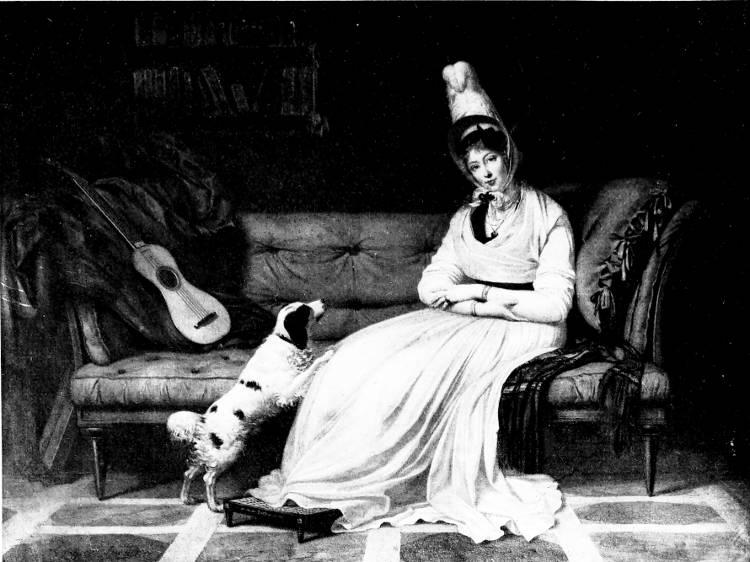
Louis Gauffier. pinx.
Emery Walker Ph. sc.
Elizabeth, third Lady Holland
1795
Ye theatre reminds me of a reply of Piron’s to Voltaire in coming out from ye Semiramis, which had some nights before been hissed. V. said: ‘You see, they have not hissed to-night.’ ‘Comment, voulez-vous qu’on siffle quand on bâille.’
LORD G. LEVESON-GOWER
20th Nov.—Parliament met. Lord G. Leveson made his debut upon the Address; he did it uncommonly well, and was praised by the good judges on the opposite side to him. He is a man of mild, popular manners; without great force of intellect, but sufficiently endowed to distinguish himself and rise in politics. His family are accused of worldly wisdom, and have an uncommon share of that indefinable, useful quality, only to be rendered by the French word tacte. Ld. H. spoke, but was discontented with himself. He said Ld. Lansdown’s speech hampered him, for he did not like to contradict him, and yet he could not agree, as it breathed praise to the Ministers. In it he said, ‘Rebellion and party are dead.’ Mr. Hare said he coupled them like robbery and murder.
21st.—Lord H. completed his twenty-fifth year. His sister, Ld. Ossory, General Fitzpatrick, Mrs. Crewe, Tierney, Hamilton, and Ld. Boringdon dined. In the evening Ly. Bessborough and Ld. Morpeth, and Ld. G. Leveson came; we were very merry.
I have been reading the Memoir, drawn up by the African Association, of Mungo Park’s journey. It is curious, as it proves that those who wrote 2000 years ago knew better the interior geography of Africa than we do, altho’ for many centuries their assertions were disbelieved.
Dec. 8th.—D’Alembert’s Éloges of the Académiciens is full of excellent criticism, altho’ he was a mathematician, and might be suspected of requiring in a poet more precision than taste. That of Boileau is very entertaining; it not only contains criticisms of his works, but is full of philosophical observations upon human character and lively anecdotes. The title is disgusting. An éloge implies a laboured panegyric upon the person who is the object, but he has adopted it only in conformity to the usage of ye French Academy, as, in fact, he has not spared Despréaux where a lash was called for. The futile prophecy of Despréaux’s father about him ought to serve as a lesson to parents not to indulge in predictions favourable or the contrary with regard to the abilities and character of their children. Who that has read Boileau can hear without a smile that it was of him that his father said, ‘Pour celui-ci, c’est un bon garçon qui ne dira jamais de mal de personne’? ‘On sent,’ says d’Alembert, ‘à quelle médiocrité sans ressource un père croit son fils condamné, quand il se borne à lui donner un éloge si modeste.’ Disgusted successively by jurisprudence and theology, he became a poet; and as if to belie his father he began by being a satirist, and by a trait of adroit flattery he converted into a friend the D. of Montausier, the declared enemy of raillery.
Mr. Fox came and slept here on ye 4th December to attend the Whig Club. He made a speech which has, if possible, added to his unpopularity. He was, in a way, called upon by a man who talked of the deceptions of O’Connor, to say something with regard to the evidence he gave at Maidstone. What he said as to that point was liberal and manly, but he unnecessarily added some sentences upon the application of those principles of liberty (which he professed maintaining in common with O’Connor) against the Governt. in Ireland. Very few of his friends attended; Grey and ye D. of Bedford would not go, thinking that as they did not take an active part in Parliament, it was wrong to do anything out of it. Ld. H. wishes, if possible, to abolish the Whig Club, more especially as the reason for which it was instituted subsists no longer, as Mr. Fox has completely seceded.
GREY AND SECESSION
Grey is the man who is placed in the most awkward situation. He now regrets the secession, yet to him, ye D. of Bedford, and Whitbread, is it owing, but most especially to him. He was the first suggester of it, and when Mr. Fox balanced (for he adopted the measure unwillingly, and now thinks it was very injudicious) he urged it vehemently. At present he is tired of inactivity, and wishes to attend, yet he feels a difficulty in doing so after all he has declared upon its inutility; besides that to the world it will always have the appearance of being a most deceitful line of conduct, to have gotten Mr. Fox pledged to absence, and then become a leader. Unless I knew him to be of an honest, open, warm-hearted character, I should myself suspect a little fraud, but I fully acquit him.
Grey, Tierney, Mr. Nicholl, and Francis dined here.
18th Dec.—The Jesuits, who kept in a register notes upon the character and abilities of those whom they educated in order to govern the world, said in the margin on Crébillon the father, ‘Enfant plein d’esprit, insigne vaurien.’ He belied the prediction, as he was an excellent man in private life. His early passion for poetry, especially dramatic, disposed the judicious procureur, under whom he was placed to study the law, to encourage his natural taste in cultivating the Muses, instead of drudging through a mass of black-lettered folios. His first piece was tolerably received, tho’ ‘le caustique Despréaux’ said it was the work of ‘Racine ivre.’ Sarcastic as he intended the observation, it was flattering to a young author to have his name in any way coupled with that of the harmonious Racine. Many years afterwards he presented a tragedy to the theatre; it was objected to, as being too harsh and not suited to the public taste, and they advised him to adopt the style of Voltaire, which pleased everyone. He said, ‘Monsr. de Voltaire travaille en or moulu, et moi je jette en bronze.’ Rhadamiste is one, if not quite the best of his tragedies, tho’ it is rugged in its versification, and turgid in expressions. The famous lines,
La Nature, marâtre en ces affreux climats, Ne produit, au lieu d’or, que du fer des soldats,
are very fine, and have been happily imitated by Goldsmith in his Traveller on Switzerland,
No product here the barren hills afford But man and steel—the soldier and his sword.
On Sunday Marsh came. He intends staying a few days only. He is one of the most excellent men I know, and one towards whom I feel the most sincere friendship. The extreme simplicity of his character is very delightful. With a very good understanding and great information he is as unassuming as the most modest youth could be; but he has some violent prejudices that are very diverting. They are chiefly owing to the French Revolution. He has so great a dread of French principles that he condemns everything that his ardent imagination can torture into a tendency towards them. His fancy is so good-humoured that it is more a scene of mirth than disputation when he gets upon the subject of politics. Yesterday the Bessbro’s dined here, Ld. Boringdon, and G. Leveson; Beauclerk came in ye evening and slept.
MR. CANNING
The Ministerialists praise Canning’s speech in reply to Tierney’s motion[236] to the skies, but it is the fault of friends to overrate, for as La Harpe says somewhere, ‘On affaiblit toujours tout ce qu’on exagère.’ Canning is very lively, writes pretty verses, and has a good deal of local wit, but I should suspect upon grave subjects which require depth and argument he is a très petit monsieur. The Opposition, who have not forgiven his desertion of them, exclaim at the venality of his politics.[237] I think they are unjust in accusing him of desertion, and he was wrong in point of judging the thing for his own reputation to make a bargain so soon. It was hard upon him that he was intimately connected with Sheridan, who chose to announce him to the world as his élève in politics, and as a confirmation of his principles, repeated strong expressions and youthful sallies of his, saying that he should be pledged to Opposition before he was well of an age maturely to decide. Principle, I believe, did not sway him much. He found the party in a desperate, languishing state, himself full of ambition and life, and that in that party he must have contented himself with a very subaltern post; whereas the reputation that Sheridan, in his over-zeal, had anticipated for him made him an object worth getting to the others. He is, in his heart, the veriest Jacobin there is, and would, if he were not in power, manifest his principles in a most dangerous, innovating Opposition. He abhors titles, and the aristocracy of hereditary nobility; the lowness of his own extraction first made him envy, then wish to destroy, those whom chance has raised above him. The worst part of his character is his love of intrigue and management. He has made a little detached party out of the great party, that peculiarly belong to him. Over them he exerts an almost despotic sway, not only in their votes, but their opinions and conduct in the minutest concerns, such as who they must see and live with.
In this little set there is a want of wit, and as the topics are generally allusions to old jokes and practical witticisms that have occurred among themselves, they are quite unintelligible in mixed societies, where, unless the catch-word is known, two-thirds of the company must see them laugh without feeling the smallest tendency to share in their mirth. The Ellis’, Frere, Mr. Legge, Sneyd, Mr. Sturges, Ld. G. Leveson, and a few others, complete the select squad. Ld. Morpeth is of it also, but he wisely chooses to conduct himself without being interfered with, so he is not quite one of ye Elect.
Charles Ellis’[238] marriage was a blow upon his power; he ventured not only to fall in love, but to make his proposals without a previous consultation with the young Cato, the authority of whose little senate was infringed upon by such an overt act. There were fifty little ridiculous circumstances about that marriage that made one laugh at the time. The ceremony was absurdly pompous; carriages full of her relations accompanied them to the church. As soon as the ceremony was finished, the bride, who had, according to etiquette, been crying all the time, was kissed round by the family to be wished joy. Ld. —— went up and consoled her, saying ‘Do not be frightened any longer, for now all is over,’ upon which the jokers say Ly. —— burst out into a flood of tears, recollecting but too well that all finished there with her, for Ld. —— has two projects, equally impracticable, that of marching at the head of a victorious army to Paris, and the other equally desperate, that of obtaining a son. It is a bold undertaking in C. Ellis to marry a Hervey, for they still keep up their strangeness of character that made a celebrated wit class mankind under the generic appellation of men, women, and Herveys.
LORD BRISTOL
That abominable, wicked old fellow, Lord Bristol, is still kept prisoner at Milan.[239] I believe, even in his confinement, he has contrived to make some miserable. He bribed his guards to let him escape, and when the moment was ripe for flight, he was unable to move, and several who were involved in his scheme were instantly shot upon being detected. He is very clever and full of quickness and wit, and his reply to Voltaire was not bad. He went to see him at Ferney. Voltaire, who did not know his profligacy, and could not let the opportunity go by of saying something distressing to an ecclesiastic, stood upon his perron, and, pointing to a theatre on one side, and to a temple dedicated to God on ye other side, said: ‘Où joue t’on la plus grande farce?’ ‘C’est selon les auteurs,’ replied ye Bishop. He called old, shrivelled Sr. Wm. Hamilton a piece of walking verd-antique.
31st Jan., ’99.—At half-past seven on Friday morning, ye 18th January, I was safely delivered of a nice little boy, who is going on perfectly well. Mr. Croft attended me. He had passed 4 nights and days in the house previous to the crash. Mrs. W. stayed, too, but was obliged to go to her eldest child, who was ill. I was sufficiently recovered by Sunday to receive company, and have every day since seen all who have called.
Ld. H. is this day gone down to attend the H. of Lds. If Ld. Grenville brings on the discussion of ye Union, he will speak.[240] Probably the last proceedings in ye Irish Parlt. will deter Pitt from pressing the measure here, altho’ it is one he pledged himself to most irrevocably, and one he is strongly attached to from motives of ambition and vanity. I shall say but little on ye subject, as it has so frequently worn out my patience lately.
The conquest of lovely Naples is added to the proud list of Republican triumphs. The Court have fled to Sicily on board of Nelson’s fleet. The happy States of Tuscany will soon fall, and all Italy pass under the despotic thraldom of the Directory.
SHERIDAN AND TIERNEY
Sheridan was expected to have made a capital speech in the H. of Commons on the Union last week, but it was reckoned very inferior to his usual style of excellence. He offended the seceders by announcing that the standard of Opposition would soon be unfurled.[241] He introduced it at the conclusion of an attack upon Ld. L., who had, he said, ‘cut a clumsy caper over the grave of party.’ (In his speech at the beginning of the session, he said, ‘Thank God, party is dead and buried.’) He pursued a strain of irony, apparently levelled at Ld. L., but, in fact, intended for Tierney, who had, in a late speech, declared that he considered himself as an individual belonging to no set of men. Sheridan said, he did not wonder party was denied, for it required strong intellect to command, and great virtues to attach for a man to become the leader of party, and great humility and sense to fall as a subaltern into the ranks of party. Sheridan hates Tierney. That hatred was roused at T.’s making a most excellent speech on ye Income Bill. It was so good that everybody praised it. S. was at Brooks’s, and was so incensed at the applause that he went to Tierney’s house, whom he found just getting into bed, insisted upon seeing him, and then said he was quite shocked to hear that a part of his speech had given great offence, that part where he hinted at the necessity of squeezing the corporations, who were ‘wallowing in wealth.’ This was said to worry Tierney, who is weakly alive to all unpopularity. T. told me this himself.
Ld. Lansdown is just returned from Bath. He was full of what Miss Fox calls effusion to Ld. H., who had said that he regretted the probability of their voting against each other upon the subject of the Union. ‘Never mind,’ said Ld. L., ‘vote, speak against me, abuse me. Do what you will. I should say, this is what I can’t hear, I can’t see; I won’t see it. You are like my sons who can’t offend me, for I won’t quarrel with them.’ In short, he was all tenderness and warmth.
Sheridan offended the Prince extremely in his last speech. I do not know precisely what he said, but it was a quotation from Secretary Cooke’s pamphlet. He certainly intended it as complimentary, but it was not probably faithfully reported by P. Ernest to ye Prince, and before S. could tell his own story, the Prince, with his usual intemperance and violence, abused him, calling him ‘rogue, liar,’ etc. This mal-entendu will vex S. beyond measure, for he has ever since the Regency courted the P., and anticipated in imagination much influence in a future reign; besides that he has wished to be considered as being as much the organ of the P. in the H. of Commons as Ld. Moira is in the House of Lords. I have malignity enough in my disposition not to feel much sympathy for his afflictions. He has afflicted so much real distress upon others, and one being dear to me, that I have not a spark of compassion to bestow. His defenders (and their number is but slender) say that all his bad conduct has proceeded from his struggling against the meanness of his origin and the littleness of his means. He attempted to efface the first by distinguishing himself, not only in the career of wit and politics, but also in that of gallantry and fashion; for such was his lust of praise that:—
***** Women and fools must like him or he dies; The wond’ring Senates hung on all he spoke, The Club must hail him Master of the Joke. ***** Enough if all around him but admire.
I shall note down a few anecdotes about him by-and-bye.
‘PRODIGY’ POLLEN
Ld. H. met at Sheridan’s, one day lately, Mr. Pollen, the man who dreaded invasion for the sake of the chastity of the ladies: he had never seen him before. Ld. H. was telling a story to prove the openness of the Irish character, and how little suspicious they were of trusting their lives to a person of tolerable character. The story was told him by Ld. Wycombe as having happened to an acquaintance of his—a Mr. Henry. A man arrested him in the streets, and, without much prefatory discourse asked him if he would be of the Executive, adding, he was a United Irishman, and was delegated by those sitting in Dublin to ask him. Upon which Mr. Pollen immediately said: ‘The same thing precisely occurred to me at Perth. A United Scotsman proposed the same question, altho’ I was in my regimentals, and he knew I was quartered with my regiment.’ The coincidence was remarkable, but tho’ Scotsmen are more wary than Irishmen, yet it was possible there might be an indiscreet Scot. They then talked of poor Ld. Lauderdale, who is dreadfully ill. His complaint is a horrid one, a local dropsy, which he will not submit to have properly treated, upon which Mr. P. said, ‘There are two modes of treating the disease: there is the palliative and the radical. I first tried the palliative, but it was troublesome, and ever since I used the radical I have felt no inconvenience.’ Ld. H. said he began to stare at two such extraordinary things having been mentioned, and that both should have happened to him. He is not above 25 or 26, and that disorder is generally in old, worn-out constitutions, and, if one may judge from Gibbon’s averseness to mention the complaint, is not one that men are apt to boast of having.... Ld. H. was all astonishment at these stories, but upon inquiry he found Mr. Pollen’s nickname was ‘Prodigy’ Pollen.
Wednesday, 13th. Feb.—On Sunday, ye 10th, Mr. Hare[242] came to pass a few days. On Wednesday Bor. and Amherst dined. On last Sunday Hare returned. Grey and Tierney dined. Miss Fox stayed from Saturday to Monday.
Hare was full of wit and pleasantry. I was expressing surprise that a man so universally extolled for his conversation and talents should not, to my taste, be pleasant, for the fact is, I never received the smallest entertainment from Sheridan’s convivial abilities. Hare said what is true enough, that before women he is always playing a game. His forte is at a club over wine, and in debate. Among many things he told us of a reply of S., in debate, to Dundas, who had asserted a falsehood for a fact, and supported it by some well-known trite joke. S. complimented the honble. gentleman upon his abilities, especially upon possessing to a remarkable degree a retentive memory and fertile imagination, but that those faculties unfortunately were perverted, as his memory was directed to works of imagination, and his imagination to facts. S. himself, however, is less tenacious about facts than he ought to be. There is a story of his offering some stories to Mr. Fox, to assist him in argument, but the latter, who is very strict as to what he asserts, asked if they were well authenticated, and, finding they depended upon report, declined using them; upon which S. said, ‘He is so d——d surly about facts.’