Volume 1 — JOURNAL OF ELIZABETH LADY HOLLAND (continued 3)
Reading edition
The twenty-fourth of December I passed in my bed; as I only got into it at eight o’clock in the morning, I thought myself entitled to a full twenty hours’ repose.
From Ulm they took the road to Memmingen, which they reached on the evening of the 25th.
A very neat, pretty town; the inhabitants are free and rich. The aubergiste had lived seven years at Lyons. With tears in his eyes he said upwards of forty of his friends had been guillotined.
KEMPTEN
The next night was passed at Kempten.
The town is odd and pretty, and I have a fancy that it resembles the German towns in America and other colonies. Enclosures for cattle between the houses like early settlers, and an air of frugality and neatness throughout the whole. The houses in the neighbourhood are very Swiss-like, being chiefly constructed of wood, with shingle roofs, on which large stones are laid to prevent their being carried off by high winds. So much wood grows in the country that the inhabitants employ it in building their cottages and fencing their enclosures. The Bishop is a Prince of the Empire, and assists at the Diet of Ratisbon. Flax grows in the neighbourhood, and linen is manufactured. Much of what the soil produces must be consumed by the inhabitants, as they have no navigable rivers to transport their productions to a distance. Perhaps they are happier without the facility of intercourse; for commerce introduces luxuries, and they again create new wants, which to supply commerce must be extended, and the love of gain soon destroys the love of ease. This goes to the destruction of morality and that charming simplicity of manners.
Passing Füssen, they entered the Tyrol, and reached Innspruck on the 28th.
I have been very negligent in my journal; the intense cold benumbed my faculties in the Tyrol. I was much shocked at Roveredo by hearing rather suddenly of the death of the Duchesse de Polignac. She fell a victim to her attachment to the Queen. Even her rivals—for enemies she had none—admitted that her affection was most disinterested; that she loved the person, not the dignity, of her unhappy friend. The death of the King threw her into violent convulsions that brought her into such a state of debility that three attempts to quit Vienna were ineffectual. The murder of the Queen filled up the measure of her grief: she sank under it, and only languished in horrible sorrow a short time. She expired in the arms of Vaudreuil. At Vienna when I saw her she gave me the idea of a person labouring under the weight of woe, which she struggled to conceal that she might spare her friends the anguish of seeing she suffered. She was lovely, features and countenance perfect, figure short and not light; her manner simple and serious, character rather grave. The brilliant situation her intimacy with the Queen put her into was always repugnant to her inclinations, and she oftentimes, and with sincerity, regretted that the difference of rank prevented her the enjoyment of retired, unsuspected, and unenvied friendship.
Upon the road we heard rumours of the capture of Toulon, but I could not and would not credit them. However, at Trent it was confirmed with many particulars. At Verona we found Ld. and Ly. Henry Fitzgerald;[117] she was suddenly brought to bed there.
Hervey passed us in the night on his return; he carried back with him the dispatches relating to the loss of Toulon. On the 18th the French made a general attack; the outposts were abandoned, and the allies forced to fly. In the evacuation 8000 of the inhabitants were saved and conveyed to the combined fleets. Previous to their quitting the town a train was laid to blow up the ships of war; many were destroyed, but still many remain.
CAPTURE OF TOULON
Just beyond Mantua we met three English officers who had been at Toulon, Messrs. Mathews, Wemyss, and Featherstone; they complained (as all English officers do) of hard duty and bad commanders. They said, what was likely to be true, that the retreat was ill-conducted, and that not a fifth part of what might have been destroyed has perished. O’Hara was taken prisoner from his own inactivity and despondency. He was deceived in his expectations: everything at Toulon was represented in the most favourable light—the valour, zeal, and unanimity of the allies, the strength and excellence of the British forces, the loyalty of the natives, etc. But how different was the truth! The allies all quarrelling; the British army (if such a word is not a satire upon a few hundreds) brave but refractory and headstrong, as they all are when they have arms in their hands; the inhabitants so disaffected that at every sortie great care was taken to prevent their shutting out the allies whenever the Carmagnols gained an advantage; the peasantry equal Republican; nor did the allies possess an inch beyond the glacis of the town.
Florence, 10th January.—On the 8th of January I arrived here, and found to my supreme delight both my dear children perfectly well. Webby surprisingly improved. The baby is as perfect a lazzarone as the Chiaia ever produced: in the first place, he has the appetite and digestion of a Neapolitan. He is a nice child, but far from pretty. I found no less than five letters cautioning me strongly against going to Naples with the baby, as there rages in the town a malignant species of smallpox, to which 7000 infants have fallen victims, and amongst them poor Lady Plymouth’s infant.
In consequence of these warnings I have determined upon performing the operation of inoculation here, and Dr. Gianetti did it this morning. The consciousness of being under the same roof with my dear children gives me a sort of tranquil delight, that my mind and spirits are quite calm: I even feel happy. The siege of Landau is raised. The French are successful everywhere, and will not be conquered by our vain taunts and boasts; they verify what they say of themselves: ‘Que la France ne sera jamais domptée, que par la France.’ This opinion is in the first page of my political creed, hence I was sanguine when I heard they had raised the standard of counter-revolution themselves.
The alarm here is very great; in the same proportion as that increases so does hatred and contempt for the English, whom they justly accuse of having compelled them to break their neutrality, and then promised support.[118] Manfredini told me that England will cause the ruin of Italy, whereas he could have saved it by temporising measures.
14th January, Florence.—The accounts from Paris make one shudder. The guillotine is active, and hundreds daily perish by that horrible machine of death. It is reported that a body of 25,000 men are advancing to meet Lord Moira. In consequence of this intelligence, the transports that came into Portsmouth are to sail immediately, and the officers have received orders to re-embark. The army that had taken possession of Noirmoutier have landed on the Continent and are marching up the south side of the Loire. Prince Coburg is marching towards Landrecies and Maubeuge to keep the army of the north in check.
DISSENSIONS AMONG ALLIES
Pondicherry is besieged and soon will fall into the hands of the English.[119] No official account from the West Indies since the first landing at St. Domingo.[120] It is said that the Spanish proclamation is totally different from ours, in which they offer to take the island for Louis XVII. The jealousy between the English and Spaniards at Toulon was glaring, and violent enough to impede the success of any undertaking that required mutual exertions. As far as my feeble judgment carries me, I do not think the allies are taking the most effectual means to obtain their object. The want of vigour and consistency in our Ministry forces an opinion of their feebleness upon the princes, and must make them distrust their intentions. The declarations at St. Domingo and at Toulon are certainly very different, and I hear that Lord Moira’s is different from either. He declares in favour of monarchy, professing not to interfere in internal arrangements, at the same time disclaiming that monarchy which was established by that ‘Risible Constitution’ in 1789. Why call that constitution risible which Lord Hood made in some measure the ground of a negotiation at Toulon? This declaration Lord Moira read at dinner at Portsmouth, together with a declaration from the British Army to their confrères d’armes in Brittany.
The inoculation has not taken effect, therefore the poor baby is again to undergo the operation. He is too pure to be corrupted.
Sunday, 19th January.—Ld. Hervey lives a good deal with me. He seems to dislike his recall, and talks of going again into the Navy, where, by-the-bye, he is very unpopular. W. Wyndham’s appointment is not much relished, as the Court want a steady, reasonable man, disposed to soothe matters, and, God knows, poor W. is not capable of filling that post.
Ld. H. implies his love for Ly. B. I shut my ears, as I abhor those sort of confidences.
24th January.—Caught a violent cold, which confined me to my bed several days.
3rd February.—Henry has passed through the smallpox very prosperously. The Austrians have been forced to abandon Fort St. Louis, which they took in conjunction with the Prussians last November. In less than eight days the French have regained the whole extent of territory the allies fought for inch by inch for this whole campaign.
Pondicherry has surrendered, and shortly the French flag will not fly in India. These distant successes alter very little the public opinion. Great alarms are entertained about Flanders; the Carmagnols are gathered in a point ready to invade it again.
LORD HOLLAND
Ld. G. Leveson-Gower[121] and Ld. Holland came here the day before yesterday. The first I knew at Dresden. He is remarkably handsome and winning; a year or two ago he created a great sensation at Paris, when Ly. Sutherland introduced him as her beau beaufrère; she also initiated him in the orgies of gambling, an acquisition he has maintained. Les mauvaises langues de Paris said she was in love with him; but that was a calumny. Ld. H. is not in the least handsome; he has, on the contrary, many personal defects, but his pleasingness of manner and liveliness of conversation get over them speedily. He is just returned from Spain, and his complexion partakes of the Moresco hue. He is now in better health. He has a very complex disorder, called an ossification of the muscles in his left leg. Fontana says it is a malady of which there are many instances in the brute as well as the human race. It arises from the calcareous and phosphoric matter, designed for the formation of the bones, being deposited on the flesh and muscles. The original cause of the malady is unknown, but it is probably from the weakness of the vessels destined to secrete this substance from the blood. When the ossification becomes general it is, of course, fatal. There are instances of the brain being indurated. A dissolution of the bones is likewise a very dreadful thing. La Condamine died of it.
They dined with us, as did Capt. Montgomery, a natural son of Ld. Pembroke’s. We all went to the Cocomero, and returned here to supper. Ld. H. quite delightful; his gaiety beyond anything I ever knew; full of good stories. He seems bent upon politics, and, with his eagerness, I think it is lucky he is out of the way of saying foolish, violent things.
5th.—I went this morning to the Cabinet Physique with Fontana. He showed me the details of his astonishing homme de bois. It is composed of 3000 pieces of wood that take off from the surface; beneath there are a variety of others which mark the veins, arteries, etc. In all there are 250,000 different pieces of wood.[122] Prince Louis d’Arenberg passed the evening with me; he is very amusing.
6th.—An order is published this day that expels all the French domiciliated here who have arrived since the 15th January, 1793. The pretext is a scarcity of corn, the price of which has been considerably augmented since the great exportation to France last year. Fontana dined with us; he tired me so much upon French politics that I quitted the room from downright ennui. In the evening Ld. Hervey brought Sir G. Elliot; they are just come from Leghorn. Sir G. was shipwrecked in sight of port, but assistance was so near that no danger ensued.[123] He was on his return to Toulon. He is trying to obtain from this Government a permission to allow the poor Toulonese emigrants to reside here.
12th Feb.—The Toulonese are permitted to reside in Tuscany. The King’s speech is very warlike, though nothing declaratory about the restoration of monarchy in France. The Duke of Portland supports the war most strenuously. Mr. Windham withholds himself from office, much as his friends urge him to accept a post that he may share the responsibility of measures which he promotes and supports. This is the stale plea of those who accept places and profess disinterestedness. Windham, Tom Grenville, and Pelham, when I left England, called themselves the Virtuous Triumvirate, and determined not to take office, from the idea that they could more effectually serve the Government by convincing the public that they quitted Opposition merely from a conviction of the wisdom of maintaining the measures of Administration than from the inducement of holding a place.
14th.—Surprise and embarrassment have completely overset me. Oh! what vile animals men are, with headstrong passions. Now! I have heard from the lips of one who affects morality and domestic virtues maxims that would revolt all but the most depraved. ‘Pécher en secret, n’est point pécher.’ I told him it savoured of his Jesuitical education. His justification was that a singular combination of events arose to create a passion, where, in truth, so little could be expected in return. His long absence from home, perfect seclusion, and the strong impression of delight at meeting a countrywoman who brought back the remembrance of past scenes—this complicated feeling made him deck the object who revived the recollection in glowing colours, and in him created a violent and, I hope, a transitory alienation from sense and propriety. Distress, awkwardness, and good-nature united made me act like a fool, but I was obliged to be peremptory latterly, as he proceeded to downright violence. One night coming from the Pergola I was compelled to get out of the carriage to avoid his pressing importunities. However, his last words were, ‘Be kind and discreet.’ He is in great alarm at his wife’s knowing this écart, as he affects great conjugal felicity.
THE RETREAT FROM TOULON
According to Sir G. Elliot’s account the retreat from Toulon must have abounded with affecting situations of distress and wretchedness. In the midst of the conflagration of the ships in the harbour, houses, magazines, etc., three small boats heavily laden with women and infants approached the Victory (Admiral Ld. Hood’s ship), near which they tossed up and down in speechless agony, not daring to ask the relief which they needed so much, but expressing their entreaties with uplifted hands and deep groans. What anguish! A merciless enemy behind, a vast expanse of dreary sea before, and not a friendly shore to land upon. Although the ship was already filled by hundreds of refugees, yet Sir Gilbert persuaded Ld. Hood to admit these. He landed at Corsica, which he describes as being in a curious situation, unlike any country in civilised Europe. The whole country up in arms, without discipline or officers, yet alert and obedient. Paoli is their chief, who without possessing any superior abilities has the talent of conciliating and governing the people. His word is a decree, his power patriarchal, a compound of sovereign and parental authority. The natives have offered to put themselves under the protection of England, and Sir G. is occupied in promoting this, as he wants to be made Governor. They offer to expel the French if they can gain assistance. They are a hardy, bold, and intrepid race, every Corsican esteeming himself equal to his companions. This notion gives them a bold freedom, especially when political affairs are discussed, when they look upon themselves as entitled to be auditors at least.
I have again heard ——’s last words, ‘I love you, for my passions are stronger than my reason: your being good, gentle, and handsome justify me: for the sake of others be discreet.’ I will indeed! Rochefoucauld lay upon my table: he opened it at the 514th maxim, which he observed was fallacious, and gave himself as a contradictory proof, ‘On passe souvent de l’amour à l’ambition; mais on ne revient guère de l’ambition à l’amour.’
On February 15, 1794, the Websters left Florence on their way to Rome, taking the road which passes Siena and Lake Bolsena. After a stay of two days at Rome, they left on the 22nd for Naples.
LORD HOLLAND
Florence, June 10th.—Reached Naples on the 26th February. Lodged at Severino’s. For the whole six or seven weeks I passed in that lovely spot I had not activity enough to occupy myself in any way but in lounging and talking. Ly. Bessborough and Ly. Spencer were there. A numerous band of young Englishmen from college; gambling and gallantry filled up the evenings and mornings. My favourite, Ld. G. Leveson-Gower, used often to come to me in the evening, as I sat at home a good deal on account of my grossesse and disliking the card parties. His companion, Ld. Holland, is quite delightful. He is eager without rashness, well bred without ceremony. His disposition and turn of mind are reckoned very like his uncle, Mr. Fox: his manner resembles his maternal uncle, Colonel Fitzpatrick. His politics are warm in favour of the Revolution, and his principles are strongly tinctured with democracy. It is the brilliant side, and apparently the honest one; all young men are hit by it at first, but when they see more of the world they cure of their honesty and love of liberty. But he would lament with all the reasonable men should revolutionary doctrines obtain in England, as he thinks the actual form of government the best suited to the country. Though so zealous, he is totally without any party rancour; in short, he is exactly what all must like, esteem, and admire. His spirits are sometimes too boisterous, and may occasionally overpower one, but he is good-humoured enough to endure a reproof.
His bosom friend, Mr. Beauclerk,[124] is far from resembling him in any one amiable point of view: he is silent and sulky, and when he opens it is to tease his friend. I am told, however, that he is remarkably sensible, good-humoured, and pleasing to those who know him, but this must be taken upon trust, as he is the counterpart of Lord Burleigh in The Critic. He is deeply in love with Ly. B., and abhors Ld. Granville, who is his rival. I understand that I am odious to him; je me venge in feeling as much against him as he possibly can towards me. Mr. Marsh[125] is very sensible; he is one of the very few rational beings I met with. I carried him to Italinski one day, who was mightily pleased with his scholarship and conversation: he also lived much with me. Ld. Morpeth improves the more he is known; I always liked him.
I never saw Lady Ann Hatton before, and to my surprise found her in company with Ly. Plymouth, who is the great retailer of anecdotes against this slippery Hibernian, and whom she declared against receiving. Her face is not regularly handsome, her figure enchanting, an airy nymphlike form as youthful as a Hebe. She is, however, past thirty considerably. Her sister, Ly. E. Monck, is divinely beautiful; her head is angelic.
Ld. Digby[126] fell in love with Ly. Bruce, who only coquets with him. He is good-humoured, and full of good useful sense. There was a bad lot of drinking Irish, with Ld. Tyrone and Mr. Jefferies at their head, but I knew little of them. Mr. Brand continues his belle amitié for me, rather sentimentally tiresome when he gets upon that topic. Italinski as usual. Drew delighted to see me. He is discontented with the Bessboroughs. Ld. Berwick behaved shockingly to poor Ly. Plymouth: she is very unhappy. He speaks to her and of her with the most disrespectful familiarity. The Hamiltons were as tiresome as ever; he as amorous, she as vulgar.
I made an excursion to Sorrento with Ld. Holland and Italinski: we slept there. I was terrified at crossing the bay. On my return I was foolish enough to get out of the boat on the Portici shore, and return home in a calecino.
A book just published by Sir William Hamilton. He got Italinski to correct the English, upon which Mr. North said, ‘He has made the Knight as clear as day.’
Ld. Henry took his seat in Parliament, and made a maiden speech which I hear from other quarters was esteemed very good. He said he was terrified at the silence of the assembly. His friend Canning has decidedly abandoned his patron and friend Sheridan, and is coming into Parliament under the auspices of Mr. Pitt. Ld. H. regrets this precipitation; though he of course likes him to act on his side, yet he thinks the law would have been a more certain friend to him than the favour of a Prime Minister. Wallace[127] has totally failed in speaking, and his principles out-Herod Herod, for the Ministers could not support him in some assertion he made as to the King’s power of landing foreign troops without the consent of Parliament. This heresy to the British Constitution was in consequence of some Hessians landing from the Isle of Wight.
SOCIETY AT NAPLES
During my stay at Naples I went, as I was told, at the peril of my life, to see Baron d’Armfeldt, who it seems is pursued by the Regent of Sweden, the Duke of Sudermania. He is accused of having formed a conspiracy to murder him, and obtain the keeping of the minor King’s person. Be this as it may, he has been demanded of the Court of Naples by that of Sweden formally to be delivered up as a fugitive rebel, but the Queen is interested about him, and has him concealed. The Swedish emissaries are active in their search, and have several times fired at him, and once at a person getting out of his carriage, whom they mistook for this supposed delinquent. The accusation is black, but the truth of it uncertain. Ld. Henry laughs at me for calling him ‘The Victim’: he is at Stockholm, and can judge of the story. I passed a pleasant day at Cumæ with the Palmerstons. I took Italinski, Mr. Marsh, and Ld. Holland in my carriage. We were joined by Count Rumford, etc.
At Rome, which I reached early in May, or, I believe, towards the middle of April, I lived in the Villa di Matta, a charming situation upon the Pincian Hill overlooking the city, and commanding a grand view of the distant hills and Campagna. Almost the whole of our Neapolitan set was there, with the exception of Lords Digby, Boringdon, G. Leveson, who for reasons best known to themselves fled the enjoyments of Italy to fulfil some dull, unimportant duties in England, where nothing short of compulsion shall ever drag me.
‘SAL VOLATILE’
We all made an excursion to Tivoli, Bessboroughs, Ld. Grandison, and the young men. I conveyed Ld. Holland, Mr. Marsh, and Beauclerk. We lodged at a nobleman’s villa, took our own provisions and cook, and passed our time with jollity. Lord Bessborough grew very cross, and from a fit of jealousy about Mr. Beauclerk, compelled us all to return to Rome, and disquieted our mirth. We got back late at night. I had seen Tivoli the year before: a charming group of cedars in the garden of the family d’Este. In the course of our evenings Ld. H. resolved to make me admire a poet, of whom I had heard but little, Cowper: he is excellent, and amply repaid the labour of reading many hundred lines in blank verse, many of which are inharmonious. Mr. Marsh used to read to me Murphy’s translation of Tacitus. A sharp fit of gout, brought on by drinking Orvieto wine, did not increase the good temper of my companion; decorum, not inclination, made me keep at home. My evenings were agreeable; he, however, did not mar my comfort by partaking of my tranquil society. Went out every morning with Ly. B. Ld. Holland’s delightful spirits cheered us so much that we called him sal volatile, and used to spare him to one another for half an hour to enliven when either were melancholy.
I saw the Pope[128] give his benediction to a kneeling and believing multitude. The sight was imposing. He is an excellent actor; Garrick could not have represented the part with more theatrical effect than his present Holiness. I was grievously disappointed at the Miserere, the composition of Pergolesi, sung by differently modulated voices in the Sixtine Chapel. The illumination of the great cross inside St. Peter’s was very striking: the effect of the light upon the monumental effigies raised the painful recollection of death, the sombre of the objects and the locality inspired melancholy. We went about to various chapels, where we found many a debauched fair one in the comely attire of matronly humility, expiating in penance and prayer many a dear sin, for the sole purpose of beginning a fresh catalogue of the cherished crimes. I saw occasionally the old Santa Croce, Cardinal Bernis, etc., etc., but Ly. Bessborough, Ld. Holland, Messrs. Marsh, Brand, etc., were those I lived habitually with.
I became very eager to get to Florence, as I received an account from Mrs. Wyndham of her arrival, and her being installed in her diplomatic functions. I parted with regret from Ly. Bessborough, who is to return by Loreto to England. I went the Perugia road to Florence, and arrived late in the night at Florence.
My first impulse was to seek with eagerness my little friend, but to my surprise I found her in a state of despondency that checked my joy. She abhors the prospect of residing here, and looks back with regret to England, and even to Bignor, which, whilst there, she detested. With some difficulty I contrived to make my house tolerably comfortable. It is a palace belonging to the family of Ginori, but not calculated for English habits, as it contains only three fireplaces, and I have not one of the three; my tormentor has one, the nursery and a sitting-room the others. Lord Holland and Mr. Beauclerk passed a few days here on their way to Venice. Ld. H. assured me he came merely to make me a visit. The Palmerstons and Ly. Spencer came for a few days. Sir G. Elliot came over from Corsica to pass a few days.
LORD WYCOMBE
On the twelfth of June I was brought to bed of a little girl, christened by Mr. Penrose at Wyndham’s: her name is Harriet Frances.[129] Lady Bessborough, Mrs. Wyndham, and Wyndham were the sponsors. A few days before her christening Ld. Holland returned from Venice; he came to await the arrival of Lord Wycombe,[130] who joined him a few days after. Lord Wycombe is a very eccentric person. For the welfare of himself and family it is to be hoped that his actions are directly opposite to his sentiments; if not, he must be a scourge. Ld. H. tells me that the ladies who live with Ld. Lansdown, Miss Vernon[131] and Miss Fox, call him, ‘A Lovelace without his polish.’ His style of conversation is grand and declamatory, his humour excellent. He is very gallant: he began by making love equally to me and Mrs. Wyndham. We half thought of a project of playing him a trick, and treating him as Mrs. Ford and Mrs. Page did the humorous knight, but Ld. H. said it was playing with an edged tool.
The months of July, August, and September were passed very pleasantly. Early in September I set off on a solitary expedition to see Lucca Baths. I went through the town of Lucca, and arrived at the Baths in time for dinner. I dined with Ly. Rivers: I got up early in the morning, and went in a portantine to see the hills, etc. The Prato Fiorito was too distant for a morning excursion; I went from thence to ——, where I lodged in the house of a Marchese; they gave me a very good supper, good bed, and received me with cordiality. I spoke no Italian, and knew none of the party, which was very numerous; however, I got through the evening tolerably. They must have thought me a strange person, young, pretty, and alone, travelling merely to see the quarries of Carrara! It was perhaps an odd freak.
I dined the next day at Massa. I had a letter to a descendant of the Greek Emperor Paleologus, his name is Paleologo. He is a single man; to avoid a tête-à-tête with a perfect stranger, the visit to whom was whimsical in itself, I admitted my maid en tiers. I was in high spirits and very jolly. I went in a chaise-à-porteurs into the quarries at Carrara. They produce the finest marble after that found at Paros. My royal Greek was very careful of me. He escorted me through all difficulties, torrents, chasms, precipices, etc. Upon the whole I expect he took me for an aventurière; indeed, he well might, though my suite rather imposed upon him, for I went in my own chaise, my maid with me, and on the seat my cook and a footman, and André was on horseback. I am sure he thought there was something mysterious, at least, about me.
I went from Massa to Pisa, where to my surprise I found Lords Wycombe and Holland, and my farouche companion; they had not found a favourable wind to cross to the Isle of Elba, and were on their return to Florence. I walked about Pisa in the morning. It is a beautiful town, and the quay has perhaps the advantage of Florence in beauty. The Campo Santo, the Campanile, and the church are very beautiful. The leaning tower is still a problem among the curious, whether its deviation from the perpendicular was accidental or intentional. Monsieur de la Condamine measured it with a plumb line, and found that when let down from the top it touched the ground at the distance of thirteen feet from the bottom of the tower.
VALLOMBROSA
Lord Wycombe read us a sonnet he had just composed; it was very ingeniously written. I went to the famous Vallombrosa, a Benedictine convent, about sixteen miles from Florence. The road for the last six miles is through a thick forest of chestnut; the ascent is steep. The monastery is placed on a verdant lawn round which the mountains form an amphitheatre; the darkest pines surround the whole building, and hanging woods of that tree only decorate the steep sides of the hills. No woman is admitted within the convent walls; I dined at the Mill House close to it. After dinner the Padre Abate and many of the monks came out and joined us. He is a lively, middle-aged man, with apparently little love of devotion and a strong love of pleasure.
In the month of October Lds. Wycombe and Holland went to Rome and Naples; the latter was unwell, and wanted to consult with Dr. Thompson. My tormentor went to Milan and Turin for some months. Mr. Amherst[132] and Mr. Cornewall[133] stayed some time at Florence. The first is a quiet, sedate young man, full of proprieties and all sorts of good things. The latter is good-humoured and weak. Mr. A. fell in love with me and Mrs. W.; he was most in love with the one he saw last. We went to balls, and were very gay. I quitted my house in the Via Maggio, as it was too cold for winter, and took a delicious residence within the walls of the town, but in the midst of gardens called the Mattonaia or Shuileries.[134] The fitting up of the house was magnificent; one room cost four thousand sequins. It was made of rich japan, fine black and gold, and the ornaments were appropriate and superb.
I read as usual a good deal. About that time, October, I began to relish the Italian poets, particularly Ariosto. Read the Pucelle in a castrated edition. Voltaire evidently imitates the Orlando, especially in the beginning of his cantos; there are some poetical descriptive passages quite good. Targioni gave me a course of experimental chemical lectures.
I rode about the environs of Florence; nothing can be more lovely than the villas. My children lived on Fiesole till about October.
... like the moon, whose orb Through optic glass the Tuscan artist views At evening, from the top of Fesolè.[135]
Milton describes Tuscany often, and seems to feel a proper love for it. They told me at Vallombrosa of his having resided several months within their monastery, and of his having written Italian sonnets—bad enough they were, the critics say.
Thick as autumnal leaves that strew the brooks In Vallombrosa, where the Etrurian shades High over-arched embow’r ...
Early in November Lords Wycombe and Holland returned from Rome. The latter gave us a great ball on the 21st November (1794), the day he came of age. Ld. Carmarthen and a few other English added novelty to our parties. The Gallery afforded me a constant source of delight, the Tribune, &c. About Christmas Sir G. W. returned from Milan. The masquerading at the Carnival diverted me. In March, Ld. H., on my birthday, wrote the following lines. ‘To a lady at Florence, on her birthday, 1795.’[136]
I went to Vallombrosa alone to pass a day or two. I meant to live in solitude. I lodged at the hospice of the Convent, a building made for the accommodation of travellers, and used as a residence for the sick monks during the rigour of the winter, but the overstrained politeness of the Padre Abate defeated my projects of quiet. He no sooner heard of my arrival than he came from the sequestered cloister, and brought with him six or seven of the Fraternity to keep me company; thus I never had a moment to myself, and was fairly compelled to go to bed at seven o’clock to escape from their civilities.
The French have taken possession of Holland this winter, and compelled the Stadtholder to fly to England with his family.[137] The terror of the Republican arms spreads everywhere.
MR. VASSALL’S DEATH
I lost my poor father; a nobler, better man he has not left behind him. Towards me he was always fond and affectionate. His only failings arose from an excess of goodness. He was weak in character, as he idolised my mother and was completely subjected to her dominion. His death puts me into the possession of great wealth, upwards of ten thousand per annum. Detestable gold! What a lure for a villain, and too dearly have I become the victim to him.
My health was alarmingly bad, and I was liable to sudden and frequent losses of blood. Not satisfied with Gianetti’s opinion Mrs. W. wished me to get better advice, and as Dr. Thompson was at Rome I went there to consult him in April.
As I had never seen the Spada Palace I determined upon seeing it, and went with Ly. Plymouth and Amherst. The great ante-camera contains the statue of Pompey, supposed to be the one at the pedestal of which Cæsar fell, a retributive justice admired by superstition. In the gallery, a charming Guido, the ‘Rape of Helen,’ beautiful colouring and composition. It represents the moment of her flight from Sparta; Paris is conducting her to the ship. She appears modest and apprehensive; he bold and encouraging. Among the female attendants there are several pretty faces, particularly one with a blue head-dress; also a pretty figure of a Cupid in the corner. A ‘Death of Dido,’ by Guercino; the agonies of death upon a lovely face finely rendered. The rest of the picture bad, the sword thrust through the body is pitiful, but the composition was sacrificed to pay this pitiful compliment to the Spada arms.
Returned by the Siena road as I came. My health did not allow me to engage in travelling, and to say the truth I made as much as I could of that pretext, that I might not be forced to return to England, as I enjoyed myself too much here to risk the change of scene. In May Sir G. W. set off to England, as he affixed an importance to his own appearance there that I own I did not strive to convince him against. In June I set off with my children and Gely to Lucca Baths, where I had taken Ly. Bessborough’s former habitation. The situation of the Baths is pretty, but the heat in the middle of the day is intense, and at sunset the cold and damp begin. It certainly is unwholesome, and I am surprised at it being sought as summer residence either upon the score of health or coolness.
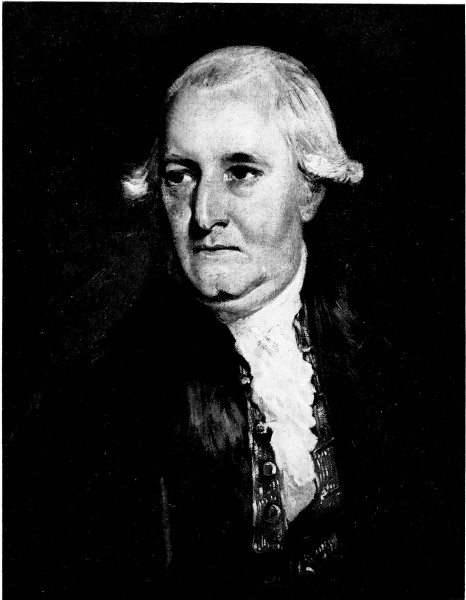
J. Hoppner Pinx. 1793
Emery Walker Ph. sc.
Richard Vassall
QUARREL WITH WYNDHAM
Soon after I arrived Mrs. Wyndham came to make me a long visit. She left her children at the Villa Careggi in Florence, a villa built by Lorenzo di Medici, and inhabited by him until his death.[138] Mr. Hodges came and resided in my house also. Soon after, Lords Wycombe and Holland came and lived near. They dined and supped with me every day regularly. I went to the illumination at Pisa, a festival in honour of the patron saint of the city. I took up my abode at Wyndham’s at the Baths of Pisa, about two miles from the town. Some trifling dispute happened between us, which was not explained, and we have not yet spoken and perhaps never may. From Pisa Mrs. W., Ld. H. and myself went to Leghorn; we were lodged at Udney’s house, the consul’s. Lady Elliot and family stayed at Lucca Baths. Wyndham came and had a serious éclat with Mrs. W.; she behaved romantically, and what in a novel would be called feelingly delicate, but like a very silly person for her worldly concerns. She is determined to separate and quit him.
In July I set off from Lucca Baths to see Genoa, with Ld. H. and Mr. Hodges. I left Gely with my children and their nurses. Slept the first night at San Marcello, a small village upon the new road to Modena, half-way up the Apennines. The second night at two posts beyond Modena, and the third at Parma. Correggio’s ‘St. Jerome’ struck me this time as far more beautiful than when I first saw it about three years ago. Whether a more intimate acquaintance with the great masters had taught me to appreciate their merits with more judgment, or that I had not given myself much trouble in the examination of this charming production I will not pretend to say, but I beheld it with all the charms of novelty.
The last post to Genoa is beautiful; every step denotes the splendour and riches of that tottering republic. Magnificent villas, ornamental gardens, and thick population, the houses of the meaner class intermingled with the stupendous habitations of a haughty aristocracy, mark strongly the immense difference power and riches have placed between them, they being wretched to an unusual degree of penury, most of them being without the necessary accommodation of windows or glass. The daily reinforcements arriving to the Austrians, the fair, and the arrival of a Spanish flotilla, crowded the town so much that I found it difficult to get a lodging; indeed the hotels were full, and we were obliged to take up our quarters in a kind of restaurateur’s, where lodgers never had been. Such a hell! Only two small garrets.
The Strada Balbi and the Strada Nuova are the finest streets in Europe, from the stately palaces on each side and their not being disfigured by any shabby dwellings. The style of architecture is not chaste, but too much crowded with heavy ornaments. The roofs are high and filled with garret windows, much in the taste of those buildings the style of which was introduced into England by William III. The palaces of Genoa are more like what one expects an Italian palace to be than any I have ever seen in other parts of Italy—open corridors, porticoes, arcades, terraces, fountains, orange groves, &c., &c.
The Durazzo Palace unites all these beauties in perfection.... There was a dispute about the genuineness of the famous ‘M. Magdalen,’ by Paolo Veronese;[139] the family in consequence bought the other at Venice, and considering their own as the original, keep the other rolled up. In the same street is the Palazzo Balbi, a spacious and grand mansion, evidently declining from its past splendour. Many fine pictures, a catalogue of which would be tedious.
GENOA
Genoa is not to be compared with Naples, and is superior to Nice; the fanal has a pretty effect jutting into the sea. I stayed only four days in Genoa, and set off with Mr. Hodges, &c., to go across the Corniche to Sarzana in portantines. I lent my carriage to Ld. Holland, who went round by Turin, and was to rejoin me at Lucca Baths.
Mrs. Wyndham joined me in a few days, as did Ld. Holland. Amherst and Cornewall passed a few days at Lucca. Wyndham came over, and the rupture with me was final; he would not make me a visit, but sent to my maître d’hôtel for some dinner, a cavalier mode of proceeding which I would not gratify him in, and he had no dinner, as there was no inn, and provisions were scarce, unless provided beforehand.
The end of August I returned to the Mattonaia. Ld. H. had a set of Maremma ponies, and used every evening to drive me out, either to the Cascines or elsewhere. I went to see the Pratolino, a country house belonging to the Grand Duke. There is an immense statue of The Apennines, represented as an old man, a colossal figure. The waterworks must have cost a prodigious sum, and, though contrary to the present taste of gardening, I confess I admire the jets d’eau and even the childish tricks which are made to catch and surprise the unwary observer. I lived very much with Mde. d’Albany and Alfieri. Don Neri Corsini, Fabroni, and a few others composed my society. Ld. H. read to me Pope’s Homer, The Iliad. I was delighted with parts of it, but the Odyssey I could not listen to.
Florence, October 4th, 1795.—The first and strongest sensation one feels on entering Italy is the recollection of those historical events that from childhood are impressed upon the mind, and those classical sentiments that one strives both from vanity and taste to bring back to memory; but when the turbulence of the imagination subsides, and a long residence in the country familiarises one with objects so attractive, modern Italy, her poets, historians, and artists, arrest the attention very justly by the admiration to which they are entitled. Florence of all places is the most calculated to inspire a taste for the pursuit of modern literature. Every step reminds one that it was the seat of the Medicis, which is synonymous with the arts, the sciences, and taste; its splendid monuments and useful works all evince the beneficence of those patrons and restorers of literature....
I meant to have continued some anecdotes of the Medici, but I have undergone too much affliction since writing the above. I was brought to bed of a lovely boy in October, but owing to the neglect of the nurses he fell into convulsions and died. Never shall I become mother to such an infant. Lord Macartney[140] came and dined several times with me on his way to Rome.
November 22nd, 1795.—Set off at one o’clock past midnight from my house, the Mattonaia, to accompany Mrs. W. as far as Bologna, on her way to Turin; Ld. H. went with us. The weather was coldish, but when we got upon the Apennines amidst the snow it was insufferably rigorous. The road was very rough, being spoilt by ye frosts and thaws. We accomplished the journey in twenty-three hours and a half, arrived at the Pellegrino, where Lord Wycombe was waiting to join our party.
BOLOGNA
As soon as I had refreshed myself with a few hours’ rest, I visited the Zampieri Palace. It is undoubtedly the best and most valuable collection here, not eked out like the others with trash.[141] ‘St. Peter Weeping,’ by Guido, reckoned the first of his works and the most faultless picture in Italy. It is in his strong manner, and in the highest preservation. Two hoary-headed old men, one crying and the other upbraiding, inspire but a small portion of interest, and one is glad to quit this perfect picture to contemplate the work of a more faulty painter, who, however, eludes that censure in this charming composition. Abraham, in compliance with envious old Sarah, dismisses his youthful handmaid Hagar and her son Ishmael: Guercino. Agostin Caracci is nowhere so great as in his mellow picture representing the ‘Woman taken in Adultery.’ A lovely little Guido, ‘A Heavenly Concert,’ done when he was eighteen....
25th.—Ld. Holland and Mr. Wyndham set off for Turin. Lord Wycombe, M. Gely, Webby, and myself remained at the Pellegrino. Lord W. dined with me every day, and several learned Bolognese, among them a lady who was reckoned a very good Greek scholar. She wrote an impromptu Greek epigram upon me, but for aught I know it might be as old as Homer.
‘St. Agnes,’ in the chapel of the monastery of that name.[142] It represents the martyrdom of that saint, but fails in the effect that the principal object ought to produce. It is taken at the moment when the executioner is plunging the sword into her bosom; the countenance is insipidly livid, without the dignity of resignation nor the anguish of pain. This group is not enough distinguished, as it falls in with a heap of dead saints. Three women and a child form a pretty group on the right-hand side. The upper part seems a separate composition, and very likely is done by a scholar of Domenichino’s. Ld. Holland read me a passage out of a letter from Charles Fox, from which it appears that he reckons this picture almost the best in Italy, and the masterpiece of Domenichino.
I visited all that was remarkable in the neighbourhood, and saw much more than I did the first time I was there. I read the Tragedies of Crébillon; the horrible subjects affected my imagination, and several nights of restlessness and groundless terror I owe to their perusal. He said to a friend who was lamenting the sombre of his taste, that Corneille had exhausted all historical subjects, that Racine had taken heaven, and l’enfer seul remained to him. Ld. Wycombe left me the day before Ld. Holland returned from Turin. Ld. Bristol,[143] with some wretched dependants, came to my inn; he dined one day with me. He is a clever, bad man. He asked me to let him have a copy of my picture, the one done by Fagan, and belonging to my friend Italinski.[144] I hesitated much, and implied, without giving it, a denial. He told me of Ly. Louisa Hervey’s marriage to Mr. Jenkinson, a son of Ld. Hawkesbury’s.
On our return to Florence we met with some difficulties on account of the deepness of the snow. When we got to Scaricar l’Asino, a small inn used only by the vetturini, we found Gely missing; after great anxiety for thirty-six hours on his account, he overtook us at the Maschere.
A LITERARY COTERIE
I passed a delightful winter. About three times a week I had dinners, to which I invited Fontana, Fabroni, Don Neri Corsini, Baldelli, Fossombroni, Pignotti, Delfico, Greppi, besides the various English who passed.
Fontana is a man known among the scientific of Europe; his chief work is a treatise upon poisons. His political principles are suspected. He is an intolerant atheist, and is as eager to obtain converts to his own disbelief as bigots are to make proselytes to their belief. Fabroni[145] is a physician, and a sort of rival to Fontana. Don Neri Corsini[146] is the brother of the Prince of that name; he is a pupil of Manfredini, and supporter of the Tuscan neutrality. He is accused of being inclined towards the French faction. Fossombroni[147] is a profound mathematician; he has given in a report full of learning and science in favour of draining some parts of the Val d’Arno. Pignotti[148] is a priggish little Abbé, attached to the House of Corsini; his fables are well known and have much merit. Delfico[149] is a Sicilian; he has written a dissertation upon the Roman law. His conversation strongly savours of the new principles. Greppi[150] is a Milanese. It was of his father that Arthur Young said as a public collector of the revenue the course he took in that country conducted him to wealth and titles, but would in England have brought him to the gallows. He is a lively, mischievous man, full of laughable stories against the governments he has lived under.
The evenings I generally spent at home. Ld. Holland used to read aloud. He read me Larcher’s translation of Herodotus, a good deal of Bayle, and a great variety of English poetry. Madame d’Albany’s society was a pleasant relief from the sameness of the Italians. Alfieri, when he condescended to unbend, was very good company.
Feb. 9th, 1796.—Set off with all my children, Gely, and accompanied by Ld. H., to Rome, with the intention of seeing Loreto. Slept the first night at Levane, dined the next day at Arezzo. The effects of the recent earthquake were not so apparent as the exaggerated accounts of it at Florence had taught us to expect; the alarm had been great, the injury slight—indeed none but the fright occasioned to some old nuns, who ran out of their convent, glad even to see the world upon such terms. A few walls in the building were split. I went to see the picture of the ‘Martyrdom of St. Donato,’ by a young Aretin called Benvenuto,[151] who studies at Rome, and is admired and protected by the old compère. The picture is well coloured, but the artist is the most barefaced plagiarist, for not content with taking from pictures, he has pilfered arms, legs, and torsi from half the statues in Rome. Reached Rome 18th. Ly. Plymouth had taken lodgings for me in ye Palazzo Corea (?), Strada Pontifice.
STATUES IN ROME
The following day I went with Ly. Plymouth, Amherst, and Ld. H., to see my old acquaintances in the Museum Clementinum. Even since last year there are alterations in the dispositions of the statues. The Laocoon seems even grander than ever. The Apollo is always miraculous, though it may be criticised, but its defects are mere artifices to give more spirit to the attitude, but nevertheless are deviations from correct truth. The legs are allowed to be faulty, if not of modern restoration. The new Antinous, discovered by Hamilton, and destined for the D. Braschi’s [sic] Palace, is among the finest things in Rome. It is of colossal size, and almost perfect; the restorations are very judicious, particularly the drapery. It is at present at Sposino’s, the sculptor, a man who has made a lasting monument of Ld. Bristol’s bad taste, and the merit of originality of thought is not his. Pitt is represented as the infant Hercules strangling the serpents, the heads of which are the portraits of Mr. Fox and Ld. North, the Coalition; Pitt’s head is of the natural size upon the body of an infant. The whole performance is like some of the uncouth decorations in the middle ages of our English cathedrals. The idea was taken from a caricature. The English artists all to a man refused to execute this puerile conceit. I went with Ly. Plymouth and Amherst to Tivoli; we stayed a couple of days.
St. Peter’s contains a statue I never observed before, but which for beauty is equal to any representation of female perfection; indeed, the effect it produced upon an enraptured artist was such as to demand drapery. The sculpture is not remarkable: the artist was Della Porta, a scholar of M. Angelo’s.[152] There is also another female saint whose cold charms roused to passion the imagination of a French artist.
Ld. Macartney came, and Ld. H. and I saw a good deal of him. The first day of March, 1796, I set off to go to Naples, merely to see my friend Italinski. I conveyed Smith, the American, an ennuyeux, in my carriage. Slept the first night at Velletri, and the second at Terracina, where both on account of the measles which prevails at Naples, and the want of passports for the French persons with me, I left Gely and my two youngest children and my cook at the pretty inn, and pursued my journey accompanied only by Smith, Hortense, and Webby.
The principal object of my excursion was to see my old friend Italinski, who in consequence of the bad conduct and dismissal of Cte. Golophin was appointed sole Chargé d’Affaires. I had the pleasure of finding him well, and sincerely rejoiced to see me. The four days I passed were totally with him. Ld. Bristol was there dangerously ill. As soon as the physician declared him in danger he sent to Italinski for my picture, adding that though he had refused him a copy, he could not deny a dying man anything. Italinski was embarrassed, but sent the picture. As soon as it came he had it placed upon an easel at the foot of his bed, and round it large cires d’église, and for aught I know to the contrary he may still be contemplating my phiz. What makes this freak the more strange is, that it is not from regard to me, as he scarcely knows me, and never manifested much liking to me; probably it reminds him of some woman he once loved, and whose image occupies his mind in his last moments.
VESUVIUS
The change in the figure of Vesuvius is very disadvantageous to it in point of beauty. It is now lower than Somma, and the crater is apparently flattened.[153] Torre del Greco presents a curious spectacle, both to the naturalist and ye moralist. The stratum of fresh lava has raised the coast near fifty feet above its former level. The lava is of a peculiar texture, more charged with metallic particles than any of the other strata from Vesuvius, though not equal in specific gravity to that at Ischia. In many places it is still smoking, and the cavities are filled by little beggars who seek warmth there. After a fall of rain the evaporation is curious, for the density of the atmosphere marks the course of the lava. The infatuation of the people is wonderful; they prefer rebuilding upon that spot to accepting lands offered by the King, and not content with that absurdity they add to it by immediately commencing, and I actually saw myself a house just finished, which was built within three inches (for I measured them) of a hole from whence the smoke issued, and upon which I could not bear my hand from the excessive heat. This surely is verifying that curious, novel, and true maxim of Adam Smith’s, that every man believes to a superstitious excess in his own good luck.
The collection of Capo di Monte has undergone various changes in the disposition of the pictures. The Queen sent to desire I would visit her at Caserta, but she told me the measles was in the palace among her children. I therefore declined the honour, on account of exposing Webby to the danger. I dined at Caserta with the Hamiltons. I found Mullady altered, and Sir William seemed more occupied about his own digestion than in admiring the graceful turn of her head. I returned day and night from Naples to Albano, where I found Ld. Holland and Mr. M. waiting for me. The next morning I went to see the lake and the emissary. The emissary is an issue from the lake to carry off the superabundant waters. It is perforated through the hill. In the evening we drove through the villas at Frascati, and returned to Rome.
I quitted Rome, and went back to Florence by the Siena road. Nothing very remarkable occurred during my short stay at Florence. I set off from thence on April ye 11th. I bid adieu to that lovely spot, where I enjoyed a degree of happiness for a whole year that was too exquisite to be permanent. Ld. Holland drove me in his phæton the first post to Prato: he returned, and I pursued my journey upon the Modena road.
For some reason, unrelated in the text, Lady Webster seems to have changed her route. On reaching Bologna, instead of turning west to Modena, she took the road to Ferrara, which she reached on April 18th.
RELICS OF ARIOSTO
Ferrara is but the skeleton of its former grandeur; it is now deserted and thinly inhabited. The tomb of Ariosto naturally attracted my veneration; it is in the Benedictine convent. The architecture of it is bad, and the bust but moderately executed; it represents him very much in the decline of life. His house, in which his grotto, chair, and inkstand used to be shown, is now pulled down and destroyed by the rapacity of the owner. The public library is small, and contains no books of value. There they preserve the original manuscript of most of the books of the Orlando, chair, and inkstand. The manuscript is written by himself, and in the margin there are numberless emendations; thus we discover that those verses that seem so easy and to flow without exertion, are precisely those that have undergone the most alteration. At the bottom of one of the pages I perceived written in pencil:—
Vittorio Alfieri vede e vennerò. 18 Giugno, 1783.
He might venerate, but the harmony he can never imitate.
Early on ye 19th I set off and crossed the Po at Lagoscuro, and from thence got to Rovigo, a dreadful road and two bad barques, one over the canal Bianco, and the other across the Adigio. Rovigo, the birthplace of Manfredini, a wretched, straggling town. We reached Padua at night. I have been there before, but I possess a very faint remembrance of the place. I have just heard that the unhappy phantom of royalty, Louis XVIII., has been compelled to quit the Venetian territory. I remained at Padua several days. Miss Bowdler and Lady Herries lodged in the same hotel. Ld. Holland overtook me from Florence.
We went to the monastery of Praia, a rich Benedictine order. The heat of the weather and badness of the road had fatigued us, and we asked permission to enter the sacristy and refresh ourselves. The lay brother, who is the porter, repulsed us with harshness, and refused us admission within the walls, adding that water was the only hospitality afforded by the monks. On my return to Padua I wrote a letter of complaint to the Abbot, who answered it with civility, and promised to reprimand the insolence of the porter.
I went the next evening to see the Villa Quirini, remarkable for possessing some of the oldest Egyptian monuments in Europe if not coeval with the Pyramids at least so Dancarville, the learned antiquary, assured me. He pretends to be so much au fait of them, that he even shows a mark made by a soldier of the army of Cambyses; but the reveries of antiquaries are absurd. The French have broken into the plain of Piémont by way of Nice, and have gained a great victory over the Austrians. Buonaparti [sic] is the French commander.
They left Padua on April 24, and took the road to Trieste.
From Trieste we went through Carniola, Carinthia, Styria, by way of Laibach, Marburg, Gratz, and Bruck to Vienna. I stayed a few days only at Vienna, dined at Sir Morton Eden’s,[154] and saw some of my old acquaintances. Met Clairfait,[155] who seems a mild, gentlemanlike man. From Vienna I went to Znaym, Iglau, across the famous field of battle at Kolin, to Prague; from thence to Dresden. The two posts at Aussig and Peterwald were just as bad as they were the last time I went. I met Lady Plymouth at Dresden, and dined with ye Duchess of Cumberland.
From Dresden I went to Berlin; tiresome deep road through sands and thin forests of pines. At Berlin I came in time to see a review. I dined with Ld. Elgin,[156] and at his house I saw the celebrated Pitt diamond,[157] brought from Paris upon sale. Hugh Elliot insisted upon bearing me company to Hamburg. Great difficulty of accommodation at Hamburg: the town so filled with emigrants. Went to see General Dumouriez. I was afraid of crossing the Elbe to Harburg, so went up where it was narrow. Went through Harburg and Stade to Cuxhaven: detained there some days on account of contrary winds.
The 4th of June I quitted Hamburg. Crossed from Cuxhaven to Yarmouth in six days and half. Came straight to London.
An interval of a year here takes place in the Journal, which Lady Holland, to use her new name, again resumes in July 1797.
HER MARRIAGE
My wretched marriage was annulled by Parliament on the 4th July. On the fifth I signed a deed by which I made over my whole fortune to Sir G. W., for our joint lives, for the insignificant sum of 800l. Every mean device, every paltry chicane that could extort money from us was had recourse to.
I was married at Rickmansworth Church by Rev. Mr. Morris to Lord Holland, on July 6th, 1797. Sir Gilbert Affleck,[158] my father-in-law, gave me away. As soon as the ceremony was over we went to Richmond, where I found my mother and my son Henry. They came to this house the next day and stayed a week. I was twenty-six years old. Ld. H. was twenty-three. The difference in age is, alas! two years and eight months—a horrid disparity. All his family behaved to me with the utmost kindness; they came, those in town, and those in the country wrote to me. I went to Bowood in July, where I met with his two aunts, Misses Vernon, and his sister, Miss Fox; they were kind and cordial. In the autumn I went to Margate.
Having a very bad memory, and many odd irregular half-hours, it has occurred to me to assist the one and occupy the others by writing down any events, conversations, anecdotes, etc., that may interest me at the moment; and though my nature is too lazy to allow me to hope that I can act up to anything like a systematic pursuit, yet whilst the fit is upon me to be so employed, I will yield. As I care too little about politics to talk of them, I certainly shall refrain from discussing them upon paper, nevertheless this moment is critical and anxious even to my indifference. The second negotiation is just broken off;[159] hostilities beginning in Italy; Mr. Fox decidedly seceded from Parliament, and the session on the point of opening; fresh taxes, discontents, and the Dutch fleet destroyed.[160] My own individual happiness is so perfect, that I can scarcely figure to myself a blessing that I do not possess—indeed, the having such a companion as I have is, in itself, everything without the accessories of other advantages.
The 14th October (1797), Mr. Fox, D. of Bedford, etc., dined here, and it was then finally concluded among them that none of the shattered remains of their party should attend the meeting of Parliament. As to the measure of secession there are many different opinions as to its expediency; but all their discussions end in the loss of time and temper, for Opposition are too unpopular to have anything left to hope for, and the system of party is obsolete. It seems astonishing to me that amidst the number of very able men who still rally round the standard of Whiggism, not one should have discovered that the temper of the country requires another species of resistance to Administration than the old scheme of a regular Opposition with a Cavendish or a Russell at its head. There is a bigotry in their adherence to their ineffectual principles that borders upon infatuation.
MR. FOX
Mr. Fox appears sincerely to rejoice at the prospect of being able to give himself up to those pursuits that amuse and, notwithstanding his powers as a statesman, occupy him most. Literature, and especially the metaphysics of grammar, and the cultivation of his plants, are objects that engage the wonderful activity of his mind. He has lately revived his Greek, and daily gets by heart a given number of lines in Homer. Having seen so little of him, my opinion of him is chiefly taken from public report and the very partial picture drawn by his nephew; however, his very enemies admit that he possesses more estimable qualities as an individual than falls to the share of scarcely any other. Perhaps to a harsh observer his facility might be termed a weakness and his good nature an indolent foible, but if extremes are bad his bent is on the most amiable side. One cannot but regret that such a man is lost to society, for so may his retirement at St. Anne’s be called, and the habits of his life when there. Mrs. Armstead,[161] I understand, possesses still those merits which, when united to the attractions of youth, a degree of beauty, and much celebrity, placed her above her competitors for the glory of ruining and seducing the giddy youth of the day. She has mildness and little rapacity, but those negative merits, when bereft of the other advantages, constitute but an insipid resource in solitude. Besides, as she still retains the immoderate love of expense which her former life led her into, she may almost be called a pernicious connection, as disadvantageous for his comfort as for his reputation; for after all that has passed, fresh pecuniary embarrassments will be discreditable to him. But I have often remarked that very superior men are easier satisfied with respect to the talents of those they live with than men of inferior abilities. Whether it springs from a movement of vanity, that they despair of meeting an equal and are therefore contented with gentle accommodation, or that they are conscious that they have little to learn, I cannot determine, but the fact is certain.
GENERAL DUMOURIEZ
I do not mean to compare Dumouriez to Mr. Fox, but nevertheless I was astonished to find, in a visit I made him (last June, ’96), that the partner of his solitude was much the most trifling, insignificant personage I had ever beheld. He was living in a wretched Westphalian hovel or barn near Hamburg, with little money and less estimation, and yet, contrary to what might have been imagined from his inordinate ambition and vanity, happier (I believe) there surrounded by his brood of well-disciplined ducklings than after the battle of Jemappes. I never saw him but once, and that in a way that might have offended a man less vain. Hearing from his relation, Chateauneuf, a bookseller at Hamburg, that he lived in the neighbourhood, I proposed making him a visit, that I might have the satisfaction of seeing one of the most conspicuous characters that had flourished in the Revolution. The motive excused the intrusion, and he was flattered. He is short and fat, and in person very unlike a Frenchman, but the deficiency in figure to prove him one is amply made up the moment he speaks. He is full of vivacity, esprit, and agrément, expressing himself pointedly and even energetically; and he may be very justly placed among the best specimens that remain of the genuine character of a Frenchman under the Monarchy. His pecuniary circumstances are very narrow—he is going to publish a 4th edition of his works, from which he hopes to obtain a maintenance. I believe he heartily repents the unlucky adherence to the Constitution that causes him to be out of his country, and prevents his rivalling Hoche and Buonaparte, for he could not conceal the envy excited by their glories. He is a man of an enterprising genius and undaunted courage, and would never incur the satire of Mr. Burke’s application of the story of the two generals, one of whom used to say upon a service of danger, ‘Allez, mes amis,’ and the other, ‘Allons, mes amis.’ He would always be for the latter.
The unfortunate La Fayette and his family are just liberated from the dungeons of Olmutz, and mean to embark at Hamburg for that country from whence he imbibed those principles that have since deluged his country with a sea of blood.[162] Whatever his errors might have been by risking such a revolution merely to distinguish himself from the common crowd of courtiers, or to try to practise the theory of virtue and patriotism, his cruel captivity has extinguished rancour even in the breasts of his bitterest enemies. M. de Bouillé,[163] in his Memoirs just published, mentions his intentions as pernicious and his conduct as weak, but never represents him as meaning evil; and upon the whole the impression given is more that of pity than any other. Poor man! his faults are expiated in his sufferings. His character is that of a phlegmatic, cold-hearted man, with much vanity and slender abilities.
His cousin Bouillé is of a very different turn: he is quite the tête chaude of the Royalists, full of that fougue and courage peculiar to his nation. Misfortunes have softened his mind, and he allows his reason to conquer his passion; he is candid and impartial to others and himself. I believe him to be very zealous and honest. I first became acquainted with him amidst the noise and tumult of a camp. In ’93, returning from Italy to spend a few weeks in England, I went from Bruxelles to see Valenciennes, which had just fallen, and in that tour I made a visit to the Duke of York, who was then besieging Dunkirk.[164] After dining at headquarters I attended the funeral of General Dalton, who had been killed the day before on the very spot over which I passed. The melancholy scene and the noise of the artillery discharged upon those occasions quite overcame me, and I declined attending the funeral that followed, of Col. Elde. The D. of York very politely excused himself from returning to headquarters with me, on account of his duty requiring his presence, but gave me to the care of the Marquis de Bouillé, who accompanied me to the Duke’s tent. Our conversation naturally fell upon those events in France in which he had had the greatest share, and he gave me a very interesting narrative of the King’s flight to Varennes, and the whole scheme as conceived by him which he describes in his Memoirs. He finished with tears, showing me his cordon bleu, which was part of his ill-fated Sovereign’s wardrobe that had reached Luxembourg, and had been received by the Marquis. He said it was the last and only relic he had of a master from whom he had received favours that demanded his eternal gratitude and tenderness.
M. DE BOUILLÉ
I saw him once afterwards at the Drawing-room, and upon my asking him the name of a tall, gaunt, figure in the circle, he smiled at the singularity of a foreigner showing to a native the Prime Minister of the country: for the person was no less than Mr. Pitt himself. There was afterwards a scheme in the city among the West India planters and merchants for giving him a pension on account of his noble behaviour in the islands during the last war. My poor father promised to subscribe, but I left England, and by hearing no more of it I presume the affair dropped.
Just before the departure of Lord M. from Lisle,[165] the Trevors, my old friends, or rather intimate acquaintances, came through France. He is in a sort of way driven from his post of Minister at Turin, as that Court exhibited a curious jumble of bigotry and Jacobinism, which must make a residence there awkward to a punctilious courtier like Trevor. It was rather whimsical that the morning she visited me was the precise one chosen by Mr. Fox to come from St. Anne’s, so the first object that presented itself to her view upon entering the gallery was her old admirer. Save a little blushing and stammering the old lovers conducted themselves very ably. The malicious say nous autres femmes get out of a scrape of that sort with great ease; this instance confirmed the calumny, as she possessed the greatest portion of the sang froid of the two.
Mrs. Trevor’s life has been singularly passed, and the latter part judiciously, circumstanced as she was. She was the daughter of a rich canon, and was married partly for her beauty and a little for her wealth. Soon after her marriage she conceived a most insurmountable disgust towards her husband. She was admired by Mr. F., and, flattered by his preference, allowed great scandal. She detained him one night at Ranelagh, whilst the House was assembled and waiting for him to speak upon a motion he had made: this gave an éclat which perhaps she did not dislike. But the moment came that was to separate her from the fashion of London. Trevor’s foreign missions drew her upon the Continent, where she has remained mostly for these last eighteen years. The first thing she did was to live apart from him, and keep up a love correspondence with him; hence to the world they appeared enamoured of one another. She is a little mad, and parsimony is her chief turn. She is good-natured, and a little clever. Trevor has no judgment and slender talents. His foibles are very harmless, and his whole life has been insipidly good. His ridicules are a love of dress coats, volantes, and always speaking French. Au reste, he is very like other people, only better.
LADY HAMPDEN
His sister-in-law, Lady Hampden,[166] is a woman of a most extraordinary character, and a melancholy proof of how much we depend upon others even for our virtues. Her father was the man who first mentioned the present Queen to Lord Bute, and was employed by him afterwards to arrange the business, and he was, by-the-bye, neglected by the upstart Majesty merely because he knew the obscurity and poverty of her native Court. Ly. H. was his only child, and was extremely young and beautiful when first married. For ten years their marriage was perfectly happy—the old Lord was living; they lived in retirement and were poor. His death gave them riches, and the fond, domestic husband was lost in the dissipated gambler. His house was amongst the first where a faro bank was kept. Unfortunately this has become prevalent, and many hold a share at those houses where every allurement is held out to attract and seduce. It was in this country that a man first dared to deal at faro without a mask, so infamous did they esteem the office upon the Continent.
It would be a curious subject to investigate and write a book upon, to trace back the little points and hazards upon which the fate of the world, its manners and opinions, have depended. Had Carthage triumphed, and Hannibal been a second Alexander, how different in all probability would have been the genius and customs of the world! Commerce would have stifled the glory of arms, and crushed the taste for the fine arts. Their industry would have spread civilisation into the heart of Africa, and that extent of country, now only a barbarous land, might have satisfied the wants of society, and these miserable Northern latitudes might still have been left to their Odins, their Druids, their fogs, and their frosts. What a blessing to have been confined to go no farther north than the Pyrenees! I may be justified in this wish, whilst at the moment of making it I am wrapped up in flannels, and roasting by a fire, to keep my blood in sufficient circulation to carry on the economy of animal life. Another epoch that would have operated even more powerfully upon the character of mankind and their usages was the chance of the battle in France between the Saracens and the Christians.[167] What would have been the effect had the former succeeded? One good would have been certain, the human mind would not have been priest-ridden as it is, and the fear of death would have been checked and not encouraged. The worst part of the Christian dispensation is the terror it inculcates upon a deathbed. The wisest dread it; no person who is strictly brought up in the principles of Christianity can ever thoroughly shake off the fear of dying. The Catholics supply instances of this every day; from infancy to manhood their minds are debased by superstition in every terrific shape. When capable of reflecting they shake off their shackles, and become from bigots atheists. So they live, but in fact the evil is but suspended; a fit of illness throws them back into the bosom of credulity, and like Gresset[168] they die in sackcloth.
The claims of the Romish Church are stronger upon the imagination than those of the more purified sects of Protestants. The priests found it so much to their interests to pervert the understanding, that the love of power made them hold their empire beyond the grave—hence their Purgatory.
EFFECT OF RELIGIOUS WARS
The Christian priests, with all their subtlety and policy, from vanity gave the staff out of their own hands. Proud of the praise centred upon them for being the preservers of learning, they weakly taught the laity the valuable treasures they had preserved, and by enlightening them the progress has been such as we see. Had they, like the priests of Egypt, confined all knowledge to their own body, society would still have been dependent upon them, and whilst there was no contention, they might have been a harmless theocracy. Certainly during the middle ages they were serviceable even to the cause of humanity, for those very Crusades eventually benefited Europe. They drew forth many turbulent spirits, who, had they remained at home, would have fallen into intestine broils, and kept up the feudal governments. Whereas, though two-thirds of the vast armies that issued out never returned, yet the one-third that did introduced a taste for foreign productions to which commerce became the consequence, and the manners of every country in Europe by degrees softened and civilised. Yet this good they did was severely bought by the horrors of the religious wars after the Reformation in Germany when Gustavus Adolphus was called in. That embraces a horrid period in the annals of history: it was an awful struggle between reason and bigotry. Fortunately for the advantage (perhaps) of mankind the former conquered to a degree, and but for the absurd excesses which have disgraced morality in this French Revolution, the cause of common sense would have completely succeeded. But we are nearer a relapse into old errors than a reformation.
Had the Saracens been masters of Europe the lot of womankind would have been but indifferent, for it is a very remarkable circumstance that all the institutions in Southern countries are very degrading to the sex. Morally and physically we are treated as beings of an inferior class, and though it is not quite demonstrable that we are supposed to be without a claim to immortality of soul, yet the reward is but trivial, and we are excluded the Paradise of men. On the contrary, the natives of the North hold even the feminine gender in respect, so great is their veneration for us: they fought with us by their sides as tutelary angels, and submitted to the government of a female chief. They called the Sun the greatest luminary, to honour it with a feminine name, and the moon, which is inferior, by a masculine one. This spirit melted into chivalry, and it is to the preux chevaliers, the Arthurs, the Orlandos, and the Round Table, that we owe our present situation in society. However, the Saracens were a great and enlightened people, and till lately literature and science have never fairly been grateful for what they owe them, and half the world to this day even confound them with those savages, the Turks. It is true that at first they fought with the sword in one hand and the Alkoran in the other, but once conquerors they cultivated the milder virtues. Where is there a better government than that under the Caliphs in Spain? The University of Granada educated our first literati, Friar Bacon, etc. It would be endless to enter into their merits: Andrès,[169] a Spanish Jesuit who lives at Mantua, has written an excellent book in Italian about them.
HER EDUCATION
I have had so strange an education, that if I speak freely upon sacred subjects it is not from an affectation of being an esprit fort, but positively because I have no prejudices to combat with. My principles were of my own finding, both religious and moral, for I never was instructed in abstract or practical religion, and as soon as I could think at all chance directed my studies; for though both my parents were as good and as virtuous people as ever breathed, and I was always an only child, yet I was entirely left, not from system, but from fondness and inactivity, to follow my own bent. Happily for me I devoured books, and a desire for information became my ruling passion. The experiment of leaving a child without guidance or advice is a dangerous one, and ought never to be done; for if parents will not educate it themselves they should seek for those that will; but I do not complain, as perhaps all is for the best in this instance, though I should be bien autre chose if I had been regularly taught. I never had any method in my pursuits, and I was always too greedy to follow a thing with any suite. Till lately I did not know the common principles of grammar, and still a boy of ten years old would outdo me.
But I never look back upon the early period of my life, but I turn from the picture with disgust. At fifteen, through caprice and folly, I was thrown into the power of one who was a pompous coxcomb, with youth, beauty, and a good disposition, all to be so squandered! The connection was perdition to me in every way; my heart was good, but accustomed to hear and see everything that was mean and selfish, I tried to shut it to the calls of humanity, and used my reason to teach me to hate mankind. Fortune smiled, and made me ample amends for seven or eight years of suffering, by making me know the most favoured of her sons. At Florence, in 1794, I began to think there were exceptions to my system of misanthropy, and every hour from that period to this (’97), which now sees me the happiest of women, have I continued to wonder and admire the most wonderful union of benevolence, sense, and integrity in the character of the excellent being whose faith is pledged with mine. Either he has imparted some of his goodness to me, or the example of his excellence has drawn out the latent good I had—as certainly I am a better person and a more useful member of society than I was in my years of misery.
November 1st, ’97.—The peace with Emperor and the Republic is certain, and a guerre à mort between this island and all the vast power of the brave, conquering French. How this country can get out of the mauvais pas it is in remains to be seen. I think it is, from the obstinacy and folly of the Government, lost, and that completely by its own fault.
Le bien nous le faisons, le mal c’est la fortune; On a toujours raison, le destin toujours tort.
Unjust as mankind is, it can hardly rest the blame of our destruction upon Fortune.
À propos of the simple, philosophical La Fontaine, I either read or heard a touching trait of his simplicity lately. He was wise enough to despise money, and spent all he had from not knowing its value or caring for its production. When reduced to nothing he lived with a friend, who loved him and supplied the very few wants he had. This friend died. One who had known La Fontaine at his house immediately went to invite him to come and live with him. He met La Fontaine on the road to his château, and upon hearing the invitation the poet replied ‘J’y allais.’ The naïveté of his reply is very striking: to a mind like his the accepting money was no dependence, he wanted it not for luxuries, but for existence. He paints his own character in his epitaph.
The King has been to see the Dutch prizes. It is supposed that the extreme fuss that has been made about the victory proceeds from some dirty politics of the King’s own, as much less was done for Ld. St. Vincent, and his victory was more brilliant;[170] but Duncan is a relation of Mr. Dundas’s and a Scotchman, and Ld. St. Vincent a member of Ld. Lansdown’s, who though he never voted against the war yet he never did for it, and it was known that his opinion went violently against that of the Court—a crime the paltry Sovereign can never pardon even in the most distinguished. So these rejoicings are meant to mortify him. It is an odd circumstance that Ld. St. Vincent used to sign ‘John Jervis’ for many months after the honour of the earldom had been conferred upon him, and he only ceased using it upon its being noticed from the Ministers. Indeed, some of the new creations might well disgust him of a dignity rendered now so contemptible.
SIR GILBERT ELLIOT
Sir Gilbert Elliot was the man I used to esteem the most for integrity and respectability among the Opposition. He is the son of a poor Scotch baronet, who was one of the King’s men. He and his brother were sent to Paris to be educated, and at the college he formed a friendship with the celebrated Mirabeau, and some years afterwards, when Mirabeau was tried for his life in England upon the accusation of having robbed his servant, Sir G. and Mr. Burke appeared in a court of justice to give testimony to his morals. Sir G. married a Miss Amyand (Lady Malmesbury’s sister). He was a sycophant of Burke’s, and during the Regency was as bitter against the poor mad King as his patron. All the papers at that time were drawn up by him, and he is reckoned to be the choicest writer of his own tongue since Addison. At the great crash among the Opposition he is accused of having repeated conversations falsely, and by so doing pledging each division to go further than they intended. Each party tell a different story, but I cannot decide upon the truth of the report. After the great schism Messrs. Windham, Grenville, and Pelham agreed to remain out of office, and they called themselves the ‘Independent Triumvirate.’ Sir G. E., by intrigue and working upon W.’s vanity, persuaded him that his not having a share of responsibility for the measures he supported was cowardly, and worked upon him to go into office in ’94. Sir G. then got the foolish commission to Toulon, and when that affair ended so ill, averse to giving up the emoluments (the full pay of Ambassador) he and Ld. Hood together hit upon that wild scheme of Corsica.
His display of domestic virtues reminded me of a saying of Saint-Foix, who, talking of Lord A. said he was a crafty, hypocritical man, with mœurs in his mouth and sin in his heart, and that his whole system was artificial, that his wife was the same, and that even ‘les petits enfants jouent aussi leurs rôles.’ His wife is a sprightly, prating, gossiping woman, with a large share of vanity and a moderate one of sense. She is the only woman I ever saw that Ld. H. absolutely cannot endure.
The French made a lively sort of epigram against Santerre,[171] the infamous brewer, who became General, and attended Louis XVI. to the scaffold. The sting of it turns upon their popular liquor, ‘La bonne bierre de Mars’:—
Ci-gît le Général Santerre, Qui n’a de Mars que sa bierre.
The secession of Mr. Fox from his duty in Parliament is a subject of great discontent to the Ministry, a strong proof that it has in part the effect intended. It is believed that if he would attend, this vexatious scheme for Assessed Taxes would be relinquished.
BOBUS SMITH’S MARRIAGE
A family event is upon the point of taking place, which surprised us all when we heard of it, a union with Mr. S.[172] and Miss V.[173] In a worldly point of view it is bad, as they will be excessively poor, but the worst part is the great disparity of age; he is twenty-seven, she is thirty-nine, twelve years upon the wrong side. I shall dwell upon his character some time or other; and perhaps hers, though it has few features beyond that of being good-hearted and well disposed.
I am most unusually dull! I heard a bon mot of Mr. Erskine’s that I think is good. He was at dinner sitting between (May 17,’97) Mr. Adam and Mr. Crewe. He was attacking Mr. A. for his constant opposition to Parliamentary reform when in Parliament, and soliciting Mr. C. for his vote for the reform which was then coming on. ‘What company I am in!’ exclaimed Erskine, ‘a Crewe in mutiny, and an Adam with original sin.’ The fleet was in mutiny at the Nore.
About the same time it was decided in a court of justice that an affidavit must have a title. Erskine, while his adversary was pleading for the necessity of the title, wrote in court these lines:—
In times like these when ’tis the vogue To title every fool and rogue, Up starts a perjured affidavit And swears that he must also have it.
Lord Lauderdale dined here and mentioned having just left Ld. Thurlow,[174] whose opinion he had asked about these Triple Assessments;[175] he answered in his usual style of vehemence and imprecation, ‘D—n seize the whole set of them; I look for Bonaparte, and expect redress from him in London at the head of 100,000 men.’
It is said that Mr. Fox’s constituents insisted upon his return to Parliament. He went there on the 13th of December and made an incomparable speech;[176] there are those who still hope the Minister will abandon the scheme, but as it is one of his own he feels the greatest parental fondness for it, and will relinquish it (if he should) with the greatest reluctance. I have just got from Ld. Lauderdale[177] the copy of a curious letter written by Lord Moira to be shown to Mr. Fox. It contains proposals for a motley Administration, but I have not yet read the particulars.
LORD MOIRA
Lord M., had he lived in the days of Rochefoucauld, would have been the character to have furnished that excellent observation that ‘La gravité est un mystère du corps pour cacher les defauts de l’esprit,’ as upon the gravity of his deportment and the passive goodness of his morals he has founded a sort of reputation that neither his abilities or his conduct have entitled him to possess. An attachment to his profession, which he imbibed from beholding the military discipline of the Austrians, and a desire of distinguishing himself by entering sooner that he might go to America, are the only brilliant points in his character. Au reste, he is a conceited, solemn coxcomb, with as much ambition as the coldness of his disposition allows. Since the unpopularity of the P. of Wales he has been the only man of distinction, either of rank or reputation, who has supported him. He is his adviser, and certainly looks forward to being at the head of affairs in this country after the King’s death, if not before. His farewell speech to the English troops in Holland deserved very severe reprehension, as much for the injudiciousness of inspiring at that moment despondency, and for his vanity in implying that his going was sufficient to cause it. He is a man of veracity, a quality strictly necessary in him. It was his father who said he never used any manure, or allowed his tenants to apply any other than what came from silkworms. There are various other extraordinary stories of his, much in the style.
His politics he conducts so that he may be in power with either side—a shabby mode of proceeding, unless it is founded upon indifference to both sides, and merely to secure safety in commotions; and even then the safety of it is doubtful. Timidity in public life I own I despise, for though I feel very lukewarm it is from the effect of circumstances and reasoning, and not disposition; for were I to indulge my nature my principles are à la hauteur de la révolution. I must either be one of the greatest patriots or tyrants that have lived. But I dread adding a spark to the flame already kindled in Ld. H.’s disposition; for every change must be the worse for me, who already possess such unalloyed happiness.
‘MONK’ LEWIS
Mr. Lewis,[178] who is known in the literary world by having written a very popular romance called The Monk in which there are some very pretty verses, has just given to the public a play not totally without merit. He has borrowed very much from the literature of the German, and his imagination, so schooled, is sometimes extravagant and monstrous. It may not be very consistent with chaste taste to admit that the German pleases, yet there are specimens that are sublime and touching, though in general the great affectation there is of simplicity and honour are more revolting than pleasing. The most fascinating part of the new play is perhaps the acting, and the agency of a most graceful female spirit, yet the two last acts may boast of intellectual interest. I saw him to-day for the first time here. He is little in person, rather ugly and shortsighted; upon the whole not engaging, though better than I expected from the picture made of him to me.