Richard Archer (continued 5)
Reading edition
“This, however, proved to be a groundless apprehension, for their curiosity was presently diverted into a new channel by Olla, who suddenly demanded to know my name. I accordingly repeated it, and she endeavoured several times to pronounce it after me, but without success. The ‘th’ seemed to constitute an insuperable difficulty, which, however, she finally evaded, by softening ‘Arthur’ into ‘Artua,’ and this, singularly enough, was what Rokóa had always been in the habit of calling me. He and Barton were now called upon for their names, and in return, we were favoured with the liquid and vowelly appellatives, by which our ingenuous and communicative acquaintances were respectively designated. Barton assumed the alias of Tom, which was straightway metamorphosed into ‘Tomma.’
“While this exchange of names was going on, an old woman came from the house, and delivered some message to Olla, which from the repetition of the words ‘poé, poé,’ I conjectured to be a summons to dinner. Mowno leading the way, we now proceeded towards the dwelling. It was surrounded by a strong, but neat hedge of the ti-plant some three and a half feet high, with an ingeniously contrived wicker gate opposite the door. A path strewn with marine shells, and fragments of white coral, led from the gate to the door. The space within the inclosure was chiefly devoted to the cultivation of yams and other vegetables, but Olla showed me a little plot of ground, near the house, which she said was her own garden. It was tastefully arranged, and carefully kept, and a considerable variety of flowers, all of which she had herself transplanted from the woods, were there in full bloom. Most conspicuous among them was the native jasmine, and a species of wood-pink, both of which were fragrant. The building itself was a model of a native dwelling, and since we are to-morrow to try our own skill in house-building, I will endeavour to describe it. It was of an oval shape; the sides were inclosed with handsome mats, with spaces left for the admission of light and air. The roof was composed of a firm and durable thatch of pandanus leaves, strung upon small reeds, laid closely together, and overlapping one another from the eaves to the ridge-pole.
“From the inside, the appearance was the neatest and prettiest imaginable, the whiteness of the straight and slender rafters of peeled hibiscus, contrasting well with the ceiling of shining brown leaves which they sustained. The furniture of the house consisted of a number of large sleeping-mats, five or six carved wooden stools, and two narrow tables, or rather shelves, of wicker-work, fastened against the wall at opposite sides of the room. Upon one of these were arranged a number of calabashes, carved wooden dishes, cocoa-nut drinking-cups, and other domestic utensils. Upon the other was a native drum, several clubs and spears, a long vivo or native flute, and a hideous-looking wooden image with four arms and a bunch of red feathers fastened to what was doubtless meant for its head. The rafters were ornamented with braided and coloured cords wound round them, the ends of which hung down several feet, and sustained a number of weapons and various other articles suspended by them.
“At the farther end of the room, a woman was pounding taro, or bread-fruit, in a wooden mortar; another, apparently very old and infirm, was sitting upon a low stool near the wall, swaying her body slowly from side to side, and making a low, monotonous noise. I observed that Olla frequently looked towards the latter, with a mournful expression of countenance. When we first entered the house, she went and sat down by her side, and talked with her in a low tone, and when she turned away, her eyes were full of tears. The old woman did not evince any corresponding emotion, but muttered something feebly and indistinctly, as if replying to what Olla had said, of which I could distinguish the words, ‘It is best, child; Malola is very old; she is sick and weak; she cannot work; it is time she should be buried out of the way.’ I instantly suspected that this unhappy creature was to be destroyed by her own friends, on account of her age and infirmities, according to a most horrible and unnatural, but too prevalent custom. I had once been present at a scene of this kind, without the slightest possibility of successful interference, when a native woman had been strangled; her own son, pulling at one end of the tappa which encircled his mother’s neck. In that case, the victim, instead of submitting quietly and willingly to her fate, (as is most usual), suddenly lost her courage at the moment of reaching the grave, beside which she was to be strangled, and opposed a frantic and desperate resistance to her murderers. Her heart-rending cries; her fearful struggles; and, more than all, the horrid indifference and cruelty of her executioners, have left upon my mind an indelible impression. I now resolved that if my suspicions proved just, I would make an earnest effort to prevent the repetition of so inhuman a deed, and from what I had already seen of the mild disposition of Mowno, I was inclined to believe that there was great hope of success in such an endeavour.
“Rokóa, on hearing the conversation above mentioned, had given me a significant glance, which sufficiently explained to me how he understood it. A very few moments sufficed to confirm my worst suspicions: I learned that the aged female who had spoken of herself as Malola, was Mowno’s aunt and that she was, with her own full consent and approval, to be destroyed in a few days. From the manner in which Olla alluded to it, while I inferred that such acts were by no means uncommon among these people, I at the same time clearly perceived, that custom and education had not stifled or perverted in her gentle nature, at least, the ordinary feelings and impulses of humanity, and that she anticipated the deed with terror and loathing. I determined to watch for an opportunity to converse with Mowno, and discover, if possible, whether the cruel insensibility, implied in countenancing such a practice, could really be concealed beneath so smooth and pleasant an aspect.
“Meanwhile, the meal to which we had been summoned was spread under the shade trees beside the house. It consisted of baked fish, served up in banana leaves, roasted yams, poé-poé, a preparation of bread-fruit, and an excellent kind of pudding, made of cocoa-nut-pulp and taro. It was easy to perceive that Olla, with all her playfulness and girlish vivacity, was a notable housekeeper.”
“Let me interrupt you a moment, to ask a single question,” said Max. “Did you get the recipe for making that pudding from Mrs Mowno?—if so, please impart the same for the general good, and I will try my hand at it the first convenient opportunity.”
“Heathen!” exclaimed Browne, “can you think of nothing but gormandising? Pray, Arthur, proceed.”
“And bring on those cannibals forthwith,” added Morton, “for unless you do so, Johnny will despair entirely of any fighting, and go to sleep.”
Chapter Twenty Two.
An Explosion.
The Cannibals appreciate Music and Eloquence, but take Offence at the New Theology.
“Then tumult rose, fierce rage, and wild affright.”
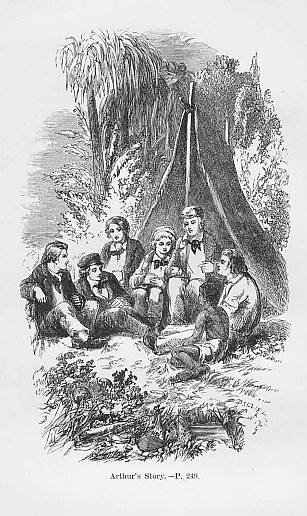
“In the afternoon,” resumed Arthur, “we went with our host and hostess, and our companions at dinner, to a grove on the banks of the stream—a place of general resort for the villagers during the latter part of every fine day. The younger people met there, to pursue a variety of sports and athletic exercises, and the older to gossip and look on. We had intended to return to the boat, as soon as the repast was over, and it would have been well had we done so. But our new friends insisted so strenuously upon our accompanying them to the grove, that we yielded at last to their playful importunities, so far as to consent to make a brief pause there on our way. We had gone but a short distance from the house, when a bird of about the size of a robin, flew down from a tree beneath which we were passing, and after circling several times around Olla’s head, alighted on her finger, which she held out for it to perch upon. It was a young wood-pigeon, which she had found in the grove, when a callow half-fledged thing, the old bird having been captured or killed by some juvenile depredators. Taking pity on its orphan state, Olla had adopted and made a pet of it: it was now perfectly tame, and would come readily at her call of ‘Lai-evi’, (little captive), the name she had given it, attending her so closely as to be seldom during the day beyond the sound of her voice.
“On reaching the grove, we found quite a number of the natives, of all ages and of both sexes assembled, and though they soon began to gather about us with inquisitive looks, we were subjected to much less annoyance than might reasonably have been expected under the circumstances. We were neither crowded, nor jostled, nor even offensively stared at, the very children appearing to possess an innate delicacy and sense of propriety, (though it may have been timidity), which made them try to gratify their curiosity covertly, seizing those opportunities to peep at us, when they thought they were themselves unobserved.
“Barton, who possessed an enviable faculty of adapting himself to all sorts of people and circumstances, was in a few moments as much at home among the villagers as if he had lived for years in their midst. He gossiped with the old people, romped with the children, and chatted and frolicked with the prettiest and most lively of the dusky maidens, to the manifest disapprobation of several grim-looking young savages, who stalked about in sullen dignity watching these familiar proceedings of the handsome stranger, with rising jealousy and indignation.
“At length a bevy of laughing girls, in punishment for some impertinence with which they charged him, fell to pelting him with jasmine buds and pandanus cones, the latter of which, in mischievous hands, are capable of becoming rather formidable missiles. Foremost among the assailants were our fair acquaintances of the morning, and even Olla, forgetting her matronly station and dignity, joined zealously in the flowery warfare; which was maintained with such spirit, that Barton was at length obliged to beg for quarter, promising at the same time to ‘make some music’ for them, as a condition of the suspension of hostilities. This proposition, as soon as it was understood, seemed to afford the most extravagant delight; the shower of missiles ceased at once, and Barton was immediately surrounded by as attentive and breathlessly expectant an audience as artist could desire. Taking his stand upon a moss-covered fragment of rock, he drew an enormous Jew’s-harp from his pocket, and handed it to me, gravely requesting me to ‘accompany’ him upon it, while he sang. Then, after clearing his throat, with quite a professional air, he commenced ‘Hail Columbia,’ and as he had a full, clear voice, and sang with great spirit, the performance was listened to with every mark of enjoyment, and was succeeded by rapturous applause.
“He next gave a solo on the Jew’s-harp to the air of ‘Yankee Doodle,’ with brilliant and original variations, which likewise met with a flattering reception. But by far the greatest sensation was produced by ‘Auld Lang syne,’ which we sang together as a grand finale. The natives really seemed to feel the sentiment of the music, although Barton turned it into a burlesque by such an exaggerated pathos of tone and expression, and gesture, that I had much difficulty in getting through my part of the performance without laughing; but my vexation at being surprised into taking a part in such a piece of buffoonery, greatly helped me in resisting my sense of the ludicrous. At the end of every verse, Barton grasped my hand in the most demonstrative manner, and commenced shaking it vigorously, looking me all the while solemnly in the face, and shaking away through the entire chorus, thereby producing a number of quavers, which, though not set down in the music, greatly added to its pathetic character. After the last chorus, he spread open his arms, rushed forward, and gave me a stage embrace. This performance, including the pantomime, must have been of a very moving character, for when we had finished, I actually saw tears in the eyes of several of our audience. This evidence of the gentle and unsophisticated character of these simple people, affected me almost as much as our music had moved them, and I could not help thinking to how much better account such amiable impressibility was capable of being turned.
“Having thus performed his promise, Barton now insisted that we ought to be entertained in our turn with some music, and after a little persuasion, three young girls sang, or rather chaunted, several plaintive, but somewhat monotonous airs. Their voices, though neither strong nor clear, were soft and melodious, like the cooing of their native wood-pigeons. In vain we asked for something livelier and more spirited. Barton humming the tune of ‘Yankee Doodle,’ to make them the better understand what we wanted. All their melodies seemed to be of a slow and measured character, and those specimens which we heard, embraced a comparatively narrow range of notes.
“Just as the native girls finished singing, we were joined by a fresh party of eight or ten men, who came across the brook, and mingled with the others. I heard Barton say to Rokóa, ‘There is the old priest again,’ but on looking around I could not see him. The new-comers did not appear to be in the same holiday humour as the throng around us; they walked gravely about without joining in the general mirth and gaiety, and manifesting none of the curiosity in regard to ourselves, which the others had evinced. I, however, thought nothing of this at the time, supposing that they had been of the number of those whom we had seen in the morning by the sea-shore, although I did not recognise any of them.
“Presently, Olla and her companions commenced begging us for more music. One young lady in particular, (the same who had pronounced us to be inhabitants of the moon), pressed Barton with unceasing importunities, mingled with threats of a renewal of hostilities in case of non-compliance. Finding all attempts at excuse or evasion utterly unavailing, he suddenly snatched a wreath of yellow candle-nut-blossoms from the head of his tormentress, crowned himself therewith, and springing upon the top of the rock, assumed an oratorical attitude, and waved his hand, as if about to harangue the people. Then, while I was wondering what was to come next, he fixed his eye sternly upon a sinister looking man of middle-age, with the head-dress of an inferior chief, who was standing directly in front of him, and began to declaim in Latin, with great vehemence— ‘Quo usque tandem abutere, Catilina, patientia nostrâ,’ etcetera, which the audience seemed at first, to consider highly interesting and entertaining. As he proceeded, delivering the sounding sentences, ‘ore rotundo,’ and emphasising each thundering polysyllable with a fierce gesture of his clenched fist, I observed that the individual before mentioned, whom the orator seemed to have chosen to represent Catiline, and who, without understanding Latin, could very well perceive that there was something menacing and vituperative in the language addressed to him, began to look at first puzzled, and then incensed. He stole two or three hurried and uncertain glances at those behind and immediately around him, as if to assure himself whether this torrent of denunciation was not in fact directed against some other person; but when all doubt on this point seemed to have been resolved by the unequivocal demonstrations of the orator, his rigid features assumed an expression of such anger and ferocity, that I began to fear some violent outbreak of passion, and made several attempts by signs and gestures, to indicate to Barton the danger of pursuing so thoughtless and imprudent a pleasantry. But he either did not perceive my meaning, or else, felt rather flattered than alarmed, by the effect which his elocution seemed to produce upon Catiline, for he continued to pour out upon him the torrent of his oratory for several minutes longer, and it was not until his memory began evidently to fail him, that he concluded with a last emphatic invective accompanied by a sufficiently significant pantomime to convey some notion of its meaning, and bowing to his audience, leaped from the rostrum.
“This performance, seemed to afford even greater pleasure to the male part of the assembly, (with a few exceptions), than the previous musical entertainment had done, and they testified their approbation, by emphatic nods and shouts of applause.
“I now thought it time to terminate our visit, and return to the boat, and was about to speak to Rokóa on the subject, when Barton seized me by the arm, and pushed me towards the platform of rock.
“‘Now, Arthur, it is your turn,’ said he, ‘you perceive what an effect my eloquence has produced on old Catiline, there: give him a lecture upon the sinfulness of indulging the vindictive passions, and exhort him to repentance.’
“The younger people pressed about me, and instigated and aided by Barton, they fairly forced me upon the rocky platform. Though by no means pleased at being obliged to take a part in a farce so little to my taste, and for which I possessed none of Barton’s talent, I saw plainly that the shortest and least troublesome way, was to comply with their wishes, and I accordingly endeavoured to recall some fragment of prose or verse which might serve the present purpose. Supposing that English would be quite as intelligible and acceptable to them as Barton’s Latin, I was just about to declaim those noble opening lines of Comus—
“‘Before the starry threshold of Jove’s Court,’ etcetera.
“Which used to be a favourite of mine at school, when suddenly another impulse seized me.
“As I glanced around upon the circle of smiling, upturned countenances, I was struck by the docile and childlike expression of many of them. I thought of the sad and benighted condition of this simple people, without the knowledge of God, or the hope of immortality, given up, as it seemed, a helpless prey to the darkest and most cruel superstitions. I thought of the moss-grown marae in the dark wood, with its hideous idols, its piles of human bones, and its hoary priest—fit minister of such a religion. I remembered the aged woman at Mowno’s house, and the frightful doom in reserve for her. I felt that perhaps to such impressible spirits, even a passing word, unskilfully and feebly spoken, might by God’s blessing do good; and yielding to the impulse of the moment, instead of declaiming the verses from Comus, I began to speak to them in their own language, of those great truths, the most momentous for civilised or savage man to know, and the most deeply interesting to every thoughtful mind, of whatever degree of culture—truths so simple, that even these untutored children of nature could receive, and be made happy by them.
“In the plainest and simplest language I could command, and striving to adapt myself to their habits of thought, and to use those forms of expression most familiar to them, I announced the great doctrine of the existence of one God, the sole creator of the world, and the loving Father of all his creatures. I spoke of his power and his goodness, and told them that though invisible to our eyes, as the wind which stirred the tops of the palm-trees above them, he was ever near each one of us, hearing our words, seeing our actions, reading our thoughts, and caring for us continually.
“I endeavoured to illustrate these attributes of God, by references and allusions to the daily aspects of nature around them, and to ideas and notions with which their mode of life, and the system of superstition in which they had been trained, rendered them familiar. My especial aim was to lead them, unconsciously, as it were, and without making any direct attack upon their religion, to contrast the benignant character of Him who has permitted us to call Him ‘Our Father in Heaven,’ with that of the malignant beings they had been taught to worship.
“I next spoke of death, and of a future life, and assured them that the friends whom they had buried, and they themselves, and all who had ever lived, should awake as from a brief sleep, and live again for ever. But when I proceeded to declare that most awful and mysterious doctrine of our religion, and spoke of the worm that dieth not and the fire that is not quenched, of eternal happiness, and unending woe, I could see by the earnestness of their attention, and the expression of their countenances, how powerfully they were impressed.
“I cannot remember all that I said, or the language I used, but I endeavoured to set before them in a shape adapted to their comprehension, the simple elements of the Christian scheme—the great doctrines of God and immortality, of human sinfulness and accountability, and of salvation through Jesus Christ. But encouraged by the attention and apparent interest of the silent and listening circle, in the glow of the moment, I went beyond this prescribed limit, and from these vast general truths, I began at last to speak of particular acts and practices. As I thought once more of the marae in the forest, and of the unhappy Malola, I told the people that our Father beyond the sky could alone hear their prayers, and should alone be worshipped; that he desired no sacrifices of living things; that he was offended and displeased with all cruelty and bloodshed; and that the offering of human sacrifices, and the killing of aged persons, were crimes which he detested, and would be sure to punish; that he had expressly commanded children to love and honour their parents, and that it was their duty, the older, the more infirm and helpless they became, the more faithfully to cherish and protect them. In speaking on this subject, I grew earnest and excited, and probably my voice and manner too strongly expressed the abhorrence I felt for such monstrous and unnatural crimes.
“At this point, Barton, who had for some time been looking on in astonishment at the serious turn which the matter had so unexpectedly taken, interrupted me with the whispered caution—
“‘Be careful, Arthur! I fear from the black looks of one of your clerical fathers here, that you are giving offence to the cloth, and trenching upon perilous ground.’
“But the warning came too late. Just as I glanced round in search of the threatening looks to which Barton alluded, a frightful figure sprang up on the outer edge of the circle of listeners, directly in front of me, and with cries of rage forced its way towards the spot where I stood. I recognised at once the old priest of the marae, but how changed since I last saw him! Every sign of age and decrepitude had vanished: his misshapen frame seemed dilated, and instinct with nervous energy: his face was pale with the intensity of his fury, and his small eyes flashed fire.
“‘Perish, reviler of Oro, and his priests!’ he cried, and hurled at me a barbed spear, with so true an aim, that if I had not stooped as it left his hand, it would have struck my face. Whizzing over my head, it pierced the tough bark of a bread-fruit tree, ten yards behind me, where it stood quivering. Instantly catching a club from the hands of a bystander, he rushed forward to renew the attack. He had reached the foot of the rock where I stood, when Rokóa with a bound placed himself between us, and though without any weapon, motioned him back, with a gesture so commanding, and an air at once so quiet, and so fearless, that the priest paused. But it was for an instant only; then, without uttering a word, he aimed a blow full at Rokóa’s head. The latter caught it in his open palm, wrenched the weapon from him, and, adroitly foiling a furious attempt which he made to grapple with him, once more stood upon the defensive with an unruffled aspect and not the slightest appearance of excitement in his manner.
“The baffled priest, livid with rage, looked round for another weapon. Half a dozen of the men who had arrived upon the ground with him, uttered a wild yell, and pressed forward with brandished clubs and spears. Barton and I, placed ourselves by Rokóa’s side, the former handing me one of his pistols. All was tumult and confusion. The outbreak had been so sudden and unexpected, and what I have just related had passed so rapidly, that the bystanders had not yet recovered from the first shock of astonishment and terror. Of the women, some shrieked and fled from the spot, others threw themselves between us and the armed natives, or invoked the interference of their brothers and friends for our protection. Only a few, even of the men, seemed to participate in the feeling of hostility against us.
“But however inferior in number, the party of our foes far surpassed that of our friends in resolution and energy. Foremost among them were the priest and the hard-featured chief, who had been so deeply incensed by what he regarded as the wanton insults offered him by Barton. A number of the young men also, whose anger and jealousy had been aroused by his sudden popularity, and the attention which had been paid us, sided zealously with the priest and his party, and joined in the clamour against us.
“Meanwhile, Mowno, at Olla’s entreaty, strove to calm the tumult, and to pacify the leader and instigator of it; but his authority was fiercely spurned, and our good-natured protector quailed before the fury of the vindictive old man. As yet, however, our enemies, conscious that the sympathies of a large number of the bystanders were with us, had offered us no actual violence, confining themselves to menacing cries and gestures, by which they seemed to be striving to work themselves up to the requisite pitch of excitement. This was likely to be speedily attained under the influence of the fierce exhortations and contagious fury of the priest. Some of the young men, in fact, now commenced a sort of covert attack, by throwing stones and fragments of wood at us from the outskirts of the crowd, and Barton was struck violently in the mouth by one of these missiles, by which his lip was badly cut. In the midst of all the excitement and tumult, Rokóa stood, with the outward appearance at least, of perfect composure. Neither the ravings of the priest, nor the menacing attitude of ‘Catiline,’ nor the brandished weapons of their followers, deprived him of his coolness and presence of mind. He steadily confronted them with an unblenching eye, grasping the club of which he had possessed himself, in readiness to meet the attack, which he at the same time did nothing, by look or gesture, to provoke. His calm intrepidity, while it seemed temporarily to restrain our enemies, served also to reassure and steady Barton and myself; and endeavouring to emulate his self-possession, we stood ready to act as circumstances should indicate, looking to him for the example.”
Here Arthur paused, as if about to suspend his narrative. Johnny, who was now broad awake, and listening eagerly, waited patiently a few moments, expecting him to recommence. Finding, however, that he did not do so, he at length asked him to “go on.”
“It is getting quite late,” answered Arthur; “see, those three bright stars which were high in the heavens when we first sat down here, are now on the very edge of the horizon, about to sink behind the ocean. As we expect to be up, and on our way to Castle-hill before sunrise to-morrow. I think we should now go to rest.”
“If we do,” replied Johnny, “I am sure I shall not be able to sleep; I shall be thinking of that terrible old priest, and trying to guess how you escaped at last.”
“I judge,” said Browne, “that you are pretty nearly at the end of your adventures in Angatan, so pray let us have the remainder now.”
“Do so,” added Morton, “and set Johnny’s mind at rest, or he will be dreaming of cannibals and cannibal-priests all night, and disturbing us by crying out in his sleep.”
“I think it’s quite likely,” said Johnny, shaking his head in a threatening manner; “I feel just now very much as if I should.”
“Since that is the case,” said Arthur, “I suppose I must ‘go on,’ in self-defence; and as I believe that twenty minutes will suffice for what remains, I will finish it.”
Chapter Twenty Three.
The Flight.
Te Vea—The Victim for Sacrifice—The Escape and Pursuit—The Priest’s Ambush.
“For life, for life, their flight they ply, And shriek, and shout, and battle-cry, And weapons waving to the sky, Are maddening in their rear.”
“While the party hostile to us, thus stood hesitating, but to all appearance rapidly approaching a point where all hesitation would cease, Olla, with tears streaming down her cheeks, besought us to fly to her husband’s house, where, she seemed to imagine, we should necessarily be safe from violence. But though no one yet laid hands on us, we were surrounded on all sides, and could not with any certainty distinguish friends from foes; and the first movement on our part to escape, would probably be the signal for an instant and general attack by the priest and his followers. We thought, therefore, that our best hope of safety lay in maintaining a firm but quiet attitude, until Mowno, and those disposed to protect us, could make their influence felt in our behalf. They, however, confined their efforts to feeble expostulations and entreaties; and perhaps it was unreasonable to expect them to engage in a deadly conflict with their own neighbours, relatives, and personal friends, in the defence of mere strangers like ourselves. They could not even restrain the younger and more violent portion of the rabble from carrying on the species of desultory warfare from which Barton had already suffered; on the contrary, the stones and other missiles, thrown by persons on the outskirts of the crowd, fell continually thicker and faster. At length Rokóa received a staggering blow on the back of the head, from a clod of earth, thrown by some one who had stolen round behind the rock for that purpose, and who immediately afterwards disappeared in the throng.
“‘How much longer are we to endure this?’ cried Barton. ‘Must we stand here and suffer ourselves to be murdered by these cowardly attacks? Let us shoot a couple of them, and make a rush for the shore.’
“But a moment’s reflection was enough to show the utter hopelessness of such an attempt. However much the natives might be astounded for an instant by the discharge of fire-arms, all fear and hesitation would vanish upon our taking to flight. Our backs once turned would be the mark for a score of ready spears; and except perhaps for Rokóa, whose speed was extraordinary, there would be scarcely the possibility for escape. Still it was evident that the audacity of our enemies was steadily increasing, though their attacks were as yet covert and indirect, and, as I knew that Rokóa would not hesitate to retaliate upon the first open assailant in which case we should be massacred upon the spot, we might soon be compelled to adopt even so desperate a suggestion, as the only alternative of instant death.
“At this critical moment, I noticed a sudden movement of surprise or alarm, on the outskirts of the crowd. A group, directly in front of us, no longer giving us their exclusive attention, began to whisper among themselves, glancing and pointing towards the rising ground in our rear, while a half suppressed and shuddering exclamation of ‘Te Vea! Te Vea!’ was heard among the people. Turning round, and looking where all eyes were now directed, I saw a tall native, with a peculiar head-dress of feathers, and a small basket of cocoa-nut-leaflets in his hand, running rapidly towards us. His appearance seemed to awaken in those around us, emotions of terror or aversion, strong enough to swallow up every other feeling, for, no sooner was he perceived, than all thought of prosecuting further the present quarrel, appeared to be abandoned. The priest, alone, evinced none of the general uneasiness or dread, but, on the contrary, a gleam of exultation lighted up his hard and discoloured countenance. The people made way to the right and left, as the new-comer drew near, and a number of them slunk away into the forest or to their homes. The stranger proceeded directly towards Mowno, and taking a small parcel wrapped in leaves, from the basket which he carried, delivered it to him: then, without pausing an instant, or uttering a word, he passed on, taking his way at a rapid pace straight through the village. Mowno received the parcel with a reluctant and gloomy air, though it seemed to consist of nothing but a rough stone, wrapped in the leaves of the sacred miro. For several minutes he stood holding it in his hand, like one deprived of consciousness. Several of those who appeared to be the principal persons present, among whom were Catiline and the priest, now approached him, and they began to hold a whispered consultation, in the course of which the priest frequently pointed towards Rokóa, as though speaking of him. Mowno seemed to be resisting some proposal urged by the others, and spoke in a more decisive and resolute manner than I had thought him capable of assuming. The discussion, whatever was its subject, soon became warm and angry: the voices of Catiline and the priest were raised, and even threatening. Every moment I expected to see Mowno relinquish his opposition; but he remained firm, and at last, with the air of one resolved to put an end to further debate, he said—
“‘No! it shall not be either of the strangers; it shall be Terano: he is an evil man, and it will be well when he is gone.’ Then speaking to two of those who stood near him, he said, ‘Go quickly to Terano’s house, before he sees the messenger and hides himself in the mountains,’ whereupon they seized their spears, and immediately set off in the direction of the village.
“Olla now renewed her entreaties for us to leave the spot, and go with her to the house; and Mowno,—by a quick gesture, meant to be seen only by us, indicated his wish to the same effect. Rokóa nodded to me to comply, and we followed Olla as she bounded lightly through the grove, no one offering to oppose our departure. But the priest’s restless eye was upon us, and had we set off in the direction of the shore, we should not have been permitted to escape, without an attempt on his part to prevent it. As it was, he appeared to give some direction to those about him, and four or five young men followed us at a distance, keeping us in sight, and taking care that they were always in such a position as to enable them to intercept us in any attempt to recross the island. After having dogged us to Mowno’s house and seen us enter, they withdrew into the forest out of sight, where they probably remained on the watch. Rokóa now proceeded to select from Mowno’s store of weapons, a club, of more formidable weight and size, than that which he had wrested from the priest, and requested Barton and myself to follow his example.
“‘We must try to get to the shore,’ he said, ‘there are at present, none to hinder us, but the young men who followed us hither.’
“‘But that demon of a priest, and the rest of his crew, are not far-off,’ said Barton, ‘and they will be sure to waylay us. For the present we are safe here; and perhaps Mowno will be able to get us back to our boat without danger.’
“Rokóa shook his head. ‘There are others here,’ he said, ‘more powerful than Mowno, and who are our enemies: we must rely upon ourselves.’
“Olla watched us anxiously during this conversation; and now, as if she understood its subject at least, she said, with an expression of intelligence and cordial friendliness in her fine eyes, ‘Listen to me: the words of the priest are more powerful with the great chief than the words of Mowno: to-night, the priest will go to the great chief, and before he returns you must fly; but not now, for you are watched by the young men; you must wait until night—until the moon is behind the grove.’
“This seemed to me a wiser course than to undertake, at present, to fight our way to the boat; but Rokóa remained of his former opinion; he apprehended an attack upon our party at the shore during our absence, by which we might be cut off from all means of leaving the island. This certainly was a weighty consideration, and one that had not occurred to me. We were still hesitating, and uncertain what course to pursue, when Mowno came in, looking much troubled, and carrying in his hand the mysterious package, the object and meaning of which I forgot to explain.
“A stone, folded in the leaves of the miro, sent by the king, or paramount chief, to the subordinate chiefs of districts or villages, is the customary method of notifying the latter that they are expected to furnish a human victim for some approaching sacrifice. The principal occasions upon which these are required, are at the building of national maraes, at the commencement of a war, or in cases of the serious illness of a superior chief. The number of victims sacrificed, is proportioned to the magnitude of the occasion; as many as a score have sometimes been offered to propitiate the gods during the severe sickness of a powerful chief. The priests signify to the chief the number required; the latter then sends out his runner or messenger, (te vea), who delivers to each of the subordinate chiefs, one of these packages for each victim to be furnished from his immediate district. The odious duty of designating the individuals to be taken, then devolves upon the subordinate, and having decided upon this, he sends a number of armed men to secure the destined victims before they secrete themselves or flee into the woods, as those who have any reason to fear being selected generally do, at the first appearance of the dreaded messenger, or even as soon as it is publicly known that an occasion is at hand for which human sacrifices will be required. When secured, the doomed persons are most commonly killed on the spot by the chief’s men, and the bodies wrapped in cocoa-nut leaves and carried to the temple. Sometimes, however, they are preserved alive, and slain by the priests themselves at the altar.
“Upon the arrival of the messenger, as already related, with a requisition for one victim from the village, the majority of Mowno’s advisers had insisted upon selecting Rokóa for that purpose, and thus avoiding the necessity of sacrificing one of their own people. The priest had gone further still, and proposed to seize upon us all, and send Barton and myself to the two neighbouring villages, to be furnished by them as their quota of victims. To these councils, Mowno had opposed a determined resistance, and he had finally sent his followers to despatch an old man named Terano, whose death would be considered a general benefit, as he was a notorious and inveterate thief and drunkard, who, when not stupefied with ava, was constantly engaged in desperate broils, or wanton depredations upon the property of his neighbours. It seemed, however, that the old man had taken the alarm and fled; several of Mowno’s followers were now in pursuit of him, and unless they should succeed in taking him before morning, another person would have to be designated, as it was required to furnish the victims at the great marae, by noon of the following day.
“I sickened with disgust, as I listened to details like these. Never before had I so fully realised the darkness and the horrors of heathenism—all the more striking in the present instance, because of the many pleasing and amiable natural qualities of the people who groped amid much darkness, and were a prey to such horrors.
“Mowno also recommended us to postpone any attempt at flight until a late hour of the night. He said that he had seen a number of men lurking in the woods near the stream, and that the priest and others had remained in the grove after he had left, probably with the intention of joining them in watching the house.
“Olla now went out into the garden, where she walked about looking up among the branches of the tree; and calling out, ‘Lai-evi!’ as if in search of her tame wood-pigeon. After going round the garden, she passed out of the gate, and wandered away in the direction of the brook, still looking among the trees, and repeating at intervals her call of ‘Lai-evi!’
“By-and-bye she returned, and though without her little favourite, she had accomplished her real object, and ascertained the number and position of the spies. She had seen seven of them skulking in the wood along the brook, and watching the house. They seemed anxious to avoid observation, and she could not, without awaking suspicion, get more than transient glimpses of them, so that possibly there might be others whom she had not seen.
“Rokóa questioned her as to the space along the bank of the stream occupied by these men, and the distance from one another at which they were stationed. Then after a moment’s reflection he turned to Mowno, and asked whether he was confident of being able to protect us, while in his house; to which the latter replied with much earnestness that he both could and would do so.
“‘Wait here, then,’ said Rokóa, addressing Barton and myself, ‘I will return before the moon sets:’ and without affording us an opportunity to inquire what he designed to do, he passed through the door, and bounded into the forest, in the direction opposite to that where the spies of the priest were lurking.
“‘Is it possible,’ said Barton, ‘that he intends to desert us?’
“‘You should know him better,’ I answered, ‘unless I am mistaken, he is about to risk his life in an attempt to communicate with our crew, in order to put them on their guard against a surprise, and to render our escape the more easy. If he lives, he will return, to incur a second time with us the very dangers to which this attempt exposes him.’
“Knowing as I did Rokóa’s great activity, coolness, and presence of mind, I was sanguine that he would succeed in eluding the vigilance of our enemies, and accomplishing his purpose.
“Soon after his departure, Olla set out for our evening meal a light repast of bananas, baked bread-fruit, and vi-apples, fresh from the garden. But neither Barton nor I could eat anything: our thoughts were with Rokóa upon his perilous adventure. When the food had been removed, Mowno suggested that we should all go out into the inclosure, and walk a few times around the house in order that those who were on the watch might be satisfied that we were still there. This we accordingly did, and continued strolling through the garden until it became quite dark. Rokóa had now been gone nearly an hour, and Barton began to grow restless and troubled. Mowno, stationing himself at the end of the walk leading from the house, leaned upon the gate in a listening attitude. As I sat in the wide doorway, beneath the vi-apple trees planted on either side of the entrance, watching the bright constellation of the Cross, just visible above the outline of the grove in the southern horizon, Olla began to question me concerning what I had told the people in the afternoon, of God, and a future life, and the doctrines of Christianity. I was at once touched and astonished, to perceive the deep interest she took in the subject, and the readiness with which she received these truths, as something she had needed and longed for. She seemed to feel how much better and more consoling they were, than the superstitions in which she had been educated.
“I was amazed to find that this young heathen woman, growing up in the midst of pagan darkness, was nevertheless possessed of deep and strong religious feelings, which could not be satisfied with the traditions of her people. As I gazed at her ingenuous countenance, full of earnestness and sensibility, while she endeavoured to express the vague thoughts on these subjects which had at times floated through her mind, I could scarcely believe that this was the same gay and careless being, whose life had seemed to be as natural, as unconscious, and as joyous, as that of a bird or a flower. She said, that often when alone in some secluded spot in the depth of the wood, while all around was so hushed and peaceful, she had suddenly burst into tears, feeling that what she had been taught of the gods could not be true, and that if Oro was indeed the creator of so beautiful a world—if he had made the smiling groves, the bright flowers, and the multitude of happy living things, he must be a good being, who could not delight in the cruelties practised in his name. Often, when a mere girl, thoughts like these had visited her, wandering by the sea-shore at twilight, or looking up through the foliage of waving cocoa-nut-groves at the starry skies, when nature herself, by her harmony and beauty, had seemed to proclaim that God was a being of light and love, in whom was no darkness at all!
“Presently Mowno joined us, and I talked with him in regard to the intended burial of the aged woman, his aunt and endeavoured to make him see the act in its true light. But with all his natural amiability, such was the effect of custom and education, that he seemed perfectly insensible on the subject. He observed, in a cool, matter-of-fact manner, that when people got very old and could not work, they were of no use to others or themselves—that it was then time for them to die, and much best that they should do so at once; and that if they did not, then their friends ought to bury them. As to Malola, his aunt, he said that she was quite willing to be buried, and had in fact suggested it herself; that she was often very sick, and in great pain, so that she had no pleasure in living any longer; he added, as another grave and weighty consideration, that she had lost most of her teeth, and could not chew her food, unless it was prepared differently from that of the rest of the family, which caused Olla much trouble.
“Finding that argument and expostulation had not the slightest effect upon him, I changed my tactics, and suddenly demanded whether he would be willing to have Olla buried, when she began to get old and infirm? This seemed at first to startle him. He glanced uneasily at his little wife, as if it had never before occurred to him that she could grow old. Then, after staring at me a moment in a half angry manner, as though offended at my having suggested so disagreeable an idea, he seemed all at once to recover himself, remarking quickly, that he should be old then, too, and that they could both be buried together. This consolatory reflection seemed completely to neutralise the effect of my last attack, and Mowno’s countenance resumed its habitual expression of calm and somewhat stolid placidity.
“Baffled, but not discouraged, I next strove, by drawing an imaginary picture of Olla and himself in their old age, surrounded by their grown up children, to show how happy and beautiful the relation between the child and the aged parent might be. I summoned up all my rhetorical powers, and sketched what I conceived to be a perfect model of an affectionate and dutiful Angatanese son. After clothing him with all the virtues and accomplishments of the savage character, I proceeded to endue him with that filial affection, whose beauty and power it was my chief object to illustrate. I represented him as loving his father and mother all the more tenderly on account of the infirmities of age now stealing over them. Upon the arm of this affectionate son, the white-haired Mowno supported himself; when at morning and evening he went forth to take his accustomed walk in the groves. He it was, who brought home daily to his aged mother, the ripest fruits, and the freshest flowers. His smiling and happy countenance was the light of their dwelling; his cheerful voice, its sweetest music. I was proceeding thus in quite an affecting strain, as it seemed to me, (though I must in honesty confess that Mowno appeared to be less moved by it than myself; and somewhat cooled my enthusiasm by giving a great yawn in the midst of one of the most touching passages), when Olla, who had been listening with moistened eyes, gently stole her arm around her husband’s neck, and murmured a few words in his ear. Whether it was my pathetic eloquence, or Olla’s caress, that melted his hitherto obdurate heart, I will not pretend to say, but it is certain that he now yielded the point, and promised that Malola should be permitted to live. ‘At least,’ he added, after a moment’s reflection, ‘as long as she can see, and walk about.’
“Several times, since it had grown dark, I had heard sounds like the distant beating of drums, mingled occasionally with the long and sorrowful note of the buccinum-shell, or native trumpet. Twice, also, while Mowno was standing at his gate, messengers had arrived, apparently in haste, and after briefly conferring with him, had posted off again. When I remarked upon these sounds, Mowno said that they came from the marae, where preparations for the approaching ceremony were going forward; but to me, they seemed to proceed from several different points, at various distances from us.
“I now began to feel painfully anxious at Rokóa’s protracted absence. It was nearly midnight, and there had been ample time for one less active than he, to go to the shore and return. The terrible apprehension, that in spite of all the resources of his skill and courage, he had fallen into the hands of some of the parties of natives which seemed to be scattered about in the forest, gained every moment a stronger hold upon my mind.
“‘He has either been taken, or else he finds that he cannot rejoin us, without too great risk,’ said Barton, breaking a long silence, and speaking of that which each knew the other to be thinking about; ‘we must start for the shore ourselves, if he does not come soon.’
“‘Hark!’ whispered Olla, ‘some one is approaching from the wood.’ Her quick ear had detected stealthy steps crossing the avenue. The next moment some one bounded lightly over the hedge at the side of the house, where the shadow of the bread-fruit trees fell darkest. Mowno started, and seemed agitated, and for an instant a suspicion that he had betrayed us, and was about to give us up, flashed through my mind. But the figure which came forward into the light, was that of Rokóa, and I felt pained at the wrong which my momentary doubts had done our inert, but well-meaning, host. Rokóa breathed quick and short. Without speaking, he pointed to the moon, now on the edge of the western horizon of forest, to intimate that he was punctual to the time set for his return.
“The sounds which I had before heard, were now borne more plainly than ever to our ears upon the night breeze. As soon as Rokóa recovered his breath, he said that we had not a moment to lose, but must commence our flight at once. He had passed an armed party of more than twenty men, coming in the direction of the house, with the purpose, as he supposed, of demanding that we should be given up to them. Mowno seemed more displeased than alarmed at this intelligence, and earnestly repeated that no harm should befall us while beneath his roof, if he had to lay down his life in our defence. But Rokóa urged our immediate departure, before the arrival of the party which he had seen. Mowno then offered to accompany, and guide us to our boat, which Rokóa firmly declined, on the ground that his presence might endanger him, and in the excited and determined mood of our enemies could be no protection to us.
“We accordingly took a hurried leave of him, and Olla. ‘Good-bye, Artua,’ said the latter, ‘Olla will not forget what you have told her of our great Father in the sky; she will ask him for a new heart that she too, may go when she dies, to the Christian heaven,’ and she pointed upward, while a happy smile lighted up her intelligent, and, for the moment, serious countenance.
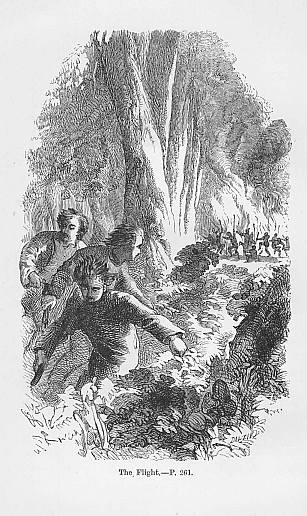
“We sprang over the hedge, and Rokóa leading the way, proceeded swiftly but silently down the avenue. We passed some distance beyond the point where we had struck into it in the morning, to avoid the neighbourhood of the village, then turning towards the shore, descended into the valley until we reached the stream. At this point, it was deep and narrow, with a rapid current, but we had no time to look for a ford. Cries and shouts on the hill above us, showed that we were pursued, and a confused clamour from the village indicated the existence of some unusual commotion there. Tum-tums were beating fiercely, and the long dismal wail of the tuba-conch resounded through the echoing arches of the forest. We swam the stream as silently as possible, Barton holding his pistols above his head in one hand to keep the charges dry. As we climbed the further bank, and plunged into the wood of miros, we could hear the splashing of the water caused by persons fording the brook a short distance below us, and opposite the village. In the same direction a multitude of candle-nut torches gleamed through the foliage, and revealed dusky forms hurrying hither and thither. We pushed on through the wood at the top of our speed, until suddenly the outlines of the marae, illuminated by the glare of a large bonfire, loomed up before us. A score of half-naked men, were dancing around the fire in front of the inclosure, with the wildest and most extravagant contortions of body. Seen by the fitful and wavering light, their painted countenances scarcely looked like those of human beings, and the grim, immovable idols, upon their pedestals, seemed vaster and more hideous than ever.
“As we turned, and plunged into the grove again, resuming our flight in a somewhat altered direction, an eager shout announced that we had been seen. But this cry proceeded, not from the group in front of the marae, who were wholly absorbed in their savage orgies, but from a straggling party of pursuers from the village, to whom the light of the bonfire had betrayed us. The chase was now no longer random or uncertain; they came on like hounds in full view of the game, uttering yells that caused the blood to curdle in my veins. My strength began to fail, and I felt a horrible spell creeping over me, like that which often in dreams, deprives us of the power to fly some appalling danger. Rokóa restrained his superior speed, and kept beside Barton and myself. ‘Courage, Artua!’ he said, ‘we are near the shore,’ and he offered me his hand to assist me, but I would not take it. Notwithstanding our utmost exertions our pursuers gained upon us. I was very nearly exhausted when we reached the ravine which divided the miro-grove from the bread-fruit plantation, and as we struggled up its steep side Barton panted and gasped so painfully for breath, that I dreaded each moment to see him fall to the ground incapable of proceeding further. But we knew that our lives were at stake, and forced ourselves to exertions which nature could not long support; still, the cries of our pursuers, the sound of their footsteps, and the crashing of branches in their path drew continually nearer.
“At last we had nearly traversed the breadth of the plantation, and the welcome sound of the waves, breaking upon the beach, greeted our ears. Safety now seemed within our reach, and we summoned all our remaining energies for a final effort. The trees, growing more thinly as we approached the skirt of the wood, let in the light, and between their trunks I caught a glimpse of the sea. Right before us was a thicket, tangled with fern, and scarcely twenty yards beyond it lay the beach shining in the star-light. As we turned a little aside to avoid the thicket, an appalling yell rang out from it, and half a dozen dark figures started from their ambush, and sprang into the path before us. The old priest was at their head: my heart sank, and I gave up all as host. Rokóa, swinging up his ponderous club, bounded into their midst. ‘Onward!’ cried he, ‘it is our only hope of escape.’ His movements were light as those of a bird, and rapid as lightning. His first blow stretched the priest at his feet. The savages gave way before him, scattering to the right and left, as if a thunderbolt had fallen among them. Barton discharged both his pistols at once, and with fatal effect, as was witnessed by the groans that followed. Before they could rally or recover themselves, we had burst through their midst. As we reached the shore, I looked round and missed Barton—he was no longer beside me. An exulting cry behind us at once explained his absence: at the same time we could hear him call out in a voice broken by exhaustion, ‘Save yourselves, you can do nothing for me!’ Without an instant’s hesitation, Rokóa turned, and we rushed back into the midst of our shouting enemies. Three or four of the party which had been in pursuit of us, were just coming up. The audacity and desperation of our attack seemed to confound them, and two of their number fell almost without a struggle beneath Rokóa’s rapid and resistless blows. Two more of them, who were dragging Barton away, were compelled to leave him at liberty in order to defend themselves. At that moment a sudden shout from the water raised by our crew, who had either heard our voices, or seen us when we came out upon the shore, increased their panic by causing them to suppose that we were leading back our whole party to the fight. They hastily gave way before us, and we had all turned once more, and gained the beach before they recovered from their surprise, and perceived their mistake.
“Our boat was just outside the surf; where the crew were keeping her steady with their paddles. We hailed them, and plunged in the water to swim out to them. The natives, stung with shame and rage at having their prisoner torn from them in the very moment of triumph, with such reckless boldness, swarmed down to the beach and pursued us into the water. They seemed excited almost to frenzy at the prospect of our escape. Some standing upon the shore assailed the canoe with showers of stones, by which several of our men were wounded. Others swam out after us, as if about to endeavour to board the vessel, and did not turn back until we had hoisted our sail, and began to draw steadily from the land.
“And thus ends the story of the Cannibal Island of Angatan.”
“Is that all?” inquired Johnny, looking somewhat disappointed.
“Yes, that is all,” answered Arthur, “it comes as near to being a cannibal story, as any thing I know. I did not see any one actually roasted and eaten, but if the savages had caught us, I suspect there would have been more to tell, and probably no one here to tell it.”
“But,” persisted Johnny, “the story don’t end there. You haven’t told us about the rest of the voyage, and whether Rokóa found his brother at last.”
“O, that don’t properly belong to this story. According to all artistical rules I ought to end precisely where I have, in order to preserve the unities. But some other time, if you wish, I will tell you all about it.”
“Pray don’t talk of artistical rules,” exclaimed Max, “after showing yourself such an egregious bungler! You had there all the elements of a capital story, and you have just spoiled them.”
“‘How prove you that, in the great heap of your knowledge,’” cried Browne, “‘come now, unmuzzle your wisdom,’ and specify the blunders of which he has been guilty. I say, with Touchstone, ‘instance briefly, shepherd; come, instance.’”
“Why, in the first place, there was a miserly spirit of economy in regard to his men. He should have invested the narrative with a tragic interest, by killing Rokóa and Barton, at least;—being the narrator he couldn’t kill himself conveniently;—but he might, with good effect have been ‘dangerously wounded.’”
“But suppose,” said Arthur, “that I wanted Rokóa to figure in a future story, and so couldn’t afford to kill him just yet?”
“A miserable apology! it evinces a lamentable poverty of imagination to make one character serve for two distinct tales.”
“Well, a further instance, ‘gentle shepherd,’” cried Browne, “‘a more sounder instance.’”
“Then, again,” resumed Max, with an oracular air, “it was a capital error to make Olla a married woman; what business I should like to know, can a married woman have in a story?—She belongs properly to the dull prosaic region of common life—not to the fairy land of romance. Now the charm of sentiment is as necessary to a perfect tale, as the interest of adventure, or the excitement of conflict, and had Olla been single, there would have been the elements of something beautifully sentimental.”
“Enough!” cried Browne, “if you have not ‘lamed me with reasons,’ you have at least overwhelmed me with words—there now! I believe I am unconsciously catching the trick of your long-winded sing-song sentences—it must be contagious.”
“Well,” said Arthur, “I give over the ‘materials’ to Max, with full permission to work them up into a romance after his own fashion, introducing as much slaughter and sentiment as he shall judge requisite for the best effect, and when completed, it shall be inserted by way of episode in our narrative.”
Note. Upon consulting the charts we find an island called “Ahangatan”, (of which Angatan is perhaps a contraction), laid down on some of them, about one hundred and fifty miles north of Hao. On others the same island is called Ahangatoff. The US Exploring Expedition visited Hae, and most of the neighbouring islands, but we have not been able to discover any mention of Angatan in the published records of the expedition.
Chapter Twenty Four.
House-Building.
Dawn on the Lagoon—The “Sea-Attorney”—The “Shark-Exterminator”—Max “Carries The War Into Africa.”
“Another hour must pass ere day grows bright, And ere the little birds begin discourse In quick low voices, ere the streaming light Pours on their nests, just sprung from day’s fresh source.”
After the late hours we had kept on the last evening, most of us would willingly have prolonged our slumbers beyond the time previously fixed for setting out upon our return to Castle-hill. But before it was fairly light, Arthur was up, with an unseasonable and provoking alacrity, calling loudly upon us to bestir ourselves.
In vain Browne apostrophised him in moving strains as “the rude disturber of his pillow,” remonstrated against such unmerciful punctuality, and petitioned for another nap; in vain Max protested that we were not New York shop-boys, obliged to rise at daylight to make fires, and open and sweep out stores, but free and independent desert islanders, who had escaped from the bondage of civilised life, and the shackles of slavish routine, and who need not get up until noon, unless of our own good pleasure. Arthur was inexorable, and finding that further sleep was out of the question, we yielded at last to his despotic pertinacity, and groped our way into the boat, yawning desperately, and not more than half awake.
The sea-fowl had not yet begun to stir in their nests, when we pushed out into the lagoon, and commenced pulling homeward—as we had now almost come to regard it—holding a course midway between the reef and the shore. A few moments’ exercise at the oars sufficed to dispel our drowsiness, and to reconcile us somewhat to the early start, which we had so reluctantly taken.
The faint grey light revealed the sleeping landscape, invested with the delicious freshness and repose of the earliest dawn in summer. The shores of the island, with their dense masses of verdure, were so perfectly mirrored in the lagoon, that the peculiar characteristics of the different kinds of foliage could be distinguished in their reflections. The drooping plumes of the palms, the lance-shaped pandanus leaves, and the delicate, filmy foliage of the casuarina, were all accurately imaged there; the inverted shore below, with its fringe of trees and shrubbery, looking scarcely less substantial and real, than its counterpart above. But as the light increased, these reflections lost their softness, and the clearness of their outlines. The gradually brightening dawn, cast new and rapidly changing lights and shades upon the waters and the shores; and the latter, which, as we moved onward, we beheld every moment from a new point of view, charmed the eye with a perpetual variety. In some places they were abrupt and bold; in others smoothly rounded, or gently sloping. Now we were opposite a jutting promontory, which, crowned with verdure, and overgrown with pendulous and creeping plants, pushed out over the narrow alluvial belt of shore, to the water’s edge; now shooting past it, we caught a sudden and transient glimpse of some cool valley, opening down to the lagoon, and stretching away inland through vistas of fine trees.
Johnny expressed a fervent wish that he was a painter, in order that we might sail round the island, take sketches of the scenery, and then paint a panorama, embracing all the best views, by exhibiting which at twenty-five cents a head, we should all make our fortunes upon getting home. He appeared to have some doubts, however, whether that particular time of day could be painted, even by the most accomplished artist. The lagoon channel wound through fields of branching coral trees of luxuriant growth, among which, numbers of large fish were moving sluggishly about, as if they had got up too early, and were more than half inclined to indulge in another nap. As we passed over a sort of bar, where there was not more than a fathom and a half of water, we espied an immense green turtle at the bottom, quietly pursuing his way across our track, and though by no means a beautiful creature, looking infinitely happier and more lively than the dull-eyed wretches of his race, which I have seen lying on their backs, at the doors of the New York restaurants, ready to be converted into soup and steaks. Johnny mourned over the impracticability of making any attempt at his capture, and heaved a sigh which seemed to come from the bottom of his heart, as the unsightly reptile disappeared among the mazes of the submarine shrubbery. The hardship of the case, seemed to be greatly aggravated in his eyes, as he contrasted it with the better fortune of Robinson Crusoe and the Swiss Family, the former of whom, as he reminded us, caught “any quantity of turtles” on the beach of his island, with no other trouble than that of turning them over upon their backs; while the latter, having surprised an enormous fellow taking an afternoon nap on the surface of the water, treacherously harpooned him in his sleep, and then, steering him as easily as one would drive a well-broken nag, compelled him to tow themselves and their pinnace ashore.
A somewhat startling incident put an end to these interesting reminiscences. Johnny was leaning over the gunwale, and with his face almost touching the surface, and his hands playing in the water, was peering down into the lagoon, probably on the look-out for another turtle, when a large shark, coming as it seemed from beneath the boat, rose suddenly but quietly, and made a snatch at him. Johnny saw the monster barely in time; for just as he sprang up with a cry of affright, and fell backwards into the boat the shark’s shovel-nose shot four feet above water at our stern, his jaws snapping together as he disappeared again, with a sound like the springing of a powerful steel-trap. Though baffled in his first attack, the voracious fish continued to follow us, watching closely an opportunity for a more successful attempt. He was a large brown shark, of the species known to sailors as the “sea-attorney,” which designation, together with his formidable reputation for keenness, vigilance, and enterprise, shows the estimation in which the members of the ancient and honourable profession of the law, are held by the honest sons of Neptune. Max professed to recognise him, as our acquaintance of the previous evening, by whom himself and Browne had been for a time kept in a state of blockade: our present visitor certainly evinced the same uncommon fierceness and audacity which had astonished us in the individual referred to. He was a trim, round-bodied, compact fellow with a wonderful display of vigour, and even of grace, in his movements; but though not without a certain kind of beauty, I do not wish to be understood as saying that his personal appearance was upon the whole, prepossessing. On the contrary, his expression, if I may venture to use the term, (and he certainly had a good deal of expression), was, if not decidedly bad, at the least exceedingly sinister. His flattened head, and long leather-like snout together with a pair of projecting goggle eyes, so situated as to command a view both in front and rear, and which he kept turning restlessly on every side, contributed greatly to enhance this forbidding aspect. Every moment he seemed to grow fiercer and bolder, and at length he actually laid hold of our keel next the rudder and fairly shook the boat from stem to stern. To our great relief, he soon desisted from this, for such was his bulk and strength, that we hardly knew what he might not effect in his furious efforts. His next move, was to make a sudden dash at Max’s oar, which had probably given him offence by coming too near his nose, and which he jerked from his hands.
Max seemed to regard this last exploit as a personal affront, and loudly declared that “this was going altogether too far, and that he should not stand it any longer.” He accordingly proceeded with great energy, to lash his cutlass to the handle of one of the remaining oars, with some twine which he found in the locker, threatening all sorts of terrible things against the unsuspecting object of his wrath. Meanwhile Morton succeeded in fishing up the lost oar, which the vigilance and activity of our attentive escort rendered a somewhat dangerous undertaking; when recovered, the marks of six rows of formidable teeth were found deeply indented upon its blade.
Max having completed his novel weapon, Browne, who had been engaged in an unprofitable attempt to strike the shark across the eyes with his cutlass, inquired, “what he was going to do with that clumsy contrivance!”
“That clumsy contrivance, as you rashly term it,” replied Max, with dignity, “is designed as a shark-exterminator, with which I intend forthwith to pay my respects to this audacious sea-bully. We have stood on the defensive quite long enough, and I am now about to carry the war into Africa.”
He accordingly jumped upon the middle seat of the yawl, where, in spite of all attempts at dissuasion, he stood watching a favourable opportunity for a thrust. This was soon presented. All unconscious of the unfriendly designs cherished against him, the shark came propelling himself carelessly alongside, and directly under Max’s nose, with his back fin quite above water. The temptation was not to be resisted. Max braced himself as firmly as possible in his position: Arthur expostulated, and begged him at least to get down and stand in the boat: Morton exhorted him to caution. But he only answered by a wave of the hand and a grim smile; then requesting Browne to lay fast hold of his waist-band, to assist him in preserving the centre of gravity, he raised his weapon in both hands, and giving it a preliminary flourish, brought it down with his full force, aiming at the broadest part of the fish’s back, just forward of the dorsal fin. But the weapon was too dull, or the blow too feeble, to pierce the tough hide of the “sea-attorney,” for it glanced smoothly off and Max losing his balance, went headlong into the sea. Browne, in a hasty effort to save him came near going over also, while the boat careened until the water poured in over the gunwale, and for a moment there was imminent danger of capsizing. Max came to the surface, almost paralysed with fright, and clutched convulsively at the side of the boat; when we drew him on board unharmed, but pale and shivering, as he well might be, after so extraordinary an escape. The shark had disappeared, and was now nowhere to be seen. Not being accustomed to Max’s system of “carrying the war into Africa,” so sudden and headlong an attack in his own element had probably somewhat disconcerted him. Max made a great effort to assume an air of composure. “Well!” said he, looking coolly around, “the enemy has, I perceive, beaten a retreat. I dare say he was quite as much frightened as I was, and that is saying a good deal.”
“But what has become of that patent shark-exterminator!” observed Browne, “I don’t see it anywhere: has the enemy carried it off as a trophy of victory, as conquering knights take possession of the arms of their vanquished adversaries!”
“It is much more likely,” replied Max with disdain, “that he has carried it off stuck fast in his carcass.”
But neither supposition proved to be correct, for we presently picked up the “exterminator,” floating near us. Johnny narrowly examined the blade, and was much disappointed at not finding “any blood on it.”
Max now took an oar to steady his nerves by rowing, for, notwithstanding his assumed composure and forced pleasantry, they had evidently been a good deal shaken by his recent narrow escape.
By the time we came in sight of Sea-bird’s Point, the increasing light, and the rosy glow in the “dappled east,” heralded the rising of the sun, and announced that the heat and glare of the tropical day, were on the point of succeeding the mild freshness of “incense-breathing morn.” Nor were other tokens wanting, that the reign of night was over. A strange confusion of indistinct and broken sounds, issuing from myriads of nests and perches all along the beach, showed that the various tribes of sea-fowl were beginning to bestir themselves. A few slumbrous, half-smothered sounds from scattered nests preluded the general concert, and then the notes were taken up, and repeated by the entire feathered population for miles along the shore, until the clamour seemed like that of ten thousand awakening barn-yards. And now the scene began to be enlivened by immense multitudes of birds, rising in the air, and hovering in clouds over the lagoon. Some wheeled around us in their spiral flight; others skimmed the water like swallows, dipping with marvellous promptness after any ill-starred fish that ventured near the surface; others again, rose high into the air, from whence, by their incredible keenness of sight, they seemed readily to discern their prey, when, poising themselves an instant on expanded wings, they would pounce perpendicularly downward, and disappearing entirely in the water for an instant, emerge, clutching securely a struggling victim. But in carrying on this warfare upon the finny inhabitants of the lagoon the feathered spoilers were not perfectly united and harmonious; and fierce domestic contentions occasionally interrupted and diversified their proceedings. A number of unprincipled man-of-war hawks, who preferred gaining their livelihood by robbing their neighbours and associates, to relying upon their own honest industry, would sail lazily around on wide-spread pinions, watching with the air of unconcerned spectators the methodical toil of the plodding gannets. But the instant that one of the latter rose from a successful plunge, with a plump captive writhing in his grasp, all appearance of indifference would vanish, and some dark-plumaged pirate of the lagoon, pouncing down like lightning upon his unwarlike neighbour, would ruthlessly despoil him of his hard-earned prize. One of these piratical gentry suffered before our eyes a fate worthy of his rapacity. A gannet had seized upon a fish much larger than his strength enabled him to manage, and was struggling in vain to lift it into the air, when a hawk darted upon them, and striking his talons into the fish, put the gannet to flight. But the greedy victor had greatly miscalculated the strength of his intended prey. A desperate conflict, sometimes under water, and sometimes just at the surface, ensued. The hawk struggled gallantly, but in vain, and was at length drawn under by his ponderous antagonist, to rise no more.
We landed a short distance beyond Johnny’s row of “Oyster-trees,” and by the time we had climbed the hill, the sun had risen, though not yet visible above the wooded heights which sheltered us to the eastward.
We were so intent upon our house-building project that, contenting ourselves with a self-denying breakfast of cocoa-nuts, we at once set zealously to work in carrying it out.
Arthur directed, superintended, and laid out the work in detail. Morton, having fitted a handle to the hatchet-head, and laboriously sharpened it upon a rough stone, undertook to supply materials as fast as called for. While he cut down trees of the kind and size required by Arthur, Max trimmed off the branches with his cutlass, and prepared them for use. Johnny and Eiulo dragged them to the site of the building, where Browne and I assisted Arthur in setting the posts into the ground, and putting together the frame of the house. Of course, our destitution of proper tools and implements rendered all this exceedingly laborious, and, but for Arthur’s perseverance and ingenuity, we should more than once have given up in despair. Instead of spades, we were obliged to use sharp bivalve shells from the shore, in digging places for the upright posts of the building, and as it was necessary that these should be set quite deep, in order to give it firmness and stability, the toil was severe. Max, who came up occasionally to see how the work was progressing, and to offer suggestions and criticisms, (more especially the latter), on finding us upon our knees, patiently grubbing up the earth with our shells, flatteringly compared us to so many hedge-hogs excavating their burrows.
Nevertheless, we persevered; and before night we had nearly completed the frame of our building, with the exception of the ridge-pole, the rafters, and cross-pieces.
The posts at the sides stood six feet out of the ground, and were stationed about three feet apart. The centre-posts, to support the ridge-pole, were nine feet high, and made from the trunks of well-grown trees, some six inches in diameter. This certainly was a good day’s work under the circumstances; at any rate, we were quite unanimous in considering it so; and towards twilight we went down to the beach for our evening bath, in an exceedingly complacent and self-satisfied state of mind, Max enlarging upon the pleasures of industry, and professing to be in the present enjoyment of those feelings—
“Which follow arduous duty well performed.”
Instead of repairing to our usual bathing-place, we proceeded along the beach to the north-west, until we reached the clump of trees at the edge of the water, already mentioned as being visible from Castle-hill. As we approached the spot, we found that what had appeared at a distance to be but a single group of trees, was, in fact, a small grove extending along the shore, and fringing a little cove of nearly elliptical form, which at this point set into the land. The narrow, shelving beach, rivalled the whiteness of a fresh snow-drift. The trees were mostly cocoa-palms; indeed, scarcely any others could flourish in such a spot; and there were no shrubs or undergrowth of any kind. The cove was perhaps a hundred paces long, and half as wide in the widest part; contracting to less than fifty feet where it communicated with the lagoon. The water was clear, the bottom smooth and regularly formed, and the greatest depth was only eight or ten feet. Max, after viewing the cove with the eye of a connoisseur, pronounced it a noble spot for bathing purposes, and fully equal to the basin on the reef in every respect, except in depth and facilities for diving.
The impression of his morning’s adventure, however, was still fresh, and he hinted at the possibility that some shark of elegant tastes, and possessing an eye for the beautiful, might be in the habit of frequenting the cove. Arthur volunteered to keep watch at the narrow entrance, while the rest of us were bathing, in order to give timely notice of the approach of the dreaded enemy; but on walking out to the edge of the lagoon we found that this precaution would be unnecessary. A bar, consisting of a coral patch, very near the surface, stretched across the mouth of the cove, rendering it almost impossible for a shark to enter.
Johnny named the spot, “The Mermaid’s Cove,” but this possessive designation was merely complimentary, for so far were we from renouncing the cove in favour of the mermaids, that from the day on which we discovered it, it became one of our favourite and regular resorts.
Chapter Twenty Five.
The Cabin by the Lake.
A Democrat in the Woods—Echo-vale and Lake Laicomo—The “Wild Frenchman” Discovered at last.
“A few firm stakes they planted in the ground, Circling a narrow space, but large enow, These strongly interknit they closed around With basket-work of many a pliant bough. The roof was like the sides; the door was low, And rude the hut, and trimmed with little care, For little heart had they to dress it now: Yet was the humble structure fresh and fair. And soon the inmates found that peace might sojourn there.”
It took us an entire week to complete the frame of our building, and this alone involved an amount and variety of labour which few of us had anticipated when we commenced it. One day was consumed in selecting, felling, and trimming a tree, tall and straight enough to serve as a ridge-pole. We next had to get out some thirty rafters of hibiscus to support the roof. Then, as we had no nails, (Max’s ship with the hardware not having yet arrived), we were obliged to adopt the means used by the Polynesian builders for fastening the rafters to the ridge-pole and cross-pieces, which consists of tying them firmly in their places with sennit. To supply the place of sennit, we manufactured a quantity of cord from twisted hibiscus bark, which answered the purpose very well.
At length the skeleton of the house was completed. Twenty-seven strong posts, (including the three tall centre ones), deeply planted in the ground, supported the string pieces and the ridge-pole. Fifteen slender rafters, regularly placed at small intervals, descended from the ridge-pole to the eaves on either side, and the whole was firmly bound together with tough and durable withes of our own manufacture.
The thatching occupied another week, and but for Eiulo’s skill and dexterity, we should never have accomplished this nice and difficult operation, except after a very bungling and imperfect fashion. Arthur understood very well how it should be done, but his knowledge was theoretical rather than practical, while Eiulo had acquired considerable skill in the art, by building and thatching miniature houses in the woods, an amusement which he and his young playmates had often practised at home. The only thing now remaining to be done, was to make a number of coarse mats, with which to enclose the sides of the house—as far as in such a climate it is desirable to enclose them—together with an additional supply, ready to be put up in bad weather, on fastenings constructed for the purpose. But for this, there seemed to be no immediate necessity. The sides of the building were low, and the eaves extended two feet beyond them, and as we had an excellent roof above us, we considered ourselves tolerably prepared, even for rainy weather. However, we commenced manufacturing mats, in which, with the instruction and example of Arthur and Eiulo, we were tolerably successful; but we proceeded with this very much at our leisure. One or two brief showers, like that which had exerted so sudden an influence in hastening the commencement of our building scheme, afforded us the most satisfactory evidence of the good qualities of our roof, which did not admit a drop of rain. But at the same time we became aware of another defect in our house, as a dwelling in wet weather. We had no floor but the bare earth, and though Arthur had so levelled it, and protected it by a little trench and embankment, that no water from the adjacent grounds could reach us, except by the gradual process of saturation, still it was very damp after a severe rain. To remedy this, Arthur talked from time to time of making a floor of cement, which would dry to the hardness of stone, and through which the moisture from the ground could not penetrate. When asked where lime was to be obtained with which to make his cement he assumed an air of mystery, and merely said that there would be no difficulty on that score. One day, after we had got a large supply of mats completed, and ready for use, he again recurred to the subject of improving our floor, and explained that he intended to prepare his mortar or cement, from sand and lime, the latter of which was to be procured by burning coral rock in a pit. He prevailed upon Morton, Browne, and myself to set about digging a “lime-pit” in the gully beside Castle-hill, while he took Eiulo and Johnny with him in the boat, to go in search of a quantity of the sponge-shaped coral, which, he said, was the best adapted to his purpose.
Max pronounced the whole project a humbug, and refusing to have anything to do with it, equipped himself with club and cutlass, and started off on a solitary excursion towards the south-easterly part of the island, which we had not yet explored. He returned in the afternoon with a glowing account of the discoveries he had made, among which were a beautiful pond of fresh water, a stream flowing into it, and a waterfall.
In two days we completed a lime-pit of proper dimensions. Arthur and his assistants had in the same time collected and brought to the spot a sufficient quantity of coral rock; we then covered the bottom of the pit with fuel, and laid the coral, previously broken into small pieces, upon it. The pile was next kindled, and when the fuel was consumed, we found that the coral had yielded a supply of excellent lime, fine and beautifully white. Without going into further details, it is enough to say that the rest of Arthur’s plan was carried out with the same success. The cement was made, and a thick layer of it spread over the floor of the house, as evenly and smoothly as could well be done, with no better trowels than gigantic oyster-shells. In three days it was hard as marble, and our house was now as complete as we could make it. It had cost us a great deal of severe toil; we had found the construction of it no such holiday employment as we had imagined; but it was the fruit of our own ingenuity and perseverance, the work of our own hands, and we regarded it with much complacency. Johnny impartially compared it with the dwellings of I don’t know how many other desert islanders, and found it superior in some point to each and all of them.
Being now in a state of complete preparation, as we flattered ourselves, for all sorts of weather, we began to feel as though a regular out-and-out storm, would be rather a luxury than otherwise. These bright skies and sunny days were very well in their way, but it wasn’t in anticipation of them, that we had been planning and working for a month or more. There was no use at all for our model house in such fine weather; indeed, while it continued, our old lodgings under the green forest leaves and the star-light, were far preferable. It took full half a dozen of our sleeping-mats, (and we had but three apiece), laid upon the stony floor of our dwelling, to make a couch half as soft as those heaps of leaves, which we used to pile up beneath the trees for our beds, and which we could not now introduce into the house for fear of “making a litter.” The prudent citizen—who, having at the threatened approach of winter laid in a bountiful provision of wood and coal, put up his hall-stoves and his double windows, now feels quite ready, in the strength of anthracite and hickory, to snap his fingers in the face of Jack Frost, and bid him do his worst—is not more impatient to have the thermometer fall to the neighbourhood of zero, in order that he may realise the comforts he has paid for, than were we for the advent of such a storm, as would enable us to say to one another, “Ah! is it not fortunate that we have a roof over our heads? What should we do now, if we had not made timely preparation?”
Well, at last we had our wish. A shower came up one day, in the afternoon, which did not cease in half an hour, as the previous ones had done. On the contrary, when darkness came on the rain still continued falling steadily, with no sign of abatement. Johnny was in ecstasies. This was evidently no night for camping out; it was a night to justify all our expenditure of labour, in planning and perfecting our dwelling. We hung up every extra mat, and fastened them securely with the store of wooden pegs and pins prepared for that purpose. To be sure, we were in complete darkness, but then we were perfectly snug and comfortable; and what a luxury, to lie sheltered from the storm, and listen to the pattering of the rain upon the root and the dismal sound of the water dripping from the eaves!
The second morning after this rain-storm, which had so pleasantly tested the qualities of our dwelling, we started, under Max’s guidance, to make an excursion to that part of the island, to the south-east of Castle-hill, of which he had given so glowing an account. After half an hour’s toilsome march over uneven ground, we entered a grove, which, to Johnny’s great exultation, was composed almost entirely of bread-fruit trees. They grew with much regularity, at almost equal distances, so as to form broad straight avenues, overarched by a canopy of spreading branches and dark glossy leaves. Vistas of shapely diamond-chequered trunks stretched away in every direction, in long and shady perspective. Among the dense masses of foliage, hung a profusion of large globes, of a light-delicate green, or a golden yellow, the splendid fruit of this noblest and most stately tree of the tropics. The ripe and the unripe fruit hung side by side from the same branches, and Johnny could hardly be persuaded to postpone gathering a supply of it until our return. Our course had been upon the whole rather an ascending one, so that this grove must have occupied an elevated situation. The ground over which it extended was nearly level, with slight wave-like undulations. As we approached its eastern limit, Max told us to prepare ourselves for the most charming spectacle that we had ever beheld. He walked on before with the air of a cicerone when about to exhibit a chef d’oeuvre, and stood waiting and beckoning for us at the border of the grove. On joining him we found that he had scarcely exaggerated in his descriptions of the spot.
We stood at the top of a smooth and gradual descent. Before us lay a secluded valley, from which the land rose on every side, to about the elevation of the grove behind us. In some places it ascended in gentle slopes, in others by abrupt acclivities. In the bosom of the valley spread a little lake of oval form, fringed in some places with shrubbery, while in others, groups of casuarinas extended their long drooping boughs in graceful arches over the water. After pausing a moment we descended to the margin of the pond, which was so limpid that we could distinguish every pebble at the bottom. At the upper or northern end, and near the point at which we had come out of the grove, a small stream precipitated itself some fifteen feet down a rocky declivity, and fell into a circular basin a few yards in diameter. Overflowing this basin, it found its way into the lake by another descent of a few feet. Around the basin, and on both sides of the waterfall, were several curious columns of basalt, and irregular picturesque piles of basaltic rock. The plash of the water, falling into the rocky basin, was the only sound that broke the Sabbath-like silence that pervaded the valley. There was, or seemed to be, something unreal and dream-like about the scene, that made us pause where we stood, in silence, as though the whole were an illusion, which a word or a motion would dispel.