Richard Archer (continued 3)
Reading edition
But to most of us, the attempt seemed too desperate to be thought of, except as a last resort; and we preferred to toil at the oars as long as our strength should last in the hope of discovering an inlet. Arthur, on whose skill and judgment we all relied, steered still farther out, and for a while we seemed to make head against the swell and the current.
For full half an hour longer, we kept up this severe struggle, that admitted not of an instant’s pause or respite. But then our progress became almost imperceptible, and every stroke was made more feebly and laboriously than the last. I could hardly hold the oar in my stiffened fingers. Still no break was to be seen in the long line of surf which seemed to hem in the island, extending like a white wall, of uniform height, far as the eye could reach, on either hand. I had read of islands, like that of Eimeo, completely encircled by coral reefs, with but a single gateway by which they were accessible. What if this were such an one, and the only entrance, miles from the spot where we were toiling for our lives! The conviction that we must risk the chance of success in an attempt to land upon some ledge of the reef, was forcing itself upon all our minds, when Max, trembling with eagerness, pointed to what appeared to be an opening through the surf, nearly opposite us; there was a narrow space where the long waves, as they rolled towards the shore, did not seem to encounter the obstacle over which they broke with such violence on both sides of it, and the swell of the ocean met the placid waters of the lagoon, without any intervening barrier. Through this gap, the shore of the island could be seen, down to the water’s edge.
Arthur hastily made a bundle of the mast and gaff, and placing it within Johnny’s reach, told him to cling to it, in case of accident. Then, calling upon us to pull steadily, he steered directly for the inlet. As we neared it the noise of the surf became almost deafening: the huge rollers, as they thundered against the perpendicular wall of coral, rising abruptly from the depths of the sea, sent up a column of foam and spray, twelve or fifteen feet into the air. When just within the entrance, the spectacle was grand and appalling. But the danger, real or apparent, was soon over: with a firm hand, and steady eye, Arthur guided the boat along the centre of the narrow pass, and in a moment we had glided from the scene of fierce commotion without the reef, into one of perfect tranquillity and repose. A dozen strokes seemed to have placed us in a new world. Involuntarily we rested on our oars, and gazed around us in silence.
From the inner edge of the reef, to the broad white beach of the island, a space of perhaps half a mile, spread the clear expanse of the lagoon, smooth and unruffled as the surface of an inland lake. Half-way between the reef and the shore, were two fairy islets, the one scarcely a foot above the water, and covered with a green mantle of low shrubs; the other, larger and higher, and adorned by a group of graceful young cocoa-nuts.
The island itself was higher, and bolder in its outlines than is usual with those of coral formation, which are generally very low, and without any diversity of surface. Dense groves clothed that portion of it opposite to us, nearly to the beach, giving it at that hour, a somewhat gloomy and forbidding aspect.
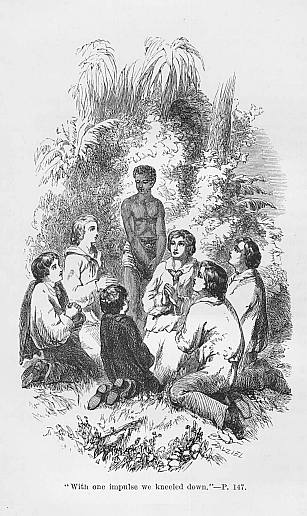
As we surveyed this lovely, but silent and desolate landscape, the doubts and apprehensions which we had before experienced began once more to suggest themselves; but they were dissipated by the cheerful voice of Arthur, calling upon us to pull for the shore. He steered for the larger of the two islets, and when, as the boat grated upon the coral tops beside it, we threw down the oars, the strength which had hitherto sustained us, seemed suddenly to fail, and we could scarcely crawl ashore. The last scene of effort and danger, had taxed our powers to the uttermost, and now they gave way. I was so feeble, that I could hardly avoid sinking helplessly upon the sand. With one impulse we kneeled down and returned thanks to Him Who had preserved us through all the strange vicissitudes of the last few days. We next began to look round in search of such means of refreshment as the spot might afford.
The cocoa-palms upon the islet, though far from having attained their full growth, (few of them exceeding twelve feet in height), bore abundantly, and we easily procured as much of the fruit as we needed. Tearing off the outer husk, and punching a hole through the shell, which in the young nut is so soft that this can be done with the finger, we drank off the refreshing liquor with which it is filled; then breaking it open, the half-formed, jelly-like kernel, furnished a species of food most nutritious and agreeable, and probably the best adapted to our half-famished condition.
Hunger and thirst being appeased, our next care was to make some arrangement for passing the night more comfortably than could be done in the boat. Selecting a clear space in the centre of the group of young cocoa-nuts, we proceeded to make a rude tent, by fixing two of the oars upright in the ground,—tying the mast across their tops and throwing the sail over it, the ends being then fastened to the ground at a convenient distance on each side.
Finding that the bare ground would make a rather hard couch, though far less so than we had lately been accustomed to, Morton proposed that we should bring a load of leaves from the neighbouring shore to spread upon it. He and I accordingly rowed over to the mainland, and collected in the grove near the beech, a boatload of the clean dry foliage of the pandanus and hibiscus, which made excellent elastic beds. Johnny watched our departure as though he considered this an exceedingly rash and adventurous enterprise, and he seemed greatly relieved at our safe return. It was now past midnight, and after hauling the boat well up on the shore, we laid down side by side and were very soon asleep.
Chapter Thirteen.
The Exploring Expedition.
Eiulo—Pearl-Shell Beach—A Warlike Colony—An Invasion Repelled.
“They linger there while weeks and months go by, And hold their hope, tho’ weeks and months are past; And still at morning round the farthest sky, And still at eve, their eager glance is cast, If there they may behold the far-off mast Arise, for which they have not ceased to pray.”
For a number of days we remained upon the islet where we had first landed, seldom visiting even the adjacent shore. During this time we subsisted upon cocoa-nuts and a small species of shell-fish, resembling mussels, which we obtained in abundance from the ledges of the neighbouring reef, and which the little native told us, were used as a common article of food among his own people. We had reason to feel grateful that, while we were as feeble and incapable of exertion as we found ourselves for some days, food could be so readily procured. It was also fortunate that during this period the weather continued remarkably fine and mild, with no perceptible variations of temperature; for I have little doubt that in the reduced and exhausted condition in which we then were, and being without any effectual shelter, two or three days of bad weather would have cost some of us our lives. The nights were dry and mild, and no dew seemed to fall upon the islet: thanks to this genial weather, and to abundance of nourishing food, we began rapidly to recover strength.
Some time passed before we thought of making any attempt to penetrate or explore the island. We were, naturally, very reluctant to admit even to ourselves, the probability that our stay upon it was to be of any long duration; and we did not therefore feel as much interest in its character and resources as we should otherwise have done. All our thoughts and hopes ran in one channel. We looked for the coming of a ship to rescue us from our dreary position; and every morning and evening, at least, and generally many times a day, some one of us climbed into the tuft of an inclining palm, to take a careful survey of that portion of the ocean, which could be seen from our side of the island. The thought of acting in any respect as though the lonely spot where we now found ourselves was destined to be our permanent abode, was in fact too painful and repugnant to our feelings to be willingly entertained; we were content therefore, to provide for our daily wants as they arose, without anticipating or preparing for the future.
A few days passed in this unvaried and monotonous routine, seemed in reality a long period; recent occurrences began to assume the vagueness of things that had happened years ago. I remember particularly, that, in looking back at the dreadful scenes of the mutiny, and our subsequent sufferings at sea, the whole seemed unreal, and more like a horrible dream, than an actual part of our past experience.
We soon found that this inert and aimless mode of living—this state of passive expectation, while awaiting the occurrence of an event which we could do nothing to procure or hasten, was a most miserable one: though our physical strength was in a great measure recruited, there was no increase of cheerfulness. Except when engaged in procuring food, or making our daily surveys of the ocean, (which was all our occupation), we were dispirited and listless.
Arthur perceived the evil of this state of things, and set himself to devising a remedy.
We had been at the island about two weeks, when he proposed, one morning, that we should go over to the mainland and commence a search for water, making an excursion a little way into the interior, if it should prove necessary.
Max objected to this, saying that we had no need of water, since we could, without doubt, obtain cocoa-nut milk as long as we should be obliged to remain upon the island, and that by going into the interior, out of sight of the ocean, we might lose an opportunity of being rescued.
To this, Arthur replied, that the exclusive use of cocoa-nut milk was considered very unwholesome, and was supposed to be the cause of certain dropsical complaints, common among the natives of many of the Pacific islands; that beside; it was by no means certain that a supply of it could be obtained throughout the year. He finally suggested the possibility that our stay on the island might be longer than we anticipated, in which case its resources, and the means of subsistence which it afforded, would be matters of great interest to us. In regard to the danger which Max seemed chiefly to fear, he said that we should seldom altogether lose sight of the ocean, but might, on the contrary, obtain a wider view of it from other parts of the island. I warmly seconded Arthur’s proposal, for I perceived the probable beneficial effects of effort, or occupation, of almost any kind. Morton also was decidedly in favour of it; and Johnny, who had recovered strength and spirits wonderfully within the last few days, was quite enthusiastic for the excursion. He calculated confidently upon our discovering a creek of fresh water, full of fishes and lobsters, and cited the history of the Swiss family Robinson, in support of the reasonableness of these expectations; declaring that for us part, he could not see why we might not count upon equal good fortune with them. Browne seemed indifferent about the matter. The little native, (whose name, upon Arthur’s authority, I shall write “Eiulo,” though “Iooloo,” comes nearer to the sound, as he himself pronounced it), shared in Johnny’s delight in prospect of the expedition; indeed, the two had already become the best friends in the world, notwithstanding the difficulty of communicating with one another, and seemed to harmonise in every thing. The excursion was accordingly determined upon, and this being so, there was nothing to prevent our setting out at once.
Morton proposed that, instead of undertaking to penetrate into the interior, we should keep along the shore to the northward, as by that means some idea might be gained of the extent of the island; and since any considerable spring or stream must find its way to the sea, we should also be more likely to discover water, than by pursuing the other course. Along the southern shore, the land was lower and less uneven than in the opposite direction, and held forth a slighter prospect of springs or streams. The difficulty of holding a straight course through the forest, where we should be without any means of ascertaining the points of the compass, was a consideration of great weight, and Morton’s plan was at last adopted, as being upon the whole the best.
The sun was not more than half an hour high, when we pushed off from the shore of the islet, and rowed over towards the mainland. The morning was fine and clear, and either the fresh, bracing sea-air, or the stir and excitement of setting out upon our expedition, had an exhilarating influence, for we gradually became quite cheerful, and even animated; and the faces of my companions began to brighten up with more of the old familiar expression, than I had seen there for many a day.
The merest breath of a breeze just stirred the crisp leaves of the palms upon the neighbouring shore; the tiny wavelets rippled softly upon the snowy, shell-spangled beach, or, out in the lagoon, danced and sparkled in the sunlight; still further out and just beyond the barrier that fenced in this quiet and secluded scene from the open ocean, we could see the huge blue rollers with their foaming crests surging high into the air; and the heavy booming of the surf, as it thundered upon the reef, might be heard for miles around, amid the prevailing silence. Beyond this again, stretched away to the horizon, the blue, swelling arch of the ocean—a clear, deep, intense blue, contrasting beautifully with the paler blue of the sky, against which it was relieved, and with the emerald expanse of the lagoon.
Browne gazed about him with more interest than I had yet seen him manifest in any thing since we had reached the island. He inhaled the fresh morning air with the appearance of actual relish and enjoyment and at last, to my surprise, (for Max had accused him, not without some reason, of having been the most lugubrious of our party), he began to sing to a brisk and cheerful tune—
“O, happy days of hope and rest Shall dawn on sorrow’s dreary night, Though grief may be an evening guest, Yet joy shall come with morning light! The light of smiles shall beam again, From lids that now o’erflow with tears, And weary hours of woe and pain, Are earnests of serener years.”
“Well,” said he, as he finished his song, “this may be a desert island, but I will defy any one to gainsay that the morning is delicious, and the scene a right lovely one.”
“I am glad you begin to wake up to it,” said Morton, “it looks very much as it has at this hour for ten days past.”
“No, no,” protested Browne, “this bright, clear atmosphere makes a very great difference in the appearance of things: we have had no such mornings as this.”
“I wish you could manage to enjoy it,” said Max, “without missing every other stroke, and digging me so unmercifully in the back with your oar-handle; if you can’t, I must ask you to change seats with me, and let me take the bow-oar.”
“How natural and refreshing that sounds!” cried Morton, laughing; “it is a sure token that prospects are brightening, and serious dangers are over, when we find ourselves again in a condition to scold about trifles.”
“It isn’t such a trifle, to be thumped and mauled with the butt of an oar, as I have been all the while Browne was singing, and rhapsodising, and going into ecstasies about the beauty of the morning; which is just such another as we have had ever since we have been here; all the difference being in his feelings, which happen to be a shade or two less doleful than usual, and so cause things to look brighter.”
“Perhaps you would have me believe,” answered Browne, “that the sun will invariably shine when I chance to be in good spirits, and that a thunder-storm would be the natural consequence of my having a fit of the blues?”
“I should be sorry if that were the case,” replied Max, “as we should then be sure to have a large average of bad weather.”
“This excursion reminds me of our school-days,” said Arthur; “it almost seems as though we were once more starting off together, on one of our Saturday rambles, as we have so often done on fine summer and autumn mornings at home.”
“I think I shall never forget those forays through the woods,” said Morton, “over hill and hollow, in search of nuts, or berries, or wild-grapes, or meadow-plums—the fishing and swimming in summer, the snow-balling, and sledding, and skating, in winter! an innocent and happy set of urchins we were then!”
“Really,” said Max, laughing, “to hear you one would suppose that we were now a conclave of venerable, grey-haired sages, scarcely able to remember the time when we were children, and so full of wisdom and experience, that we had long ago ceased to be ‘innocent and happy.’”
“Without professing to be so wise or experienced, as to be very unhappy on that account,” returned Morton, “I suppose I may say that I am old enough, and sufficiently changed since those days, to feel, as I now look back upon them with a sigh, their peculiar happiness, so unlike any thing that after-life affords.”
“How singular it is,” said Browne, “that you four who were playmates when children, should have happened to keep together so long.”
“And still find ourselves together on an island in the Pacific Ocean, thousands of miles from home,” added Arthur.
“After quitting school,” continued Browne, “I never met with any of my comrades there. Of all the mates with whom I used on the Saturday half-holydays, to go gathering hips and haws, or angling in the Clyde, I have not since come in contact with one.”
“It don’t seem at all like Saturday to me,” said Johnny, who for some minutes past had appeared to have something on his mind, as to the expediency of communicating which he was undecided; “I was afraid that it was Sunday, every thing is so still; but I hope it is not, for Arthur would not think it right to start upon an exploring expedition on Sunday, and so it would be put off.”
“Truly,” said Browne, “that is extremely flattering to the rest of us. Do you think we are all heathens, except Arthur? I, for one, have no notion of becoming a savage, because I am on a desert island; I shall go for maintaining the decencies of Christianity and civilisation.”
“Does any one know what day it really is?” inquired Morton.
Max said he believed it was Monday. Arthur thought it was Wednesday, and added that he had memoranda, from which he had no doubt he could fix the day with certainty.
“It was on Friday,” said Max, “that the mutiny took place, and that we got to sea in the boat.”
“Yes,” said Arthur, “and it was on Wednesday night, I think, five days afterwards, that we landed here.”
“Five days!” cried Max. “Do you mean to say that we were but five days at sea before reaching the island?”
“I think that is all,” replied Arthur, “though the time certainly seems much longer. Then, if my calculations are correct, we have been here just two weeks to-day, so that this is Wednesday. But,” continued he, “as our heavenly Father has thus guided our little bark safe through this wilderness of waters, let us celebrate the day of our landing on this ‘Canaan,’ by making it our first Sabbath, and our grateful voices shall every seventh day, from this, be lifted up in praise and thanksgiving for the mercy thus vouchsafed to us.”
While this conversation was going on, we reached the shore. Johnny scrambled eagerly to the bow, anxious to be the first to land, and he attained this object of his ambition, by jumping into the water nearly up to his waist, before the boat was fairly beached. Then, after gazing around him a moment with exclamations of wonder and admiration, he suddenly commenced running up and down the wide, firm beach, gathering shells, with as much zeal and earnestness, as though he was spending a holiday by the sea-side at home, and could tie up these pretty curiosities in his handkerchief, and run back with them in five minutes to his father’s house. There was certainly some ground for Johnny’s admiration; just at the spot where we had landed, the shore was thickly strewn, in a manner which I had never before seen equalled, with varieties of the most curious and beautiful shells. They were of all sizes, and of every conceivable shape and colour. The surfaces of some were smooth and highly polished; others were scolloped, or fluted, or marked with wave-like undulations. There were little rice and cowrie shells; mottled tiger shells; spider shells, with their long, sharp spikes; immense conches, rough, and covered with great knobs on the outside, but smooth and rose-lipped within, and of many delicate hues. There were some that resembled gigantic snail shells, and others shaped like the cornucopias, used to hold sugar-plums for children. One species, the most remarkable of all, was composed of a substance, resembling mother-of-pearl, exquisitely beautiful, but very fragile, breaking easily, if you but set foot on one of them: they were changeable in colour, being of a dazzling white, a pearly blue, or a delicate pale green, as viewed in different lights. Scattered here and there, among these deserted tenements of various kinds of shell-fish, were the beautiful exuviae and skeletons of star-fish, and sea-eggs; while in the shallow water, numerous living specimens could be seen moving lazily about. Among these last, I noticed a couple of sea-porcupines, bristling with their long, fine, flexible quills, and an enormous conch crawling along the bottom with his house on his back, the locomotive power being entirely out of sight.
Johnny seemed for the moment to have forgotten every thing else, in the contemplation of these treasures; and it was not until Arthur reminded him that there was no one to remove or appropriate them, and that he could get as many as he wanted at any time, that he desisted from his work, and reluctantly consented to postpone making a collection for the present.
Having drawn the boat high up on the beach, and armed ourselves with a cutlass apiece, (Johnny taking possession of the longest one of the lot), we commenced our march along the shore, to the right, without further delay.
We had by this time scarcely a remaining doubt that the island was uninhabited. No palm-thatched huts occupied the open spaces, or crowned the little eminences that diversified its windward side; no wreaths of smoke could be seen rising above the tops of the groves; no canoes, full of tattooed savages, glided over the still waters within the reef; and no merry troops of bathers pursued their sports in the surf. There was nothing to impart life and animation to the scene, but the varied evolutions of the myriads of sea-fowl, continually swooping, and screaming around us. With this exception, a silence like that of the first Sabbath brooded over the island, which appeared as fresh, and as free from every trace of the presence of man, as if it had newly sprung into existence.
With the continued absence of every indication of inhabitants our feeling of security had increased to such an extent, that even Johnny ventured sometimes to straggle behind, or to run on before, and occasionally made a hasty incursion into the borders of the grove, though he took care never to be far out of sight or hearing of the main body. Soon after starting, we doubled a projecting promontory, and lost sight of the boat and the islet. The reef bent round to the north, preserving nearly a uniform distance from the shore, and was without any break or opening.
The forest in most places, extended nearly to the beach, and was composed chiefly of hibiscus, pandanus, and cocoa-nut trees, with here and there a large pisonia, close to the lagoon. One gigantic specimen of this last species, which we stopped a moment to admire, could not have been less than twenty feet in girth. Max, Morton, Arthur, and myself, could not quite span it, taking hold of hands, and Johnny had to join the ring, to make it complete. For several hours we continued our journey pretty steadily, encountering no living thing, except tern, gannets, and other sea-birds, and one troop of gaudy little paroquets, glittering in green, and orange, and crimson. These paroquets were the only land-birds we saw during the day. Max pronounced them “frights,” because of their large hooked bills, and harsh discordant cries. They certainly gave Johnny, a terrible “fright,” and indeed startled us all a little, by suddenly taking wing, with loud, hoarse screams, from a hibiscus, beneath which we were resting, without having observed that they were perched over our heads.
When it was near noon, and we had travelled, as we supposed, making allowance for delays and deviations, some six or eight miles, the character of the shore suddenly changed. The white, shelving beach, and the dense groves meeting it near the water, now disappeared, and were succeeded by an open strip of land, bordering the lagoon, strewed with huge, irregular fragments of coral rock, and seamed with gullies. The line of the forest here receded some distance from the shore, leaving a broad rounded point, embracing a large area of low and barren ground, covered thinly with a growth of stunted shrubs, and a few straggling, solitary looking trees. The lagoon was at this point quite shallow, and low rocks and coral patches appeared above the surface, at short distances apart, nearly to the centre of the channel. The reef opposite, was entirely under water, and its position was indicated only by a line of breakers. A large portion of the point, comprising several acres, was covered with the rude nests of various aquatic birds. Many of these nests were occupied even at that hour, and the birds seemed in no wise alarmed, or even disturbed by our approach. When we came very close to any of them, they would survey us with an air half angry, and half inquisitive, stretching out their long necks; and screwing their heads from side to side, so as to obtain a view of us first with one eye, and then with the other; this seeming to be considered indispensable to a complete and satisfactory understanding of our character and intentions. After a thorough scrutiny, they would resume their former appearance of stupid indifference, as though we were creatures altogether too unimportant to merit further notice. They all, without exception, seemed perfectly tame and fearless, and quite ready to resent any infringement upon their rights.
Johnny, while inspecting too closely the nest of one of them, curiously constructed of long stiff reeds, resembling rods of steel, suddenly received, as a rebuke for his impertinence, a blow from the wing of the offended owner, which laid him sprawling upon his back.
Notwithstanding this severe lesson, the gentle and amiable aspect of a large white bird, so far reassured him, that he ventured to make some friendly advances, whereupon he got so severely pecked, that he at once gave up all further attempts at familiarity with any of them. This harsh treatment, in fact, so disgusted Johnny with the whole race of sea-birds, and so impaired his faith in their innocent and inoffensive looks, that he declared he would never have any thing more to do with them, “since that beautiful white bird had bitten him so savagely, when he only offered to stroke its neck.”
Some of these birds were very large and strong: in several of the unoccupied nests I saw eggs, as large as those of the duck: they were of different colours some of them prettily speckled or mottled, but most were of an ash colour, or a whitish brown. Eiulo pointed out two kinds, which he said were highly prized for food, and which, as we afterwards found, were, in fact, nearly equal to the eggs of the domestic duck.
The heat had by this time become exceedingly uncomfortable, and we concluded to halt until it should abate a little, at the first convenient and pleasant spot. Leaving the shore, which, besides being unsheltered from the sun, was so rugged with crevices and gullies, and great irregular blocks of coral, as to be almost impassable, we entered the borders of the wood, and took a short cut across the point. Johnny, in imitation of the desert islanders of the story-books, desired to give appropriate names to all the interesting or remarkable localities with which we became acquainted. He had already christened the little island on which we had first landed, “Palm-Islet,” and the spot upon the opposite shore, abounding in brilliant shells, had, from that circumstance, received the impromptu name of “Pearl-shell Beach.” He now proposed to call the point, “Cape Desolation,” from its waste and forbidding aspect; but finally fixed upon “Sea-bird’s Point,” as being more appropriate, the birds having, in fact, taken possession of nearly its entire area, which, judging from the warlike spirit they had displayed, they were likely to hold against all comers. Having crossed the point and reached the lagoon again, we found that the shore resumed its former character. The forest again extended nearly to the beach, but it was more open, and not so thickly wooded as before, and the trees were of a finer growth, and in much greater variety; many of them being of kinds unknown to any of us. We had not proceeded far, after regaining the beach, when we espied just such a resting-place as we were in search of.
Chapter Fourteen.
Castle-Hill.
The Noonday Halt—A Charming Resting-Place—Heathen Skill versus Civilisation and the Story-Books.
“Beneath the tropic rays, Where not a shadow breaks the boundless blaze, Earth from her lap perennial verdure pours, Ambrosial fruits, and amaranthine flowers.”
A little way before us rose a smooth and gentle acclivity, crowned by a clump of majestic trees, which promised to afford a deeper and more grateful shade than any other spot in sight, and we accordingly made towards it. On a nearer approach it proved to be more elevated than had at first appeared, and in order to reach the top, we were obliged to scale a long series of natural terraces, almost as regular as though they had been the work of art. From this spot there was a fine view of the shore, the lagoon, and the ocean, to the north and west. The trees that covered the level space at the summit of the ascent, were varieties of a much larger growth than those generally found on the low alluvial strip of land bordering the lagoon. Conspicuous among them, were the majestic candle-nut, with its white leaves and orange-coloured blossoms; the inocarpus, a kind of tropical chestnut; and most magnificent and imposing of all, a stately tree, resembling the magnolia in its foliage and manner of growth, and thickly covered with large white flowers, edged with a delicate pink. The ground was level as a parlour floor, and free from brushwood or undergrowth of any kind, except a few long-leaved, fragrant ferns, and in places a thick carpet of flowering vines and creepers. The trees were stationed at such distances apart, as to compose a fine open grove, and yet close enough to unite in one rich mass of foliage overhead, impenetrable to the rays of the sun, and creating a sombre and almost gloomy shade, even during the fiercest glare of noonday. In one spot, a number of gigantic trees were grouped nearly in a circle. Their dense tops formed a leafy dome, through which not the smallest patch of sky was visible. Around their huge, but shapely, stems, which one might look upon as forming the pillars of a natural temple, a number of flowering parasites twined in luxuriant wreaths, and hung in festoons from the tower branches. A considerable space around the boles of some of these trees was completely covered by an elegant species of creeping plant with fine cut foliage of a delicate pea-green, and large clusters of scarlet blossoms, about which, swarms of brilliantly-coloured insects, of the butterfly tribe, were hovering.
“Here we may actually, and not figuratively, indulge in the luxury of ‘reposing on the beds of flowers,’” said Max, throwing himself down at the foot of a towering candle-nut, amid a soft mass of this vegetable carpeting. All were sufficiently tired by the long march of the morning, to appreciate the luxury, and our entire company was soon stretched upon the ground, in attitudes in which comfort rather than grace, was consulted.
“What do you think of this, Johnny?” said Max, “it strikes me, as being quite romantic and like the story-books—almost up to the Arabian Nights. If the history of our adventures should ever be written, (and why shouldn’t it be?) here’s material for a flowery passage. Just see how this would sound, for instance:— ‘And now our little band of toil-worn castaways,’ (that’s us), ‘weary and faint with their wanderings through the desert, (that’s Cape Desolation, or Sea-bird’s Point, or whatever Johnny in his wisdom shall conclude to call it), arrived at a little oasis, (this is it), a green spot in the wilderness, blooming like the bowers of Paradise, where stretched at ease, upon beds of bright and odoriferous flowers, they reposed from the fatigues of their journey.’ There, that sentence, I flatter myself is equal in harmony and effect, to the opening one in the history of Rasselas, Prince of Abyssinia—there’s my idea of the style in which our adventures should be recorded.”
As we had taken no refreshment since setting out in the morning, we now began to feel the need of it. At the edge of the eminence, on the southern side, grew several large cocoa-nut trees, fully three feet in diameter at the base, and rising to the height of seventy or eighty feet at the very least. Eiulo was the only one of our number, who would have dreamed of undertaking to climb either of them; he, however, after finding a young purau, and providing himself with a strip of the bark, fastened the ends about his ankles, and then firmly clasping the trunk of one of the trees with his hands and feet alternately, the latter being as wide apart as the ligature would permit, he vaulted rapidly and easily upward, and soon gained the dizzy height where the nuts grew. Once fairly perched in the tuft of the tree among the stems of the enormous leaves, where he looked scarcely larger than a monkey, he quickly supplied us with as many cocoa-nuts as we could put to present use. Loading ourselves with the fruit, we returned to our first resting-place, and after piling the nuts in a heap, reclined around it, after the manner of the ancients at their banquets, while we enjoyed our repast. Though all these nuts were gathered from the same tree, and, in fact, from the same cluster, some of them contained nothing but liquid, the kernel not having yet begun to form, and in these the milk was most abundant and delicious: in others, a soft, jelly-like, transparent pulp, delicate and well-flavoured, had commenced forming on the inner shell: in others, again, this pulp had become thicker and firmer, and more like the kernel of the imported nut, the milk having diminished in quantity, and lost in a great measure its agreeable taste.
Johnny, after having tried all the different varieties with the zeal of an epicure, declared that he was beginning to get sick of cocoa-nuts: he wondered whether we should have to live entirely on cocoa-nuts and shell-fish, and whether there was not some bread-fruit on the island.
“If there is,” said Browne, “it will be of no use to us, unless we can find means to make a fire, and cook it.”
“Make a fire!” cried Johnny, “that’s easy enough—all we’ve got to do, is just to get two dry sticks and rub them together briskly for a few minutes. None of the shipwrecked people I ever read of, had any trouble about that.”
“How lucky we are,” cried Max, gravely, “in having some one with us, who has read all about all the desert islanders that have ever lived, and can tell us just what to do in an emergency! Please get a couple of those dry sticks which you speak of, Johnny, and show us how unfortunate castaways in our condition, are accustomed to kindle a fire.”
Without seeming, in the simplicity of his heart, to suspect for a moment the perfect good faith and sincerity of Max’s compliment, Johnny commenced casting about for some sticks or pieces of wood, with which to make the experiment. He soon found a fallen branch of the inocarpus, well baked by the sun, and which had long lost every particle of moisture. Breaking it into two pieces, he began to rub them together with great zeal, and apparently with perfect faith in the result: gradually he increased his exertions, manifesting a commendable perseverance, until the bark began to fly, and the perspiration to stream down his face; but still there was no fire nor any sign of it.
Meantime, Max encouraged him to proceed.
“Keep it a-going, Johnny!” he cried, “if you stop for half a second, you lose all your labour; only persevere, and you’re sure to succeed; none of the shipwrecked people you ever read of had any trouble about it, you know.”
But Johnny concluded that the sticks could not be of the right kind, and notwithstanding Max’s exhortations, he at last gave up the attempt.
Morton, however, not discouraged by this unfortunate result, nor by Max’s disposition to make fun of the experiment expressed a belief that the thing could be done, and after preparing the sticks by cutting away one of the rounded sides of each, he went to work with an earnestness and deliberation, that caused us to augur favourably of his success. After nearly ten minutes powerful and incessant friction, the sticks began to smoke, and Johnny, tossing his cap into the air, gave an exulting “Hurrah!”
But his rejoicing proved premature, for, though the wood fairly smoked, that was the utmost that could be attained, and Morton was obliged to desist, without having produced a flame.
Eiulo had been watching these proceedings with great interest; and he now intimated by signs that he would make a trial. Taking the sticks, he cut one of them to a point, with Arthur’s knife, and made a small groove along the flat surface of the other, which he then placed with one end upon the ground, and the other against his breast, the grooved side being upwards. Placing the point of the first stick in the groove, he commenced moving it up and down along the second, pressing them hard together. The motion was at first slow and regular, but increased constantly in rapidity. By-and-bye the wood began to smoke again, and then Eiulo continued the operation with greater vigour than ever. At length a fine dust, which had collected at the lower extremity of the groove, actually took fire; Arthur quickly inserted the edge of a sun-dried cocoa-nut leaf in the tiny flame, and it was instantly in a blaze.
“Bravo!” shouted Max, “that’s what I consider a decided triumph of heathenism over civilisation, and the story-books.”
Morton now seized the sticks again, and imitating Eiulo’s method of proceeding, succeeded in kindling them, though it took him a considerable time to do it: thus it was satisfactorily established, by actual experiment, that we could obtain a fire whenever we should want one.
The question was now raised, whether we should continue our exploration further that day, or remain where we were until the following morning; and as the heat was still very oppressive, and we were sufficiently tired already, the latter course was unanimously determined upon.
Johnny liked the spot which we occupied so well, that he proposed “building a hut” upon it, and making it our head-quarters, as long as we should have to stay on the island. It was certainly a pleasant site; and, commanding as it did a wide view of the ocean, vessels could be descried at a greater distance, and signalled with a surer prospect of attracting notice, than from any other locality yet known to us. From the wooded summit, the land descended on every side—towards the shore in a series of terraces—towards the interior in one smooth and continuous slope, after which it again rose in a succession of densely wooded eminences, irregular and picturesque in their outlines, and each higher than the last as you proceeded inland; the farthest of them towering up in strong relief against the south-eastern sky. The various shades of the masses of different kinds of foliage with which these heights were clothed, from that of the pale-leaved candle-nut, to the sombre green of the bread-fruit groves, contributed greatly to the pleasing effect of the landscape. On the right, as you looked towards the ocean, lay the flat tract, occupied by the sea-fowl, and which Johnny had named after them. At nearly an equal distance on the left, the line of the beach was broken, by what appeared to be a small grove, or clump of trees, detached from the main forest, and planted directly on the line of the shore.
As we had concluded to suspend our explorations until the next day, every one was left to his own resources for the remainder of the afternoon. Johnny having set Morton at work, to make him a bow, “to shoot birds with,” began to occupy himself in the very important task of finding an appropriate name for the height, which he finally concluded to call “Castle-Hill,” from its regular shape and bold steep outlines. Max extended himself on his back in the coolest nook he could find, and spreading his handkerchief over his face, to protect it from the gaudy, but troublesome, winged insects which haunted the spot, forbade any one to disturb him on pain of his high displeasure. Arthur, taking Eiulo with him, proceeded upon a botanising tour about the neighbourhood, in the hope of making some discovery that might prove useful to us. For my own part, happening to think of the question which had been started in the morning, as to the day of the week, I began to make a retrospect of all that had taken place since the fearful night of the mutiny, and to endeavour to fix the order of subsequent events, so as to arrive at the number of days we had been at sea, and upon the island. In the course of these calculations, and while Browne and myself were discussing the matter, he suggested the want of pencil and paper. I found that the last leaf had been torn from my pocket-book, and the rest were in an equally destitute condition. In this strait, I remembered having heard Arthur describe the manner in which the native children had been taught to write in the missionary schools at Eimeo, the only materials used being plantain leaves and a pointed stick. I mentioned this to Browne, and we forthwith proceeded to experiment with different kinds of leaves, until at last we found a large heart-shaped one, which answered our purpose admirably; it was white, and soft as velvet on the under side, and marks made upon it with the rounded point of a small stick, were perfectly distinct, showing of a dark green colour upon a white ground.
Late in the afternoon, Arthur and Eiulo returned from their tour of examination, having made, as Arthur intimated, some discoveries, of which, in due time, we should all reap the benefit. Morton having found a tough and elastic kind of wood, had shaped a tolerable bow for Johnny, when it came to providing a string, the resources of both failed. The difficulty being made known to Eiulo, he volunteered to supply what was wanted, and went with Johnny and Morton into the adjoining forest to look for a certain kind of bark, from which to make the required cord.
“There!” said Arthur, when we were left alone together; “how capitally this excursion has worked. How differently things seem from what they did yesterday, when we were at the islet perfectly stagnant and stupid. One would not take us for the same people. Only let us always have something to do, something to interest and busy ourselves about, and we need not be very miserable, even on a desert island.”
Chapter Fifteen.
Camping Out.
A Desperate Engagement—Johnny Discovers an “Oyster Tree”—Vagrants, or Kings?—A Sleeping Prescription.
“Travellers ne’er did lie, Though fools at home condemn them: If in Naples, I should report this now, would they believe me?”
About sunset we went down to the beach to bathe. The trees along the shore were occupied by immense crowds of exemplary sea-fowl, whose regular and primitive habits of life had sent them to roost at this early hour. Notwithstanding their webbed feet, they managed to perch securely among the branches, many of which were so heavily freighted, that they bent almost to the ground beneath their load.
Finding a spot where the beach shelved off gradually into deep water, with a smooth, firm bottom, free from shells and corallines, we had a refreshing swim. Afterwards, strolling along the shore by myself, I found a large fish, beautifully marked with alternate black and yellow bands, in a shallow, fenced off from the lagoon at low water, by a coral ridge. The too eager pursuit of some of the smaller tribe of fishes, had probably beguiled him into this trap, where he had been left by the tide, to fall a victim, as I confidently reckoned, to his own rapacity. All escape into deep water seemed to be pretty effectually cut off and I looked upon him as already the captive of my bow and spear; but fearing lest some of the others should come up to share the glory of securing so splendid a prize, I forthwith set about effecting his actual capture. Rolling my trowsers above my knees, I waded into the water to drive him ashore; but I soon found that my task was not going to prove by any means as easy as I had anticipated. My intended victim was exceedingly vigorous and active, and as ferocious as a pike. He obstinately refused to be driven at all, and struggled and floundered as desperately as if he already had a vivid presentiment of the frying-pan, snapping viciously at my fingers whenever I undertook to lay hold of him. To add to the aggravating features of the case, he seemed to bristle all over with an inordinate and unreasonable quantity of sharp-pointed fins and spines, which must have been designed by nature as weapons of defence, since there were certainly more of them than any fish could use to advantage for swimming purposes. I began to suspect that I had caught a Tartar; but I had now gone too far to back out with credit: my self-respect wouldn’t admit of the thought. So, taking a short breathing spell, I again advanced to the attack, somewhat encouraged by perceiving that my scaly antagonist seemed exhausted and distressed by his recent exertions. His mouth was wide open, and his gills quivered; but I was rather uncertain whether to regard this as a hostile demonstration, or a sign of pain and fatigue. However, at it we went; and, after getting my hands badly cut by some of the aforesaid bristling spines and fins, besides being drenched with water, and plastered all over with wet sand, which he splashed about in the struggle, I succeeded in seizing him firmly by the tail, and throwing him high and dry upon the beach. I then scooped out a hollow in the sand, a little above the tide-mark, and filling it with water, pushed him into it, thus securing him for the present.
Max, Morton, and Browne, who had been practising climbing cocoa-nut trees, at the edge of the wood, with very indifferent success, had witnessed, from a distance, the latter part of the “engagement,” as Max facetiously called it; and they now came up to learn the particulars, and to inquire “whether it was a shark, or a young whale, that I had been having such a terrible time with.” While they were admiring my captive, and jocosely condoling with me on the hard usage which I had received, the voice of Johnny, (who, accompanied by Eiulo, had ventured to stroll off in the direction of the point), was heard, raised to its highest pitch, as he shouted for us to “come and see something strange.” But it seemed that his impatience would not permit him to await the result of his summons, for the next moment he came running towards us in a state of great excitement, and all out of breath, crying out that he had “found a tree covered with oysters,” and he had no doubt, there were “lots more of them.”
“A tree covered with what?” inquired Browne, dubiously.
“With oysters—with fine, large oysters!” cried Johnny, “just come and see for yourselves.”
“Wonderful island! productive soil!” exclaimed Max, in mock admiration. “If oysters will take root, and grow here, I suppose pretty much any thing will: I believe I will plant my boots to-morrow: they may do for seed, and are good for nothing else any longer—don’t you begin to think this must be an enchanted island, Johnny?”
“O, you may make fun of it, if you please; but it’s true: and if you’ll come with me, I’ll shew you the trees.”
“Well,” said Browne, “I am ready for almost any thing in the way of the marvellous, since having seen a solid and substantial-looking island turn into a vapour, and vanish away before my very eyes. I shall be careful about doubting any thing, until I get back to some Christian country, where things go on regularly. For the present, I am in state of mind to believe in phoenixes and unicorns—and why not in oyster-trees? Who knows but we have happened upon a second Prospero’s isle? Lead on, Johnny, and bring us to this wonderful tree.” And Johnny started off accordingly, followed by Browne and Morton.
In a moment the latter was heard calling out, “I say, Max! do you understand conchology?”
“Yes, enough to tell a bivalve when I see one: should like to have a ‘dozen fried’ before me now.”
“If a ‘dozen raw’ will answer, just step this way, and we’ll accommodate you equal to Florence.”
On hastening to the spot, all scepticism as to the “oysters growing on trees,” was speedily removed. A row of mangroves lined the shore for some distance, each elevated upon its white pile of protruding and intertwisted roots. Attached to the branches of these trees, which overhung the water and drooped into it at high tide, were abundance of fair-sized oysters. Looking down into the water beneath the mangroves, I perceived the certain indications of an extensive and well-stocked oyster-bed. The bottom was thickly covered with them, in every stage of growth multitudes being scarcely larger than a sixpence. I could also see, through the shallow water, an immense number of little white specks, like drops of spermaceti, scattered about among them. It was evident, that here was an abundant and unfailing supply of these delicious shell-fish.
Browne broke off from one of the trees a large branch, having half a dozen oysters attached to it, with which he hastened to confront the unbelieving Max, and flourishing it in his face, demanded to know if he was “convinced now.” Although constrained to admit that they looked very like oysters, Max seemed to consider the evidence of more than one of the senses necessary to afford satisfactory proof of so extraordinary a phenomenon, and accordingly proceeded to see how they tasted.
After opening one of the largest, (using his cutlass as an oyster-knife), and making the experiment with due deliberation, he announced himself perfectly satisfied.
By the time we had all sufficiently tasted the quality of the oysters, (which were really very good, and well-flavoured, notwithstanding the unusual position in which they were discovered), it had become quite dark. Though the evening was fine, there was not much light, the moon and stars glimmering faintly through a soft purple haze, which, as I had observed since we had been on the island, generally seemed to fill the atmosphere for a short time after sunset, and at a little later hour entirely disappeared. As we strolled back towards the foot of “Castle-Hill,” Johnny suddenly looked up, and inquired, as if the thought had just occurred to him, where we were going to sleep.
“That’s a pretty question to ask,” said Browne, laughing, “it implies that we are common vagrants.”
“So we are, strictly speaking,” answered Max, “we have no regular means of living, and no fixed place of abode, and that I believe, makes us common vagrants, according to Webster.”
“I should think our means of living were ‘regular’ enough to rescue us from the definition,” replied Morton, “having been thus far, cocoa-nuts and mussels every day, and all day long, and nothing but cocoa-nuts and mussels. I am glad that there is now some prospect of a little more irregularity in future.”
“As to our having no fixed habitation or place of abode,” said Browne, “that does not arise from poverty, or lack of land—‘the isle is all before us where to choose’—and we are now on a tour of observation through our extensive domains, in order to decide upon the finest spot for our head-quarters. Meantime, for a night or two, we shall have to be satisfied with ‘a tent in the green wood, a home in the grove,’ in other words, we shall have to ‘camp out,’ as the most renowned hunters and soldiers have frequently done before us. I’m sure there’s no vagrancy in that.”
“Why,” cried Johnny, forgetting for the moment his anxiety on the score of our quarters for the night, “we are no more vagrants than Robinson Crusoe was:—
“‘We are monarchs of all we survey, And our realm there is none to dispute,’
“As he says of himself so that we are much more like kings than vagrants.”
“And the sea-birds and fishes,” said Max, “are to be considered as our subjects, I presume, since we have no man Friday, and no goats or poll-parrots to reign over.”
“Yes,” said Johnny, “I suppose so; there are enough of them too.”
“And some very disloyal, rebellious, and stiff-necked ones among them,” added Max, “who ought to be dealt with as traitors forthwith—that sturdy feathered rebel for instance, who not regarding the inviolability of the royal person, no longer ago than this morning laid one of our royal majesties sprawling upon his royal back.”
“And that other scaly traitor,” added Browne, “who perversely refused to come out of the water to be cooked, in accordance with the royal will, and who nearly bit off the sacred thumb of one of our majesties, in resisting the royal authority.”
“Well, Johnny,” said Max, “if we are not actually kings, we at any rate have some royal blood upon the island. Not to speak of myself, who am descended direct from ‘Kaiser Maximilien,’ here is Eiulo, who is a real prince, his father being King of the Cannibal Islands, or some other islands in these seas.”
“I wish you wouldn’t speak so of Eiulo’s father,” said Johnny, warmly, “he is not a cannibal, and I believe he is a very good man; I think his islands are near here, and if we should one day get there, he would treat us kindly, and let us go home whenever we should have an opportunity.”
“Hilloa!” cried Max, “what has put all that into your head? What do you know about Eiulo’s father, or his islands, or where they are?”
This sudden outburst of Johnny’s surprised us all, with perhaps the exception of Arthur, and we listened with some interest, as he replied to Max’s volley of questions.
“Oh, I have talked with Eiulo about it,” he answered, “mostly by signs; and he has made me understand that he believes his home is not far distant—off in that direction, (pointing north), and that ships sometimes stop there; and so I have been thinking that if we could only find the way there, we should have some prospect of getting home at last.”
Upon this we became silent and thoughtful; nothing further was said, until Johnny recurred to the question which he had started a few moments before, and again asked where we proposed to pass the night.
“Not in those gloomy woods, I hope,” said he, “where it is so lonely, and the wind and the trees make such strange noises. I would rather sleep down here upon the shore; this nice dry, white sand, up where the water never comes, will make a very good bed.”
Thus far, we had passed every night upon the islet, to which we had now become familiarised and accustomed. Its small extent, and separation from the mainland, gave it an air of security, which made us feel more at our ease there at night, than we could among the sombre and unexplored forests of the larger island, about which we as yet knew so little. Johnny’s timidity was not therefore unnatural. Indeed, unless I am mistaken, none of us was, on this first night of our exploration, entirely free from a vague spirit of insecurity, and of liability to some unknown danger.
“That will hardly do, Johnny,” said Browne, in answer to his suggestion about taking up our quarters for the night upon the shore, “a heap of dry pandanus leaves will make a much more comfortable bed than the hard sand. Thus I propose to arrange it—we will go up to the top of the hill where we rested to-day, and lodge there; our beds of leaves shall be all in a circle, and Johnny’s shall be in the middle; and then he won’t feel lonesome or afraid, for all the uncanny noises of the wind and the trees; knowing that he has good friends and true all around him, and particularly one stout John Browne, who is worth all the rest together, being a fair match for any thing in this part of the South-Seas!” and by way of raising Johnny’s spirits, and inspiring him with the greater confidence in the prowess of his protector, he flourished his cutlass, and went scientifically through the broad-sword exercise, slashing and carving away at his imaginary antagonist, with a fierceness and vigour wonderful to behold, having lopped off an indefinite quantity of airy heads and limbs, be finished, by reciting with a bold and warlike air—
“Scots wha hae wi’ Wallace bled! Scots wham Bruce has aften led!” etcetera.
This demonstration seemed to produce the desired effect and Johnny soon became reassured, and quite reconciled to “camping out” in the woods.
The evening was so fine, and the gentle breeze setting in from the ocean was so cool and grateful, after the excessive heat of the day, that we continued for some time loitering along the shore. The sea was highly phosphorescent; that is, during the earlier part of the evening, and before the mist or haze before spoken of cleared up. The tiny wavelets, as they rippled upon the beach in rapid succession, sparkled with phosphoric fire, and out in the lagoon, wherever a coral patch rose to the surface, or the water was disturbed by any floating object, it gave forth a clear and brilliant light, and was studded by myriads of fiery dots and spangles.
At length Johnny began to complain of weariness, and we scaled the terraced hill, and gathering a large quantity of clean and well-dried leaves, arranged our beds as Browne had suggested, beneath the group of noble trees where we had taken our siesta at noon.
The novelty of our situation, long proved with me an effectual antidote to fatigue and drowsiness, and I lay looking up at the moon glimmering through the foliage of the trees, an hour after the rest seemed to be asleep.
Just as I was at last sinking into unconsciousness, Johnny, sitting up among the leaves in which he was half buried, inquired softly, “Max, are you awake!” I spoke to him, to let him know that he was not alone. “I can’t get asleep,” said he, “every thing looks so beautiful and so strange. It seems to me I never saw the moon and the stars so big and so bright.”
“You must keep your eyes shut, and not look at the moon, if you want to get asleep.”
“But the trees keep rustling so; just as if they were whispering softly to one another; and then the sound of the waves on the reef is so sad and mournful, that it sets me to thinking all sorts of strange things. I wonder whether there are any wild animals on the island!” I assured him that it was quite improbable, and that no dangerous animals of any kind were ever found on the islands of the Pacific. This, however, did not seem to satisfy him entirely, and I began to suspect that his mind was running on the jackalls, tiger-cats, and hyenas of the Swiss Family Robinson. A question or two which he presently asked, showed that I had guessed correctly, and I hastened to meet the difficulty, by reminding him that “their island, (if indeed it was an island at all, and not a part of the mainland), was situated near the coast of New Holland, from which animals might pass over to it by swimming.”
“Why, I thought,” said Johnny, “that there were no wild animals in New Holland, except kangaroos and opossums: my book of beasts, birds, and fishes, says so.”
This was a fact in Natural History which I was not prepared to gainsay; especially when backed by so redoubtable an authority as “the book of beasts, birds, and fishes.” For a moment I was taken all aback; but being loathe to give up my little companion a prey to imaginary jackalls, tiger-cats, and hyenas, I rallied again, resolved upon one more desperate effort for his deliverance.
“Well,” said I, “the fact is, we don’t know exactly where the Swiss Family Robinson’s island really was—it is altogether uncertain. It may have been near Java, or Ceylon, or the coast of India, in which case, all those Asiatic beasts could easily have got there—that is, if the two places were close enough together. Now we know that we are somewhere in the middle of the Pacific, a vast distance from any continent, or any of the great Indian islands, so that large animals here are out of the question, unless they have taken a swim of a thousand miles or so.”
This seemed to be pretty decisive; and I think it settled the jackalls, tiger-cats, and hyenas, effectually, for Johnny said no more on the subject, except to remark, that, even if they could swim that distance, they would stand a bad chance with the sharks and other sea-monsters; to which I added, as a final clincher, that in any event they would be sure to starve on the voyage, unless they should bring a large supply of provisions along. “Well,” said he, after a minute’s silence, “I’m not afraid of anything; but somehow or other I feel very wide awake to-night, and not in the least sleepy.”
“Shut your eyes,” said I, “and think of a great wheel, whirling round and round, with a regular and even motion, and never stopping, until you have counted it go round a hundred times.”
Johnny laughed softly to himself, as though pleased with this device, and was quite still for a minute or two; then he spoke again.
“It has gone round a hundred times, but towards the end it got a-going dreadfully fast; it would go fast in spite of all I could do.”
“Never mind the wheel, then,” said I, “but think of the huge lazy swells in a calm, rising and falling, rising and falling, as they did when we lay rocking in the boat, all those long days and nights, out on the sea.”
“Well, I’ll try—but I don’t believe it will be of any use.”
“Don’t look at the moon, and don’t speak to me again—unless for something very particular—and now good night.”
“Good night!” and he nestled down among his leaves again. In a very few minutes the deep and regular breathing of the little patient, proved the efficacy of my sleeping prescription, and announced that his troubles for that night were over.
Chapter Sixteen.
Domestic Embarrassments.
A Desert Island Breakfast—Persuasive Reasoning—Romance and Reality—The Prince and Princess.
“Now my co-mates, and brothers in exile, Hath not long custom made this life more sweet Than that of painted pomp? Are not these woods More free from peril than the envious court? Here feel we but the penalty of Adam, The seasons’ difference; as the icy fang And churlish chiding of the winter’s wind.”
The next morning “the Islanders,” or some of them, at least, were stirring early; and the first thing that attracted my attention, on opening my eyes, was a busy group, consisting of Max, Eiulo, and Johnny, gathered round a fire at a little distance, and engaged in some apparently very interesting operation. A savoury smell at the same time saluted my olfactory organs, and on approaching the scene of action, to investigate the matter more closely, I found my finny prize of the preceding evening undergoing a somewhat primitive style of cookery, of which Max appeared to be the chief director and superintendent. A number of large oysters were also roasting in the embers; and from these last proceeded the grateful and appetising odour referred to.
“Good morning!” cried Max; “you see we have breakfast nearly ready; and a breakfast, too, that will be a positive luxury, after so long a course of cocoa-nut diet; how Browne will exult at the sight of it; how his eyes will open—to say nothing of his mouth! And don’t we deserve a vote of thanks for our early labours for the general good?”
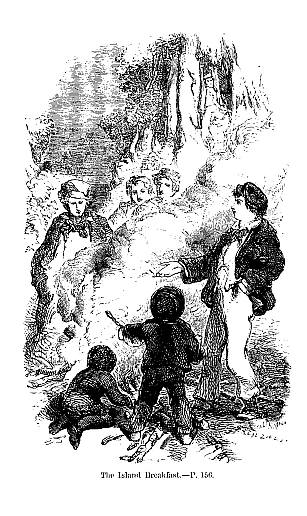
Morton and Browne at this moment emerged from their respective heaps of leaves, and, after rather more than the usual amount of yawning and stretching of limbs, came towards the fire.
“Fee, faw, fo, fum!” cried Morton, snuffing the agreeable smell of the cookery in progress, “I trust we’re not too late for breakfast, and that there is something more than the savour of good victuals left.”
“You are in good time,” said Johnny, bustling about the fire with an air of official dignity, “the first bell hasn’t rung yet.”
“But why has Shakespeare such a long face?” said Max; “has camping out caused a reminiscence of rheumatism!”
“Bad dreams, horrible dreams!” answered Browne, shaking his head solemnly, “which came of lying staring at the moon last night, until I fell asleep:”—then throwing himself into an attitude, he commenced declaiming with a tragic air—
“‘O, I have passed a miserable night, So full of fearful dreams, of ugly sights, That as I am a Christian, faithful man, I would not pass another such a night Though ’twere to buy a world of happy days, So full of dismal terror was the time.’”
“Bravo!” cried Max, applauding furiously, “I like to see that; it’s what I call coming out strong under discouraging circumstances. Here are we, six forlorn castaways, on a desert island, somewhere, (no one knows where), in the Pacific Ocean; and, instead of moping, and sulking, and bemoaning our hard fate, we wake up of a fine morning, quite bright and cheerful, and one of the six, (or seven, more correctly speaking), goes to work spouting Shakespeare, carrying us back to old times, and making us feel, (as Morton would say), like ‘happy schoolboys again.’”
“What’s all this?” cried Arthur, coming forward with a puzzled air, “what is Max making a speech about? has he taken the stump as a candidate for the presidency of the island?”
“He needn’t do that,” said Browne, “we’re not going to have any presidents, or other republican trumpery here; I have formally taken possession of the island in the name of Victoria; and it is therefore a colony of Great Britain; I shall apply, at the first convenient opportunity, for letters patent, making me colonial governor.”
“Tory, monarchist!” cried Max, “recant at once, or you sha’n’t taste a mouthful of my breakfast.”
“Do you think I’ll sell my loyalty for a mess of pottage! No, I’m for a well-regulated monarchy: hurrah for Victoria!”
“Down with the Britisher!” cried Johnny, entering into the spirit of the scene, and tugging at Browne’s coat-tails; “make him hurrah for the stars and stripes, or else don’t give him any of our oysters!”
“You’re surely not going back to the principles of the dark ages—you won’t attack the right of private judgement, and persecute for opinion’s sake.”
“The right of private judgment, indeed!” answered Max, with great contempt. “I hold that no person can have a right, on any pretence whatever, to entertain erroneous opinions on important subjects, affecting the welfare of mankind. If a man does entertain such opinions, it is the duty of those who know better to convince him of the error by the most effectual arguments at their command. It is, therefore, my duty to open your eyes to the blessings of liberal institutions. I have here, (pointing towards the incipient breakfast), the most powerful means to assist and quicken your perception of the truth. Shall I not use those means?”
“The line of argument which you indicate is exceedingly forcible, (how delightfully those oysters smell!) I really think I begin to perceive some of the advantages of republicanism already.”
“With the right of private judgment, properly understood,” resumed Max, “I should be reluctant to interfere. You will, I presume, enjoy the exercise of so precious a privilege, even with a cocoa-nut breakfast, which you can probably obtain, by requesting Prince Eiulo to scale one of yonder tufted trees.”
“How clear the matter becomes with a little reflection,” observed Browne ”(this camping out in the open air gives one a famous appetite). In fact your reasoning is almost irresistible, (that fish looks particularly nice), and really I begin to think I can safely profess myself a good republican—until after breakfast at any rate.”
Max’s culinary operations being at last completed, Johnny placed a huge shell to his lips, and sounded a long blast by way of announcement that breakfast was ready. The fish was served up in a fresh palm-leaf, and Johnny declared with much complacency, that not all the crockery-stores in New York, could furnish a platter of such royal dimensions. The leaves of the hibiscus, served admirably for plates; for knives and forks, we used the strong stalks, or central fibres, of cocoa-nut leaflet; which, with fingers in reserve for an emergency, answered at least as well as the chopsticks of the Chinese. Upon the whole, it cannot be denied that our table-service, simple as it was, has its advantages: it involved no necessity for any washing of dishes, no anxiety on the score of broken crockery, and we could indulge in the extravagance of a new dinner set every day, or even at every meal, for that matter, if so disposed.
The fish proved most excellent, resembling the striped bass in flavour and appearance: as to the oysters, they were unanimously voted equal to Shrewsburys.
“Ah!” sighed Max, “if we had now but a cup of coffee and a hot roll, those inestimable blessings of civilisation, we could almost forget that we are on a desert island.”
“Wait until the bread-fruit ripens,” said Arthur, “and we shall have a tolerably fair substitute for your ‘hot rolls.’ Eiulo will show us the most approved mode of preparing it, and we shall find it nearly equal to the wheaten loaf.”
“All that Max seems to think about, is the eating,” said Browne, swallowing the last remaining oyster, “but I begin to feel troubled about another matter: see, I am getting fairly out at the elbows, and neither ‘coffee and rolls,’ nor roast-beef and plum-pudding in indefinite quantities, would afford me any satisfaction, compared to the possession of a supply of clothing, or even a few changes of linen—in fact, comrades, what are we to do? There is danger that we shall all become savages: I begin to feel a loss of self-respect already.”
“We shall have to go into the manufacturing business, I suppose,” said Arthur. “I have often watched the whole process of making tappa, or native cloth, from the bark of the paper-mulberry; it is quite simple, and I have no doubt we can succeed in it; I have talked with Eiulo on the subject and find that he understands the process thoroughly.”
“But are there any paper-mulberries on the island!” inquired Morton.
“I have not seen any,” answered Arthur. “If there are none, the bark of the bread-fruit tree will answer nearly as well: the cloth made from it is as strong and durable, though not so fine.”
“For the present, and before we go into home manufactures,” said Max, “I advise Shakespeare, in order to avoid the loss of his remaining self-respect in consequence of wearing foul linen, to betake himself to the beach, wash his garments, and take a bath until they dry in the sun, which is the course I intend to pursue myself.”
“And what are we going to do for shoes, I wonder!” said Johnny, “mine are badly cracked and torn, and nearly worn out: we shall all have to go barefoot!” and he looked aghast at the thought.
“We must kill a shark by-and-bye,” said Arthur, “when we have nothing more pressing to do; and we can make leggins, or moccasins, from the skin.”
“How these things kill the romance and poetry of desert island life!” said Max, “there’s no romance about being out at the elbows, or being obliged to wear dirty linen—”
“Or in doing one’s own washing in salt-water, and sitting naked while one’s clothes are drying,” interposed Browne, pathetically.
“Or in having your toes poke out at the end of your boots,” added Morton, advancing his right foot in illustration.
“No! these are all stern realities,” said Max, “cases not provided for in the story-books; how is it, Johnny, are there any precedents going to show how desert islanders do their washing and mending?”
“I think they generally saved heaps of clothes from the wreck,” answered Johnny, gravely. “Robinson Crusoe brought off several chests, containing ever so many sailors’ clothes of all sorts; whether there were any shoes or not, I don’t remember: the Swiss family Robinson also obtained an abundance of such things from the wreck of their ship before it sunk; Philip Quarll made garments for himself from the skins of animals.”
“But what are we to do? we havn’t any wreck from which to supply ourselves with chests of clothing, with arms and ammunition, and stores of ship-biscuit and salt provisions. We’re worse off it seems, than any of our predecessors. And since we are not supplied with the requisite capital and stock-in-trade for desert islanders, it is reasonable to infer that we are not destined to a Robinson Crusoe life, so that we may confidently expect to be taken off by some ship, in a short time.”
As we were finishing our breakfast, a couple of tiny, fairy-like tern, came flying round us. They were very tame, and hovered smoothly over our heads, at the distance of sometimes but a few feet. Their plumage was snowy-white, and as they glided quietly around, peering curiously into our faces, you could almost fancy that there was the gleam of intelligence in their large eyes.
“O, what beautiful little birds!” cried Johnny, in great delight: “I wish I had some crumbs of bread for them.”
“Who knows, Johnny,” suggested Max, “but these strange little birds, as they seem to be, are no birds, after all, but an unfortunate prince and princess, who having incurred the resentment of some potent enchanter, have been transformed by his magical arts into their present shape, and banished to this desert island; and have now come to us for sympathy and assistance—see what a mournful expression there is in their mild dark eyes!” Johnny was pleased with the conceit, and the little tern were always afterwards known as the prince and princess. They frequently came hovering around us in the most friendly and fearless manner, when we were in that part of the island.
Chapter Seventeen.
The Progress of Discovery.
A Voice in the Woods—Vive Napoleon!—Calculating the Longitude—The “Wild Frenchman’s” Hat.
Stephano. Hark! what sound is that? Caliban. Art thou afeard, master? Stephano. No, monster, not I. Caliban. Be not afeard: the isle is full of noises.
Our failure to discover fresh water, or any indications of it, during yesterday’s expedition, increased the anxiety which we felt on the subject and we determined to devote the day to a continuation of the search.
The base of Castle-Hill was skirted on the left and divided from the neighbouring forest by a deep gully, that had much the appearance of a dried-up water-course, and was probably a channel by which, in the rainy season, the water from the higher ground was conveyed to the sea. From the hill we could trace the course of the ravine, until it struck the beach, near the point where the small grove, before spoken of, seemed to spring up out of the lagoon. Our last evening’s ramble along the shore had extended nearly to this spot and to avoid going over the same ground a second time, we struck into the ravine, and followed its course as it descended towards the beach.
Johnny every now and then, without any apparent object, unless to evince his entire superiority to any feeling of timidity, separated himself from the rest and disappeared for a time in the forest, generally returning with a specimen of some new plant or flower, or an account of some strange bird, or curious tree, which he had seen. From one of these adventurous excursions, he came rushing back; closely followed by Eiulo, both looking a good deal frightened, and, as soon as he had recovered breath sufficiently to be able to speak, he earnestly affirmed that he had heard a man call out to him in the wood. His statement was strange enough; he had found a twining plant, with a flower like a morning glory, and called loudly for Eiulo, who was a little way off, to come and see if it was the patara vine. The root of this plant is a valuable and nutritious esculent, and Arthur had described the leaf and flower to us, in order that we might recognise it if met with. Immediately a harsh voice issued from a neighbouring thicket, uttering some words which he did not distinctly understand, but they were in French, and were something about Napoleon.
“In French!—and about Napoleon!” cried Arthur, in amazement. “Are you quite sure, Johnny, that you heard any words at all;—any thing more than a strange noise of some kind?”
But Johnny was positive;—he had heard the “Napoleon,” as plainly as he ever heard any thing. There were only a few words—not more than two or three, but they were spoken very distinctly, and quite loud, as if the person were cheering; he could not be mistaken.
“Only two or three words,” pursued Arthur, “would you know them again if you should hear them repeated?”
“Yes, I think I should.”
“Was it ‘Vive Napoleon!’ that you heard?”
“Those are the very words!” cried Johnny; “they were spoken as plainly as you speak them, but in a rougher voice.”
“Did you see any thing—did you look towards the thicket!”
“I saw something stir, but could not tell what it was. The voice was harsh and angry, and I was frightened, and ran away as fast as I could. I thought perhaps it was a wild man—some one who had been shipwrecked here many years ago, and lived alone in the woods until he had grown wild or mad.”
Johnny was so positive in this singular story, that for a moment we hardly knew what to think of it. Eiulo too had heard the voice—the same harsh voice that Johnny described as issuing from the thicket. But the notion of any person amusing himself by shouting “Vive Napoleon!” in the forests of a solitary island in the Pacific, seemed so preposterous, that we could not help coming to the conclusion, that some sudden noise in the wood had seemed to Johnny’s excited imagination like a human voice—though why he should fancy that it uttered those particular words—the words of a strange language, was a puzzle which we could not solve. We, however, turned into the forest, and Johnny pointed out the spot where he was standing when he heard the voice. There were the vines, with flowers like morning-glories; and there was the thicket whence, as he alleged, the sound had proceeded. We shouted aloud several times, but there was no response, except from a large bird that rose heavily into the air, uttering a discordant scream; and we were satisfied that it was this, or some similar sound, that had startled Johnny; in which conviction we dismissed the matter from our minds.
The flowering vine proved to be the patara, which Arthur had been so anxious to discover, and on digging it up, two roots, resembling large potatoes, were found attached to the stalk. Quite a number of these plants were scattered about the neighbourhood; enough, as Arthur said, to make a tolerable potato patch.
All this time Max was missing, having been some little distance in advance of the rest, when Johnny had raised his strange alarm. When we got back into the ravine, he was not in sight, but we had hardly resumed our progress towards the shore, when we heard him calling out that he had found water. At this announcement, our orderly march broke at once into a hasty scramble. Browne alone maintained his dignity, and came on at his usual elephantine pace, probably suspecting that the pretended discovery was a hoax. Morton and I raced along the hollow, “neck and neck,” till we suddenly reached a point where there was an abrupt descent to the level of the shore. We were under too much headway to be able to stop, and jumping together down the steep bank, we narrowly missed alighting upon Max, as he lay extended on the ground, scooping up water with his hand, from the basin of a small pool. I came down close beside him, while Morton, sprang fairly over his head, and alighted with a great splash in the centre of the pool. I had barely time to roll out of the way, when the others, with the exception of Browne, came tumbling in their turn over the bank, which took them as much by surprise as it had us. Morton’s lamentable figure, as he stood motionless in the midst of the pool, drenched with water, and with a great patch of black mud plastered over one eye, together with Max’s look of consternation at his own narrow escape, were irresistibly ludicrous, and provoked a laugh, in which, after a moment, they both heartily joined.
“Very obliging of you, Morton,” said Max, recovering his self-possession, “I wanted to see how deep it was, and you are a good enough measuring-stick; just stand still a minute, if you please.”
“You have reason to feel obliged to me,” answered Morton, extricating himself from the mud, “it was on your account solely that I got into this pickle. I had to choose between breaking your neck, as you lay right in my way, or jumping into this hole, and not having much time to deliberate, it isn’t surprising if I came to a foolish conclusion.”
“It would be less unfeeling,” replied Max, “as well as more strictly according to the facts of the case, to say a hasty conclusion, which might be understood literally, and would then be literally correct.”
The water, which we found to be good, though slightly brackish, was contained in a narrow pit situated in the centre of a circular hollow, or basin. It was not more than half full, but its sides showed a fresh and distinct water-mark, more than a foot above the present level. At the edge of the basin, a solitary palm shot upward its straight shaft, to the height of nearly a hundred feet; the long, fringed leaves drooping from the top, like a bunch of gigantic ostrich plumes, and overshadowing the well. It seemed difficult to account for this supply of fresh water in so unpromising a spot, and so near the sea-shore. I was at first inclined to think it nothing more than a reservoir of standing water, left by the last rains, which had filled not only the pit, but also the surrounding basin. The former being deep and narrow, evaporation would be very gradual, which might, I supposed, account for the small quantity still remaining.
“That can hardly be,” said Arthur, when I suggested this explanation, “the spot is wholly unsheltered from the sun, except at noon, by this screen of palm-leaves, and if the entire hollow were filled with water this morning, there would not be a drop of moisture left in three days, unless the supply were renewed. Besides, the water is too fresh and sweet to have stood since the last rains.”
“I should judge,” said Morton, “that this spot is but little above the level of the lagoon, and if the bottom of the well here, is below that level at ebb tide, this supply of fresh water can be easily accounted for.”
“The rise and fall of the tide here, does not seem to be more than eighteen inches, or two feet,” said Max, “and as to the depth of the pit or well, as you call it, you ought to be able to speak with confidence, having so recently been to the bottom of it.”
“There are wells on the low islands of the West Indies,” said Morton, “which communicate with the sea, and rise and fall with the tide, the sea-water penetrating through the sand, and being distilled in its passage: and I think this is one of the same kind. Here is a recent water-mark, more than a foot above the present level. If I am right, we shall find that the tide is now low.”
Arthur thrust a stick into the side of the well to mark the height of the water, while Johnny rushed furiously down to the beach, and in a moment came posting back with the announcement that the tide was low.
“Very well, so far,” said Arthur, “it only remains to be seen, whether, when the tide has risen, there will be any corresponding rise here.”
“And, meantime,” suggested Browne, “let us refresh ourselves with a bath, before the sun gets higher; and we can also take the opportunity to give our under garments the benefit of an ablution, as Max has proposed.”
No one can fully appreciate the luxury of sea-bathing who has not enjoyed it within the tropics.
The calm, transparent water, with the firm white beach and bottom, looked so deliciously cool and inviting, that the suggestion was adopted as soon as made; and the expedition with which the preliminaries were got through with, reminded me of those eager races to “the pond,” on the letting out of the village school at home, of a hot summer afternoon, in which several of our present company had often been competitors for the honour of being “the first one in.” Arthur warned us to beware of sharks, and to keep a vigilant look-out for “back fins,” and our dread of those prowling and rapacious monsters, was a great drawback to the enjoyment of our bath. In all the feats and dexterities of the swimmer’s art, Eiulo far outdid the rest of us, moving through the water with the ease, rapidity, and gracefulness of a fish. After one or two trials with him, in swimming under water, and diving for shells, even Max yielded the palm, declaring that he was ready to match himself against any land animal, but should for the future decline entering into a contest of that kind with amphibious creatures.
Eiulo thought that this swimming in smooth water was but indifferent sport and began to talk to Arthur with great animation, in his native tongue, about the pleasures of “faahee,” or surf-bathing, and the exquisite fun of dodging the “manos,” or sharks, among the rollers. Presently he struck out into the lagoon, and before we could guess his intention, he swam over to the reef, and, picking his way across it, plunged fearlessly among the breakers on the outside. He stayed, however, but a short time, and came back saying, that the “manos” were altogether too thick out there, and that a huge blue one, had come near seizing him in the surf, before he could catch a roller so as to land safely upon the reef. When blamed by Arthur for his rashness, he laughed, and promised that he would not incur the risk again. From his frightened looks when he got back, I guessed that he had not found “dodging the mano” such exquisite fun as he had anticipated.
Max presently desisted from swimming, in order, as he said, to “do his washing,” consoling himself for the hardship of being obliged to do laundress’ work, with the reflection that the necessity for such a task would soon cease, as our clothes being in constant use, without the benefit of a change, could not last long. Browne and I followed this example, and having spread our garments in the sun to dry, resumed our aquatic sports in the meantime. Arthur dressed himself and accompanied by Eiulo, left us, saying that he would rejoin us in an hour at the hill. The two proceeded a short distance along the shore to the right, and then turned into the forest to search, as we supposed, for plants, or roots, capable of being turned to useful account.
By the time our clothes were sufficiently dry to be put on, the tide had risen considerably, and on repairing to the well, we found the water several inches above Arthur’s mark, thus confirming Morton’s theory in regard to it. Though we should have been better pleased to have discovered a spring, yet there was no reason to doubt that here was an ample and permanent supply of fresh water.
As it was now getting towards noon, and the day was excessively hot, we returned to Castle-Hill, to enjoy the grateful shade of its cool, dark groves, and the breeze which was sure to play about its summit, if air was stirring any where. Max sought out a leafy bower of ferns and creepers, near the foot of the great candle-nut tree, where he stretched himself out and went to sleep. Johnny got his bow and arrows, and began to practise archery, by shooting at the large and gaudy insects hovering around the blossoms of the vines, and when, probably by accident, he carried away the wing of one of them at the distance of some six or seven yards, he boasted loudly of the exploit, and intimated that in case of a brush with any cannibals, his bow might be relied on to do some execution. Getting tired at length of his crusade against the butterflies, he expressed a wish to try his skill upon some larger game, but as nothing in the shape of a jackall or tiger-cat was obliging enough to make its appearance, he put aside his weapons with a sigh, and lying down near Max, was soon asleep. There was a drowsy influence in the profound quiet, and subdued light of the spot, to which I should soon have yielded but for Browne, who began to talk of Scottish scenes and legends, with sufficient interest to keep Morton and myself awake. It seemed strange enough, to lie there in that tropical forest, listening to an enthusiastic description of the rugged sublimity of the Trossachs, the romantic beauty of Loch Vennacher, Loch Katrine, and Loch Achray, or the lovely vale of Kelso, bosomed in green woods, with its placid streams, smooth lawns, and hazel-fringed dells.
About noon, Arthur and Eiulo made their appearance, emerging from the grove to the south-east of the hill, laden with roots, plants, strips of bark, etcetera. They had been looking for the auti, or paper-mulberry, but without success. Arthur had discovered a large and beautiful species of sweet-scented fern, with a tuberous root shaped like a sweet-potato, which he said was baked and eaten by the Society Islanders: he brought with him several entire specimens, root and all. The leaves were fragrant and elegantly shaped, and the roots were of a mottled brown and yellow. Eiulo carried in his hand an unripe bread-fruit—a splendid pea-green globe, nearly as big as his head. They had discovered a noble grove of this most valuable tree, at no great distance from the hill, but the fruit was not yet perfectly ripe. Johnny, who had awaked at the return of the absentees, was greatly delighted at these discoveries, and began to lament that he had not accompanied Arthur. He inquired very particularly as to the direction of the bread-fruit grove, as if cherishing the design of setting out at once to visit it; but Browne letting some thing drop about the voice in the woods, Johnny changed the subject, and saying that it must be nearly dinner-time, proposed to make a fire, and bake the fern roots, so as to test their quality. Upon hearing this, Max, whose slumbers had also been disturbed, raised his head for a moment and exclaimed so vehemently against the very mention of a fire, when we were already dissolving with heat, that nothing further was said about it.