Self-Registering Systems
Reading edition
In 1870 the Signal Corps, U.S. Army, took on the burden of official meteorology in the United States as the result of a joint resolution of the Congress and in accordance with Joseph Henry's dictum that the Smithsonian Institution should not become the permanent agency for such scientific work once its permanency had been decided upon. Smithsonian meteorology had not involved self-recording instruments, and neither did that of the Signal Corps at the outset "because of the expense of the apparatus, and because nothing of that kind was at that time manufactured in this country."[19]
But almost immediately after 1870 the Signal Corps undertook an evidently well-financed program for the introduction of self-registration. "Complete outfits" were purchased, representing Wild's system, the Kew system as made by Beckley, Hipp's system (fig. 8), Secci's meteorograph (figs. 9, 10), Draper's system, and Hough's printing barograph and thermograph. Of these only the Kew system, the photographic system already mentioned, could have been obtained before 1867.
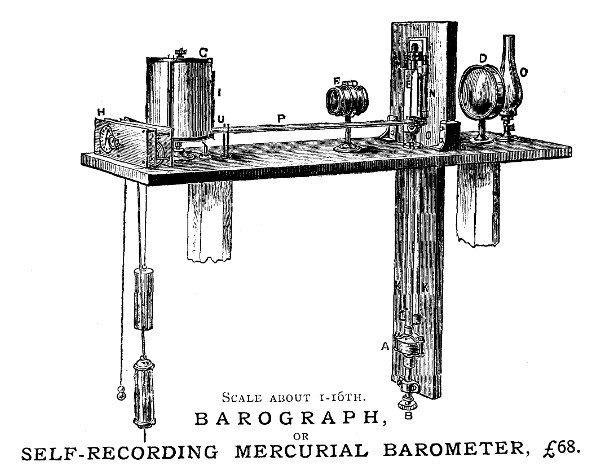
Figure 6.—Photographic registering mercurial barometer, typical commercial version. (From J. J. Hicks, Catalogue of ... Meteorological Instruments, London, n.d., about 1870.)
Like Kew, Daniel Draper's observatory in Central Park, New York City, was established primarily for meteorological observation.[20] Draper was one of the sons of the prominent scientist J. W. Draper. Hipp was an instrument-maker of Neuchâtel who specialized in precision clocks.[21] The others after whom these "systems" were named were directors of astronomical observatories, which were, at this time, the most active centers of meteorological observation. Wild was at the Bern Observatory,[22] Secci at the Papal Observatory, Rome,[23] and George Hough at the Dudley Observatory, Albany, New York.[24] While the Signal Corps seems to have acquired all of the principal "systems," some interesting instruments were developed at still other observatories, notably by Kreil at the astronomical observatory in Prague.[25] The principal impetus for this full-scale mechanization of observation undoubtedly came from the directors of astronomical observatories.
Thus within little more than the decade of the 1860's were developed five new systems of meteorological self-registry that were sufficiently well thought of to be adopted or copied by observatories outside their places of origin. Wild and Draper tell us that it was decided when their respective observatories were established—in 1860 and 1868—that all instruments should be self-registering. Each was obliged to design his own, being dissatisfied with the photographic registers commercially available. The development of these systems would therefore appear to have been due, in part, to the general spread of a conviction that satisfactory instruments were attainable.
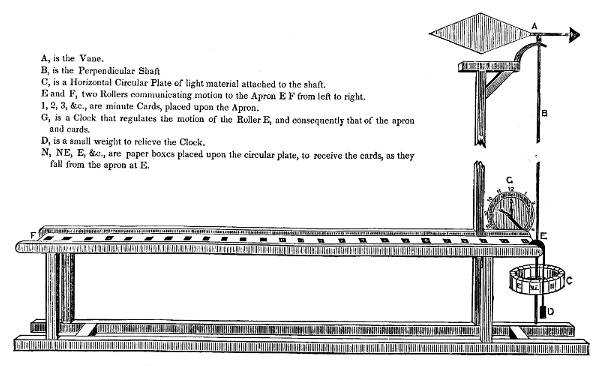
Figure 7.—In 1838 the pioneer American meteorologist James H. Coffin (1806-1873) devised a self-registering wind direction indicator; in 1849 he improved it as shown here. The band, moved by clockwork, carries cards marked with the day and hour. In Coffin's earlier instrument, a part of which is now in the Smithsonian Institution, the vane carried a funnel for sand, which ran into a circular row of bottles. (From Proceedings of the American Association for the Advancement of Science, 1849, vol. 2, p. 388.)
This confidence was warranted, for the decade of the 1850's had seen the appearance of major innovations in the basic instruments—thermometer, barometer, and wind velocity indicator—that made available instruments more adaptable to self-registration. It also saw the development of a new method of electrical registration derived from the telegraph. Sir Charles Wheatstone initiated this small revolution in 1843 when he reported to the British Association that he had constructed an electromagnetic meteorological register which "records the indications of the barometer, thermometer and the psychrometer [meaning wet-bulb thermometer] every half hour ... and prints the results on a sheet of paper in figures," running a week unattended. The working of this register involved the insertion of a conductor in the tubes to make a circuit, the thermometers having open tops.[26] This was ten years after the development of the electromagnetic relay and six years after Wheatstone's introduction of his own telegraph.
Wheatstone's instrument left a very ephemeral record in the meteorological literature, and appears to have been defective or out of fashion with its time, which was concerned with the introduction of photographic instruments. Wheatstone's work was rediscovered, along with that of several other much earlier inventors, by the determined observatory directors of the 1860's.
Of the five systems developed at that time, four used electromagnetic registration, only Draper adhering to a mechanical system (see fig. 11). For temperature measurement Secci and Hough used Wheatstone's electrical system with a mercurial thermometer (fig. 12), but the other four utilized a physical principle which had been proposed periodically for at least a century—the unequal thermal expansion of a bimetallic strip. This principle had been utilized by watchmakers for a quite different purpose—the temperature compensation of the watch pendulum—but its possibilities as a thermometer had been known long before the mid-19th century.[27]
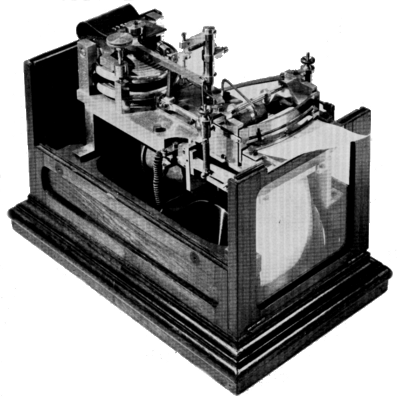
Figure 8.—Hipp's registering aneroid barometer, with a telegraphic printer. (USNM 314544; Smithsonian photo 46740-D.)
For the measurement of pressure, Secci, Wild, and Draper adopted, or rediscovered, the balance barometer devised by Wren in the 17th century. In this type of instrument (see figs. 13, 15) either the tube or the reservoir of the barometer is attached to one arm of a balance, the equilibrium of which is disturbed by the movement of the mercury in the instrument.[28]
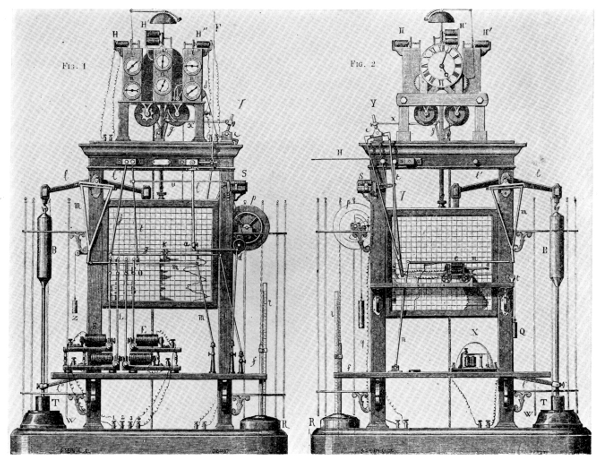
Figure 9.—Front and rear views of Secci's meteorograph, 1867. (From Lacroix, op. cit. footnote 22.)
Hough's barometer was an adaptation of the electrical contact thermometer. The movement of the mercury over a certain minute distance within the tube served as a switch to energize an electrical recording system. Hipp, who was perhaps the latest of this group, first applied the aneroid barometer (fig. 8) to self-registration. The idea of the aneroid—an air-tight bellows against which the atmospheric pressure would act—had been advanced by Leibniz in the 17th century and had been the subject of a few abortive experiments in the 18th century. Not until 1848 was an instrument produced that was acceptable to users of the barometer.[29]
As a wind velocity instrument all six systems used the cup-anemometer developed by Robinson in 1846, an instrument whose chief virtue was the care which its inventor had taken to work out the relationship between its movement and the actual velocity of the wind.[30] Beckley and Draper caused it to move a pencil through gearing; the others used with it electromagnetic counters actuated by rotating contacts.
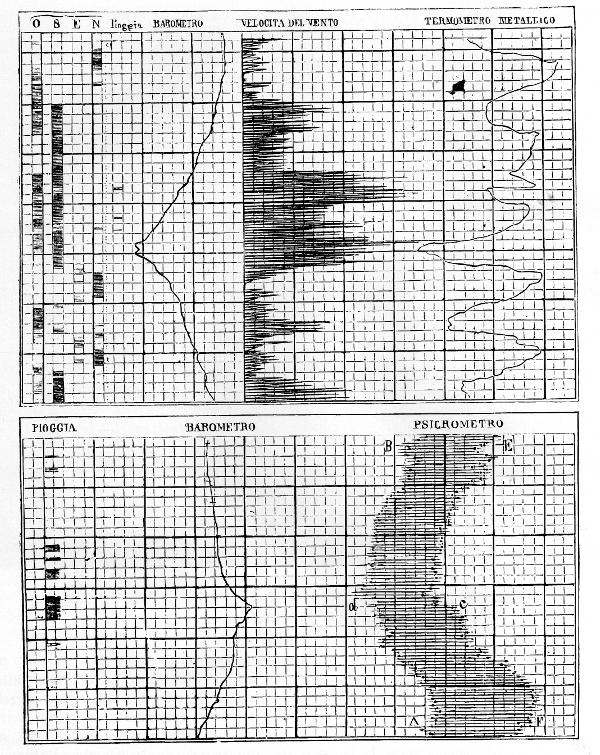
Figure 10.—Chart from Secci's meteorograph. (From Lacroix, op. cit. footnote 22.)
As has been indicated, the Signal Corps used all six systems, a panoply of gadgetry which must have been wondrous to behold. Its Secci meteorograph, which had attracted much attention at Paris, was estimated to have cost 15,000 francs. Abbe reported in 1894 that the instruments were long kept in the apparatus room "as a fascinating show to visitors and a stimulation to the staff in the invention of other instruments."[31]
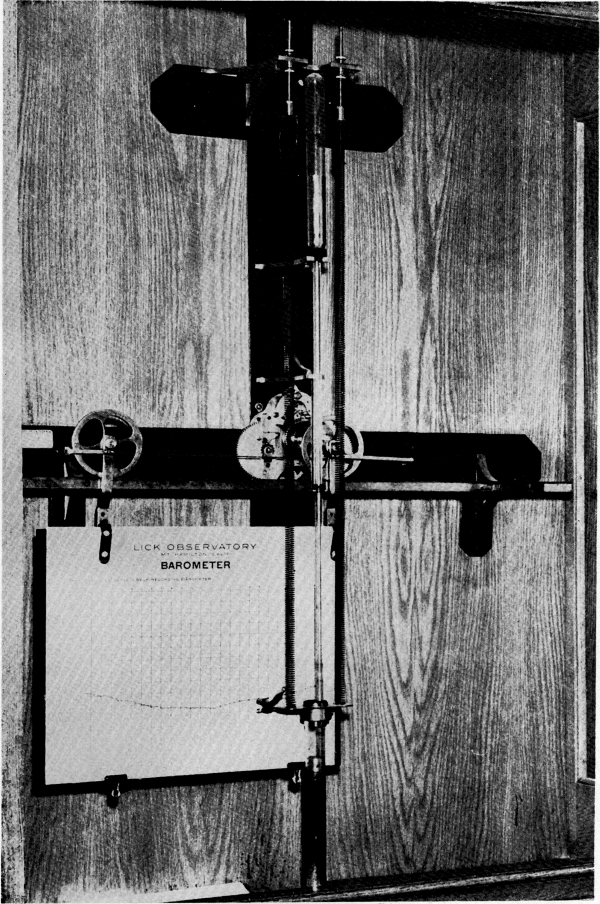
Figure 11.—Draper's mechanical registering barometer, as used in the Lick Observatory. (Photo courtesy Lick Observatory.)
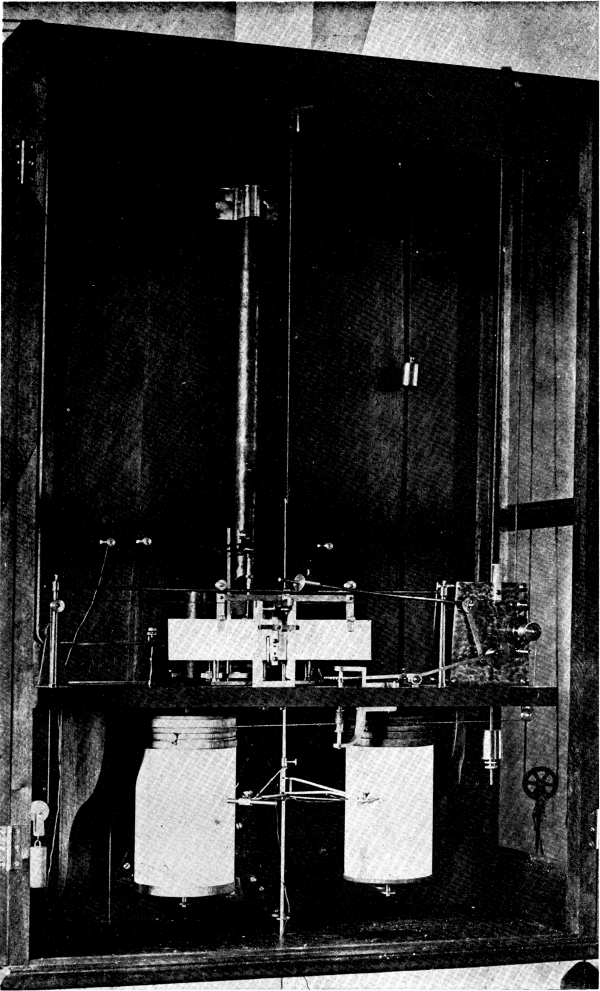
Figure 12.—Hough's electromechanical registering barometer, about 1871.
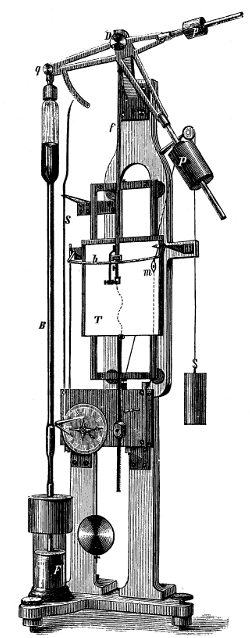
Figure 13.—Fuess' "balance barometer after Samuel Morland," 1880. Wren probably was the originator of this type of instrument. (From Loewenherz, op. cit. footnote 28.)
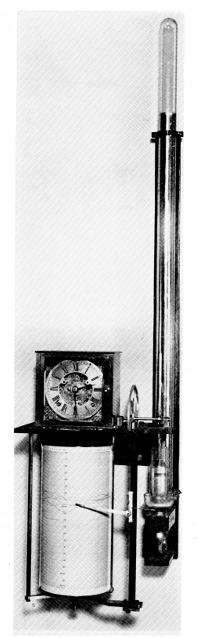
Figure 14.—Marvin's mechanical registering barometer, 1905. This instrument was formerly in the U.S. Weather Bureau. (USNM 316500; Smithsonian photo 46740-E.)
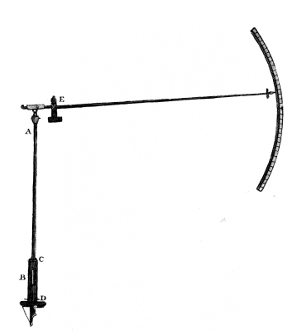
Figure 15.—"Steelyard barometer" as shown in Charles Hutton's Mathematical and Philosophical Dictionary (London, 1796, vol. 1, p. 188). Hutton makes no reference to the originator of this instrument; he attributes the "Diagonal" (or inclined) barometer to Samuel Morland.
From 1875 the question was no longer one of the introduction of self-registering instruments to major observatories but their complete mechanization and the extension of registration to substations. Having accepted self-registration, meteorologists turned their attention to the simplification of instruments. In 1904 Charles Marvin, of what is now the U.S. Weather Bureau, brought the self-registering barometer into something of a full circle by producing an instrument (fig. 14) that was nothing more than Hooke's wheel barometer directly adapted to recording.[32] But this process of simplification had been accomplished at a stroke, about 1880, with the introduction by the Parisian instrument-maker Jules Richard of a self-registering barometer and a thermometer combining the simplest form of instrument with the simplest form of registration (see fig. 16). This innovation, which fixed the form of the conventional registering instrument until the advent of the radiosonde, seems to have stemmed from a source quite outside meteorology—the technology of the steam gauge. Richard's thermometric element was the curved metal tube of elliptical cross-section that Bourdon had developed several decades earlier as a steam gauge. Pressure within such a tube causes it to straighten, and thus to move a pointer attached to one end. Bourdon had opened it to the steam source. Richard filled it with alcohol, closed it, and found that the expansion of the alcohol on heating caused a similar straightening. His barometric element was a type of aneroid, which Hipp had already used but which Richard may have also adopted from a type of steam gauge. For a recording mechanism, Richard was able to use a simple direct lever connection, as the forces involved in his instruments, being concentrated, were not greatly hampered by friction.[33] By 1900 these simple and inexpensive instruments had relegated to the scrap pile, unfortunately literally, the elegant products of the mass attack of observatory directors in the 1860's on the problem of the self-registering thermometer and barometer.[34]