Conclusions
Reading edition
In view of the rarity of special studies on the history of meteorological instruments, it is impossible to claim that this brief review has neglected no important instruments, and conclusions as to the lineage of the late 19th century instruments can only be tentatively drawn. The conclusion is inescapable, however, that the majority of the instruments upon which the self-registering systems of the late 19th century were based had been proposed and, in most cases, actually constructed in the 17th century. It is also evident that in the 17th century at least one attempt was made at a system as comprehensive as any accomplished in the 19th century.
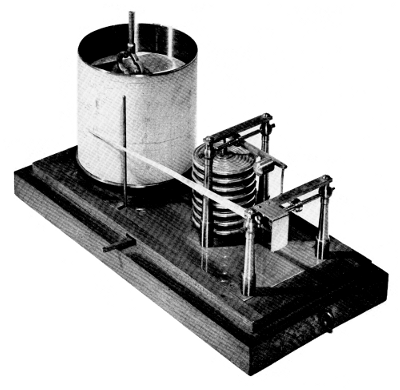
Figure 16.—Richard's registering aneroid barometer, an instrument used at the U.S. Weather Bureau about 1888. The Richard registering thermometer is similar, the aneroid being replaced by an alcohol-filled Bourdon tube. (USNM 252981; Smithsonian photo 46740-C.)
To attribute the success of self-registering instruments in the late 19th century to the unquestionable improvements in the techniques of the instrument-maker is to beg the question, for it is by no means clear that the techniques of the 17th-century instrument-maker were unequal to the task. It should also be noted that the photographic and electromagnetic systems of the 19th century seem to have been something of an interlude, for some of the latest and most durable (all of Draper's and Richard's instruments and Marvin's barograph) were purely mechanical instruments, as had been those of Hooke and Wren. If we conclude that the 19th-century instruments were more accurate, we should also recall Forbes' comments upon the question of instrumental accuracy.
What, then, was the essential difference between the 17th and 19th centuries that made possible the development of the self-registering observatory? It would appear to have been a difference of degree—the maturation in the 19th century of certain features of the 17th. The most important of these features were the spread throughout the western world of the spirit that had animated the scientific societies of Florence and London, the continued popularity of the astronomical observatory as an object of the philanthropy of an affluent society, and the continued existence of the nonspecialized scientist. Under these circumstances such nonmeteorologists as Wheatstone, Henry, Hough, Wild, and Secci had the temerity to range over the whole of the not yet compartmented branches of science and technology, fully confident that they were capable of finding thereby a solution to any problem important enough to warrant their attention.
FOOTNOTES:
U.S. GOVERNMENT PRINTING OFFICE, 1961. For sale by the Superintendent of Documents, U.S. Government Printing Office, Washington 25, D.C. - Price 25 cents