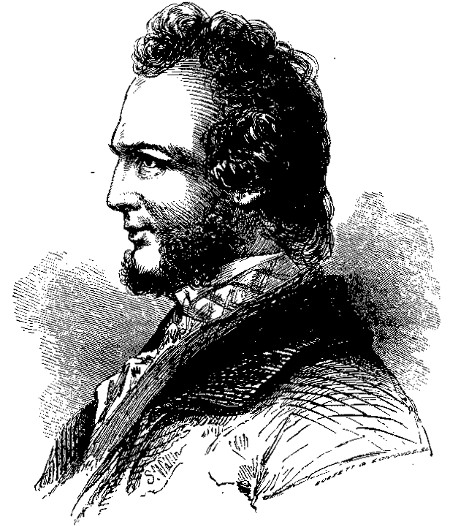
JOHN GODFREY SAXE.
Reading edition
Every catalogue of English poets embraces the name of Butler, though he was but the most unpoetical of satirists. If Hudibras is poetry there can be no difficulty in admitting to this distinction Trumbull's Progress of Dulness and McFingal, Snelling's Truth, a Gift for Scribblers, Halleck's Fanny, Osborn's Vision of Rubeta, Lowell's Fable for Critics, and some dozen other attempts in in this line, by Americans. The disease of the satiric muse in this country has been the spleen, and the reason why we have had so little of the healthful humorous rage, ideal and lyrical, of which the old masters gave us immortal examples, is, that those among us who have attempted this kind of composition have generally had far more to do with persons than with manners, have been influenced more by envy and malice than by a generous scorn of what is ludicrous and mean and criminal. The author of "Progress" has fallen into none of the prevailing sins; he is of the school of Horace, and has as little as he may to do with fools, while he holds up, unfolds, and whips, the follies of the day.
John G. Saxe was born in Highgate, Franklin county, Vermont, on the second day of June, 1816, His youth was passed in rural occupations until he was seventeen years of age, when he determined to study one of the liberal professions, and with this view entered the grammar school at St. Albans, and, after the usual preliminary course, the college at Middlebury, where he graduated bachelor of arts in the summer of 1839. He subsequently read law at Lockport in New-York and at St. Albans, and was admitted to the bar at the latter place in September, 1843, since which time he has been practising in the courts with more than the average success of young attorneys, and he is now a leading politician of the democratic party, the conductor of its local organ, the Burlington Sentinel, and District Attorney, by the grace of personal popularity—all other candidates on the same ticket having been defeated.
Mr. Saxe became known as an occasional contributor to the Knickerbocker Magazine, some eight or ten years ago. Among his pieces in that miscellany is one characteristically remarkable for a sympathetic fitness of phrase, entitled the Rhyme of the Rail, and beginning:
Singing through the forests, Rattling over ridges, Shooting under arches, Rumbling over bridges, Whizzing through the mountains, Buzzing o'er the vale,— Bless me! this is pleasant, Riding on the Rail!
In this period he has thrown off scores of epigrams, &c., anonymously, besides the more ambitious performances acknowledged in the collection of his Poems, of which we have before us a third edition—showing that their quality is well appreciated—from the press of Ticknor & Co. The longest of these is Progress, first published in 1846. In skilful felicities of language and rhythm, general clear and sharp expression, and alternating touches of playful wit and vigorous sense, there is nothing so long that is so well sustained in the hundred and one books of American satire. In the beginning of it he says finely of our "glorious tongue:"
Let thoughts, too idle to be fitly dressed In sturdy Saxon, be in French expressed; Let lovers breathe Italian,—like, in sooth, Its singers soft, emasculate, and smooth; But for a tongue, whose ample powers embrace Beauty and force, sublimity and grace, Ornate or plain, harmonious, yet strong, And formed alike for eloquence and song, Give me the English,—aptest tongue to paint A sage or dunce, a villain or a saint, To spur the slothful, counsel the distressed, To lash the oppressor, and to soothe the oppressed, To lend fantastic Humor freest scope, To marshal all his laughter-moving troop, Give Pathos power, and Fancy lightest wings, And Wit his merriest whims and keenest stings!
And then proceeds with a display of popular follies, and especially of those most grotesque and offensive, the sham philosophies by which it is attempted to regenerate society:
Hail, Social Progress! each new moon is rife With some new theory of social life, Some matchless scheme ingeniously designed From half their miseries to free mankind; On human wrongs triumphant war to wage, And bring anew the glorious golden age. "Association" is the magic word From many a social "priest and prophet" heard; "Attractive Labor" is the angel given, To render earth a sublunary Heaven! "Attractive Labor!" ring the changes round, And labor grows attractive in the sound; And many a youthful mind, where haply lurk Unwelcome fancies at the name of "work," See pleasant pastime in its longing view Of "toil made easy" and "attractive" too, And, fancy-rapt, with joyful ardor, turns Delightful grindstones, and seductive churns!
In the same vein we are treated with "novelties which disturb our peace," in literature, fashion, politics, religion, and morals; and every line is faultless in finish and in wit. The Proud Miss McBride, and The New Rape of the Lock, are in different veins, but abound in the same exquisite turns, agreeable images, and comic displays of wisdom. In the New Rape of the Lock:
The gossips whispered it through the town, That "Captain Jones loved Susan Brown;" But, speaking with due precision, The gossips' tattle was out of joint, For the lady's "blunt" was the only point That dazzled the lover's vision! And the Captain begged, in his smoothest tones, Miss Susan Brown to be Mistress Jones,— Flesh of his flesh and bone of his bones, Till death the union should sever; For these are the words employed, of course, Though Death is cheated, sometimes by Divorce; A fact which gives an equivocal force To that beautiful phrase, "for ever!" And Susan sighed the conventional "Nay" In such a bewitching, affirmative way, The Captain perceived 'twas the feminine "Ay," And sealed it in such commotion, That no "lip-service" that ever was paid To the ear of a god, or the cheek of a maid, Looked more like real devotion!
At the wedding party all the aristocracy of the circle in which the Browns and Joneses were acquainted came together, and Miss Susan—
To pique a group of laughing girls Who stood admiring the Captain's curls, She formed the resolution To get a lock of her lover's hair, In the gaze of the guests assembled there, By some expedient, foul or fair, Before the party's conclusion. "Only a lock, dear Captain!—no more, 'A lock for Memory,' I implore!" But Jones, the gayest of quizzers, Replied, as he gave his eye a cock, "'Tis a treacherous memory needs a lock," And dodg'd the envious scissors. Alas! that Susan couldn't refrain, In her zeal the precious lock to gain, From laying her hand on the lion's mane! To see the cruel mocking, And hear the short, affected cough, The general titter, and chuckle, and scoff, When the Captain's Patent Wig came off, Was really dreadfully shocking!
The Times, a poem read before the Boston Mercantile Library Association, in 1849, Carmen Lætum, recited last year at a meeting of the Alumni of Middlebury College, and New England Men, delivered before the literary societies of the New-York University a few weeks ago, are his other most elaborate productions, and they are all carefully finished and alike in their chief characteristics. His shorter pieces in a few instances have touches of sentiment, but this is not his forte; by the definition which limits poetry to rhythmical creations of beauty, Mr. Saxe can scarcely be called a poet of great excellence; his distinction is, that he is a wit, and that he has been eminently successful in giving to his wit a poetical expression.
As a judicious critic has said of him, "he unquestionably an artist, of a high order, in the narrow range which he has taken. His comical productions are beautifully finished. As they stand, they are terse, smooth, and fluent, and any one who has ever tried his hand at this species of composition, will readily appreciate the time, labor, and taste, which must have been expended, to jest so easily, in rhyme."