Book 7 — Historical Review of the Month.
Reading edition
In the United States, since our last publication, no events have occupied more attention than the great Agricultural State Fair which was held recently at Rochester, and of which we shall give a particular account, illustrated with numerous engravings, in our next number; and the Railroad Festival at Boston, which was held at the same time. At the latter were present the President of the United States, the Secretary of State, and other members of the Cabinet, the Governor-General of Canada, his Aids and Cabinet, the principal members of the Canadian Parliament, and the leading merchants in the Canadian cities, the Governors of New England states, the Presidents of the railways in New England, the Mayors of the cities of New England and many other influential persons interested in railways and steam navigation. Speeches were made by the President of the United States, by Lord Elgin, Daniel Webster, Edward Everett, and many others, and the occasion was altogether one of the most brilliant and satisfactory of its kind ever known in this country.
On the 10th of September Mr. Gorsuch, a citizen of Maryland, accompanied by several officers and other persons, proceeded from Philadelphia to Christiana, near Lancaster, for the purpose of arresting two negroes claimed under a law of the United States as fugitive slaves. In order to resist the execution of the law the negroes of the vicinity rallied to the number of seventy or eighty, armed themselves with guns, and fired on the party of whites, killing Mr. Gorsuch, and mortally wounding his son. The negroes were also considerably injured by a discharge from revolvers by the party with the officers. It appears from a statement published by the Rev. Mr. Gorsuch, a son of the claimant of the negroes, that a conspiracy was planned beforehand, to resist the officers of the law in the execution of their duty; and that it was not confined to the negroes, but was apparently under the guidance and control of whites. Mr. Gorsuch says that while the officers were awaiting the decision of the blacks, a white man rode up; that his presence seemed to inspire the negroes with renewed hostility; that he refused, when summoned, to aid the officers, and threatened them with bloodshed if they persisted in executing the law. It is further alleged that it was after receiving some communication from this person that the negroes rushed on the officers and killed Mr. Gorsuch. Since then a correspondence on the subject has been held between the national executive and the executives of the states of Maryland and Pennsylvania. The slaves have not been recovered, but many arrests have been made of persons charged with conspiracy to prevent the execution of the laws, and with treason.
The Free Soil party of Massachusetts, at a State Convention, held Sept. 16, nominated for Governor, John G. Palfrey, and for Lieutenant-Governor, Amasa Walker. The nomination for Governor was first tendered to Stephen C. Phillips, of Salem, who declined. The democrats held their State Convention on the 26th of August. They passed resolutions decidedly in favor of the Union, and against all anti-national and anti-sectional agitation. George S. Boutwell was nominated for Governor, and Henry W. Cushman for Lieutenant-Governor, and Charles G. Greene, Henry H. Childs, and Isaac Davis, were appointed delegates to the National Democratic Convention, which was recommended to be holden at Baltimore in May, 1852. The Whig State Convention was held at Springfield on the 10th of September and, on the first ballot, Robert C. Winthrop was nominated as their candidate for Governor, and George Grinnell as their candidate for Lieutenant-Governor. The proceedings were very harmonious, and the address of the chairman, and the resolutions passed by the convention, were of a strong national and Union character. Edward Everett, George Ashmun, and Seth Sprague, were chosen delegates from the State at large to the National Whig Convention.
In New-York the Whig State Convention assembled at Syracuse on the 11th of September. George W. Patterson, was nominated for Controller; James M. Cook, for Treasurer; Samuel A. Foote, for Judge of the Court of Appeals; James C. Forsyth, for Secretary of State; Daniel Ullmann, Jr., for Attorney-General; Henry Fitzhugh, for Canal Commissioner; and A. H. Wells, for State Prison Inspector. Resolutions were adopted, declaring that the proceeding of the two Whig State Committees at Albany, for the union and co-operation of the party, was "the result of honorable and patriotic devotion to the Constitution, and for the best interests of the whole people, and that it is adopted and approved by this Convention;" and pledging the whigs to the most liberal conduct in the matter of internal improvements. The Democratic Convention met at the same place on the tenth. Resolutions were adopted reaffirming the principles avowed in the resolutions adopted by the State Convention held at the same place last year. The following persons were nominated for the several state offices: John C. Wright, for Controller; Henry S. Randall, for Secretary of State; Levi S. Chatfield, for Attorney-General; Benjamin Welch, Jr., for Treasurer; Horace Wheaton, for Canal Commissioner; W. J. M'Alpine, for State Engineer; General Storms, for Inspector of State Prisons; and A. S. Johnson, for Judge of the Court of Appeals.
The Maryland Whig State Convention at Baltimore, September 17th, nominated, with great unanimity, the following State ticket: For Controller of the Treasury, George C. Morgan; Lottery Commissioner, O. H. Hicks; Commissioner of the Land Office, George C. Brewer. The Democrats, at their State Convention held at Baltimore, on the 12th, nominated Philip Francis Thomas, of Baltimore City, for Controller; James Murray, of Annapolis, for Commissioner of the Land Office; Thomas R. Stewart, of Caroline, for Lottery Commissioner.
In Virginia, an election for members of Congress, under the old system and apportionment, takes place on the fourth Thursday in the present month. The question of the ratification of the new constitution is to be decided under the universal suffrage system, on the same day. Members of the Legislature are also to be elected, according to the old apportionment; but if the new constitution is ratified, the legislative election is to be superseded by a new election, under the new apportionment, in December next. At the same time, a Governor and Lieutenant-Governor &c., are to be elected; and next spring, the county officers will be chosen in another election; after which the State elections will occur regularly from time to time.
In South Carolina a large meeting was held at Charleston, on the 28th of August, in favor of co-operation between the slaveholding states, and opposed to separate State Action for the purpose of resistance to the National Government. John Rutledge presided, and in the list of other officers we find the names of many of the most distinguished citizens of the State. Our advices from California, to the 14th of August, are of a favorable character. In San Francisco business is active in spite of the effects of the recent conflagration, and the administration of justice is placed on a more substantial basis. Great activity prevails in the mining districts, and the work of constructing canals on various gold-bearing streams is vigorously advancing. Accounts from Utah represent the new territory in a prosperous condition, with the exception of some slight Indian difficulties. The crops are unusually fine. The emigrants for Salt Lake and Oregon are progressing prosperously. The Mormons have extended their settlements along the base of the mountains, northward, and facing the Great Salt Lake, ninety miles, nearly to Bear River ferry. They are fast taking up all the good land in the Valley, and are engaged in building a railroad to the mountain, some seven or eight miles, on which to transport the materials for their great temple. Dr. John M. Bernhisel has been chosen Territorial Delegate to Congress.
It has been stated that the Survey of the Mexican Boundary Commission was progressing rapidly westward. The astronomers and surveyors of the American and Mexican Commissioners had joined forces, and their advanced parties had reached a point thirty miles west of Rio Mienlies. The line was to run eight or ten miles south of Cooks Spring, thus giving the United States the whole of the road to the Copper Mines, and the only route which can be traversed by wagons. We have later intelligence, that in consequence of a disagreement between the Commissioners and the Surveyor, the operations of the Commission are almost suspended.
Dr. Gardner, of fraudulent Mexican claim notoriety, has returned to Washington, surrendered himself into the hands of the United States authorities, and given bail in the sum of $40,000 to appear for trial at the December term. Senator Chase, of Ohio, has issued a manifesto in which he announces his intention to adhere to the platform and support the ticket of the Ohio Democratic Convention. But the ground of this determination is, that he considers the action of that Convention, besides being acceptable on other topics, as in effect indorsing the Free Soil doctrines. John McPherson Berrien has declared his intention of acting with the Union party. Gen. Quitman, before the late election, withdrew from the contest, as the secession candidate for Governor of Mississippi. The Special Convention of the Protestant Episcopal Church for the election of an Assistant Bishop fur the Diocese of Illinois, was held at Pekin, Sept. 8, and resulted in the election of Dr. Whitehouse, of New-York. The annual meeting of the American Board of Commissioners for Foreign Missions was held at Portland, on the 9th day of September. The President, Theodore Frelinghuysen, presided, and the affairs of the society and its prospects, were presented in several very interesting reports.
In the last number of this magazine, we stated the failure of some ineffectual risings in CUBA, and supposed that the peace of that island was reestablished, at least for a considerable period. But, about the end of August, the country became exceedingly interested respecting the fate of the steamer Pampero, which, it had become known, had left New Orleans with several hundred men, under the command of General Narciso Lopez, with the intention of landing at some point on the Cuban coast. It afterwards was disclosed that the party, which consisted of 480 men, designed to go to the River St. John, and effect a junction with an artillery force which was waiting there, and then land at some point in the central department; but on touching at Key West for stores, they were informed of a revolt of the Vuelta de Abajo, and Lopez resolved to land in that district. The party disembarked at the small town of Morillos, at two o'clock, on the morning of the 12th of August; and, soon after, General Lopez sent a pronunciamento to Los Pazos, in which he informed the inhabitants he was about to march on them, and would give no quarter to any who did not join him. Being without means of transportation, he ordered Colonel Crittenden to remain and protect the baggage, together with 1000 musket cartridges, 3000 muskets, and 700 pounds of powder in kegs. He told Crittenden that he would send for him at Los Pazos, and took with him 323 men, leaving 130 with Crittenden, who, at 11 o'clock that night, started to rejoin him. Their advance was slow, and on the morning of the 13th, while eating breakfast, they were surprised by a report of musketry, and the whistling of bullets, from a body of the enemy, who were repulsed with a loss of nine killed. A short time after they repeated the attack. Crittenden charged, and forced them to retreat to a chaparral, from which, as the invaders advanced, they opened a destructive fire. Finding he could not maintain his position, Crittenden ordered a return, and the enemy again advanced. At this time, he wished a small party to attain a position at the right flank of the enemy, to charge from that side at the same moment he charged on the front. Lieutenants Van Vechten and Crafts, with twenty men, volunteered, and attained the position. After remaining about half an hour, and hearing nothing of Crittenden, they were compelled to retreat, leaving their baggage and stores. The next morning this party succeeded in joining Lopez at Los Pazos, half an hour before he marched from that place. Gen. Enna, commander of the Spanish troops, immediately attacked Lopez with 800 men. After a hard fight, the enemy retreated, leaving a large number (among whom were several of their highest officers) dead and wounded. Lopez lost in killed and wounded, thirty men, among whom were Col. Dowzeman, Lieut. Laviseau, killed; Gen. Pragay, Capts. Brigham and Gonti, mortally wounded. On the morning of the 14th, Lopez marched into the mountains, and on that day he was attacked by 900 men. The action lasted three hours, and the Spaniards retreated with a large loss. At the moment that the Spaniards retreated in one direction, Lopez issued an order to retreat in an opposite one, and made a forced march of 18 miles in 5 hours, over a mountain road. On the 19th, being still in the mountains, two leagues from Bahia, he was overtaken by a heavy rain storm, which destroyed the greater part of his ammunition, and rendered the firearms entirely useless. On the morning of the 20th, the sentry was surprised and shot, and Lopez was completely routed, flying to the mountains. Lopez escaped on horseback, with nothing but what he wore. He encamped on one of the mountains, exposed to the violence of a terrific storm. On the evening of the 21st, having been forty-eight hours without food, a horse was killed and divided among 125 men, who were all that remained with him. They wandered about until mid-day of the 24th, when a halt was ordered, and on examination it was found that they had only 60 serviceable muskets, and about 40 dry cartridges. They commenced a retreat, when a force of 900 charged on the party. They dispersed, threw away their arms, and fled to the mountains; seven men only remaining with Lopez, and a large number being overtaken and killed. Lopez was taken with six of his men in the Pinos de Rangel; his captors were Jose Antonio Castañeda, guide of a pursuing force, and fifteen peasants of the country. The capture took place on the 29th, just seventeen days from his landing. The news of it spread at once through the country, and people began to flock into the camp to see the prisoners; to avoid inconvenience, Col. Ramon de Lago, who commanded the column, conveyed them to Havana by a night march.
The second day after being separated from Lopez, the party under Colonel Crittenden was captured by a detachment of Spanish soldiers and carried into Havana, where, on the sixteenth of August they were shot, by order of the Captain General. Very much exaggerated accounts of the circumstances attending their execution were circulated in the United States; and by forged letters respecting successes by the invaders, adhesions to them by the people of the island, indignities to Americans, &c., it was sought to excite the public indignation so that further expeditions should be set on foot that would be altogether irresistible. The party whose managements consisted of such systematic and persevering falsehood lost all its energy when news came of the capture of Lopez and the remnants of his army. At seven o'clock on the morning of the first of September, Lopez was garroted—that being the Spanish punishment for treason—in the presence of from eight to ten thousand troops. Brought from the prison he ascended the platform with a firm and steady step. Facing the multitude he made a short speech, and his last words were, "I die for my beloved Cuba." He then took his seat—the machine was adjusted; at the first twist of the screw his head dropped forward—and he was dead. He was a brave man, but of feeble capacities, and the leading members of the Cuban junta in the United States had no confidence in any movements subject to his direction. A few of the prisoners taken about the time of the capture of Lopez have been set at liberty, and others have been transported to Spain. The result of the whole business shows that the bodies of the prisoners shot at Havana with Crittenden and Kerr, were not mutilated nor anywise maltreated, as had been stated, but that the story that they had been was fabricated to excite indignation and procure reinforcements in this country; that the invaders achieved no important success at any time, beyond the killing of General Enna and the consequent repulse of the detachment led by him; that they killed not more than two hundred of the Spaniards; that they at no time were able to act on the offensive, but fought for their lives from the first, and were at length surprised and utterly routed; that, though they were landed in the very quarter of Cuba where Lopez was most likely to obtain aid, yet they received none of any kind, and were not joined by a single corporal's guard from the hour of their setting foot on the soil of Cuba; that the Creoles, or natives of Cuba, so far from affording them such aid as even cowards friendly to them might safely have done, evinced the most active and deadly hostility throughout to the invaders and their cause. We cannot doubt that they furnished the information which led to the surprise and route of Lopez; we know that they finally deceived, betrayed, bound and delivered him to Concha.
The Canadian Parliament was prorogued by the Governor-General on Saturday, the 30th of August, to the 8th of October. The royal speech represents the revenue as in a satisfactory state, and refers to the grants for improving the navigation of the St. Lawrence, and to the reduction of the emigrant tax. Six bills were reserved for the approval of the Queen, three of which relate to churches and rectories, two to the reduction of salaries, and one to the incorporation of the Fort Erie and Buffalo Suspension Bridge Company. The reciprocity question was left unsettled. The paraphernalia of the Canadian Government has since been removed from Toronto to Quebec. The general election in the Province of Nova-Scotia for members of Parliament, has resulted in a majority for the existing Government. The Provincial Secretary, the Attorney-General, the Financial Secretary, leading members of the Cabinet, have been reëlected. The construction of the railway from Halifax to Portland, and through New-Brunswick to Quebec, may be considered as secured. The question has been one of the prominent points in the election—the Liberals being in favor of, and the Conservatives opposed to it.
The Mexican Congress have passed a bill for the formation of an alliance, offensive and defensive, between all the Spanish American republics. With a foreign debt beyond her ability to pay; with a deficit accruing every year; with a whig government, threatened by insurrection at home, and blockade from a foreign power, Mexico may well look around her for some method of prolonging her existence. Opposition continues to the Tehuantepec treaty; and it is stated that two vessels sent from New-Orleans to commence the canal were seized by the Mexican authorities.
In South America there has been more than the usual amount of revolution. The President of Ecuador, General Nueva, left Querto on the seventeenth of July, to visit his family at Guayaquil. On approaching the city he was met by a military cavalcade, apparently for the purpose of escorting him in: but was seized by them, and hurried off to sea in a vessel lying in the river; the destination of the vessel, and the fate of the prisoner were unknown. General Urbina immediately entered upon the administration of affairs. In Chili, Don Manuel Montt has been elected President by a large majority. Advices from Montevideo to July thirtieth, state that Urguiza and Garzon passed the Uraguay on the twentieth with seven thousand five hundred men, and that General Servando Gomez at once went over to them from the army of Oribe with two thousand cavalry, some staff officers and one thousand extra horses. It is expected that all of Oribe's forces will desert him in the same manner. Garzon, who formerly served with Oribe, is very popular among his forces. A Brazilian army of twelve thousand men is marching to join Urguiza and Garzon. The war will now be carried into the territories of Buenos Ayres. It will doubtless be a most ferocious contest; with Rosas it is a matter of life and death; the power he has built up with such bloodshed and tyranny will either be destroyed utterly or confirmed by the result. In Peru, the best understanding is said to exist between the Legislative and Executive bodies in the Government. Movements are being made for the greater extension of freedom of trade, and for prohibiting the circulation of Bolivian money within the Republic.
A revolution has broken out in the provinces of Antiochia and Popayan, in New-Grenada, which at the last advices (July twenty-fourth), was rapidly spreading over the country. The rising is headed by General Borrero, who took up arms with one thousand men, and has since received large accessions to his forces. General Borrero has the reputation of being an accomplished soldier and a sincere patriot. The city of Carthagena was thrown into great confusion by the reception of the intelligence, the militia being called out and the people supplied with arms.
In Nicaragua a revolution has displaced the government, and M. Montenegro, who was elected successor of the deposed President, died in a few days after, and the chief of the opposite faction, General Muños, is probably now in authority.
From Great Britain the news is various but generally of small importance. The Queen and Royal Family have been making a tour in Scotland, which gave occasion to the usual rejoicings and demonstrations of loyalty. The most grave questions discussed in the journals are connected with the Roman Catholic Disabilities subject. On the 19th August a great gathering of the Roman Catholic clergy and laity took place at the Rotunda in Dublin. The object in view was the organization of a party and the commencement of an agitation to bring about the repeal of the obnoxious act of Parliament. So strongly was public feeling excited on the occasion, that the military and police forces were held in readiness for action. Fortunately the peace was not disturbed; although the spiritual leaders themselves boldly set the law at defiance by the use, in one of their resolutions, of the very titles prohibited by the recent enactment. Among the notices of motion that have been placed on the books of the House of Commons for "next session," is one by Mr. Hume to move that "after a day to be fixed by Parliament, no person, male or female, shall be admitted to the service of the public, in any permanent civil office or department, unless they shall pass an examination by competent persons appointed for that purpose, and shall be found capable of fluently reading and writing the English language". In England the Railway Companies have held their annual meetings. The increase of travel has not kept pace with the increase of railways; the average profit is 3 per cent. The Times has had some forcible articles recently on the possibility of running a railroad straight from London to Constantinople, and thence through Ask Minor to India, so as to make Calcutta accessible in seven days. This the Times describes not only as practicable, but even of probable accomplishment, in a given number of years.
The harvest in England, Scotland, and Ireland has been of the most gratifying description. The weather was generally favorable, and a large quantity of grain was secured in excellent condition. As the harvest proceeded the reports from the agricultural districts improved, and previous estimates of crops, both as to quantity and quality, under rather than over what is realised. The aggregate produce of the kingdom is expected to be fully equal to that of good average seasons. Accounts of the potato blight have been greatly exaggerated. The disease has no doubt reappeared, but in much less degree than at the corresponding time in any previous year since its first appearance. But notwithstanding the prospect of a good harvest, the tide of emigration continues to roll on as unceasingly as in the spring months. Day after day the journals chronicle the departure of hundreds of emigrants, the major portion of whom are represented as possessing sufficient capital to enable them to purchase land on their arrival in America. The Monaghan Standard remarks that the greater proportion of emigrants now are of a very different description from the hordes of unhappy creatures, poverty stricken and debilitated with disease, who formerly struggled across the Atlantic. The greater number of those who now crowd our emigrant ships are men who, with a capital varying from £100 to £300, have been in the habit of conducting, with the aid of their sons and daughters, the cultivation of their land. An honorable trait of the character of the Irish in America is shown in a fact stated in the Ballinesloe Star, that in six weeks upwards of £20,000 were received from relations in America, in sums varying from £5 to £30, by persons in Ireland, the great majority of whom had been receiving relief in the work-houses up to the time of the money reaching them. In many cases the poor people have kept the matter secret, through a mistaken fear that if it were known to the poor law officials, a portion of the money would be impounded to pay for their maintainance while in the work-house. The money is consigned to some third party—some shopkeeper, or person who could be depended upon, to have it safely conveyed to its intended destination, without the knowledge of the work-house officers.
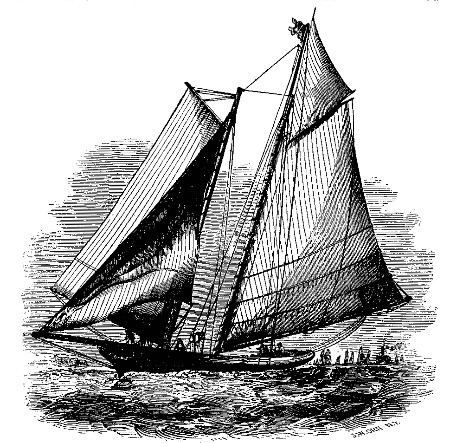
Much excitement has been created in England by a match between the yacht America, owned by Mr. John C. Stevens, of New-York, and the yacht Titania, and by other matches between the America and the most celebrated yachts in England, in all of which the America was successful.
The America arrived out early in July. Hitherto the dozen or more yacht clubs in the United Kingdom had never dreamed of foreign competition. It was just known that there was an Imperial Yacht Club of St. Petersburg, maintained to encourage a nautical spirit among the nobility; and that owners of yachts at Rotterdam had enrolled themselves as the "Royal Netherlands Yacht Club;" but, till the America appeared, the few who were aware of the fact that there was a flourishing club at New York did not regard it as of the slightest consequence, or as at all likely to interfere with their monopoly of the most useful of sports. The few trial runs the America made after her arrival proved she was possessed of great speed, and that the owners were not so little justified as at first they had been thought in offering to back an untried vessel against any yacht in the English waters for the large sum of £10,000. As the day of the Royal Squadron's grand match drew near, the entries became numerous. In the memory of man Cowes never presented such an appearance as on the 22d of August. A large portion of the peerage and gentry of the United Kingdom had left their residences, and forsaken the sports of the moors, to witness the struggle. There must have been a hundred yachts lying at anchor in the roads; the beach was crowded, from Egypt to the piers; the esplanade in front of the Club thronged with ladies and gentlemen, and with the people inland, who came over in shoals, with wives, sons, and daughters, for the day. Eighteen yachts entered as competitors; the largest of which was a three-mast schooner, the Brilliant, 392 tons; and the smallest a cutter, Volante, 48 tons. Nine of the yachts were of above 100 tons, and nine were of less than 100 tons. The America's burden is 170 tons. The umpire in the case was Earl Wilton, and the triumph of the America complete. The "Cup of All Nations" was presented to Commodore Stephens and his brother, the owners of the America, after a dinner in the club-house that night. Mr. Abbot Lawrence was present, and acknowledged the compliments paid to this country. The yacht has since been sold to an English gentleman,—to be a model for British naval architects.
THE YACHT "AMERICA"
In the American section of the Great Exhibition, Mr. Hobbs has been the great centre of attraction, and his colloquial powers have been severely tested by the thousand and one explanations he is obliged to give of the mode in which his late achievements were effected. He contents himself with asserting the vulnerability of all British locks and the impregnability of his own. He looks on the picking of Chubb's locks as the smallest of his feats; and it appears that the Directors of the Bank of England (no bad judges in such matters), have given in their adhesion, by ordering several of Mr. Hobbs's patent locks.
"Every practical success of the season," says the Times, "belongs to the Americans." Their reaping machines, their revolvers, their yachts, are great "facts," and every one in England seems willing to admire the skill and enterprise that produced them. Narrow-minded critics, who are too wise to learn, find out that the reasons for the "America's" success were exceedingly trifling; it was only a difference in her build, and in the construction of the sails, &c. Precisely so, and it was only a stroke with a knife that enabled the egg of Columbus (which it is true must be stale by this time) to stand perpendicular. Every one can do it now, just as with the aid of fire and coals, and some water, they can rush from continent to continent, and baffle the wind or the waves. Every discovery that is useful is simple. In the works of nature, there is no perplexing machinery.
The war at the Cape of Good Hope, still threatens to be expensive and protracted. The British troops have shown great gallantry in action, and the greatest endurance and even cheerfulness under the severe fatigue inseparable from the nature of the country, and the wide range embraced by the operations. But they are few in number; the policy of the insurgents is to avoid as much as possible a general engagement; the frontier is too extended to be effectually protected by stationary posts; the troops, therefore, are necessarily harrassed by constant patrol duty, and with no more decisive result than an occasional skirmish, in which four, five, or six Caffres are put hors de combat.
The directors of the Manchester Commercial Association, and of the Chamber of Commerce, continue to prosecute their endeavors to encourage the cultivation of cotton in India. In the early part of this year, letters were received by the association that fresh New-Orleans cotton seed was scarce in the districts of Tinnivelly and Coimbetore, and other parts of the Madras territory; and fearing that the India Board, if appealed to, might not be sufficiently prompt in supplying that deficiency. Mr. John Peal, one of the members of the association, has imported at his own risk thirty tons of this seed, and placed it at the disposal of the Court of Directors.
A California has been discovered in an interior county of New South Wales. The Sydney Morning Herald of May 20, quotes from the Bathurst Free Press of a few days previous, an article which describes "a tremendous excitement" in the town of Bathurst and the surrounding district of the counties Bathurst, Roxburg, and Westmoreland, on the discovery that "the country from the mountain ranges to an indefinite extent in the interior is one immense gold field."
In India the British government has derided to take and keep possession of certain parts of the Nizam's dominions unless he repays at once the monies due to the Government of India, amounting to upwards of eighty lacs of rupees, with interest at six per cent. The districts of country about to be absorbed are, it is said, all those on the other side of the Kishna river, Bachore, and Neildroog, besides Berar. But it is considered in Bombay that the Nizam "has the means to pay," and that at the eleventh hour he will pay and save his territory.
Traces appear to have been discovered of the movements of Sir John Franklin, in the earlier part of his voyage, but throwing little light, as we apprehend, on the painful question of his subsequent fate—of little more importance, in fact, than would be the vestiges he may have left behind him in Scotland. Yet we doubt whether it would be justifiable to abandon the pursuit, until their fate has been demonstrated by actual observation. This melancholy satisfaction, at least, is due to science, to humanity, and to surviving relatives. The Americans are foremost in this work of philanthropy. They have furnished the latest and most valuable information on the subject. Captain de Haven, Mr. Penny, and Dr. Kane, of the United States expedition, are especially entitled, with the officers and crews of their ships, to general admiration.
On the 1st August, a large party of the Corporation of London, and of the Royal Commissioners of the Great Exhibition, repaired to Paris, by invitation of the Prefect of the Seine. They were entertained on the way, and on August 2, a magnificent banquet was given at the Hotel de Ville in Paris, followed by a comedy and a concert. The total number of persons present was 4,000. The next day, Sunday, the wonders of Versailles and the grandes eaux were exhibited, and it is supposed that 100,000 persons were present. On Monday, the Lord Mayor and his suite, with the other distinguished visitors, inspected some of the most remarkable prisons in Paris, and in the afternoon left for St. Cloud, where they were received by the President, who expressed the extreme happiness he derived from the visit of the chief magistrate of the city of London, and his warm sense of the kind feeling towards France; manifested by the English nation. On Tuesday, a splende déjeuner was given at the English Embassy, in honor of the English visitors; and in the evening a grand ball took place at the Hotel de Ville, which was attended by 6000 persons. On Wednesday a mimic fight took place in the Champ de Mars; and in the evening, at the Grand Opera, an operatic entertainment was produced called Les Nations, written expressly in honor of Great Britain, by M. Adolpbe Adam. It was a tasteful and well-imagined trifle, of two scenes, the principal being one of the Crystal Palace.
From France the political news is of little moment, or at least is without any distinguishing event. The project for a revision of the constitution having failed, all parties are preparing for the important event of electing a new President. The Prince Joinville may be considered to be in the field as the representative of the Bourbon dynasty; and it is probable that the real conflict will be fought between the adherents of Napoleon and those of the exiled monarchy. A majority of the Councils of Arrondissement—according to some, a majority of no less than two thirds—have decided against any revision of the Constitution. At Lyons a conspiracy against the state was discovered, its leaders arrested, and their trial has excited much attention. Their object it is said was to give the south-eastern departments of France a secret organization, sufficiently strong and complete to enable them to break out in simultaneous insurrection on a given signal; to secure the frontier of Switzerland and of Savoy as a means of assistance or retreat; to support the French movement by the advance of the refugees collected at Geneva; to take possession, if possible, of the ports of Toulon and Marseilles, and thus to command Algiers and the fleet; to inflame by this insurrection the south-eastern provinces pledged to the movement, and subsequently the eastern departments supposed to be favorable to it; and thus to lead to a general republican rising throughout the country, especially where the garrisons—were weakest. The prisoners were tried by a council of war, and their council in the course of the trial threw up their briefs in despair of obtaining a fair inquisition. Three of the prisoners, M. Gent, their leader, who had been conspicuous in affairs during the provisional government, and Longomazino, and Ode—were condemned to deportation; thirteen to detention for terms from three to fifteen years as felons, with police surveillance for life; nine to imprisonment for short terms; eleven were acquitted, besides ten who were condemned, and two acquitted by default. The punishment of deportation is the highest penalty for political offences now known to the French law, and has been expressly substituted by a recent enactment for the punishment of death. It consists in transportation to Nonkahiva or Vuitkan, in the Marquesas, the most desolate islands in the Pacific Ocean, one day to be peopled, as an enterprising public writer has observed, with the chiefs and leaders of political parties in France. At Paris, on the 31st of August, 125 persous were arrested, charged with a conspiracy against the State. Among the number was an advocate, named Maillard, formerly Secretary to Ledru Rollin. Rollin is said to be implicated in the conspiracy. A general Socialist Revolution was the object of the conspiracy. There was less excitement upon the subject in Paris than might have been anticipated. It is reported that an expedition will be sent to the Sea of Japan, under the orders of a rear-admiral, who has long navigated in the Pacific Ocean and the Chinese seas. The expedition will, it is added, be at once military, commercial and scientific, and has for its object the opening to European commerce of ports which have been closed against it since the sixteenth century.
We learn from Paris, that the Cabinet had held two councils, at which the President of the Republic presided, to discuss the Cuban affairs, and it was unanimously resolved to take, if necessary, efficient measures, with or without the concurrence of England, to protect the rights of Spain.
Letters from Toulon state that the Mediterranean squadron has received orders to proceed forthwith to the coast of Italy. The disturbed state of the Peninsula, and especially of Naples, is said to be the cause of this movement on the part of the French. Naples, and indeed all Italy, is becoming daily more and more uneasy.
In Italy there is little of importance, except constant atrocities by the government, irritating more and more the people of the several states, and driving them toward such excitements as will make revolution unavoidable. An "Italian League of Princes" is talked of, at the head of which is to be Austria; and a visit of the Cardinal Prince Altieri to Lombardy is said to be for the purpose of coming to an understanding with that Court on the subject. The Pope would be nominal president of the league, the object of which is to preserve the peace of Italy, and unite in suppressing every revolutionary movement at home, and aggression from abroad. A profound sensation has been created throughout Europe by the publication of two letters by Mr. Gladstone, a member of the British Parliament, exposing the despotism of the government of Naples. Mr. Gladstone, a scholar, a man of academic reputation, an eminent member of the conservative party of English politicians, and distinguished among members of that party for his calm and logical mind, and for his profound views of the nature and functions of a church—this man went to Italy in the winter of 1850-51, and spent three months in Naples, where, against his will, he was convinced that the conduct of the government was more cruel and unjust than had ever before been tolerated in a civilized country. He returned to England to arraign the despot Ferdinand at the bar of public opinion. Of his disclosures we can merely state, that twenty thousand of the most intelligent and virtuous men in that kingdom are now suffering both moral and physical torture as prisoners of state. Besides this, a catechism is used in the schools inculcating the most absolute doctrines of despotic government. What is thus proved of Naples is equally true of Modena. In fact, it pervades Italy. The organs of the Neapolitan Government give the lie to Mr. Gladstone's statements, and hirelings have been employed in London and Paris to answer them, but the result has been a triumphant vindication of his letters.
The correspondent of the Daily News, at Naples, states that more than one of the hangers-on of the Neapolitan Court have offered to reply to Mr. Gladstone's Setters, and n notorious spy has sent a manuscript to his Majesty: but "the King, I am assured, prefers availing himself of such journals in England or France as are open to an offer." Material has been sent off to the Univers, the organ of the Jesuits in France; and "an Englishman, well known for certain transactions in Italy, is to do all the pen fighting work for Ferdinand in London. Really," says the Daily News, "the princes of this epoch have much to redeem. Almost every crowned, or would-be crowned, head, as he appears on the scene, does so as a mean intriguer, a lying varlet, a wearer of false colors. None have the courage to avow the nature of their policy or claims; all pretending to be all things, and all as unscrupulous as the most reckless of adventurers in private life."
The Voss Gazette of Berlin, publishes a letter from Vienna of the 7th, which states that an extensive conspiracy has been discovered in Italy, and it was on that account the rigors of the state of siege in the Austrian provinces have been increased. It is added that on the fourth of July a gentleman at Venice died suddenly of apoplexy, and that on placing seals on his papers the scheme of a conspiracy, signed by more than 400 persons, was discovered. The object of it was, it is said, to kill the Emperor in the event of his going to Italy, and to kill all Austrian officers on the same night. Only one conspirator resided at Venice; thirty-seven were at Brescia, and the rest at Bologna. All have, it is said, been arrested.
There is considerable activity among the military in Italy. The Austrian garrison and stations are strengthened along the whole line of frontier, especially towards Piedmont. Radetzky is understood to have applied for reinforcements from Germany. Connected with these movements—perhaps arising out of them—are numerous but rather vague reports of plots and contemplated insurrections. The Court of Saxony, long notorious for its zeal in propagating the Roman Catholic faith, has offered to mediate between the King of Sardinia and the Pope. The intimate family relations which connect the Courts of Saxony and Turin have prompted this step: it appears to be contemplated not without alarm by the Italian Liberals.
Great excitement has been created throughout Europe, by the promulgation of the two decrees of the Emperor of Austria, in which he declares that his ministers are henceforth to be responsible to no other political authority than the throne. The very terms of the Constitutional Government are abolished. The Emperor has violently suppressed the "Free Congregations," established by Ronge, and that once popular reformer has published some masterly letters on the subject, calling on the people of England to give the aid of their sympathy to the liberal thinkers of Germany. The Austrian Government has summarily expelled from its dominions Mr. Warrens, late Consul-General of the United States at Vienna, and for the last few years the proprietor of the widely-known newspaper, The Lloyds. The cause assigned is the publication of some unpalatable political remarks. This circumstance, coupled with the late bad treatment of Mr. Brace, will embitter our diplomatic relations with Austria.
From Russia information as to the war in its Caucasian departments is indefinite and uncertain. There had been several conflicts but none decisive or very important.
The Emperor of Russia has declared himself hostile to the incorporation of the non-German territories of Austria into the Germanic Confederation. This would seem to indicate that the Autocrat still clings to his project of a Panaslavonic union.
In the beginning of July, several prisoners, detained in the citadel at Warsaw, were condemned by Court Martial, and had their sentences communicated to them. The families of these unfortunates expected to obtain their pardon from the Emperor during his stay in Warsaw, or at all events during the celebration at Moscow on the 25th anniversary of his coronation, but they had hoped in vain. On the 20th of July, four of the convicted were publicly flogged. One received 2,000 lashes, two 1,500 each, and the fourth 2,000. This last fell dead after having received 1,000 lashes, and they placed the body of the dying man on a stretcher, where they administered the remaining thousand to his corpse. Thirty others, of whom the greater part were entitled to the amnesty granted to refugees, were sent to Siberia.
The census for Hungary, recently published in Austria, gives the following statistics: The collective mass of the native population is given at 7,659,151 souls. Of these there are 3,782,627 males, 3,876,624 females. These again are divided into 2,090,459 unmarried males, 1,943,946 unmarried females; 1,580,465 married males, 1,588,772 married females. One of the consequences of the civil war is to be found in the fact, that there are 134,113 more widows than bereaved males! The following is an estimate of the polyglott population—Magyars, 3,749,652—Sclavonians or Sclaves, 8,656,311—Germans, 834,350—Romanis, 538,373—Ruthenians, 347,734—Jews, 23,564—Croats, 82,003—Wends, 49,116—Gipsies, 47,609—Serfs, 20,994. Other nationalities, made up of Illyrians, Moravians, Bohemians, Italians, Armenians, Poles, 81 French, 25 English, 12 Swiss, and 2 Belgian, in all, 9,435. These classified according to religion, show of—Roman Catholics, 4,122,738—Greek Catholics, 676,398—Protestants of both confessions, 2,139,520—Greek not united, 396,931.
Revolution appears to be making the tour of the globe. Even the supposed unchangeable China is visited by the spirit of mutability. According to the latest intelligence, it is highly probable that the malcontents, who have been variously represented as brigands and rebels, are masters of all the provinces south of the Yellow River, and have seized upon the great entrepot of Canton. This would be a revolution; for Pekin, which derives its supplies of provisions by the great canal from those Southern provinces, would be starved into submission; and the principal seat of foreign commerce would fall into the hands of a party more bigotedly hostile to intercourse with foreigners than even the Celestial Government. Nor is such a revolution either impossible or improbable. Our knowledge of Chinese history is dim and obscure; yet enough appears to show that the Mantchoo authority has never been so firmly established to the South as to the North of the Yellow River—that the purely Chinese element of society has always preponderated in the Southern provinces. The pretended Emperor, at the last dates, was reported to be stopping at Sinchau, a departmental city of Kwang-si, having a water communication with Canton, whence it is distant about 200 miles. In a letter from one of his followers, it is stated that Teen-teh is himself at the head of the rebel forces, whom he led to victory "in the middle term of the third month of the present year" (early in June), "when 10,000 of the Government troops were destroyed, being hemmed in in a narrow pathway through a wood in a mountain pass." Having been duly proclaimed Emperor, Teen-teh dates the commencement of his reign from the month of September of last year, and has published an almanac, which his emissaries are busy distributing in various parts of the empire.
In Siam two changes of policy appear to be impending. The King, who refused to treat with Sir James Brooke, died on the 3d of April, and his throne is now occupied by two of his brothers; the eldest being first, and the other second king. This division of authority is not without precedent in Siam, and has taken place in the present instance in accordance with a legal nomination, made by the late King. There is little doubt but that for the future a different and more enlightened course of policy will be pursued towards foreigners. The new ruler-in-chief is a man of more than usual education, speaking English, and being somewhat acquainted with literature and science, and he has stated that if the English and American ambassadors return, they will be kindly received, and liberal treaties negotiated with them.