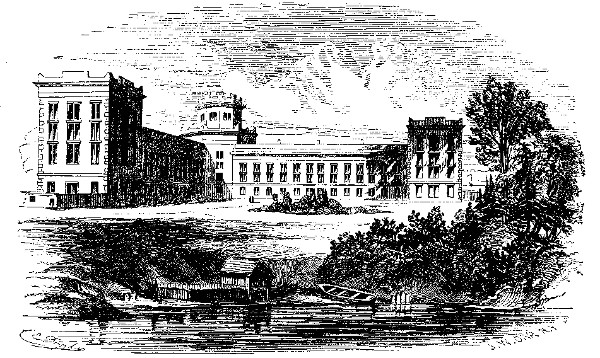
THE BENEVOLENT INSTITUTIONS OF NEW-YORK.
Reading edition
No city in the world is more justly entitled to consideration for active, judicious, and liberal benevolence, than New-York, though it must be confessed that in some respects others may make a more splendid display of the machinery of philanthropy, and even seem in the subscriptions made every year to particular charities to be more liberal. This is easily explained, by the fact that, while the people of New-York are behind none in thrift and virtue, the great commercial capital has nevertheless more than twice as much pauperism and crime, from emigration and importation, as any other city in the world. Foreigners who come here of their own will, foreigners who pay their own passages to our country, are always welcome; but those who are banished from their native places for crime, or deported for idleness, imbecility, or any cause that renders them a burthen to the public, should be shut out from our ports by some more efficient means than have yet been devised for the purpose. This class alone demands of the organized and individual benevolence of New-York a larger amount of money every year than is paid for the relief of human wretchedness in any other city.
The benevolent institutions of New-York are remarkable for their number, so that in no department does an establishment indicate the attention given to the particular necessities to which it is devoted; and not only do the Quakers and the Jews, as in other places, take care of their own poor, but almost every church, no matter of what denomination, is here a well organized society for the relief of the unfortunate among its members, and to a degree, within the sphere of its influence. Where wealth has been acquired by its possessor, there is apt to be a generous consideration for the less fortunate, and no city had ever so many of the philanthropic merchants, of whom the late Samuel Ward was a type, who are as judicious as they are liberal in shielding the oppressed, strengthening the weak, and guiding the unwary, in pointing out ways and furnishing means to the young who seem born to the inheritance of degradation, and in saving others from sufferings caused by improvidence or inevitable misfortune.
We propose no account of the humane societies of New-York, but only a brief mention of some few of those whose edifices are most likely to arrest the attention of strangers, as from several directions they approach the city.
The Institution for the Blind is in the square bounded by Eighth and Ninth Avenues and by Thirty-third and Thirty-fourth Streets, and is built of marble. The society was founded by Mr. Samuel Wood, aided largely by Dr. Samuel Ackerley, and was incorporated in 1831. In the spring of the following year the managers reported that they had made arrangements for instructing two or three blind children, "by way of experiment," and from that period the increase of its action and resources has been constant. Pupils are received for one hundred and thirty dollars a year, and the State has made provision for the maintenance at the institution of one hundred and twenty-eight indigent blind persons, so that it is always nearly full. The system of instruction includes the common English studies, with philosophy and the higher mathematics, mechanics, vocal and instrumental music, and, when desired, such trades as the blind can advantageously practise. The library contains more than seven hundred volumes in raised letters, besides a considerable collection printed in ink. The occasional exhibitions of the pupils have excited much attention, and the institution may be regarded as altogether one of the most successful of its kind in the world.
THE INSTITUTION FOR THE BLIND.
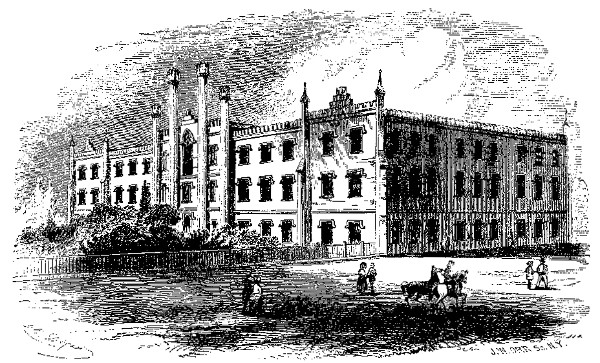
In 1797 the celebrated Isabella Graham founded the Society for the Relief of Poor Widows with Small Children, and in the spring of 1806, Mrs. Alexander Hamilton, the widow of the great statesman, and Mrs. Bethune, a daughter of Mrs. Graham and the mother of the Rev. Dr. Bethune, with several associates, established, as a branch of that institution, the Orphan Asylum of the City of New-York, which was incorporated in 1807. Its first edifice was in Bank-street, but the enlargement of its activity and resources in 1836 led to the purchase of the ample and beautiful grounds near Eightieth-street, five miles from the City Hall, from which the edifice described in the engraving looks down on the Hudson, and forms one of the most picturesque views which greet the traveller who approaches the city by the river from the north. The eminent women whom we have mentioned continue, after nearly half a century, to be active in its management.
THE ORPHAN ASYLUM.
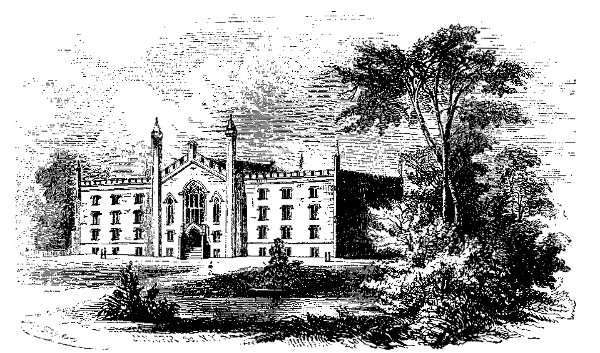
There is also a Protestant Half-Orphan Asylum in Sixth Avenue, a Roman Catholic Orphan Asylum, conducted by Sisters of Charity, in Mott-street, a Roman Catholic Half-Orphan Asylum in Eleventh-street, a very large Colored Orphan Asylum in Twelfth-street, and several other establishments of the same description, supported by public or private charity, in different parts of the city. New-York is second only to Philadelphia in the liberality of its provision for orphan children: the college founded by Stephen Girard places the latter city in this respect before any other in the world.
NEW-YORK INSTITUTION FOR THE DEAF AND DUMB.
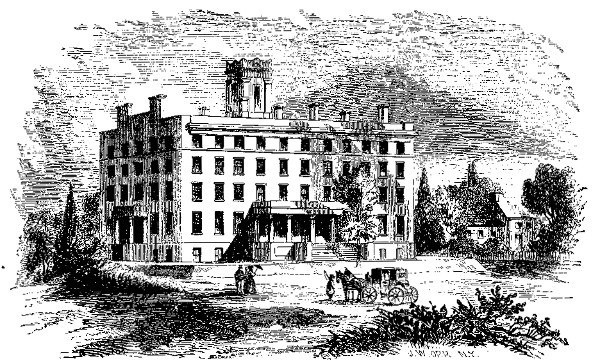
The Institution for the Instruction of the Deaf and Dumb was incorporated in 1817, the first pupils were received in the following year, and in 1827 the foundation was laid for the edifice now occupied by the institution in Fiftieth street, near Fourth Avenue. Since 1831, the President, Harvey P. Peet, LL.D. has had the chief direction of its affairs, and its income, the number of its inmates, and its good reputation, have rapidly increased.
The New-York Hospital in Broadway, the Bloomingdale Asylum for the Insane, the Marine Hospital, the Seamen's Retreat, the Sailors' Snug Harbor, and the numerous establishments (several of which have large and splendid edifices) under the control of the municipal authorities, we may describe at length hereafter. The illustrations of this article evince the liberal style as well as the extent of the institutions which the position of New-York has rendered it necessary for her citizens to establish and support.
LUNATIC ASYLUM, BLACKWELL'S ISLAND.