ADVENTURES AND OBSERVATIONS IN NICARAGUA.
Reading edition
We have already announced in these pages that Mr. Squier, who was lately representative of the United States in Nicaragua, had in preparation for the press an account of his residence in that interesting country, and expressed an opinion that his work would surpass in interest and value the entire library of English and French publications on the subject. An examination of some of the sheets justifies our expectations; Mr. Squier must hereafter be ranked among the most successful travel-writers as well as antiquaries of the time; he knows what to observe and how to observe, and his relations with the Nicaraguans were such that no traveller had ever better opportunities for the acquisition of facts or the formation of judgments. His work will soon be published in a profusely illustrated octavo by Mr. Putnam. A pleasant specimen of the author's style is afforded by the following sketch of an evening ride on the banks of the lake of Granada, and of the sigñoras of that metropolis.
"After a pleasant interview of half an hour we bade Don Jose "buena tarde," and galloped down to the shores of the lake, just as the sun was setting, throwing the whole beach in the shade, while the fairy "Corales" were swimming in the evening light. The shore was ten-fold more animated than when we landed the day previously; men on horseback, women on foot, sailors, fishermen, idlers, children, and a swarm of water-carriers, mingling together, gave life to the scene; while boats and graceful canoes drawn up on the beach, barges rocking at their anchors outside, the grim old fort frowning above, and the green border of trees, with bars of sunlight streaming between them, all contributed to heighten and give effect to the picture. We rode up the glacis of the old castle, through its broken archway, into its elevated area, and looked out beyond the broad and beautiful lake, upon the distant shores of Chontales, with its earthquake-river, hills, and rugged volcanic craters. Their rough features were brought out sharply and distinctly in the slanting light which gilded the western slope of the gigantic volcano of Momobacho, while its eastern declivity slept in purple shadow. We were absorbed in contemplating, one by one, these varied beauties, when the bells of the city struck the hour of the "oracion." In an instant every voice was hushed, the horseman reined in his steed, the rope dropped from the hands of the sailor, the sentinel on the fort stopped short in his round; even the water-jar was left half filled, every head was uncovered, and every lip moved in prayer. The merry waves seemed to break more gently on the shore in harmony with the vibrations of the distant bells, while the subdued hum of reverential voices filled the pauses between. There was something almost magical in this sudden hush of the multitude, and its apparent entire absorption in its devotions, which could not fail deeply to impress the stranger witnessing it for the first time.
"No sooner, however, had the bells ceased to toll and struck up the concluding joyful chime, than the crowd on the shore resumed its life and gayety, while we put spurs to our horses and darted through their midst on our return to the city. The commandant and his companions would only leave me at my door, where we were saluted by our host with, "Saved your distance, gentlemen, dinner's ready!"
"An evening visit to the Señorita Teresa, finished our first entire day in Granada. This young lady had been educated in the United States, spoke English very well, and was withal a proficient in music—accomplishments which we never before learned to estimate at their true value. It was worth something to hear well executed passages from familiar operas, amidst tangible and not painted orange trees and palms, and in an atmosphere really loaded with tropical perfumes, instead of the odors of oil-pots and gas lights. Eight o'clock was the signal for general withdrawal from the streets, for then commenced the reign of the military police, and the city became at once still and quiet. The occasional barking of a dog, the tinkling of a distant guitar, the soughing of the evening wind amongst the trees of the courtyard, the measured tread and graduated "alertas!" of the sentinels, were the only interruptions to the almost sepulchral silence. While returning to our quarters we were startled by the "Quien vive?" of the sentinel, uttered in a tone absolutely ferocious, and as these fellows rarely parleyed long, we answered with all expedition, "La Patria," which was followed on the instant by "Que gente?" "Americanos del Norte." This was enough—these we found were magic words which opened every heart and every door in all Nicaragua. They never failed us. We felt proud to know that no such charm was attached to "Ingleses," "Alemanes", or "Franceses."
"The day following, in accordance with the "costumbres del pais," the customs of the country, we returned the visits of the preceding day, and began to see more of the domestic and social life of the citizens of Granada. We found all of the residences comfortable, and many elegant, governed by mistresses simple, but graceful and confiding in their manners. They were frank in their conversation and inquired with the utmost naïveté whether I was married or intended to be, and if the ladies of El Norte would probably visit Granada, when the "Vapores grandes," the great steamers came to run to San Juan, and the "Vaporcitas" steameretts, to ply on the lake and river. They had heard of a Mr. Estevens (their nearest approach to Stephens), who had written a book about their "pobre pais," their poor country, and were anxious to know what he had said of them, and whether our people really regarded them as "esclavos y brutes sin verguenza," slaves and brutes without shame, as the abominable English (los malditos Ingleses) had represented them. They were also very anxious to know whether the party of Californians which had passed through, were "gente commun," common people, or "caballeros," gentlemen, upon which point, however, we were diplomatically evasive, for there was more in the inquiry than we chose to notice. Our lady had heard that I was a great antiquarian, and, anticipatory to my visit, had got together a most incongruous collection of curiosities, from "vasos antiguos," fragments of pottery, and stone hatchets, down to an extraordinary pair of horn spectacles and a preposterously distorted hog's hoof,—all of which she insisted on sending to my quarters, which she did, with some rare birds, and a plate of dulces! At every house we found a table spread with wines and sweetmeats, and bearing a silver brazier filled with burning coals, for the greater convenience of lighting cigars. I excited much surprise by declining to smoke, on the ground that I had never done so; but the ladies insisted on my taking a "cigarita," which they said wouldn't injure a new-born babe, and paid me the compliment of lighting it with their own fair lips, after which it would have been rank treason to etiquette, and would have ruined my reputation for gallantry, had I refused. I at first endeavored to shirk the responsibility of smoking by thrusting them into my vest pocket, but found that as soon as one disappeared, another was presented, so I was obliged "to face the music" in the end. In every sala we found a large hammock suspended from the walls, which was invariably tendered to the visitor, even when there were easy chairs and sofas in the room. This is the seat of honor.
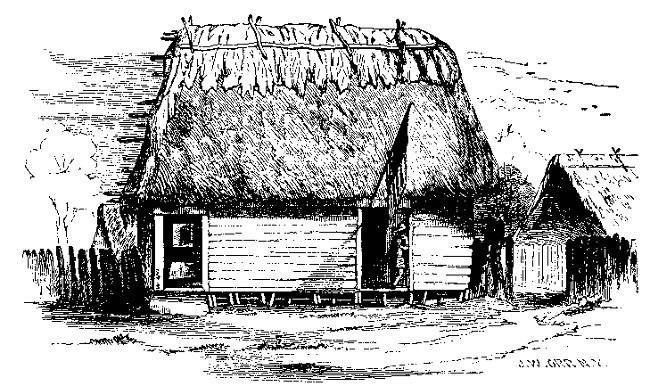
RESIDENCE OF THE UNITED STATES CHARGE D'AFFAIRES, SAN JUAN DE NICARAGUA.
"The women of pure Spanish stock are very fair, and have the embonpoint which characterizes the sex under the tropics. Their dress, except in a few instances where the stiff costume of our own country had been adopted, was exceedingly loose and flowing, leaving the neck and arms exposed. The entire dress was often pure white, but generally the skirt, or nagua, was of some flowered stuff, in which case the guipil (anglice vandyke) was white, heavily trimmed with lace. Satin slippers, a red or purple sash wound loosely round the waist, and a rosary sustaining a little golden cross, with a narrow golden band, or a string of pearls extending around the forehead and binding the hair, which often fell in luxuriant waves upon their shoulders, completed a costume as novel as it was graceful and picturesque. To all this add the superior attractions of an oval face, regular features, large and lustrous black eyes, small mouth, pearly white teeth, and tiny hands and feet, and withal a low but clear voice, and the reader has a picture of a Central American lady of pure stock. A large number of the women have, however, an infusion of other families and races, from the Saracen to the Indian and the Negro, in every degree of intermixture. And as tastes differ, so may opinions as to whether the tinge of brown, through which the blood glows with a peach-like bloom, in the complexion of the girl who may trace her lineage to the Caziques upon one side, and the haughty grandees of Andalusia and Seville on the other, superadded, as it usually is, to a greater lightness of figure and animation of face,—whether this is not a more real beauty than that of the fair and more languid Señora, whose white and almost transparent skin bespeaks a purer ancestry. Nor is the Indian girl, with her full, lithe figure, long, glossy hair, quick and mischievous eyes, who walks erect as a grenadier beneath her heavy water-jar, and salutes you in a musical, impudent voice, as you pass—nor is the Indian girl to be overlooked in the novel contrasts which the "bello sexo" affords in this glorious land of the sun."
Some of the pleasantest incidents related in the book are those which befell the author in his dealings with the Indians, in prosecuting his archæological investigations. These Indians are all passionate admirers of the United States, and of the "hijos de Washington"—the sons of Washington. Mr. Squier was waited upon officially by the authorities of several of the Indian pueblos or towns, and among them by the municipality of the Indian pueblo of Subtiaba, headed by a great friend of our author, Don Simon Roque, first alcalde, who presented him with an address in the aboriginal language, of which the following is a literal translation:
"Sir: The municipality of the Pueblo of Subtiaba, of which we are members, entertain the highest enthusiasm in view of the relations which your arrival induces us to believe will speedily be established between Nicaragua and the United States, the greatest and most glorious republic beneath the sun. We rejoice in the depths of our hearts that a man like yourself has been chosen to convey to us the assurances of future prosperity, in the name of the sons of Washington; and we trust in the Almighty, that the flag of the United States may soon become the shield of Nicaragua on land and sea. Convey our sincerest thanks for their sympathy to the great people which you represent, and give to your generous government the assurances of that deep gratitude which we feel but cannot express. We beg of you, sir, to accept this humble evidence of the cordial sentiments which we entertain both for you, your countrymen, and your Government, and which are equally shared by the people which we represent
Jose de la Cruz Garcias, (Signed) Simon Roque, Francisco Luis Autan."
Our author returned the visit, and gives us the following account of his reception:
"The reader may be assured that I did not forget my promise to the municipality of Subtiaba. A day was shortly afterwards fixed for my visit, and I was received with great ceremony at the cabildo or council chamber, where I found collected all the old men who could assist me in forming a vocabulary of the ancient language, which I had casually expressed a desire to procure. It was with difficulty that we could effect an entrance, for a half-holiday had been given to the boys of all the schools, in honor of the occasion, and they literally swarmed around the building. We were finally ushered into an inner room, where the archives of the municipality were preserved. Upon one side was a large chest of heavy wood, with massive locks, which had anciently been the strong box or treasury. A shadow fell over Simon's animated face as he pointed it out to me, and said that he could remember the time when it was filled with "duros," hard dollars, and when, at a single stroke of the alarm bell, two thousand armed men could be gathered in the plaza of Subtiaba. But those days were passed, and the municipality now scarcely retained a shadow of its former greatness. Under the crown it had earned the title 'leal y fiel' (loyal and true), and in reward of its fidelity it had received a grant of all the lands intervening between it and the ocean, to hold them in perpetuity for the benefit of its citizens. And Simon showed me the royal letters, signed "Yo, el Rey" (I, the King), which the imperial emperor had thought it not derogatory to their dignity to address to his predecessors in office, and notwithstanding his ardent republicanism, I thought Simon looked at them with something of regret. I inquired for manuscripts which might throw some light upon the early history of the country, but found only musty records of no interest or value.
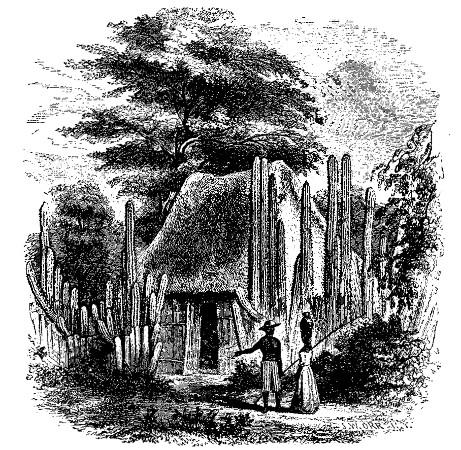
INDIAN HOUSE, SUBTIABA, NICARAGUA.
"My attempts to fill out the blank vocabulary with which I was provided created a great deal of merriment. I enjoyed it quite as much as any of them, for nothing could be more amusing than the discussions between the old men in respect to certain doubtful words and phrases. They sometimes quite forgot my presence, and rated each other soundly as ignoramuses, whereat Simon was greatly scandalized, and threatened to put them all in the stocks as "hombres sin verguenza" (men destitute of shame). 'Ah!' said he, 'these old sinners give me more trouble than the young ones'—a remark which created great mirth amongst the outsiders, and especially amongst the young vagabonds who clung like monkeys to the window bars. The group of swarthy, earnest faces, gathered round the little table, upon which was heaped a confused mass of ancient, time-stained papers, would have furnished a study for a painter. It was quite dark when I had concluded my inquiries, but I was not permitted to leave without listening to a little poem, 'Una Decima,' written by one of the school-masters, who read it to me by the light of a huge wax candle, borrowed, I am sure, from the church for the occasion. My modesty forbids my attempting a translation, and so I compromise matters by submitting the original:
DECIMA.
Nicaragua, ve harta cuando Cesara vuestro desvelo, Ya levantara el vuelo Hermoso, alegre, y triunfante; Al mismo tiempo mirando De este personage el porte, Y mas sera cuando corte Todos los gradeciamentos: Diremos todos contentos Viva el Gobierno del Norte. D. S.
"As I mounted my horse, Don Simon led off with three cheers for 'El Ministro del Norte,' and followed it with three more for 'El Amigo de los Indios' (the friend of the Indians), all of which was afterwards paraded by a dingy little Anglo-servile paper published in Costa Rica, as evidence that I was tampering with the Indians, and exciting them to undertake the utter destruction of the white population!"