Volume 3 / Book 4 — Recent Deaths.
Reading edition
Death of an Officer of Louis XV.'s Mousquetaires.—The Journal de Francfort states that Viscount Frederic Adolphe de Gardinville, of Athies, mousquetaire gris in the service of Louis XV., and knight of the order of St. Louis, has just died, aged 113, at his country house, near Homburg. This officer was born on the twenty-eighth of January, 1738, and had retired to Homburg after the dissolution of the army of the Condé.
The Rev. John Ogilby, D.D., of New-York, died in Paris on the second of February. He was rector of St. Mark's church, in the Bowery, and had been for nine years professor of Ecclesiastical History in the General Theological Seminary of the Protestant Episcopal Church. His health had been impaired for several years, and he had visited Europe in the hope that change of climate and associations would improve it.
The venerable and accomplished George Thomson, the correspondent of Burns, died recently in Leith Links, at the advanced age of ninety-two. Mr. Thomson's early connection with the poet Burns is universally known, and his collection of Scottish Songs, for which many of Burns's finest pieces were originally written, has been before the public for more than half a century. His letters to the poet are incorporated with all the large editions of Burns, and the greater portion of them will be included in the new life by Chambers.
The Emir Bechir, who, during fifty years, played so important a part in Syria, died lately at Kaoi-keni, a village on the Bosphorus. His eldest son, Halib, and younger son, Emir, who had both embraced Islamism, died a few days before him. Izzet Pasha is appointed Governor of Damascus.
Dr. Leuret, the physician of Bicêtre, who is well-known to the scientific world by his profound works on mental derangement and the anatomy of the brain, died on the sixth of January, at Nancy, his birthplace, after a long illness.
The Dutch papers report the death, at Amsterdam, aged seventy-two, of a marine painter of eminence, M. Kockkoek, father of the distinguished landscape painter of the same name.
Joanna Baillie, whose literary life reached back into the last century, and whose early recollections were of the days of Burke, Dr. Johnson, Goldsmith, Sir Joshua Reynolds, and the great men who figured before the French Revolution, died at Hampsted, near London, on the evening of Sunday, the twenty-third of February, at the great age of nearly ninety years. During the principal part of her life she lived with a maiden sister, Agnes—also a poetess—to whom she addressed her beautiful Birthday poem. They were of a family in which talent and genius were hereditary. Their father was a Scottish clergyman, and their mother a sister of the celebrated Dr. William Hunter. They were born at Bothwell, within a short distance of the rippling of the broad waters of the Clyde. Joanna's child-life and associations are beautifully mirrored in the poem to which we have alluded. Early in life the sisters removed to London, where their brother, the late Sir Matthew Baillie—the favorite medical adviser of George III.—was settled as a physician, and there her earliest poetical works appeared, anonymously. When she began to write, she tells us in one of her prefaces, not one of the eminent authors of modern times was known, and Mr. Hayley and Miss Seward were the poets spoken of in society. The brightest stars in the poetical firmament, with very few exceptions, have risen and set since then; the greatest revolutions in empire and in opinion have taken place; but she lived on as if no echo of the upturnings and overthrows which filled the world reached the quiet of her home; the freshness of her inspirations untarnished; writing from the fulness of a true heart of themes belonging equally to all the ages. Personally she was scarcely known in literary society; but from her first appearance as an author, no woman commanded more respect and admiration by her works; and the most celebrated of her contemporaries vied with each other in doing her honor. Scott calls her the Shakspeare of her sex:
——"The wild harp silent hung By silver Avon's holy shore, Till twice a hundred years roll'd o'er, When she, the bold enchantress, came With fearless hand and heart on flame,— From the pale willow snatched the treasure, And swept it with a kindred measure, Till Avon's swans, while rung the grove With Montfort's hate and Basil's love, Awakening at the inspiring strain Deem'd their own Shakspeare lived again!"
Her first volume was published in 1798, under the title, A Series of Plays, in which it is attempted to delineate the stronger Passions of the Mind, each Passion being the subject of a Tragedy and a Comedy. A second volume was published in 1802, and a third in 1812. During the interval, she gave the world a volume of miscellaneous dramas, including the Family Legend, a tragedy founded upon a story of one of the Macleans of Appin, which, principally through the good offices of Sir Walter Scott, was brought out at the Edinburgh Theatre. She visited Scott, in Edinburgh, in 1808, and in the following year the Family Legend was played in that city fourteen nights in succession. Scott wrote for it a prologue, and Mackenzie, the author of The Man of Feeling, contributed an epilogue. The same piece was performed in London in 1814. The only "Play of the Passions" ever represented on a stage was De Montfort, first brought out by John Kemble and Mrs. Siddons, and played eleven nights. In 1821 it was revived by Edmund Kean, but fruitlessly. Miss O'Neil then played the heroine. Kean subsequently brought out De Montfort in Philadelphia and New-York. No actors of inferior genius have ventured to attempt it, and probably it will not again be represented.
The "Plays of the Passions" are Miss Baillie's most remarkable works. In this series each passion is made the subject of a tragedy and a comedy. In the comedies she failed completely; they are pointless tales in dialogue. Her tragedies, however, have great merit, though possessing a singular quality for works of such an aim, in being without the earnestness and abruptness of actual and powerful feeling. By refinement and elaboration she makes the passions sentiments. She fears to distract attention by multiplying incidents; her catastrophes are approached by the most gentle gradations; her dramas are therefore slow in action and deficient in interest. Her characters possess little individuality; they are mere generalizations of intellectual attributes, theories personified. The very system of her plays has been the subject of critical censure. The chief object of every dramatic work is to please and interest, and this object may be arrived at as well by situation as by character. Character distinguishes one person from another, while by passion nearly all men are alike. A controlling passion perverts character, rather than develops it; and it is therefore in vain to attempt the delineation of a character by unfolding the progress of a passion. It has been well observed too, that unity of passion is impossible since to give a just relief and energy to any particular passion, it should be presented in opposition to one of a different sort so as to produce a powerful conflict in the heart.
J Baillie
In dignity and purity of style, Miss Baillie has not been surpassed by any of the poets of her sex. Her dialogue is formed on the Shakespearian model and she has succeeded perhaps better than any other dramatist in imitating the manner of the greatest poet of the world.
In 1823 Miss Baillie published a collection of Poetic Miscellanies, in 1836 three more volumes of Plays, in 1842 Fugitive Verses, and she was the author also of A View of the General Tenor of the New Testament Regarding the Nature and Dignity of Jesus Christ.
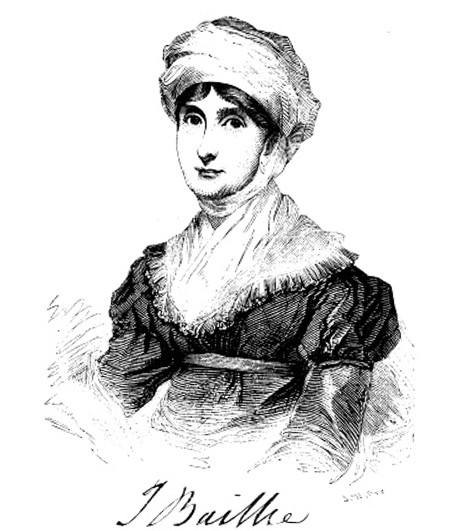
A short time before her death—not more than six weeks—a complete edition of her Poetical Works was published in London, in a very large and compact volume of 850 pages, by the Longmans—"with many corrections and a few additions by herself." The volume opens with the Plays on the Passions. We have then the miscellaneous plays; and the last division includes her delightful songs and all her poetical compositions not dramatic nor connected with the plays; and here appears a poem of some length, recently printed for private circulation, as well as some short poems not before published. A pleasing and characteristic portrait accompanies the volume, and we have had it copied for the International.
Though Miss Baillie's fame always tended to draw her into society, her life was passed in seclusion, and illustrated by an integrity, kindness, and active benevolence, which showed that poetical genius of a high order may be found in a mind well regulated, able and willing to execute the ordinary duties of life in an exemplary manner. Gentle and unassuming to all, with an unchangeable simplicity of character, she counted many of the most celebrated persons of the last age among her intimate friends, and her quiet home was frequently resorted to by people of other nations, as well as by her own countrymen, for the purpose of paying homage to a woman so illustrious for genius and virtue.
Spontini, the celebrated composer, author of La Vestale and Fernand Cortez, died on the 24th ult., at Majolati, near Ancona, where he had gone to pass the winter, in the hope of re-establishing his health. Being desirous of attending divine service, in spite of the severity of the season, he took cold on leaving the church, which in a short time led to a fatal result. He expired in the arms of his wife, the sister of M. Erard, the celebrated pianist. He was in the seventy-second year of his age. The life of this unfortunate Maestro, says the Athenæum, would be a curious rather than a pleasing story, were it thoroughly written. He was educated at the Conservatorio de la Pietà of Naples, and began his career when seventeen years of age, as the composer of an opera, I Puntigli delle Donne. To this succeeded some sixteen operas, produced within six years, for the theatres of Italy and Sicily, not a note of which has survived. In 1803, Spontini went to Paris, in which capital again he produced some half-a-dozen operas and an oratorio,—all of which have perished. It would seem, however, as if there must have been something of grace in either Maestro or music, since Spontini was appointed music-director to the Empress Josephine; and it was owing to court interest that his La Vestale—on a libretto rejected by both Mehal and Cherubini—was put into rehearsal at the Grand Opéra. The rehearsals went on for a twelvemonth. Spontini rewrote and re-touched the work while it was in preparation to such an excess, that the expense of copying the alterations is said to have amounted to ten thousand francs ($2,000)! La Vestale, however, was at last produced, in 1809, with brilliant and decisive success, so far as France and Germany were concerned. In 1809 he produced his Fernand Cortez at the Grand Opéra. That work, too, was favorably received, and still keeps the stage in Germany. In no subsequent essay was the composer so fortunate. Olympie, the third grand work written by him for France, proved a failure. During the latter part of his residence in Paris, he directed the Italian Opera, until it fell to Madame Catalani. It was in 1820 that the magnificent appointments offered to the Maestro by the Court of Prussia tempted him to leave Paris for Berlin; in which capital his last three grand operas were produced with great splendor. These were, Nourmahal (founded on 'Lalla Rookh), Alcidor, and Agnes von Hohenstauffen. None of them, however, could be called successful. In Berlin, Spontini continued to reside as first Chapel-master till the death of the late King,—and there his professional career may be said to have ended. A life in some respects more outwardly prosperous cannot be conceived. Spontini was rich,—girt with ribbons and hung with orders;—but it may be doubted whether ever official grew old in the midst of such an atmosphere of dislike as surrounded the composer of La Vestale at Berlin. He was mercilessly attacked in print,—in private spoken of by rival musicians with an active hatred amounting to malignity. There was hardly a baseness of intrigue with which report did not credit him. His music, even, was avoided in his own theatre; and it was an article in the contract of more than one prima donna, that she would not sing in Spontini's operas. Of later years, he rarely was seen in the orchestra save to direct his own works. In this capacity he showed a vivacity, a precision, and an energy almost incomparable. As a man, he had the courtliest of courtly manners; the air, too, of one well satisfied with his own personal appearance. He conversed chiefly concerning himself and his works, apparently taking little or no interest in other transactions of art. This might account for his ill odor in a capital where misconstructions and jealous evil-speaking have too often been the lot of the simplest, the most learned, and the least self-asserting of artists. The limited nature of his sympathies may be felt in Spontini's music. With all its spirit, this is generally dry—awkward without the excuse of learned pedantry—sometimes grand, very seldom tender—the rhythm more decided than the melody, which is often frivolous, often flat, rarely vocal. He has been accused of shallowness in the orchestral treatment of his operas,—in which noise is often accumulated to conceal want of resource. But allowing all these objections to be generally true to the utmost, the finale to the second act of La Vestale still remains—and will remain—a master-piece of declamation, spirit, and stage climax. The rest of La Vestale is carefully wrought,—but in power, and brightness, and passion, by many a degree inferior to that temple-scene. For its sake, the name of Spontini will not be forgotten, unsatisfactory as was his career in Art, and small as was his personal popularity.
Charles Coquerell, a brother of the eminent Protestant minister, and himself well known and esteemed in the scientific circles of Paris, died in that city, early in February. He long reported the proceedings of the Academy of Sciences for the Courrier Français; and is the author, besides, of various works in general literature. He wrote a History of English Literature—Caritéas, an Essay on a complete Spiritualist Philosophy—and The History of the Churches of the Desert, or of the Protestant Churches of France from the Revocation of the Edict of Nantes to the Reign of Louis the XVI. In this last performance he introduces the substance of a mass of private and official correspondence from Louis XIV.'s time down to the revolution, relative to Protestantism in France, and the numberless and atrocious persecutions to which it was subjected. Many of the papers he obtained are of great literary and historical value, and he has taken measures for their preservation.
Colonel George Williams, M. P. for Ashton, died on the nineteenth of December. He was born in St. John's Newfoundland, and is said to have joined the army of Burgoyne at the age of twelve years, and to have been present at the battle of Stillwater. He afterwards accompanied Lady Harriet Acland on her memorable expedition to join her husband in captivity. He afterwards saw much active service, and died aged eighty-seven, supposed to have been the last survivor of the army of Saratoga.
Herr Charles Matthew Sander, described as one of the most celebrated surgeons of Germany, and author of many works not only in illustration of his more immediate profession and of medicine, but also on Greek phiology and archæology, died suddenly, at Brunswick, in his seventy-second year, while seated at his desk in the act of writing a treatise on anatomy.
Nicholas Vansittart, Lord Bexley, was the second son of Henry Vansittart, Governor of Bengal, and was born on the twenty-ninth of April, 1776. Four years after, his father perished in the Aurora frigate, when that vessel foundered at sea, on her outward passage to India. In 1791 he was called to the bar, but, finding little prospect of forensic advancement, he deserted Westminster Hall for the more ambitious arena of the House of Commons, being elected member for Hastings in 1796. In 1801 he proceeded on a special mission to the Court of Copenhagen; but the Danish Government, overawed by France and Russia, refused to receive an English ambassador. Soon after his return he became joint secretary of the treasury, which office he held until 1804, when the Addington ministry resigned. In 1805, he was appointed Chief Secretary for Ireland; in 1806, he resumed his former duties at the treasury; and, in 1812, on the formation of the Liverpool administration, he obtained the office of Chancellor of the Exchequer, for which he was peculiarly fitted by the bent and information of his mind. So far back as 1796, he had addressed a series of pamphlets to Mr. Pitt, on the conduct of the bank directors; and in 1796 he had published an inquiry into the state of the finances, in answer to a very popular production, by a Mr. Morgan, on the national debt. The death of Lord Londonderry, in 1822, led to a reconstruction of the ministry; and Mr. Vansittart was offered a peerage and the Chancellorship of the Duchy of Lancaster, with a seat in the cabinet, on condition that he quitted the Exchequer. This arrangement was carried out in the month of January following. At length, in 1828, he retired from public life, and since that period resided in comparative retirement, at Footscray, near Bexley, in Kent. Lord Bexley was F.R.S., D.C.L., and F.S.A.
John Pye Smith, D.D., F.R.S., one of the most eminent scholars and theological writers of the time, died at Guilford, near Leeds, in England, on the fifth of February, at the advanced age of seventy-six—having been born at Sheffield in 1775. His father was a bookseller, and it was intended to bring him up to the same business, but his early displays of talent, and his love of learning induced his father to send him to Rotherham College, where he greatly distinguished himself, and upon the completion of his terms of study became a classical tutor. In 1801—at the early age of twenty-five—he became theological tutor and principal of Homerton College, the oldest of the institutions for training ministers among the Independents. The duties of that responsible post he filled with untiring devotedness and the highest efficiency for the long space of fifty years. A theological professorship is naturally combined with ministerial duties; and in two or three years after his settlement at Homerton he received a call from the church at the Gravel Pits chapel, and continued the pastor of that church for about forty-seven years. The chief labor of Dr. Pye Smith's life, and his most enduring monument, was the work entitled The Scripture Testimony to the Messiah: an inquiry with a view to a satisfactory determination of the doctrine taught in the Holy Scriptures concerning the person of Christ. This work is admitted by the greatest scholars to be the first of its kind. It is marked by profound and accurate learning, candid criticism, and by that reverential and Christian spirit which ought to govern every theological inquiry. He published several less important compositions, including one of decided value upon the relations of geology and revelation, which led to his election into the Royal Society; and he left a voluminous System of Christian Doctrine, in MS.