Volume 3 / Book 4 — Ladies' Fashions for the Spring.
Reading edition
The advance of the spring appears to have brought increase of gayety in London and in Paris, in which cities fashionable society has received new impulses from circumstances connected with affairs. Heavy velvets have generally given place to silks and satins, and there is a prevailing airiness in the manner in which they are made up. The first of the above full-lengths represents a dress composed of a pale sea-green satin; the sides of the front decorated with bouffants or fullings of white tulle, formed in rows of three; at the top of each third fulling is a narrow border of green cord, forming a kind of gymp; these fullings reach up to each side of the point of the waist; low pointed corsage, the centre of which is trimmed to match the jupe; a small round cape encircles the top part of the corsage, descending halfway down each side of the front, trimmed with fullings of white tulle and narrow green cord; the lower part of the short sleeve is trimmed to match. The hair is arranged in ringlets, and adorned on the right side with a cluster of variegated red roses.
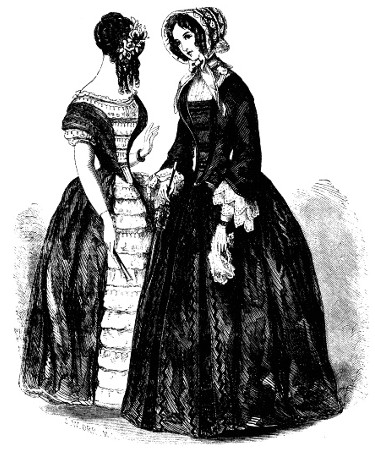
In the second, is a dress of rich dark silk, made plain and very full, with three-quarter-high body, fitting close to the figure; bonnet of deep lilac.
Ball dresses are worn richly ornamented with ribbons, flowers, lace, and puffs, in great profusion.
Velvet necklaces, and bracelets, are much in vogue; the shades preferred are coral red, garnet, china rose, and, above all, black velvet, which sets off the whiteness of the skin. These bracelets and necklaces are fastened by a brooch or pin of brilliants or marcasite.
Dresses of heavy stuffs are rare in private drawing-rooms, and much more frequently seen at subscription balls, at the Opera, or exhibitions of art. Antique watered silk, figured pompadour, drugget, and lampus, attract by their wreaths of flowers; light net dresses, or mousselins, are rare.
Net dresses, with two skirts, are worn over a taffeta petticoat—the under and the upper skirts decked with small flowers, each trimmed with a dark ribbon. Wide lace also is worn in profusion, and the body as well as the sleeves is almost covered with it—the skirts having two or three flounces of English lace (application) or Alençon point; and these two kinds of lace are generally used for the heavy silk stuffs.
We have little to say about walking dresses. The choicest materials for morning dresses are dark damask satinated Pekin taffeta, and drugget.