POEMS BY S. G. GOODRICH[8]
Reading edition
POEMS BY S. G. GOODRICH[8]
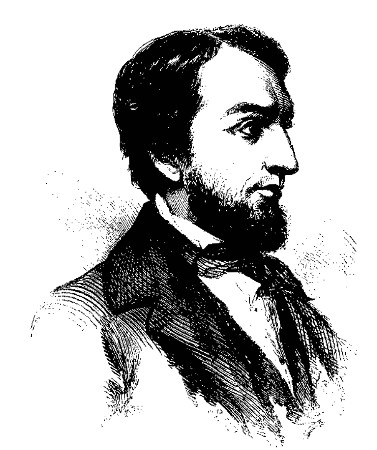
For the last twenty years the name of Mr. Goodrich has been very constantly associated with American literature. He commenced as a publisher, in Boston, and was among the first to encourage by liberal copyrights, and to make attractive by elegant editions, the works of American authors. One of his earliest undertakings was a collection of the novels of Charles Brockden Brown, with a memoir of that author, by his widow, with whom he shared the profits. In 1828 he began "The Token," an annual literary souvenir, which he edited and published fourteen years. In this appeared the first fruits of the genius of Cheney, who has long been acknowledged the master of American engravers; and the first poems and prose writings of Longfellow, Willis, Mellen, Mrs. Osgood, Mrs. Child, Mrs. Sigourney, and other eminent authors. In "The Token" also were printed his own earlier lyrical pieces. The work was of the first rank in its class, and in England as well as in this country it was uniformly praised.
In 1831 an anonymous romance was published by Marsh & Capen, of Boston. It was attributed by some to Willis, and by others to Mrs. Child, then Miss Francis. It illustrated a fine and peculiar genius, but was soon forgotten. Mr. Goodrich appreciated its merits, and applied to the publishers for the name of the author, that he might engage him as a contributor to "The Token." They declined to disclose his secret, but offered to forward a letter to him. Mr. Goodrich wrote one, and received an answer signed by Nathaniel Hawthorne, many of whose best productions, as "Sights from a Steeple," "Sketches under an Umbrella," "The Prophetic Pictures," "Canterbury Pilgrims," &c., appeared in this annual. In 1839, Mr. Goodrich suggested to Mr. Hawthorne the publication of a collection of his tales, surrendering his copyrights to several of them for this purpose; but so little were the extraordinary qualities of this admirable author then understood, that the publishers would not venture upon such an experiment without an assurance against loss, which Mr. Goodrich, as his friend, therefore gave. The public judgment will be entitled to little respect, if the copyright of the works of Hawthorne be not hereafter a most ample fortune.
Mr. Goodrich soon abandoned the business of publishing, and, though still editing "The Token," devoted his attention chiefly to the writing of that series of educational works, known as Peter Parley's, which has spread his fame over the world. The whole number of these volumes is about sixty. Among them are treatises upon a great variety of subjects, and they are remarkable for simplicity of style and felicity of illustration. Mr. Goodrich has accomplished a complete and important revolution in juvenile reading, substituting truth and nature for grotesque fiction in the materials and processes of instruction, and his method has been largely imitated, at home and abroad. In England many authors and publishers have disgraced the literary profession by works under the name of "Parley," with which he has had nothing to do, and which have none of his wise and genial spirit.
Besides his writings under this pseudonym, Mr. Goodrich has produced several works of a more ambitious character, which have been eminently popular. Among them is a series entitled "The Cabinet Library," embracing histories, biographies, and essays in science; "Universal Geography," in an octavo volume of one thousand pages; and a "History of all Nations," in two large octavos, in which he has displayed such research, analysis, and generalization, as should insure for him an honorable rank among historians. We cannot better illustrate his popularity than by stating the fact, that more than four hundred thousand volumes of his various productions are now annually sold in this country and Europe. No living writer is, therefore, as much read, and in the United States hardly a citizen now makes his first appearance at the polls, or a bride at the altar, to whose education he has not in a large degree contributed. For twenty years he has preserved the confidence of parents and teachers of every variety of condition and opinion, by the indefectible morality and strong practical sense, which are universally understood and approved.
Like many other eminent persons, Mr. Goodrich lets sought occasional relaxation from the main pursuits of his life in poetry, and the volume before us contains some forty illustrations of his abilities, as a worshipper of the muse whose temples are most thronged, but who is most coy and most chary of her inspiration. They have for the most part been previously printed in "The Token," or in literary journals, but a few are now published the first time. In typographical and pictorial elegance the book is unique. It is an exhibition of the success of the first attempt to rival the London and Paris publishers in woodcut embellishment and general beauty of execution.
That Mr. Goodrich possesses the poetical faculty in an eminent degree, no one has doubted who has read his fine lines "To Lake Superior:"
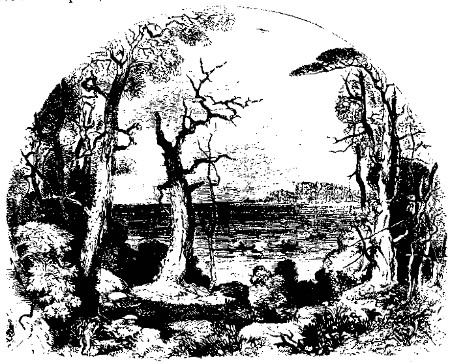
Father of Lakes! thy waters bend, Beyond the eagle's utmost view, When, throned in heaven, he sees thee send Back to the sky its world of blue. Boundless and deep the forests weave Their twilight shade thy borders o'er, And threatening cliffs, like giants, heave Their rugged forms along thy shore. Nor can the light canoes, that glide Across thy breast like things of air, Chase from thy lone and level tide, The spell of stillness deepening there. Yet round this waste of wood and wave, Unheard, unseen, a spirit lives, That, breathing o'er each rock and cave, To all, a wild, strange aspect gives. The thunder-riven oak, that flings Its grisly arms athwart the sky, A sudden, startling image brings To the lone traveller's kindled eye. The gnarled and braided boughs that show Their dim forms in the forest shade, Like wrestling serpents seem, and throw Fantastic horrors through the glade. The very echoes round this shore, Have caught a strange and gibbering tone, For they have told the war-whoop o'er, Till the wild chorus is their own. Wave of the wilderness, adieu— Adieu, ye rocks, ye wilds, ye woods! Roll on, thou Element of blue, And fill these awful solitudes! Thou hast no tale to tell of man. God is thy theme. Ye sounding caves, Whisper of Him, whose mighty plan, Deems as a bubble all your waves!
The "Birth Night of the Humming Birds" has been declared by the London Athenæum equal to Dr. Drake's "Culprit Fay," and it may be regarded as in its way the best specimen of Mr. Goodrich's talents. It is too long to be quoted in these paragraphs. In descriptions of nature he is uniformly successful, presenting his picture with force and distractness.
There are many examples of this in one of his longest poems, "The Mississippi," in which the traditions that cluster around the Father of Waters, and the advances of civility along his borders, are graphically presented. The river is described as rising.
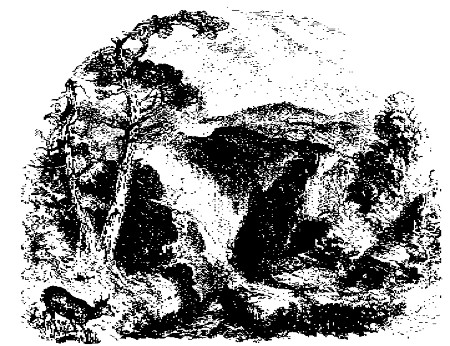
"Far in the west, where snow-capt mountain's rise, Like marble shafts beneath heaven's stooping dome, And sunset's charming curtain drapes the skies As if Enchantment there would build her home.
The bard laments that
"though these scenes are fair As fabled Arcady, the sylph and fay, And all their gentle kindred, shun the air, Where car and steamer make their stormy way;"
Yet trusts that in a future time,
"Perchance some Cooper's magic art may wake The sleeping legends of this mighty vale, And twine fond memories round the lawn and lake, Where Warrior fought or Lover told his tale.
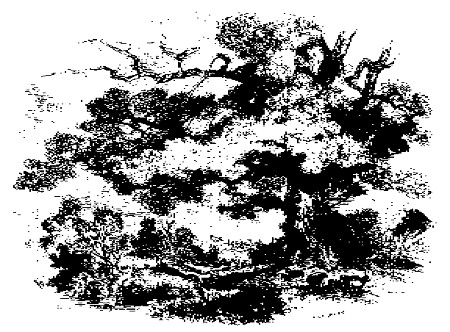
In the volume are several allegorical pieces of much merit, of which the most noticeable are the "Two Windmills," "The Bubble Chase," and "The Rainbow Bridge." Several smaller poems are distinguished for a quaint simplicity, reminding us of the old masters of English verse; and others, for refined sentiment, as the "Old Oak," of which the key-note is in the lines,
Here is the grassy knoll I used to seek At summer noon, beneath the spreading shade, And watch the flowers that stooped, with glowing cheek, To meet the romping ripples as they played.
The longest of Mr. Goodrich's poems is "The Outcast." It was first published many years ago, and it appears now with the improvements suggested by reflection and criticism. Its fault is, a certain intensity, but it has noble passages, betraying a careful study and profound appreciation of the subtler operations of the mind, particularly, when, in its most excited action, it is influenced by the observation of nature.
The volume will take its place in the cabinets of our choice literature, and will be prized the more for the fact that by selecting American themes for his most elaborate compositions, Mr. Goodrich has made literature subservient to the purposes of patriotism.
FOOTNOTES: