ILLUSTRATIONS (continued 5)
Reading edition
"This isn't the time to talk about what I owe you," he said, feeling the insufficiency of his words; "it's too much to be disposed of in a few phrases."
"On the contrary, you owe me nothing at all."
"We'll not dispute the point now."
"No; but I'd rather not leave you under a misapprehension. If I've done anything to-night—been of any use at all—it's been simply because I loved Dorothea—and—and—it was right. When it was in my power, I couldn't have refused to do it for any one—for any one, you understand."
"Oh yes, I understand perfectly; but any one, in the same circumstances, would feel as I do. No, not as I do," he corrected, quickly. "No one else in the world could feel—" "I'm really very tired," she said, hurriedly; "I'll go now; but I count on you to call me."
He watched her while she glided across the room; but it was only when her door had closed and he had dropped into his seat that he was able to state to himself the fact that the mere sight of her again had demolished all the barricades he had been building in his heart against her for the last six months. They had fallen more easily than the walls of Jericho at the blast of the sacred horn. The inflection of her voice, the look from her eyes, the gestures of her hands, had dispelled them into nothingness, like ramparts of mist. But it was not that alone! He was too much a man of affairs not to give credit to the practical abilities she had shown that night. No graces of person or charms of mind or resources of courage could have called forth his admiration more effectively than this display of prosaic executive capacity. What had to be done she had done more promptly, wisely, and easily than any man could have accomplished it. She had foreseen possibilities and forestalled accident with a thoroughness which he himself could not have equalled.
"My God!" he groaned, inwardly, "what a wife she would have made for any man! How I could have loved her, if it hadn't been for—"
He stopped abruptly and leaped to his feet, looking around dazed on the great empty hail, at the end of which a porter slept in his chair, while the clerk blinked drowsily behind his desk.
"I do love her," he declared to himself. "All summer long I have uttered blasphemies. I do love her. Whatever she may have been, she shall be my wife."
Out on the terrace the cold wind was grateful, and he stood for a minute bareheaded, letting it blow over his fevered face and through his hair. It had risen during the last hour, making the pines rock slowly in the starlight and swelling their moan into deep sobs.
As Derek Pruyn paced the terrace in strained expectation he was deceived again and again into the thought that something was approaching. Now it was the champing and stamping of horses toiling up the ascent; now it was the bray and throb of the automobile; now it was the voices of men, conversing or calling or breaking into laughter. Twenty times he hastened to the steps at the end of the terrace, sure he could not have been mistaken, only to hear the earth-forces sob and sough and shout again, as if in derision of this puny, presumptuous mortal, with his evanescent joy and pain.
So another hour passed. His mind was not of the imaginative order which invents disaster in moments of suspense, so that he was able to keep his watch more patiently than many another might have done. Once he tried to smoke; but the mere scent of tobacco seemed out of place in this curious world, alive with odd psychical suggestions, and he threw the cigar away into the darkness, where its light glowed reproachfully, like a dying eye, till it went out.
It was after three when a sudden sound from the driveway struck his ear; but he had been deceived so often that he would pay it no attention. Though it seemed like the unmistakable approach of an automobile, it had seemed so before, and he would not even look round till he had reached the distant end of the terrace. When he turned he could see through the trees, and along the dark line of the avenue, the advance of the heralding light. Dorothea had come at last. She was even close upon them. In a few more seconds she would be alighting at the steps.
He hurried inside to wake the porter and warn Diane.
"She's here!" he called, rapping sharply at her door. "Please come! Quick!"
There was a response and a hurried movement from within, but he did not wait for her to appear. When she came out of her room she could see from the light thrown over the terrace that the motor had already stopped at the steps. Some one was getting out, and she could hear men's voices. Advancing to a spot midway between her room and the main entry, she stood waiting for Derek to bring her his daughter. A moment later he sprang into the light of the doorway with features white and alarmed.
"Go back!" he cried to her, with a commanding gesture. "Go back!"
"But what's the matter?"
"Go back!" he ordered, more imperiously than before.
"Oh, Derek, it's Dorothea! She's hurt. I must go to her. I will not go back."
She rushed toward the entry, but he caught her and pushed her back.
"I tell you you must go back," he repeated.
"It's Dorothea!" she cried. "She's hurt! She's killed! Let me go! She needs me!"
"It isn't Dorothea," he whispered, forcing her over the threshold of her own room and trying to close the door upon her.
"Then what is it?" she begged. "Tell me now. You're hurting me. Let me go! You're killing me."
"It's—"
But there was no need to say more, for the main door swung open again and the Marquis de Bienville entered, followed by a porter carrying his valise.
At his appearance Derek relinquished Diane's hands, and Diane herself was so astonished that she stepped plainly into view. Not less astonished than herself, Bienville stopped stock-still, looked at her, looked into the room behind her, looked at Derek with a long, half-amused, comprehending stare, lifted his hat gravely, and passed on.
When he had gone there was a minute of dead silence. With parted lips and awe-stricken eyes Diane gazed after him till he had spoken to the clerk at the desk and passed on into the darker recesses of the hotel. When she turned toward Derek he was smiling, with what she knew was an effort to treat the situation lightly.
"Well, this time we've given him something to talk about," he laughed, bravely.
She shrugged her shoulders and spread apart her hands with one of her habitual, fatalistic gestures.
"I don't mind. He can't do me more harm than he's done already. It's not of him that I'm thinking, but of Dorothea. She hasn't come."
"No, she hasn't come."
The fact had grown alarming, so much so as to make the incident of Bienville's appearance seem in comparison a matter of little moment. Diane remained on the threshold of her room, and Derek in the hail outside, while, for mutual encouragement, they rehearsed once more the list of predicaments in which the young people might have found themselves without serious danger.
Diane was about to withdraw, when a man ran down the hall calling:
"The telephone!—for the gentleman!"
Derek started on a run, Diane following more slowly. When she reached the office Derek had the receiver to his ear and was talking.
"Yes, Fulton. Go on. I hear.... Who has rung you up?... I didn't catch ... Miss—who? Oh, Miss Marion Grimston. Yes?... In Philadelphia, at the Hotel Belleville.... Yes; I understand ... and Miss Dorothea is with her.... Good! ... Did she say how she got there?... Will explain when we get back to New York to-morrow morning.... All right.... Yes, to lunch.... She said Miss Dorothea was quite well, and satisfied with her trip!... That's good.... Well, good-night, Fulton. Sorry to have kept you up."
He put up the receiver and turned to Diane.
"Did you understand?"
"Perfectly. I think I know what has happened. I can guess."
"Then, I'll be hanged if I can. What is it?"
"I'll let them tell you that themselves. I'm too tired to say anything more to-night."
She kept close to the office where the clerk was shutting books and locking drawers preparatory to closing.
"You must let me come and thank you—" he began.
"You must thank Miss Marion Grimston," she interrupted, "for any real service. All I've done for you, as you see, has been to bring you on an unnecessary journey."
"For me it has been a journey—into truth."
"I'll say good-night now. I shall not see you in the morning. You'll not forget to be very gentle with Dorothea, will you—and with him? Good-night again—good-night."
Smiling into his eyes, she ignored the hand he held out to her and slipped away into the semi-darkness as the impatient clerk began turning out the lights.
XXII
Derek Pruyn was guilty of an injustice to the Marquis de Bienville in supposing he would make the incident at Lakefield a topic of conversation among his friends. His sense of honor alone would have kept him from betraying what might be looked upon as an involuntary confidence, even if it had not better suited his purposes to intrust the matter, in the form of an amusing anecdote, told under the seal of secrecy, to Mrs. Bayford. In her hands it was like invested capital, adding to itself, while he did nothing at all. Months of insinuation on his part would have failed to achieve the result that she brought about in a few days' time, with no more effort than a rose makes in shedding perfume.
Before Derek had been able to recover from the feeling of having passed through a strange waking dream, before Dorothea and he had resumed the ordinary tenor of their life together, before he had seen Diane again, he was given to understand that the little scene on Bienville's arrival at the Bay Tree Inn was familiar matter in the offices, banks, and clubs he most frequented. The intelligence was conveyed by a score of trivial signs, suggestive, satirical, or over-familiar, which he would not have perceived in days gone by, but to which he had grown sensitive. It was clear that the story gained piquancy from its contrast with the staidness of his life; and his most intimate friends permitted themselves a little covert "chaff" with him on the event. He was not of a nature to resent this raillery on his own account; it was serious to him only because it touched Diane.
For her the matter was so grave that he exhausted his ingenuity in devising means for her protection. He refrained from even seeing her until he could go with some ultimatum before which she should be obliged to yield. An unsuccessful appeal to her, he judged, would be worse than none at all; and until he discovered arguments which she could not controvert he decided to hold his peace.
Action of some sort became imperative when he found that Miss Lucilla Van Tromp had heard the story and drawn from it what seemed to her the obvious conclusion.
"I should never have believed it," she declared, tearfully, "if you hadn't admitted it yourself. I told Mrs. Bayford that nothing but your own words would convince me that any such scene had taken place."
"Allowing that it did, isn't it conceivable that it might have had an honorable motive?" "Then, what is it? If you could tell me that—"
"I could tell you easily enough if there weren't other considerations involved. I should think that in the circumstances you could trust me."
"Nobody else does, Derek."
"Whom do you mean by nobody else?—Mrs. Bayford?"
"Oh, she's not the only one. If your men friends don't believe in you—"
"They believe in me, all right; don't you worry about that."
"They may believe in you as men believe in one another; but it isn't the way I believe in people."
"I know how you believe in people if ill-natured women would let you alone. You wouldn't mistrust a thief if you saw him stealing your watch from your pocket."
"That's not true, Derek. I can be as suspicious as any one when I like."
"But don't you see that your suspicion doesn't only light, on me? It strikes Diane."
"That's just it."
"Lucilla! he cried, reproachfully.
"Well, Derek, you know how loyal I've been to her. It's been harder, too, than you've ever been aware of; for I haven't told you—I wouldn't tell you—one-half the things that people have hinted to me during the past two years."
"Yes; but who? A lot of jealous women—"
"It's no use saying that, Derek; because your own actions contradict you. Why did Diane leave your house, if it wasn't that you believed—?"
"Don't." He raised his hand to his face, as if protecting himself from a blow.
"I wouldn't," she cried, "if you didn't make me. I say it only in self-defence. After all, you can only accuse me of what you've done yourself. Diane made me think at first that you had misjudged her; but I see now that if she had been a good woman you wouldn't have sent her away."
"I didn't send her away. She went."
"Yes, Derek; but why?"
"That has nothing to do with the question under discussion."
"On the contrary, it has everything to do with it. It all belongs together. I've loved Diane, and defended her; but I've come to the point where I can't do it any longer. After what's happened—"
"But, I tell you, what's happened is nothing! If it was only right for me to explain it to you, as I shall explain it to you some day, you'd find you owed her a debt that you never could repay."
"Very well! I won't dispute it. It still doesn't affect the main point at issue. Can you yourself, Derek, honestly and truthfully affirm that you look upon Diane as a good woman, in the sense that is usually attached to the words?"
"I can honestly and truthfully affirm that I look upon her as one of the best women in the world."
"That isn't the point. Louise de la Vallière became one of the best women in the world; but there are some other things that might be said of her. But I'll not argue; I'll not insist. Since you think I'm wrong, I'll take your own word for it, Derek. Just tell me once, tell me without quibble and on your honor as my cousin and a gentleman, that you believe Diane to be—what I've supposed her to be hitherto, and what you know very well I mean, and I'll not doubt it further."
For a moment he stood speechless, trying to formulate the lie he could utter most boldly, until he was struck with the double thought that to defend Diane's honor with a falsehood would be to defame it further, while a lie to this pure, trusting, virginal spirit would be a crime.
"Tell me, Derek," she insisted; "tell me, and I'll believe you."
He retreated a pace or two, as if trying to get out of her presence.
"I'm listening, Derek; go on; I'm willing to take your word."
"Then I repeat," he said, weakly, "that I believe her, I know her, to be one of the best women in the world."
"Like Louise de la Vallière?"
"Yes," he shouted, maddened to the retort, "like Louise de la Vallière! And what then?" He stood as if demanding a reply. "Nothing. I have no more to say." "Then I have; and I'll ask you to listen." He drew near to her again and spoke slowly. "There were doubtless many good women in Jerusalem in the time of Herod and Pilate and Christ; but not the least held in honor among us to-day is—the Magdalen. That's one thing; and here's something more. There is joy, so we are told, in the presence of the angels of God—plenty of it, let us hope!—but it isn't over the ninety-and-nine just persons who need no repentance, so much as over the one poor, deserted, lonely sinner that repenteth—that repenteth, Lucilla, do you hear?-and you know whom I mean." With this as his confession of faith he left her, to go in search of Diane. He had formed the ultimatum before which, as he believed, she should find herself obliged to surrender.
It was a day on which Diane's mood was one of comparative peace. She was engrossed in an occupation which at once soothed her spirits and appealed to her taste. Madame Cauchat, the land-lady, bewailing the continued illness of her lingère, Diane had begged to be allowed to take charge of the linen-room of the hotel, not merely as a means of earning a living, but because she delighted in such work. Methodical in her habits and nimble with her needle, the neatness, smoothness, and purity of piles of white damask stirred all those house-wifely, home-keeping instincts which are so large a part of every Frenchwoman's nature. Her fingers busy with the quiet, delicate task of mending, her mind could dwell with the greater content on such subjects as she had for satisfaction.
They were more numerous than they had been for a long time past. The meeting at Lakefield had changed her mental attitude toward Derek Pruyn, taking a large part of the pain out of her thoughts of him, as well as out of his thoughts of her. She had avoided seeing him after that one night, and she had heard nothing from him since; but she knew it was impossible for him to go on thinking of her altogether harshly. She had been useful to him; she had saved Dorothea from a great mistake; she had done it in such a way that no hint of the escapade was likely to become known outside of the few who had taken part in it; she had put herself in a relation toward him which, as a final one, was much to be preferred to that which had existed before. She could therefore pass out of his life more satisfied than she had dared hope to be with the effect that she had had upon it. As she stitched she sighed to herself with a certain comfort, when, glancing up, she saw him standing at the door. The nature of her thoughts, coupled with his sudden appearance, drew to her lips a quiet smile.
"They shouldn't have shown you in here," she protested, gently, letting her work fall to her lap, but not rising from her place.
"I insisted," he explained, briefly, from the threshold.
"You can come in," she smiled, as he continued to stand in the doorway. "You can even sit down." She pointed to a chair, not far from her own, going on again with her stitching, so as to avoid the necessity for further greeting. "I suppose you wonder what I'm doing," she pursued, when he had seated himself.
"I'm not wondering at that so much as whether you ought to be doing it."
"I can relieve your mind on that score. It's a case, too, in which duty and pleasure jump together; for the delight of handling beautiful linen is like nothing else in the world."
"It seems to me like servants' work," he said, bluntly.
"Possibly; but I can do servants' work at a pinch—especially when I like it."
"I don't," he declared.
"But then you don't have to do it."
"I mean that I don't like it for you."
"Even so, you wouldn't forbid my doing it, would you?"
"I wish I had the right to. I've come here this afternoon to ask you again if you won't give it to me."
For a few minutes she stitched in silence. When she spoke it was without stopping her work or lifting her head.
"I'm sorry that you should raise that question again. I thought it was settled."
"Supposing it was, it can be reopened—if there's a reason."
"But there is none."
"That's all you know about it. There's a very important reason."
"Since—when?"
"Since Lakefield."
"Do you mean anything that Monsieur de Bienville may have said?"
"I do."
"That wouldn't be a reason—for me."
"But you don't know—"
"I can imagine. Monsieur de Bienville has already done me all the harm he can. It's beyond his power to hurt me any more."
"But, Diane, you don't know what you're saying. You don't know what he's doing. He's—he's—I hardly know how to put it—He's destroying your reputation."
She glanced up with a smile, ceasing for an instant to sew.
"You mean, he's destroying what's left of it. Well, he's welcome! There was so little of it—"
"For God's sake, Diane, don't say that; it breaks my heart. You must consider the position that you put me in. After you've rendered me one the greatest services one person can do another, do you think I can sit quietly by while you are being robbed of the dearest thing in life, just because you did it?"
"I should be sorry to think the opinion other people hold of me to be the dearest thing in life; but, even if it were, I'd willingly give it up for—Dorothea."
"It isn't for Dorothea; it's for me."
"Well, wouldn't you let me do it—for you? I'm not of much use in the world, but it would make me a little happier to think I could do any one a good turn without being promised a reward."
"A reward! Oh, Diane!"
"It's what you're offering me, isn't it? If it hadn't been for—for—the great service you speak about, you wouldn't he here, asking me again to be your wife."
"That's your way of putting it, but I'll put it in mine. If it hadn't been for the magnitude of the sacrifice you're willing to make for me, I shouldn't have dared to hope that you loved me. When all pretexts and secondary causes have been considered and thrust aside, that's why I'm here, and for no other reason whatever. If you love me," he continued, "why should you hesitate any longer? If you love me, why seek for reasons to justify the simple prompting of your heart? What have you and I got to do with other people's opinions? When there's a plain, straightforward course before us, why not go right on and follow it?"
She raised her eyes for one brief glance.
"You forget."
The words were spoken quietly, but they startled him.
"Yes, Diane; I do forget. Rather, there's nothing left for me to remember. I know what you'd have me recall. I'll speak of it this once more, to be silent on the subject forever. I want you to forgive me. I want to tell you that I, too, have repented."
"Repented of what?"
"Of the wrong I've done you. I believe your soul to be as white as all this whiteness around you."
"Then," she continued, questioning gently, "you've changed your point of view during the last six months?"
"I have. You charged me then with being willing to come down to your level; now I'm asking you to let me climb up to it. I see that I was a self-righteous Pharisee, and that the true man is he who can smite his breast and say, God be merciful to me a sinner!"
"A sinner—like me."
"I don't want to be led into further explanations," he said, suddenly on his guard against her insinuations. "You and I have said too much to each other not to be able to be frank. Now, I've been frank enough. You've understood what I've felt at other times; you understand what I feel to-day. Why draw me out, to make me speak more plainly?"
"I am not drawing you out," she declared. "If I ask you a question or two, it was to show you that not even the woman that you take me for—not even the forgiven penitent—could be a good wife for you. I can't marry you, Mr. Pruyn. I must beg you to let that answer be decisive."
There was decision in the way in which she folded her work and smoothed the white brocaded surface in her lap. There was decision, too, in the quickness with which he rose and stood looking down at her. For a second she expected him to turn from her, as he had turned once before, and leave her with no explanation beyond a few laconic words. She held her breath while she awaited them.
"Then that means," he said, at last, "that you put me in the position of taking all, while you give all."
"I don't put you in any position whatever. The circumstances are not of my making. They are as much beyond my control as they are beyond yours."
"They're not wholly beyond mine. If there are some things I can't do, there are some I can prevent."
"What things?"
His tone alarmed her, and she struggled to her feet.
"You're willing to make me a great sacrifice; but at least I can refuse to accept it."
"What do you mean?" She moved slightly back from him, behind the protection of one of the tables piled breast-high with its white load.
"You're willing to lose for me the last vestige of your good name—"
"I don't care anything about that," she said, hurriedly.
"But I do. I won't let you."
"How can you stop me?" she asked, staring at him with large, frightened eyes.
"I shall tell Dorothea's part in the story."
"You'd—?" she began, with a questioning cry.
"All who care to hear it, shall. They shall know it from its beginning to its end. They shall lose no detail of her folly or of your wisdom."
"You would sacrifice your child like that?"
"Yes, like that. Neither she nor I can remain so indebted to any one, as you would have us be to you."
"You—wouldn't—be—indebted—to—me?"
"Not to so terrible an extent. If it's a choice between your good name and hers—hers must go. She'd agree with me herself. She wouldn't hesitate for one single fraction of an instant—if she knew. She'd be grateful to you, as I am; but she couldn't profit by your magnanimity."
"So that the alternative you offer me is this: I can protect myself by sacrificing Dorothea, or I can marry you, and Dorothea will be saved."
"I shouldn't express it in just those words, but it's something like it."
"Then I'll marry you. You give me a choice of evils, and I take the least."
"Oh! Then to marry me would be—an evil?"
"What else do you make it? You'll admit that it's a little difficult to keep pace with you. You come to me one day accusing me of sin, and on another announcing my contrition, while on the third you may be in some entirely different mood about me."
"You can easily render me ridiculous. That's due to my awkwardness of expression and not to anything wrong in the way I feel."
"Oh, but isn't it out of the heart that the mouth speaketh? I think so. You've advanced some excellent reasons why I should become your wife, and I can see that you're quite capable of believing them. At one time it was because I needed a home, at another because I needed protection, while to-day, I understand, it is because I love you."
"Is this fair?"
"I dare say you think it isn't; but then you haven't been tried and judged half a dozen times, unheard, as I've been. I'll confess that you've shown the most wonderful ingenuity in trying to get me into a position where I should be obliged to marry you, whether I would or not; and now you've succeeded. Whether the game is worth the candle or not is for you to judge; my part is limited to saying that you've won. I'm ready to marry you as soon as you tell me when."
"To save Dorothea?"
"To save Dorothea."
"And for no other reason?"
"For no other reason."
"Then, of course, I can't keep you to your word."
"You can't release me from it except on one condition."
"Which is—?"
"That Dorothea's secret shall be kept."
"I must use my own judgment about that."
"On the contrary, you must use mine. You've made me a proposal which I'm ready to accept. As a man of honor you must hold to it—or be silent."
"Possibly," he admitted, on reflection. "I shall have to think it over. But in that case we'd be just where we were—"
"Yes; just where we were."
"And you'd be without help or protection. That's the thought I can't endure, Diane. Try to be just to me. If I make mistakes, if I flounder about, if I say things that offend you, it's because I can't rest while you're exposed to danger. Alone, as you are, in this great city, surrounded by people who are not your friends, a prey to criticism and misapprehension, when it is no worse, it's as if I saw you flung into the arena among the beasts. Can you wonder that I want to stand by you? Can you be surprised if I demand the privilege of clasping you in my arms and saying to the world, This is my wife? When Christian women were thrown to the lions there was once a heathen husband who leaped into the ring, to die at his wife's side, because he could do no more. That's my impulse—only I could save you from the lions. I couldn't protect you against everything, perhaps, but I could against the worst. I know I'm stupid; I know I'm dull. When I come near you, I'm like the clown who touches some exquisite tissue, spun of azure; but I'm like the clown who would fight for his treasure, and defend it from sacrilegious hands, and spend his last drop of blood to keep it pure. It's to be put in a position where I can't do that that I find hard. It's to see you so defenceless—"
"But I'm not defenceless."
"Why not? Whom have you? Nobody—nobody in this world but me."
"Oh yes, I have."
"Who?"
She smiled faintly at the fierceness of his brief question.
"It's no one to whom you need feel any opposition, even though it's some one who can do for me what you cannot."
"What I cannot?"
"What you cannot; what no man can. Asperges me hyssopo, et mundabor. Thou shalt purge me with hyssop, and I shall be clean. Derek, He has purged me with hyssop, even though it has not been in the way you think. With the hyssop of what I've had to suffer He has purged me from so many things that now I see I can safely commit my cause to Him."
"So that you don't need me?"
She looked at him in silence before she replied:
"Not for defence."
"Nor for anything else?"
She tried to speak, but her voice failed her.
"Nor for anything else?" he asked again.
Her voice was faint, her head sank, her body trembled, but she forced the one word, "No."
XXIII
"Mademoiselle has sent for me?" Bienville kissed the hand that Miss Grimston, without rising from her comfortable chair before the fire, lifted toward him. The hand-screen with which she shielded her face protected her not only from the blaze, but from his scrutiny. In the same way, the winter gloaming, with its uncertain light, nerved her against her fear of self-betrayal, giving her that assurance of being mistress of herself which she lacked when he was near.
"I did send for you. I wanted to see you. Won't you sit down?"
"I've been expecting the summons," he said, significantly, taking the seat on the other side of the hearth.
"Indeed? Why?"
"I thought the day would come when you would be more just to me."
"You thought I'd—hear things?"
"Perhaps."
"I have. That's why I asked you to come."
During the brief silence before she spoke again he was able to congratulate himself on his diplomacy. He had checked his first impulse to come to her with his great news immediately on his return from Lakefield. He had seen how relatively ineffective the information would be were it to proceed bluntly from himself. He had even restrained Mrs. Bayford's enthusiasm, in order to let the intelligence filter gently through the neutral agencies of common gossip. In this way it would seem to Miss Grimston a discovery of her own, and appeal to her as an indirect corroboration of his word. He had the less scruple in taking these precautions in that he believed Diane to have justified anything he might have said of her. It was no small relief to a man of honor to know he had not been guilty of a gratuitous slander, even though it was only on a woman. He awaited Miss Grimston's next words with complacent expectancy, but when they came they surprised him.
"I wondered a little why you should have been at Lakefield."
"I'm afraid you'll think it was for a very foolish reason," he laughed, "but I'll tell you, if you want to know. I went because I thought you were there."
"I? At three o'clock in the morning?"
"It was like this," he went on. "You'll pardon me if I say anything to give you offence, but you'll understand the reason why. On the day when we all lunched together at the Restaurant Blitz—you, Madame your aunt, your friend Monsieur Reggie Bradford, and I—I was a little jealous of some understanding between you two, in which I was not included. You spoke together in whispers, and exchanged glances in such a way that all my fears were aroused. Afterward you went away with him. That evening, at the Stuyvesant Club, I heard a strange rumor. It was whispered from one to another until it reached me. Your friend Monsieur Bradford is not a silent person, and what he knows is sure to become common property. The rumor—which I grant you was an absurd one—was to the effect that he had persuaded you to run away and marry him; and that you had actually been seen on the way to Lakefield in his car."
"I was in his car. That's quite true."
"Ah? Then there was some foundation for the report. Madame your aunt will have told you how I hurried here, about eleven o'clock that night. You had disappeared, leaving nothing behind but an enigmatic note saying you would explain your absence in the morning. What was I to think, Mademoiselle? I was afraid to think. I didn't stop to think. I determined to follow you. It was too late for any train, so I took an auto. I reached the Bay Tree Inn—and saw what I saw. Voilà!"
A smile of amusement flickered over her grave features, but she made no remark.
"If I was guilty of an indiscretion in following you, Mademoiselle," he pursued, "it was because of my great love for you. If you had chosen to marry some one else, I couldn't have kept you from it; but at least I was determined to try. Though I thought it incredible that you should take a step like that, in secrecy and flight, yet I find so many strange ways of marrying in America that I must be pardoned for my fear. As it is, I cannot regret it, since, by a miracle, it gave me proof of that which you have found it so difficult to believe. It has grieved me more than I could ever make you understand to know that during all these months you have doubted me."
"I'm sure of that," she said, softly, gazing into the fire. "But haven't you wondered where I was that night when you followed me to Lakefield?"
"If I have, I shouldn't presume to inquire."
"It's a secret; but I should like to tell it to you. I know you'll guard it sacredly, because it concerns—a woman's honor."
Though she did not look up, she felt the startled toss of the head, characteristic of his moments of alarm.
"If Mademoiselle is pleased to be satirical—"
"No. There's no reason why I should be satirical. If, in spite of everything, my confidence in you wasn't absolute, I shouldn't risk a name I hold so dear as that of Dorothea Pruyn."
"Tiens!" he exclaimed, under his breath.
"Miss Pruyn is a charming girl, but she's been very foolish. What she did was not quite so bad in American eyes as it would be in French ones, but it was certainly very wilful. If you heard rumors of an elopement, it was hers."
"Mon Dieu! With the big Monsieur Reggie?"
"Not quite. I needn't tell you the young man's name; it will be enough to say that the big Monsieur Reggie, as you call him, was in his confidence. It was Reggie who undertook to convey Dorothea to Lakefield, where she was to meet the bridegroom-elect and marry him."
"And then?"
"Then Reggie told me. It was silly of any one to intrust him with a mission of the kind, for he couldn't possibly keep it to himself. He told me while we were lunching at the Blitz. That's what he was whispering. That's why I went away with him after lunch and left you with my aunt. I saw you were annoyed, but I couldn't help it."
"You wanted to dissuade him?"
"I tried; but I saw it was too late for that. Reggie wouldn't desert his friend at the last minute. The only concession I could wring from him was that he should let me take his place in the motor."
"You?"
"I drive at least as well as Mr. Bradford. I made him see that in case of accident it would make all the difference in the world to Miss Pruyn's future life to be with a woman, rather than a man."
"Did you make her see it, too?"
"I didn't try. The arrangements these wise young people had made rendered the substitution easy. Dorothea had apparently considered it part of the romance not to know with whom she was going, or where she was being taken. At the time and place appointed she found an automobile, driven by a person in a big fur coat, a cap, and goggles. It was agreed that she should enter and ask no questions."
"And did she?"
"She fulfilled her engagement to the letter. As soon as she was seated I drove away; and for six hours I didn't hear a sound from her."
"Six hours? Did it take you all that time to reach Lakefield?"
"I didn't go to Lakefield. I took her to Philadelphia. My one object was to keep her from meeting the young man that night; but perhaps that's where I made my mistake."
"But why? It was better for her that she shouldn't."
"For her, perhaps; but not for every one else. You see, I lost my way two or three times; though, as I had been over the ground twice already, I was always able to right myself after a while. Near Trenton, Dorothea got frightened, and when I peeped inside I could see she was crying. As all danger was over then, I stopped and let her see who I was."
"Was she angry?"
"Quite the contrary! The poor child was terrified at her own rashness, and very much relieved to find she had been kept from being as foolish as she had intended. I got in beside her, and let her have her cry out in comfort. After that we ate some sandwiches and took heart. It was weird work, in the dead of night and along the lonely roads; but we pushed on, and crept into Philadelphia between one and two in the morning."
"That was a very brave, act, Mademoiselle." Bienville's eyes glistened and his face lighted up with an ardor that was not dampened by the casual, almost listless, air with which she told her story.
"It might have been better if I had let the whole thing alone."
"Why so?"
"You can rarely interfere in other people's affairs without doing more harm than good. If I had let them go their own way, Diane Eveleth wouldn't have been put in a false position."
"Ah?"
"That's the other part of the story. If I had known, I should have left the matter in her hands. She would have managed it better than I. As it was, she made my bit of help superfluous."
"I should find it hard to credit that," he said, twisting his fingers nervously.
"You won't when I tell you."
In the quiet, unaccentuated manner in which she had given her own share in the action she gave Diane's. Shading her eyes with the hand-screen, she was able to watch his play of feature, and note how the first forced smile of bravado faded into an expression of crestfallen gravity.
"You see," she concluded, "they were frantic at Dorothea's failure to appear. When you arrived they naturally thought it was she; and if Derek Pruyn hadn't lost his head when he saw you, he wouldn't have tried to thrust her out of sight as though she were caught in a crime. It was so like a man to do it; a woman would have had a dozen ways of disarming your suspicion, while he did the very thing to arouse it. I don't blame you for thinking what you did—not in the least. I don't even blame you for telling it, since it would seem to bear out—what you said before. I should only blame you—"
"Yes, Mademoiselle? You would only blame me—?"
"I should only blame you if—now that you know the truth—you didn't correct the impression you have given."
"Are you going to begin on that again?" he asked, in a tone of disappointment.
"I'm not beginning again, because I've never ceased. If I say anything new on the subject, it is this—that it's time the final word was spoken."
"I agree with you there; it is time for that word; but you must speak it."
There was a ring of energy in his voice which caused her to turn from her contemplation of the fire and look at him. When she did he had taken on a new air of resolution.
"I think it's time we came to a definite understanding," he went on, "and that you should see how the matter looks from my point of view. You speak of doing right, Mademoiselle, as if it were an easy thing. You don't realize that, for me, it would have to be the last act but one in life."
In spite of the shock, she ignored his implied confession, going on to speak in the tone of ordinary conversation.
"The last act but one? I don't understand you."
"Really? I'm surprised at that. You're so good a sportsman that I should think you'd see that if I do what you ask there will be only one more thing left for me."
For a few minutes she looked at him silently, with fixed gaze, taking in the full measure of his meaning.
"That's folly," she said at last.
"Is it? Not for me. It might be for some people, but—not for me. You must remember who I am. I'm a Frenchman. I'm an aristocrat. I'm a Bienville. I'm a member of a class, of a clan, that lives and breathes on—honor. I can do without almost everything in the world but that. I can do without money, I can do without morals, I can do without most kinds of common honesty, I can do without nearly all the Christian virtues, and still keep my place among my friends; but I can't do without that particular shade of conduct which they and I understand by the word honor."
"But aren't you doing without it as it is?"
"No; because there again our code is special to ourselves. With us the crime is not in suspicion or supposition; it isn't even in detection. It's in admission. It's in confession. All sorts of things may be thought of you, and said of you, and even known of you, and you can bluff them out; but when you have acknowledged them—you're doomed."
"Even so, isn't it better to acknowledge them—and be doomed?"
"That's the question. That's what I have to decide. That's where you must help me decide. If you had allowed me, I should have made up my own mind, on my own responsibility; but you won't let me. Now that the incident at Lakefield is no good as evidence, I see that you will never rest until we come to the plainest of plain speech. The problem I've had to solve is this: Is Diane Eveleth to be happy, or am I? Is she to rise while I go under, or shall I keep her down and stay on the surface? Since it's her life or mine, which is it to be? The alternative may be a brutal one, but there it is."
"And you've decided in your own favor?"
"So far. I've been actuated by the instinct of self-preservation."
"And are you going to persist in it?"
"That's for you to tell me. But I should like to remind you first of this, that if I don't—I go."
"And what if—if I went with you?"
"You couldn't. The journey would be too long."
"But you needn't go so far if I'm there."
"I couldn't take you with me. You must understand that. I once knew an American girl who married a man who cheated at cards, and buried herself alive with him. I wouldn't let a woman do that for me."
"But if she wanted to?"
"In that case she ought to be protected from herself. There's no use in ruining two lives where one will do."
"There's such a thing as losing your life to find it."
"If so, it's something for me to do—alone."
"Isn't it a kind of moral cowardice to say that?"
"I don't think so. To me it seems only looking things squarely in the face. I'm not the sort of man for whom there's any possibility of beginning life anew. A man like me can't live things down. When once, by his own confession, he has lost his honor, there's no rehabilitation that can make him a man again. Like Cain, he has got to go out from the presence of the Lord; only, unlike Cain, there's no land of Nod waiting to receive him. There's no place for him anywhere on earth. A few years ago, when I was motoring in the Black Forest with the d'Aubignys, we dropped into a little hole of an inn as nearly out of the world as anything could be. As we approached the door a man got up from a bench and shambled away. When he had got to what he considered a safe distance he turned to look at us. I knew him. It was Jacques de la Tour de Lorme."
"Really?"
"The poor wretch had hidden himself in that God-forsaken spot, where he supposed no one would be able to track him down; but we had done it. I've never forgotten his weary gait or the woe-begone look in his eyes. It is what would come to me if I waited for it."
"I don't see why. There's no similarity between the cases. Jacques de La Tour de Lorme did wrong he never could put right. You'd be doing the very thing he found impossible."
He shook his head. "It wouldn't make any difference in my world. Nobody there would think of the right or the wrong; they'd only consider what I'd owned to. It's the confession that would ruin me."
"Surely you exaggerate. You could do it quietly. No one need know—outside Derek Pruyn and two or three more of us."
"I don't do things in that way," he said, with an odd return of his old-time pride. "If I put the woman right, it shall be in the eyes of the world. I don't ask to have things made easy for me. If I do it at all, I shall do it thoroughly. I'm not afraid of it or of anything it entails. It's a curious thing that a man of my make-up is afraid of being ridiculed or being given the cold shoulder, but he's not afraid to die."
Though he was looking straight at her, he was too deeply engrossed in his own thoughts to see how proudly her head went up, or to note the flash of splendid light in which her glance enveloped him.
"I was all ready to die," he pursued, in the same meditative tone, "that morning in the Pré Catalan. George Eveleth could have had my life for the asking. I'd never known him to miss his mark, and he wouldn't have missed me—if he hadn't had another destination for his bullet. I've regretted it more than once. I've had pretty nearly all that life could give me—and I've made a mess of it."
"You haven't had—love," she ventured.
"Love?" he echoed, with a short laugh. "I've had every kind of love but one; and that I'm not worthy of."
"We get a good many things we're not worthy of; but they help us just the same."
"This wouldn't help me," he returned, speaking very slowly. "I shouldn't know what to do with it. It would be as useless to me in my new conditions as a chaplet of pearls to a slave in the galleys. So, what would you do?"
"I'd do right at any cost."
She scarcely knew that the words were spoken, so intent was her thought on the strange mixture of elements in his personality. It was not until she had waited in vain for a response that she found the echo of her speech still in her mental hearing and recognized its import. Her first impulse was to cry out and take it back; but she restrained herself and waited. It was an instant in which the love of daring, that was so instinctive in her nature, blew, as it were, a trumpet-challenge to the same passion in his own, while they sat staring at each other, wide-eyed and speechless, in the dancing firelight.
XXIV
On the following day the Marquis de Bienville found the execution of any intentions he might have had toward Derek Pruyn postponed by the circumstance that Miss Regina van Tromp was dead. The helpless, inarticulate life, which for three years had served as a bond to hold more active existences together, had failed suddenly, leaving in the little group a curious impression of collapse. It became perceptible that the hushed sick-room, where Miss Lucilla and Mrs. Eveleth were the only ministrants, had in reality been a centre for those who never entered it. Now that the living presence was withdrawn, there came the consciousness of dispersing interests, inseparable from the passing away of the long established, which gives the spirit pause. The days before the funeral became a period of suspended action, in which Life refrained from too marked a manifestation of its energies, out of reverence for Death. Even when the grave was filled in, and the will read, and the family face to face with its new conditions, there was a respectful absence of hurry in beginning the work of reconstruction. The lull lasted, in fact, till James van Tromp arrived from Paris; and it was broken then only by the banker's desire "to get things settled" with all possible speed, so that he might return to the Rue Auber.
The first sign of real disintegration came from Mrs. Eveleth. She had waited for the arrival of the man whom she looked upon now as her confidential adviser, to make the announcement that, since Miss Lucilla would no longer need her, she meant to have a home of her own. The economies she had been able to practise during the last two years, together with a legacy from Miss van Tromp, would, when added to "her own income," provide her with modest comfort for the rest of her days. There was something triumphant in the way in which she proclaimed her independence of the daughter-in-law who had been the author of so many of her woes. It was the old banker himself who brought this intelligence to Diane.
During the fortnight he had been in New York he had formed an almost daily habit of dropping in on her. She was the more surprised at his doing so from the fact that her detachment from the rest of the circle of which she had formed a part was now complete. She had gone to see Miss Lucilla with words of sympathy, but her reception was such that she came away with cheeks flaming. Miss Lucilla had said nothing; she had only wept; but she had wept in a way to show that Diane herself, more than the departed Miss Regina, was the motive of her grief. After that Diane had remained shut up in her linen-room, finding in its occupied seclusion something of the peace which the nun seeks in the cloister.
There was no one but the old man to push his way into her sanctuary, and for his visits she was grateful. They not only relieved the tedium of her days, but they brought her news from that small world into which her most vital interests had become absorbed.
"So the old lady is set up for life on your money," he observed, as he watched Diane hold a white table-cloth up to the light and search it for imperfections.
"It isn't my money now; and even if it were I'd rather she had the use of it. She would have had much more than that if it hadn't been for me."
"She might; and then again she mightn't. Who told you what would have happened—if everything had been different from what it is? There are people who think they would have had plenty of money if it hadn't been for me; but that doesn't prove they're right."
"In any case I'm glad she has it."
"That's because you're a very foolish little woman, as I told you when you came to me three years ago. I said then that you'd be sorry for it some day—"
"But I'm not."
"Tut! tut! Don't tell me! Can't I see with my own eyes? No woman could lose her good looks as you've done and not know she's made a mistake. How old are you now?"
"I'm twenty-seven."
"Dear me! dear me! You look forty."
"I feel eighty."
"Yes; I dare say you do. Any one who's got into so many scrapes as you have must feel the burden of time. I don't think I ever saw a young woman make such poor use of her opportunities. Why didn't you marry Derek Pruyn?"
Diane kept herself quite still, her needle arrested half-way through its stitch. She took time to reflect that it was useless to feel annoyed at anything he might say, and when she formed her answer it was in the spirit of meeting him in his own vein.
"What makes you think I ever had the chance?"
"Because I gave it to you myself."
"You, Mr. van Tromp?"
"Yes; me. I did all that wire-pulling when you first came to New York; and I did it just so that you might catch him."
"Oh?"
"I did," he declared, proudly. "And if you had been the woman I took you for, you could have had him."
"But suppose I—didn't want him?"
"Oh, don't tell me that," he said, pityingly. "Why shouldn't you want him?—just as much as he'd want you?"
"Well, I'll put it that way if you like. Suppose he didn't want me?"
"Then the more fool he. I picked you out for him on purpose."
"May I ask why?"
"Certainly. I saw he was getting on in life, and, as he'd been a good many years a widower, I imagined he'd had some difficulty in getting any one to have him. If he's good-looking, he's not what you'd call very bright; and he's got a temper like—well, I won't say what. I'd pity the woman who got him, that's all; and so—"
"And so you thought you'd pity me."
"I did pity you as it was. It seemed to me you couldn't be worse off, not even if you married Derek Pruyn."
"It was certainly good of you to give me the opportunity; and if I had only known—"
"You would have let it slip through your fingers just the same. You're one of the young women who will always stand in their own light. I dare say, now, that if I told you I was willing to marry you myself, you wouldn't profit by the occasion."
"I should never want to profit by your loss, Mr. van Tromp."
"But suppose I could afford—to lose?"
Unable to answer him there, she held her peace, though it was a relief that, before he had time to speak again, a page-boy knocked at the door and entered with a card. Diane took it hastily and read the name.
"Tell the gentleman I can't see him," she said, with a visible effort to speak steadily.
"Wait!" the banker ordered, as the boy was about to turn. "Who is it?" Without ceremony he drew the card from Diane's hand and looked at it. "Heu!" he cried. "It's Bienville, is it? Of course you'll see him; of course you will; of course! Here, boy, I'll go with you."
Returning to Gramercy Park after this interview, the banker pottered about his apartment until, on hearing the door-bell ring, he looked out of the window and recognized Derek Pruyn's chauffeur. On the stairs, as he went down, he heard Miss Lucilla's voice in the hall.
"Oh, come in, Derek. Marion isn't here yet, but she won't be long. I asked you to come punctually, because I gathered from her note that she wanted to see you very particularly, and without Mrs. Bayford's knowledge. She has evidently something on her mind that she wants to tell you."
"Hello, dears!" the old man interrupted suddenly, as, leaning heavily on the baluster, he descended the stairs. "I've got good news for you."
"Good news, Uncle James?" Miss Lucilla said, reproachfully. With her long, grave face, and in her heavy crape, she looked as though she found good news decidedly out of place.
"The very best," the banker declared, reaching the hall and taking his nephew and niece each by an arm. "Come into the library and I'll tell you. There!" he went on, pushing Miss Lucilla into an arm-chair. "Sit down, Derek, and make yourself comfortable. Now, listen, both of you. Perhaps you're going to have a new aunt."
"Oh, Uncle James!" Miss Lucilla cried, in the voice of a person about to faint.
"You're going to be married!" Derek roared, with the fury of a father addressing a wayward son.
"The young woman," the banker went on to explain, "is of French extraction, but Irish on the mother's side."
Derek grasped the arms of his chair and half rose, making an inarticulate sound.
"'Sh! 'Sh!" the old man went on, lifting a warning hand. "She'd had reverses of fortune; but that wasn't the reason why she came to me. Though her husband had just died, leaving nothing, she had her own dot, on the income of which she could have lived. But that didn't suit her. Her husband had left a mother, who had neither dot nor anything else in the world. At the age of sixty the old woman was a pauper. My little lady came to see me in order to transfer all her own money secretly to her mother-in-law, and face the world herself with empty hands."
"My God!" Derek breathed, just audibly. Miss Lucilla sat upright and tense, hot tears starting to her eyes.
"Plucky, wasn't it?" the uncle went on, complacently. "I didn't approve of it at first, but I let her do it in the end, knowing that some good fellow would make it up to her."
"Don't joke, uncle," Derek cried, nervously. "It's too serious for that."
"I'm not joking. It's what I did think. And if the world wasn't full of idiots who couldn't tell diamonds from glass, a little woman like that would have been snapped up long ago."
Derek sprang up and strode across the room.
"Do you mean to tell me," he demanded, turning abruptly, "that she made over all her money to Mrs. Eveleth—a woman who has deserted her, like the rest of us?"
"That's what she did; but there's this to be said for the old lady, that she doesn't know it. She thinks it's the wreck of her own fortune, and Diane wouldn't let me tell her the truth. Since you seem to be interested in the little story," he added, with sarcasm, "you may hear all about it."
With tolerable accuracy he gave the details of his first interview with Diane, three years previous. Long before he finished, Lucilla was weeping silently, while Derek stood like a man turned to stone. Even the banker's own face took on an expression of whimsical gravity as he said in conclusion:
"And so I've decided to give her a home—that is," he added, significantly, "if no one else will."
"Do you mean that for me?" Derek asked, in a tone too low for Lucilla to hear it.
"Oh no—not particularly. I mean it for—any one."
"Because," Derek went on, "as for me—I'm not worthy to have her under my roof."
The banker made no comment, sitting in a hunched attitude and humming to himself in a cracked voice while Derek stared down at him.
They were still in this position when Marion Grimston was shown in.
XXV
Greetings having been exchanged, it was Miss Lucilla's policy to draw her uncle away to some other room, leaving Marion free to have her conference with Pruyn; but the old man settled himself in his chair again, with no intention of quitting the field. Derek, too, entered on the task of dislodging him, but without success. Nursing his knee, and peering at Marion with bulgy, short-sighted eyes, the banker kept her answering questions as to Mrs. Bayford's health, blind to her obvious nervousness and distress.
The cousins exchanged baffled, impatient glances, while Lucilla managed to say in an undertone: "Take Marion to the drawing-room. We'll never get him to go."
Derek was about to comply with this suggestion, when the footman threw open the library door again. For a moment no one appeared, though a sound of smothered voices from the hall caused the four within the room to sit in strangely aroused expectancy.
"No, no; I can't go in," came a woman's whispered protest. "You can do it without me."
"You must!" was the man's response; and a second later Bienville was on the threshold, standing aside as Diane Eveleth entered.
Derek sprang to his feet, but, as if petrified by a sense of his own impotence, stood still. Miss Lucilla, with the instincts of the hostess awake, even in these strange conditions, went forward, with her hand half outstretched and the words "Monsieur de Bienville" on her lips. The old banker rose, and, taking Diane's hand, drew it within his arm in a protecting way for which she was grateful, while she suffered him to lead her some few steps apart. Marion Grimston alone, seated in a distant corner, did not move. With her arm resting on a small table, she watched the rapidly enacted scene with the detachment of a spectator looking at a play. She had thrown back her black veil over her hat, and against the dark background her face had the grave, marble whiteness of classic features in stone.
During the minute of interrogatory silence that ensued, Bienville, with quick reversion to the habits of the drawing-room, was able to re-establish his self-control. With his hat, his gloves, and his stick, he had that air of the casual visitor which helped to give him back the sensation of having his feet on accustomed ground.
"I must beg your pardon, Miss van Tromp, for disturbing you," he said, addressing himself to Miss Lucilla, who stood in the foreground. "I shouldn't have done so if I hadn't something of great importance to say."
His voice was so calm that Miss Lucilla could not do otherwise than reply in the same vein of commonplace formality.
"I'm very glad to see you, Monsieur de Bienville. Won't you sit down? I was just going to ring for tea."
"Thank you," he said, with a wave of the hand that declined without words the proffered entertainment. "Perhaps I had better say what I have to say—and go."
"Oh, if you think so—!"
Having fulfilled her necessary duties as mistress of the house, she felt at liberty to fall back, leaving Bienville isolated in the doorway.
"Mr. Pruyn," he said, after further brief hesitation, "I come to make a confession which can scarcely be a confession to any one in this room—but you."
Derek grew white to the lips, but remained motionless, while Bienville went on.
"On the way up from South America last spring I said certain things about a certain lady which were not true. I said them first out of thoughtless folly; but I maintained them afterward with deliberate intent. When I pretended to take them back, I did so in a way which, as I knew, must convince you further."
"It did."
As he brought out the two words, Derek tried to look at Diane, but she was clinging to the arm of old James van Tromp, while her frightened eyes were riveted on Bienville.
"I'm telling you the truth to-day," Bienville continued, "partly because circumstances have forced my hand, partly because some one whom I greatly respect desires it, and partly because something within myself—I might almost call it the manhood I've been fighting against—has made it imperative. I've come to the point where my punishment is greater than I can bear. I'm not so lost to honor as not to know that life is no longer worth the living when honor is lost to me."
He spoke without a tremor, leaning easily on the cane he held against his hip.
"I must do myself the justice to say that the wrong of which I was guilty had its origin, at the first, in a sort of inadvertence. I had no intention of doing any one irreparable harm. I was taking part in a game, but I meant to play it fairly. The lady of whom I speak would bear me out when I say that the people among whom she and I were born—in France—in Paris—engage in this game as a sort of sport, and we call it—love. It isn't love in any of the senses in which you understand it here. We give it a meaning of our own. It's a game that requires the combination of many kinds of skill, and, if it doesn't call for a conspicuous display of virtues, it lays all the greater emphasis on its own few, stringent rules. Like all other sports, it demands a certain kind of integrity, in which the moralist could easily pick holes, but which nevertheless constitutes its saving grace. Well, in this game of love I—cheated. I said, one day, that I had won, when I hadn't won. I said it to people who welcomed my victory, not through friendship for me, but from envy of—her." The perspiration began to stand in beads upon Bienville's forehead, but he held himself erect and went on with the same outward tranquillity. His eyes were fixed on Pruyn's, and Pruyn's on his, in a gaze from which even the nearest objects were excluded. "In the little group in which we lived her position was peculiar. She was both within our gates and without them. While she was one of us by birth, she was a stranger by education and by marriage. She was admitted with a welcome, and at the same time with a question. She was a mark for enmity from the very first. There was some- thing about her that challenged our institutions. In among our worn-out passions and moribund ideals she brought a freshness we resented. She made our prejudices seem absurd from contrast with her own sanity, and showed our moral standards to be rotten by the light of the something clear and virginal in her character. I can't tell you how this effect was brought about, but there were few of us who weren't aware of it, as there were few of us who didn't hate it. There was but one impulse among us—to catch her in a fault, to make her no better than ourselves. The daring of her innocence afforded us many opportunities; and we made use of them. One man after another confessed himself defeated. Then came my turn. I wasn't merely defeated; I was put to utter rout, with ridicule and scorn. That was too much for me. I couldn't stand it; and—and—I lied."
"Oh, Bienville, that will do!" Diane cried out, in a pleading wail. "Don't say any more!"
"I'm not sure that there's any more I need to say. The rest can be easily understood. Every one knows how a man who lies once is obliged to lie again, and again, and yet again, unless he frees himself as I do. When I began I thought I had it in me to go on heroically—but I hadn't. I can't keep it up. I'm not one of the master villains, who command respect from force of prowess. I'm a weakling in evil, as in good, fit neither for God nor for the devil. But that's my affair. I needn't trouble any one here with what only concerns myself. It's too late for me to make everything right now; but I'll do what I can before—before—I mean," he stammered on, "I'll write. I'll write to the people—there were only a few of them—to whom I actually used the words I did. I'll ask them to correct the impression I have given. I know they'll do it, when they know—"
He stopped helplessly. The lustre died out of his eyes, and his pallor became sallowness.
"But I've said enough," he began again, making a tremendous effort to regain his self-mastery. "You can have no doubt as to my meaning; and you will be able to fill in anything I may have left unspoken. Now," he added, sweeping the room with a look—"now—I'd better—go."
"No, by God! you infernal scoundrel," shouted Derek Pruyn, "you shall not go."
All the suffering of months shot out in the red gleam of his eyes, while the muscular tension of his neck was like that of an infuriated mastiff. In three strides he was across the room, with clinched fist uplifted. Bienville had barely time in which to fold his arms and stand with feet together and head erect, awaiting the blow.
"Go on," he said, as Derek stood with hand poised above him. "Go on."
There was a second of breathless stillness. Then slowly the clinched fingers began to relax and the open hand descended, softly, gently, on Bienville's shoulder. Between the two men there passed a look of things unspeakable, till, with bent head and drooping figure, Derek wheeled away.
"I'll say good-by—now."
Bienville's voice was husky, but he bowed with dignity to each member of the company in turn and to Marion Grimston last.
"Raoul!" The name arrested him as he was about to go. He looked at her inquiringly. "Raoul," she said again, without rising from her place, "I promised that if you ever did what you've done to-day I would be your wife."
"You did," he answered, "but I've already given you to understand that I claim no such reward."
"It isn't you who would be claiming the reward; it's I. I've suffered much. I've earned it."
"The very fact that you've suffered much would be my motive in not allowing you to suffer more."
"Raoul, no man knows the sources of a woman's joy and pain. How can you tell from what to save me?"
"There's one thing from which I must save you: from uniting your destiny with that of a man who has no future—from pouring the riches of your heart into a bottomless pit, where they could do no one any good. I thank you, Mademoiselle, with all my soul. I've asked you many times for your love; and of the hard things I've had to do to-day, the hardest is to give it back to you, now, when at last you offer it. Don't add to my bitterness by urging it on me."
"But, Raoul," she cried, raising herself up, "you don't understand. We regard these things differently here from the way in which you do in France. It may be true, as you say, that in losing your honor you've lost all—in French eyes; but we don't feel like that. We never look on any one as beyond redemption. We should consider that a man who has been brave enough to do what you've done to-day has gone far to establish his moral regeneration. We can honor him, in certain ways—in certain ways, Raoul—almost more than if he had never done wrong at all. None of us would condemn him, or cast a stone at him—should we, Lucilla?—should we, Mr. Pruyn?"
"No, no," Miss Lucilla sobbed. "We'd pity him; we'd take him to our hearts."
"She's right, Bienville," Derek muttered, nodding toward Marion. "Better do just as she says."
"I'm a Frenchman. I'm a Bienville. I can't accept mercy."
"But you can bestow it," the girl cried, passionately. "Any one would tell you that, after all that has happened—after this—I should be happier in sharing your life than in being shut out of it. I appeal to you, Miss Lucilla! I appeal to you, Diane!—wouldn't any woman be proud to be the wife of Raoul de Bienville after what he has done this afternoon, no matter how the world turned against him?"
"These ladies, in the goodness of their hearts, might say anything they chose; but nothing would alter their conviction that for you to be my wife would be only to add misery to mistake."
"That's so," the old banker corroborated, smacking his lips, "but you wouldn't be much worse when you'd done that than you are now; so why not just let her have her way?"
Bienville tried to speak again, but his dry lips refused to frame the words.
"Noble ... impossible ... drag you down," came incoherently from him, when by a quick backward movement he stepped over the threshold into the semi-obscurity of the hail.
The act was so sudden that seconds had already elapsed before Marion Grimston uttered the cry that rent her like the wail of some strong, primordial creature without the power of tears.
"Raoul, come back!"
With rapid motion she glided across the room and was in the hail.
"Raoul, come back!"
She had descended the hail, and had almost reached him as he opened the door to pass out.
"Raoul, I love you!"
But the door closed as, falling against it, she sank to the floor. Before Miss Lucilla and James van Tromp could reach her she was already losing consciousness.
XXVI
"No; stay where you are; I'll go." Derek spoke with the terse command of subdued excitement, almost pushing Diane back, as she, too, attempted to go to Marion's assistance. She sank obediently into one of the great chairs, too dazed even for curiosity as to what was passing in the hail. Derek closed the door behind him, and, though confused sounds of voices and shuffling feet reached her, she gave them but a dulled attention. It was not till he came back that her stunned intelligence revived sufficiently to enable her to think.
He closed the door again, throwing himself wearily into another of the big leathern chairs.
"They've taken her into Lucilla's room. She'll be all right now. It was better that it should end like that."
"I'm not so sure. I'm afraid for him."
"Oh, he'll survive it."
"You don't know our Frenchmen. They're not like you, nor any of your men. With their sensitiveness to honor and their indifference to moral right, it's difficult for you to understand them. I shouldn't be surprised at anything he might do."
"I'll go and see him to-morrow and try to knock a little reason into him."
"If it isn't too late."
"Oh, I dare say it will be. Everything seems to be—too late."
"It's better that some things should come too late rather than not at all."
"What things do you mean?"
"I suppose I mean the same things as you do." He gave a long sigh that was something of a groan, slipping down in his chair into an attitude, not of informality, but of dejection. For the moment neither was equal to facing the great subjects that must be met.
"I wonder what Bienville will do to himself?" he asked, suddenly, changing his position with nervous brusqueness, leaning forward now, with his elbows on his knees. "I wish you'd go and see him to-night."
"Well, perhaps I will. I've a good deal of fellow-feeling with him. I can't help thinking that he and I are in much the same box, and that he has shown me the way Out."
"Derek!"
She sprang up with a cry of alarm, standing, with hands crossed on her breast, in a sudden access of terror.
"Oh, don't be afraid," he laughed, grimly, staring up at her. "I'm not his sort. There are no heroics about me. Men of my stamp don't make theatrical exits; we're too confoundedly sane. Whether we do well or whether we do ill, we plod along on our treadmill round, from the house to the office, and from the office to the grave, as if we never had anything on the conscience. But if I had the spirit of Bienville, do you know what I should do?"
"No, no, no!" she burst out. "Don't say it! Don't say it!"
"Then I won't. But if Bienville thought of it, why shouldn't I? What has he done that is worse than what I've done? What has he done that's as bad? For, after all, you were little or nothing to him, when you were everything to me. I knew you as he didn't know you. I had lived in one house with you, watched you, studied you, tried you, put you to tests that you never knew anything about, and had seen you come through them successfully. I had seen how you bore misfortune; I had seen how you carried yourself in difficult situations; I had seen the skill with which you ruled my house, and the wisdom with which you were more than a mother to my child; I had seen you combine with all that is most womanly the patience and fortitude of a man; and it wasn't enough for me—it wasn't enough for me!"
He threw himself back into his seat, with a desperate flinging out of the hands, letting his arms drop heavily over the sides of his chair till his fingers touched the floor.
"My God! My God!" he groaned, ironically. "It wasn't enough for me! I doubted her. I doubted her on the first idle word that came my way. I did more than doubt her. I haled her into my court, and tried her, and condemned her, and, as nearly as might be, put her to death. I, with my ten hundred thousand sins—all of them as black as Erebus—found her not pure enough for me! It ought to make one die of laughter. Diane," he went on, in another tone—a tone of ghastly jocularity—"didn't it amuse you, knowing yourself to be what you are—knowing what you had done for Mrs. Eveleth—knowing the things Bienville has just said of you—didn't it amuse you to see me sitting in judgment on you?"
"It doesn't amuse me to see you sitting in judgment on yourself."
"Doesn't it? I should think it would. It seems to me that if I saw a man who had done me so much harm visited with such awful justice as I'm getting now, it would make up to me for nearly everything I ever had to suffer."
"In my case it only adds to it. I wish you wouldn't say these things. If you ever did me wrong, I always knew it was—by mistake."
"Oh, Lord! Oh, Lord!" He laughed outright, getting up from his chair and dragging himself heavily across the room, where, with his hands in his pockets and his back against the bookshelves, he stood facing her. "What do you think of Bienville's attitude toward Marion Grimston?" he asked, with an inflection that would have sounded casual if it had not been for all that lay behind.
"I can understand it; but I think he was wrong."
"You think he ought to allow her to marry him?"
"Weighing one thing with another—yes."
"Would you marry a man who had shown himself such a hound?"
"It would depend."
"On what?"
"Oh, on a good many things."
"Such as—?"
She hesitated a minute before deciding whether or not to walk into his trap, but, as his eyes were on the ground and she felt stronger than a minute or two ago, she decided to do it.
"It would depend, for one thing, on whether or not I loved him."
"And if you did love him?"
Again she hesitated, before making up her mind to speak.
"Then it would depend on whether or not he loved me."
She had given him his chance. The word he had never uttered must come now or never. For an instant he seemed about to seize his opportunity; but when he actually spoke it was only to say:
"Would you marry me?"
"No." She gave her answer firmly.
"No?"
"No."
"Why?"
She shrugged her shoulders and threw out her hands, but said nothing in words.
"Is it because I haven't expressed regret for all the things I have—to regret?"
She shook her head.
"Because if it is," he went on, "I haven't done it only for the reason that the utmost expression would be so inadequate as to become a mockery. When a man has sinned against light, as I've done, no mere cries of contrition are going to win him pardon. That must come as a spontaneous act of grace, as it wells out of the heart of the Most High—or it can't come at all."
"That isn't the reason."
"Then there's another one?"
"Yes; another one."
"One that's insurmountable?"
"Yes, as things are—that's insurmountable."
With a look of dumb, unresenting sadness, he turned away, and, leaning on the mantelpiece, stood with his back toward her, and his face buried in his hands.
Minutes went by in silence. When he spoke it was over his shoulder, and, as it were, parenthetically:
"But, Diane, I love you."
He stood as he was, listening, but as if without much expectation, for a response. When none came, and he turned round inquiringly, he beheld in her that radiant change which was visible to those who saw the martyred Stephen's face as he gazed straight into heaven.
For a long minute he stood spellbound and amazed.
"Was it that?" he asked, in a whisper.
She gave him no reply.
"It was that," he declared, in the tone of a man making a discovery. "It was that."
"Why didn't you tell me so before?" she found strength to say.
"Tell you, Diane? What was the use of telling you—when you knew? My life has been open, for you to look into as you would."
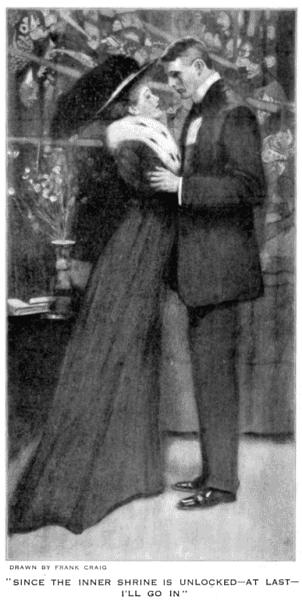
"Yes, but not to go into. There's only one key that unlocks the inner shrine of all—the word you've just spoken. A woman knows nothing till she hears it."
He looked at her with the puzzled air of a man getting strange information.
"Well," he said, after a long pause, "you've heard it. So what—now?"
"Now I'm willing to say that I love you."
"Oh, but I knew that already," he returned. "A man doesn't need to be told what he can see. That isn't what I'm asking. What I want to learn is, not what you feel, but what you'll—do."
She smiled faintly.
"I'm asking what you'll—do?" he repeated.
"If you insist on my telling you that," she said glancing up at him shyly, "I'll say that—since the inner shrine is unlocked—at last—I'll go in."
"Then, come, come."
He stood with arms open, his tone of petition still blended with a suggestion of command, as she crossed the room toward him.
THE END