ILLUSTRATIONS (continued 4)
Reading edition
"I should like to see Mrs. Eveleth."
Like the hasty raising and dropping of a curtain on some jealously guarded view, the words gave to Miss Lucilla but a fleeting glimpse of what was passing in the obscure recesses of the girl's heart; but she determined to make the most of it by fixing, there and then, the day and hour when, without apparently forcing the event, the two might come face to face on the neutral ground of Gramercy Park.
It was a meeting that, when it took place, would have been attended with embarrassment had not both young women been practised in the ways of their little world. Progress in mutual understanding was made the easier by the existence, on both sides, of the European view of life, with its fusion of interests, its softness of outline, its give and take of toleration, in contradistinction to the sharp, clear, insistent American demands for a certain line of conduct and no other. Five minutes had not gone by in talk before each found in the other's presence that sense of repose which comes from similar habits of thought and a common native idiom. Whatever grounds for difference they might find, they were, at least, ranged on the same side in that battle which the two hemispheres half unconsciously wage upon each other as to the main purposes of life. Thus they were able to approach their subject without that first preliminary shock which makes it difficult for races to agree; and thus, too, Marion Grimston found herself, before she was aware of it, pouring out to Diane Eveleth that heart which, in response to Miss Lucilla's tender pleading, had been dumb.
They sat in the big, sombre library where, only a few days before, Diane had seen Derek Pruyn turn his back on her, without even a gesture of farewell. On the long mahogany table the red azalea was in almost passionate luxuriance of blossom; while through the open window faint odors of lilac came from Miss Lucilla's bit of garden.
"I don't want you to think him worse than you're obliged to," Marion said, as though in defence of the stand her heart had taken. "I've been told that very few men possess the two kinds of courage—the moral and the physical. Savonarola had the one and Nelson had the other; but neither of them had both. And of the two, for me, the physical is the essential. I can't help it. If I had to choose between a soldier and a saint, I'd take the soldier. When the worst is said of Monsieur de Bienville, it must be admitted that he's brave."
"I've always understood that he was a good rider and a good shot," Diane admitted. "I've no doubt that in battle he would conduct himself like a hero."
The girl's head went up proudly, and from the languorous eyes there came one splendid flash before the lids fell over them again.
"I know he would; and when a man has that sort of courage he's worth saving."
"You admit, then, that he needs to be—saved?" Again the heavy lids were lifted for one brief, search-light glance.
"Yes; I admit that. I believe he has wronged you. I can't tell you how I know it; but I do. It's to tell you so that I've asked you to come here. I hoped to make you see, as I do, that he's capable of doing it without appreciating the nature of his crime. If we could get him to see that—"
"Then—what?"
"He'd make you reparation."
"Are you so sure?"
"I'm very sure. If he didn't—" The consequences of that possibility being difficult of expression, she hung upon her words.
"I should be sorry to have you brought to so momentous a decision on my account."
"It wouldn't be on your account; it would be on my own. I understand myself well enough to see that I could love a dishonorable man; but I couldn't marry him."
"You have, of course, your own idea as to what makes a man dishonorable."
"What makes a man dishonorable is to persist in dishonor after he has become aware of it. Any one may speak thoughtlessly, or boastfully, or foolishly, and be forgiven for it. But he can't be forgiven if he keeps it up, especially when by his doing so a woman has to suffer."
The movement with which Diane pushed back her chair and rose betrayed a troubled rather than an impatient spirit.
"Miss Grimston," she said, standing before the girl and looking down upon her, "I should almost prefer not to have you take my affairs into your consideration. I doubt if they're worth it. I can't deny that I shrink from becoming a factor in your life, as well as from feeling that you must make your decisions, or unmake them, with reference to me."
"I'm not making my decisions, or unmaking them, with reference to you; it's with reference to Monsieur de Bienville. He has my father's consent to his asking me to be his wife. I understand that, according to the formal French fashion, he's going to do it to-morrow. Before I give him an answer I must know that he is such a man as I could marry."
"You would have thought him so if you hadn't heard this about me."
"Even so, it's better for me to have heard it. Any prudent person would tell you that. What I'm going to ask you to do now will not be for your sake; it will be for mine."
"You're going to ask me to do something?"
"Yes; to see Monsieur de Bienville."
Diane recoiled with an expression of dismay.
"I know it will be hard for you," Miss Grimston pursued, "and I wouldn't ask you to do it if it were not the straightest way out of a perplexing situation. I've confidence enough in him to believe that when he has seen you and heard your story, he'll act according to the dictates of a nature which I know to be essentially honorable, even if it's weak. You can see what that will mean to us all. It will not only clear you and rehabilitate him, but it will bring happiness to me."
There was something in the way in which these brief statements were made that gave them the nature of an appeal. The very difficulty of the reserved heart in speaking out, the shame-flushed cheek—the subdued voice—the halting breath—had on Diane a more potent effect than eloquence. What was left of her own hope, too, at once put forth its claim at the possibility of getting justice. It was a matter of taking her courage in both hands, in one tremendous effort, but the fact that this girl believed in her was a stimulus to making the attempt. Before they parted—with stammering expressions of mutual sympathy—she had given her word to do it.
XVI
In the degree to which masculine good looks and elegance are accessories to impressing a maid's heart, the Marquis de Bienville had reason to be sure of the effect he was producing, as he bent and kissed Miss Marion Grimston's hand, in her aunt's drawing-room, on the following afternoon. He was not surprised to detect the thrill that shot through her being at his act of homage, and communicated itself back to him; for he was tolerably certain of her love. That had been, to all intents and purposes, confessed more than two years ago; while, during the intervening time, he had not lacked signs that the gift once bestowed had never been withdrawn. He had stood for a few seconds at the threshold on entering the room, just to rejoice consciously at his great good-fortune. She had risen, but not advanced, to meet him, her tall figure, sheathed in some close-fitting, soft stuff, thrown into relief by the dark-blue velvet portière behind her. He was not unaware of his unworthiness in the presence of this superb young creature, and as he crossed the room it was with the humility of a worshipper before a shrine.
"Mademoiselle," he said, simply, when he had raised himself, "I come to tell you that I love you."
The glance, slightly oblique, of suspended expression with which she received the words encouraged him to continue.
"I know how far what I have to give is beneath the honor of your acceptance; and yet when men love they are impelled to offer all the little that they have. My one hope lies in the fact that a woman like you doesn't love a man for what he is—but for what she can make him."
The words were admirably chosen, reaching her heart with a force greater than he knew.
"A woman," she answered, with a certain stately uplifting of the head, "can only make a man that which he has already the power to become. She may be able to point out the way; but it's for him to follow it."
"I don't think you'd see me hesitate at that."
"I'm glad you say so; because the road I should have to ask you to take would be a hard one."
"The harder the better, if it's anything by which I can prove my love."
"It is; but it's not only that; it's something by which you could prove mine."
His face brightened.
"In that case, Mademoiselle—speak."
She took an instant to assemble her forces, standing before him with a calmness she did not feel.
"You must forgive me," she said, trying to keep her voice steady, "if I take the initiative, as no girl is often called upon to do. Perhaps I should hesitate more if you hadn't told me, two years ago, what I know you've come to repeat to-day. The fact that I've waited those two years to hear you say it gives me a right that otherwise I shouldn't claim."
He bowed.
"There are no rights that a woman can have over a man which you, Mademoiselle, do not possess over me."
"Before telling me again," she continued, speaking with difficulty, "what you've told me already, I want to say that I can only listen to it on one condition."
"Which is—?"
"That your own conscience is at peace with itself."
There was a sudden startled toss of the head, but he answered, bravely:
"Is one's conscience ever at peace with itself? A woman's, perhaps; but a man's—!"
He shook his head with that wistful smile of contrition which is already a plea for pardon.
"I'm not speaking of life in general, but of something in particular. I want you to understand, before you ask me—what you've come to ask, that you couldn't make one woman happy while you're doing another a great wrong."
He was sure now of what was in store for him, and braced himself for his part. He was one of those men who need but to see peril to see also the way of meeting it. He stood for a minute, very straight and erect, like a soldier before a court-martial—a culprit whose guilt is half excused by his very manliness.
"I have wronged women. They've wronged me, too. All I can do to show I'm sorry for it is—not to give them the same sort of offence again."
"I'm thinking of one woman—one woman in particular."
He threw back his head with fine confidence.
"I don't know her."
"It's Diane Eveleth. She says—"
"I can imagine what she says. If I were you, I wouldn't pay it more attention than it deserves."
"It deserves a good deal—if it's true."
"Not from you, Mademoiselle. It belongs to a region into which your thought shouldn't enter."
"My thought does enter it, I'm afraid. In fact, I think of it so much that I've invited Mrs. Eveleth to come here this afternoon. I hope you don't mind meeting her?"
"Certainly not. Why should I?" he demanded, with an air of conscious rectitude.
Miss Grimston touched a bell.
"Ask Mrs. Eveleth to come in," she said to the footman who answered it.
As Diane entered she greeted Bienville with a slight inclination of the head, which he returned, bowing ceremoniously.
"I've begged Mrs. Eveleth to meet us," Marion hastened to explain, "for a very special reason."
"Then perhaps she will be good enough to tell me what it is," Bienville said, with a look of courteous inquiry.
"Miss Grimston thought—you might be able—to help me."
There was a catch in Diane's voice as she spoke, but she mastered it, keeping her eyes on his, in the effort to be courageous.
"If there's anything I can do—" he began, allowing the rest of his sentence to be inferred.
He concealed his nervousness by placing a small gilded chair for Diane to sit on. He himself took a chair a few feet away, seating himself sidewise, with his elbow supported on the back, in an easy attitude of attention. Marion Grimston withdrew to the more distant part of the room, where, with her hands behind her, she stood leaning against the grand piano, with the bearing of one only indirectly, and yet intensely, concerned. Bienville left the task of beginning to Diane. In spite of his determination to be self-possessed, a trace of compunction was visible in his face as he contrasted the subdued little woman before him with the sparkling, insouciant creature to whom, two or three years ago, he had paid his inglorious court.
"I shall have to speak to you quite simply and frankly," Diane began, with some hesitation, still keeping her eyes on his, "otherwise you wouldn't understand me."
"Quite so," Bienville assented, politely.
"You may not have heard that since—my—my husband's death, I have my own living to earn?"
"Yes; I did hear something of the kind."
"I've had what people in my position call a good situation; but I have lost it."
"Ah? I'm sorry."
"I thought you would be. That's why Miss Grimston asked me to tell you the reason. She was sure you wouldn't injure me—knowingly."
"Naturally. I'm very much surprised that any one should think I've injured you at all. To the best of my knowledge your name has not passed my lips for two years, at the least. If it had it would only have been spoken—with respect."
"I'm sure of that. I'm not pretending when I say that I'm absolutely convinced you're a man of sensitive honor. If you weren't you couldn't be a Frenchman and a Bienville. I want you to understand that I've never attributed—the—things that have happened—to anything but folly and imprudence—for which I want to take my full share of the blame."
"I've never ventured to express to you my own regret," Bienville said, in a tone not free from emotion, "but I assure you it's very deep."
"I know. All our life was so wrong! It's because I feel sure you must see that as well as I do that I hoped you'd help me now."
He said nothing in reply, letting some seconds pass in silence, waiting for her to come to her point.
"On the way up from South America," she began again, with visible difficulty, "you were on the same ship with my—my—employer. From certain things you said then—"
"But I've withdrawn them," he interrupted, quickly. "He should have told you that. Mademoiselle," he added, rising, and turning toward Marion Grimston, "wouldn't it spare you if we continued this conversation alone?"
"No; I'd rather stay," Miss Grimston said, with an inflection of request. "Please sit down again."
"He should have told you that," Bienville repeated, taking his seat once more, and speaking with some animation. "I did my best to straighten things out for him."
"Then he didn't understand you. He told me you had taken back what you had said, but only in a way that reaffirmed it."
"That's nothing but a tortuous construction put on straightforward words."
"Quite so; but for that very reason I thought that perhaps you'd go to him again and explain what you meant more clearly."
He took a minute to consider this before speaking.
"I don't see how I can," he said, slowly. "I've already used the plainest words of which I have command."
"Words aren't everything. It's the way they're spoken that often counts most. I'm sure you could convince him if you went the right way to work about it."
"I doubt that. I'm afraid I don't know how to force conviction on any one against his will."
"You mean—?"
"I mean—you'll excuse me; I speak quite bluntly—I mean that he seemed very willing to believe anything that could tell against you, but less eager to credit what was said in your defence."
"You think so because you don't understand him. As a matter of fact—"
"Oh, I dare say. I don't pretend to understand the gentleman in question. But for that very reason it would be useless for me to try to enlighten him further. It would only make matters worse."
"It wouldn't if you'd put things before him just as they happened. I don't want any excuses made for me. My best defence would be—the truth."
There was a perceptible pause, during which his eyes shifted uneasily toward Marion Grimston.
"I should think you could tell him that yourself," he suggested, at last.
"It wouldn't be the same thing. You're the only person who could speak with authority. He'd accept your word, if you gave it—in a certain way."
"I'm afraid I don't know what that way is."
"Oh yes, you do, Bienville!" she exclaimed, pleadingly, leaning forward slightly, with her hands clasped in her lap. "Don't force me to speak more plainly than I need. You must know what I refer to."
He shook his head slowly, with a look of mystification.
"What you may not know," she continued, "is all it means to me. I won't put the matter on any ground but that of my need for earning money. Because Mr. Pruyn has—misunderstood you, I've had to give up my—my—place"—she forced the last word with a little difficulty—"and until something like a good name is restored to me I shall find it hard to get another. You can have no idea of what that means. I had none, until I had to face it. There's only one kind of work I'm fitted for—the kind I've been doing; but it's just the kind I can't have without the—the reputation you could give back to me."
That this appeal was not without its effect was evident from the way in which his expressive brown eyes clouded, while he stroked his black beard nervously. The fact that his pity was largely for himself—that with instincts naturally chivalrous he should be driven to these miserable verbal shifts—being unknown to Diane, she was encouraged to proceed.
"You see," she went on, eagerly, "it wouldn't only bring me happiness, but it would add to your own. You're at the beginning of a new life, just like me—or, rather, just as I could be if you'd give me the chance. Think what it would be for you to enter on it, I won't say with a clear conscience, but with the knowledge that in rising yourself you had helped an unhappy woman up, instead of thrusting her further down! It isn't as if it would be so hard for you, Bienville. I'd make it easy for you. Miss Grimston would help me. Wouldn't you?" she added, turning toward Marion. "It could all be done quite simply and confidentially between ourselves—and Mr. Pruyn."
"Oh no, it couldn't," he said, coldly. "If I were to admit what you imply, secrecy wouldn't be of any use to me."
"Does that mean," she asked, fixing her earnest eyes upon him, "that you don't admit it?"
"It means," he said, rising quietly and standing behind his chair, "that this conversation is extremely painful to me, and I must ask to be excused from taking any further part in it. I know only vaguely what you mean, Madame; and if I don't inquire more in detail, it's because I want to spare you distressing explanations. I think you must agree with me, Mademoiselle," he continued, looking toward Miss Grimston, "that we should all be well advised in letting the subject drop."
Marion came slowly forward, advancing to the side of Diane, over whose shoulder, as she remained seated, she allowed her hand to fall, in a pose suggestive of protection.
"Of course, Monsieur," she agreed, "we must let the subject drop, if you have nothing more to say."
He stood silent a minute, looking at her steadily. "I'm afraid I haven't," he said, then.
"Nor I," Miss Grimston returned, significantly.
Again there was a minute or two of silence, during which Bienville seemed to probe for the meaning of the two laconic words. If anything could be read from his countenance, it was doubt as to whether to relinquish the prize with dignity or to pay its price in humiliation. There was an instant in which he appeared to be bracing himself to do the latter; but when he spoke his interrogation threw the responsibility for decision on Miss Grimston.
"Have I received—my answer?"
She waited, finding it hard to give him his reply. It was as if forced to it against her will that her head bent slowly in assent.
"Then," he said, in a tone of dignified regret, "there's nothing for me but to wish Mademoiselle good-by."
He bowed separately to Miss Grimston and to Diane, and, with the self-possession of a man accustomed to the various turns of drawing-room drama, he left the room.
XVII
During the summer that followed these events Derek Pruyn set himself the task of stamping the memory and influence of Diane Eveleth out of his life. His sense of duty combined with his feelings of self-respect in making the attempt. In reflecting on his last interview with her, he saw the weakness of the stand he had taken in it, recoiling from so unworthy a position with natural reaction. To have been in love at all at his age struck him as humiliation enough; but to have been in love with that sort of woman came very near mental malady. He said "that sort of woman," because the vagueness of the term gave scope to the bitterness of resentment with which he tried to overwhelm her. It enabled him to create some such paradise of pain as that into which the souls of Othello and Desdemona might have gone together. Had he been a Moor of Venice he would doubtless have smothered her with a pillow; but being a New York banker he could only try to slay the image, whose eyes and voice had never haunted him so persistently as now. In his rage of suffering he was as little able to take a reasoned view of the situation as the maddened bull in the arena to appraise the skill of his tormentors.
When in the middle of May he had retired to Rhinefields it was with the intention of laying waste all that Diane had left behind in the course of her brief passage through his life. The process being easier in the exterior phases of existence than in those more secret and remote, he determined to work from the outside inward. Wherever anything reminded him of her, he erased, destroyed, or removed it. All that she had changed within the house he put back into the state in which it was before she came. Where he had followed her suggestions about the grounds and gardens he reversed the orders. Taken as outward and visible signs of the inward and spiritual change he was trying to create within himself, these childish acts gave him a passionate satisfaction. In a short time, he boasted to himself, he would have obliterated all trace of her presence.
And so he came, in time, to giving his attention to Dorothea. She, too, bore the impress of Diane; and as she bore it more markedly than the inanimate things around, it caused him the greater pain. He could forbid her to hold intercourse with Diane, and to speak of her; but he could not control the blending of French and Irish intonations her voice had caught, or the gestures into which she slipped through youth's mimetic instinct. In happier days he had been amused to note the degree to which Dorothea had become the unconscious copy of Diane; but now this constant reproduction of her ways was torture. Telling himself that it was not the child's fault, he bore it at first with what self-restraint he could; but as solitude encouraged brooding thoughts, he found, as the summer wore on, that his stock of patience was running low. There were times when some chance sentence or imitated bit of mannerism on Dorothea's part almost drew from him that which in tragedy would be a cry, but which in our smaller life becomes the hasty or exasperated word.
In these circumstances the explosion was bound to come; and one day it produced itself unexpectedly, and about nothing. Thinking of it afterward Derek was unable to say why it should have taken place then more than at any other time. He was standing on the lawn, noting with savage complacency that the bit by which he had enlarged it, at Diane's prompting, had grown up again, in luxuriant grass, when Dorothea descended the steps of the Georgian brick house, behind him.
"Would you be afther wantin' me to-day?" she called out, using the Irish expression Diane affected in moments of fun.
"Dorothea," he cried, sharply, wheeling round on her, "drop that idiotic way of speaking. If you think it's amusing, you're mistaken. You can't even do it properly."
The words were no sooner out than he regretted them, but it was too late to take them back. Moreover, when a man, nervously suffering, has once wounded the feelings of one he loves, it is not infrequently his instinct to go on and wound them again.
"We have enough of that sort of language from the servants and the stable-boys. Be good enough in future to use your mother-tongue."
Standing where his words had stopped her, a few yards away, she looked up at him with the clear gaze of astonishment; but the slight shrug of the shoulders before she spoke was also a trick caught from Diane, and not calculated to allay his annoyance.
"Very well, father," she answered, with a quietness indicating judgment held in reserve, "I won't do it again. I only meant to ask you if you want me for anything in particular to-day; otherwise I shall go over and lunch at the Thoroughgoods'."
"The Thoroughgoods' again? Can't you get through a day without going there?"
"I suppose I could if it was necessary; but it isn't."
"I think it is. You'll do well not to wear out your welcome anywhere."
"I'm not afraid of that."
"Then I am; so you'd better stay at home."
He wheeled from her as sharply as he had turned to confront her, striding off toward a wild border, where he tried to conceal the extent to which he was ashamed of his ill temper by pretending to be engrossed in the efforts of a bee to work its way into a blue cowl of monk's-hood. When he looked around again she was still standing where he had left her, her eyes clouded by an expression of wondering pain that smote him to the heart.
Had he possessed sufficient mastery of himself he would have gone back and begged her pardon, and sent her away to enjoy herself. It was what he wanted to do; but the tension of his nerves seemed to get relief from the innocent thing's suffering. The very fact that her pretty little face was set with his own obstinacy of self-will, while behind it her spirit was rising against this capricious tyranny, goaded him into persistence. He remembered how often Diane had told him that Dorothea could be neither led nor driven; she could only be "managed"; but he would show Diane, he would show himself, that she could be both driven and led, and that "management" should go the way of the wall-fruit and the roses.
As, recrossing the lawn, he made as though he would pass her without further words, he was an excellent illustration of the degree to which the adult man of the world, capable of taking an important part among his fellow-men, can be, at times, nothing but an overgrown infant. It was not surprising, however, that Dorothea should not see this aspect of his personality, or look upon his commands as other than those of an unreasonable despotism.
"Father," she said, "I can't go on living like this."
"Living like what?"
"Living as we've lived all this summer."
"What's the matter with the summer? It's like any other summer, isn't it?"
"The summer may be like any other summer; but you're not like yourself. I do everything I can to please you, but—"
"You needn't do anything to please me but what you're told."
"I always do what I'm told—when you tell me; but you only tell me by fits and starts."
"Then, I tell you now: you're not to go to the Thoroughgoods'."
"But they expect me. I said I'd go to lunch. They'll think it very strange if I don't."
"They'll think what they please. It's enough for you to know what I think."
"But that's just what I don't know. Ever since Diane went away—"
"Stop that! I've forbidden you to speak—"
"But you can't forbid me to think; and I think till I'm utterly bewildered. You don't explain anything to me. You haven't even told me why she went away. If I ask a question you won't answer it."
"What's necessary for you to know, you can depend on me to tell you. Anything I don't explain to you, you may dismiss from your mind."
"But that's not reasonable, father; it's not possible. If you want me to obey you, I must know what I'm doing. Because I don't know what I'm doing, I haven't——"
"You haven't obeyed me?" he asked, quickly.
"Not entirely. I've meant to tell you when an occasion offered, so I might as well do it now. I've written to Diane."
"You've——!"
He strode up to her and caught her by the arm. It was not strange that she should take the curious light in his face for that of anger; but a more experienced observer would have seen that two distinct emotions crowded on each other.
"I've written to her twice," Dorothea repeated, defiantly, as he held her arm. "She didn't reply to me—but I wrote."
"What for?"
"To tell her that I loved her—that no trouble should keep me from loving her—no matter what it was."
He released her arm, stepping back from her again, surveying her with an admiration he tried to conceal under a scowling brow. The rigidity of her attitude, the lift of her head, the set of her lips, the directness of her glance, suggested not merely rebellion against his will, but the assertion of her own. It occurred to him then that he could break her little body to pieces before he could force her to yield; and in his pride in this temperament, so like his own, he almost uttered the cry of "Brava!" that hung on his lips. He might have done so if Dorothea had not found it a convenient moment at which to make all her confessions at once and have them off her mind. It was best to do it, she thought, now that her courage was up.
"And, father," she went on, "it may be a good opportunity to tell you something else. I've decided to marry Mr. Wappinger."
During the brief silence that followed this announcement he had time to throw the blame for it upon Diane, using the fact as one more argument against her. Had she taken his suggestions at the beginning, and suppressed the Wappinger acquaintance, this distressing folly would have received a definite check: As it was, the odium of putting a stop to it, which must now fall on him, was but an additional part of the penalty he had to pay for ever having known her. So be it! He would make good the uttermost farthing! In doing it he had the same sort of frenzied satisfaction as in defacing Diane's image in his heart.
"You shall not," he said, at last.
"I don't understand how you're going to stop me."
"I must ask you to be patient—and see. You can make a beginning to-day, by staying at home from the Thoroughgoods'. That will be enough for the minute."
Fearing to look any longer into her indignant eyes, he passed on toward the stables. For some minutes she stood still where he left her, while the collie gazed up at her, with twitching tail and questioning regard, as though to ask the meaning of this futile hesitation; but when, at last, she turned slowly and re-entered the house, one would have said that the "dainty rogue in porcelain" had been transformed into an intensely modern little creature made of steel.
She did not go to the Thoroughgoods' that day, nor was any further reference made to the discussion of the morning. Compunction having succeeded irritation, with the rapidity not uncommon to men of his character, Derek was already seeking some way of reaching his end by gentler means, when a new move on Dorothea's part exasperated him still further. As he was about to sit down to his luncheon on the following day, the butler made the announcement that Miss Pruyn had asked him to inform her father that she had driven over in the pony-cart to Mrs. Throughgood's, and would not be home till late in the afternoon.
He was not in the house when she returned, and at dinner he refrained from conversation till the servants had left the room.
"So it's—war," he said, then, speaking in a casual tone, and toying with his wine-glass.
"I hope not, father," she answered, promptly, making no pretence not to understand him. "It takes two to make a quarrel, and——"
"And you wouldn't be one?"
"I was going to say that I hoped you wouldn't be."
"But you yourself would fight?"
"I should have to. I'm fighting for liberty, which is always an honorable motive. You're fighting to take it away from me——"
"Which is a dishonorable motive. Very well; I must accept that imputation as best I may, and still go on."
"Oh, then, it is war. You mean to make it so."
"I mean to do my duty. You may call your rebellion against it what you like."
"I'm not accustomed to rebel," she said, with significant quietness. "Only people who feel themselves weak do that."
"And are you so strong?"
"I'm very strong. I don't want to measure my strength against yours, father; but if you insist on measuring yours against mine, I ought to warn you."
"Thank you. It's in the light of a warning that I view your action to-day. You probably went to meet Mr. Wappinger."
In saying this his bow was drawn so entirely at a venture that he was astonished at the skill with which he hit the mark.
"I did."
He pushed back his chair; half rose; sat down again; poured out a glass of Marsala; drank it thirstily; and looked at her a second or two in helpless distress before finding words.
"And you talk of honorable motives!"
"My motive was entirely honorable. I went to explain to him that I couldn't see him any more—just now."
"While you were about it you might as well have said neither just now—nor at any other time."
She was silent.
"Do you hear?"
"Yes; I bear, father."
"And you understand?"
"I understand what you mean."
"And you promise me that it shall be so?"
"No, father."
"You say that deliberately? Remember, I'm asking you an important question, and you're giving me an equally important reply."
"I recognize that; but I can't give you any other answer."
"We'll see." He pushed back his chair again, and rose. He had already crossed the room, when, a new thought occurring to him, he turned at the door. "At least I presume I may count on you not to see this young man again without telling me?"
"Not without telling you—afterward. I couldn't undertake more than that."
"H'm!" he ejaculated, before passing out. "Then I must take active measures."
It was easier, however, to talk about active measures than to devise them. While Dorothea was sobbing, with her elbows on the dining-room table, and her face buried in her hands, he was pacing his room in search of desperate remedies. It was a case in which his mind turned instinctively to Diane for help; but in the very act of doing so he was confronted by her theories as to Dorothea's need of diplomatic guidance. For that, he told himself, the time was past. The event had proved how impotent mere "management" was to control her, and justified his own preference for force.
Before she went to bed that night Dorothea was summoned to her father's presence, to receive the commands which should regulate her conduct toward "the young man Wappinger." They could have been summed up in the statement that she must know him no more. She was not only never to see him, or write to him, or communicate with him, by direct or indirect means; as far as he could command it, she was not to think of him, or remember his name. His measures grew more drastic in proportion as he gave them utterance, until he himself become aware that they would be difficult to fulfil.
"I will not attempt to extract a promise from you," he was prudent enough to say, in conclusion, "that you will carry out my wishes, because I know you would never bring on me the unhappiness that would spring from disobedience."
"It's hardly fair, father, to say that," she replied, firmly. "In war, no one should shrink from—the misfortunes of war."
"That means, then, that you defy me?"
She was calmer than he as she made her reply.
"It doesn't mean that I defy you. I love you too much to put either you or myself in such an odious position as that. But it does mean that one day, sooner or later, I shall marry—Mr. Wappinger."
He looked at her with a bitter smile.
"I admire your frankness, Dorothea," he said, after a brief pause, "and I shall do my best to imitate it. If it's to be war, we shall at least fight in the open. I know what you intend to do, and you know that I mean to circumvent you. The position on both sides being so pleasantly clear, you may come and kiss me good-night."
During the process of the stiff little embrace that followed it was as difficult for her not to fling herself sobbing on his breast as for him not to seize her in his arms; but each maintained the restraint inspired by the justice of their respective causes. When she had closed the door behind her, he stood for a long time, musing. That his thoughts were not altogether tragic became manifest as his brow cleared, and the ghost of a smile, this time without bitterness, hovered about his lips. Suddenly he slapped his leg, like a man who has made a discovery.
"By Gad!" he whispered, half aloud, "when all is said and done, she knows how to play the game!"
XVIII
It was, perhaps, the knowledge that Dorothea could play the game that enabled Derek, during the rest of the summer, to play it himself. This he did without flinching, finding strength in the fact that, as time went on, Dorothea seemed to enter into his plans and submit to his judgment. The first few weeks of pallor and silence having passed, she resumed her accustomed ways, and, as far as he could tell, grew cheerful. Always having credited her with common-sense, he was pleased now to see her make use of it in a way of which few girls of nineteen would have been capable. She accepted his surveillance with so much docility that, by the time they returned to town in the autumn he was able to congratulate himself on his success.
On her part, Dorothea carried out his instructions to the letter. Notwithstanding the opening of the season and the renewal of the usual gayeties, she lived quietly, accepting few invitations, and rarely going into society at all, except under her father's wing. On those accidental occasions when Carli Wappinger came within their range of vision, it was only as a distant ship drifts into sight at sea—to drift silently away again. If Dorothea perceived him, she gave no sign. It was clear to Derek that her spurt of rebellion was over, and that her little experience had done her no harm. The name of Wappinger being tacitly ignored between them, he could only express his pleasure, in the results he had achieved, by an extravagant increase of Dorothea's allowance, and gifts of inappropriate jewels. It would have taken a more weatherwise person than he to guess that behind this domestic calm the storm was brewing.
The first intuition of threatening events came to Mrs. Wappinger.
"I've seen nothing and heard nothing," she declared, in her emphatic way, to Diane, "but I know something is going on."
That was in September. They sat in the shade of the cool flag-paved pergola at Waterwild, Mrs. Wappinger's place on Long Island. The tea-table stood between them, and they lounged in wicker chairs. Framed by marble pillars, and festooned from above by vines drooping from the roof, there was a view of terraced lawns descending toward the sea. Between the slightly overcrowded urns and statues there were bright dashes of color, here of dahlias in full bloom, there of reddening garlands of ampelopsis or Virginia creeper. It was what Mrs. Wappinger called an "off-day," otherwise she could not have had Diane at Waterwild. In her loyalty toward the deserted woman she seized those opportunities when Carli was away, and she was certain of having no other guests, "to have the poor thing down for the day, and give her a good meal."
Not that people occupied themselves with Diane or her affairs! Her place in the hurrying, scrambling social throng had been so unobtrusive that, now that she no longer filled it, she was easily forgotten. Among the few who paid her the tribute of recollection there was the generally received impression that Derek Pruyn, having discovered her relations with the Marquis de Bienville—relations which, so they said, had been well known in Paris, in the days when she was still some one—had dismissed her from her position in his household. That was natural enough, and there was no further reason for remembering her. Having disappeared into the limbo of the unfortunate, she was as far beyond the mental range of those who retained their blessings as souls that have passed are out of sight of men and women who still walk the earth. For this very reason she called out in Mrs. Wappinger that motherly good-nature which was only partially warped by the ambition for social success. On more than one of her "off-days" she had lured Diane out of her refuge in University Place, treating her with all the kindness she could bestow without causing disparaging comment upon herself. On the present occasion she was the more desirous of her company because of the fact that, as she expressed it herself, she had "sniffed something going on."
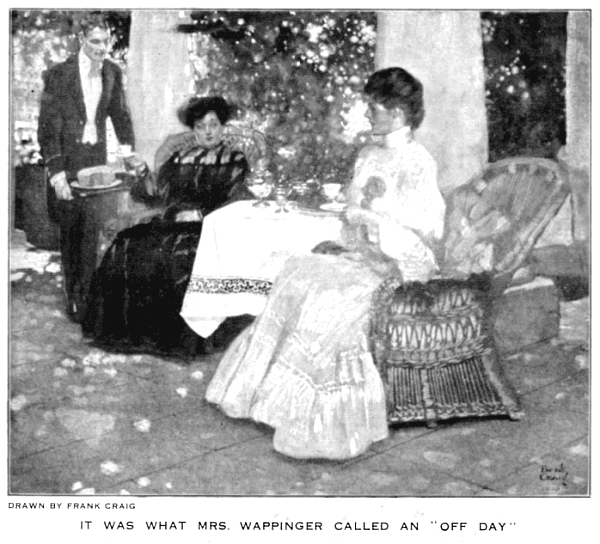
"As I tell you," she repeated, "I've heard nothing, and seen nothing; I've just sniffed it. If you were to ask me how, I couldn't explain it to you any more than I can say how I get the scent of this climbing heliotrope. But I do get it; and I do know something is in the wind, more than what is told to you and I."
"One can only hope that it will be nothing foolish," Diane murmured, guardedly.
"It will be something foolish," Mrs. Wappinger declared, "and you may take my word for it. Derek Pruyn can't arrogate to himself the powers of the Lord above any more than we can. If he thinks he can stop young blood from running he'll find out he's wrong."
It was the first mention of his name that Diane had heard in many weeks, and at the sound her hand trembled in such a way that she was obliged to put down untasted the cup she had half raised to her lips.
"He's not an unkind man," she found voice to say; "he's only a mistaken one. He has one of those natures capable of dealing magnificently with great affairs, but helpless in the trivial matters of every day. He's like the people who see well at a distance, but become confused over the objects right under their eyes."
"Then the farther you keep away from that man the better the view he'll take of you. It's what I'd say to Carli if he'd ask for my advice."
"Does that mean," Diane ventured to inquire, "that you don't want him to marry Dorothea?"
"I certainly do not. If there were no other reason, she's the sort of girl to make me put one foot into the grave, whether I want to or no; and it stands to reason that I don't want to be squelched one hour before my time."
"Naturally; but I fancy you'd find her a sweeter girl than you might suppose."
"So she may be, dear; but I've spent too much money on Carli to wish to see him force his way into a family where he isn't wanted."
This was the text of Mrs. Wappinger's discourse, not only on the present occasion, but on the subsequent "off-days," when Diane was induced to visit Waterwild.
"Whatever is going on, Reggie Bradford's in it," she confided to Diane some few weeks later.
"Is that the fat young man with the big laugh?"
"Yes; and one of the greatest catches in New York. Carli tells me he's wild about Marion Grimston, and I can see for myself that Mrs. Bayford is playing him against that Frenchman. She'll get the title if she can, but if not, she'll fall back on the money."
"It's a pretty safe alternative," Diane smiled, making an effort to speak without betraying her feelings.
"Reggie is a good-natured boy," Mrs. Wappinger pursued, "but a regular water-pipe. If you want to get anything out of him you've only got to turn the faucet. It's just as well that he is; because whatever Carli is up to Reggie knows, and what Reggie knows Marion Grimston knows. If ever you see her—"
"Oh, but I don't—not now."
"That's a pity. If you did, you could pump her."
"I'm afraid I'm not much good at that sort of thing."
"Well, I am, when I get a chance. I'm bound to find out, somehow; and there are more ways of killing a cat than by giving it poison."
A few weeks later still Mrs. Wappinger informed Diane that Dorothea Pruyn was not happy.
"The Thoroughgoods told the Louds," she explained, "and the Louds told me. Her father thinks she has given in to him; but she hasn't—not an inch. He keeps her like a jailer; and she acts like a convict—always with an eye open for some way of escape. That man no more understands women than he does making pie."
"I've always noticed that the really strong men rarely do. There's almost invariably something petty about a man to whom a woman isn't a puzzle and a mystery."
"If it comes to a puzzle and a mystery, I don't know where you'd find a greater one than Derek Pruyn himself. After the way he's acted—and treated people—"
Diane flushed, but kept her emotions sufficiently under control to be able to follow her usual plan of straightforward speaking.
"If you mean me, Mrs. Wappinger, I ought to say that Mr. Pruyn has done nothing for which I can blame him. He was placed in a situation with which only a very subtle intelligence could have dealt, and I respect him the more for not having had it. It's generally the man who is most competent in his own domain who is most likely to blunder when he gets into the woman's; and I, for one, would rather have him do it. I've had to suffer because of it, and so has Dorothea; and yet that doesn't make me like it less."
"No, I dare say not," Mrs. Wappinger responded, sympathetically. "Mr. Wappinger himself was just such a man as that. He'd put through a deal that would make Wall Street shiver; but he understood my woman's nature just about as much as old Tiger there, wagging his tail on the grass, follows the styles in bonnets. Only, I'll tell you what, Mrs. Eveleth: it's for men like that that God created sensible, capable wives, like you and me; and they ought to have 'em."
This theme admitting of little discussion, Diane did not pursue it, but she went away from Waterwild with a deepened sense of Derek's need of her, as well as of Dorothea's. She could so easily have helped them both that the enforced impotence was a new element in her pain. To walk the town in search of work to which she was little suited, when that which no one but herself could accomplish had to remain undone, became, during the next few weeks, the most intolerable part of the irony of circumstance. The wifely, the maternal qualities of her being, of which she had never been strongly conscious till of late, awoke in response to the need that drew them forth, only to be blighted by denial.
The inactivity was the harder to endure because of the fact that, as autumn passed into early winter, there came a period when all her little world seemed to have dropped her out of sight. There were no more "off-days" at Waterwild, and Miss Lucilla's occasional letters from Newport ceased. Between her mother-in-law and herself, after a few painful attempts at intercourse, there had fallen an equally painful silence. Even her two or three pupils fell away.
From the papers she learned that one or another of those for whom she cared was back in town again. She walked in the chief thoroughfares in the hope of meeting some of them, but chance refused to favor her. In the dusk of the early descending November and December twilights she passed their houses, watching the warm glow of the lights within, against which, now and then, a shadow that she could almost recognize would pass by. She could have entered at Miss Lucilla's door, or Mrs. Wappinger's; but a strange shyness, the shyness of the unfortunate, had taken hold of her, and she held back. In the mean time she was free to watch, with sad eyes and sadder spirit, the great city, reversing the processes of nature, awaken from the torpor of the genial months into its winter life.
No one knew better than herself that thrill of excited energy with which those born with the city instinct return from the acquired taste for mountain, seaside, and farm, to enter once more the maze of purely human relationships. It was a moment with which her own active nature was in sympathy. She liked to see the blinds being raised in the houses and the barricading doors taken down. She liked to see the vehicles begin to crowd one another in the streets and the pedestrians on the pavement wear a brisker air. She liked to see the shop-windows brighten with color and the great public gathering-spots let in and let out their throngs. She responded to the quickened animation with the spontaneity of one all ready to take her part, till the thought came that a part had been refused her. It was with a curious sensation of being outside the range of human activities that, during those days of timid, futile looking for employment, she roamed the busy thoroughfares of New York. As time passed she ceased to think much about her need of sympathetic fellowship in her anxiety to get work. She wrote advertisements and answered them; she applied at schools, and offices, and shops; she came down to seeking any humble drudgery which would give her the chance to live.
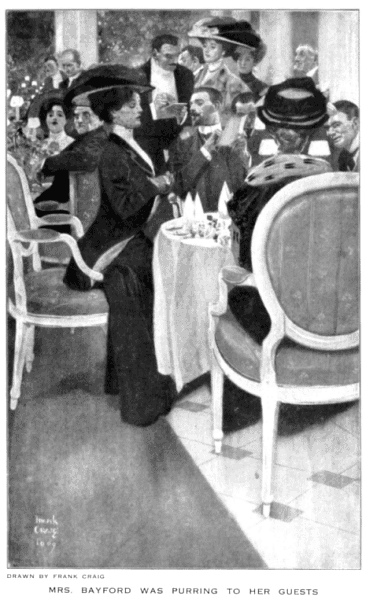
It was not till one day in early December that the last flicker of her hope went out. Chance had made her pass at midday along the pavement opposite one of the great restaurants. Lifting her eyes instinctively toward the group of well-dressed people on the steps, she saw that Mrs. Bayford and Marion Grimston were going in, accompanied by Reggie Bradford and the Marquis de Bienville. She had heard little or nothing of them during the last four empty months; but it was plain now that the lovers were agreed and her own cause abandoned. Up to this moment she had not realized how tenaciously she had clung to the belief that the proud, high-souled girl would yet see justice done her; and now she had deserted her, like the rest!
For the first time during her years of struggle she felt absolutely beaten—beaten so thoroughly that it would be useless to renew the fight. She had been on her way to see a lady who had advertised for a nursery governess; but she had no strength left with which to face the interview. In the winter-garden of the restaurant Mrs. Bayford was purring to her guests, Reggie Bradford was whispering to Miss Grimston, and the Marquis de Bienville was ordering the wines, while Diane was wandering blindly back to the poor little room she called her home, there to lie down and allow her heart to break.
But hearts do not break at the command of those who own them, and when she had moaned away the worst of her pain, she fell asleep. When she awoke it was already growing dark, and the knocking at her door, which roused her, was like a call from the peace of dreams to the desolation of reality. When she had turned on the light she received from the hands of the waiting servant that which had become a most rare visitant in the blankness of her life—a note.
The address was in a sprawling hand, which she recognized. What was written within was more sprawling still:
"For Heaven's sake, come to me at once. The expected has happened, and I don't know what to do. The motor will wait and bring you.
CLARA WAPPINGER."
XIX
As Diane entered, Mrs. Wappinger, dishevelled and distraught, was standing in the hail, a slip of yellow paper in her hand.
"Oh, my dear, I'm so glad you've come! I'm just about crazy! Read this!"
Diane took the paper and read:
"D. and I are to be married to-night. Be ready to receive us to-morrow. CARLI."
"When did this come?" Diane asked, quickly.
"About half an hour ago. I sent for you at once."
"I see it's dated from Lakefield. Where's that?"
Mrs. Wappinger explained that Lakefield was a small winter health resort some two hours by train from New York. She and Carli had stayed there, more than once, at the Bay Tree Inn. He would naturally go to the same hotel, only, when she had telephoned to it, a few minutes ago, she could find no one of the name in residence. Under the circumstances, Diane suggested, he would probably not give his name at all. There followed a few minutes of silent reflection, during which Mrs. Wappinger gazed at Diane, in the half-tearful helplessness of one not used to coping with unusual situations.
"Won't you come in and sit down?" she asked, with a sudden realization that they were still standing beneath the light in the hail.
"No," Diane answered, with decision; "it isn't worth while. May I have the motor for an hour or so?"
"Why, certainly. But where are you going?"
"I'm going first to Mr. Pruyn's, and afterward to Lakefield."
"To Lakefield? Then I'll go with you. We could go in the car."
Diane negatived both suggestions. The motor might break down, or the chauffeur might lose his way; the train would be safer. If any one went with her, it would have to be Mr. Pruyn.
"But don't go to bed," she added, "or at least have some one to answer the telephone, for I'll ring you up as soon as I have news for you."
"God bless you, dear," Mrs. Wappinger murmured. "I know you'll do your best for me, and them. Keep the auto as long as you like; and if you decide to go down in it, just say so to Laporte."
But Diane seemed to hesitate before going. A flush came into her cheek, and she twisted her fingers in embarrassment.
"I wonder", she faltered, "if—if—you could let me have a little money? I shall need some, and—and I haven't—any."
"Oh, my dear! my poor dear!"
Mrs. Wappinger bustled away, crumpling the notes she found in her desk into a little ball, which she forced into Diane's hand. To forestall thanks she thrust her toward the door, accompanying her down the steps, and kissing her as she entered the automobile.
"Why, bless my `eart, if it ain't the madam!"
This outburst was a professional solecism on the part of Fulton, the English butler, at Derek Pruyn's, but it was wrung from him in sheer joy at Diane's unexpected appearance.
"You'll excuse me, ma'am", he continued, recapturing his air of decorum, "but I fair couldn't help it. We'll be awful pleased to see you, ma'am, if I may make so bold as to say it—right down to the cat. It hasn't been the same 'ouse since you went away, ma'am; and me and Mr. Simmons has said so time and time again. You'll excuse me, ma'am, but—"
"You're very kind, Fulton, and so is Simmons, but I'm in a great hurry now. Is Mr. Pruyn at home?"
"Why, no, he ain't, ma'am, and that's a fact. He's to dine out."
"Where?"
"I couldn't tell you that, ma'am; but perhaps Mr. Simmons would know. He took Mr. Pruyn's evening clothes to the bank, and he was to change there. If you'll wait a minute, ma'am, I'll ask him."
But when Simmons came he could only give the information that his master was going to a "sort o' business banquet" at one of the great restaurants or hotels. Moreover, Miss Dorothea had gone out, saying that she would not be home to dinner.
"Then I must write a note," Diane said, with that air of natural authority which had seemed almost lost from her manner. "Will you, Fulton, be good enough to bring me a glass of wine and a few biscuits while I write? I must ask you, Simmons, for a railway guide."
In Derek's own room she sat down at the desk where, six months ago, she had arranged his letters on the night when he had returned from South America. She had no time to indulge in memories, but a tremor shot through her frame as she took up the pen and wrote on a sheet of paper which he had already headed with a date:
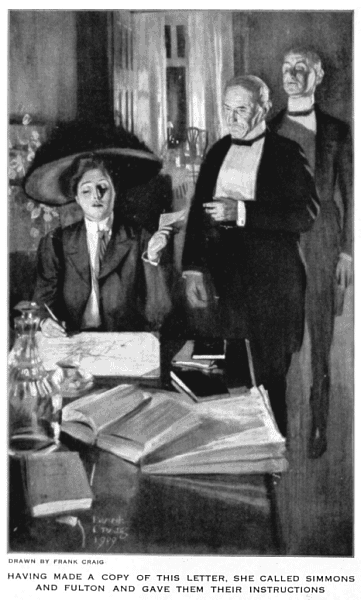
"I have bad news for you, but I hope I may be in time to keep it from being worse. I have reason to think that Dorothea has gone to Lakefield to be married there to Carli Wappinger. Should there be any mistake you will forgive me for disturbing you; but I think it well to be prepared for extreme possibilities. I am, therefore, going to Lakefield now—at once. A train at seven-fifteen will get there a little after nine. There are other trains through the evening, the latest being at five minutes after ten. Should this reach you in time to enable you to take one of them, you will be wise to do so; but in case it may be too late, you may count on me to do all that can be done. Let some one be ready to answer the telephone all night. I shall communicate with the house from the Bay Tree Inn. I must ask you again to forgive me if I am interfering rashly in your affairs, but you can understand that I have no time to take counsel or reflect.
"DIANE EVELETH."
Having made a copy of this letter, she called Simmons and Fulton and gave them their instructions. There had been an accident, she said, of which she had been able to get only imperfect information, but it seemed possible that Miss Dorothea was involved in it. She herself was hurrying to Lakefield, and it would be Simmons' task to find Mr. Pruyn in time for him to catch the ten-five train, at latest. He was to pack two valises with all that Mr. Pruyn could require for a change. He was to take one of the two letters, and one of the two valises, and go from place to place, until he tracked his master down. Fulton was to say nothing to alarm the other servants, merely informing Miss Dorothea's maid that the young lady was absent for the night and that Mrs. Eveleth was with her. He would take charge of the second letter and the second valise, in case Mr. Pruyn should return to the house before Simmons could find him. The important charge of the telephone was also to be in Fulton's trust, and he was to answer all calls through the night. In concluding her directions Diane acknowledged her relief in having two lieutenants on whose silence, energy, and tact she could so thoroughly depend. She committed the matter to their hands not merely as to Mr. Pruyn's butler and valet, but as to his trusted friends, and in that capacity she was sure they would do their duty and hold their tongues.
In a similar spirit, when she arrived, about half-past nine, at the Bay Tree Inn, she asked for the manager, and took him into her confidence. A runaway marriage, she informed him, had been planned to take place that very night at Lakefield, and she had come there as the companion and friend of a motherless girl, her object being to postpone the ceremony.
The manager listened with sympathy, and promised his help. As a matter of fact, a gentleman had arrived, driving his own motor, that very afternoon. He had put the machine in the garage, and taken a room, but had not registered. Their season having scarcely begun, and the hotel being empty, they were somewhat careless about such formalities. He could only say that the young man was tall, fair, and slender, and seemed to be a person of means. He believed, too, that at this very minute he was smoking on the terrace before the door. If Diane had not come up by another way she must have met him. She could step out on the terrace and see for herself whether it was the person she was looking for or not.
Being tolerably sure of that already, Diane preferred to complete her arrangements first. She would ask for a room as near as possible to the main door of the hotel, so that when the young lady arrived she could be ushered directly into it. Fortunately the establishment was able to offer her exactly what she required, one of the invalids' suites which were a special feature of the house—a little sitting-room and bedroom for the use of persons whose infirmities made a long walk between their own apartments and the sun-parlor inadvisable. Having inspected and accepted it, Diane bathed her face and smoothed her hair, after which she stepped out to confront Mr. Wappinger.
XX
She saw him at the end of the terrace, peering through the moonlight, down the driveway. She did not go forward to meet him, but waited until he turned in her direction. She knew that at a distance, and especially at night, her own figure might seem not unlike Dorothea's, and calculated on that effect. She divined his start of astonishment on catching sight of her by the abrupt jerk of his head and the way in which he half threw up his hands. When he began coming forward, it was with a slow, interrogative movement, as though he were asking how she had come there, in disregard of their preconcerted signals. Some exclamation was already on his lips, when, by the light streaming from the windows of the hotel, he saw his mistake, and paused.
"Good-evening, Mr. Wappinger. What an extraordinary meeting!"
Priding himself on his worldly wisdom, Carli Wappinger never allowed himself to be caught by any trick of feminine finesse. On the present occasion he stood stock-still and silent, eying Diane as a bird eyes a trap before hopping into it. Though he knew her as a friend to Dorothea and himself, he knew her as a subtle friend, hiding under her sympathy many of those kindly devices which experience keeps to foil the young. He did not complain of her for that, finding it legitimate that she should avail herself of what he called "the stock in trade of a chaperon"; while it had often amused him to outwit her. But now it was a matter of Greek meeting Greek, and she must be given to understand that he was the stronger. How she had discovered their plans he did not stop to think; but he must make it plain to her that he was not duped into ascribing her presence at Lakefield to an accident.
"Is it an extraordinary meeting, Mrs. Eveleth—for you?"
"No, not for me," Diane replied, readily. "I only thought it might be—for you."
"Then I'll admit that it is."
"But I hoped, too", she continued, moving a little nearer to him, "that my coming might be in the way of a—pleasant surprise."
"Oh yes; certainly; very pleasant—very pleasant indeed."
"I'm a good deal relieved to hear you say that, Mr. Wappinger," she said, "because there was a possibility that you mightn't like it."
"Whether I like it or not", he said, warily, "will depend upon your motive."
"I don't think you'll find any fault with that. I came because I thought I could help Dorothea. I hoped I might be able indirectly to help you, too."
"What makes you think we're in need of help?"
She came near enough for him to see her smile.
"Because, until after you're married, you'll both be in an embarrassing position."
"There are worse things in the world than that."
"Not many. I can hardly imagine two people like Dorothea and yourself more awkwardly placed than you'll be from the minute she arrives. Remember, you're not Strephon and Chloe in a pastoral; you're two most sophisticated members of a most sophisticated set, who scarcely know how to walk about excepting according to the rules of a code of etiquette. Neither of you was made for escapade, and I'm sure you don't like it any more than she will."
"And so you've come to relieve the situation?"
"Exactly."
"And for anything else?"
"What else should I come for?"
"You might have come for—two or three things."
"One of which would be to interfere with your plans. Well, I haven't. If I had wanted to do that, I could have done it long ago. I'll tell you outright that Mr. Pruyn requested me more than once to put a stop to your acquaintance with Dorothea, and I refused. I refused at first because I didn't think it wise, and afterward because I liked you. I kept on refusing because I came to see in the end that you were born to marry Dorothea, and that no one else would ever suit her. I'm here this evening because I believe that still, and I want you to be happy."
"Did you think your coming would make us happier?"
"In the long run—yes. You may not see it to-night, but you will to-morrow. You can't imagine that I would run the risk of forcing myself upon you unless I was sure there was something I could do."
"Well, what is it?"
"It isn't much, and yet it's a great deal. When you and Dorothea are married I want to go with you. I want to be there. I don't want her to go friendless. When she goes back to town to-morrow, and everything has to be explained, I want her to be able to say that I was beside her. I know that mine is not a name to carry much authority, but I'm a woman—a woman who has head a position of responsibility, almost a mother's place, toward Dorothea herself—and there are moments in life when any kind of woman is better than none at all. You may not see it just now, but—"
"Oh yes, I do," he said, slowly; "only when you've gone in for an unconventional thing you might as well be hung for a sheep as a lamb."
"I don't agree with you. Nothing more than the unconventional requires a nicely discriminating taste; and it's no use being more violent than you can help. You and Dorothea are making a match that sets the rules of your world at defiance, but you may as well avail yourselves of any little mitigation that comes to hand. Life is going to be hard enough for you as it is—"
"Oh, I don't know about that. They can't do anything to us—"
"Not to you, perhaps, because you're a man. But they can to Dorothea, and they will. This is just one of those queer situations in which you'll get the credit and she'll get the blame. You can always make a poem on Young Lochinvar, when it's less easy to approve of the damsel who springs to the pillion behind him. I don't pretend to account for this idiosyncrasy of human nature; I merely state it as a fact. Society will forget that you ran away with Dorothea, but it will never forget that she ran away with you."
"H'm!"
"But I don't see that that need distress you. You wouldn't care; and as for Dorothea, she's got the pluck of a soldier. Depend upon it, she sees the whole situation already, and is prepared to face it. That's part of the difference between a woman and a man. You can go into a thing like this without looking ahead, because you know that, whatever the opposition, you can keep it down. A woman is too weak for that. She must count every danger beforehand. Dorothea has done that. This isn't going to be a leap in the dark for her; it wouldn't be for any girl of her intelligence and social instincts. She knows what she's doing, and she's doing it for you. She has made her sacrifice, and made it willingly, before she consented to take this step at all. She crossed her Rubicon without saying anything to you about it, and you needn't consider her any more."
"Well, I like that!" he said, in an injured tone, thrusting his hands into his overcoat pockets and beginning to move along the terrace.
"Yes; I thought you would," she agreed, walking by his side. "It shows what she's willing to give up for you. It shows even more than that. It shows how she loves you. Dorothea is not a girl who holds society lightly, and if she renounces it—"
"Oh, but, come now, Mrs. Eveleth! It isn't going to be as bad as that."
"It isn't going to be as bad as anything. Bad is not the word. When I speak of renouncing society, of course I only mean renouncing—the best. There will always be some people toWell, you remember Dumas' comparison of the sixpenny and the six-shilling peaches. If you can't have the latter, you will be able to afford the former."
They walked on in silence to the end of the terrace, and it was not till after they had turned that the young man spoke again.
"I believe you're overdrawing it," he said, with some decision.
"Isn't it you who are overdrawing what I mean? I'm simply trying to say that while things won't be very pleasant for you, they won't be worse than you can easily bear—especially when Dorothea has steeled herself to them in advance. I repeat, too, that, poor as I am, my presence will be taken as safeguarding some of the proprieties people expect one to observe. I speak of my presence, but, after all, you may have provided yourself with some one better. I didn't think of that."
"No; there's no one."
"Then Dorothea is coming all alone?"
"Reggie Bradford is bringing her—if you want to know."
"By the ten-five train?"
"No; in his motor."
"How very convenient these motors are! And has she no companion but Mr. Bradford?"
"She hasn't any companion at all. She doesn't even know that the man driving the machine is Reggie. He thought that, going very slowly, as he promised to do, to avoid all chances of accident, they might arrive by eleven."
"And Dorothea was to be alone here with you two men?"
"Well, you see, we are to be married as soon as she arrives. We go straight from here to the clergyman's house; he's waiting for us; in ten minutes' time I shall be her husband; and then everything will be all right."
"How cleverly you've arranged it!"
"I had to make my arrangements pretty close," Carli explained, in a tone of pride. "There were a good many difficulties to overcome, but I did it. Dorothea has had no trouble at all, and will have none; that is", he added, with a sigh, at the recollection of what Diane had just said, "as far as getting down here is concerned. She went to tea at the Belfords', and on coming out she found a motor waiting for her at the door. She walked into it without asking questions and sat down; and that's all. She doesn't know whose motor it is, or where she's going, except that she is being taken toward me. I provided her with everything. She's got nothing to do but sit still till she gets here, when she will be married almost before she knows she has arrived."
"It's certainly most romantic; and if one has to do such things, they couldn't be done better."
"Well, one has to—sometimes."
"Yes; so I see."
"What do you suppose Derek Pruyn will say?" he asked, after a brief pause.
"I haven't the least idea what he'll say—in these circumstances. Of course, I always knew—But there's no use speaking about that now."
"Speaking about what now?" he asked, sharply.
"Oh, nothing! One must be with Mr. Pruyn constantly—live in his house—to understand him. You can always count on his being kinder than he seems at first, or on the surface. During the last months I was with Dorothea I could see plainly enough that in the end she would get her way."
He paused abruptly in his walk and confronted her.
"Then, for Heaven's sake," he demanded, "why didn't you tell me that before?"
"You never asked me. I couldn't go around shouting it out for nothing. Besides, it was only my opinion, in which, after all, I am quite likely to be wrong."
"But quite likely to be right."
"I suppose so. Naturally, I should have told you," she went on, humbly, "if I had thought that you wanted to hear; but how was I to know that? One doesn't talk about other people's private affairs unless one is invited. In any case, it doesn't matter now. A man who can cut the Gordian knot as you can doesn't care to hear that there's a way by which it might have been unravelled."
"I'm not so sure about that. There are cases in which the longest way round is the shortest way home, and if—"
"But I didn't suppose you would consider so cautious a route as that."
"I shouldn't for myself; but, you see, I have to think of Dorothea."
"But I've already told you that there's no occasion for that. If Dorothea has made her choice with her eyes open—"
"Good Lord!" he cried, impatiently, "you talk as if all I wanted was to get her into a noose."
"Well, isn't it? Perhaps I'm stupid, but I thought the whole reason for bringing her down here was because—"
"Because we thought there was no other way," he finished, in a tone of exasperation. "But if there is another way—"
"I'm not at all sure that there is," she retorted, with a touch of asperity, to keep pace with his rising emotion. "Don't begin to think that because I said Mr. Pruyn was coming round to it he's obliged to do it."
"No; but if there was a chance—"
"Of course there's always that. But what then?"
"Well, then—there'd be no particular reason for rushing the thing to-night. But I don't know, though," he continued, with a sudden change of tone; "we're here, and perhaps we might as well go through with it. All I want is her happiness; and since she can't be happy in her own home—"
Diane laughed softly, and he stopped once more in his walk to look down at her.
"There's one thing you ought to understand about Dorothea," she said, with a little air of amusement. "You know how fond I am of her, and that I wouldn't criticise her for the world. Now, don't be offended, and don't glower at me like that, for I must say it. Dorothea isn't unhappy because she hasn't a good home, or because she has a stern father, or because she can't marry you. She's unhappy because she isn't getting her own way, and for no other reason whatever. She's the dearest, sweetest, most loving little girl on earth, but she has a will like steel. Whatever she sets her mind on, great or small, that she is determined to do, and when it's done she doesn't care any more about it. When I was with her, I never crossed her in anything. I let her do what she was bent on doing, right up to the point where she saw, herself, that she didn't want to. If her father would only treat her like that, she—"
"She wouldn't be coming down here to-night. That's what you mean, isn't it?"
"Oh no! How can you say so?"
"I can say so, because I think there's a good deal of truth in it. I'm not without some glimmering of insight into her character myself; and to be quite frank, it was seeing her set her pretty white teeth and clinch her fist and stamp her foot, to get her way over nothing at all, that first made me fall in love with her."
"Then I will say no more. I see you know her as well as I do."
"Yes, I know her," he said, confidently, marching on again. "I don't think there are many corners of her character into which I haven't seen."
Several remarks arose to Diane's lips, but she repressed them, and they continued their walk in silence. During the three or four turns they took, side by side, up and down the terrace, she divined the course his thought was taking, and her speech was with his inner rather than his outer man. Suddenly he stopped, with one of his jerky pauses, and when he spoke his voice took on a boyish quality that made it appealing.
"Mrs. Eveleth, do you know what I think? I think that you and I have come down here on what looks like a fool's business. If it wasn't for leaving Dorothea here with Reggie Bradford, I'd put you in the motor and we'd travel back to New York as fast as tires could take us."
"Upon my word," she confessed, "you make me almost wish we could do it. But, of course, it isn't possible. There must be some one here to meet Dorothea—and explain. I could do that if you liked."
"Oh no!" he exclaimed, with a new change of mind; "I should look as if I were showing the white feather."
"On the contrary, you'd look as if you knew what it was to be a man."
"And Derek Pruyn might hold out against me in the end."
"It would be time enough, even then, to do—what you meant to do to-night; and I'd help you."
He hesitated still, till another thought occurred to him.
"Oh, what's the good? It's too late to rectify anything now. They must know at her house by this time that she has gone to meet me."
"No; I've anticipated that. They understand that she's here, at the Bay Tree Inn—with me."
He moved away from her with a quick backward leap.
"With you? You've done that? You've seen them? You've told them? You're a wonderful woman, Mrs. Eveleth. I see now what you've been up to," he added, with a shrill, nervous laugh. "You've been turning me round your little finger, and I'm hanged if you haven't done it very cleverly. You've failed in this one point, however, that you haven't done it quite cleverly enough. I stay."
"Very well; but you won't refuse to let me stay too—for the reasons that I gave you at first."
"You're wily, I must say! If you can't get best, you're willing to take second best. Isn't that it?"
"That's it exactly. I did hope that no marriage would take place between Dorothea and you to-night. I hoped that, before you came to that, you'd realize to what a degree you're taking advantage of her wilfulness and her love for you—for it's a mixture of both—to put her in a false position, from which she'll never wholly free herself as long as she lives. I hoped you'd be man enough to go back and win her from her father by open means. Failing all that, I hoped you'd let me blunt the keenest edge of your folly by giving to your marriage the countenance which my presence at it could bestow. Was there any harm in that? Was there anything for you to resent, or for me to be ashamed of? Is a good thing less good because I wish it, or a wise thought less wise because I think it? You talk of turning you round my little finger, as though it was something at which you had to take offence. My dear boy, that only shows how young you are. Every good woman, if I may call myself one, turns the men she cares for round her little finger, and it's the men who are worth most in life who submit most readily to the process. When you're a little older, when, perhaps, you have children of your own, you'll understand better what I've done for you to-night; and you won't use toward my memory the tone of semi-jocular disdain that has entered into nearly every word you've addressed to me this evening. Now, if you'll excuse me," she added, wearily, "I think I'll go in. I'm very tired, and I'll rest till Dorothea comes. When she arrives you must bring her to me directly; and she must stay with me till I take her to—the wedding. My room is the first door on the left of the main entrance."
She was half-way across the terrace when he called out to her, the boyish tremor in his voice more accentuated than before.
"Wait a minute. There's lots of time." She came back a few paces toward him. "Shouldn't I look very grotesque if I hooked it?"
"Not half so grotesque as you'll look to-morrow morning when you have to go back to town and tell every one you meet that you and Dorothea Pruyn have run away and got married. That's when you'll look foolish and cut a pathetic figure. As things are it could be kept between two or three of us; but if you go on, you'll be in all the papers by to-morrow afternoon. Of course your mother knows?"
"I suppose so; I wired when I thought it was too late for her to spread the alarm. But I don't mind about her. She'll be only too glad to have me back at any price."
"Then—I'd go."
The light from the hotel was full on his face, and she could almost have kissed him for his doleful, crestfallen expression.
"Well—I will."
There was no heroism in the way in which he said the words, and the spring disappeared from his walk as he went back to the hotel to pay his bill and order out his "machine." Diane smiled to herself to see how his head drooped and his shoulders sagged, but her eyes blinked at the mist that rose before them. After all, he was little more than a schoolboy, and he and Dorothea were but two children at play.
She did not continue her own way into the hotel. Now that the first part of her purpose in coming had been accomplished, she was free to remember what the comedy with Carli had almost excluded from her mind—that within an hour or two Derek Pruyn and she might be face to face again. The thought made her heart leap as with sudden fright. Fortunately, Dorothea would have arrived by that time, and would stand between them, otherwise the mere possibility would have been overwhelming.
Yes; Dorothea ought to be coming soon. She looked at her watch, and found it was nearly eleven. On the stillness of the night there came a sound, a clatter, a whiz, a throb—the unmistakable noise of an automobile. She hurried to the end of the terrace; but it was not Dorothea coming; it was Carli going away. She breathed more freely, standing to see him pass, and knowing that he was really gone.
A minute later he went by in the moonlight, waving his hand to her as she stood silhouetted on the terrace above him. Then, to her annoyance, the motor stopped and he leaped out. For a moment her heart stood still in alarm, for if he was coming back the work might be to do all over again. He did come back, scrambling up the steps till he was at her feet. But it was only to seize her hand and kiss it hastily, after which, without a word, he was off again. Then once more the huge machine clattered and whizzed and throbbed, rattling its way down the drive and on into the dark, till all sound died away in the solemn winter silence.
XXI
During the next half-hour small practical tasks occupied Diane's mind and kept the thought of Derek Pruyn's arrival from becoming more than a subconscious dread. She informed the manager of her success with his mysterious young guest, and arranged that Dorothea, when she came, should spend the night with her. Then she put herself in telephonic communication, first with Mrs. Wappinger, and then with Fulton. She gave the former the intelligence that Carli had departed, and received from the latter the information that Simmons had found his master, who had been able to leave for Lakefield by the ten-five train. These steps being taken, there was nothing to do but to sit down and wait for Dorothea. Allowing thirty or forty minutes for possible delays, she calculated that the girl ought to arrive a good half-hour before her father. This would give her time to deal with each separately, clearing up misunderstandings on both sides, and preparing the way for such a meeting as would lead to mutual concessions and future peace.
Physically tired, she took off her hat and threw herself on the couch in her little sitting-room. By sheer force of will she continued to shut out Derek from her thought, concentrating all her mental faculties on the arguments and persuasions she should bring to bear on Dorothea. She had no nervousness on this account. The naughty, headstrong child that runs away from home does not get far without a realizing sense of its happy shelter. She divined that the long ride through the dark, with an unknown man, toward an unknown goal, would have already subdued Dorothea's spirits to the point where she would be only too glad to find herself dropping into familiar, feminine arms.
At eleven o'clock she got up from her couch with a vague impulse to be in a more direct attitude of welcome. At half-past eleven she went to the office to inquire of the manager how long a motor going slowly should take to reach Lakefield from New York, assuming that it had got away from the city about six o'clock. Alarmed by his reply, she begged him to keep a certain number of the servants up, and the hotel in readiness to cope with any emergency or accident, promising liberal remuneration for all unusual work. After that came another long hour of waiting. It was about half-past twelve when there was a sound of a carriage coming up the driveway. It was probably Derek; and yet there was a possibility that, the automobile having broken down, Reggie and Dorothea had been obliged to finish their journey in a humbler way than that in which they had started. Diane hurried to the terrace. The moon had disappeared, but the stars were out, and the night had grown colder. The pines surrounding the hotel shot up weirdly against the midnight sky, soughing with a low murmur, like the moan of primeval nature. Up the ascent from the main road the carriage crept wearily, while Diane's heart poured itself out in a sort of incoherent prayer that Dorothea might have arrived before her father. The horses dragged themselves to the steps, and Derek Pruyn sprang out.
Instinctively Diane fell back.
"Oh, it's you," she gasped, unable for the instant to say more.
"Yes," he returned, quickly, peering down into her face. "What news?"
"Dorothea hasn't come. The—the other person has gone."
"Gone? How—gone?"
"He went away of his own accord."
"That is, you sent him."
"Not exactly; he was willing to go. He saw he'd been doing wrong."
A porter having come from the hotel and seized Derek's valise, it was necessary for them to go in and attend to the small preliminaries of arrival. When they were finished Derek returned to Diane, who had seated herself in a wicker chair beside one of the numerous tea-tables to which a large part of the hall was given up. Under the eye of the drowsy clerk, who still kept his place at the office desk, she felt a certain sense of protection, even though the width of the hotel lay between them.
"Now, tell me," Derek said, in his quick, commanding tones; "tell me everything."
The repressed intensity of his bearing had on Diane the effect of making her more calmly mistress of herself. Quietly, and in a manner as matter-of-fact as she could make it, she told her tale from the beginning. She narrated her summons from Mrs. Wappinger, her visit to his own house, her arrangements there, her journey to Lakefield, and her interview with Carli Wappinger. Without making light of what he and Dorothea had undertaken to do, she reduced their fault to a minimum, turning it into indiscretion rather than anything more grave. She laid stress on the excellence of the young man's character, as well as on the promptness with which he had relinquished his part in the plan as soon as he saw its true nature. In spite of himself Derek began to think of the lad as of one who had sprung to his help in a moment of need, and to whom he was indebted for a service. Not until Diane ceased speaking was he able to brush this absurd impression away, in the knowledge that Dorothea, who should have arrived nearly two hours ago, was still out in the dark. That, for the moment, was the one fact to which everything else was subordinate.
"I can't understand it," he said, nervously. "If they left New York by six, or even seven, they should have been here by eleven at the latest. That would have given them time for slow going or taking a circuitous route."
He rose nervously from his seat, interviewed the clerk at the desk, went out on the terrace, listened in the silence, walked restlessly up and down, and, returning to Diane, enumerated the different possibilities that would reasonably account for the delay. Glad of this preoccupation, since it diverted thought from their more personal relations, she pointed out the wisdom of accepting whatever explanation was least grave until they knew the certainty. When he had gone out several times more, to listen on the terrace, he came back, and, resuming his seat, said, brusquely:
"You look tired. You ought to get some rest."
The tone of intimate care reached Diane's heart more directly than words of greater import.
"I would," she said, simply—"that is, I'd go to my room if I thought you'd be kind to Dorothea when she came."
"And don't you think so?"
"I think you'd want to be," she smiled, "if you knew how."
"But I shouldn't know how?"
"You see, it's a situation that calls directly for a woman; and you're so essentially a man. When Dorothea arrives, she won't be a headstrong, runaway girl; she'll be a poor little terrified child, frightened to death at what she has done, and wanting nothing so much as to creep sobbing into her mother's arms and be comforted. If you could only—"
"I'll do anything you tell me."
"It's no use telling; you have to know. It's a case in which you must act by instinct, and not by rule of thumb."
In her eagerness to have something to say which would keep conversation away from dangerous themes, she spoke exhaustively on the subject of parental tact, holding well to the thread of her topic until she perceived that he was not so much listening to what she said as thinking of her. But she had gained her point, and led him to see that Dorothea was to be treated leniently, which was sufficient for the moment.
"Now," she finished, rising, "I think I'll take your advice, and go and rest till she comes. That's my door, just opposite. I chose the room for its convenience in receiving Dorothea. You'll be sure to call me, won't you, the minute you hear the sound of wheels?"
He had sat gazing up at her, but now he, too, rose. It was a minute at which their common anxiety regarding Dorothea slipped temporarily into the background, allowing the main question at issue between them to assert itself; but it asserted itself silently. He had meant to speak, but he could only look. She had meant to withdraw, but she remained to return his look with the lingering, quiet, steady gaze which time and place and circumstance seemed to make the most natural mode of expression for the things that were vital between them. What passed thus defied all analysis of thought, as well as all utterance in language, but it was understood by each in his or her own way. To her it was the greeting and farewell of souls in different spheres, who again pass one another in space. For him it was the dumb, stifled cry of nature, the claim of a heart demanding its rightful place in another heart, the protest of love that has been debarred from its return by a cruel code of morals, a preposterous convention, grown suddenly meaningless to a woman like her and to a man like him. Something like this it would have been a relief to him to cry out, had not the strong hand of custom been upon him and forced him to say that which was far below the pressure of his yearning.