Book 3.—The Other Woman
Reading edition
CHAPTER XV.
ON MOUNT PARNASSUS.
At Long Barton the Reverend Cecil had strayed into Betty's room, now no longer boudoir and bedchamber, but just a room, swept, dusted, tidy, with the horrible tidiness of a room that is not used. There were squares of bright yellow on the dull drab of the wall-paper, marking the old hanging places of the photographs and pictures that Betty had taken to Paris. He opened the cupboard door: one or two faded skirts, a flattened garden hat and a pair of Betty's old shoes. He shut the door again quickly, as though he had seen Betty's ghost.
The next time he went to Sevenoaks he looked in at the builders and decorators, gave an order, and chose a wall paper with little pink roses on it. When Betty came home for Christmas she should not find her room the faded desert it was now. He ordered pink curtains to match the rosebuds. And it was when he got home that he found the letter that told him she was not to come at Christmas.
But he did not countermand his order. If not at Christmas then at Easter; and whenever it was she should find her room a bower. Since she had been away he had felt more and more the need to express his affection. He had expressed it, he thought, to the uttermost, by letting her go at all. And now he wanted to express it in detail, by pink curtains, satin-faced wall-paper with pink roses. The paper cost two shillings a piece, and he gloated over the extravagance and over his pretty, poetic choice. Usually the wall-papers at the Rectory had been chosen by Betty, and the price limited to sixpence. He would refrain from buying that Fuller's Church History, the beautiful brown folio whose perfect boards and rich yellow paper had lived in his dreams for the last three weeks, ever since he came upon it in the rag and bone shop in the little back street in Maidstone. When the rosebud paper and the pink curtains were in their place, the shabby carpet was an insult to their bright prettiness. The Reverend Cecil bought an Oriental carpet—of the bright-patterned jute variety—and was relieved to find that it only cost a pound.
The leaves were falling in brown dry showers in the Rectory garden, the chrysanthemums were nearly over, the dahlias blackened and blighted by the first frosts. A few pale blooms still clung to the gaunt hollyhock stems; here and there camomile flowers, "medicine daisies" Betty used to call them when she was little, their whiteness tarnished, showed among bent dry stalks of flowers dead and forgotten. Round Betty's window the monthly rose bloomed pale and pink amid disheartened foliage. The damp began to shew on the North walls of the rooms. A fire in the study now daily, for the sake of the books: one in the drawing-room, weekly, for the sake of the piano and the furniture. And for Betty, in far-away Paris, a fire of crackling twigs and long logs in the rusty fire-basket, and blue and yellow flames leaping to lick the royal arms of France on the wrought-iron fire-back.
The rooms were lonely to Betty now that Paula was gone. She missed her inexpressibly. But the loneliness was lighted by a glow of pride, of triumph, of achievement. Her deception of her step-father was justified. She had been the means of saving Paula. But for her Paula would not have returned, like the Prodigal son, to the father's house. Betty pictured her there, subdued, saddened, but inexpressibly happy, warming her cramped heart in the sun of forgiveness and love.
"Thank God, I have done some good in the world," said Betty.
In the brief interview which Vernon took to tell her that Paula had gone to England with her father, Betty noticed no change in him. She had no thought for him then. And in the next weeks, when she had thoughts for him, she did not see him.
She could not but be glad that he was in Paris. In the midst of her new experiences he seemed to her like an old friend. Yet his being there put a different complexion on her act of mutiny. When she decided to deceive her step-father, and to stay on in Paris alone Paula had been to be saved, and he had been, to her thought, in Vienna, not to be met. Now Paula was gone—and he was here. In the night when Betty lay wakeful and heard the hours chimed by a convent bell whose voice was toneless and gray as an autumn sky it seemed to her that all was wrong, that she had committed a fault that was almost a crime, that there was nothing now to be done but to confess, to go home and to expiate, as the Prodigal Son doubtless did among the thorny roses of forgiveness, those days in the far country. But always with the morning light came the remembrance that it was not her father's house to which she must go to make submission. It was her step-father's. And after all, it was her own life—she had to live it. Once that confession and submission made she saw herself enslaved beyond hope of freedom. Meanwhile here was the glad, gay life of independence, new experiences, new sensations. And her step-father was doubtless glad to be rid of her.
"It isn't as though anyone wanted me at home," she said; "and everything here is so new and good, and I have quite a few friends already—and I shall have more. This is what they call seeing life."
Life as she saw it was good to see. The darker, grimmer side of the student life was wholly hidden from Betty. She saw only a colony of young artists of all nations—but most of England and America—all good friends and comrades, working and playing with an equal enthusiasm. She saw girls treated as equals and friends by the men students. If money were short it was borrowed from the first friend one met, and quite usually repaid when the home allowance arrived. A young man would borrow from a young woman or a young woman from a young man as freely as school-boys from each other. Most girls had a special friend among the boys. Betty thought at first that these must be betrothed lovers. Miss Voscoe, the American, stared when she put the question about a pair who had just left the restaurant together with the announcement that they were off to the Musée Cluny for the afternoon.
"Engaged? Not that I know of. Why should they be?" she said in a tone that convicted Betty of a social lapse in the putting of the question. Yet she defended herself.
"Well, you know, in England people don't generally go about together like that unless they're engaged, or relations."
"Yes," said Miss Voscoe, filling her glass from the little bottle of weak white wine that costs threepence at Garnier's, "I've heard that is so in your country. Your girls always marry the wrong man, don't they, because he's the first and only one they've ever had the privilege of conversing with?"
"Not quite always, I hope," said Betty good humouredly.
"Now in our country," Miss Voscoe went on, "girls look around so as they can tell there's more different sorts of boys than there are of squashes. Then when they get married to a husband it's because they like him, or because they like his dollars, or for some reason that isn't just that he's the only one they've ever said five words on end to."
"There's something in that," Betty owned; "but my aunt says men never want to be friends with girls—they always want—"
"To flirt? May be they do, though I don't think so. Our men don't, any way. But if the girl doesn't want to flirt things won't get very tangled up."
"But suppose a man got really fond of you, then he might think you liked him too, if you were always about with him—"
"Do him good to have his eyes opened then! Besides, who's always about with anyone? You have a special friend for a bit, and just walk around and see the sights,—and then change partners and have a turn with somebody else. It's just like at a dance. Nobody thinks you're in love because you dance three or four times running with one boy."
Betty reflected as she ate her noix de veau. It was certainly true that she had seen changes of partners. Milly St. Leger, the belle of the students' quarter, changed her partners every week.
"You see," the American went on, "We're not the stay-at-home-and-mind-Auntie kind that come here to study. What we want is to learn to paint and to have a good time in between. Don't you make any mistake, Miss Desmond. This time in Paris is the time of our lives to most of us. It's what we'll have to look back at and talk about. And suppose every time there was any fun going we had to send around to the nearest store for a chaperon how much fun would there be left by the time she toddled in? No—the folks at home who trust us to work trust us to play. And we have our little heads screwed on the right way."
Betty remembered that she had been trusted neither for play nor work. Yet, from the home standpoint she had been trustworthy, more trustworthy than most. She had not asked Vernon, her only friend, to come and see her, and when he had said, "When shall I see you again?" she had answered, "I don't know. Thank you very much. Good-bye."
"I don't know how you were raised," Miss Voscoe went on, "but I guess it was in the pretty sheltered home life. Now I'd bet you fell in love with the first man that said three polite words to you!"
"I'm not twenty yet," said Betty, with ears and face of scarlet.
"Oh, you mean I'm to think nobody's had time to say those three polite words yet? You come right along to my studio, I've got a tea on, and I'll see if I can't introduce my friends to you by threes, so as you get nine polite words at once. You can't fall in love with three boys a minute, can you?"
Betty went home and put on her prettiest frock. After all, one was risking a good deal for this Paris life, and one might as well get as much out of it as one could. And one always had a better time of it when one was decently dressed. Her gown was of dead-leaf velvet, with green undersleeves and touches of dull red and green embroidery at elbows and collar.
Miss Voscoe's studio was at the top of a hundred and seventeen polished wooden steps, and as Betty neared the top flight the sound of talking and laughter came down to her, mixed with the rattle of china and the subdued tinkle of a mandolin. She opened the door—the room seemed full of people, but she only saw two. One was Vernon and the other was Temple.
Betty furiously resented the blush that hotly covered neck, ears and face.
"Here you are!" cried Miss Voscoe. She was kind: she gave but one fleet glance at the blush and, linking her arm in Betty's, led her round the room. Betty heard her name and other names. People were being introduced to her. She heard:
"Pleased to know you,—"
"Pleased to make your acquaintance,—"
"Delighted to meet you—"
and realised that her circle of American acquaintances was widening. When Miss Voscoe paused with her before the group of which Temple and Vernon formed part Betty felt as though her face had swelled to that degree that her eyes must, with the next red wave, start out of her head. The two hands, held out in successive greeting, gave Miss Voscoe the key to Betty's flushed entrance.
She drew her quickly away, and led her up to a glaring poster where a young woman in a big red hat sat at a café table, and under cover of Betty's purely automatic recognition of the composition's talent, murmured:
"Which of them was it?"
"I beg your pardon?" Betty mechanically offered the deferent defence.
"Which was it that said the three polite words—before you'd ever met anyone else?"
"Ah!" said Betty, "you're so clever—"
"Too clever to live, yes," said Miss Voscoe; "but before I die—which was it?"
"I was going to say," said Betty, her face slowly drawing back into itself its natural colouring, "that you're so clever you don't want to be told things. If you're sure it's one of them, you ought to know which."
"Well," remarked Miss Voscoe, "I guess Mr. Temple."
"Didn't I say you were clever?" said Betty.
"Then it's the other one."
Before the studio tea was over, Vernon and Temple both had conveyed to Betty the information that it was the hope of meeting her that had drawn them to Miss Voscoe's studio that afternoon.
"Because, after all," said Vernon, "we do know each other better than either of us knows anyone else in Paris. And, if you'd let me, I could put you to a thing or two in the matter of your work. After all, I've been through the mill."
"It's very kind of you," said Betty, "but I'm all alone now Paula's gone, and—"
"We'll respect the conventions," said Vernon gaily, "but the conventions of the Quartier Latin aren't the conventions of Clapham."
"No, I know," said she, "but there's a point of honour." She paused. "There are reasons," she added, "why I ought to be more conventional than Clapham. I should like to tell you, some time, only—But I haven't got anyone to tell anything to. I wonder—"
"What? What do you wonder?"
Betty spoke with effort.
"I know it sounds insane, but, you know my stepfather thought you—you wanted to marry me. You didn't ever, did you?"
Vernon was silent: none of his habitual defences served him in this hour.
"You see," Betty went on, "all that sort of thing is such nonsense. If I knew you cared about someone else everything would be so simple."
"Eliminate love," said Vernon, "and the world is a simple example in vulgar fractions."
"I want it to be simple addition," said Betty. "Lady St. Craye is very beautiful."
"Yes," said Vernon.
"Is she in love with you?"
"Ask her," said Vernon, feeling like a schoolboy in an examination.
"If she were—and you cared for her—then you and I could be friends: I should like to be real friends with you."
"Let us be friends," said he when he had paused a moment. He made the proposal with every possible reservation.
"Really?" she said. "I'm so glad."
If there was a pang, Betty pretended to herself that there was none. If Vernon's conscience fluttered him he was able to soothe it; it was an art that he had studied for years.
"Say, you two!"
The voice of Miss Voscoe fell like a pebble into the pool of silence that was slowly widening between them.
"Say—we're going to start a sketch-club for really reliable girls. We can have it here, and it'll only be one franc an hour for the model, and say six sous each for tea. Two afternoons a week. Three, five, nine of us—you'll join, Miss Desmond?"
"Yes—oh, yes!" said Betty, conscientiously delighted with the idea of more work.
"That makes—nine six sous and two hours model—how much is that, Mr. Temple?—I see it written on your speaking brow that you took the mathematical wranglership at Oxford College."
"Four francs seventy," said Temple through the shout of laughter.
"Have I said something comme il ne faut pas?" said Miss Voscoe.
"You couldn't," said Vernon: "every word leaves your lips without a stain upon its character."
"Won't you let us join?" asked an Irish student. "You'll be lost entirely without a Lord of Creation to sharpen your pencils."
"We mean to work," said Miss Voscoe; "if you want to work take a box of matches and a couple of sticks of brimstone and make a little sketch class of your own."
"I don't see what you want with models," said a very young and shy boy student. "Couldn't you pose for each other, and—"
A murmur of dissent from the others drove him back into shy silence.
"No amateur models in this Academy," said Miss Voscoe. "Oh, we'll make the time-honoured institutions sit up with the work we'll do. Let's all pledge ourselves to send in to the Salon—or anyway to the Indépendants! What we're suffering from in this quarter's git-up-and-git. Why should we be contented to be nobody?"
"On the contrary," said Vernon, "Miss Voscoe is everybody—almost!"
"I'm the nobody who can't get a word in edgeways anyhow," she said. "What I've been trying to say ever since I was born—pretty near—is that what this class wants is a competent Professor, some bully top-of-the-tree artist, to come and pull our work all to pieces and wipe his boots on the bits. Mr. Vernon, don't you know any one who's pining to give us free crits?"
"Temple is," said Vernon. "There's no mistaking that longing glance of his."
"As a competent professor I make you my bow of gratitude," said Temple, "but I should never have the courage to criticise the work of nine fair ladies."
"You needn't criticise them all at once," said a large girl from Minneapolis, "nor yet all in the gaudy eye of heaven. We'll screen off a corner for our Professor—sort of confessional business. You sit there and we'll go to you one by one with our sins in our hand."
"That would scare him some I surmise," said Miss Voscoe.
"Not at all," said Temple, a little nettled, he hardly knew why.
"I didn't know you were so brave," said the Minneapolis girl.
"Perhaps he didn't want you to know," said Miss Voscoe; "perhaps that's his life's dark secret."
"People often pretend to a courage that they haven't," said Vernon. "A consistent pose of cowardice, that would be novel and—I see the idea developing—more than useful."
"Is that your pose?" asked Temple, still rather tartly, "because if it is, I beg to offer you, in the name of these ladies, the chair of Professor-behind-the-screen."
"I'm not afraid of the nine Muses," Vernon laughed back, "as long as they are nine. It's the light that lies in woman's eyes that I've always had such a nervous dread of."
"It does make you blink, bless it," said the Irish student, "but not from nine pairs at once, as you say. It's the light from one pair that turns your head."
"Mr. Vernon isn't weak in the head," said the shy boy suddenly.
"No," said Vernon, "it's the heart that's weak with me. I have to be very careful of it."
"Well, but will you?" said a downright girl.
"Will I what? I'm sorry, but I've lost my cue, I think. Where were we—at losing hearts, wasn't it?"
"No," said the downright girl, "I didn't mean that. I mean will you come and criticise our drawings?"
"Fiddle," said Miss Voscoe luminously. "Mr. Vernon's too big for that."
"Oh, well," said Vernon, "if you don't think I should be competent!"
"You don't mean to say you would?"
"Who wouldn't jump at the chance of playing Apollo to the fairest set of muses in the Quartier?" said Temple; "but after all, I had the refusal of the situation—I won't renounce—"
"Bobby, you unman me," interrupted Vernon, putting down his cup, "you shall not renounce the altruistic pleasure which you promise to yourself in yielding this professorship to me. I accept it."
"I'm hanged if you do!" said Temple. "You proposed me yourself, and I'm elected—aren't I, Miss Voscoe?"
"That's so," said she; "but Mr. Vernon's president too."
"I've long been struggling with the conviction that Temple and I were as brothers. Now I yield—Temple, to my arms!"
They embraced, elegantly, enthusiastically, almost as Frenchmen use; and the room applauded the faithful burlesque.
"What's come to me that I should play the goat like this?" Vernon asked himself, as he raised his head from Temple's broad shoulder. Then he met Betty's laughing eyes, and no longer regretted his assumption of that difficult role.
"It's settled then. Tuesdays and Fridays, four to six," he said. "At last I am to be—"
"The light of the harem," said Miss Voscoe.
"Can there be two lights?" asked Temple anxiously. "If not, consider the fraternal embrace withdrawn."
"No, you're the light, of course," said Betty. "Mr. Vernon's the Ancient Light. He's older than you are, isn't he?"
The roar of appreciation of her little joke surprised Betty, and, a little, pleased her—till Miss Voscoe whispered under cover of it:
"Ancient light? Then he was the three-polite-word man?"
Betty explained her little jest.
"All the same," said the other, "it wasn't any old blank walls you were thinking about. I believe he is the one."
"It's a great thing to be able to believe anything," said Betty; and the talk broke up into duets. She found that Temple was speaking to her.
"I came here to-day because I wanted to meet you, Miss Desmond," he was saying. "I hope you don't think it's cheek of me to say it, but there's something about you that reminds me of the country at home."
"That's a very pretty speech," said Betty. He reminded her of the Café d'Harcourt, but she did not say so.
"You remind me of a garden," he went on, "but I don't like to see a garden without a hedge round it."
"You think I ought to have a chaperon," said Betty bravely, "but chaperons aren't needed in this quarter."
"I wish I were your brother," said Temple.
"I'm so glad you're not," said Betty. She wanted no chaperonage, even fraternal. But the words made him shrink, and then sent a soft warmth through him. On the whole he was not sorry that he was not her brother.
At parting Vernon, at the foot of the staircase, said:
"And when may I see you again?"
"On Tuesday, when the class meets."
"But I didn't mean when shall I see the class. When shall I see Miss Desmond?"
"Oh, whenever you like," Betty answered gaily; "whenever Lady St. Craye can spare you."
He let her say it.
CHAPTER XVI.
"LOVE AND TUPPER."
"Whenever Vernon liked" proved to be the very next day. He was waiting outside the door of the atelier when Betty, in charcoal-smeared pinafore, left the afternoon class.
"Won't you dine with me somewhere to-night?" said he.
"I am going to Garnier's," she said. Not even for him, friend of hers and affianced of another as he might be, would she yet break the rule of a life Paula had instituted.
"Fallen as I am," he answered gaily, "I am not yet so low as to be incapable of dining at Garnier's."
So when Betty passed through the outer room of the restaurant and along the narrow little passage where eyes and nose attest strongly the neighborhood of the kitchen, she was attended by a figure that aroused the spontaneous envy of all her acquaintances. In the inner room where they dined it was remarked that such a figure would be more at home at Durand's or the Café de Paris than at Garnier's. That night the first breath of criticism assailed Betty. To afficher oneself with a fellow-student—a "type," Polish or otherwise—that was all very well, but with an obvious Boulevardier, a creature from the other side, this dashed itself against the conventions of the Artistic Quartier. And conventions—even of such quarters—are iron-strong.
"Fiddle-de-dee," said Miss Voscoe to her companions' shocked comments, "they were raised in the same village, or something. He used to give her peanuts when he was in short jackets, and she used to halve her candies with him. Friend of childhood's hour, that's all. And besides he's one of the presidents of our Sketch Club."
But all Garnier's marked that whereas the habitués contented themselves with an omelette aux champignons, sauté potatoes and a Petit Suisse, or the like modest menu, Betty's new friend ordered for himself, and for her, "a real regular dinner," beginning with hors d'oeuvre and ending with "mendiants." "Mendiants" are raisins and nuts, the nearest to dessert that at this season you could get at Garniers. Also he passed over with smiling disrelish the little carafons of weak wine for which one pays five sous if the wine be red, and six if it be white. He went out and interviewed Madame at her little desk among the flowers and nuts and special sweet dishes, and it was a bottle of real wine with a real cork to be drawn that adorned the table between him and Betty. To her the whole thing was of the nature of a festival. She enjoyed the little sensation created by her companion; and the knowledge which she thought she had of his relations to Lady St. Craye absolved her of any fear that in dining with him tête-à-tête she was doing anything "not quite nice." To her the thought of his engagement was as good or as bad as a chaperon. For Betty's innocence was deeply laid, and had survived the shock of all the waves that had beaten against it since her coming to Paris. It was more than innocence, it was a very honest, straightforward childish naiveté.
"It's almost the same as if he was married," she said: "there can't be any harm in having dinner with a man who's married—or almost married."
So she enjoyed herself. Vernon exerted himself to amuse her. But he was surprised to find that he was not so happy as he had expected to be. It was good that Betty had permitted him to dine with her alone, but it was flat. After dinner he took her to the Odeon, and she said good-night to him with a lighter heart than she had known since Paula left her.
In these rooms now sometimes it was hard to keep one's eyes shut. And to keep her eyes shut was now Betty's aim in life, even more than the art for which she pretended to herself that she lived. For now that Paula had gone the deception of her father would have seemed less justifiable, had she ever allowed herself to face the thought of it for more than a moment; but she used to fly the thought and go round to one of the girls' rooms to talk about Art with a big A, and forget how little she liked or admired Betty Desmond.
She was now one of a circle of English, American and German students. The Sketch Club had brought her eight new friends, and they went about in parties by twos and threes, or even sevens and eights, and Betty went with them, enjoying the fun of it all, which she liked, and missing all that she would not have liked if she had seen it. But Vernon was the only man with whom she dined tête-à-tête or went to the theatre alone.
To him the winter passed in a maze of doubt and self-contempt. He could not take what the gods held out: could not draw from his constant companionship of Betty the pleasure which his artistic principles, his trained instincts taught him to expect. He had now all the tête-à-têtes he cared to ask for, and he hated that it should be so. He almost wanted her to be in a position where such things should be impossible to her. He wanted her to be guarded, watched, sheltered. And he had never wanted that for any woman in his life before.
"I shall be wishing her in a convent next," he said, "with high walls with spikes on the top. Then I should walk round and round the outside of the walls and wish her out. But I should not be able to get at her. And nothing else would either."
Lady St. Craye was more charming than ever. Vernon knew it and sometimes he deliberately tried to let her charm him. But though he perceived her charm he could not feel it. Always before he had felt what he chose to feel. Or perhaps—he hated the thought and would not look at it—perhaps all his love affairs had been just pictures, perhaps he had never felt anything but an artistic pleasure in their grouping and lighting. Perhaps now he was really feeling natural human emotion, didn't they call it? But that was just it. He wasn't. What he felt was resentment, dissatisfaction, a growing inability to control events or to prearrange his sensations. He felt that he himself was controlled. He felt like a wild creature caught in a trap. The trap was not gilded, and he was very uncomfortable in it. Even the affairs of others almost ceased to amuse him. He could hardly call up a cynical smile at Lady St. Craye's evident misapprehension of those conscientious efforts of his to be charmed by her. He was only moved to a very faint amusement when one day Bobbie Temple, smoking in the studio, broke a long silence abruptly to say:
"Look here. Someone was saying the other day that a man can be in love with two women at a time. Do you think it's true?"
"Two? Yes. Or twenty."
"Then it's not love," said Temple wisely.
"They call it love," said Vernon. "I don't know what they mean by it. What do you mean?"
"By love?"
"Yes."
"I don't exactly know," said Temple slowly. "I suppose it's wanting to be with a person, and thinking about nothing else. And thinking they're the most beautiful and all that. And going over everything that they've ever said to you, and wanting—"
"Wanting?"
"Well, I suppose if it's really love you want to marry them."
"You can't marry them, you know," said Vernon; "at least not simultaneously. That's just it. Well?"
"Well that's all. If that's not love, what is?"
"I'm hanged if I know," said Vernon.
"I thought you knew all about those sort of things."
"So did I," said Vernon to himself. Aloud he said:
"If you want a philosophic definition: it's passion transfigured by tenderness—at least I've often said so."
"But can you feel that for two people at once?"
"Or," said Vernon, getting interested in his words, "it's tenderness intoxicated by passion, and not knowing that it's drunk—"
"But can you feel that for two—"
"Oh, bother," said Vernon, "every sort of fool-fancy calls itself love. There's the pleasure of pursuit—there's vanity, there's the satisfaction of your own amour-propre, there's desire, there's intellectual attraction, there's the love of beauty, there's the artist's joy in doing what you know you can do well, and getting a pretty woman for sole audience. You might feel one or two or twenty of these things for one woman, and one or two or twenty different ones for another. But if you mean do you love two women in the same way, I say no. Thank Heaven it's new every time."
"It mayn't be the same way," said Temple, "but it's the same thing to you—if you feel you can't bear to give either of them up."
"Well, then, you can marry one and keep on with the other. Or be 'friends' with both and marry neither. Or cut the whole show and go to the Colonies."
"Then you have to choose between being unhappy or being a blackguard."
"My good chap, that's the situation in which our emotions are always landing us—our confounded emotions and the conventions of Society."
"And how are you to know whether the thing's love—or—all those other things?"
"You don't know: you can't know till it's too late for your knowing to matter. Marriage is like spinach. You can't tell that you hate it till you've tried it. Only—"
"Well?"
"I think I've heard it said," Vernon voiced his own sudden conviction, very carelessly, "that love wants to give and passion wants to take. Love wants to possess the beloved object—and to make her happy. Desire wants possession too—but the happiness is to be for oneself; and if there's not enough happiness for both so much the worse. If I'm talking like a Sunday School book you've brought it on yourself."
"I like it," said Temple.
"Well, since the Dissenting surplice has fallen on me, I'll give you a test. I believe that the more you love a woman the less your thoughts will dwell on the physical side of the business. You want to take care of her."
"Yes," said Temple.
"And then often," Vernon went on, surprised to find that he wanted to help the other in his soul-searchings, "if a chap's not had much to do with women—the women of our class, I mean—he gets a bit dazed with them. They're all so nice, confound them. If a man felt he was falling in love with two women at once, and he had the tiresome temperament that takes these things seriously, it wouldn't be a bad thing for him to go away into the country, and moon about for a few weeks, and see which was the one that bothered his brain most. Then he'd know where he was, and not be led like a lamb to the slaughter by the wrong one. They can't both get him, you know, unless his intentions are strictly dishonourable."
"I wasn't putting the case that either of them wished to get him," said Temple carefully.
Vernon nodded.
"Of course not. The thing simplifies itself wonderfully if neither of them wants to get him. Even if they both do, matters are less complicated. It's when only one of them wants him that it's the very devil for a man not to be sure what he wants. That's very clumsily put—what I mean is—"
"I see what you mean," said Temple impatiently.
"—It's the devil for him because then he lets himself drift and the one who wants him collars him and then of course she always turns out to be the one he didn't want. My observations are as full of wants as an advertisement column. But the thing to do in all relations of life is to make up your mind what it is that you do want, and then to jolly well see that you get it. What I want is a pipe."
He filled and lighted one.
"You talk," said Temple slowly, "as though a man could get anyone—I mean anything, he wanted."
"So he can, my dear chap, if he only wants her badly enough."
"Badly enough?"
"Badly enough to make the supreme sacrifice to get her."
"?" Temple enquired.
"Marriage," Vernon answered; "there's only one excuse for marriage."
"Excuse?"
"Excuse. And that excuse is that one couldn't help it. The only excuse one will have to offer, some day, to the recording angel, for all one's other faults and follies. A man who can help getting married, and doesn't, deserves all he gets."
"I don't agree with you in the least," said Temple,—"about marriage, I mean. A man ought to want to get married—"
"To anybody? Without its being anybody in particular?"
"Yes," said Temple stoutly. "If he gets to thirty without wanting to marry any one in particular, he ought to look about till he finds some one he does want. It's the right and proper thing to marry and have kiddies."
"Oh, if you're going to be Patriarchal," said Vernon. "What a symbolic dialogue! We begin with love and we end with marriage! There's the tragedy of romance, in a nut-shell. Yes, life's a beastly rotten show, and the light won't last more than another two hours."
"Your hints are always as delicate as gossamer," said Temple. "Don't throw anything at me. I'm going."
He went, leaving his secret in Vernon's hands.
"Poor old Temple! That's the worst of walking carefully all your days: you do come such an awful cropper when you do come one. Two women. The Jasmine lady must have been practising on his poor little heart. Heigh-ho, I wish she could do as much for me! And the other one? Her—I suppose."
The use of the pronoun, the disuse of the grammar pulled him up short.
"By Jove," he said, "that's what people say when—But I'm not in love—with anybody. I want to work."
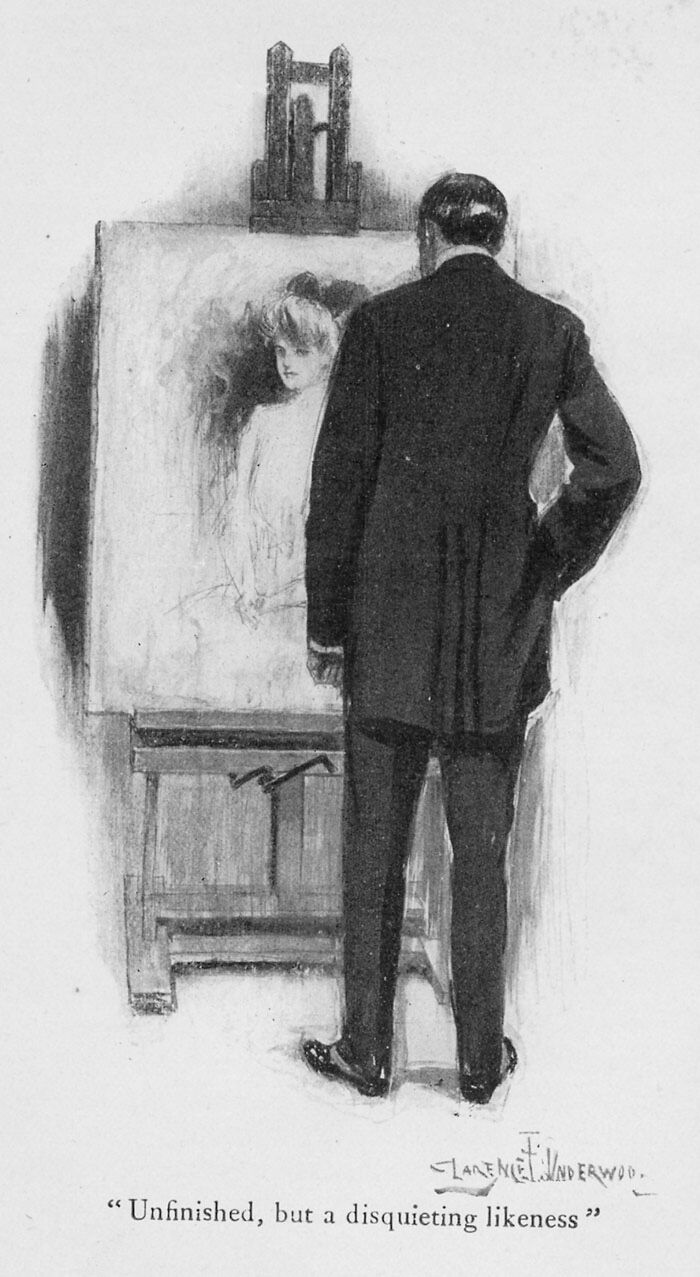
But he didn't work. He seldom did now. And when he did the work was not good. His easel held most often the portrait of Betty that had been begun at Long Barton—unfinished, but a disquieting likeness. He walked up and down his room not thinking, but dreaming. His dreams took him to the warren, in the pure morning light; he saw Betty; he told himself what he had said, what she had said.
"And it was I who advised her to come to Paris. If only I'd known then—"
He stopped and asked himself what he knew now that he had not known then, refused himself the answer, and went to call on Lady St. Craye.
Christmas came and went; the black winds of January swept the Boulevards, and snow lay white on the walls of court and garden. Betty's life was full now.
The empty cage that had opened its door to love at Long Barton had now other occupants. Ambition was beginning to grow its wing feathers. She could draw—at least some day she would be able to draw. Already she had won a prize with a charcoal study of a bare back. But she did not dare to name this to her father, and when he wrote to ask what was the subject of her prize drawing she replied with misleading truth that it was a study from nature. His imagination pictured a rustic cottage, a water-wheel, a castle and mountains in the distance and cows and a peasant in the foreground.
But though her life was now crowded with new interests that first-comer was not ousted. Only he had changed his plumage and she called him Friendship. She blushed sometimes and stamped her foot when she remembered those meetings in the summer mornings, her tremors, her heart-beats. And oh, the "drivel" she had written in her diary!
"Girls ought never to be allowed to lead that 'sheltered home life,'" she said to Miss Voscoe, "with nothing real in it. It makes your mind all swept and garnished and then you hurry to fill it up with rubbish."
"That's so," said her friend.
"If ever I have a daughter," said Betty, "she shall set to work at something definite the very instant she leaves school—if it's only Hebrew or algebra. Not just Parish duties that she didn't begin, and doesn't want to go on with. But something that's her own work."
"You're beginning to see straight. I surmised you would by and by. But don't you go to the other end of the see-saw, Miss Daisy-Face!"
"What do you mean?" asked Betty. It was the morning interval when students eat patisserie out of folded papers. The two were on the window ledge of the Atelier, looking down on the convent garden where already the buds were breaking to green leaf.
"Why, there's room for the devil even if your flat ain't swept and garnished. He folds up mighty small, and gets into less space than a poppy-seed."
"What do you mean?" asked Betty again.
"I mean that Vernon chap," said Miss Voscoe down-rightly. "I told you to change partners every now and then. But with you it's that Vernon this week and last week and the week after next."
"I've known him longer than I have the others, and I like him," said Betty.
"Oh, he's all right; fine and dandy!" replied Miss Voscoe. "He's a big man, too, in his own line. Not the kind you expect to see knocking about at a students' crémerie. Does he give you lessons?"
"He did at home," said Betty.
"Take care he doesn't teach you what's the easiest thing in creation to learn about a man."
"What's that?" Betty did not like to have to ask the question.
"Why, how not to be able to do without him, of course," said Miss Voscoe.
"You're quite mistaken," said Betty eagerly: "one of the reasons I don't mind going about with him so much is that he's engaged to be married."
"Acquainted with the lady?"
"Yes," said Betty, sheltering behind the convention that an introduction at a tea-party constitutes acquaintanceship. She was glad Miss Voscoe had not asked her if she knew Lady St. Craye.
"Oh, well"—Miss Voscoe jumped up and shook the flakes of pastry off her pinafore—"if she doesn't mind, I guess I've got no call to. But why don't you give that saint in the go-to-hell collar a turn?"
"Meaning?"
"Mr. Temple. He admires you no end. He'd be always in your pocket if you'd let him. He's worth fifty of the other man as a man, if he isn't as an artist. I keep my eyes skinned—and the Sketch Club gives me a chance to tot them both up. I guess I can size up a man some. The other man isn't fast. That's how it strikes me."
"Fast?" echoed Betty, bewildered.
"Fast dye: fast colour. I suspicion he'd go wrong a bit in the wash. Temple's fast colour, warranted not to run."
"I know," said Betty, "but I don't care for the colour, and I'm rather tired of the pattern."
"I wish you'd tell me which of the two was the three-polite-word man."
"I know you do. But surely you see now?"
"You're too cute. Just as likely it's the Temple one, and that's why you're so sick of the pattern by now."
"Didn't I tell you you were clever?" laughed Betty.
But, all the same, next evening when Vernon called to take her to dinner, she said:
"Couldn't we go somewhere else? I'm tired of Garnier's."
Vernon was tired of Garnier's, too.
"Do you know Thirion's?" he said. "Thirion's in the Boulevard St. Germain, Thirion's where Du Maurier used to go, and Thackeray, and all sorts of celebrated people; and where the host treats you like a friend, and the waiter like a brother?"
"I should love to be treated like a waiter's brother. Do let's go," said Betty.
"He's a dream of a waiter," Vernon went on as they turned down the lighted slope of the Rue de Rennes, "has a voice like a trumpet, and takes a pride in calling twenty orders down the speaking-tube in one breath, ending up with a shout. He never makes a mistake either. Shall we walk, or take the tram, or a carriage?"
The Fate who was amusing herself by playing with Betty's destiny had sent Temple to call on Lady St. Craye that afternoon, and Lady St. Craye had seemed bored, so bored that she had hardly appeared to listen to Temple's talk, which, duly directed by her quite early into the channel she desired for it, flowed in a constant stream over the name, the history, the work, the personality of Vernon. When at last the stream ebbed Lady St. Craye made a pretty feint of stifling a yawn.
"Oh, how horrid I am!" she cried with instant penitence, "and how very rude you will think me! I think I have the blues to-day, or, to be more French and more poetic, the black butterflies. It is so sweet of you to have let me talk to you. I know I've been as stupid as an owl. Won't you stay and dine with me? I'll promise to cheer up if you will."
Mr. Temple would, more than gladly.
"Or no," Lady St. Craye went on, "that'll be dull for you, and perhaps even for me if I begin to think I'm boring you. Couldn't we do something desperate—dine at a Latin Quarter restaurant for instance? What was that place you were telling me of, where the waiter has a wonderful voice and makes the orders he shouts down the tube sound like the recitative of the basso at the Opera."
"Thirion's," said Temple; "but it wasn't I, it was Vernon."
"Thirion's, that's it!" Lady St. Craye broke in before Vernon's name left his lips. "Would you like to take me there to dine, Mr. Temple?"
It appeared that Mr. Temple would like it of all things.
"Then I'll go and put on my hat," said she and trailed her sea-green tea-gown across the room. At the door she turned to say: "It will be fun, won't it?"—and to laugh delightedly, like a child who is promised a treat.
That was how it happened that Lady St. Craye, brushing her dark furs against the wall of Thirion's staircase, came, followed by Temple, into the room where Betty and Vernon, their heads rather close together, were discussing the menu.
This was what Lady St. Craye had thought of more than a little. Yet it was not what she had expected. Vernon, perhaps, yes: or the girl. But not Vernon and the girl together. Not now. At her very first visit. It was not for a second that she hesitated. Temple had not even had time to see who it was to whom she spoke before she had walked over to the two, and greeted them.
"How perfectly delightful!" she said. "Miss Desmond, I've been meaning to call on you, but it's been so cold, and I've been so cross, I've called on nobody. Ah, Mr. Vernon, you too?"
She looked at the vacant chair near his, and Vernon had to say:
"You'll join us, of course?"
So the two little parties made one party, and one of the party was angry and annoyed, and no one of the party was quite pleased, and all four concealed what they felt, and affected what they did not feel, with as much of the tact of the truly well-bred as each could call up. In this polite exercise Lady St. Craye was easily first.
She was charming to Temple, she was very nice to Betty, and she spoke to Vernon with a delicate, subtle, faint suggestion of proprietorship in her tone. At least that was how it seemed to Betty. To Temple it seemed that she was tacitly apologising to an old friend for having involuntarily broken up a dinner à deux. To Vernon her tone seemed to spell out an all but overmastering jealousy proudly overmastered. All that pretty fiction of there being now no possibility of sentiment between him and her flickered down and died. And with it the interest that he had felt in her. "She have unexplored reserves? Bah!" he told himself, "she is just like the rest." He felt that she had not come from the other side of the river just to dine with Temple. He knew she had been looking for him. And the temptation assailed him to reward her tender anxiety by devoting himself wholly to Betty. Then he remembered what he had let Betty believe, as to the relations in which he stood to this other woman.
His face lighted up with a smile of answering tenderness. Without neglecting Betty he seemed to lay the real homage of his heart at the feet of that heart's lady.
"By Jove," he thought, as the dark, beautiful eyes met his in a look of more tenderness than he had seen in them this many a day, "if only she knew how she's playing my game for me!"
Betty, for her part, refused to recognise a little pain that gnawed at her heart and stole all taste from the best dishes of Thirion's. She talked as much as possible to Temple, because it was the proper thing to do, she told herself, and she talked very badly. Lady St. Craye was transfigured by Vernon's unexpected acceptance of her delicate advances, intoxicated by the sudden flutter of a dream she had only known with wings in full flight, into the region where dreams, clasped to the heart, become realities. She grew momently more beautiful. The host, going from table to table, talking easily to his guests, could not keep his fascinated eyes from her face. The proprietor of Thirion's had good taste, and knew a beautiful woman when he saw her.
Betty's eyes, too, strayed more and more often from her plate, and from Temple to the efflorescence of this new beauty-light. She felt mean and poor, ill-dressed, shabby, dowdy, dull, weary and uninteresting. Her face felt tired. It was an effort to smile.
When the dinner was over she said abruptly:
"If you'll excuse me—I've got a dreadful headache—no, I don't want anyone to see me home. Just put me in a carriage."
She insisted, and it was done.
When the carriage drew up in front of the closed porte cochère of 57 Boulevard Montparnasse, Betty was surprised and wounded to discover that she was crying.
"Well, you knew they were engaged!" she said as she let herself into her room with her latchkey. "You knew they were engaged! What did you expect?"
Temple could not remember afterwards exactly how he got separated from the others. It just happened, as such unimportant things will. He missed them somehow, at a crossing, looked about him in vain, shrugged his shoulders and went home.
Lady St. Craye hesitated a moment with her latchkey in her hand. Then she threw open the door of her flat.
"Come in, won't you?" she said, and led the way into her fire-warm, flower-scented, lamplit room. Vernon also hesitated a moment. Then he followed. He stood on the hearth-rug with his back to the wood fire. He did not speak.
Somehow it was difficult for her to take up their talk at the place and in the strain where it had broken off when Betty proclaimed her headache.
Yet this was what she must do, it seemed to her, or lose all the ground she had gained.
"You've been very charming to me this evening," she said at last, and knew as she said it that it was the wrong thing to say.
"You flatter me," said Vernon.
"I was so surprised to see you there," she went on.
Vernon was surprised that she should say it. He had thought more highly of her powers.
"The pleasure was mine," he said in his most banal tones, "the surprise, alas, was all for you—and all you gained."
"Weren't you surprised?"—Lady St. Craye was angry and humiliated. That she—she—should find herself nervous, at fault, find herself playing the game as crudely as any shopgirl!
"No," said Vernon.
"But you couldn't have expected me?" She knew quite well what she was doing, but she was too nervous to stop herself.
"I've always expected you," he said deliberately, "ever since I told you that I often dined at Thirion's."
"You expected me to—"
"To run after me?" said Vernon with paraded ingenuousness; "yes, didn't you?"
"I run after you? You—" she stopped short, for she saw in his eyes that, if she let him quarrel with her now, it was forever.
He at the same moment awoke from the trance of anger that had come upon him when he found himself alone with her; anger at her, and at himself, fanned to fury by the thought of Betty and of what she, at this moment, must be thinking. He laughed:
"Ah, don't break my heart!" he said, "I've been so happy all the evening fancying that you had—you had—"
"Had what?" she asked with dry lips, for the caress in his tone was such as to deceive the very elect.
"Had felt just the faintest little touch of interest in me. Had cared to know how I spent my evenings, and with whom!"
"You thought I could stoop to spy on you?" she asked. "Monsieur flatters himself."
The anger in him was raising its head again.
"Monsieur very seldom does," he said.
She took that as she chose to take it.
"No, you're beautifully humble."
"And you're proudly beautiful."
She flushed and looked down.
"Don't you like to be told that you're beautiful?"
"Not by you. Not like that!"
"And so you didn't come to Thirion's to see me? How one may deceive oneself! The highest hopes we cherish here! Another beautiful illusion gone!"
She said to herself: "I can do nothing with him in this mood," and aloud she could not help saying: "Was it a beautiful one?"
"Very," he answered gaily. "Can you doubt it?"
She found nothing to say. And even as she fought for words she suddenly found that he had caught her in his arms, and kissed her, and that the sound of the door that had banged behind him was echoing in her ears.
She put her hands to her head. She could not see clearly.
CHAPTER XVII.
INTERVENTIONS.
That kiss gave Lady St. Craye furiously to think, as they say in France.
Had it meant—? What had it meant? Was it the crown of her hopes, her dreams? Was it possible that now, at last, after all that had gone before, she might win him—had won him, even?
The sex-instinct said "No."
Then, if "No" were the answer to that question, the kiss had been mere brutality. It had meant just:
"You chose to follow me—to play the spy. What the deuce do you want? Is it this? God knows you're welcome," the kiss following.
The kiss stung. It was not the first. But the others—even the last of them, two years before, had not had that sting.
Lady St. Craye, biting her lips in lonely dissection of herself and of him, dared take no comfort. Also, she no longer dared to follow him, to watch him, to spy on him.
In her jasmine-scented leisure Lady St. Craye analysed herself, and him and Her. Above all Her—who was Betty. To find out how it all seemed to her—that, presently, seemed to Lady St. Craye the one possible, the one important thing. So after she had given a few days to the analysis of that kiss, had failed to reach certainty as to its elements, had writhed in her failure, and bitterly resented the mysteries constituent that falsified all her calculations, she dressed herself beautifully, and went to call on the constituent, Betty.
Betty was at home. She was drawing at a table, cunningly placed at right angles to the window. She rose with a grace that Lady St. Craye had not seen in her. She was dressed in a plain gown, that hung from the shoulders in long, straight, green folds. Her hair was down.—And Betty had beautiful hair. Lady St. Craye's hair had never been long. Betty's fell nearly to her knees.
"Oh, was the door open?" she said. "I didn't know, I've—I'm so sorry—I've been washing my hair."
"It's lovely," said the other woman, with an appreciation quite genuine. "What a pity you can't always wear it like that!"
"It's long," said Betty disparagingly, "but the colour's horrid. What Miss Voscoe calls Boy colour."
"Boy colour?"
"Oh, just nothing in particular. Mousy."
"If you had golden hair, or black, Miss Desmond, you'd have a quite unfair advantage over the rest of us."
"I don't think so," said Betty very simply; "you see, no one ever sees it down."
"What a charming place you've got here," Lady St. Craye went on.
"Yes," said Betty, "it is nice," and she thought of Paula.
"And do you live here all alone?"
"Yes: I had a friend with me at first, but she's gone back to England."
"Don't you find it very dull?"
"Oh, no! I know lots of people now."
"And they come to see you here?"
Lady St. Craye had decided that it was not necessary to go delicately. The girl was evidently stupid, and one need not pick one's words.
"Yes," said Betty.
"Mr. Vernon's a great friend of yours, isn't he?"
"Yes."
"I suppose you see a great deal of him?"
"Yes. Is there anything else you would like to know?"
The scratch was so sudden, so fierce, so feline that for a moment Lady St. Craye could only look blankly at her hostess. Then she recovered herself enough to say:
"Oh, I'm so sorry! Was I asking a lot of questions? It's a dreadful habit of mine, I'm afraid, when I'm interested in people."
Betty scratched again quite calmly and quite mercilessly.
"It's quite natural that Mr. Vernon should interest you. But I don't think I'm likely to be able to tell you anything about him that you don't know. May I get you some tea?"
It was impossible for Lady St. Craye to reply: "I meant that I was interested in you—not in Mr. Vernon;" so she said:
"Thank you—that will be delightful."
Betty went along the little passage to her kitchen, and her visitor was left to revise her impressions.
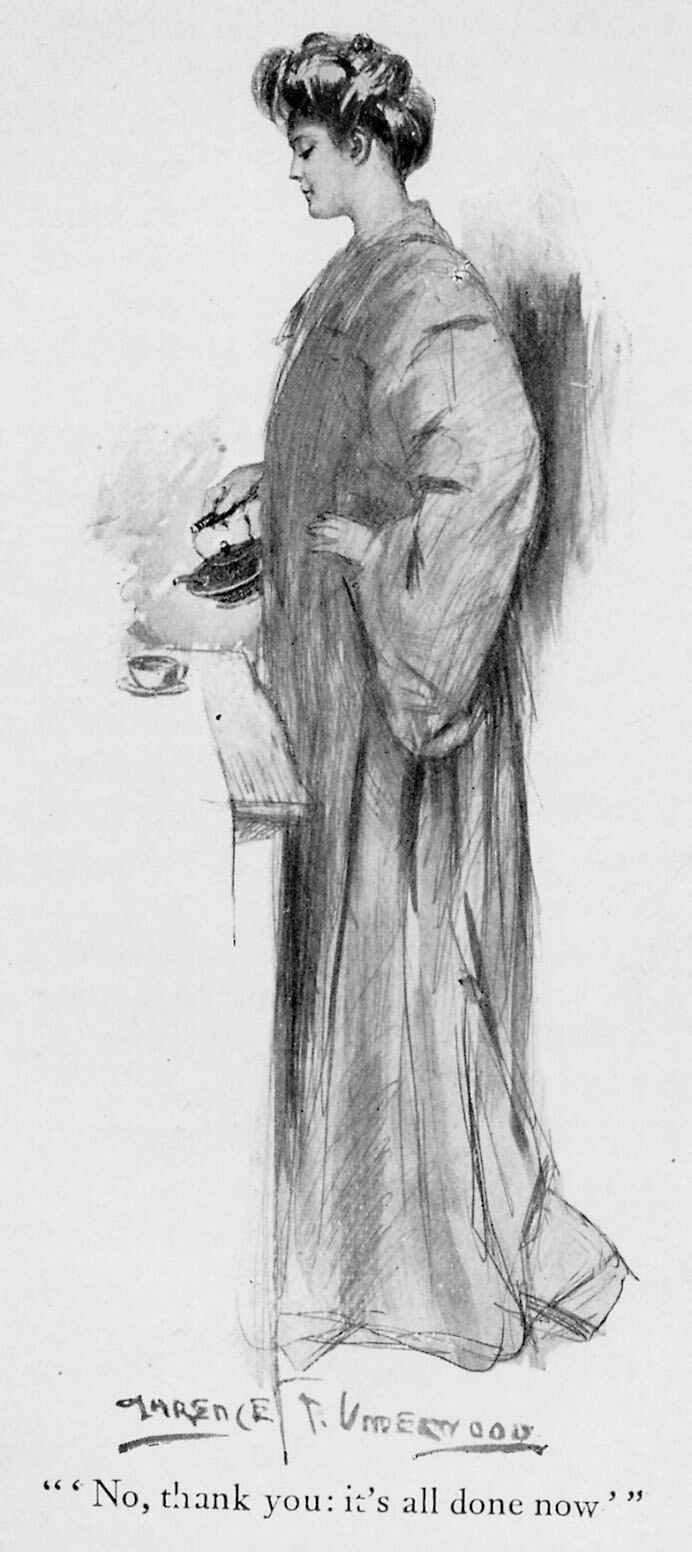
When Betty came back with the tea-tray, her hair was twisted up. The kettle could be heard hissing in the tiny kitchen.
"Can't I help you?" Lady St. Craye asked, leaning back indolently in the most comfortable chair.
"No, thank you: it's all done now."
Betty poured the tea for the other woman to drink. Her own remained untasted. She exerted herself to manufacture small-talk, was very amiable, very attentive. Lady St. Craye almost thought she must have dreamed those two sharp cat-scratches at the beginning of the interview. But presently Betty's polite remarks came less readily. There were longer intervals of silence. And Lady St. Craye for once was at a loss. Her nerve was gone. She dared not tempt the claws again. After the longest pause of all Betty said suddenly:
"I think I know why you came to-day."
"I came to see you, because you're a friend of Mr. Vernon's."
"You came to see me because you wanted to find out exactly how much I'm a friend of Mr. Vernon's. Didn't you?"
Candour is the most disconcerting of the virtues.
"Not in the least," Lady St. Craye found herself saying. "I came to see you—because—as I said."
"I don't think it is much use your coming to see me," Betty went on, "though, if you meant it kindly—But you didn't—you didn't! If you had it wouldn't have made any difference. We should never get on with each other, never."
"Really, Miss Desmond"—Lady St. Craye clutched her card-case and half rose—"I begin to think we never should."
Betty's ignorance of the usages of good society stood her friend. She ignored, not consciously, but by the prompting of nature, the social law which decrees that one should not speak of things that really interest one.
"Do sit down," she said. "I'm glad you came—because I know exactly what you mean, now."
"If the knowledge were only mutual!" sighed Lady St. Craye, and found courage to raise eyebrows wearily.
"You don't like my going about with Mr. Vernon. Well, you've only to say so. Only when you're married you'll find you've got your work cut out to keep him from having any friends except you."
Lady St. Craye had the best of reasons for believing this likely to be the truth. She said:
"When I'm married?"
"Yes," said Betty firmly. "You're jealous; you've no cause to be—and I tell you that because I think being jealous must hurt. But it would have been nicer of you, if you'd come straight to me and said: 'Look here, I don't like you going about with the man I'm engaged to.' I should have understood then and respected you. But to come like a child's Guide to Knowledge—"
The other woman was not listening. "Engaged to him!"—The words sang deliciously, disquietingly in her ears.
"But who said I was engaged to him?"
"He did, of course. He isn't ashamed of it—if you are."
"He told you that!"
"Yes. Now aren't you ashamed of yourself?"
Country-bred Betty, braced by the straightforward directness of Miss Voscoe, and full of the nervous energy engendered by a half-understood trouble, had routed, for a moment, the woman of the world. But only for a moment. Then Lady St. Craye, unable to estimate the gain or loss of the encounter, pulled herself together to make good her retreat.
"Yes," she said, with her charming smile. "I am ashamed of myself. I was jealous—I own it. But I shouldn't have shown it as I did if I'd known the sort of girl you are. Come, forgive me! Can't you understand—and forgive?"
"It was all my fault." The generosity of Betty hastened to meet what it took to be the generosity of the other. "Forgive me. I won't see him again at all—if you don't want me to."
"No, no." Even at that moment, in one illuminating flash, Lady St. Craye saw the explications that must follow the announcement of that renunciatory decision. "No, no. If you do that I shall feel sure that you don't forgive me for being so silly. Just let everything go on—won't you? And please, please don't tell him anything about—about to-day."
"How could I?" asked Betty.
"But promise you won't. You know—men are so vain. I should hate him to know"—she hesitated and then finished the sentence with fine art—"to know—how much I care."
"Of course you care," said Betty downrightly. "You ought to care. It would be horrid of you if you didn't."
"But I don't, now. Now I know you, Miss Desmond. I understand so well—and I like to think of his being with you."
Even to Betty's ears this did not ring quite true.
"You like—?" she said.
"I mean I quite understand now. I thought—I don't know what I thought. You're so pretty, you know. And he has had so very many—love-affairs."
"He hasn't one with me," said Betty briefly.
"Ah, you're still angry. And no wonder. Do forgive me, Miss Desmond, and let's be friends."
Betty's look as she gave her hand was doubtful. But the hand was given.
"And you'll keep my poor little secret?"
"I should have thought you would have been proud for him to know how much you care."
"Ah, my dear," Lady St. Craye became natural for an instant under the transfiguring influence of her real thoughts as she spoke them, "my dear, don't believe it! When a man's sure of you he doesn't care any more. It's while he's not quite sure that he cares."
"I don't think that's so always," said Betty.
"Ah, believe me, there are 'more ways of killing a cat than choking it with butter.' Forgive the homely aphorism. When you have a lover of your own—or perhaps you have now?"
"Perhaps I have." Betty stood on guard with a steady face.
"Well, when you have—or if you have—remember never to let him be quite sure. It's the only way."
The two parted, with a mutually kindly feeling that surprised one as much as the other. Lady St. Craye drove home contrasting bitterly the excellence of her maxims with the ineptitude of her practice. She had let him know that she cared. And he had left her. That was two years ago. And, now that she had met him again, when she might have played the part she had recommended to that chit with the long hair—the part she knew to be the wise one—she had once more suffered passion to overcome wisdom, and had shown him that she loved him. And he had kissed her.
She blushed in the dusk of her carriage for the shame of that kiss.
But he had told that girl that he was engaged to her.
A delicious other flush replaced the blush of shame. Why should he have done that unless he really meant—? In that case the kiss was nothing to blush about. And yet it was. She knew it.
She had time to think in the days that followed, days that brought Temple more than once to her doors, but Vernon never.
Betty left alone let down her damp hair and tried to resume her drawing. But it would not do. The emotion of the interview was too recent. Her heart was beating still with anger, and resentment, and other feelings less easily named.
Vernon was to come to fetch her at seven. She would not face him. Let him go and dine with the woman he belonged to!
Betty went out at half-past six. She would not go to Garnier's, nor to Thirion's. That was where he would look for her.
She walked steadily on, down the boulevard. She would dine at some place she had never been to before. A sickening vision of that first night in Paris swam before her. She saw again the Café d'Harcourt, heard the voices of the women who had spoken to Paula, saw the eyes of the men who had been the companions of those women. In that rout the face of Temple shone—clear cut, severe. She remembered the instant resentment that had thrilled her at his protective attitude, remembered it and wondered at it a little. She would not have felt that now. She knew her Paris better than she had done then.
And with the thought, the face of Temple came towards her out of the crowd. He raised his hat in response to her frigid bow, and had almost passed her, when she spoke on an impulse that surprised herself.
"Oh—Mr. Temple!"
He stopped and turned.
"I was looking for a place to dine. I'm tired of Garnier's and Thirion's."
He hesitated. And he, too, remembered the night at the Café d'Harcourt, when she had disdained his advice and gone back to take the advice of Paula.
He caught himself assuring himself that a man need not be ashamed to risk being snubbed—making a fool of himself even—if he could do any good. So he said: "You know I have horrid old-fashioned ideas about women," and stopped short.
"Don't you know of any good quiet place near here?" said Betty.
"I think women ought to be taken care of. But some of them—Miss Desmond, I'm so afraid of you—I'm afraid of boring you—"
Remorse stirred her.
"You've always been most awfully kind," she said warmly. "I've often wanted to tell you that I'm sorry about that first time I saw you—I'm not sorry for what I did," she added in haste; "I can never be anything but glad for that. But I'm sorry I seemed ungrateful to you."
"Now you give me courage," he said. "I do know a quiet little place quite near here. And, as you haven't any of your friends with you, won't you take pity on me and let me dine with you?"
"You're sure you're not giving up some nice engagement—just to—to be kind to me?" she asked. And the forlornness of her tone made him almost forget that he had half promised to join a party of Lady St. Craye's.
"I should like to come with you—I should like it of all things," he said; and he said it convincingly.
They dined together, and the dinner was unexpectedly pleasant to both of them. They talked of England, of wood, field and meadow, and Betty found herself talking to him of the garden at home and of the things that grew there, as she had talked to Paula, and as she had never talked to Vernon.
"It's so lovely all the year," she said. "When the last mignonette's over, there are the chrysanthemums, and then the Christmas roses, and ever so early in January the winter aconite and the snow-drops, and the violets under the south wall. And then the little green daffodil leaves come up and the buds, though it's weeks before they turn into flowers. And if it's a mild winter the primroses—just little baby ones—seem to go on all the time."
"Yes," he said, "I know. And the wallflowers, they're green all the time.—And the monthly roses, they flower at Christmas. And then when the real roses begin to bud—and when June comes—and you're drunk with the scent of red roses—the kind you always long for at Christmas."
"Oh, yes," said Betty—"do you feel like that too? And if you get them, they're soft limp-stalked things, like caterpillars half disguised as roses by some incompetent fairy. Not like the stiff solid heavy velvet roses with thick green leaves and heaps of thorns. Those are the roses one longs for."
"Yes," he said. "Those are the roses one longs for." And an odd pause punctuated the sentence.
But the pause did not last. There was so much to talk of—now that barrier of resentment, wattled with remorse, was broken down. It was an odd revelation to each—the love of the other for certain authors, certain pictures, certain symphonies, certain dramas. The discovery of this sort of community of tastes is like the meeting in far foreign countries of a man who speaks the tongue of one's mother land. The two lingered long over their coffee, and the "Grand Marnier" which their liking for "The Garden of Lies" led to their ordering. Betty had forgotten Vernon, forgotten Lady St. Craye, in the delightful interchange of:
"Oh, I do like—"
"And don't you like—?"
"And isn't that splendid?"
These simple sentences, interchanged, took on the value of intimate confidences.
"I've had such a jolly time," Temple said. "I haven't had such a talk for ages."
And yet all the talk had been mere confessions of faith—in Ibsen, in Browning, in Maeterlinck, in English gardens, in Art for Art's sake, and in Whistler and Beethoven.
"I've liked it too," said Betty.
"And it's awfully jolly," he went on, "to feel that you've forgiven me"—the speech suddenly became difficult,—"at least I mean to say—" he ended lamely.
"It's I who ought to be forgiven," said Betty. "I'm very glad I met you. I've enjoyed our talk ever so much."
Vernon spent an empty evening, and waylaid Betty as she left her class next day.
"I'm sorry," she said. "I couldn't help it. I suddenly felt I wanted something different. So I dined at a new place."
"Alone?" said Vernon.
"No," said Betty with her chin in the air.
Vernon digested, as best he might, his first mouthful of jealousy—real downright sickening jealousy. The sensation astonished him so much that he lacked the courage to dissect it.
"Will you dine with me to-night?" was all he found to say.
"With pleasure," said Betty. But it was not with pleasure that she dined. There was something between her and Vernon. Both felt it, and both attributed it to the same cause.
The three dinners that followed in the next fortnight brought none of that old lighthearted companionship which had been the gayest of table-decorations. Something was gone—lost—as though a royal rose had suddenly faded, a rainbow-coloured bubble had broken.
"I'm glad," said Betty; "if he's engaged, I don't want to feel happy with him."
She did not feel happy without him. The Inward Monitor grew more and more insistent. She caught herself wondering how Temple, with the serious face and the honest eyes, would regard the lies, the trickeries, the whole tissue of deceit that had won her her chance of following her own art, of living her own life.
Vernon understood, presently, that not even that evening at Thirion's could give the key to this uncomforting change. He had not seen Lady St. Craye since the night of the kiss.
It was after the fourth flat dinner with Betty that he said good-night to her early and abruptly, and drove to Lady St. Craye's.
She was alone. She rose to greet him, and he saw that her eyes were dark-rimmed, and her lips rough.
"This is very nice of you," she said. "It's nearly a month since I saw you."
"Yes," he said. "I know it is. Do you remember the last time? Hasn't that taught you not to play with me?"
The kiss was explained now. Lady St. Craye shivered.
"I don't know what you mean?" she said, feebly.
"Oh, yes, you do! You're much too clever not to understand. Come to think of it, you're much too everything—too clever, too beautiful, too charming, too everything."
"You overwhelm me," she made herself say.
"Not at all. You know your points. What I want to know is just one thing—and that's the thing you're going to tell me."
She drew her dry lips inward to moisten them.
"What do you want to know? Why do you speak to me like that? What have I done?"
"That's what you're going to tell me."
"I shall tell you nothing—while you ask in that tone."
"Won't you? How can I persuade you?" his tone caressed and stung. "What arguments can I use? Must I kiss you again?"
She drew herself up, called wildly on all her powers to resent the insult. Nothing came at her call.
"What do you want me to tell you?" she asked, and her eyes implored the mercy she would not consciously have asked.
He saw, and he came a little nearer to her—looking down at her upturned face with eyes before which her own fell.
"You don't want another kiss?" he said. "Then tell me what you've been saying to Miss Desmond."
CHAPTER XVIII.
THE TRUTH.
There was a silence.
"Come, my pretty Jasmine lady, speak the truth."
"I will: What a brute you are!"
"So another lady told me a few months ago. Come, tell me."
"Why should I tell you anything?" She tried to touch her tone with scorn.
"Because I choose. You thought you could play with me and fool me and trick me out of what I mean to have—"
"What you mean to have?"
"Yes, what I mean to have. I mean to marry Miss Desmond—if she'll have me."
"You—mean to marry? Saul is among the prophets with a vengeance!" The scorn came naturally to her voice now.
Vernon stood as if turned to stone. Nothing had ever astonished him so much as those four words, spoken in his own voice, "I mean to marry." He repeated them. "I mean to marry Miss Desmond, if she'll have me. And it's your doing."
"Of course," she shrugged her shoulders. "Naturally it would be. Won't you sit down? You look so uncomfortable. Those French tragedy scenes with the hero hat in one hand and gloves in the other always seem to me so comic."
That was her score, the first. He put down the hat and gloves and came towards her. And as he came he hastily sketched his plan of action. When he reached her it was ready formed. His anger was always short lived. It had died down and left him competent as ever to handle the scene.
He took her hands, pushed her gently into a chair near the table, and sat down beside her with his elbows on the table and his head in his hands.
"Forgive me, dear," he said. "I was a brute. Forgive me—and help me. No one can help me but you."
It was a master-stroke: and he had staked a good deal on it. The stake was not lost. She found no words.
"My dear, sweet Jasmine lady," he said, "let me talk to you. Let me tell you everything. I can talk to you as I can talk to no one else, because I know you're fond of me. You are fond of me—a little, aren't you—for the sake of old times?"
"Yes," she said, "I am fond of you."
"And you forgive me—you do forgive me for being such a brute? I hardly knew what I was doing."
"Yes," she said, speaking as one speaks in dreams, "I forgive you."
"Thank you," he said humbly; "you were always generous. And you always understand."
"Wait—wait. I'll attend to you presently," she was saying to her heart. "Yes, I know it's all over. I know the game's up. Let me pull through this without disgracing myself, and I'll let you hurt me as much as you like afterwards."
"Tell me," she said gently to Vernon, "tell me everything."
He was silent, his face still hidden. He had cut the knot of an impossible situation and he was pausing to admire the cleverness of the stroke. In two minutes he had blotted out the last six months—months in which he and she had been adversaries. He had thrown himself on her mercy, and he had done wisely. Never, even in the days when he had carefully taught himself to be in love with her, had he liked her so well as now, when she got up from her chair to come and lay her hand softly on his shoulder and to say:
"My poor boy,—but there's nothing for you to be unhappy about. Tell me all about it—from the very beginning."
There was a luxurious temptation in the idea. It was not the first time, naturally, that Vernon had "told all about it" with a sympathetic woman-hand on his shoulder. He knew the strategic value of confidences. But always he had made the confidences fit the occasion—serve the end he had in view. Now, such end as had been in view was gained. He knew that it was only a matter of time now, before she should tell him of her own accord, what he could never by any brutality have forced her to tell. And the temptation to speak, for once, the truth about himself was overmastering. It is a luxury one can so very rarely afford. Most of us go the whole long life-way without tasting it. There was nothing to lose by speaking the truth. Moreover, he must say something, and why not the truth? So he said:
"It all comes of that confounded habit of mine of wanting to be in love."
"Yes," she said, "you were always so anxious to be—weren't you? And you never were—till now."
The echo of his hidden thought made it easier for him to go on.
"It was at Long Barton," he said,—"it's a little dead and alive place in Kent. I was painting that picture that you like—the one that's in the Salon, and I was bored to death, and she walked straight into the composition in a pink gown that made her look like a La France rose that has been rained on—you know the sort of pink-turning-to-mauve."
"And it was love at first sight?" said she, and took away her hand.
"Not it," said Vernon, catching the hand and holding it; "it was just the usual thing. I wanted it to be like all the others."
"Like mine," she said, looking down on him.
"Nothing could be like that," he had the grace to say, looking up at her: "that was only like the others in one thing—that it couldn't last.—What am I thinking of to let you stand there?"
He got up and led her to the divan. They sat down side by side. She wanted to laugh, to sing, to scream. Here was he sitting by her like a lover—holding her hand, the first time these two years, three years nearly—his voice tender as ever. And he was telling her about Her.
"No," he went on, burrowing his shoulder comfortably in the cushions, "it was just the ordinary outline sketch. But it was coming very nicely. She was beginning to be interested, and I had taught myself almost all that was needed—I didn't want to marry her; I didn't want anything except those delicate delightful emotions that come before one is quite, quite sure that she—But you know."
"Yes," she said. "I know."
"Then her father interfered, and vulgarized the whole thing. He's a parson—a weak little rat, but I was sorry for him. Then an aunt came on the scene—a most gentlemanly lady,"—he laughed a little at the recollection,—"and I promised not to go out of my way to see Her again. It was quite easy. The bloom was already brushed from the adventure. I finished the picture, and went to Brittany and forgot the whole silly business."
"There was some one in Brittany, of course?"
"Of course," said he; "there always is. I had a delightful summer. Then in October, sitting at the Café de la Paix, I saw her pass. It was the same day I saw you."
"Before or after you saw me?"
"After."
"Then if I'd stopped—if I'd made you come for a drive then and there, you'd never have seen her?"
"That's so," said Vernon; "and by Heaven I almost wish you had!"
The wish was a serpent in her heart. She said: "Go on."
And he went on, and, warming to his subject, grew eloquent on the events of the winter, his emotions, his surmises as to Betty's emotions, his slow awakening to the knowledge that now, for the first time—and so on and so forth.
"You don't know how I tried to fall in love with you again," he said, and kissed her hand. "You're prettier than she is, and cleverer and a thousand times more adorable. But it's no good; it's a sort of madness."
"You never were in love with me."
"No: I don't think I was: but I was happier with you than I shall ever be with her for all that. Talk of the joy of love! Love hurts—hurts damnably. I beg your pardon."
"Yes. I believe it's painful. Go on."
He went on. He was enjoying himself, now, thoroughly.
"And so," the long tale ended, "when I found she had scruples about going about with me alone—because her father had suggested that I was in love with her—I—I let her think that I was engaged to you."
"That is too much!" she cried and would have risen: but he kept her hand fast.
"Ah, don't be angry," he pleaded. "You see, I knew you didn't care about me a little bit: and I never thought you and she would come across each other."
"So you knew all the time that I didn't care?" her self-respect clutched at the spar he threw out.
"Of course. I'm not such a fool as to think—Ah, forgive me for letting her think that. It bought me all I cared to ask for of her time. She's so young, so innocent—she thought it was quite all right as long as I belonged to someone else, and couldn't make love to her."
"And haven't you?"
"Never—never once—since the days at Long Barton when it had to be 'made;' and even then I only made the very beginnings of it. Now—"
"I suppose you've been very, very happy?"
"Don't I tell you? I've never been so wretched in my life! I despise myself. I've always made everything go as I wanted it to go. Now I'm like a leaf in the wind—Pauvre feuille desechée, don't you know. And I hate it. And I hate her being here without anyone to look after her. A hundred times I've had it on the tip of my pen to send that doddering old Underwood an anonymous letter, telling him all about it."
"Underwood?"
"Her step-father.—Oh, I forgot—I didn't tell you." He proceeded to tell her Betty's secret, the death of Madame Gautier and Betty's bid for freedom.
"I see," she said slowly. "Well, there's no great harm done. But I wish you'd trusted me before. You wanted to know, at the beginning of this remarkable interview," she laughed rather forlornly, "what I had told Miss Desmond. Well, I went to see her, and when she told me that you'd told her you were engaged to me, I—I just acted the jealous a little bit. I thought I was helping you—playing up to you. I suppose I overdid it. I'm sorry."
"The question is," said he anxiously, "whether she'll forgive me for that lie. She's most awfully straight, you know."
"She seems to have lied herself," Lady St. Craye could not help saying.
"Ah, yes—but only to her father."
"That hardly counts, you think?"
"It's not the same thing as lying to the person you love. I wish—I wonder whether you'd mind if I never told her it was a lie? Couldn't I tell her that we were engaged but you've broken it off? That you found you liked Temple better, or something?"
She gasped before the sudden vision of the naked gigantic egotism of a man in love.
"You can tell her what you like," she said wearily: "a lie or two more or less—what does it matter?"
"I don't want to lie to her," said Vernon. "I hate to. But she'd never understand the truth."
"You think I understand? It is the truth you've been telling me?"
He laughed. "I don't think I ever told so much truth in all my life."
"And you've thoroughly enjoyed it! You alway did enjoy new sensations!"
"Ah, don't sneer at me. You don't understand—not quite. Everything's changed. I really do feel as though I'd been born again. The point of view has shifted—and so suddenly, so completely. It's a new Heaven and a new earth. But the new earth's not comfortable, and I don't suppose I shall ever get the new Heaven. But you'll help me—you'll advise me? Do you think I ought to tell her at once? You see, she's so different from other girls—she's—"
"She isn't," Lady St. Craye interrupted, "except that she's the one you love; she's not a bit different from other girls. No girl's different from other girls."
"Ah, you don't know her," he said. "You see, she's so young and brave and true and—what is it—Why—"
Lady St. Craye had rested her head against his coat-sleeve and he knew that she was crying.
"What is it? My dear, don't—you musn't cry."
"I'm not.—At least I'm very tired."
"Brute that I am!" he said with late compunction. "And I've been worrying you with all my silly affairs. Cheer up,—and smile at me before I go! Of course you're tired!"
His hand on her soft hair held her head against his arm.
"No," she said suddenly, "it isn't that I'm tired, really. You've told the truth,—why shouldn't I?" Vernon instantly and deeply regretted the lapse.
"You're really going to marry the girl? You mean it?"
"Yes."
"Then I'll help you. I'll do everything I can for you."
"You're a dear," he said kindly. "You always were."
"I'll be your true friend—oh, yes, I will! Because I love you, Eustace. I've always loved you—I always shall. It can't spoil anything now to tell you, because everything is spoilt. She'll never love you like I do. Nobody ever will."
"You're tired. I've bothered you. You're saying this just to—because—"
"I'm saying it because it's true. Why should you be the only one to speak the truth? Oh, Eustace—when you pretended to think I didn't care, two years ago, I was too proud to speak the truth then. I'm not proud now any more. Go away. I wish I'd never seen you; I wish I'd never been born."
"Yes, dear, yes. I'll go" he said, and rose. She buried her face in the cushion where his shoulder had been.
He was looking round for his hat and gloves—more uncomfortable than he ever remembered to have been.
As he reached the door she sprang up, and he heard the silken swish of her gray gown coming towards him.
"Say good-night," she pleaded. "Oh, Eustace, kiss me again—kindly, not like last time."
He met her half-way, took her in his arms and kissed her forehead very gently, very tenderly.
"My dearest Jasmine lady," he said, "it sounds an impertinence and I daresay you won't believe it, but I was never so sorry in my life as I am now. I'm a beast, and I don't deserve to live. Think what a beast I am—and try to hate me."
She, clung to him and laid her wet cheek against his. Then her lips implored his lips. There was a long silence. It was she—she was always glad of that—who at last found her courage, and drew back.
"Good-bye," she said. "I shall be quite sane to-morrow. And then I'll help you."
When he got out into the street he looked at his watch. It was not yet ten o'clock. He hailed a carriage.
"Fifty-seven Boulevard Montparnasse," he said.
He could still feel Lady St. Craye's wet cheek against his own. The despairing passion of her last kisses had thrilled him through and through.
He wanted to efface the mark of those kisses. He would not be haunted all night by any lips but Betty's.
He had never called at her rooms in the evening. He had been careful for her in that. Even now as he rang the bell he was careful, and when the latch clicked and the door was opened a cautious inch he was ready, as he entered, to call out, in passing the concierge's door not Miss Desmond's name, but the name of the Canadian artist who occupied the studio on the top floor.
He went softly up the stairs and stood listening outside Betty's door. Then he knocked gently. No one answered. Nothing stirred inside.
"She may be out," he told himself. "I'll wait a bit."
At the same time he tapped again; and this time beyond the door something did stir.
Then came Betty's voice:
"Qui est la?"
"It's me—Vernon. May I come in?"
A moment's pause. Then:
"No. You can't possibly. Is anything the matter?"
"No—oh, no, but I wanted so much to see you. May I come to-morrow early?"
"You're sure there's nothing wrong? At home or anything? You haven't come to break anything to me?"
"No—no; it's only something I wanted to tell you."
He began to feel a fool, with his guarded whispers through a locked door.
"Then come at twelve," said Betty in the tones of finality. "Good-night."
He heard an inner door close, and went slowly away. He walked a long way that night. It was not till he was back in his rooms and had lighted his candle and wound up his watch that Lady St. Craye's kisses began to haunt him in good earnest, as he had known they would.
Lady St. Craye, left alone, dried her eyes and set to work, with heart still beating wildly to look about her at the ruins of her world.
The room was quiet with the horrible quiet of a death chamber. And yet his voice still echoed in it. Only a moment ago she had been in his arms, as she had never hoped to be again—more—as she had never been before.
"He would have loved me now," she told herself, "if it hadn't been for that girl. He didn't love me before. He was only playing at love. He didn't know what love was. But he knows now. And it's all too late!"
But was it?
A word to Betty—and—
"But you promised to help him."
"That was before he kissed me."
"But a promise is a promise."
"Yes,—and your life's your life. You'll never have another."
She stood still, her hands hanging by her sides—clenched hands that the rings bit into.
"He will go to her early to-morrow. And she'll accept him, of course. She's never seen anyone else, the little fool."
She knew that she herself would have taken him, would have chosen him as the chief among ten thousand.
"She could have Temple. She'd be much happier with Temple. She and Eustace would make each other wretched. She'd never understand him, and he'd be tired of her in a week."
She had turned up the electric lights now, at her toilet table, and was pulling the pins out of her ruffled hair.
"And he'd never care about her children. And they'd be ugly little horrors."
She was twisting her hair up quickly and firmly.
"I have a right to live my own life," she said, just as Betty had said six months before. "Why am I to sacrifice everything to her—especially when I don't suppose she cares—and now that I know I could get him if she were out of the way?"
She looked at herself in the silver-framed mirror and laughed.
"And you always thought yourself a proud woman!"
Suddenly she dropped the brush; it rattled and spun on the polished floor.
She stamped her foot.
"That settles it!" she said. For in that instant she perceived quite clearly and without mistake that Vernon's attitude had been a parti-pris: that he had thrown, himself on her pity of set purpose, with an end to gain.
"Laughing at me all the time too, of course! And I thought I understood him. Well, I don't misunderstand him for long, anyway," she said, and picked up the hair brush.
"You silly fool," she said to the woman in the glass.
And now she was fully dressed—in long light coat and a hat with, as usual, violets in it. She paused a moment before her writing-table, turned up its light, turned it down again.
"No," she said, "one doesn't write anonymous letters. Besides it would be too late. He'll see her to-morrow early—early."
The door of the flat banged behind her as it had banged behind Vernon half an hour before. Like him, she called a carriage, and on her lips too, as the chill April air caressed them, was the sense of kisses.
And she, too, gave to the coachman the address:
Fifty-seven Boulevard Montparnasse.
CHAPTER XIX.
THE TRUTH WITH A VENGEANCE.
In those three weeks whose meetings with Vernon had been so lacking in charm there had been other meetings for Betty, and in these charm had not been to seek. But it was the charm of restful, pleasant companionship illuminated by a growing certainty that Mr. Temple admired her very much, that he liked her very much, that he did not think her untidy and countrified and ill-dressed, and all the things she had felt herself to be that night when Lady St. Craye and her furs had rustled up the staircase at Thirion's. And she had dined with Mr. Temple and lunched with Mr. Temple, and there had been an afternoon at St. Cloud, and a day at Versailles. Miss Voscoe and some of the other students had been in the party, but not of it as far as Betty was concerned. She had talked to Temple all the time.
"I'm glad to see you've taken my advice," said Miss Voscoe, "only you do go at things so—like a bull at a gate. A month ago it was all that ruffian Vernon. Now it's all Mr. Go-to-Hell. Why not have a change? Try a Pole or a German."
But Betty declined to try a Pole or a German.
What she wanted to do was to persuade herself that she liked Temple as much as she liked Vernon, and, further, that she did not care a straw for either.
Of course it is very wrong indeed to talk pleasantly with a young man when you think you know that he might, just possibly, be falling in love with you. But then it is very interesting, too. To be loved, even by the wrong person, seems in youth's selfish eyes to light up the world as the candle lights the Japanese lantern. And besides, after all, one can't be sure. And it is not maidenly to say "No," even by the vaguest movements of retreat, to a question that has not been asked and perhaps never will be.