Book 2.—The Man
Reading edition
CHAPTER VIII.
THE ONE AND THE OTHER.
"Some idiot," remarked Eustace Vernon, sipping Vermouth at a little table, "insists that, if you sit long enough outside the Café de la Paix, you will see everyone you have ever known or ever wanted to know pass by. I have sat here for half-an-hour—and—voila."
"You met me, half an hour ago," said the other man.
"Oh, you!" said Vernon affectionately.
"And your hat has gone off every half minute ever since," said the other man.
"Ah, that's to the people I've known. It's the people I've wanted to know that are the rarity."
"Do you mean people you have wanted to know and not known?"
"There aren't many of those," said Vernon; "no it's—Jove, that's a sweet woman!"
"I hate the type," said the other man briefly: "all clothes—no real human being."
The woman was beautifully dressed, in the key whose harmonies are only mastered by Frenchwomen and Americans. She turned her head as her carriage passed, and Vernon's hat went off once more.
"I'd forgotten her profile," said Vernon, "and she's learned how to dress since I saw her last. She's quite human, really, and as charming as anyone ought to be."
"So I should think," said the other man. "I'm sorry I said that, but I didn't know you knew her. How's trade?"
"Oh, I did a picture—well, but a picture! I did it in England in the Spring. Best thing I've done yet. Come and see it."
"I should like to look you up. Where do you hang out?"
"Eighty-six bis Rue Notre Dame des Champs," said Vernon. "Everyone in fiction lives there. It's the only street on the other side that authors seem ever to have dreamed of. Still, it's convenient, so I herd there with all sorts of blackguards, heroes and villains and what not. Eighty-six bis."
"I'll come," said the other man, slowly. "Do you know, Vernon, I'd like awfully to get at your point of view—your philosophy of life?"
"Haven't you got one, my dear chap!—'sufficient unto' is my motto."
"You paint pictures,", the other went on, "so very much too good for the sort of life you lead."
Vernon laughed.
"My dear Temple," he said, "I live, mostly, the life of a vestal virgin."
"You know well enough I'm not quarrelling with the way you spend your evenings," said his dear Temple; "it's your whole outlook that doesn't match your work. Yet there must be some relation between the two, that's what I'd like to get at."
There is a bond stronger than friendship, stronger than love—a bond that cannot be forged in any other shop than the one—the bond between old schoolfellows. Vernon had sometimes wondered why he "stood so much" from Temple. It is a wonder that old schoolfellows often feel, mutually.
"The subject you've started," said he, "is of course, to me, the most interesting. Please develop your thesis."
"Well then, your pictures are good, strong, thorough stuff, with sentiment—yes, just enough sentiment to keep them from the brutality of Degas or the sensualism of Latouche. Whereas you, yourself, seem to have no sentiment."
"I? No sentiment! Oh, Bobby, this is too much! Why, I'm a mass of it! Ask—"
"Yes, ask any woman of your acquaintance. That's just it—or just part of it. You fool them into thinking—oh, I don't know what; but you don't fool me."
"I haven't tried."
"Then you're not brutal, except half a dozen times in the year when you—And I've noticed that when your temper goes smash your morals go at the same time. Is that cause or effect? What's the real you like, and where do you keep it?"
"The real me," said Vernon, "is seen in my pictures, and—and appreciated by my friends; you for instance, are, I believe, genuinely attached to me."
"Oh, rot!" said Bobby.
"I don't see," said Vernon, moving his iron chair to make room for two people at the next table, "why you should expect my pictures to rhyme with my life. A man's art doesn't rhyme with his personality. Most often it contradicts flatly. Look at musicians—what a divine art, and what pigs of high priests! And look at actors—but no, one can't; the spectacle is too sickening."
"I sometimes think," said Temple, emptying his glass, "that the real you isn't made yet. It's waiting for—"
"For the refining touch of a woman's hand, eh? You think the real me is—Oh, Temple, Temple, I've no heart for these childish imaginings! The real me is the man that paints pictures, damn good pictures, too, though I say it."
"And is that what all the women think?
"Ask them, my dear chap; ask them. They won't tell you the truth."
"They're not the only ones who won't. I should like to know what you really think of women, Vernon."
"I don't think about them at all," lied Vernon equably. "They aren't subjects for thought but for emotion—and even of that as little as may be. It's impossible seriously to regard a woman as a human being; she's merely a dear, delightful, dainty—"
"Plaything?"
"Well, yes—or rather a very delicately tuned musical instrument. If you know the scales and the common chords, you can improvise nice little airs and charming variations. She's a sort of—well, a penny whistle, and the music you get depends not on her at all, but on your own technique."
"I've never been in love," said Temple; "not seriously, I mean," he hastened to add, for Vernon was smiling, "not a life or death matter, don't you know; but I do hate the way you talk, and one of these days you'll hate it too."
Miss Desmond's warning floated up through the dim waters of half a year.
"So a lady told me, only last Spring," he said. "Well, I'll take my chance. Going? Well, I'm glad we ran across each other. Don't forget to look me up."
Temple moved off, and Vernon was left alone. He sat idly smoking cigarette after cigarette, and watched the shifting crowd. It was a bright October day, and the crowd was a gay one.
Suddenly his fingers tightened on his cigarette,—but he kept the hand that held it before his face, and he bent his head forward.
Two ladies were passing, on foot. One was the elder Miss Desmond—she who had warned him that one of these days he would be caught—and the other, hanging lovingly on her aunt's arm, was, of course, Betty. But a smart, changed, awakened Betty! She was dressed almost as beautifully as the lady whose profile he had failed to recognise, but much more simply. Her eyes were alight, and she was babbling away to her aunt. She was even gesticulating a little, for all the world like a French girl. He noted the well-gloved hand with which she emphasized some point in her talk.
"That's the hand," he said, "that I held when we sat on the plough in the shed and I told her fortune."
He had risen, and his feet led him along the road they had taken. Ten yards ahead of him he saw the swing of the aunt's serviceable brown skirt and beside it Betty's green and gray.
"I am not breaking my word," he replied to the Inward Monitor. "Who's going out of his way to speak to the girl?"
He watched the brown gown and the green all the way down the Boulevard des Capucines, saw them cross the road and go up the steps of the Madeleine. He paused at the corner. It was hard, certainly, to keep his promise; yet so far it was easy, because he could not well recall himself to the Misses Desmond on the ground of his having six months ago involved the one in a row with her relations, and discussed the situation afterwards with the other.
"I do wonder where they're staying, though," he told himself. "If one were properly introduced—?" But he knew that the aunt would consider no introduction a proper one that should renew his acquaintance with Betty.
"Wolf, wolf," he said, "let the fold alone! There's no door for you, and you've pledged your sacred word as an honourable wolf not to jump any more hurdles."
And as he stood musing, the elder Miss Desmond came down the church steps and walked briskly away.
Some men would, doubtless, have followed her example, if not her direction. Vernon was not one of these. He found himself going up the steps of the great church. He had as good a right to go into the Madeleine as the next man. He would probably not see the girl. If he did he would not speak. Almost certainly he would not even see her.
But Destiny had remembered Mr. Vernon once more. Betty was standing just inside the door, her face upturned, and all her soul in her eyes. The mutterings of the organ and the voices of boys filled the great dark building.
He went and stood close by her. He would not speak. He would keep his word. But she should have a chance of speaking. His eyes were on her face. The hymn ended. She exhaled a held breath, started and spoke.
"You?" she said, "you?" The two words are spelled alike. Spoken, they are capable of infinite variations. The first "you" sent Vernon's blood leaping. The second froze it to what it had been before he met her. For indeed that little unfinished idyll had been almost forgotten by the man who sat drinking Vermouth outside the Café de la Paix.
"How are you?" he whispered. "Won't you shake hands?"
She gave him a limp and unresponsive glove.
"I had almost forgotten you," she said, "but I am glad to see you—because—Come to the door. I don't like talking in churches."
They stood on the steps behind one of the great pillars.
"Do you think it is wise to stand here?" he said. "Your aunt might see us."
"So you followed us in?" said Betty with perfect self-possession. "That was very kind. I have often wished to see you, to tell you how much obliged I am for all your kindness in the Spring. I was only a child then, and I didn't understand, but now I quite see how good it was of you."
"Why do you talk like that?" he said. "You don't think—you can't think it was my fault?"
"Your fault! What?"
"Why, your father finding us and—"
"Oh, that!" she said lightly. "Oh, I had forgotten that! Ridiculous, wasn't it? No, I mean your kindness in giving so many hours to teaching a perfect duffer. Well, now I've seen you and said what I had to say, I think I'll go back."
"No, don't go," he said. "I want to know—oh, all sorts of things! I can see your aunt from afar, and fly if she approaches."
"You don't suppose," said Betty, opening her eyes at him, "that I shan't tell her I've seen you?"
He had supposed it, and cursed his clumsiness.
"Ah, I see," she went on, "you think I should deceive my aunt now because I deceived my step-father in the Spring. But I was a child then,—and besides, I'm fond of my aunt."
"Did you know that she came to see me?"
"Of course. You seem to think we live in an atmosphere of deceit, Mr. Vernon."
"What's the matter with you?" he said bluntly, for finer weapons seemed useless. "What have I done to make you hate me?"
"I hate you? Oh, no—not in the least," said Betty spitefully. "I am very grateful to you for all your kindness."
"Where are you staying?" he asked.
"Hotel Bête," said Betty, off her guard, "but—"
The "but" marked his first score.
"I wish I could have called to see your aunt," he said carelessly, "but I am off to Vienna to-morrow."
Betty believed that she did not change countenance by a hair's breadth.
"I hope you'll have a delightful time," she said politely.
"Thanks. I am sure I shall. The only consolation for leaving Paris is that one is going to Vienna. Are you here for long?"
"I don't know." Betty was on her guard again.
"Paris is a delightful city, isn't it?"
"Most charming."
"Have you been here long?"
"No, not very long."
"Are you still working at your painting? It would be a pity to give that up."
"I am not working just now."
"I see your aunt," he said hurriedly. "Are you going to send me away like this? Don't be so unjust, so ungenerous. It's not like you—my pupil of last Spring was not unjust."
"Your pupil of last Spring was a child and a duffer, Mr. Vernon, as I said before. But she is grateful to you for one thing—no, two."
"What's the other?" he asked swiftly.
"Your drawing-lessons," she demurely answered.
"Then what's the one?"
"Good-bye," she said, and went down the steps to meet her aunt. He effaced himself behind a pillar. In spite of her new coldness, he could not believe that she would tell her aunt of the meeting. And he was right, though Betty's reasons were not his reasons.
"What's the good?" she asked herself as she and her aunt walked across to their hotel. "He's going away to-morrow, and I shall never see him again. Well, I behaved beautifully, that's one thing. He must simply loathe me. So that's all right! If he were staying on in Paris, of course I would tell her."
She believed this fully.
He waited five minutes behind that pillar, and then had himself driven to the Rue Notre Dame des Champs, choosing as driver a man with a white hat, in strict accordance with the advice in Baedeker, though he had never read any of the works of that author.
This new Betty, with the smart gown and the distant manner, awoke at the same time that she contradicted his memories of the Betty of Long Barton. And he should not see her again. Of course he was not going to Vienna, but neither was he going to hang round the Hotel Bête, or to bribe Franz or Elise to smuggle notes to Miss Betty.
"It's never any use trying to join things on again," he told himself. "As well try to mend a spider's web when you have put your boot through it."
'No diver brings up love again Dropped once In such cold seas!'
"But what has happened? Why does she hate me so? You acted very nicely, dear, but that wasn't indifference. It was hatred, if ever I've seen it. I wonder what it means? Another lover? No—then she'd be sorry for me. It's something that belongs to me—not another man's shadow. But what I shall never know. And she's prettier than ever, too. Oh, hang it!"
His key turned in the lock, and on the door-mat shewed the white square of an envelope—a note from the other woman, the one whose profile he had not remembered. She was in Paris for a time. She had seen him at the Paix, had wondered whether he had his old rooms, had driven straight up on the chance of being able to leave this—wasn't that devotion?—and would he care to call for her at eight and they could dine somewhere and talk over old times? One familiar initial, that of her first name, curled in the corner and the card smelt of jasmine—not of jasmine-scent in bottles, but of the real flower. He had never known how she managed it.
Vernon was not fond of talking over old times, but Betty would be dining at the Hotel Bête—some dull hole, no doubt; he had never heard of it. Well, he could not dine at the Bête, and after all one must dine somewhere. And the other woman had never bored him. That is a terrible weapon in the hands of a rival. And Betty had been most unjust. And what was Betty to him, anyway? His thoughts turned to the American girl who had sketched with him in Brittany that Summer. Ah, if she had not been whisked back to New York by her people, it would not now be a question of Betty or of the Jasmine lady. He took out Miss Van Tromp's portrait and sat looking at it: it was admirable, the fearless poise of the head, the laughing eyes, the full pouting lips. Then Betty's face and the face of the Jasmine lady came between him and Miss Van Tromp.
"Bah," he said, "smell, kiss, wear—at last throw away. Never keep a rose till it's faded." A little tide of Breton memories swept through him.
"Bah," he said again, "she was perfectly charming, but what is the use of charm, half the world away?"
He pulled his trunk from the front of the fire-place, pushed up the iron damper, and made a little fire. He burned all Miss Van Tromp's letters, and her photograph—but, from habit, or from gratitude, he kissed it before he burned it.
"Now," said he as the last sparks died redly on the black embers, "the decks are cleared for action. Shall I sentimentalise about Betty—cold, cruel, changed Betty—or shall I call for the Jasmine lady?"
He did both, and the Jasmine lady might have found him dull. As it happened, she only found him distrait, and that interested her.
"When we parted," she said, "it was I who was in tears. Now it's you. What is it?"
"If I am in tears," he roused himself to say, "it is only because everything passes, 'tout lasse, tout passe, tout casse.'"
"What's broken now?" she asked; "another heart? Oh, yes! you broke mine all to little, little bits. But I've mended it. I wanted frightfully to see you to thank you!
"This is a grateful day for women," thought Vernon, looking the interrogatory.
"Why, for showing me how hearts are broken," she explained; "it's quite easy when you know how, and it's a perfectly delightful game. I play it myself now, and I can't imagine how I ever got on before I learned the rules."
"You forget," he said, smiling. "It was you who broke my heart. And it's not mended yet."
"That's very sweet of you. But really, you know, I'm very glad it was you who broke my heart, and not anyone else. Because, now it's mended, that gives us something to talk about. We have a past. That's really what I wanted to tell you. And that's such a bond, isn't it? When it really is past—dead, you know, no nonsense about cataleptic trances, but stone dead."
"Yes," he said, "it is a link. But it isn't the past for me, you know. It can never—"
She held up a pretty jewelled hand.
"Now, don't," she said. "That's just what you don't understand. All that's out of the picture. I know you too well. Just realize that I'm the only nice woman you know who doesn't either expect you to make love to her in the future or hate you for having done it in the past, and you'll want to see me every day. Think of the novelty of it."
"I do and I do," said he, "and I won't protest any more while you're in this mood. Bear with me if I seem idiotic to-night—I've been burning old letters, and that always makes me like a funeral."
"Old letters—mine?"
"I burned yours long ago."
"And it isn't two years since we parted! How many have there been since?"
"Is this the Inquisition or is it Durand's?"
"It's somewhere where we both are," she said, without a trace of sentiment; "that's good enough for me. Do you know I've been married since I saw you last? And left a widow—in a short three months it all happened. And—well I'm not very clever, as you know, but—can you imagine what it is like to be married to a man who doesn't understand a single word you say, unless it's about the weather or things to eat? No, don't look shocked. He was a good fellow, and very happy till the motor accident took him and left me this."
She shewed a scar on her smooth arm.
"What a woman it is for surprises! So he was very happy? But of course he was."
"Yes, of course, as you say. I was a model wife. I wore black for a whole year too!"
"Why did you marry him?"
"Well, at the time I thought you might hear of it and be disappointed, or hurt, or something."
"So I am," said Vernon with truth.
"You needn't be," said she. "You'll find me much nicer now I don't want to disappoint you or hurt you, but only to have a good time, and there's no nonsense about love to get in the way, and spoil everything."
"So you're—But this isn't proper! Here am I dining with a lady and I don't even know her name!"
"I know—I wouldn't put it to the note. Didn't that single initial arouse your suspicions? Her name? Her title if you please! I married Harry St. Craye. You remember how we used to laugh at him together."
"That little—I beg your pardon, Lady St. Craye."
"Yes," she said, "De mortuis nil nisi bonum: of the dead nothing but the bones. If he had lived he would certainly have beaten me. Here's to our new friendship!"
"Our new friendship!" he repeated, raising his glass and looking in her eyes. Lady St. Craye looked very beautiful, and Betty was not there. In fact, just now there was no Betty.
He went back to his room humming a song of Yvette Guilbert's. There might have been no flowering May, no buttercup meadows in all the world, for any thought of memory that he had of them. And Betty was a thousand miles away.
That was at night. In the morning Betty was at the Hotel Bête, and the Hotel Bête was no longer a petty little hotel which he did not know and never should know. For the early post brought him a letter which said:
"I am in Paris for a few days and should like to see you if you can make it convenient to call at my hotel on Thursday."
This was Tuesday.
The letter was signed with the name of the uncle from whom Vernon had expectations, and at the head of the letter was the address:
"Hôtel Bête, Cité de Retraite, Rue Boissy d'Anglais."
"Now bear witness!" cried Vernon, appealing to the Universe, "bear witness that this is not my fault!"
CHAPTER IX.
THE OPPORTUNITY.
Vernon in those two days decided that he did not wish to see Betty again. She was angry with him, and, though he never for an instant distrusted his power to dissipate the cloud, he felt that the lifting of it would leave him and her in that strong light wherein the frail flower of sentiment must wither and perish. Explications were fatal to the delicate mystery, the ethereal half-lights, that Vernon loved. Above all things he detested the trop dit.
Already a mood of much daylight was making him blink and shrink. He saw himself as he was—or nearly—and the spectacle did not please him. The thought of Lady St. Craye was the only one that seemed to make for any sort of complacency. The thought of Temple rankled oddly.
"He likes me, and he dislikes himself for liking me. Why does he like me? Why does anyone like me? I'm hanged if I know!"
This was the other side of his mood of most days, when the wonder seemed that everyone should not like him. Why shouldn't they? Ordinarily he was hanged if he knew that.
He had expected a note from Lady St. Craye to follow up his dinner with her. He knew how a woman rarely resists the temptation to write to the man in whom she is interested, even while his last words are still ringing in her ears. But no note came, and he concluded that Lady St. Craye was not interested. This reassured while it piqued.
The Hotel Bête is very near the Madeleine, and very near the heart of Paris—of gay Paris, that is,—yet it might have been a hundred miles from anywhere. You go along the Rue Boissy, and stopping at a gateway you turn into a dreary paved court, which is the Cité de la Retraite. Here the doors of the Hotel Bête open before you like the portals of a mausoleum. There is no greeting from the Patronne; your arrival gives rise to no pleasant welcoming bustle. The concierge receives you, and you see at once that her cheerful smile is assumed. No one could really be cheerful at the Hotel Bête.
Vernon felt as though he was entering a family vault of the highest respectability when he passed through its silent hall and enquired for Mr. James Vernon.
Monsieur Vernon was out. No, he had charged no one with a billet for monsieur. Monsieur Vernon would doubtless return for the déjeûner; it was certain that he would return for the diner. Would Monsieur wait?
Monsieur waited, in a little stiff salon with glass doors, prim furniture, and an elaborately ornamental French clock. It was silent, of course. One wonders sometimes whether ornamental French Ormolu clocks have any works, or are solid throughout. For no one has ever seen one of them going.
There were day-old English papers on the table, and the New York Herald. Through the glass doors he could see everyone who came in or went out. And he saw no one. There was a stillness as of the tomb.
Even the waiter, now laying covers for the déjeûner, wore list slippers and his movements were silent as a heron's ghost-gray flight.
He came to the glass door presently.
"Did Monsieur breakfast?"
Vernon was not minded to waste two days in the pursuit of uncles. Here he was, and here he stayed, till Uncle James should appear.
Yes, decidedly, Monsieur breakfasted.
He wondered where the clients of the hotel had hidden themselves. Were they all dead, or merely sight-seeing? As his watch shewed him the approach of half-past twelve he found himself listening for the tramp of approaching feet, the rustle of returning skirts. And still all was silent as the grave.
The sudden summoning sound of a bell roused him from a dreamy wonder as to whether Betty and her aunt had already left. If not, should he meet them at déjeûner? The idea of the possible meeting amused more than it interested him. He crossed the hall and entered the long bare salle á manger.
By Heaven—he was the only guest! A cover was laid for him only—no, at a distance of half the table for another. Then Betty and her aunt had gone. Well, so much the better.
He unfolded his table-napkin. In another moment, doubtless, Uncle James would appear to fill the vacant place.
But in another moment the vacant place was filled—and by Betty—Betty alone, unchaperoned, and bristling with hostility. She bowed very coldly, but she was crimson to the ears. He rose and came to her holding out his hand.
With the waiter looking on, Betty had to give hers, but she gave it in a way that said very plainly:
"I am very surprised and not at all pleased to see you here."
"This is a most unexpected pleasure," he said very distinctly, and added the truth about his uncle.
"Has Monsieur Vernon yet returned?" he asked the waiter who hovered anxiously near.
"No, Monsieur was not yet of return."
"So you see," his look answered the speech of her hand, "it is not my doing in the least."
"I hope your aunt is well," he went on, the waiter handing baked eggs the while.
"Quite well, thank you," said Betty. "And how is your wife? I ought to have asked yesterday, but I forgot."
"My wife?"
"Oh, perhaps you aren't married yet. Of course my father told me of your engagement."
She crumbled bread and smiled pleasantly.
"So that's it," thought Vernon. "Fool that I was to forget it!"
"I am not married," he said coldly, "nor have I ever been engaged to be married."
And he ate eggs stolidly wondering what her next move would be. It was one that surprised him. For she leaned towards him and said in a perfectly new voice:
"Couldn't you get Franz to move you a little more this way? One can't shout across these acres of tablecloth, and I've heaps of things to tell you."
He moved nearer, and once again he wronged Betty by a mental shrinking. Was she really going to own that she had resented the news of his engagement? She was really hopeless. He began to bristle defensively.
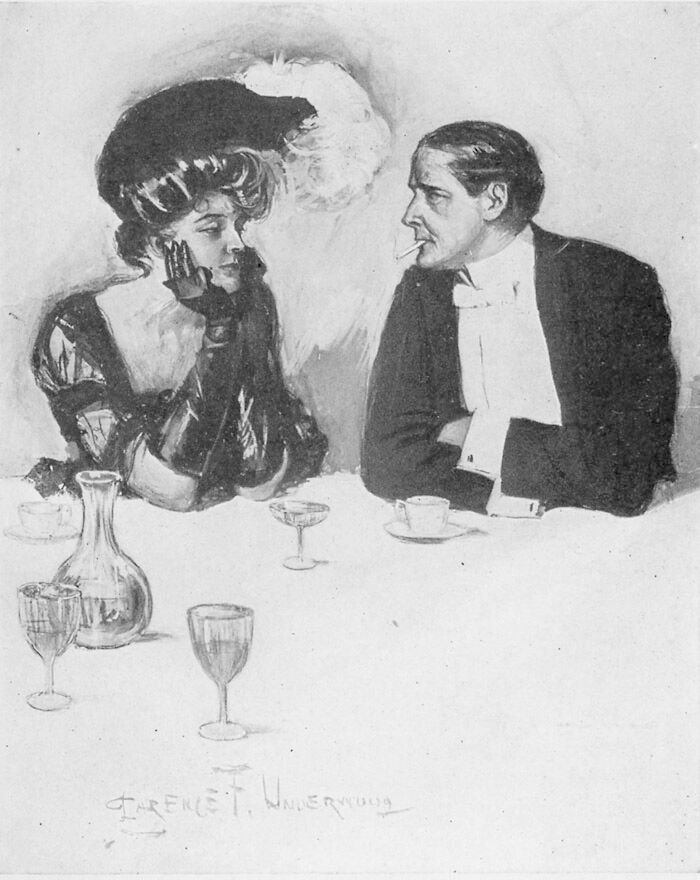
["'Ah, don't be cross!' she said"]
"Anything you care to tell me will of course be of the greatest possible interest," he was beginning, but Betty interrupted him.
"Ah, don't be cross!" she said. "I know I was perfectly horrid yesterday, but I own I was rather hurt."
"Hold back," he adjured her, inwardly, "for Heaven's sake, hold back!"
"You see," she went on, "you and I were such good friends—you'd been so kind—and you told me—you talked to me about things you didn't talk of to other people,—and when I thought you'd told my step-father a secret of yours that you'd never told me, of course I felt hurt—anyone would have."
"I see," said he, beginning to.
"Of course I never dreamed that he'd lied, and even now I don't see—" Then suddenly she did see and crimsoned again.
"He didn't lie," said Vernon carefully, "it was I. But I would never have told him anything that I wouldn't have told you—nor half that I did tell you."
The waiter handed pale meat.
"Yes, the scenery in Brittany is most charming; I did some good work there. The people are so primitive and delightful too."
The waiter withdrew, and Betty said:
"How do you mean—he didn't lie?"
"The fact is," said Vernon, "he—he did not understand our friendship in the least. I imagine friendship was not invented when he was young. It's a tiresome subject, Miss Desmond; let's drop it—shall we?"
"If you like," said she, chilly as December.
"Oh, well then, just let me say it was done for your sake, Miss Desmond. He had no idea that two people should have any interests in common except—except matters of the heart, and the shortest way to convince him was to tell him that my heart was elsewhere. I don't like lies, but there are some people who insist on lies—nothing else will convince them of the truth. Here comes some abhorrent preparation of rice. How goes it with art?"
"I have been working very hard," she said, "but every day I seem to know less and less."
"Oh, that's all right! It's only that every day one knows more and more—of how little one does know. You'll have to pass many milestones before you pass out of that state. Do they always feed you like this here?"
"Some days it's custard," said Betty, "but we've only been here a week."
"We're friends again now, aren't we?" he questioned suddenly.
"Yes—oh, yes!"
"Then I may ask questions. I want to hear what you've been doing since we parted, and where you've been, and how you come to Paris—and where your aunt is, and what she'll say to me when she comes in."
"She likes you," said Betty, "and she won't come in, but Madame Gautier will. Aunt Julia went off this morning—she couldn't delay any longer because of catching the P. & O. at Brindisi; and I'm to wait here till Madame Gautier comes at three. Auntie came all the way back from America to see whether I was happy here. She is a dear!"
"And who is Madame Gautier? Is she also a dear? But let's have our coffee in the salon—and tell me everything from the beginning."
"Yes," said Betty, "oh, yes!"
But the salon window was darkened by a passing shape.
"My uncle, bless him!" said Vernon. "I must go. See, here's my card! Won't you write and tell me all about everything? You will, won't you?"
"Yes, but you musn't write to me. Madame Gautier opens all our letters, and friendships weren't invented when she was young either. Good-bye."
Vernon had to go towards the strong English voice that was filling the hall with its inquiries for "Ung Mossoo—ung mossoo Anglay qui avoir certainmong etty icy ce mattan."
Five minutes later Betty saw two figures go along the pavement on the other side of the decorous embroidered muslin blinds which, in the unlikely event of any happening in the Cite de la Retraite, ensure its not being distinctly seen by those who sojourn at the Hotel Bête.
Betty instantly experienced that feminine longing which makes women write to lovers or friends from whom they have but now parted, and she was weaker than Lady St. Craye. There was nothing to do. Her trunks were packed. She had before her two hours, or nearly, of waiting for Madame Gautier. So she wrote, and this is the letter, erasures and all. Vernon, when he got it, was most interested in the erasures here given in italics.
Dear Mr. Vernon:
I am very glad we are good friends again, and I should like to tell you everything that has happened. (After you, after he—when my step-father). After the last time I saw you (I was very unhappy because I wanted to go to Paris) I was very anxious to go to Paris because of what you had said. My aunt came down and was very kind. (She told me) She persuaded my step-father to let me go. I think (we) he was glad to get rid of me, for (somehow) he never did care about me, any more than I did about him. There are a great many (other) things that he does not understand. Of course I was wild with joy and thought of nothing but (what you) work, and my aunt brought me over. But I did not see anything of Paris then. We went straight on to Joinville where Madame Gautier has a villa, and (we) my aunt left me there, and went to Norway. It was all very strange at first, but I liked it. Madame Gautier is very strict; it was like being at school. Sometimes I almost (forgot) fancied that I was at school again. There were three other girls besides me, and we had great fun. The Professor was very nice and encouraging. He is very old. So is everybody who comes to the house—(but) it (was) is jolly, because when there are four of you everything is so interesting. We used to have picnics in the woods, and take it in turn to ride in the donkey-cart. And there were musical evenings with the Pastor and the Avocat and their wives. It was very amusing sometimes. Madame Gautier had let her Paris flat, so we stayed at Joinville till a week ago, and then my Aunt walked in one day and took me to Paris for a week. I did enjoy that. And now aunt has gone, and Madame Gautier is taking the inventory and getting the keys, and presently she will come for me, I shall go with her to the Rue Vaugirard, Number 62. It will be very nice seeing the other girls again and telling them all about (everything) my week in Paris. I am so sorry that I shall not have the pleasure of seeing you again, but I am glad we met—because I do not like to think my friends do not trust me.
Yours sincerely,
Betty Desmond.
That was the letter which Betty posted. But the first letter she wrote was quite different. It began:
"You don't know, you never will know what it is to me to know that you did not deceive me. My dear friend, my only friend! And how I treated you yesterday! And how nobly you forgave me. I shall see you again. I must see you again. No one else has ever understood me." And so on to the "True and constant friend Betty."
She burned this letter.
"The other must go," she said, "that's the worst of life. If I sent the one that's really written as I feel he'd think I was in love with him or some nonsense. But a child who was just in two syllables might have written the other. So that's all right."
She looked at her watch. The same silver watch with which she had once crossed the hand of one who told her fortune.
"How silly all that was!" she said. "I have learned wisdom now. Nearly half-past three. I never knew Madame late before."
And now Betty began to watch the windows for the arrival of her chaperone; and four o'clock came, and five, but no Madame Gautier.
She went out at last and asked to see the Patronne, and to her she explained in a French whose fluency out-ran its correctness, that a lady was to have called for her at three. It was now a quarter past five. What did Madame think she should do?
Madame was lethargic and uninterested. She had no idea. She could not advise. Probably Mademoiselle would do well to wait always.
The concierge was less aloof.
But without doubt Madame, Mademoiselle's friend had forgotten the hour. She would arrive later, certainly. If not, Mademoiselle could stay the night at the hotel, where a young lady would be perfectly well, and go to Madame her friend in the morning.
But Betty was not minded to stay the night alone at the Hótel Bête. For one thing she had very little money,—save that in the fat envelope addressed to Madame Gautier which her aunt had given her. It contained, she knew, the money to pay for her board and lessons during the next six months,—for the elder Miss Desmond was off to India, Japan and Thibet, and her horror of banks and cheques made her very downright in the matter of money. That in the envelope was all Betty had, and that was Madame Gautier's. But the other part of the advice—to go to Madame Gautier's in the morning? If in the morning, why not now?
She decided to go now. No one opposed the idea much. Only Franz seemed a little disturbed and the concierge tepidly urged patience.
But Betty was fretted by waiting. Also she knew that Vernon and his uncle might return at any moment. And it would perhaps be awkward for him to find her there—she would not for the world cause him a moment's annoyance. Besides he might think she had waited on the chance of seeing him again. That was not to be borne.
"I will return and take my trunks," she said; and a carriage was called.
There was something very exhilarating in driving through the streets of Paris, alone, in a nice little carriage with fat pneumatic tires. The street lamps were alight, and the shops not yet closed. Almost every house seemed to be a shop.
"I wonder where all the people live," said Betty.
The Place de la Concorde delighted her with its many lamps and its splendid space.
"How glorious it would be to live alone in Paris," she thought, "be driven about in cabs just when one liked and where one liked! Oh, I am tired of being a school-girl! I suppose they won't let me be grown up till I'm so old I shall wish I was a school-girl again."
She loved the river with its reflected lights,—but it made her shudder, too.
"Of course I shall never be allowed to see the Morgue," she said; "they won't let me see anything real. Even this little teeny tiny bit of a drive, I daresay it's not comme il faut! I do hope Madame won't be furious. She couldn't expect me to wait forever. Perhaps, too, she's ill, and no one to look after her. Oh, I'm sure I'm right to go."
The doubt, however, grew as the carriage jolted through narrower streets, and when it drew up at an open carriage-door, Betty jumped out, paid the coachman, and went in quite prepared to be scolded.
She went through the doorway and stood looking for the list of names such as are set at the foot of the stairs leading to flats in London. There was no such list. From a lighted doorway on the right came a babel of shrill, high-pitched voices. Betty looked in at the door and the voices ceased.
"Pardon, Madame," said Betty. "I seek Madame Gautier."
Everyone in the crowded stuffy lamplit little room drew a deep breath.
"Mademoiselle is without doubt one of Madame's young ladies?"
Perhaps it was the sudden hushing of the raised voices, perhaps it was something in the flushed faces that all turned towards her. To her dying day Betty will never know why she did not say "Yes." What she did say was:
"I am a friend of Madame's. Is she at home?"
"No, Mademoiselle,—she is not at home; she will never be at home more, the poor lady. She is dead, Mademoiselle—an accident, one of those cursed automobiles ran over her at her very door, Mademoiselle, before our eyes."
Betty felt sick.
"Thank you," she said, "it is very sudden."
"Will Mademoiselle leave her name?" the concierge asked curiously. "The brother of Madame, he is in the commerce at Nantes. A telegramme has been sent—he arrives to-morrow morning. He will give Mademoiselle details."
Again Betty said what she had not intended to say. She said:
"Miss Brown." Perhaps the brother in the commerce vaguely suggested the addition, "of Manchester."
Then she turned away, and got out of the light into the friendly dusk of the street.
"Tiens, but it is droll," said the concierge's friend, "a young girl, and all alone like that."
"Oh, it is nothing," said the concierge; "the English are mad—all! Their young girls run the streets at all hours, and the Devil guards them."
Betty stood in the street. She could not go back to that circle of harpy faces, all eagerly tearing to pieces the details of poor old Madame Gautier's death. She must be alone—think. She would have to write home. Her father would come to fetch her. Her aunt was beyond the reach of appeal. Her artist-life would be over. Everything would be over. She would be dragged back to the Parishing and the Mothers' meetings and the black-cotton-covered books and the Sunday School.
And she would never have lived in Paris at all!
She walked down the street.
"I can't think—I must think! I'll have this night to myself to think in, anyway. I'll go to some cheap hotel. I have enough for that."
She hailed a passing carriage, drove to the Hotel Bête, took her luggage to the Gare du Nord, and left it there.
Then as she stood on the station step, she felt something in her hand. It was the fat letter addressed to Madame Gautier. And she knew it was fat with bank notes.
She unfastened her dress and thrust the letter into her bosom, buttoning the dress carefully over it.
"But I won't go to my hotel yet," she said. "I won't even look for one. I'll see Paris a bit first."
She hailed a coachman.
"Go," she said, "to some restaurant in the Latin Quarter—where the art students eat."
"And I'm alone in Paris, and perfectly free," said Betty, leaning back on the cushions. "No, I won't tell my coachman to drive along the Rue Notre Dame des Champs, wherever that is. Oh, it is glorious to be perfectly free. Oh, poor Madame Gautier! Oh dear, oh dear!" She held her breath and wondered why she could feel sorry.
"You are a wretch," she said, "poor Madame was kind to you in her hard narrow way, and now is she lying cold and dead, all broken up by that cruel motor car."
The horror of the picture helped by Betty's excitement brought the tears and she encouraged them.
"It is something to find one is not entirely heartless," she said at last, drying her eyes, as the carriage drew up at a place where there were people and voices and many lights.
CHAPTER X.
SEEING LIFE.
The thoughts of the two who loved her were with Betty that night. The aunt, shaken, jolted, enduring much in the Paris, Lyons and Mediterranean express thought fondly of her.
"She's a nice little thing. I must take her about a bit," she mused, and even encouraged her fancy to play with the idea of a London season—a thing it had not done for years.
The Reverend Cecil, curtains drawn and lamp alight, paused to think of her even in the midst of his first thorough examination of his newest treasure in Seventeenth Century Tracts, "The Man Mouse baited and trapped for nibbling the margins of Eugenius Philalethes, being an assault on Henry Moore." It was bound up with, "The Second Wash, or the Moore scoured again," and a dozen others. A dumpy octavo, in brown leather, he had found it propping a beer barrel in the next village.
"Dear Lizzie!—I wonder if she will ever care for really important things. There must be treasures upon treasures in those boxes on the French quays that one reads about. But she never would learn to know one type from another."
He studied the fire thoughtfully.
"I wonder if she does understand how much she is to me," he thought. "Those are the things that are better unsaid. At least I always think so when she's here. But all these months—I wonder whether girls like you to say things, or to leave them to be understood. It is more delicate not to say them, perhaps."
Then his thoughts went back to the other Lizzie, about whom he had never felt these doubts. He had loved her, and had told her so. And she had told him her half of the story in very simple words—and most simply, and without at all "leaving things to be understood" they had planned the future that never was to be. He remembered the day when sitting over the drawing-room fire, and holding her dear hand he had said:
"This is how we shall sit when we are old and gray, dearest." It had seemed so impossibly far-off then.
And she had said:
"I hope we shall die the same day, Cec."
But this had not happened.
And he had said:
"And we shall have such a beautiful life—doing good, and working for God, and bringing up our children in the right way. Oh, Lizzie, it's very wonderful to think of that happiness, isn't it?"
And she had laid her head on his shoulder and whispered:
"I hope we shall have a little girl, dear."
And he had said:
"I shall call her Elizabeth, after my dear wife."
"She must have eyes like yours though."
"She will be exactly like both of us," he had said, and they sat hand in hand, and talked innocently, like two children, of the little child that was never to be.
He had wanted them to put on her tombstone, Lizzie daughter of —— and affianced wife of Cecil Underwood, but her mother had said that there there was no marrying or giving in marriage. In his heart the Reverend Cecil had sometimes dared to hope that that text had been misunderstood. To him his Lizzie had always been "as the angels of God in Heaven."
Then came the long broken years, and then the little girl—Elizabeth, his step-child.
The pent-up love of all his life spent itself on her: a love so fond, so tender, so sacred that it seemed only self-respecting to hide it a little from the world by a mask of coldness. And Betty had never seen anything but the mask.
"I think, when I see her, I will tell her all about my Lizzie," he said. "I wonder if she knows what the house is like without her. But of course she doesn't, or she would have asked to come home, long ago. I wonder whether she misses me very much. Madame Gautier is kind, she says; but no stranger can make a home, as love can make it."
Meanwhile Betty dining alone at a restaurant in the Boulevard St. Michel, within a mile of the Serpent, ordered what she called a nice dinner—it was mostly vegetables and sweet things—and ate it with appetite, looking about her. The long mirrors, the waiters were like the ones in London restaurants, but the people who ate there they were different. Everything was much shabbier, yet much gayer. Shopkeeping-looking men were dining with their wives; some of them had a child, napkin under chin, solemnly struggling with a big soup spoon or upturning on its little nose a tumbler of weak red wine and water. There were students—she knew them by their slouched hats and beards a day old—dining by twos and threes and fours. No one took any more notice of Betty than was shewn by a careless glance or two. She was very quietly dressed. Her hat even was rather an unbecoming brown thing. When she had eaten, she ordered coffee, and began to try to think, but thinking was difficult with the loud voices and the laughter, and the clink of glasses and the waiters' hurrying transits. And at the back of her mind was a thought waiting for her to think it. And she was afraid.
So presently she paid her bill, and went out, and found a tram, and rode on the top of it through the lighted streets, on the level of the first floor windows and the brown leaves of the trees in the Boulevards, and went away and away through the heart of Paris; and still all her mind could do nothing but thrust off, with both hands, the thought that was pushing forward towards her thinking. When the tram stopped at its journey's end she did not alight, but paid for, and made, the return journey, and found her feet again in the Boulevard St. Michel.
Of course, she had read her Trilby, and other works dealing with the Latin Quarter. She knew that in that quarter everyone is not respectable, but everyone is kind. It seemed good to her to go to a café, to sit at a marble topped table, and drink—not the strange liqueurs which men drink in books, but homely hot milk, such as some of the other girls there had before them. It would be perfectly simple, as well as interesting, to watch the faces of the students, boys and girls, and when she found a nice girl-face, to speak to it, asking for the address of a respectable hotel.
So she walked up the wide, tree-planted street feeling very Parisian indeed, as she called it the "Boule Miche" to herself. And she stopped at the first Café she came to, which happened to be the Café d'Harcourt.
She did not see its name, and if she had it would naturally not have conveyed any idea to her. The hour was not yet ten, and the Café d'Harcourt was very quiet. There were not a dozen people at the little tables. Most of them were women. It would be easy to ask her little questions, with so few people to stare and wonder if she addressed a stranger.
She sat down, and ordered her hot milk and, with a flutter, awaited it. This was life. And to-morrow she must telegraph to her step-father, and everything would end in the old round of parish duties; all her hopes and dreams would be submerged in the heavy morass of meeting mothers. The thought leapt up.—Betty hid her eyes and would not look at it. Instead, she looked at the other people seated at the tables—the women. They were laughing and talking among themselves. One or two looked at Betty and smiled with frank friendliness. Betty smiled back, but with embarrassment. She had heard that French ladies of rank and fashion would as soon go out without their stockings as without their paint, but she had not supposed that the practice extended to art students. And all these ladies were boldly painted—no mere soupçon of carmine and pearl powder, but good solid masterpieces in body colour, black, white and red. She smiled in answer to their obvious friendliness, but she did not ask them for addresses. A handsome black-browed scowling woman sitting alone frowned at her. She felt quite hurt. Why should anyone want to be unkind?
Men selling flowers, toy rabbits, rattling cardboard balls, offered their wares up and down the row of tables. Betty bought a bunch of fading late roses and thought, with a sudden sentimentality that shocked her, of the monthly rose below the window at home. It always bloomed well up to Christmas. Well, in two days she would see that rose-bush.
The trams rattled down the Boulevard, carriages rolled by. Every now and then one of these would stop, and a couple would alight. And people came on foot. The café was filling up. But still none of the women seemed to Betty exactly the right sort of person to know exactly the right sort of hotel.
Of course she knew from books that Hotels keep open all night,—but she did not happen to have read any book which told of the reluctance of respectable hotels to receive young women without luggage, late in the evening. So it seemed to her that there was plenty of time.
A blonde girl with jet black brows and eyes like big black beads was leaning her elbows on her table and talking to her companions, two tourist-looking Germans in loud checks. They kept glancing at Betty, and it made her nervous to know that they were talking about her. At last her eyes met the eyes of the girl, who smiled at her and made a little gesture of invitation to her, to come and sit at their table. Betty out of sheer embarrassment might have gone, but just at that moment the handsome scowling woman rose, rustled quickly to Betty, knocking over a chair in her passage, held out a hand, and said in excellent English:
"How do you do?"
Betty gave her hand, but "I don't remember you," said she.
"May I join you?" said the woman sitting down. She wore black and white and red, and she was frightfully smart, Betty thought. She glanced at the others—the tourists and the blonde; they were no longer looking at her.
"Look here," said the woman, speaking low, "I don't know you from Adam, of course, but I know you're a decent girl. For God's sake go home to your friends! I don't know what they're about to let you out alone like this."
"I'm alone in Paris just now," said Betty.
"Good God in Heaven, you little fool! Get back to your lodging. You've no business here."
"I've as much business as anyone else," said Betty. "I'm an artist, too, and I want to see life."
"You've not seen much yet," said the woman with a laugh that Betty hated to hear. "Have you been brought up in a convent? You an artist! Look at all of us! Do you need to be told what our trade is?"
"Don't," said Betty; "oh, don't."
"Go home," said the woman, "and say your prayers—I suppose you do say your prayers?—and thank God that it isn't your trade too."
"I don't know what you mean," said Betty.
"Well then, go home and read your Bible. That'll tell you the sort of woman it is that stands about the corners of streets, or sits at the Café d'Harcourt. What are your people about?"
"My father's in England," said Betty; "he's a clergyman."
"I generally say mine was," said the other, "but I won't to you, because you'd believe me. My father was church organist, though. And the Vicarage people were rather fond of me. I used to do a lot of Parish work." She laughed again.
Betty laid a hand on the other woman's.
"Couldn't you go home to your father—or—something?" she asked feebly.
"He's cursed me forever—Put it all down in black and white—a regular commination service. It's you that have got to go home, and do it now, too." She shook off Betty's hand and waved her own to a man who was passing.
"Here, Mr. Temple—"
The man halted, hesitated and came up to them.
"Look here," said the black-browed woman, "look what a pretty flower I've found,—and here of all places!"
She indicated Betty by a look. The man looked too, and took the third chair at their table. Betty wished that the ground might open and cover her, but the Boule Miche asphalt is solid. The new-comer was tall and broad-shouldered, with a handsome, serious, boyish face, and fair hair.
"She won't listen to me—"
"Oh, I did!" Betty put in reproachfully.
"You talk to her like a father. Tell her where naughty little girls go who stay out late at the Café d'Harcourt—fire and brimstone, you know. She'll understand, she's a clergyman's daughter."
"I really do think you'd better go home," said the new-comer to Betty with gentle politeness.
"I would, directly," said Betty, almost in tears, "but—the fact is I haven't settled on a hotel, and I came to this café. I thought I could ask one of these art students to tell me a good hotel, but—so that's how it is."
"I should think not," Temple answered the hiatus. Then he looked at the black-browed, scowling woman, and his look was very kind.
"Nini and her German swine were beginning to be amiable," said the woman in an aside which Betty did not hear. "For Christ's sake take the child away, and put her safely for the night somewhere, if you have to ring up a Mother Superior or a Governesses' Aid Society."
"Right. I will." He turned to Betty.
"Will you allow me," he said, "to find a carriage for you, and see you to a hotel?"
"Thank you," said Betty.
He went out to the curbstone and scanned the road for a passing carriage.
"Look here," said the black-browed woman, turning suddenly on Betty; "I daresay you'll think it's not my place to speak—oh, if you don't think so you will some day, when you're grown up,—but look here. I'm not chaffing. It's deadly earnest. You be good. See? There's nothing else that's any good really."
"Yes," said Betty, "I know. If you're not good you won't be happy."
"There you go," the other answered almost fiercely; "it's always the way. Everyone says it—copybooks and Bible and everything—and no one believes it till they've tried the other way, and then it's no use believing anything."
"Oh, yes, it is," said Betty comfortingly, "and you're so kind. I don't know how to thank you. Being kind is being good too, isn't it?"
"Well, you aren't always a devil, even if you are in hell. I wish I could make you understand all the things I didn't understand when I was like you. But nobody can. That's part of the hell. And you don't even understand half I'm saying."
"I think I do," said Betty.
"Keep straight," the other said earnestly; "never mind how dull it is. I used to think it must be dull in Heaven. God knows it's dull in the other place! Look, he's got a carriage. You can trust him just for once, but as a rule I'd say 'Don't you trust any of them—they're all of a piece.' Good-bye; you're a nice little thing."
"Good-bye," said Betty; "oh, good-bye! You are kind, and good! People can't all be good the same way," she added, vaguely and seeking to comfort.
"Women can," said the other, "don't you make any mistake. Good-bye."
She watched the carriage drive away, and turned to meet the spiteful chaff of Nini and her German friends.
"Now," said Mr. Temple, as soon as the wheels began to revolve, "perhaps you will tell me how you come to be out in Paris alone at this hour."
Betty stared at him coldly.
"I shall be greatly obliged if you can recommend me a good hotel," she said.
"I don't even know your name," said he.
"No," she answered briefly.
"I cannot advise you unless you will trust me a little," he said gently.
"You are very kind,—but I have not yet asked for anyone's advice."
"I am sorry if I have offended you," he said, "but I only wish to be of service to you."
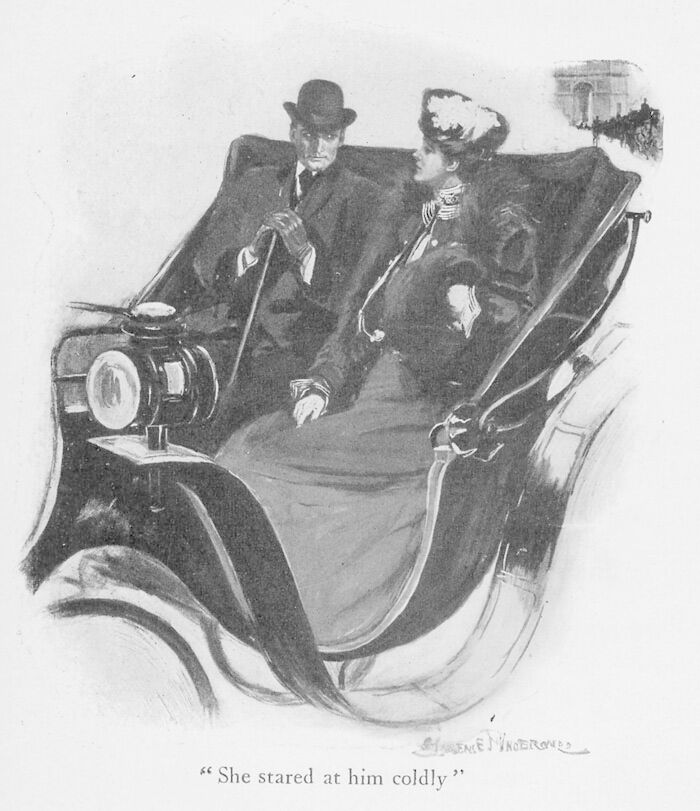
"Thank you very much," said Betty: "the only service I want is the name of a good hotel."
"You are unwise to refuse my help," he said. "The place where I found you shews that you are not to be trusted about alone."
"Look here," said Betty, speaking very fast, "I dare say you mean well, but it isn't your business. The lady I was speaking to—"
"That just shews," he said.
"She was very kind, and I like her. But I don't intend to be interfered with by any strangers, however well they mean."
He laughed for the first time, and she liked him better when she had heard the note of his laughter.
"Please forgive me," he said. "You are quite right. Miss Conway is very kind. And I really do want to help you, and I don't want to be impertinent. May I speak plainly?"
"Of course."
"Well the Café d'Harcourt is not a place for a respectable girl to go to."
"I gathered that," she answered quietly. "I won't go there again."
"Have you quarreled with your friends?" he persisted; "have you run away?"
"No," said Betty, and on a sudden inspiration, added: "I'm very, very tired. You can ask me any questions you like in the morning. Now: will you please tell the man where to go?"
The dismissal was unanswerable.
He took out his card-case and scribbled on a card.
"Where is your luggage?" he asked.
"Not here," she said briefly.
"I thought not," he smiled again. "I am discerning, am I not? Well, perhaps you didn't know that respectable hotels prefer travellers who have luggage. But they know me at this place. I have said you are my cousin," he added apologetically.
He stopped the carriage. "Hôtel de l'Unicorne," he told the driver and stood bareheaded till she was out of sight.
The Thought came out and said: "There will be an end of Me if you see that well-meaning person again." Betty would not face the Thought, but she was roused to protect it.
She stood up and touched the coachman on the arm.
"Go back to the Cafe d'Harcourt," she said. "I have forgotten something."
That was why, when Temple called, very early, at the Hôtel de l'Unicorne he heard that his cousin had not arrived there the night before—Had not, indeed, arrived at all.
He shrugged his shoulders.
"It's a pity," he said. "Certainly she had run away from home. I suppose I frightened her. I was always a clumsy brute with women."
CHAPTER XI.
THE THOUGHT.
The dark-haired woman was still ably answering the chaff of Nini and the Germans. And her face was not the face she had shewn to Betty. Betty came quietly behind her and touched her shoulder. She leapt in her chair and turned white under the rouge.
"What the devil!—You shouldn't do that!" she said roughly; "You frightened me out of my wits."
"I'm so sorry," said Betty, who was pale too. "Come away, won't you? I want to talk to you."
"Your little friend is charming," said one of the men in thick German-French. "May I order for her a bock or a cerises?"
"Do come," she urged.
"Let's walk," she said. "What's the matter? Where's young Temple? Don't tell me he's like all the others."
"He meant to be kind," said Betty, "but he asked a lot of questions, and I don't want to know him. I like you better. Isn't there anywhere we can be quiet, and talk? I'm all alone here in Paris, and I do want help. And I'd rather you'd help me than anyone else. Can't I come home with you?"
"No you can't."
"Well then, will you come with me?—not to the hotel he told me of, but to some other—you must know of one."
"What will you do if I don't?"
"I don't know," said Betty very forlornly, "but you will, won't you. You don't know how tired I am. Come with me, and then in the morning we can talk. Do—do."
The other woman took some thirty or forty steps in silence. Then she asked abruptly:
"Have you plenty of money?"
"Yes, lots."
"And you're an artist?"
"Yes—at least I'm a student."
Again the woman reflected. At last she shrugged her shoulders and laughed. "Set a thief to catch a thief," she said. "I shall make a dragon of a chaperon, I warn you. Yes, I'll come, just for this one night, but you'll have to pay the hotel bill."
"Of course," said Betty.
"This is an adventure! Where's your luggage?"
"It's at the station, but I want you to promise not to tell that Temple man a word about me. I don't want to see him again. Promise."
"Queer child. But I'll promise. Now look here: if I go into a thing at all I go into it heart and soul; so let's do the thing properly. We must have some luggage. I've got an old portmanteau knocking about. Will you wait for me somewhere while I get it?"
"I'd rather not," said Betty, remembering the Germans and Nini.
"Well then,—there'd be no harm for a few minutes. You can come with me. This is really rather a lark!"
Five minutes' walking brought the two to a dark house. The woman rang a bell; a latch clicked and a big door swung open. She grasped Betty's hand.
"Don't say a word," she said, and pulled her through.
It was very dark.
The other woman called out a name as they passed the door of the concierge, a name that was not Conway, and her hand pulled Betty up flight after flight of steep stairs. On the fifth floor she opened a door with a key, and left Betty standing at the threshold till she had lighted a lamp.
Then "Come in," she said, and shut the door and bolted it.
The room was small and smelt of white rose scent; the looking-glass had a lace drapery fastened up with crushed red roses; and there were voluminous lace and stuff curtains to bed and window.
"Sit down," said the hostess. She took off her hat and pulled the scarlet flowers from it. She washed her face till it shewed no rouge and no powder, and the brown of lashes and brows was free from the black water-paint. She raked under the bed with a faded sunshade till she found an old brown portmanteau. Her smart black and white dress was changed for a black one, of a mode passée these three years. A gray chequered golf cape and the dulled hat completed the transformation.
"How nice you look," said Betty.
The other bundled some linen and brushes into the portmanteau.
"The poor old Gladstone's very thin still," she said, and folded skirts; "we must plump it out somehow."
When the portmanteau was filled and strapped, they carried it down between them, in the dark, and got it out on to the pavement.
"I am Miss Conway now," said the woman, "and we will drive to the Hotel de Lille. I went there one Easter with my father."
With the change in her dress a change had come over Miss Conway's voice.
At the Hotel de Lille it was she who ordered the two rooms, communicating, for herself and her cousin, explained where the rest of the luggage was, and gave orders for the morning chocolate.
"This is very jolly," said Betty, when they were alone. "It's like an elopement."
"Exactly," said Miss Conway. "Good night."
"It's rather like a dream, though. I shan't wake up and find you gone, shall I?" Betty asked anxiously.
"No, no. We've all your affairs to settle in the morning."
"And yours?"
"Mine were settled long ago. Oh, I forgot—I'm Miss Conway, at the Hotel de Lille. Yes, we'll settle my affairs in the morning, too. Good night, little girl."
"Good night, Miss Conway."
"They call me Lotty."
"My name's Betty and—look here, I can't wait till the morning." Betty clasped her hands, and seemed to be holding her courage between them. "I've come to Paris to study art, and I want you to come and live with me. I know you'd like it, and I've got heaps of money—will you?"
She spoke quickly and softly, and her face was flushed and her eyes bright.
There was a pause.
"You silly little duffer—you silly dear little duffer."
The other woman had turned away and was fingering the chains of an ormolu candlestick on the mantelpiece.
Betty put an arm over her shoulders.
"Look here," she said, "I'm not such a duffer as you think. I know people do dreadful things—but they needn't go on doing them, need they?"
"Yes, they need," said the other; "that's just it."
Her fingers were still twisting the bronze chains.
"And the women you talked about—in the Bible—they weren't kind and good, like you; they were just only horrid and not anything else. You told me to be good. Won't you let me help you? Oh, it does seem such cheek of me, but I never knew anyone before who—I don't know how to say it. But I am so sorry, and I want you to be good, just as much as you want me to. Dear, dear Lotty!"
"My name's Paula."
"Paula dear, I wish I wasn't so stupid, but I know it's not your fault, and I know you aren't like that woman with the Germans."
"I should hope not indeed," Paula was roused to flash back; "dirty little French gutter-cat."
"I've never been a bit of good to anyone," said Betty, adding her other arm and making a necklace of the two round Paula's neck, "except to Parishioners perhaps. Do let me be a bit of good to you. Don't you think I could?"
"You dear little fool!" said Paula gruffly.
"Yes, but say yes—you must! I know you want to. I've got lots of money. Kiss me, Paula."
"I won't!—Don't kiss me!—I won't have it! Go away," said the woman, clinging to Betty and returning her kisses.
"Don't cry," said Betty gently. "We shall be ever so happy. You'll see. Good night, Paula. Do you know I've never had a friend—a girl-friend, I mean?"
"For God's sake hold your tongue, and go to bed! Good night."
Betty, alone, faced at last, and for the first time, The Thought. But it had changed its dress when Miss Conway changed hers. It was no longer a Thought: it was a Resolution.
Twin-born with her plan for saving her new friend was the plan for a life that should not be life at Long Barton.
All the evening she had refused to face The Thought. But it had been shaping itself to something more definite than thought. As a Resolution, a Plan, it now unrolled itself before her. She sat in the stiff arm-chair looking straight in front of her, and she saw what she meant to do. The Thought had been wise not to insist too much on recognition. Earlier in the evening it would have seemed merely a selfish temptation. Now it was an opportunity for a good and noble act. And Betty had always wanted so much to be noble and good.
Here she was in Paris, alone. Her aunt, train-borne, was every moment further and further away. As for her step-father:
"I hate him," said Betty, "and he hates me. He only let me come to get rid of me. And what good could I do at Long Barton compared with what I can do here? Any one can do Parish work. I've got the money Aunt left for Madame Gautier. Perhaps it's stealing. But is it? The money was meant to pay to keep me in Paris to study Art. And it's not as if I were staying altogether for selfish reasons—there's Paula. I'm sure she has really a noble nature. And it's not as if I were staying because He is in Paris. Of course, that would be really wrong. But he said he was going to Vienna. I suppose his uncle delayed him, but he'll certainly go. I'm sure it's right. I've learned a lot since I left home. I'm not a child now. I'm a woman, and I must do what I think is right. You know I must, mustn't I?"
She appealed to the Inward Monitor, but it refused to be propitiated.
"It only seems not quite right because it's so unusual," she went on; "that's because I've never been anywhere or done anything. After all, it's my own life, and I have a right to live it as I like. My step-father has never written to Madame Gautier all these months. He won't now. It's only to tell him she has changed her address—he only writes to me on Sunday nights. There's just time. And I'll keep the money, and when Aunt comes back I'll tell her everything. She'll understand."
"Do you think so?" said the Inward Monitor.
"Any way," said Betty, putting her foot down on the Inward Monitor, "I'm going to do it. If it's only for Paula's sake. We'll take rooms, and I'll go to a Studio, and work hard; and I won't make friends with gentlemen I don't know, or anything silly, so there," she added defiantly. "Auntie left the money for me to study in Paris. If I tell my step-father that Madame Gautier is dead, he'll just fetch me home, and what'll become of Paula then?"
Thus and thus, ringing the changes on resolve and explanation, her thoughts ran. A clock chimed midnight.
"Is it possible," she asked herself, "that it's not twelve hours since I was at the Hotel Bête—talking to Him? Well, I shall never see him again, I suppose. How odd that I don't feel as if I cared whether I did or not. I suppose what I felt about him wasn't real. It all seems so silly now. Paula is real, and all that I mean to do for her is real. He isn't."
She prayed that night as usual, but her mind was made up, and she prayed outside a closed door.
Next morning, when her chocolate came up, she carried it into the next room, and, sitting on the edge of her new friend's bed, breakfasted there.
Paula seemed dazed when she first woke, but soon she was smiling and listening to Betty's plans.
"How young you look," said Betty, "almost as young as me."
"I'm twenty-five."
"You don't look it—with your hair in those pretty plaits, and your nightie. You do have lovely nightgowns."
"I'll get up now," said Paula. "Look out—I nearly upset the tray."
Betty had carefully put away certain facts and labelled them: "Not to be told to anyone, even Paula." No one was to know anything about Vernon. "There is nothing to know really," she told herself. No one was to know that she was alone in Paris without the knowledge of her relations. Lots of girls came to Paris alone to study art. She was just one of these.
She found the lying wonderfully easy. It did not bring with it, either, any of the shame that lying should bring, but rather a sense of triumphant achievement, as from a difficult part played excellently.
She paid the hotel bill, and then the search for rooms began.
"We must be very economical, you know," she said, "but you won't mind that, will you? I think it will be rather fun."
"It would be awful fun," said the other. "You'll go and work at the studio, and when you come home after your work I shall have cooked the déjeûner, and we shall have it together on a little table with a nice white cloth and a bunch of flowers on it."
"Yes; and in the evening we'll go out, to concerts and things, and ride on the tops of trams. And on Sundays—what does one do on Sundays?"
"I suppose one goes to church," said Paula.
"Oh, I think not when we're working so hard all the week. We'll go into the country."
"We can take the river steamer and go to St. Cloud, or go out on the tram to Clamart—the woods there are just exactly like the woods at home. What part of England do you live in?"
"Kent," said Betty.
"My home's in Devonshire," said Paula.
It was a hard day: so many stairs to climb, so many apartments to see! And all of them either quite beyond Betty's means, or else little stuffy places, filled to choking point with the kind of furniture no one could bear to live with, and with no light, and no outlook except a blank wall a yard or two from the window.
They kept to the Montparnasse quarter, for there, Paula said, were the best ateliers for Betty. They found a little restaurant, where only art students ate, and where one could breakfast royally for about a shilling. Betty looked with interest at the faces of the students, and wondered whether she should ever know any of them. Some of them looked interesting. A few were English, and fully half American.
Then the weary hunt for rooms began again.
It was five o'clock before a concierge, unexpected amiable in face of their refusal of her rooms, asked whether they had tried Madame Bianchi's—Madame Bianchi where the atelier was, and the students' meetings on Sunday evenings,—Number 57 Boulevard Montparnasse.
They tried it. One passes through an archway into a yard where the machinery, of a great laundry pulses half the week, up some wide wooden stairs—shallow, easy stairs—and on the first floor are the two rooms. Betty drew a long breath when she saw them. They were lofty, they were airy, they were light. There was not much furniture, but what there was was good—old carved armoires, solid divans and—joy of joys—in each room a carved oak, Seventeenth Century mantelpiece eight feet high and four feet deep.
"I must have these rooms!" Betty whispered. "Oh, I could make them so pretty!"
The rent of the rooms was almost twice as much as the sum they fixed on, and Paula murmured caution.
"Its no use," said Betty. "We'll live on bread and water if you like, but we'll live on it here."
And she took the rooms.
"I'm sure we've done right," she said as they drove off to fetch her boxes: "the rooms will be like a home, you see if they aren't. And there's a piano too. And Madame Bianchi, isn't she a darling; Isn't she pretty and sweet and nice?"
"Yes," said Paula thoughtfully; "it certainly is something that you've got rooms in the house of a woman like that."
"And that ducky little kitchen! Oh, we shall have such fun, cooking our own meals! You shall get the déjeûner but I'll cook the dinner while you lie on the sofa and read novels 'like a real lady.'"
"Don't use that expression—I hate it," said Paula sharply. "But the rooms are lovely, aren't they?"
"Yes, it's a good place for you to be in—I'm sure of that," said the other, musing again.
When the boxes were unpacked, and Betty had pinned up a few prints and photographs and sketches and arranged some bright coloured Liberty scarves to cover the walls' more obvious defects—left by the removal of the last tenant's decorations—when flowers were on table and piano, the curtains drawn and the lamps lighted, the room did, indeed, look "like a home."
"We'll have dinner out to-night," said Paula, "and to-morrow we'll go marketing, and find you a studio to work at."
"Why not here?"
"That's an idea. Have you a lace collar you can lend me? This is not fit to be seen."
Betty pinned the collar on her friend.
"I believe you get prettier every minute," she said. "I must just write home and give them my address."
She fetched her embroidered blotting-book.
"It reminds one of bazaars," said Miss Conway.
57 Boulevard Montparnasse.
My dear Father:
This is our new address. Madame Gautier's tenant wanted to keep on her flat in the Rue de Vaugirard, so she has taken this one which is larger and very convenient, as it is close to many of the best studios. I think I shall like it very much. It is not decided yet where I am to study, but there is an Atelier in the House for ladies only, and I think it will be there, so that I shall not have to go out to my lessons. I will write again as soon as we are more settled. We only moved in late this afternoon, so there is a lot to do. I hope you are quite well, and that everything is going on well in the Parish. I will certainly send some sketches for the Christmas sale. Madame Gautier does not wish me to go home for Christmas; she thinks it would interrupt my work too much. There is a new girl, a Miss Conway. I like her very much. With love,
Yours affectionately,
E. Desmond.
She was glad when that letter was written. It is harder to lie in writing than in speech, and the use of the dead woman's name made her shiver.
"But I won't do things by halves," she said.
"What's this?" Paula asked sharply. She had stopped in front of one of Betty's water colours.
"That? Oh, I did it ages ago—before I learned anything. Don't look at it."
"But what is it?"
"Oh, only our house at home."
"I wonder," said Paula, "why all English Vicarages are exactly alike."
"It's a Rectory," said Betty absently.
"That ought to make a difference, but it doesn't. I haven't seen an English garden for four years."
"Four years is a long time," said Betty.
"You don't know how long," said the other. "And the garden's been going on just the same all the time. It seems odd, doesn't it? Those hollyhocks—the ones at the Vicarage at home are just like them. Come, let's go to dinner!"
CHAPTER XII.
THE RESCUE.
When Vernon had read Betty's letter—and holding it up to the light he was able to read the scratched-out words almost as easily as the others—he decided that he might as well know where she worked, and one day, after he had called on Lady St. Craye, he found himself walking along the Rue de Vaugirard. Lady St. Craye was charming. And she had been quite right when she had said that he would find a special charm in the companionship of one in whose heart his past love-making seemed to have planted no thorns. Yet her charm, by its very nature—its finished elegance, its conscious authority—made him think with the more interest of the unformed, immature grace of the other woman—Betty, in whose heart he had not had the chance to plant either thorns or roses.
How could he find out? Concierges are venal, but Vernon disliked base instruments. He would act boldly. It was always the best way. He would ask to see this Madame Gautier—if Betty were present he must take his chance. It would be interesting to see whether she would commit herself to his plot by not recognizing him. If she did that—Yet he hoped she wouldn't. If she did recognize him he would say that it was through Miss Desmond's relatives that he had heard of Madame Gautier. Betty could not contradict him. He would invent a niece whose parents wished to place her with Madame. Then he could ask as many questions as he liked, about hours and studios, and all the details of the life Betty led.
It was a simple straight-forward design, and one that carried success in its pocket. No one could suspect anything.
Yet at the very first step suspicion, or what looked like it, stared at him from the eyes of the concierge when he asked for Madame Gautier.
"Monsieur is not of the friends of Madame?" she asked curiously.
He knew better than to resent the curiosity. He explained that he desired to see Madame on business.
"You will see her never," the woman said dramatically; "she sees no one any more."
"Is it that she is ill?"
"It is that she is dead,—and the dead do not receive, Monsieur." She laughed, and told the tale of death circumstantially, with grim relish of detail.
"And the young ladies—they have returned to their parents?"
"Ah, it is in the young ladies that Monsieur interests himself? But yes. Madame's brother, who is in the Commerce of Nantes, he restored instantly the young ladies to their friends. One was already with her aunt."
Vernon had money ready in his hand.
"What was her name, Madame—the young lady with the aunt?"
"But I know not, Monsieur. She was a new young lady, who had been with Madame at her Villa—I have not seen her. At the time of the regrettable accident she was with her aunt, and doubtless remains there. Thank you, Monsieur. That is all I know."
"Thank you, Madame. I am desolated to have disturbed you. Good day."
And Vernon was in the street again.
So Betty had never come to the Rue Vaugirard! The aunt must somehow have heard the news—perhaps she had called on the way to the train—she had returned to the Bête and Betty now was Heaven alone knew where. Perhaps at Long Barton. Perhaps in Paris, with some other dragon.
Vernon for a day or two made a point of being near when the studios—Julien's, Carlorossi's, Delacluse's, disgorged their students. He did not see Betty, because she was not studying at any of these places, but at the Atelier Bianchi, of which he never thought. So he shrugged his shoulders, and dined again with Lady St. Craye, and began to have leisure to analyse the emotions with which she inspired him. He had not believed that he could be so attracted by a woman with whom he had played the entire comedy, from first glance to last tear—from meeting hands to severed hearts. Yet attracted he was, and strongly. He experienced a sort of resentment, a feeling that she had kept something from him, that she had reserves of which he knew nothing, that he, who in his blind complacency had imagined himself to have sucked the orange and thrown away the skin, had really, in point of fact, had a strange lovely fruit snatched from him before his blunt teeth had done more than nibble at its seemingly commonplace rind.
In the old days she had reared barriers of reserve, walls of reticence over which he could see so easily; now she posed as having no reserves, and he seemed to himself to be following her through a darkling wood, where the branches flew back and hit him in the face so that he could not see the path.
"You know," she said, "what makes it so delightful to talk to you is that I can say exactly what I like. You won't expect me to be clever, or shy, or any of those tiresome things. We can be perfectly frank with each other. And that's such a relief, isn't it?"
"I wonder whether it would be—supposing it could be?" said he.
They were driving in the Bois, among the autumn tinted trees where the pale mist wreaths wandered like ghosts in the late afternoon.
"Of course it could be; it is," she said, opening her eyes at him under the brim of her marvel of a hat: "at least it is for simple folk like me. Why don't you wear a window in your breast as I do?"
She laid her perfectly gloved hand on her sables.
"Is there really a window? Can one see into your heart?"
"One can—not the rest. Just the one from whom one feareth nothing, expecteth nothing, hopeth nothing. That's out of the Bible, isn't it?"
"It's near enough," said he. "Of course, to you it's a new sensation to have the window in your breast. Whereas I, from innocent childhood to earnest manhood, have ever been open as the day."
"Yes," she said, "you were always transparent enough. But one is so blind when one is in love."
Her calm references to the past always piqued him.
"I don't think Love is so blind as he's painted," he said: "always as soon as I begin to be in love with people I begin to see their faults."
"You may be transparent, but you haven't a good mirror," she laughed; "you don't see yourself as you are. It isn't when you begin to love people that you see their faults, is it? It's really when they begin to love you."
"But I never begin to love people till they begin to love me. I'm too modest."
"And I never love people after they've done loving me. I'm too—"
"Too what?"
"Too something—forgetful, is it? I mean it takes two to make a quarrel, and it certainly takes two to make a love affair."
"And what about all the broken hearts?"
"What broken hearts?"
"The ones you find in the poets and the story books."
"That's just where you do find them. Nowhere else.—Now, honestly, has your heart ever been broken?"
"Not yet: so be careful how you play with it. You don't often find such a perfect specimen—absolutely not a crack or a chip."
"The pitcher shouldn't crow too loud—can pitchers crow? They have ears, of course, but only the little pitchers. The ones that go to the well should go in modest silence."
"Dear Lady," he said almost impatiently, "what is there about me that drives my friends to stick up danger boards all along my path? 'This way to Destruction!' You all label them. I am always being solemnly warned that I shall get my heart broken one of these days, if I don't look out."
"I wish you wouldn't call me dear Lady," she said; "it's not the mode any more now."
"What may I call you?" he had to ask, turning to look in her eyes.
"You needn't call me anything. I hate being called names. That's a pretty girl—not the dark one, the one with the fur hat."
He turned to look.
Two girls were walking briskly under the falling leaves. And the one with the fur hat was Betty. But it was at the other that he gazed even as he returned Betty's prim little bow. He even turned a little as the carriage passed, to look more intently at the tall figure in shabby black whose arm Betty held.
"Well?" said Lady St. Craye, breaking the silence that followed.
"Well?" said he, rousing himself, but too late. "You were saying I might call you—"
"It's not what I was saying—it's what you were looking. Who is the girl, and why don't you approve of her companion?"
"Who says I don't wear a window in my breast?" he laughed. "The girl's a little country girl I knew in England—I didn't know she was in Paris. And I thought I knew the woman, too, but that's impossible: it's only a likeness."
"One nice thing about me is that I never ask impertinent questions—or hardly ever. That one slipped out and I withdraw it. I don't want to know anything about anything and I'm sorry I spoke. I see, of course, that she is a little country girl you knew in England, and that you are not at all interested in her. How fast the leaves fall now, don't they?"
"No question of your's could be im—could be anything but flattering. But since you are interested—"
"Not at all," she said politely.
"Oh, but do be interested," he urged, intent on checking her inconvenient interest, "because, really, it is rather interesting when you come to think of it. I was painting my big picture—I wish you'd come and see it, by the way. Will you some day, and have tea in my studio?"
"I should love it. When shall I come?"
"Whenever you will."
He wished she would ask another question about Betty, but she wouldn't. He had to go on, a little awkwardly.
"Well, I only knew them for a week—her and her aunt and her father—and she's a nice, quiet little thing. The father's a parson—all of them are all that there is of most respectable."
She listened but she did not speak.
"And I was rather surprised to see her here. And for the moment I thought the woman with her was—well, the last kind of woman who could have been with her, don't you know."
"I see," said Lady St. Craye. "Well, it's fortunate that the dark woman isn't that kind of woman. No doubt you'll be seeing your little friend. You might ask her to tea when I come to see your picture."
"I wish I could." Vernon's manner was never so frank as when he was most on his guard. "She'd love to know you. I wish I could ask them to tea, but I don't know them well enough. And their address I don't know at all. It's a pity; she's a nice little thing."
It was beautifully done. Lady St. Craye inwardly applauded Vernon's acting, and none the less that her own part had grown strangely difficult. She was suddenly conscious of a longing to be alone—to let her face go. She gave herself a moment's pause, caught at her fine courage and said:
"Yes, it is a pity. However, I daresay it's safer for her that you can't ask her to tea. She is a nice little thing, and she might fall in love with you, and then, your modesty appeased, you might follow suit! Isn't it annoying when one can't pick up the thread of a conversation? All the time you've been talking I've been wondering what we were talking about before I pointed out the fur hat to you. And I nearly remember, and I can't quite. That is always so worrying, isn't it?"
Her acting was as good as his. And his perception at the moment less clear than hers.
He gave a breath of relief. It would never have done to have Lady St. Craye spying on him and Betty; and now he knew that she was in Paris he knew too that it would be "him and Betty."
"We were talking," he said carefully, "about calling names."
"Oh, thank you!—When one can't remember those silly little things it's like wanting to sneeze and not being able to, isn't it? But we must turn back, or I shall be late for dinner, and I daren't think of the names my hostess will call me then. She has a vocabulary, you know." She named a name and Vernon thought it was he who kept the talk busy among acquaintances till the moment for parting. Lady St. Craye knew that it was she.