Front matter (continued 5)
Reading edition
Prue greeted the money-lender in her stateliest manner, and entrenching herself behind the little tea-table, requested him to be seated.
"This is indeed a surprise," she said. "I should never have supposed that the busy Mr. Aarons had time to spare for visiting."
"You are right, Viscountess. I never, in my life, made a visit without an object," he replied, "but the busiest of men may discover that there are other things in life besides business. I, for example, have discovered that youth, beauty and accomplishments—such as yours—may outvalue wealth and power—such as mine."
"You are mistaken, Mr. Aarons," said Prue, in a moralizing tone. "Youth is fleeting, beauty is but skin-deep and accomplishments—such as mine—are apt to lead their possessor into mischief of more kinds than you wot of."
"Most mischief can be repaired by money," said Aarons insinuatingly, "and what can not be achieved by youth, beauty and accomplishments with unlimited wealth to boot? You, dear Viscountess, have gone far without money. Think what you could aspire to with more than you could spend if you tried your hardest!"
"Why tantalize me with such visions?" cried Prue. Then suddenly recalling the motive of her last visit to the money-lender, she added maliciously, "Sir Geoffrey, according to you, will not be likely to test my extravagance so severely!"
"Sir Geoffrey!" he exclaimed, with a frown. "He is no match for your ladyship. You have but to wait a few weeks for the dissolution of Parliament to see him luxuriously lodged in his town mansion of the Queen's Bench. Be warned by me, Viscountess, unless you wish to share his lodging."
"You mean that I, also, may be arrested for debt?" she retorted with disdain. "If I remember aright, you threatened me with the debtors' prison t'other day."
"I threatened you, Lady Prudence!" cried Aarons, in a horrified tone. "Never, never! Besides, your debts to me are amply secured, and my confidence in your prospects is so great that I came to-day expressly," he drew a morocco case from his breast-pocket, "to restore the necklace you left in my care. Your court toilets must need diamonds to set them off, though you do not, and it is a pity to keep this hidden any longer in my strong-box, where there are many—and still finer ones, waiting to adorn the loveliest of her sex."
As he spoke, he opened the case and displayed a necklace of fine diamonds, Prue's wedding-gift from her father-in-law, the Earl of Overbridge. At this sight, her eyes sparkled more brightly than the gems, and her hand involuntarily stretched out toward the glittering thing.
Aarons watched her with a sardonic smile, in which triumph and admiration contended with his innate contempt for feminine weakness, and thrusting the casket into her hands, said, in a voice far less harsh than usual, "It is yours. Only let me have the pleasure of seeing you wear it."
The softening of his tone roused Prue with a sort of shock. The scorn and repulsion with which she had listened to Aarons' first declaration revived, made sharper by an unfamiliar touch of shame, and she withdrew her hand as though the gift had stung her. Then, swift as thought, a bright glow and sparkle sprang into her face, and she darted from the room, leaving Aarons transfixed with amazement.
He was still in the same position—leaning forward with the open jewel-case in his outstretched hand—when she fluttered back, radiant and breathless, and dropped into her seat behind the table with a laugh of glee.
"Pardon my discourtesy, my good Mr. Aarons," she cried. "You took me somewhat by surprise; I was not prepared for so much forethought. Tell me, was it not two hundred guineas you lent me upon that necklace?"
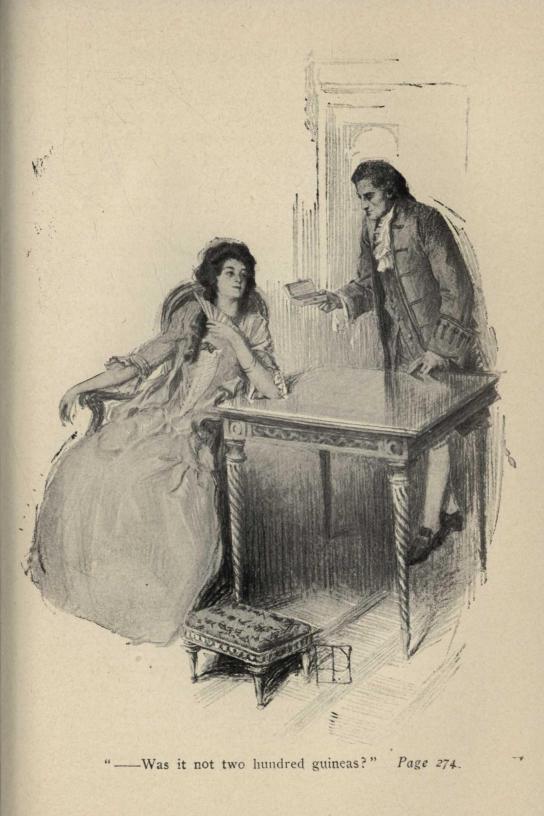
"——Was it not two hundred guineas?"
"Yes—but—" began the usurer.
"One moment," Prue quickly interposed: "I am hopelessly stupid about such matters, but even I know that there is interest to pay for that loan. Please tell me how much? Another hundred pounds, perhaps, or—"
"I don't know how much," Aarons interrupted bruskly. "This is not a matter of loan and interest."
"Oh! pardon me, I think it is," said Prue, drawing up her slender neck with a vast access of dignity. "I am charmed to have my diamonds once more—God he knows for how long!" and she took the jewel-case from Aarons' unresisting hand. "And here, my good sir, are three hundred pounds; if I am still in your debt, let me know and I will pay you some other day."
She placed three of Robin's bank-notes before him, and lifting the necklace from its velvet bed clasped it about her throat.
"There!" she cried, facing Aarons with a bewitching smile. "Now you can have your wish: I have put it on so that you can see me wear it!"
"It is a sight I shall always remember with admiration," said Aarons, recovering his self-command with the ease of long practice, "and I will leave it to your mirror's reflection to remind you that I only await a word from you to place my fortune at your feet."
"Ah!" sighed Prue, "if it were only a question of your fortune! Must you go, Mr. Aarons?" for he had risen, and hat in hand, was already bowing himself out.
"Unfortunately, I am much pressed for time, Viscountess, so I am reluctantly compelled to take my leave; but I trust not for long. Fare you well." And he was gone, leaving the bank-notes where she had placed them on the table.
In the hall he found James engaged in an altercation with a red-faced person in shabby black of a quasi-clerical cut. This individual was not precisely drunk, but most evidently not very sober, and the voice in which he expressed his intention of seeing and speaking with the Viscountess Brooke—if he had to wait until midnight—was very husky and rather bellicose.
"If I can not see the Lady Brooke, I'll wait and see Sir Geoffrey Beaudesert," he insisted, as James reiterated the utter impossibility of such a visitor to any member of the family.
"Sir Geoffrey Beaudesert does not live here," replied James loftily. "You had better call at his house."
The tipsy gentleman leered in a most impertinent fashion. "I'm a good deal more likely to find him at Lady Brooke's house than his own," he observed confidentially.
A hand was placed on his arm, and turning with a nervous start, he found the harsh gaze of Mr. Aarons bent sternly upon him.
"Parson Goodridge! you here and in this condition?" exclaimed the money-lender.
"Me here? Well, so are you!" hiccoughed the reverend gentleman. "Who the devil would expect to find old 'shent-per-shent' in a lady's boudoir?"
"I am frequently in places where you would least expect to meet me," said Aarons, with a scowl at the other's tipsy familiarity. "But this meeting is opportune; I want a few words with you, and as you will gain nothing by waiting here, you may as well come with me."
Goodridge hesitated and made an abortive attempt to wriggle out of the usurer's firm grasp.
"You can't do anything to me," he said at last, in a resigned tone. "I'm safe in the 'Rules,' and all the creditors in London Town can not touch me."
However, he made no further resistance, and when they reached the street, Aarons' manner changed completely. His hand slipped through the parson's arm with a friendly pressure and his voice lost its grinding harshness.
"Is there no quiet place of entertainment near by, where we can have a little talk—on business?" he inquired. "Pleasant business, Parson; business that may fill your pockets with gold, mayhap; or, if not that, at least will give us a chance to crack a bottle of good wine together."
"You have come to the right man if you are thirsty," replied Goodridge solemnly. "I never drink between meals myself, but there are few places within the pale of civilization, where I can not help a fellow-creature to quench his thirst."
With which exordium, he turned into a narrow lane or mews, at the farther end of which a mean little inn advertised its attractions by a sign from which the device had long since disappeared.
"'Tis better inside than out," the reverend gentleman declared, and he was so far right that the unoccupied coffee-room was cleanly sanded and a bottle of not absolutely poisonous port was soon on the rough wooden table between the oddly assorted couple.
Aarons plied his guest discreetly, while he led up to the subject he wished to discuss. He praised the beauty and charms of Lady Prudence, and congratulated Goodridge on the friendship of a lady so high in the queen's favor. No doubt her influence would obtain some fat preferment for his reverence? Goodridge winked with great unction, but was not to be drawn by any mere conversational bait.
"My interest in the viscountess is, of course, money," said Aarons, with an air of great frankness; "that is the only interest I have in any of these fine dames. They will gamble at cards, and run into debt; until they get desperate and fly to me with their jewels, to stave off their creditors until luck turns or some wealthy relative leaves them a fortune. Many of them owe me money, and it is my business to see that they do not cheat me out of it. Sometimes it is worth my while to pay well for a little information."
"Sometimes it may pay better to keep a secret than sell it," said Goodridge, with latent boastfulness.
"Unless you are clever enough to make one pay you for keeping it and another for selling it," suggested Aarons. "Not that I want you to sell me any secret of the Viscountess Brooke's. 'Tis easy for me to know all I want about her affairs. My interest is in her lover, Sir Geoffrey Beaudesert."
Goodridge laughed and held out his glass for replenishment.
"Sir Geoffrey, I fear, is not worthy of this lady," said Aarons, passing the bottle over to his guest. "She might make a much better match if she could be prevented from marrying him. It would suit me better to have her marry a rich man who could pay her debts, you understand, than one such as Sir Geoffrey, who is himself only kept out of prison by being in Parliament. Now, it is more than likely that such a gay gallant has many a little entanglement or intrigue or what not, that it would be useful for me to know about, and any one who could serve me by discovering some such irregularity would do a true kindness to the lady and help himself at the same time."
Goodridge laughed again, and emptying his glass, refilled it and held it with an unsteady hand between his bleary eye and the dim window. Aarons watched him with a wry smile, patient and sardonic, looking for the psychological moment when his lips would unclose under the influence of the repeated bumpers.
"Boy," he called to the attendant, "another bottle; shall it be the same, Parson?"
"This is fair, but they've a better one," replied Goodridge, smacking his lips.
"Bring us a bottle of the best you have," Aarons ordered, and when it came, he filled both glasses and proposed the health of the beautiful viscountess, and a rich husband for her.
Again Goodridge laughed, and this time with such rapturous glee that Aarons was quite confounded.
"What a merry fellow you are, Parson," he grunted; "I'd give a guinea to know what you are laughing at."
"A guinea!" cried Goodridge. "You would give more than that, I'll warrant. Why, I was thinking that there's no more chance for Sir Geoffrey Beaudesert than there is—for—you, for example—or me!"
"You think not?" queried Aarons, passing over the personal application of the remark with a mental reservation.
"I know it," said Goodridge, with tipsy solemnity. "I'll take my oath on it."
"Your oath may be priceless," said Aarons, "but I can only pay for proof."
"And what," said Goodridge, setting down his empty glass, "may you be willing to pay for proof that Sir Geoffrey Beaudesert can not marry the Lady Prudence?"
Aarons eyed him warily. "I have a judgment against you, Parson, for forty-three pounds and costs. I will vacate the judgment and give you—five guineas. 'Tis a liberal offer for—I know not what."
For answer, the reverend gentleman leaned across the table, and extending his right hand within a few inches of Aarons' nose, snapped his fingers half-a-dozen times.
"That for your judgment!" he shouted truculently. "I'm in the Rules for life and you can neither keep me in nor let me out. Why, man, I've a score of judgments against me, and if you vacated yours, I should be no better off; nay, worse, for it might remind the creditors who have long since forgotten me. No, no, most excellent money-lender, my secret may be worth nothing or it may be worth much, but only cash can buy it—ready cash!"
Aarons, with a scowling brow, reflected. Was it worth a large sum to break off the match between those two headstrong young people? If Goodridge was to be believed the marriage was impossible, and no expenditure of his beloved gold was needed to prevent it. On the other hand, the triumph of proving to Prue some hidden treason of Sir Geoffrey's allured him, and the possibility that she might avenge herself by taking another and wealthier husband, included the probability of that other husband being the one to enlighten her and offer himself as the ready instrument of retaliation.
"I will give you ten guineas, cash," he said, after a pause.
"When you know my secret, you will think it cheap at ten times ten guineas," said Goodridge.
Aarons rose and began to button his surtout. "I see," he said, "that we are not like to agree, and as my time is valuable you will excuse me if I leave you to finish the bottle alone." As he spoke, he allowed some loose coins to rattle in his pocket, and in paying the reckoning, pulled out a handful of golden guineas and tossed one to the waiter.
The sight of the money produced the effect he had expected. Goodridge's moist eyes glistened and his lips pursed themselves greedily. "Sit down, Aarons," he said thickly, "and have a parting glass."
With an air of reserve and ill-humor, the usurer poured a small quantity of wine into his glass and without resuming his seat nodded to his guest, and muttering something that might have been either a toast or a malediction, sipped it with a deprecatory expression.
"Come now," said Goodridge, after waiting vainly for him to renew the negotiations; "what is it really worth to you to stop this marriage?"
"It may not be worth a great deal to me," said Aarons carelessly, but he sat down; "you never can account for women's vagaries. If I get her out of this affair, she may do worse instead of better."
"She can't do worse," chuckled Goodridge. But Aarons had not the key to his merriment and all his suspicions were centered on some unpardonable misdeed of the bridegroom elect.
"Were you going to tell her so when I met you at her house?" he inquired, smiling grimly. "What do you expect to get from her?"
"That's my business," he retorted. "But I wasn't going to offer her any secrets for sale. Oh! no, the Lady Prudence is my good friend, and if I need a few guineas, she's too kind-hearted to refuse me."
Suddenly it dawned upon Aarons that there was something sinister in the situation; a woman like the Viscountess Brooke was not the friend of such a miserable wretch for mere kindliness. He felt that whatever the price, he must know the whole truth, if this man could be induced to tell it.
"Will you take twenty guineas for your fine secret?" he asked with a sneer.
"No, but I'll take fifty and give you full value," said Goodridge. "I haven't the proofs here, but I'll tell you the secret for half the money and you shall give me the rest, when I give you the proofs. It's a loss to me," he half-whimpered, "for if I kept the secret and used it right, I might live well on it as long as it remained a secret."
Aarons counted out twenty-five gold coins upon the table, and covered them with his hand. "Now," he said, "there is half your price, and if you can give me a satisfactory reason why Sir Geoffrey Beaudesert can not, by any possibility, marry Lady Prudence Brooke, that money is yours, and as much more when I have your proofs. But if you are deceiving me, beware! I am not a man to be trifled with."
"Sir Geoffrey Beaudesert can not marry Lady Prudence Brooke for the very good reason that she is already married," Goodridge whispered, leaning across the table with his mouth at Aarons' ear.
The usurer started back and his face became black with fury. "Lady Prudence married!" he exclaimed.
"Sh-sh-sh!" Goodridge glanced round apprehensively; "don't blurt it out for the whole town to hear. Yes, she is married. I myself performed the ceremony."
"You performed the ceremony!" muttered Aarons, with increasing anger and amazement. "Tell me the whole story; whom did she marry, and when?"
"Is it worth the money?" asked Goodridge, leering at his scowling face. Aarons pushed the twenty-five guineas across the table with quick impatience, and the other picked them up, counted them and stowed them in his pocket, before continuing.
"I married her less than a week ago," he then went on. "The wedding took place in Newgate Prison, and the bridegroom was Robin Freemantle, the highwayman. Now you know as much as I do."
"You lie, you damned scoundrel!" roared Aarons, beside himself with rage. "This is an invention to rob me. You think to get my money for a tissue of lies and then laugh at me for a credulous fool! A woman who could pick and choose among a dozen titles and fortunes many a felon in jail! If this is a joke, it is a dangerous one, Mister Parson, as you will find unless you return my money and make me a humble apology."
Goodridge had risen to his feet and, considerably sobered by this unexpected outburst, faced the infuriated man, pale beneath his vinous flush.
"Did you think to get such a secret as that from me and then rob me of the price?" he stuttered. "I swear by the Cross you accursed Jews despise, that I have told you the truth. Last Friday I married Prudence, widow of James Stuart Brooke," he sank his voice to a whisper, "to the highwayman, then under sentence to be hanged last Monday."
A gleam shot across Aarons' face. "Hanged last Monday!" he exclaimed. "Why, then, she's a widow again."
"That's what she expected to be, I'll be sworn," said Goodridge, with great significance. "But I said under sentence. That sentence was not carried out. He was reprieved and set at liberty, and my lady is still his wife."
A dark frown furrowed the usurer's brow. Before his eyes rose the vision of the beautiful object of his desire, with the diamonds he had thought to buy her with around her milky throat and the banknotes he had refused in payment lying unregarded on the table. He ground his teeth in impotent fury to think how he had been the dupe of his own fatuity, and a savage longing rose in him for revenge upon the disdainful beauty, whose astounding caprice had placed her out of his reach.
Tipsy as Goodridge was, he had been crafty enough to hold his tongue about Sir Geoffrey's part in the transaction, therefore it was not unnatural that Aarons' thoughts should turn to his erstwhile rival as a fit instrument of Prue's humiliation. To expose her, degrade her and, if possible, ruin her socially, he would spare neither money nor skill, but he felt himself unfit for the task; the blow from his hand might recoil upon himself and leave her unscathed. Besides, his ideas were, for the moment, too chaotic, and he was not the man to weaken his purpose by undue haste.
With a tremendous effort of his iron will, he subdued all outward expression of anger, and even called up a smile of grim amusement. Once more rising from the table, he bade his companion adieu without any further allusion to the twenty-five guineas, much to the reverend scamp's relief.
"Take my advice, Parson, and keep a silent tongue in your head," he remarked. "I will keep your secret, because it will not serve me to betray it, but if you take many more into your confidence, you may get into trouble."
With which he strode away, leaving Goodridge to the congenial society of the half-empty bottle.
CHAPTER XXIV
A SUPPER FOR THREE
Prue's delight at the restoration of her necklace was so great that she forgot her fatigue, and Peggie found her dancing before a mirror and trying a variety of coquettish poses to show off the sparkling jewel and the fair throat it adorned. At first she could not resist the temptation of teasing Peggie by feigning to take Mr. Aarons' proposal seriously.
"Fancy, dear coz," she cried; "this Croesus tells me his strong-box literally bursts with diamonds only awaiting my acceptance. He promises me the finest of town-houses, with equipages and retinue to turn the grandest of our duchesses green with envy—the purse of Fortunatus, which will only be the fuller the more I spend! How pleased grannie will be to own Lady Prudence Aarons for a granddaughter!"
Peggie broke into smiles. "Lady Prudence Aarons! Picture grannie's face when you present the new grandson-elect to her ladyship."
"But seriously, Peg," Prue went on more soberly, "this man aspires to marry me, and would have bestowed my own necklace upon me as a gift, had I not insisted upon paying him."
"Paying him!" cried Peggie, in accents of the most profound astonishment. At the same moment her eye fell upon the little table and she pounced upon the neglected bank-notes with amazement too intense for words.
"He left the money!" exclaimed Prue, gazing at the notes as Peggie wildly fluttered them before her. "I have done Aarons injustice. He must be really in love with me."
"Prue! where on earth did this come from?" demanded Peggie, utterly mystified.
"Not from Aarons," replied Prue, a tender smile creeping over her lips as she took the notes with an almost caressing touch. "Don't be afraid; I am not yet sold to the devil. But come, Peggie, we have no time to waste. We must dress for Lady Rialton's dinner and I must show myself at half-a-dozen routs and balls before I can even spare time to think. Oh! I wonder where Barbara is going to-night!"
"You are bound to meet her somewhere," said Peggie consolingly, "and if not, you may be sure she'll take good care of your Robin, so don't be uneasy."
Prue gave her a half-comical, half-reproachful glance. "I never saw Barbara look as charming as she did to-day," she pouted. "Those tall lace heads are certainly very becoming to her kind of figure—they make her look quite slender—and the touch of hair-powder gave an extra sparkle to her eyes."
"'Twas not the powder on her hair, but the rouge on her cheeks that made her eyes sparkle," quoth Peggie, who was a trifle jealous of Barbara's influence.
"Do you think so? Would a little rouge improve me, do you think? I am sure I look faded." Prue peered anxiously into a mirror, but the sight that greeted her eye was reassuring. "I wish I had kept him here; we could have hidden him somewhere," she said, with a regretful sigh.
"Where?" cried Peggie trenchantly. "Under grannie's bed, belike! Any other place might have been searched if Lord Beachcombe had brought a constable with a warrant!"
"He is capable of that, even now," Prue agreed. "Barbara's coquetry is more dangerous to me, perhaps, but safer for Robin."
Poor Prue was doomed to a good many heart-pangs that evening, and without even the accustomed support of Peggie's sympathy. After Lady Rialton's dinner the cousins separated. Peggie returned home, and Prue, with less heartiness than usual, pursued the round of social functions. Her first inquiry at every house was for Barbara Sweeting. No one was surprised at that, because the two were known to be the closest allies; but she had not been seen anywhere, a circumstance that caused some remark in so pious a pilgrim of pleasure. Various reasons were suggested, such as an attack of vapors, the return of General Sweeting's gout, or chagrin at not having been invited to take part in the amateur theatricals at Marlborough House, none of which satisfied Prue, who, perhaps for the first time in her life, felt the serpent-tooth of jealousy.
But if Barbara's absence disturbed her, she was goaded almost beyond endurance by the persistence of Lord Beachcombe, who followed her like a shadow, ignoring alike her snubs and the gibes of those who fancied themselves on the trail of a renovated infatuation. In self-defense she kept Sir Geoffrey in close attendance, reckless of significant glances from curious eyes that were swift to mark his air of triumphant proprietorship, until at last, worn out with disappointment and fatigue, she begged him to call her chair, as she was dying to go home and get to bed.
"And do, I implore you, leave me to go away alone, Sir Geoffrey," she entreated, in most pathetic tones. "I am too weary to entertain any one; you must see for yourself that I am almost too tired to speak."
It was impossible to contradict her, for her pale face and clouded eyes betrayed intense nervous strain. Sir Geoffrey contented himself with obtaining permission to inquire after her health at an early hour next day, and repaired to his club, where he speedily found distraction at the card-table.
But Prue, tired as she was, had no intention of going home without one more attempt to see Barbara, to whose mansion in Park Lane she was forthwith conveyed. Her friend was at home and the servants, aware of the intimate relations between the two ladies, did not hesitate to admit Prue, and inform her that supper was then being served in the Painted Room, a charming apartment, where Barbara was in the habit of holding high revelry with her closest intimates, and giving gay supper-parties at which gambling for high stakes, charades imitated from the entertainments of the French court, and similar amusements kept gossip on the qui vive.
There was no gathering of wits and beauties to-night, however. The room (which took its name from the mythological paintings with which the ceiling and walls were decorated) was brightly lighted, but unoccupied, and in the small conservatory opening out of it, at a little table set for two among the banks of blossoming plants and cages of bright-hued birds, sat Barbara coquetting with Robin Freemantle—highwayman and outlaw!—who was in the very act of raising her hand to his lips when the door opened to admit Prue.
"My dearest Prue—here you are at last—I had almost given up expecting you!" cried Barbara, greeting her with effusion.
"Did you really expect me?" asked Prue, with irrepressible irony. "Meeting you nowhere, I feared you might be indisposed, but I am vastly relieved to find that you reached home without mishap."
"Nothing could be more triumphantly successful than our escape," cried Barbara, gaily ignoring Prue's loftiness; "and as you see, I am taking excellent care of my captive."
"Dearest Barbara, I know well what an incomparable hostess you are," she replied dryly, "and now that I have seen for myself that you are safe, and not too greatly incommoded by your exploit, I will take my leave, as I am positively sinking with fatigue."
And she made as though to withdraw without deigning a second glance toward Robin, who had risen, and stood there a veritable statue of amazement and mortification.
But Barbara caught her by both hands and drew her to the table. "Nonsense, Prue!" she laughed, "Do you think I am going to let you run off like that? Sinking with fatigue indeed! I'll warrant you will flutter from ball-room to ball-room for the next two hours if I do not keep you here. Captain de Cliffe and I were about to bore each other to death over a tête-à-tête supper and you have come like a good fairy to preserve us from yawning in each other's face—(Prue smiled satirically)—at least sup with me, dear Gossip; 'twill rest you more than going home to bed."
"My chair waits—" Prue began, though not without signs of hesitation.
"What matters that? It shall be dismissed and I will send you home in mine."
"The temptation of returning in such state as that is well-nigh irresistible," Prue conceded, feeling that she had been sufficiently coaxed to do what she particularly wanted to do without sacrificing her dignity. She began to unfasten the mantle in which she was enveloped, but when Robin sprang forward to assist her, she allowed it to drop to the floor and walked away, leaving him to pick it up if he pleased.
"You will stay, then," cried Barbara; "that is delightful. I will order another cover and a bottle of your favorite Chambertin, and we will have a little festival to wish your friend bon voyage."
And she rustled away; more out of compassion for Robin's disconcerted aspect than the mere impulse of hospitality.
Prue seated herself behind a bank of flowering shrubs, as far away as the little conservatory would allow, and after a momentary hesitation, Robin followed.
"Have I been so unfortunate as to incur your displeasure, dearest?" he inquired anxiously.
"My displeasure, sir? Certainly not," she replied. "What can it matter to me how many ladies' hands you kiss?"
At this Robin (who, although a novice in love, was no fool,) was completely relieved. He was even quite elated over the little display of jealousy which proved that Prue was far from indifferent to him. "When I am not with you, dear Prue," he said in a tone of gentle reproach, "my heart is so full of you that it flows over with gratitude to any one who will but utter your name. If you had heard what Lady Barbara was saying about you, you would not have been surprised to see me embrace her feet instead of her hand."
"What did she say?" asked Prue, her curiosity overcoming her petulance.
"She said many things in praise of the dearest of women," said Robin, taking courage to seat himself beside her, "but, best of all, she assured me that not one of all your scores of suitors could boast of half the interest you had shown to-day in the poor outlaw. Do you wonder that I kissed her hand?"
"Barbara is very indiscreet," said Prue, smiling a little. "Besides, she has the most beautiful hands in the world!"
"Are they beautiful? I was thinking too much of her kind words to notice aught else. Yet she warned me that my love for you is hopeless, and indeed she is right. I must leave England in a few hours, perhaps for ever—"
"And what right has Barbara to think our love other than hopeless? She knows nothing about it! I have a good mind," cried Prue, "to tell her all and see what she says then! But no! she would think me a fool for throwing myself away upon a man who loves me so little that he can bear to talk of leaving me for a day, let alone for ever—"
"I love you more than my own life and soul," said Robin, "more than anything except honor and duty; but their call I dare not disobey. My life does not belong to myself, but to the cause of my king, and a felon's death may end it at any moment. It would be infamous for me to hold you bound by such a marriage as ours—"
"Do you know me so little as to suppose that I would hold myself bound by it if I wished for freedom?" she retorted. "I did think you loved me, but I see it is not so; a man who loved me would fling discretion to the winds and busy himself with plans for keeping me whether I would or no. Out on such scruples! I will not be set free. If there is anything infamous about our marriage, the infamy is mine, and I take the consequences and glory in them. Leave me now, if honor and duty call you. We are young and who knows what may happen? The king who calls you away now, will bring you back in triumph some day, then, perhaps, it may be Beachcombe's turn to be hunted and driven from his country." Then suddenly remembering the cause of Lord Beachcombe's fierce pursuit, she brought out the little packet, somewhat crumpled, but otherwise intact. "I had almost forgotten to return this," she said; "I found it after you had escaped by the river on Tuesday and methinks 'tis for this he seeks you."
Robin took the packet and glanced at the superscription. "'Tis indeed this," he exclaimed. "By a miracle it fell into your hands instead of his. Prithee keep it, dear one; there is that in this envelope in exchange for which Beachcombe would give all his earthly possessions, and mayhap, some day when I am not here to protect you, it may be worth much to you to hold the secret that compelled him to take me out of Newgate, and has kept him thirsting for my life ever since."
"I am but a weak woman," said Prue, smiling archly, as she replaced the precious packet in her bosom. "Can you trust me with such a secret?"
"'Tis the secret of my birth," said Robin gravely, "and belongs as much to my wife as to me."
"I discovered that secret for myself this afternoon," Prue began, but Barbara, thinking she had given the lovers ample time to make up their quarrel, now came back on hospitable thoughts intent, and the trio, in a very pleasant mood, sat down to supper.
It was long past midnight, when Prue, after several fainthearted suggestions, at last rose resolutely and announced that she really must go home, and refusing Barbara's urgent offer of her new sedan-chair, declared she would have Robin's escort and walk the short distance to Lady Drumloch's house.
"It will be safer for him to come away now, than to wait until daylight," she said.
"It would be safest, I think, for him to stay here for a few days," Barbara proposed seriously. But the mutinous pout, and glance of arch defiance with which Prue received her suggestion, provoked her to hearty laughter, and she received Robin's thanks for her protection and the farewells of both her guests with an air of such thorough comprehension, that Prue felt constrained to whisper in her ear, "I will come to confession to-morrow, dear Gossip," and blushingly hurried away on Robin's arm.
Late as it was, they lingered on the way and managed to eke ten minutes' walk into forty. Robin had so much to say—so many vows of eternal fidelity to pledge, and such repeated assurances to give of his swift return—that it was not until a near-by church-clock struck two, that Prue quickened her steps a little, and declared with a sigh that the parting moment had really come.
"You will be careful, dear Robin," she pleaded. "Do not run any risks, and if we can not meet again safely before you leave for France, write me by some sure hand, and I will do the same. Remember—I forbid you to attempt to visit me—but oh! I shall count the hours until I see you again."
With the prospect of a long and perhaps fatal parting, their farewells were not soon over; each last kiss was but an excuse for one more, until the tramp of the approaching night-watch warned them of the danger of delay, and Prue tore herself from his arms and without trusting herself to a backward glance, hurried into the house.
CHAPTER XXV
A CONFESSION
It was Peggie who, after some hours' anxious watching, opened the door without waiting for Prue's knock. She had long ago persuaded the sleepy and unreluctant James to retire to bed, and settling herself beside the dim lamp with a book, uncomplainingly resigned herself to a tedious and solitary vigil.
She had passed an evening not without excitement, for her grandmother's searching and persistent inquiries into Prue's mysterious behavior were not to be evaded, and some kind of explanation was inevitable. So, ingeniously substituting Captain de Cliffe, the emissary of King James, for Captain Freemantle, the highwayman, Peggie admitted that Prue and he had met "in the North," that after his arrest she had visited him in Newgate Prison, and that although now an outlaw and fugitive, steeped in Jacobite plots and charged with state secrets and compromising documents, he had played an important part in her recovery of the queen's necklace. In fact, she had contrived, without desperately straining the truth, to surround Robin with an aura of heroism and loyalty that had enlisted the old countess' sympathy for him, almost to the extent of preparing her to sanction Prue's marriage.
Having skilfully wrought her up to this point. Peggie had retired, leaving her revelations to work upon Lady Drumloch's long-dormant but far from extinct passion for the cause which had robbed her of husband, sons and worldly possessions, and left her nothing for the consolation of her declining years but unrecognized devotion to the most ungrateful of dynasties.
Too excited to think of bed, the cousins were still eagerly exchanging confidences, when Prue stopped abruptly and listened. Peggie was hurrying on with her story, but Prue checked her with a warning hand.
"Hark, Peggie, did you hear that? Was it not some one knocking at our door?"
Peggie listened, and the knocking was repeated. She threw open the window, and thrusting her head out, withdrew it after a brief investigation, with the announcement that there was a man in the street, looking up at their lighted window.
"Only one man?" queried Prue. "Can it be Robin?"
"I think not," said Peggie; "it does not seem tall enough—this man is—there is the knocking again—what shall we do?"
"Something has happened to Robin!" cried Prue, hastily throwing a cloak about her. "I must go down and see what is the matter."
"I'll come with you," cried Peggie, impelled partly by curiosity, and partly by the impulse to protect her cousin. They ran down together, and at the door paused to take counsel. It was no uncommon thing in those days for the "Mohawks" to batter thus at quiet citizens' doors and mistreat the person who answered their summons, or even, if a woman, to carry her off, shrieking and struggling.
"Who is there?" Prue demanded through the closed door.
"It is I, Steve Larkyn," a voice replied. "Oh! Mistress Brooke, I beseech you open the door; they have taken my master!"
Prue flung the door open, and there stood Steve, ghastly pale in the broad moonlight.
"They have taken your master? Then what are you doing here, alive and unhurt?" she cried passionately.
"Madam, what could one arm, and without a sword, avail against a dozen men, fully armed? The captain had but time to say to me, 'Fly—to Prudence!'—your pardon, but those were his words—when they surrounded him and made him prisoner without a chance to defend himself."
"Oh! dear God!" murmured Prue, covering her face with her trembling hands. "It is my fault; if I had left him with Barbara, he would now be safe. I brought him away to his death for a jealous whim! Where have they taken him?" she demanded, looking at Steve with widely distended eyes. "To Newgate? to the Tower? Tell me and I will go to him and share his prison."
"I don't know what they mean to do with him," said Steve, "but they were taking him to Lord Beachcombe's house—"
"Lord Beachcombe! Oh! I see it all! This is no arrest; it is a plot to rob and mayhap to murder him. Lord Beachcombe fancies that he has to deal with a defenseless outlaw and a weak woman. I will show him that there are stronger weapons than swords and bludgeons. I will go instantly to Rodney House."
"Oh! Prue, wait until morning!" implored Peggie.
"And give Lord Beachcombe time to spirit Robin away to some secret dungeon, where I may, perhaps, never find him alive? No! I will go to him at once, without a moment's delay."
"Then I will go with you," cried Peggie. "You can not go to Lord Beachcombe's house alone."
"Can not I? Besides, I shall not be alone; Steve Larkyn will escort me." She turned to Robin's faithful henchman with a wan smile. "One woman is enough for you to take care of; and you, Peggie, dear, will watch for me, so that when I return, I can get in without rousing the house. Believe me, dear," she went on firmly, as Peggie was about to remonstrate, "what I have to do can be better done by myself alone; and I am not timid, as you know."
"But, Prue—what on earth can you do for Robin, by going to Lord Beachcombe in the middle of the night?" Peggie urged, in desperation.
"That remains to be seen," said Prue, with a smile of mystery. "I think I can make Lord Beachcombe set him free, and be grateful for the chance. Come, Steve," and wrapping her mantle closely round her, she drew the hood well over her face, and went out with a resolute step into the street, already growing gray in the early dawn of the May morning.
The courtyard of Rodney House was all astir when Prudence, clinging to Steve Larkyn's arm, stole through the great gateway, and under the deep shadow of the arcade that flanked the main entrance. That was closed, but from a low door a few feet away, a flood of light poured upon a traveling carriage with four horses and a group of mounted men. Without a moment's hesitation, Prue darted past them, ran down a few stone steps and found herself in a large, bare basement hall, where Robin, his dress in some disorder and his hands tied behind him, stolidly confronted Lord Beachcombe in a white heat of fury.
At Prue's sudden apparition a couple of servitors interposed to stop her and Lord Beachcombe, in a voice hoarse with rage, shouted, "Who are these people? What the devil do they want? Turn them out—"
Prue's silvery laugh rang out. "Not so fast!" she cried, flinging back her hood. "I have business of the utmost importance with Lord Beachcombe," and she swept him a mockingly ceremonious curtsey. No lady of the court, not even the great Duchess Sarah herself, was better known than the beautiful "Widow Brooke." The sight of her familiar face seemed to paralyze every one present. The lackeys fell back abashed, Robin gazed at her speechless, and Beachcombe's sallow face flushed with a purple that suffused even his eyeballs.
"Viscountess Brooke!" he stammered. "What in the name—"
"You are surprised?" she interrupted. "To be sure, my visit is somewhat untimely." She came close to him and lowered her voice almost to a whisper. "Did you find what you expected when you searched Captain de Cliffe?" she inquired insinuatingly.
"How do you know I searched him?" demanded Beachcombe.
"Why, when one sees a man with his hands tied behind him and his pockets inside out, it is not unreasonable to suppose that he has been searched. Yet I'll venture to say, Lord Beachcombe, that whatever you found, it was not what you were looking for!"
"How can you know anything about that?" he replied, with dawning suspicion. "Perhaps you know what it was and where it may be found? If so, you must be aware that it has no value except to me—"
"And Captain de Cliffe," she interposed.
"Captain de Cliffe!" he repeated, with a bitter and disdainful emphasis.
"What would you have me call him?" she bent forward and in a whisper suggested, "Robert—Earl Beachcombe?—is that better?"
The blood ebbed from his face, leaving it ghastly with fear and fury. He cast a hasty glance toward the group of men surrounding Robin, and although they were quite out of earshot, he fiercely motioned them to a greater distance. Then he pulled himself together sufficiently to force a sardonic laugh.
"Was it to play comedy that your ladyship honored me with this nocturnal visit?" he sneered.
"Not altogether," she replied. "I came to prevent your harming Captain de Cliffe, and, incidentally, yourself. Now tell me—in confidence—not having found the documents you sought, what do you propose to do with your prisoner?"
"I propose," said Beachcombe slowly, "to hand him over to justice. I believe the—documents—to be lost. At any rate, I am willing to hazard the risk of their recovery in order that this man may receive his deserts as a traitor and a malefactor. After he has been hanged, there will be plenty of time for me to deal with a claim that has no longer a claimant."
"And you really hate him enough to prefer his death to your own safety?" Prue could not repress a shudder at the cold ferocity of his tone.
"What if I secure both?" he retorted, gratified by the effect he had produced. "This man is a traitor and has earned a traitor's death. Although I may not have found what I sought, I have found papers that will send him to the gallows, and give me a claim to the gratitude of the government. Do not trouble further about him, his fate is sealed."
"And how if another claimant, perhaps far stronger, should spring up in his place? How if he leaves a widow?" suggested Prue. "One, for example, able and willing to pursue his claim?"
"I am not uneasy about that," he replied, but his tone was less confident than his words. "I have the best of reasons for knowing that he is not married."
"And you think that having no wife and leaving no—heir—to his claim (you acknowledge that he has a claim) it will cease with his death, because there is no one to pursue it?"
"My dear Lady Prudence, a lawyer could not have put it more clearly! That is exactly his position; I think mine is pretty safe, even if those redoubtable documents should still be in existence. It will then be merely a matter of money—some one will bleed me more or less copiously—but that will be the end of the trumped-up claim of Captain—Freemantle."
"Well, Lord Beachcombe," said Prue, smiling up into his face, "now I ask you, as a favor to me, to liberate Captain Freemantle, and to molest him no further. I will answer for it that he will leave the country immediately and abandon his claim. Surely, you will not refuse a favor that is so hard to ask and so easy to grant!"
Beachcombe laughed unpleasantly. "Come, dear Viscountess," he said, and his tone, though bland, was tinged with insolence, "I know of old your thirst for adventure, but surely it has been slaked by the romantic episode of the queen's necklace and the mysterious spiriting-away of your cavalier—your Knight of the Road—by Barbara Sweeting! The excitement of the affair has evaporated; its novelty has staled. Waste no more of your enchanting wiles on so sorry a subject. I have made up my mind, and even for the sake of the most charming of women, I will not change it."
"Yet I think I may induce you," said Prue undauntedly, "because to my certain knowledge Captain de Cliffe has a wife and those precious papers are in her possession. She knows their value, too, and will only give them up on her own terms. If you will not grant me this gentleman's life as a favor—will you make a bargain with her?"
Astonishment and doubt struggled with Lord Beachcombe's self-command, but he kept an unmoved face, although an inkling of the truth began to force itself upon him. Not the whole incredible truth, of course, but enough to make him suspect that Lady Prudence Brooke was more than commonly interested in the subject of their discussion.
"And what might be the terms of the bargain?" he demanded, after a brief hesitation.
"You had better settle them with Captain de Cliffe," she said, "and I pledge my word that his wife will agree to whatever will satisfy him."
"I will make no terms with him," said Beachcombe sullenly. "If I listen to any proposition it is entirely for your sake, Lady Prudence, and must come from you and be carried out by you alone."
She reflected a few moments, while he watched her intently.
"This is my proposal," she said, at last. "That you will liberate your captive, giving him such time to reach a place of safety as he considers necessary. And that when you have received the packet you will engage not to take any steps to prevent his leaving the country. In return I promise that his wife will consider the whole matter at an end, and regard the claim as though it had never existed."
"And when I have liberated him and given him every opportunity to elude justice, what security have I that those papers will be delivered to me?" he demanded.
"I myself will be hostage for him. Send Steve with him and when he returns, having left his master in safety, I will hand you the packet. Does that satisfy you?"
Robin, sitting on the corner of a table, a little apart, could only guess from a word here and there that rose above the low-voiced colloquy, that Prue was making terms for him, the conditions of which it was not difficult to divine. Cruelly as it irked him to see her pleading with his bitter enemy for his life, he resisted the strong temptation to interfere, as he certainly would have done, could he have known that she was offering to remain a hostage to this unscrupulous man, until his safety had been purchased by her acknowledgment of their marriage. She was too well aware of that to admit him to the conference.
Lord Beachcombe, sullenly balancing pros and cons, found it no easy matter to decide between the gratification of his revenge upon Robin and the fear of losing what might be his last chance of securing the coveted documents.
It is impossible to say how long he might have fluctuated between two desires equally importunate, but it was at last borne in upon the sluggish current of his intelligence that the certificates were possibly that moment in the possession of Lady Prudence Brooke, who certainly would not hesitate to use them for his humiliation if he exasperated her.
"What will you do if I refuse?" he said at last.
"Then," said Prue, with spirit, "I shall go straight from here to the Duchess of Marlborough and lay the whole story—including the documents—before her. She has pledged herself to grant me any request I make of her, and will not consider the life of a highwayman too high a price to cancel her debt to me."
"The duchess is no longer the power behind the throne," said Beachcombe, with a scowl. "If you rely upon her influence—"
"I do not rely upon that alone," said Prue, retaining her patience with the greatest difficulty; "I will go to the queen herself and plead with her—oh! when I show her my heart, she can not resist the appeal of my prayers and tears—" She forgot for the moment where she was and who was her listener, and in imagination was already at the feet of her royal mistress. Beachcombe regarded the sapphire eyes sparkling through unshed tears and the piteous tumult of the lovely bosom beneath the laces of her ball-dress, and his pulse quickened dizzily.
"If her Gracious Majesty were a king, I think he would give you whatever you were pleased to ask," he breathed. "Ah! Prue—"
"And can you refuse me, when with a word you can secure my gratitude—my friendship—for life?" She stretched out her hands with a gesture so alluring, and turned upon him a look of such compelling appeal, as might have melted even a colder heart than his. He could not altogether resist her, but he still sought to temporize.
"You have those—that packet?" he demanded.
"Yes."
"Have you examined the contents? Surely woman's curiosity—" The lightness of his words could not veil the anxiety in his voice.
"The seals are still unbroken," she assured him, "and, if you agree to my terms, will remain so until you break them yourself."
"But you know somewhat of the contents? No doubt," with intense bitterness, "Captain Freemantle has given you his version of their importance?"
"Whatever I know about them, Lord Beachcombe, will be forgotten—absolutely—from the moment that Captain—Freemantle—is out of danger."
Beachcombe still hesitated. His curiosity was strongly roused. He had had more than one experience of Prue's unbridled caprice, but this one bewildered him. He could not grasp the only explanation; its improbability baffled him. She had led so many eligible suitors—himself one of them—a lively dance to the very altar-rails; was it believable that this man—outlaw, fugitive, proscribed, penniless—could have won the wayward beauty, and won her so completely that having actually married him, she was ready to sacrifice the future she expected to share, for his present safety?
"How am I to know that his wife, if there be such a person, will keep the promises you make for her?" he said, with his crafty eyes upon her.
"I will answer for his wife—as for myself," said Prue. "Question me no further, Lord Beachcombe, but accept my terms—or refuse them if you deem it more to your advantage."
It is doubtful whether even then he would have taken the decisive step, but for a sudden recollection that flooded his mind with rapture. If Prue were married, Sir Geoffrey had lost his bet, and five thousand pounds, plus a glorious revenge, would fall into the hands of his bitter foe! Unable to conceal his excitement, he seized Prue's hand and drew her reluctantly farther away.
"Tell me," he whispered, "are you his wife? If so, I will make no further demur. For your sake," he added as an afterthought, "I am willing not only to free this—gentleman—but to aid his escape, although, by doing so, I play the traitor to my sovereign."
Prue gazed steadily into his eyes, as though she would read the depths of his mean soul. Then she replied firmly, "I am his wife."
"He is free! I pledge you my word I will not pursue him. Let him go where he pleases; your husband is sacred in my eyes." The sinister light in them was not in accordance with the bland, congratulatory smile that played over his lips, as he turned to Robin.
"The Lady Prudence has proved irresistible, as usual, Captain Freemantle. You are free. Take my advice and use your freedom to put as many leagues as possible between yourself and London. I shall not pursue you, but there are others who seek your life, on whom the charms of Lady Prue might be exercised in vain. Untie his hands and set him free."
When he was obeyed and Robin had returned his pockets to their proper place, Beachcombe restored their ravished contents, reserving only one object. With his eyes fastened upon that, Robin pocketed his well-furnished purse, his handkerchief and other belongings, and then held out his hand once more.
"Your pardon, Lord Beachcombe, you have forgotten my wallet."
"The contents of that wallet, Sir Highwayman, concern matters of too great importance for either of us to deal with. It shall be placed in the hands of those most interested—when you are out of their reach," was the reply, pompously delivered.
"I can not leave this place without that wallet," said Robin resolutely. "It is worth more than life to me, and rather than purchase my freedom at the price of its surrender, I will remain here, and risk the worst."
"Robin!" cried Prue, in a voice of anguish. "Have pity on me if not on yourself!"
"Would you have me sacrifice a hundred lives to save my own?" said Robin unflinchingly, though pale to the lips. With drooping head she sank upon a bench, her courage for the first time failing. Lord Beachcombe looked from one to the other with a scowl as black as thunder, then with a sudden impulse snatched up the wallet and almost flung it into Robin's hand.
"Go!" he shouted; "go quickly, before I have time to repent my folly, and remember that other swords will soon be thirsting for your life," and he laughed harshly, as he turned abruptly away and walked to the farther end of the hall.
Then Robin approached Prue and taking her hand, said gently, "A thousand pardons, dear Heart of my heart. I must seem an ungrateful churl; but oh! if you could know—I will write—"
"Yes, yes!" she interrupted feverishly; "but now go quickly—every moment's delay is fatal to you—and to me—" the last words were murmured inaudibly. "How soon can you reach some safe concealment?"
"Very soon; in less than an hour," he said. "I leave you in Steve's care; he will conduct you home and protect you with his life."
"First you must take him with you and send him back when you are on the road to safety. I have pledged your precious packet," she said, smiling bravely up at him, "and when Steve returns to say you are safe, I shall give it to Lord Beachcombe. It is the price of your ransom."
"But you—"
"Don't you yet understand," she cried impatiently, "that I am like a cat? No matter where I am thrown, I always fall on my feet. Do not fear for me, but begone, and if you love me, do not attempt to see me again. Farewell."
It was no place for the tender adieux of parting lovers. He pressed her hand passionately to his lips, threw his cloak round him, and with a brief salute to Beachcombe—who took no notice of it—strode away, followed by Steve.
When their footsteps ceased to reverberate under the colonnade, Beachcombe approached Prue with a friendly smile.
"Permit me, dear Viscountess, to offer my congratulations," he said. "You have indeed prepared a charming surprise for your friends—and enemies, if one so adorable could by any possibility have any such."
Her answering laugh had the old ring of sweet, contagious mirth. "Circumstances have forced me to reveal my secret rather prematurely," she said, "but I can trust your lordship's discretion not to share it—with my dear friends—and enemies."
"Oh! we will give your husband time to escape before we impart the joyful news to—Sir Geoffrey Beaudesert, for example!"
Prue experienced an unpleasant shock as he pronounced this name, in a tone of malevolent triumph. This man, who had no cause to love either herself or Robin, evidently purposed using the secret he had torn from her in some hateful scheme of retaliation, of which Sir Geoffrey was to be the victim and executioner.
"Why Sir Geoffrey?" she murmured, half to herself.
"Because I hate Sir Geoffrey," said Beachcombe, with cold bitterness. "He has insulted me and triumphed over me—who can know how so well as you? He has worsted me in a duel and boasts that he will tame the lovely sorceress who has bewitched so many—myself among them—to their undoing. I hate him, and I shall never be satisfied until I see him reft of what I also have lost—impoverished—in a debtors' prison—" he checked himself at the sight of the indignant horror his words had roused. "I can wait, however," he went on, less vehemently. "It will satisfy me, for the present, to feel my power over him, without using it. How can I accommodate your ladyship while you wait for the captain's messenger? You can not wait here; will you honor me by accepting the poor hospitality of my house?"
"I can perfectly well wait here," she replied, reseating herself on the bench. "Your countess would be somewhat amazed to receive a visit from me at five o'clock in the morning—in my ball-dress! Even the Widow Brooke must draw the line somewhere!"
CHAPTER XXVI
PREPARATIONS FOR A JOURNEY
Mr. Moses Aarons sat in his private office. His pen hung idle between thumb and finger, and for perhaps the first time within his memory, his thoughts were very far from post-obit and mortgage. For once something more engrossing than money occupied his busy brain, and calculations more abstruse than compound interest furrowed his brow and contracted his eyes into a glittering line.
A night's reflection, so far from softening the bitterness of his anger against Prue, had intensified it to a pitch that positively shocked him. While he despised himself for the unaccustomed tumult of emotion into which he had been plunged, he was amazed to discover that the desire of possession was vastly augmented by the obstacle which he did not for one moment dream of surmounting. He was too shrewd to indulge in futile hopes, but he was weak enough to crave after revenge.
Only a week ago she had visited him, attempting to obtain a loan on the announcement of her speedy marriage with Sir Geoffrey Beaudesert. Was it possible that only a week had passed since she stood in that very room, indignantly championing one lover and that when she was already married to another? What were women made of, and who could anticipate the caprices of creatures so irresponsible? And yet, who could look into her eyes—those limpid sapphires—and not long to look again? Who could hear the thrilling voice and gushing laughter and not listen ever after for the echo of that divine music? The vision of that lovely face, smiling archly at him over the diamonds he had deemed irresistible, floated before him—sleeping and waking—yet it never occurred to him to claim them back or demand the payment he had refused. More, far more than that was necessary to assuage the fury that raged in his breast.
She had made him suffer, had humbled his pride, befooled him and made him ridiculous in his own eyes. For that she must suffer; her pride must be dragged in the dust, and she who had made sport of hearts and reputations must find her own in the pillory of public derision.
The wife of a highwayman—a malefactor who had been sentenced to die for his crimes, and had narrowly escaped the gallows! Married in Newgate Prison by a drunken Fleet-parson—"Lady Prudence Freemantle!" It was incredible! He laughed at the mere idea, a harsh, croaking laugh more evil than a curse. It would certainly be enough to publish such a mad freak, to cover the perpetrator with undying shame. But many considerations restrained him from taking a prominent part in her exposure. Some one else must be employed, some one whom his money could buy, and yet who would not be suspected of too base a motive.
Goodridge was too mean a tool. The indomitable Lady Prudence Brooke would surely find weapons to defend herself triumphantly from so paltry a foe, even could he be brought to attack her, which was far from certain. Aarons' thoughts reverted time and again to Sir Geoffrey Beaudesert. A spendthrift at his last gasp for a guinea, no doubt he had a price, though it might be a high one. The money-lender was no miser. Money he worshipped less for itself than for its influence, and one factor in his successful accumulation of vast wealth, was his intuitive knowledge of when to spend and how. But this was probably the first occasion in his life on which he contemplated an outlay, without counting the cost or discounting the return.
How could he buy Sir Geoffrey, and how could he use him? And in the first place, how could he reach him without arousing suspicion as to his own motive?
Aarons threw down his pen, and leaving word that he would be back in about an hour, went on 'Change, in hopes of diverting his mind by the exciting scenes of "Bubble" speculation, then at its frenzied height. But his mind was out of tune to its ordinary interests, and within the appointed time he returned. At his office door stood a handsome chariot, and with boundless satisfaction, he recognized Sir Geoffrey's liveries.
Within, impatiently pacing the narrow office, he found the man he was so anxious to see.
During the few minutes he consumed in slowly mounting the stairs, Aarons had resumed complete mastery over himself. He was again the smooth, wily, impenetrable man of affairs, equally prepared to baffle the craft of his clients or profit by their lack of it.
"Sir Geoffrey Beaudesert! This is an unexpected honor," he said. "I trust I have not kept you waiting long?"
"Time is always long when one is waiting for so dear a friend, Mr. Aarons," replied Sir Geoffrey, in his jauntiest manner.
"Pray be seated," said Aarons, indicating the only easy chair, and taking his usual place at the desk. "You are well, I can see for myself. How goes the wooing of the fair viscountess?"
"The wooing speeds gloriously," said Sir Geoffrey, "but the wheels of Hymen's chariot do not run fast enough to satisfy an impatient lover. Truth to tell, they need greasing, and that quickly. Women are proverbially fickle and I would fain secure my lady while she is in a yielding mood."
Aarons with difficulty repressed a sneer. This fatuity at the same time gratified him and excited his contemptuous amusement.
"The Lady Prudence has great temptations," he said suavely. "I understand that there are several rivals in your honor's way. With high titles and vast fortunes at her feet, I do not wonder at your eagerness to secure the prize before it is snatched from you. Yet without ready money—" he shook his head regretfully as he met Sir Geoffrey's clouded eyes.
"You will not believe in the wealth of old Lady Drumloch without positive proof, I suppose?" the baronet hinted, "yet I give you my word of honor that my information is from a source impossible to discredit. And furthermore, I shall receive five thousand guineas on the day I marry Lady Prudence—entirely independent of the fortune she will inherit from her grandmother."
"Is it possible?" exclaimed Aarons. "Five thousand guineas on her wedding-day! I was not aware of this change in her fortunes, and yet," an idea struck him suddenly, "to tell you the truth—this is in sacred confidence between us, Sir Geoffrey—yesterday I returned her ladyship's necklace which I have held as security for moneys advanced a long time ago, and I have reason to know that, although she tried to borrow from me last week, she now has money to redeem her diamonds, and tossed hundred-pound notes about like curl-papers!"
Sir Geoffrey's eyes sparkled. "What did I tell you?" he exclaimed. "Who but Lady Drumloch can have redeemed her diamonds (I saw them on her fair neck last night) and paid her debts? The old lady has done it before, and can do it again. Come, Aarons, open your heart and your purse-strings, and let me have a few hundreds on my note-of-hand, if you will not increase the mortgage. I'll pay you out of the five thousand guineas—that's a positive certainty—the day I marry Lady Prue."
"And suppose—I am bound to be cautious—suppose, by any chance, you should not, after all, marry the viscountess?"
"I will marry her, if I have to carry her off by force!" cried Sir Geoffrey, suddenly savage. "She shall not jilt me, by Heaven! or if she does, no other man shall care to take her afterward!"
Secretly delighted at this outburst of ferocity, Aarons assumed a deprecatory air, and with uplifted hands, entreated his visitor to be calm.
"We all know," he said insinuatingly, "how dearly the ladies love to think that they have been won in spite of themselves. The most tricksey of coquettes may turn out the meekest and most devoted of wives to the man who has the courage to prove himself master. At least, so I have heard, but of course I should not presume to advise so experienced a lady-killer as Sir Geoffrey Beaudesert."
"Well, Aarons, if you will furnish the sinews of war, I will undertake to carry the citadel by storm. A few hundreds for a week or less, and if I fail you may clap me in the Fleet, an' you will, and put everything I possess under the hammer."
Aarons still, for the sake of form, protested, but allowed himself to be coaxed and reasoned into a compliant mood, and finally accepted Sir Geoffrey's note for a substantial sum, on the tacit understanding that, by fair means or foul, the Lady Prudence Brooke was to be made Lady Beaudesert without loss of time.
Leaving the money-lender to gloat over the unexpectedly efficient tool he had found for his vengeance, and to wonder whether Prue would confess her reckless marriage and take the consequences, or defy Sir Geoffrey and drive him to extremities, the latter made his way westward with all speed. Although the hour was still early for social calls, he presented himself at Lady Drumloch's and learning that Prue was somewhat indisposed and had not yet risen, left a message that he would return later, and having still some hours to spare before his parliamentary duties claimed his brief and perfunctory attendance, repaired to the Cocoa-Tree.
With a pocketful of crisp bank-notes, the card-table irresistibly attracted him, and finding, as he expected, a little coterie of congenial spirits, he passed a pleasant and profitable hour or two with the luck steadily on his side. Then, flushed with victory and in something of a boastful humor, he ran almost into the arms of Lord Beachcombe, on his way out.
"Your pardon, my Lord!" he cried, retreating a step, and bowing low; "'tis a pity you were not here sooner. Nat Bedloe and Lord Eustace have been throwing dice, and the ace came up sixteen times running! 'Gad I never saw such a thing before."
"I never throw dice—can't see any sport in it," drawled Beachcombe; "but that must have been worth seeing. Have you been playing? With your usual good luck, no doubt?"
Sir Geoffrey shrugged his shoulders. "I must make the most of my few remaining days of bachelor freedom," he said. "I intend to settle down when I am married, and become a model man of family. But I am still a gay bachelor, and very much at your service at the club or elsewhere."
"You forget that I am already married—and a father, no less!" Beachcombe replied, in his friendliest manner. "Still, I have not entirely given up worldly pleasures. I still book a little wager from time to time, and as my lady has a passion for Ombre, she can not grumble if I still take a hand at écarté or whist. Is your wedding-day fixed? No doubt the marriage of so charming and popular a lady as the Viscountess Brooke will be a brilliant function. All the court will wish to do her honor; perhaps even her Gracious Majesty intends to be present?"
"I fear that the state of her grandmother's health will prevent Lady Prue's indulging her natural desire to shine on this occasion. As the old lady's heiress, of course she can not risk offending her; even at the last minute wills may be changed and fortunes lost for a trifle."
"Ha! is the venerable countess so wealthy as to make her will a matter of importance? Yet she passes for poor, and when I was—when I had the privilege of standing in your present enviable relations to Lady Prue, she assured me—yet these old women are often miserly—no doubt she will give the world a surprise when her hoards are unearthed. I congratulate you upon your prospects! A bride so incomparable and a great fortune to boot! You are indeed the favored of the gods! With such a prize in your grasp, you will scarcely think it worth while to remember our little wager."
"Five thousand guineas will come in very handy to start housekeeping!" cried Sir Geoffrey gaily. His laugh was echoed with a boisterous merriment that startled him like an explosion. Lord Beachcombe was so little given to mirth, his laughter was so noiseless and so rarely responsive to another man's hilarity, that the jovial shouts and gleeful contortions with which he received Sir Geoffrey's retort would have disturbed less susceptible nerves than his.
The sinister sounds rang in his ears all the afternoon as he sat through a dreary debate which did not interest the few members present sufficiently to interrupt the general conversation. What was Lord Beachcombe laughing at? he asked himself a hundred times, with ever-increasing irritation. He was not a man to take the loss of a large sum of money cheerfully. Yet it was impossible for him to have any suspicion of a serious impediment to the marriage. Still, Sir Geoffrey decided that delay was perilous and a secret known to five persons has fifty loop-holes to escape through, so for a vast number of reasons Prue must be induced, by fair means, if possible—but somehow, anyhow—to marry him immediately.
To reassure himself, Sir Geoffrey carefully read the record of the wager and satisfied himself that it merely required him to marry Lady Prudence Brooke within one month of a certain date. There was no stipulation of what kind of marriage it should be, and even should it be contested later. Lord Beachcombe could not repudiate a wager that had been settled, even if the method of winning it were open to criticism. He heartily cursed Robin for failing to be hanged according to reliable calculations, and was even inclined to blame Prue for lack of foresight, but he pooh-poohed the possibility of danger in ignoring the Newgate wedding and the idea of Robin as a serious rival brought a contemptuous sneer to his lips.
At the first opportunity he slipped away and hurried back to Mayfair, where he found Prue and Peggie in a state of pleasurable excitement, and the anteroom thronged with milliners and mercers as in the early times of Lady Prue's lively widowhood.
Surrounded by obsequious tradesmen, anxious to atone for their late importunities by reckless offers of unlimited credit to the reinstated favorite, Prue was in her element. Over her graceful shoulders a chattering, little Frenchwoman draped a filmy scarf, while gloves and ribbons, sacks and "heads," silken hose and rainbow stuffs were spread before her on every side and half-a-dozen voices, raised in laudation of these and other wares too numerous to mention, filled the air with confusion.
Barbara Sweeting, as high-priestess of fashion, criticized, selected, condemned and approved, while Lady Drumloch, installed on her favorite sofa, half-buried in her choicest cashmeres, voiced an occasional opinion in her crisp, decisive way, to which Prue gave more than usual heed.
"A fair day to you, ladies!" cried Sir Geoffrey. "'I faith, I feel like a stag-beetle among the butterflies." He bent over Prue as though examining a trinket in her hand. "Are you choosing the nuptial garments, dearest?" he whispered. "May I have a voice in the selection?"
"What do you think of this?" she replied, indicating a skirt ruffled to the waist and surmounted by full paniers of brocade stiff with silver embroidery. "'Tis the latest from France and vastly becoming to a slender shape. I shall be glad of advice as I have but little time for selection. The queen's physicians have hurried her off to Tunbridge and she is even now on the road. The royal command to attend her there without loss of time reached me but an hour ago, and to-morrow I must follow post-haste, so I am just gathering a few necessaries. Barbara, would you decide on that blue train or do you think the pink stripe will go better with the silver-gray?"
"What are you going to do with that lace flounce?" interposed Peggie. "You ought to trim the silver brocade with it; it is too lovely for a petticoat."
"Lady Drumloch's lace!" cried Barbara, pouncing on it with cries of ecstasy. "I protest 'tis the finest I ever beheld! You should keep it for your wedding-dress, Prue."
Prue glanced at her grandmother, and the slight smile that passed between them caused Sir Geoffrey an uneasy thrill, though he could not have explained why.
"I wish Prue to look her best," said the old lady. "It is a great opportunity for her to be in waiting upon the queen at this particular time. Her Majesty is to be kept very quiet on account of her gout and few people will have access to her; Prue may be fortunate enough to become indispensable, and the queen can be very indulgent to those who win her favor."
"And after Tunbridge there will be a summer at Windsor, I hope," said Prue, "and mayhap a few weeks at Bath—and who can tell what may happen before next winter?"
Barbara, nothing loath, chimed in with various suggestions, by no means calculated to soothe Sir Geoffrey's temper, which by this time was almost out of control. This was what a man might expect who built his hopes on a shallow coquette without a thought above frills and furbelows, and entirely devoid of a proper sense of duty to her future lord! He felt that to subdue her tricksy spirit was a sacred duty, and that any means would be justified with such a laudable aim in view.
"Do you actually leave for the Wells to-morrow?" he inquired. "Is it possible for such elaborate preparations to be so quickly achieved?"
"Why, I must do the best I can," she replied regretfully. "This silver brocade can be fitted to me in a couple of hours. Mrs. Buckram has all her women at work upon a couple of morning frocks and a traveling dress, and with those I must be content. There will be no court at any rate for a few days and I am not journeying into a desert. London is not inaccessible, nor is there a better milliner here than little Madame Prim on Tunbridge High Street. Yes, my post-chaise is ordered for to-morrow morning, and I shall start at nine o'clock if I have to go barefoot and bareheaded."
"Might I be permitted to offer you the use of my chariot? Posting is far from agreeable or safe in a hired rattletrap."
She gave him an arch glance. "A thousand thanks!" she laughed, "but I am growing wise in my old age, and I fear that there would be a rare wagging of tongues should I be known to travel in Sir Geoffrey Beaudesert's coach."
"I regret deeply that no service I can offer is acceptable to you, my dear Lady Prudence," said Sir Geoffrey, with grave dignity. "Yet I pray you to remember that should you find yourself in any unpleasant predicament, there is a sword at your service and a hand not unaccustomed to use it—for that purpose."
Her eyes fell and he was gratified to observe a passing embarrassment in her manner. Taking the propitious moment for his departure, he rose, and while bending over her hand, murmured, "Have you forgotten that you promised me a favorable answer in a week?"
"If I mistake not I said that 'on my return,' I would hope to be ready with my answer. You see for yourself that my return is uncertain; but when it takes place I promise not to keep you in suspense. Do not forget that in the meantime you are free to—"
"Free to blow my brains out, if you drive me to despair," he interrupted, in a low, tense tone. "But not until I have exhausted every other means of bringing you to reason, dear Lady Prue. Tunbridge is not at the other end of the world, and as you may see me sooner than you expect, I will not say farewell, but—Until our next happy meeting!"
Something in his manner restrained the petulant rejoinder that rose to her lips, and she allowed him to kiss her hand in silence. He lingered a few minutes beside Lady Drumloch, inquiring after her health and condoling with her approaching loss of Prue's delightful company, and then, with a few passing compliments to Peggie and a brief skirmish with Barbara, he bowed himself out with consummate aplomb.
"Dear Gossip," said Barbara, when he was out of hearing, "be on your guard; there goes one who will not wear his willow submissively."
"He must wear it as he pleases," she replied, "or not at all if he prefer. I protest I'll not contradict him, if it suits him to say he jilted me."
"Is his successor chosen?" queried Barbara archly. "Do I know him?—is he—"
"There is no successor," Prue interrupted hastily; "no more lovers for me. I am sick of courting and compliments, sick to death of 'hearts at my feet' and 'swords at my service,' and tongues more false than the one and sharper than the other ready and waiting to stab me in the back; or, worse still, in the reputation!"
CHAPTER XXVII
A DIFFERENT HIGHWAYMAN
After all, Prue's departure was by no means as early as she had intended. Quite a number of little hindrances contributed to the delay. An indispensable garment was not forthcoming at the promised time, another must absolutely be altered at the last minute. Messengers were despatched in hot haste for trifles unaccountably forgotten, and lingered upon their errands in the most provoking way. And when, at last, the packing was finished, Prue disappeared into her grandmother's chamber and remained so long in conference there, that Peggie, on guard to ward off interruptions, at last ventured to knock at the door and suggest that noon was swiftly approaching.
Receiving no reply, she gently opened the door, and there was Prue, at Lady Drumloch's feet, weeping bitterly, while the old lady comforted her with caresses and tender words.
"I do not blame you, child," Peggie overheard her say; "a brave man and a loyal soldier—what better could any woman hope for? Let him serve his king first, and meanwhile your influence may, perhaps, open the way for his return. And mayhap I may find a way to help you, though I am very old and useless now. Come in, Peggie; don't stand there letting in the draft. Is it time for Prue to depart? Is the post-chaise ready packed?"
Peggie exclaimed and ran out to find that the post-chaise had not yet arrived. Then there was scurrying and scampering, and James, bareheaded and bereft of his stately deliberation, hurried to the livery-stable, and presently returned in the belated vehicle. The postboy, with many oaths and strange-sounding asseverations, protested that his master had mistaken the order for noon, and that he had been loitering about the yard all morning, waiting for the appointed time. Another explanation might have been afforded by Sir Geoffrey Beaudesert, who could also have cleared up the mysterious presence of two golden guineas in the postboy's pocket.
Thus it was within an hour or so of noon, when Prue, having received Lady Drumloch's blessing and exchanged many kisses and last words with Peggie (from whom she had rarely been parted even for a week at a time), took her seat in the post-chaise with her two substantial leather valises strapped on the roof and her valuables in the dressing-case under her feet.
She had often traveled the Tunbridge Road before in attendance upon Queen Anne, whose physicians were in the habit of recommending the Tunbridge waters as a corrective to the royal indulgence in the pleasures of the table. So when she had amused herself by observing the queer little stalls on London Bridge, where the closely packed throng compelled the chaise to proceed at a foot-pace, and wondered why everybody and everything looked so strange and different in Southwark, from those on the more fashionable side of the river, she soon grew tired of the squalid streets and dreary country beyond and still more bored by having no one to talk to, and composing herself in a corner of the carriage, courted such uneasy slumber as the rough road permitted.
During the earlier stages of the journey there was no lack of company. In those days travelers, unless well armed or otherwise protected, were greatly averse to solitude even in broad daylight, and Prue, though far from timid, was not displeased to find that the queen's visit to Tunbridge, in the balmy springtime, was drawing thither quite a rush of visitors.
Gallants on horseback, lumbering family-coaches and dashing chariots followed one another in quick succession, some forging ahead, only to be overtaken, perhaps, in a ditch with a wheel off, or at the post-house waiting for relays—a mishap that kept Prue waiting a couple of hours at Seven Oaks, to her great chagrin. However, the inn was hospitable and a good dinner compensated in some measure for the delay, though the afternoon shadows were perceptibly lengthening when the journey was resumed.
The road was more lonely now, those lucky folk who had secured the earliest relays having hurried forward to make the most of the daylight, and others, whose turn was yet to come, lingering impatiently behind or resigning themselves to the dire alternative of spending a night at the inn.
When Prue, after the first mile or so, put her head out of the window and surveyed the long stretch of road, with dense woods on one hand and a desolate vastness of uncultivated common on the other, she rather wished that she too had taken the better part of valor and broken her journey at Seven Oaks, instead of risking the worst part in the declining day. However, looking back, she saw another carriage at no great distance, and the sense of companionship relieved her fears so thoroughly that she once more settled herself in her corner and fell into a pleasant train of thought.
Planning how to exercise her most winning arts upon the queen, who for a whole week of semi-invalidism would be chiefly dependent upon her for amusement, Prue mentally acted half-a-dozen charming little scenes in which she would relate Robin's adventures in so moving and pathetic a fashion that the queen would be only too ready to applaud the climax and bestow her sanction and blessing upon the romantic pair. Robin would be recalled and pardoned, and perhaps his devotion, combined with her own eloquence, would bring about a reconciliation between the queen and her half-brother, who, in gratitude, would shower honors upon his loyal follower in the happy days when King James the Third was come into his own.
Prue was roused out of these pleasant fancies by the rough jolting of the chaise. She looked out on the desolate landscape, rendered still more dreary by the rising mist that veiled the sinking sun. On one hand was a vast common, stretching away into the vague distance, on the other rose a steep incline, thickly wooded and already gloomy with twilight shadows, though all else was still bright. No habitation was in sight, nor any sign of life except the carriage she had previously observed and which, she remarked with some surprise, kept almost within hailing distance without any apparent haste to overtake her. She reflected that perhaps the occupant was timid and even more anxious for company than herself.
The jolting and rocking of the chaise increased so much that at last Prue let down the front window and remonstrated with the postboys.
"Pray drive a little less recklessly," she cried; "I can not keep my seat and I fear you will land me in a ditch."
"'Tis a bad piece of road, my Lady," replied the senior, bringing his horses to a standstill. "'Ere, Jimmie," he added to his assistant; "'old the 'orses while I looks to that near hind wheel; 'tain't none too staunch and this cursed cross-road is enough to shake the Lord Mayor's coach to splinters."
"Cross-road!" cried Prue. "Have you left the highway—? in the dusk—?" she was about to descend, scarcely knowing what she did in her sudden alarm.
"Keep your seat, Lady," the man replied; "'tis but a bit of a short-cut I took, to save 'alf-an-hour 'cos it's growin' late." He fumbled a little with the hind wheel and then remounted his horse.
Meanwhile the carriage which had followed passed and went ahead in leisurely fashion.
Prue's post-chaise resumed the journey, more shaky and jerky than before, although scarcely moving at a walking pace. Very wide-awake now, and extremely uneasy with vivid recollections of postboys in league with robbers, and other perils to unprotected females, Prue sat as quiet as the rough jolting would allow and tried to comfort herself with the assurance that the next post-house could not be far distant, and that she could certainly find means there to have the wheels looked to or get another chaise if this one were unsafe.
But scarcely a hundred yards farther on there was a crash and a shock and Prue was lying in a heap in the overturned chaise. The shouts of the postboys, the trampling of the startled horses mingled with her screams of pain and terror—then other voices added to the tumult and in the midst of it all the door was forced open and Prue lifted out and gently deposited on the roadside.
"The lady has fainted," said a voice that sounded familiar. "Search for water, one of you boys; is there no brook or stream near by?"
"Nothing nearer than the river that I knows of, your Honor," said the man, "'less there's some in yon ditch—"
"You need seek no ditch-water for me," said Prue, sitting up and struggling with the wraps in which her head was entangled. "Since you are there, Sir Geoffrey, you may as well lend me some assistance."
"Good Gad! Lady Prue!" cried the baronet, with a vast show of astonishment. "By what happy chance am I fortunate enough to be of use to you? Methought you were safe in Tunbridge hours ago."
"No doubt that is why you have been following my carriage ever since I left Seven Oaks," she retorted. "'Tis strange you should also have taken a short cut which seems to lead to nowhere in particular!"
"It has led you into an awkward predicament, my dearest Prudence," he replied gravely. "I shudder to think of the straits to which you would have been reduced, had I not been—quite providentially—passing at the critical moment."
"Well, as Providence has been kind enough to send me a knight-errant, perhaps he will tell me where I am and how far it is to the next post-house," said Prue, not very graciously, for Sir Geoffrey's presence was too opportune to appear quite unpremeditated.
"The next post-house?" he reflected. "Post-boy, how far is the next post-house?"
"Four mile or thereabout, your Honor," the man returned, beginning to unstrap the valises.
"Is there any inn or cottage near, where I can wait while you take horse to the post-house and fetch me another chaise?" inquired Prue. The man scratched his head doubtfully and looked at Sir Geoffrey as if for instructions.
"Well, fellow, can not you answer the lady? You surely know what houses of entertainment there are on the road to Tunbridge," said Sir Geoffrey.
"There's a pike a mile or so ahead," said the man, "but 'tis no place for a lady to sit down in—a bit of a wooden cabin, and the pike-keeper's a rough blade."
Prue's dismay was unutterable. A mile to walk along a rugged country road in the dusk, and an indefinite period of waiting in the hut of a turnpike-keeper! She was silent for sheer lack of words to do justice to the situation.
"There is an alternative that will relieve you of all embarrassment," said Sir Geoffrey, after a sufficiently long pause to allow her to realize the horror of her dilemma. "My coach is not many yards away, and if you will not honor me by accepting my escort to Tunbridge, permit me, at least, to carry you to the nearest post-house, where no doubt you can obtain a conveyance for the rest of the journey."
Prue looked down at her little feet in their dainty, high-heeled slippers, and wondered how far they would support her along that rough, uneven road. She rose from the grassy bank where Sir Geoffrey had deposited her and a little cry escaped her. Though uninjured in the breakdown, she was shaken and bruised, and would have fallen had not Sir Geoffrey caught her in his arms, from which she extricated herself with great promptness. Drawing back a pace or two, she raised her lovely eyes searchingly to his, and though, in their clear depths he could read a hundred swift suspicions, he met their scrutiny without flinching.
"Sir Geoffrey," she said, after a brief pause, "I thank you for your offer, and accept your escort as far as the post-house, on condition that if we should pass any decent cottage, you will permit me to seek its shelter until a chaise can be sent to me."
"Your lack of confidence wounds and astonishes me, Lady Prudence," he replied, with bitterness. "After my long devotion and the vows that have been exchanged between us, it is strange that you should impose restrictions upon me that would sound injurious to a stranger. But I submit—as I have always done—to your lightest caprice."
"This is no caprice," she returned, with cold reserve; "my circumstances are peculiar and I am bound to beware of appearances."
He bowed low and taking her hand without further resistance, led her to his chariot, upon which the men were already loading her valises. Her jewel-box and the other contents of the chaise having been safely bestowed, Sir Geoffrey took his seat beside her, his valet returned to the rumble and they drove off, leaving the postboys to patch up the damaged vehicle and convey it, as best they might, to the nearest inn.
Glancing back at them, Prue observed with satisfaction that another carriage had come into view, following the same road. Greatly relieved at this proof that the "short-cut" was not, as she had feared, an unfrequented by-road, she relaxed her austerity, and was soon chattering with her natural vivacity. Sir Geoffrey was not slow to respond to her friendly mood, which he mistook for a sign that her fears were allayed and that her inveterate coquetry, momentarily under severe restraint, was ready for fresh development. His tones soon became tender, and his eyes glowed with a passion that he no longer attempted to moderate. He seized her hands, and, regardless of her struggles, pressed them over and over again to his lips. Then growing bolder still, he attempted to draw her closer and clasp her in his arms.