Front matter (continued 3)
Reading edition
"Now, Captain," said Mr. Double, "I am at your service."
Robin walked to the door, and removing his beaver, swept so low a bow, that he dropped it on the floor.
"Farewell, Mr. Perry,—you will hear from me—from foreign parts. My Lord Beachcombe—adieu."
The lawyer, who had already assumed an air of preoccupation with other matters, returned the bow with ceremonious frostiness. Lord Beachcombe did not even turn his head. Consequently, neither of them saw Robin kick his own hat out of the way and help himself to one that lay on a chair near the door.
"Give me five minutes start," he whispered to Double, as he quickly disengaged himself from the green cloak and threw it into a dark corner of the stairway. When he emerged from the front door, a dignified gentleman in a plum-colored riding-coat and black velvet cavalier hat with a long, drooping ostrich feather, he looked as little as possible like the roystering blade who had been seen a few minutes before at the upper window. He signed to the boy with the horse, and mounting without haste, threw him a shilling and beckoned to the chief of the posse of constables.
"You had better bring your men on this side of the street," he said imperiously; "don't give the fellow time to get away or you will never catch him again. And, mind—dead or alive!"
The man knuckled his hat obsequiously. "Yes, m' Lud," he said, with something the air of one bulldog being egged on to attack another. "Them's my orders."
Robin gave him a curt word, and rode out through the gateway leading into Chancery Lane. When he was out of sight, he gave rein to his horse, and taking to the network of narrow lanes that lay between the Strand and the river, made off with the utmost speed toward Westminster.
CHAPTER XIII
THE SEALED PACKET
Mr. Double did not hurry after his client, but gave him a good ten minutes' start, while he made Samuel search the blue-bag for some imaginary papers, and then, bidding him shoulder his hated burden, went forth, much reassured by the absence of commotion in the Square.
The posse had collected outside the house, and eyed the lawyer and his clerk suspiciously. There was a moment of expectation as they recognized the companions of their quarry, but Double and his satellite were not molested, and at a short distance they separated, and Samuel pursued his westward way alone. He did not go far, but leaving his bag in charge of a friendly law-stationer, scurried back to Lincoln's Inn, and slipping through the constables, ran up-stairs and knocked timidly at the door of Mr. Perry's private sanctum.
"What do you want here, fellow?" demanded Perry, opening the door and discovering the little, cringing, shabby figure shrinking into the shadow. "This is not the clerk's office."
"Could I—can I—speak a word with the—the lord?" stammered Samuel.
Mr. Perry looked very searchingly at him for a minute or so. Then he relaxed a little and made room for him to pass into the room, which he did, smoothing his flaxen wig over his forehead with his moist palm, and evidently in a desperately uneasy frame of mind.
"Do you want to speak to Me?" demanded Lord Beachcombe, in a haughty voice, that sounded so terrible to the clerk, that he could hardly stammer out, "Y—yes."
"And what have you to say?" inquired Mr. Perry, in a more encouraging tone. "Speak out, man, don't be frightened; nobody will hurt you."
"Ah! but he would, if he knew," quavered Samuel, jerking his thumb over his shoulder.
"You mean Mr. Double? I suppose you want to tell us something he is concealing from us, eh? Well, we will protect you from him," said Mr. Perry magnanimously.
"'Tis not so much him I'm afraid of as the captain," whispered Samuel, glancing from side to side, as though he expected to see him lurking somewhere about. Then he approached Lord Beachcombe on tiptoe. "What will you give me if I get you those certificates?"
"Damnation!" cried Beachcombe, starting up, black with fury; "are my private affairs known to every quill-driver in the town?"
Samuel turned livid with terror. "I only know where they are," he whimpered; "I don't know anything about them."
"Well, where are they?" demanded Beachcombe threateningly.
A glint of cunning sparkled in Samuel's eye. "It wouldn't be any use for me to tell your lordship where they are. No one can get at them but me, and as I shall be suspected, it's worth a good deal for the risk I run—if the certificates are any use to your lordship."
"How do you know what certificates these are, if you say you don't know anything about them?" interposed Mr. Perry.
"Because I heard the captain tell Mr. Double that he could afford to let Lord Beachcombe have everything else, so long as he kept the two certificates back. So he put them where nobody knows but himself and Double and me. And he'll have them out if I don't hurry and get there first."
"You need not be uneasy about that," said Beachcombe, with a grin of malicious joy. "Captain Freemantle is on his way to Newgate Prison by now, and if those—papers—find their way into my possession, I think it is safe to say that he will never come out except to make the journey to Tyburn."
"On his way to Newgate?" cried the little clerk, rubbing his hands with glee. "Then, if we can agree on the price, your lordship can have them in an hour."
"If you bring them to me—without reading them—in an hour, I will give you ten guineas," said Lord Beachcombe magnificently.
"Ten guineas!" echoed Samuel, with a falling countenance. "They can not be so very important, after all, if that's all they're worth."
"How much did you expect?" demanded Beachcombe, who hated parting with his money, and was still writhing under the agony of having had to disburse so considerable a sum already over this affair.
"Considering the risk, I think I ought to have a hundred pounds," pleaded Samuel, trembling at his own audacity.
"A hundred devils!" growled Beachcombe; "do you think I am made of money?"
"It's well worth it, my Lord," urged Samuel. "You don't know the risk I run, even if the captain is in jail. And why wouldn't he get out? He's been there before and cheated the hangman; he's as artful as a fox, and has more friends than you and I know of."
Beachcombe reflected a while. "Well, bring the documents to my house and you shall have the hundred pounds. But if you ever betray the slightest knowledge of them, it will be worse for you than if the captain, as you call him, escaped from prison and came after you with all his friends."
"They're in a sealed packet, my Lord, and if I break the seal you can keep your money," said Samuel, growing bolder, as a confederacy in dishonor brought the haughty peer nearer to his level. Beachcombe signified his acceptance of the compact and walked over to the window, while Mr. Perry gave Samuel instructions how to make sure of the packet falling into no other than the right hands.
"God's death!" Beachcombe suddenly exclaimed, in so strange a voice, that the others hurried to the window and looked anxiously out to see what had befallen. The street was perfectly quiet. A couple of barristers, with their gowns tucked up, stood talking and laughing, a street vendor shouted the praises of his wares, a slatternly woman, with a baby in her arms and another clinging to her skirt, lounged under the trees opposite, and the group of constables, still expectant, chewed straws and spat them out in the gutter, with the utter absence of hurry so frequently observed in men whose time is owned and paid for by the government. Nothing else was in sight.
"What are those men waiting for?" roared Beachcombe. "Is that scoundrel hiding in this house? Call them in, Perry, and make them search every corner. By Heaven! if you have let him slip through your fingers—"
"Do you mean the captain?" asked the trembling clerk. "He went out half an hour ago, just before me and Mr. Double."
"And no one stopped him? He passed through the constables unchallenged? It is collusion; they shall hang for it. Give me my hat, Perry—"
Samuel flew to obey, and after a brief search, emerged from beneath a table with a somewhat weather-beaten beaver, turned up with a silver buckle.
Beachcombe dashed it from his hand. "That is not mine!" he shouted; "that is the one that fellow wore when he came in. He has left it behind and taken mine; he has used it as a disguise, and those idiots have been taken in by it—" He flung out of the room, and the next minute was heard furiously cursing and berating the crestfallen constables, who, taking him for their long-awaited prey, sprang upon him as soon as he appeared, and but for the speedy interference of Mr. Perry, would have handled him roughly.
The men fell back in confusion as the situation dawned upon them. This the real lord? Then who was the haughty and self-important personage who had ridden away from them so coolly after issuing orders with such an air of authority?
"You shall sweat for this!" cried Beachcombe. "Where is my horse?"
No one seemed able to answer this question. The men glanced from one to another, and the mysterious crowd that springs up from the roadside when there is any excitement, began to collect. Some one suggested that a gentleman in a black hat and feather had been seen riding out of the Square, on a fine chestnut horse, and a murmur from the crowd confirmed the statement.
By this time, Lord Beachcombe had become speechless with rage. He signed to a passing chair, and getting in bareheaded, pulled the curtains close, and departed without a valedictory greeting.
After a visit to Bow Street which gave promise of a warm quarter of an hour to the constables on their return, Beachcombe hurried to his house, overlooking St. James' Park, to await Samuel's visit, and concoct plans by which Robin should not only be arrested, but brought to an ignominious and lingering death. Torture was supposed to have been abolished in those days, but treason was still punishable by drawing and quartering, and while the country was still astir with Jacobite plots, the charge of treason might easily be fastened on any man who could not readily account for his comings and goings.
The day passed slowly, for Lord Beachcombe, shut up in his study, gave orders that no visitor should be admitted except the lawyer's clerk. Once possessor of the proofs—if proofs they were—of the shadow upon his birth, he could set his heel without fear upon the throat of this miscreant who claimed to be his brother. His brother—! his elder brother—! The shrill cry of the baby-heir smote upon his ear, and goaded him to such a madness of impotent fury that if Samuel could have seen him then and known the cause of the furrow on his brow and the blood upon his bitten lip, he might have made his own terms and become rich for life.
In the afternoon, a groom came to say that his lordship's horse had been brought to the stable by a ragged boy, who had made off before he could be questioned.
"What condition was he in? Had he been ridden fast or far?" Lord Beachcombe inquired eagerly.
"Hadn't turned a hair, my Lord," was the reply; "might 'a' been for a canter round the Park."
Beachcombe went to the stable himself to make inspection, but could discover no mark or sign to enlighten the most sharpsighted. "Oh! if you could speak!" he muttered, as he caressed the glossy coat and deer-like head of his favorite. "If you could tell me where you have been these three hours!"
But there was nothing to be learned; not so much as could be shown by a muddy fetlock. If the horse had been out of town, he had been carefully groomed on his return and every trace of travel removed. His master returned to the house, more morose and vengeful than ever, to while away the hours that slowly passed until it was time to dress for the great entertainment at Marlborough House.
When he descended from his wife's apartments, where he had gone to display himself in his masquerade dress, he was certainly a magnificent and picturesque figure. His costume, of the period of Charles II., was of white satin, profusely trimmed with exquisite lace, and adorned with dazzling orders and jewels. A wig of long curls softened the harsh outline of his face, and a skilful touch of rouge relieved his swarthy pallor and lent a brilliancy to his dark eyes. His resemblance to Robin was remarkable enough then to have struck the most unobservant.
Over his arm he carried a voluminous domino of scarlet silk, and a mask to match dangled from his jeweled fingers.
He was stepping into his carriage, when a little black figure darted in front of him, and Samuel, bowing to the very ground before this gorgeous apparition, besought a word with him.
"Leave him alone," cried Beachcombe, as two or three serving-men stepped forward to sweep this insect from their master's path. "Have you anything important to say to me?" he eagerly inquired.
"Most important, your worship—I mean your Lordship," replied Samuel. "I've got it; only just now, though, and I've run every step of the way," and he showed a corner of the letter hidden in his breast.
"Give it to me," said Beachcombe, in a low, concentrated voice, and held out his hand for it. But Samuel hung back.
"My Lord—my Lord—" he stammered, clutching the packet like a drowning man grasping a straw, "will you give me my hundred pounds?"
"What, now; before I see the papers? Besides, I've not so much about me," exclaimed Beachcombe. "Why, you imp of the devil, are you afraid to trust me? Here, take my purse and give me that packet. I must have it now, do you hear? And come to me to-morrow for your hundred guineas."
And before Samuel could make up his mind what to do, he found himself standing alone with a silken purse, full of golden guineas, in his hand, and the precious packet being whirled away from him in the earl's chariot.
Lord Beachcombe, with the packet tightly clutched in his hand, gave way to a reverie so pleasant and absorbing that he did not notice a slight additional jar in the jolting of the carriage over the ill-paved street. The cause of the jar was the sudden accession of two outside passengers; one on the box beside the coachman, and the other beside the lackey behind. Each of these functionaries, at the same instant, felt the cold contact of a pistol against his ear, and before they could make any outcry, the carriage was going in a different direction.
A touch of the whip sent the horses forward at breakneck speed. "Keep quiet and you are safe," said the stranger on the box, and in a moment he slipped over the coachman's head a bag that served both to gag and blindfold him. The same operation was performed simultaneously upon the footman. Very soon, they turned sharply under an archway, and a heavy gate was slammed behind them.
Leaving the coachman on the box, his captor got off and opened the carriage door.
"Descend here, Lord Beachcombe," he said, holding up a lantern, which revealed a tall man in a mask and behind him an open door.
"What is the meaning of this outrage?" demanded Beachcombe, fumbling at his sword. The masked man, with very little ceremony, hauled him out of the carriage, and disregarding a strenuous resistance, conducted him into a small room, barely furnished and dimly lighted. He then saw that his assailant was almost as richly dressed as himself, and wore a jeweled star and other decorations of great splendor.
"What am I brought here for?" he asked, in a more subdued tone, for as his fear of robbery subsided in these surroundings, the fact that he had many and bitter enemies rose up before him.
"No harm unless you bring it upon yourself," replied the other. "At worst, an hour or two's detention and solitude and the loan of your invitation to the duchess' masquerade."
"Your voice sounds familiar to me," said Lord Beachcombe. "Will you not remove your mask, now that we are alone?" The other hesitated. "Is it worth while to keep up this mystery, Captain Freemantle? You see I recognize you."
"Since you know me, it is not worth while," replied Robin, unmasking. As he did so, Beachcombe whipped out his sword and rushed upon him. Robin had no time to arm himself, but dodging the onslaught with the agility of a cat, closed upon his assailant with a clever wrestling trick that threw him upon his back half-stunned, and before he could recover, had his hands securely tied behind his back with his gold-fringed sash.
"You would have it!" said Robin. "Now I can—" his eye fell upon a packet that had fallen from Beachcombe's hand, with the superscription upward:
"To Mistress Larkyn,
"In care of Mine Hostess of "The Fox and Grapes."
He picked it up and turned it over, examining the unbroken seals, and glancing from time to time at his captive.
"So you found a traitor in the camp," he said, at last. "Let him beware—but, tush! I know who it is; it can be no other than Samuel. I need not interfere with him; he will find his own way to the gallows soon enough. I'm afraid I shall have to search you, my friend. You may as well take it quietly; you know I'm an expert at discovering hidden treasure."
Lord Beachcombe, however, would not submit quietly, so Robin bound him securely to a chair and instituted a rigorous search, which revealed nothing except the emblazoned note of invitation to the ball. So, warning his prisoner that any outcry would lead to rough treatment from those who were left in charge of him, Robin withdrew, taking with him the packet and the invitation, and also Beachcombe's sword and the lamp, and leaving him to darkness and reflection.
CHAPTER XIV
A PAIR OF GLOVES
When Robin Freemantle left Prue, she ran to the mirror and critically examined her reflection in it.
"What a fright I look!" she exclaimed, "with my hair plastered down and my nose red and swollen. Peggie, I should not be surprised if that man were as disappointed with his bargain as I am with mine."
"You don't look much like yourself," Peggie admitted frankly. "But even as you are, you must be a great deal prettier than the sort of women a highwayman would be used to."
"Why, Peggie, do you think—do you suppose Robin has women-thieves for friends? Pick-pockets, perhaps—or Gipsies! Yet he looks like a gentleman. Highwaymen are sometimes brave and chivalrous—one hears of their doing generous things—they are not like common malefactors—"
"They get hanged, all the same," said Peggie unthinkingly.
"Oh! Peggie, you wicked, cruel creature; how dare you say such things!" cried Prue indignantly. "Robin hanged! Never, never! I would rather go to the queen and implore a pardon for him on my knees. Peggie, you saw him yourself. He is handsome, is he not, and dignified? He made me feel very much ashamed of myself; yet I hate him! I would I had never set eyes on him! Do you suppose he despises me, Peggie?"
"I shouldn't think he would have the impudence!" exclaimed Peggie. "A common adventurer, if no worse."
"Adventurer, 'tis true, but which of us is not? Am I not an adventuress, Peggie? Aye, and not so very honest a one either. Say he will rob my Lord Bishop of his wig and my Lord Tomnoddy of his purse; what better do I when I buy what I can not pay for, and marry a man condemned to be hanged in order to cheat my creditors. Oh! my dear Peggie, there are many fine folk with their noses in the air, who can not glance into a mirror without seeing the reflection of an adventurer."
"Not a doubt of it," said Peggie philosophically. "but most people, when they look in a mirror, see nothing there but what they want to see."
"Well, what I see is just the reverse of that," said Prue, casting a dissatisfied glance at her own reflection, as she hurried away to rid herself of her somber dress and release her curls from their unaccustomed bonds. This was hardly accomplished to her satisfaction, when Sir Geoffrey Beaudesert arrived, in a state of great excitement.
"Good morning, fair ladies," he cried, saluting them with less ceremony than usual. "No need to ask whether you have seen this morning's Courant."
"Why not?" inquired Prue innocently.
"Because you look too happy and unconcerned to have heard the disastrous news," he said, with a portentous air. "I grieve to be a harbinger of misfortune."
"You alarm us," cried Prue. "What has happened? Speak!"
"Calm yourself, dearest Prudence, and remember that I will not suffer any harm to come to you." Sir Geoffrey lowered his voice to a mysterious whisper, "The highwayman you wot of has escaped!"
"Is that all?" said Prue, with a shrug; "I thought you had news for us. We knew that an hour ago."
"You knew it? How? Has the villain dared—"
"How did we know it?" Peggie interrupted quickly, to prevent a retort from her cousin. "Why, the same way you did," and she displayed the printed sheet that, adorned with a rude cut of a gallows, gave a minute account of the morning's executions, adding that the queen's clemency had been extended to Robin Freemantle, through the influence of powerful friends in certain quarters, and that he had left Newgate with great secrecy late Sunday evening.
Sir Geoffrey was greatly vexed at having his surprise discounted. "I'm glad to find you taking it so unconcernedly," he observed, looking anything but glad. "I feared that you would be crushed by such a calamity."
"Did you, indeed, think us bloodthirsty enough to regret the saving of a fellow-creature's life?" said Prue, with grave reproof. "I hoped that you had a better opinion of our humanity."
"Humanity," echoed the baronet, with ill-dissembled irritation. "Such angelic sentiments well become the cruel beauty whose path is strewn with bleeding hearts. But has my dear Prudence no pity to spare for the unhappy swain, condemned to worse than death by Robin, the highwayman's, unexpected good luck?"
"On the contrary," laughed Prue, "she congratulates you on your escape; believe me, a far greater piece of luck than Robin's."
"Do not jest, dear one, I implore you," said Sir Geoffrey seriously. "You certainly have not considered the position this miscarriage of justice has placed you in. Let me lay before you the consequences—"
"Pray, do not," interrupted Prue pettishly. "If I am resigned to the will of Heaven, why persecute me with reasons for rebellion?"
Sir Geoffrey, with his hand upon his heart, bowed to the ground.
"Before such piety, I am dumb," he said. "Is it permitted to ask if you are reconciled to your creditors as well as to the means you took to rid yourself of them?"
"It is not," replied Prue with overpowering dignity. "That is my private affair and I do not care to discuss it, even with Sir Geoffrey Beaudesert. By the by, Sir Geoffrey"—with an entire change of tone and manner—"you always know the latest news; do tell us why Mrs. Tewkesbury has gone home to her father, and whether her husband is going to fight a duel or will merely horsewhip her hair-dresser?"
The conversation drifted into safer channels, and Prue was soon her own bright, frivolous, enchanting self. Other guests dropped in; fashion, scandal, and the duchess' masquerade were discussed, and Prue had a saucy answer for every compliment and a ready laugh for every jest, and beneath her dainty bodice such a tumult of fear and shame and sharp sense of defeat, and withal such strange, swift stabs of something that was not pain, and yet hurt her more than all the other emotions that quickened her pulse and sent the blood surging through her brain.
It was late in the afternoon, and Prue's guests were making their adieux, when Robin's messenger came—a rustic-looking youth with a ruddy complexion and a shock of tow-colored hair. He was dressed like the footboy of a prosperous tradesman, and carried an oilskin covered basket—and of a surety bore no resemblance to the crippled beggar who had followed Robin so persistently on his way to the conference in Lincoln's Inn.
Yet it was the same man.
With an air of dense stupidity, he evaded such questions as James deigned to put to him, and reiterated his petition for a personal interview with Lady Prudence Brooke, for whom he had a message that was to be delivered to her, and to her alone. James, scenting a discreet but persistent dun, bade him wait in the library, and conveyed his request to Prue with the same air of respectful condolence with which he would have announced any other calamity. Although he disapproved of her youth and frivolity, James would have yielded to none in admiration of his beautiful young mistress, whom he had carried in his arms as a baby and conspired with every other member of Lady Drumloch's household to indulge, spoil and flatter from the first hour that her blue eyes had opened on a world full of her adorers.
"A young man is waiting below, my Lady. He has a message for you which he will not send up. I told him you were engaged, but he said he would wait until you were at leisure."
"What sort of a young man, James? Does he look as if he came for money?" Prue asked. "You know most of my duns better than I do."
"He is a stranger to me, my Lady, but it is likely he may be a lawyer's clerk in disguise."
"I will see him, James; bring him up here," she interrupted.
"The hair-dresser is here; shall I tell him to wait?" inquired James.
"No; send him up-stairs. Peggie, go and have your hair dressed first, and by that time I will be ready."
She was alone when the young man was shown in. "You want to see me?" she said, as soon as the door was shut. "You come to fetch something, do you not?"
"The captain told me—" he began, then stopped and stared mutely at her.
"Well, what did the captain tell you?" she demanded impatiently.
"He told me I should see the most beautiful lady in the whole world, and that I should know her for the Lady Prudence Brooke, without asking her name," said the lad.
"Your captain is a fool!" cried Prue. But, try as hard as she might to look indignant, she blushed divinely and a furtive smile played hide-and-seek among her dimples. Of all Prue's many charms there was none to equal her smile. It was, perhaps, on that account that she smiled often and so maintained a reputation for good-nature that lured many an unsuspecting victim into disaster.
"That he is!" cried the messenger heartily. "For he said he'd done this beautiful lady a great injury, but for all that he would trust his life—and more than that—in her hands. Can any man be a worse fool than to trust a woman so far as that?"
"Said he that, in very truth?" asked Prue, turning very pale.
"Aye, and other things just as foolish," said the man, with the same stupid air of rusticity. "Will it please your ladyship to give me what the captain left with you?"
She brought out the white silken packet from its hiding-place among the laces of her bodice, and held it out to him. "Tell your captain from me," she said disdainfully, "that I scarce know which is the greater fool—he or his messenger."
The man laughed very heartily, and having bestowed the packet safely, opened his basket and took out a parcel and a letter. "The captain bade me present these to your ladyship," he said, and was bowing himself out, when she stopped him hurriedly.
"I forget the captain's address," she said; "I might want to—to send a message to him."
"Any time your ladyship wants to send to him, a word to Steve Larkyn, at Pip's Coffee-house, Essex Street, Strand, will find your ladyship's humble servant, who will be most honored by any commands you lay upon him," said the man. And before she could speak again, had disappeared.
Prue opened the parcel, which contained a long, narrow box of perfumed wood, lined with pink sarsenet. The next moment, she was flying up-stairs, two at a time, in her haste to display the contents to her cousin.
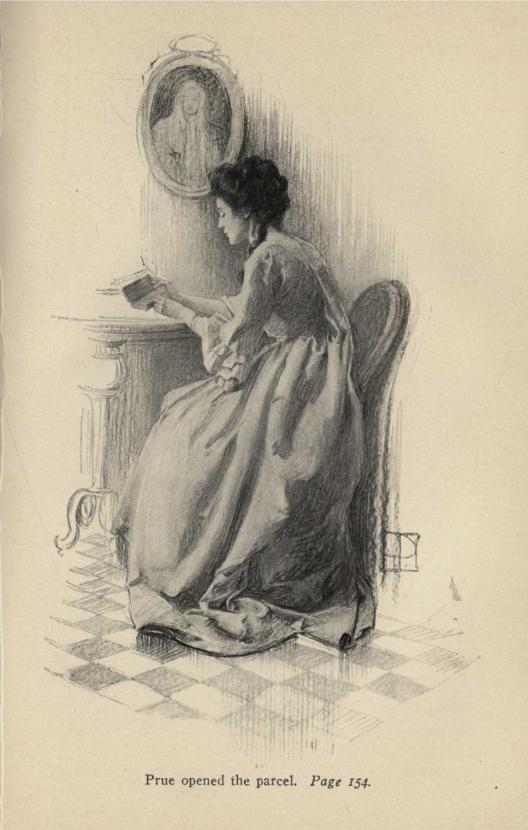
Prue opened the parcel.
"Look, Peggie, did you ever see anything half so lovely?" she cried, holding out for her inspection a pair of long silk gloves as filmy as a cobweb and exquisitely embroidered with seed-pearls.
Peggie dared not move her head, for the coiffeur was busy with his tongs, but she rolled her eyes round until she saw the gloves, and then rolled them up as far as they would go to emphasize her one word of admiration, "Incomparable!"
Prue drew on one of the gloves. It was so elastic, and yet so clinging, that it clasped her slender fingers like another skin, giving them even a more tapering and delicate appearance than usual. She did not open her letter until she was alone in her own room, and then, tearing off the cover with more eagerness than she would have cared to own, found nothing inside but ten crisp, new Bank of England notes for one hundred pounds each.
She dropped them as though they had been so many adders, and a flush of anger rose to her cheek. "I suppose he has been waylaying and robbing some one!" she said half-aloud, "and hugs himself to think he can buy me with stolen money! Oh! he is just as base as the rest—"
There was a movement in the other room, so Prue snatched up the bank-notes and crumpled them into her jewel-box. Not even to Peggie did she wish to confide this fresh instance of Robin's turpitude.
CHAPTER XV
THE RED DOMINO
Fashionable hours were early in the days of Queen Anne, and it was a well-known fact that the imperious Sarah Churchill did not easily pardon the slight of unpunctuality at her entertainments. So by nine o'clock the gorgeous drawing-rooms were well-filled and the steady stream of rank and beauty poured up the great staircase as fast as chariots and chairs could discharge their glittering loads.
The sight was a dazzling one; every nationality, every celebrity was represented. Cardinals paid court to Gipsies, Charlemagne and Henry the Eighth contended for the favor of Helen of Troy, and in front of the dais upon which the duchess stood unmasked, to receive her guests, an endless procession passed, of monks and devils, kings and clowns, swashbucklers, nuns, fairies, princesses, allegorical and mythological personages—a veritable phantasmagoria, in which the mask and domino afforded just as much concealment as the wearer desired, but no more.
A ripple of laughter or a murmur of admiration at frequent intervals announced the arrival of some specially brilliant or humorous masker, and when the crowd was at its densest, a couple approached the dais, followed by a stream of hilarious compliments.
Foremost came Prue, dressed as a shepherdess. Over a skirt of her grandmother's priceless lace, she wore a Watteau dress of white silk, brocaded with bunches of rosebuds and forget-me-nots, and coquettishly perched upon her luxuriant curls was a little straw hat, adorned with a wreath of roses and a flowing knot of blue ribbon. The pearl-embroidered gloves covered her hands, in one of which she carried a crook all laced with fluttering ribbons, and in the other a silken cord, by which she led Peggie, admirably disguised as a lamb; of gigantic growth, to be sure, but delightfully and gracefully grotesque as she ambled and pranced beside the little shepherdess, who at every other step, stopped to caress and encourage her.
The little procession was so irresistibly funny that the duchess, at first rather disturbed by the rising tide of laughter and applause, as soon as she set eyes upon the cause of it, joined in with the utmost heartiness, and even the queen, who sat beside her in a chair of state, vouchsafed a smile of genuine amusement, rare enough upon the face of that woman of few emotions.
Dancing was going on in the great ball-room, but Prue refused to dance. "I dare not leave my lamb at the mercy of all these wolves," she declared, in a falsetto voice that deceived no one. "Is there no grassy nook where I can repose, while my pet frolics round me?"
"Certainly," said a voice, which she recognized as Sir Geoffrey's. "There are secluded retreats in the conservatories sacred to Chloris and her flock—"
"Including Strephon? No, thank you," and warning him off with her crook, she roamed about, launching the harmless arrows of her ready wit against such of the guests as she recognized, or pretended to.
Presently a voice began to murmur close behind her—
"Her hair,
In ringlets rather dark than fair,
Does down her ivory bosom roll,
And hiding half, adorn the whole.
In her high forehead's fair half-round
Love sits in open triumph crown'd.
Her lips, no living bard, I weet,
May say how red, how round, how sweet—"
"Oh! hush!" cried Prue, in a great flutter; "how could you be so rash? You will be recognized." She turned a quick, timid glance backward, and was promptly reassured. The tall, stately figure, picturesquely draped in a voluminous red domino, had nothing about it to attract attention, and a red mask with a deep fall of gold-lace concealed the entire face, except the firm mouth and strong, square chin.
"What made you come here, of all places in the world?" she asked.
"Chiefly to see you, but partly because I had business here," he answered.
Poor Prue thought of the bank-notes, and almost collapsed. What business could a highwayman have at a ball unless to rob the guests while pretending to be one of them? Just then Peggie drew her attention by pulling at the cord.
"For Heaven's sake," she whispered, "come out of this crowd. I am so hot, muffled in this sheepskin, I shall die if I don't get to the air."
Prue signed to Robin to follow, and led her lambkin away. Outside the ball-room, they were soon in comparative solitude. In the card-rooms a few elderly people had thrown off their masks and given themselves over to the full enjoyment of whist and écarté. Here and there a tête-à-tête was progressing behind the kindly shelter of albums or portfolios. In the library a sedate couple mused side by side over the latest number of the Spectator, upside down, while two or three portly, be-starred and be-ribboned fogies discussed the threatened Jacobite uprising over an exclusive bottle of Burgundy.
Prue was at home in every corner of Marlborough House, and had no difficulty in piloting her companions into a cool, dim-lighted conservatory, where the sound of voices and music reached the ear agreeably softened by distance.
"Every one has seen me," said Peggie; "I'll get rid of this sheepskin, and then I can dance."
"Peggie would rather dance than eat, sleep or go to church," remarked Prue, seating herself and making a little, half-hesitating, half-inviting movement toward the seat beside her.
Robin was not slow in availing himself of the opportunity. There was something in Prue's manner that allured him, while it kept him at a distance. He longed to take her in his arms as he had done once; yet he dared not touch her hand.
"I am glad to have an opportunity of speaking to you," she said, removing her mask. "You sent me something to-day—"
"Yes—oh! you don't know how happy you have made me by wearing them," he said earnestly.
"Ah! yes," she started and looked down at the gloves; "they are beautiful—just the very thing for my dress, too. But that was not what I meant."
A deep flush burned his face under the mask. "I beg and implore you not to speak of anything else I sent," he said, in a low, tremulous voice. "Let me deceive myself into the belief that you acknowledge that, at least, as my rightful privilege."
She raised her lovely eyes to his with a puzzled expression, then dropped them, a little embarrassed. "We will not discuss that," she said, "but unfortunately I can not avoid speaking about the money, because—you see, I can not help knowing that you—that perhaps—that perhaps it honestly belongs to somebody else and you have no right to give it to me. There!" She looked apprehensively at him, fearing an outburst of rage, but he was quite calm, and the mask concealed any change of countenance.
"You are very scrupulous," he said coldly.
"Oh! I know you had no reason to expect honesty from me!" she exclaimed, with a touch of temper in her voice. "But when you threw your purse to me in the carriage, I had no opportunity of returning it and I never expected to see you again. Besides, you took mine and—and—" She glanced at him out of the tail of her eye, but he did not accept the challenge. "You think, perhaps," she went on, quite angrily now, "that I have done a much worse thing for money than ever you did; but if I have married a robber—"
"Stop, stop!" he said authoritatively. "If you must say these things about yourself, it shall not be to me. Insult me as much as you please, but do not accuse me of daring to blame you for anything you have done, or could do. Tell me, if I assure you that that money is my very own, will you take my word for it?"
She hesitated and softened. "Tell me truly—in what way your own? Do not fear to trust me."
"Trust you! Do you not know that you could charm any secrets of my own from me by a kind word? But this is no secret; it is the price of my birthright, received in honest sale and barter over a lawyer's table. You will believe me, won't you?"
She put out both her hands, with a gesture of enchanting frankness. "I will believe anything you tell me," she said; "I know you would not deceive me."
He took the two little fluttering hands in his, and raised them one after another to his lips.
"I see you are not wearing a sling," she remarked. "Is your arm healed?"
"It was nothing; a broken collar-bone is quickly cured," he said carelessly, though delighted by even so slight a token of interest from her. "Besides, the person whose domino I borrowed, does not wear his arm in a sling, and I do not wish any difference to be remarked when he resumes it."
"Then you are here in some one else's disguise?" she said quickly. "What will you do when we unmask?"
"At midnight the right face will be found under this mask," he replied.
"What fun it would be!" she cried, with reckless gaiety, "if you were to stay until midnight and unmask with the rest! I wonder if any one would recognize you."
"If the experiment will amuse you, I will stay and try it," said Robin tranquilly.
Her own voice dropped almost to a whisper. "To amuse me?" she murmured. "What do you suppose would happen?"
"Probably nothing at all; I am not so well known. At the worst, they would merely arrest me," he said.
"Merely arrest you! and send you back to—prison, I suppose?"
"Why, 'tis likely; and then, in a few days, you would be free—to marry some one you love."
"I have had enough of marrying," she said petulantly. "Besides, had I loved one man, I would not have married another, even in jest."
"Even in jest," he repeated. "Well, have a little patience and you may laugh as heartily as you please at this merry jest. When you are free, will you—" he hesitated—"I owe you a chance to make a better use of your freedom next time, yet it irks me to think that you will very likely throw it away again upon one who is not worthy of you."
"Do you mean Sir Geoffrey Beaudesert?" she said. "Do not fear, I shall never marry him."
"You will not?" he exclaimed eagerly. "You do not love him? Oh! you give me new life; I care little what becomes of me, if I am sure you will not marry Sir Geoffrey Beaudesert."
"Hush-sh," she whispered, peering round in the dim twilight of their retreat; "I thought I heard a movement; suppose any one had overheard you!"
He clapped his hand on his sword, but everything was still except the distant music and the approaching voices of another pair in search of solitude.
"Let us go," said Prue, rising in a tremor and adjusting her mask. "I would not, for the world, have anything happen to you, and I fear you are not safe here; we have been incautious—prithee, begone from this house—"
"Do not be uneasy, dear Lady Prudence; I am safe here," said Robin, devouring her with his eyes. "I may never see you again; do not banish me—"
"Never see me again?" she interrupted. "Why not? I am sure you are in some danger you will not tell me of, else why should I never see you again?"
"Would you care if you did not see me again?"—he was beginning, in a passionate whisper, when Peggie, released from her sheepskin and clad in somewhat scanty drapery intended to represent springtime, pounced upon them, delighted with the semi-nudity that displayed her charming form, while the mask concealed her plain face.
"Have I been away long enough?" she cried saucily. "Have you had plenty of time to quarrel and make love? Come, Prue; eleven o'clock has struck, and we shall scarcely be in time for a country-dance before we unmask. Hasten!"
She was drawing Prue after her by one hand, but she hung back, extending the other to Robin, who stood irresolute, longing to follow, yet not venturing, unbidden.
"Farewell," she said, in a thrilling voice. "Prithee, do not linger."
He pressed a kiss on her finger-tips and was still looking after her with his heart in his eyes, when a hand brushed his arm with a peculiar touch, and turning with his wandering senses suddenly on the alert, he saw a figure in a monk's habit, strolling slowly toward the most crowded card-room. He followed, and soon caught up with him.
"Your dress is too conspicuous," said the monk, in a harsh whisper. "There is work to be done, instantly, and your dress unfits you for it."
"Show me the work," said Robin, apparently greatly interested in two players who were throwing dice for high stakes.
"I expected to find you at your post, and after a long search, where do I discover you? You, of all men—at the feet of the most heartless little Jezebel in London," said the monk, with bitterness.
Robin laughed silently. "Have you also been under her feet?" he asked. "Well, if it were any one else, I would kill him for such a calumny upon the most virtuous and adorable lady in the world; but I can not spare you, so give me your news."
"The papers stolen from a certain general are here, in the possession of a man who does not know their importance, but only that Madame Sarah will pay handsomely for them. Not being able to obtain audience of her, he is now leaving the house."
"Why do you make such a long story of it?" said Robin impatiently. "Describe him to me, and I will see to the rest."
"There is no hurry; he has a sweetheart among the maids, and will be some time about his adieux. I will show him to you, but you must get rid of that scarlet affair; what have you underneath? Oh! that is still worse; satin and velvet and diamonds! Why couldn't you come quietly dressed, like the rest of us?"
Robin blushed under his mask, for he knew very well that if Prue had not been among the guests, the monk's frock or the student's cap and gown would have been fine enough for his purpose.
"Never mind my dress," he said shortly. "You can lend me your frock, and if you have no further business here, you can do me a service."
As they went out together, Robin explained to his friend the manner in which he had obtained a domino and an invitation, and, incidentally, the predicament of Lord Beachcombe. Together they sought and found his carriage, at a place previously arranged for, and within it the exchange of garments was effected.
"Now go to the house by the riverside, where you will find Lord Beachcombe tied hand and foot in the dark in the guard-room, and his lackeys under similar conditions in another room. Steve Larkyn is in charge of them. Restore the mask and domino to Lord Beachcombe, return him and his varlets to the carriage, blindfolded, and when you have taken them a safe distance from Essex Street, set them free to go their way to the ball or the devil, whichever pleases them."
The carriage drove away and Robin, completely concealed under the monk's gown, made his way back to the house. Not, however, through the brilliantly lighted main-entrance, but this time by a side-door that led to the servants' quarters.
CHAPTER XVI
AT THE UNMASKING
When Prue and Robin had left the conservatory a sufficiently long time to insure their return to the ball-room, out from behind a clump of plants slipped Sir Geoffrey Beaudesert. Observing her exit from the ball-room with a tall and conspicuously habited masker, he had followed with the intention of interrupting a tête-à-tête and forestalling one of Prue's little flirtations that, however harmless in themselves, were dangerous, as he knew by experience, to anterior claims.
When he found that, avoiding the well-lighted rooms, Prue guided her companion to an out-of-the-way retreat, where it was unlikely that they would be disturbed by any one less familiar with the house than herself, his annoyance increased, and with it his anxiety to know who the favored swain might be, and when Peggie, with the good-natured intention of giving Robin an opportunity, left them to rid herself of her sheepskin, the green-eyed monster took complete possession of Sir Geoffrey and prompted a baseness of which, a moment before, he would have blushed to think himself capable.
The only available concealment was at such a distance that at first nothing reached him but the murmur of voices. He could see that Prue stretched out her hands to her companion, and that he kissed them with ardor, but until his own name was mentioned, he heard nothing but a disjointed word here and there. Then, with ears preternaturally sharpened by something even more poignant than jealousy, he overheard Prue's repudiation of himself and her companion's expression of relief and gratitude for the same.
It was fortunate, perhaps, that the colloquy was so soon brought to an end by Peggie's eagerness to carry her cousin off to the ball-room, whither Sir Geoffrey followed as quickly as he deemed wise, only to find Prue already standing up in a country-dance, and the tall masker in scarlet missing. He hunted everywhere for him, but in vain, and finally withdrew to one of the card-rooms, where he played with a marked absence of his usual skill, and also of the luck for which he was proverbial.
At midnight a flourish of trumpets announced that the moment for unmasking had arrived. The dancers formed a double line and marched past the dais, each couple unmasking as they saluted the duchess and her royal guest. Following them came an almost interminable procession of the beauty, talent and rank of the country, and among the very last of these, Sir Geoffrey's search was rewarded. The tall figure in its scarlet drapery suddenly appeared, he knew not whence, and within a few feet of him, doffed domino and mask and revealed the familiar but unlooked-for person of Lord Beachcombe.
Instantly there flashed into Sir Geoffrey's mind an explanation of the words he had overheard, which roused him to an almost uncontrollable fury. This man, once his rival, was still in love with Prue, and after goading him into a monstrous wager about her, had exerted some infernal arts or arguments to induce her to play the jilt once more and thus rob him, at one stroke, of his bride and his money.
"Oh!" he muttered, with intense bitterness, "such a trick is worthy of a man who would not pay his own sister's dowry, until he was sued for it! He shall answer for this treachery with his heart's best blood, and as for her—" His look boded ill for the future of the capricious beauty toward whom his feeling just then was less like love than hate. He was forced into self-control, however, by the reflection that to provoke a meeting on this issue would place him in a more than equivocal position and that it would be necessary to find some other cause of quarrel.
Beachcombe, meanwhile, unconscious of what had happened under shelter of his disguise, saluted his hostess and his sovereign and passed on with a bland exterior and a temper in a highly inflammable state.
Sir Geoffrey lost no time in throwing himself in Beachcombe's way. They exchanged greetings and then, "How goes the courting?" asked my lord. "How is it you are not in attendance on the fair widow?"
Sir Geoffrey's fury choked him. Was ever such impudence as this scoundrel's?
"Do you require an explanation on the subject?" he said, between his clenched teeth.
"Far from it," retorted Beachcombe, with a jeering laugh. "It will be quite enough for me to know that she has jilted you; I care nothing for the details. Still, if I were you, I would not carry my willow quite so openly."
"No doubt your lordship regards it as quite permissible to prejudice the Viscountess Brooke against a suitor who has a wager with you, dependent on her favor," sneered Beaudesert.
"I hardly fancy it would be diplomatic," drawled the other, not having the clew to Sir Geoffrey's meaning, and relishing his peevishness as evidence of defeat. "As the lady has probably never pardoned my speedy consolation, I doubt not that anything I might say against you would only drive her into your arms. This is the first time I have seen the Lady Prudence since Her Majesty requested her to retire from the court a year ago. She appears to me even more beautiful and vivacious than formerly. I must endeavor to make my peace with her; one can not afford to be at odds with so bewitching a creature, especially if she is to be attached to the queen's household again, where we shall be obliged to meet constantly."
Sir Geoffrey was so dumfounded by what he took to be the earl's audacity and dissimulation, that he fell back and allowed him to follow in the wake of the subject of their conversation. It was but a small consolation to him that Prue was in his power through her rash marriage; she had already shown him that she considered him particeps criminis, if she did not go so far as to lay the blame on his shoulders. It was plain to him that Beachcombe would give him no opening for a quarrel about her and that he would have to find some other cause for the duel he was determined to force upon him, but that gave him no uneasiness. At that period dueling, though nominally unlawful, was a highly popular means of settling any and every difference between gentlemen, and love, cards, etiquette, family jars, political opinions and a host of more or less trivial causes gave plausible excuse for the indulgence of personal hatred. Sir Geoffrey was a dead shot and a fairly skilled swordsman, and had come off scathless in encounters with far more formidable antagonists than this young lordling, whose prowess was still untried and whose reputation for courage or any other lofty quality was yet to make.
With a wager of five thousand guineas contingent upon Prue's fidelity to him, Sir Geoffrey was not prepared to be overnice about the pretext that would put such an antagonist hors de combat for a few weeks.
While he was turning over in his mind a variety of baits by which he might draw Beachcombe into a quarrel, the latter pursued his way through the crowd, exchanging greetings and receiving congratulations upon the advent of his son and heir, and at last reached Prudence. It was no very easy task to edge his way through the throng of her admirers, nor had he any special reason to felicitate himself upon his success when he had gained it. He came up, bowing low, with his hand upon his breast, pouring out the customary stream of high-flown compliments and asseverations that the sun, moon and stars had refused their light since her eyes, the brightest of all luminaries, had been withdrawn from the firmament!
Prue regarded him with one of her most beaming smiles.
"'And pray, sir, when came you from hell?
Our friends there—did you leave them well?'"
she inquired, with an air of flattering interest.
In the midst of the laughter that greeted this sally, Peggie was heard to exclaim, in a voice of mock-horror, "Prue! how shocking!"
"My dear, you must blame Mr. Prior, not me, if you object to the quotation," said Prue demurely.
"Maybe," retorted Peggie; "but in conversation one can not see the inverted commas, and you know Lord Beachcombe does not read poetry."
"True, I apologize," said Prue, and turning again to her former suitor, she dropped a deep curtsey. "How is it, Lord Beachcombe, that we have not seen you earlier?" she asked graciously. "When did you arrive from—home? and did you leave her ladyship and the baby well?"
The laugh that followed this was utterly incomprehensible to the proud father, who replied with urbanity, feeling that Prue showed great self-denial in making these inquiries so publicly and exposing herself to the hilarity of those who could not fail to remember how she had forfeited the proud position of wife to the present and mother of the future Earl of Beachcombe. He felt quite sorry for the regret and mortification she must be suffering and was inclined to concede that the punishment was overharsh for the frailty of a creature so winsome.
He offered his hand to lead her into the supper-room and the magnetic thrill of her touch sent the blood surging through his veins in the old accustomed way—he looked down into the sparkling depths of her lovely eyes and straightway forgot—everything that he ought to have remembered. It needed but the gloomy frown of Sir Geoffrey Beaudesert to incite him to offer the most effusive attentions and Prue to permit, if not actually encourage them, until wearying of a pastime that had nothing to recommend it but its folly, she turned the battery of her fascinations in another direction.
It must not be supposed that Lord Beachcombe was without curiosity as to the use Robin had made of the invitation and disguise he had borrowed so peremptorily. He questioned several people, but no one seemed to have observed the scarlet domino, and the one person who could have enlightened him, he did not dream of connecting with the exploits of a highwayman. He began to feel reassured, and a couple of bottles of wine helped to restore his damaged amour propre, though his temper was considerably ruffled. He followed Prue to the ball-room, but his invitation to dance was coldly declined and he retreated to the card-room where Sir Geoffrey was already seated and hailed his coming with fierce joy. It would be strange, indeed, he argued, if means could not be found to fasten a quarrel upon a man who came to the card-table with a naturally morose temper heated with wine and still further excited by the bitter-sweet arts of a coquette.
That Beachcombe was still infatuated with his old love, Sir Geoffrey had not the slightest doubt, and that he had persuaded her to jilt him he had, as he firmly believed, the evidence of his own senses.
The play was high, and Sir Geoffrey's luck had taken another turn. The pile of guineas in front of him grew apace and gradually the others dropped out, except Beachcombe, who had also been winning, though not so largely. His luck soon gave way before Sir Geoffrey's, and in a short time he had lost all his winnings and a considerable sum besides. Seeing him hesitate and half rise from the table, his opponent laughingly exclaimed, "Don't leave me, Beachcombe; I'm in the vein to-night—"
"Unlucky in love, lucky at cards," sneered Beachcombe. "I see the widow has jilted you."
"That's a lie and you know it!" cried Sir Geoffrey. Both the men started to their feet and stood glaring at each other across the table. Most of the other games were suspended, and a breathless hush fell upon the whole assembly.
"Is that intended for an insult?" said Beachcombe thickly. A laugh or two expressed the opinion of the onlookers as to the propriety of such a question.
"You can take it any way you please," retorted Sir Geoffrey. "What I have said I am ready to repeat, if you require it, and uphold in any way you demand."
A gray-haired man in general's uniform came forward and laid a hand on the arm of each.
"Gentlemen," he said, "the duchess will be much offended, if this should go further under her roof, on such an occasion as this. If you wish to continue this discussion, my quarters, near by, are at your disposal after the ball. Until then, pray let us avoid any unpleasantness."
Beachcombe turned on his heel and walked off to the other end of the room. Sir Geoffrey accepted the old general's invitation, and pocketing his winnings, repaired to the ball-room, his temper and spirits vastly improved.
There he had the good fortune to find Prue in a gracious mood, and willing to make up for her previous neglect by dancing with him and allowing him to linger at her side until the ball came to an end. Then he had the felicity of shawling her and handing her into her carriage, where she bade him good morrow and permitted him to press a kiss upon Robin's pearl-embroidered gloves.
CHAPTER XVII
LADY BARBARA'S NEWS
The sun was flushing the horizon when Prue and Peggie left off comparing notes about the ball and laid their weary heads on their respective pillows. Peggie, light of heart and easy of conscience, was very soon asleep, but Prue was less fortunate. The more tightly she closed her eyes, the more distinctly she saw everything that had happened to her since yester morning's sun had looked coldly upon her grief and remorse. Could it be only yesterday that she had been awakened by the hideous thought that her husband was expiating his crimes upon the gallows? Only yesterday that she had bemoaned herself as the wickedest and crudest of women, while she believed him dead: yet was ready to reproach him with perfidy when she saw him alive? Oh! it was impossible that only yesterday morning she had scorned herself for the folly that bound her to a malefactor. Why, last night she had treated him as an equal, had taken his word as a gentleman, had felt and acknowledged anxiety for his safety, and had permitted him to kiss her hands; not out of pity as when she married him, but just as if he had been of the same social flesh-and-blood as herself. She vainly reminded herself that this Robin was the same who had waylaid her on Bleakmoor; the same who had lain in Newgate Prison, a felon condemned to the gallows; the same she had married because he was doomed to death, and for no other reason; oh! more the shame to her! As to him, his part in that ignoble contract was blameless and even generous. With which thought last in her mind, she fell asleep.
When she opened her eyes, Peggie stood at her bedside, smiling over an armful of roses.
"Guess what little bird sent these to you," she said.
Prue started up eagerly. "Is he here?" Peggie shook her head. "What, did he go away without seeing me?" cried Prue, her face falling and her lip drooping like a grieved child.
"No, he sent them by his lackey. You had better make haste to be up and dressed, in case he comes to be thanked."
Prue jumped out of bed and began dressing in a great hurry.
"How comes he with a lackey, forsooth!" she said presently, feigning to cavil so that Peggie would go on talking.
"Why, does not Sir Geoffrey always send his lackey with flowers for you—and grandmother?" laughed Peggie.
"Sir Geoffrey!" cried Prue, starting away from the roses as though she had suddenly encountered their thorns.
"Of course; who did you think had sent them?" inquired Peggie blandly.
"Why—I thought—you said—Oh! Peggie, what did you mean by a little bird?" pouted Prue.
"Ha! ha! ha!" Peggie screamed with laughter. "So the only bird you can think of now is a Robin! Why, Prue, you foolish coz, what is the use of setting your heart on him? You know you can not have him."
"And suppose I can not; is not that enough to make any woman set her heart on a man?" cried Prue. "Take those nasty things out of the room, Peggy; the smell of them makes me quite sick."
Peggie started to go, sniffing them voluptuously. "Poor Robin!" she murmured; "'tis well he can not see how his roses are treated. Nasty things, indeed! I never knew the smell of roses to make you sick before."
Prue flew after her. "Margaret!" she exclaimed, with flashing eyes. "How dare you torment me like this? Tell me, this instant, who sent those flowers to me?"
"Why, didn't I tell you they came from Robin?" asked Peggie, regarding her with guileless surprise.
"Give them to me this instant! Oh, Peggie, Peggie, you know you tried to make me think Sir Geoffrey sent them—"
"I only said he always sent flowers by his lackey," Peggie interposed.
"Was there nothing with them? Not a letter, not a message?" Prue went on. "Oh, Peggie, just a word—?"
"Not a word. But the day is not over yet, and mayhap Captain Scatterbrain will bring his own message. He is mad enough for anything. Now don't keep smelling those 'nasty things'—you know the smell of roses makes you sick to-day—and make haste down-stairs. Grandmother is feeling almost well to-day and will take her chocolate in the drawing-room. She wishes you to join her anon, so that she can hear from your own lips all about your triumphs last night."
When Prue came down presently, she wore a great cluster of red roses at her breast, and one or two nestled in the rich braids of her hair. It was a pity Robin could not see how well they became her, but they were not altogether wasted, as Sir Geoffrey, coming in a short time later, made them the occasion of some charming compliments.
Old Lady Drumloch, with no sign of weakness about her but her delicate waxen pallor, reclined on a couch enveloped in her cashmeres, sipping chocolate, and listening with great complacency to her granddaughter's account of the masquerade. She greeted Sir Geoffrey without enthusiasm, accepted his congratulations upon her recovery with resignation, and remorselessly turned him over to Peggie for entertainment, while she kept Prue in close attendance upon herself.
Other guests dropping in, Prue was kept so busy dispensing chocolate and sweetmeats that she hardly noticed the portentous gravity with which Sir Geoffrey drew Peggie apart and engaged her in a low-voiced conversation, which at first amused, then surprised, and finally caused her to exhibit unmistakable signs of uneasiness. Her efforts to catch Prue's eye being abortive, she was on her way across the room, when the door was thrown open, and with a great rustling of silks and clattering of fans, three ladies were announced. "Lady Limerick, Miss Warburton and Lady Barbara Sweeting."
Of the new-comers, the latter deserves a word of introduction, for Lady Barbara had been the sharer, and many thought, the instigator of half the frolics of Prue's lively widowhood. They were fast friends, and if the fading charms of Lady Barbara suffered by contrast with Prue's fresh loveliness, those who desired the friendship of either were usually wise enough to treat both with impartial gallantry.
A great favorite of Queen Anne and also a dangerous rival of Sarah Churchill, Lady Barbara owed her popularity chiefly to her skill in collecting and disseminating scandal. She knew everything long before any one else suspected it. Projected marriages, family jars, political intrigues supplied her with an ever-fresh stock of amusing anecdote. Mischievous but rarely malicious, she often pricked but seldom stabbed, and was as ready to turn the laugh against herself as to make fun out of her most cherished enemy.
"Dear Lady Drumloch, what a delightful surprise, and how charming you look!" she cried, taking the old lady's delicate hand in hers and pressing upon it as reverential a kiss as though it had been Queen Anne's own chubby fingers. "You don't know how enchanted we are to have you among us again! We have missed you so. Prue, you wicked witch, how dare you look so lovely? After last night you ought to be pale and languishing, instead of looking so shamelessly unconcerned and lighthearted." Prue, without knowing why, changed countenance a little, at which her tormentor ran on still more volubly. "We were getting on very nicely without you—a little dull, perhaps, but one can live without duels, and while you stayed in the North, wives could let their husbands run alone, even if they had been your bond-slaves. Prithee, was ever General Sweeting the victim of your enchantments? If so, alack, what is to become of me?"
A laugh rippled round the room, for Lady Barbara's husband was notoriously henpecked, and although he had once been a redoubtable warrior and a still more formidable rake, it was in the days when Prue's mother had not emerged from the nursery and Prue's self was an unpropounded problem of the distant future.
Not at all disturbed by the amusement of her audience, Lady Barbara raised her quizzing-glass and ran her bright, sharp glance round the room.
"What! Sir Geoffrey Beaudesert! how come you here? Why are you not flying for safety to your Yorkshire Castle? Or perhaps your parliamentary immunities extend to the slaughter of the innocents as well as the spoiling of the Egyptians!"
Sir Geoffrey, very red in the face, came forward, bowing low. "Dear Lady Barbara, as you are strong, be merciful," he murmured imploringly.
She gave him a look very unlike her ordinary merry defiance. "Merciful to you, who have no mercy even for the nursing mother and the suckling babe? Never! Lady Beachcombe is one of my ninety-and-nine dearest friends. I have just come from her. There was a sight to wring the heart of a monster! the weeping mother in one room and the wounded husband and father—"
"Oh, tush!" interrupted Sir Geoffrey, recovering his aplomb. "'Twas the merest scratch. A strip torn from my lady's kerchief would have bound it up and left something to spare—"
"Don't quarrel, you two," interposed Prue's sweet, cooing voice. "Bab, come and sit beside granny and I'll give you a cup of chocolate, while you tell her the latest news."
"The latest news! There is so much, that the difficulty is to know where to begin. I went, this morning, to visit my interesting friend, Lady Beachcombe, and according to promise, to give her full description of the ball, including"—here she shook her finger at Prue—"all the doings and misdoings of her lord. I was prepared to be cautious with the dear creature, but instead of finding myself welcomed as a bearer of news, I heard so much that my poor head fairly swims with trying to remember it all."
"Begin with the least exciting and work up by easy stages to a climax," suggested Peggie, edging toward her cousin and trying to attract her attention.
"No, begin with the most thrilling while our nerves are strong enough to bear it," Prue proposed eagerly.
"First, then," Lady Barbara began, highly enjoying her anticipated triumph, "there was a robbery at Marlborough House last night; and sure no common thief would venture to steal Her Majesty's diamond necklace from the royal tiring-room."
The general chorus of incredulity and indignation realized her expectations and she looked around with a mysterious smile. "No common thief, indeed; but Robin Freemantle, the highwayman, is out of jail, and 'tis said—indeed my authority can not be questioned—that he was among the maskers."
Prue felt cold shivers trickling down her spine, but the consciousness that Sir Geoffrey was watching her, gave her strength to fix a smile upon her face and pour out the cup of chocolate with a steady hand.
"Why do they think he had anything to do with this?" some one inquired. "Tell us everything quickly, Barbara, before we die of curiosity."
"Why, now we come to the best story of all," cried the fair newsmonger. "On his way to the ball, Lord Beachcombe was waylaid by Robin Freemantle and a band of ruffians, who carried him off—carriage, servants and all complete—to a secret cavern and left him there for several hours, having robbed him of his mask and domino and borrowed his invitation and his carriage!"
"The devil!" ejaculated Sir Geoffrey, suddenly very much enlightened.
"Fie, Sir Geoffrey; you should leave such remarks to our poor friend Beachcombe, when he discovered, this morning, the purpose for which his disguise had been taken."
"But he was there; I spoke with him," said Prue, feeling the color ebb from her cheeks and surreptitiously trying to pinch some of it back.
"Did I not see you supping with him?" retorted Lady Barbara archly. "I refrained from dwelling upon that subject to my poor friend, Lady Beachcombe, but I saw what I saw! Before midnight his property was restored and he was set free. He hastened to the ball, and doubtless he would have done much better to go straight home, eh, Sir Geoffrey?"
"He seemed in a bad humor," said Prue reflectively, "but not more so than usual."
"He might well be in a bad humor. It appears that he was instrumental in getting Robin Freemantle pardoned when he was in Newgate, condemned to be hanged."
"That is strange!" Peggie exclaimed. "'Tis the first time I ever heard tell of a charitable act of his!"
"'Twill be the last, no doubt; the man is an ingrate. His first use of his liberty was to steal his benefactor's mask and domino, and under cover of them to rob the queen's Majesty. Oh! 'tis outrageous!" Lady Barbara ran on volubly. "But he will be punished; and speedily." She became mysterious. "His retreat is known. When Beachcombe questioned his servants and added his own suspicions to theirs, he came upon important clues, and when I left he was going to place them in the hands of the authorities, from whom this miscreant will certainly not be rescued a second time—by him!"
"Or by any one else, it is devoutly to be hoped," remarked Sir Geoffrey; "don't you agree with me, Lady Prudence?"
"You played thief-taker before, Sir Geoffrey," she retorted, with unaccustomed acrimony. "You should offer your services again; his escape would then be impossible."
"Quite impossible!" cried Lady Barbara, who only caught the last words. "His home will be surrounded by soldiers, and he will be lodged in the Tower, when they catch him."
"Do they send soldiers to catch a highwayman?" inquired Peggie.
"And why the Tower?" objected Lady Drumloch. "Methought that was reserved for gentlemen; 'tis too much honor for robbers and footpads. Will they also behead this person; like a gentleman?"
"'Tis likely," cried Barbara. "I had so much to tell you, that I forgot that this Robin is not a mere ordinary highwayman; he is a Jacobite plotter, no less, and is known to carry letters and messages from rebels in the South to those in the North and back again—doing, I presume, a little highway robbery on the way, for the good of the cause. Mayhap he appropriated the queen's necklace as a contribution to the treasury of the 'King in Exile.'"
"Barbara!" exclaimed Prue and Peggie together, in a panic.
"My dear Lady Barbara," put in the thin, incisive voice of Lady Drumloch, "the 'King in Exile' is the queen's brother and probably—may the day be distant—will succeed her. I can not permit such insinuations to be made in my presence, against the cause for which my husband and my son laid down their lives."
"Pray pardon me, dearest Lady Drumloch," cried Lady Barbara, really shocked at her own want of tact. "I meant no harm—my tongue runs away with me—and to be sure, I have no greater fancy for a Dutchman on the throne than any other loyal Englishwoman. Yet 'tis true that Robin Freemantle is only the nom de guerre of one of the most turbulent rebels against the queen's government—"
"If by that you mean the Whigs, you should rather say against the Duchess of Marlborough's government," retorted Lady Drumloch crisply.
"And what is the real name of this—rebel?" inquired Prue.
"Why, he calls himself De Cliffe, and if he really is an offshoot of the family, that would explain why Beachcombe obtained a pardon for him," said Lady Barbara.
"Indeed, it requires explaining," remarked Prue, who had quite regained her self-command. "It is much easier to understand why he is sending him to the Tower, if he be a poor relation."
During the laughter that followed this sally, other guests arrived and the loss of the queen's diamond necklace having, by this time, become pretty generally known, poor Prue had to listen to every variation of the story and every kind of theory concerning it, all leading to the same conclusion, that Robin the highwayman had been at the masquerade ball and profiting by opportunity—the Ruling Planet of adventurers—had carried off a prize of incalculable value.
With difficulty she eluded Sir Geoffrey's ironical condolences, and took her accustomed part in the heedless chatter, watching the clock as minute by minute slipped away and still her visitors lingered.
"Oh! if they would only go," she whispered to Peggie. "Do you think if I were to fall in a fit, or make James give an alarm of fire, that it would speed the parting guest?"
But the longest afternoon comes to an end some time, and Lady Drumloch's weary looks presently reminded her guests that she was but recently off her sick-bed. So with a great rustling of silks and sweeping of voluminous curtseys, they withdrew, with as many farewell speeches as though they did not expect to meet again in a few hours at dinner, rout or playhouse, and left the old countess to be carried up-stairs, and the two girls to their own devices.
When they were alone, Peggie threw her arms round her cousin. "Oh! my poor Prue," she cried; "what I have suffered for you the last hour—"
"Tell me of your sufferings by and by, Peggie," said Prue, rather ungratefully. "If you would help me, bid James fetch a chair, while I get me a cloak; I must hasten to the duchess."
"The duchess! Oh, Prue, dearest, don't do anything rash; for Heaven's sake, try to be discreet. If you can not help Robin, do not ruin yourself for the sake of a thief!"
"You are quite mistaken, Margaret; every one is determined that Robin has taken the necklace, and if I did not know him better than you do, I might think the same. But trust me; for once I will be the personification of prudence, and you will see that everything will come right. If any one should ask you where I am, say I have gone to offer my services and sympathies to the duchess. Sure, 'tis a terrible blow for her, and there are those about the queen who would rejoice if it were mortal. No one will wonder that I should wish at such a time to prove my friendship for one who has so often stood by me."
CHAPTER XVIII
THE DEN OF THE HIGHWAYMAN
Prue allowed James to direct the chairmen to Marlborough House, but, a short distance away, she stopped them, and giving them a crown, desired them to carry her with the utmost speed to Essex Street, where she would reward them amply for their diligence. Scenting an intrigue, with the usual accompaniment of a generous douceur for their share in it, they trotted off at a pace that gave their light burden hard work to keep her seat.
With all their haste, it was dark before they reached Essex Street, where Prue desired them to seek out "Pip's Coffee-House," a small hostelry of retiring, not to say furtive aspect. A flickering oil-lamp hung over the entrance, and through the red-baize window-curtain a dull glimmer penetrated.
Excited as she was, Prue was not without alarms at the sinister possibilities of this adventure, so vastly different from the sparkling follies of her giddy career. But "Cowards fayle," and Prue was no coward, nor was she capable of drawing back when curiosity and inclination combined to thrust her on. She descended, and bidding the chairmen wait, boldly entered the house and knocked at the first door she came to.
A voice called out, "Come in," and she obeyed. The room was of moderate size, divided into small compartments, each containing a rough wooden table and a couple of benches to match. The floor was sanded, the ceiling low and smoke-blackened, but there was no appearance of squalor, and the few occupants, who were reading the News sheet or playing dominoes, looked respectable and orderly enough.
Reassured, Prue approached the man in charge of the little curtained bar, and in a timid voice inquired for "Mr. Steve Larkyn."
He stared at her, but her veil effectually hid her face, though the sweetness of her voice and the distinction of her bearing could not be disguised.
"Steve Larkyn? I'll call him, my lady," said the man.
"I'm no lady," retorted Prue sharply. "If I were I should not be asking for Steve Larkyn!"
She was sorry for her quickness the next moment, for the man laughed rather rudely, and opening a door behind him, called out, "Hullo, Steve, here's a lady asking for thee, that says she ain't no lady."
The Steve Larkyn who came hurrying out was so unlike the one she had seen in disguise, that she was about to repudiate him, when with a sudden grimace he changed himself back into the rustic foot-boy, all but the shock of tow-colored hair, which no longer covered his sleek brown head. The change passed like a ripple of wind over a smooth pool, but it reassured Prue.
"Can you come outside a minute?" she said, in a very low voice; "I must speak with you."
He followed her into the street, and once out of range of observant eyes and ears, she grasped him by the arm, and demanded to be taken instantly to the captain.
"I can take a message," said Steve, hesitating. "It will attract less notice than a visit from a lady."
"Waste no time in idle objections," she cried, almost fiercely. "I must see him; what I have to say is for his ear alone, and even if otherwise, 'twould be a waste of precious time to tell my tale twice over. Lead me to him instantly or take the responsibility of his certain death upon your own head!"
"Come, then," he replied; "but you must come afoot. 'Tis ill enough to take a woman into a secret, without a pair of spying lackeys to boot. Can you walk a short distance? The road is dark and rough."
"No matter, I can walk it." She paid the chairmen liberally, and dismissing them, followed Steve down a steep and narrow lane leading to the riverside. It was unlighted, and she slipped and stumbled on the miry, uneven causeway until Steve, in pity, begged her to lean upon his arm. "'Tis not far now," he said, less gruffly, and a few yards farther they came to a huge and gloomy gateway, within which a little door admitted them into a dark hall. Steve struck a light and led the way across the echoing emptiness and up a broad staircase. He scratched with his nail upon a door, which was promptly opened by Robin himself, fully equipped for a journey.
"Steve!" he exclaimed. "What has happened, and who is this with you?"
Before he could answer. Prue stepped forward and throwing off her veil replied, "Your wife!"
"Lady Prudence!" he cried, scarcely believing the evidence of his senses. "In the name of Heaven, what brings you here? Why are you so pale and excited? Something terrible has happened?"
"No; but will happen unless you instantly escape." She came into the room and closed the door, leaving Steve outside. "Oh! Robin, Robin," she cried, clasping her hands and looking at him with reproachful eyes, "I know all that happened last night. How could you be so mad? You can not hope to escape again if you are arrested for this."
"Indeed," said Robin grimly, "if I am taken this time, 'twill be worse than hanging! But I'll never be taken alive—"
"There is time to escape," she urged. "Your retreat is known and you will be arrested to-night. Lord Beachcombe has discovered where he was brought yester night—"
"Ah!" said Robin, with a bitter smile. "I should have taken extra precautions against the bloodhound instinct of hatred! And so, Dear Heart," he went on, in a very different tone, "you came to warn me of danger? 'Twas very noble of you, for if you had left me to my fate, in a few hours you might have been a free woman."
Prue burst into tears. "Oh! you are cruel, cruel," she sobbed. "I do not want freedom—that way."
"I believe it," he said, taking her hand and pressing it to his lips. "Do not grieve, my hunted life is not worth one of those tears—"
"But hasten," she interrupted, listening attentively and holding up her hand to silence him. "I know who you are and that you are concerned in Jacobite plots. Soldiers will surround the house and you will be arrested and taken to the Tower as a traitor. You have very little time to escape—"
He glanced at some papers on the table and began to gather them up and conceal them about him. In doing this, he uncovered a jewel-case of purple velvet embroidered in gold with the royal arms.
Prue uttered a faint shriek and covered her eyes, as if to shut out the sight that confirmed her worst fears.
"Oh! Robin!" she gasped. "The queen's necklace—!"
"Was it the queen's?" he replied carelessly. "Well, now it is yours, if you care to have it." He opened the case and displayed the diamonds flashing like a string of fire. "'My faith! the gems are gorgeous; they will look well on the peerless neck of my beautiful Prue."
"I wear the queen's diamonds! You must be mad! What possessed you to take them? Oh, I hoped so that it was a mistake and that you were innocent of this."
"Innocent of what? Do you really think I stole the necklace? My dear Lady Prudence, I am a highwayman when occasion serves, but I am not a thief. Last night, on the king's business, I waylaid the wrong man, and all I got for my pains was this fine casket, which I never opened until now. Evidently I robbed the thief, confound him! and the papers I was commanded to secure are God knows where!"
"Oh! Robin, I am so glad!" she cried. "They said Robin the highwayman was at his tricks again, and had stolen the queen's necklace from Marlborough House, and oh, I was so ashamed to think such a thing could be said of—-my husband!"
She half turned away, murmuring the last words so softly that only the ears of love could have caught them.
"Oh! Prue—angel—is it really possible that you think of me as your husband? Oh! I know there has been an empty ceremony which meant nothing to you, and to me only vain longing and a mad dream of unattainable happiness; but what a fool I am! Of course I ought to have understood that you fear to be brought to shame if it should be suspected that the thief of the queen's necklace is your—"
Prue's eyes flashed and her little high-heeled shoe tapped angrily on the floor.
"You are indeed a fool!" she exclaimed. "I do not know why I have any patience at all with you. Will you begone from here at once, sir, and not offend me by tarrying when I have risked so much to save your life?"
He started and flushed guiltily. "Selfish brute that I am! I forgot the danger to you. A thousand thanks, dear Lady Prudence, for your warning. I will profit by it when I have conducted you to safety."
"You will do nothing of the sort," she retorted imperiously. "When I arrived you were preparing to depart; do so at once, for if you wait for the house to be surrounded by the soldiers it will be too late. Even now, if you leave it alive, you may fall into an ambush. Is there no exit except into the street?"
"Yes; this room opens on a terrace overlooking the river, and although I believed myself safe in London for a few days, I have a boat in readiness in case I should be forced to leave in a hurry," said Robin. "There are hiding-places in Southwark and Lambeth where the queen's whole army might hunt a week for me in vain."
"Be cautious then, for that may be known to your enemies; and, above all, be speedy—"
While she was speaking, the door was flung open abruptly and Steve Larkyn—his face blazing with fury—darted in.
"You are betrayed, Captain!" he ejaculated. "This woman has brought the soldiers with her. For the love of God, do not stop to listen to her, but escape while there is time—"
"You hear?" cried Prue, in a frenzy. "Go—go instantly! I command you!"
"What, go away and leave you here to meet the soldiers alone? Never!" said Robin, with a calmness that contrasted strongly with the excitement of the others.
"Then I will remain with you, and when the soldiers come I will declare that I helped you enter Marlborough House, and show the diamonds to prove that I was your accomplice; nay, I will say that my familiarity with the duchess' apartments gave me access where you could not have entered and that I stole the diamonds and gave them to you!"
"You will do this?" he gasped, utterly stupefied.
"I will; and if necessary I will proclaim myself your wife and let them think I have had my share in whatever you are accused of."
"But why? In the name of God, what is the meaning of this madness?"
She stretched out her arms to him with a gesture of utter self-abandonment. "It means that I love you, Robin. I love you, and would rather die with you than live without you!"
He caught her in his arms and strained her to his breast with all the pent-up passion of his being in that fervid embrace.
"Leave you—now, my darling, my heart's heart—"
She tore herself from his arms. "More than ever now," she pleaded. "If you hope ever to possess me, fly, and I swear that I will come to you—if not on earth, in Heaven. Stay, I have an idea." She snatched up a sheet of paper and thrust a pen into his hand. "Write," she commanded, and he wrote at her dictation.
"MISTRESS BROOKE:
"Follow the bearer and you will find the queen's diamond necklace."
"There," she exclaimed, laughing and crying together, "leave the rest to me, and go—if you do not wish to destroy us both. Hark! the soldiers are already at the gate," she flung the window open—"trust to my woman's wit," she cried, "I shall not only be safe but covered with glory and honor."
He pressed a burning kiss upon her willing lips and sprang through the window. "Follow your master," she said to Larkyn, who stood by, an effigy of astonishment. He obeyed without demur, and she shut the window, closing and fastening the shutter and half-drawing the faded curtain.
Then she resumed her mantle and veil and looked around for any sign of Robin's late occupancy. He had secured all his papers and on the table nothing was left except the purple velvet case and some writing materials, which she thrust into a drawer. In doing so she came upon a packet addressed:
"To Mistress Larkyn,
"In care of Mine Hostess of "The Fox and Grapes."
She took it up and recognized Robin's writing. The angry blood glowed in her veins. "The insolent varlet!" she muttered. "He has been writing to a woman—'Mistress Larkyn,' indeed!—Mine Hostess of the 'Fox and Grapes,' forsooth! 'Tis some low intrigue, and I thought him my true lover and loyal husband. I will see how he addresses this creature." She was about to tear open the packet, when a crash below stairs and the sound of hurried footsteps warned her that the soldiers had broken into the house. She hurriedly thrust it into her bosom and waited.
A voice shouted harshly, "In the queen's name!" and the door was opened without ceremony. Half-a-dozen soldiers with drawn swords rushed in, and at sight of the little cloaked figure, came to a halt in some confusion.
But Prue, without waiting to be interrogated, threw back her veil, exclaiming, "Soldiers!" in accents of well-feigned joy and relief. "Oh! I am so glad! I was afraid, when I heard the noise, that I had fallen into a den of robbers, who would, perhaps, kill me for the sake of the queen's necklace."
"The queen's necklace!" exclaimed the officer in command. "Who are you, and what do you know about the queen's necklace?"
"I am the Viscountess Brooke," she replied, in her loftiest tone, "and this message will explain why I am here, and what I know about the queen's necklace."
She landed the paper to him and watched anxiously to see its effect. He read it dubiously and turned it over and over, evidently at a loss how to deal with a matter outside of his instructions.
"You see the necklace," she went on after a pause, taking up the emblazoned casket and opening it. "The person who brought me here disappeared when the noise began at the gate." She looked round in every direction but the window. "I think there must be a secret panel somewhere in the room, for while my attention was distracted by the noise, she disappeared."
"She!" cried the officer. "Did a woman bring you here? What kind of person was it? Could it not have been a man, disguised?"
"A man!" she exclaimed; "oh, no"—then the advantage of prolonging this cross-examination struck her and she continued slowly, as if pondering over the suggestion—"at least, that never occurred to me. Her voice was loud and rough 'tis true—"
"Was she—or he—tall and broad?" demanded the officer, glancing at a document in his hand and reading from it—"swarthy complexion, black eyes, black hair, without powder, worn—"
She interrupted him with a laugh. "Surely not, the woman was old, bent, no taller than myself; a toothless, blear-eyed beldame—"
"And she disappeared, you say? Sergeant, examine the room thoroughly and break in anything that seems like a secret panel. I fear, Madam," the officer said, again addressing Prue, "that I shall be compelled to arrest you if we can not find the person we are seeking."
"Arrest me!" cried Prue. "Why, you will make yourself the laughing-stock of London if you arrest Lady Prudence Brooke. As to myself, I should enjoy it amazingly; I have never been arrested, and it would be something quite new for me in the way of an adventure, but I have found the queen's necklace"—she clasped it in her arms with an air of defiance—"and you must first take me either to Marlborough House, where it was lost, or to Kensington Palace, where you will easily find out whether or no to arrest one of Her Majesty's ladies-in-waiting."
She threw off her veil and smiled up at him with all the alluring archness at her command. It was not thrown away, although the young soldier made a brave effort to resist her captivating arts, by ordering his men to leave no loophole of escape for the object of their search or any one who might be his accomplice. They roughly tested the walls with blows and kicks, and finding at last a hollow-sounding panel, knocked it in without delay and found, not a secret passage, but a closet containing some weapons, a saddle and a couple of cloaks. These they made into a bundle and were about to search farther, when the sounds of shouts and shots from the river drew their attention that way.
"By Heaven, they have caught him on the river!" cried the officer, hurrying to the window. He unclasped the shutter and dashing the window open, sprang out on the terrace, followed by Prue. The night was intensely dark and a drizzling rain falling, but at a short distance the blaze of torches stained the fog a dull crimson, that looked to her excited imagination like a haze of blood. She stood shivering on the terrace beside the officer, as he shouted himself hoarse in his efforts to get into communication with the crew of the boat which had intercepted Robin's flight, but the lights drifted farther away and the shouting ceased, and, at last, she ventured to lay her hand lightly on the officer's arm.