X THE JAPANESE DOCKYARDS
Reading edition
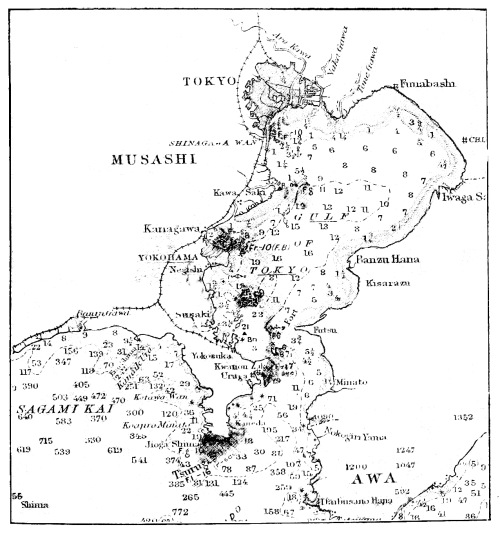
Yokosuka.
Yokosuka is the oldest Imperial dockyard in Japan, and was a going concern in the sixties. It is at present expanding considerably as a building yard. There are large engine shops for machinery construction. There are three dry docks opening into the outer basin, their dimensions being—
No. 1 (stone).
Feet.
Length 392
Width 82
Depth 22½
No. 2 (stone).
Length 502⅓
Width 94½
Depth 28⅓
No. 3 (stone).
Length 308
Width 45¼
Depth 17¼
No. 2 is able to take any ship in the Japanese Navy; but the others are not available for any of the large battleships or armoured cruisers.
There are two slips. On these, amongst others, the following ships have been built: Hashidate, Akitsushima, Suma, Akashi, Takao, and Yaeyama.
The dockyard lies at the foot of a picturesquely wooded hill, in the Bay of Tokio, and is well defended by sea forts. To the landward the defence is, however, poor, and Yokosuka could be taken by an army that could secure a foothold on the southern coast, supposing it able to defeat the defenders.
Tokio.
At Tokio, roughly twenty-five miles from Yokosuka, there is a small dry dock belonging to the Japanese Government. It is, however, only suitable for gunboats and destroyers.
Dimensions—
Feet.
Length 300
Width 52
High-water depth at springs 14⅔
There is also a private dock here, belonging to the Tokio Shipbuilding Company.
Dimensions—
Feet.
Length 220
Width 42
High-water depth 14
The water front of Tokio is very shallow.
Kuré.
Kuré, in the province of Aki, is the coming dockyard of Japan. Situated on the Inland Sea, it is almost impossible of access by an enemy, while it is far nearer any possible base of operations than Yokosuka. Two large dry docks have been built here, but the larger is not yet complete.
Dimensions—
No. 1.
Feet.
Length 464
Width 69
High-water depth 29
This dock is able to take the Asama class, but not the battleships.
No. 2 (building).
Feet.
Length 525
Width 125
High-water depth on sill 33½
This dock is building for the new 16,400-ton battleships, and its dimensions indicate that still larger vessels are expected in the future. It will be the largest dry dock in the world.
Sassebo.
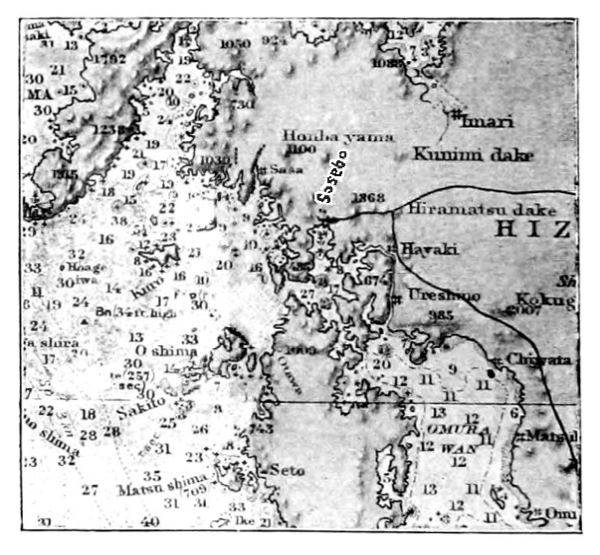
Sassebo, in Hizen, near Nagasaki, is not of much account as a dockyard. It has neither dry docks nor slips, and is essentially a place for minor repairs. For these it is very fully equipped.
It was found most useful in the Chino-Japanese War, and its utility continued in the war with Russia.
The dockyard lies well inside a deep, sheltered bay. The navigation around it would be very difficult to a hostile fleet, as many shoals exist.
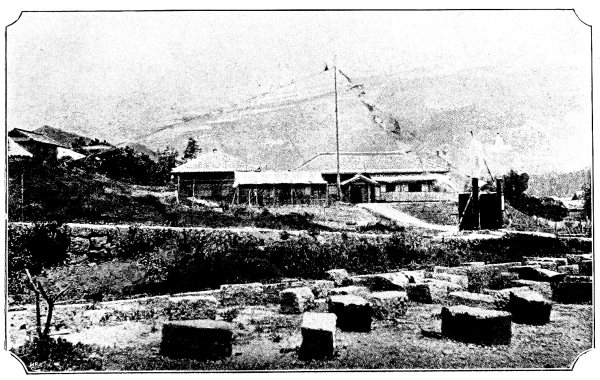
NAVAL CLUB, SASSEBO.
Maitzuru.
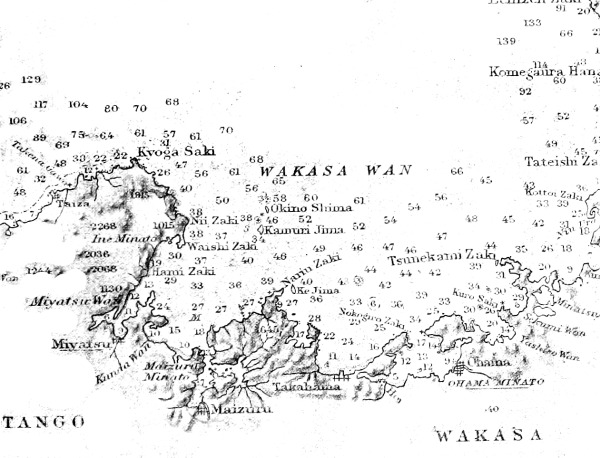
Maitzuru, in the province of Tango, lies at the end of an inlet which has a uniform depth of seven fathoms at low water. The position is not very unlike that of Kiel, in Germany.
A dockyard is building here, but its resources are nil as yet.