IV THE IMPERIAL NAVY
Reading edition
With the sea fight off Hakodate the civil war ended. The feudal fleets were abolished, and all ships were enrolled in an Imperial Navy—a proceeding that, of course, increased its strength. Some reorganisation of personnel was also effected, bringing the Navy more into line with the Western model.
Naval advisers came and went. They included, during the period 1865-1885, the present British admirals Tracy and Hopkins, the eminent French naval architect M. Bertin, and finally Captain Ingles, R.N., of whom more will be found in the Appendix.
The same year in which the Adsuma was launched the Riu Jo[5] was set afloat at Aberdeen. She, too, was possibly originally destined to fly the Confederate flag, but about this details are hard to procure. Particulars are:—
Displacement 2530 tons.
Material Composite.
Length 213 ft.
Beam 41 ft.
Draught (extreme) 19 ft.
Armament One 6½-in. Krupp. Six 70-pdrs.
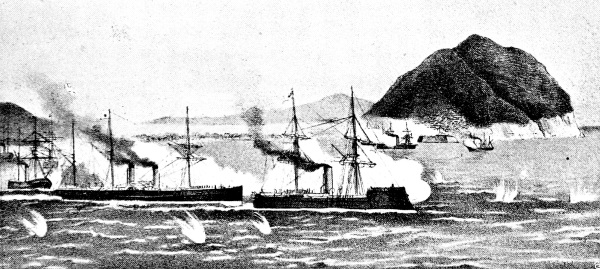
Fleet of Nahamoto, Adsuma leading.
[By a Japanese artist.
BATTLE OF HAKODATE.
The horse-power was 975 nominal, the speed 9 knots. She was single-screwed, and carried 350 tons of coal. Like all the early sea-going ironclads, she had a 4½-in. iron armour belt, and 4 inches over the amidship battery. The heaviest gun was carried in the bow on a pivot. The ship still exists as a hulk. She did not reach Japan till the Civil War was over.
The he-sho, launched in England in 1867, is also retained as a gunnery tender at the present day. She is a small gunboat of 320 tons, carrying one 7-in. Armstrong M.L. and one 5½-in. Krupp B.L.
Some other early Japanese ships may now be referred to.
The Nisshin was built at Amsterdam, and ordered, probably, previously to the Civil War.
Tonnage 1470.
Material of hull Wood.
Armament One 7-in. M.L.
Six smaller M.L.
Speed on trial 11 knots.
Single screw, swan-bow, barque-rigged corvette.
The Amagi of the same period was built in Japan. Particulars of her are:—
Tonnage 526.
Material of hull Wood.
Armament One 6-in. 2½-ton Krupp.
Four 4¾-in. Krupp.
Horse-power (nominal) 720.
Speed 11 knots.
Screws One.
In appearance she more or less resembles the foregoing.
She was followed by the Seiki, also built in Japan, and famous in her way, because she was the first Japanese ship to make a voyage to England. Particulars:—
Tonnage 857.
Material of hull Wood.
Length 200 ft.
Beam 30 ft.
Draught 13 ft.
Armament One 6-in. 2½-ton Krupp.
Four 4¾-in. Krupp.
Horse-power 1270.
Speed 11 knots.
Save that her stern was sharper, she was, to look at, much like the Amagi. She is now removed from the Japanese Navy list.
A sailing training brig of 153 tons, the Ishikawa, and a larger brig, the Tateyama, of 543 tons, were built or acquired prior to 1877.
The Banjo was built by the Japanese on the same model as the Amagi. Particulars are:—
Displacement 667 tons.
Material of hull Wood.
Length 154 ft.
Beam 25 ft.
Draught (mean) 12 ft.
Armament One 6-in. 2½-ton Krupp.
Two 4¾-in. Krupp.
I.H.P. 590.
Speed 10.5 knots.
Screws One.
Coal supply 107 tons.
She is swan-bow, barque-rigged, and has one funnel.
This ended this particular period of Japanese shipbuilding.
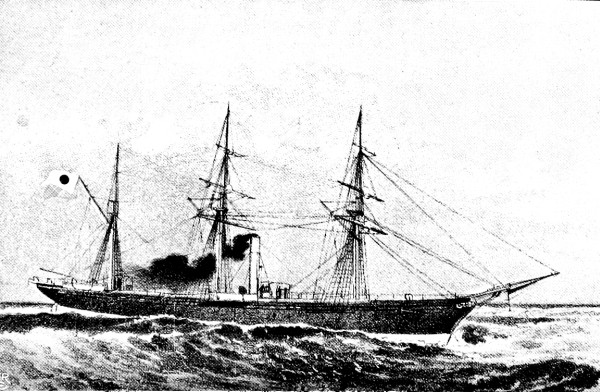
[By a Japanese artist.
THE SEIKI.
(The first Japanese warship to visit England.)
In the year 1875, or thereabouts, the Japanese finally decided to embark upon a war navy, and laid the foundations of that fleet which some twenty years later was to vindicate its existence at Yalu and Wei-hei-wei. In that year a then modern ironclad, up-to-date ironclad, and two armoured cruisers, on what was then the best accepted model, were ordered.
Of these the Fu-So,[6] designed by Sir E. J. Reed, and launched at Samuda’s Yard, Poplar, England, in 1877, was then a powerful second-class battleship. In design she resembles the French Rédoutable, though of only half her size. Particulars are:—
Material of hull Iron.
Displacement 3718.
Length 220 ft.
Beam 48 ft.
Draught 18⅓ ft.
Original armament Four 9.4-in. Krupps in the main deck,
central-armoured battery.
Two 6.6-in. Krupps in unarmoured
barbettes above the armoured battery.
Horse-power 3500.
Nominal speed 13 knots.
Screws Two.
Coal 360 tons.
Nominal radius 3500 miles at 10 knots.
The armour is distributed in a complete belt of iron from 9 to 4 ins. in thickness. The battery armour is 8 ins., with 7-in. bulkheads forming a redoubt. The engines, by Penn, are horizontal compound trunk. She was then barque-rigged, with a single funnel. She carried no torpedo tubes, but these were added later. Just previous to the war with China the Japanese reconstructed and re-armed her, removing the mainmast, and fitting military tops to the fore and mizzen; 6-in. Q.F. were mounted in the barbettes in place of the old 6.6-in. Either immediately before or directly after the war, two additional 6-in. Q.F. (as shown in the photograph of her at sea) were mounted, one on the forecastle and one on the poop behind shields; and subsequently four further 6-in. Q.F. replaced the old guns in the battery, these having been found well-nigh useless for modern warfare. This by no means exhausts the history of the Fu-So, but her subsequent adventures will be found on a later page.[7]
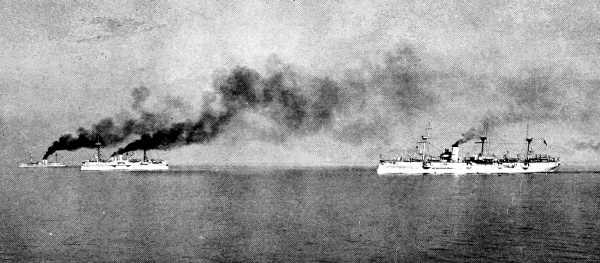
[Official photograph.
Chin Yen. Chiyoda.
THE JAPANESE FLEET IN LINE ABREAST. NAVAL MANŒUVRES.
Russia with the General Admiral would appear to have inspired the idea of the Hi-Yei[8] and Kon-go. The former of these was launched early in 1878 at Milford Haven, the latter at Hull towards the end of 1877. The ships are sisters. Details are:—
Material of hull Composite.
Displacement 2250 tons.
Length 231 ft.
Beam 40¾ ft.
Draught 17½ ft.
Armament Three 6.6-in. Krupp.
Six 6-in. 2½-ton Krupp.
Four Nordenfelts.
Two torpedo tubes.
Horse-power Hi-Yei, 2270.
Kon-go, 2035.
Screws One.
Speed (nominal) Hi-Yei, 13 knots.
Kon-go, 13.7 knots.
Engines (by Earle) Horizontal compound.
The armour is a mere iron strip on the water-line, varying from 4½ to 3 ins. in thickness.
In 1876 a new Imperial yacht, the Jin-Jei, was launched. She is a paddler, with swan-bow, two funnels, and two high pole masts—a pretty-looking vessel.
Displacement 1464 tons.
Material of hull Wood.
Length 249 ft.
Beam 32 ft.
Draught 14½ ft.
Armament Two 4¾-in. Krupp.
Horse-power 1430.
Speed 12 knots.
In 1879 began what later events constituted the supplementary Japanese shipbuilding programme. In 1879 Elswick built for China those once famous “alphabetical gunboats,” a series of “flat-irons” of the Rendel type, to carry one gun. Like a good many other Chinese vessels, they were destined to fly the Japanese flag at a later period of their existence. Altogether there were eleven of these craft, named after letters of the Greek alphabet, but re-named by the Chinese. They were named Lung-shang (Alpha), he-wei (Beta), Fei-ting (Gamma), Tche-tien (Delta), the first two of 340 tons, the other two of 420 tons, and which the Chinese still own. The remainder are a little larger, four, Cheng-tung (Epsilon), Chen-Sei (Zeta), Chen-nan (Eta), Chen-pei (Theta), of 490 tons, and Chin-pen (Kappa), Hai-chang-ching (Lambda), and Chen-chung (Iota) of 500 tons. Japan now owns all of this last batch, except the Hai-chang-ching.
Gamma and Delta carry a 38-ton Armstrong M.L.; all the others are armed with the 11-in. 25-ton gun. Horse-power varies from 235 in the smaller craft to 472 in the larger. There are slight differences in dimensions, but the largest only runs to 125 ft. long by 29 ft. broad. Two other rather smaller gunboats once existed, but these the French sunk at Foochow in the early eighties. The development of small guns has long since rendered this type of gunboat useless; but, apart from that, the bad care taken of them by the Chinese would have made them of no service.
China in 1881 was making some considerable efforts towards being a naval power, efforts that continued till 1889, when they suddenly died out, or resolved themselves into the building of small craft by Chinamen. A Chino-Japanese war was a possibility in 1881 as much as in 1890. Neither side was, however, ready for the conflict, and in the early eighties Japan’s energies were concentrated on training personnel, China’s on acquiring materiel. In 1881 the latter had launched for her the big ironclad Ting Yuen at Stettin, followed a little later by the Chin Yuen, now in the Japanese service. From the time China first had them, Japan coveted these ironclads; by the irony of fate, she did not secure them (or rather the one that was left) till far superior ships of her own were on the stocks.
The Tung Yuen sank at Wei-hai-wei during the war; the Chen Yuen, her sister, was taken at the same time. Her details are:—
Displacement 7350 tons.
Material of hull Steel.
Length 308 ft.
Beam 59 ft.
Draught 23 ft.
Armament (originally) Four 12-in. 20 cals. Krupp.
Two 6-in. Krupp.
Eight machine guns.
One torpedo tube in the stern;
one on each beam forward of barbettes.
Horse-power 6200.
Screws Two.
Speed (on first trials) 14.5 knots.
Engines Two sets, three-cylinder horizontal compound.
Coal 1000 tons.
The arrangement of the heavy armament is upon the system that in 1880 was held to be the system of the future—four big guns able to fire end-on or on the broadside. The ideal warship of those days was to fight in line abreast. The advantages of that disposition were seen, while its disadvantages were ignored. It was not realised how easily an enemy could get round upon either flank and mask the fire of nearly all the units in this cumbersome formation, the advantages of which lie only in going into action against an enemy right ahead.
When the Chin Yen was the Chinese Chen Yuen she carried thin shields over her big guns. The 6-in. pieces were in the extreme bow and stern, each in a 3-in. turret. The big gun shields were removed before the war. The Japanese captured these with Port Arthur, and have since replaced them. They have also mounted a 6-in. Q.F. in the bow turret, substituted a 6-in. Q.F. behind a shield for the after turret, and mounted two additional Q.F.’s upon sponsons specially built near the mainmast. Two 6-pounder Q.F. and a number of 3- or 2½-pounders have also been added on the upper deck. The photograph shows the ship as she now is.
The armour of the Chin Yen is distributed as follows: Amidships for 150 ft. is a 14-in. compound belt. Under-water and at the end of it this belt thins to 10 ins. Forward and aft of it is a protective deck 3 ins. thick. The ends of the belt are joined by flat bulkheads of 14 ins. Rising from this redoubt are the barbettes, 12 ins. compound. The starboard one is forward, the port somewhat aft of it.[9] The big gun hoods are quite thin, 4 ins. or less; between the big guns in the conning-tower, 8 ins. in thickness.
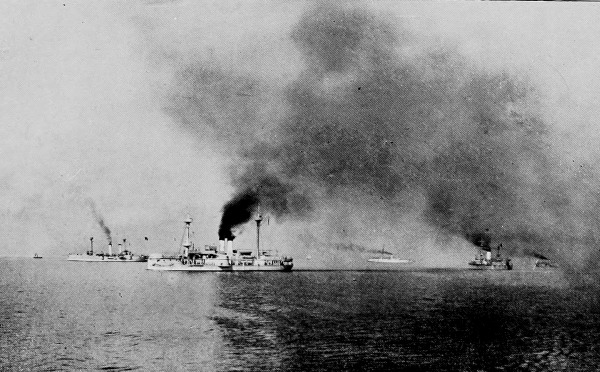
[Official photo.
THE CHIN YEN AT EVOLUTIONS WITH THE JAPANESE FLEET. 1902.
The ship, it will be seen, is of the British Ajax or Colossus type—very much a “soft ender.” She is, however, given a good deal of protection in the way of specially arranged watertight compartments, and there is also a species of cofferdam.
In 1881 Elswick set afloat the Arturo Prat, a small cruiser originally intended for Chili, but subsequently purchased by Japan and re-named Tsukushi. China had two sisters built at the same time, the Tchao Yong and Yang-wei, both of which were sunk at Yalu. Particulars of the Tsukushi are as follows:—
Displacement 1350 tons.
Material of hull Steel.
Length 210 ft.
Beam 32 ft.
Draught (maximum) 16½ ft.
Armament Two 10-in. 32 cals. Elswick.
Four 4.7 in. Q.F.[10]
Four 1-pdr. Q.F.
Two torpedo tubes.
Horse-power 2887.
Screws Two.
Speed on trial 16.4 knots.
Sea speed (circa) 12 knots.
Coal 250 tons.
Engines (by Hawthorn Leslie) Horizontal compound.
The ship has no armour deck, or protection of any sort.
In 1882 the construction of wooden ships was still proceeding in Japan. In that year they launched at Yokosuka the Kaimon, of which the measurements are:—
Displacement 1367 tons.
Material of hull Wood.
Length 211 ft.
Beam 32 ft.
Draught (mean) 16½ ft.
Armament Eight 4¾-in. Krupp.
Two 3-pdr. Q.F.
Horse-power 1125.
Trial speed 12 knots.
Screws One.
Coal 180 tons.
Complement 230.
The engines were constructed in Japan at the Yokosuka Dockyard, and are of the horizontal compound type. This was the first ship put together by them of which they constructed the engines also.
The following year they launched the Tenriu at Yokosuka. Details are:—
Displacement 1547 tons.
Material of hull. Wood.
Length 212 ft.
Beam 32½ ft.
Draught (mean) 16½ ft.
Armament Eight 4¾-in. Krupp.
Two Nordenfelts.
Horse-power 1165.
Trial speed 12 knots.
Screws One.
Coal 256 tons.
Complement 214.
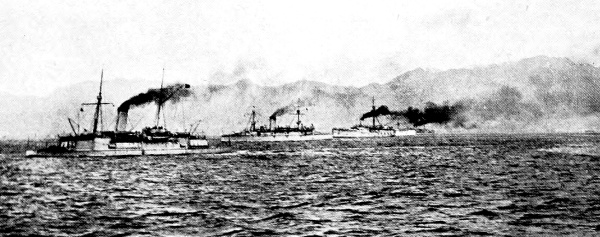
Tsukushi.Naniwa.Itsukushima.
[Official photo.
JAPANESE CRUISER TSUKUSHI AT SEA.
The ship is practically a sister to the Kaimon. The engines of both were made at Yokosuka, and are of the same type. Both ships have swan bows, one funnel, and are barque-rigged. The sterns are rather square.
In 1884 Elswick suddenly sprang the deck-protected cruiser on the world. In that year was launched the famous Esmeralda. She was, like the Arturo Prat, built for Chili, and as a Chilian cruiser bore a share in the Chilian revolution. When the Chino-Japanese war broke out Japan made overtures for this ship, and in 1895 purchased her through the agency of Ecuador. The war was over before the cruiser could be employed, but she was probably purchased against possible eventualities with Russia, France, and Germany. Being now obsolete, she has not proved a valuable acquisition, and the Japanese speak of her as a very bad sea boat. Particulars of this once famous vessel are:—
Displacement 3000 tons.
Material of hull Steel.
Length 270 ft.
Beam 42 ft.
Draught (maximum) 19½ ft.
Armament (originally) Two 10-in. 32 cals.
Six 6-in. 32 cals.
Two 6-pdr. Q.F.
Five 1-pdr. Q.F.
Two Gardners.
Three torpedo tubes, one of them
in the bow.
The six 6-in. B.L. have been removed by the Japanese, and six 4.7-in. Q.F. of 40 calibres substituted.
When new the Esmeralda was one of the swiftest ships afloat. Her I.H.P. natural draught was 6500, with an 18.5-knot speed on her trials in 1885. She carries 400 tons of coal, with provision for 200 tons more.
Protection is afforded by a steel deck 1 in. thick on the slopes and ½ in. on the flat. Over the loading stations of the big guns a 1-in. steel skin is carried.
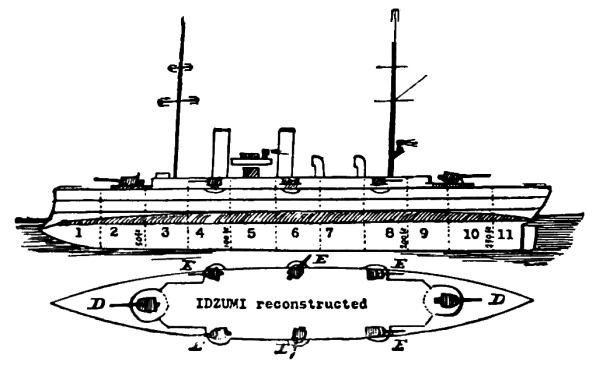
ESMERALDA, NOW IDZUMI.
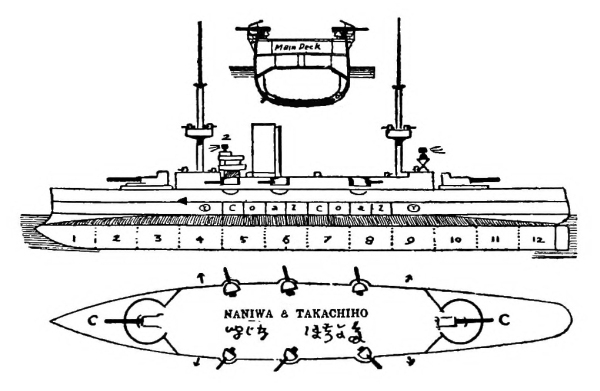
News of the Esmeralda’s fame soon reached Japan, and two glorified editions of her, the Naniwa and Takachiho, were promptly ordered. Japanese home construction was not, however, affected, and three composite vessels, Yamato, Katsuragi, and Mushashi, were put in hand, and launched in 1885-86. Details of these are as follows:—
Displacement 1502 tons.
Material of hull Composite.
Length 207 ft.
Beam 36 ft.
Draught (mean) 15 ft.
Armament Two 6.6-in. Krupp.
Six 4¾-in. Krupp.
Four Nordenfelts.
Two torpedo tubes.
Horse-power 1600.
Trial speed 13.5 knots.
Complement 231.
As before, Yokosuka made the horizontal compound engines, and in the Katsuragi twin screws were attempted for the first time. These ships are now employed for training squadron duties. They have clipper bows, and are, generally speaking, small editions of the British Raleigh. They are all three barque-rigged. The Mushashi is distinguished by a red band, the Katsuragi a yellow one.
The “warship Naniwa-kan,” as she used to be called in England, in defiance to all explanations to the effect that the affix “kan” simply meant “warship,” attained a good deal of celebrity while under construction. The British Navy had then no ships like her, and the Mersey class, then building, though more heavily gunned on about the same displacement, were popularly considered very poor substitutes, since their biggest guns were 8-in. pieces only, against the Naniwa’s 10-in. The big gun had at that time a very great hold on popular imagination.
Details of the Naniwa, and her sister, the Takachiho, are as follows:—
Displacement 3700 tons.
Material of hull Steel.
Length 300 ft.
Beam 46 ft.
Draught 20 ft.
Armament Two 10-in. 32 cals. Krupp.
Six 6-in. B.L. Krupp.
Two 6-pdr. Q.F.
Fourteen smaller Q.F. and machine.
Four torpedo tubes.
(Elswick 6-in. Q.F. have lately been substituted for the old 6-in. B.L.).
The big guns are generally described as Elswick pieces, but they are not, although Elswick built the ships.
Engines (Hawthorn, Leslie & Co.) Horizontal compound.
Horse-power 7120.
Speed on trial 18.7 knots
Sea speed (circa) 15 knots.
Screws Two.
Coal (normal) 350 tons.
” (maximum) 800 tons.
Radius with full bunkers (circa) 5000 miles.
Complement 357.
Search-lights Four.
Protection is afforded by a steel deck 3 ins. on the slopes, 2 ins. on the flat. The engine hatches have a 3-in. glacis. The conning-tower is 1½-in. steel, and the loading stations of the big guns have a similar protection.
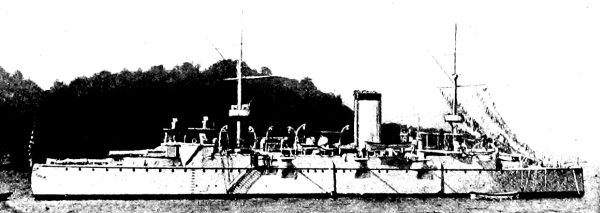
THE NANIWA (present rig).
(This is the cruiser that sunk the Kow-shing.)
Note.—The sinking of the Kow-shing will be found described in the chapter on the Chino-Japanese war. Special interest attaches to the Naniwa on account of the fact that during this war she was commanded by the present Admiral Togo.
As originally rigged, the Naniwa and Takachiho carried a top on each mast. After the war, in which they did not exhibit the best of sea-keeping qualities, these tops were lowered, and light platforms erected where they used to be, as in the illustration. The old rig, which is tolerably familiar, will be noticed in the illustrations dealing with the war. The Naniwa and Takachiho both took part in the first engagement at Asan; the Naniwa subsequently made her name familiar to the world over the Kow-shing affair. Both ships participated at Yalu and Wei-hai-wei. The Naniwa was launched on March 18, 1885, at Elswick, the Takachiho on May 16th in the same year. In appearance the two craft are almost absolutely identical; for convenience, and to enable their own officers to distinguish them, the Takachiho has a red band round her instead of the orthodox black one. As a further guide, she carries a couple of signal yards on the main, in place of the single yard carried there by the Naniwa.
Meanwhile China continued to have ships built in England and Germany, and in 1886 there was launched at Stettin a small cruiser, the Tche-Yuen (Tsi-Yuen is a more familiar spelling), which was destined to be taken over by the Japanese at Wei-hai-wei in 1895. Her details are:—
Displacement 2300 tons.
Material of hull Steel.
Length 246 ft.
Beam 33 ft.
Draught (maximum) 18 ft.
Armament Two 8.2-in. Krupp, forward in an armoured turret.
One 6-in. Krupp aft.
Four 4-pdr. Gruson Q.F.
Two Gatlings.
Four torpedo tubes.
Horse-power 2800.
Speed on trial 15 knots.
Screws Two.
Coal (normal) 230 tons.
Radius (circa)1000 miles.
Complement 180.
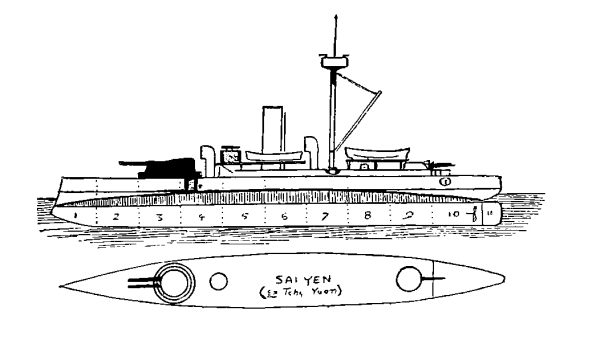
This ship represents an application of the Italian Lepanto idea to a small cruiser. She is provided with a steel protective deck, 3 ins. thick on the slopes; the hull is otherwise unprotected, but the fore turret, containing the 8-in. guns, is heavily armoured with 10-in. compound, thus rendering it proof against any of the 10-in. guns afloat in the Japanese Fleet at the time she was built. Indeed, at Yalu there were only three guns present in the Japanese Fleet against which the Tche-Yuen’s turret armour was not proof. However, the possession of a little impenetrable armour is of small service to a warship—the odds being always against any one particular spot being hit. At Asan, in which the Tche-Yuen suffered rather severely, none of the Japanese guns against her were able to pierce this forward turret.
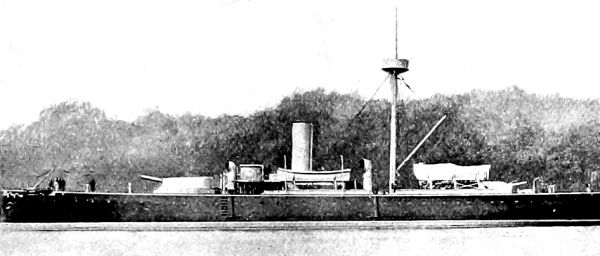
SAI YEN (ex TCHE-YUEN).
In 1879 Japan had already had four torpedo boats built for her at Yarrow’s. These craft displaced only 40 tons. In 1886, however, Yarrow’s built the first-class twin-screw torpedo boat Kotaka. This boat is remarkable as the first armoured torpedo boat ever constructed. She has 1-in. steel plating all over her machinery compartment, and the subdivision of the hull is, for a torpedo boat, singularly complete. In her way the Kotaka was the forerunner of the destroyers, being larger than the run of torpedo boats even now. Full details of her are:—
Displacement 190 tons.
Material of hull Steel.
Length 170 ft.
Beam 19½ ft.
Draught 5 feet.
Horse-power 1400.
Speed on trial 19 knots.
Screws Two.
Coal carried 50 tons.
Torpedo tubes Six.
Armament Four machine guns.
The torpedo tubes are thus disposed: two forward, firing right ahead, a pair amidships, and another pair a little abaft of them. The Kotaka made a name for herself in the war, and previously to that was a successful craft. However, for some reason Japan had no more boats from Yarrow, or, indeed, from England, for the next ten years, the next, a batch of fourteen, being ordered from Creusot. These were launched in 1889. The Kotaka, after being built, was sent out to Japan in sections, and there put together again. The Creusot boats were sent out in similar fashion, while a further seven were put together entirely at Kobé, in Japan. All these boats were small ones of 56 tons, 114½ ft. long, 10½ ft. beam, and 6 ft. draught. With 525 I.H.P., they made 20 knots on trial. They have two torpedo tubes, carry two 1-pounder Q.F., a complement of 16 men, and are single screw. One of them was lost off the Pescadores in December, 1895, and a couple at Wei-hai-wei in February of the same year.
Japan still continued the construction of other craft, having launched the Maya[11] at Onohama in 1886, the Akagi[12] at the same yard in 1887, the Atago[13] at Yokosuka in 1887, and the Chiokai[14] at Tokio in the same year. The Maya and Chiokai were, as before, composite, but the other two are noteworthy as being constructed entirely of steel. A large proportion of the material for them was imported, and the building was rather a case of merely putting together.
The dimensions, etc., of all are identical, and are as follows:—
Displacement 622 tons.
Length 154¼ ft.
Beam 27 ft.
Draught (mean) 9¼ ft.
Horse-power 700.
Trial speed (circa) 12 knots.
Screws Two.
Coal supply 60 tons.
Complement 104.
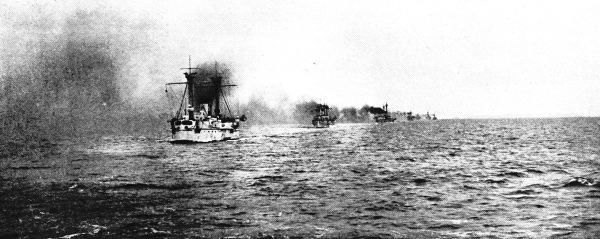
[Official photo.
JAPANESE FLEET AT SEA. FUSO LEADING.
In appearance and armament they vary much. The Maya carries a couple of 6-in. Krupp’s, with two 3-pounder Q.F. and a couple of machine guns; the Chiokai and Atago are armed with one 8-in. Krupp and one 4.7-in. gun and two machine guns; the Akagi carries two special French guns of about 4.7-in. calibre. These guns are the only ones of the kind in the world, and singularly powerful pieces—Hebrieu guns. The objection to them is that their lives are short. They proved too powerful for the little Akagi, and shook her up badly on trial. They were afterwards fired with reduced charges, except at Yalu, where they proved very useful, owing to their power.
The Akagi has a raised forecastle, the other three have not. All used to be schooner-rigged, but just before the war a fighting-top was fitted to the Akagi’s foremast, and a crow’s-nest to her main. To distinguish them, the Maya has a black band, the Chiokai a red one, the Atago yellow. The Akagi’s band is black, but her forecastle and fighting-top distinguish her. In addition, she has a rather elaborate green scrollwork on the bow. She has also sponsons for her machine guns. At Yalu this ship lost her mainmast, and the damage was left unrepaired for a long time in deference to naval sentiment; it has, however, been replaced lately.
Reference has already been made to the transfer of torpedo-boat building from British to French firms. M. Bertin was at that time naval adviser to the Japanese Government, consequently French design for large ships secured a similar victory in the year 1887-8. With such ships as she now had, Japan was beginning to be able to stand alone, many English instructors were dispensed with; but she was yet some distance from her present independence. French enterprise saw its chance and took it; all the foreign-built ships of the new programme came from France.
These were the Itsukushima, Matsushima, and Hashidate (this last put together in Japan), the Unebi, Tschishima, and some smaller ships (laid down in Japanese yards), Yayeyama, Oshima, and Takao.
The ships built in Japan during the Bertin régime, 1887 to 1890, are distinctly French in design and appearance. The first to take the water was the Takao, launched at Yokosuka in 1888. Particulars are:—
Displacement 1778 tons.
Material of hull Steel.
Length 229 ft.
Beam 34 ft.
Draught 14 ft.
Armament Four 6-in.
One 4.7-in. Q.F.
Two torpedo tubes.
Horse-power 2300.
Speed on trial 15 knots.
Sea speed (circa) 12 knots.
Screws Two.
Coal supply 300 tons.
Boilers Two cylindrical.
Engines (made at Yokosuka) Two sets horizontal compound.
Complement 220.
She is fitted with military and searchlight tops on both masts. The four 6-in. guns are in sponsons in the waist, the 4.7-in. is carried right aft. There is no protection of any sort to the machinery. She was the first steel ship built in Japan.
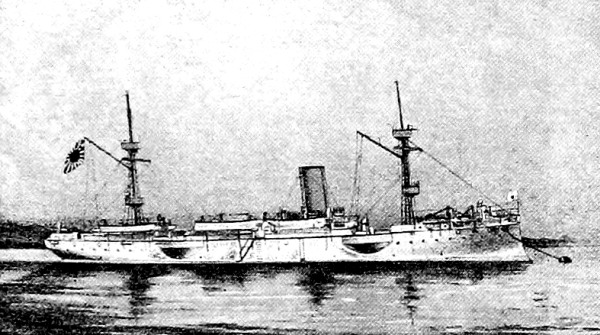
TAKAO.
About 1887 Japan definitely decided to draw all her Q.F. guns, 6-in. or 4.7-in., from Elswick, and all heavy guns from Canet. Krupp’s pieces were discarded. This resolution was adhered to till 1902-03, so far as Elswick was concerned, but Canet guns were given up some years ago. Elswick guns were, in 1890, shipped to France for the Itsukushima and her sister. At present (1904) new guns are on the Vickers model.
Following the Takao, Yokosuka launched the despatch vessel Yayeyama in 1899. She was designed by M. Bertin. Her dimensions, etc., are:—
Displacement 1605 tons.
Material of hull Steel.
Length 315 ft.
Beam 34½ ft.
Draught 15 ft.
Armament Three 4.7-in. Q.F.
Six machine guns.
Two torpedo tubes.
Horse-power (forced draught) 5630.
Speed on trial 20.7 knots.
Screws Two.
The engines were provided by Messrs. Hawthorn, Leslie & Co. of England, and, instead of the horizontal compound previously fitted in Japanese-built ships, are horizontal, direct-acting, triple expansion. The boilers are of steel; there are six of these—cylindrical.
Over the engines and boilers a ½-in. steel deck is carried, affording, in conjunction with the bunkers, some slight protection.
The Onohama Yard laid down a vessel in this year, the Oshima. She was launched in 1890. Particulars:—
Displacement 640 tons.
Material of hull Steel.
Length 233 ft.
Beam 25½ ft.
Draught 15¾ ft.
Armament Four 4.7-in. Q.F.
Eight 3-pdr. Q.F.
Horse-power (forced draught) 1200.
Speed on trial 16 knots.
Screws One.
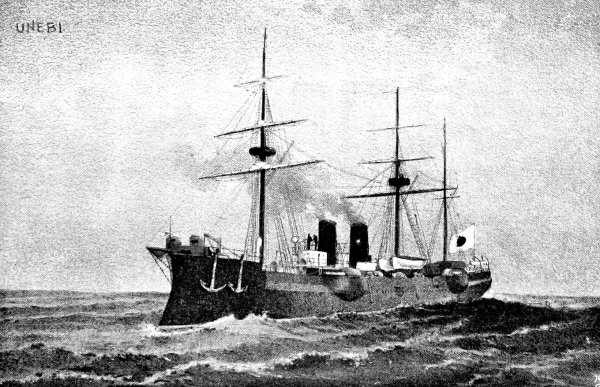
[From a Japanese print.
THE UNEBI (NOW LOST).
There is no protection to the machinery. The engines were built at Yokosuka.
Meanwhile, shipbuilding abroad had been proceeding apace, but disaster attended both the earlier vessels. The first, the Unebi, a cruiser of 3650 tons, with four 6-in. Q.F. as her principal armament, mysteriously disappeared while on her way out to Japan[15] and still in the contractors’ hands. Her loss was officially attributed to instability, and seems to have inspired the Japanese authorities with a profound distrust for French shipbuilding; at any rate, the Chiyoda, a vessel generally resembling the lost Unebi, was given to Thomson Yard at Clydebank for construction. She will be described in due course later on.
The second French-built ship, upon the same general plan as the French Milan and Japanese Yayeyama, was the Tschishima, of 750 tons displacement. In appearance she was nearly identical to the French Milan. She met with disaster in the Inland Sea almost immediately after the Japanese took her over (1892), and all her crew were drowned. The Tatsuta was ordered from Elswick to replace her.
The Itsukushima, the first of the “Bertin cruisers,” so-called after their designer, was launched at La Seyne in 1889. Captain Ingles, R.N., naval adviser to the Japanese, had strongly persuaded them against ironclads; they had been advised against the big gun also. However, they were bent on mounting a gun able to pierce any armour in the Chinese Navy or in foreign warships likely to come to the Far East. By the irony of fate, these big guns contributed nothing to the victory of the Yalu; however, the decision of the Japanese to have them cannot be condemned, in view of the fact that naval construction everywhere in ’88 was based upon the big gun. Having a full idea of their requirements, the Japanese settled upon the Italian Lepanto as embodying the most useful type of ship for them, and the Itsukushimas were ordered on that principle.
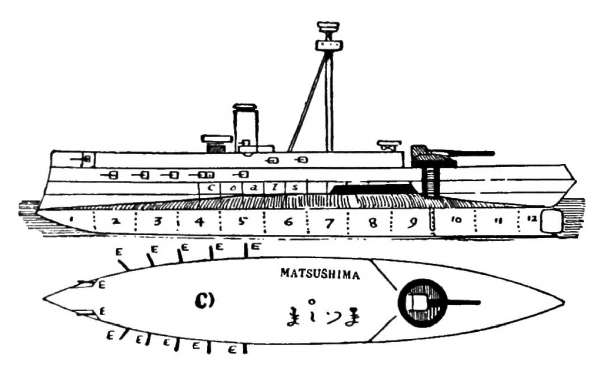
Particulars of the Itsukushima are as follows:—
Displacement 4278 tons.
Material of hull Steel.
Length 295 ft.
Beam 50½ ft.
Draught (maximum) 21¼ ft.
Armament One 12.8-in. Canet.
Eleven 4.7-in. Q.F. Elswick of 32 cals.
Five 6-pdr. Q.F.
Eleven 3-pdr. Q.F.
Six machine guns.
Six torpedo tubes
(bow, stern, and four on the broadsides).
Horse-power (natural draught) 3400.
Trial speed (natural draught) 15.7 knots.
Horse-power (forced draught) 5400.
Trial speed (forced draught) 16.5 knots.
Screws Two.
Engines Triple expansion.
Boilers Six cylindrical.[16]
Furnaces 18.
Coal supply 400 tons.
Complement 360.
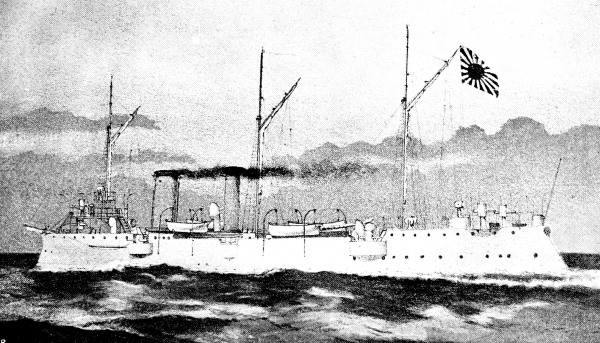
TORPEDO GUNBOAT TSCHICHIMA—
LOST BY CAPSIZING IN THE INLAND SEA.
For protection there is a steel deck 1½ ins. thick on the slopes. With this is associated a cellulose belt and coal protection. The total protection, so far as penetration is concerned, is not, however, more than equivalent to what a 6-in. belt of old iron armour would afford, and it would keep out nothing above a 4.7-in. shot, and that only at long ranges. Over the engine hatches is a patch of thick steel armour.
The heavy gun barbette is a strip of 12-in. Creusot steel, with a 4-in. steel shield over the breech of the gun. There is an armoured hoist that affords some support, but, speaking generally, the gun is more or less at the mercy of shell bursting underneath it.
The Hashidate was built from the same designs at Yokosuka, and is practically identical with the Itsukushima, save that the battery guns aft are in small unarmoured sponsons, and obtain thereby a slightly greater angle of fire. She is further distinguished by a red band; the Itsukushima, being the first of the class, has, of course, a black band.
Grave doubts were soon entertained as to the seaworthiness of these two ships, and the Matsushima being a little more behindhand than the others, her design was altered. She carries the big gun aft, which makes her a better sea boat. The battery is shifted forward in the main deck. In place of the single 4.7-in. that her companions carry in the stern, the raised fok’s’le of the Matsushima contains two of these pieces, firing through recessed port.
Her small quickfiring armament is also different, there being sixteen 3-pounders.
All three ships have a single tripod mast abaft the funnel, with a couple of tops on it. Each now carries three signal yards.
The Itsukushima was launched on July 11, 1889, and commissioned in Japan in 1891. The Matsushima, launched on January 22, 1890, went out in 1892. The Hashidate was not launched till March 24, 1891, but early in 1893 she was in commission.
It had been hoped that these ships would attain speeds of 17.5 knots; none of them, however, ever reached it.
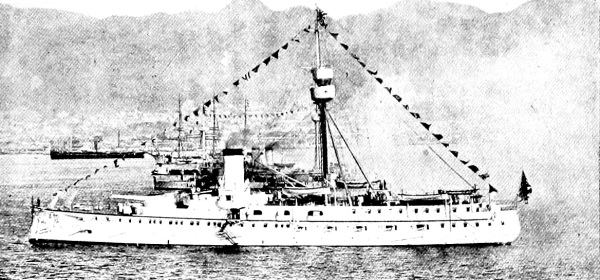
[Official photo.
HASHIDATE.
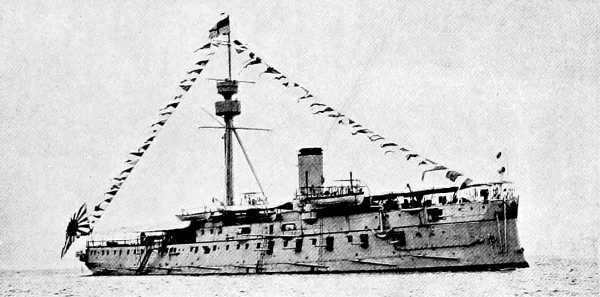
MATSUSHIMA.
Torpedo Boats. 1891.
In 1891 Japan had built for her by Normand at Le Havre a 75-ton torpedo boat, 118 ft. long, two tubes, and a trial speed of 23 knots. She is a twin-screw boat.
Two other boats, 90-tonners, were also launched in Germany at Elbing. Length, 128 ft.; trial speed, 23 knots; one screw; armament, three tubes and three 1-pounder Q.F.
China in 1890 launched a home-built diminutive of the Itsukushima, the Ping Yuen. The Japanese took her at Wei-hai-wei, but she has never been of any use to them, and she now does duty as a gunnery hulk. Particulars of this craft are:—
Displacement 2600 tons.
Material of hull Steel.
Length 200 ft.
Beam 40 ft.
Draught 19 ft.
Armament (originally) One 10.2-in. Krupp, 25 cals.
Two 6-in. Krupp.
Eight 3-pdr. Q.F.
One 1-pdr. Q.F. (in the top).
Four torpedo tubes.
The old 6-in. Krupp are now replaced by a couple of 45-calibre Elswick 6-in. Q.F. for drill purposes. The old 10-in. gun remains, and, being always cocked up in the air at an extreme elevation, is the most noticeable and characteristic feature of this ship, which every Japanese regards as a standing joke. An enormous dragon adorns each broadside. Japanese officers who come to Portsmouth always, by the way, christen our Hero “the British Ping Yen.”
The Ping Yuen was begun as a 16-knot, 2850-ton ship, a copy in fine of the Stettin-built King Yuen. In an early stage of construction, however, her length was much reduced, for economical reasons. She appears to have had much the same machinery as the King Yuen originally. This, however, was tinkered in fitting, and some of her boilers were stolen, or otherwise dispensed with! On trial she made 10.5 knots for a short period, but, after being taken care of by the Chinese, soon sank below that modest speed. It is doubtful whether she made as much as 6 knots at Yalu.
There is a 2-in. steel protective deck in places; amidships and under water there is a small patch of 8-in. compound armour. The barbette is a 5-in. strip of armour; the conning-tower has the same thickness. A thin shield—removed during the war—covers the big gun.
On June 3, 1890, the third-class cruiser Chiyoda, built to replace the lost Unebi, took the water at Clydebank. Particulars of her are as follows:—
Displacement 2450 tons.
Material of hull Steel.
Length 308 ft.
Beam 43 ft.
Draught (maximum) 17 feet.
Armament Ten 4.7-in. Q.F. 40 cals.
Fourteen 3-pdr. Q.F.
Three Gatlings.
Three torpedo tubes
(of which one is fixed in the bow).
Horse-power 5600.
Trial speed 19 knots.
Engines Two sets, triple expansion.
Boilers Belleville.
Complement 350.
Coal supply 420 tons.
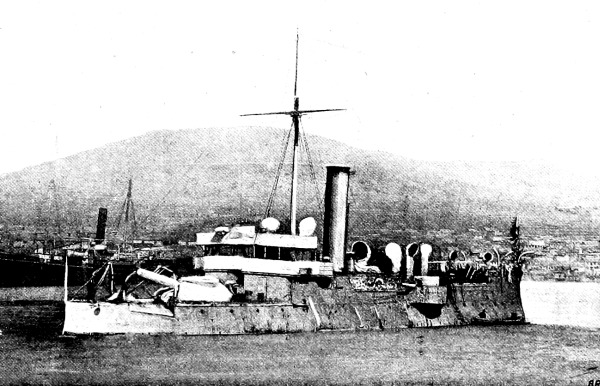
HEI YEN.
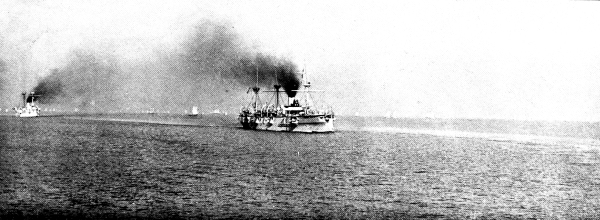
CHIYODA
THE CHIYODA AT SEA WITH THE FLEET. 1903.
She was the first ship in any navy to be fitted with water-tube boilers, which were barely coming into existence in those days. Hers are of the Belleville type.
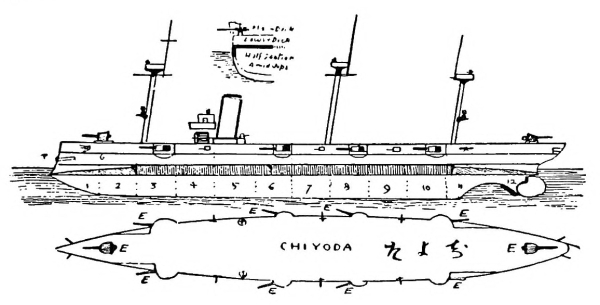
For protection she depends on a 4¼-in. chrome steel armour belt, 200 ft. long, amidships. Forward and aft of this is a protective deck 1½ ins. thick on the slopes. Throughout the entire water-line is a cellulose belt, and she is divided into 84 watertight compartments. The guns have no protection beyond the ordinary shields. They are, however, very well disposed.
In 1898 she was practically re-boilered, the old tubes being replaced by some specially large ones, in order to enable her to burn Japanese coal, which sooted the ordinary tubes.
In 1890 the Akitsushima was laid down at Yokosuka. It was at first supposed that she was a sister to the Matsushima. The Yoshino was contracted for at Elswick towards the end of this year. Both were launched in 1892, and commissioned just before the war with China.
The Akitsushima was the last ship to be built in Japan with imported material. She is practically a small copy of the U.S.S. Baltimore. Details of the two, for comparison, are as follows:—
Akitsushima. Baltimore.
Displacement 3150 tons. 4600 tons.
Material of hull Steel. Steel.
Length 302 ft. 328 ft.
Beam 43 ft. 48½ ft.
Draught 18½ ft. 23 ft.
Armament Four 6-in. Q.F. (D). Four 8-in. 25 cals. (C).
Six 4.7-in. Q.F. (E). Six 6-in. (D.)
Ten 3-pdr. Q.F. Eight small Q.F.
Four torpedo tubes. Five torpedo tubes.
Horse-power
(forced draught) 8400. 10,060.
Speed on trial 19 knots. 20.1 knots.
Engines Vertical triple Horizontal triple
expansion. expansion.
Boilers Cylindrical. Four double-ended Scotch.
Screws Two. Two.
Coal (normal) 500. 400.
” (bunker capacity) 800. 900.
Armour deck on slopes 3-in. (e). 4-in. (d).
Other protection Cellulose belt and cofferdam.
Complement 330. 395.
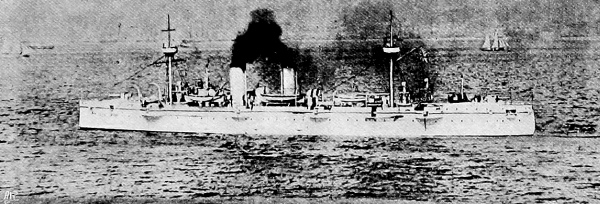
[Photo by favour of Commander Kurri, I.J.N.
AKITSUSHIMA.
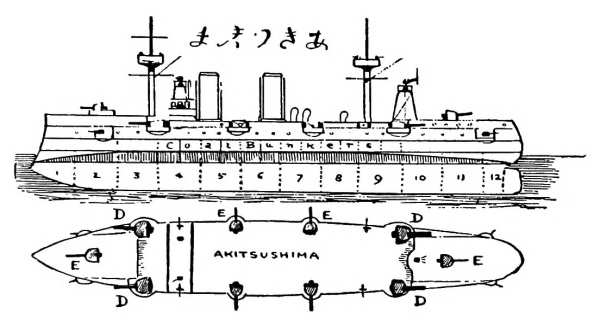
The Akitsushima mounts 6-in. guns in the foremost and aftermost sponsons; four 4.7-in. are carried amidships, the fifth on the forecastle, and the sixth astern. She has thus a broadside fire of two 6-in. and four 4.7-in., against two 8-in. and three 6-in. in the Baltimore. Assuming that ship’s guns to be now replaced by Q.F., the Akitsushima would bring the equivalent of a 6-in. gun less.
The Yoshino, when new, was the swiftest cruiser in the world, and very few ships are equal to her yet. Particulars of her are:—
Displacement 4150 tons.
Material of hull Steel.
Length 350 ft.
Beam 46 ft.
Draught (maximum) 19 ft.
Armament Four 6-in. Q.F.
Eight 4.7-in. Q.F.
Twenty-two 3-pdr. Q.F.
Five torpedo tubes
(one of them fixed in the bow).
Horse-power (forced draught) 15,000.
Trial speed 23.031 knots.
Engines Vertical triple expansion.
(Humphrys, Tennant & Co.)
Boilers Cylindrical.
Screws Two.
Coal (maximum bunker capacity) 1000 tons.
Complement 360.
The normal coal supply, at 4150 tons displacement, is about 400 tons. Bunkers are disposed amidships in the usual fashion above the armour deck. Amidships this deck is 4½ ins. thick on the slopes (= c) and 2 ins. on the flat. Allowing for the additional resistance of the coal, nothing under a 10-in., or modern 9.2 or 9.4-in., could penetrate to the engine-room, and then only with solid shot. The watertight compartments are exceptionally numerous. With natural draught the ship has made 21.6 knots.
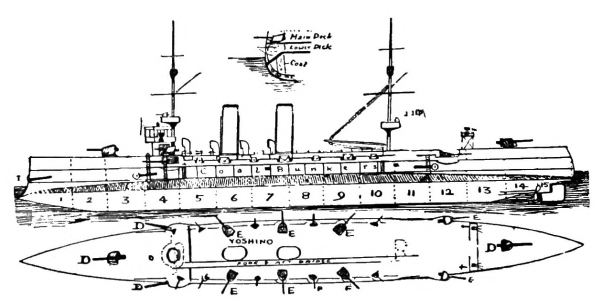
The 6-in. guns are thus distributed: one on the forecastle, one on the poop, the other two in the foremost sponsons. The other broadside guns are 4.7-in. and 3-pounders. The bow and stern chasers have an arc of fire of 270 degrees, the 6-in. guns in sponsons fire 3 degrees across the bow and 60 degrees abaft it.
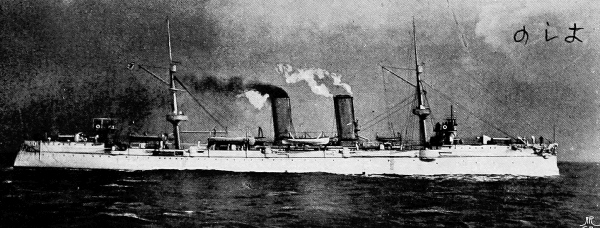
Photo by Sir W. G. Armstrong, Mitchell & Co., Ltd., Elswick.
YOSHINO.
The aftermost 4.7-in. fire 3 degrees across the stern and 60 degrees before it. The broadside guns have an arc of about 120 degrees. Each of the fighting-tops carries a couple of 3-pounder Q.F., four on each bridge, two under the forecastle forward, two under the poop well aft, the remaining six between the guns amidships.
Towards the end of 1893 a violent agitation against the Navy filled the Japanese newspapers. The existing types of ships—particularly the Chiyoda and Itsukushima class—were unfavourably criticised. The personnel was not free from these attacks; it was in some quarters demonstrated useless and inefficient. In the midst of these attacks the war with China loomed and broke out. After that war nothing further was heard on the subject of the personnel’s “defects.”
The primary result of the agitation was a new shipbuilding programme. The only ships actually under construction at that time were the Suma, building at Yokosuka, and laid down in March, 1893, and the Tatsuta, ordered to replace the lost Tschishima, building at Elswick. The new programme embodied “two first-class battleships of the most powerful type,” a cruiser at Yokosuka of the Suma type, and a sloop Miyako, laid down at Kuré in 1894. This programme was also a subject of attack in a portion of the Japanese press.
Before, however, anything could be done, the battle of Asan and the affair of the Kow-shing precipitated the war with China. Consequently, on the outbreak of war, the Tatsuta, launched at Elswick on April 6, 1894, and hastily completed in August of the same year, was stopped as contraband on her way out at Aden.
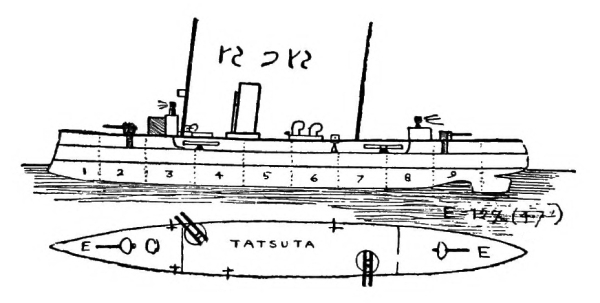
The Tatsuta is a torpedo gunboat. Particulars as follows:—
Displacement 875 tons.
Material of hull Steel.
Length 240 ft.
Beam 27½ ft.
Draught (mean) 9½ ft.
Armament Two 4.7-in. Q.F.
Four 3-pdr. Q.F.
Five torpedo tubes (one fixed in bow, the
others in pairs—a pair on each quarter).
Horse-power (forced draught) 5500.
Trial speed 21 knots.
Engines (Hawthorn, Leslie & Co.) Vertical triple expansion.
Screws Two.
Coal supply (normal) 188 tons.
”” ( maximum capacity) 200 tons.
Complement 100 men.