Trials And Troubles of an Artist.
Reading edition
By Fred Miller.
Illustrations by E. M. Jessop.
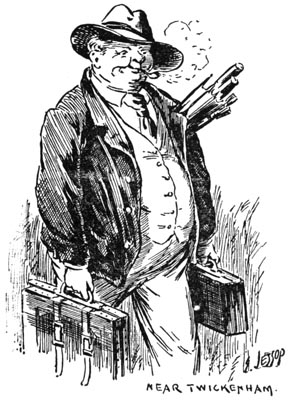
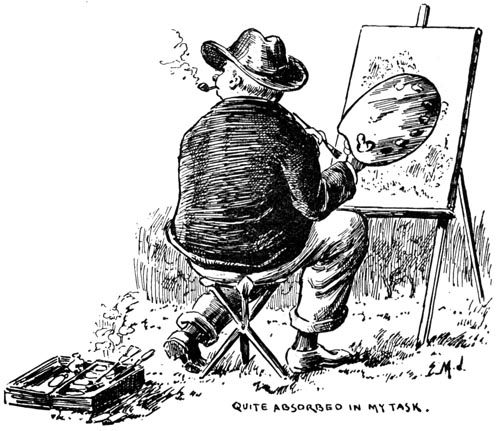
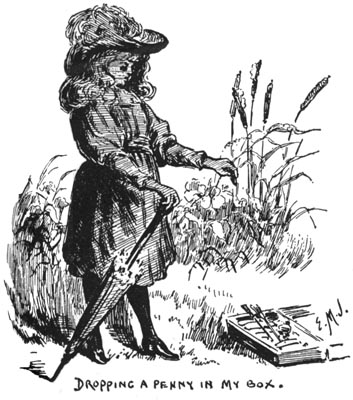
Are any professional men so liable to public insults as painters? Only last summer a new, and I think unique, type of insult was dropped upon me. I had a picture in hand, and wanted a bit of background to complete it. I had seen just the very thing near Twickenham, so, taking my sketching-box and camp-stool, I trained out, and in due course started work. Although I was painting by the side of a public road, the traffic was small and the passers-by few. Still there were passers-by, mostly children, with their nurses or governesses. I am too used to being looked at to take any notice of those who try to peep as they pass, and I soon got quite absorbed in my task. Presently, I was aroused from my artistic abstraction by a little girl dropping a penny in my box, and before I had time to explain, expostulate, or thank her, she had run away. “The world is less hard-hearted than I thought,” was my reflection as I resumed painting. A little while after this I noticed, during the pauses of my work, another little girl hovering about me in an undecided sort of way. After a few moments’ indecision, she dropped a penny in my box and disappeared. “This is encouraging,” I said to myself, “I shall certainly come here again.”
I resumed my sketch, when presently a young girl with two children came and stood near me. These were of a different class. There was no timidity or reticence about them. After standing at my side, and finding that they could not see to advantage, the three sidled round to the back, and gradually edged themselves nearer and nearer until they commanded a satisfactory view of the sketch.
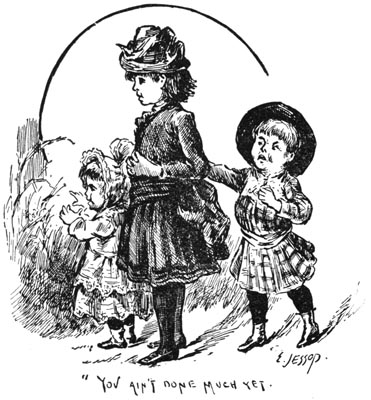
They watched in silence for awhile, and then the girl said—“You ain’t done much yet. ’Spose you’re going to finish it at ’ome?”
The tone of her voice made me inclined to humour her, so I replied—
“Well, you see, miss, I haven’t taken enough yet. Can’t afford to go home on twopence.”
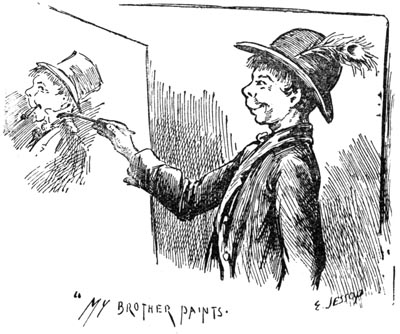
“My brother paints. He’s in the sixth standard. I give ’im a box of paints on his birthday, and he’s going to paint me a picture for my bedroom.”
The gulf that might have divided us was bridged now, so I got what satisfaction I could out of her chatter.
“I wish I could paint. I’d like to do them tex’s what they gives yer at Sunday school.”
“Oh, that’s the line you’d like to take up, Julia, is it?”
Another pause.
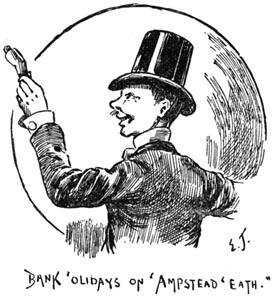
“D’yer like them paintin’s what they gives yer at the tea grocers? My brother says ’e’s going to paint them sort when ’e gets them colours what you squeezes out of tubes; you know, like them ladies’ tormenters, same as you gets on Bank ’olidays on ’Ampstead ’Eath.”
I wanted to go on with my picture, so I suggested to Julia (I had no reason to suppose that her name was not Julia) that it was getting near tea-time.
“Oh, is it,” she said; “come along, Halbert.” Then, turning to me, she added—“Are yer comin’ to-morrer? I’d like yer to see my brother’s paintin’s.”
“That depends upon how much I make to-day, Julia,” I answered—“whether the ‘pitch’ is a good one or not.”
“Oh,” said Julia, thoughtfully; “I’d like yer to come to-morrer,” and then as she passed she dropped a halfpenny into my box.
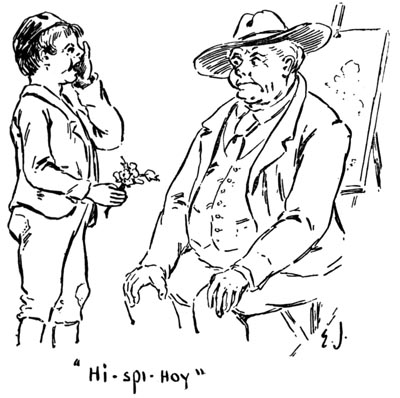
On other occasions, when out painting in poor neighbourhoods, my easel, camp-stool, and self have been used as “home” in games like “Hi-spi-Hoy” and “Hoop,” and I have, during the progress of my sketch, been more than once in imminent danger of being carried away, and my kit sent flying, during a sudden rush of the excited players. But even such an indignity as this does not touch bottom. Boys have before now made me a “Harbour of Refuge,” with the poetry left out, and bricks and various missiles substituted. They have dodged behind me to escape the consequences of “cheekiness” to bigger boys, and have used my canvas as a screen to shield off stones.
And what are you to do? Just at that moment, in all likelihood, you are putting in a crisp, telling touch that will “do the trick,” and if the news were brought to you that your favourite aunt had fallen downstairs, it would not be sufficient to make you rise from off your camp-stool.
I was sketching once near a row of those cheap one-storied cottages, generally called Villa This and Villa That, inhabited by a tribe the mothers of which seem always to have a baby on hand, and several others in various stages of development. These children spend most of their time, so far as I can judge, in hanging about, just outside the front garden, waiting for something to turn up to amuse them, and I had been much bothered by their creeping round behind me, or edging closer and closer to my side, and occasionally shoving each other so as to shake me or my sketch. I tried to forget them, and maintained a chilling silence. The numbers, however, kept on increasing, and presently games were projected in my immediate vicinity, as though I were the centre of gravity, or the hub of the universe. The climax was reached when a young nurse, aged seven or thereabouts, with a child just on the brink of independence in her arms, came up and said—
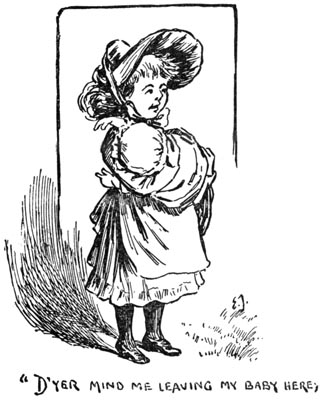
“D’yer mind me leaving my baby here, while I have a game with the Tubbses? She’ll be all right if I sit her on your jacket.”
Nice thing when seeking material for a masterpiece for next year’s Academy to be asked to look after baby!
The remarks made by street loafers and errand-boys, too, who stand at your elbow for half-an-hour at a stretch, are not encouraging, as a rule. One boy, in what he considers a tone of confidence, will say to another—
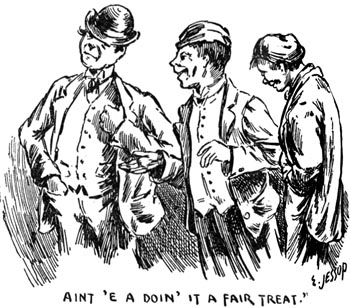
“S’elp me, Bob, aint ’e a doin’ it a fair treat.”
“Carry me out” (it is impossible to write “out” as they pronounce it), “’Arree, ain’t it fine” (rising intonation on the “I”)—“I wish I wos a bloomin’ hartist.”
“Don’t ’e fancy ’isself, just.”
It is difficult to keep quietly on at work with every appearance of indifference under such circumstances. It is also exasperating to be called “Matey,” as though you were a pal of theirs, and lived on the same landing. Yet these are only a few of the indignities with which a poor artist has to put up.
Who has not, when on a sketching tour, felt the contempt that the bucolic mind has for a man who, day after day, and week after week, sits out of doors on his camp-stool, doing his best to catch some of Nature’s mystery and fleeting beauty, and give it an abiding place on his canvas.
My friend S—— is a big, healthy, bearded fellow, who looks as though he could pick half-hundred weights up in each hand with the ease that I pick up my palette. The following dialogue took place on one occasion between him and an elderly rustic who had been standing watching him for some time, as he sat by the roadside, painting.
“No offence, sir,” said the agriculturist, “but is anything the matter wi’ yer?”
“No,” answered S—— “What makes you ask?”
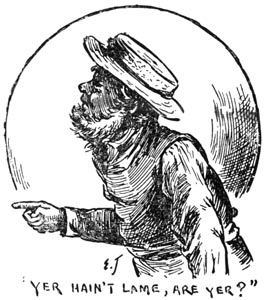
“Yer hain’t lame, are yer?”
“Lame! Good gracious, no!”
“You hain’t ’ad a misfortune in any way? The sciatics or lumbager, that’s kind o’ laid yer by?”
“No, I’m as well as I have always been.”
“An’ yer call yerself a man and can sit theer a doin’ o’ that. Well, I’m d—— d!”
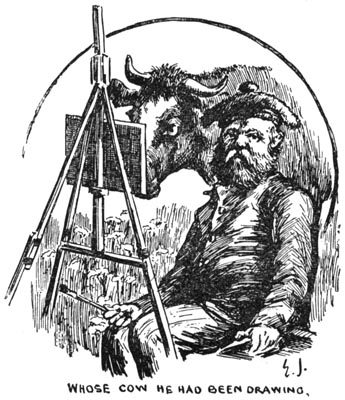
I never go out sketching without feeling this silent contempt, for it is only rarely that it finds expression. The remarks made by villagers show how utterly unable they are to grasp the idea of anyone valuing an artist’s efforts. The old story of the painter who was asked by the farmer whose cow he had been drawing, what the said picture might be worth when finished, is typical.
“Oh, I hope to get thirty pounds for it if it is well hung,” explained the artist.
“Thutty pound for the mere picture!” cried the old fellow in astonishment. “Why, I’d sell you the old cow itself for ten.”
A spirit of commiseration underlies a good many of the remarks made by the bucolic. I went down on one occasion to see a couple of painters who had taken a small cottage at one and sixpence a week in order to paint some orchard pictures. When their neighbours, who were farm hands, got to know them a bit, they were very friendly disposed, and made them presents of vegetables, and one old fellow who was reputed to have “saved a smart bit o’ money,” said to one of the “painter chaps,” as they were called—
“There don’t seem much of a living in your business, sir. I s’pose trade’s a bit dull with ye, now folks is a spring cleaning. What do yer say now to paintin’ my cart in yer dinner hour? I shall want it done afore long, and I’d like to gie ye the job, for a shilling or two down’t come amiss to any of us. Do it now?”
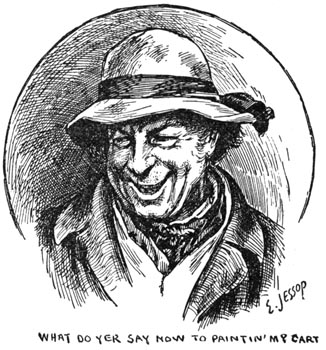
Another job refused by these same artists was to clean and touch up an old picture that had been bought for a few shillings at a sale. The old chap who had purchased it went so far as to offer them a shilling to do the work, and that offer being declined, he threw in a pint of stout as an additional inducement.
A friend who had painted a 50 x 40 canvas outside during one summer, spending some five or six weeks upon it, told me that one old chap, who looked like a jobbing gardener, used to pass by every day, and invariably stayed to stare at the work, but always at a respectful distance, and it was not until the picture was nearly completed that he broke the silence.
“D’yer moind me ’aving a look at it, sir?”
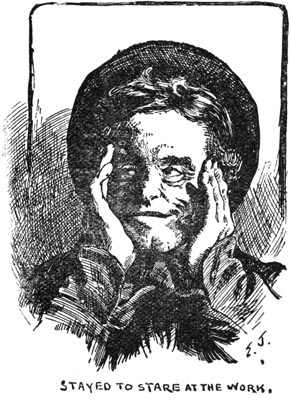
“Oh, certainly not,” and my friend got off his camp-stool to let the critic have an uninterrupted view. The subject was a careful study of wild flowers and herbage, growing in the corner of an orchard. The old fellow seemed to take the picture in very carefully, and at length said:
“Is it a view in Ireland, sir?”
“View in Ireland! What made you think of that? Don’t you see it’s the corner of the orchard there, with all the thistles and docks and wild flowers?”
“Well, to be sure! Fancy anyone a paintin’ them weeds and trumpery!” and with that cheerless remark the old fellow sheered off.
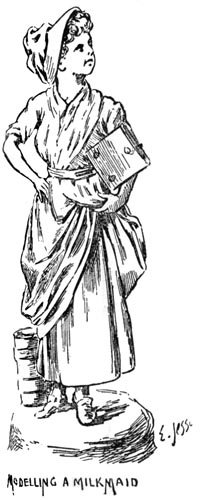
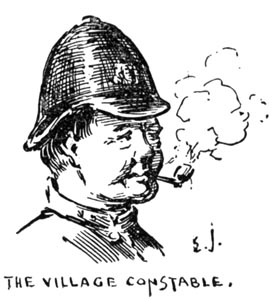
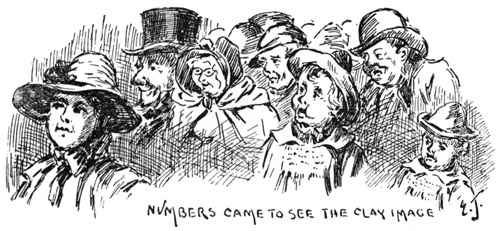
Sculptors, unlike painters, rarely venture out of their studios, but it happened that a sculptor came down to spend a few days with us when in a Norfolk village, and so liked the place that he hired a barn, had a lot of clay and a turntable sent down, and started modelling a milkmaid. As the work progressed, it became the talk of the place, and, in due course, numbers came to see the clay image that my friend was setting up in the barn. This work did appeal to them. They could see at a glance what it was meant to represent, and the chorus of approval was loud and general, except on the part of the village constable. He was a taciturn man, and used to come and smoke his pipe and preserve a contemptuous silence. One day he said—
“Are you making that image for a church?”
“No. Why did you think I was?”
“Oh, nothing. Only when I was in London, and that’s a smart while ago, I worked on a church as was a buildin’, and we had to fix some figures; only they were made in what we calls Portland cement.”
“Oh, then, you have seen sculpture before?”
“Yes, sir, ’tain’t the first time as I’ve seed a graven image, as the Bible calls ’em. D’yer ever make them figures they puts over doors and winders of houses?”
“No; I can’t say I do.”
“Did you ever see them two figures in the Lord Mayor’s palace in the City? You ought to see them, sir. I reckon they’re the best things in that line you can see anywhere?”
“I’m afraid I don’t remember which figures you refer to.”
“Oh, they ain’t like your work, not a little bit. They’re picked out in all kinds of colours, and are ever so big. I was thinking they must represent two of them heathen gods what the Children of Israel fell down and worshipped. You know the figures I mean?”
“I’m afraid I don’t. Can’t you remember their names?”
“Why, Gog and Magog, aren’t they, sir?”