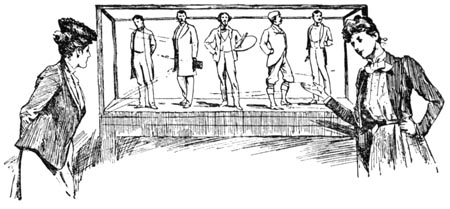
The Brothers’ Agency.
Reading edition
By Do Bahin.
Illustrations by The Misses Hammond.
“she won’t see you.”
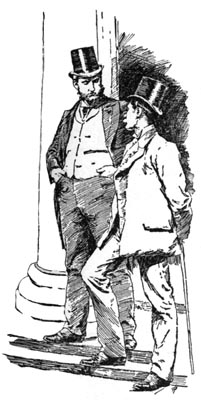
“She won’t see you, my boy,” said Grigsby, as I stood on the steps of the Scandalmongers’ Club waiting for the next West Kensington ’bus; “she’s doing a roaring trade, and don’t want any more advertisements; and if she does she’ll put up her own notices, and not use you for billsticker.”
“Grigsby may not be right this time,” I reflected, as I scaled the ’bus. “He seldom is! And haven’t I triumphantly interviewed all the most unmanageable celebrities of the last ten years, from Lord Tennyson to the Royal baby? I suppose it’s my bland appearance. It lulls suspicion and excites curiosity. People want to see whether it is possible for any man to be such a fool as I look. Anyhow, I must go through with it now, as I’ve let it out to Grigsby.”
The fact is, I was about to try to interview Miss Jenny T. Buller, the inventress and manager of the “Brothers’ Agency,” perhaps the most important social factor of the present century. In due course I found myself opposite a smart-looking house, on whose door-plate was engraved “The Brothers’ Agency.”
Being taken no doubt for a postulant Brother, I was shown upstairs into a severe but elegant room, in the middle of which, at a huge desk loaded with papers, sat a fashionable young lady of the frailest type of Transatlantic beauty.
“Miss Buller, I believe.”
“You will not suit,” she said, after one short but decisive stare. “You are not up to our mark.”
“I don’t wish to be a Brother,” I replied.
“Then what do you want?” she answered.
“Miss Buller,” I inquired, as if my life depended on the response, “how did you ever think of this wonderful scheme?”
She laid down her pen, and turned in her chair; and I saw that I had won.
“I’m tired of writing just now,” she began, “and I don’t mind if I tell you.
“‘i don’t mind if i tell you.’”
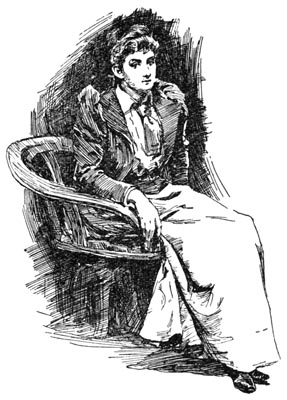
“I found myself obliged to increase my income by some means. I first thought of starting a servants’ agency; but the inconvenience I experienced from having no brothers to take me about suggested a novel idea to me. I was wondering if other girls felt as I did, when it flashed upon me that young men who, from any reasons, are in want of money, might let themselves out as brothers to well-to-do damsels possessing no fraternal relations. I immediately settled to start an agency for this object—somewhat on the principle of ‘Lady Guides’—the full title being ‘The agency for supplying Brothers to brotherless girls, or those with unobliging brothers.’ I resolved to call it shortly ‘The Brothers’ Agency.’ It is a good name, and gives to the undertaking a kind of monastic flavour that I find is very taking.
“Of course I only began in a small way amongst the men and girls I knew personally; but my business spread so rapidly that I soon started a regular office, and issued printed rules.
“I decided that the Brothers should go to their work during the day (as such relations do), and only be engaged for the evening to escort my clients, as their sisters, to balls, theatres, etc. I knew that young men in London society were supposed to let themselves out for dances; so why not as Brothers?”
“Why not, indeed?” I murmured sympathetically.
“We do not find,” she continued vivaciously, “that it leads to matrimonial complications, as the men who seek employment as Brothers are usually so very impecunious that they understand that marriage is out of the question for them. I was told by my friends, by which I mean all those who felt themselves privileged to say nasty things to me, that we should degenerate into a matrimonial agency, but I have not found it so. On the contrary, every man entering his name on our books, and every girl engaging a Brother, signs a paper agreeing to pay a large prohibitive fine should they get engaged to each other during the period of fraternity. Any man known to be engaged is obliged to take his name off the books at once, as we find fiancées very prejudiced, and several unpleasant visits were paid to me at the office. Any man becoming engaged while fulfilling a contract is liable to instant dismissal at the employer’s pleasure, it having been found that he almost invariably becomes remiss and inattentive in his discharge of duties.
“one sister was seen at the theatre by an old maiden aunt.”
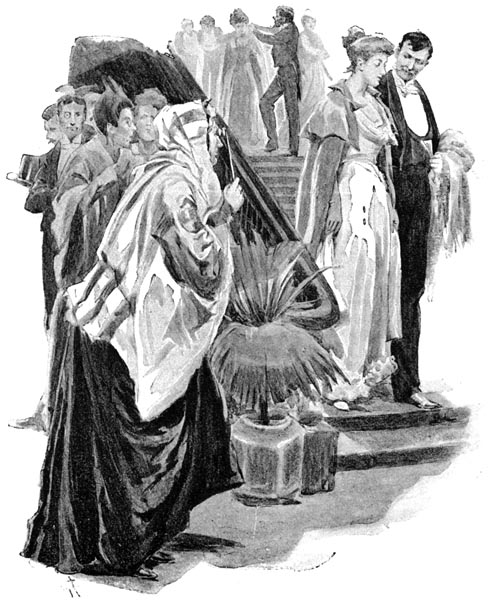
“Of course, till the significance of the title of ‘Brother’ became generally known in London society, there arose a good deal of scandal and confusion.
“One sister was seen at the theatre by an old maiden aunt, who had never heard of the Agency. The young lady offered as an explanation that the man with her was ‘only engaged for the time,’ which so shocked the poor old lady that she made a codicil next day to her will reciting her niece’s misbehaviour and disinheriting her.”
“That kind of misunderstanding,” I said, “can hardly occur any longer.”
“I should think not,” she retorted. “And meantime, thank goodness, the term ‘Brother’ has put an end to that hackneyed form of refusal, ‘I love you as a brother.’ The sisters are only allowed to require the attention of the Brothers for a stated number of nights a week, and the work is well paid. On the other hand, the sisters escape all the duties they generally have to perform for their real brothers, such as practising accompaniments, mending, shopping, or running messages.
“mending.”
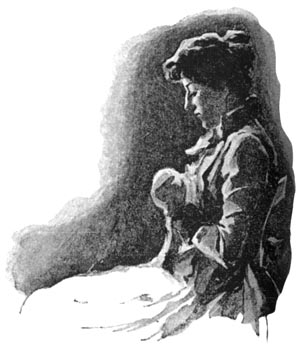
“Brothers are engaged by the week; but I always recommend that the same Brother should not be retained for more than a month, as too long a service makes them—like old family servants—presume, and fancy themselves invaluable.”
“And how do you manage about characters?” I here enquired.
“I never,” she said, “consent to act as agent for any man I have not seen, or to procure a Brother for any girl I have not talked to; and I study their characters so as to know how any arrangement is likely to answer. We often have photographs of Brothers ready for engagement—in fact, those who keep their names permanently on the books usually supply us with cabinet pictures for reference, and I arrange for interviews as between mistresses and servants.”
“And what terms are generally asked by the Brothers?” I said.
“These, of course,” she replied, “depend largely on the nature of the situation, and the qualifications of the Brother. Vulgar or disagreeable girls have to pay very heavily. Families with several girls are charged more in proportion, as many men object to go where other Brothers are kept. Some men are willing to go as joint Brother to a family of girls, but this rarely works well.
“They are paid so much a week, and their theatre money if they have to escort the lady to the play (like beer money, you know). One man required his buttonhole bouquets, but I said he was clearly above his place. We do not arrange any engagements for the summer vacation, as we have found it too dangerous. I really think,” she added thoughtfully, “that the best way of explaining our methods to you would be to show some entries in our books.”
“I should be deeply interested,” I answered, stifling my eagerness, “and it would be very kind of you.”
She drew a great ledger towards her, and showed me one or two entries. The first ran as follows:
“‘A Brother, six feet high; dresses well; aristocratic manners; a good dancer, and knows all the newest steps, including the Pas de Quatre; obliging, and good-tempered; a teetotaller, and only smokes the best tobacco. Has the highest credentials from his last place. Available for “Church Parade” on Sunday, but prefers not to attend church previously, as he cannot get up so early.’”
“knows all the newest steps.”
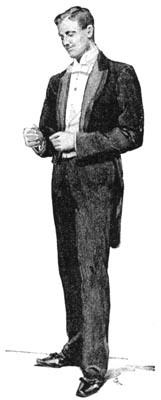
“What a paragon!” I exclaimed.
“Ah! but he asks a very large salary,” she rejoined; “he is so much sought after. This is a less expensive one—
“‘A Brother, aged 27, something in the City; bad figure, but pleasant smile, and amusing to talk to; slightly provincial, but very highly educated; most respectable and steady; musical, and a good tennis player. Very few private engagements, and therefore available most days of the week. Charges strictly moderate.’”
“We have one man on the books who owns a dogcart,” resumed Miss Buller. “He is in the Guards, and preferred to earn a little money to being obliged to leave his regiment. I need hardly say that his charges are very high.”
“Naturally,” I murmured.
“Here is an advertisement addressed to young ladies of a religious turn of mind:
“‘A young curate, who has a conscientious objection to bazaars, would be glad to augment his income (the money to be devoted to charitable objects) by obtaining employment as a Brother. He does not dance himself, but would give the sanction of his presence to such entertainments any day except Friday. He is fond of tennis and a good oar. He will give assistance to any lady district-visiting, or taking a Sunday-school class in his own parish. He prefers, as the object is a charitable one, leaving the question of salary to the sister’s own good feeling.’
“a young curate.”

“You wouldn’t believe,” said Miss Buller, “what a run there is on him; but I find I can easily supply every kind of variety now. A barrister, on this next page, suggests that, as he has influential legal connections, he can generally procure for his sister an excellent place at the sensational trials that have become so fashionable for ladies to attend! He commands a huge salary, especially being a gifted conversationalist, and taking the charge of a dinner table brilliantly; he has credentials from his last place for being ‘witty without vulgarity.’”
“And now,” I said, “I should like to see the sort of advertisement used by ladies needing Brothers, if you would be kind enough to show me one.”
“They are not so interesting,” she replied, “but here is one I received to-day:
“‘A Brother is required during the hunting season by two sisters. He must be a good rider, capable of giving a lead, but very obliging, as two Brothers have been parted with lately, owing to over-excitement in the field causing them to neglect their sisters. The Brother will be mounted by the ladies’ parents.’”
“Don’t you find that disputes arise,” I asked, “between Brothers and their employers? I should have thought the position might become irksome to a young man, if the sister was unpleasant.”
“Of course,” she answered pensively, “an ill-tempered girl can make matters very unpleasant; but such people pay very highly, as I pointed out only yesterday to one of our most promising Brothers. ‘She is rather a common girl,’ I said, ‘but you know you were very unlucky at Newmarket lately; and you sit up incessantly playing poker; and if you take my advice you will make your losses good by sticking to your place. I dare say the theatres are rather trying, but, on the other hand, as you don’t go into at all the same society that she does, you are not likely to meet anyone you know at the parties she takes you to; and, of course, as her Brother, you need not dance incessantly with her!’ He finally took my advice.”
“Now that,” I said, in my very stupidest manner, “is one of the difficulties which has occurred to me. A man who has been engaged as a Brother finds himself saddled with an undesirable acquaintance after the engagement is over.”
“an ill-tempered girl can make matters very unpleasant.”
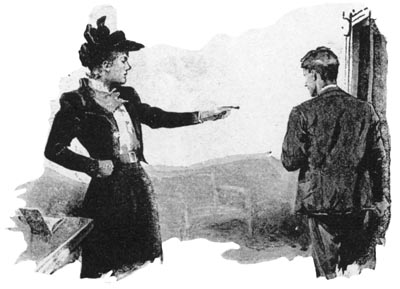
“I should have thought,” she replied, indignantly, “that you would have understood that neither the lady nor the Brother are expected to recognise each other when they meet after the termination of the engagement.”
“It must be anxious work sometimes,” I remarked, “settling the disputes that arise.”
“It is, indeed,” said Miss Buller. “One contract on the part of a rising young artist was actually broken off in the middle because the sister who had engaged him, an inordinately vain girl, insisted on being introduced as a central figure into his Academy picture for the year. He refused, and appealed to me; I supported him; on which the young lady came to the office and abused us both. My fear now is,” she continued, “that Mr. Whiteley will step in and ‘provide’ Brothers, but I feel sure that this business could only be managed successfully by a lady. A dispute arose last week over the question of a Brother being required to introduce any friends he might meet at a party to his sister. I vetoed this at once, as real brothers often decline to do this, unless they consider their sister does them credit. On another occasion a Brother insisted on smoking a strong cigar in a cab, coming back from the theatre, saying that he was not accustomed to treat his sisters with ceremony.”
“That was rude,” I remarked; “but still I pity the men if they are engaged by very exacting sisters, because, after all, they are not real brothers.”
“abused us both.”
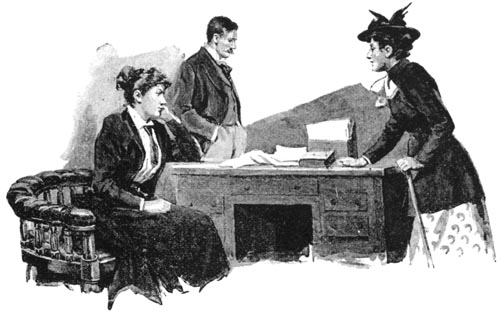
“Oh,” said Miss Buller, “I admit that sometimes sisters do get troublesome. One situation I find very hard to fill: the Brothers complain of its being such a hard place, as the young lady is so unpopular that no men ever come to speak to her, and her idea of a Brother is a person who never quits your side in the Row, or elsewhere. The consequence is, that the wretched Brother never has a moment’s relaxation. She pays very highly, however. You know, many men stipulate that, even if fulfilling engagements, they shall be free to attend race meetings. We are obliged to consider the Brothers, as I assure you the competition for our best ones is tremendous. They are engaged—like seats at the theatre—for weeks beforehand. I forgot to mention that they are paid less highly in the winter than in the Season.”
“You are certainly doing an excellent work,” I exclaimed, growing bolder as I felt my copy was made; “and, if I could hire myself out as your Brother,”—I paused expressively.
“I guess I don’t need to hire,” she replied gaily, “I find all the Brothers are willing to take me out for nothing.”
“For love, and not for money,”—I interrupted, bowing.
“When they are disengaged,” she continued, laughingly. “Besides, being American, I don’t need to call them Brothers.”
“The Brothers have taste!” was my remark; and then I added, “I suppose the work nearly all falls on your shoulders?”
“‘for love, and not for money,’ —i interrupted.”

“Yes; that is inevitable. Arranging for engagements is nothing, but I find it necessary to make the Brothers refer all disputes to me, and delicate points arise. One arose last week, when a lady called upon her Brother to chastise an erring suitor, who had jilted her. However, I said at once that this was not included in his duties, as the offence was prior to his entering on his present Brothership.”
“Well, I think you were quite right,” I said; “but I’m afraid your position is not so enviable as I fancied at first. I shouldn’t care myself to settle such delicate points.”
“Nonsense!” she replied, “these are crumpled rose leaves. The agency is paying splendidly. I am making my fortune, and at the same time conferring a boon on society. Why there is no longer a dearth of partners at dances, as most girls bring a Brother. In fact, the agency is doing so well that I shall soon have to take larger premises.”
“Well, Miss Buller,” I said, taking up my hat, “I hardly know how to thank you for your courtesy and patience in answering all my questions. I now thoroughly understand the working of your excellent agency, and I am sure that it is a scheme that will continue to flourish.”
“Till the Brothers form a Union, and go out on strike,” replied Miss Buller gaily. “The demand already exceeds the supply!”
She rang the bell, and a neat parlourmaid showed me out.
As I walked away, I marvelled that this inspired scheme, which bids fair to revolutionise modern society, should be the fruit of one mind.
I also thought with pleasure of my next meeting with Grigsby.