In the Hands of Jefferson.
Reading edition
By Eden Phillpotts.
Illustrations by Ronald Gray.
It is not difficult to appreciate the recent catastrophe in Oceania, where the island of Great Sangir was partially smothered by terrific volcanic and seismic convulsions, when one has visited the Western Indies.
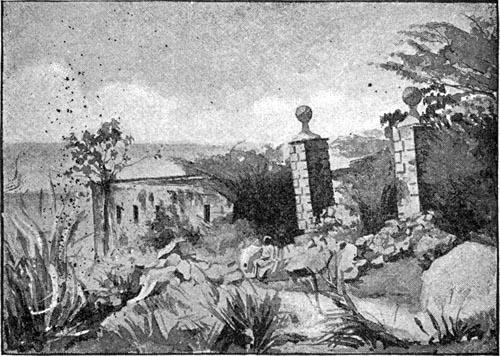
“where lord nelson enjoyed his honeymoon.”
Many of these tropic isles probably owe their present isolation, if not their actual existence, to mighty earthquake throes in remote ages of terrestrial history beyond the memory of man. But man’s memory is not a very extensive affair, and at best probes the past to the extent of a mere rind of a few thousand years. For the rest he has to read the word of God, written in fossil and stone and those wondrous arcana of Nature, which, each in turn, yields a fragment of the secret of truth to human intellect.
Regions that have been produced or largely modified by earthquake and volcanic upheaval may, probably enough, vanish at any moment under like conditions; and the island of Nevis, hard by St. Christopher, in the West Indies, strongly suggests a possibility of such disaster. It has always been the regular rendezvous of hurricanes and earthquakes, and it consists practically of one vast volcanic mountain which rises abruptly from the sea and pushes its densely-wooded sides three thousand two hundred feet into the sky. The crater shows no particularly active inclination at present, but it is doubtless wide awake and merely resting, like its volcanic neighbour in St. Christopher, where the breathing of the dormant giant can be noted through rent and rift. The Fourth Officer of our steamship “Rhine” assured me, as we approached the lofty dome of Nevis and gazed upon its fertile acclivities and fringe of palms, that it would never surprise him upon his rounds to find the place had altogether disappeared under the Caribbean Sea. He added, according to his custom, an allusion to Columbus, and explained also that, in the dead and gone days of Slave Traffic, Nevis was a much more important spot than it is ever likely to become again. Then, indeed, the island enjoyed no little prosperity and importance, being a head centre and mart for the industry in negroes. Emancipation, however, wrecked Nevis, together with a good many other of the Antilles.
At Montpelier, on this island, Lord Nelson enjoyed his honeymoon, but now only a few trees and a little ruined masonry at the corner of a sugar-cane plantation appear to mark the spot. Further, it may be recorded, as a point in favour of the place, that it grows very exceptional Tangerine oranges. These, to taste in perfection, should be eaten at the turning point, before their skins grow yellow. We cannot judge of the noble possibilities in an orange at home. I brought back a dozen of these Nevis Tangerines with me, but I secretly suspected that, in spite of their fine reputation, quite inferior sorts would be able to beat them by the time they got to England; and it was so.
We stopped half-an-hour only at Charlestown, Nevis, and then proceeded to St. Christopher, a sister isle of greater size and scope.
At Antigua, there came aboard the “Rhine” a young man who implicitly leads us to understand that he is the most important person in the West Indies. He is the Governor of Antigua’s own clerk, and is going to St. Christopher with a portmanteau, some walking-sticks, and a despatch-box. It appears that his significance is gigantic, and that, though the nominal seat of government lies at Antigua, yet the real active centre of political administration may be found immediately under the Panama hat of the Governor’s own clerk. This he takes the trouble to explain to us. The Governor himself is a puppet, his trusted men of resource and portfolio-holders are the veriest fantoccini; for the Governor’s own clerk pulls the strings, frames the foreign policy, conducts, controls, adjusts difficulties, and maintains a right balance between the parties. This he condescends to make clear to us.
“the most important person in the west indies.”
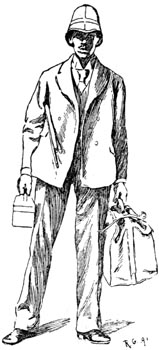
I ventured to ask him how many of the more important nations were involved with the matters at present in his despatch-box; and he said lightly, as though the concern in hand was a mere bagatelle, that only the United States, Great Britain and Germany were occupying his attention at the moment.
The Model Man said:
“I suppose you’ll soon knock off a flea-bite like that?”
And the Governor’s own clerk answered:
“Yes, I fancy so, unless any unforeseen hitch happens. Negotiations are pending.”
I liked his last sentence particularly. It smacked so strongly of miles of red tape and months of official delay.
When we reached St. Christopher, it was currently reported that the Governor’s own clerk had simply come to settle a dispute between two negro landowners concerning a fragment of the island rather smaller than a table-napkin; but personally I doubt not this was a blind, under cover of which he secretly pushed forward those pending negotiations. He certainly had fine diplomatic instincts, and a sound view, from a political standpoint, of the value of veracity.
When we cast out anchor off Basseterre, St. Christopher, the Treasure hurried to me in some sorrow. He had proposed going ashore, with his Enchantress and her mother, to show them the sights, but now, to his dismay, he found that unforeseen official duties would keep him on the ship during our brief sojourn here. With anxiety almost pathetic, therefore, he entrusted the Enchantress to me, and commended her mother to the Doctor’s care. I felt the compliment, and assured him that I would simply devote myself to her—platonically withal; but the Doctor was not quite so hearty about her mother. However, he must behave like a gentleman, whether he felt inclined to do so or not, which the Treasure knew, and, therefore, felt safe.
Our party of four started straightway for a ramble in St. Kitts (as St. Christopher is more generally called), and, upon landing, we were happily met by a middle-aged negro, who had evidently watched our boat from afar. He tumbled off a pile of planks, where he had been basking in the sun, girt his indifferent raiment about him, and then, by sheer force of character, took complete command of our contemplated expedition. It may have been hypnotism, or some kindred mystery, but we were unresisting children in his hands. He said: “Follow me, gem’men: me show you ebb’ryting for nuffing: de ’tanical Garns, de prison-house, de public buildings, de church, an’ all. Dis way, dis way, ladies. Don’t listen to dem niggers; dey nobody on dis island.”
“‘follow me, gem’men!’”
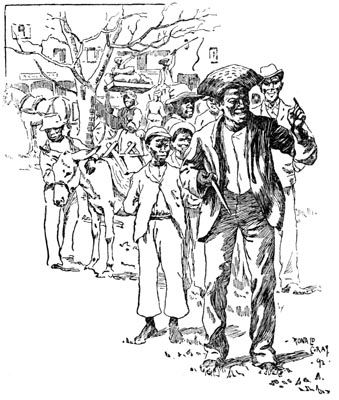
The Doctor alone fought feebly, but it was useless, and, in two minutes, our masterful Ethiop had led us all away to see the sights.
“What’s your name?” I asked.
“Jefferson, sar; ebb’rybody know Jefferson. Fus’, we go to ’tanical Garns. Here dey is.”
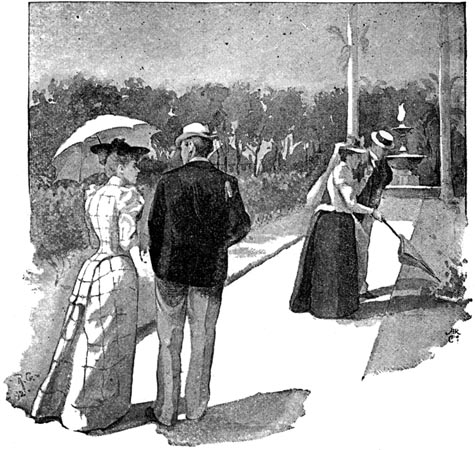
The Botanical Gardens of Basseterre, St. Kitts, were handsome, extensive, and well cared for. We wandered with pleasure down broad walks, shaded by cabbage palms and palmettos, mahogany and tamarind trees; we admired the fountain and varied foliage and blazing flower-beds, streaked and splashed with many brilliant blossoms and bright-leaved crotons.
“There,” said the mother of the Enchantress, pointing to a handsome lily, “is a specimen of Crinum Asiaticum.”
The Doctor started as though she had used a bad word. He hates a woman to know anything he does not, and this botanical display irritated him; but our attention was instantly distracted by Jefferson, who, upon hearing the lily admired, walked straight up to it and picked it.
“‘there is a specimen of crinum asiaticum.’”
I expostulated. I said:
“You mustn’t go plucking curiosities here, Jefferson, or you will get us all into hot water.”
“Dat’s right, massa,” he replied. “Me an’ de boss garner great ole frens. De ladies jus’ say what dey like, an’ Jefferson pick him off for dem.”
He was as good as his word, and a fine theatrical display followed, as our party grew gradually bolder and bolder, and our guide, evidently upon his mettle, complied with each request in turn.
I will cast a fragment of the dialogue and action in dramatic form, so that you may the better judge of and picture that wild scene.
The Enchantress (timidly): Should you think we might have this tiny flower?
Jefferson: I pick him, missy. (Does so.)
The Doctor: I wonder if they’d miss one of those red things? They’ve got a good number. I believe they’re medicinal. Should you think——?
(Jefferson picks two of the flowers in question. The Doctor takes heart.)
“‘might we have that?’”
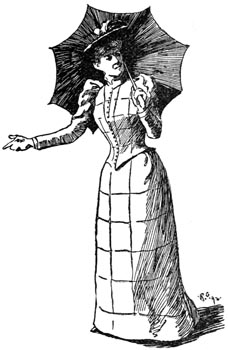
The Mother of the Enchantress: Dear me! Here’s a singularly fine specimen of the Somethingiensis. I wonder if you——?
(Jefferson picks it.)
The Doctor: We might have that big affair there, hidden away behind those orange trees. Nobody will miss it. I should rather like it for my own.
(Jefferson wrestles with this concern, and the Doctor lends him a knife.)
The Enchantress: Oh, there’s a sweet, sweet blossom! Might we have that, and that bud, and that bunch of leaves next to them, Monsieur Jefferson?
(Jefferson, evidently feeling he is in for a hard morning’s work, makes further onslaught upon the flora, and drags down three parts of an entire tree.)
The Mother of the Enchantress: When you’re done there, I will ask you to go into this fountain for one of those blue water-lilies.
(Jefferson, getting rather sick of it, pretends he does not hear.)
The Doctor (speaking in loud tones which Jefferson cannot ignore): Pick that, please, and that, and those things half-way up that tree.
(Jefferson begins to grow very hot and uneasy. He peeps about nervously, probably with a view to dodging his old friend, the head gardener.)
The Chronicler (feeling that his party is disgracing itself, and desiring to reprove them in a parable): I say, Jefferson, could you cut down that palm—the biggest of those two—and have it sent along to the ship? If the head gardener is here, he might help you.
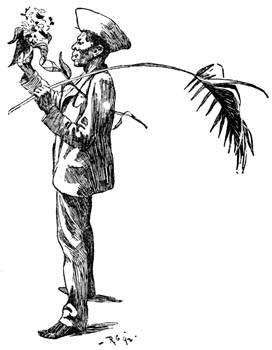
Jefferson (losing his temper, missing the parable, and turning upon the Chronicler): No, sar! You no hab no more. I’se dam near pulled off ebb’ryting in de ’tanical Garns, an’ I’se goin’ right away now ’fore anyfing’s said!
(Exit Jefferson rapidly, trying to conceal a mass of foliage under his ragged coat. The party follows him in single file.)
[Curtain.]
I doubt not that, had we met the head gardener just then, our guide would have lost a friend.
“‘i’se pulled off ebb’ryting in the ’tanical garns.’”
Henceforth, evidently feeling we were not wholly responsible in this foreign atmosphere of wonders, Jefferson stuck to the streets, and took us to churches and shops and other places where we had to control ourselves and leave things alone.
On the way to a photographer’s he cooled down and became instructive again. He told us the name and address and bad actions of every white person we met. Society at St. Kitts, from his point of view, appeared to be in an utterly rotten condition. The most reputable clique was his own. We met several of his personal friends. They were generally brown or yellow, and he assured us that he had white blood in him too—a fact we could not possibly have guessed. Presently he grew confidential, and told us that his eldest son was a source of great discomfort to him. At the age of fifteen Jefferson Junior had run away from home and left St. Kitts to better himself at Barbados. Five years afterwards, however, when he had almost passed out of his parents’ memory, so Jefferson declared, the young man returned, sick and penniless, to the home of his birth. I said here:
“This is the Prodigal Son story over again, Jefferson. Did you kill the fatted calf, I wonder, and make much of the lad?”
“No, sar,” he answered; “didn’t kill no fatted nuffing, but I precious near kill de podigal son.”
Concerning St. Christopher, we have direct authority, from the immortal and ubiquitous Columbus himself, that it is an island of exceptional advantages; for, delighted with its aspect in 1493, he bestowed his own name upon it. Indeed, the place has a beautiful and imposing appearance. Dark green forests and emerald tracts of sugar-cane now clothe its plains and hills; and Mount Misery, the loftiest peak, rises to a height of over four thousand feet. Caribs were the original inhabitants and possessors of St. Kitts, but when England and France agreed to divide this island between them in 1627, we find the local anthropophagi left out in the cold as usual. After bickering for about sixty years, the French enjoyed a temporary success, and slew their British brother colonists pretty generally. Then Fortune’s wheel took a turn, and under the Peace of Utrecht, in 1713, St. Kitts became our property from strand to mountain-top.
“volcanic indications.”
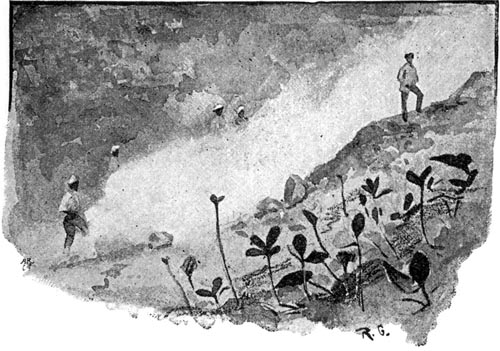
There is only one road in this island, I am told, but that is thirty miles long, and extends all round the place. Volcanic indications occur freely on Mount Misery, and, as at Nevis, so here, the entire community may, some day, find itself very uncomfortably situated. A feature of St. Kitts is said to be monkeys, which occur in the woods. These, however, like the deer at Tobago, are more frequently heard of than seen. People were rather alarmed here, during our flying visit, by a form of influenza which settled upon the town of Basseterre; but we, who had only lately come from England, and were familiar with the revolting lengths to which this malady will go in cold climes, reassured them, and laughed their puny tropical species to scorn. Finally, of St. Kitts, I would say: From information received in the first case, and from personal experience in the second, that there you shall find sugar culture in most approved and advanced perfection, and purchase walking-sticks of bewildering variety and beauty.
“the doctor grew delighted.”
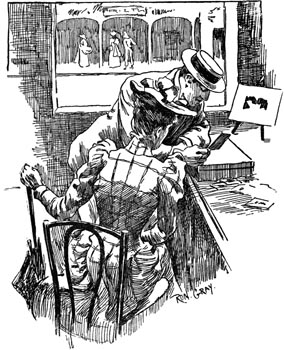
The ladies of our party decreed they had no wish to visit the gaol—a decision on their part which annoyed Jefferson considerably. He explained that the St. Kitts prison-house was, perhaps, better worth seeing than anything on the island; he also added that a book was kept there in which we should be invited to write our names and make remarks. They were proof, however, against even this inducement; and, having seen the church—a very English building, with homely little square tower—we left our Enchantress and her parent at the photographer’s, to make such purchases as seemed good to them, and await our return.
In this picture-shop, by the way, the Doctor grew almost boisterously delighted over a deplorable representation of negro lepers. Young and old, male and female, halt and maimed, the poor sufferers had been photographed in a long row; and my brother secured the entire panorama of them and whined for more. These lamentable representations of lepers gave him keener pleasure than anything he had seen since we left the Trinidad Hospital. In future, when we reached a new port, he would always hurry off to photographers’ shops, where they existed, and simply clamour for lepers.
I asked Jefferson, as we proceeded to the prison, whether he thought we should be allowed to peer about among the inner secrets of the place, and he answered: “You see ebb’ryting, sar; de head p’liceman great ole fren’ of mine.”
My brother said:
“You seem to know all the best people in St. Kitts, Jefferson.”
And he admitted that it was so. He replied:
“Jefferson ’quainted wid ebb’rybody, an’ ebb’rybody ’quainted wid Jefferson.”
Which put his position in a nutshell.
The prison was not very impressive viewed from outside, being but a mere mean black and white building, with outer walls which experienced criminals at home would have smiled at. We rang a noisy bell, and were allowed to enter upon the demand of Jefferson.
Four sinners immediately met our gaze. They sat pensively breaking stones in a wide courtyard. A building, with barred windows, threw black shade upon the blazing white ground of this open space; and here, shielded from the sun, the convicts reclined and made a show of work. Jefferson, with rather a lack of delicate feeling, drew up before this little stone-breaking party and beamed upon it. The Doctor and I walked past and tried to look as though we saw nobody, but our guide did not choose that we should miss the most interesting thing in the place thus.
“Look har, gem’men; see dese prisoners breakin’ stones.”
“All right, all right,” answered my brother; “push on; don’t stand staring there. We haven’t come to gloat over those poor devils.”
But I really think the culprits were as disappointed as Jefferson. They evidently felt that they were the most important part of the entire spectacle, and rather resented being passed over.
“You won’t see no more prisoners, if you don’t look at dese, sar,” answered Jefferson. “Dar’s only terrible few convics in de gaol jus’ now.”
“So much the better,” answered the unsympathetic Doctor.
It certainly appeared to be a most lonely and languishing place of incarceration. We inspected the cells, and observed in one of them a peculiar handle fastened against the wall. This proved to be a West Indian substitute for the treadmill. The turning of the handle can be made easy or difficult by an arrangement of screws without the cell. The affair is set for a certain number of revolutions, and a warder explained to us that where hard labour has been meted to a prisoner, he spends long, weary hours struggling with this apparatus and earning his meals. When the necessary number of turns are completed, a bell rings, and one can easily picture the relief in many an erring black man’s heart upon the sound of it. At another corner of the courtyard was piled a great heap of cannon-balls. These were used for shot-drill—an arduous form of exercise calculated to tame the wildest spirit and break the strongest back. The whitewashed cells were wonderfully clean and wholesome—more so, in fact, than most public apartments I saw elsewhere in the West Indies. This effect may be produced in some measure by the absolute lack of household goods and utensils, pictures or bric-à-brac. In fact, the only piece of furniture I could find anywhere was a massive wooden tripod, used for flogging prisoners upon.
“a chat with the superintendent.”
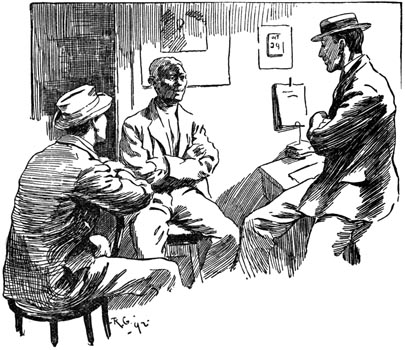
Then we went in to have a chat with the Superintendent. He was rather nervous and downcast, and apparently feared that we had formed a poor opinion of his gaol. He apologised quite humbly for the paucity of prisoners, and explained that times were bad, and there was little or nothing doing in the criminal world of St. Kitts. He really did not know what had come to the place lately. He perfectly remembered, in the good old days, having had above fifty prisoners at a time in his hands. Why, blacks had been hung there before now. But of late days business grew to be a mere farce. If anybody did do anything of a capitally criminal nature at St. Kitts, during the next twenty years or so, he very much doubted if the authorities would permit him to carry the affair through. His opinion was that an assassin would be taken away altogether and bestowed upon Antigua. I asked him how he accounted for such a stagnation in crime, and he answered, rather bitterly, that the churches and chapels and Moravian missions had to be thanked for it. There were far too many of them. Ordinary human instincts were frustrated at every turn. Little paltry sects of nobodies filled their tin meeting-houses Sunday after Sunday, and yet an important Government institution, like the gaol, remained practically empty. He could not understand it. At the rate things were going, it would be necessary to shut his prison up altogether in a year’s time. Certainly, one of his present charges—a man he felt proud of in every way—was sentenced to penal servitude for life, and had only lately made a determined attempt to escape. But he could hardly expect the Government to keep up an entire gaol, with warders and a Superintendent and everything, for one man, however wicked he might be. I tried to cheer him up, and spoke hopefully about the natural depravity of everything human. I said:
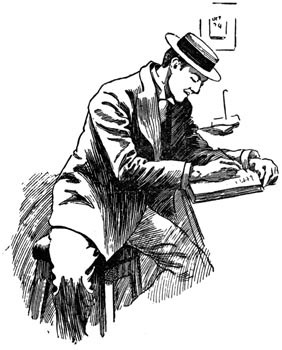
“filled half a page with complimentary criticism.”
“You must look forward. The Powers of Evil are by no means played out yet. Black sheep occur in every fold. After periods of drought, seasons of great plenty frequently ensue. There should be magnificent raw material in this island, which will presently mature and keep you as busy as a bee.”
“Dar’s my son, too,” said Jefferson, encouragingly; “I’se pretty sure you hab him ’fore long.”
Then the man grew slightly more sanguine, and asked if we should care to sign his book, and make a few remarks in it before departing.
“Of course I know it’s only a small prison at best,” he said, deferentially.
“As to that,” answered the Doctor, speaking for himself, “I have certainly been in a great many bigger ones, but never in any house of detention better conducted and cleaner kept than yours. You deserve more ample recognition. I should judge you to be a man second to none in your management of malefactors. For my part, I will assuredly write this much in your book.”
The volume was produced, and my brother sat down and expatiated about the charms and advantages of St. Kitts prison-house. He filled half a page with complimentary and irresponsible criticism; then he handed the book to me. The Superintendent said that he should take it as particularly kind if, in my remarks, I would insert a good word for the drainage system. Advised by the Doctor that I might do so with truth and justice, I wrote as follows:
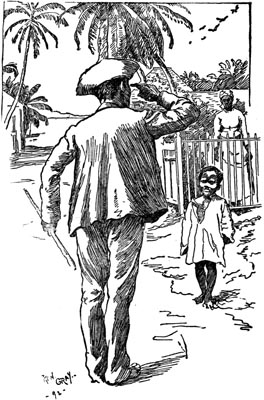
“saluting his many friends.”
“A remarkably clean, ably-managed, and well-ordered establishment, with an admirable staff of officials, a gratifying scarcity of evil-doers, and particularly happy sanitary arrangements.”
Then we went off to rejoin the Enchantress and her mother, and see further sights during the brief time which now remained at our disposal. The ladies had completed their purchases, and with them we now traversed extended portions of the town, and visited a negro colony, where thatched roofs peeped out from among tattered plantain leaves, and rustic cottages hid in the shade of tamarind and orange, lime and cocoanut. The lazy folks lounged about, chewing sugar-cane and munching bananas, according to their pleasant custom. The men chattered, and the women prattled and played with their yellow and ebony babies. One saw no ambition, no proper pride, no obtrusive morality anywhere. Jefferson appeared to be a personage in these parts. He marched along saluting his many friends and smoking a cigar which the Doctor had given him. He stopped occasionally to crack a joke or offer advice; and when we came to any negro or negress whose history embraced a matter of interest, Jefferson would stop and lecture upon the subject, while he or she stood and grinned and admitted his remarks were unquestionably true. As a rule, instead of grinning, they ought to have wept, for Jefferson’s anecdotes and scraps of private scandals led me to fear that about ninety-nine in a hundred of his cronies ought to be under lock and key, in spite of what the prison authorities had told us.
Then we came down through a slum and found ourselves by the sea, upon a long, level beach of dark sand. The pier stood half-a-mile ahead, and we now determined to proceed without further delay to the boats, return to the “Rhine,” and safely bestow our curiosities before she sailed. Apprised of this intention, Jefferson prepared to take leave of our party. He assured me that it had given him very considerable pleasure to thus devote his morning hours to our service. He trusted that we were satisfied with his efforts, and hinted that, though he should not dream of levying any formal charge, yet some trifling and negotiable memento of us would not be misunderstood or give him the least offence. We rewarded him adequately, thanked him much for all his trouble, and hoped that, when next we visited St. Kitts, his cheerful face might be the first to meet us. He answered:
“Please God, gem’men, I be at de pier-head when next you come ’long. Anyhow, you ask for Jefferson.” Then, blessing us without stint, he departed.
And here I am reluctantly compelled to reprove the white and tawny-coloured inhabitants of St. Kitts for a breach of good manners. Boat-loads of gentlemen from shore crowded the “Rhine,” like locusts, during her short stay at this island. They inundated the saloon bar, scrambled for seats at the luncheon-table, and showed a wild eagerness to eat and drink for nothing, which was most unseemly. One would have imagined that these worthy folks only enjoyed a hearty meal upon the occasional visits of a steamer; for after they had done with us they all rowed off to a neighbouring vessel, and boarded her in like manner, swarming up her sides to see what they could devour. That the intelligent male population of an island should come off to the ships, and chat with acquaintances and hear the latest news and enlarge its mind, is rational enough; but that it should organise greedy raids upon the provisions, and get in the way of the crew and passengers, and eat up refreshments which it is not justified in even approaching, appears to me unrefined, if not absolutely vulgar.
Leprosy and gluttony are the prevailing disorders at St. Kitts. The first is, unfortunately, incurable, but the second might easily be remedied, and should be. All that the white inhabitants need is a shade more self-control in the matter of other people’s food, then they will be equal to the best of their brothers at home or abroad.
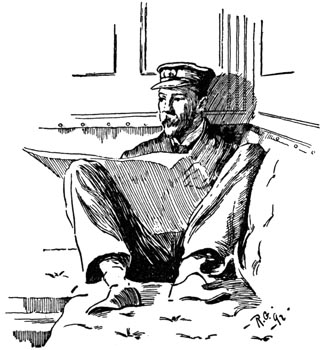
That afternoon the subject of influenza formed a principal theme in the smoking-room of the “Rhine.” Our Fourth Officer said:
“Probably I am better qualified to discuss it than any of you men; for, two years ago, I had a most violent attack of Russian influenza in Russia. Mere English, suburban influenza is child’s-play by comparison. I suffered at Odessa on the Black Sea, and my temperature went up to just under two hundred, and I singed the bed-clothes. A friend of mine, an old shipmate, had it at the same place; and his temperature went considerably over two hundred, and he set his bed-clothes on fire and was burnt to death, being too weak to escape.”
This reminiscence would seem to show that our Fourth Officer has at last exhausted his supplies of facts, and will now no doubt fall back on reserves of fiction; which, judged from this sample, are probably very extensive. Though few mariners turn novelists, yet it is significant, as showing the great bond of union between seafaring life and pure imagination, that those who have done so can point to most gratifying results.
“‘probably i am better qualified to discuss it than any of you.’”
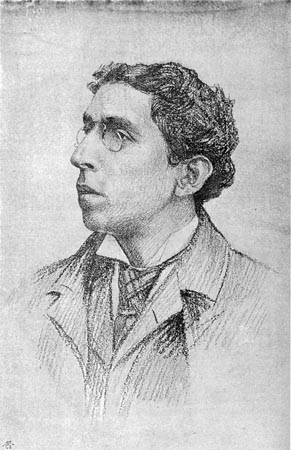
i. zangwill.