Alphonse Daudet at Home.
Reading edition
By Marie Adelaide Belloc.
Illustrations by Jan Berg, J. Barnard Davis, and E. M. Jessop.
M. and Madame Alphonse Daudet—for it is impossible to mention the great French writer without also immediately recalling the personality of the lady who has been his best friend, his tireless collaboratrice, and his constant companion during the last twenty-five years—have made their home on the top storey of a fine stately house in the Rue de Belle Chasse, a narrow old-world street running from the Boulevard Saint Germain up into the Quartier Latin.
madame daudet.
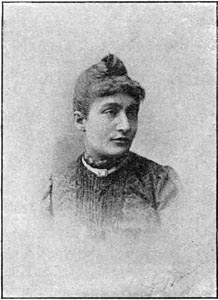
Like most houses on the left bank of the Seine, the “hotel” is built round a large courtyard, the Daudets’ pretty appartement being situated on the side furthest from the street, and commanding a splendid view of Southern Paris, whilst in the immediate foreground is one of those peaceful, quiet gardens, owned by some of the old Paris religious foundations still left undisturbed by the march of Republican time.
The study in which Alphonse Daudet does all his work, and receives his more intimate friends, is opposite the hall door, but a strict watch is kept by Madame Daudet’s faithful servants, and no one is allowed to break in upon the privacy of le maître without some good and sufficient reason. Few writers are so personally popular with their readers as is Alphonse Daudet; there is about most of his books a strange magnetic charm, and every post brings him quaint, curious, and often pathetic, epistles from men and women all over the world, and of every nationality, discussing his characters, suggesting alterations, offering him plots, and asking his advice on their own most intimate cases of conscience, whilst, if he were to grant all the requests for personal interviews which come to him day by day, he would literally have not a moment for work or leisure.
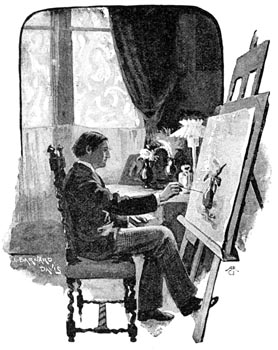
daudet at work.
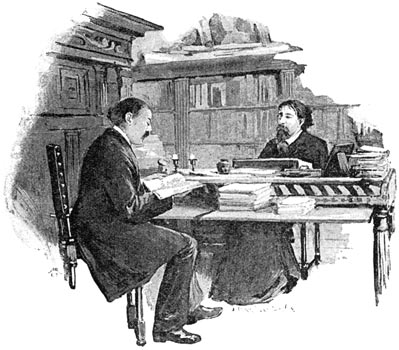
But to those who have the good fortune of his acquaintance, M. Daudet is the most delightful and courteous of hosts, and, though rarely alluding to his own work in conversation, he will always answer those questions put to him to the best of his ability, and as one who has thought much and deeply on most subjects of human interest.
The first glance shows you that Daudet’s study is a real work room; there is no straining after effect; the plain, comfortable furniture, including the large solid writing table covered with papers, proofs, literary biblots, and the various instruments necessary to his craft, were made and presented to him by a number of workmen, his military comrades during the war, and serve to perpetually remind him of what, he says, has been the most instructive and intensely interesting period of his life. “That terrible year,” I have heard him exclaim more than once, “taught me many things. It was then for the first time that I learned to appreciate our workpeople, le peuple. Had it not been for what I then went through, one whole side of good human nature would have been shut to me. The Paris ouvrier is a splendid fellow, and among my best friends I reckon some of those who fought by my side in 1870.”
During those same eventful months M. Daudet made the acquaintance of the man who was afterwards to prove his most indefatigable helper; it was between one of the long waits outside the fortifications. To his surprise, the novelist saw a young soldier reading a Latin book. In answer to a question, the pioupiou explained that he had been brought up to be a priest, but had finally changed his mind and become a workman. Now, the ex seminarist is M. Daudet’s daily companion and literary agent; it is he who makes all the necessary arrangements with editors and publishers, and several of Daudet’s later writings have been dictated to him.
All that refers to a great writer’s methods cannot but be of interest. Daudet’s novels are really human documents, for from early youth he has put down from day to day, almost from hour to hour, all that he has seen, heard, and done. He calls his note-books “my memory.” When about to start a new novel he draws out a general plan, then he copies out all the incidents from his note-books which he thinks will be of value to him for the story. The next step is to make out a rough list of chapters, and then, with infinite care, and constant corrections, he begins writing out the book, submitting each page to his wife’s criticism, and discussing with her the working out of every incident, and the arrangement of every episode. Unlike most novelists, M. Daudet does not care to always write on the same paper, and his manuscripts are not all written on paper of the same size. Of late he has been using some large, rough hand-made sheets, which Victor Hugo had specially made for his own use, and which have been given to M. Daudet by Georges Hugo, who knew what a pleasure his grandfather would have taken in the thought that any of his literary leavings would have been useful to his little Jeanne’s father-in-law, for it will be remembered that Léon Daudet, the novelist’s eldest child, married some three years ago “Peach Blossom” Hugo, for whom was written L’Art d’être Grand-père.
Although M. Daudet takes precious care of his little note-books, both past and present, he has never troubled himself much as to what became of the fair copies of his novels. They remain in the printers’ and publishers’ hands, and will probably some day attain a fabulous value.
His handwriting is clear, and somewhat feminine in form, and he always uses a steel pen. Till his health broke down he wrote every word of his manuscripts himself, but of late he has been obliged to dictate to his wife and two secretaries; re-writing, however, much of his work in the margin of the manuscript, and also adding to, and polishing, each chapter in proof, for no writer pays more attention to style and chiselled form than the man who has been called the French Dickens, and whose compositions, to the uninitiated, would seem to be singularly spontaneous.
Since the war M. Daudet has never had an hour’s sleep without artificial aid, such as chloral; but devotees of Lady Nicotine will be interested to learn that in answer to a question he once said, “I have smoked a great deal while working, and the more I smoked the better I worked. I have never noticed that tobacco is injurious, but I must admit that, when I am not well, even the smell of a cigarette is odious.” He added that he had a great horror of alcohol as a stimulant for work, and has ofttimes been heard to say that those who believe in working on spirits had better make up their minds to become total abstainers if they hope to achieve anything in the way of literature.
Unlike most literary ménages, M. and Madame Daudet are one of those happy couples who are said by cynics to be the exceptions which prove the rule. Literary men are proverbially unlucky in their helpmates; and geniuses have been proved again and again to reserve their fitful humours and uncertain tempers for home use. M. and Madame Daudet are at once sympathetic, literary partners, and the happiest of married couples; in L’Enfance d’une Parisienne, Enfants et Mères, and Fragments d’un Livre Inédit, Madame Daudet has proved that she is in her own way as original and delicate an artist as her husband. She has never written a novel, but, as a great French critic once aptly remarked, “Each one of her books contains the essence of innumerable novels.” Her literary work has been an afterthought, an accident; she is not anxious to make a name by her writing, and her most intimate friends have never heard her mention her literary faculty; like most Frenchwomen, a devoted mother, when not helping her husband, she is absorbed in her children, and whilst her boys were at the Lycée she taught herself Latin in order to help them prepare their lessons every evening; and she is now her young daughter’s closest companion and friend.
One of the most charming characteristics of Alphonse Daudet is his love for, and pride in, his wife. “I often think of my first meeting with her,” he will say. “I was quite a young fellow, and had a great prejudice against literary women, and especially against poetesses, but I came, saw, and was conquered, and,” he will conclude smiling, “I have remained under the charm ever since.... People sometimes ask me whether I approve of women writing; how should I not, when my own wife has always written, and when all that is best in my literary work is owing to her influence and suggestion. There are whole realms of human nature which we men cannot explore. We have not eyes to see, nor hearts to understand, certain subtle things which a woman perceives at once; yes, women have a mission to fulfil in the literature of to-day.”
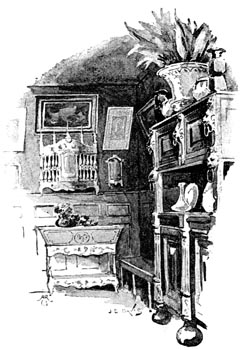
the provençal furniture.
Strangely enough, M. Daudet made the acquaintance of his future wife through a favourable review he wrote of a volume of verse published by her parents, M. and Madame Allard. They were so pleased with the notice that they wrote and asked the critic to come and see them. How truly thankful the one time critic must now feel that he was inspired to deal gently by the little bouquin.
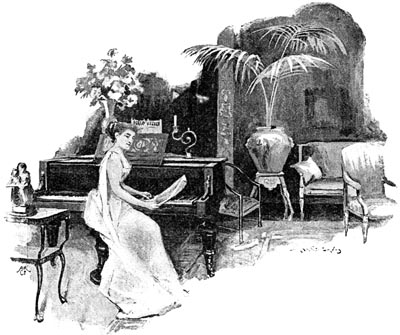
Madame Daudet is devoted to art, and her pretty salon is one of the most artistic intérieurs in Paris, whilst the dining-room, fitted up with old Provençal furniture, looks as though it had been lifted bodily out of some fastness in troubadour land.
The tie between the novelist and his children is a very close one; he has said of Léon that there stands his best work; and, indeed, the young man is in a fair way to make his father’s words come true, for, inheriting much of both parents’ literary faculty, M. Léon Daudet lately made his débût as a novelist with Hœrès, a remarkable story with a purpose, in which the author strove to explain his somewhat curious theories on the laws of heredity. Having originally been intended for the medical profession, he takes a special interest in this subject. It is curious that three such distinct and different literary gifts should exist simultaneously in the same family.
As soon as even the cool, narrow streets of the Quartier Latin begin to grow dusty and sultry with summer heat, the whole Daudet family emigrate to the novelist’s charming country cottage at Champrosay. There old friends, such as M. Edmond de Goncourt, are ever made welcome, and life is one long holiday for those who bring no work with them. Daudet himself has described his country home as being “situated thirty miles from Paris, at a lovely bend of the Seine, a provincial Seine invaded by bulrushes, purple irises, and water-lilies, bearing on its bosom tufts of grass, and clumps of tangled roots, on which the tired dragon-flies alight, and allow themselves to be lazily floated down the stream.”
the drawing room.
It was in a round, ivy-clad pavilion overhanging the river that le maître du logis wrote L’Immortel. On an exceptionally fine day he would get into a canoe, and let it drift among the reeds, till, in the shadow of an old willow-tree, the boat became his study, and the two crossed oars his desk. Strange that so bitter and profoundly cynical a study of modern Paris life should have been evolved in such surroundings, whilst the Contes de Mon Moulin, and many other of his most ideal nouvelles, were written in the sombre grey house where M. and Madame Daudet lived during many years of their early married life.
The author of Les Rois en Exile has not yet utilised Champrosay as a background to any of his stories; he takes notes, however, of all that goes on in the little village community, much as he did in the Duc de Morny’s splendid palace, and in time his readers may have the pleasure of perusing an idyllic yet realistic picture of French country life, an outcome of his summer experiences.
Alphonse Daudet was born just fifty-three years ago in the sunlit, white bâtisse at Nimes, which he has described in the painful, melancholy history of his childhood, entitled Le Petit Chose. At an age when other French boys are themselves lycéans, he became usher in a kind of provincial Dotheboys Hall; and some idea of what the sensitive, poetical lad went through may be gained by the fact that he more than once seriously contemplated committing suicide. But fate had something better in store for le petit Daudet, and his seventeenth birthday found him in Paris sharing his brother Ernest’s garret, having arrived in the great city with just forty sous remaining of his little store, after spending two days and nights in a third-class carriage.
Even now, there is a touch of protection and maternal affection in the way in which Ernest Daudet regards his younger brother, and the latter never mentions his early struggles without recalling the self-abnegation, generous kindliness, and devotion of “mon frère.” The two went through some hard times together. “Ah!” says the great writer, speaking of those days, “I thought my brother passing rich, for he earned seventy-five francs a month by being secretary to an old gentleman at whose dictation he took down his memoirs.” And so they managed to live, going occasionally to the theatre, and seeing not a little of life, on the sum of thirty shillings a month apiece!
When receiving visitors, the author of Tartarin places himself with his back to the light on one of the deep, comfortable couches which line the fireplace of his study, but from out the huge mass of his powerful head, surrounded by the lionese mane, which has become famous in his portraits and photographs, gleam two piercing dark eyes, which, like those of most short-sighted people, seem to perceive what is immediately before them with an extra intensity of vision.
To ask one who has far outrun his fellows what he thinks of the race seems a superfluous question. Yet, in answer as to what he would say of literature as a profession, M. Daudet gave a startlingly clear and decided answer.
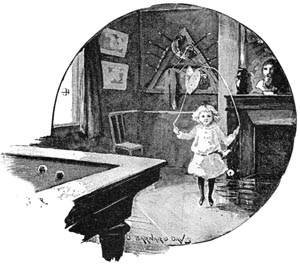
the billiard and fencing room.
“The man who has it in him to write will do so, however great his difficulties, but I would never advise any young fellow to make literature his profession, and I think it is nothing short of madness to give up a good chance of making your livelihood in some other, though perhaps less congenial, fashion, in order to pursue the calling of letters. You would be surprised if you knew the number of young people who come to me for sympathy with their literary aspirations, and as for the manuscripts submitted to me, the sending of them back keeps one of my friends pretty busy, for of late years I have had to refuse to look at anything sent to me in this way. In vain I say to those who come to consult me, ‘However much occupied you are with your present way of earning a livelihood, if you have it in you to write anything you will surely find time to do it.’ They go away unconvinced, and a few months later sees them launched on the perilous seas of journalism; with now really not a moment to spare for serious writing! Of course, if the would-be writer has already an income, I see no reason why he should not give himself up to literature altogether. It was in order to provide a certain number of coming geniuses with the wherewithal to find at least spare time in which to write possible masterpieces, that my friend Edmond de Goncourt and his brother Jules conceived the noble and unselfish idea to found an institute, the members of which would require but two qualifications, poverty and exceptional literary power. If a would-be writer can find someone who will assist him in this manner, well and good; but no one is a prophet in his own country, and friends and relations are, as a rule, most unwilling to waste good money on their young literary acquaintances. Still I admit that the Academie de Goncourt would fulfil a want, for there have been, and are, great geniuses who positively cannot produce their masterpieces from bitter poverty.”
“Then do you believe in journalism as a stepping-stone to literature?”
“I cannot say that I do, though, strangely enough, there is scarcely one of us—I allude to latter-day French novelists and critics—who did not spend at least a portion of his youth doing hard, pot-boiling newspaper work. But I deplore the necessity of a novelist having to make journalism his start in life, for, as all newspaper writing has to be done against time, his style must certainly deteriorate, and his literature becomes journalese.”
“What was your own first literary essay, M. Daudet?”
“You know I was born a poet, not a novelist; besides, when I was a lad everyone wrote poetry, so I made my débût by a book of verse entitled Mes Amoureuses. I was just eighteen, and this was my first stroke of luck; for six weary months I had carried my poor little manuscript from publisher to publisher, but, strange to say, I never got further than these great people’s ante-chamber; at last, a certain Tardieu, a publisher who was himself an author, took pity on my Amoureuses. The title had been a happy inspiration, and the volume received some favourable notices, and led indirectly to my getting journalistic work.”
Indeed, it seems to have been more or less of an accident that M. Daudet did not devote himself entirely to poetry; and probably the very poverty which seemed so bitter to him during his youth obliged him to try what he could do in the way of story-writing, that branch of literature being supposed by the French to be the best from a pecuniary point of view. So remarkable were his verses felt to be by the critics of the day, that one of them wrote, “When dying, Alfred de Musset left his two pens as a last legacy to our literature—Feuillet has taken that of prose; into Daudet’s hand has slipped that of verse.”
But some years passed before the poet-journalist became the novelist; at one time he dreamed of being a great dramatist, and before he was five-and-twenty several of his plays had been produced at leading Paris theatres. Fortune smiled upon him, and he was appointed to be one of the Duc de Morny’s secretaries, a post he held four years, and which supplied him with much valuable material for several of his later novels, notably Les Rois en Exile, Le Nabab, and Numa Romestan, for during this period he was brought into close and intimate contact with all the noteworthy personages of the Third Empire, making at the same time the acquaintance of most of the literary lions of the day—Flaubert, with whom he became very intimate; Edmond and Jules de Goncourt, the two gifted brothers who may be said to have founded the realistic school of fiction years before Emile Zola came forward as the apostle of realism; Tourguenieff, the two Dumas, and many others who welcomed enthusiastically the young Southern poet into their midst.
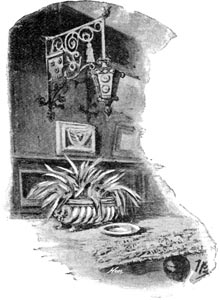
the tuileries stone.
The first page of Le Petit Chose was written in the February of 1866, and was finished during the author’s honeymoon, but it was with Fromont Jeune et Risler Ainé, published six years later, that he made his first real success as a novelist, the work being crowned by the French Academy, and arousing a veritable enthusiasm both at home and abroad.
Alphonse Daudet is not a quick worker; he often allows several years to elapse between his novels, and refuses to bind himself down to any especial date. Tartarin de Tarascon was, however, an exception to this rule, for the author wrote it for Messrs. Guillaume, the well-known art publishers, who, wishing to popularise an improved style of illustration, offered M. Daudet 150,000 francs (£6,000) to write them a serio-comic story. Tartarin, which obtained an instant popularity, proved the author’s versatility, but won him the hatred of the good people of Provence, who have never forgiven him for having made fun of their foibles. On one occasion a bagman, passing through Tarascon, put, by way of a jest, the name “Alphonse Daudet” in his hotel register. The news quickly spread, and had it not been for the prompt help of the innkeeper, who managed to smuggle him out of the town, he might easily have had cause to regret his foolish joke.
Judging by sales, Sapho has been the most popular of Daudet’s novels, for over a quarter of a million copies have been sold. Like most of his stories, its appearance provoked a great deal of discussion, as did the author’s dedication “To my two sons at the age of twenty.” But, in answer to his critics, Daudet always replies, “I wrote the book with a purpose, and I have succeeded in painting the picture as I wished it to appear. Each of the types mentioned by me really existed; each incident was copied from life....”
The year following its publication M. Daudet dramatised Sapho, and the play was acted with considerable success at the Gymnase, Jane Hading being in the title-rôle. Last year the play was again acted in Paris, with Madame Rejane as the heroine.
daudet’s younger son.
M. Daudet, like most novelists, takes a special interest in all that concerns dramatic art and the theatre. When his health permits it he is a persistent first-nighter, and most of his novels lend themselves in a rare degree to stage adaptation.
I once asked him what he thought of the attempts now so frequently made to introduce unconventionality and naked realism on the stage.
“I have every sympathy,” he replied, “with the attempts made by Antoine and his Thêatre Libre to discover strong and unconventional work. But I do not believe in the new terms which a certain school have invented for everything; after all, the play’s the thing, whether it is produced by a group who dub themselves romantics, realists, old or new style. Realism is not necessarily real life; a photograph only gives a rigid, neutral side of the object placed in front of the camera. A dissection of what we call affection does not give so vivid an impression of the master-passion as a true love-sonnet written by a poet. Life is a thing of infinite gradations; a dramatist wishes to show existence as it really is, not as it may be under exceptionally revolting circumstances.”
His own favourite dramatist and writer is Shakespeare, whom, however, he only knows by translation, and Hamlet and Desdemona are his favourite hero and heroine in the fiction of the world, although he considered Balzac his literary master.
M. Daudet will seldom be beguiled into talking on politics. Like all Frenchmen, the late Panama scandals have profoundly shocked and disgusted him, as revealing a state of things discreditable to the Government of his country. But the creator of Désirée Dolobelle has a profound belief in human nature, and believes that, come what may, the novelist will never lack beautiful and touching models in the world round and about him.
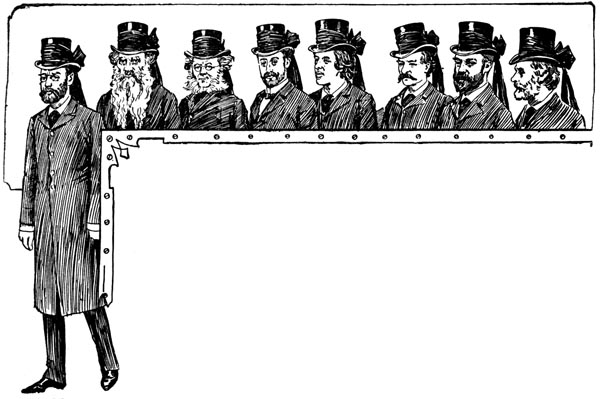
The Dismal Throng.
By Robert Buchanan.
Illustrations by Geo. Hutchinson.
(Written after reading the last Study in Literary Distemper.)
thomas hardy.
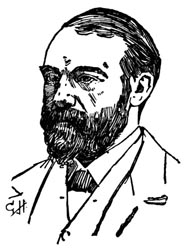
The Fairy Tale of Life is done, The horns of Fairyland cease blowing, The Gods have left us one by one, And the last Poets, too, are going! Ended is all the mirth and song, Fled are the merry Music-makers; And what remains? The Dismal Throng Of literary Undertakers!
Clad in deep black of funeral cut, With faces of forlorn expression, Their eyes half open, souls close shut, They stalk along in pale procession; The latest seed of Schopenhauer, Born of a Trull of Flaubert’s choosing, They cry, while on the ground they glower, “There’s nothing in the world amusing!”
zola.
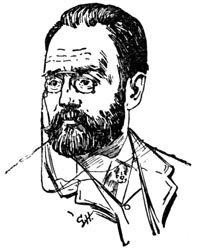
There’s Zola, grimy as his theme, Nosing the sewers with cynic pleasure, Sceptic of all that poets dream, All hopes that simple mortals treasure; With sense most keen for odours strong, He stirs the Drains and scents disaster, Grim monarch of the Dismal Throng Who bow their heads before “the Master.”
There’s Miss Matilda[1] in the south, There’s Valdes[2] in Madrid and Seville, There’s mad Verlaine[3] with gangrened mouth. Grinning at Rimbaud and the Devil. From every nation of the earth, Instead of smiling merry-makers, They come, the foes of Love and Mirth, The Dismal Throng of Undertakers.
tolstoi.
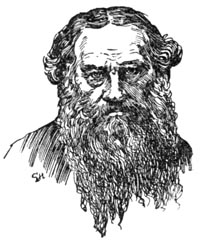
There’s Tolstoi, towering in his place O’er all the rest by head and shoulders; No sunshine on that noble face Which Nature meant to charm beholders! Mad with his self-made martyr’s shirt, Obscene, through hatred of obsceneness, He from a pulpit built of Dirt Shrieks his Apocalypse of Cleanness!
ibsen.
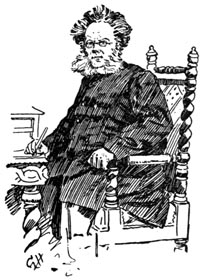
There’s Ibsen,[4] puckering up his lips, Squirming at Nature and Society, Drawing with tingling finger-tips The clothes off naked Impropriety! So nice, so nasty, and so grim, He hugs his gloomy bottled thunder; To summon up one smile from him Would be a miracle of wonder!
pierre loti.
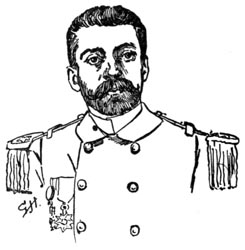
There’s Maupassant,[5] who takes his cue From Dame Bovary’s bourgeois troubles; There’s Bourget, dyed his own sick “blue,” There’s Loti, blowing blue soap bubbles; There’s Mendès[6] (no Catullus, he!) There’s Richepin,[7] sick with sensual passion. The Dismal Throng! So foul, so free, Yet sombre all, as is the fashion.
“Turn down the lights! put out the Sun! Man is unclean and morals muddy. The Fairy Tale of Life is done, Disease and Dirt must be our study! Tear open Nature’s genial heart, Let neither God nor gods escape us, But spare, to give our subjects zest, The basest god of all—Priapus!”
The Dismal Throng! ’Tis thus they preach, From Christiania to Cadiz, Recruited as they talk and teach By dingy lads and draggled ladies; Without a sunbeam or a song, With no clear Heaven to hunger after; The Dismal Throng! the Dismal Throng! The foes of Life and Love and Laughter!
By Shakespere’s Soul! if this goes on, From every face of man and woman The gift of gladness will be gone, And laughter will be thought inhuman! The only beast who smiles is Man! That marks him out from meaner creatures! Confound the Dismal Throng, who plan To take God’s birth-mark from our features!
Manfreds who walk the hospitals. Laras and Giaours grown scientific, They wear the clothes and bear the palls Of Stormy Ones once thought terrific; They play the same old funeral tune, And posture with the same dejection, But turn from howling at the moon To literary vivisection!
oscar wilde.
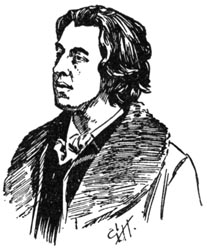
And while they loom before our view, Dark’ning the air that should be sunny, Here’s Oscar,[8] growing dismal too, Our Oscar, who was once so funny! Blue china ceases to delight The dear curl’d darling of society, Changed are his breeches, once so bright, For foreign breaches of propriety!
george moore.
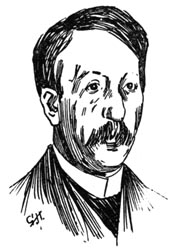
I like my Oscar, tolerate My Archer[9] of the Dauntless Grammar, Nay, e’en my Moore[10] I estimate Not too unkindly, ’spite his clamour; But I prefer my roses still To all the garlic in their garden— Let Hedda gabble as she will, I’ll stay with Rosalind, in Arden!
O for one laugh of Rabelais, To rout these moralising croakers! (The cowls were mightier far than they, Yet fled before that King of Jokers) O for a slash of Fielding’s pen To bleed these pimps of Melancholy! O for a Boz, born once again To play the Dickens with such folly!
mark twain.
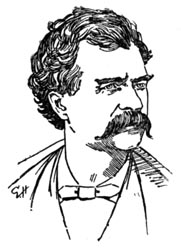
Yet stay! why bid the dead arise? Why call them back from Charon’s wherry? Come, Yankee Mark, with twinkling eyes, Confuse these ghouls with something merry! Come, Kipling, with thy soldiers three, Thy barrack-ladies frail and fervent, Forsake thy themes of butchery And be the merry Muses’ servant!
Come, Dickens’ foster-son, Bret Harte! Come, Sims, though gigmen flout thy labours! Tom Hardy, blow the clouds apart With sound of rustic fifes and tabors! Dick Blackmore, full of homely joy, Come from thy garden by the river, And pelt with fruit and flowers, old boy, These dismal bores who drone for ever!
george meredith.
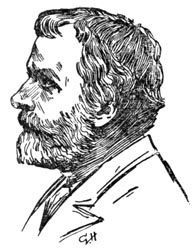
Come, too, George Meredith, whose eyes, Though oft with vapours shadow’d over, Can catch the sunlight from the skies And flash it down on lass and lover; Tell us of Life, and Love’s young dream, Show the prismatic soul of Woman, Bring back the Light, whose morning beam First made the Beast upright and human!
You can be merry, George, I vow! Wit through your cloudiest prosing twinkles! Brood as you may, upon your brow The cynic, Art, has left no wrinkles! For you’re a poet to the core, No ghouls can from the Muses win you; So throw your cap i’ the air once more, And show the joy of earth that’s in you!
By Heaven! we want you one and all, For Hypochondria is reigning— The Mater Dolorosa’s squall Makes Nature hideous with complaining! Ah! who will paint the Face that smiled When Art was virginal and vernal— The pure Madonna with her Child, Pure as the light, and as eternal!
Pest on these dreary, dolent airs! Confound these funeral pomps and poses! Is Life Dyspepsia’s and Despair’s, And Love’s complexion all chlorosis? A lie! There’s Health, and Mirth, and Song, The World still laughs, and goes a-Maying— The dismal, droning, doleful Throng Are only smuts in sunshine playing!
Play up, ye horns of Fairyland! Shine out, O sun, and planets seven! Beyond these clouds a beckoning Hand Gleams from the lattices of Heaven! The World’s alive—still quick, not dead, It needs no Undertaker’s warning; So put the Dismal Throng to bed, And wake once more to Light and Morning!
Note.—These verses refer to a literary phenomenon that will in time become historical, that phenomenon being the sudden growth, in all parts of Europe, of a fungus-literature bred of Foulness and Decay; and contemporaneously, the intrusion into all parts of human life of a Calvinistic yet materialistic Morality. This literature of a sunless Decadence has spread widely, by virtue of its own uncleanness, and its leading characteristics are gloom, ugliness, prurience, preachiness, and weedy flabbiness of style. That it has not flourished in Great Britain, save among a small and discredited Cockney minority, is due to the inherent manliness and vigour of the national character. The land of Shakespere, Scott, Burns, Fielding, Dickens, and Charles Reade is protected against literary miasmas by the strength of its humour and the sunniness of its temperament.—R.B.