THE HORSE’S MOUTH,
Reading edition
SHOWING THE AGE
BY
THE TEETH.
1. That the teeth of the horse denoted the age of the animal appears to have been a very ancient belief, which the experience of centuries seems in no degree to have weakened. As a general rule, applied within certain limitations, the impression is certainly well founded; for perhaps no development is more regular than the teeth of the horse, and no natural process so little exposed to the distortions of artifice. We are, nevertheless, not to expect that the animal carries about in its mouth a certificate of birth, written in characters so deep or legible that they cannot be obliterated or misinterpreted. The indications to be discovered by an inspection of the mouth of the horse, however, are so generally true, that in these dependence may be placed; although they are not so arbitrary or invariable, that upon them in every instance an absolute opinion can hastily be pronounced. He who would judge of the age by the teeth, must therefore be content to study and prepared to encounter difficulties. In proportion as he has done the one, and is fortified thereby to overcome the other, will be his success. There is no secret charm which will enable man to unravel Nature’s mysteries. Her ways are regular, but they are not uniform—her laws are fixed, but her acts cannot be measured by a system of rule or compass. The qualified judge alone will read the teeth correctly; but in proportion as the task is difficult, will be the candour and caution of him who fulfils it properly. He will make allowance where certain marks are indistinct or absent—he will not feel himself degraded by a confession of inability to speak with certainty when the signs are complex or confused—and above all, he will be cautious before he pronounces a final opinion, and gives it forth as a decision, against which there ought to be no appeal. The Veterinary Practitioner knows from repeated trials, tested by long experience, that the teeth of the horse are worthy of attention; he feels that their indications, scientifically interpreted, will seldom mislead; but he does not regard them with a reverence resembling that originating from an antiquated superstition, or look upon them as the exemplifications of a principle which admits of no exceptions.
2. In every case the evidence of the teeth is secondary to direct and substantiated testimony; for as there is no limit to possibility, so no man can be prepared to say what Nature may or may not do. In the absence, however, of positive and corroborated testimony, the teeth become the best evidence, and that on which reliance should be placed. When opposed to the indications of the mouth, the oath of a single individual, for obvious reasons, would be of no weight. A foal can hardly be born without many parties being cognizant of the fact—the colt cannot change its master without several persons being made aware of the transaction—and horses, for honest purposes, are not generally sold or bought in secret. Proof of the age can generally be adduced, if the parties interested think proper to seek it; or when it is not possible to adduce such proof, the teeth deserve more confidence than an uncorroborated assertion. An individual may be interested to mis-state, or may be mistaken in his belief; whereas the teeth, being natural growths, are removed from such suspicions.
3. Some of the causes which induce certain persons to doubt the possibility of the horse’s age being accurately told from the teeth, are not difficult to explain away. The Jockey Club has seen reason to declare, that all thorough-bred animals shall be born on the 1st of January, or if any should make their appearances at a later period, such shall be esteemed one year old when the 31st of December has expired. All blood horses have but one birth-day, nor do they in that respect differ from their brethren of the coarser breeds; only those of the last description are supposed to begin their existences upon the 1st of May. If a racer has seen six Januaries, it is said to be six years old; and if a nag had looked upon half a dozen Mays it would be pronounced to be of a similar age. These customs are convenient, as affording a point from which to date the age of an animal; but under such regulations, confusion will and does frequently arise. In a long number of years, a few months may be of little importance; but at the earlier period the difference of several weeks may, in the calculation of the age, be a serious matter. I will endeavour to show how far, in an extreme case, confusion may be created by the operation of these customs, and to prove, that he who should read the teeth correctly, would be unable to satisfactorily pronounce the accepted age of a colt. According to the received laws, a blood foal dropt on the 31st of December, and a foal not thorough-bred, born on the 30th of April, would each, the second day of life, complete the first year of its existence. Let it be supposed that a blood mare bore a foal in the latter end of December—the animal would be entered in the stud book according to the year of its birth, but for obvious reasons could never be put into training; it would be kept until another January arrived, when, although but one year and a few days of age, it could, in strict accordance with the established custom, be sold as a two-year-old; and the entry being in the stud book, of course the point would not be disputed. The colt is bought and taken into an ordinary stable, where all the horses not being thorough-bred advance a year when the 1st of May appears; and when that day dawns, the blood colt, not eighteen months of age, rising with the rest, is called three years off. Now in such a case, the man who judged by the teeth would be certain to be wrong; and if it is possible under any circumstances for truth to be discredited, we may imagine that many apparent mistakes would, on inquiry, be cleared up. The age of a horse is seldom correctly stated even in a court of law. Witnesses swear by the customs of men, and it never seems to occur to them that Nature has not yet given in her adherence to the codes by which their consciences are narcotized. Horses are born at all times and seasons. The regular breeder, it is true, takes care towards the observance of the regulations; but all who may think proper to have “a foal out of the old mare when she’s done up for work,” are by no means nice in that particular. Stallions are paraded for “service” in the autumn, and there are to be found men who will argue stoutly in favour of a “late get.”
4. The teeth more frequently contradict an arbitrary calculation than disagree with fact. The mouth declares only the positive age, reckoned from the actual day of birth, and I know of no evidence of a similar description which may be more confidently trusted. Occasional exceptions are to be found, and of these notice will be hereafter taken; such exceptions, however, are not sufficiently frequent to upset the rule, and were the testimony of the teeth to be rejected, I know of no other that could be substituted. We are therefore necessitated to retain the test, and consequently should know how to apply it. Almost every one within or about the stable pretends to be able to do this, but some even of those who have studied the subject are not capable of doing it correctly. The evidence is often true when the judgment is false, and in this circumstance, perhaps, lies the chief danger of the test. A knowledge of the teeth is by no means universal; but where that knowledge is profound, though the test may seldom disappoint, yet because it will occasionally do so, the indications of the mouth ought to be corroborated. To proceed summarily (as in the case of the Queen of Cyprus) upon an inspection of the teeth, is certainly not justifiable, since the mouth may possibly be eccentric, or the judgment pronounced upon it may be erroneous. The teeth in every horse case are of importance. The suggestions to which they give rise should not be disregarded; yet at the same time no opinion of a final kind should be based upon their showing. The utmost that the inspection of the teeth could warrant is a doubt, certainly a strong one, as to the reported age of the animal. That doubt would justify inquiry, and the teeth can substantiate no more than the right to inquire. Some may be disposed to think that such a right would not be worth possessing; but it must be remembered, that until the inquiry were ended, no decision as to the qualification of the animal could be arrived at. A valid doubt would have been created. Let the owner of the suspected horse dispel it, or the party who is interested to do so have time to seek the evidence which would convert it into certainty. The umpire, on the showing of the teeth, would be bound to withhold his judgment, not called upon to decide. Were such the rule, all fear of injustice would be guarded against; and as gentlemen connected with the turf cannot endure suspicion, and are not very patient of delay, those who were the owners of animals, the mouths of which presented any peculiarities, ought to notify the fact some days before the horses started. By forbearing to do so, gentlemen expose themselves to accusation. By examining the animal at the moment of starting, and founding a decision thereon, no good can be done, but injustice may be perpetrated; for supposing the suspected horse is pronounced to exhibit the tokens of the lawful age, the inspection of its mouth by a stranger may, by exciting its irritability, lose the race. At the same time, to permit an unqualified animal to start, would be unjust; and therefore the greater necessity for such a timely inspection as would allow of a preliminary investigation of the proofs that could be brought forward in contradiction of the teeth. These suggestions are made with the less hesitation, as the writer feels that were they adopted, few cases would spring out of them; for the mouths of racers are so regular in their development, that the age of this description of animal can with more certainty be pronounced than that of any other kind of horse.
5. For the security of the purchaser of a horse not connected with the turf, the teeth are a sufficient guard, and their indications, when properly understood, may be confidently acted upon. This opinion is put forth after a matured consideration of the subject, and probably there is no dealer who would dissent from the decision at which the author has arrived. The purchasers possibly may, on reflection, see less reason to be satisfied, because the teeth would, perhaps, in many instances, seem to favour the interest opposed to theirs. Let the matter, however, be deliberately weighed, and perhaps it may be found that neither party is likely to gain considerably, or to be seriously injured. In ordinary trade, the word of the seller is not much regarded; but in horse transactions, the assertion of the dealer is never received. One source of evidence is therefore discarded, and some other must be sought. Now, where horses are concerned, even the oaths of men appear to be of little force; “hard” swearing is expected in every business of that nature, and such expectation almost disqualifies all those persons to whose testimony the dealer could appeal. Let it be remembered that it is not the dealer who refuses to give evidence, or to adduce it; but the purchaser, who is prejudiced against accepting it. This act on the purchaser’s part limits the proof he might demand; for as attestation is rejected by him, not denied to him, he is by his conduct left without cause of complaint, and bound to seek the evidence which he will accept. Such evidence he looks for in the mouth of the animal, and is seldom deceived when capable of interpreting it. The teeth, in fact, are the only testimony that his caution leaves him to decide upon; and it will be hereafter shown, that even when the teeth are early in their development, the purchaser is not virtually wronged. All men, however, seek to arm themselves by suspicion, when dealing in horse-flesh; and the tricks that are played upon the teeth, rise immediately to the mind. Such tricks certainly are played, but they are assuredly more talked about than practised. There is a superstitious idea afloat, that breeders can make horses appear of any age they please, by torturing the mouths of the poor animals. The folly of such a belief will be exposed in another part of this work; it is sufficient for the present to state, that the credulity of the public in this matter has no foundation. A colt cannot be made by any barbarity to look like a horse; and an old horse cannot be forced to exhibit the mouth of a colt. That attempts are made to disguise the teeth, and that such attempts occasionally impose upon the buyer, is not denied; but all of such practices are shallow in the extreme, and so easily detected, that the person deceived by them is not an object of pity. If people will presume to judge before they have learnt to recognize, their temerity is more to be blamed than its consequence is to be commiserated. No one goes to buy a horse unwarned of the dangers that will surround him; and if in his conceit he rather prefers to hazard these than to seek protection, what right has he to murmur at a result which it needed no conjurer to foretell? Is there any market in the world where ignorance is secure from imposition? The world is not yet so honest that the affairs of the horse mart are a subject worthy of its special wonder; and it may be doubted if the principles which regulate the conduct of the horse dealer, are not those which influence the transactions of the most honourable traders. There are men of the highest character living by the sale of horses; and it is creditable to humanity, that after all of a certain class have been unscrupulously stigmatized and openly reproached, there may still among its members be found, beings preserving honour for the sake of itself alone. The liberal public, however, in its wisdom, has pronounced the character of the horse dealer; it has rejected his attestations, and refused to listen to the testimony of those with whom he has communication. The age of a horse is not taken from the mouth of its owner, but looked for in that of the animal. This mode of procedure is convenient—the record is at hand, the evidence brief, and the decision to which it leads is that to which the purchaser by choice appeals. The dealer stands by and knows that his voice is to be restrained. The teeth denote the age, and when the word of the owner is not to be accepted, there is no other evidence at hand. Were additional proof to be required, in some instances it could not be procured, and in the majority its production would be attended with an expense perhaps equal to the price of the horse which it concerned. The expence, the seller of course could not be expected to bear, and the buyer equally would resist its infliction. Nothing is more high priced than absolute proof of any kind; and there is always a further difficulty in the difference of opinion which prevails, as to what constitutes absolute proof. A cursory glance at the matter is enough to convince us, that the custom of inspecting the teeth of the horse to ascertain the age of the animal, is one which has had its origin in necessity. Experience has taught that the mouth of the horse affords the most satisfactory evidence, and the author’s investigations on this subject have convinced him that the public need require no better or more conclusive testimony. The reader, however, before he ventures to abide by his own interpretation of the signs which the horse’s teeth exhibit, must be content to study, and prepared to find the task somewhat difficult. All that can be done to render the subject plain and clear, the author will attempt.
6. The description of the teeth cannot be rendered pleasing; but as it is a necessary part of the subject, the reader must exert his patience, while the matter is briefly discussed. Teeth are anatomically classed with bones, which in many respects they resemble. A tooth is divided into two parts, or into crown and fang. The crown is that portion which projects above the gum into the mouth; therefore so much as can be seen while the animal lives, is the crown of the tooth. The fang, the end of which is called the root, is that part of the tooth which is hidden from view, and is inserted into the jaw. For the convenience of description, however, other portions of the tooth have received distinct names, and the neck and table are spoken of. The neck is that portion of the tooth which is immediately surrounded by the gum. The table is the upper surface, or the part which touches the corresponding tooth of the opposing jaw when the mouth is closed. Such is the division made, and it will hereafter be found to assist the description of the various changes which the teeth undergo.
7. The teeth are situated in the maxillary bones, in which certain osseous cups, like indentations or holes, called the alveolar cavities, are developed for their reception. Each tooth has its separate cavity, and however close the crowns may appear, nevertheless each fang is divided from those before and behind by bony plates. The alveolar cavity always corresponds to the fang. As the fang alters in form, or diminishes in length, so does the shape of the cavity simultaneously change; and should the tooth be removed, the space, no longer needed, is filled up; the alveolar cavity being obliterated by a growth of bony matter.
8. Teeth are organised, that is, they possess nerves, arteries, veins, and absorbents, or are endowed with those vessels needed to resist decay, and to promote nutrition. That a tooth possesses nerves, no one who has submitted to have these members filed by the dentist, or who has endured the tooth-ache, can for an instant doubt; and that they are even, in some degree, susceptible of external impressions, the sensation produced by certain acids seems to render probable. The growth they exhibit shows they are gifted with arteries and veins; and these vessels can be traced directly to and from, though not unto, their substance. The existence of absorbents some have doubted; but the removal by nature of the fangs of the temporary teeth, clearly testifies the presence of these vessels.
9. The horse possesses forty teeth, viz., twelve incisors, four tushes, and twenty-four molars. The incisors, sometimes called nippers, are those which, situated in front of the mouth, are seen when the lips are parted. They are the instruments, by means of which the animal bites its food, and are placed six in the upper, and six in the lower jaw. They are classed as pairs, being generally cut or developed after that fashion. The middle two, in both jaws, are called the centre incisors; the two most backward, on either side of the mouth, the corner incisors; and the teeth, by which the corners and centres are separated, the lateral incisors. Of the tushes, the two placed in the lower jaw are the most forward. These teeth, which are sometimes termed canines, and sometimes cuspidati, (from cuspis, a point,) are isolated, appearing in the space which divides the incisors from the molars. They are only fully developed in the male, the mare often being without any indication of them, and never displaying them in so prominent a degree as the horse. Their use is not very apparent, but they certainly would be employed in those combats to which stallions seem naturally predisposed, and would render the grasp, and the wound it could inflict, more severe. Because the mare is of a more pacific temperament, Nature seems to have denied to her a perfect tush, by the presence or absence of which, the sex is indicated by the mouth, and upon which castration appears to exercise no influence, since the gelding has as well-formed a tush as the perfect male. The molars are ranged in companies of six, one company on either side of the upper, and a like number similarly situated in the lower jaw. The molars are the instruments which enable the horse to grind down the fibrous and hard food upon which it subsists, and they are distinguished by their locality, as first, second, third, fourth, fifth, or sixth molar tooth of the near or off side in the upper or lower jaw; the first being that growing in front, or nearest to the incisors, and the sixth that placed most backward in the cavity of the mouth.
10. Three substances enter into the composition of the horse’s tooth. Each of these substances is distinct, and can be distinguished from either of the others. The names given to the various parts are—1, crusta petrosa, or hard crust; 2, enamel; and 3, ivory.
11. The crusta petrosa is the most externally situated, and when the tooth first appears in the mouth, it is entirely coated by this substance, having a somewhat dull and dark appearance, which is only lost when the hard crust is removed by attrition, and the enamel thereby exposed. In amount, the crusta petrosa is second to the ivory, being more in quantity than the enamel. In composition, it is characterized by containing a great amount of animal substance; and, in structure, it is peculiar for exhibiting, under the microscope, numerous corpuscles or cells, from which pores or minute tubes appear to radiate. Within the alveolar cavity, the crusta petrosa, which around the fang becomes of considerable thickness, is of a yellowish white colour; but where, in connexion with the crown of the tooth, it is exposed to the chemical action of the food and air, it presents a darker aspect and looks like an accumulation of tartar, for which indeed it has been mistaken. It fills up the infundibula of the molars of the upper jaw, and lines those of the incisors, being pierced by all the vessels which nourish the teeth. If a tooth be subjected to the action of dilute hydrochloric acid, the enamel will be removed, and the ivory and crusta petrosa be rendered separate and distinct.
12. The enamel of the horse’s tooth appears to be unorganized, and to contain no animal matter. Hydrochloric acid entirely dissolves it with a slight effervescence, and though a few and a very few threads remain, these rather seem to be connexions between the ivory and crusta petrosa, than component parts of the enamel itself. That the enamel is an unorganized substance, it may be essential to state, is asserted only of this body in the tooth of the horse; for the enamel of the cow’s tooth is of a different nature, since hydrochloric acid does not dissolve it, affect its whiteness, or destroy its form. The enamel is the least of the three components of the tooth; of a whitish semi-transparent shining aspect, it forms a thin crust to the ivory, lying immediately under the crusta petrosa, and extending nearly to the root.
13. The ivory forms the main bulk of the tooth, and though blood vessels can be traced to, but not within its substance, yet it presents numerous pores or minute canals, radiating from the centre to the circumference, which the mind naturally associates with nutrition. These pores cannot be traced to the cells or corpuscles of the crusta petrosa, though in works of high authority, drawings obviously indicating such a connexion, are presented; they are limited to the ivory, and terminate within it. What their exact use may be, is not known, but that they are of service, their presence is sufficient proof. Like the minute canals of bone, they probably convey a serous or colourless fluid, for the nutrition of the part in which they are developed.
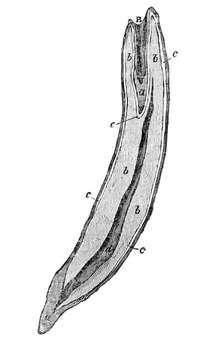
The relative positions of the various structures that enter into the composition of the incisor tooth, will be better understood by reference to the accompanying wood-cut, which represents one of those members divided down its centre:—a indicates the crusta petrosa, which can be traced to enclose the organ, and to dip down the infundibulum B. The crusta petrosa is shown to be thicker at the root of the fang, and at the base of the infundibulum, than at other parts. b denotes the ivory, which forms the principal and central portion of the tooth, in the middle of which is the darker space marked by the letter d. This last is intended to represent the cavity of the pulp, which, in the young incisor is, as in the diagram, of great length. Between the ivory b, and the crusta petrosa a, is a white line c, which indicates the position of the enamel, and will be seen to cover the upper surface of the tooth dipping into the infundibulum, but not to extend quite to the root.
14. The uses of the ivory, enamel, and crusta petrosa must be now noticed. The ivory is less dense than the enamel, and harder than the crusta petrosa. On the external surface of the incisor teeth, the crusta petrosa is, by the attrition to which this part must be subjected during the gathering of the food, soon sufficiently removed to expose a portion of the enamel: as the years of the animal increase, the outer coating is almost worn away, and not being reproduced, little of the crusta petrosa will be found on the nippers of very old horses. The ivory, however, is always nearly on a level with the enamel, notwithstanding the greater attrition which the substance forming the principal portion of the table of the tooth must necessarily endure. A sufficient indentation of the ivory, nevertheless, can be observed, to render prominent the ridge of enamel, and to indicate that the last-named material is endowed with the greatest power of resistance. The enamel, in fact, is as hard as flint, and by striking it against a steel, fire can be drawn forth. The three structures, therefore, vary in hardness, and in an opposite direction they contrast to one another in toughness. The ivory is sometimes fractured, but not frequently. I have never seen the crusta petrosa of a living tooth exhibit such an injury; but the enamel is rarely inspected without its being discovered to be more or less in a ragged, chipped, and broken condition, especially at the anterior edge of the table of the incisors.
15. The separate uses of the three component structures, however, is not well shown in the incisors; for as the crusta petrosa is by a natural process removed, and the ivory is not of essential service in cutting the food, it might be supposed that the first was no more than a temporary covering to, and the last only a basement for, the enamel. When the mind, however, is directed to the observation of the molars or double teeth, the properties and uses of all become apparent. The sense of touch in the horse resides in the lips; with those organs he gathers together the food before he grasps it with the incisors. Delicate, however, as the animal’s sense of touch is, the selection of the food is further aided by the sight and smell. The most fragrant, the softest, and the cleanest portions, therefore, are selected; but it would be too much to suppose, that no particle of dirt, sand, or grit, was ever taken into the mouth. That much is necessarily bitten, the incisors of those horses which pasture on sandy soils, afford sufficient proof, as such animals generally exhibit the anterior edges of those teeth considerably jagged or notched. In the best fields, the grass is never free from adherent impurities, and the manger, as well as the rack, is not always remarkable in that respect. All, however, that is gathered by the lips, or grasped by the incisors, passes to the molars to be comminuted and mixed with the saliva previous to being swallowed. The molars, in fact, are animal grindstones, and the different degrees of hardness which the three component substances display, by wearing unevenly, always keep the grinding surfaces irregular or sharp. The inequality of the grinding surfaces of the molars enables the horse to reduce the toughest fibre to a pulpy mass; but as many substances little less hard than the tooth itself must frequently be ground up with the food, the molars would, at first sight, appear to be subject to injury, especially as they have ten times the work of the incisors to perform, and the senses of touch, smell, and sight, cannot operate for their protection. Nature, however, has provided against the danger to which they appear to be exposed; for if, notwithstanding the guarding agency of the senses, the incisors are so often injured, the molars, blindly employed, and used when the full power of the horse’s jaw is exerted, certainly needed some provision against fracture. The crusta petrosa gives all the security that could be desired; it encircles these teeth, dips into their fissures, and fills their infundibula, forming no small part of the substance of the molars. The subjoined wood-cut will better explain the manner in which the various substances are arranged.
Fig. 1. Fig. 2.
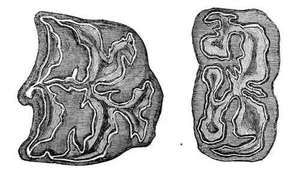
Figure 1 represents the table of one of the molars taken from the upper jaw. Figure 2 the table of a molar extracted from the lower jaw. The difference of size between the two organs is thus well marked, as also the difference of shape. The white line indicates the enamel, and the variegated substance which is encircled by it, denotes the comparative quantity and position of the ivory. The crusta petrosa is represented by the somewhat darker shade situated on the exterior of the enamel. In figure 1, however, the reader will observe two patches enclosed by white lines. These are the representatives of the two infundibula which exist in all of the molars of the upper jaw, but which are not developed in the lower teeth. The similar direction of the lines will enable the reader to connect them with the crusta petrosa, which substance, save in the newly-cut tooth, generally fills up these cavities, although the enamel lining extends almost to the root. The intricacy of the arrangement is, by this diagram, made apparent, and the purpose rendered plain. Without such a provision, the first meal of the animal consumed would probably shatter the instruments of mastication into innumerable atoms; but girded round, and bound up with the tough and resistant crusta petrosa, however hard may be the fibre the animal chews—however much of grit or sand may be contained in it—or however great may be the force by which the molars are pressed together, and made to pass at the same time from side to side—not a particle of the brittle enamel is fractured. Like a thin layer of glass, guarded between two pieces of wood, it performs its office in security; and as the necessity for the provision, towards which I have directed attention, is obvious, so is it the more strange that the thick coating of the crusta petrosa around the molars should by authors have been mistaken for an accumulation of tartar. The mistake was certainly extraordinary, as the crusta petrosa in the horse’s tooth is of physiological importance, and will presently be shown to merit the attention of the pathologist. I am aware, when making this statement, that contradiction is offered to the opinions of many and deservedly esteemed authorities; and while I regret the necessity of differing with such writers, I also lament that my opinion as to the supposed use of the outer membrane of the newly-developed organ, does not coincide with theirs. The nature of this treatise will not allow me to enter into the subject of the development of the teeth; but I may here say, that the outer membrane has been generally stated to secrete the enamel. It is that membrane which, thickening with the growth of the tooth, becomes the crusta petrosa; but with regard to its secretive powers, I do not imagine it is endowed with any function of that description, or that it is in any way concerned in the production of the enamel. My reasons for making such and so bold an assertion are well considered, not hastily advanced. I have before me the left anterior molar, taken from the jaw of a colt which was rising four. A representation of the tooth alluded to is here given.
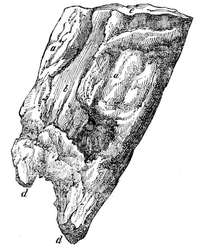
a denotes the crusta petrosa, b the outer surface of the enamel, the lines representing the plated or finely grooved aspect, which this part exhibits on its exterior. c, which letter will, on inspection, be discovered in the centre of the darkened space to the right of the lower portion of the enamel, indicates a spot where disease was existing, and to which reference will be hereafter made. d denotes the roots, which, as will be seen, are (although the tooth had been in active employment for twelve months) still incomplete, and not enveloped by crusta petrosa. The above wood-cut, the accuracy of which is not to be disputed, shows a comparatively large portion of the assumed secretive membrane to be absent. The deficient part of the outer covering, I may here state, was removed by a natural process, as I myself extracted the tooth. Nevertheless where the crusta petrosa is deficient, the laminated external surface of the enamel is exposed in perfect and normal condition. This evidence appears pretty conclusive, for where the secretive substance is absent, the secretion would hardly appear. On the other hand, if the secretion of the enamel were the special function of the crusta petrosa, then wherever the one was found, the other would also be present. Let the reader, however, refer to the wood-cut inserted at page 21. In that diagram, the crusta petrosa is faithfully represented as thickest at the root; but at this very point the enamel is seen to be entirely wanting. The conclusion towards which such facts point, is almost decisive; but, nevertheless, there are many inferences which help to support it. If a longitudinal section of a tooth be made, a very thin white line may be plainly seen, indicating, probably between the ivory and the enamel, another source for the production of the substance which the crusta petrosa has been said to secrete. Moreover, if a tooth be boiled for some hours, a very little force will enable any person to pull off the enamel from the ivory; and this experiment likewise suggests the intervention of some gelatinous membrane between the two structures. The microscope also confirms the opinion I advance, and shows that, in the old tooth, the membrane is absorbed, for its remains can only be detected in isolated places. I am fully aware that none of the arguments here advanced are, with the exception of the first, at all conclusive. Appearances are deceptive, and results consequent upon artificial processes by no means to be trusted. After all, however, the necessity for such a secretive membrane is by no means imperative for the production of the enamel. Our views on these points may be too circumscribed, since at the extremities of the bones we see cartilage and osseous structure connected, without any such interposition; and no one expects such a matrix for the vitreous table of the cranial parietes. The crusta petrosa may have its uses apart from any conjectural function of secretion; and, in further proof that it does not secrete, it can, in the young subject, before the tooth has emerged from its primary cavity, be separated with the greatest facility from the enamel. It serves to protect the enamel, but it likewise answers the end of keeping the tooth firm in the jaw: around the neck of the molars it becomes thickened to a great extent; and at the roots, especially of old teeth, it exhibits considerable substance. The horse’s molars are continually being wrenched from side to side while the food is being ground, and unless they were very firmly mortised, the vessels which nurture them would be continually lacerated: this the crusta petrosa, by entirely filling the alveolar cavity, prevents; and as the molars wear down with age, the thickening of the membrane enables the jaw to retain with security the latest portion of the tooth. I have specimens taken from very aged subjects, where the fang having been worn away, the molar consists merely of the roots of teeth embedded in a mass of crusta petrosa.
16. The various parts and peculiarities of form, now require consideration. If the table of an incisor tooth be observed, a cavity will be seen in the centre of it: this cavity, called the infundibulum, is of variable depth. In the temporary or milk teeth, it extends only half way down the crown; in the permanent or horse incisors, it is from three quarters of an inch to an inch and a quarter deep, being of greater depth in the teeth of the upper than in those of the lower jaw, and not of the same magnitude in all horses. The infundibula are indentations in the body of the ivory, and they possess two coverings, an external one of crusta petrosa, and internal investment of enamel: the enamel does not materially vary in thickness upon this part, but the crusta petrosa of the infundibula is, in different subjects, of very unequal extent. In some animals it becomes very thick, and in such, the infundibula seem soon to be obliterated, owing to the crusta petrosa filling up the cavity. A good specimen of the early obliteration of the cavity, by the thickness of its investing membrane, is shown by the teeth preserved with the jaw of the horse Leander, which is now in the possession of Mr. W. Field. That animal, though but four years old, had lost the “marks” in the central incisors. A white line, however, shows that the enamel dips deep into the substance of the ivory, and indicates what would have been the form of the infundibula, had not the crusta petrosa filled up the cavities. The infundibula have received special attention from horsemen, and have been thought to indicate correctly the age of the horse; their lining membrane speedily becomes blackened by the chemical action of the food, &c., constituting what are called the “marks” of the mouth; and as the teeth undergo wear, these marks are ultimately lost. The period at which they may disappear, and the appearances which they may put on, are well shown in a plate which Mr. Fores has published, entitled “The Age of the Horse,” and to that plate I therefore refer the reader; but, while doing so, I must caution him not to depend too much upon a sign, which is only true as a general rule; for as the infundibula in all animals are not of the same depth, or supposing them to be of one depth, the crusta petrosa is seldom of the like thickness in any two horses, and the teeth do not wear uniformly in different subjects, of course the indications they exhibit cannot be absolutely relied upon. Those indications, however, ought to be known, and should never be disregarded. Some animals of seventeen years of age, and even in rare instances of twenty-eight years old, will retain the marks in two or more of the incisors; nevertheless, as a general rule, these signs are worthy of attention, and, taken in conjunction with the illustrations presented in this work, afford all that can be obtained to confirm the judgment.
17. There are infundibula also in the molar teeth, but not in all of them. Those of the lower jaw have no infundibula, but only grooves or fissures, into which the crusta petrosa dips, and which it fills up. The manner of the arrangement will be seen in the table of one of these teeth represented in figure 2, page 26. In the same place, the wood-cut, figure 1, depicts the grinding surface of one of the superior molars. Every tooth of the last description, possesses two infundibula, which extend almost to the root, and are possessed of the same coverings as the like cavities in the incisors. The crusta petrosa, however, which lines the infundibula of the superior molars, is much thicker than the similar membrane inverting the like parts in the incisors; consequently, absolute cavities, answering to the marks of the nippers, are of comparatively slight extent, soon obliterated, and not generally found in any of these teeth after the horse is six years old; indeed all the marks are often obliterated before the fifth year.
18. To distinguish an upper from a lower molar tooth is not difficult. The presence of the infundibula in the first would alone enable it to be pointed out; but there are other indications that are worthy of a passing notice. The table of the upper molars is much broader, being compared to those of the lower jaw as nine is to five. Then the form of the table is different in each. The table of the lower tooth is indented on either side, the indentation extending downwards along the fang. The table of the upper molars present two narrow prominences, and two broad grooves on the outer side; and also exhibits one broad prominence upon the centre of the inner side—all of these developments being likewise contained along the fang. The slant of the tables also differs. In the upper jaw, the outer edge is the lowest. In the lower jaw, the tables incline in the opposite direction.
19. The teeth of the horse are very firmly implanted in the jaws. The fangs are of a length which they who have only seen the teeth extracted from the mouth of a human being would hardly imagine. The length of fang of course gives the teeth some security; but this is not the only provision made for that end. The teeth radiate towards a common centre, being widely separated at their roots, but approximating at the crowns. They also incline laterally from the perpendicular, so that the force applied to them never acts in a direct line, or is concentrated upon one particular point.
20. The molars of the lower jaw are the active agents of mastication, for motion, during this process, only takes place in that part of the head in which those teeth are placed. The inferior molars are the instruments that grind—the upper molars are simply the surfaces upon which the food is ground. The whole of the molars, however, are never simultaneously employed. The horse can chew but on one side at a time, for as the inferior maxillary bone is considerably narrower than the superior, if the teeth on one side are brought into apposition, those of the opposite side are necessarily separated. Any one who has observed a horse feeding, will have remarked that the animal, during the act, continually abducts and adducts, the lower jaw not causing it to describe a circle, as does the cow, but urging it first to one side and then to the other. It will be seen, therefore, that the whole force of those strong muscles, which close the mouth of the horse, is employed on a portion of the jaw at the same moment, and the power then exerted must obviously be very great. Recognizing this fact, the reason for all that has been pointed out—the shelving tables—the grooved or indented sides—the double inclination, and the great length of the fangs is at once perceived, for the action is a wrenching one; and the greater extent of, and more uneven, surface presented by the molars of the upper jaw, facilitates the comminution, without imposing weight upon the muscular activity. Had the larger teeth been implanted in the inferior maxillary bone, the labour imposed would have been much augmented, and the end attained have been in no way expedited.
21. Provision has been made by Nature to meet the wear to which the horse’s teeth are subjected. Such provision, however, I am of opinion, has been somewhat mis-stated by the majority of writers who have treated of this matter. Many of these authors dwell greatly upon the growth of the teeth of the horse, as though this function were in constant activity during the life of the animal. The arguments by which their views are supported, are primarily drawn from analogy rather than deduced from observation. Because the teeth of certain animals, especially those classed by naturalists as rodentia, and of which the rat and rabbit are familiar types—because the teeth of these creatures are known to grow, and those of the elephant are also proved to increase—the same is assumed of the horse. The inference is certainly of strength, but nevertheless it is far short of proof; a similarity between the animals is not demonstrated, and a sameness cannot be shown. Moreover, in another direction, an evidence is attempted to be made of the consequence which ensues when one of the molar teeth loses its vitality; the tooth that so suffers is rapidly worn down, and the opposing tooth becomes of an unnatural length, projecting far beyond its fellows. The increase of length in such a case has been supposed to go on in the sound organ at the natural rate, and the growth of the diseased tooth only has been thought to be stopped; hence the amount of wear and of growth is attempted to be measured; but on consideration it will be seen, that something more than the mere cessation of increase has to be calculated. The carious tooth had ceased to be a part of the living body, and with its vitality the organ lost its capability of self-preservation. The condition of the part had changed, and of the strength which vitality bestows, all persons must be conscious. To argue from the results produced upon dead matter, and then apply the deductions to living organs, is a course which no physiologist will sanction. The tooth that had ceased to live, might be quickly worn down, for other reasons than that it had ceased to grow. This is so clear, and the inference to which allusion was formerly made so obviously untenable, that I shall not longer detain the reader by dwelling upon either, but proceed to state my own views of the subject. I admit the teeth of the horse do grow, and only doubt if the process has been properly described. When the crown of the tooth first appears in the mouth, the fang is not completed, and the root has not even been developed. The horse is seven years old before all the roots are perfected, and when these are completed, I doubt if the after growth is material. If the jaw of an old horse be examined, the alveolar cavities will be found to be shallow, showing that the loss, consequent upon the wear, was compensated by the tooth being projected into the mouth, and not by any increase of substance. Again, those animals, the incisors of which retain the marks in extreme old age, may show long teeth, but not of that excessive length which growth would suppose; only such as the want of wear would occasion, supposing the increase to cease when the root was perfected. The fang, in fact, is so much tooth in reserve, and as such answers the purpose for which growth was supposed to be necessitated. I have by me, specimens of old teeth, but the measurement of none of them contradicts the opinion I have advanced, there being but a material increase of the crusta petrosa, which at the root blends with the ivory, and cannot be clearly separated from it. The thickening of the crusta petrosa around the root and neck, probably never ceases during the health of the animal; but to this substance alone is confined the imaginary growth of the horse’s teeth. When the roots are perfected, the length of the tooth is completed, and the only after process consists in a gradual deposition of earthy matter, within the body of the member, the bulk of which is defined. In old teeth, the ivory becomes very dense; and he who attempts to cut through an old and young tooth, will be made aware of a contrast. The pulp in the teeth, after the formation of the root, gradually diminishes and ultimately disappears, in consequence of the ossific deposition. In fact, when growth ceases, consolidation has taken place, and rendered its continuance no longer necessary.
22. The cavity of the pulp has been always stated to exist in the tooth of the horse. In the human tooth it occupies the extremity of the fang, being situated within the substance of the ivory; and the double teeth are known to have as many cavities of this kind as there are roots to the part. The same has been assumed to be the case also with the horse, but I cannot say that investigation enables me to corroborate this opinion. I find no cavity, that is no empty space, constantly present in the fangs of the horse’s teeth, and no separate or defined cavities at the roots of the molars. The bone or ivory may be deficient, more or less, towards the centre of the fang; but this space, not yet occupied by the osseous deposit, is filled by a membraneous substance which is continuous with the crusta petrosa of the root, and will ultimately be converted into bone. I cannot separate the tissues forming the pulp, from the crusta petrosa itself; and I assume the two to be continuous. The only difference I can observe is, that the tissue of the pulp is the finest; but as the vessels of the one primarily pierce through and ramify upon the other, I cannot perceive the necessity for their separation. It will be understood, that I am speaking of these parts in a fresh subject, and not alluding to a mascerated and dried specimen, the appearance presented by the last being calculated to mislead. With age, the pulp diminishes; and in a tooth extracted from a very old animal, no positive remains of it will be found—osseous matter filling up the space which the pulp once occupied.
23. Nature provides the horse with two sets of teeth. The first are small, or of a size proportioned to the diminutive stature of the foal, and are called milk teeth—colt’s teeth—or temporary teeth—either of which terms equally well characterizes them. The temporary teeth are twenty-four in number—six incisors in either jaw, and three molars on both sides of the upper and also of the lower jaw. The incisors sometimes begin to appear in the mouth before birth, though generally the gums are unbroken when the foal is dropped; they commence to be shed when the colt is two years and a half old—none remaining in the jaws after the fifth year. The molars, which are the first, second, and third, or the anterior three, begin to be cast off at two years and a half, being entirely removed between the third and fourth year. It used to be asserted that the last temporary molar was shed between the fourth and fifth year of the animal’s life; but while I was connected with the Veterinary College, I inspected several heads and found none that corroborated the doctrine, which, for half a century, had been inculcated at that Institution. My observations were at first violently contested, and opportunities were sought to uphold the received and old manner of teaching. By slow degrees, however, the truth prevailed; and I have now the pleasure of knowing, that what I pointed out to the professors, those gentlemen at present communicate to their pupils. Several parties, however, have been mean enough to pretend they either are ignorant of what I effected, or believe what I accomplished was the work of another person; while I am sorry to add, that a professor has even gone so far as to lay claim to a discovery, which at the time cost me some pains to fully make out, and more to firmly establish. My observations were, in the first instance, made alone, and the only person who eventually assisted me was Mr. I. K. Lord, of Tavistock. That gentleman did afford me much help, and to him I beg publicly to record my sense of obligation. No other individual was in any manner concerned in the investigation, and I regret that I should be necessitated to make such an assertion. The point, however, is now fully established; and it will be seen, that it may be of practical importance. The molars, as truthfully as the incisors, denote the age; and, as corroborators, they should, in every doubtful case, be inspected.
24. To know the temporary from the permanent teeth, or to be able to distinguish one from the other, is very essential; but such knowledge is not so common as may be generally imagined. Dealers have blundered, and many a gentleman having purchased a yearling for a horse, has afterwards been surprised to discover that the animal was losing some of its front teeth. These kind of mistakes are mostly confined to the smaller breeds—with ponies the incident is common enough, but even with horses it has occurred. I may therefore be excused if I enter rather minutely into those points of difference which distinguish the one from the other. The reader must be content to study well this portion of the treatise, for the age is best marked by the number of milk teeth retained in the jaw, and easiest told during those years when these teeth are in the course of being shed.
25. To recognize a milk incisor tooth the reader must bear in mind that it is of a temporary nature, and intended only to exist during the few first years of the animal’s life, or during its colthood; for when all the permanent teeth are fairly up, the creature becomes a horse. The recollection of their temporary character will cause them to be the more easily distinguished: they look less solid and less firm; they are smaller, more white, and if ideas of beauty and sentiment befit such a subject, have a prettier and more innocent appearance. This is perfectly true as a general rule, but nevertheless must not be absolutely applied; for I have seen rare instances in which the milk teeth were, from constitutional or other causes, so discoloured, as altogether to lose their infantine and prepossessing character—the permanent incisors appearing cleanly by the contrast. On account of so singular a circumstance occasionally happening, if for no stronger reason, it is imperative therefore, even at the risk of being tedious, to enter minutely into this part of the subject. In colour these teeth are white, because the coating of crusta petrosa which originally invests them is particularly thin, and soon, for the most part, disappears, exposing the enamel; their crowns are shorter, and the neck is well developed, because their fangs are narrow and of less length. In the annexed wood-cut, for the purpose of making the dissimilarity the more conspicuous, a temporary and a permanent incisor are contrasted. Figure 1 is the horse, Figure 2 the milk tooth. The fang of the milk tooth is properly represented of considerable less diameter than the crown; and just where it arises will be observed a little shading, which indicates a sinking in, or nipping up, at that particular spot: the place so narrowed is the neck, which in the temporary teeth of the colt is not badly developed.
Fig. 1. Fig. 2.
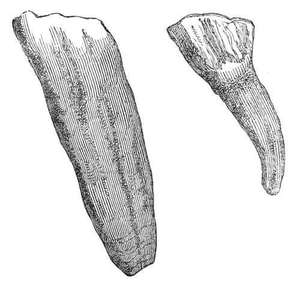
However, while the milk tooth is retained in the mouth the neck is not particularly well shown, because the gum encircling the crown in a great measure conceals that part. But the form of the outer surface of the crown can hardly be mistaken. In the foal’s tooth it more or less approaches to a semi-circle, from which the permanent teeth greatly differ, as will be seen by comparing the representations of the two as given in the plates. The outer surface likewise is characterized by peculiar indentations: a number of small channels run along it, taking a course from the neck towards the margin of the table, and giving an irregular fluted appearance to the enamel. There will be seen, on the crown of Figure 2, lines intended to convey an idea of the situation and direction of these little grooves. The table is always oblong, but the infundibula are generally absent after the second year, and when they are present, the cavities are narrow, and obviously of little depth. These numerous signs enable the milk tooth to be recognized with facility, at a single glance, for it is seldom that one of the various indications is absent; and after all have been impressed by observation, the milk tooth can hardly be mistaken.
26. The permanent incisors are indicated by their greater size, a circumstance which the foregoing wood-cut does not exaggerate. The gum is much further retracted, and this gives to these organs an irregular oblong figure, which is very different from the semi-circular shape of the milk teeth. The incisors, however, are not of equal length in all horses, and in some the gum may be so prominent as to give the permanent somewhat the appearance of a temporary incisor; other indications, however, even then, enable the different nature of each to be with certainty distinguished. The enamel is only partially exposed in the horse tooth; the shaded portion of Figure 1, in the preceding wood-cut, denotes the extent to which it is generally covered during the period of dentition; and when the teeth first appear, the enamel is wholly concealed by a covering of crusta petrosa. That covering is never entirely removed—a small portion of it, even in the oldest mouths, is seen near to the gums. It looks like an accumulation of tartar, and is most conspicuous in the tooth that has been newly cut. The presence or absence of this substance, therefore, should be noted, and moreover, the enamel surface should be further inspected. The numerous channels that give so peculiar a fluted appearance to the milk tooth, are not to be seen upon that of a permanent description; but in the stead are to be detected only one or two broad grooves, which extend the entire length of the crown. Figure 1, at page 48, indicates the shape and direction of the grooves upon the surface of the permanent tooth, though probably a better idea of them is to be derived from an inspection of the coloured engravings, in which they are more prominently exhibited. By means of such guides, the opinion is rendered positive, and the inspection of the table is hardly needed to confirm it; but the table affords corroborative evidence, which may be of service. The table is broader, and the infundibulum is deeper. In this latter cavity, food accumulates in the permanent, but rarely in the temporary incisor. The gum may so contract as to give to the tooth some appearance of possessing a neck, but in reality no such part is developed in the horse incisors, as will be seen by referring to the previous cut, which may, with profit, be compared with the coloured engravings, which depict these members as they are exhibited in the mouth of the living animal.
27. The temporary cannot be well distinguished from the permanent molars, while the horse is alive. It is true that the table of the first is somewhat narrower than, though of equal length, with that of the last; but the difference is not so marked as to justify an opinion being pronounced upon the imperfect inspection which, under the most favourable circumstances, can be made of these organs. The number of the molars may, however, be counted, and from this the age of the animal deduced with correctness. The operation can be at all times performed, and the fact ascertained. When, however, removed from the jaw, the character of the molar is easily recognized, for the difference in the length and shape of the fang renders it then impossible to confound the temporary with the permanent tooth.
28. The various points which denote youth must now be noticed. The remarks on this subject, however, must be confined to the mouth, to which this treatise is devoted. In the foal, the membrane of the mouth is of a delicate pink colour, suggestive of its high vascularity. The gums are prominent, for as the permanent are cut posteriorly to the milk incisors, and the germs of the horse teeth are developed even at the time of birth, the anterior part of the jaw is pushed forward to make room for their growth. This gives the little animal somewhat the appearance of being parrot-mouthed, as will be observed by referring to the coloured plate of nine months. Then the palate is low in its position, and the bars appear almost on a level with the tables of the upper teeth, and may even descend beyond them. The lower jaw, also, if felt, will be found to be quite round; and the face, if observed at that part under which the molar teeth are situated, will seem full, or the cheek will look a little blown out. These last signs, more or less, remain till the process of dentition is completed.
29. The indications of age are no less deserving of notice. The edges of the lower jaw become sharp, and ultimately retracted; the cheeks grow flat; the membrane of the mouth loses its vascularity, and puts on a dull yellowish colour; the gums look hard, and the front of the jaw becomes narrower, while at the same time it inclines more backward, causing the teeth to project horizontally. The inclination which age gives to the teeth, will be easily perceived by comparing the coloured engravings with each other; and the peculiarity of the upper and lower incisors not being perceptible at the same time in the mouth of a thirty-years old, entirely springs from the acuteness of the angle which they form at that period. The bars, as years accumulate, also change their positions, being drawn upwards. From the space between the corner incisors and the first molars, the tongue on either side protrudes, as if the narrowed cavity left not sufficient room for the organ to repose in. The extent to which the tongue will project may be conjectured, by regarding the representation of it given in the coloured plate of the thirty-year old mouth. At that age, the protrusion is too strongly marked to escape the observation of any one whose attention has once been directed to the circumstance. Accompanying the inability to retain the tongue within the jaws, is a constant flow of saliva, which continually falls from the mouth of the old horse when the lips be held apart. The latter fact, the author, when he made the drawings for the present work, had ample experience of, as in some instances it occasioned serious delay.
30. The incisor teeth, in old age, have their characteristic signs. Mostly they appear unnaturally long, though in rare instances they are worn down almost to the gums. When long, they will generally show interstices dividing them, such interstices, however, not being free, but occupied by a compact mass of foreign matter, derived from the food, and having a black colour. The reader will, by turning to the coloured plates of twenty and thirty years, see these accumulations indicated. When the incisors are very short, they are arranged in a different order to those of the young animal. The tables of the teeth of the young horse, form almost a semi-circle; in the adult animal, they gradually assume a crescentic order, and as age progresses, they ultimately range, more or less, in a straight line. The teeth also look narrower as the fangs descend with the wear of the organs, and in colour they slightly change. The enamel loses much of its semi-opaque and characteristic appearance, assuming a more dull aspect, and a yellowish tint. The crusta petrosa is to be seen only near to the gums, and within the grooves, which often are deep and very well defined, and within which the remains of the once-investing membrane becomes almost black. Then again, the tables themselves change their shape as the years increase. At first, these surfaces are of an oblong and somewhat oval figure; by degrees, however, they become angular, and ultimately more or less square. The continental authors have been very minute, and not a little profuse upon the changes of form which the tables undergo, and attribute the alteration to the gradual wear of the teeth. The correctness of this view they endeavour to establish by sawing a tooth through at various places, and attempting to show, that the forms of the surfaces exposed by this process correspond to the shapes assumed by the table during the progress of age. Their deductions can, in the study, be made to appear true, but in the stable will not bear the absolute application to which these writers would put them. By means of this test, Pessina asserted he would tell the age of a horse, accurately, up to the twenty-second year. The Girards acknowledge the tables will not guide them so far, but nevertheless are willing to apply them during the first seventeen years of the animal’s life. I leave the reader to form his own opinion of the value of such speculations—for while I confess they are of some worth as guides to the primary study, and helps to the proper understanding of the cause of those changes of figure to be anticipated—I am not satisfied that any rule drawn from them can be depended upon. For that reason I shall hereafter present the reader with figures of the tables taken from authenticated mouths, rather than amuse him with speculations, which, however imposing they may seem to the ignorant, practice soon discovers to be no more than remote and plausible possibilities.
31. Some judges depend upon the tushes as indicative of the age, and taken in conjunction with the other parts they afford corroborative evidence; singly, however, they should not be relied upon, nor should too much weight at any time be placed upon their appearance. In the first place, the tushes are cut irregularly; they may appear in the mouth between the second and third, and they may not pierce the gums so late even as the eighth year; the periods named being of course the extremes. As a general rule, however, they come up between the fourth and fifth year. The custom, however, which Nature so frequently disregards, can afford no positive guide to the judgment, and the wear which may begin thus early or late, should not be too particularly insisted upon. The tushes when they first show are shaped somewhat like a spear head, smooth and rounded on their external surfaces, but grooved on the side which touches the tongue, pointed at their extremities, and sharp at their edges. The inclination of the young tush is oblique, standing forward, and the situation is comparatively near to the incisors. As the animal’s age advances, the tushes retract, the grooves on the inner surfaces wear out, and the space which separates them from the incisors increases: all observations, however, concerning the tushes, must be accepted with much allowance, for these teeth are very irregular. As a general rule, the lower tush becomes blunt, or rounded at its point and edges, and also of considerable length, while the upper is often so diminished as to be worn almost to the level of the gum. In stallions, kept only for service, the lower tush, however, frequently attains a great length, presenting the appearance depicted in the coloured engravings of the mouths at twelve and sixteen years. In those plates, the reader will observe the tushes no longer point in a forward direction, but have a decided inclination outward, and somewhat backward also. Another indication of extreme age is also worthy of notice, although, if too absolutely relied upon, it may occasionally mislead. Tartar, not generally found in any quantity upon the other teeth in the horse, accumulates around the tush, and in very old animals almost conceals it. This excessive deposit I have rarely observed in horses of moderate age.
32. The wolf’s teeth or eye teeth aid us in judging of the age; though we are bound to state of these that they can be received only as presumptive evidence. The wolf’s teeth have not been before alluded to, because they are not concerned in mastication, and are no more than the representatives of those organs which form the continuous chain in the mouths of some other animals. These teeth appear to be of no use to the horse. They are little nodules of tooth-like structure, having minute fangs, which are inserted immediately anterior to the first molars of the upper, being rarely seen in the lower jaw, and when present there, always being even yet more diminutive. These wolf’s teeth are generally shed with the first temporary molars, and therefore if they can be seen, it may be assumed that the permanent molars have not begun to appear. The assumption, however, must not be converted into an assertion; for in some instances the wolf’s teeth are retained, and, in a few heads, will remain after the horse has reached an age far beyond that of colthood: their presence, therefore, rather leads our expectations than confirms our judgment.
33. The mode in which the horse cuts his teeth remains to be pointed out. It is generally said, that the tooth, originally growing in its circumscribed cavity, pushes its way through the parts which oppose its entrance into the mouth. So mechanical an idea is characterized by a small amount of physiological knowledge, and it is time the notions which attributed development to mere force were discarded. The tooth is first a pulpy mass, very soft and highly vascular; the superior part, or that part which primarily shows itself above the gum, is the first to become consolidated. Enamel and ivory are there simultaneously deposited, and gradually these extend towards the fang. When a portion of the fang is completed, and the time has arrived for the tooth to be cut, those structures which oppose the egress of the tooth are absorbed; the absorption taking place, not only on the internal surface, against which the young tooth has been supposed to exert its force, but also upon the external parts, upon which it could have no effect. By absorption the barrier is removed and the tooth then comes forward. The process is very beautiful, and no less worthy of admiration is the manner in which the milk teeth are shed. The incisors lose their fangs, and just when the permanent teeth appear, the crown of the temporary ones is removed from the mouth. The removal of the fangs of the milk incisors is the result also of absorption, and the same process effects the removal of the temporary molars, only its operation is not precisely similar; for in these last, not only the fang but the greater portion of the crown is taken away, and little more than the table is cast off when the remnant of what once was a tooth is at length shed. The process of cutting the molar teeth will be more clearly comprehended by referring to the annexed wood-cut, in which the darkened spots indicated by the line running from a denotes the permanent tooth already through the gum and in the mouth, though still covered and partially concealed by the retained table of the temporary grinder c. The appearance of the table of the temporary molar when cast off is shown in the figure immediately underneath, to which the letter c is also affixed, and the projecting portions ascending from its edges exhibit the last remnants of what originally was the fang: b b are molars, well up and worn to a level.
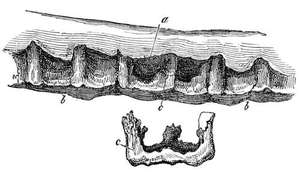
The next wood-cut exhibits the molar a, immediately after it has lost its covering. At this time the table is very uneven, presenting points which the finger would readily recognize, but in a short time these wear off, and an even surface is obtained, rendering it level with the other teeth, b b.
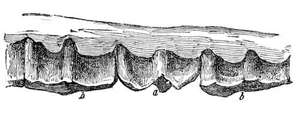
As is here seen, when the crown has been removed, the permanent molar is well up, although it occupies the same place, and fills the same alveolar cavity which the temporary molar originally held. The horse incisors do not occupy the same cavities in which the milk incisors were placed, but are developed in cells formed especially for their reception, and come up rather behind than absolutely under the primary teeth. The form of the anterior part of the jaw in the foal admits of such an arrangement, and its greater comparative bulk gives all the space that was required. The space, however, between the branches of the lower jaw where the molars are developed, is filled by important muscles; and while any thickening externally would deteriorate from the symmetry of the head, any internal enlargement would have interfered with the free motion of the tongue and hyoideal appendages, the movements of both being as essential to perfect mastication as the presence of the teeth themselves. Hence the grinders are in their development regulated by a different law to the incisors; nor is the ordinization which declared the first should be well up, and the last scarcely to be seen when the period for casting off the temporary teeth arrived, to be passed over in silence. The molars are more important to the welfare of the animal than the incisors can be supposed to be. If the front teeth are irregular, the horse, nevertheless, can manage to feed; and if some are even wanting, the animal can subsist. A few would serve to grasp a sufficiency of food, especially such food as the state of the mouth, during the period of dentition, would dispose the colt to partake of. The animal is then in an inflammatory condition—the system is excited—and it is a wise provision which leaves the creature inclined only, at such a time, to consume a soft and laxative herbage, not in too great a quantity. The molars, on the contrary, if irregular in their growth, or uneven upon their surfaces for any lengthened period, would produce great local pain, and much constitutional disturbance. The food, in consequence of the rugged condition of these teeth, would be imperfectly masticated, the organs of digestion would become impaired, and the whole frame would suffer. To prevent this, the molars are fully cut before the temporary tables are cast off, nor do both the tables leave the mouth at the same time. The one on the upper jaw is first shed, and it is not until this has, by attrition, been rendered somewhat flat, so as to present a surface upon, or against which the food can be ground that the permanent molar of the lower jaw is uncovered. The unevenness of the grinding agent becomes now of less moment, since the part over which it is to be moved has been rendered fit for its uses, and since there are other teeth that present all their surfaces, suited for the purposes of mastication.
34. The manner of examining the teeth is simple enough, and yet a few remarks may as well be made upon this part of the subject. To see the incisors, all that is necessary is to part the lips; but many horses are naturally shy when their mouths are touched, and more are rendered so by unnecessary severity in the administration of medicine, or by the tricks to which they may have been subjected. A certain degree of caution is always needed when an animal is strange to the examiner. Where the horse shows a disposition to resist, the groom who attends upon it, if present, should be allowed to handle the mouth, the judge being content to look and form his opinion from what he sees. If the groom be not in the way and the horse seems nervous, let the neck be patted, the face below the eye gently rubbed, then the nose caressed; and when the timid animal is assured that no harm is intended, the lips may be freely drawn asunder: but should the head be snatched away, when the first attempt to see the teeth is made, let the hand immediately release the mouth, rather than endeavour to retain the hold. It is far better to begin again than justify the fears of the horse, by a needless and worse than useless struggle, which in the end will probably be of no avail. After the horse has by forbearance been rendered quiet, while the lips are held asunder, the shape, colour, length, and obliquity of the teeth are noted, and the presence or absence of milk teeth observed. When this is done without violence, the animal will not often offer any opposition to the finger being introduced to feel the tushes, or to the sides of the mouth being separated so as to obtain a fair view of them. The examiner now places himself in front of the horse, and by introducing one finger behind the incisors and getting it under the tongue, will cause the animal to open its mouth, or the tongue may be seized and drawn out of the mouth; and if confidence is established, no opposition will be offered to the jaws being kept for a short time apart. Of this, advantage is taken to observe the arrangement of the teeth, to inspect the tables, and to note the shape or depth of the infundibula. When all this has been accomplished, in less time perhaps than it takes to read a description of the process, the business is generally finished, and a conclusion has been arrived at that amounts to positive conviction. On certain occasions, however, it may be desirable to inspect the molars; and to do this properly requires a little tact. Some persons cast the horse for this slight operation: indeed, there are people who throw horses as though they imagined nothing could be done without the hobbles. There is, however, generally no occasion for such a proceeding; the twitch in the great majority of cases is all that is needed, and, with a little patience, even that instrument of torture may be dispensed with. A stool, or if nothing better is at hand, the stable pail is fetched for the operator to stand upon, so as to look with ease into the mouth of the elevated head. The animal is led into a good light, the balling iron placed between its jaws to keep them asunder, the tongue being drawn out to the side, removed from that which it is desired to inspect. While the mouth is thus distended, the person who is to judge, mounts the stool or pail, and looks into it till he is satisfied. Should the operator be desirous of feeling the teeth, he descends from his rostrum, and having pulled off his coat and bared his arm, introduces it into the mouth, while the tongue is drawn to one side by the assistant who holds the iron; always, however, taking care if possible, to have a balling iron which is open on one side, the arm being so introduced that the elbow is towards the free space. Should this precaution be neglected, if the horse prove suddenly restive, an accident may ensue. The lower jaw being easiest felt, and the teeth therein situated being most readily counted, that is the part generally manipulated. This is not difficult unless made so, and often rendered dangerous by the intemperance of the party who undertakes to accomplish it. Having described it, the author will now proceed to state the times at which the different teeth appear, and the signs which they exhibit.
35. At birth the foal has usually three molar teeth on either side of each jaw,* and perhaps two front incisors, which last are then lateral in situation, and appear to be very large in proportion to the age of the animal. It is, however, usually a fortnight or three weeks after birth before the incisors appear. I have to acknowledge the greatest obligations to the Messrs. Tattersall, for the valuable opportunities afforded me of inspecting blood stock, at their large and admirably-conducted establishment at Willesden Paddocks.
* The wolf’s teeth at the anterior of the two rows of upper molars are generally present or indicated at birth; but as they are not invariably found, and are by no means to be depended upon as significant of the age, no direct notice need be taken of their existence.
36. At six weeks, two more incisors are generally cut in either jaw, and those which originally seemed to grow from the sides, have, by this time, taken a position more directly in the front of the mouth.
37. At six months, the incisors have moved almost into the situation they will hereafter occupy, and the jaw appears somewhat elongated; but, if the gums be observed, it will be seen that nature is preparing to cut the corner milk teeth, which may even be through the gum.
38. At nine months old, the corner milk teeth are up, but their edges do not yet meet. The coloured engraving will show the appearance they present, and likewise exhibit the protruded state of the gums at this age. The drawing was made from a head in the author’s possession. It has been tested several times, and its correctness fully ascertained. The last occasion, when it was authenticated, was by the mouth of a bay colt, by Muley Moloch, out of Canaletti’s dam, with which it perfectly agreed.
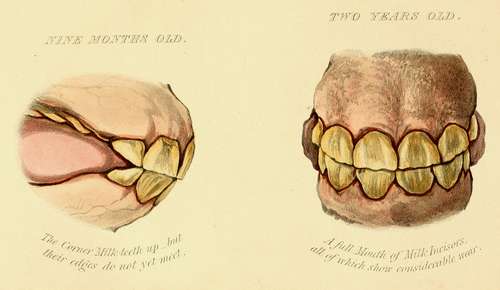
NINE MONTHS OLD. The Corner Milk-teeth up, but their edges do not yet meet.
TWO YEARS OLD. A full Mouth of Milk Incisors, all of which show considerable wear.
39. At one year, all the temporary teeth are up and in apposition; but by this time two pairs of permanent teeth, which are the fourth molars, have made their appearance, and the yearling therefore has sixteen molars and twelve incisors, or twenty-eight teeth. The large number of yearlings annually brought into the market afford such frequent opportunities of examining the mouth at this age, that I need not state here the means by which the drawing has been authenticated. It would be a task of supererrogation to allude further to a fact which is so well known and thoroughly established.
40. At eighteen months, the incisors show some wear, the infundibula look as if they would soon be obliterated; indeed some of them may be lost. At or about this time also four more permanent molars, one on each side of either jaw, being the fifth in situation, protrude into the mouth.
41. At two years old, there is a full mouth of milk incisors, all of which show considerable wear. The coloured engraving of the two-year old mouth, will convey an accurate idea of the features which it presents at that age. The original drawing was made for the Jockey Club in anticipation of the celebrated Running Rein trial. Accepted by such authority, it perhaps hardly requires further proof of its correctness, but it has since been repeatedly tested. On the last occasion it was compared with the mouth of a chesnut filly, by Calmuck out of Miss Greatrex, and was found to agree with the indication therein presented. At two years, the infundibula are lost in the temporary incisors, and the fifth molars are in perfect apposition; indeed the smooth surfaces of these last are the best evidence that the animal is two years old, for he cannot then be far below that age. The incisors having been for some time employed, but still being to be retained for some months, have an aspect of wear and strength conjoined. The two-year old mouth, therefore, by those who cannot distinguish the milk from the horse teeth, (none of the latter being present to help the judgment by the contrast they exhibit) is likely to be mistaken for that of a five-year old; especially if the colt chances to be somewhat fully developed. A regular horseman, however, would not require the aid of the mouth to discover the animal was still in its colthood.
42. At three years old, the centre horse teeth are well up, and are distinguished by their size, shape, and colour. The appearance which the mouth will exhibit, the coloured engraving represents. The original drawing is in the possession of the Jockey Club, for whom it was made. It has, however, been repeatedly tested, in order to place its correctness beyond doubt. Both colts and fillies have been inspected for this purpose, and equally have the different breeds been consulted. As the public, however, place the greater confidence in blood stock, it may here be mentioned that the appearances perfectly coincided with those exhibited by a brown colt by Muley Moloch out of Miss Greatrex, and Roxey, a brown filly, by Lanercost, out of Ellen Percy, besides various others which it would be both needless and tedious to recapitulate. The mouth, at this period, indeed is so marked, and in general so regular, that it is the more readily recognized. The new horse incisors, by their size, contrast with the milk teeth which are still retained. The comparative length and squareness of their figure cannot fail to attract attention, and their deeper colour can hardly be unobserved; that colour is caused by much of the primitive coating of crusta petrosa being retained, or only removed from the edges where the enamel is bright. But as a vast number of horses are sold at this age, and many are started for heavy stakes, it will be imperative now to proceed more cautiously in the description. About this time the terms “rising three,” or “coming three,” or “three next birth-day,” are made use of, as well as “three off”—the first phrases indicating that the colt is yet between its second and third year, or will in a month or more be three years old, and the last term meaning that the animal has attained its third year, and has recently entered the fourth year of its existence. The season here materially aids the judgment; for if a blood horse shows a fair three-year old mouth in December, it is unhesitatingly pronounced to be “coming three;” and if it exhibits the same appearance in January the animal is declared to be “three off.” The same holds good with the coarser breeds, only, as before stated, the month of April would then be estimated as that of December in the former case, and May would answer to January. “Coming three,” however, can, with a little stretching of the term, be applied to any foal; and is commonly used when the colt is strictly but “two off;” for the terms are somewhat loosely used, though in their stringent sense a horse is only rising three, four, or five, after the mouth has began to assume the form which characterizes the respective ages. When the colt is two off, that is two years and three months old, the milk teeth are all retained, and to a casual observer, the mouth would still say “two.” A little closer observation will, however, correct the judgment, for looking attentively, perhaps a slight, and only a slight difference in the colour of the central incisors may be remarked. The tinting of the enamel may be a “thought” darker, and yet the contrast so delicate, that the difference can only be seen in a certain light. Then again casting the eye to the gums of the upper central incisors which are first shed, that part of them immediately covering the neck of one of these teeth may show a little redness, and the other exhibit nothing of the kind. The redness indicates that nature is making ready for the appearance of the permanent incisors, and on evidence no heavier than this, the animal is pronounced to be “two off.” The redness, it may be said, can be artificially produced—so it may be, but the natural character can hardly be imitated. The colour in the normal mouth is not deep or angry; it is not caused by inflammation, but is only increased vascularity of the part, and it is at first limited to the edge of the gum. The colt shows no symptoms of tenderness in the reddened gum, but stands quite as still, and even more quiet when it is pressed, than when the opposite one is handled. If the part had been tampered with, the animal would probably tell tales when the finger touched it, and the redness would be more intense on the prominent or bulging portion of the gum than where the margin encircles the neck of the tooth; while it is ten to one inflammation had been produced rather than vascularity excited. Little occasion, therefore, is there to fear imposition, and little room for those who would practise it to hope for success. The next indication of advancing age is given by the gums growing more vascular, even now looking inflamed, while a yellow deposit (the nature of which is not well understood) may be seen upon the neck of the tooth, and the central incisors of the upper jaw, if felt, may probably be found loose. In another or about the sixth month, one of the central incisors is removed. It does not fall out, as is generally stated, but while the animal is feeding, the tooth is, as by accident, wrenched off. The gum bleeds, and being slightly lacerated, looks sore and angry for some time. The sharp edge of the new brown-coated permanent incisor is now seen protruding. In a week or two the remaining milk central incisor of the upper jaw is, by a seeming accident, forced out; and the mouth now has an irregular appearance, the edges of the upper central incisors not being level with the tables of the lateral milk teeth. The lower central incisors, when the upper milk teeth are lost, generally are loose, and their gums inflamed; but a month or sometimes six weeks may elapse before these are gone: by that time the upper permanent teeth have grown considerably. When the central milk incisors have disappeared, the molars begin to change, and those of the upper jaw are the first uncovered; not in any regular order, or the two teeth on the same day, but generally the first molar before the second, the wolf’s teeth mostly departing at the same time. A week or two subsequent, the first two permanent molars of the lower jaw are laid bare, so that at or about the ninth month, the horse has all those teeth, which denote the animal to be three years old, fairly in the mouth; that is, he has between the second and third year cut four horse incisors and eight permanent molars. Lest the description should not be perfectly clear, or such as to enable the reader to readily understand which teeth by this time are shed, a drawing of the head of an adult animal, which forms the frontispiece of this work, was designed. It will enable the reader to form some notion of the extent of the horse’s mouth and likewise of the positions of the teeth. Near to the teeth will be seen figures which do not denote the periods when these organs first appear, but the time at which they are fairly up, or to some extent exhibit wear. In that engraving no further notice is taken of the milk teeth than is conveyed by the small star associated with such of the figures as indicate the places from which they have been displaced: thus the figures 1, 2, and the last 4, having no star, indicate that those molars are developed only as permanent teeth. The figures 3*, 3*, 3*, having stars, denote that milk teeth originally occupied the situations where these teeth are shown: those figures will be seen above and below the central incisors and the first two molars of either jaw; and as but one side of the face could be displayed, of course the number has to be doubled, the colt getting twelve additional permanent teeth by the time it completes the third year. At three years, therefore, the central permanent nippers are in apposition, and show wear, though to only a limited extent. The infundibulum is broad, as depicted in the accompanying cut.
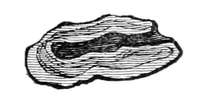
In the above representation of the table of a three year old tooth, it will be remarked that the infundibulum appears in the outward direction to extend quite across the surface. This aspect is produced by an indentation at that part, which, by the completion of the third year, is in most instances not worn out, but after the third year is attained, it speedily disappears; so the table of the three year off has become somewhat broader, and the infundibulum circumscribed, or well defined, as it is shown in the subjoined wood-cut.
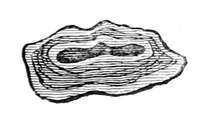
In fact, the shape of the table is here the best guide, and should be carefully studied, as otherwise the judgment can never be assured. At this age, one tush may be peeping through. I have never seen more than one present at three years, and then these teeth have always been slightly developed, rather indicating what was to grow than exhibiting that which had actually grown. The tushes, however, now in almost every case, may be felt under the membrane through which they are ultimately to protrude, and can most readily be felt in the upper jaw. Nevertheless, the tushes of the lower jaw always make their appearance first, because the membrane covering these is less loose, and therefore more easily penetrated; and also because the lower jaw being the active agent of mastication, as well as the resting place for the bit, it is naturally subjected to greater wear, thereby assisting the egress of the tushes. In the upper jaw they are often concealed by the loose membrane long after they are fully developed. The tushes, at this age, however, are no guides. The three year old colt, for general purposes, is easily recognized, when the lips only are separated.
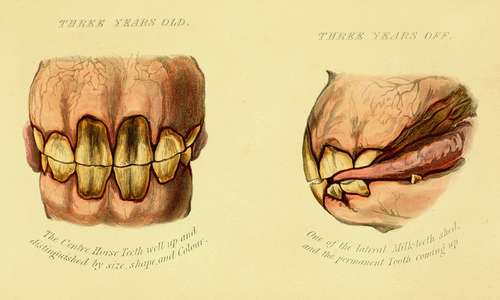
THREE YEARS OLD. The Centre Horse Teeth well up and distinguished by size, shape, and Colour.