THE HORSE’S MOUTH, (continued 2)
Reading edition
THREE YEARS OFF. One of the lateral Milk-teeth shed, and the permanent Tooth coming up.
43. At three years off, the lateral milk teeth are shed, and the permanent teeth are coming up. The coloured engraving, the original of which is also the property of the Jockey Club, for whom it was executed, was made from the mouth of a bay gelding, by Almack, out of a mare by Rubens, Jun., belonging to—Goring, Esq. The state of the mouth therein exhibited is so peculiar to the age, and so decided in its indications, that it can hardly be mistaken. One of the lateral milk teeth from the lower jaw has been recently lost. The gum is sore, and the top of the permanent incisor is seen rising up. By comparing the temporary incisor, which is speedily to fall from the upper jaw, with those representations of the same teeth given in the previous plates, the gum will be observed to have considerably retracted. Preparation is evidently being made for the change which will in a few weeks take place. The milk teeth begin to be shed about the seventh or eighth month after the completion of the third year, those in the lower jaw being the first to quit the mouth; and all that was observed on the subject in the former paragraph, may be applied to the present, only making allowance for the differences of position in the teeth.
44. When rising four years old the lateral horse teeth are in the mouth, but their edges do not fairly meet. The coloured engraving of this age will denote the altered aspect of the mouth, consequent upon the development of a few months, when the colt may want only a dozen weeks for the completion of its fourth year. The original sketch for this plate was taken from the mouth of a horse called the General, the property of Sir Samuel Spry. To test it, however, it has been largely applied, and in every case it has been confirmed. If the mention of names is here required, I may repeat those of Blackbird, Marquiss of Conyngham, and a host of others. The plate, therefore, may be regarded as fully established, and the reader, without fear, may depend upon its correctness. As is shown in the engraving, the lateral incisors, at this age, touch, but nevertheless do not meet so as to be of any service in nipping the food. It is of some importance to attend to this peculiarity, inasmuch as were the presence of the indicative teeth alone remarked, an animal wanting some months to be four years old might be purchased for one that was rising five.
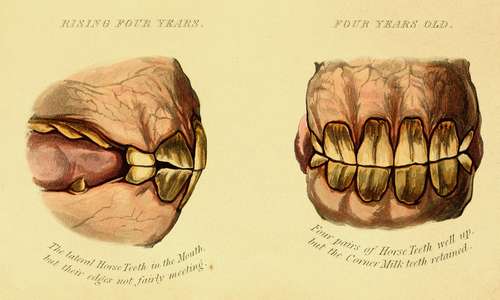
RISING FOUR YEARS. The lateral Horse Teeth in the Mouth, but their edges not fairly meeting.
FOUR YEARS OLD. Four pairs of Horse Teeth well up, but the Corner Milk teeth retained.
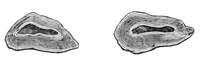
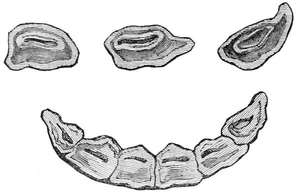
45. At four years, four pairs of horse teeth are well up, but the corner milk teeth are retained. Such a state of the mouth is very characteristic of the age, and not likely to be mistaken. The appearance which the teeth present, if viewed from the front when the lips are separated, is shown in the coloured engraving, and it is such as no person can well mistake. The original drawing in this case was also made for the Jockey Club, and was produced upon the famous trial. On all occasions that presented themselves, which have indeed been numerous, it has been compared with the mouths of living animals, and in no single instance has it been found to be contradicted. This has not only been done with colts, but also with fillies, among which last I may mention Lupine, Mora, Nightcap, Chamois, and Jew Girl. To the plate, therefore, the reader should refer; and supposing him to have done so, the other indications which the mouth presents between the third and fourth year will now be enlarged upon. The state of the molars at this period may be regarded as demonstrative of the age of the animal. The reader will remember, that according to what has been pointed out, the colt at three years old has five molar teeth on either side of both jaws, and that of these teeth, one only, the third in situation, marked thus, 4* in the frontispiece, is of a temporary nature. Shortly after the upper lateral milk incisors have been cast off, and sometimes previous to that occurrence, the point of the sixth molar penetrates through the gum, and before it is fully up the covering of the third permanent molar is removed. This effected, the colt has six molars on either side of both jaws, and whenever that number is found they may be assumed to be all of a permanent character; so at four years old the tables of the central incisors exhibit some considerable wear, the infundibula no longer extend entirely across, but have become circumscribed and well defined. The tables of the lateral incisors, on the contrary, are only beginning to be formed, and very often the part posterior to the infundibulum has not received any attrition. The infundibula in these last extend the entire breadth of the table, and in consequence of an indentation on that side which touches the corner milk teeth, the space is there free. The reader will comprehend this particular formation, by referring to the wood-cut of the table of the tooth presented at page 79, the appearance being so much alike as not to necessitate a repetition to enforce it. When the fourth year, however, has been for a month or two perfected, the tables then assume the form represented in the following wood-cut, which exhibits the change that has taken place in the central incisor, and also the appearance of the more recent lateral tooth when the colt is fairly four years off.
One or more of the tushes may also be well up: the whole may have made their appearance; but more frequently only the two originating from the lower jaw are through the gum. No dependence, however, can be placed on the presence or absence of the tushes, which repeated proof has shown to be irregular in their development: nor is the state of the mouth during the fourth year such as justifies an off-hand opinion being pronounced; for though during that period the growth of the teeth is generally well marked, nevertheless exceptions more frequently happen than between the second and third years. An instance illustrative of this fact occurred at the Veterinary College, at St. Pancras, during November, 1844. To that Institution was brought a dun colt, which the professors, one and all, pronounced to be “rising three.” Mr. Robb, a gentleman of great talent, and then a pupil at the school, having looked at the animal’s mouth, pronounced it to be “three off,” or “rising four.” Here was a difference of opinion to the extent of a whole year; and of course the pupil was sneered at for his ignorance and presumption. Mr. Robb, however, had reasons for his conviction; he would not give up the point, but wrote to the breeder, and obtained a reply which showed the teachers had yet to learn. Being an acute observer, Mr. Robb had attended to the wear of the tables; had seen the infundibula had become defined, and the surrounding surface broad. He had also remarked the gums, and seen that those of the lower jaw were slightly red; and, taking these tokens in conjunction with the appearance of the colt, arrived at a conclusion which the result proved to be correct, and which did not show the mouth deficient in its symbols. Mr. Goodwin, veterinary surgeon to the Queen, has casts of mouths taken from horses of known ages. No gentleman connected with the veterinary profession, perhaps, has enjoyed such peculiar opportunities as Mr. Goodwin, and no one could be characterized by a greater inclination to take advantage of them. With a natural talent for observation, and an innate love for scientific inquiry, combined with enthusiasm in the cause of truth, Mr. Goodwin has, in the midst of ill health, pursued his researches, and spite of an opposition, which did not stop short of calumny, fearlessly advanced his opinions. Those opinions, Mr. Goodwin’s position, and his acknowledged ability should have claimed consideration for. The conclusions which had not been hastily arrived at, ought to have been deliberately weighed. The author of this work is proud to acknowledge the obligation under which the courtesy of Mr. Goodwin has placed him, and with pleasure confesses that he has, in that gentleman’s society, learned much upon a subject which he had previously diligently studied to become the master of. The facts which Mr. Goodwin brings forward in support of his convictions, are strange and startling. The candour with which he courts investigation, enforces belief. He is certainly right in his own sphere; so far as his observations have extended, his conclusion cannot be overthrown. To the information he has generously afforded the author, allusion will repeatedly be made in the course of this work; but at present the remarks must be confined to the models in Mr. Goodwin’s possession. One of these exhibits the mouth of a colt called Julius, (which was ridden by Her Majesty) retaining the lateral milk incisors, when but a few days were wanting for the completion of the fourth year. The teeth that should have been shed, however, are evidently on the eve of leaving the jaw, and therefore though an exception, it is not so much so as to grossly mislead the judgment beyond a few months. It is to be regretted that the molars of this horse were not examined, and to the tables of the incisors, as shown in the model, I make no allusion, because these parts evidently have not received the particular attention of the artist, and consequently cannot be argued upon. The same gentleman has also favoured me with the inspection of a model of the teeth of a horse known to have wanted three months of the third year: nevertheless the mouth is that of a colt which would be pronounced to be “rising four.” The lateral incisors on both sides, and in both jaws are fully up, and they possess tables, which, if correctly depicted, indicate that for some time they have been in apposition. A lusus naturæ of this sort is beyond the pale of reason. Connected with it there is no record of the development of the molars; and on the state of the tables as shown in the cast, I am, for the causes before stated, not inclined to place any great reliance. The growth of the incisors shows the colt to be “rising four;” the evidence declares it only to be “coming three.” Here is an exception to a general rule: one which I believe is unique; at all events I am aware of the existence of no similar specimen; and it is to be lamented that the growth of the incisors, from the earliest period, had not in this horse been observed. As a unique specimen it is curious, but as a premature and extraordinary development, it cannot be opposed to a general rule. Children have been born with three legs, or joined together at various parts; but the race of men are nevertheless described as having two inferior extremities, and as being independent in their existence. A solitary instance is no more than a curiosity, and, until it is proved to be the exemplification of a general rule, must not be made the basis of a general deduction. Such occurrences, however rare, nevertheless deserve consideration; and had the animal last alluded to been trained, there is no doubt any qualified judge would have pronounced it beyond the actual age. Therefore, gentlemen possessed of racing studs, should, from time to time, have the mouths of their horses examined by approved members of the Royal College of Veterinary Surgeons, that any irregularity of development may be known and stated. To neglect so simple and reasonable a precaution, is to incur a needless hazard. By adopting it, the proprietor would be prepared to meet objection; and the idle reports that every year get into circulation would be quashed at their birth. A firmer basis for the authenticity of the age would be established than the reputation of the owner; and gentlemen would not annually be subjected to having their characters questioned by a host of interested ignoramuses. The turf is bound to adopt some measure of this kind for its own defence, especially as the honour of its members is, on every occasion, called into question, and a single instance of suspicion, seems, in the public eye, to warrant a general aspersion.
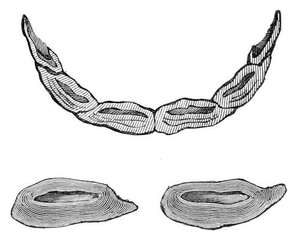
46. When rising five years old all the horse teeth are in the mouth, but the corner teeth have yet to meet. The peculiar sign of this particular age is the loss of the corner temporary incisors. It is scarcely possible to mistake the last milk tooth of the four year old, for the horse incisor which is characteristic of the fifth year; the difference between them is so great, that no person ought to confound one with the other. The corner milk tooth is often by the third year worn almost to a stump; its table being somewhat triangular, or occasionally round. By the fourth year it generally becomes a mere stump, or so changed in appearance that it contrasts in size with the other nippers, and seems incapable of performing any active function. At first, the permanent tooth when it makes its appearance, strikes us by its greater breadth, the gum not then having sufficiently retracted, or the tooth sufficiently grown to allow its after length being estimated. When the corner teeth are in the mouth, some time will elapse before they touch, but the incisors are then arranged so as to represent almost a semi-circle. The annexed wood-cut will convey an idea of the manner in which they are placed, and also of the shape of the tables of the central and lateral nippers, at the time when the corner teeth do not approximate, although they are through the gums.
The periods when the teeth which characterize the fifth year make their appearance, must now be described. When the animal is four years and three months of age, the gums of the upper corner teeth begin to redden, and before it is three months older, one of the corner milk teeth may have been removed. The opposite milk tooth speedily follows, and then the corner horse incisors grow down, and seem almost to be fully developed before the corner milk teeth of the lower jaw are shed. When, however, all the milk teeth are lost, the corner incisors will not touch for some time; and by the completion of the fifth year, though the teeth approximate, their tables are not formed, nor do their edges denote any amount of attrition. The corner tooth at five years old, looks young, and is principally covered by the membraneous crusta petrosa, which give to it a dark aspect, as though it were encrusted with tartar, little of the enamel being to be seen, while the shape of the gum is also characteristic. The five year old mouth, therefore, is easy of recognition, the shelly character of the corner teeth being very marked and not subject to much eccentricity in its figure. As five however, is the age when, for general purposes, the majority of high priced horses are brought into the market, the changes which take place before and after this period have been illustrated in the coloured engravings. When the animal is near to or rising five, the corner teeth are dark coloured, and though they touch, nevertheless their edges are not fairly together. The superior surfaces exhibit no tables, and the general aspect is such as is depicted in the engraving; the original of which was made from recollection of the appearances presented by the mouth of Mr. Payne’s Rebel, which horse was seen at Hampton Court. The drawing was more recently corroborated and corrected by the mouth of a fine young black hunter, the property E. C. Crowley, Esq. The peculiarities of this age, as denoted by the corner teeth not closing, should be remarked. It is not altogether unimportant to observe this circumstance, as animals are esteemed suitable for particular uses, only after the fifth year has been completed, and certainly all are less liable to disease when the mouth has been perfected. The distinction, therefore, is of some moment; and the better to enforce it, the reader will remember, that not until the accomplishment of the fifth year do the tables of the corner teeth begin to show: even at that time, however, they are very imperfect.
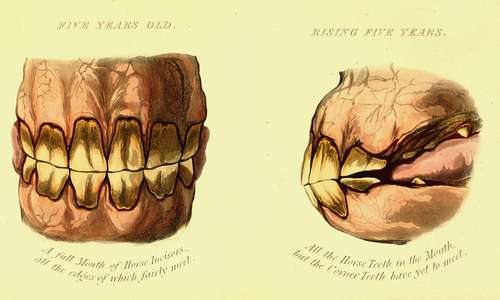
FIVE YEARS OLD. A full Mouth of Horse Incisors, all the edges of which fairly meet.
RISING FIVE YEARS. All the Horse Teeth in the Mouth, but the Corner Teeth have yet to meet.
47. At five years old there is a full mouth of horse incisors, all the edges of which fairly meet. The coloured engraving—which has been amply proved, by comparing it with the mouths of horses of various breed, among which those of blood have not been forgotten, since it was last tested by the aspect presented by the teeth of the well-known horse, The Baron,—will instruct the reader in the altered character which the mouth now assumes. It looks more huge, and far more powerful than it did at the fourth year. The teeth fairly close, but on inspection there can be detected slight signs of wear. The tables are not yet formed. The anterior edges alone are rendered level; all posterior to the infundibulum being as yet untouched. The tables then present the appearance indicated in the following wood-cut, which also represents the semi-circular order in which they are arranged.
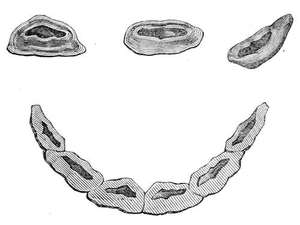
48. At five years off the corner teeth only show slight wear, and the posterior margins are round. Much of the original coating of the crusta petrosa is retained, but in colour it may not at this time be dark. At those places where it has been recently worn down, it is often of a yellow tint, which is but a little deeper than the enamel, which last, however, is nevertheless easily distinguished by its greater transparency and more pearly appearance. This peculiarity in the crusta petrosa not unseldom gives to the six year old mouth a darker aspect than is presented by the teeth of the younger animal; and the author, to convey to the reader some idea of this fact, has purposely rendered the incisors of the next representation of the mouth, as they frequently are seen. Such a circumstance, however, will not confuse the judgment. The corner nippers still look young to him who is acquainted with those signs which denote youth in the horse’s teeth, and the coloured engraving will convey a fair idea of the aspect they now put on. The corner nipper, in fact, after the fourth year, leads, in a great measure, if it does not entirely sway, the judgment. This tooth is sometimes called the shell tooth, on account of its infundibulum being, for the most part, better exhibited and longer retained than in the other incisors. The tables, however, of the other teeth should also receive some attention: those of the centre nippers may exhibit the infundibula shallow, or, in certain instances, when the crusta petrosa which lines these cavities is very thick, no infundibula may be distinguishable: even then, however, on close inspection, the form of the cavity will be discovered, marked out by a line of enamel, and the space that is usually vacant filled up with a substance, which in appearance differs little from the ivory. The tables of the lateral incisors will be fully formed, and the infundibulum is rarely obliterated, while its margin is always circumscribed and well defined, as the previous wood-cuts will indicate.
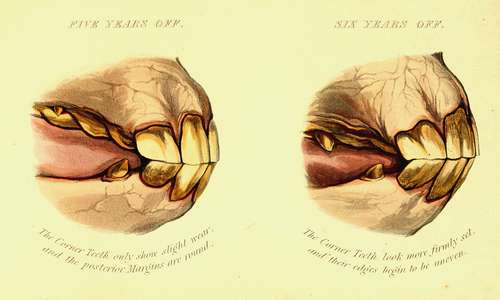
FIVE YEARS OFF. The Corner Teeth only show slight wear, and the posterior Margins are round.
SIX YEARS OFF. The Corner Teeth look more firmly set, and their edges begin to be uneven.
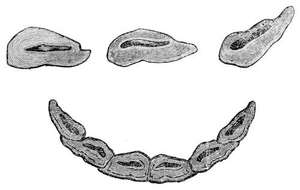
49. At six years of age, the corner teeth look more firmly set, and their edges begin to be uneven; they have become more square in the figure of the external surface; the edges of the teeth, when the mouth is closed, fairly meet; the round appearance of the posterior border is nearly lost, and the teeth are altogether of a most prominent character. The table of the corner teeth, nevertheless, is still confined to the part anterior to the infundibulum, which cavity is not yet fairly circumscribed or surrounded by a level margin. The infundibula may be lost in the central incisors, and those of the lateral teeth may begin to look shallow; but more generally these cavities are retained at six years old. The tables, likewise, have somewhat changed their positions, and the semi-circle which they formed at the fifth year, now is hardly so perfect, though still well marked. The above description will be the better understood by reference to the coloured engraving, which has been compared with the mouths of numerous animals, viz., Skeleton Sorella, and a brown horse, the property of Mr. T. Brown, &c., &c. The reader, however, will at once recognise the general truth of the drawing, the purpose of which the accompanying wood-cut will serve to explain. The alteration in the semi-circular arrangement will be better perceived by contrasting the present diagram with the one which preceded it, and though the change may not seem very great, nevertheless, sufficient is indicated to instruct the eye accustomed to observe it. The corner teeth have now acquired a degree of surface which will fairly represent a table, though it is still imperfect. The more darkly shaded portion of the separated table denotes the part which has yet received no attrition, but notwithstanding it is readily discerned that the nipper has come into active use.
50. At seven years off, the corner teeth, without showing age, exhibit further evidence of wear. The coloured engraving to which the reader must refer, exhibits those alterations which have now taken place. The original sketch was made from the mouth of a horse in the possession of the author’s father, and having been corroborated by the inspection of numerous others, it is confidently put forward as characteristic of the age. I cannot here forbear from acknowledging the personal kindness and professional attention bestowed upon me by Mr. Percival, who, on being made aware that I was engaged upon a work illustrative of the horse’s teeth, not only allowed me to inspect the mouths of the animals under his charge, but honoured me by accompanying me and assisted my endeavours to arrive at a just conclusion by his remarks. I have also to express my thanks to Mr. Braby for the liberty to inspect the large stud of heavy dray horses in the stables of Messrs. Barclay and Perkins, the eminent brewers. The advantages I derived from comparing so many mouths of the same age at the same time, and the facilities which were given of minutely examining each, enable me with more certainty to speak upon a subject which otherwise it would have been prudent to mention only in the most qualified terms. However, after such ample investigation, I can, with confidence, refer to the plate depicting the mouth at seven years off. Looking at it, the reader will see the teeth have become more white, in consequence of the crusta petrosa having, by the natural wear, been to a greater extent removed. The tushes are exhibited as fully up, in which condition they are generally seen. Where the corner teeth meet, they close in such a manner as denotes considerable use. The way in which the gums encircle the necks of the shell teeth has also changed. By referring back to the engraving of the five-year off mouth, the difference will be more readily understood, the round arrangement of the gums at the earlier age being very significant. The tables of the teeth, however, at this period ought never to be overlooked; they afford, perhaps, the best indications on which the judgment can be based. The infundibula may or may not be gone in the lateral teeth; but those of the corner teeth have at this age become defined. Where the corner teeth meet, in consequence of those of the lower jaw being, in many horses, a little the most forward, the upper shell teeth may present posteriorly a small projection, which is seldom seen prior to the seventh year. When this is present, it is so obvious as not to escape observation, therefore, it has not been depicted in the coloured engraving, which has purposely been made to represent the less marked indication that is more difficult to judge by. The reader will see the projection alluded to slightly indicated in the previous coloured engraving, portraying the mouth at six years off. Where the two shell teeth meet, he will observe that the most backward portion of the upper, not being opposed by the lower tooth, and consequently suffering no wear, bulges slightly downwards. It is this particular part, which often at the seventh year, by the wearing down of the upper tooth, becomes so apparent as to be significant of the age. It is, however, not constantly present, and the tables consequently become of the greater importance, as they are always to be found. Those of the lateral incisors begin to depart from their oval figure, and those of the central nippers are growing decidedly angular: the tushes may have the edges slightly rounded, and the semi-circle which the tables of the incisors formed when the animal was five years old, may exhibit some inclination to change in favour of the lineal arrangement that is in many horses so prominently marked in old age. This semi-circular arrangement of the incisors is most conspicuous when the colt is rising five; and from that period gradually alters, till in very old subjects the tables will occasionally be ranged almost in a straight line. The alteration which takes place in this respect is, however, by no means uniform, and though, consequently, no rule can be absolutely laid down concerning it, yet, from the known inclination of the teeth to assume a certain figure, an inference can be drawn which, connected with other signs, enables a pretty close opinion to be formed. At the seventh year, however, the corner teeth, their external figure, and the form of their tables, taken in conjunction with the wear exhibited by the central and lateral incisors, and considered with the narrowed but not yet sharp edge of the lower jaw, enable the judge to arrive, with tolerable certainty, at a conclusion. The following representation of the tables, taken in conjunction with the coloured engraving of the seven-year old mouth, will convey an idea of its appearance at that age. The reader will remark the infundibulum of the corner tooth has become circumscribed, being now encircled by a flattened surface, which posteriorly is of some width.
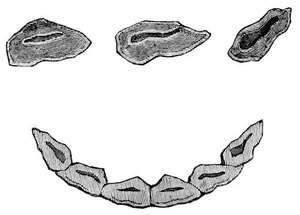
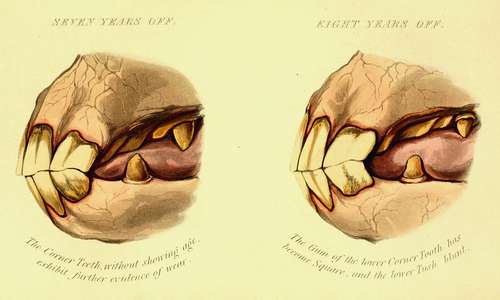
SEVEN YEARS OFF. The Corner Teeth without showing age, exhibit further evidence of wear.
EIGHT YEARS OFF. The Gum of the lower Corner Teeth has become Square, and the lower Tush blunt.
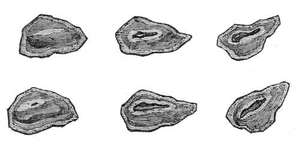
51. At eight years off, the gum of the lower corner tooth has become square, and the lower tush blunt. The original drawing was made from the teeth of that noted horse, Oakley; and in order to render it as perfect as possible, the mouths of mares (Meal, Edgworth, Bess, &c.) have been compared. The departure from the circular form of the gum, as depicted in the coloured engraving, is even more marked than it was at the seventh year. Added to this change of figure, the gums appear more hard and less delicate; the mouth looks more firm, and seems to have attained the perfection of its strength. The margin of the lower jaw is now comparatively sharp, and the cheeks are flat. The crusta petrosa on the upper teeth is in a great degree removed; the enamel not yet, however, having a marked yellow tinge. On the lower corner incisors the crusta petrosa may still continue, but it no longer has a dull brown aspect: it is never prominent at this age, but rather speckled over the outer surface, than regularly enveloping any portion of it. It has a somewhat rough and worm-eaten aspect, and in colour is nearer to a dirty yellow than a dull brown. If the posterior angle of the upper corner incisor is pendant, or exhibits that species of notch, which was alluded to in the previous paragraph, it is at the eighth year well shown, and the table has undergone considerable alteration. There is now on the shell tooth, a full table, the infundibulum of which, if not obliterated, is always of lessened size, well marked out, and on all sides surrounded by a broad and a flattened surface. The other teeth have also changed their figures. The tables of the centre nippers have taken on a decided angular shape, and those of the lateral display no dubious tendency to assume that form. The infundibula may be obliterated, but more generally those in the lateral and corner teeth are retained, or if now absent, the circle of enamel will, on inspection, show that the cavity is only filled up by crusta petrosa, not absolutely worn out. The following wood-cuts exhibit the changes which the tables undergo; and as the eighth year is an important one, inasmuch as the horse which has attained it is called “aged,” a double set is here introduced, to show the difference of figure which these parts may present. In those tables, it will be seen the infundibulum has gone from a central nipper only; but even in that instance, a white mark indicates that the cavity is merely filled up by crusta petrosa, the enamelled lining not being yet worn out. The alteration in the form and magnitude of the infundibula cannot, if the accompanying wood-cut be compared with those which have preceded it, fail to strike the reader; indeed these changes, aided by the worn appearance of tables of the shell teeth, are now the principal guides when judging of the age by the mouth.
52. After the eighth year, there is no certainty in any opinion drawn from the teeth. A guess may be hazarded, and very often that guess will prove correct, but at the same time it should be received only as a conjecture. The chance of naming the age decreases as the number of years increase. After the twelfth, the probability of hitting the exact year is very small. After the sixteenth year, all is confusion, and there remains no sign which could warrant any person in pretending he could pronounce the age by the teeth. It is true that certain tokens may induce a conviction that an animal is much older than sixteen, and this conviction may be so justified as to amount almost to a certainty; but no man, I imagine, could form any opinion with regard to the number of years by which a horse exceeded sixteen, or pronounce a decision that should have any appearance of exactitude. They who pretend to an ability of this kind, may, in a few solitary instances, strike the point; but repeated failures will show that there is no positive principle in operation to guide the judgment. Indeed the age is most correctly told during the periods of dentition, and up to the sixth year. After the sixth year, the certainty is not so great, but a very fair, if not a positive judgment can be pronounced until the eighth year is accomplished. After the eighth year, no man should give an unqualified opinion concerning the age of a horse. After the twelfth, whatever may be pronounced should be offered only as a conjecture; and, after the sixteenth, the practitioner had better be silent. When stating this the author must be understood as expressing the conviction at which almost exclusive attention to the subject, and much necessary consideration, has enabled him to arrive. It must not, however, be thought that he is arrogating a power of measuring the capabilities of genius; his wish is only to declare the truth as he perceives it. The intention to publish a work upon the teeth has not been concealed; opinions have been solicited and information sought; the author has many obligations to acknowledge; all to whom he has made application have been liberal in their communications; but from no one has he been able to obtain anything opposed to the conclusions he has here promulgated. It may be that hereafter the power of judging of the age shall be extended. Pessina and the Girards thought it could be done with exactitude up to an extreme point, and saw a principle in the latest changes which the teeth undergo. The general experience in this country, however, seems to have decided that, after the eighth year, there is no certainty. With that decision the author is reluctantly obliged to acquiesce, and even to add that certainty is not to be obtained after the sixth year. This limitation, coupled as it is with a confession of inability, may seem to be a backward movement; but truth cannot retrograde. By ascertaining how far our present knowledge leads us, a motive is given to genius by the opportunity created for its exercise. No pains have been spared to investigate the hypotheses which have been made known; they have been candidly put to the test, and on the proof of their inefficiency discarded. That the reader may judge for himself, the tables of teeth, and mouths of various ages are presented. The altered aspect of the tables at the ninth year is indicated in the following wood-cut, which exhibits these surfaces as gaining depth and narrowing from side to side. This appearance they generally assume, and at the same time the infundibula are either lost or much contracted.
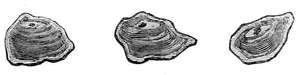
The next wood-cut, which depicts the form of the tables at the tenth year, though true in its general character, will serve to show how far dependence may be placed in ordinary signs, since the infundibulum of the lateral nipper shows a well-marked cavity, while from the other teeth it seems to be upon the eve of disappearing. On inspection, however, it will be seen that in figures the tables approach more towards the square, which is the last form these surfaces assume.
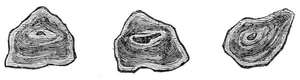
53. At twelve years old, there may be tartar on the lower tush. The teeth are longer, narrower, and the enamel darker. The coloured engraving, which was, on the last occasion justified by a comparison with the mouth of that famous horse, Charles the Twelfth, will convey a general idea of the prevailing characteristics of this age. The teeth have lost the white and firm set aspect they bore at the eighth year. Often, at this period, they have, by wear, become irregular generally, as exhibited in the plate; the grooves, extending down the length of the upper incisors, contain the remnants of the crusta petrosa, which is almost black. The upper tush is usually much diminished, while the lower is long, especially in stallions kept for service. The teeth project more outward and begin to arrange themselves more in a line, no longer showing the crescentic order which they assumed at five years old. Also, by the twelfth year, the tongue, when the jaws are closed, protrudes from the open space between the incisors and molars. The degree in which these alterations have taken place, together with the protrusion of the incisors, is all that is present to guide the judgment; and practical experience is needed, to give him, who attempts to decide upon such weak evidence, any chance of success. As in cases of this description every thing that can help the judgment is eagerly seized upon, the general appearance of the animal is always to be considered; and that may warn the practitioner to modify his opinion. The lower jaw is sharp, the cheeks flat, and around the tushes there may be an accumulation of tartar. It is true the tables, consequent on the wear of the teeth, will have undergone some change, but that alteration is now so slightly marked as not to enforce itself upon the observation. It is easily overlooked, and by no means easily recognised. The annexed wood-cut will suggest the nature of the change. In it will be seen a further remove from the oval form of these parts in the young mouth. The surfaces have become square or angular, and the corners are only sufficiently rounded to indicate what once was the shape which they exhibited.
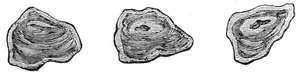
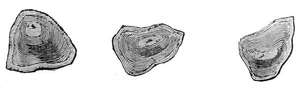
The following wood-cut depicts the tables at the completion of the fourteenth year, and only by careful comparison could the increase of age which they denote be detected. On inspection, however, it will be seen that the irregularities of outline are less prominent even than at the twelfth year.
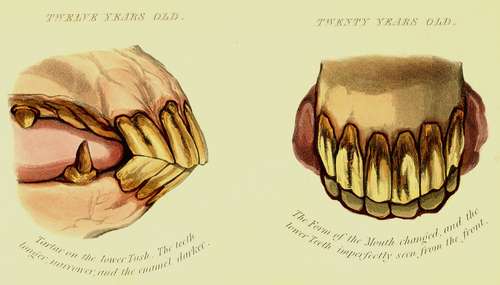
TWELVE YEARS OLD. Tartar on the lower Tush. The teeth longer, narrower, and the enamel darker.
TWENTY YEARS OLD. The Form of the Mouth changed, and the lower Teeth imperfectly seen from the front.
54. At sixteen years old, when the teeth are viewed from the side, only two incisors can be seen in the lower jaw, as depicted in the coloured engraving, which was last authenticated by the mouth of Muley Moloch, which favourite stallion I was, by the kindness of Mr. Theobald, permitted to examine at his well-known establishment, where I also saw many other horses of the purest blood and highest promise. Of the excellence of the arrangements and the value of the animals, which give character to that gentleman’s establishment, it would be presumption of me to speak. I have only to express my admiration of what I beheld, and tender my thanks for the attention I received. The engraving, however, was fortunately corroborated, and its general indications may therefore be accepted. The enamel has entirely lost its white and pearly tone. The tushes, perhaps, loaded with tartar in both jaws, are blunt, and generally either very short or long, inclining somewhat outward. The extension of the crescentic arrangement of the lower teeth enables only two to be seen when the parts are viewed from the side. The tongue protrudes to an obvious degree, and the saliva runs from the mouth when the jaws are separated. The edge of the lower jaw is very sharp and somewhat retracted, while the incisors have taken a horizontal direction. No sign, however, save the protrusion of the tongue, is positive. The general character is that of advanced age, and this general character, at once recognised by the eye of experience, is more to be depended upon than the teeth themselves. The teeth have now assumed the permanent character of old age; and in the figure of the tables will undergo no further alteration upon which any dependence can be placed. Up to the sixteenth year, however, the tables deserve to be consulted. Below is exhibited such evidence as they present, which the reader will perceive is so nice and delicately marked as to be easily misinterpreted. In the tables which belonged to the fourteenth year, it will be seen the infundibula are almost gone, a speck alone denotes their latest trace; nevertheless, the next wood-cut, which exhibits the tables at the sixteenth year, will show that the absence of the infundibula is not to be relied upon. Still the advance in age is, though feebly, indicated. The central incisor has assumed a form which is peculiarly characteristic of age in the horse. It is seldom that at sixteen years all the tables take so marked a shape, but some of them, and generally those in the centre, will, at this period, be symbolical of the truth.
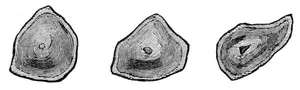
Had it not been for the very conspicuous indication of the central tables, the others in the former wood-cut might have been reasonably decided to be more juvenile in their aspect.
55. At twenty years old, the form of the mouth has changed, and the lower teeth are imperfectly seen from the front. This circumstance springs from the more horizontal direction which the teeth have now assumed, and the acuteness of the angle which they consequently form when closed. The engraving also depicts that alteration in position which disables a person, standing in front, from well seeing both rows of incisors when the lips are separated. When the upper incisors are fairly presented to the sight, a partial view only of the lower teeth is obtained, and as the age advances even that is lost. Further inspection also shows additional changes in position, shape, and tint. The grooves are broad, deep, and well marked by their dark colour. Between the upper incisors there are interspaces in which the food has accumulated and become black, giving to the mouth the appearance represented in the coloured plate. The upper tush, which is now of a brownish hue, may be worn to the gum, and the lower continue long and surrounded by tartar, or both may be reduced to mere stumps. The tongue protrudes greatly; the membrane of the mouth seems hard; and no longer vascular, it is thrown into wrinkles. The edge of the lower jaw is sensibly retracted, and its sides are flattened or narrowed. The general appearance indicates the decay of nature. Here again, however, nothing is positive, save the yellowness of the teeth and the protrusion of the tongue. The general character of the animal is of more value than the indications of the mouth; and, persons familiar with horses can, sometimes by this, guess the age of an animal with the same approach to accuracy, which most people exhibit, when pronouncing the extent of an individual’s life, by simply looking at a man’s face. In neither instance, perhaps, could the basis of the opinion, which possibly shall approach very close to correctness, be accurately stated. Proof, as to the evidence upon which a conclusion is in such cases based, cannot be anticipated, and to the inquiry how they were able to tell the age, each would probably answer, by the “looks,” but neither would be capable of precisely defining in what these “looks” consisted.
56. At thirty years old, the jaws are contracted; the lower are not seen when the upper teeth are in view. The coloured engraving, which at first sight seems to suggest that the animal possessed only a single jaw, exhibits the mouth as it appears at the thirtieth year. The animal, the mouth of which is here depicted, had a lower jaw with excellent teeth considering its age, but without elevating its head these could not, while the mouth was closed, be seen, or when seen, the view of those in the upper jaw was lost. This peculiarity arises from the teeth having taken a still more horizontal inclination; they are now crowded together; and, from the irregularity of their wear, may assume the pointed figure indicated in the plate. The change of colour also has become more decided, and the general indications, which have been before alluded to, are more marked. After what has been so frequently repeated concerning the deceptive character of the tables in extreme age, little, perhaps, need be added to that subject. Nevertheless, to convey an idea of the appearances which these surfaces may assume, subjoined are wood-cuts taken from authenticated mouths, for the inspection of which I am indebted to the liberality of Mr. Ernes, of Dockhead, who has paid great attention to the changes of the teeth. To the honour of that gentleman, I may, while confessing the heavy obligations under which his generosity has placed me, here mention, that no member of the veterinary profession had, to my knowledge, under his care so great a number of animals working at a period of life when the horse is usually supposed to be worthless. The majority of these were in good condition, active, and capable of doing every kind of ordinary service. They presented a pleasing spectacle, more than creditable to the talent of him under whose charge they had retained health and vigour. The aspects which the tables of the teeth exhibited, however, were such as set judgment at defiance, and for the purpose of enabling the reader to form his own opinion on the matter, engravings of a few of them are here introduced.
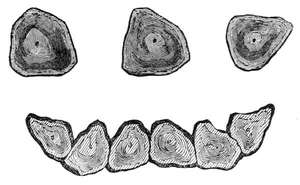
The above wood-cut exhibits the tables and arrangement of the incisors as they were seen in the mouth of an animal which was proved to be no less than twenty-eight years old. Any one, who should base his opinion solely on the marks, must have pronounced the creature to have been no more than five, since none of the infundibula are lost. The semi-circular arrangement also had suffered no very material change, and altogether the contrast with the next representation of the same parts, as they appeared in the mouth of a horse which was but one year older, is very striking.
In the above engraving the teeth are seen to be ranged almost in a line, which is the form they have a disposition to take at this great age. The appearance, here delineated, is more true than the foregoing in its general character, the infundibula being entirely worn out; for the specks in the centre of the tables show, not the remains of the last portion of the marks, but the exposure of the upper extremity of what once was the cavity of the pulp. In the next wood-cut, however, which depicts the tables of the teeth which were in the jaw of a horse, that had reached its thirtieth year, and from which the drawing for the coloured engraving was made, displays a portion of the infundibulum still retained in the corner incisor. The true character of age nevertheless is conspicuous in the form of the tables.
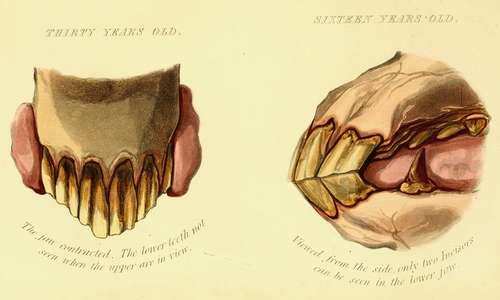
THIRTY YEARS OLD. The jaw contracted. The lower teeth not seen when the upper are in view.
SIXTEEN YEARS OLD. Viewed from the side, only two Incisors can be seen in the lower jaw.
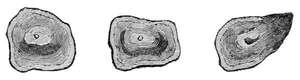
Such contradictory indications admit of being to a certain degree reconciled. The representations of the tables are correctly given, but, in the living mouths, these were corrected by the appearances of the teeth themselves. The incisors of the horse which was twenty-eight years old had suffered but little wear. An unusual degree of hardness, or an extraordinary power of self-preservation, contributed to keep them, so far as the tables were concerned, in appearance, young, long after the season of youth had passed. Almost from the fifth year the tables would seem to have suffered but a very gradual change; for even when twenty-eight, these parts do not indicate the horse to be more than “aged.” The absence of wear may, in some measure, be attributed to the kind of food which the animal had consumed, it having been chiefly fed from the manger; and also to its being of a quiet disposition, or not inclined to bite and snap when the groom was dressing it. The want of wear, however, did not necessitate the cessation of growth, which went on at the natural rate; therefore, though the tables had a very youthful look, the teeth were, nevertheless, unusually long, and gave to the mouth a decided appearance of age. Their colour, and the removal of almost every vestige of the crusta petrosa, together with the general appearance of the horse, was sufficient to awaken those suspicions which would warn the practitioner. The eccentricities, however, which particular parts can exhibit, will teach the student, that a conclusion should only be drawn from observation and comparison of all the various signs which the teeth present. No sign can be singly relied on; but, by weighing the evidence, and placing the contradictory indications in opposition, something approaching to truth may, even in extreme age, be deduced; though such deductions, for obvious reasons, ought to be expressed with caution, and never, under any circumstances, positively advanced. Mr. Henderson, the respected veterinary surgeon to Her Majesty the Queen Dowager, possesses in his museum many interesting specimens of the teeth. Among the rest, he has the jaw of an animal which was ascertained to have reached the thirty-eighth year. This preparation, however, exhibits no sign that could characterize the extreme age which the horse had attained, and I allude to it, only as a confirmation of the opinion I have expressed, that, as the period of life advances, the mouth of the horse becomes more and more difficult of interpretation.
57. The tricks, that are practised on the teeth, are so much talked about and so generally feared, that the subject demands a few words in explanation. The breeders are known to extract the milk teeth, hoping thereby to hasten the growth of the permanent incisors, and to increase the apparent age of the colt. The gums they are likewise known to touch with the hot iron, or to freely lance for the same purpose. All of these practices are common enough; but that they accomplish the design of the persons who employ them is not at all certain. By either of these practices the animal is pained, and pain does not favour development, but, on the contrary, retards it. The suffering, however, may be brief, yet the effect does not stop there. If the milk tooth is firm in the mouth, when the attempt is made to extract it, in nineteen cases out of twenty, it will be broken and the fang left in the jaw. When the extraction of the milk teeth has been general, I have seen numbers of horses, with the broken fangs in their mouths, palpable evidences that the animals have been tampered with. But, supposing all of the tooth to be removed, nothing would be thereby gained. The permanent tooth does not push out the temporary; nor does the temporary, so directly obstruct the coming up of the permanent, as to render its presence or absence of much consequence. If the fang be removed, there may be nothing to absorb, but on that account it does not follow that there will be anything more deposited. The body of a man does not grow larger because one or more of his limbs have been amputated. On the contrary, the shock occasioned to the system by the operation, and the consequence ensuing on the loss of blood, may cause an immediate diminution of the frame. So, if a horse’s tooth be drawn, the animal is alarmed, tortured—and, if the creature recovers from these effects very speedily, so that no loss of growth could be estimated, certainly the most favourable circumstances would not allow us to imagine any stimulus to development had been created. There will be some loss of blood, and this, however slight it may be, nevertheless being taken from the immediate part, must act as a local depletion. Now to deplete is to check growth by abstracting the very source of nutriment. The hemorrhage, however small, must be injurious; and the mouth being made more or less sore, the inclination to feed, as a natural consequence, is diminished, thereby further checking the development. I cannot see in what manner the extraction of the milk teeth is to hasten the growth of the permanent incisors; but I can perceive that the operation may have the opposite effect; and I have known the practice to have been followed by the non-appearance of the very tooth, the protrusion of which through the gum, it was employed to quicken. The tooth, which previously seemed to be on the eve of piercing the gum, after the extraction of the milk incisor never came up,—nor will any person who has thought for an instant, wonder if the violence, necessarily used, does occasionally injure or rupture the delicate vessels and gelatinous tissues of the pulp. More often the breeder’s impatient interference breaks the tooth off at the neck and leaves the fang in the jaw. This he has not the skill to extract, and as it is not afterwards absorbed but speedily assumes a dark colour, it remains a tell-tale and an eye-sore during the life of the animal. Had the colt been left alone, the fang in a few months would, by the natural process, have been absorbed: but the force which broke the tooth, though incapable of extracting it, probably ruptured the delicate tubes of the absorbent vessels. The broken member is left in the mouth, either to act as a foreign body, or to become united by anchylosis to the jaw, and continue for life a deformity. The folly of the practice will surely on reflection be evident to all; and the other means employed for the same end are in a like degree injurious. The breeder will consult his own interest best by studying the feelings of his animals. For the sake of profit, if not for the love of humanity, he had better cease to torture the poor beasts by which he hopes to gain. Suffering will neither engender spirit, growth, or fat, and the market pays price for each of these. The mouth of the horse is too important towards the value of the animal to be ignorantly mutilated. Let the mind reflect, before the hand is permitted even to use the lancet. To lance the gums of the human infant was once a favourite practice; nor has the custom at the present time fallen quite into disuse, but it is generally resorted to only during the cutting of the primary teeth, and not commonly adopted to facilitate the appearance of those teeth which the horse-dealer employs it to quicken. In the latter case, on man the gum lancet is not employed; and, if found useless on one animal, a strong inference is created as to the inutility of constantly experimentalizing with the instrument upon another. By incising the gums a wound is created, the part is thickened, and a cicatrix induced; the effects of which are to cause an impediment to the growing tooth; and this being seen and corroborated by practical observation, the best dentists and surgeons of the present day are not very enthusiastic in the use of the gum lancet, which they have in a great measure cast aside, and which is beneficial only in scientific hands. The loss of blood likewise is to be considered, and that certainly aids in retarding the growth, which the adoption of the other means, general with the breeders of horses, could not accelerate. The employment of the cautery, to expedite the appearance of the teeth, is so strange a resort, that I can only account for the use of that agent by imagining certain persons to be totally ignorant of its action. In the first place, it destroys the part with which it comes in contact; inflammation follows and suppuration ensues; a quantity of blood is diverted to the surface, and of course drawn from the pulp of the new tooth, which originally it flowed to and nurtured. A slough must take place, and the mouth remain sore till the escar is thrown off and the exposed granulating surface cicatrized. But wherever the hot iron is applied the immediate part is thickened, rendered more hard and tense. Which of these effects is it the horse-dealer regards as likely to promote his wishes? A little knowledge would inform any one, that the cautery must act in the opposite direction to that, which it is supposed, by ignorant people, to favour. Indeed, I do not think, that horse-dealers or others have yet obtained so great a mastery over nature, that the dame can be made to hurry at their bidding, however cruelly their orders may be enforced. A “Yorkshire five” may sound well, but there is no more possibility of making a four-year old colt, by barbarity, show the development of a five-year old horse, than there is, by wrenching, cutting, and burning, of making a boy of fifteen look like a man of twenty. Nature obeys her own laws, and is not yet subjected to human practices. Careful rearing, nutritious food, sufficient exercise, and no work does promote development, and of the growth thereby engendered, the purchaser has no reason to be in fear; for if one part shows maturity, he may be assured, that the other parts are also equally matured. The time the animal has lived is not of half the consequence, that the use which has been made of its life is, to the future possessor. The horse that has a mouth indicating five, and that can be proved to be five, if it has been worked from its earliest year and stinted in its food, has less energy and life than a younger creature forwarded by the fostering care of the breeder. The two animals are not to be compared. Supposing the one to be no more than four, it possesses the vigour and development of five; while the other, which is five, may have the decrepitude and constitutional infirmity of twenty. Let not the buyer fear the deceit of the breeder, but without dread accept the mouth as proof of the age; if the animal is not in years, he is in development, that which the teeth declare. To this conclusion, however, some will oppose their opinions. The animal, they will argue, has been stimulated to exhibit an unnatural maturity, and the seeds of future disease have thereby been planted in the system; therefore, it will be urged, the worth is depreciated. The statement looks well, but it is of no value, for a little inquiry will prove it to be based on false principles. Excessive stimulus checks the growth, or causes early disease, sacrificing either the health or life of the being. The feeder knows, from experience, that the quantity of nutriment must be measured by the powers of the creature that consumes it; and that over-feeding, by impairing the digestion, destroys or weakens rather than nurtures the body. The stimulus, pushed beyond a certain point, would keep the horse in the infirmary, and never fit it for the market. Every dealer knows this, and though such persons are, by the prejudice of the public, obliged to keep their animals loaded with fat, or in what is called “bloomy condition,” they nevertheless fear to maintain this state of body for too long a period; and while it lasts, constantly resort to drugs, to counteract that tendency to disease which it engenders. They treat their stock, almost as a physician would treat so many city aldermen; and give dinner or digestive pills almost as regularly. A fatted beast is always diseased, but an animal liberally fed is thereby rendered the more healthy. In fact, the dread of those results which ensue from comfort is, with regard to the horse, quite as unfounded as the fear, that mankind once had, of the “miseries of the rich,” and the envy, poets taught them to indulge, towards the starvation of the poor. Such idle fancies may be dismissed with profit to the person who discards them; but at the same time there are some practices the reader needs to be cautioned against. To give the face of the horse a youthful appearance, some of the class of dealers who frequent public markets, low auctions, and country fairs, puncture the skin at that part where the falling or depression is seen above the eyes in old animals. Having inserted into the orifice a small quill, they then blow into the part, thereby inflating the subjacent tissue, and concealing the cavity. This notable artifice, which is called “puffing the glym” ought to impose upon no one. Should the trick be suspected, let the hand be carelessly raised to pat the neck and cheek of the animal, when it can, under pretence of likewise stroking the face, be passed over the part which is supposed to have been tampered with; and in the act a little pressure may be made upon the suspicious region: then, if the swelling has been induced in the manner stated, the passage of the hand is sufficient to squeeze out the air, and the contrast which the two sides of the face will afterwards present, gives to the countenance of the poor horse, a very knowing and peculiar expression. Let the person, however, who thus undertakes to expose roguery, be assured of his ability to protect himself in the office he has assumed; for the gentlemen who display their ingenuity on horses, are not averse to occasionally mutilating the human frame. To lay bare and detect such low, mean, and obvious cheatery, as the above, properly belongs to the police; and the least acute of the force, ought to be equal to the detection of so gross an imposition. The swelling, when caused by inflation, always has an unnatural aspect, such as a school-boy would find no difficulty in recognising, after his attention has been directed to the point. It looks puffed, and when the jaw moves, the part does not play freely with the motion. These circumstances, at a glance, declare the cheat which the pressure of the hand can, in an instant, prove to have been practised. The artifice, however, when adopted, ought to be of no avail. Young horses often exhibit the depression above the eye, of great depth; nor is it unusual to see old animals, in which the cavity is naturally shallow. The qualified judge, therefore, glances at, but never permits the state of, the part, to influence his decision; and the trick, when resorted to, can impose only on those who are too vain to acknowledge their ignorance, or too mean to pay for protection. Other indications are of greater worth, and to these, observation is directed. The roundness or flatness of the cheek, the sharpness or fulness of the lower jaw, no art can imitate: these, consequently, receive more attention. The eye is directed to the mouth; and still supposing the reader to be present at such places as the parties who practise tricks with horse flesh mostly frequent, let him be thought desirous of purchasing the animal, and therefore proceed with an examination: it will not be long before the teeth will be inspected. When the lips are separated, the incisors may be long and horizontal in their inclination; and, by the time this is noted, the seller probably has volunteered the information, that the horse he is most reluctantly obliged to part from, was six years old last grass. The expression of surprise such a statement elicits, is answered by oaths as to the fact, and direct accusations of ignorance against any one who would assert the animal to be a day older. The jaws are pulled asunder, and all the marks are seen. Here is proof; no man who knows anything of horses, he is told, would reject such evidence; and a host of ready bye-standers stare at the mouth, and only doubt if the creature is full six yet. The judge also looks at the marks, and then walks away: he has formed his opinion, and the sight of the marks confirms him in the conclusion he had arrived at. The absence of the police may caution him not to expose himself by noticing the shout of defiance, and bellowed taunts, that signalize his retreat; but he has seen the animal is a “bishop.” Now what promoted the poor brute to ecclesiastical dignity? The term in horse slang, simply means that the marks are not natural, but have been made. There are two means by which that can be done. When time presses, and tools or skill are wanted, the tables of the teeth are touched only with a red hot wire, which leaves a black mark wherever it is applied. This, however, is a coarse expedient, and the more usual practice is, to dig out the cavities with a kind of engraver’s tool, and then to blacken the spaces thus created. The infundibula are imitated with much nicity; but the resemblance, however close it may be, never for a moment imposes on the qualified judge. The shape of the table, characteristic of the old tooth, cannot be altered, nor can the edge of enamel, which should gird the infundibulum, be artificially produced. Moreover, many of the people who “bishop” horses, are content to perform the operation only on the lower jaw, leaving the upper teeth untouched, because these are not generally inspected. Should such be the case, of course the marks will be more or less faded, where naturally they would be most fresh; for the infundibula of the lower jaw are lost some years prior to those of the upper disappearing. The attempted deception, therefore, is never successful, save when the “copers” are fortunate enough to meet with a “flat,” who has just knowledge enough to be very wise in his own conceit. It must, however, be remembered, that the lower class of dealers are not limited in their transactions, and often dispose of animals to persons of respectability; therefore, it is not unusual to find horses standing for sale at commission stables, with mouths of a most conspicuous character. The owners of such horses may be gentlemen of the highest probity, and in ignorance the age may be mis-stated. For this reason, no man should purchase a horse of any individual, without having the animal previously examined by a certificated member of the Royal College of Veterinary Surgeons. The money so spent, is the smallest item in the account; and the sum saved by following this rule is often disproportioned to the expenditure,—to make no estimate of the disappointment and vexation which may be prevented. Respectable dealers will not knowingly allow the character of their stables to be injured by the presence of a “bishoped” animal. This class of persons are very scrupulous in that respect, but they are not always able to detect the truth—their education is often limited, and though good ordinary judges, they cannot, under every circumstance, decide correctly—they unconsciously deceive, being themselves deceived; and consequently every purchaser should take the precaution pointed out, no matter whence, or from whom, he may be buying a horse. Were all to act in the way indicated, much law would be spared, and a great deal of anger allowed to slumber. The dealers are not the rogues the enlightened public are fond of believing—many among them are as honourable as all men should be—some of the class, however, never let a horse escape out of their hands unmutilated. The teeth invariably receive the primary attention: if long, they are, by the application of a file, reduced to the length which the self-taught equine dentist supposes proper to youth. An acid is also applied to the enamelled surface, in order to render it white. No vast good is effected, but if the means were not designed to impose, no great harm would perhaps be done. The acid is not allowed to corrode the tooth, and the diminution of the length may possibly in some degree benefit the animal. The welfare of the creature, however, is not the object sought—the hope is to cheat; but no person who ought to be trusted, or even to trust himself to purchase a horse, should be so imposed upon. Whiteness is no sign of youth in the tooth of a horse, and the file cannot make the tables assume the juvenile figure. Horses that show such mouths, may be easily recognised—perhaps they are quiet while their legs are handled, but shy when the head is touched—they are not vicious, but timid, and the teeth tell the reason of their fear. It is well to pass them by, and dangerous to accept them at any price. If the teeth have been tampered with, what tricks may not have been practised to conceal other defects?
58. Irregularity of growth in the horse’s teeth, should, in all cases, be early noticed, and speedily attended to, for so much of the worth of the horse depends on the animal’s ability to feed, that it may be said, “no teeth no horse.” The milk teeth are so regular in their growth, that I have not been able to hear of, or meet with a specimen, in which they were eccentric. The permanent teeth, however, are not unusually irregular; the most common irregularity which they exhibit, is that of retention of one or more of the milk incisors, and this more frequently is to be seen in the lower than in the upper jaw. Mr. Ernes, of whom I have before spoken as an excellent judge of the teeth, and a most able practitioner, was kind enough to show me the mouth of a cart horse which was under his care; the lower jaw had eleven incisors, but of these five were milk teeth. The appearance which the mouth presented was rather that of some foreign animal than of an ordinary horse. The bone had become deformed, and the gums were in several places in an inflammatory condition. Mr. Henderson possesses a most curious preparation of the lower jaw of a horse, in which there is exhibited eleven permanent teeth. The appearance which this specimen presents is extraordinary, and the existence of such a monstrosity, showing the extent to which nature may violate her own laws, deserves special attention. The possibility of so great a variation being encountered, will prepare the mind to expect and to consider the less marked deformities, which in practice are not unusually met with. It is not unusual to find horses with eight teeth in one jaw, two of which are generally, on inspection, found to be retained milk incisors. The milk teeth, if allowed to remain after the horse incisors are fairly up, often give to these last a very strange appearance. The following wood-cut depicts the mouth of a mare, to which my notice was directed by Mr. Henderson, the gentleman to whose generosity I have before had occasion to confess my obligations.
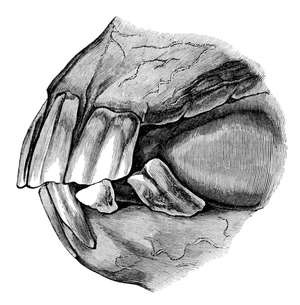
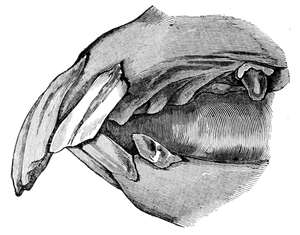
The corner milk tooth here not having been extracted after nature had failed to remove it by the process of absorption, has caused the last permanent incisor to take an unnatural situation, where, being removed from attrition, it has become of extraordinary length, and looks as much like a curious tush as the thing it really is. Such a state of the mouth is far from rare, and because of its frequency, being the more likely to be met with in practice, it was chosen for illustration. The molar teeth are less subject to distortion, but, nevertheless, are sometimes irregular, and from the same causes. I have seen the palate pierced by a tooth which grew in an unnatural direction. The treatment, in both cases, would be alike. The milk teeth should never be allowed to remain in the mouth after the corresponding permanent teeth are fairly up. If removal prior to this period does no good, now the operation is suggested by its accordance with the natural process, and the sooner it is undertaken the better: any delay will only create difficulty, and render the restoration of the displaced tooth, more problematical. The unabsorbing fang, will, in time, become united to the bone; and if its extraction is then attempted, fracture of the jaw may be the consequence. In no instance should the stable keeper be told to pull out the teeth: he has not the proper instruments for the purpose, and must use unnecessary violence even if he does no greater injury. The animal, besides, is rendered shy of him, in whom it is essential it should be educated to repose confidence; and many a horse, by the bungling efforts of such people, pretending to operate, is ultimately rendered dangerous in the stable. Moreover, the horse owner cannot be too seriously cautioned, against giving permission to those who attend on his animals, to overstep their lawful limits. In the first instance he may, perhaps, congratulate himself upon the result, but speedy experience will convince him, to his cost, of the danger of the system. If the operation should have been delayed so long, as to allow the teeth to have become of unequal lengths, then, after the milk incisors are extracted, the permanent teeth must be rendered level; and, however far apart they may at first be, in time they will approximate. The operation, which is recommended, any Member of the Royal College of Veterinary Surgeons will execute; and, as in skilful hands, it is never dangerous, so it should, on no account, be entrusted to quacks or pretenders. For some irregularities, however, there is no help; for instance, when the lower jaw exhibits only four permanent incisors, which is by no means unusual, and which, in the majority of cases, could be traced to the efforts made to extract the corner milk teeth, before the time had arrived for their removal. An animal with such a mouth is obviously deteriorated. The lessened number of its teeth may be of little consequence while it is young and kept in the stable. During the earlier years, the corner nippers, which are those most frequently wanting, are not in perfect apposition, nor are the incisors of so great importance, when the food is to be pulled from the rack or gathered from the manger. But at grass, especially in old age, when horses are most frequently turned out, and when the spreading of the semi-circle brings all the teeth into play, none can be spared. The absence of one-third of the nippers in the active jaw, would then cause the animal more work for its livelihood, and probably counteract all the benefit which “the run” was intended to produce, even if more serious evils did not ensue. The eccentricities of the teeth should always be regarded, to conjecture how far they may retard the welfare of the horse. The presence of an additional molar in each jaw is sometimes seen, and is hardly to be counted a defect: such supernumerary teeth are generally posteriorly situated, and of small size; they may cause no inconvenience, and their existence not be suspected during the life of the animal. The reverse, however, is the case when an extra tooth is found only in one jaw. I am indebted to Mr. Dunsford, a gentleman who pays more than usual attention to every case entrusted to his care, for a fine specimen of the evil which may result from an abnormal molar. In the lower jaw, on the near side, are seen seven molar teeth; and the last has, from the absence of attrition, grown to a length which caused it to do serious injury to the mouth. The teeth are placed one behind the other in a perfect row; hence, as well as from their all being of the full size, one, the last in position, was occasioned to project, forcing itself through the gum, even into the substance of the superior maxillary bone. The horse was destroyed, having become useless, in consequence of its inability to masticate its food. Another defect in the molars is observed, in these teeth sometimes being placed apart from one another, leaving interspaces between them, in which the food accumulates, and inflaming the gums, causes the animal much pain whenever it attempts to feed. For this, nothing can be done, beyond giving the poor beast its meat artificially prepared; but with all care the unfortunate animal becomes emaciated, and is speedily consigned to the knacker. Fortunately, however, the molars are not often irregular in their growth. In fact, most irregularities of the teeth must be carefully sought for, but one form which is not rare by any means ought to be always observed. In certain animals the lower jaw is so short, that the creatures cannot place the incisors together or in apposition: the consequence is, that the lower incisors being active instruments, have to perform their functions at considerable disadvantage; but, nevertheless, they act and receive wear. The upper incisors, however, are, in such mouths, subjected to little attrition; the corner, and a portion of the lateral nippers alone, meeting each other; hence the central nippers, which grow more forward than they ought, at length project downwards, and overhang those of the lower jaw. This arrangement of the incisors constitutes what is called a “parrot mouth,” because of the resemblance which the teeth bear to the bill of the bird. Most old horses are more or less parrot-mouthed; but young horses also occasionally exhibit mouths of this description, and in these last it is certainly a defect, for in a state of nature, or at grass, the animal would be necessitated to tear rather than bite its food. The proprietor of such a beast, therefore, can or ought never to turn the creature out, but keep it constantly in the stable, and under many circumstances this would entail inconvenience and expense. There is nothing to be done for such a malformation, but an allowance should be made for it in the price. That the reader may be able to recognise it, a copy of a mouth, in which the deformity was well marked, is here presented. The animal, which was introduced to my notice by my talented friend, Mr. Broad, of Paddington, was twenty-one years of age; and though more conspicuous cases of the kind are sometimes seen, the one I have chosen for illustration shows a rather greater malformation than is usually met with; but, nevertheless, it well illustrates the point upon which I have been dwelling.
The molars sometimes wear unevenly, their edges becoming as sharp as knives, and their tables slanting in an unnatural degree. The slanting tables cannot perfectly comminute the food, so that which is swallowed, not being properly prepared, affords little sustenance; while the sharp edges cutting the inside of the mouth, and causing it to ulcerate, render the animal, from the pain, disinclined to eat. The contraction of the bones of the lower jaw, in some old horses, by disabling them from bringing the tables of the molars in perfect apposition, is the cause of these teeth assuming such a shape; for in young animals this species of distortion is never witnessed, save as the consequence of disease. The horse not feeding, attracts the attention of the groom, and rarely does his intelligence detect the cause. Any member of the Royal College of Veterinary Surgeons, however, will soon discover the seat of mischief; by reducing the cutting edges of the molars, and invigorating the constitution, while the ulcerated mouth is properly treated, and the food carefully attended to, he will soon restore the horse once more to health and activity. The proprietor, however, must ever after have the horse, from time to time, attended to, as the symptoms denote a relapse; and with such precaution the animal may continue in full work for a number of years. Not a few horses show the edges of the incisor teeth perfectly rounded, so that when the mouth is closed the tables no longer touch in every part; indeed the form of the tables is destroyed, and the age of the animal can by them hardly be conjectured. These rounded teeth have been supposed to denote crib-biting, and gentlemen have for fifty years been told, to set down every horse presenting such a mouth, as a confirmed cribber. The notion, however, is not supported by fact, for cribbers generally exhibit even mouths; and I have not yet been able to discover an instance in which this habit had caused the tabulated surfaces of the teeth to be convex. The round form of the tables results from the horse biting when being groomed, and generally is seen in those which are of an excitable nature. These animals are usually good servants, but this shape of teeth unfits them for being turned out to grass, as the cutting edges of the nippers are destroyed.
59. The diseases to which the teeth of the horse are subjected, are, fortunately, not very common; though this assertion must not induce any person to imagine that his animals may not be afflicted in this respect. Every owner should be particularly watchful on such a point; for so important are the teeth to the welfare of the animal, and so difficult of cure are neglected cases of this description, that numbers of valuable horses have been and will be slaughtered, simply on their account. No animal is exempt from this species of affliction. One man may during his life possess many horses, and die without knowing how fatal are the diseases of the teeth. Another person, whose stable shall contain but a single nag, may, in a few months, be taught how dreadful are the ravages which this affection can induce. All therefore should, for the security of their property, be aware of the first indication of this species of disease. Though the teeth are not vital organs, and the course of the malady is generally slow, nevertheless, the consequences to which it gives rise are such as in every case, deteriorate the value of the animal; and, in many, nay, perhaps the majority of instances, render it alike prudent and humane to deprive the poor beast of existence. Probably I do not assert too much when I add that, in the ordinary examination of horses, little attention is paid to the condition of the teeth. The incisors are inspected to ascertain the age, and any peculiarity in these is particularly noted; but for the most part the molars are passed over without comment. Here the rarity of disease may shield the negligence of the practitioner, who, nevertheless, is in every case exposed to blame through his inattention. Such a man may pass through a long practice, and escape reproach; but, nevertheless, the first horse on which he pronounced an opinion, might have blighted his reputation, by exhibiting the disease he had taken no pains to detect. Every animal purchased of a party whose warranty might be at all suspicious, ought to be seen to feed before a conclusion as to soundness is pronounced. If then the molars are affected, the truth would be made obvious; and there is nothing can render a horse more unsound than disease of these teeth. The animal so afflicted, may, for a time, be equal to its work: yet to render it capable of exertion it requires continual care, and in the end, spite of all precaution, it may become worthless. Some means should therefore be adopted to ascertain that the grinders are free from disease, and a little corn will enable the fact to be conjectured. Should any suspicion be created, a further examination will discover the truth. The molars, in the judgment of every one who has thought upon the matter, are the teeth which, especially in aged animals, require attention. The incisors indicate the age, but they are not usually liable to disease. I have not met with a single case in which the incisors were affected, nor in which the tushes were diseased. I am, however, informed by Mr. Field, whose high reputation and extensive practice give weight to his assertion, that he has had to treat horses for disease of the incisor teeth, and has even been obliged to remove a portion of the lower jaw in order to procure relief. Other practitioners, of whom inquiry has been made, have not known such a form of disease, neither have I witnessed it: instances of this kind, therefore, are rare, and hitherto have not attracted attention. The honour of making known the possibility of their existence, belongs to a gentleman whose name is proudly associated with the science which it has so long adorned. The incisors of the colt are not, however, liable to be seriously affected: when those teeth decay, age must have advanced. During colthood, nevertheless, the teeth, if exempt from disease, may be the causes of great constitutional disturbance. Mr. Percival, the gentleman who, as editor of the “Veterinarian,” and author of the best and most elaborate works on the diseases of the horse that have yet appeared in the English language, attaches much importance to those ailments incidental to dentition. Of the consequences that may ensue from the cutting of the tushes, he adduces positive proof, and from his admirable work on “Hippopathology,” page 172, vol. 2, I cannot forbear extracting the following most valuable case:—
“I was requested to give my opinion concerning a horse, then in his fifth year, who had fed so sparingly for the last fortnight, and so rapidly declined in condition in consequence, that his owner, a veterinary surgeon, was under no light apprehensions about his life. He had himself examined his mouth, without having discovered any defect or disease; though another veterinary surgeon was of opinion, that the averseness or inability manifested in mastication, and the consequent cudding, arose from preternatural bluntness of the surfaces of the molar teeth, which were, in consequence, filed; but without beneficial result. It was after this that I saw the horse; and I confess I was, at my first examination, quite as much at a loss to offer any thing satisfactory as others had been. While meditating, however, after my inspection, on the apparently extraordinary nature of the case, it struck me that I had not seen the tusks. I went back, and discovered two little tumours, red and hard, in the situation of the inferior tusks, which, when pressed, gave the animal insufferable pain. I instantly took a pocket-knife, and made crucial incisions through them, down to the coming teeth, from which moment the horse recovered his appetite, and by degrees his wonted condition.”
The fact here recorded has certainly been generally overlooked; and Mr. Percival deserves the gratitude of his professional brethren for directing their observation to the point. Every practitioner, however, has met with instances in which the molars were implicated. There are two forms of disease to which these teeth are liable; caries, or decay, and a loss of vitality, or death. The death of a tooth has not hitherto been observed upon by veterinary authors, but it is not rare. The causes which may give rise to it cannot be accurately stated, though they may be conjectured. The vessels that nurture the fang and ramify through the pulp, are small and delicate; the alveolar cavities are thin, some of them in the upper jaw being not thicker in parts of their walls than brown paper. The force of the masticatory muscles is very great, and if any hard substance be taken between the teeth, it is easy to imagine that the minute arteries of the fang should thereby be ruptured. The effect produced upon the pulp, and the transient agony occasioned by biting a piece of hard crust, are familiar to every human being; nor can we suppose that the horse’s teeth, especially when the greater strength of its muscles is duly considered, are not liable to similar and proportionably greater injury. There may be no history to such a case, no record of the date when the occurrence took place; for the horse is not always watched during the time of its feeding, nor were it watched, is it possible that the groom would attribute the sudden exhibition of pain to the right cause. The primary effect is therefore misinterpreted or unnoticed; but after a time it is remarked that the creature is longer than its companions emptying the manger; then it begins to quid its hay,—that is, the hay is taken into the mouth partially masticated and formed into a pellet or round mass; but instead of being swallowed, the prepared morsel is allowed to fall from the mouth. Should no advice be taken, the horse becomes bad in its coat, and loses flesh. No amount of corn, or extra grooming, will restore it to condition; medicines may be administered with no better effect. The disease is strictly local in its nature, and the constitutional symptoms are only sympathetic. Should the affection still be suffered to proceed unchecked, the animal is continually moving its lips; either it is restless in the stable, or leans the head against the manger, and neglecting the food which is before it, remains dull and quiet, the eyes half closed, and the breathing quickened. A dose of medicine seems to do it some temporary good, but the purgation has hardly ceased before the symptoms reappear; saliva runs from the mouth, and the food in the manger is rendered sloppy, almost like to a mash, before it is eaten; the bones of the face at last swell; the breath becomes fetid; and a thick offensive purulent discharge issues from one of the nostrils. That discharge is not continuous; sometimes it will cease for days, and the proprietor congratulates himself that the horse is getting well; the fetor, however, remains, and after a time it breaks forth again with redoubled vigour. The animal becomes daily worse, and would linger on, but the patience of the owner is exhausted; the knacker is employed to cut short the hopeless trouble and expense, and then a hasty examination is made for the cause of all this mischief. Such is a condensed description of the customary incidents, in the order in which they ensue; but of course the intelligent reader is aware that the symptoms of disease cannot be mapped down, as though they were results obtained from inorganic matter. Such symptoms always more or less vary, though upon the whole they present sufficient similarity to enable them, in every case, to be interpreted; and hence the value of practical experience, which enables the party possessing it to recognise a fact, when not fully declared. The writer cannot, to the like extent, communicate instruction; he must condense his remarks, and be content to speak a general truth; for if he descends to particulars he becomes tedious, and that which he would teach is disregarded. Of course the symptoms vary: all may not be present, yet one or more will lead the practised mind to the seat of injury. The history, however, which has been recorded, supposes the dead tooth to be located in the upper jaw: should it be situated in the lower jaw, some difference will be presented in the effect; for then the injury is not so serious. The discharge from the nostrils does not ensue, but the inferior maxillary bone enlarges, and the breath becomes offensive. The swelling of the bone takes place immediately under the tooth which has ceased to be a part of the living frame; and at this point also an abscess forms; this bursts, and discharges an unhealthy matter: unlike ordinary abscesses, however, which, when they have thrown out their contents, close, this, notwithstanding that the orifice is dependent, exhibits no disposition to heal up: a thin stinking liquid continuously issues from the opening, which becomes hard around its edges, and the hair about which sticks out, looking coarse and ragged. Such outward and visible signs are hardly to be misunderstood; and attention being directed to the mouth, the examination of the teeth will confirm them. From one jaw will be felt a molar projecting far above the level of the rest, and in a like degree will the opposing tooth in the other jaw be found depressed—worn down actually to the gum. All is now clear; and the question is, what shall be done? In the first place the condition of the mouth has certainly deranged the digestive organs, and, where there is room for choice, no operation, however simple or apparently safe, should be undertaken while the stomach is out of order. The seat of the disease is known, but the general health is first attended to; and when that has been in some measure re-established, the great object of the surgeon is fit to be accomplished. The question is, which of the teeth are to be interfered with? One is diseased or dead, and there can be no doubt that the diseased tooth should be removed. That which is unnaturally long, obviously indicates that its power of growth is retained; and though hypertrophy is an abnormal action, teeth are not parts liable to that species of affection. The one which by its growth indicates vitality, therefore displays no symptom of disease; but the tooth that is reduced to the level of the gums, tells us that its power of self-preservation has ceased, and that its vitality is gone. If that tooth be felt, it will, in the majority of instances, be found loose, and therefore it can be easily extracted: the operation, however, is not then ended. Should the affected organ have occupied the upper jaw, a quantity of pus may flow freely into the mouth on its extraction, but more frequently such will not be the case: nevertheless, the discharge from the nostril, (should the case have been of long standing,) together with the softened and swollen condition of the facial bones, may convince the attendant that matter is locked up in the maxillary sinuses. Some writers speak of the antrum as the part most seriously affected; but I cannot find any thing corresponding to the antrum in the horse’s head. That animal has no development of this description, and therefore it only shows ignorance to operate with a special view to opening an imaginary cavity. The maxillary sinuses are spacious cells, and freely communicate with the frontal sinuses, which are also large. These facial sinuses have but a limited and kind of valvular opening into the nasal chambers, and if pus is allowed to remain within them there is little hope of cure: therefore a means must be found for its escape. To this end the finger is employed to probe the alveolar cavity, whence the tooth was taken, and it will probably prove to be of no great depth. An instrument constructed for the purpose is now used, and with it a hole is made through the walls of the alveolar, directly into the maxillary sinus—his knowledge of anatomy teaching the operator so to direct his hand that none of the important nerves and vessels, which ramify through the parts he is penetrating into, may be injured. On the withdrawal of the instrument, pus will mostly follow, but not gush forth as from an ordinary abscess. A dependent orifice has now been established, and if the case is not a severe one, that may be sufficient: if, however, the disease is aggravated, it will be necessary to trepline the frontal and perhaps the maxillary bone, leaving in each a free space, from which a circular piece has been removed. Through the superior opening, warm water is injected; but if the stench be very offensive, a weak solution of chloride of lime or of creosote may be employed, and must be daily repeated. None of the coarse applications which some ignorant persons recommend, ought to be used. A strong solution of the sulphate of copper or of zinc, by coming in contact with a large surface of granulating mucous membrane, can hardly be expected to allay its irritability, or dispose it to take on a healthy action; and a seton, forced barbarously through the orifices made with the trephine, can only exist as a foreign agent, keeping up the action which the surgeon is desirous should terminate. Gentle means are, in every sense, the ones to be adopted. Mild tepid injections are to be employed, with the intention to wash out the accumulated pus, allay the inflammation that caused it to be secreted, and correct the diseased tendency of the part. All stronger agents are barbarous; and I have witnessed animals rendered dangerously vicious by their employment. When, however, the acute stage has past; when the inflamed and secreting surface has lost its activity, not unfrequently succeeds a dull, lethargic state, which the mild treatment, hitherto advised, will not touch: now it is that stimulating injections are beneficial; and however much reason there was in the first instance to denounce their employment, they are now indicated by the soundest principles of scientific practice. Even at this time, however, they must not be pushed too far. The constitution should be stimulated, that their effect may be aided, and their continuance necessitated for the shortest possible period. The sulphate of copper or of zinc; the acetate of copper or of zinc; the chloride of zinc or of lime; the nitrate of silver or of mercury; the black or yellow wash, in strength proportioned to the symptoms, may here be of service. It is well, however, to remember that these agents soon lose the efficacy, and the greatest benefit, therefore, is obtained when they are occasionally changed on the first sign of their potency decreasing. Still injections alone cannot be expected to effect a restoration, and, therefore, topical measures must be combined with constitutional treatment. A course of mercury may be tried, or some of the many agents, which, like balsams, peppers, and essential oils, act on the mucous system, can be administered,—never, however, relying upon any one medicine for too long a period; but, as in the previous case of injections, changing it wherever the drug appears either to have no effect, or to have lost its power over the system. By such treatment, actively employed and combined with a proper attention to exercise and diet, the case must be aggravated indeed which is beyond relief. The cure, however, we must not expect to be quick; but it will generally in the end be realized. Perseverance may be required, but barbarity will not hasten success. I object to many of the practices which the veterinary professors of the London College inculcate to their pupils; because those practices, in my opinion, being based on false principles, are needlessly severe. Of the potent solutions habitually employed at the St. Pancras School, I have spoken; but there is another practice to which I have not alluded: corks are forcibly thrust into the holes made by the trephine, under the notion that by such means the opening can be kept free, and the wound uncorked and corked up like the mouth of a bottle. Mr. Percival has spared me the trouble of exposing the folly of the idea, and the inutility of the practice. That gentleman tried the notable experiment, and found that the cork in no degree delayed the consequence it was employed to retard. The presence of a foreign body thrust into immediate connexion with a diseased surface, and violently there retained, must cause excruciating agony—promote serious irritation—and might lead to the worst possible results. The ignorance should indeed be gross, which could conjecture such a vulgar resort was capable of inducing the slightest benefit. Equally objectionable is the custom recommended by the veterinary professors, of shutting an animal up in a close stable, and causing it to inhale the fumes of chlorine gas. Chlorine is an irritant to mucous membranes. If the nasal cavities were the seat of the disease, the passage of the air being rapid through these channels, and retained for a comparatively long period in the bronchia, the supposed remedy would be far more likely to affect the lungs, than to act immediately on the part which it was intended to benefit. In respiration, however, it is not probable that even during health, any large quantity of air enters the sinuses, which, in these cases, are the seats of the disease; and when those cavities are blocked up by an abnormal secretion, none could possibly gain admittance to them. Chlorine, therefore, obviously is inoperative in the direction where its remedial agency is desired to act; and it does some injury. It violently affects the animal which requires to be soothed; causes it to endure much inconvenience and even suffering; produces quickened respiration with violent cough, and may be reasonably supposed to lay the foundation of subsequent disease. The advantages of its employment have not been demonstrated, but the results of practice rather show it to be injurious. By the members of the veterinary profession it is not generally used: gentler measures are of greater importance, and these ought, only under very peculiar circumstances, to be abandoned. There, however, yet remains to be described, the mode of proceeding when the diseased tooth is seated in the lower jaw. In that case, a sinus or canal, discharging an unhealthy matter, is present. No treatment will cause that sinus to close, while the diseased tooth is retained; and until its removal is effected, all applications designed for that end are thrown away. After the tooth has been extracted, a solution of sulphate of zinc may, with advantage, be daily injected, and constitutional measures at the same time adopted, till an altered action has been called forth, when the annoyance will quickly cease. The enlarged bone will, however, remain; and, in the majority of cases, it may be best no further to interfere with it, than by the external application of such agents as are likely to promote absorption. In such cases, however, no means are very speedily beneficial, and time must be given for their operation: but should the deformity be great, the firing iron may be employed to cause exfoliation of the part. Yet as in the removal of one blemish, it is not justifiable to create another, the violent agent must be applied after a particular manner. The integument should be first divided, and the edges of the incision drawn asunder, so as to expose the bone, which alone should be touched with the cautery. By this simple expedient the osseous structure will be destroyed; and as such structure is not highly sensitive, the suffering of the animal will be slight, while after exfoliation has taken place, the trivial cicatrix will be concealed by the hair. When caries is present, the symptoms do not materially differ from those described as indicating the death of a tooth. The disease may commence at any part of the fang or crown; but the structure which it generally first involves in the horse, is the crusta petrosa: for however far the caries had proceeded, I have usually recognised it working from this substance into the ivory. The crusta petrosa is the least osseous, and most vascular of all the structures that enter the composition of the tooth. In proportion to the vascularity, may be estimated the disposition to assume disease; and when it is further remembered that the crusta petrosa being the external, is the most exposed portion of the tooth, and that any wrenching action, or other violence, would first affect this part, the dullest comprehension will perceive why the crusta petrosa is likely to be the primary seat of caries. Enamel is not subject to caries, nor is it otherwise involved than by being deprived of its supports, and chemically acted upon by the decomposed matters with which it is in contact. The ivory, however, may, in exceptionable cases, be the original seat of the affection; and when decay has commenced, this part of the tooth is speedily diseased. When caries begins, there is only partial death of the tooth; but the portions which retain their vitality and are becoming affected, cause excruciating fits of agony. Before anything can be perceived by manipulating the molars, the animal may exhibit frequent slight fits of illness, being occasionally dull—off its feed—sluggish at its work—soon fatigued—resting the head on the manger, and displaying symptoms of transient attacks of fever. On other days the animal is lively; eats well, looks well, and works well, and is all the owner could desire. Something is evidently wrong, but as yet all is doubt: then the hay is quidded and another examination of the molars is made, when there may be detected a little roughness on some part of one of those teeth, and the mystery is explained. There may be no, or a very slight increased growth of the molar, which, in the opposing jaw, corresponds to that which is evidently carious. The carious tooth may be firmly implanted; and yet, notwithstanding the firm manner in which it is fixed in the jaw, no time ought to be lost in its removal. The operation may occupy some time, and should be conducted with proper caution if the horse be young; and I have by me a molar taken from the jaw of a colt that was rising four, in which the crusta petrosa was diseased. A wood-cut representing that tooth, is inserted at page 29; and the darker spot indicates the place where decay had commenced. During youth the fangs of the molars are of great length, consequently, any violence would be likely to do injury to the thin plates of the alveolar cavity. In old animals the fangs being shorter, greater speed may be allowable; but in every instance where the tooth is firm, judgment must be exercised. Supposing the horse to be young, the following method will be found to answer:—The precise position of the tooth having been ascertained, and the animal cast, traction, with a proper instrument, is made in the right direction. In the first attempt the force is not designed to extract the tooth; if it can be perceptibly moved or raised upward, so that the nerves and arteries of the pulp may be broken or ruptured, a great point has been gained, and the molar should be no further drawn in the first instance. The instrument should be then loosened, and another hold having been taken, a renewed effort should be made, when a little additional way may be gained. After this, a further hold should be taken, and thus adapting the grasp of the instrument to each pull, and proceeding gradually, the molar may be extracted. The operator, however, must not, in every instance, anticipate that he will be thus successful. The tooth may be perceptibly moved, but after this it may resist all subsequent attempts. The surgeon will become aware that only great force could accomplish his wishes, and he will therefore reflect whether the employment of the necessary violence might not fracture the jaw as well as extract the tooth. Something has been gained by rupturing the arteries and nerves. The pain and course of the disease has, in a degree, been checked. The molar is no longer a part of the body, but a foreign substance; and Nature, if left alone, will proceed in her own way to eject it. The course, however, that Nature, if unaided, would pursue, might be too slow to prevent evil consequences. The operator, therefore, discontinues his attempts for the present; and though some foolish persons will think slightly of him, for not at once doing the thing he desired to accomplish, he orders the animal to be let up, and led back into the stable. Many a proprietor has been so displeased by this, that he has thereupon sought other advice; and the next operator has pleasingly surprised him, by extracting, with ease, the tooth which the first wisely forbore to wrench out of the jaw. The fact is, that the time which intervened had made a material change; the molar had become loose, and he who properly refused in the first instance to drag it forth, would now, had he been permitted, have taken it out without difficulty. Indeed in every case where the operator is made conscious of great opposition from natural causes, it is better to cease all attempts for the present—to wait for a week or two, and then renew the trial; and even make a third effort, after a like pause, rather than by unjustifiable violence hazard an accident, perhaps more fatal in its consequences than the evil which it was desired should be removed. The course of the malady allows the surgeon to exercise his patience, without effort; and even if danger threatened, his principles teach him that force is never justifiable. Gentle, resolute, and collected, must such a person be at all times: the violence he seems to employ is but the proper application of his art, and the speed he appears to make is but the graceful use of the time and means at his command. Often does he to the ignorant appear to be idle, when he is only anxiously waiting for the proper time to commence his operations; and frequently is he accused of precipitation, when he knows that activity alone can crown his efforts with success. Let there then be no authority exercised over him whose painful duty it is to deal with disease. The means at his command are confessedly small, the end to be accomplished is acknowledged to be great. The labour is harrassing, the result is dubious, and any interference can but deteriorate from the success of the issue. A wise person will therefore see often, observe much, and think long, before he presumes to suggest anything to a medical practitioner, and never will a command issue from his mouth. All, however, within and about the stable, are, for the most part, in their own conceits, qualified to cure the horse; and curious are the suggestions obtrusively volunteered, and the judgments pronounced during every operation. Frequently, indeed, is the animal sacrificed by the ignorance of its anxious attendants, who, in their zeal, will often, out of their scanty wages, purchase injurious nostrums, notwithstanding a member of the Royal College of Veterinary Surgeons may be in regular attendance. Happily for the teeth, no specifics are yet declared, and the groom is therefore unwillingly obliged to be idle. The owner should also be passive, seeing that which is ordered is administered, and taking care that no charms are employed. When the tooth that was carious is in the early stage extracted, the animal is by a little constitutional treatment, afterwards quickly restored, but from time to time will require attention; for the teeth that have once been operated on, will, at intervals, ever after during the life of the horse, need the hand of the surgeon. If caries, however, is neglected, and proceeds to the last stage, cure is all but hopeless. During the death of a tooth, the symptoms are continuous. In caries, there are intermissions, seasons of uncertain duration, during which the horse appears to be free from suffering; but the effects, if not so rapid in their development, are more frequently fatal in their termination. When a tooth has lost its vitality, it becomes a foreign body, which Nature, in time, will cast out. The retention irritates the surrounding structures, but the irritation may in part be regarded as a restorative process. When caries takes place, a portion only dies, but that portion has all the injurious effect which could be attributed to the former case, and even more, for the remaining vitality in the unaffected part of the tooth, prevents Nature from resorting to that process by which she would otherwise cast off the dead matter. In consequence of this, a foreign substance is retained for a longer period, and at the same time disease is progressing. Here, therefore, is an additional cause at work, and hence the excess of effect. The arteries which nourish the pulp, and the crusta petrosa, proceed from the vessels which nurture the bone, and supply the mucous membrane of the sinuses with the means of secretion. The same, likewise, may be stated of the nerves going to the tooth, and though through these last the constitution is affected, it is mainly through the agency of the blood vessels, that the sinuses become diseased. Hence the necessity for decision, and the need of judgment, in the application of the remedy. To enforce the foregoing remarks, and convey to the reader a slight idea of the consequences which ensue from a carious tooth, the accompanying wood-cut is introduced. The specimen selected for illustration, does not exhibit a rare or extraordinary proof of the results of this species of disease.