Volume 6 / Part 1 — TENNESSEE. PART II[169]
Reading edition
TENNESSEE. PART II[169]
Tennessee's pioneer period was from 1885-1911, for during those years the educational and organization work carried on by a few intrepid women was as difficult as was the same work in other parts of the United States thirty or more years before that time. Woman suffrage was in the stage of ridicule and abuse and with a few exceptions the press of the State was opposed and lost no opportunity to disparage it.
The State Equal Suffrage Association was reorganized in Memphis in 1906 and there was increasing activity each year afterwards. In 1907 the suffragists held a convention and reported their membership trebled. They secured a suffrage article in the News Scimitar through the courtesy of Mike Connolly, its editor. In 1908 Dr. Shaw spoke at the Goodwin Hall in Memphis under the auspices of the State association and a return engagement was secured by the Lyceum Course the following winter. The third annual convention was held Dec. 15, 1909, in Memphis at the home of the State president, Mrs. J. D. Allen, and the officers were re-elected. It was reported that a petition had been sent to Congress for a Federal Amendment and more than 400 letters written, one to President Taft asking him to declare for woman suffrage and local work had been done. Mrs. E. S. Conser, assisted by Mrs. Allen and the suffrage club, prevailed upon the Memphis University Law Department to open its doors to women and Mrs. Conser became its first woman student. Mrs. Allen attended the national convention at Seattle, Washington. Mrs. Ittie K. Reno delivered the first woman suffrage address in Nashville, at the Centennial Club, and the first one in Chattanooga was given by Miss Margaret Ervin at the university where she was a student.
In 1910 a league was organized in Knoxville by Mrs. L. Crozier French, who became its president. In the summer a suffrage debate, affirmative taken by Mrs. Ford, was held in the Methodist church at Kingston, the first time the question was discussed in that part of the State and people came from neighboring towns. Miss Catherine J. Wester, a Kingston suffragist, had a six weeks' newspaper debate in the Chattanooga Times. A booth was maintained at the Appalachian Exposition, and 590 names of visitors from Tennessee, Arkansas and Mississippi were registered in the suffrage booth at the Tri-State fair in September at Memphis.
The fourth State convention was held at Memphis in the Business Men's Club Feb. 18, 1911, and the president, Mrs. Allen, reported suffrage trips to Little Rock, Ark., and Jackson, Miss. Addresses were given by Attorney Robert Beattie and by H. P. Hanson, vice-president of the Southern Conference on Child and Woman Labor, who brought word that the Memphis Typographical Union was on record for woman suffrage. Mrs. Beattie was elected vice-president and Dr. Madge Patton Stephens secretary. The Nashville club was organized September 28, with Mrs. Guilford Dudley president; one at Morristown November 3, with Mrs. Hannah Price Hardy president; one at Chattanooga December 9, with Mrs. E. W. Penticost president.
By 1912 a new era had dawned with five of the largest cities organized and affiliated with the State association. It held its annual convention at Nashville January 10-11. Governor Ben W. Hooper addressed it and stated that he was "on the fence" as to the suffrage question. Mrs. Allen was elected honorary president and Miss Sarah Barnwell Elliott president. Miss Elliott spent two months of this year speaking in the State and she also spoke in Birmingham, in New York and the Mississippi Valley Conference in Chicago. In December a suffrage club was organized in Jackson with Mrs. C. B. Bell president. J. W. Brister, State Superintendent of Schools, gave a suffrage address at Nashville.
The State convention was held again at the Hermitage Hotel in Nashville, Jan. 6, 7, 1913. The principal speakers were ex-Governor John I. Cox, U. S. Senator Luke Lea, Misses Laura Clay of Kentucky and Mary Johnston of Virginia. Mrs. Virginia Clay Clopton, as president, sent greetings from the Huntsville, Ala., league, reorganized after a lapse of thirty years with the same president. The main discussion was whether to introduce a suffrage bill in the Legislature. Mrs. Margaret Ervin Ford urged it, saying that, though it had small chance, it was well to accustom the Legislature to the idea. The matter was placed in the hands of Miss Elliott, Mrs. French, Mrs. Dudley and Mrs. Scott, who recommended that no bill should be introduced. Mrs. Allen and Miss Elliott were re-elected and Mrs. James M. McCormack was made vice-president-at-large; Miss Clay and Miss Johnston spoke on the 10th at a large meeting in Chattanooga and Miss Clay the following Sunday in the Universalist church. On April 7 Miss Elliott and Mrs. Dudley marched in Washington in a parade to the Capitol to interview the Tennessee representatives in Congress on the Federal Amendment. This year Miss Jeannette Rankin of Montana, an organizer for the National Association, came to assist. By October the State membership was 942 and fifteen newspapers were reached regularly with suffrage matter. Booths were conducted at many of the county fairs and a "suffrage day" was given at the Memphis Tri-State fair, when the outside speakers were Miss Clay and Miss Kate Gordon of Louisiana. The News Scimitar issued a suffrage edition.
A second convention met in Morristown, October 21, 22. Miss Sue S. White was elected secretary, Mrs. Hardy State organizer and the other officers continued. At the national convention in Washington in November Miss Wester and Mrs. Ford represented Tennessee on the "committee of one hundred," which, led by Mrs. Medill McCormick, chairman of the National Congressional Committee, called upon President Wilson to enlist his assistance. That year and each succeeding year letters, telegrams and petitions were sent to the President and to the Tennessee Representatives in Congress urging their support of the Federal Amendment. One petition from Chattanooga bore a thousand signatures.
By 1914 the six largest cities in the State were organized and the majority of the clubs celebrated National Suffrage Day, May 2, with parades and open air meetings to the amazement and interest of the people. The Chattanooga parade, with a brass band, ended at the Court House where the steps of that building were aglow with yellow bunting. Mrs. Wesley Martin Stoner of Washington, D. C., was the principal speaker and Mrs. Ford, the local president, read the following resolution: "We, citizens of Chattanooga, voice our demand that women citizens of the United States be accorded the full right of citizenship." The silence was breathless as the sound of the "ayes" died away and not a voice was raised to say "no." Other speakers were Mayor Jesse M. Littleton, L. P. Barnes, Attorney J. J. Lynch, the Reverends Charles H. Myers, L. R. Robinson and Dr. Daniel E. Bushnell. The State Federation of Women's Clubs in convention at Pulaski voted down a suffrage resolution, though the president, Mrs. George W. Denney, favored it.
From March to May 13 there was a spirited controversy as to whether the annual convention of the National American Woman Suffrage Association should meet in Chattanooga, which city had invited it, or in Nashville, which had not. Miss Elliott, who was ill, resigned and Mrs. McCormack took charge of the State work. Chattanooga won the convention on the first vote of the State board but after balloting by the clubs through telegrams for several weeks and much misunderstanding it met in Nashville the next November. The annual convention was held in Knoxville October 28-30, when there was a separation of the State forces, Mrs. Crozier French and her following leaving the convention, taking three clubs with them and organizing the "Tennessee Equal Suffrage Association Incorporated," with Mrs. French president. Mrs. McCormack was elected president of the original Equal Suffrage Association, of which this chapter is the history.
The Southern States Suffrage Conference, Miss Kate M. Gordon, president, met in Chattanooga, November 10-11, just before the national convention. A special suffrage edition of the News, with Mrs. Frances Fort Brown editor-in-chief, was issued and the conference was a great success. Many prominent women from outside the State attended and all except Mrs. Oliver H. P. Belmont of New York and Miss Christabel Pankhurst of England, who was with her, went on to the national convention at Nashville. Here a special edition of the Tennesseean was issued, many street meetings were held and suffrage arguments filled the air. Both State delegations were seated.
By the end of the year only four cities with a population of five thousand or over were still unorganized. In December Miss Mary Pleasant Jones organized the Nashville Business Women's League with a large membership. Organization was continued during 1915. Through the courtesy of Judge Samuel C. Brown, the Circuit Court at Benton was suspended for an hour to hear the speeches of Miss Wester, Miss Sarah Ruth Frazier and Mrs. Ford and a club was then organized with 100 members. Mrs. Ford organized the Business Woman's Suffrage Club of Chattanooga with 160 charter members. A Men's Suffrage Club was formed there, the first in the State, R. B. Cook, George Fort Milton and J. B. F. Lowery, officers.
This year the suffragists assisted a vigorous campaign to secure a majority vote for holding a convention to prepare a new constitution, opened headquarters in the different cities and worked day and night, and they received letters of high appreciation from the chairman of the State committee. The convention really won but was lost by dishonest election returns. The annual convention was held at the Hotel Patton, Chattanooga, December 9, Mrs. McCormack presiding. In 1912 a treasury fund of $5.50 was turned over to the new treasurer, Miss Wester, who handled in 1915 $1,127. The National Association this year elected Mrs. McCormack auditor.
National Suffrage Day, May 2, 1916, was celebrated in all of the larger cities. The Business Women's Club brought Mrs. Emmeline Pankhurst of England and Miss Margaret Foley of Boston to Chattanooga and the 5,000 capacity auditorium was packed. The State Federation of Women's Clubs, which was to hold its convention there May 3, was invited to attend and the next day it passed a woman suffrage resolution by a vote of 96 to 43.
In May woman suffrage planks were secured in both the Republican and Democratic State platforms, after which the State officers living in Chattanooga had a 25-foot streamer prepared with the following words on it: Tennessee Leads the South, The State Federation, Republican and Democratic Parties Endorse Woman Suffrage, and had it stretched across the main street. Over night Police Commissioner E. R. Betterton had made a ruling that banners could no longer hang over the street and three policemen with the patrol wagon "arrested" it. The women secured the release of the culprit and through the courtesy of E. A. Abbott, a merchant, it was placed over the front of his store and there it hung for several weeks. On June 13 it was taken to the National Democratic convention at St. Louis, where it gave its silent message hanging on the wall of the lobby of the hotel in which the Tennessee delegation had headquarters. Mrs. Dudley and Mrs. Ford addressed the Tennessee delegates to the convention urging them to vote for the woman suffrage plank, which they did unanimously.
Mrs. Catt held a successful congressional conference in Memphis, spoke at several large meetings and the biggest automobile parade ever seen in the city added to the occasion.[170] Federal Amendment Day was celebrated in twenty-six cities and thousands of leaflets were distributed. In October the legislative chairman wrote to all candidates for Congress asking their position on suffrage and eight declared in favor. In November those elected were interviewed and banquets, luncheons and receptions given them on the eve of their leaving for Washington.
In order to unite the two State associations Mrs. Catt suggested that they hold their conventions at about the same time in the same city. The Tennessee Equal Suffrage Association, Mrs. McCormack president, set its convention for Jan. 5, 6, 1917, and that of the other was announced for the 9th, both in Nashville. The former was held at the Hotel Hermitage, large and enthusiastic, with the principal speakers Clyde Shropshire, Speaker of the House, the Hon. George L. Berry, Dixon Merritt, editor of the Tennesseean, and Miss Laura Clay. Mrs. Ford was elected president. The latter postponed its convention to January 30-31, which made the union impossible. On February 22 the former association offered its services to Governor Rye to be utilized as he should see fit, should the United States enter the war. Mrs. Catt called a meeting of the Executive Council of the National Association for the 23rd in Washington to consider offering its assistance to President Wilson and Mrs. Ford represented Tennessee. The suffragists of this State, as did those of every other, rallied to the colors. Many served in France and thousands at home in every field of activity where women were permitted, in army and navy, in citizen service, Red Cross, Government bond sales, etc., and their devoted service proved a most effective plea for their enfranchisement.
On March 26, 1918, the boards of the two associations met in Memphis at the Professional and Business Women's Club, with Mrs. Allen, honorary president, in the chair. A union was effected and Mrs. Leslie Warner was unanimously elected president of the amalgamated associations. Mrs. Warner spoke at the State Federation of Women's Clubs in Jackson and after one session she asked all to remain who were interested in suffrage. About 90 per cent. did so and an enthusiastic meeting was held. Her next work was to secure resolutions in favor of the Federal Suffrage Amendment and protests against further delay in the Senate. She spoke before nineteen organizations of various kinds, all of which passed the desired resolutions. It was also endorsed by the Democratic and Republican State Committees.
As vice-chairman of the Woman's Committee Council of National Defense, Mrs. Warner introduced Dr. Shaw, its chairman, to an audience of 7,000 people at Nashville in April. In July she called 200 suffragists from all sections of the State for a hearing before U. S. Senator John K. Shields, hoping they might convince him that the Tennessee women did want the ballot, as one of his reasons for voting against the Federal Amendment was that they did not. Later when pressed by the women for a declaration during his candidacy for re-election he gave to the press his correspondence with President Wilson who had urged him to vote for it, to whom he wrote: "If I could bring myself to believe that the adoption of the resolution would contribute to the successful prosecution of the war we are waging with Germany I would unhesitatingly vote for it, because my whole heart and soul are involved in bringing the war to a victorious issue and I am willing to sacrifice everything save the honor and freedom of our country in aiding you to accomplish that end, but I have been unable to do so...."
The President said in reply: "I realize the weight of argument that has controlled your attitude in the matter and I would not have written as I did if I had not thought that the passage of the amendment at this time was an essential psychological element in the conduct of the war for democracy. I am led by a single sentence in your letter, therefore, to say that I do earnestly believe that our action upon this amendment will have an important and immediate influence upon the whole atmosphere and morale of the nations engaged in the war and every day I am coming to see how supremely important that side of the whole thing is."
On August 8 the State Bar Association passed a strong resolution endorsing woman suffrage by Federal Amendment. The president, Colonel Ed Watkins, in his annual address, included a strong plea for it and Judge David V. Puryear introduced the resolution. Miss Elizabeth Lea Miller and Mrs. Ford, the first women members of the association; Mrs. John Lamar Meek and others worked for it. Col. Joseph H. Acklen gave his services as attorney for years to the State association without charge. Urgent petitions which bore the names of all the leading Democrats of the State, arranged on a large sheet with the photograph of and a quotation from President Woodrow Wilson, were sent to Senator Shields. The State board sent petitions to the legislators urging that they ask him to vote for the Federal Amendment resolution, which lacked only two votes of passing the Senate, but he opposed it to the end.
The remainder of Mrs. Warner's régime was filled with efforts in the Legislature for the Presidential suffrage bill. She began in September and worked unceasingly until its passage the next April, financing the campaign with some small assistance from her board. During the hundredth anniversary of the city of Memphis in June, a notable State event, a suffrage "victory" celebration was held with addresses by Mayor Monteverde and leading suffragists.
The eleventh annual convention was held in the Tulane Hotel, Nashville, June 4, 5, 1919. During the second day's session news came of the submission of the Federal Amendment by the U. S. Senate and excitement ran riot. Telegrams of congratulation were sent to Mrs. Catt, Dr. Shaw, U. S. Senator McKellar and the Tennessee Representatives who voted for it. It was a dramatic ending of the long contest—long even in Tennessee, for here too women had grown old and died in the struggle. Tributes were paid to those who were gone, among them Mrs. Meriwether who had given her life to the work. The two pioneers present, Mrs. Allen and Miss Terrett, gave reminiscences of the early days. Mrs. George Fort Milton was elected president.
A call was issued for the final convention of the State association and the first convention of the Tennessee League of Women Voters to meet May 18, 19, 1920, in the House of Representatives at Nashville. This was signed by the presidents of the following State associations: Suffrage, Mothers' Congress and Parent Teachers', Woman's Christian Temperance Union, Federation of Music Clubs, Daughters of the American Revolution and Press and Authors' Club. Mrs. Milton presided over the convention and Miss Mary Boyce Temple, regent of the D. A. R., presided over the first conference of the League of Women Voters. The association and the League were merged and Mrs. Milton was elected chairman.[171]
Legislative Action. 1911. This year for the first time a resolution was introduced by Senator Walter White of Dayton "to amend the constitution so as to give women the ballot." It was referred to the Constitutional Amendment Committee, Alfred A. Adams, chairman, which reported adversely. The women in charge were Mrs. J. D. Allen, State president, and Attorney Frances Wolf, legislative chairman.
1915. The suffragists espoused two bills. The association of which Mrs. McCormack was president worked for a new State constitution because of the great difficulty of changing the old one. The association of which Mrs. Dudley was president asked for an amendment. It received a "courtesy" vote in favor from the first Legislature and did not come before a second. Mrs. McCormack, Mrs. Ford, Mrs. Henry J. Kelso, Mrs. Hall and Miss Wester were the Legislative Committee.
1917. In March the Legislature passed an Act amending the charter of Lookout Mountain so as to give the women Municipal suffrage. The prime mover was Attorney James Anderson and Mayor P. F. Jones, and the other commissioners voted unanimously for it. Mrs. Ford, the State president, a lifelong resident, had the previous year registered there in order to call attention to the injustice of "taxation without representation" but her name was removed from the records. Early in 1917 Mrs. Ford called on President Wilson at the White House and asked him to send a message to the Legislature in favor of the pending Presidential suffrage bill, which he did.
[Mrs. Ford's thorough account of the fortunes of this bill through the Legislatures of 1917 and 1919 is so largely covered by the report in Part I of this chapter that it is omitted here.][172]
After the law was enacted Mrs. Kenny and Mrs. Kimbrough appeared at the office of the county trustee and made a tender of the amount due as their poll tax. He refused to receive it, acting under instructions from the county attorney who declared that the laws of the State exempted women. They then filed a bill in the Chancery Court of Davidson county asking a decision. Chancellor Newman dismissed it with an opinion in part as follows: "It will be observed by Section 686 of the code that those liable for poll taxes are males between the ages of 21 and 50 years on the 10th day of January the year the assessment is laid. Women were not liable Jan. 10, 1919, for poll tax and plainly it was never the purpose or intent of Section 1220 that a qualified voter as a condition precedent to the right to vote should produce satisfactory evidence that he had paid a poll tax assessed against him for which he was not liable.... All women between the ages of 21 and 50 years, otherwise qualified as voters, are entitled to vote in the November election of 1920 without paying a poll tax for 1919." The case was taken to the Supreme Court, which ruled that women did not have to pay in order to vote that year.
Ratification. When the Legislature of Washington in March, 1920, ratified the Federal Woman Suffrage Amendment making the 35th, there came an absolute stop. The southeastern States had rejected it and it had been ratified by all the others except Vermont and Connecticut, whose Governors refused to call special sessions. It looked as if the women of the United States would be prevented from voting at the presidential election in November for the lack of one ratification. There was every reason to believe that the Legislature of Tennessee would give this one if it were not prevented by a clause in the State constitution. Meanwhile the ratification of the Federal Prohibition Amendment by the Ohio Legislature had been sent to the voters by a recent law, they had rejected it and an appeal had been taken to the U. S. Supreme Court on the constitutionality of the referendum law. On June 1, in Hawk vs. Smith, this court held that a referendum to the voters on the ratification of Federal Amendments was in conflict with Article V of the Federal Constitution, therefore null and void, as this Constitution was the supreme law of the land. The decision said: "It is not the function of courts or legislative bodies, National or State, to alter the method which the U. S. Constitution has fixed."
Article II, Section 32 of the Tennessee constitution reads: "No convention or General Assembly of this State shall act upon any amendment of the Constitution of the United States proposed by Congress to the several States unless such convention or General Assembly shall have been elected after such amendment is submitted." The presumption was naturally that this clause was nullified by the U. S. Supreme Court's decision. On June 10, Mrs. Carrie Chapman Catt, president of the National American Suffrage Association, telegraphed Governor Albert H. Roberts, urging him to call an extra session. He, thereupon, sought the opinion of Attorney General Frank M. Thompson as to the power of the present Legislature to ratify, who answered that it would have the power. He said that he had submitted the question to the U. S. Department of Justice through Solicitor General John L. Frierson, to whom President Wilson had also appealed, whose answer in brief was as follows: "The ruling of the Supreme Court in the Ohio case and the consideration which I gave to this question in preparing those cases for hearing leave no doubt in my mind that the power to ratify an amendment to the Federal Constitution is derived solely from the people of the United States through this constitution and not from the people or the constitution of the State. The provision of the Tennessee constitution that no Legislature shall act on an amendment to the Federal Constitution unless elected after the proposal of the amendment, if valid, would undoubtedly be a restriction upon that power.... If the Legislature is called in extra session it will have the clear right to ratify."
A request was made to President Wilson for assistance, and on June 24 he sent the following telegram to Governor Roberts: "It would be a real service to the party and to the nation if it is possible for you under the peculiar provisions of your State constitution, having in mind the recent decision of the Supreme Court in the Ohio case, to call a special session of the Legislature to consider the Federal Suffrage Amendment. Allow me to urge this very earnestly." At the same time the Governor received a telegram signed by practically every member of the Tennessee delegation at the National Democratic convention meeting in San Francisco, impressing on him the advantage to the party of his calling the extra session. In addition U. S. Senator Kenneth McKellar, a member of the platform committee of that convention, secured a plank in the platform, endorsing the amendment and urging the Democratic Governors and legislators of Tennessee and other States to unite in an effort to complete the ratification. On June 26 Homer S. Cummings, chairman of the Democratic National Committee, informed the Governor that the committee that day by unanimous vote had directed him to send the following message: "We most earnestly emphasize the extreme importance and urgency of an immediate meeting of your Legislature for the purpose of ratifying the proposed 19th Amendment to the Federal Constitution." On June 8 the Tennessee Democratic convention had passed the following resolution: "We heartily favor the ratification of the 19th Amendment to the Constitution of the United States ... and we demand that the Governor call an extra session."
Governor Roberts answered President Wilson: "I will call the extra session in ample time for the women to vote in the 1920 elections." This he did on August 7, calling the Legislature to convene on the 9th.[173]
The first of July Governor Roberts appointed Mrs. Leslie Warner State chairman to organize for ratification. She selected a committee of one hundred, some from each county, recommended by the legislators, and opened headquarters at the Hotel Hermitage in Nashville and Mrs. James B. Ezzell was elected vice-chairman, Mrs. Margaret Ervin Ford, secretary of the committee, which became known as the Democratic Ratification Committee. On the advisory board were: Miss Charl Williams, vice-chairman of the National Democratic Committee; Miss Della Dortch, regional chairman of the National League of Women Voters; Mesdames A. H. Roberts, wife of the Governor; Guilford Dudley, third vice-president of the National Suffrage Association; John B. Gilmore, James S. Fraser and Miss Lutie Jones. Mrs. George Fort Milton, chairman of the League of Women Voters, appointed Mrs. John M. Kenny State chairman for ratification with Mesdames John R. Aust and Claude B. Sullivan chairmen of committees. They opened headquarters at the Maxwell House. Mrs. James Beasley became chairman of the Republican committee and ex-Governor Rye of the Men's Committee, assisted by ex-Governors Albert A. Taylor and Ben W. Hooper and Mr. Hal H. Clements.
Early in July Miss Marjorie Shuler, chairman of publicity of the National Suffrage Association, was sent by it to assist. She expressed gratification at what had been accomplished, saying: "The Tennessee women have done wonders; they are now well organized and things look promising for ratification." She joined with the committees in urging Mrs. Catt to come and direct the work and she came soon after the middle of July and remained six weeks.[174] Her first move was to start a series of letters through the League of Women Voters to local groups urging meetings, deputations to legislators and the return to headquarters of their signed pledges to vote for ratification, which later were very useful. With Mrs. Milton and with Miss Shuler in charge of publicity, a speaking tour began at Memphis and ended in eastern Tennessee, including all the large cities and creating much favorable sentiment. During this trip Mrs. Catt did not hesitate to call attention to the sinister forces which it was discovered were working against ratification and she sent a message to Senator Harding and Governor Cox, the presidential candidates, describing them. On July 24 Miss Esther Ogden, a director of the National Association, with a deputation of women, appeared before the National Democratic Committee in session at Columbus, O., presenting a memorial from that association, signed by Mrs. Catt, urging the committee to assume the responsibility of achieving the ratification and she brought their favorable answer to Nashville. The last week in July Mrs. Catt received the following from Senator Harding: "I am exceedingly glad to learn that you are in Tennessee seeking to consummate the ratification of the suffrage amendment. If any of the Republican members should ask my opinion as to their course I would cordially recommend immediate favorable action." He sent a similar message to Senator John C. Houk, State chairman, but later when the Harding-Coolidge League of the District of Columbia urged him to appeal further for ratification he answered: "You can understand why I cannot consistently urge Tennessee legislators to vote for ratification without knowing their reasons for such commitment as they have made. The situation is being reported to national headquarters, where it will be given attention at once."
A letter from Governor Cox to Mrs. Catt said: "I am very much gratified at the news that you are to remain in Tennessee for the ratification campaign. It gives me added reason for expressing confidence that the Legislature will act favorably, which will greatly please the national Democratic party." In addition he sent Miss Charl Williams, a member of the Democratic National Committee, to Nashville with the message that if necessary he would himself come and fight for it. On August 7 at the request of Will H. Hays, chairman of the Republican National Committee, Mrs. Harriet Taylor Upton, vice-chairman of its executive committee, came to assist.
Urged by President Wilson, Governor Cox, George White, chairman of the National Democratic Committee, and Senator Pat Harrison, its chairman of publicity and speakers, U. S. Senator McKellar came with his valuable help. Miss Edna A. Beveridge of Maryland and Mrs. Lydia Holmes, president of the Louisiana Suffrage Association, came to assist Mrs. Catt. Miss Sue White, Tennessee chairman of the National Woman's Party, assisted by Mesdames L. Crozier French, Walter Jackson, Frank Phillips, Miss Anita Pollitzer, Miss Betty Grim, Parley P. Christensen and others, also opened headquarters and worked for ratification. Since there were so many committees at work it was decided to appoint a general chairman and Miss Charl Williams was the wise choice.
From the time the special session was called anti-suffragists gathered in Nashville from Maine to the Gulf of Mexico, many of them paid workers. Everett P. Wheeler, a New York lawyer, president of a so-called American Constitutional League, formerly the Men's Anti-Suffrage Association, came and formed a branch composed of men prominent politically, who used every means known to influence legislation; sent speakers into the districts of friendly legislators, promised rewards, used threats, and charges of bribery were so insistent that Judge D. B. DeBow ordered a grand jury investigation. There was no depth to which some of the men trying to defeat woman suffrage did not descend.[175]
Mrs. James S. Pinckard of Alabama, president of the Southern Women's Rejection League; Miss Josephine Pearson, its Tennessee president; Miss Mary G. Kilbreth, president of the National Anti-Woman Suffrage Association, with many of their followers were at work with the legislators. They were industriously assisted by Mrs. Ruffin G. Pleasant, wife of the ex-Governor of Louisiana, and by Miss Kate M. Gordon of that State and Miss Laura Clay of Kentucky, ardent suffragists but opposed to the Federal Amendment. The presidents or other officers of anti-suffrage associations in Ohio, Maryland, Delaware, Massachusetts, Maine and other States joined with the forces above.
The Legislature convened in extraordinary session Aug. 9, 1920, and heard the Governor's message, which said in part: "The Legislatures of thirty-five States have ratified the amendment, only one more being required to make it effective as a part of the Constitution of the United States. Its prompt ratification is urgently recommended. Tennessee occupies a pivotal position and the eyes of all America are upon us. Millions of women are looking to this Legislature to give them a voice and share in shaping the destiny of the Republic." He then quoted the platform declarations of both State and National Democratic and Republican parties urging ratification. The next day the Senate was called to order by President Andrew L. Todd, who introduced the ratification resolution. It was introduced in the House by the Shelby county delegation, all for it. Both were referred to the Committee on Constitutional Amendments.
On the night of August 12 a joint hearing was held and able speeches were made by Senator McKellar, Generals James A. Fowler and Charles A. Cates, Jr., and Attorney Ed T. Seay. Anti speakers were: Congressman Finis J. Garrett, Major E. B. Stahlman, Judges S. F. Wilson and G. N. Tillman. Miss Charlotte Rowe, of Yonkers, N. Y., represented the National Anti-Suffrage Association. The next day a memorial from Maryland "antis" urging rejection was read in the Senate. Senator L. E. Gwin presented the committee report recommending ratification, signed by himself and Senators M. H. Copenhaver, John C. Houk, C. C. Collins, J. W. Murray, T. L. Coleman, Douglas Wikle and E. N. Haston. Senators W. M. Cameron and J. W. Rice presented the minority report. After many eloquent speeches in favor and two in opposition the Senate vote was ayes 25, noes 4, two not voting, and a motion to reconsider was tabled.
On August 17 the House Committee reported in favor of ratification, saying: "This is the performance of solemn platform promises and we take great pride in the fact that to Tennessee has been accorded the signal distinction of passing a resolution which will secure the final adoption of the 19th Amendment." Speaker Seth M. Walker then moved to adjourn to gain time, which was carried by 52 ayes, 44 noes. He had given the suffragists his word that he would not only vote for ratification but would lead the fight for it in the House. On the contrary he suddenly underwent a radical change and fought it bitterly through the entire session.
On August 18 occurred the most exciting and dramatic session ever held in the House. Speaker Walker moved to table the resolution in an effort to kill it. R. L. Dowlen, who had undergone a serious operation, was brought from his bed to the Capitol to vote for it. T. A. Dodson received a message that his baby was dying and after he had taken the train it was found that his vote would be needed to carry it. A member reached the train as it was pulling out, found him and they leaped off. He cast his vote for the resolution and a man who was able to do so sent him home on a special train. The Speaker lobbied openly after clearing the House of suffrage lobbyists. Sitting with his arm around the shoulder of Banks S. Turner he stopped his voting when his name was called, but Turner won the honor of all present when, at the end of the roll call, he threw off Speaker Walker's arm, stood up and cast his vote for ratification. Harry T. Burn, aged 24, had been voting with the opposition but had given the suffragists his word that, as he had voted for the Presidential suffrage bill in 1919 and as his mother wanted him to vote for ratification, he would do so if his vote should be needed but otherwise he would vote against it, as his constituency was opposed. When the vote was a tie—48 to 48—he instantly realized that the resolution would be lost unless he should vote for it. This he did and the vote stood 49 ayes, 47 noes. Speaker Walker then changed his vote from no to aye, making the vote 50 ayes, 46 noes, and moved to reconsider.[176]
By the rules of the House Speaker Walker had for three days the exclusive right in which to call up the motion to reconsider, after which others could do so. During this time the opponents worked madly to get one of the loyal 49 to change his vote without avail. They attempted every unscrupulous scheme known to control legislation. All failing, as a last desperate move, 36 in the early morning hours made a hegira to Decatur, Ala., where they remained for about ten days.
On August 23 the seats of the "antis" were conspicuously vacant. As the Speaker had not asked for a reconsideration, Mr. Riddick moved to call from the Journal the motion to reconsider. Speaker Walker ruled this out of order, giving among other reasons that Judge E. F. Langford of the Chancery Court had granted a temporary injunction restraining the Governor, Secretary of State and Speakers from certifying to Secretary of State Colby that the Legislature had ratified. Mr. Riddick appealed from the decision of the chair and it was not sustained. He then moved that the House reconsider its action in concurring in the Senate ratification, which was defeated by 49 noes, 9 present and not voting. He next moved that the Clerk of the House be instructed to transmit to the Senate the ratification resolution, which was carried by a viva voce vote. Governor Roberts, himself formerly a Judge, could not be checked by the devices of the opposition but asked Attorney General Thompson to place the matter before Chief Justice D. L. Lansden of the State Supreme Court. He issued a writ of supersedeas and certiorari, which, taking the matter out of the jurisdiction of the Chancery Court, amounted to a dissolving of the injunction. The Governor then mailed the certificate of ratification to Secretary Colby at noon, August 24, which he received on the morning of August 26. This completed the necessary thirty-six ratifications and Secretary Colby immediately proclaimed the Federal Suffrage Amendment a part of the Constitution of the United States.
During the weeks of machinations by the opposition, Governor Roberts, State Superintendent of Education Albert H. Williams, the other officers of the administration and the efficient Steering Committee, made up of members of the Legislature, headed by President Todd and Chief Clerk W. M. Carter of the Senate, were on complete guard night and day.
After the American Constitutional League had failed in the courts of Tennessee they planned to secure injunctions against election officials to prevent women from voting and carried their fight to the courts of the District of Columbia, losing in every one. They finally reached the Supreme Court of the United States, which eventually decided that the 19th Amendment was legally and constitutionally ratified. [This matter is referred to in Chapter XX of Volume V.] Meanwhile on September 20 Speaker Walker and other opponents went to Washington and requested Secretary Colby to withdraw and rescind the ratification proclamation. Failing in this effort they went on to Connecticut to prevent ratification by the special session there, which had at last been called, and this mission also was a failure.
To Tennessee will forever belong the glory of placing the last seal on the Federal Amendment by which the women of the United States were enfranchised.
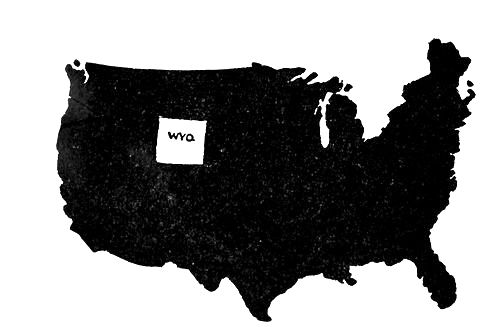
MAP I.
The Suffrage Map from 1869 to 1893. Wyoming as a Territory in 1869 and as a State in 1890 gave equal suffrage to women.
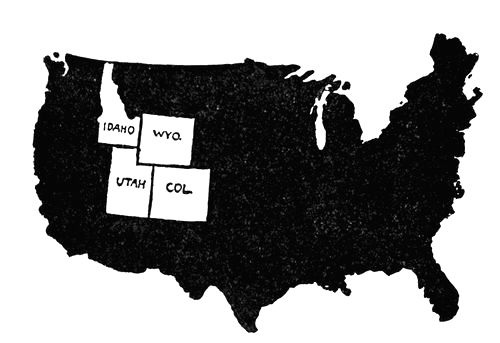
MAP II.
The Suffrage Map from 1893 to 1910. Colorado gave equal suffrage to women in 1893 Utah in 1895, Idaho in 1896.
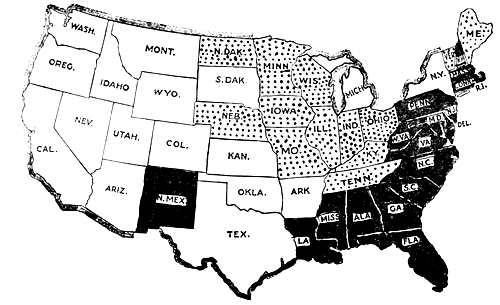
MAP III.
The Suffrage Map when Congress submitted the Federal Amendment June 4, 1919. In the white States women had full suffrage; in the dotted States Presidential; in Illinois, Nebraska, North Dakota, Tennessee and Vermont Municipal also; in the first three County besides.
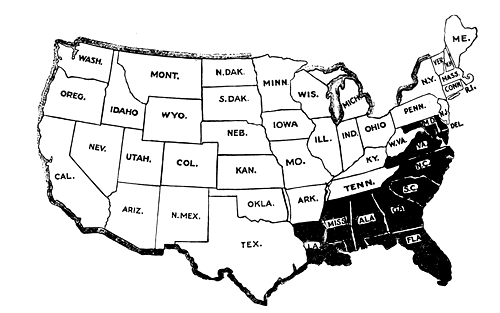
MAP IV.
The Legislatures of all the white States ratified the Federal Woman Suffrage Amendment; those of the black States rejected it except that of Florida, whose Governor said it would do so if he called a special session.
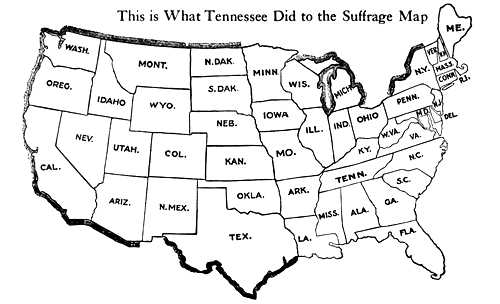
MAP V.
The Suffrage Map after the Ratification of the Federal Amendment—universal, complete woman suffrage in every State.