The Declaratyon of the Example.
Reading edition
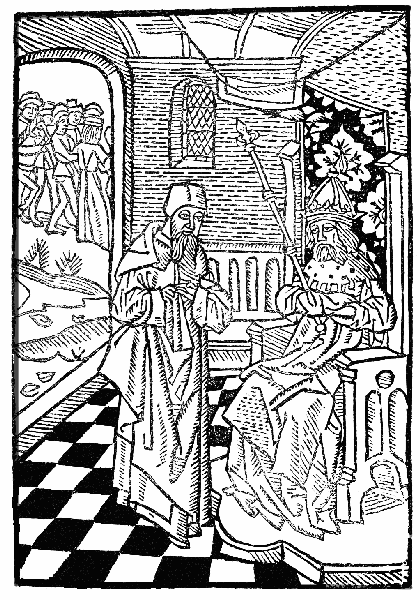
Tho spake thempresse, thus my lorde I fere me it shalbe of you ⁊ of your sone. This knyght for loue of his sone was made poore. ⁊ fyrste he commytted thefte ⁊ brake the toure, secondary dyde hymself too be heded, that his chyldren sholde haue no shame. After ye sone cast his hede in a dyke, ⁊ buryed it nether in chyrche nor in chyrcheyerde, his body he suffred to hange styll vpon the galowes, yf that he coude not haue taken it downe in the daye he myght wel haue done in ye nyght. In the same maner ye laboure nyght and day that ye maye promote your sone to honoure ⁊ ryches. But without doubte he dayly laboureth for your confusyon ⁊ destructyon that he may regne after you in your empyre. Therfore I aduyse you yt ye do hȳ to be hanged before or he you destroye. Themperour sayd ye haue shewed me a good example. The knyghtes sone whan he had smyten of his faders hede wolde not bury it. Without doute my [son] fader (sic) shall not do so by me, but he communded (sic) anone his offycers that they sholde lede hym to the galowes. ⁊ they obeyed his cōmaūdement hastely. ⁊ as they lad hym thrugh the stretes ye people made grete noyse ⁊ lamentacyon. alas alas the onely sone of the emperour is lad ayen towardes ye galowes / ⁊ as they thus ladde hym the thyrde mayster named Craton came rydȳg vpon an hors / ⁊ as ye chylde sawe hym he bowed downe his hede to hym as though he had sayd, haue mynde vpon me. The pepole cryed saying, O good mayster hast you ⁊ saue youre dyscyple. He smote his horse wt spores ⁊ haysted him to ye palays. And whan he came before themperoure he honourably salued hym, whiche sayd, thy comyng hyther shall neuer auayll the / nor it that yu comest for. The mayster sayd, I hoped in my comynge to haue be welcome ⁊ haue had a better rewarde ⁊ not too haue be rebuked. The emperour sayd / as ye haue deserued so shal it be to you. To whom he sayd, my lord what haue I deserued. Themperour sayde, ye haue ryghte well deserued deth, for why I delyuered to you my sone well spekynge ⁊ wel manered for to enfourme and teche, ⁊ ye haue delyuered hym ayen too me dompe ⁊ a rybaude. To whom the mayster sayd / in that ye say he is dompe yt I commytte to god / for he maketh the dompe to speke ⁊ the defe to here. But in that ye saye yt he wolde haue your wyfe enforced that wolde I gladly knowe yf ony creature haue yt seen, for there is no malyce aboue ye malyce of a woman / and that shall I proue by a good example that wȳmen are full of lesȳges ⁊ decepcōns, ⁊ yf ye put to deth your sone for the wordes of your wyfe / it shall happen to you as it dyd to a noble man of his wyfe ⁊ of his pye, the whiche he loued merueylously. To whome themperour sayd, you tell me how that wymmen are full of malyce ⁊ lesynges / whiche sayd I wyll not do it / but yf ye fyrst calle ayen your sone frome the dethe, ⁊ then at youre pleasure I shall shewe thexample. Than themperour anone made the chylde too be called ayen and put in pryson. Than the mayster began to say this example in this fourme folowynge.