IV THE SECRETARY’S DEVICE
Reading edition
Barton’s elaborate design fixed the reverse, but that part of the seal does not appear to have caused much discussion. For the obverse it produced the displayed eagle, but Barton’s eagle was crested and not the American or bald-headed eagle.
The whole matter now having by order of Congress come into the hands of Charles Thomson, he took a radical departure from all previous designs. Putting the eagle as the central figure of his design, he specified that it be an American eagle, rising, not displayed. As emblematic of the war power he put in the sinister talon a bundle of arrows, where Barton had put the American flag, introducing the arrows into the seal for the first time. To picture peace he put in the eagle’s dexter talon an olive branch which had figured in the device of the second committee, instead of Barton’s sword and wreath of laurel. For the crest he used the constellation of thirteen stars surrounded by clouds, as in the second committee’s report, and arranged the red and white stripes, which the second committee had made diagonal and Barton horizontal, in chevrons, one side of red 34and white, the other of white and red. From the report of the first committee he took the motto “E pluribus unum.” He made or had made a rough drawing of his device, which was colored. It was almost 4 inches in diameter. For the reverse he adopted Barton’s device, changing only the mottoes. These were from Virgil, “Audacibus annue cœptis” (favor my daring undertaking), being found in the Æneid, book 9, verse 625 (also in the Georgics, 1, 40), and “Magnus ab integro seclorum nascitur ordo” (the great series of ages begins anew), coming from the fourth eclogue, fifth verse. Although the form “seclorum” was adopted, the more approved spelling is “sæclorum.”[24]
The report which follows is entirely in Thomson’s handwriting and is endorsed by him “The Secretary’s device:”
Device for an Armorial Atchievement and Reverse of a great Seal for the United States in Congress Assembled.
Arms.
On a field Chevrons composed of seven pieces on one side & six on the other, joined together at the top in such wise that each of the six bears against or is supported by & supports two of the opposite side the pieces of the chevrons on each side alternate red & white. The shield born on the breast of an American Eagle on the Wing & rising proper. In the dexter talon of the Eagle an Olive branch & in the sinister a bundle of arrows. Over the head of the Eagle a constellation of Stars surrounded with bright rays and at a little distance clouds.
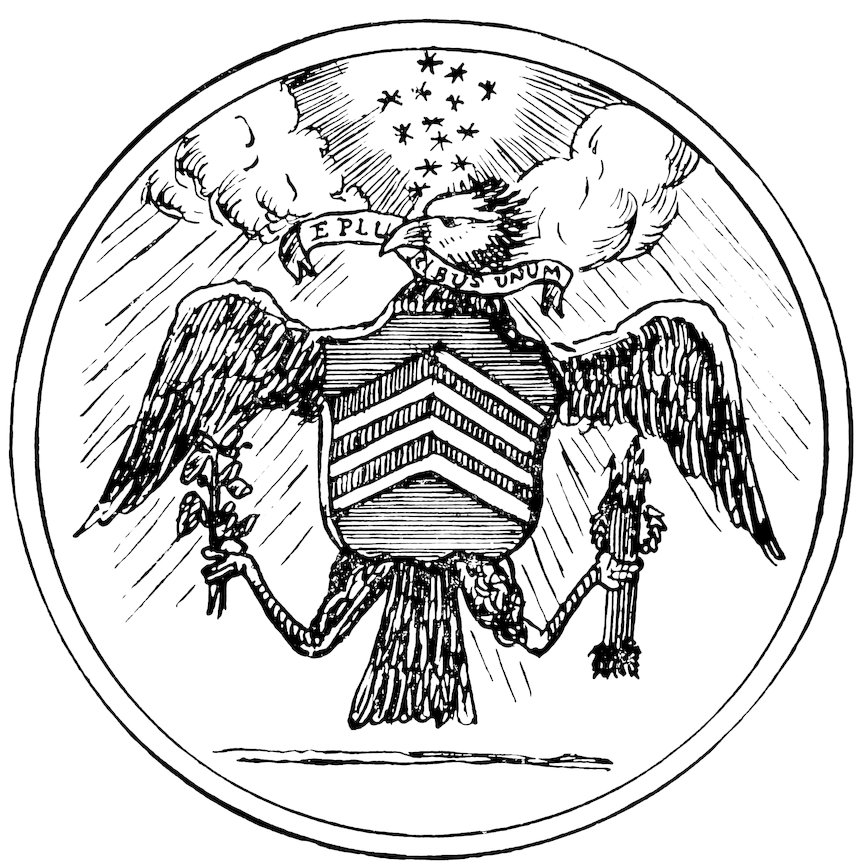
CHARLES THOMSON’S DESIGN [Traced from the original] Face p. 34
35In the bill of the Eagle a scroll with the words E pluribus unum.—
Reverse
A pyramid unfinished
In the Zenith an Eye in a triangle surrounded with a glory, proper.
Over the eye these words
Annuit cœptis
On the base of the pyramid the numerical letters
MDCCLXXVI
and underneath these words
Novus ordo seclorum.
N. B. the Head & tail of the American bald Eagle are white the body & wings of a lead or dove colour.
This design of Thomson’s was returned to Barton, who changed it by inserting pales for the chevrons, the colors alternating white and red, with a blue chief. He restored the displayed eagle as in his own design and specified that the bundle of arrows should contain thirteen. He also recommended that in the exergue should be the date of American independence and in the margin a Latin legend, “Sigul. Mag. Reipub. Confœd.,” but in the final design this was left out. The report was written by Barton and is endorsed by Thomson, “Mr. Barton’s improvement on the Secretary’s device.”
36Device for an Armorial Atchievement for the United States of North America, blazoned agreeably to the Laws of Heraldry—proposed by Wm. Barton, A. M.
Arms.
Paleways of [25]thirteen pieces, Argent & Gules; a Chief Azure:—The Escutcheon placed on the Breast of an American (the bald-headed) Eagle, displayed, proper; holding in his Beak a Scroll, inscribed with this Motto, viz.
“E pluribus Unum”—
And in his dexter Talon a Palm or an Olive Branch—in the other a Bundle of 13 Arrows; all proper.
For the Crest.
Over the Head of the Eagle, which appears above the Escutcheon, a Glory, Or; breaking through a Cloud, proper, and surrounding thirteen Stars forming a Constellation, Argent, on an Azure Field.
In the Exergue of the Great Seal—
“Jul. iv. MDCCLXXVI”—
In the Margin of the same—
“Sigil. Mag. Reipub.
“Confœd. Americ.”
Remarks.
The Escutcheon is composed of the Chief & Pale, the two most honorable ordinaries: the latter represent the several States; all joined in one solid, compact Entire, 37supporting a Chief, which unites the whole & represents Congress—The Motto alludes to this Union.—The Colours or Tinctures of the Pales are those used in the Flag of the United States—White signifies Purity & Innocence; Red, Hardiness & Valour. The Chief denotes Congress—Blue is the Ground of the American uniform, and this Colour signifies Vigilance, Perseverance & Justice.
The Meaning of the Crest is obvious, as is likewise that of the Olive Branch & Arrows.
The Escutcheon being placed on the Breast of the Eagle displayed is a very antient Mode of bearing, & is truly imperial. The Eagle displayed is an Heraldical Figure; and, being borne in the Manner here described, supplies the Place of Supporters & Crest. The American States need no Supporters but their own Virtue, and the Preservation of their Union through Congress.—The Pales in the Arms are kept closely united by the Chief, which last likewise depends on that Union & the Strength resulting from it, for its own Support—the Inference is plain.
W. B.
June 19th. 1782
This report originated from two sources, Thomson and Barton, and the agency of each is clearly defined. The distinction of producing the arms of the United States can not justly be accorded wholly to either, but belongs wholly to both, with the larger share of distinction to the Secretary, Charles Thomson.
On June 24, four days after the seal had been adopted, Thomson wrote to Barton:
38I enclose you a copy of the device by which you have displayed your skill in heraldic science, and which meets with general approbation.
The chief change made by Barton in Thomson’s design was in the substitution for the chevrons of thirteen pales, alternate white and red, with a blue chief, and this has been often attributed, without adequate warrant, to an outside source, which deserves to be noticed.
Sir John Prestwich was a distinguished English antiquary and a friend of the American Revolution. He enjoyed an acquaintance with John Adams when the latter was on his foreign mission in 1779, and they conversed on the subject of the seal, in which Adams, of course, took an interest, as he had been on the first committee to design it. It appears that Sir John made certain suggestions for a design which were afterwards enlarged into a claim by others that he had made the design of the arms which was finally adopted. Sifting from the question the conjecture and inference surrounding it one fact is important. It is set forth by the historian Benson J. Lossing in the Field Book of the American Revolution and War of 1812:[26]
In the manuscript letter before me [he says], written in 1818 by Thomas Barritt, Esq., an eminent antiquary of Manchester, England, addressed to his son in this country, is the following statement: “My friend, Sir 39John Prestwich, Bart., told me he was the person who suggested the idea of a coat of arms for the American States to an embassador [John Adams] from thence, which they have seen fit to put on their moneys. It is this, he told me—party per pale of thirteen stripes, white and red, the chief of the escutcheon, blue, signifying the protection of Heaven over the States.—He says it was soon after adopted, as the arms of the States, and to give it more prominence was placed upon the breast of a displayed eagle.”
There is no claim here that Sir John Prestwich suggested the eagle as an emblem, or the placing of the shield upon the eagle’s breast, but simply the pales and the chief. The theory is that Adams communicated this suggestion to Charles Thomson, who engrafted it upon his own and Barton’s designs. But it must be remembered that two shields were already on the files of Congress, with alternate red and white, or white and red, stripes, and Barton’s first design had bars of the same colors. Prestwich’s suggestion was, therefore, no more than that they be perpendicular instead of diagonal or parallel, and that the chief be blue; but in the device submitted by the committee of 1780 the diagonal stripes were charged upon a field azure. Sir John Prestwich, of course, knew nothing of these designs, and his statement after the seal was adopted was made in ignorance of the fact that the essentials of his suggestion were already before Congress.[27] That 40his suggestion influenced the final result even in the slight degree possible, seems improbable. Why did Thomson, with the Prestwich suggestion before him, make his first shield of chevrons, which Barton, it appears, changed to pales? Thomson may have told Barton of the Prestwich design, but what is more natural than that Barton should try of his own initiative the only new arrangement of the stripes that was left to try? Diagonal stripes, bars, chevrons, had all figured in designs and had not given satisfaction. Pales were then drawn and proved acceptable.
41