III WILLIAM BARTON’S DESIGNS
Reading edition
The report of the Lovell committee met with the same fate as the report of the first committee. It was recommitted, and nothing further was done until May, 1782, when Arthur Middleton of South Carolina, Elias Boudinot of New Jersey, and Edward Rutledge of South Carolina were appointed a committee to design a seal. The two South Carolinians were men of foreign education, and a cultivated gentleman in those days usually had some knowledge of heraldry. Boudinot had an interest in coins and medals, it is presumed, as he was appointed Director of the Mint at Philadelphia in 1795. This committee did no independent labor of a serious character, but called into consultation William Barton, A. M., a private citizen of Philadelphia. He was the son of Rev. Thomas Barton, rector of St. James Episcopal Church, his mother being a sister of the famous David Rittenhouse,[21] and in 1813 he published a memoir of Rittenhouse. He was also the author of a monograph on the nature and use of Paper Credit, etc. (Philadelphia, 1781). The reasons which prompted 24the committee to go to him are not known. It is evident, however, that he had studied heraldry, and his drawings show that he was ingenious in the use of his pencil. From the time he first appears in connection with the seal he is the central figure, until he divides the honors with the Secretary of Congress, Charles Thomson.
Rutledge’s connection with the committee was never active, and Arthur Lee, who had recently returned from France, acted with it, although never formally assigned as a member.
Barton’s first design for the seal was as follows:
A Device for an Armorial Atchievement, for the Great Seal of the United States of America, in Congress assembled; agreeable to the Rules of Heraldry:—proposed by William Barton, A. M.
Arms.
Barry of thirteen pieces, Argent & Gules; on a Canton, Azure, as many Stars disposed in a Circle, of the first: a Pale, Or, surmounted of another, of the third; charged, in Chief, with an Eye surrounded with a Glory, proper; and, in the Fess-point, an Eagle displayed, on the Summit of a Doric Column which rests on the Base of the Escutcheon, both as the Stars.
Crest.
On an Helmet of burnished Gold damasked, grated with six Bars, and surmounted of a Cap of Dignity, Gules, turned up Ermine, a Cock armed with Gaffs, proper:
25
Supporters
On the dexter Side: the Genius of America (represented by a Maiden with loose Auburn Tresses, having on her Head a radiated Crown, of Gold, encircled with a Sky-blue Fillet Spangled with Silver Stars; and clothed in a long, loose, white garment, bordered with Green: from her right Shoulder to her left Side, a Scarf semé of Stars, the Tinctures thereof the same as in the Canton; and round her Waist a purple Girdle fringed or; embroidered, Argent, with the Word “Virtue”:)—resting her interior Hand on the Escutcheon; and holding in the other the proper Standard of the United States, having a Dove, argent, perched on the Top of it.
On the sinister side: a Man in complete Armour; his Sword-belt, Azure, fringed with Gold; his Helmet encircled with a Wreath of Laurel, and crested with one white & two blue Plumes: supporting with his dexter Hand the Escutcheon, and holding, in the exterior, a Lance with the point sanguinated; and upon it a Banner displayed, Vert,—in the Fess-point an Harp, or, stringed with Silver, between a Star in Chief, two Fleurs-de-lis in Fess, and a pair of Swords in Saltier, in Base, all Argent. The Tenants of the Escutcheon stand on a Scroll, on which the following Motto—
“Deo favente”—
which alludes to the Eye in the Arms, meant for the Eye of Providence.
Over the Crest, in a Scroll, this Motto—
“Virtus sola invicta”—
which requires no comment.
26The thirteen pieces, barways, which fill up the Field of the Arms, may represent the several States; and the same Number of Stars upon a blue Canton, disposed in a Circle, represent a new Constellation, which alludes to the new Empire, formed in the World by the Confœderation of those States—Their Disposition, in the form of a circle, denotes the Perpetuity of its Continuance, the Ring being the Symbol of Eternity. The Eagle displayed is the Symbol of Supreme Power & Authority, and signifies the Congress; the Pillar, upon which it rests, is used as the Hieroglyphic of Fortitude & Constancy; and, it’s being of the Doric Order, (which is the best proportioned & most agreeable to Nature,) & composed of several Members or parts, all, taken together, forming a beautiful Composition of Strength, Congruity & Usefulness, it may with great propriety signify a well planned Government. The Eagle, being placed on the Summit of the Column, is emblematical of the Sovereignty of the Government of the United States; and, as further expressive of that Idea, those two Charges or Figures are borne on a Pale, which extends across the thirteen pieces into which the Escutcheon is divided. The Signification of the Eye has been already explained.
The Helmet is such as appertains to Sovereignty; and the Cap is used as the Token of Freedom & Excellency: It was formerly worn by Dukes “because,” says Guillim, “they Had a more worthy Government than other Subjects.”—The Cock is distinguished for two most excellent Qualities, Necessary in a free Country, viz. Vigilance & Fortitude.
The Genius of the American confœderated Republic is denoted by her blue Scarf & Fillet, glittering with Stars, 27and by the Flag of Congress which she displays. Her Dress is white edged with green; Colours emblematical of Innocence and Youth. Her purple Girdle & radiated Crown indicate her Sovereignty: the Word “Virtue” on the former is to show, that that should be her principal Ornament; and the radiated Crown, that no Earthly Crown shall rule her. The Dove on the Top of the American Standard denotes the Mildness & Lenity of her Government.
The Knight in Armour with his bloody Lance represents the Military Genius of the American Empire, armed in Defence of its just Rights. His blue Belt & blue Feathers indicate his Country, & the white Plume is in Compliment to our gallant Ally. The Wreath of Laurel round his Helmet is expressive of his Success. The Green Field of the Banner denotes Youth and Vigor; the Harp is emblematical of the several States acting in Harmony & Concert; the Star, in Chief, has reference to America, as principal in the Contest; the two Fleurs-de-lis are borne as a grateful[22] Testimonial of the Support given to her by France; and the two Swords, crossing each other, signify a State of War. This Tenant & his Flag relate, totally, to America at the Time of her Revolution.
William Barton.
This, the first device of Barton, was not illustrated, and his second device, of which he offered a colored drawing, differed from it in that he transferred the eye to the reverse and the eagle from the 28summit of the column to the crest, thereby eliminating the cock. He put at the summit of the column a phœnix rising from the flames, left out the American flag from the dexter supporter’s hand, and changed the sinister supporter from a warrior in armor to one in continental uniform, holding in his hand a baton instead of a lance. He also left out the harp and the fleur-de-lis and transferred the motto to the reverse. The fleur-de-lis was proposed to commemorate the alliance with France, this being the only report in which the alliance figured. The design is important, because it establishes the fact that the idea had become fixed of having in the seal the thirteen stars, the blue field, and thirteen stripes of red and white or white and red. In this design appears for the first time the eagle.
Barton’s second design was addressed to “The Honble. Elias Boudinot, Esqr. & Arthur Lee Esq. In Congress.”
Device for an Armorial Atchievement & Reverse of a Great Seal, for the United States of North America: proposed by William Barton, Esqr. A. M.—
Blazoned according to the Laws of Heraldry—
Arms.
Barry of thirteen pieces, Argent & Gules; on a pale, Or, a Pillar of the Doric Order, Vert, reaching from the Base of the Escutcheon to the Honor point; and from the Summit thereof, a Phœnix in Flames with Wings expanded, proper; the whole within a Border, Azure, charged with as many Stars as pieces barways, of the first.
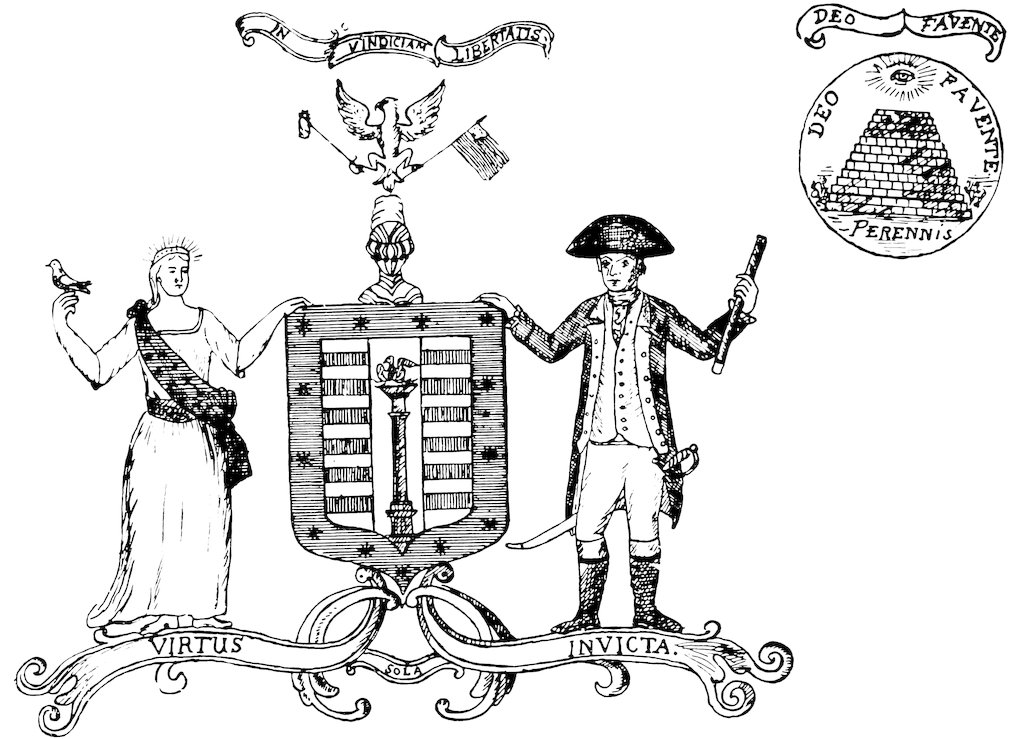
WILLIAM BARTON’S SECOND DESIGN [Traced from the original and reduced one-half] Face p. 28
29
Crest.
On a Helmet of Burnished Gold, damasked, grated with six Bars, a Cap of Liberty, Vert; with an Eagle displayed, Argent, thereon: holding in his dexter Talon a Sword, Or, having a Wreath of Laurel suspended from the point; and, in the sinister, the Ensign of the United States, proper.
Supporters.
On the dexter side, the Genius of the American Confederated Republic: represented by a Maiden, with flowing Auburn Tresses; clad in a long, loose, white Garment, bordered with Green; having a Sky-blue Scarf, charged with Stars as in the Arms, reaching across her Waist from her right Shoulder to her left Side; and, on her Head, a radiated Crown of Gold, encircled with an Azure Fillet spangled with Silver Stars; round her Waist a purple Girdle, embroidered with the Word “Virtus”, in Silver:—a Dove, proper, perched on her dexter Hand.
On the sinister side, an American Warrior; clad in an uniform Coat, of blue faced with Buff, and in his Hat a Cockade of black & white Ribbons; in his left Hand, a Baton Azure, semé of Stars Argent.
Motto, over the Crest—
“In Vindiciam Libertatis”
Motto, under the Arms—
“Virtus sola invicta”
30Reverse of the Seal.
A Pyramid of thirteen Strata, (or Steps) Or. In the Zenith; an Eye, surrounded with a Glory, proper.
In a Scroll, above—or in the Margin
“Deo favente”
The Exergue
“Perennis”
Remarks.
The Imperial Eagle of Germany (which is sable, and with two Heads) is represented with a Sword in one Talon, and a Sceptre in the other.
The Phœnix is emblematical of the expiring Liberty of Britain, revived by her Descendants in America.
The Dove (perched on the right Hand of the Genius of America) is Emblematical of Innocence and Virtue.
The Sword (held by the Eagle) is the Symbol of Courage, Authority & Power. The Flag or Ensign denotes the United States of America, of the sovereignty of which the Eagle is expressive.
The Pillar is the Hieroglyphic of Constancy & Fortitude; and is likewise emblematical of Beauty, Strength & Order.
The Pyramid signifies Strength & Duration.
The other parts have been explained.
The Armorial Atchievements of Sovereign Princes & States are usually blazoned by the planets, to represent the Colours; but that mode is purposely deviated from, being condemned by the best Heralds.
The committee adopted this complicated design and reported it to Congress May 9, 1782, but Congress was not satisfied with it, and on June 13 it was referred to the Secretary of Congress.
31The endorsement on Barton’s design is in Thomson’s hand, except the last sentence, “Passed,” etc.:
No. 26—Report of Mr. Middleton Mr. Boudinot Mr. Rutledge. Device of a Seal Entd. May 9, 1782 June 13–1782 Referred to the Secy of the United States in Congress Assembled to take order. Passed June 20 1782.
The number on the report had reference to the arrangement of papers in the Secretary’s office. The words “Passed June 20 1782,” had reference to the later design.
It should be noticed that Barton termed the description of his device a “blazon”—that is, a verbal description so precise that a person understanding heraldry would be able to draw and color the arms correctly. All of the other reports on the seal were blazons also, thus showing the purpose of making an illuminated arms.
Barton’s design for the obverse, as he drew it for the committee, was 9½ inches by 8 inches large, and the reverse 2½ inches in diameter, and both were in colors, the coloring following the description correctly, and the lettering and scroll work being in black and white. The circumstances under which Barton was called upon to submit his final design were noted by him in a memorandum which he left among his papers:
In June, 1782 [he says] when Congress was about to form an armorial device for a Great Seal for the United States, Charles Thomson, Esq., then Secretary of Congress, 32with Hon. Arthur Lee and Elias Boudinot, member of Congress, called on me and consulted me on the occasion. The Great Seal, for which I furnished these gentlemen with devices (as certified by Charles Thomson, Esq.), was adopted by Congress on the 20th of June, 1782. Mr. Thomson informed me, four days after, that they met with general approbation.
W. Barton.[23]
33