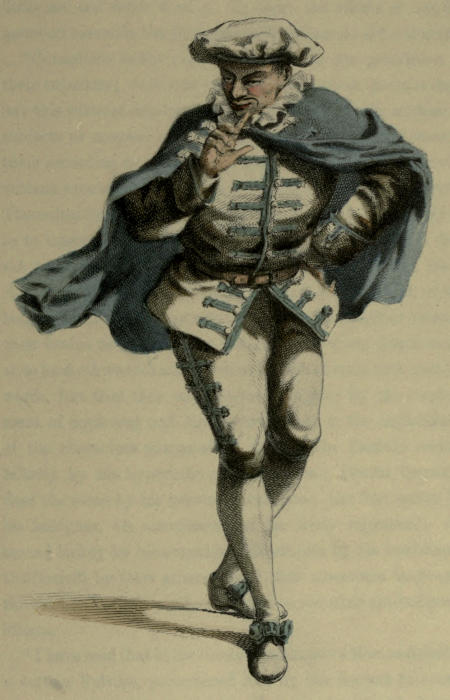
XIII SCAPINO
Reading edition
Endowed with honeyed language, engaging manners and a sycophantic politeness, Brighella is the most infamous rascal that ever drew breath. He does not even display the brutal frankness of Polichinelle to counterbalance the baseness of his sentiments. He is a smirking cat concealing vicious claws in pads of velvet. Lively and insolent with women, braggart and boastful with old men and cowards, he decamps on the approach of any of those who do not fear him. There is a great deal to be dreaded from him; the more you have frightened him the less disposed is he to forgive you, and if you should receive a stab in the dark, be sure that his was the hand that dealt it. A singer, a dancer and a musician, when he desires to do anyone an evil turn there is no house into which he is not able to insinuate himself. He is a valuable servant to the man who knows how to employ his talents. As his needs are many, he requires a deal of money, and if you know how to flatter his self-love and to pay him well, there is neither girl nor woman in Italy whom he is not able to wheedle for you. He has discharged all kinds of offices; he has been a soldier, an attorney’s clerk, and he has even turned hangman’s assistant so as to abstract himself from the attentions of justice. The service he prefers to all others is that of lovers, and it is rather from inclination than from necessity that he loves what he calls his estate. For if there is no one to serve he will work for his own account to keep himself in practice, and then woe betide the young girls who fall under his claws! They are for ever lost if they lend an ear to his proposals and his sophisms. Brighella believes absolutely in nothing but the rope which is one day to hang him; hence a glimpse of a watchman will reduce him to a condition which it is impossible to describe.
Such was the old Brighella; but in the course of centuries and of civilisation he has improved a little. He is still imbued with the same instincts, but he does not assassinate quite so freely. To-day many women are able to look him in the face without trembling and to listen to him without believing. He is far more terrible to the purses of old men, which he purloins with incredible dexterity. His dreams are of nothing but thefts like the Epidicus of Plautus, from whom he descends in direct line.
“As for me,” says Epidicus, “I am going to assemble the Senate of my mind to deliberate upon what I shall do. For it is upon money (however much it may be our best friend) that I am going to declare war. What source shall I tap? I must neither fall asleep nor draw back. I am resolved to make a fresh attempt upon my old master. I have procured a sharp knife to disembowel the old man’s purse. But what do I see? Two old men at once! What a capture! I shall transform myself into a leech and suck their blood....”
Later, when he is content with his misdeeds:
“I do not believe that in all Attica there is a soil more fruitful than my old master. I take all the money I want from his cupboard, however locked and sealed he may leave it. But should the old man come to perceive it, ’ware the rod!”
Brighella, whose name signifies intriguer, is as old as Harlequin, his compatriot. We have already said that both were natives of Bergamo. The Slaveró of La Piovana of Angelo Beolco is a true Brighella.
“As for me,” he says, “I find nothing difficult; I am accustomed to despise things. I want two young girls, and if it be not sufficient to kill one man I shall kill two. Do you not remember that dispute in which I stabbed a man as easily as you prick a bladder, and of that other fellow whose bones I broke as you squelch a bean?”
Elsewhere we hear him declaring: “I am now going to seek Sittono, into whose hands the girl must have fallen by now. I shall so contrive with amiable words that he shall give me the fifty livres promised me so that I may get me hence. And should anyone suggest that I have acted badly, I shall throw the entire fault of it upon my gossip.”
Slaveró recks nothing of being a perjurer like Brighella. A purse has been stolen, and Bertevello, the fisherman, knows who has it.
Bertevello. Good-morrow, comrade. What is your name?
Slaveró. My name is Slaveró.
Bertevello. Slaveró. Very good. I am resolved to conceal nothing from you because I have no desire to go to prison. Since you say that the purse is yours, swear to me that if I tell you who has it you will give me what you promised.
Slaveró. On the faith of an honest man.
Bertevello. Swear it on your soul.
Slaveró. Since I give you my assurance, why should you require an oath?
Bertevello. Swear as I shall bid you.
Slaveró. Very well.
Bertevello. Say: I, Slaveró, I swear——
Slaveró. I, Slaveró, I swear——
Bertevello. —that I will give you what I have promised you——
Slaveró. —that I will give you what I have promised you——
Bertevello. —of whatever is in the purse——
Slaveró. —of whatever is in the purse——
Bertevello. —in livres, sous and deniers——
Slaveró. —in livres, sous and deniers——
Bertevello. —upon burning coals——
Slaveró. —upon burning coals——
Bertevello. —burning and scorching me at once——
Slaveró. —burning and scorching me at once——
Bertevello. —that by a miracle may the living and the dead——
Slaveró. —that by a miracle may the living and the dead——
Bertevello. —leap at my eyes, tear them out, and burn them, and wither my hands.
Slaveró. —leap at my eyes, tear them out and burn them, and wither my hands.
Bertevello. And that the devil himself may bear me off——
Slaveró. And that the devil himself may bear me off——
Bertevello. —into the depths of misfortune——
Slaveró. —into the depths of misfortune——
Bertevello. —so that not a fragment of my person shall survive.
Slaveró. —so that not a fragment of my person shall survive.
Bertevello. Very good. Await me here and I will bring the man with the purse to you.
Slaveró. I shall wait. Ah, purse! You see how strongly I desire you. Have no fear, we shall depart together. Otherwise I should not have sworn as I have done. And I do not consider myself under any obligation of giving what I promised to this fellow for having sworn what I swore. Moreover I swore with my tongue and not with my conscience. Is not my tongue free? Can I dispose of it? My tongue can say what it pleases.
In a more modern Italian scenario which has done duty in various forms, always with success, “some young Venetian gentlemen are in a villa on the banks of the Brenta. To amuse themselves and to dispel the sadness which might result from the death of their butler, Meneghino, they take it into their heads to make fun of three poltroons who are in their service: Pantaloon, Harlequin and Brighella. They make the pretence to believe in the boastful valour of Pantaloon, and they beg of him to spend the night watching over the body of the dead butler. Pantaloon consents against his will; but it is Harlequin who has been put to bed on the bier instead of Meneghino. They have covered him with a sheet and painted his face white. Harlequin is no more at ease than he who watches over him. He fears lest this farce should bring some misfortune; nevertheless he makes merry at the expense of his comrade, performs a somersault on his bed, and heaves great sighs. Soon, however, his laughter ceases, and he thinks only of following the example of Pantaloon, who has gone into hiding, for Brighella appears, dressed as a devil, and pursues them with a torch. Brighella, however, imagined that he would have to do only with Pantaloon, and did not expect to find Harlequin in the place of the dead man, still less to find a corpse running in this scared fashion about the chamber. In his fright he falls down, and we behold the three of them rolling on the ground possessed by terror ineffable. Finally the entrance of their masters, who come to mock them, brings about their return to reason, at the end of a long series of jests which the public receives ever with uproarious laughter.”
The costume of Brighella in the sixteenth and seventeenth centuries consisted of a sort of jacket and a wide pantaloon in white linen to suggest his rustic origin, a cap laced in green, and a cloak; the coat and pantaloons were laced at the seams with green cloth so as to make the costume represent a sort of livery. His olive-tinted and bearded mask conforms, like that of Harlequin, with the tradition of the ancient Sanniones.
In the nineteenth century his costume became a bizarre combination of old and new fashions. His jacket took the form of a riding-coat made of wool or white flannel with three collars; further he wore a waistcoat and pantaloons of the same material laced with green. He preserved his traditional white cap trimmed with green and his brown half-mask, whose beard was arranged so as to imitate heavy whiskers and a slight moustache. The chin was shaven. In this costume he looks very much like a negro arrayed in a ridiculous livery.
Brighella is the stock from which are sprung Beltrame, Scapino, Mezzetin, Flautino, Gradelino, Truccagnino, Fenocchio, Bagolino, and all the shrewd and intriguing lackeys of the Comédie-Française, from Sbrigani (a variant of the name of Brighella), Sganarelle, Mascarille and La Montagne to Frontin and Labranche; the livery only has changed; the character is always that of Brighella, and from Pseudolus, the Greek slave, down to Figaro, the factotum, the type has always been a liar, a drunkard, a thief, a debauchee and more or less a murderer.
An Italian comedian, known under the name of Briguelle, appeared in 1671 on the stage of the Comédie-Italienne to replace Locatelli (Trivelin), lately dead, in the parts of first Zani. According to Robinet, this character became the rage, and, after his portrayer’s death, Louis XIV., seeking to replace him, requested another actor from the Duke of Modena. The duke sent him Giuseppe Cimadori, who played under the name of Fenocchio the same rôles as those of Brighella. This actor, however, died on the journey.
The two most famous players of Brighella during the eighteenth century in the Italian troupes were Giuseppe Angeleri, who from 1704 to 1752 undertook the improvised parts in the comedies of Goldoni, and Atanasio Zanoni of Ferrara, who was one of the best comedians of the eighteenth century. “Zanoni received a very good education, but his taste for declamation having urged him to embrace a theatrical career, he joined the troupe of the famous Antonio Sacchi, whose sister he married. Zanoni was unrivalled in the grace of his enunciation and the vivacity and wit of his repartees. To the qualities natural to his state he added those of a lofty character. On the 22nd February 1792, on his way home from a splendid supper, he fell into a deep canal and died soon afterwards.” In 1787 a collection was published in Venice of the mordant, allegorical and satirical Brigelleschi witticisms. We will cite some fragments.
“One should not say ‘a thief,’ but ‘an ingenious mathematician who finds a thing before its owner has lost it.’ Appropriated objects are the things which we inherit before the death of those who possess them. To conduct a theft with propriety it is necessary to be assisted by three devils: one who will teach you how to purloin adroitly, one who will show you how to conceal effectively, and a third who will persuade you never to make restitution. When I am compelled to travel—that is to say, to decamp—I console widowed hens by adopting their chickens. I deliver purses and watches from captivity. I am very talkative because my father was dumb and he left behind him a capital of new words which had never been used. For the rest, I am a bastard. Out of charity I was once given a bowl of soup, but so extremely limpid that the beautiful Narcissus might have seen himself mirrored in it more clearly than in his fountain. My shirt is become a romance; it is full of knights-errant and the washerwoman refuses to wash it for fear of poisoning the river. My supper is the supper of Bertoldo: a plate of peas ventosissimi, with some boiled hope, a ragout of desires and a piece of roast expectation. My debts have transformed me into a star that is seen only at night.”
ii
Fenocchio, a variant of the type of Brighella, made his appearance on the Italian stage as early as 1560. Like Brighella, he finds employment in amorous intrigues, and he acts in these not only on behalf of Celio, Leandro or Zerbino, but also on his own. We behold him in a Venetian play of the seventeenth century, written in dialogue upon an old scenario, as the lover of Olivette, the servant of Pantaloon’s daughter Beatrice. Harlequin, another lackey in the piece, is so naïve as to take him into his confidence, never suspecting that Fenocchio is his rival. From that moment Fenocchio swears to be avenged upon Harlequin, and seeks for means to be rid of him. He begins by playing nasty tricks upon him. Harlequin is bearing Olivette two birds alive in a basket; Fenocchio takes possession of it, and replaces the birds by a cat. He is present at the compliments by which Harlequin accompanies his gift and those returned him by Olivette, who adores birds, and he is the sniggering witness of her disappointment when she beholds a furious tabby escaping from the basket, after having scratched her. The anger of Olivette and the tears of Harlequin rejoice the heart of Fenocchio. Harlequin, wondering who can have done him such an evil turn, suspects his confidant. But Fenocchio swears by all that there is most sacred (in which he does not compromise himself, seeing that he believes in nothing) that he is incapable of a farce which could result in spilling the blood of the beautiful Olivette.
By force of circumstances Harlequin is unable to continue to see Olivette, whom Pantaloon keeps in duress with his daughter. He has recourse to the expedients of Fenocchio. The latter takes advantage of the situation to rid himself of his preferred rival.
“Pretend to be dead,” he advises him. “I shall put you in a coffin and take you to Pantaloon the apothecary upon the pretext of getting him to make your autopsy. During the night, when everyone is asleep, you can go and seek Olivette.”
Credulous Harlequin consents. Fenocchio carries him to Pantaloon’s house, and, after having related to the latter an unlikely story, which Pantaloon readily believes, he withdraws, hoping that the apothecary will deprive Harlequin perhaps of a leg or an arm. But Harlequin, being alone with Pantaloon, who is admiring the beautiful body which has been brought him for dissection, cannot resist the need to scratch himself. This occasions some surprise to the apothecary, who has never seen the like. Trembling, he seizes a scalpel, and is about to make a large incision in Harlequin, when the latter leaps up in his alarm, and, shouting for help, throws himself upon Pantaloon, who swoons in terror.
Harlequin goes to Fenocchio to discover a fresh expedient. Fenocchio reproaches him with his lack of patience. “You should have let the apothecary bleed you a little,” he says, “and thus you would have seen Olivette. However I have found a better way: you shall disguise yourself as a pig, and I shall take you to Pantaloon as a present from the doctor.”
Harlequin again consents. Fenocchio disguises him, and leads his pig to Pantaloon, who admires this beautiful animal.
“It is a pity to kill it,” he says. Again Harlequin is taken with the need to scratch himself, and he does this in a fashion so singular in a pig that Pantaloon is surprised.
Fenocchio explains that this is a trained pig, and he makes Harlequin go through several performances, such as that of walking upright, of taking snuff from the apothecary’s box, and replying by signs to questions that are addressed him.
Pantaloon exclaims: “What an admirable pig! What a rare animal! I shall not have him killed until to-morrow morning,” and he causes Harlequin to be shut up in a sty, whilst Fenocchio slips into the house in quest of Olivette, certain that this time he is rid of his rival, and confident that he will see him disembowelled on the morrow.
During the night Harlequin finds a way out of the place where he has been imprisoned. Always in his bizarre disguise, he wanders forth in quest of Olivette’s chamber. But he gets into the apothecary’s shop, where Pantaloon sleeps on his camp bed. Whilst groping his way about, Harlequin knocks over some vessels, which are broken in their fall.
Pantaloon (waking with a start). Nane! Nane! Drive out the cats that have got into my shop!
Harlequin (aside). He takes me for a cat, I am lost if he recognises me. Oh, poor Harlequin! who could have foretold you that to see Olivette it would be necessary for you to play the pig? The worst of it is that I do not know where I am going.
He hurtles against a pile of bottles and breaks the lot. Pantaloon laments: “There goes my oil of frogs! My balsam of oysters is all lost! My electuary of sepia is broken, I am sure!” He gets up, lights his candle and looks about him; meanwhile Harlequin has slipped under the bed. Pantaloon, after having deplored the loss of his drugs, which he admits, however, will not be difficult to replace, seeing that in reality they consist of no more than earth and water, returns to bed and puts out the light. Harlequin attempts to rise, and in doing so lifts up the bed. Pantaloon rolls along the ground with him, gets up and strikes out haphazard, shouting: “The pig! The pig is strangling me! Help!”
When Fenocchio finds that he has not succeeded in disembarrassing himself of Harlequin by this means, he suggests to him a third expedient; this is to procure a deal of money with which to bribe Pantaloon, who will then allow him to see Olivette. He announces that he knows a way to get the money. “The Doctor is a collector of curiosities. We will go and sell him one.”
He dresses up Harlequin as a clock, with a dial in the middle of his belly, and carries him off to the Doctor, who admires this beautiful and very curious piece of horology.
“This,” says Fenocchio to the Doctor, “represents, as you see, a man, and it tells the minutes, the hours, the days, the months, the years and the centuries; also it can predict the past, and it can say Papa and Mamma, and it chimes.”
So saying, Fenocchio takes up a hammer and shows the Doctor that all that is necessary to make it chime is to strike the head of the figure. But Harlequin ducks his head and threatens to discover everything if he is touched. Fortunately the Doctor has not perceived this movement. Fenocchio, who loves money better than vengeance, begins to haggle with the Doctor. But at this point a servant enters with the Doctor’s soup. Harlequin is unable to resist the temptation, and throws himself upon the soup, which he swallows greedily. The Doctor turns round, and cries: “Ho! ho! ho! A clock that eats! Help! murder! thieves!”
iii
Louis Riccoboni says, in speaking of the costume of Beltrame:
“His dress is not extraordinary, and I think that it is proper to his day, or perhaps a little earlier. He wears a mask which is the same as that of Scapin.... Beltrame, who was a Milanese, and who spoke the language of his country, wore also the costume of it.”
His dress is that of a servant of the end of the sixteenth century.
This type, more modern than Brighella, had no other employments in the Gelosi troupe than that of an astute and cunning gossip; but, like Mezzetin, and the French Sganarelle later on, he played all the husband parts, pretending at times to believe the stories that were told him. In the middle of the nineteenth century, at Bologna, this personage, which by then had passed into the marionettes, still represented the burgher, the merchant or the old Jew, and shared the parentage of Columbine with old Tabarino.
Niccolo Barbieri was the first actor to render the French acquainted with this shade of Brighella. Under the name of Beltrame da Milano, he went with Flaminio Scala and Isabella Andreini to play in Paris before Henri IV., in 1600. After the Gelosi troupe was dispersed, Beltrame returned to Italy, and joined the Fedeli company. In 1613 he was back again in Paris with this company under the management of G. B. Andreini. He remained until 1618, returned yet again in 1623 and continued in the French capital until 1625, when he himself became the head of the troupe, and rendered himself famous in Italy and in France, not only as an actor but also as a writer.
His work: “La Supplica: a tract for all men of merit who have not set up as critics and who are not entirely foolish,” is no more than a piece of pleading in favour of the comedians and the comedy of his day; it is, however, extremely interesting for the anecdotes included in it, which give an idea of the manners of the time.
“All the authors who have written against comedy” (he says) “have not always been equipped with knowledge of this art. The science of all things is to be found among all men, but no single man has the gift of knowing everything. Sacred and profane authors cannot judge us. Saint Bonaventura draws such a picture of comedians, that if you were to believe him you must consider us all damned. Let me relate a little anecdote which proceeds directly out of what I am saying.
“When I left Vercelli, my birthplace, in the year 1596, I joined a mountebank known by the surname of Monteferrin. We visited Aosta (anciently Augusta), a city of Savoy, and Monteferrin begged the chief magistrate’s permission to set up his trestles there. But, as this perhaps was not the custom in that city, the magistrate, not knowing what to decide, went to seek counsel of his spiritual superior, who plainly refused this permission, saying that he did not desire the admission of magicians into that country. The stupefied Monteferrin replied that, being unable so much as to read, it was impossible for him to work magic. The superior bade him be silent: ‘I know all about that,’ he said. ‘I have seen in Italy charlatans who took a ball in one hand and caused it to pass into the other, or who threw a leaden bullet into one eye, and caused it to come out of the other; who swallowed burning tow, ejecting the fire from their mouths in a thousand sparks; who pierced their arms with a knife and were instantly cured of the wound; and all that by magic and other works of the devil.’ Thereupon the superior dismissed Monteferrin without waiting for his reply, and threatening him with imprisonment.
“This superior was a theologian, but he knew nothing of human adroitness, and in that he greatly resembled those blessed saints who have spoken so ardently against the art of comedy, having never witnessed more than some stray farce or some obscene nonsense performed by the marionettes of mountebanks and charlatans.
“Many ignorant folk, who do not know the etymology of the word istrio, nor its derivation, believe that by istrioni (histrions) stregoni (warlocks) is meant, magicians and men abandoned to the devil; and it is as a result of this that in some parts of Italy the ignorant people hold the belief that comedians can command rain or summon a tempest at their will. As a matter of fact they are very poor enchanters and magicians, and very hungry ones, who have a deal of trouble to command a little money to rain upon them so that they may live; besides, if they had the power to summon rain they would be careful not to exercise it, for when it rains no one comes to their performances.”
To prove that comedy is not a vile and contemptible art, Beltrame cites a large number of comedians who were honoured and held in high esteem, mentioning among actors of antiquity Roscius, the friend of Cicero, Aliturus and Æsop, and among actors of his own day Isabella Andreini, Pietro-Maria Cecchini (Fritellino), Giovanni-Battista Andreini (Lelio), Cintio Fidenzi, Maria Malloni (Celia), Nicolò Zeccha (Bertolino), and himself. “Myself,” he says, “the least of all these, I was appointed by King Louis the Just—a very good and very Christian monarch—a soldier in his guard of honour, and I was jealous to show myself worthy of that honour, as my captain, the illustrious Duc de la Valette, will bear witness. The eminent Cardinal Ubaldini can also tell how much His Very Christian Majesty was disposed to overwhelm me with favours. I will not mention the princes, princesses, kings, queens and emperors who have held the children of comedians at the baptismal font and have called their parents gossip, both in speaking and in writing to them, nor how, upon occasion, they have made them participate in their fêtes, drive with them in their court carriages, gratified them with presents from their own hands, regaled them with sumptuous banquets, and invited them to participate in their amusements. Many princes and great lords have played in comedies before their relatives and friends, and have been eager to interpret in the best possible manner the characters entrusted to them, and this entirely for their amusement. Are they on that account to be deemed infamous and contemptible? No. Therefore, it follows that comedy is not vile.
“How many princes, kings and emperors have played in public in their own theatres? In my own day I have seen the Dukes of Mantua, Francesco, Fernando and Vincenzo performing with our comedians, as well as the Prince of Urbino and so many others whom I do not mention. If the great lord may tread the stage for his amusement without derogating from his nobility, why should honest folk be lost in reputation if they do the same for their livelihood? Since the nobles are not ashamed of performing in comedy, the art cannot be contemptible.
“I compare the efforts made to condemn comedy and comedians to those butterfly hunts engaged in by children, who run furiously through fields, heedlessly crushing plants and flowers under their feet, coming and going and striking the air with their arms, holding the very wind in their hands, and perspiring even unto blood. In their despair we see them sometimes throwing stones or their hats into the air, and then precipitating themselves upon their prey, without recking how they tear their garments or perhaps even break a limb. And all this to what purpose? To seize a thing which, living, is of little use and dead of none. In short, the efforts of our denouncers resemble the prowesses of Don Quixote of La Mancha.
“Comedians study printed libretti with the permission of their superiors; it is true that they themselves invent a deal, but this without departing from the subject. The authors of subjects or scenarii seek the most likely stories and arrange them according to the rules of humour, just as the dramatic authors arrange their subjects according to the rules of poetry. Thereafter the actors undergo the necessary degree of study so as to interpret as aptly as possible the characters which they are to represent. Lovers and women study history, fable, rhymes and prose so that they may exploit the wealth of the language. Those whose aim it is to excite laughter ransack their brains to discover new jests, not out of any desire to sin or to lead others into sin, not to extol vice or error with obscene words, but that they may provoke laughter by the employment of equivocal and bizarre inventions in the exploitation of the characters entrusted to them. The Captain excites hilarity by his hyperbolic extravagances; Doctor Graziano does the same by his garbled quotations; the first lackey by his intrigues, his astuteness and his lively rejoinders; the second lackey by his stupidity; Harlequin by his tumblings; the Covielli by their grimaces and their macaronic language; the old men by their ponderous manners and their old-fashioned idioms.
“I have read that in the time of the Emperor Marcus Aurelius a certain Fulvius, pronounced lost by the doctors in consequence of an abscess in the breast, determined in his despair to go and get himself killed in war. In battle he received a lance-thrust exactly in the middle of his abscess, and this wound cured him immediately of his alleged incurable ill. The very contrary happened to the consul Cneus Ruffinus, an old warrior, who died in consequence of a comb’s tooth penetrating his head whilst he was combing himself. Are we to argue from these events that he who wishes to be well should go to war, and that none should ever comb himself under pain of death? I have seen sick men despaired of by their doctors, drink wine and recover health. Shall we therefore give wine to all sick men that they may be cured? A cripple who could never walk without crutches, slipped and fell; a passing vehicle ran over his legs at that moment and broke them both, as a consequence he was so thoroughly cured that thereafter he could walk without crutches. Is it therefore necessary that he who is crippled or lame should go and throw himself under vehicles so as to recover? It is very possible that some undesirable events may have taken place in the theatre. But is that a reason why one should not visit them? Two or three trees do not make a forest, and a man may die as becomingly in the theatre as elsewhere.
“In Italy the customs of one town are very different from those of another. In Naples a woman will call a man familiarly ‘my treasure’ or ‘my handsome fellow’ and other similar names, whilst in Lombardy such terms are not uttered save between lovers, or else are employed only by courtesans. To kiss a married woman in Naples is an insult to be washed out in blood, whilst in Piedmont it is considered a very trivial matter, and is deemed between acquaintances a proof of friendship or a mark of reverence. In some countries it is customary for women to salute strangers in this fashion; in others it were an impoliteness. In certain parts of the Marches the women seem almost hostile to the male sex, and they envelop themselves in their garments almost to the point of concealing their countenances. In Venice young girls are dressed entirely in white and widows entirely in black, and in such a fashion as not to allow one to see their faces, which are beautiful, for there the handsomest women are to be found. In other countries it is fashionable for ladies to display the throat and part of the breast, whilst in others again they are covered to the neck; and yet all alike are honourable women. A fisherman will go half naked through the streets, as will also a wool-worker. What in some would be licentious is rendered by custom perfectly becoming in others. To see the naked feet and a little of the leg of a beautiful lady seems to be a great affair, whilst washerwomen and poor peasant girls display naked feet and legs without exciting the least comment. Nevertheless a woman’s honour is everywhere the same. Why should the one give scandal and not the other? Custom is answerable. Thus is it with women who play in comedy; we know that the love speeches which they utter are no more than fictions, which cannot be held to corrupt the soul, since in uttering them an actress but conforms with the custom of her art.”
iv
“Here come the coaches of Ferrara and Bologna! This way, sirs! This way, illustrious gentlemen! Where are the baggages? I will take charge of everything. Will your Excellencies lodge at the Three Moors, at the Golden Shield, at the Royal Hostelry, at the Pelican, or elsewhere? I will conduct you where you will. I am a faithful and dependable man. Shall I carry your saddle bags? Mind that pool of water! This way, my lords! Ficchueto! Fenocchio! Come and fetch the trunks, portmantles, baggages, cloaks, swords and all the effects (tutta la roba) of these gentlemen! Do you require a pleasant agreeable valet who understands all things, or perhaps a cicerone? Here I am, my masters! My services are at your disposal. I ask nothing but the honour of being your servant, and you shall pay me what you please. Will your Excellencies dine forthwith? Or perhaps you would prefer to whet the appetite before supper? Here, sir host! Put all your dishes in the oven, I am bringing you travellers of quality!” (And in a whisper:) “I am to have half your profits or I shall proclaim your inn the hovel of a poisoner.”
Thus Scapino.
Sometimes travellers will have none of him, telling him that they are not making a stay, and giving him perhaps a few coppers to be rid of him and his speeches. In such case he will set down the baggages and cloaks in the middle of a brook, and walk off shrugging his shoulders in contempt and pity.
“What misers! (Che cacastechi!) What needy fellows! (Che bisognosi!)”
Nevertheless Scapino is less of a rascal than his father Brighella. Where Brighella would freely ply his dagger, Scapino will but ply hands and feet, and more often still no more than his legs, for he is a thorough coward, and he will not give the lie to the etymology of his name Scappino, which is derived from scappare, to escape.
Always a valet, he frequently changes his master; he is an intriguer, a wit, a garrulous fellow and a fluent liar. He bears a very evil reputation. He is a humbug (un imbroglione), a beggar and more or less of a thief, but greatly in favour with soubrettes. These young ladies find it impossible to amuse themselves without him. Scapin is a character that has been treated in a masterly manner by the hand of Molière. His name is the French equivalent of Brighella. They are one and the same personage, wearing the same costume and endowed with the same natures. In France Brighella lost his original name and modified his costume in the early part of the seventeenth century. Fundamentally, however, he remained unchanged in all but the label.
Caillot, in his Petits Danseurs, represents the Italian Scapino of his day, dressed like Fritellino, in ample garments with mask and beard, plumed hat, cloak and wooden sword. It was in such raiment that Dionis of Milan, the director of a troupe, played the parts of lackey in 1630.
But, upon being introduced to the French stage by Molière and Regnard, Scapin’s costume became mixed with that of Beltrame, Turlupin and Jodelet. He discarded the mask, assumed garments striped green and white, his traditional colours, and became Gros-René, with powdered face, Mascarille, La Violette, Sganarelle, etc.
Molière, upon being reproached with the follies of Scapin, replied: “I saw the public quit Le Misanthrope for Scaramouche; I entrusted Scapin with the task of bringing them back again.”
The Italian Scapino, who appeared on the Italian stage in Paris in 1716, resumed the costume of Brighella, slightly modernised, and he perpetuated the rôles created by the ancient Briguelle and by Mezzetin.
Giovanni Bissoni played these parts in the troupe of 1716. Born in Bologna, he became an actor at the age of fifteen. He was engaged as a clown in a small troupe under the management of a certain Girolamo, a charlatan who sold his unguents by the aid of his farces, in 1681. After a short while Bissoni found himself as wise as his master. He became first his partner and afterwards his competitor. He set out to sell his unguents in Milan; but, finding himself forestalled there by another, and being in danger of starving, he bethought him of a stratagem which was successful.
He set up his trestles in an open place near that in which his rival was operating. He boasted with emphasis the efficacy of his drugs. “But why should I boast of them?” he asked the crowd. “You know all my remedies; they are the same as those of the operator, my neighbour here, for I am his son.”
Thereupon he proceeded to invent a very likely story. He related that this rigorous parent had cursed him, on account of certain youthful follies, had driven him from home and refused to recognise him. This speech was reported to the other operator. Bissoni, profiting by the emotion of the crowd, went with a penitent air and a countenance bathed in tears, to throw himself on his knees before his pretended father and to implore pardon for his faults. The other maintained the fictitious character imposed on him far beyond all hopes that Bissoni could have entertained: he called him fool and rogue, and protested that, far from being his father, he did not even know him. The higher rose the anger of that operator against the swindle perpetrated by Bissoni, the more did the people become concerned in the fate of this poor youngster, until in the end they were so deeply moved that they not only purchased all his drugs, but made him presents in addition.
Bissoni, satisfied with his success, and fearing lest the truth should come to light, hastened to depart from Milan. Soon afterwards he abandoned the trade of charlatan and joined an itinerant troupe in which he played the parts of Scapin. Later he entered the service of M. Albergotti, as maître d’hôtel, travelled in France with him, and then returned to Italy. It was there that Riccoboni found him when he was assembling the company for the Regent of France, and he engaged him for the Comédie-Italienne to play Zanni parts. His talent was mediocre but he continued in this employment until his death, in May of 1723, at the early age of forty-five. He bequeathed all of which he died possessed to Riccoboni, who had frequently rendered him good service.
On the 2nd September 1739 Alessandro Ciavarelli, born in Naples, made his début at the Comédie-Italienne in the part of Scapino.
“Ciavarelli met tant de grâces Quand il représente Scapin, Qu’à ses lazzi, à ses grimaces, On le prendrait pour Arlequin.”
In 1769, Camerani, a very mediocre actor, enjoyed nevertheless a sort of celebrity for his singular capers, and his gluttony, which was the cause of his death. He succumbed to an indigestion of pâté de foie gras.
The principal authors had entered into an agreement to obtain from the Théâtre-Italien an increased remuneration for their rights. Camerani pronounced himself against them at the meeting held by the actors, delivering himself on that occasion of the following witticism:—“Sirs, take care. I have already been telling you for some time that as long as there are authors comedy will never thrive.”
v
Giovanni Gherardi, of Prato in Tuscany, went to Paris in 1675 to replace, under the name of Flautino, the Brighella of the Italian troupe. He made his début in Arlecchino Pastore di Lemnos.
Giovanni Gherardi was a good actor; he was extremely comical, he played the guitar perfectly and imitated various wind instruments with his throat. He was in himself a whole orchestra.
He remained a very short time in the theatre. His depraved morals led him into trouble. He was imprisoned and upon his liberation immediately quitted France. He left one son, Evaristo Gherardi, the famous Harlequin.
vi
Gradelino is another variant of the type of Brighella. It was under this name, already known in Italy, that Constantino Constantini went to play in Paris in 1687.
Constantino Constantini was a member of a good family of Verona; he had set up a factory and was a discoverer of several chemical secrets for the dyeing of cloth. Having fallen in love with a comedienne, not only did he quit his country and his business to follow her, but further induced his legitimate wife and children to accompany him. Thus in the wake of that actress he wandered through Italy under the name of Gradelino, accompanied by his two sons, Angelo Constantini (Mezzetin) and Gian-Battista Constantini (Ottavia). When his mistress died, Constantini went to Paris to display there his accomplishments, which were very real, and had already earned him the greatest success in Italy. He conceived the unfortunate notion to sing on the Parisian stage a song composed in Italy against the French. He was so thoroughly booed and hooted, notwithstanding his talent, that he never dared to show himself again.
vii
The earliest Mezzetini date from the end of the sixteenth century, and had their birth in the Gelosi company. They then wore white linen garments, a mask, a hat, a cloak and the wooden sabre of the ancient Zanni. Thus they are depicted by Caillot. They were then no more than simple variants of Scapino and Brighella; their costume was the same, their name only was different. But when, at the beginning of the seventeenth century, the rôles of Zanni assumed a greater importance, the actors who played them adapted their costumes to the tastes of their day, both when they preserved the original type intact and when they modified it.
Angelo Constantini was the first to dress the character of Mezzetin in the striped red and white garments which became characteristic of him. He had been received into the old troupe in 1682 to double Domenico Biancolelli in the rôle of Harlequin; perceiving that the troupe had no second Zanni, no Brighella, he took up that character, and borrowed from the Italian and French buffoons, his predecessors, this striped costume traditional of the Sannionnes of antiquity. He discarded the mask which had been worn by Brighella, Beltrame, Scapin and all the earlier Zanni, both Italian and French. We know that Molière himself long played lackey parts under a mask. Constantini fashioned the cut of his garments after the mode of his day, whilst preserving the striped fabric.
After the death of Domenico, Mezzetin wore the lozenges of Harlequin and played the same rôles until the arrival of Evaristo Gherardi. Mezzetin then resumed his livery and his character of shrewd lackey, acting sometimes on his own account, playing the parts of deceived or deceiving husbands such as Sganarelle, sometimes appearing as the servant of Ottavio or of Cinthio.
Angelo Constantini, the son of Constantino Constantini, after spending his youth playing in Italy, went to Paris in 1682, and made his first appearance there in Arlequin Protée, in the rôle of Glaucus-Mezzetin, whilst Domenico played Protée-Arlequin.
When it fell to his lot to replace Domenico, Constantini received from the hands of Columbine, in a scene prepared ad hoc, the garments and the mask of Harlequin. He retained this rôle for a very long time, but he always played it under his own name of Mezzetin. As his countenance, despite its great swarthiness, was comely and mobile, and as he was beloved of the public, the entire audience rose, and, by way of manifesting its esteem for him, shouted: “No mask! No mask!” As a consequence Constantini performed without mask until Evaristo Gherardi came to make his début as Harlequin, and to appropriate the character on his first appearance. Constantini then returned to his rôles of Mezzetin and continued in them until the theatre was closed in 1697.
The brothers Parfait tell the following story of Constantini:—“It is worth while to relate a thing that happened to him at the house of M. le Duc de Saint-Agnan. He had dedicated a play to this nobleman, who was in the habit of paying generously for such dedications; with the object of receiving the recompense he hoped for, he presented himself one morning at the duke’s house; but the porter, suspecting the object of his visit, refused to allow him to enter. Mezzetin, to overcome this refusal, offered him a third of such recompense as he might receive from his master, and out of consideration for this promise was allowed to pass. On the stairs he met the head lackey, who proved no less intractable than the porter. Mezzetin promised him another third, and was thus introduced into the ducal apartments. There he found the duke’s valet, who showed himself still more inflexible than the other two, and was with difficulty overcome by a promise of the last remaining third. In this fashion nothing was left for poor Mezzetin who, upon beholding the duke, ran to him and cried: ‘My lord! here is a theatrical piece which I take the liberty of presenting to you, and for which I beg that you will compensate me by ordering that I be given a hundred lashes.’ This extraordinary request amazed the duke, who demanded to know the reason of it. ‘It is, my lord,’ said Mezzetin, ‘that to contrive to reach your presence I have been compelled to promise to your porter, to your lackey and to your valet each one third of whatever you may have the goodness to give me.’ The duke severely reprimanded his servants, and sent a hundred louis to the wife of Mezzetin, who had entered into no promises.”
The Mezzetin of the plays of Gherardi, although generally softened in his ways, is often the real Brighella of other days, with all his villainy.
Mezzetin (to Isabelle). Come now, my beauty, tell the truth. Is it not true that you would very willingly become my better half? Look now, consider me—my air, my carriage! Eh? I grow angry when I observe these little embryos attempting to enter into competition with me.
Isabelle. They must indeed have lost their wits. They are very amusing marionettes.
Mezzetin. No matter for that. Let us speak of the happiness in store for us.
Isabelle. These are calculations in which we are sometimes mistaken, and it is not often that we find in marriage all the happiness that we had expected.
Mezzetin. I am gentle, peaceful, easy to live with, my humour is silk and velvet. I lived six years with my first wife without ever having the slightest dispute.
Isabelle. That is very extraordinary.
Mezzetin. I quarrelled with her only once. I had taken snuff and I wanted to sneeze; she caused me to miss my stroke. In my anger I took up a candlestick and broke her head. She died a quarter of an hour afterwards.
Isabelle. Heavens! Is it possible?
Mezzetin. That was the only difference we ever had, and it didn’t last very long as you can see. If a woman is to die it is better that she should die at the hands of her husband than at those of a doctor, who charges heavy fees, and who may keep her languishing perhaps for six months or a year. I cannot bear to see people languishing.
Isabelle. And can you think without horror of having committed as black a crime as that?
Mezzetin. I? Not at all. I am used to blood from my youth. My father had a thousand affairs in his life, and he invariably killed his man. He served the king for thirty-two years.
Isabelle. On land or sea?
Mezzetin. In the air.
Isabelle. How in the air? I never heard of such employment.
Mezzetin. It is that as he was of an extremely charitable disposition, and whenever he happened to meet a doomed man on his way to the gallows, he would get into the cart with him and assist him to die in the best possible manner.
Isabelle. Oh! Horror!
Mezzetin. If you had but seen him at work you would have been inclined to get yourself hanged.
Isabelle. As these are perhaps family talents, you should have taken up your father’s office.
Mezzetin. I inclined considerably towards it; but, as you know, it is necessary that a gentleman should travel.
Isabelle. I perceive only one slight difficulty to our marriage; it is that I am married already.
Mezzetin. Married? Pooh! What of that? Shall that embarrass you? I am also married, but there is nothing easier than to be widowed; twopennyworth of rat-poison will do the business.
In other scenes of the same repertory, Mezzetin shines only in his clownishness and cowardice.
Isabelle (as an inn servant, receiving Mezzetin dressed as a traveller and followed by Harlequin, his lackey). Good-morning, gentlemen, what do you lack?
Harlequin. Come along, my girl; a chamber, a fire and the best food. I always put up willingly at a house where the wine is good and the waiting-woman pretty.
Isabelle. Sirs, you shall have all that you seek, nothing is wanting here.
Mezzetin (presenting his booted leg to Isabelle). Now then, my girl, off with my boots.
Isabelle. Draw off your boots! Indeed, sir, that is not my business.
Mezzetin. Are you not also the ostler?
Harlequin (to Mezzetin). Now that seems a resolute girl. But I think that she is ogling you a little.
Mezzetin. The little rogue is pretty, faith. Come here, my girl; are you married?
Isabelle. No, sir, thank God. I have not that honour; it is not a good year for girls. All the young men are at the war.
Mezzetin (becoming mincing). If you would but repose me a little from my warlike exploits? I have money.
Isabelle. Good! I am very fortunate, I have never been tempted by money. I prefer a man whom I like to all the treasures of the world, and if you want me to speak frankly, I like your valet better than yourself. (She strikes Harlequin in the stomach with all her strength.)
Harlequin. Ouf! Faith, the rogue has good taste. Come, sir, withdraw. This is not meat for your birds. (Pushing Mezzetin away.)
Mezzetin (approaching her). The little rogue does not appreciate my merit.
Isabelle. I beg you, sir, again to be quiet. I do not like to be mauled. If you wish to put up at the inn the door is open. Otherwise—your very humble servant.
(She attempts to enter the inn, Mezzetin arrests her, seizing one of her arms; Cinthio, who has seen this, comes out of the inn and rudely thrusts Mezzetin aside.)
Cinthio. By virtue of what, sir, if you please, do you permit yourself liberties with this girl?
Mezzetin. By virtue of what? By virtue of my good pleasure.
Cinthio. Your pleasure! Listen to me, my ugly little fellow. Don’t warm my ears for me because I might find my pleasure in something that would not please you.
Mezzetin. Sir, that is not the way to address a Parisian gentleman who returns from Flanders.
Cinthio. You from Flanders?
Harlequin (who has been hiding round the corner out of fear, approaching). May the devil take us if we are not!
Mezzetin (standing squarely). Oh no, we were not there when our general issued his summons to the enemies; they did not appear on the last day of July to plead on the battlefield. The case was called and it lasted for eight hours, but by virtue of good pieces of cannon which we carried we very quickly routed the enemy. They attempted two or three times to appeal, but they were always dislodged from their opposition and condemned to pay expenses, damages, interests and costs. Ah! and costs! Well then, were we there? Oh no! I am but jesting!
Cinthio. As far as I can see, sir, you have observed the battle in some lawyer’s office. But I recommend you to go your ways and not to look behind you.
Mezzetin. Sir, have a care what you do. Should you insult me.... (He draws his sword, Cinthio carries his hand to his own hilt.)
Cinthio. Well?
Mezzetin (hiding behind Harlequin). You will have to deal with my lackey.
Harlequin (running off). I am not obliged to get myself killed in your place.
Cinthio. Begone! I don’t deign to answer you. But if you come ogling this girl again I’ll beat you to death. (He flicks Mezzetin’s nose with his gloves and departs.)
Mezzetin (after Cinthio has gone). But he is going for all that! (To Harlequin.) Heh! What do you think of it? I nailed him all right, didn’t I?
Sometimes Mezzetin would sing in parodies, accompanying himself on the guitar. Watteau painted him playing this instrument amid the various actors of the Comédie-Italienne: Isabelle, Ottavio, Columbine, and the rest.
He also sang and danced in allegorical costumes in the ballets which concluded most of the plays, or, after having played the rôle of the servant of Ottavio throughout the piece, he would disappear in the last act to go and make up as an American Indian.
After the suppression of the theatre and the company in 1697, Constantini set out for Germany to seek employment. He had found an engagement in a company at Brunswick, when Augustus I., King of Poland, who had heard of him, made him a proposal. Constantini accepted it, and found himself charged by this prince with the formation of a company which was alternately to play Italian comedy and sing Italian opera. He went to France in 1698 to recruit his company, and discharged his mission so well that in the following year Augustus I. named him chamberlain and treasurer of his entertainments, and ennobled him.
Such brilliant fortune, however, could not endure. The daring and enterprising Mezzetin fell in love with the king’s mistress, and declared himself. Nor did he stop there; he set himself to depreciate the king in the spirit of this lady. The lady, it is said, was indignant at the insolence of the comedian. The king was informed of what had passed and concealed himself in the lady’s chamber, where an assignation had been given to Constantini. What happened no one knows beyond the fact that Augustus came forth in a fury, sword in hand, threatening the comedian’s death. “But probably he felt that it was not fitting that he should soil his hands in the blood of a man who had betrayed him so unworthily.” He ordered his arrest, and had him imprisoned in the castle of Königstein.
Mezzetin remained for twenty years in this fortress. At last another lady of the court, who then enjoyed some influence over the heart of Augustus, induced the King of Poland to visit his fortress-prison of state. There she summoned Constantini, who appeared “with a beard which he had allowed to grow ever since his arrest.” He flung himself at the king’s feet, but notwithstanding that the lady added her supplications to the actor’s, Augustus remained inexorable and refused the solicited mercy. This lady, however, continued her efforts with such good result that a few months later Constantini was restored to liberty. “All his property was restored to him, but he was commanded to quit Dresden and the state of Saxony.”
Mezzetin set out for Verona, but he remained there only a little while. Anxious to revisit Paris and to return to the stage where so long he had played with success, he joined the new company of the Regent, and was received into it with joy and surprise. He made arrangements with his old comrades to perform in five or six pieces for the payment of a thousand crowns, and he reappeared on the stage on the 5th February 1729.
In the Mercure de France for the month of February 1729 you may read:
“The Sieur Angelo Constantini, a native of Verona, known heretofore by the name of Mezzetin, a comedian of the old Hôtel de Bourgogne, played in the same theatre, and made his début in the rôles which he had erstwhile performed in the comedy entitled La Foire Saint-Germain, originally presented in 1695.
“This piece was preceded by a prologue by the Sieur Lelio, the son, of which the following is the subject:—
“Momus and Harlequin first make their appearance. Momus complains that his place should so long have been abandoned. He inquires of Harlequin the cause, and Harlequin imputes it to the extreme love of the French for novelty. Momus promises to remedy this difficulty by a novelty which shall surpass all others. By his orders a venerable old man comes forward; he explains that this is the Mezzetin of the old Italian theatre. At a further order from the god who introduces him, and who takes him under his protection, he casts aside his old man’s robe, and appears in the garb of Mezzetin. Momus recites a fable on the subject of old age. This fable does not at first seem favourable to an old man of seventy-five, but Momus consoles him with a tap from his bauble, thereby shedding upon this beloved disciple a pleasant folly which is to take the place of youth.”
Mezzetin then relates a dream which he has just had. He dreamed himself, he says, in Paris, on the Italian stage; he beheld a guitar issuing from the boards and he was singing again notwithstanding his great age. Whilst he is relating this a guitar is, in fact, thrust upwards. He takes it, tunes it and sings to his own accompaniment, addressing the groundlings:
“Mezzetin, par d’heureux talens, Voudroit vous satisfaire; Quoiqu’il soit dupuis très long-temps Presque sexagénaire; Il rajeunira de trente ans S’il peut encor vous plaire.”
There was such a concourse of spectators that, notwithstanding that the prices of admission had been doubled, as many people had to be turned away as it was found possible to admit.
He gave five performances, and a few days later set out for Verona, leaving in Paris “more creditors than reputation,” according to one of his detractors. He died in Italy at the end of that same year, 1729.
Angelo Constantini had married in Italy Auretta, the daughter of Dorsi and of the famous actress Angiola. Auretta was seen in Paris at the Italian theatre of the Hôtel de Bourgogne; but she was not a success. Her talents and appearance were only mediocre. Thence she went to Germany. Of this marriage were born a daughter who became a nun at Chaumont, and a son named Gabriele Constantini who played Harlequin in Italy.
viii
Narcisino is a native of the town of Malalbergo, between Bologna and Ferrara. The Bolognese, having already in the Doctor a character which spoke the dialect of the educated classes, the actor Ricconi created, towards the middle of the seventeenth century, another personage speaking that of the lower orders—a dialect which is almost a different language from that which is spoken still to-day. This character was, in the seventeenth century, sometimes a stupid servant, sometimes a master; further he would very often play the rôles of fathers and of guardians usually imbecile, stupid, and as obstinate and malicious as possible. He shared these duties with Tabarino and Fitoncello, rôles which, like those of Beltrame and Sganarelle, served two purposes, and were created—or rather reconstructed—by the actor Bigher, in Bologna.
Narcisino was still held in great esteem and enjoyed a great vogue in Bologna at the beginning of the nineteenth century. His part was then a singular one. He scarcely appeared at all in the course of the actual plays, coming upon the stage merely to utter or perform some buffoonery which had no connection with the scenic action.
Wearing a straw hat, his hair long like that of the peasants, dressed in extremely wide coat and breeches, in red and green stripes, sometimes with a cloak on his arm or a basket of fruit in his hand, he would come during the entr’acte to perform an interlude and to chat with the audience, criticising the manners of his day, and relating amusing adventures of the suburbs and the country. He was a sort of Pasquino or Bruscambille. He was accorded the right to say anything he chose, but he was obliged to confine himself to generalisations, avoiding personalities that were too pointed.
“Sirs! It must be confessed, and you will confess it with me I am sure, that falsehood is a curious thing. Should there be any liars in the theatre I beg them to have the goodness to depart so that they may not hear what I am going to say.” (He pauses a moment.) “Well, then! Does no one depart? I see, sirs, that we are all men of sincerity. I may tell you then between men.... Ah! but I perceive some women yonder! All sincere and frank ladies are entreated to remain; those who are addicted to falsehood may return home to see whether the wine is turning sour in their cellars.” (A pause.) “Not a lady departs. Well done, ladies! I see that I have round me nothing but frankness and loyalty.” (He goes to one side of the stage, stoops, and, with his hand to his mouth, as if he were speaking secretly in the ear of each:) “I don’t believe it for a moment, but they wish to be taken for something that they are not! Now, since frankness and truth reign here, I will tell you in confidence that women must imagine men to be far more stupid than they are, to relate to them a heap of inventions which they have the air of believing and of accepting as current coin until one day when, weary of this tissue of diabolic invention, they dismiss the lies together with the women who utter them.
“I ask you now, ladies (yes, it is to you in particular that I address myself), is it not true that when you don’t even so much as stir your tongues you still indulge in falsehood by means of your raiment? I ask you whether it is not the greatest falsehood that a woman could invent to lead us to believe in the existence of that which she does not possess. I see it every day. The thinnest women parade themselves in petticoats of the rotundity of the cupola of Saint-Mark in Venice. The streets of Bologna are now too narrow, for our ladies are compelled to go afoot—there are no carriages capable of containing them. I ask you what is the result of all this? Under these mendacious cruppers what is there? Nothing!”
In another interlude he says: “Sirs, let all misers depart quickly, lest they might employ their ears in listening to me! Since no one budges I may speak freely. How foolish are those people who spend some forty years of their lives in piling farthing upon farthing to make halfpence, and halfpence upon halfpence to make livres, and livres upon livres to make louis! By the time that they have amassed sufficient for enjoyment they can no longer make use of their fortune; old age has exhausted them. Let the exhausted ones depart, I am going to address young people in the prime of life. Oh, you young fools, who think but of eating, drinking and making love! Is that the aim of existence? I pause, sirs; we are in the theatre and not at a sermon.” And, with a pirouette like that of Stenterello, he disappears.
ix
There are several French characters derived from the type of Scapino, among which the principal ones are Turlupin, Gandolin, Grattelard and Jodelet.
Turlupin (unlucky, unfortunate) was created at the end of the sixteenth century at the Hôtel de Bourgogne, by Henri Legrand. He played the rôle for more than fifty years in a costume greatly resembling that of Brighella in point of shape, and somewhat derived from that of Harlequin in point of colour.
Turlupin was of great fecundity in quips, puns, cock-and-bull tales and gibberish, and in that style of jests which derived from him the name of turlupinades. Like most of the French comedians of his day he helped himself to what he found available; but the most prolific source was undoubtedly Rabelais.[3]
“He was an excellent comedian,” says Sauval; “his sallies were full of wit, fire and judgment; in a word, he was short of nothing but a little naïveté; and notwithstanding this, everyone confesses never to have seen his like. Although florid he was a handsome well-made man, with a pleasing countenance. He was astute, witty and amusing in conversation.” He entered the theatre in 1583 and spent his life there, quitting it only for the grave which was accorded him in the church of Saint-Sauveur in 1637.
In the French troupe at the Hôtel de Bourgogne, “Gros-Guillaume,” says Tallemant, “was le fariné, Gaultier the old man, and Turlupin the rogue. The latter also played the part of Zanni, who was regarded as the facetious one of the company, and in that character he wore a costume similar to that of Brighella, with the little cloak and pantaloon.”
Turlupin was a man of well-ordered life, a husband who would not suffer his wife to enter the theatre, and who lived after the fashion of a bourgeois. He devoted long hours to learning his rôles. “He studied his trade assiduously, and it would happen sometimes that when a man of quality who esteemed him invited him to dinner he would answer that he must study.”
Louis Legrand, his son, upheld the celebrity of his father. He made his début, under the same name of Turlupin, in December, 1620, and lived until 1655.
x
Grattelard (1620), a French buffoon of the tabarinic farces, surnamed by derision the Baron Grattelard, is another type of cunning lackey. His costume is very similar to that of Trivelino. Like Trivelino he wears a doublet and pantaloon in the Italian fashion, very wide and embroidered with deep-coloured triangular designs upon a pale ground. He wears also the half mask, the chin-piece and the skull cap, the wide pleated collar, the lath and the light coloured shoes, a cap like Brighella’s but no cloak. Above a portrait of this character lately discovered in the Bibliothèque des Estampes the following distich is to be read:—
“Ma mime n’est belle ny bonne, Et je vous jure sur ma foy Qu’on peut bien se fier à moy, Car je ne me fie à personne.”
The same engraving presents two other characters of the same epoch—Jasmin (a sort of Crispin) and Jean Broche or Boche, who is somewhat related to the Italian Doctors.
Already before Grattelard, other French buffoons had attached to their theatre-names titles borrowed derisively from the nobility: Le Comte de Salles, Le Marquis d’Argencourt, Le Baron de Plancy and Le Comte de Permission.
The most brilliant rôle of Grattelard is in the farce of The Three Hunchbacks, a story drawn from the Facétieuses Nuits of Straparole, who himself derived it from an Eastern source.
The Farce of the Hunchbacks
“Trostolle the hunchback has three hunchback brothers, the sight of whom he cannot bear. He is filled with horror of misshapen people. One day, being compelled to leave home, he enjoins his wife to lock up after dinner and not to allow anyone to enter. He does not wish to find his brothers there, in which case he would lay the stick across Madame’s back. Thereupon he departs. Madame Trostolle has a love intrigue with a certain Horace, who sends her his servant Grattelard with a love letter.
“The husband being gone, the three hunchbacks arrive with stomachs as hollow as wells and teeth as sharp as wolves’.
“‘It is a long time since we have eaten,’ says the first hunchback, ‘and at need my belly might serve as a lantern.’
“‘Here is the house of my brother,’ says the second, ‘let us go in.’
“The third knocks at the door. But Madame Trostolle recognises them from their humps. Nevertheless she permits herself to be moved by their entreaties, admits them and sets food before them. But Trostolle returns and she hides the three brothers. Trostolle, whilst suspecting the presence of the hunchbacks, departs again upon receiving his wife’s assurances that no one has entered the house. She runs then to her brothers-in-law and finds them drunk.
“‘I think,’ she says, ‘that they have a reservoir on their backs, for they have emptied a hogshead. However, they must be got out of this.’
“Grattelard arrives with his letter: ‘Consider my trouble,’ says Madame Trostolle. ‘A hunchback has dropped dead on my threshold. You must take him to the river.’
“‘What will you give me?’
“‘Twenty crowns.’
“‘Very good. Let us get to business.’
“‘Very well; here is the fellow.’
“‘He is very heavy,’ says Grattelard, and thereupon shoulders the hunchback and departs to throw him into the water.
“‘I have made a bargain to get him to carry one away; I must contrive that he shall carry away all three,’ says Madame.
“Grattelard returns. ‘I have thrown him into the water,’ he announces. ‘But he was very heavy!’
“‘You are mocking me,’ replies the woman. ‘You must have thrown him in very badly, for he has come back again. Look! Here he is!’
“‘To the devil with the hunchback! I will load my shoulders with him again and carry him back to the river.’
“He goes and returns, but still he finds a hunchback.
“‘Don’t you understand that he will always come back?’ says Madame Trostolle; ‘you don’t know how to go about it.’
“‘Mordienne!’ says Grattelard. ‘I shall end by getting angry! I shall take him back again, but if he makes another appearance I shall put a stone round his neck.’ And for the third time he carries off the hunchback, whilst Madame goes off on the other side.
“Trostolle returns; he has discharged his affairs and wishes to assure himself that his brothers have not been to his house.
“‘How now! Death of my life!’ cries Grattelard, who has returned for the third time, and perceives Trostolle, ‘there is my hunchback again! To the river, my hunchback! To the river!’
“He seizes the husband, and carries him off like the others. That done he returns to receive the promised twenty crowns.
“‘Well, have you thrown him into the river?’ inquires Madame Trostolle.
“‘I had to carry him there four times!’ answers Grattelard; ‘he persisted in coming back, but this time——’
“‘Four times! Has he by chance put my husband with the others?’
“‘Faith, the last one at least could talk!’
“‘Oh! what have you done?’ cries the woman. ‘You have thrown my husband into the water!’
“‘There’s no great harm done! He was a hunchback who could never have been straight. Here, this is a letter from Master Horace.’
“‘Is he far from here?’ she asks.
“‘Since your husband is dead,’ is the answer, ‘you had best marry him. Lo, here he comes!’
“‘Madame,’ says Horace, ‘if the affection which I bear you may serve as a warrant to permit me to present to you my vows, you may believe that I am the most faithful of your subjects.’”
xi
Jodelet, a clownish lackey, ingenuous and stupid of appearance, was played in the French troupe of the Hôtel de Bourgogne by Julien Geoffrin, from 1610 to 1660. In shape his costume is that of Beltrame; as to its colour, he wears a black cap, striped doublet, trunk and hose, the mask of Brighella and the black chin-piece, the cloak, purse and wooden sabre of all similar types.
It was for the character of this personage that Scarron wrote Jodelet Duelliste and Jodelet Maître et Valet in 1645.
We have also Jodelet Astrologue, a comedy by d’Ouville, 1646; and La Feinte Mort de Jodelet, a comedy by Brécourt, 1660.
Julien Geoffrin was the last to play la farce in France.
“For one who plays the naïve with his face plastered with flour” (says Tallemant) “he is a good actor. Farce is no longer played save at the Marais, where he is, and it is on his account that it is played there. Jodelet speaks through his nose in consequence of not having been properly treated ... and that lends him a certain quaintness.”
Jodelet played also sometimes with the Italian troupe.
Gilotin, Tripotin and Filipin played in farces at the French theatre of the Hôtel de Bourgogne (1655). Filipin, whose real name was Villiers, played the same rôles as Jodelet. Scarron wrote for him Le Gardien de Soi-Même. He wore the black mask of the Italian lackeys, and a red cap adorned by two feathers.
(1635) Goguelu was a French mask who appears to have attempted to replace Gros-Guillaume at the theatre of the Hôtel de Bourgogne. He wore wide pantaloons, a doublet like that of Brighella, the cloak, skull cap and exaggerated moustache of the Italian buffoons.
Bruscambille, another type of the Hôtel de Bourgogne, was created by Deslauriers. He was a native of Champagne, an actor and an author, and he made his first appearance in 1598, on the trestles of Jean Farine, joining the company of the Hôtel de Bourgogne in 1634.