Volume 1 — ASIA. (continued 3)
Reading edition
Yet where talent exists it has sometimes found means to manifest itself, even within the circumscribed limits of the harem.
Many beautiful designs for Cashmere shawls, embroidery, and printed cottons, have been designed by these secluded women. Mherul-Nisa, afterward favorite sultana of Jehangire, emperor of Hindostan, being shut up with other slaves in a mean apartment of the seraglio, exerted her ingenuity to increase her scanty support. She embroidered splendid tapestry, painted silks with exquisite skill, and invented a variety of fanciful ornaments. These being extensively bought, and much admired in the city of Delhi, excited the emperor’s curiosity. He paid her a visit; and from that moment she never lost the extraordinary influence which she suddenly acquired over him. She became his favorite wife, under the title of Noor Jehan, signifying the light of the world; her relations were placed in the principal employments of the empire, ranked with princes of the blood, and admitted to the private apartments of the seraglio; her name was stamped on the coin with that of the emperor; and the most expensive pageants, consisting of music, fireworks, and illuminations, were continually kept up to please her.
The discovery of that exquisite perfume called attar of roses is attributed to Noor Jehan. She had not only baths, but whole canals, filled with rose-water, that she might enjoy its fragrance. One fine morning, walking with the emperor along one of these canals, in his magnificent gardens at Cashmere, she observed a fine scum floating on the surface. She took up some of it, and perceived that it yielded a powerful odour. She caused the chemists to examine it, and from it they produced the essence which has ever since commanded so high a price. Noor Jehan gave it the name of Atyr Jehangire, in honor of her husband, and introduced the use of it throughout Hindostan.
Among the foreign nations settled in India are the Parsees, descendants from the ancient Persians, who, like them, worship fire and sun, not as God, but as his most perfect symbol. There are among them holy women, who keep a perpetual fire burning before their habitations, and are very strict in the observance of religious rites; these women are held in the highest veneration.
The Parsees, like most other oriental women, are in the habit of bringing water on their heads from the rivers and wells. They are well shaped, and almost as fair as Europeans. They have large black eyes, and aquiline noses. They are married very young, but generally remain with their parents some time after the wedding. The Parsees are allowed to marry but one wife, and she must be of their own nation.
The Hindoos in general believe in witchcraft. If the crops are blighted, sickness prevails, or any unusual misfortunes occur, they write the names of all the women in the village on branches of the saul-tree, and let them remain in water four hours and a half; if any branch withers, the person whose name is on it is decided to be a witch. Other superstitious ordeals are likewise resorted to, and certain forms of investigation are gone through with, which not unfrequently end in the death of the accused.
They believe in the existence of demons, and use various exorcisms to expel them from those who are possessed. Women are almost always the persons in whom these evil spirits are supposed to have fixed their residence.
The Hindoos people the stars, the air, the woods, and the ocean with deities; among which the goddesses are about as numerous as the gods. The two most conspicuous are Saraswadi, goddess of literature and the arts, and Parvati, goddess of time and of enchantments; the latter, like Venus, was born of the foam of the sea, and is the mother of Love. The Hindoo Cupid is called Camdeo, or Manmadin. His bow is of sugar-cane, his arrows made of flowers, and pointed with honey-comb. He is usually represented riding on a parrot, and is particularly worshipped by women desirous to obtain faithful lovers and good husbands.
English residents are numerous in Hindostan, where they preserve their national customs, slightly varied by climate and surrounding circumstances. India has been a great marriage-market, on account of the emigration of young enterprising Englishmen, without a corresponding number of women. Faded belles, and destitute female orphans, were sure of finding husbands in India. Some persons actually undertook to import women to the British settlements, in order to sell them to rich Europeans, or nabobs, who would give a good price for them. How the importers acquired a right thus to dispose of them is not mentioned; it is probable that the women themselves, from extreme poverty, or some other cause, consented to become articles of speculation upon consideration of receiving a certain remuneration. In September, 1818, the following advertisement appeared in the Calcutta Advertiser: “Females raffled for. Be it known that six fair pretty young ladies, with two sweet engaging children, lately imported from Europe, having the roses of health blooming on their cheeks, and joy sparkling in their eyes, possessing amiable tempers, and highly accomplished, whom the most indifferent cannot behold without rapture, are to be raffled for next door to the British Gallery. Twelve tickets at twelve rupees each; the highest of the three doubtless takes the most fascinating.”
The wives of respectable Hindoos are very rarely seen in the street with their husbands, unless they are going a journey. When they see an English-woman walk arm-in-arm with her husband, they are exceedingly shocked, and exclaim, “Oh! ah! do you see this? They take their wives by the hand and lead them about, showing them to other English. These people have no shame.”
The inhabitants of Thibet are marked by a Chinese cast of countenance; small black eyes, with long pointed corners, with eyelashes and eyebrows extremely thin. Ladies of rank extend the corner of the eyelids towards the temples as far as possible, by artificial means. They are fond of ornaments, and wear a profusion of coral and amber necklaces, to which are suspended images of their gods, forms of prayer, or sentences from their sacred writings. The most wealthy wear chaplets of large gems, such as rubies, lapis-lazuli, &c.; and their black hair is, on state occasions, almost entirely concealed by heaps of pearl, emeralds, and coral.
Matrimony is rather dishonorable in Thibet. A marriage contract forms an almost insuperable obstacle to the attainment of political rank or influence. Hence ambitious parents are desirous of placing their sons in the monasteries, where no woman is allowed to enter, and where a vow of perpetual celibacy is taken. Every family consisting of more than four boys is obliged to devote one of them to this recluse life.
There are likewise in Thibet female devotees, who, like nuns, devote themselves entirely to celibacy and the duties of religion. They do not use a rosary to facilitate their prayers; but, instead of this, they have a painted barrel, with gilt letters on it, placed upright in a case, which has an opening to admit the hand. It revolves upon an axis, and as they twirl it round, they repeat certain appointed words.
The Thibetian customs with regard to marriage are very extraordinary. One woman is the wife of a whole family of brothers, be they ever so numerous. This custom is not confined to the lower ranks, but prevails in the most opulent families. The oldest brother has the right of choice. The courtship is very brief, and the marriage quite unceremonious. If the parents of the damsel approve his request, they carry their daughter to his house, where the relations meet and carouse for three days, with music and dancing. The priests, who are bound to shun the sight of women, have no share in the scene. Mutual consent is the only bond of union. The engagement thus formed cannot be dissolved, unless both the parties consent to a separation; and even where this is the case, they are never after at liberty to form a new connection. These women, who are said to be very jealous of their husbands, enjoy a degree of freedom and consideration unknown to the Hindoos. They are the acknowledged mistresses of their family, have liberty to go where they please, and are generally well supported by the joint earnings of their numerous partners. When captain Turner was at Teshoo Loomboo, he was acquainted with five brothers, who all lived together in the utmost harmony and affection, with one wife among them all. The first-born child belongs to the oldest brother, the second to the next of age, and so on.
Instances of infidelity are said to be rare. In such cases, a man is condemned to pay a pecuniary fine; a woman receives corporeal punishment. Public opinion is said not to be very fastidious concerning the character of unmarried females.
In Thibet, the exchange of scarfs accompanies almost all the courtesies of life. When a visit is paid, scarfs are exchanged; and every letter is accompanied with a scarf, however distant may be its place of destination. White and red are in use; but the former is considered more genteel, and is respectful in proportion to its fineness. These scarfs are soft, thin, glossy, and of dazzling whiteness. They are woven with damask figures, and usually have some sacred motto near the fringe at the ends.
Women of the laboring classes are inured to a great deal of toil. They plant, weed, reap, and thresh grain, and are exposed to the roughest weather, while their indolent husbands are perhaps living at their ease.
The Birmans in their features resemble the Chinese. The women, especially those belonging to the northern districts, are fairer than the Hindoos, but less delicately formed, being generally inclined to corpulence. Their hair is black, coarse, and long. Both sexes color the teeth, the eyelashes, and the edges of their eyelids, with black. When women are in full dress, they stain their nails and the palms of their hands red, and strew their faces and bosoms with powder of sandal-wood, or of a bark called sunneka.
The hair is usually tied at the top of the head, and the fillet worn by people of rank is embroidered, and adorned with jewels. A long piece of silk or cloth is fastened round the waist, and falls to the feet, sometimes trailing on the ground. The upper part of the person is covered by a loose jacket, with long tight sleeves; but the lower garment being open, it is impossible to walk without exposing the limbs, in a manner that would be regarded as very indelicate by Europeans. Wealthy women wear shoes, that turn up with a pointed toe; the peasantry go barefoot. Girls are taught at an early age to invert their arms, so that the protruding joint of the elbow comes inside, and gives the arm the appearance of being broken.
The Birmans have less personal cleanliness than the Hindoos, who, though they seldom wash their garments, consider frequent bathing a religious duty. Though separated from the Hindoos only by a narrow range of mountains, they are strikingly unlike them in character. The Birmans are lively, active, and impatient. Their wives and daughters are allowed the same degree of freedom in social intercourse with men, as prevails in European society. Marriage is a purely civil contract, over which the priesthood have no jurisdiction. The law allows but one wife; but the wealthy usually keep a number of mistresses, who reside under the same roof with the wife, and are subject to her control. When she goes abroad, they attend her, bearing her betel-box, fan, &c.; and when the husband dies, they become the widow’s property, unless he has specifically emancipated them.
The formalities of courtship and marriage are similar to those of India. If the first private proposal be well received by the damsel and her parents, the relatives meet to agree concerning her dowry; the bridegroom sends a present of dresses and jewels, according to his wealth; the parents of the bride give a feast, and written contracts are signed; the new-married couple eat out of the same dish; the bridegroom presents the bride with some pickled tea, she returns the compliment, and thus ends the ceremony.
Divorces may be obtained under peculiar circumstances, but they are attended with a good deal of expense. The women are generally virtuous; for their constant occupation leaves little leisure for the mind to become corrupted. Ladies of the highest rank are busy at the labors of the loom. When the British envoy made a formal visit to the queen’s mother, he found her maidens in the gallery of the palace, weaving with the utmost activity. Nearly all the cotton and silk used in the Birman empire is woven at home by the women. Indeed, they take an active share in the general superintendence both of out-door and in-door transactions. When the governor of Maindu had a large ship on the stocks, his wife was seen to cross the river every morning in her husband’s barge, attended by female servants; she took her seat on the timbers, and superintended the workmen for hours; and she seldom failed to come again in the evening, to see that the day’s task had been completed. The Englishmen, who observed her, said her husband never accompanied her, and she appeared to have no need of his assistance.
But notwithstanding the Birmese ladies enjoy so much more of freedom and confidence than their neighbors, they share something of the degradation imposed upon all Asiatic women. Their evidence is not deemed equal to that of a man, and they are not allowed to ascend the steps of a court of justice, but are obliged to give their testimony outside of the building. A man who cannot pay his debts is liable to be sold, with his wife and children; hence innocent, industrious women not unfrequently suffer most cruelly for the vices or indolence of their husbands. Sometimes when criminals are condemned to death, the helpless wife and children share his punishment. When driven by poverty, the lower class of Birmans do not hesitate to sell their wives and daughters to foreign residents. Women are not considered as dishonored by these circumstances, and seem easily to resign themselves to their lot. They are generally very faithful to their new owners, and render themselves useful by keeping accounts, and aiding in the transaction of business. But foreigners are never allowed to carry these women or their children out of the country. If a vessel were discovered with a Birmese female on board, it would never again be allowed to enter any of their ports.
Orders of monks are established in the Birman empire, and formerly there were establishments of nuns; but, for political reasons, a law was passed forbidding any woman to seclude herself from society by a religious vow.
Female mourners are hired to chant dirges at funerals. Dancing and singing girls are introduced at entertainments, and some of them are said to be extremely graceful. In the month of April they celebrate a merry festival, by throwing as much water as they please upon whomsoever they meet; but in this, as in all their amusements, the Birmans are scrupulously decorous toward women. They may throw water upon any girl who is the first aggressor, but they must not lay hands upon her; neither are they allowed to molest any female, who does not choose to join in the merriment of the season.
The women of the Arracan mountains tattoo their faces all over in segments of circles, which give them a hideous appearance. These half savage tribes consider a flat forehead the perfection of beauty, and in order to produce it, they lay a heavy plate of lead upon the brow of infants. The inhabitants of Pegu are passionately addicted to tattooing.
The inhabitants of Tonquin and Cochin China, though similar to the Chinese in features, written language, and religious ceremonies, are very unlike them in character, and in some of their customs. The Cochin Chinese are lively, talkative, and familiar; and they suffer their women to be quite as gay and unrestrained as themselves. The middling and lower classes of women are indeed condemned to laborious occupations. They stand in the water from morning till night, transplanting rice; they till the ground; assist in repairing the mud cottages; manufacture coarse earthen-ware; manage boats; carry produce to market; gather the cotton, spin, weave, and color it; and then make it into garments for themselves and families. Their endurance of hardship is so remarkable, that the Cochin Chinese proverb says: “A woman has nine lives, and bears a great deal of killing.”
The law makes no restriction as to the number of wives; but the first espoused takes precedence of the others. If married parties choose to separate, they break one of their copper coins, or a pair of chop-sticks, in the presence of witnesses, and the union is dissolved; but the husband must restore all the property his wife possessed before marriage.
Men consider their wives as an inferior race, and sell them when they please. They are shamefully indifferent about their moral character, if they can obtain money by their vices. Women living thus without the encouragement or restraint of public opinion, and without the sweet reward of domestic esteem and confidence, are generally vicious, wherever there is the least temptation to be so. There are, however, severe laws, which are enforced when husbands think proper to appeal to them. Sometimes an unfaithful wife is trampled to death by elephants, and sometimes both of the offending parties are tied together and thrown into the river. The women are dark and coarse featured, with blackened teeth, and small pretensions to beauty; but there is something pleasing in their perpetual cheerfulness and lively good-nature. They take great pride in long hair, considering the reverse as a token of degeneracy, and a mark of vulgarity.
The Cochin Chinese have dramatic performances, in which female actors are introduced. Their voices, when singing, are said to be shrill and warbling, and their dancing full of graceful gestures and attitudes.
Men and women of the common class dress nearly alike. Both wear a brown or blue frock, with black nankeen trowsers, made very wide. They have neither stockings nor shoes. The women wear their long hair sometimes twisted on the top of the head, and sometimes hanging in loose flowing tresses. To shield them from the sun they have broad hats, like an inverted saucer, woven with the fibres of bamboo, and made impervious to water by means of a fine varnish. These hats are fastened under the chin by a slender wooden bow, like the handle of a pail; the rich have it made of ivory, ebony, silver, or gold. The higher classes dress very much like the wealthy Chinese. Both ladies and gentlemen, when they go abroad, have attendants to carry their fans, and a box made of fragrant wood, often inlaid with gold and silver, to contain their areca, betel, &c. Garments are seldom changed till they begin to fall in pieces, and their habits are in general so uncleanly that a near approach to them is not pleasant.
The Siamese are a tawny people, with short black hair, which both sexes cut quite short. They have faces broad in the middle, and narrowing toward the forehead and the chin. Their ears are naturally large; and, like many other nations in the torrid zone, they weigh them down with heavy ornaments, so that one might thrust several fingers through the distended apertures.
Long nails, particularly on the right hand, are considered a mark of gentility. They often attain a growth of several inches; and when women wish to be particularly elegant, they wear artificial ones four inches long.
The Siamese bathe very frequently, and anoint themselves with perfumes. The interior of their houses is likewise very neat. They seldom wear any ornament about the head, except ear-rings; and none but the young wear bracelets. Their common clothing is very slight; consisting merely of a large piece of calico, tied above the hips, and falling to the feet.
Women enjoy a considerable degree of freedom. When a young man sends his female friends to ask a damsel in marriage, her parents consult their daughter’s inclination; and if they approve the match, magicians are immediately called to cast nativities and consult the stars for omens. The lover pays two or three visits to his betrothed, bringing presents of fruit and betel. At the third visit, the relations sign contracts, and pay the dowry. A few days after, the priests sprinkle the young couple with consecrated water, and repeat prayers. The bride’s parents keep up feasting, dancing, and music for several days; and sometimes months elapse before the young people commence house-keeping for themselves.
The Siamese laws allow of several wives, but the wealthy only avail themselves of this indulgence. Superior privileges are conferred on the first wife, and upon her children. The children of the others are not allowed to use the familiar appellation of “father,” but are required to say, “Mr. father.” The first wife may be divorced, but cannot be sold, like the others. In case of divorce, she may claim the first, third, fifth child, and so on, through the odd numbers. The husband has a right to all the even numbers; of course, the mother sometimes has a larger share than the father.
All the property left by a husband belongs to the first wife. She likewise inherits his authority; but she cannot sell the even-number children, who in case of division would have belonged to their father.
The poorer classes work on the land, and transact business for their husbands, during the half of each year, which they are obliged to spend in the service of a despotic prince. They take great care of their children, especially of their daughters, and are generally very virtuous and modest. The Siamese, unlike their neighbors of Cochin China, are very scrupulous concerning the character of their women, with which they conceive their own honor to be intimately connected. Their laws are very severe. An unfaithful wife is exposed alive to tigers, or sold as a slave.
These people have a singular religious ceremony, which reminds one of the Jewish scape-goat. An infamous woman is carried about on a barrow, accompanied with trumpets and hautboys. Every one curses her, and pelts her with dirt. She is then carried out of the town, left among bushes and thorns, and forbidden ever to return to the city. They have a superstition that this ceremony will avert all threatened evils from them to her.
The Siamese priests are not allowed to marry, on pain of being burnt to death.
There are female convents in Siam, but no woman is allowed to take the vow before she is fifty years old. When a man is condemned for any crime, his innocent family suffer with him; and wives and children are not unfrequently gambled away at games of chance. The women marry very young. It is a common thing to see wives and mothers of twelve years old.
Like other nations in the vicinity, they smoke a good deal, and universally color their teeth black.
The Malays are a proud and revengeful people, excessively jealous of their women. The lower classes of females are, however, allowed to go about in public, and transact various kinds of business, with a hardihood that braves all manner of fatigue and exposure. The women, of course, imbibe something of the fierce character of the men. No love can hope to find favor in their eyes, until he can produce a number of human skulls, which he has severed from the bodies. When attacked by enemies, they fight by the side of their husbands and brothers, with a fiery courage amounting to desperation.
Their manner of living is almost as simple and rude as that of savages. The women are generally well shaped, with tawny complexions, oval faces, expressive eyes, large mouths with thin lips, and teeth blackened by chewing betel. They are fond of gallantry, dress, and jewels. The higher class wear a muslin garment, descending to the feet, and fastened with a girdle at the waist; and to this they add a short jacket. They frequently have ear-rings, bracelets, and gold chains, and fasten their long shining black hair at the top of the head with a gold pin. The common people of both sexes dress almost exactly alike; their clothing consisting merely of a cloth wrapped about the waist, fastened by a belt, in which they carry their daggers.
The children in Malacca, and the neighboring nations, universally go without clothing.
The Chinese women have broad unmeaning faces; small, lively eyes, obliquely placed, with eyelids rounding into each other at the corners, not forming an angle, as in Europeans; their hair is black; lips rather thick and rosy; and their complexion is a yellowish brown; excepting some inhabitants of the northern provinces, who are fairer. They generally paint their faces so as to give a strong carnation tint to the whole surface. A foot unnaturally small is considered a great beauty. In order to attain this, the higher classes bind tight bandages round the feet of female infants, so that none but the great toe is suffered to retain its natural position. This compression is continued until the foot ceases to grow. It is then a misshapen little stump, four or five inches long, with all the smaller toes adhering firmly to the sole. The growth thus cruelly checked in its proper place, increases the ankle to such a clumsy size, that it almost entirely conceals the foot. When the ladies attempt to walk, they seem to be moving on stumps, and hobble along in the most awkward manner imaginable. Their little shoes are as fine as tinsel and embroidery can make them. According to Chinese history, this custom originated several centuries go, when a numerous body of women combined together to overthrow the government; and to prevent the recurrence of a similar event it was ordained that female infants should wear wooden shoes, so small as to cramp their feet and render them useless. Some writers have supposed that this singular practice originated in the jealousy of Chinese husbands, who contrived this method to keep their wives at home; but this seems very improbable. The Persians, who seclude their women with much greater rigor than the Chinese, do not think it necessary to disable their feet; nor would such a precaution be a safeguard against intrigues. The reason of this, as well as other customs equally strange, may probably be found in the caprice of fashion; and while unnaturally small feet are considered by Chinese men as a charming indication of elegant helplessness, the Chinese women will no doubt endure any degree of suffering to attain the enviable distinction.
Chinese hands are exceedingly small. The ladies keep them concealed by long wide cuffs, and consider it immodest to let them appear, even in presence of male relations. Both sexes, among the wealthy, suffer the finger nails to grow to an immense length, to show that they perform no labor. Sometimes they are said to be from eight to twelve inches long. In order to preserve them from being broken, they are obliged to keep them in light bamboo cases. The ladies generally comb their hair back from the face, and pluck out their eyebrows, so as to leave only a very thin arch. They wear their robes so long as to conceal the person from the throat to the toes. The garments of the higher classes are made of the richest materials, but are clumsy and inelegant. The usual colors are red, blue, and green. Though the Chinese ladies have no opportunity to rival each other in the conquest of hearts, they are nevertheless very fond of ornaments, especially about the head. Bunches of silver or gilt flowers are always interspersed among their ringlets, in greater or less profusion; and sometimes they wear the fong-hoang or Chinese phœnix, made of silver gilt, and so arranged as to move with the slightest motion of the wearer. The spreading tail forms a glittering aigrette on the middle of the head, and the wings wave over the front.
The Chinese trace the institution of marriage as far back as their first sovereign, Fo-Hi, supposed to be coeval with Noah. The law permits but one wife; but though the emperor only can legally keep several mistresses, custom sanctions the practice, and it generally prevails among all who can afford it. These women are generally purchased as slaves, and the wife has control over them and their children; but the latter have a right to a share of the paternal inheritance. These female slaves call the lawful wife “mother,” and at her death are obliged to observe the same ceremonies of mourning prescribed for a real parent.
The emperor never marries a foreign princess. When he ascends the throne, people of the highest rank present their youngest and handsomest daughters to him, that he may choose a wife among them. The empress, who is called Hoang-heou, has peculiar prerogatives; and her family acquire great credit and influence. Next to the empress in rank are two queens with their numerous attendants; and the third rank consists of six queens and their attendants. The children of all these women are considered a part of the imperial family. The emperor has arbitrary power to name his successor, either in his family or out of it; but he generally chooses one of the sons of the empress.
The emperor’s daughters never succeed to the throne. They are usually married to Tartar princes, and mandarins of high rank, who always consider such an alliance a mark of distinction. The great men of the Celestial Empire keep their women most carefully concealed from all eyes but their own. If there is occasion to remove them from one place of residence to another, they are conveyed in close carriages, with gauze drawn over the small windows, and a eunuch to guard them on each side. On state occasions, they are sometimes admitted to the theatre, where they are concealed behind a screen of close lattice-work. The scenes represented on the Chinese stage are said to be so indecent and disgusting, that European spectators are absolutely driven away. They have no actresses. Female characters are performed by beardless young men, in the costume of women. The ladies amuse themselves with embroidery, music, dancing, puppet-shows, and painting birds, flowers, and insects, on rice-paper, or thin gauze. Some of the emperors, willing to gratify the curiosity of their wives, built within the parks of their palaces miniature towns, to represent, on a small scale, the most remarkable objects in Pekin. The gardens belonging to the imperial palaces are exceedingly picturesque and beautiful. Here the princes spend many tranquil hours, while their wives play on musical instruments, and their children frolic around them.
Chinese education consists principally in learning certain ceremonials of behavior; such as what kind of salutation to make to a superior, what to an inferior, how to give a present, and how to receive one. When an emperor dies, his widows cannot marry again. They are removed to a palace peculiarly appropriated to their use, and never again allowed to leave it. It was formerly customary to immolate a number of slaves on the grave of an emperor, or prince; but this has given place to the harmless custom of burning images of tinfoil, cut in the human form.
A bridegroom knows nothing of the character or person of his intended wife, except what he gathers from the report of some female relative, or confidant, who undertakes to arrange the marriage, and determine the sum that shall be paid for the bride. Very severe laws are made to prevent deception and fraud in these transactions. On the day appointed for the wedding, the damsel is placed in a close palanquin, the key of which is sent to the bridegroom, by the hands of some trusty domestic. Her relations and friends, accompanied by squalling music, escort her to his house; at the gate of which he stands in full dress, ready to receive her. He eagerly opens the palanquin and examines his bargain. If he is pleased, she enters his dwelling, and the marriage is celebrated with feasting and rejoicing; the men and women being all the time in separate apartments. If the bridegroom is dissatisfied, he shuts the palanquin, and sends the woman back to her relations; but when this happens, he must pay another sum of money equal to the price he first gave for her. A woman who unites beauty with accomplishments brings from four to seven hundred louis d’ors; some sell for less than one hundred. The apartments of the women are separated from those of the men by a wall, at which a guard is stationed. The wife is never allowed to eat with her husband; she cannot quit her apartments without permission; and he does not enter hers without first asking leave. Brothers are entirely separated from their sisters at the age of nine or ten years.
Divorces are allowed in cases of criminality, mutual dislike, jealousy, incompatibility of temper, or too much loquacity on the part of the wife.
The Chinese character is grave, ceremonious, and taciturn. It is said that women are in the habit of answering concisely, and seldom speak unless spoken to; nevertheless the Chinese proverb declares, “What women have lost in their feet they have gained in their tongues.” If female loquacity be a ground for divorce, it may render the marriage contract very precarious, even in China. A husband can neither put away his wife, nor sell her, until a divorce is legally obtained. If she leaves him, he may immediately commence an action at law, by the sentence of which she becomes his slave, and he is at liberty to sell her to whom he pleases. If he leaves her for three years, she may, by permission of the mandarins, marry again; but if she were to anticipate their consent, she would be liable to very severe punishment.
A husband has always a right to sell an unfaithful wife for a slave. Women do not inherit property, but it may be left to them by will.
Next to submission, industry is inculcated as the greatest of female virtues. The following are extracts from a Chinese ballad: “Employment is the guardian of female innocence; do not allow women time to be idle; let them be the first dressed, and the last undressed, all the year round.”
“No in-door household work is repugnant to a modest and sensible woman. The shuttle and the needle are only the occupation of her leisure; the neatness of her house is the work of her cares; and it is her glory either to nurse the sick, or prepare a repast.”
“The pearls and precious stones, the silk and gold with which a coquette so studiously bedecks herself, are a transparent varnish which makes all her defects the more apparent.”
It seems difficult to imagine such a thing as coquetry, where there are no opportunities for display. However, the Chinese must be more stupid than women in general, if they are beautiful and cannot contrive some means to let the world know it. Travellers say they have sometimes seen pretty Chinese girls sitting smoking pipes at the doors, but that they always ran away at their approach. Perhaps when they see a young man of their own nation and rank, they take time to knock the ashes from their pipes before they run.
Most of the houses in cities have terrace roofs, on which flowers and shrubs are planted; and these form a favorite promenade for the ladies. The Chinese being a sedentary people, their florists, fruit dealers, &c. are obliged to walk about the streets crying their goods; mantuamakers, carrying a basket with the implements of their trade, march round in search of customers, which are not very numerous in a land where the fashions never change; fortune-tellers, mountebanks, and jugglers, squeaking on a wretched flute, likewise go from house to house, and are beckoned to call where their services are required.
The wealthy make great rejoicings at the birth of a child, particularly if it be a son. They boil great quantities of eggs hard, prepare rice after a peculiar fashion, and send these, with dainties of various kinds, to their relatives and friends. On the third day the child is washed, and new feasts are given. Hundreds of eggs, called third-day eggs, are roasted and painted all manner of colors. Relations and friends in their turn present the same kind of eggs, with all sorts of pastry and sweetmeats.
The oldest Chinese writers attribute the first invention of spinning to the wife of their emperor Yao, and the discovery of silk to one of the wives of their emperor Hoang-Ti. From that time, the empresses have been in the habit of breeding, rearing, and feeding silkworms, reeling the cocoons, and working the silk. Until the last dynasty, there was a mulberry grove in the gardens of the palace. Every year, the empress, accompanied by the queens and the other principal ladies of the court, went to this grove with great solemnity and gathered leaves from the branches, which her attendants lowered within her reach. The finest pieces of silk, which were made under her own inspection, and at which she often worked, were destined for the ceremony of the great sacrifice to Chang-Ti.
In the silk establishments the care of the insects is intrusted to an intelligent woman called Tsam-Mou, or Mother of the Worms. She is not allowed to perform the duties of her office, unless she has just bathed, and put on perfectly clean clothes. She must not have eaten recently, or touched wild endive, the smell of which is considered injurious to the young worms. She wears thin light robes, that she may be able to judge of the heat of the room; for the Chinese do not use thermometers in these establishments. The indifference with which the silk reelers plunge their hands into boiling water, in order to recover the cocoon when the thread breaks, is truly astonishing. Bowls of cold water are kept near, to soothe the pain. The skin on the hands of these women becomes very thick and tough.
When the Chinese women are engaged in embroidery, or any other sedentary employment, they are usually seated on large china jars instead of chairs. Their mirrors are of highly polished copper, which they prefer to glass.
It is said that the leaves of the best kind of tea are rolled separately by the fingers of a woman appointed to the business. Females of the lower classes endure as much labor and fatigue as the men. A wife sometimes drags the plough in rice fields with an infant tied upon her back, while her husband performs the less arduous task of holding the plough.
No Chinese female is allowed to leave the celestial empire, nor is any foreign woman permitted to pass the frontiers. A European woman, who once endeavored to enter Pekin in disguise, was discovered, and came very near losing her life. In two or three instances Chinese women have escaped secretly, and been exhibited as great curiosities in Europe and America; but their punishment would be very severe, should they again come under the laws of China. These strict regulations are doubtless made to prevent the introduction of new fashions, and democratic ideas, to disturb the dead calm that prevails in a country where the individuals of each class are entirely subservient to the one above it, and where women of all classes are allowed a very small share of personal freedom.
The custom of exposing infants, principally daughters, prevails in China, as well as in some parts of Hindostan. Every morning five carts drawn by buffaloes traverse the streets of Pekin to pick up babes, whom parents are either unable or unwilling to support, as well as those whose lifeless bodies are thus exposed to avoid the great expenses attending burial. The dead infants are conveyed to a public cemetery, and the living are placed in a charitable asylum. As the streets of Chinese cities swarm with hungry dogs and swine, the fate of these poor innocents is sometimes horrible. Catholic and Mohammedan missionaries station themselves at the gate of the cemetery, to save such as appear to have any remains of life. Sailors and fishermen often put their new-born infants into gourds and toss them into the water, where they perish, unless some kind hand is stretched forth to save them. The children thus cruelly exposed are usually girls, because they are less likely to be profitable to poor parents than boys, and it is more difficult to bring them up.
It is supposed that as many as twenty or thirty thousand infants are annually exposed in the Chinese empire. These scenes principally occur in cities, and are more frequent in seasons of scarcity.
The Chinese celebrate the commencement of the year with great festivities. The tribunals and shops are closed, the posts stopped, and all business, public and private, suspended; presents are given, children formally pay respects to their parents; mandarins do the same to their superior officers, and servants to their masters. This is called “taking leave of the old year.” In the evening, all the family partake of a great feast, to which no stranger is admitted; but the next day they are more social, and spend the whole time in feasting and amusements. The celebration is concluded by brilliant illuminations in the evening.
Chinese children are not allowed to make the remotest allusion to the infirmities of old age, in the presence of their father or mother. If their father be in mourning for any relative, they must abstain from playing on instruments; and they must give up music, all kinds of entertainments, and even bright-colored dresses, if their father or mother is ill.
White is the mourning color among the Chinese. A son cannot wear it while his parents are alive, but he can wear no other for three years after their death; and even after this period of mourning is ended, his garments must ever be of one color.
The emperor Kien-Long having fallen in love with a beautiful young girl at Sanchou-Fou, his empress hung herself. One of her sons was very much embarrassed to know what course to pursue. To go into mourning might seem like an insult to his father; and to omit it would be disrespectful to the memory of his mother. By the advice of his tutor, he appeared with a full dress over a suit of mourning. This enraged the emperor so much, that he gave his son a violent kick, which occasioned his death a few days after.
Every morning, at daybreak, a Chinese son is required to present his father and mother with water to wash their hands, and stand ready to perform any trifling services they may require. Filial obedience is carried to such an extreme, that a son is bound to divorce his wife if she be displeasing to his parents. Even the emperor himself is not exonerated from these obligations. When the mother of Kien-Long died, all the mandarins were ordered to go into mourning for seventeen days, and to abstain from all amusements. No person of any rank was allowed to shave for the space of one hundred days, or to partake of any entertainment. For one month, people were not permitted to marry; and in the most crowded streets all classes refrained from speaking, except in whispers. The will of that princess is a curious document:
“Though unworthy, high Heaven has bestowed upon me its choicest favors. I received from the blessed ancestors of my husband the most valuable of all gifts, when I brought into the world a son destined to succeed him. The emperor, always full of tenderness and respect for his mother, has omitted nothing that lay in his power to render my life happy. He never failed to come every morning and evening either to salute me, or to see me eat. He was constantly contriving means to gratify my heart. He danced in my presence, recited the poems he composed, showed me paintings which no hand but his own had touched, and decorated my apartments with them himself. All these attentions penetrated to the bottom of my soul. I forgot my age, and my old frame was filled with new vigor.”
At the close of the long and magnificent procession which followed this empress to her grave, were pages bearing her mirrors, boxes, jewels, fans, &c.; and last of all the walking stick on which she had leaned in her old age, was carried along with peculiar veneration.
The Chinese books are full of anecdotes of filial piety. “The mother of Ouang-Ouei-Yuen had ever expressed great apprehensions of thunder, and when she saw it approaching always requested her son not to leave her. After her death, whenever he heard a storm coming on, he hastened to his mother’s grave, and said softly, ‘I am here, mother.’”
Another story is told of a young woman whose mother-in-law, being without teeth, could not take food without great exertion. Her dutiful step-daughter nursed her several years from her own breast often rising in the night to afford her nourishment.
In the month of April, the Chinese visit the tombs of their parents, however distant, to pluck up the weeds, repeat certain ceremonies, and deposit wine and provisions. When the Tartars invaded China, they availed themselves of the filial piety of the people, and marched against them with their captive mothers ranged in front of the troops. In some cases, where this experiment was tried, the women fell by their own hands, calling out to their sons to revenge the death of those who would not consent to be an obstacle in the way of their courage. At this trying period the Chinese women, disguised as men, labored with the utmost zeal, carrying wood, stones, &c. to rebuild the fortifications.
A widow of any considerable rank seldom marries again. Those of high station esteem it a sacred duty to show this mark of veneration for the memory of a husband, even if they have been but a few days married, or even if the marriage contract had been settled at the time of his death.
The poorer classes of widows are often sold for the benefit of their deceased husband’s relations, who are desirous of regaining the money originally paid for them. The arrangement is often made without their knowledge, and in spite of their resistance. As soon as the bargain is concluded; the new proprietor sends a palanquin well guarded, and the widow is locked up in it, and sent to his house. If avaricious relatives force a woman to this step before the customary period of mourning expires, she can obtain redress by application to the mandarins. A widow who is averse to a second marriage, and has no one on whom she can rely to repay the original price, may avoid it by becoming a bonze or nun. Of these there are two orders in China. One have their heads shaved, and covered with a black cap, wear dark robes, and live together in communities, like convents; the other class dress more elegantly, and are not confined to any particular place of abode. The female bonzes are not as numerous, or so much respected, as formerly. In 1787, one of them, who pretended to perform miracles, and predict future events, gained such unbounded influence over the minds of women of rank and wealth, that her vanity and ostentation became excessive. She received homage on a kind of throne, and ventured to wear the light yellow robes appropriated to the imperial family. Until this period, Chinese women had been allowed to visit temples served by these priestesses; but the enraged emperor, having put the ambitious bonze to death, forthwith issued the following decree: “All persons of the female sex, of whatever quality and condition, are forbidden upon any pretext whatsoever to enter a temple, or to quit their houses except in cases of absolute necessity. Fathers, husbands, brothers, sons, or relatives, are commanded to keep them at home, upon pain of being themselves severely punished. After this prohibition, any woman who shall enter a temple shall be apprehended and imprisoned, till some one shall appear to claim her, and to undergo the punishment due to his negligence.”
By the despotic laws of China a man not only suffers for his own crimes, but it is often ordained that his wife, all his mistresses, his children, and his near relations, shall be put to death, or sold into slavery. Suicide is said to be more common with both sexes in China, than in any part of the world.
The habits of this singular people are very uncleanly. They seldom wash their garments, and do not, like most Asiatics, bathe frequently. It is said that the bandages round the women’s little feet sometimes drop to pieces without ever having been changed.
Great numbers of people live continually in boats on the water. The children are tied to the raft with ropes, so that they can run about; and sometimes their mothers fasten an empty gourd about their necks, to keep them above water, in case they fall overboard. Many persons born in these floating dwellings never quit them till they die.
Some of the Chinese customs are much despised by their Tartar conquerors. The Tartar women, instead of cramping their feet, add to their natural length by shoes with a long curved toe. The Chinese, in derision, call them Tartar junks, from the resemblance they bear to those vessels. These women have a frank confident look, and appear freely in the streets, either walking, riding on horseback after the fashion of men, or carried by two bearers on a little open carriage supported by one wheel. Like the Chinese women, they cover their faces with paint, but have naturally a more delicate complexion. They are in general well formed. A small waist is regarded by them as a peculiar characteristic of beauty. Their hair is turned up all round, tied on the top of the head, after the Chinese fashion, and almost always adorned with flowers. The constant habit of smoking and chewing betel makes their teeth yellow.
At the new and full moon Tartar women sacrifice to a household god, called the Spirit of the Door. Two lighted tapers are placed on a small altar, and leaves of gold and silver paper are burned in a pan of perfumes. This is done with the idea of warding off certain malignant influences, which might bring disasters on the dwelling.
Many of the conquerors, who did not bring wives with them, married Chinese women, and their descendants are still called Tartars. It is said that when they conquered the province of Nankin, they made prisoners of all the women, whom they did not choose to appropriate to themselves. Old and young were tied up in sacks, and sold at the same price. A Chinese artisan, who had but ten shillings, went to market, with the rest, to try his luck. His money was exactly the price required; so he seized a sack, slung it over his shoulders, and pushed through the crowd to examine his bargain. When he found he had bought an ugly old woman, he was so enraged that he was about to throw the unfortunate creature into the river. But she begged him to spare her life, assuring him that her sons would amply reward him; and in fact it proved that he had drawn no inconsiderable prize in this odd lottery.
In the mountainous districts of China is a singular tribe called the Miao-Tse. They live together in the utmost harmony, under the government of elders. The men and women dress almost exactly alike. The men wear ear-rings, and the women carry a sword. Both go barefoot, and climb the sharpest rocks with the swiftness of mountain goats. The women roll their hair round a board about a foot long and six inches broad, to which they fasten the hair with bees-wax, so as to form a sort of hat. This is very inconvenient when they wish to lie down. They comb it but three or four times a year, and are obliged to spend hours in melting the wax before the fire. One of these women defended a fort against Chinese troops, for more than two months after every other being but herself was killed. She contrived to fire several muskets in such a manner as to deceive them with regard to the strength of the garrison; and at every moment of leisure she collected heaps of large stones, to hurl down upon them from different places with her foot.
The Coreans, though they in general observe the customs that prevail in the Chinese empire, do not cripple the feet of their women; and young people are allowed to marry according to their own inclinations, after having had free opportunities of becoming acquainted with each other. In this respect, custom imposes so little restraint, that the lady often resides at the house of her future father-in-law some time before her marriage.
The laws of Corea do not allow a plurality of wives; but sanction as many mistresses as a man can support, provided he keeps them out of the house. The husband can divorce his wife at pleasure, and leave her the charge of maintaining his children. In case of unfaithfulness, he has a right to put her to death. The observance of the marriage vow is enforced by very severe laws, both with regard to the woman and her lover.
The class of abandoned females is said to be very large in Chinese cities.
Yang-Tcheou is famed for the beauty and accomplishments of its women, many of whom are sold at a high price to the principal nobility in various parts of the empire.
At Chinese funerals, as often as relations or friends come to look at the corpse, the women and children set up a dismal cry.
In their pagodas the image of a woman and child, with rays encircling the head, is often worshipped under the name of “the Sacred Mother.” It seems difficult to reconcile this circumstance with their early and strong aversion to the Catholic religion.
In some of their temples there is another image of a woman, whose attributes seem to correspond with the Lucina of the ancient Romans.
The women of Chinese Tartary assemble, to the number of ten or fifteen, who annually elect a directress. An aged bonze or priest presides, and sings anthems in praise of their god Fo. These meetings continue seven days, during which they employ themselves in laying up treasure for the world to come. This consists of small paper houses painted and gilded, filled with minikin boxes, in which are little rolls of paper done over with gold and silver leaf. The houses and their contents are intended to procure a comfortable home, with all its conveniences, in the world to come. These miniature dwellings are locked with paper padlocks and keys; and when a lady dies, the survivors burn the whole with much ceremony, believing that from the ashes will arise to her just the same things, only made of real silver and gold.
The Tartars generally lead a wandering life, with no other wealth than their flocks and herds; though some subsist by fishing, and a few by agriculture. Their dwellings are usually tents made of felt, and their food horse-flesh, mare’s milk, and millet. They drink tea, boiled with milk, butter, and salt. Mare’s milk is said to be deliciously sweet; but the Tartars will not drink it till it has been fermented in leather bottles, which are never washed. Their habits are filthy, and, in common with the Chinese, they have very little delicacy about their food. Dr. Clarke says he saw a Calmuck girl grinning with delight because she had succeeded in snatching a portion of a decaying horse from thirteen hungry dogs. The Tartar women in general perform a greater share of labor than the men; for it is a prevailing opinion that they were sent into the world for no other purpose but to be useful and convenient slaves to the stronger sex. Besides cooking and other household avocations, they milk the mares, cows, and goats, take care of the cattle, tan leather, and make garments, mattresses, pillows, &c., of skins.
The baron de Tott gives the following account of their method of tailoring: “I approached a group of Tartars assembled round a dead horse, which they had just skinned. A young man about eighteen, without clothing, had the hide of the animal thrown over his shoulders. A woman, who performed the office of tailor with great dexterity, began by cutting the back of this new dress, following with her scissors the round of the neck, the fall of the shoulders, the semicircle which formed the sleeve, and the side of the habit, which was intended to reach below the knee. She proceeded in the same manner with the other parts, till the cutting out was finished. The man, who had served as a mould, then crouched on his hams, while the several pieces were stitched together; so that in less than two hours he had a good bay coat, which only needed to be tanned by continual wearing.”
The Mongul race of Tartars are very ugly. Their complexion, which is naturally fair, becomes tawny by exposure. They have high cheek bones, broad flat noses, exceedingly small eyes, widely separated and placed very obliquely, scanty eyebrows, thick lips, and projecting ears. The infants are said to be so unsightly, that they resemble bear’s cubs rather than human beings.
The Tartar men and women dress very nearly alike. Both wear wide trowsers; but the women’s robe reaches to the feet, while that of the men does not extend further than the knees. The poorest wear garments made of the skins of animals, with the hair turned inside in winter, and outside in summer. Some wear woollen, others linen; and the khans, or princes, with their families, sometimes wear embroidered silks and brocades, trimmed with rich furs. Tartar women of all classes are very fond of ornaments. Their ear-rings are plain hoops of metal, to which strings of beads, or pieces of mother-of-pearl, are suspended. The neck and bosom is often covered with a net-work of beads, and their caps are frequently embroidered with beads, or covered with coins, laid one over another, like shingles on the roof of a house. The shape of these caps vary with the different tribes; some are conical, some round, and others exactly resemble a bishop’s mitre.
Married women may generally be distinguished from unmarried, by the arrangement of the head-dress. Girls braid their hair in a much greater number of tresses than the matrons, and adorn the ends with ribbons or coins. They sometimes interweave a quantity of horse-hair with their own. Children wear no clothing whatever, until they are ten or twelve years old.
These tribes, like most people who have no care about accumulating wealth, are of an easy, indolent disposition, and spend much of their time in amusement. During the long winter nights, the young people of both sexes enjoy themselves with music and dancing. Their most common instrument is a two-stringed lute. Their dancing consists more in the motions of the hands than the feet.
The Calmucks are not, like some of the Tartar tribes, addicted to drunkenness; but they occasionally have festivals, during which they continue to drink for half a day without interruption. On these occasions the young women place themselves by the men, and sing songs of love, or war, or fabulous adventures.
The necessity of procuring fresh pasturage for their flocks, induces frequent migrations among the Calmucks; and these occasions are celebrated with a good deal of parade and festivity. The khan, whose tents are carried before him, heads the procession, accompanied by the princes on horseback. Women of any distinction have awnings over their saddles, to protect them from the sun and rain.
The doctrines of Lamaism forbid polygamy; therefore the Calmucks, with very few exceptions, have but one wife. The husband may, however, put away his partner, and seek another, whenever it pleases him; and the wife may do the same. Such separations are not uncommon. Princes sometimes marry their half-sisters; but in general the Calmucks do not wed within the fourth or fifth degree of relationship; and they very rarely marry out of their own class.
When a young man has fixed his mind upon a girl, he sends to her relations to make proposals. If these are accepted, the lover gives an entertainment at the house of the bride’s parents, where the betrothal is forthwith celebrated. In case of refusal, the young man sometimes seizes the damsel and carries her off full speed. The parents cannot reclaim their daughter, if he succeeds in getting her within his hut, and preventing her escape until the next day; but this compulsory proceeding does not release him from the obligation of paying the accustomed price, in reindeer, camels, horses, or flocks.
When the terms are settled in a more amicable way, a magician is consulted to ascertain what day will be most fortunate for the nuptials; and sometimes the superstitious young couple are required to wait several months. On the appointed day, the bridegroom erects a neat new tent of white felt, very near the bride’s parents. Her relations place her on horseback to be conducted to her husband; and custom requires that she should offer some resistance to the proceeding. A priest purifies the hut with incense and prayers, while the young couple go out and squat beside each other on their heels, according to the Tartar fashion. The priest comes forth, sits down cross-legged before them, and repeats the usual prayer.
A dish of minced meat is offered the young couple, of which the man eats three handfuls, but the woman refuses to partake. The caps of the bridal pair are then thrown into the hut, and an entertainment begins, which lasts till midnight. Before they separate, the married and unmarried females have a contest together for the bride; the former, who always gain the victory, arrange the girl’s head-dress after the fashion of matrons.
In a few days, the bridal tent is taken down, and the husband removes to his accustomed dwelling. During the two first years, the wife is not allowed to visit her parents, unless upon some great emergency; and then she must sit down outside of their hut, without presuming to enter it. At the end of that period, she goes to see them, and is loaded with presents.
Among one tribe of the Calmucks, called Soongas, marriages are celebrated on horseback. The bride, mounted on a fleet horse, gallops off at full speed; the lover pursues; and if he overtakes her, she is carried to his hut, and becomes his wife without further ceremony, except an entertainment to friends. If the damsel be disinclined to the match, the lover seldom succeeds in overtaking her before they arrive at the destined goal.
The Calmucks are, almost without exception, remarkably expert riders. Even matrons of eighty years old will gallop twenty miles without stopping, and children pursue the fleet-footed antelopes half a day, upon their unshod horses.
If men think they have sufficient cause for jealousy, they sometimes put their wives to death with their own hands; but if a woman should, in a sudden fit of desperation, kill her husband, her nose and ears would be cut off, and she would be sold for a slave. They have very definite laws concerning marriages and marriage portions; and certain punishments are appointed for those who attempt to break off a match.
The Buraits, on the frontiers of China, live in a manner very similar to the other Tartars. They have in their huts images of wood, felt, or tin, intended to represent good and evil spirits. The women are not permitted to approach these images, or even to pass before them. Polygamy is lawful among this tribe; and they take from one wife to five, according to their means of support. A girl costs from five head of cattle to one hundred; and the wealthy sometimes give five hundred. The dowry given with the bride generally amounts to about one-fourth of the price paid for her. A new tent is built for a wedding. Festivities are kept up for five days, with singing, dancing, wrestling, and horse-racing, and each day a horse is killed, to feast relations and friends. Owing to the general contempt in which women are held, boys treat their fathers with much more respect than their mothers. When a woman dies, cooking utensils, a pipe, and a quantity of tobacco are buried with her, for her use in another world, as bows and arrows are always buried with the men.
The inhabitants of western Tartary differ very much in personal appearance from the Mongul race; being generally well shaped, with handsome features, and a Turkish cast of countenance. A large proportion of them are Mohammedans. Many of them, having gathered into large cities and villages, and acquired wealth, wear more elegant and tasteful apparel, and are more civilized in their habits, than the tribes previously described. The women are not handsome, but have a fresh, healthy, modest look, which is very pleasing. They are extremely frugal, industrious, and submissive. In some of the larger towns there are schools for girls as well as boys; and though they probably never learn any thing more than reading and writing, these are rare advantages for the women of Asia. Among the Tartars, as among other eastern nations, married women are generally better dressed than girls. All the expense bestowed upon the latter would be a loss to the father when his daughters were sold, exchanged, or bestowed in marriage; but the finery of wives is a perpetual credit to the wealth and generosity of their husbands. Almost all the Tartars are great admirers of scarlet garments, and all share the oriental taste for ornaments. The rich have their foreheads covered with a net-work of pearls, in lieu of which the poor wear glass beads. The married women fasten to the back of their jewelled-covered caps a piece of gay brocaded silk, adorned with pearls or beads, which hangs down nearly to the end of their robes. Some of the tribes stain their nails red, and their eyebrows black. They seldom appear before strangers without a veil. Dr. Clarke’s servant, perceiving that the Tartar women of the Casan always covered their faces, and ran away at his approach, thought it polite to save them the trouble, by putting his hands to his own face, and getting out of their way as quick as possible. This excited female curiosity. The next time they met him, they partially removed their veils; and he, as in duty bound, ran the faster. At last they fairly hunted him in troops, with their veils off, impatient to see the man who thus hid his face at the approach of a woman.
Even the poorest habitations are divided into two parts; and the most intimate friend would give deadly offence, if he were to enter the dwellings appropriated to the female members of the family. Where there are several wives, each one has a separate set of apartments. The houses are generally very clean, being often whitewashed, and the floors well covered with neat mats and carpets. The rich sometimes have handsome Turkish sofas with damask canopies.
Wives are purchased at various sums, from twenty to five hundred rubles, in money or flocks, according to beauty and other advantages. Among some of the pastoral tribes a good healthy girl may be obtained for two or three rubles. Their numbers are regulated by the same laws that prevail in other Mohammedan countries; and, as usual, the poorer classes seldom have more than one wife. But when the first grows old, or ceases to please, they take a second. Merchants who are obliged to travel a good deal, generally maintain houses at various places, with a wife at each.
The wedding ceremonies bear a general resemblance to those already described. When the stipulated price has been paid, the priest, in the presence of assembled friends, asks the young people if they will wed one another, repeats a prayer, and bestows the nuptial blessing. Among the Tartars of the Casan, all the female friends of the bride meet at her father’s house the day previous to the marriage, and deplore with her the approaching change in her condition, while two men sing songs that treat of the happiness of married life.
The Katschinzes, when they wish for a bride, send an agent to the girl’s father, to present him with brandy and a pipe of tobacco, and retire instantly without speaking. If, when he returns sometime afterward, the presents remain untouched, it is a refusal; but if one has been drank and the other smoked, it is acceptance. At the end of six months, the lover himself comes to repeat the same ceremony; the price is stipulated, and the wedding appointed. Sometimes several months elapse, before a day deemed sufficiently lucky arrives; but however long the probation may be, the young people must not indulge in any thing like courtship. A girl would be disgraced, if she were to give her intended husband the slightest reason to suppose she preferred him to any other man.
When a young man is too poor to purchase a bride, he often agrees to serve her father four or five years. If a richer or more fortunate rival present himself before the term of service expires, the first suitor can merely demand wages for his work. If the girl dies in the mean time, the bargain is transferred to her sister; and if she had no sister, the lover loses his labor. If the intended bridegroom should die, his future bride becomes one of his father’s wives.
But if none of these misfortunes occur, and the wedding takes place, the bride must never see her father-in-law after the day of the marriage; should she chance to meet him, she must fall on the ground and conceal her face till he has passed. Her other relatives visit her when they please. In case of any dissatisfaction, the husband sends his wife back to her parents, and retains the children as his property.
A Baschkir girl, before marriage, takes formal leave of all the females of the hamlet, and afterward of the milk vessel from which she has been fed since infancy; this memorial of childhood is embraced with many tears. When the priest unites the young couple, he gives the husband an arrow, saying: “Be bold; support and protect thy wife.” The bridegroom conducts her to his hut, and a woman goes before them proclaiming aloud the portion of the bride. When the bride enters her husband’s dwelling, she kneels down before his nearest relations. The festivities continue three days.
Among the Yakutes, it is customary for the bridegroom to remain with his father-in-law several days after the wedding, and entertain his friends there. When his wife is conducted to her new habitation, she is led by female relatives, her own face being closely covered with ermine. The door is barred by a slender piece of wood, which she pushes against and breaks. When she has entered, seven small sticks with bits of butter are put into her hands, and she throws them in the fire, while the priest pronounces a blessing. On this occasion, feasts are again given for two days to relations and friends.
Married women of this tribe wear an odd kind of cap, made of the skin of some animal, in such a manner that the ears stand upright and resemble horns.
The Yakutes and Baschkirs, unlike most of the neighboring nations and tribes, always consult the inclinations of their daughters, before they agree to a marriage contract. Where there is more than one wife, the first, provided she has borne children, always retains a certain degree of pre-eminence over the others. When a husband dies, such of his wives as have had no children return to their parents, with the clothes and presents they have received; if they have no paternal home, they can remain subordinate to the oldest wife, and are entitled to a tenth part of the cattle.
The occupations of the wealthy classes are similar to those of other Asiatic women of rank. The love of smoking is universal. Tartar women, besides cooking, tending their children, making garments, and milking the flocks, tan the skins of water-fowl, with the feathers on, for caps and other articles; weave cloth from common nettles; spin cotton of extraordinary fineness; make felt coverings for the tents; dye cloth; tan leather by means of sour milk and chalk; and manufacture water-bottles, as transparent as horn, from the hides of horses and camels. While they are busy at these various avocations, the men take care of the flocks, hunt, fish, or lie stretched at their ease beside the kumiss bottle.
Few Tartars marry more than one wife. They seldom take a second while they live in peace with the first. They expend a great deal in wedding entertainments; even the peasantry sometimes lavish a thousand roubles on such occasions. The higher classes will never bestow a younger daughter in marriage before the elder is disposed of, though a much higher price should be offered for the junior sister. When a murza, or Tartar noble, enters the apartments of his women, they all rise up respectfully, and repeat the same ceremony when he leaves the room, though he may come and go very frequently. Very aged women are, by permission, excused from this inconvenient homage, on account of their infirmities.
But though the women are kept in a state of such complete subjection, personal abuse is considered very dishonorable, and the Tartars are seldom guilty of it. In case of ill usage, a wife may complain to magistrates, who, attended by some of the principal people of the village, go to the house, pronounce a formal divorce, and give the woman permission to return to her own relations.
Tartar mothers nurse their infants till they are two or three years old, and think Christian women very cruel to wean them so early.
There is little variety in amusements. The men and women generally have separate dances. Those of the men are lively and martial; but the female dances consist principally in slow motions and changing attitudes, while the face is covered by the hands. The women in general have no share in the amusements of men; because this could not be without violating Mohammedan ideas of decorum. The day when any tribe removes to fresh pastures is always a day of festivity. The women, sure of being seen by all the men, decorate themselves in their best style, and put on all their store of ornaments.
The Mohammedan Tartars often make war on their neighbors, for the purpose of obtaining slaves to sell. They frequently steal children for this purpose; and if their own daughters are beautiful, or their wives give them the least offence, they do not hesitate to sell them to the Jewish slave merchants, who are always traversing the country.
In former times nearly the whole of Asia was tributary to the powerful Mogul empire. Traces of ancient wealth and refinement are occasionally dug up from the ruins of edifices built by Zinghis Khan and Tamerlane. In 1720, there were found, in Calmuck Tartary, urns, lamps, ear-rings, an equestrian statue, the image of a prince wearing a diadem, and two women seated on thrones. It is said the Mogul women sometimes inherited the crown, but always issued their decrees from behind a screen. They were sometimes admitted to the apartments of men after supper, where they conversed and partook of the refreshments offered them. On such occasions they always remained veiled, and the slightest rudeness toward them would have been revenged even unto death. When present at any public entertainments, the Mogul women were screened from observation by galleries of close lattice-work.
The Amazons, so famed in history, are supposed to have lived on the borders of the Black sea. They are said to have formed a state from which men were entirely excluded, to have founded cities, and conquered nations. They are represented armed with bows, arrows, javelins, and a peculiar kind of axe, called “the axe of the Amazons.” Some ancient writers dispute the existence of this female empire; but the monuments and coins on which Amazons are represented are too numerous to admit a doubt that there was some foundation for the story. That it was a nation without men is highly improbable. The women were probably warlike, and perhaps fought battles in squadrons, separate from their husbands and brothers. Among some of the Tartar tribes of the present day, females manage a horse, hurl a javelin, hunt wild animals, and fight an enemy, as well as the men.
The women of Siberia are in a state of the most abject slavery. Brides are bought with money, cattle, or clothing, and their numbers depend on the wealth of the purchaser. The tribe called Tchuwasches offer honey and bread to the sun, and to other deities, at the time the marriage contract is settled. On the wedding day, the bride hides herself behind a screen until the guests are assembled; she then walks slowly three times round the room, preceded by young girls who carry beer, honey, and bread. The bridegroom enters, snatches off her veil, kisses her, and exchanges rings with her. She then hands refreshments to the assembled guests, who hail her as the betrothed girl. After this, she again retires behind the screen, where the married women assist her in putting on the matron’s cap, which is much more ornamented than the head-dress worn by maidens. After all have partaken of a feast, the new wife pulls off her husband’s boots, in token of subservience to him. The festivities continue for two days; and at parting the guests generally deposit some coin in a loaf of bread, hollowed out for the purpose.
It is considered a wife’s duty to obey the most capricious and unreasonable commands of her husband, without one word of expostulation or inquiry. If her master be dissatisfied with the most trifling particular in her conduct, he tears the cap or veil from her head, and this constitutes a divorce. The complexion of these people is generally extremely pale, owing probably to their wretched fare.
The marriage ceremonies of the Tcheremisses are almost precisely similar to those just described. The morning after a wedding, a man, who represents the father of the bride, delivers the husband a whip, which is very freely used whenever his wife offends him. They have sacred groves, where the ceremonials of pagan worship are performed. Women are not allowed to approach these places, and men must bathe before they enter. The mead, cakes, and beer, offered to their gods must be prepared by virgins. At the return of vegetation in the spring, a great sacrifice is offered to their deities, accompanied by a feast; this is the only occasion, on which the women and children are allowed to eat with their husbands and fathers.
Among the Morduans, when the stipulated price has been paid, the father of the bridegroom leads away the bride, who, closely veiled, departs from the parental roof with many tears. On reaching the bridegroom’s dwelling, her future spouse, pulling his cap over his eyes, sits down with her to table. His father takes a cake three feet long, prepared for the occasion, and putting one end of it under the bride’s veil, says, “Behold the light. Mayst thou be happy in bread and children!” After this ceremony, the young man is, for the first time, permitted to see the woman whom his father has chosen for him. The day is spent in dancing, singing, feasting, and drinking; at the close of which the bride is placed on a mat and carried to the bridegroom, to whom she is consigned with these words: “There, wolf, take thy lamb.”
The Wotyake fathers go to the house of their sons-in-law, soon after the wedding, with a portion of the dowry they had promised; they take the bride back to the parental home, where she remains for a few months, sometimes a year. During this time, she lays aside the matron dress she had assumed, and works partly for her parents, partly for herself. When her husband comes to claim her again, she shows the same reluctance to accompany him, that she did at first. These women are very modest, virtuous, and industrious.
The Ostiaks generally make a great many visits to a girl’s father, before her price is settled; and each time a strong effort is made to abate the sum, so as to get as cheap a bargain as possible. The price varies from ten to one hundred reindeer; but the bride usually brings some dowry to her husband. As soon as the young man has paid half the price they have agreed upon, he comes to the hut and takes up his abode there. If he likes the girl, who without further ceremony is considered his wife, he is bound to give her mother a reindeer; but if he has cause for dissatisfaction, she is obliged to give him one. The husband cannot take his wife to his own hut, or beat her without her father’s permission, until the whole of her price is paid. On payment of the second installment, a wedding feast is given, and the company divert themselves with singing, dancing, and stories of love or war. The men and women dance together, in couples, with a variety of amorous gestures.
The Tungusians are the prettiest women in Siberia, and the men are the best archers. Some of them tattoo lines, curves, and figures on various parts of the face. It is done by drawing threads, blackened with soot, under the skin. The threads are soon withdrawn, but when the violent inflammation subsides, dark blue marks appear, which are never afterward erased. This painful operation is performed on children from six to ten years old. A wife is bought for a few reindeer, but not even the simple and universal ceremony of a feast takes place in commemoration of the event.
The Samoyedes have such squat figures, large heads, small eyes, flat noses, and wide mouths, that some old travellers described them as human beings with dogs’ heads. The women are said to be somewhat less ugly than the men. A Samoyede has as many wives as he can furnish reindeer to pay for; but no ceremonies of any kind consecrate their marriages.
The Tchuktchi are among the wildest of the Siberians. They consider it wrong and disgraceful to rob or murder one of their own tribe; but such actions are regarded as honorable, and even glorious, when committed upon the members of any other tribe. This is a good commentary on Christian and enlightened nations, who consider it a great sin to make slaves of their own people, but regard the self-same action as perfectly justifiable toward persons of different complexion. If savage nations could write our history, how ridiculous they might make us appear by stating simple facts, without the varnish of sophistry with which we are accustomed to conceal them!
But to return to the Tchuktchi; expertness in theft is considered so honorable, that a girl who has not given some such proofs of her abilities, stands a poor chance for a husband. These people, as well as the Koraiks, have as many wives as they can buy. Those who are rich in flocks often have one to tend each of their numerous herds. The poor serve their intended father-in-law for a stipulated time, or carry off some girl by force.
The men of Kamtschatka are an uncouth looking race; but when the women are clean, they are said not to be altogether disagreeable. They have black hair and eyes, a ruddy complexion, and small hands and feet. The Kamtschadales take as many wives as they can, and abandon them whenever they think proper.
The Siberians spend their time in hunting, fishing, smoking, drinking, and bartering away their furs to Russian traders, by the light of a brand, in a country covered with eternal snows. All the numerous and toilsome domestic occupations fall upon the women. They build the huts, tend the cattle, pack the sledges, harness the reindeer, weave mats, baskets, and cloth, dye worsted for embroidery, tan hides, make garments, cook the food, tend the children, and in some tribes catch all the fish. Their husbands are savagely jealous; yet they would consider it beneath their masculine dignity to reward the most virtuous and industrious wife with a kind word, or even a kind look. Women are not allowed to eat with men; and particular dainties, such as reindeer’s head, they are never suffered to taste. Among many tribes they seem to be regarded as impure, unholy beings. They must not approach that portion of the hut which contains any sacred object; in loading or unloading the sledges, they are not suffered to step across the foot-marks of men or reindeer, but must go round the sledge; and it is deemed necessary to purify by fumigation the places where they have sat. When likely to become mothers their situation is peculiarly deplorable; for they are then obliged to live on stale, half putrid provisions, not being allowed to touch fresh food.
When boys commit any fault, mothers are often beaten for it in their stead. Under these cruel circumstances, the love of offspring, naturally so strong in the female heart, is entirely destroyed. Wives deprecate becoming mothers, and use all the means within their knowledge to destroy innocent beings, who, if they drew the breath of existence, would only add to their cares and sufferings. They nurse their infants for a very long time. When busy, they hang them up in a sort of basket, while the older children tumble about on hay spread on the ground. Their cabins are parted into small divisions not unlike cow stalls, and each mother has her separate establishment. It is not unusual to see Samoyede women mothers at eleven years old, although they inhabit an intensely cold climate, on the very borders of the Frozen ocean.
Throughout Siberia it is a common thing for a man who is too poor to buy a wife, and too lazy to work for one, to seize and carry off by main force the first woman he meets; indeed this is not a rare occurrence among any tribes where wives are purchased. If the depredator be overtaken, he is likely to receive a sound drubbing; but if he secures the prize within his hut, he can make much cheaper arrangements with the parents, than he could under other circumstances.
The Siberian women are remarkably stupid and listless. In general they seem to be alive to no other emotion than fear of the cudgel. Yet, even in the rudest tribes, there are individuals who care enough about personal attractions to paint their faces red and white, or tattoo the face, neck, and arms in whimsical patterns. The Tchuktchi women, who wear merely trowsers and robes of dog-skin, or reindeer’s skin, with the hair outside, leave one half of the breast uncovered, tattoo the arms, and almost always contrive to have some kind of ear-rings and necklaces.
The Kamtschadale women used to wear feather caps in winter, and wooden hats in summer; but Russian caps are now in general use; and commerce has made them so luxurious that a few of the rich paint their faces, wear garments of costly fur, with silk stockings and morocco shoes.
Most of the Siberian women wear bark shoes, and wrap up their ankles in rags, until they resemble stumps. Tribes in the vicinity of trading stations are comparatively well supplied with the necessaries and conveniences of life, and the women are less stupid and indifferent. Their dress is sometimes not altogether devoid of taste, and even elegance. Their garments are neatly made, all the borders and seams being embroidered with colored worsted. Their birch bark caps are adorned with coral, beads, shells, coins, or small plates of metal. Suspended behind these gay head-dresses are loose floating bands, or festoons of beads; and sometimes from each shoulder hangs a long strip of yellow leather or cloth, adorned with little brass images of horses, reindeer, and fish. Some hang from their girdles a collection of tassels, thimbles, buttons, and other trinkets, which make an incessant jingling when they walk. Indeed one of the smarter sort of Siberian women, in what she considers full dress, carries decorations that would be quite too heavy to caparison a horse.
The Siberians have various uncouth pantomimic dances. Those in which the women are allowed to join, are generally of an amorous character, and not remarkably decorous. Cleanliness either in their persons, food, or garments, is a rare virtue among these tribes; some are filthy beyond description.
The shamans of Siberia are priests, physicians, and sorcerers. Children of extremely irritable nerves are usually chosen for this profession, the duties of which are fatiguing and often frightful. The poor creatures are made to drink intoxicating liquors, and early have their imaginations filled with an idea of the awful supernatural power they are destined to receive from evil spirits. These preparations induce paroxysms of frenzy, during which their words and actions are supposed to be inspired. Women, from their liability to nervous disorders, are often chosen for this purpose. The parents of such debilitated girls make money by the superstitions of people who come to consult them, and to purchase little images as a protection against malignant spirits. These unfortunate beings often lead an existence full of terror, laboring under great bodily weakness, and fully believing themselves under the influence of the evil one; some of them, however, are artful, and enjoy the power which they know to be a mere mockery. They wear the horns of animals, stuffed serpents, eagles’ claws, and all manner of fantastic things, to give them an awful appearance.
When the Siberians remove to a new place of residence, the women sometimes walk on snow-shoes, and sometimes ride the reindeer. The Kamtschadale women travel in sledges, but are obliged to have some man with them, to guide the unruly dogs.
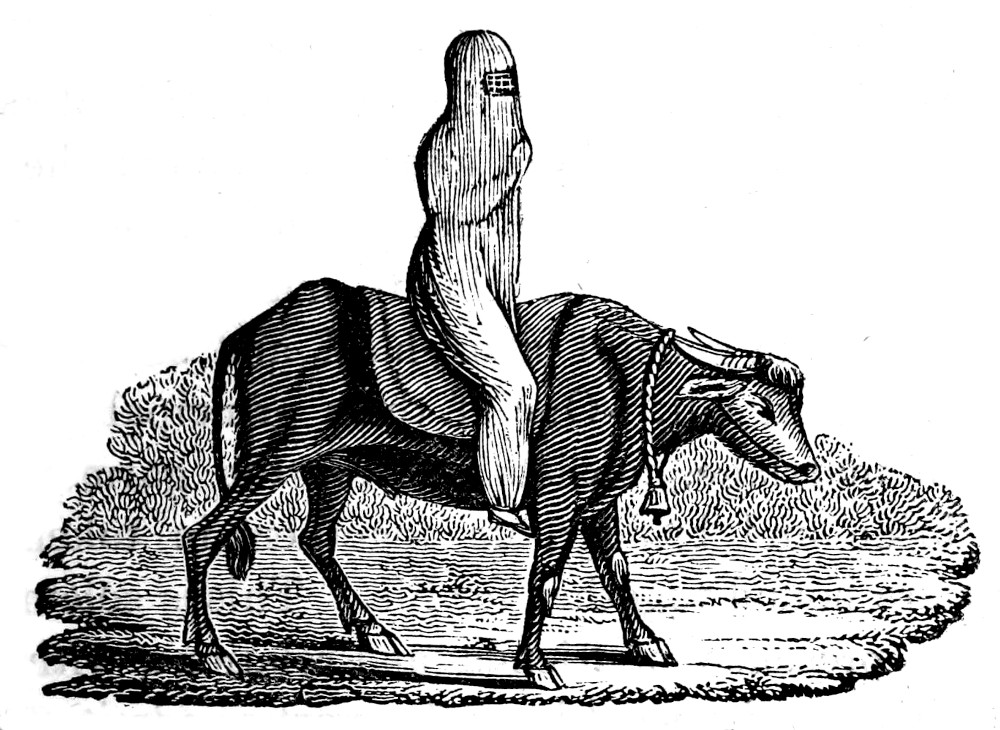
A Mohammedan woman riding.
FOOTNOTES:
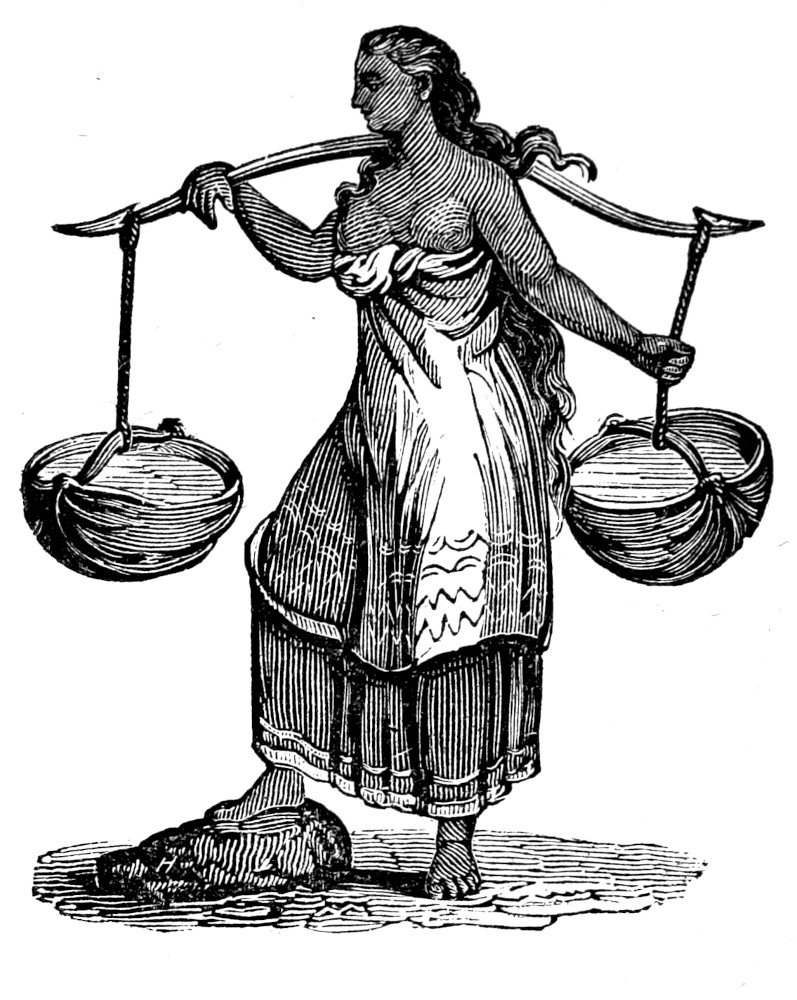
Girl of Timor.