Volume 1 — AFRICA. (continued 2)
Reading edition
Mr. M’Leod, who visited Dahomey in 1803, had his compassion much excited by the sudden disappearance of Sally Abson, daughter of the late English governor by a native female. This girl, who had been educated in the European manner, was accomplished, and had a most winning simplicity of manner. Mr. M’Leod could obtain no tidings of her for a long time. But at last an old domestic ventured to tell him that she had been carried off by an armed band, in the night-time, to be enrolled among the king’s women.
The king of Ashantee has three thousand three hundred and thirty-three wives; a mystical number, on which the prosperity of the nation is supposed to depend.
The king of Yarriba boasted to captain Clapperton, that his wives linked hand in hand would reach entirely across his kingdom. The first question asked by the chiefs was, how many wives the king of England had; and when told that he had but one, they would burst into loud peals of laughter, accompanied by expressions of surprise and pity.
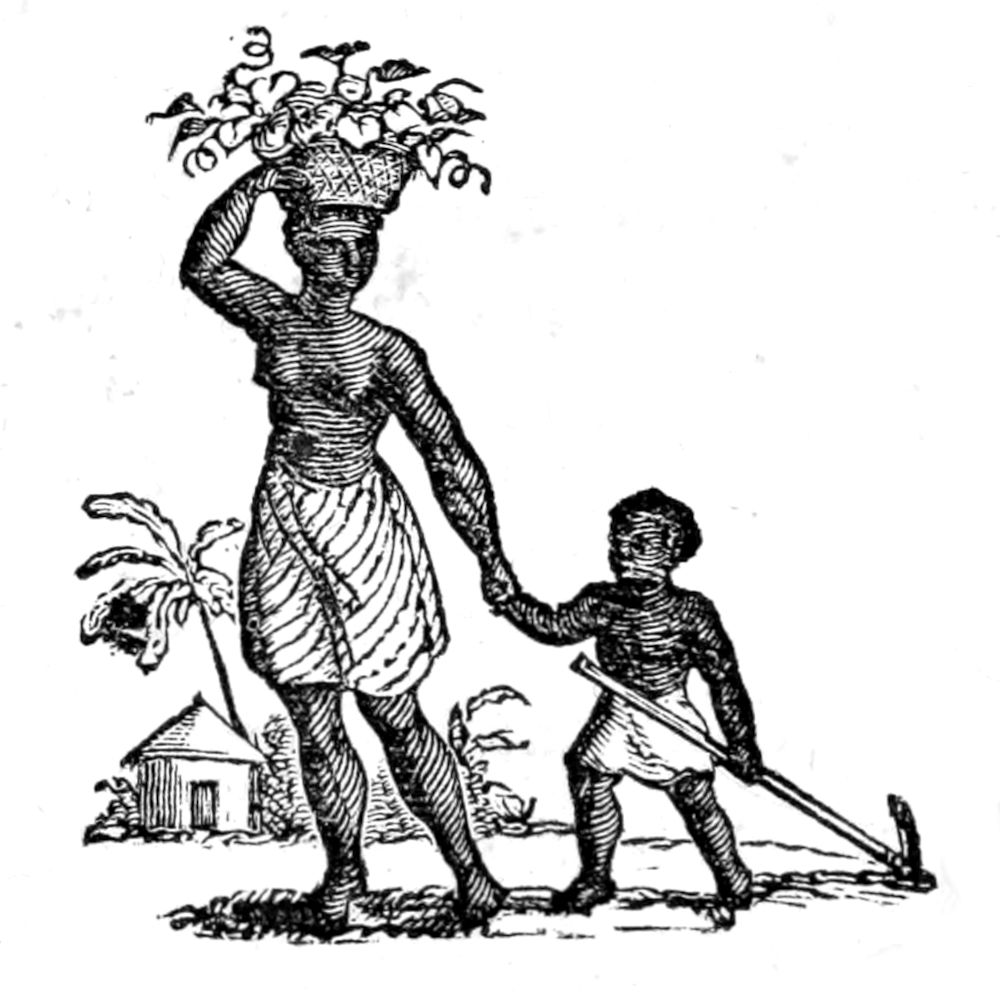
These numerous queens are, however, in fact, nothing but servants, and valued only as an indication of power and wealth. Beside forming a military guard for the king, they labor in the fields, bring water, and carry heavy burdens on their heads, just like the wives of the poorest subject.
The pagan Africans are formally married but to one wife; but they take as many mistresses as they can maintain, and send them away when they please. The lawful wife, provided she has children, has authority over all the female members of the household, and her children enjoy privileges superior to the rest; but if she is so unfortunate as not to be a mother, she is not considered as the head of the establishment.
The women belonging to one household generally live very peaceably. Each one takes her turn in cooking and other domestic avocations; and the husband is expected to be equally kind, generous, and attentive to all.
A slatee, with whom Mr. Park entered Kamalia, brought with him a young girl as his fourth wife, for whom he had given her parents three slaves. His other wives received her at the door very kindly, and conducted her into one of the best huts, which they had caused to be swept and whitewashed on purpose for her reception.
Dissensions, it is said, do sometimes occur, and the husband finds it necessary to administer a little chastisement before tranquillity is restored.
Unfaithfulness to the marriage vow is said to be very rare among the Mandingoes and the Kaffers. Throughout Africa this crime in a woman is punished by being sold into slavery; but the punishment cannot be arbitrarily and immediately inflicted by the husband, as is the case in many Asiatic countries; it is necessary to call a public palaver, or discussion, upon the subject. The price of a woman condemned for this vice is divided between the king and his grandees; it is therefore probable that they keep rather a strict watch upon the morality of their female subjects. Sometimes the paramour is likewise sentenced to be sold into slavery; sometimes he receives a severe flogging, amid the shouts and laughter of the multitude; and not unfrequently he is murdered by the abused husband. In this latter case, unless the murderer can buy a pardon from his prince, he is obliged to seek refuge in some other kingdom, where he falls at the feet of some rich person, and voluntarily acknowledges himself a slave; but he can never be sold, and is in fact regarded as one of the family. It frequently happens that the whole family of the culprit are obliged to flee their country, to avoid being sold into slavery for the crime of their relative.
The marabouts always marry among each other; and as the children follow the profession of their fathers, there are whole villages of these priests. They obtain great influence by being able to write verses of the Koran, and administer very simple medicinal remedies. They consider it a sacred obligation to ransom all persons of their own profession from slavery.
The ties of domestic affection are said to be peculiarly strong among the Shouaa Arabs, who reside in tents near the central part of Africa. When their chief learned that major Denham had been three years absent from home, he said, “Are not your eyes dimmed with straining to the north, where all your thoughts must be? If my eyes do not see the wife and children of my heart for ten days, they are flowing with tears when they should be closed in sleep.” His parting salutation to the traveller was, “May you die at your own tents, and in the arms of your wife and family.”
In some cases wealthy Africans do not avail themselves of the universal custom of polygamy. Barrow thus describes the Kaffer prince, Gaika: “At the time I saw him, he was under twenty years of age, of an elegant form, and a graceful and manly deportment; his face of a deep bronze color, nearly approaching to black; his skin soft and smooth; his eyes dark brown, and full of animation; his teeth regular, well set, and pure as the whitest ivory. He had the appearance of possessing in an eminent degree a solid understanding, a clear head, and an amiable disposition. He seemed to be adored by his subjects; the name of Gaika was in every mouth, and it was seldom pronounced without symptoms of joy. He had only one wife, who was very young, and, setting aside the prejudice against color, very pretty.”
The French traveller Brue says the women on the banks of the Senegal appeared to consider the condition of European wives very enviable, and expressed great compassion for him in being separated from his only wife without the power of marrying another. When Dr. Lichtenstein visited Latakoo, the women were, as usual, very curious about the Christian custom of having but one wife. The queen approved the system, but she thought polygamy was necessary in Africa, because such numbers of the men were killed in war.
Infants of a few hours old are washed in cold water and laid on a mat, with no other covering than a cotton cloth thrown loosely over them.
In twelve or fifteen days the mothers carry them about, suspended at their backs, by means of the pagne or mantle, which they fasten around the hips, and over one shoulder. Infants are kept in this situation nearly the whole day, while the women are busy at their various avocations. They are nursed until they are able to walk; sometimes until three years old. A few tumbles, or similar trifling accidents, are not considered worthy of much anxiety or commiseration. Till ten or twelve years old, children wear no clothing, and do nothing but run about and sport on the sands. Those who live near the sea-shore, are continually plunging into the water; in consequence of which scarcely any disease appears among them, except the small-pox. A child receives its name when it is eight days old. A sort of paste, called dega, is prepared for the occasion, and the priest recites prayers over it. He takes the babe in his arms, invokes the blessing of heaven upon it, whispers a few words in its ear, spits three times in its face, pronounces aloud the name that is given to it, and returns it to the mother. He then divides the consecrated dega among the guests, and if any person be sick, he sends them some of it. A similar custom prevails in the Barbary states.
The moment an African ceases to breathe, his wife runs out of the hut, beating her breast, tearing her hair, and summoning her neighbors by loud cries. Friends and relatives soon assemble in the hut, and join in her lamentations, continually repeating, “Woe is me!”
When the marabouts have rubbed the corpse with oil and covered it with cloths, each person goes up and addresses it, as if still living. In a few minutes they go away, saying, “He is dead;” the lamentations are renewed, and continue till the next day, when the burial takes place. Major Denham speaks of hearing the Dugganah women singing funeral dirges all night long in honor of their husbands, who had fallen in battle. These dirges were prepared for the occasion, and were so solemn and plaintive, that they could not be listened to without the deepest sympathy.
The body is conveyed to the grave in straw mats. Women hired for the occasion follow it with loud shrieks, and the most extravagant demonstrations of sorrow. They return howling to the hut, where they pronounce an eulogium on the deceased. If they perform their parts well, they are complimented by relations, and are treated with palm wine, or other spirituous liquors. For eight days in succession these women go to the grave at sunrise and sunset, and renew their lamentations, saying, “Hadst thou not wives, and arms, and horses, and pipes, and tobacco? Wherefore then didst thou leave us?”
The relations and friends of the deceased remain in seclusion with his widow eight days, to console her grief.
The Abyssinian women wound their faces while they lament for the dead. In Congo, the relatives shave their heads, anoint their bodies, and rub them with dust, during the eight days of mourning. They consider it very indecorous for a widow to join in any festivity for the space of one year after her husband’s death.
In Dahomey and Ashantee, wives, and slaves of both sexes, often one hundred in number, are slaughtered at the death of the king, from the idea that he will need their attendance in another world; and every year, at least one human being and many animals are killed “to water the graves” of the royal family. The government of Yarriba is more mild and paternal; but it is the custom for a few of the king’s favorite wives, and some of his principal ministers, to take poison, which is presented to them in parrots’ eggs, in order that they may go to serve his majesty in the world of spirits.
Fragrant flowers and a quantity of gold are sometimes buried with people of rank, for their use in another world. On the death of a young girl, the body is washed, anointed with palm oil, decorated in all her finery, and laid upon a bed; her companions join in a dance around her; and when this ceremony is concluded, she is buried in her best clothes. The graves are covered with little mounds of straw, on which a lance, bow, and arrow are placed for the men, and a mortar and pestle for a woman. The solemnities always conclude with a feast, at which the guiriots dance, while all join in singing the praises of the deceased.
The Africans, like the Asiatics, do not use knives or forks. All eat from a wooden bowl, which is placed on a mat, or low stool, in the middle of the hut. The women seldom eat until the men have done. After the repast a woman brings a calabash of water, and offers it to each of the guests, for the purpose of washing his hands and mouth. In Tesee the women are not allowed to eat eggs, though the men eat them without scruple. It is not known in what the custom originated, but nothing will affront a woman of that country so much as to offer her an egg.
In Congo, people of rank are often carried by slaves in a sort of hammock swung upon poles, which is frequently protected from the sun by an awning thrown over it. Women in all parts of Africa are often seen riding on asses or oxen. They guide the latter by means of a string passed through a ring in the nose; and they sometimes manage to make these quiet beasts curvet and caper.
Apes, baboons, and monkeys, are exceedingly numerous in Africa. A woman of the country of Galam, who was carrying some milk and millet to sell in a neighboring village, was attacked by a troop of apes from three to four feet high. They threw stones at her, and holding her fast, beat her with sticks, until she dropped the vessel she was carrying. She returned home much bruised, and the men formed a hunting party, which killed ten of the savage animals, and wounded several others; not however without getting sundry bites and bruises during the encounter.
The Hottentot race seem to be distinct from all other people, and surpassing all others, even the Calmucks, in ugliness. The eyes are long, narrow, and distant from each other; the eyelids do not form an angle at the extremity near the nose, but are formed in a manner very similar to the Chinese; their cheek bones are very high and prominent, and form nearly a triangle with the narrow pointed chin; the complexion is yellowish brown, like an autumn leaf; the hair grows in small tufts at certain distances from each other; when kept short, the head looks like a hard shoe-brush, but when suffered to grow, it hangs in the neck in a sort of hard twisted fringe. An old Hottentot woman is said to be a most uncouth and laughable figure; some parts of the body being very lank, and others jutting out in huge protuberances of loose flesh. The letter S gives the best idea of the curvature of their forms. The habit of throwing the breast over the shoulder, in order to enable infants to nurse while swinging at their backs, contributes not a little to increase their deformity. Yet some of the women, when very young, are said to be perfect models of beauty in the female form. Every joint and limb is well turned and proportioned, and the hands and feet are remarkably small and delicate, though they never wear shoes, or sandals. Their charms, however, endure but a very short time. They are old at thirty; and long before that time, their shape assumes those strange and disgusting disproportions, for which it seems difficult to account.
In their state of slavery they have suffered great cruelties from their masters, the Dutch boors of South Africa. The lands and flocks, of which their fathers had been in peaceful and happy possession, were wrested from them; they were compelled to labor without compensation; allowed scarcely food enough to support life; mangled with tough, heavy whips of the sea-cow’s hide; and sometimes, for the slightest offences, chained to a post, while shot was fired into their naked limbs. These Dutch tyrants introduced a singular degree of luxurious refinement into their mode of despotism; they did not, according to the usual custom of slave-owners, order their offending vassals to receive a certain number of lashes, but directions were given to flog them while their master or mistress lazily smoked out one, two, three, or four pipes.
Under these circumstances, the simple, kind-hearted Hottentots became servile, degraded, and wretched to the last degree. Unlike all others of the colored race, they were always gloomy and dejected, being rarely excited even to a languid smile. Their indolence was so great that they would fast a whole day rather than dig a root, if they might only be allowed to sleep. The natural color of their bodies was concealed by an accumulation of grease and soot, and their habits were so filthy that the description would be disgusting. Though strong in their attachment to each other, they were generally disinclined to marriage.
The situation in which women were placed,—being originally ignorant savages, and afterward completely in the power of masters, whose policy it was to brutalize them,—of course precluded all possibility of morality or modesty. In fact the immortal part of man seemed extinguished in the Hottentots, and they appeared to be altogether like the beasts of the field.
The bit of sheep-skin which they wear for clothing scarcely answers the purposes of decency, and with them it is entirely a matter of indifference whether it does or not. The women wear a small leather apron, seven or eight inches wide, which it is their delight to decorate with beads, shells, or large metal buttons. If in addition to this they can obtain beads for the neck, and copper rings for the arms, they experience as much delight as can possibly be felt by people of such a phlegmatic temperament. Those who cannot afford beads and shells wear leather necklaces and bracelets, and cover themselves with a piece of sheep-skin, cut into narrow strips, which hang in a bunch about half way to the knee. The rattling of this hard dry skin announces the approach of a Hottentot woman some time before she appears. In winter, they defend themselves from the cold by means of a sheep-skin cloak over the shoulders; and some wear skin caps on their heads, ornamented as their rude fancy dictates. Fragments of a looking-glass, to fasten in their caps, or among their hair, are considered as precious as diamonds with us.
The habit of greasing their bodies probably originated, as it did in other warm climates, in the scarcity of water, and the necessity of some protection from the rays of the sun. Barrow suggests that this practice introduced into South America would prove a salutary check to the prevalence of that loathsome disorder called the elephantiasis.
When a Hottentot wishes to marry, he drives two or three of his best oxen or sheep to the house of the bride’s relations, accompanied by as many friends as he can collect together. The animals are slain, and the whole assembly rub themselves with the fat. The men sit in a circle round the bridegroom, and the women round the bride. A blessing is then pronounced on the young couple, which principally consists in the hope that their sons will be expert huntsmen, and prove a comfort to their old age. A feast is then prepared, and when they have all eaten voraciously, a pipe is lighted, of which each one smokes a few whiffs, and then passes it to his neighbor. Feasting is sometimes kept up for several days; but they have no music or dancing. Men and women always eat separately.
When an infant is born, they rub it gently with fresh cow-dung, believing it to possess certain medicinal qualities; they then bruise the stalks of wild figs and wash the child in the juice; and when this is dry, fat, or butter, is liberally applied. After this the parents give it a name, which is generally the appellation of some favorite animal. A feast is given, of which all the inhabitants of the kraal, or village, partake, except the mother, who receives some of the fat for the use of herself and child.
Large numbers of the Hottentot women are childless, and a family of six is considered a wonderful prodigy.
The half European and half Hottentot children are remarkably vigorous and healthy, and become tall, well-proportioned men and women. This mixed race, somewhat remarkable for brightness and activity, seem likely to supplant the natives entirely.
It rarely happens that a Hottentot woman has twins, but when this is the case one of them is barbarously exposed in the woods, to be starved, or devoured by wild beasts, as the case may be. Very old people are sometimes exposed in the same way. All the other African tribes are distinguished for great respect and tenderness toward the aged.
When the Hottentot boys are eighteen years old, they are formally admitted into the society of men. The company of women, even that of their own mothers, is ever after considered a disgrace to them; and being released from all maternal authority, they not unfrequently beat their mothers and sisters, merely to show manly independence.
The women howl and lament for the dead, in the same manner that prevails in other portions of the continent.
A Hottentot kraal, or village, consists of a circle of low dirty huts, which at a little distance resemble a cluster of bee-hives. The employments of the women are such as generally fall to their lot in a savage state. A great many of them are slaves to the Dutch boors, and of course perform all their most menial and laborious occupations. Their patience and fortitude under suffering are truly wonderful.
Low as the Hottentots are in the scale of humanity, they are by no means destitute of good and agreeable qualities. They are very mild, inoffensive, open-hearted, honest, and grateful. Their affection for each other is so strong, that they will at any moment share their last morsel of food with a distressed companion; and they very seldom quarrel, or speak unkindly to their associates. They seem to be entirely destitute of cunning, and when they have committed a fault rarely fail to tell of it with the utmost simplicity.
M. Vaillant says: “They are the best, the kindest, and the most hospitable of people. Whoever travels among them may be sure of finding food and lodging; and though they will receive presents, they never ask for any thing. If they learn that the traveller has a long journey to accomplish, they will supply him with provisions as far as their circumstances will allow, and with every thing else necessary to enable him to reach the place of his destination. Such did these people appear to me, in all the innocent manners of pastoral life. They excite the idea of mankind in a state of infancy.”
The Hernhüters, or Moravian missionaries, have had a most blessed influence on this poor persecuted race. These missionaries cultivate gardens and fields in the neatest manner, and are themselves engaged in various mechanical trades. The Hottentots by kindness and punctual wages are induced to come and work for them, and the good fathers are ever ready to instruct them in agriculture and the mechanical arts. In 1824, nearly two thousand Hottentots lived in small huts, under the protecting influence of the missionaries, each one cultivating a little patch of ground to raise vegetables for his family. Some of them employed their leisure moments in making mats and brooms, while others obtained a comfortable subsistence by the sale of poultry, eggs, and cattle.
Three hundred of their children attended Sunday school; and they contributed five hundred six dollars to the missionary establishment by voluntary subscriptions. Under the fostering care of true-hearted, humble Christians, their habits of indolence and filth disappeared, and they became distinguished for industry and cleanliness. By the last accounts, about sixty Hottentots were communicants of the church.
Barrow, who visited the establishment in 1798, says: “Early one morning I was awakened by the noise of some of the finest voices I ever heard, and looking out saw a group of female Hottentots sitting on the ground. It was Sunday, and they had assembled thus early to chant the morning hymn. They were all neatly dressed in printed cotton gowns. A sight so different from what we had hitherto observed, with regard to this unhappy class of beings, could not fail of being most grateful.”
“On Sundays, they all regularly attend divine service, and it is astonishing how ambitious they are to appear at church neat and clean. Of the three hundred, or thereabouts, that composed the congregation, about half were dressed in printed cottons. Their deportment was truly devout. One of the fathers delivered a discourse replete with good sense, and well suited to the occasion; tears flowed abundantly from the eyes of those to whom it was particularly addressed. The females sung in a plaintive and affecting style; and the voices were in general sweet and harmonious.”
The Dutch had always excused their own tyranny by saying that their unfortunate victims could not possibly be raised above the level of brutes; and they manifested extreme jealousy of the influence of the Gospel, because it bringeth light and freedom. The same spirit, which always led them to place the poor Hottentot in the worst possible point of view, likewise induced them to represent the amiable and generous Kaffers as a savage, treacherous, and cruel tribe. Yet they knew perfectly well that the Kaffers had shown a remarkable degree of moderation toward the white colonists; and that in the midst of a war, into which they had been driven by a series of iniquitous persecutions, they spared the lives of all the Dutch women and children that fell into their hands, though their own wives and children were murdered by the Dutch without mercy.
In 1828 the British government relieved the Hottentots from their grievous thraldom, and at once bestowed upon them all the privileges of citizens. The change from slavery to freedom produces the effect that would naturally be expected by any one who had observed human nature attentively. This long oppressed race are fast improving in health, cleanliness, industry, and respectability.
The Bojesmans, or Bushmen, are wild Hottentots, who have always preserved their independence, though under circumstances of the extremest misery and want. In personal appearance they very much resemble the Hottentots, but are more diminutive and ugly. The colonists call them Chinese Hottentots, on account of the peculiar position and formation of the eyes and eyelids. Their customs and modes of life bear a general resemblance to those of their more submissive brethren; but, unlike them, they are very cheerful, active, and industrious. Both men and women spring from rock to rock, like wild antelopes, and their motions are so swift that a horseman finds it impossible to keep up with them on uneven ground. Although their scanty subsistence is earned with great danger and fatigue, they are always merry.
The deadly animosity of the Dutch settlers makes it necessary for them to remain concealed in their hovels among the rocks all day; but on moonlight nights, they come out and dance from the setting of the sun to its rising. They consider the first thunder storm as a sure indication that winter has passed away, and testify their joy by tearing off their sheep-skin coverings, and tossing them high up in the air. On these occasions, they dance for several successive nights. The circular places trodden around their huts indicate their fondness for this amusement.
The women usually wear a piece of antelope’s skin cut into filaments, after the manner of the other Hottentots; and like them they are entirely unconscious of any shame in being without even this scanty covering. Some of them wear caps made of ass’ skin, and bits of copper or shells suspended in the neck from their little tufts of hair. It is customary for elderly men to have two wives, one old and the other young. These poor creatures have such a dread of white men, that Mr. Barrow could hardly tempt the little children to come down the rocks toward his party, to receive the biscuits he held out to them. The mothers, finding their little ones were treated kindly, ventured to approach; and when they had received a few trifling presents, forty or fifty women and girls came down without any symptoms of fear. But the women went backward and forward a dozen times, with invitations and presents of tobacco, before one man could be prevailed upon to descend; and when he did, he half cried, half laughed, and trembled like a frightened child.
The Gonaquas are a tribe of unsubdued Hottentots, taller than the Bojesmans, but resembling them in personal appearance. The women generally paint the whole body with compartments of red and black. The red is an ochrey earth, the color of brick-dust, and the black is either soot or charcoal, mixed with grease. To finish this embellishment in approved style is a tedious process. Some content themselves with merely painting the cheeks. These colors are always perfumed with a powder called boughou, the smell of which is very disagreeable to those who are unused to it; but the Hottentots are so fond of it, that they will sometimes give a lamb for a thimble full of boughou. The men paint only the upper lip; by means of which they continually inhale the fragrance. When young girls consent to perform this office for their lovers, it is considered a very endearing proof of affection. These women are very fond mothers. Their principal occupations are cooking, taking care of their children, and making garments and vessels of the skins of animals sewed with sinews. Their aprons and cloaks are usually made of calf skins, and are longer and larger than those worn by other Hottentots. As soon as milk is taken from the cow, it is put in a leather sack with the hairy side inwards, and suffered to ferment; for, like the Arabs, they have a dislike to sweet milk.
The Dutch women at the Cape are excessively ignorant, tyrannical, lazy, and fat; the inevitable consequence of having slaves to do every species of labor, while they themselves indulge in great profusion of animal food. An old Dutch African woman is said to be as laughable a figure as an old Hottentot; one being as large and uninterruptedly round as a hogshead, and the other characterized by uncouth projections of the body. The young Dutch girls at the Cape are said to be much superior to their clumsy, awkward brothers. They are generally small and well formed, with social, unaffected manners. A few of the higher class are tolerable proficients in music, French, and English, and have considerable skill in lace and various kinds of needle-work. They copy with much eagerness the English fashions that are brought to them, from time to time, by ladies bound for India.
Sons and daughters share equally in the paternal inheritance, and an entire community of property, both real and personal, takes place at the marriage of two persons, unless provided against by a formal contract before the wedding.