THE HISTORY OF THE CATNACH PRESS (continued 3)
Reading edition
8
NURSE LOVECHILD’S LEGACY.
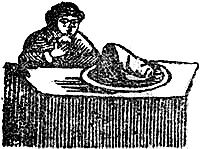
Be not a glutton when you eat, But spare some for the needy, Or people will, when filled with meat, Say, like a wolf, you are greedy.
9
NURSE LOVECHILD’S LEGACY.
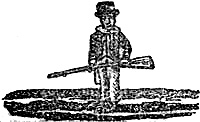
There was a little man, And he had a little gun, And his bullets were made of lead, He shot John Sprig Thro’ the middle of his wig, And knock’d it off his head.
10
NURSE LOVECHILD’S LEGACY.
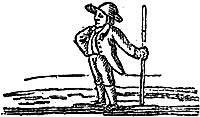
Now what do you think Of little Jack Jingle, Before he was married, He used to live single. But after he married, To alter his life, He left off living single And lived with his wife.
11
NURSE LOVECHILD’S LEGACY.
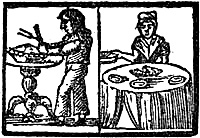
Tom Trueby was a good and sensible boy, who neither played the truant nor kept company with naughty children. He did not like tossing up nor chuck up farthing, because he thought it might lead him to love gaming, when he was grown up; but he liked very well to play at ball or top, and most particularly at marbles, at which he was very clever, never cheated, and played so well that he used to teach the neighbouring children.
12
NURSE LOVECHILD’S LEGACY.
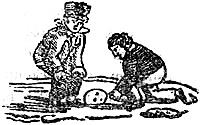
And here you see him instructing Master Manly, a Baronet’s son in the place, as he did in matters of more consequence, and behaved so well towards him, that he was his friend all his lifetime.
13
NURSE LOVECHILD’S LEGACY.
Fire-Works and Crackers.
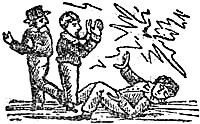
Fire-Works are things that look very pretty when they are properly managed by those who understand them, but children ought to take care how they meddle with gunpowder lest they should hurt themselves or other people.
14
NURSE LOVECHILD’S LEGACY.
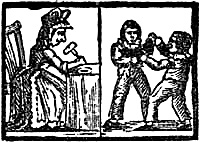
Tom Hazard for example was always fond of playing with serpents crackers &c. At one time he was near doing damage by his fireworks falling into a cellar, and at another time as you see in the cut he so much frightened one of his schoolfellows that he fell down, and put his ancle out, for which Tom was severely corrected and you must own he richly deserved it.

15
NURSE LOVECHILD’S LEGACY.
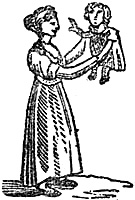
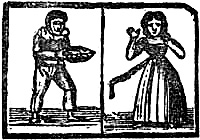
See the Mother, Good and mild, How she plays With her dear Child.
2
The Lord’s Prayer.

Our Father, who art in Heaven, hallowed be thy Name, thy Kingdom come, thy Will be done on Earth, as it is in Heaven, Give us this Day our daily Bread, and forgive us our Trespasses as we forgive them that trespass against us, and lead us not into Temptation, but deliver us from Evil. For thine is the Kingdom, the power and the Glory, for ever and ever. Amen.

3
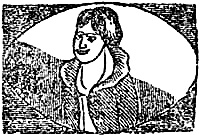
A Was an Arch Boy.
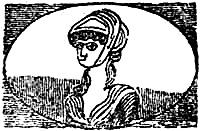
B A Beauty was.
4
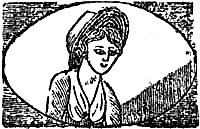
C A comely Wench but Coy.
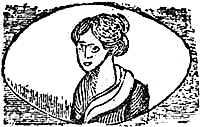
D A Dainty Lass.
5
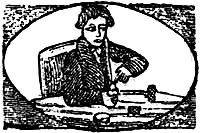
E Loved Eggs, and eat his fill.
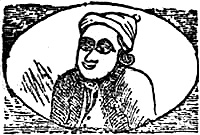
F Was full and fat.
6
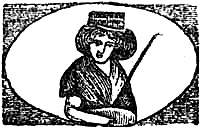
G Had Grace and wit at will.

H Wore a Gold Lace Hat.
7
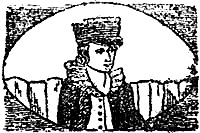
I Stands for little Jackys name.
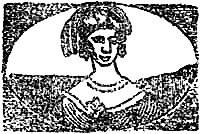
K For Kitty Fair.
8
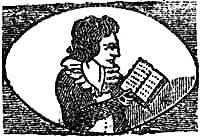
L Loved Learning & got fame.
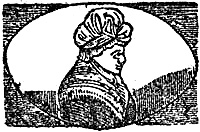
M Was his Mother dear.
9
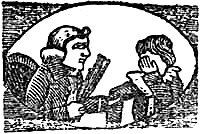
N Was naughty & oft crying.
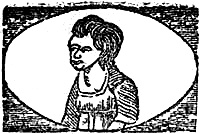
O An Only Child.
10
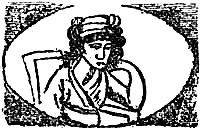
P Was pretty Peggy sighing.
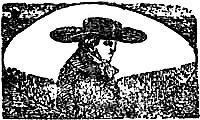
Q Was a Quaker mild.
11
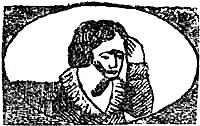
R Was Rude, & in disgrace.
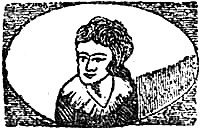
S Stands for Sammy Still.
12
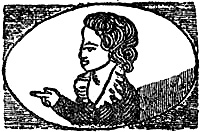
T For ever talked a-pace.
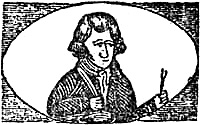
V Was fond of Veal.
13
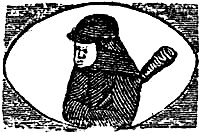
W He watched the house & hall.

X Does like a Cross appear.
14
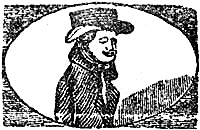
Y A Youth well shaped & tall.
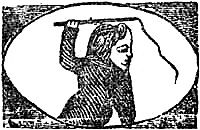
Z Whips up the Rear.
15
Let all good children come to me, And I’ll learn them their
A B C
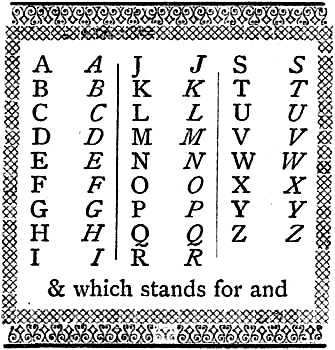
If you are bad I pray reform, And praise will all Your acts adorn.
London: Printed by J. Catnach, 2, Monmouth Court, 7 Dials.
2
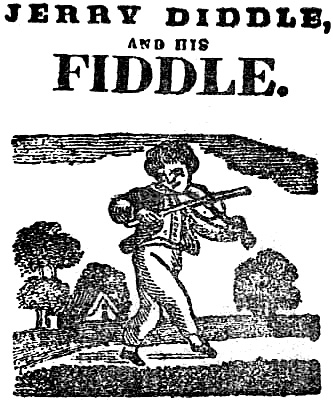
JERRY DIDDLE. Bought a fiddle, To play to little boys, He wax’d his string, And began to sing, Youth is the time for joys.
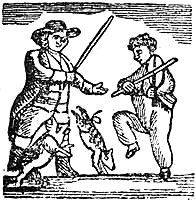
He went to a pig, and play’d a jig.
3
The pigs did grunt for joy, Till the farmer came out, And made a great rout, Saying “Off, or I’ll cane you, my boy.”
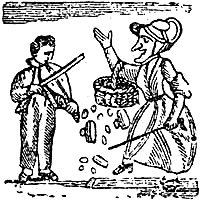
He met an old woman to market a prancing, He took out his fiddle, and set her a dancing.
4
She broke all her eggs, And dirtied her butter; At which her old husband Began for to splutter.
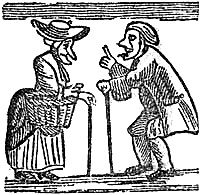
Oh! then, said Jerry, I’ll soon make you merry.
5
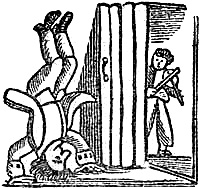
And the way with his fiddle he led, The old man heard the tune, As he sat in his room, And danc’d on top of his head.
6
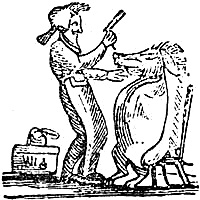
He next met a barber, With powder and wig, He play’d him a tune, And he shaved an old pig.
7
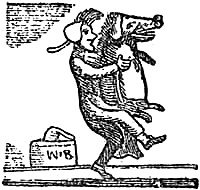
Then up in his arms He carried the boar, And went to the ale-house, To dance on the floor.
8
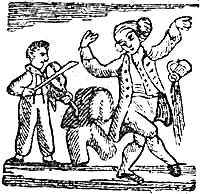
He met an old man, With beer in a can, And a bundle of clothes on his shoulder, He bade Jerry play, And threw all away, To astonish each gaping beholder.
9
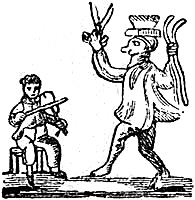
He went to a tailor, Who was ill in bed; When he got up to dance, With a goose on his head.
10
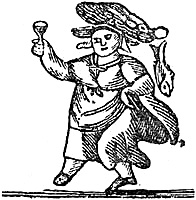
He went to a fishwomen, Tippling of gin, When she like a top, Began for to spin.
11
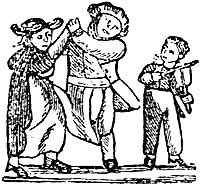
The publican star’d, As he fill’d out the glasses, But when Jerry play’d, He danc’d with the lasses.
12
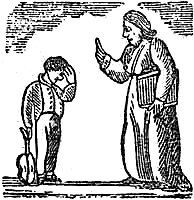
He next met an old man, With beard white and long, Who laugh’d at poor Jerry, And scoff’d at his song.
13
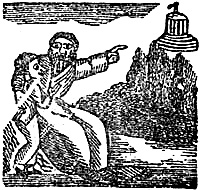
His name was Instruction, The friend of the wise, Who teaches good youth, To win honor’s prize.
14
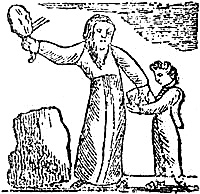
He broke Jerry’s fiddle, And taught him to read, And told him that honor Would daily succeed.
15
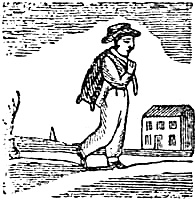
Jerry now is a lad At school always true, The joy of his friends, And a pattern for you.
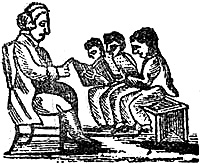
Be instructed by him, To avoid folly’s snare, And your bosom thro’ life, Will escape every care.
FINIS.
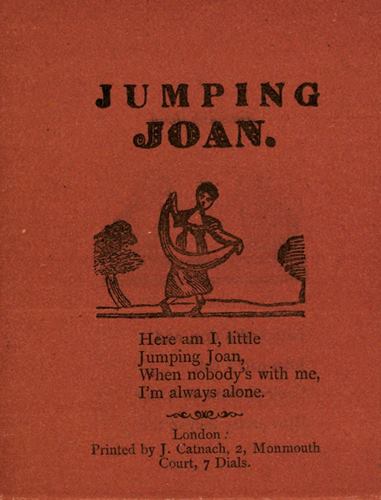
2
Jumping Joan.
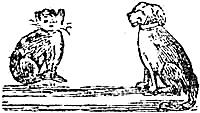
Joan had a dog, and Joan had a cat, Look at them both, see How pretty they’re sat.
3
Jumping Joan.
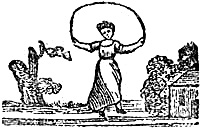
Joan she lov’d skipping, And was not at a loss, At jumping or hopping, Or going a cross.
4
Jumping Joan.
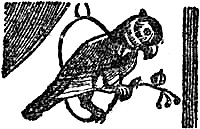
Joan had a parrot Could chatter and bawl, But Joan could talk faster, And longer withal.
5
Jumping Joan.
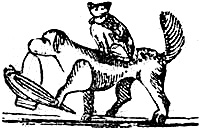
Joan’s dog, Prinny, No learning did lack, He’d carry Poll in his mouth And Puss on his back.
6
Jumping Joan.
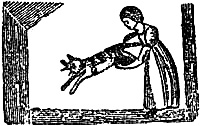
As Joan lov’d jumping, She learned her cat, Look at them both, And see what they’re at.
7
Jumping Joan.
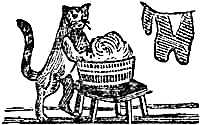
Here’s Pussy a washing Joan’s linen you know, She could wash for herself A long while ago.
8
Jumping Joan.
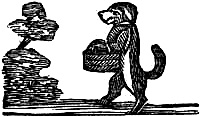
Now Prinny, Joan’s dog, To market would go, But what he’ll bring back, I’m sure I don’t know.
9
Jumping Joan.
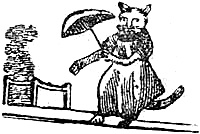
Here’s Pussy drest out Like a lady so gay, She’s going to court, if She finds but the way.
10
Jumping Joan.
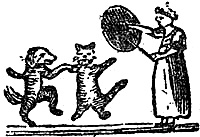
Here’s Prinny and Pussy To dancing have got, While Joan plays a tune On the lid of a pot.
11
Jumping Joan.
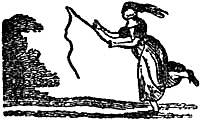
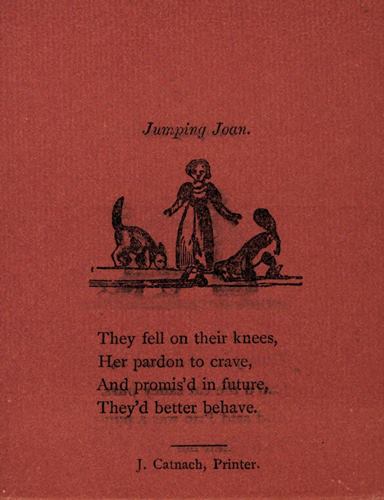
Here’s Joan with a whip, Taking very long strides, And vows if she finds ’em, She’ll bang both their hides.
12
Jumping Joan.
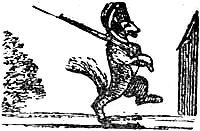
Here’s Prinny with gun, Sword and gorget so smart, He’s going to France, To fight Bonaparte.
13
Jumping Joan.
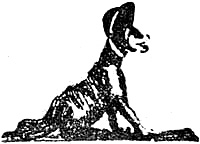
And Joan’s threat had fill’d Poor Prin with alarms, He said he’d not fight, And so grounded his arms.
14
Jumping Joan.
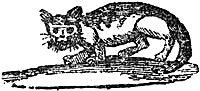
Then Puss in a fright Ran back to the house, She pull’d off her clothes, And has just caught a mouse.
15
Jumping Joan.
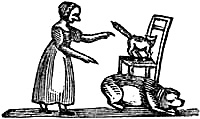
Then Joan she came in, Call’d the cat saucy puss, And said Prin was a puppy, To frighten her thus.
TO THE
Juvenile Reader.

Little Boys and Girls will find At Catnach’s something to their mind. From great variety may choose, What will instruct them and amuse; The prettiest plates that you can find, To please at once the eye and mind, In all his little books appear, In natural beauty, shining clear, Instruction unto youth when given, Points the path from earth to heaven. He sells by Wholesale and Retail, To suit all moral tastes can’t fail.
THE
Butterfly’s Ball,
AND
Grasshopper’s Feast.
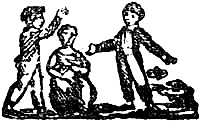
Come take up your hats, And away let us haste, To the Butterfly’s Ball, Or the Grasshoppers Feast.

J. Catnach, 2, Monmouth Court, 7 Dials.
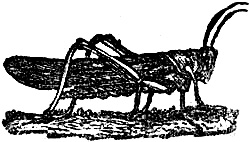
THE
BUTTERFLY’S BALL,
AND
Grasshopper’s Feast.

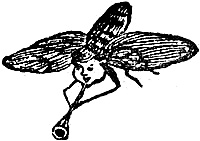
The trumpeter Gad-fly, Has summon’d the crew, And the revels are now, Only waiting for you.
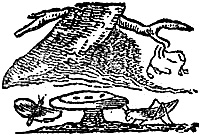
On the smooth shaved grass, By the side of a wood. Beneath a broad oak, Which for ages had stood.
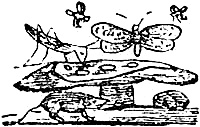
See the children of earth, And the tenants of air, To an evening’s amusement, Together repair.
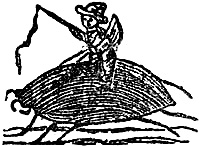
And there came the Beetle, So blind and so black, And carried the Emmet, His friend on his back.
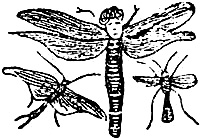
And there came the Gnat, And the Dragon-fly too, And all their relations— Green, orange and blue.
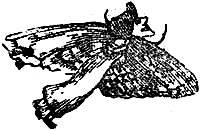
And there came the Moth With her plume of down, And the Hornet with jacket Of yellow and brown.
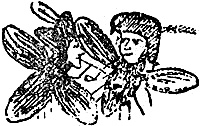
Who with him the Wasp, His companion did bring, But they promised that evening To lay by their sting.
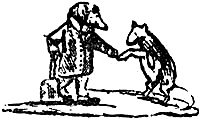
The sly little Dormouse, Peep’d out of his hole, And led to the feast, His blind cousin the Mole.
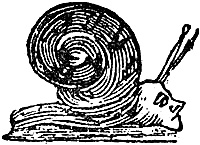
And the Snail with his horns, Peeping out of a shell. Came fatigued with the distance, The length of an ell.
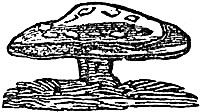
A Mushroom the table, And on it was spread, A water-dock leaf, Which their table-cloth made.
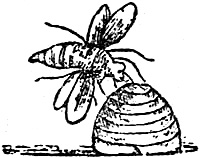
The viands were various, To each of their taste, And the Bee brought the honey, To sweeten the feast
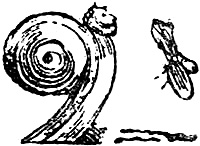
With steps most majestic, The Snail did advance, And he promised the gazers A minuet to dance.
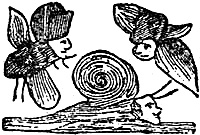
But they all laugh’d so loud, That he drew in his head, And went in his own Little chamber to bed.
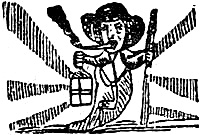
Then as the evening gave way To the shadows of night, Their watchman the glow-worm Came out with his light.
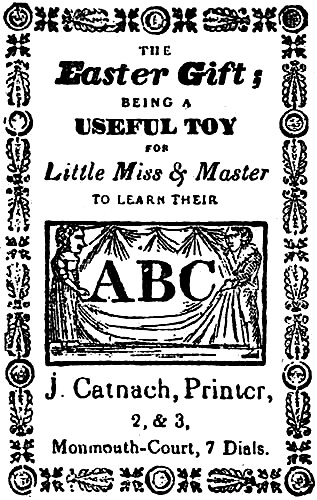
Let all good children come to me, And I’ll learn them their
A B C
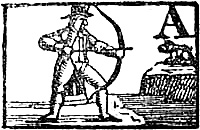
A Was an Archer and shot at a frog, But missing his mark shot into a bog.
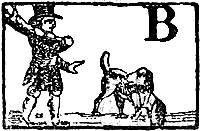
B Was a Butcher and had a great dog, Who always went round the streets with a clog.
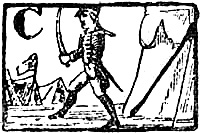
C Was a Captain so brave and so grand, He headed in buff the stately train’d band.
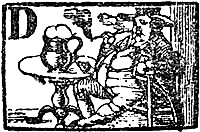
D Was a Drunkard and lov’d a full pot, His face and his belly shew’d him a great sot.
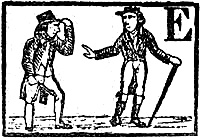
E Was an Esquire, both lofty and proud, His servant was softy though he was full loud.
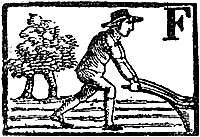
F Was a Farmer and followed the plough, And gathered good from the sweat of his brow.
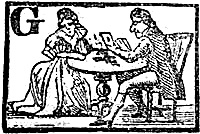
G Was a Gamester, and oft would he play, A poor single ace against a bold tray.
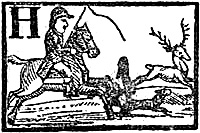
H Hunted the buck, and likewise the doe, The hart and the fox, and also the roe.
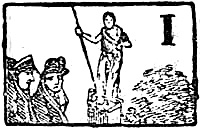
I Was an Image set up at Rome, Many that see it were better at home.
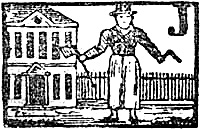
J Was a Joiner and built him a house, A little time after there came in a mouse.
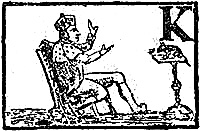
K Was a King, who would drink and carouse, Affrighted was he at a stand and a mouse.
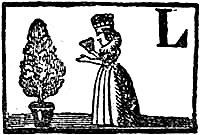
L Was a Lady that lov’d a fine tree, Though none understood it so little as she.
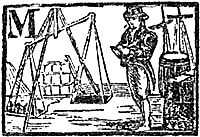
M Was a Merchant to foreign lands gone. To bring home fine tea and rich silks anon.
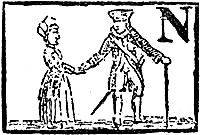
N Was a Noble of birth and high power, To the poor most gentle, to the haughty most sour.
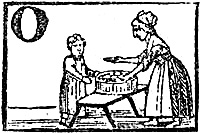
O With her Oysters, a delicate cry. Come buy my sweet Oyster, come buy, come buy.
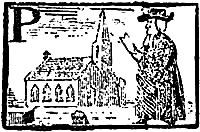
P Was a Parson, and wore a black gown, For goodness and virtue of high renown.
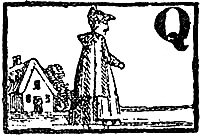
Q Was a Quaker, both stiff and upright, In yea and nay they chiefly delight.
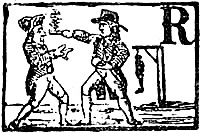
R Was a Robber on the highway, For which he’s been hung this many a day.
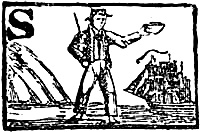
S Was a Sailor and liv’d in a ship, He made the Spaniards and French for to skip.
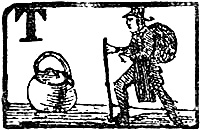
T Was Tom Tinker and mended a kettle, While he was hammering was deaf as a beetle.
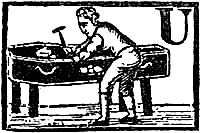
U Was an Undertaker at work for his bread. The living must pay, though he works for the dead.
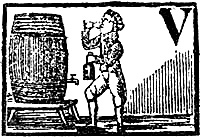
V Was a Vintner that loved his pottle, Went seldom to bed without his full bottle.
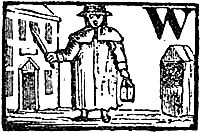
W Was a Watchman, to guard the warehouse, That rogues did not strip it of every souse.
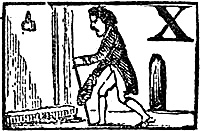
X Was expensive, and so became poor, With his little dog begged from door to door.
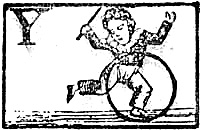
Y Was a Youngster that lov’d not his school, But trundled his hoop though out of all rule.
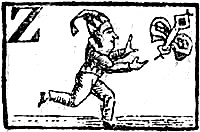
Z Was a Zany that look’d like a fool, With his long tassell’d cap he was the boy’s fool.

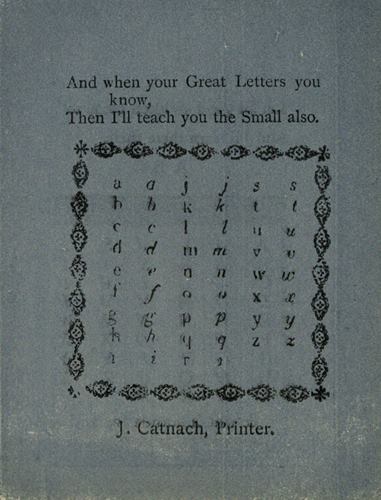
And when your great letters you know, Then I’ll teach you the small ones also.
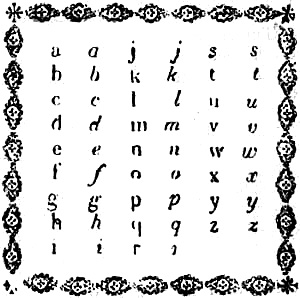
Printed by J. Catnach.
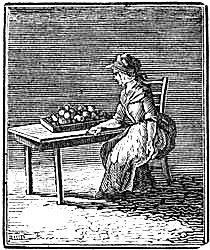
An apple pie when it looks nice, Would make one long to have a slice, And if its taste should prove so too, I fear one slice would scarcely do, So to prevent my asking twice, Pray mamma, cut a good large slice.
THE LIFE AND DEATH OF AN APPLE PIE.
AB An Apple-pie.Bit it.
CD Cut it.Dealt it.
EF Did eat it.Fought for it.
GH Got it.Had it.
JK Join’d for it.Kept it.
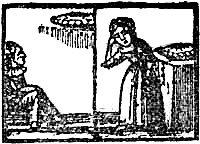
LM Long’d for it.Mourned for it.
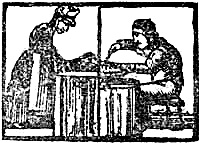
NO Nodded at it.Open’d it.
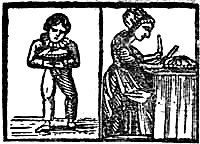
PQ Peeped into it.Quartered it.
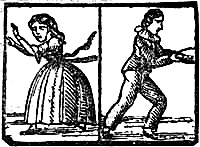
RS Ran for it.Stole it.
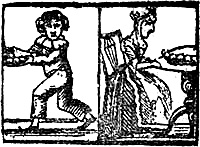
TV Took it.View’d it.
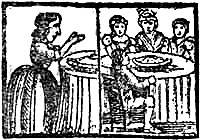
WXYZ and & Wanted it.All wished for a piece in hand.
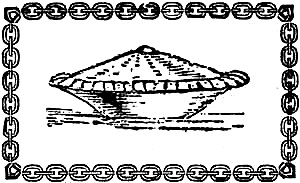
At last they every one agreed, Upon the apple pie to feed; But as there seem’d to be so many, Those who were last might not have any, Unless some method there was taken That every one might have their bacon, They all agreed to stand in order, Around the apple pie’s fine border, Take turn as they in hornbook stand From great A down to &, In equal parts the pie divide, As you may see on the other side.

A curious Discourse that passed between the Twenty-five Letters at dinner time.
A 1. Says, A, give me a good large slice. B 2. Says B, a little bit but nice. C 3. Says C, cut me a piece of crust. D 4. Take it, says D, ’tis dry as dust. E 5. Says E, I’ll eat it fast, who will? F 6. Says F, I vow I’ll have my fill. G 7. Says G, give it me both good and great. H 8. Says H, a little bit I hate. I 9. Says I, I love the juice the best. K 10. And K, the very same confess’d. L 11. Says L, there’s nothing more I love. M 12. Says M, it makes your teeth to move. N 13. N notic’d what the others said, O 14. O, others plates with grief survey’d. P 15. P prais’d the cook up to the life. Q 16. Q quarrell’d because he’d a bad knife. R 17. Says R, it runs short I’m afraid. S 18. S, silent sat and nothing said. T 19. T, thought that talking might lose time. U 20. U understood it at meals a crime. W 21. W wish’d there had been a quince in. X 22. Says X, those cooks there’s no convincing. Y 23 Says Y, I’ll eat, let others wish. Z 24. Z sat as mute as any fish. & 25. While & he lick’d the dish.
Having concluded their discourse and dinner together, I have nothing more to add; but if my little readers are pleased with what they have found in this book they have nothing to do but to run to J. Paul & Co’s., 2, & 3, Monmouth Court; 7 Dials, where they may have a great variety of books not less entertaining than this of the same size and price.
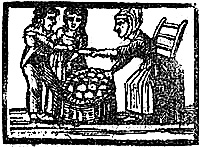
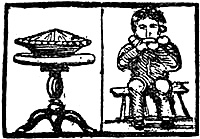
But that you may not think I leave you too abruptly, I here present you with the picture of dame Dumpling, who made the Apple pie you have been reading about; she has several more in her basket, and she promised that if you are good children you shall never go to bed supperless while she has one left. But as good people always ask a blessing, as a token that you are good and deserve a pie, you must learn the two following Graces, that one be said before your meals, and the other after.

Grace before Meat.
Good Lord, bless us, and these thy creatures, to our use, which we are about to receive, of thy bounteous liberality, through Jesus Christ our Lord. Amen.
Grace after Meat.
We thank thee, O Lord, for all the benefits of this time, and of our whole lives. Make us thankful for all thy mercies now, and for evermore. Amen.

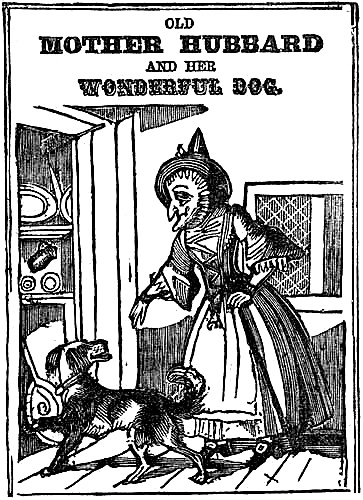
Old Mother Hubbard went to the cupboard To get the poor dog a bone; But when she came there the cupboard was bare, And so the poor dog had none.
London: Printed by J. Catnach, 2 & 3, Monmouth Court, 7 Dials.
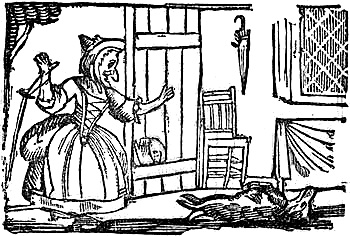
She went to the baker’s to buy him some bread, When she came back the dog was dead. Ah! my poor dog, she cried, oh, what shall I do? You were always my pride—none equal to you.
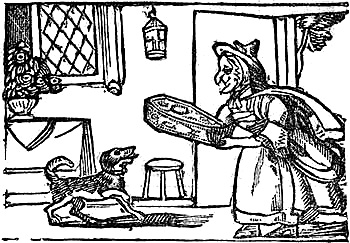
She went to the undertaker’s to buy him a coffin, When she came back, the dog was laughing. Now how this can be quite puzzles my brain, I am much pleased to see you alive once again.
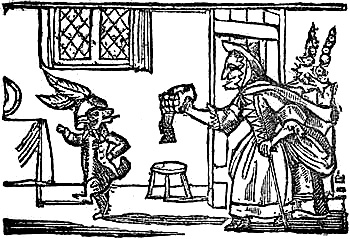
She went to the barber’s to buy him a wig, When she came back he was dancing a jig. O, you dear merry grig, how nicely you’re prancing; Then she held up the wig, and he began dancing.
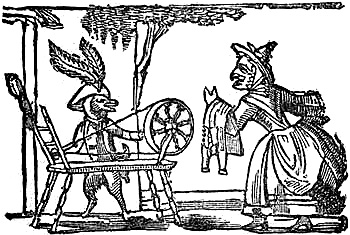
She went to the sempstress to buy him some linen, When she came back the dog was spinning. The reel, when ’twas done, was wove into a shirt, Which served to protect him from weather and dirt.
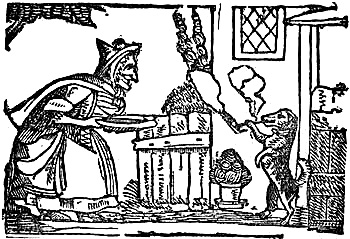
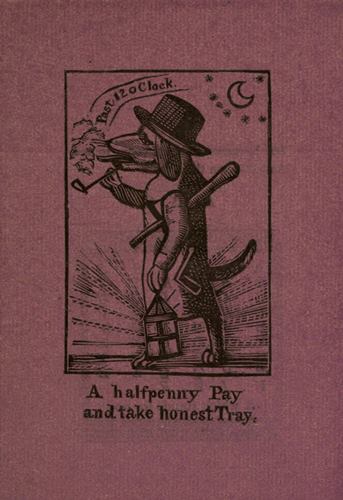
To market she went, to buy him some tripe, When she came back he was smoking his pipe. Why, sure, cried the dame, you’d beat the great Jocko. Who before ever saw a dog smoking tobacco?
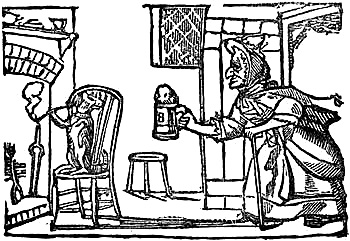
She went to the alehouse to buy him some beer, When she came back he sat on a chair. Drink hearty, said Dame, there’s nothing to pay, ’Twill banish your sorrow and moisten your clay.
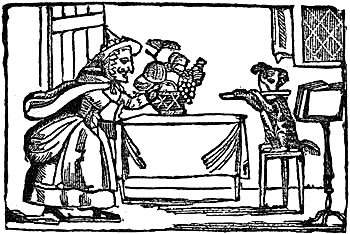
She went to the fruiterer’s to buy him some fruit, When she came back he was playing the flute. Oh, you musical dog, you surely can speak: Come, sing me a song, then he set up a squeak.
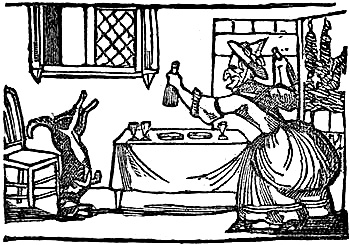
She went to the tavern for white wine and red, When she came back he stood on his head. This is odd, said the dame, for fun you seem bred, One would almost believe you’d wine in your head.
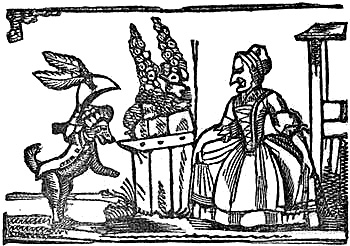
The dog he cut capers, and turned out his toes, ’Twill soon cure the vapours, he such attitude shows. The dame made a curtsey, the dog made a bow, The dame said, Your servant, the dog said Bow wow.
Text of Image
NURSERY RHYMES.

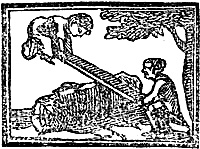
See-saw, sacradown, Which is the way to London town? One foot up, and the other down, And that is the way to London town.
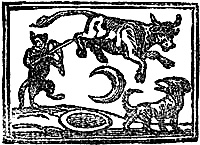
Hey diddle, the cat and the fiddle, The cow jumped over the moon. The little dog laughed to see the sport, And the dish ran away with the spoon.
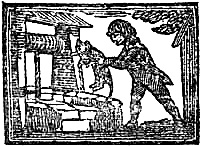
Ding, dong, bell! Pussy’s in the well. Who put her in? Little Johnny Green. Who pulled her out? Little Johnny Snout, What a naughty boy was that, To drown poor pussy cat, Who never did him any harm, And kill’d the mice in his father’s barn.
Jack and Jill went up the hill, To get a pail of water: Jack fell down and broke his crown, And Jill came tumbling after.
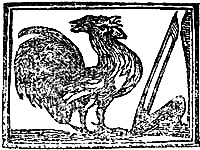
Cock a doodle do, The dame has lost her shoe, And master’s lost his fiddle stick And don’t know what to do.
Simple Simon met a pieman, Going to the fair! Says Simple Simon to the pieman, Let me taste your ware.
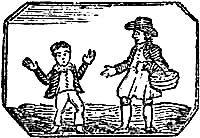
Says the pieman unto Simon First give me a penny; Says Simple Simon to the pieman, I have not got any. Once Simon made a great snow ball And brought it in to roast, He laid it down before the fire, And soon the ball was lost.
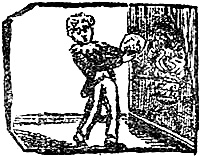
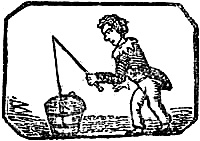
He went to ride a spotted cow, That had a little calf, She threw him down upon the ground And made all the people laugh. Now Simple Simon went a fishing, For to catch a whale, But all the water he had got Was in his mother’s pail.
He went to catch a dickey bird And thought he could not fail Because he had a bit of salt, To put upon his tail. He went to see if cherries ripe, Did grow upon a thistle, He pricked his finger very much, Which made poor Simon whistle.
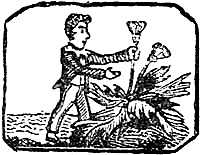
He went to take a bird’s nest, ’Twas built upon a bough, A branch gave way, down Simon fell Into a dirty slough. Simon was sent to market, To buy a joint of meat, He tied it to his horse’s tail, To keep it clean and sweet.
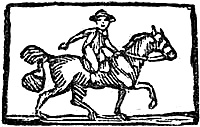
He went to slide upon the ice, Before the ice would bear, Then he plunged in above his knees, Which made poor Simon stare. He went to shoot a wild duck, But the duck flew away, Says Simon I can’t hit him, Because he would not stay.
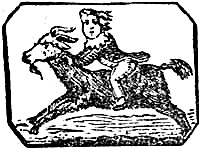
Then Simple Simon went a hunting, For to catch a hare, He rode an ass about the street, But could not find one there. He went for water in a seive, But soon it all run through, And went all o’er his clothes, Which made poor Simon rue.
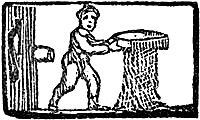
He washed himself with blacking ball, Because he had no soap, And then said to his mother I’m a beauty now I hope. He went to eat some honey, Out of the mustard pot, It bit his tongue until he cried, That was all the good he got.
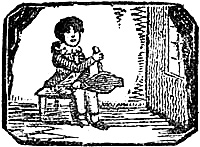
Simple Simon cutting his mother’s bellows open to see where the wind lay.
JACK JINGLE.
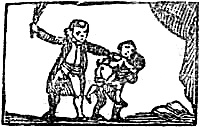
Little Jack Jingle, Played truant at school, They made his bum tingle For being a fool; He promised no more Like a fool he would look But be a good boy and attend to his book.
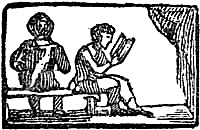
See little Jack Jingle Learning his task, He’s a very good boy, If the neighbours should ask, To school he does run, And no truant does play, But when school is done, He can laugh and be gay.
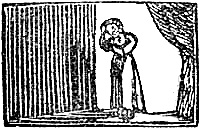
Here sulky Sue, What shall we do. Turn her face to the wall, Till she comes to; If that should fail, A touch with the cane Will do her good, When she feels the pain.
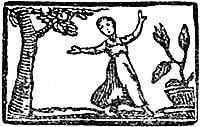
Now Suky never pouts, Never frowns, never flouts, But reads her book with glee, Then dances merrily, No girl so good as she, In all the country; Cheerfully doth all things do, She lost the name of sulky Sue.
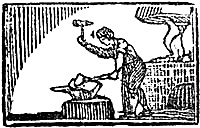
Jack Jingle went ’prentice, To make a horse-shoe, He wasted the iron, Till it would not do, His master came in, And began for to rail; Says Jack, the shoe’s spoil’d, But ’twill still make a nail.
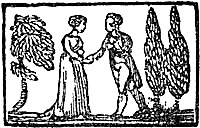
Little Jack Jingle, Went to court Suky Shingle, Says he, shall we mingle Our toes in the bed; Fye! Jacky Jingle, Says little Suke Shingle, We must try to mingle, Our pence for some bread.
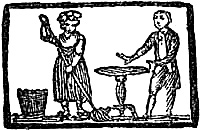
Suke Shingle when young, Did what others have done, She could dirty two clouts, While her mother wash’d one. But now grown a stout wench, With her pail and her mop, If she don’t clean the board, She can make a great slop.
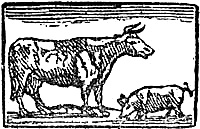
Suky you shall be my wife, And I’ll tell you why; I have got a little pig, And you have got a sty; I have got a dun cow, And you can make good cheese, Suky will you have me? Say yes, if you please.
DEATH & BURIAL OF COCK ROBIN.

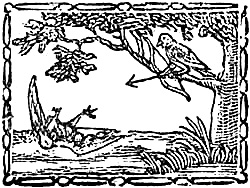
Who kill’d Cock Robin? I said the sparrow, With my bow and arrow. I kill’d Cock Robin. Who caught his blood? I, said the fish, With my little dish— I caught his blood.
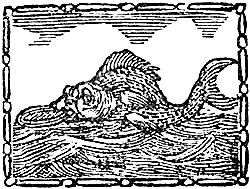
This is the fish That held the dish. Who saw him die? I, said the fly With my little eye— I saw him die.
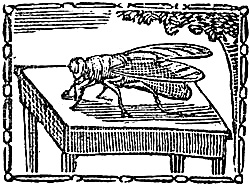
This is the fly That saw him die. Who made his shroud? I, said the beetle, With my little needle— I made his shroud.
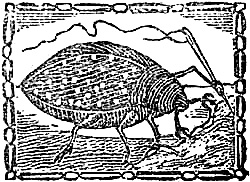
This is the beetle, With his little needle. Who’ll be the Parson? I, said the rook, With my little book— I will be the Parson.
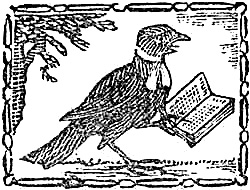
Here is Parson Rook, Reading his book. Who’ll carry the coffin? I, said the Kite, If it’s not in the night— I’ll carry the coffin.
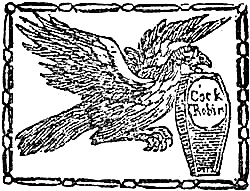
Behold the Kite, How he takes his flight. Who’ll be the clerk? I, said the Lark, If its not in the dark— I will be the clerk.
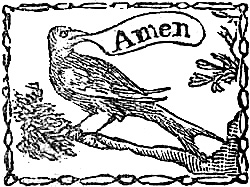
Behold how the Lark, Says Amen like a clerk. Who will carry the link? I, said the linnet: I’ll fetch it in a minute— I will carry the link.
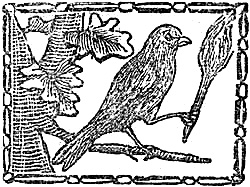
The Linnet with a light, Altho’ it is not night.
LITTLE RED RIDING HOOD.

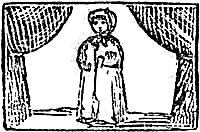
And now her riding hood is on, How pretty she does look; Mamma made it to keep her warm Because she learn’d her book; So be good girls all who hear this And boys be good also, And your Mammas will give you all Great coats and hoods, I know.
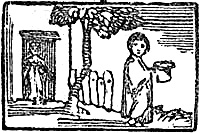
You see this pot of butter nice, And likewise this plum-cake, Which little Biddy’s dear mamma For grandmamma did make: Who lived in a little house, A mile or two away, And Red Riding Hood must take them, To Grandmamma next day
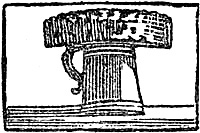
The morning come—the hood put on, The pot and cake she took, Biddy, good bye—good bye, mamma And then her hand she shook: And so set off for grandmamma’s Mamma stood at the door, And watched her little Biddy till She could see her no more.
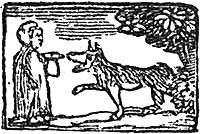
Now in the road to grandma’s house, A lonesome wood there lay, And Goffip Wolf popp’d from a bush, And stopp’d her in the way He was a fierce and cruel beast, And would have eat her there, But turning of his head about, He found he did not dare.
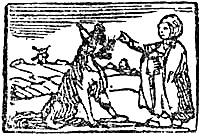
I’m going to my grandmamma’s, She is not very well, With cake and pot of butter; Says Wolf where does she dwell? In yonder house, by yonder mill Good bye—I cannot stay— And with her pretty finger, she Pointed out the way.
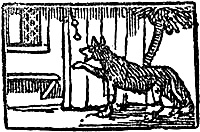
The Wolf got first to grandma’s door, And knocked toc, toc, toc; Who is that, said grandmamma, That at the door doth knock; ’Tis your grandaughter, said the Wolf And mimic’d Biddy’s voice, Mamma has sent you a plumb cake, And pot of butter nice.
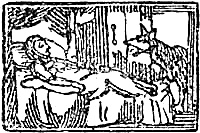
Now grandmamma being very ill, She on the bed did lie, And called out, the bobbin pull, And up the latch will fly; The bobbin pull’d, up flew the latch, The Wolf popp’d in his head And soon he eat up grandmamma And then got into bed.
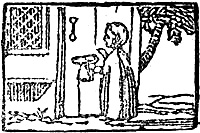
Toc, toc, toc, at grandma’s door Knocked Little Red Riding Hood, Who’s there, says Wolf, and with a voice, Like grandma’s as he could; ’Tis your grandaughter, little Bid With cake and pot of butter; The bobbin pull, the latch will fly, The wicked Wolf did mutter.
CINDERELLA.

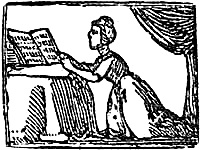
Here Cinderella you may see A beauty bright and fair, Her real name was Helena, Few with her could compare Besides she was so very good, So affable and mild, She learned to pray and read her book, Like a very good child.
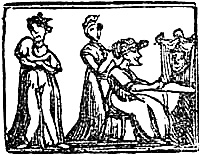
Her mother-in-law you see, One of the worst of hags, Who made her do all drudgery work. And clothed her in rags; And after she had done her work, Her mother-in-law would tell her The cinders she might sit among, Then call’d her Cinderella.
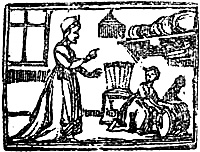
These are her two sisters-in-law, Both deformed & ordinary, Altho’ they dress as fine as queens, Which you may think extraordinary; But neither of them scarce can read, Nor pray to God to bless’em They only know to patch and paint, And gaudily to dress’em,
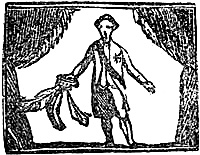
This is the king’s fine gallant son, Young, handsome, straight and tall He invited all the ladies round For to dance at his ball; Which when the ugly sisters heard They dress’d themselves so fine, And off they set, being resolv’d At this grand ball to shine.
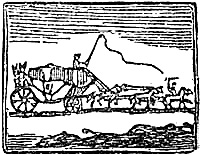
Her god-mother came to lend her aid, And her power is not small To help her god-daughter to go To this fine prince’s ball. This coach was once a pumpkin, By the fairy changed from that, The footmen once were lizards green, The coachman once a rat.
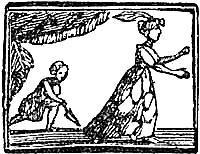
Now having danced with the prince, He led her to her place, While all the ladies at the ball Envied her handsome face; Behold the clock now striking twelve, Out Cinderella run, And happily got out of door Just as the clock had done.
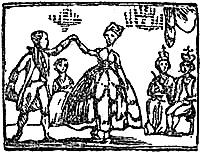
But in her haste to get away, One of her slippers fell, Which the young prince himself pick’d up, And it pleased him so well, That straight he offer’d a reward, It was ten thousand pound, To any person that could tell Where the owner could be found.
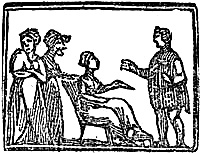
And now the sisters tried in vain The slipper to get on; Said Cinderella, let me try, Dear sisters, when you’ve done; She tried, and on it went with ease To the foot of Cinderella, Said She, I think the slipper’s mine, See here I’ve got the fellow.
THE CHILD’S NEW YEAR’S GIFT.
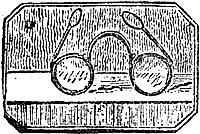
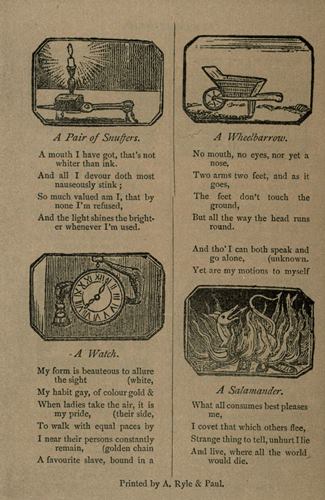
A pair of Spectacles.
Without a bridle or a saddle, Across a thing I ride and straddle. And those I ride by help of me, Tho’ almost blind are made to see.
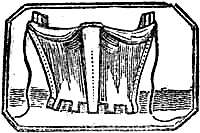
A pair of Stays.
My legs I can venture, To say within bound, Are twelve, if not more, Tho’ they ne’er touch the ground; If you search for my eyes, More than thirty you’ll find And strange to be told They are always behind.
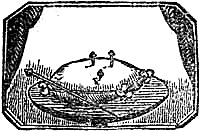
A Pin.
And tho’ I’m a brazen-fac’d sharper at best, No lady without my aid can be drest, When I’m wanted, I’m dragg’d by the head to my duty And am doomed to be slave to the dress of a beauty.

A letter M.
I’m found in most countries, Yet not in earth or sea, I am in all timber, Yet not in any tree, I am in all metals, Yet, as I am told, I am not in iron, lead, Brass, silver, nor gold.
Text of Image
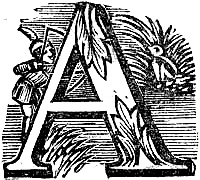
Was an Archer, Who shot at a frog.
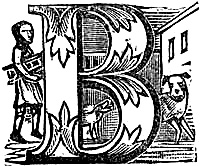
Was a Butcher, And kept a great dog.
Was a Captain, All covered with lace.
Was a Drunkard And had a red face.
Was an Esquire, With insolent brow.
Was a Farmer, And Followed the plough.
Was a Gamester, Who had but ill-luck.

Was a Huntsman, And hunted a buck.
Was an Inn-keeper, Who loved to bouse.
Was a Joiner, And built up a house.
Was King William, Once governed this land.
Was a Lady, who Had a white hand.
Was a Miser, And hoarded up gold.
Was a Nobleman, Gallant and bold.
Was an Oyster-wench, And went about town.
Was a Parson, and Wore a black gown.
Was a Queen, Who was fond of flip.
Was a Robber, And wanted a whip.
Was a Sailor, Who spent all he got.
Was a Tinker, And mended a pot.
Was a Usurer, A miserly elf.
Was a Vinter, who Drank all himself.
Was a Watchman, And guarded the door.

Was Expensive, And so became poor.
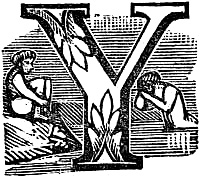
Was a Youth, Who did not love school.
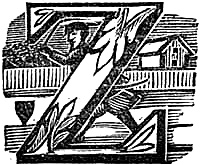
Was a Zany, A silly old fool.
THE ALPHABET.
The Letters promiscuously arranged.
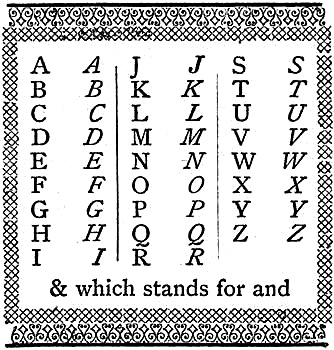
D B C F G E H A X U Y M V W N K P J O Z Q I S L T R z w x o c l y b b f p s m q n v h k r t g e j a u i
Double and Triple Letters.
fi fl ff ffi ffl f i f l f f f f f i f l
Diphthongs, &c.
AE Œ æ œ & &c. Æ OE ae oe and et cætera
Arabic Numerals.
1 2 3 4 5 6 7 8 9 0
Roman Numerals.
I. II. III. IV. V. VI. VII. VIII. IX. X. XI. XII. XIII. XIV.
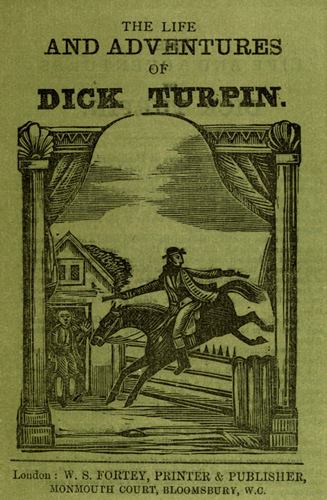
THE LIFE AND ADVENTURES OF DICK TURPIN.

RICHARD TURPIN was born at Hempstead, in Essex, where his father kept the sign of the Bell; and after being the usual time at school, he was bound apprentice to a butcher in Whitechapel, but did not serve out his time, for his master discharged him for impropriety of conduct, which was not in the least diminished by his parents’ indulgence in supplying him with money, which enabled him to cut a figure round the town, among the blades of the road and the turf, whose company he usually kept.
His friends, thinking that marriage would reclaim him, persuaded him to marry, which he did with one Hester Palmer, of East Ham in Essex, but he had not long been married before he became acquainted with a gang of thieves, whose depredations terrified the whole county of Essex, and the neighbourhood of London. He joined sheep stealing to foot-pad robbery; and was at last obliged to fly from his place of residence for stealing a young heifer, which he killed and cut up for sale.
Soon after, he stole two oxen from one Farmer Giles, of Plaistow, and drove them to a Butcher’s slaughtering house, near Waltham Abbey.
He was followed there, but made his escape out of the window of the house where he was, just as they were entering the door.
He now retreated into the Hundreds of Essex, where he found more security: he adopted a new scheme; and that was to rob the smugglers, but he took care not to attack a gang, only solitary travellers, this he did with a colour of justice, for he pretended to have a deputation from the Customs, and demanded their property in the king’s name.
He again joined the gang with whom he had before connected himself, the principal part of those depredations were committed upon Epping Forest, &c.
But this soon becoming an object of magisterial enquiry, he again returned to the solitude of the country, with some more of the gang, and they became notorious deer-stealers, and Turpin being a good shot, sent many a buck up to his connections in London.
DICK TURPIN.3
They next determined to commence house-breakers; and in this they were much encouraged by joining with Gregory’s gang, as it was then called, a company of desparadoes that made the Essex and adjacent roads very dangerous to travel.
Somehow or other, Turpin became acquainted with the circumstances of an old woman, that lived at Laughton, that kept a great quantity of cash by her; whereupon they agreed to rob her; and when they came to the door, Wheeler knocked and Turpin and the rest forcing their way into the house, blindfolded the eyes of the old woman and her maid, and tied the legs of her son to the bedstead, but not finding the wished-for booty, they held a consultation, as they were certain she must have a considerable sum concealed. Turpin told her he knew she had money, and it was in vain to deny it, for have it they would. The old lady persisted that she had none, but Turpin insisting she had money, he swore he would put her on the fire. She continued obstinate and endured for some time, when they took her off the grate, and robbed her of all they could find, upwards of four hundred pounds.
They next proceeded into Surrey, where Turpin and his company robbed Mr. Sheldon’s house, near Croydon Church, where they arrived about seven o’clock in the evening. They secured the coachman in the stable. His master hearing some strange voices in the yard, was proceeding to know the cause, when he was met by Turpin, who seizing hold of him compelled him to show them the way into the house, when he secured the door, and confined the rest of the family in one room, here they found but little plate and no cash. From Mr. Sheldon’s person they took eleven guineas, two of which Turpin returned him, begged pardon for what they had done, and wished him a good night.
These robberies hitherto had been carried on entirely on foot, with only the occasional assistance of a hackney coach but now they aspired to appear on horse-back, for which purpose they hired horses at the Old Leaping Bar in Holborn, from whence they set out about two o’clock in the afternoon, and arrived at the Queen’s Head, Stanmore, where they staid to regale themselves. It was by this means that Wood, the master of the horse, had so good an opportunity of observing the horses, as to remember the same again when he saw them afterwards in Bloomsbury, where they were taken. About five they went from Mr. Wood’s to Stanmore and staid from six until seven and then went together for Mr. Lawrence’s, about a mile from thence, where they got about half-past seven. On their arrival at Mr. Lawrence’s they alighted from their horses at the gate; whereupon Fielder knocked at the door, and calling out Mr. Lawrence. The man servant thinking it to be some of the neighbours, opened the door, upon which they all rushed in with pistols, and seizing Mr.
4DICK TURPIN
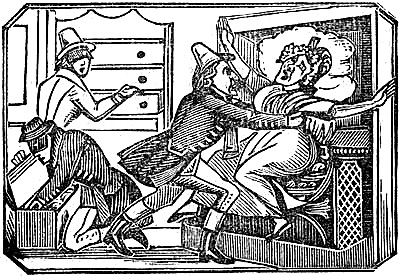
Lawrence and his man, threw a cloth over their faces then fell to rifling their pockets, out of which they took one guinea, and about fifteen shillings in silver, with his keys. They said they must have more, and drove Mr. Lawrence up stairs, where coming to a closet, they broke open the door, and took out from thence two guineas, ten shillings, a silver cup, 13 silver spoons, and two gold rings. They then rifled the house of all they could get, linen, table cloths, shirts, and the sheets off the bed, and trod the beds under feet, to discover if any money was concealed therein. Suspecting there was more money in the house, they then brought Mr. Lawrence down again, and threatened to cut his throat, and Fielder put a knife to it, as though he intended to do it; to make him confess what money was in the house. One of them took a chopping bill, and threatened to cut off his leg: they then broke his head with their pistols, and dragged him about by the hair of his head. Another of them took the kettle off the fire, and flung it upon him; but it did no other harm just wetting him, because the maid had just before taken out the greater part of the boiling water, and filled it again with cold. After this they dragged him about again, swearing they would “do for him” if he did not immediately inform them where the rest of the money was hid. They then proceeded to make a further search; and then withdrew; threatening to return again in half an hour, and kill every one
DICK TURPIN.5
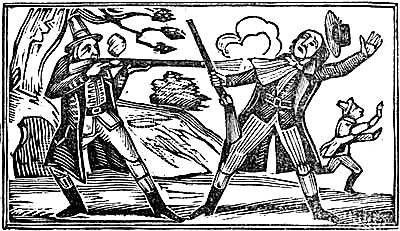
they found loose. So saying they locked them in the parlour and threw the keys down the area.
Turpin by this robbery got but little, for out of the 26l, they took in the whole, he distributed it among them all but three guineas and six shillings and six pence.
A proclamation was issued for the apprehension of the offenders, and a pardon and 50l was offered to any of the party who would impeach his accomplices, which however, had no effect. The white Hart in Drury-lane was their place of rendezvous. Here they planned their nightly visits, and here they divided their spoil, and spent the money they acquired.
The robbery being stated to the officers of Westminster, Turpin set off to Alton, where he met with an odd encounter, which got him the best companion he ever had, as he often declared. King, the highwayman, as he was returning from this place to London, being well dressed and mounted, Turpin seeing him have the appearance of a substantial gentleman, rode up to him, and thinking him a fair mark, bid him stand and deliver, and therewith producing his pistols, King fell a laughing at him, and said “what dog rob dog! Come, come, brother Turpin, if you don’t know me, I know you, and shall be glad of your company.” After a mutual communication of circumstances to each other, they agreed to keep company, and divide good or ill fortune as the trumps might turn up. In fact King was true to him to the last, which was for more than three years.
They met with various fortunes; but being too well known to
6DICK TURPIN.
remain long in one place, and as no house that knew them would receive them in it, they formed the resolution of making themselves a cave, covered with bevins and earth, and for that purpose pitched upon a convenient place, enclosed with a thicket, situated on the Waltham side of Epping, near the sign of the King’s Oak.
In this place Turpin lived, ate, drank, and lay, for the space of six years, during the first three of which he was enlivened by the drollery of his companion, Tom King, who was a fellow of infinite humour in telling stories, and of an unshaken resolution in attack or defence.
One day, as they were spying from their cave, they discovered a gentleman riding by, that King knew very well to be a rich merchant near Gresham College. This gentleman was in his chariot, and wife with him; his name was Bradele. King first attacked him on the Laughton road; but he being a man of great spirit, offered to make resistence, thinking there was but one; upon which King called Turpin, and bid him hold the horses’ heads. They proceeded first to take his money, which he readily parted with, but demurred a good while about his watch, being the dying bequest of his father. King was insisting to take it away, when Turpin interposed, and said, they were more gentlemen than to deprive anyone of their friend’s respect which they wore about them, and bid King desist from his demand.
On the day after this transaction they went to the Red Lion ale house, in Aldersgate street, where they had not been more than half an hour, when Turpin heard of the approach of the chief constable and his party; they mounted each their horse; but before King could get fairly seated he was seized by one of the party, and called on Dick to fire. Turpin replied, “If I do, I shall hit you.” “Fire, if you are my friend.” said King—Turpin fired, but the ill-fated ball took effect in King’s breast. Dick stood a moment in grief, but self-preservation made him urge his mare forward to elude his pursuers; it was now he resolved on a journey to York, and raising himself in his saddle, he said, “By G—, I will do it.” Encouraged by “Harkaway Bess,” she flew on.
Astonishing to relate, he reached York the same evening and was noticed playing at bowls in the bowling-green with several gentlemen there, which circumstance saved him from the hands of justice for a time. His pursuers coming up and seeing Turpin, knew him; and caused him to be taken into custody; one of them swore to him and the horse he rode on, which was the identical one he arrived upon in that city; but on being in the stable, and its rider at play, and all in the space of four-and-twenty hours, his alibi was admitted; for the magistrates of York could not believe it possible for one horse to cover the ground, being upwards of 190 miles, in so short a space.
DICK TURPIN.7
For the last two years of his life he seems to have confined his residence to the county of York, where he appears to be a little known. He often accompanied the neighbouring gentlemen in their parties of hunting and shooting; and one evening, on a return from an expedition of the latter kind, he saw one of his landlord’s cocks in the street, which he shot.
The next day Mr. Hall received a letter from Robert Appleton, Long Sutton, with this account:—that the said John Palmer had lived there about three quarters of a year, and had before that been once apprehended, and made his escape, and that they had a strong suspicion he was guilty of horse-stealing.
Another information gave notice, that he had stolen a horse from Captain Dawson, of Ferraby; his horse was that which Turpin rode on when he came to Beverley, and which he stole from off Hickinton Fen in Lincolnshire.
He wrote to his father upon being convicted, to use his interest to get him off for transportation, but his fate was at hand, his notoriety caused application to be ineffectual.
After he had been in prison five months, he was removed from Beverley to York Castle to take his trial. When on his trial his case seemed much to affect the hearers. He had two trials, upon both of which he was convicted upon the fullest evidence. After a long trial the Jury brought in their Verdict and found him Guilty.
He was carried in a cart to the place of execution, on Saturday, April, 7th, 1739. He behaved himself with amazing assurance and bowed to the spectators as he passed. It was remarkable that as he mounted the ladder, his right leg trembled, on which he stamped it down with an air, and with undaunted courage looked round about him; and after speaking near half an hour to the topman, threw himself off the ladder, and expired in about five minutes.
W. S. Fortey, Printer, Monmouth Court, Bloomsbury.
Text of Image
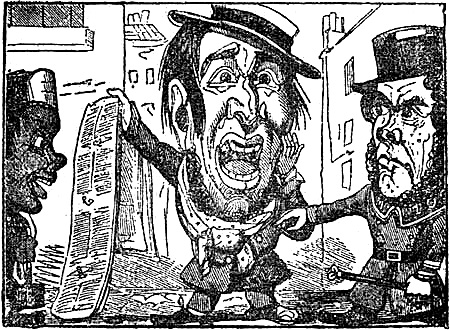
The Long Song-Seller.
Songs and Song Literature.
“Old songs, old songs—what heaps I knew, From ‘Chevy Chase’ to ‘Black-eyed Sue’; From ‘Flow, thou regal, purple stream,’ To ‘Rousseau’s melancholy Dream!’ I loved the pensive ‘Cabin Boy,’ With earnest truth and real joy. To greet ‘Tom Bowling’ and ‘Poor Jack’; And, oh! ‘Will Watch,’ the ‘Smuggler’ bold, My plighted troth thou’lt ever hold.” Eliza Cook.

“Songs! Songs! Songs! Beautiful songs! Love songs! Newest songs! Old songs! Popular songs! Songs, Three Yards a Penny!” was a “standing dish” at the “Catnach Press,” and Catnach was the Leo X. of street publishers. And it is said that he at one time kept a fiddler on the premises, and that he used to sit receiving ballad-writers and singers, and judging of the merits of any production which was brought to him, by having it sung then and there to some popular air played by his own fiddler, and so that the ballad-singer should be enabled to start at once, not only with the new song, but also the tune to which it was adapted. His broad-sheets contain all sorts of songs and ballads, for he had a most catholic taste, and introduced the custom of taking from any writer, living or dead, whatever he fancied, and printing it side by side with the productions of his own clients.
He naturally had a bit of a taste for old ballads, music, and song writing; and in this respect he was far in advance of many of his contemporaries. To bring within the reach of all the standard and popular works of the day, had been the ambition of the elder Catnach; whilst the son was, nolens volens, incessant in his endeavours in trying to promulgate and advance, not the beauty, elegance, and harmony which pervades many of our national airs and ballad poetry, but very often the worst and vilest of each and every description—in other words, those most suitable for street-sale. His stock of songs was very like his customers, diversified. There were all kinds, to suit all classes. Love, sentimental, and comic songs were so interwoven as to form a trio of no ordinary amount of novelty. At ordinary times, when the Awfuls and Sensationals were flat, Jemmy did a large stroke of business in this line.
It is said that when the “Songs—Three-yards-a-penny”—first came out and had all the attractions of novelty, some men sold twelve or fourteen dozen on fine days during three or four of the summer months, so clearing between 6s. and 7s. a day, but on the average about 25s. a week profit. The “long songs,” however, have been quite superseded by the “Monster” and “Giant Penny Song Books.” Still there are a vast number of half-penny ballad-sheets worked off, and in proportion to their size, far more than the “Monsters” or “Giants.”
As a rule there are but two songs printed on the half-penny ballad-sheets—generally a new and popular song with another older ditty, or a comic and sentimental, and “adorned” with two woodcuts. These are selected without any regard as to their fitness to the subject, and in most cases have not the slightest reference to the ballad of which they form the head-piece. For instance:—“The Heart that can feel for another” is illustrated by a gaunt and savage looking lion; “When I was first Breeched,” by an engraving of a Highlander sans culotte; “The Poacher” comes under the cut of a youth with a large watering-pot, tending flowers; “Ben Block” is heralded by the rising sun; “The London Oyster Girl,” by Sir Walter Raleigh; “The Sailor’s Grave,” by the figure of Justice; “Alice Grey” comes under the very dilapidated figure of a sailor, or “Jolly Young Waterman;” “Bright Hours are in store for us yet” is headed with a tail-piece of an urn, on which is inscribed Finis! “The Wild Boar Hunt,” by two wolves chasing a deer; “The Dying Child to its Mother,” by an Angel appearing to an old man; “Autumn Leaves lie strew’d around,” by a ship in full sail; “Cherry Ripe,” by Death’s Head and Cross Bones; “Jack at the Windlass,” falls under a Roadside Inn; while “William Tell” is presented to the British public in form and style of an old woman nursing an infant of squally nature. Here follow a few examples of the style, also that of some of the ballad-sheets: together with various verbatim imprints used by “The Catnach Press,” chronologically arranged from circa 1813 to the present time.
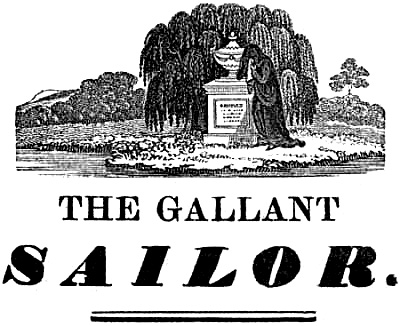
London: Printed by J. Catnach, and sold Wholesale and Retail at No. 60, Wardour Street, Soho Square.
Farewell thou dear and Gallant Sailor, Since thou and I have parted been, Be thou constant and true hearted, And I will be the same to thee.
CHORUS.
May the winds and waves direct thee, To some wishful port design’d, If you love me, don’t deceive me, But let your heart be as true as mine. ***** When oft times my fancy tells me, That in battle thou art slain, With true love I will requite thee, When thou dost return again. May the winds, &c.
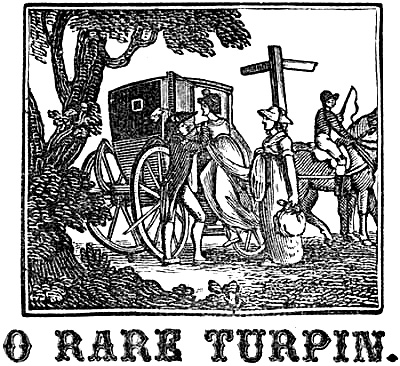
Printed by J. Catnach, 2, Monmouth Court, 7 Dials. Sold by J. Sharman, Cambridge, Bennet, Brighton; & R. Harris, Salisbury.


As I was riding over Hunslow Moor, There I saw a lawyer riding before, And I asked him if he was not afraid, To meet bold Turpin that mischievous blade. CHORUS.—I asked him if he was not afraid, To meet bold Turpin that mischievous blade. Says Turpin to the lawyer and for to be cute, My money I have hid all in my boot, Says the lawyer to Turpin they mine can’t find, For I have hid mine in the cape of my coat behind. I rode till I came to a powder mill, Where Turpin bid the lawyer for to stand still, For the cape of your coat it must come off, For my horse is in want of a new saddle cloth. Now Turpin robbed the lawyer of all his store, When that’s gone he knows where to get more, And the very next town that you go in, Tell them you was robb’d by the bold Turpin.
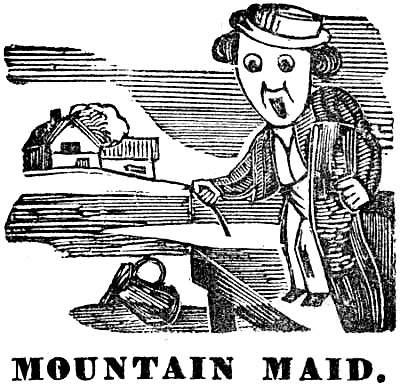
Printed by J. Catnach, 2, Monmouth Court, 7 Dials. Travellers and Shopkeepers supplied with Sheet Hymns. Patters, and Slip Songs as Cheap and Good as any Shop in London.


The Mountain Maid from her bower has hied, And speed to the glassy river’s side, Where the radiant mead shone clear and bright, And the willows wav’d in the silver light. On a mossy bank lay a shepherd swain, He woke his pipe to tuneful strain, And so blythely gay were the notes he play’d, That he charm’d the ear of the Mountain Maid. She step’d with timid fear oppress’d, While soft sighs swell her gentle breast, He caught her glance, and mark’d her sigh, And triumph laugh’d in his sparkling eye. So softly sweet was the tuneful ditty, He charmed her tender heart to pity; And so blithely gay were the notes he play’d, That he gain’d the heart of the Mountain Maid.
————————————— J. Catnach, Printer, 2, Monmouth Court, 7 Dials. Cards, &c. Printed Cheap. ☞ Country Shops and Travellers supplied. ——————————
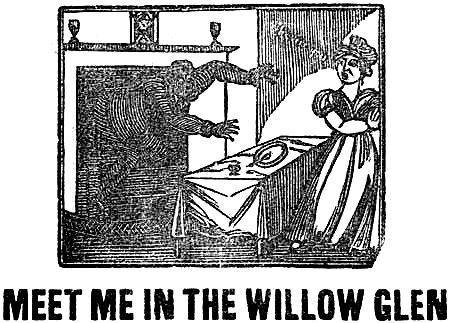
Meet me in the willow glen, Where the silvery moon is beaming, Songs of love I’ll sing thee then, When all the world is dreaming. Meet me in the willow glen. When the silver moon is beaming, Songs of love I’ll sing thee then, If you meet me in the willow glen. No prying eye shall come love. No stranger foot be seen. And the busy village hum, love, Shall echo through the glen. Meet me, &c.
J. Catnach, Printer, 2, Monmouth Court, 7 Dials. Sold by W. Marshall. Sold by T. Pierce, Southborough. (Cards Printed Cheap.)
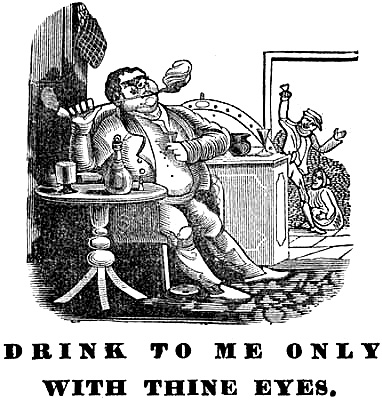
Drink to me only with thine eyes, And I will pledge with mine, Or leave a kiss but in the cup, And I’ll not look for wine; The thirst that from my soul doth rise, Doth ask a drink divine; But might I of Jove’s nectar sip, I would not change for thine.
Printed by J. Catnach, 2, Monmouth Court, 7 Dials. Sold by Pierce, Southborough, Bennet, Brighton; and Sharman, Cambridge.


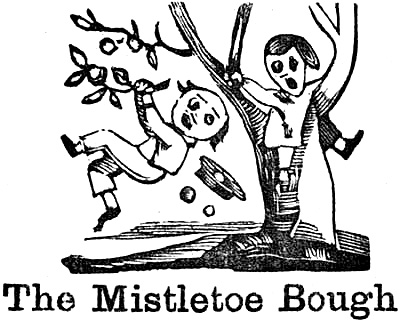
The mistletoe hung in the castle hall, The holly branch shone on the old oak wall, The baron’s retainers were blithe and gay, And keeping their Christmas holiday. The baron beheld with a father’s pride, His beautiful child, young Lovell’s bride: While she with her bright eyes, seemed to be The star of the goodly company. Oh! the mistletoe bough! “I’m weary of dancing now,” she cried! “Here tarry a moment—I’ll hide—I’ll hide, And, Lovell, be sure thou’rt the first to trace The clue to my secret lurking place.” Away she ran—and her friends began Each tower to search, and each nook to scan; And young Lovell cried, “Oh! where dost thou hide? I’m lonesome without thee, my own dear bride.” Oh! the mistletoe bough!
Printed by J. Catnach, 2, Monmouth Court, 7 Dials. Sold by T. Batchelor, 14, Hackney Road Crescent; W. Marshall, Bristol. Sold by Bennet and Boyes, Brighton.
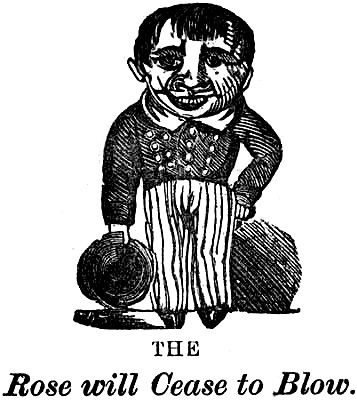
The rose will cease to blow, The eagle turn a dove, The streams will cease to flow, Ere I will cease to love. The sun shall cease to shine, The world shall cease to move, The stars their light resign, Ere I will cease to love.
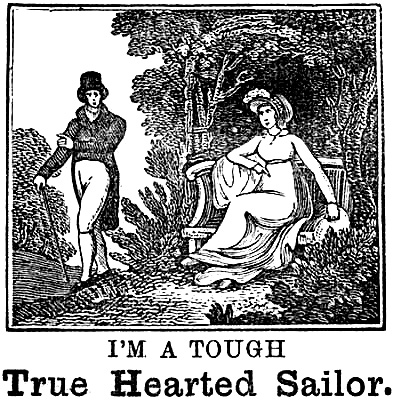
J. Catnach, Printer, 2 & 3, Monmouth Court, 7 Dials, & at 14, Waterloo Road, (late Hill’s). Country Shops, and Travellers supplied.


I’m a tough true-hearted sailor, Careless and all that, d’ye see, Never at the times a railer— What is time or tide to me? All must die when fate must will it, Providence ordains it so; Every bullet has its billet, Man the boat, boys—Yeo, heave, yeo! Life’s at best a sea of trouble, He who fears it is a dunce, Death, to me, an empty bubble, I can never die but once, Blood, if duty bids, I’ll spill it, Yet I have a tear for woe, Every bullet has its billet, &c.
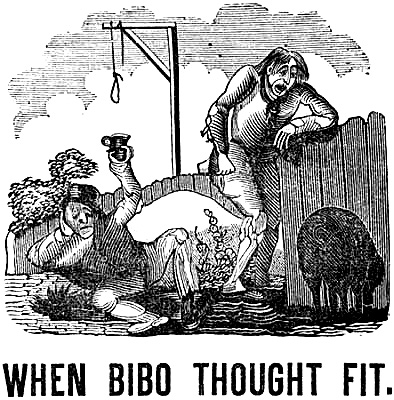
Printed and Sold by J. Catnach, 2 & 3, Monmouth Court, 7 Dials.


When Bibo thought fit from the world to retreat, As full of champagne as an egg’s full of meat; He wak’d in the boat, and to Charon he said, He would be rowed back, for he was not yet dead. ‘Trim the boat, and sit quiet,’ stern Charon replied— ‘You may have forgot—you were drunk when you died!’
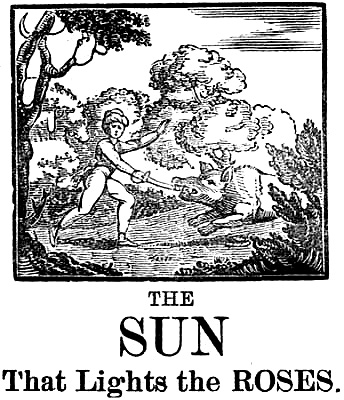
A. Ryle and Co., Printers, 2 & 3, Monmouth Court, Seven Dials, and 35, Hanover Street, Portsea, where upwards of 4000 different sorts of ballads are continually on sale together with 40 new penny song books.
Tho’ dimple cheeks may give delight Where rival beauties blossom; Th’o balmy lips to love invite, To extacy the bosom. Yet sweeter far yon summer sky, Whose blushing tints discloses, Give me the lustre beaming eye, The Sun that lights the Roses.
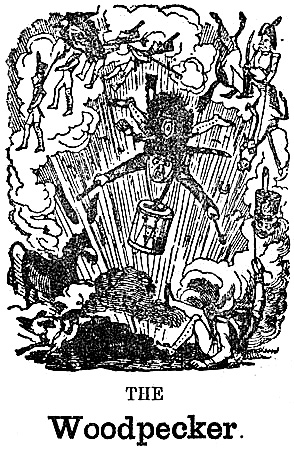
London:—Printed by J. Paul & Co., 2 & 3, Monmouth Court.
I knew by the smoke that so gracefully curl’d Above the green elms, that a cottage was near, And I said if there’s peace to be found it the world, A heart that is humble might hope for it here.
CHORUS.
Every leaf was at rest, and I heard not a sound, But the woodpecker tapping in the hollow beech tree. And here in this lone little wood, I exclaim’d, With a maid who was lovely to soul and to eye, Who would blush when I prais’d her, and weep if I blam’d, How blest could I live, and how calm could I die. Every leaf, &c.
London:—Published by Ryle and Paul, 2 & 3, Monmouth Court, 7 Dials. Where an immense number of songs are always ready.
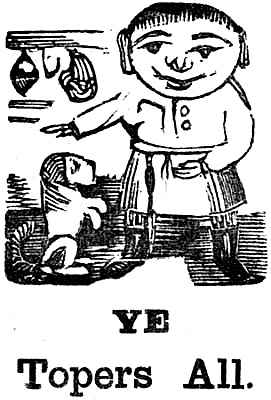
Ye topers all drink to the soul, Of this right honest fellow; Who always loved a flowing bowl, And would in death be mellow. The lamp of life be kindled up, With spirit stout and glowing; His heart inspired thus with a cup, Ascends where nectar’s flowing.
—————————— London:—Ryle & Co., Printers, 2 & 3, Monmouth Court, Bloomsbury. ——————————
RECITATIVE.
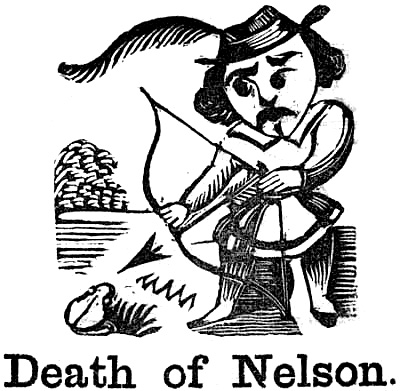
O’er Nelson’s tomb, with silent grief oppress’d Britannia mourns her hero now at rest. But these bright laurels ne’er shall fade with years, Whose leaves are water’d by a Nation’s tears.
AIR.
’Twas in Trafalgar’s bay, We saw the Frenchmen lay, Each heart was bounding then; We scorned the foreign yoke— Our ships were British oak, And hearts of oak our men, Our Nelson mark’d them on the wave, Three cheers our gallant seamen gave, Nor thought of home or beauty; Along the line this signal ran— “England expects that every man This day will do his duty!”
A. Ryle & Co., Printers, 2 & 3, Monmouth Court, Bloomsbury.
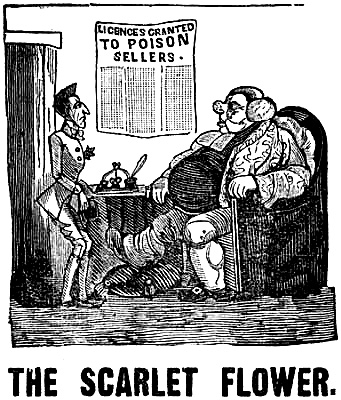
She’s gentle as the zephyr, That sips of every sweet, She fairer than the fairest lily, In nature’s soft retreat; Her eyes are like the crystal brok, As bright and clear to see? Her lips outshine the Scarlet Flow’r Of bonny Ellerslie.
London:—Printed at the “Catnach Press” by W. Fortey, (late A. Ryle) 2 & 3, Monmouth Court. Bloomsbury. (Established 1813.) The Oldest and Cheapest House in the World for Ballads, (4,000 sorts) Song Books, &c.
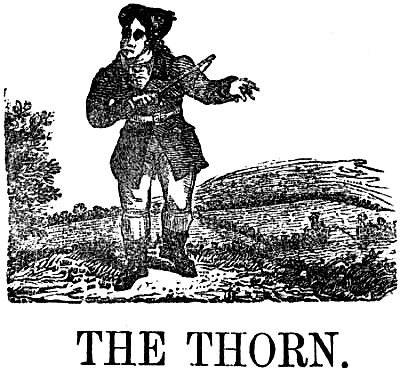
From the white blossomed sloe, My dear Chlœ requested, A sprig her fair breast to adorn; No by heavens I exclaimed, may I perish If ever I plant in that bosom a thorn. When I shewed her the ring and implored her to marry She blushed like the dawning of morn, Yes I’ll consent she replyed if you’ll promise, That no jealous rival shall laugh me to scorn, No by heavens I exclaim’d may I perish, If ever I plant in that bosom a thorn.
Printed at the “Catnach Press” by W. FORTEY, Monmouth Court, Bloomsbury, the Oldest House in the World for Ballads (4,000 sorts) Song Books, &c. &c.
Hark! I hear the drums a beating—no longer can I stay, I hear the trumpets sounding, my love I must away, We are ordered from Portsmouth many a long mile, For to join the British soldiers on the banks of the Nile. Willie, dearest Willie, don’t leave me here to mourn, You’ll make me curse and rue the day that ever I was born, For the parting of my own true love is parting of my life, So stay at home dear Willie, and I will be your wife. I will cut off my yellow locks, and go along with you, I will dress myself in velveteens, and go see Egypt too I will fight or bear your banner, while kind fortune seems to smile, And we’ll comfort one another on the banks of the Nile.
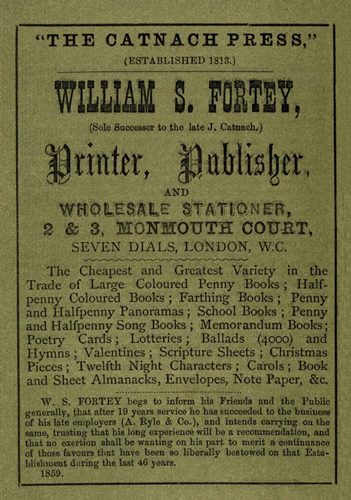
London:—Printed at the “Catnach Press” by W. S. Fortey, 2 & 3, Monmouth Court, Bloomsbury. (Established 1813.) The Oldest and Cheapest House in the World for Ballads, Song Books, Children’s Spelling & Reading Books, Panorama Slips, Almanacks, Valentines, Hymns, Toy Cards, Poetry Cards, Lotteries, Characters, Note Paper, Envelopes, &c. ⁂ Shopkeepers and Hawkers supplied on the lowest terms.
Why fair maid in every feature, Are such signs of fear expressed, Can a wandering wretched creature, With such horror fill thy breast. Do my frenzied looks alarm thee, Trust me, sweet, thy fears are vain, Not for Kingdom would I harm thee, Shun not then poor crazy Jane. Fondly my young heart believed him, Which was doomed to love but one; He sighed, he vowed, and I believed him, He was false, and I’m undone. From that hour has reason never, Had her empire o’er my brain, Henry fled, with him for ever Fled the wits of Crazy Jane.
“It was Christmas morning—dear Christmas morning When bright angels and men kept watch for its dawning— And merrily Christmas bells were out ringing, And blithely the children their carols were singing— ’Twas a hundred years agone—or more.”
From time immemorial the ballad singer, with his rough and ready broad-sheet, has travelled over the whole surface of the country in all seasons and weathers, yet there was one time of the year, however, when he went out of his every-day path and touched on deeper matters than accidents, politics, prize fights, sporting matches, murders, battles, royalty, famous men and women. Christmas time brought, both to him and his audience, its witness of the unity of the great family of heaven and earth, its story of the life and death of Him in whom that unity stands. Several examples, of Christmas carols and Scripture-sheets, bearing Catnach’s imprint lie before us, thanks to the kindness of Mr. W. S. Fortey, Catnach’s successor; these broadsides bear several distinctive marks which show that it was an object of more than ordinary care to publishers and ballad singers. In the first place, these Christmas sheets are double the size of the ordinary broad-sheet—measuring 30 inches by 20—and contain four or five carols—generally one long narrative ballad, and three or four short pieces. Each of them having two or three large woodcuts and several of smaller sizes, and having the following distinctive titles—The Trial of Christ. Faith, Hope, and Charity. Our Saviour’s Love. The Tree of Life. The Crucifixion. The Saviour of Mankind. The Messiah. The Harp of Israel. The Saviour’s Garland. Divine Mirth. And The Life of Joseph, to which is appended:—
LONDON: PRINTED AND SOLD BY J. CATNACH, 2, MONMOUTH COURT, 7, DIALS, WHERE MAY BE HAD THE FOLLOWING SHEETS, WITH CUTS.
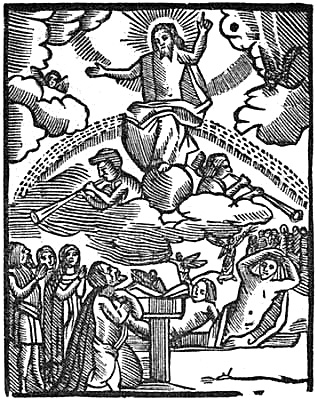
The Last Day, Our Saviour’s Letter, The Son of Righteousness, Travels of the Children of Israel, Glory of Solomon, The Morning Star, The Noble Army of Martyrs, Christmas Gambols, The Hertfordshire Tragedy, and a Variety of Others are in a state of forwardness for the Press.
“Looking at these Christmas broad-sheets,” says the writer of an article on street-ballads, in the “National Review,” for October, 1861, “it would really seem as if the poorest of our brethren claimed their right to higher nourishment than common for their minds and souls, as well as for their bodies, at the time of year when all Christendom should rejoice. And this first impression is confirmed when we examine their contents. In all those which we have seen, the only piece familiar to us is that noble old carol ‘While shepherds watched their flocks by night,’ where the rest come from, we cannot even conjecture; but in the whole of them there is not one which we should wish were not there. We have been unable to detect in them even a coarse expression; and of the hateful narrowness and intolerance, the namby-pamby, the meaningless cant, the undue familiarity with holy things, which makes us turn with a shudder from so many modern collections of hymns, there is simply nothing.
“Account for it how we will, there is the simple fact. Perhaps it may lead us to think somewhat differently of those whom we are in the habit of setting down in the mass as little better than heathens. We cannot conclude this article better than by giving an extract or two from these Christmas broad-sheets.”
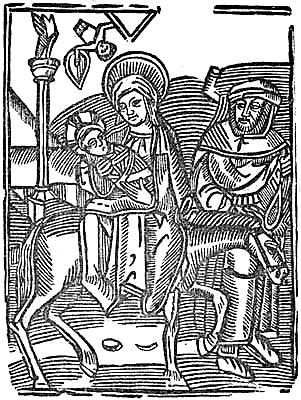

“The Saviour’s Garland, a choice Collection of the most esteemed Carols,” has the usual long narrative ballad, which begins:
“Come, all you faithful Christians That dwell upon the earth,— Come celebrate the morning Of our dear Saviour’s birth: This is the happy morning,— This is the happy morn Whereon, to save our ruined race, The Son of God was born.”
And after telling simply the well-known story, it ends:
“Now to him up ascended, Then let your praises be, That we His steps may follow, And He our pattern be; That when our lives are ended We may hear His blessed call: ‘Come, Souls, receive the Kingdom Prepared for you all.’”
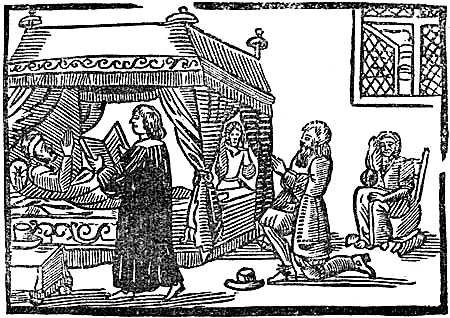
Another, “The Star of Bethlehem, a collection of esteemed Carols for the present year,” opens its narrative thus:
“Let all that are to mirth inclined Consider well and bear in mind What our good God for us has done, In sending His beloved Son. Let all our songs and praises be Unto His heavenly Majesty; And evermore amongst our mirth Remember Christ our Saviour’s birth. The twenty-fifth day of December We have great reason to remember; In Bethlehem, upon that morn, There was a blessed Saviour born,” &c.
One of the short pieces, by no means the best, we give whole:
“With one consent let all the earth The praise of God proclaim, Who sent the Saviour, by whose birth To man salvation came. All nations join and magnify The great and wondrous love Of Him who left for us the sky, And all the joys above. But vainly thus in hymns of praise We bear a joyful part, If while our voices loud we raise, We lift not up our heart. We, by a holy life alone, Our Saviour’s laws fulfil; By those His glory is best shown Who best perform His will. May we to all His words attend With humble, pious care; Then shall our praise to heaven ascend, And find acceptance there.”
We do not suppose that the contents of these Christmas broad-sheets are supplied by the same persons who write the murder-ballads, or the attacks on crinoline. They may be borrowed from well known hymn books for anything we know. But if they are borrowed, we must still think it much to the credit of the selectors, that, where they might have found so much that is objectionable and offensive, they should have chosen as they have done. We only hope that their successors, whoever they may be who will become the caterers for their audiences, will set nothing worse before them.
Christmas broad-sheets formed an important item in the office of the “Catnach Press,” as the sale was enormous, and Catnach always looked forward for a large return of capital, and a “good clearance” immediately following the spurt for Guy Fawkes’ speeches, in October of each year. But although the sale was very large, it only occupies one “short month.” This enabled them to make Carols a stock job, so that when trade in the Ballad, Sensational, “Gallows,” or any other line of business was dull, they used to fill up every spare hour in the working off or colouring them, so as to be ready to meet the extraordinary demand which was sure to be made at the fall of the year.
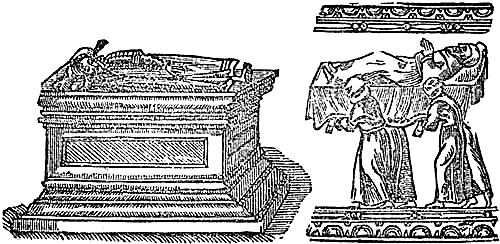
Like most of the old English customs, Christmas-carol singing is fast dying out. Old peripatetic stationers well remember the rich harvest they once obtained at Christmas times by carol selling. Now there are very few who care to invest more than a shilling or two at a time on the venture; whereas in times long past, all available capital was readily embarked in the highly-coloured and plain sheets of the birth of our Saviour, with the carol of “Christians awake,” or “The Seven Good Joys of Mary:”—
“The first good joy our Mary had, It was the joy of one, To see her own Son, Jesus, To suck at her breast-bone. To suck at her breast-bone, God-man, And blessed may He be Both Father, Son, and Holy Ghost, To all eternity.”
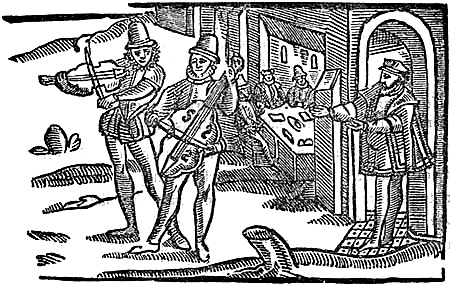
Now, whether carol singing has degenerated with carol poetry, and consequently the sale of Christmas carols diminished is a question we need not enter upon; but when we turn to the fine old carols of our forefathers, we cannot help regretting that many of these are buried in the records of the long past.
Here are a couple of verses of one, said to be the first carol or drinking-song composed in England. The original is in Anglo-Norman French:—
“Lordlings, from a distant home, To seek old Christmas are we come, Who loves our minstrelsy— And here unless report mis-say, The greybeard dwells; and on this day Keeps yearly wassail, ever gay With festive mirth and glee. **** Lordlings, it is our host’s command, And Christmas joins him hand in hand, To drain the brimming bowl; And I’ll be foremost to obey, Then pledge we, sirs, and drink away, For Christmas revels here to day, And sways without control. Now wassail to you all! and merry may you be, And foul that wight befall, who drinks not health to me.”
One can well imagine the hearty feeling which would greet a party of minstrels carolling out such a song as the above in Christmas days of yore; and then contrast the picture with a troupe from St. Giles’s or Whitechapel bawling out “God Rest you Merry Gentlemen!” The very thought of the contrast sends a shudder through the whole human system; and no wonder the first were received with welcome feasting, and the latter driven “with more kicks than half-pence” from the doors.
In an old book of “Christmasse Carolles newely emprinted at London, in the fletestrete at the sygne of the Sonne by Wynkyn de Worde. The yere of our Lorde, m.d.xxi. Quarto.” Is a carol on “Bryngyng in the Bore’s Head”:—
“The bore’s head in hand bring I, With garlandes gay and rosemary, I pray you all synge merely, Qui estis in convivio. The bore’s head, I understande Is the chiefe servyce in this lande, Loke wherever it be fande, Servite cum Contico. Be gladde, lordes, both more and lasse, For this hath ordayned our stewarde, To chere you all this Christmasse The bore’s head with mustarde.”
With certain alterations, this carol is still, or at least was very recently, retained at Queen’s College, Oxford, and sung to a cathedral chant of the psalms.
It would occupy too much space to search into the origin of Christmas carols. They are doubtless coeval with the original celebrations of Christmas, first as a strictly Romish sacred ceremony, and afterwards as one of joyous festivity.
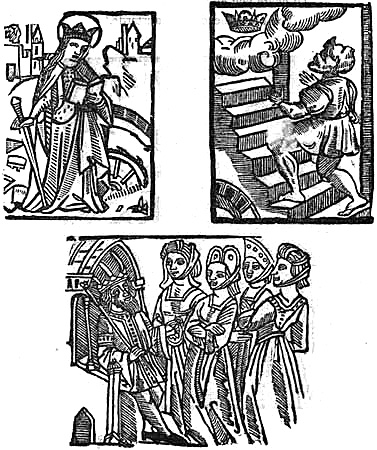
This “Moral-Sheet” entitled “THE STAGES OF LIFE: or, The various Ages and Degrees of Human Life explained by these Twelve different Stages, from our Birth to our Graves,” had a great sale.
INFANCY
To 10 Years old.
“His vain delusive thoughts are fill’d With vain delusive joys— The empty bubble of a dream, Which waking change to toys.”
From 10 to 20 Years old.
“His heart is now puff’d up, He scorns the tutor’s hand; He hates to meet the least control And glories to command.”
From 20 to 30 Years old.
“There’s naught here that can withstand The rage of his desire, His wanton flames are now blown up, His mind is all on fire.”
From 30 to 40 Years old.
“Look forward and repent Of all thy errors past, That so thereby thou may’st attain True happiness at last.”
From 40 to 50 Years old.
“At fifty years he is Like the declining sun, For now his better half of life, Man seemeth to have run.”
From 50 to 60 Years old.
“His wasted taper now Begins to lose its light, His sparkling flames doth plainly show ’Tis growing towards night.”
From 60 to 70 Years old.
“Perplex’d with slavish fear And unavailing woe, He travels on life’s rugged way With locks as white as snow.”
From 70 to 80 Years old.
“Infirmity is great, At this advanced age, And ceaseless grief and weakness leagued, Now vent their bitter rage.”
From 80 to 90 Years old.
“Life’s ‘Vital Spark’—the soul, Is hovering on the verge Of an eternal world above, And waiting to emerge.”
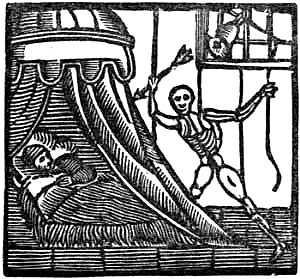
From 90 to 100 Years old.
“The sun is sinking fast Behind the clouds of earth, Oh may it shine with brighter beams, Where light receiv’d her birth.”
Catnach was now at the height of his fame as a printer of ballads, Christmas-pieces, carols, lotteries, execution papers, dying speeches, catchpennies, primers and battledores, and his stock of type and woodcuts had very considerably increased to meet his business demands. And it may be said that he was the very Napoleon of buyers at sales by auction of “printers’ stock.” On one occasion, when lot after lot was being knocked down to him, one of the “Littlejohn crew” of “knock-out-men” of the period, observed to the auctioneer, “Why, sir, Mr. Catnach is buying up all the lots.” “Yes,” replied the auctioneer, “And what’s more, Mr. Catnach will pay for them and clear away all his lots in the morning;” then adding somewhat pointedly, “which is a thing I can’t say of all parties who attend my sales.”
But although we are informed, vivâ voce of a contemporary, that Jemmy Catnach was so large a buyer at sales by auction of “printers’ stock,” we may, with some degree of safety, come to the conclusion that he could have only bought such lots that would be considered by other master printers as worthless, and that it was the apparent cheapness that would be the incentive for his buying up all the worn-out and battered letter, for Jemmy was a man who hated “innowations” as he used to call improvements, and he, therefore, had a great horror in laying out his money in new and improved manufactured type, because, as he observed, he kept so many standing forms, and when certain sorts ran short he was not particular, and would tell the boys to use anything which would make a good shift. For instance, he never considered a compositor could be aground for a lowercase “l” while he had a figure “1” or a cap “I” to fall back upon; by the same rule, the cap. “O” and figure “0” were synonymous with “Jemmy;” the lowercase “p,” “b,” “d,” and “q,” would all do duty for each other in turn, and if they could not always find Roman letters to finish a word with, why the compositor knew very well that the “reader” would not mark out Italic, nor wrong founts.
From a small beginner in the world, Catnach was soon able to see his way clear to amass a fortune. He had now established his reputation as a man of enterprise, and he was very sensitive to maintain a sort of shabby-genteel appearance. It was amusing, especially when over his glass, to hear him describe the effect the “awfuls” had on the public. The proprietor of any of our leading journals could not have felt prouder than did Catnach, as he saw drafted from his press the many thousands of varied productions.
We will now briefly allude to the wood-blocks which Catnach had in his possession, and which served for the purpose of illustrating during the time that he had been in business. He had a large collection, such as they were; but as works of art they had little or no pretension, being, upon the whole, of the oddest and most ludicrous character. Those that were intended for the small books were very quaint—as we have shown by the fac-similed specimens we have given—whilst the larger portion, which were chiefly intended for the “awfuls,” were grotesque and hideous in their design and execution. No more ghastly sight could be imagined than one of Jemmy’s embellishments of an execution. It would appear that for the last discharge of the law he had a large collection of blocks which would suit any number of victims who were about to undergo the dread penalty. It mattered little how many Jack Ketch was going to operate upon, wood-blocks to the exact number were always adopted, in this particular the great “Dying Speech Merchant” would seem to have thought that his honour and reputation were at stake, for he had his network so formed as to be able to secure every information of news that was passing between the friends of the culprits and the prerogative of the Crown. But we are informed that upon one occasion he was nearly entrapped. Three victims were upon the eve of being executed, and in those days—and in later times—it was not an uncommon thing to see the confession and dying speech printed one or two days previous to the event. This we are told by those in the trade was almost necessary, in order that the sheets might be ready for the provinces almost as soon as the sentence of the law had been carried out. It so happened that on the night previous to an execution, one of the culprits was reprieved. It was solely by a piece of good luck that Catnach heard of it. Several sheets had been struck off; and Jemmy was often chaffed about hanging three men instead of two; but our informant assures us that the error was corrected before any of the impressions were dispatched from the office. Had they gone before the public in their original state, the locus standi of the great publisher in Monmouth Court would have been greatly imperilled. To those who are fond of the fine arts, in usum vulgi, Catnach’s embellishments will afford a fund of amusement. Amongst the lot were several well known places, the scenes of horrible and awful crimes, engravings of debauchery and ill-fame, together with an endless number of different kinds, suitable at the shortest possible notice, to illustrate every conceivable and inconceivable subject.
The Seven Dials in general, and “The Catnach Press” in particular, had no dread of copyright law—the principal Librarian of the British Museum, Stationers’, or any other Hall in those days—and as wood engravings were not to be had then so quickly or cheaply as now-a-days, Jemmy used at times to be his own engraver, and while the compositors were setting up the types, he would carve out the illustration on the back of an old pewter music plate, and by nailing it on to a piece of wood make it into an improvised stereo-plate off-hand, for he was very handy at this sort of work, at which also his sister, with his instruction, could assist; so they soon managed to rough out a figure or two, and when things were dull and slack they generally got one or two subjects ready in stock, such as a highwayman with crape over his face, shooting a traveller, who is falling from his horse near a wide-spreading old elm tree, through which the moon was to be seen peeping; not forgetting to put the highwayman in top boots and making him a regular dandy. This was something after the plan of the artists of the cheap illustrated papers of the present day, who generally anticipate events sometime beforehand to be ready with their blocks. As a proof of this, the editor of the “London, Provincial, and Colonial Press News,” says “I happened to call one day on an artist for the ‘Illustrated Press,’ and found him busily engaged in sketching a funeral procession with some twenty coffins borne on the shoulders of men who were winding their way through an immense crowd. Upon inquiry, I was told that it was intended for the next week’s issue, and was to represent the funeral of the victims of the late dreadful colliery explosion, for although the inquest was only then sitting, and all the bodies had not yet been found, there was sure to be a funeral of that kind when it was all over, and as they did not know how many bodies were to be buried at one time, it was very cleverly arranged to commence the procession from the corner of the block, and so leave it to the imagination as to how many more coffins were coming in the rear; something after the plan of a small country theatre, when representing Richard the Third, and in the battle scene, after the first two or three of the army had made their appearance, to cry ‘halt!’ very loudly to all those behind who were not seen, and leave the spectators to guess how many hundreds their were to come.”
For the illustrating of catchpennies, broadsides, and street-literature in general, particular kinds of wood-cuts were required. In most cases one block was called upon to perform many parts; and the majority of metropolitan printers, who went in for this work, had only a very limited number of them. Very often the same cuts were repeated over and over again, and made to change sides as one another, and that simply to make a little variation from a ballad or broadside that had been printed at the same office on the day, week, or month previous. It mattered little what the subject was, it required some adornment, in the shape of illustration, to give effect to it. The catchpennies, especially those connected with the awful, were in general very rough productions. A lover strangling his sweetheart with a long piece of rope. A heartless woman murdering an innocent man. Vice punished and virtue rewarded, and similar subjects, were always handled in such a manner as to create a degree of excitement, sympathy, and alarm. The broadsides, generally adorned with some rough outline of the royal arms of England, a crowned king or queen, as the subject might be, received their full share of consideration at the hands of the artist. Scions of royal blood, and those connected with the court, were often painted in colours glaring and attractive, whilst the matter set forth in the letterpress was not always the most flattering or encouraging.
CATCH-PENNY:—Any temporary contrivance to obtain money from the public; penny shows, or cheap exhibitions. Also descriptions of murders, fires, and terrible accidents, &c., which have never taken place.
Hotton’s: Slang Dictionary.

An Account OF THE DREADFUL APPARITION
That appeared last night to Henry —— in this street, of Mary ——, the shopkeeper’s daughter round the corner, in a shroud, all covered in white.
The castle clock struck one—the night was dark, drear, and tempestuous.—Henry sat in an antique chamber of it, over a wood fire, which in the stupor of contemplation, he had suffered to decrease into a few lifeless embers; on the table by him lay the portrait of Mary—the features of which were not very perfectly disclosed by a taper, that just glimmered in the socket. He took up the portrait, however, and gazing intensely upon it, till the taper, suddenly burning brighter, discovered to him a phenomenon he was not less terrified than surprised at.—The eyes of the portrait moved;—the features from an angelic smile, changed to a look of solemn sadness; a tear stole down each cheek, and the bosom palpitated as with sighing.
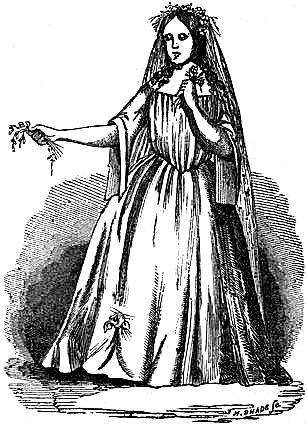
Again the clock struck one!—it had struck the same hour but ten minutes before.—Henry heard the castle gate grate on its hinges—it slammed too—the clock struck one again—and a deadly groan echoed through the castle. Henry was not subject to superstitious fears—neither was he a coward;—yet a hero of romance might have been justified in a case like this, should he have betrayed fear.—Henry’s heart sunk within him—his knees smote together, and upon the chamber door being opened, and his name uttered in a hollow voice, he dropped the portrait to the floor; and sat, as if rivetted to the chair, without daring to lift up his eyes. At length, however, as silence again prevailed, he ventured for a moment to raise his eyes, when—my blood freezes as I relate it—before him stood the figure of Mary in a shroud—her beamless eyes fixed upon him with a vacant stare; and her bared bosom exposing a most deadly gash. “Henry!—Henry!!—Henry!!!” she repeated in a hollow tone—“Henry! I come for thee! thou hast often said that death with me was preferable to life without me; come then, and enjoy with me all the ecstacies of love these ghastly features, added to the contemplation of a charnel-house, can inspire;” then grasping his hand with her icy fingers, he swooned; and instantly found himself—stretched on the hearth of his master’s kitchen; a romance in his hand, and the house dog by his side, whose cold nose touching his hand, had awaked him.
———
FRIENDS
It is with feelings of the deepest regret that we are at present compelled, for the support of our friends and families, to offer this simple, but true tale to your notice, trusting, at the same time, that you will be pleased to purchase this paper, it being the only means at present to support the tender thread of our existence, and keep us and our families from utter starvation which at present surrounds us.
Price One Penny. Printed for Author and Vendor.
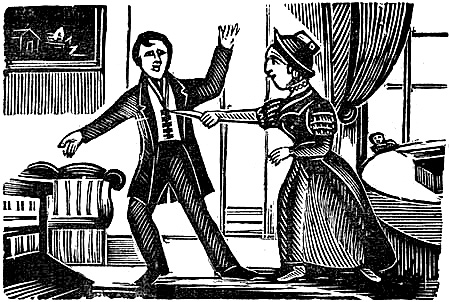
Murder of Captain Lawson.
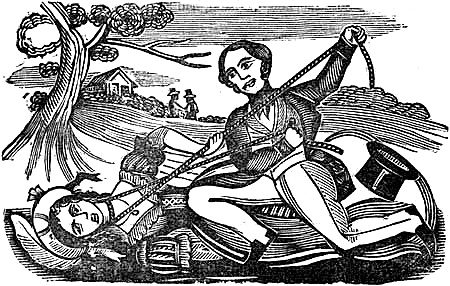
Cruel and Inhuman Murder, Last Night.
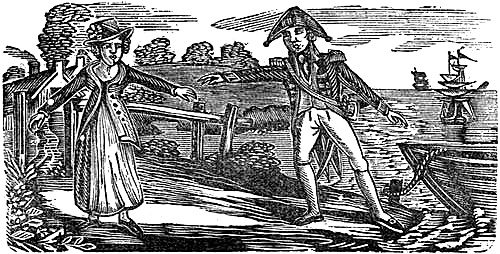
THE SCARBOROUGH TRAGEDY.

Giving an Account how Susan Forster, a Farmer’s Daughter, near Scarborough, was seduced by Mr. Robert Sanders, a Naval Officer, under promise of Marriage.—How she became Pregnant, and the wicked hardened and cruel Wretch appointed her to meet him at a well-known, retired spot, which she unhappily did, and was basely Murdered by him, and buried under a Tree—and of the wonderful manner in which this base Murder was brought to light, and he committed to Gaol.
Young virgins fair of beauty bright, And you that are of Cupid’s fold, Unto my tragedy give ear, For it’s as true as e’er was told. In Yorkshire, liv’d a virgin fair, A farmer’s only daughter dear, And a young sea-captain did her ensnare, Whose station was her father near. Susannah was this maiden’s name, The flower of all that country, This officer a courting came, Begging that she his love would be. Her youthful heart to love inclin’d Young Cupid bent his golden bow, And left his fatal dart behind, Which prov’d Susannah’s overthrow. Ofttimes at evening she would repair, Close to the borders of the sea, Her treach’rous love would meet her there, The time it passed most pleasantly. And while they walked the sea-banks over, To mark the flowing of the tide, He said he’d be her constant lover, And vow’d that she should be his bride. *****
He did confess—they dug the ground while hundreds came to view, And here the murder’d corpse they found, of her who lov’d so true; In irons now in Prison strong lamenting he does lie; And, by the laws condemn’d ere long, most justly he will die.

J. CATNACH, Printer, 2, Monmouth-court, 7 Dials.
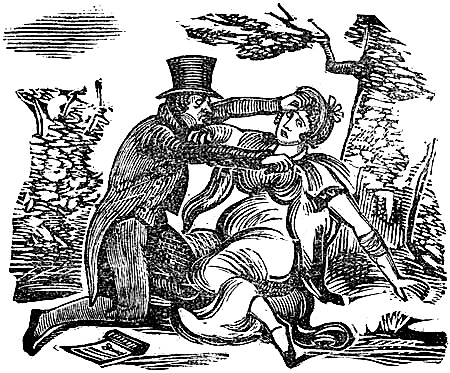
HORRID MURDER, Committed by a Young Man on a Young Woman.
George Caddell became acquainted with Miss Price and a degree of intimacy subsisted between them, and Miss Price, degraded as she was by the unfortunate step she had taken, still thought herself an equal match for one of Mr. Caddell’s rank of life. As pregnancy was shortly the result of their intimacy, she repeatedly urged him to marry her, but he resisted her importunities for a considerable time. At length she heard of his paying addresses to Miss Dean, and threatened in case of his non-compliance, to put an end to all his prospects with that young lady, by discovering everything that had passed between them. Hereupon he formed a horrid resolution of murdering her, for he could neither bear the thought of forfeiting the esteem of a woman whom he loved, nor of marrying one who had been as condescending to another as to himself. So he called on Miss Price on a Saturday and requested her to walk with him in the fields on the following day, in order to arrange a plan for their intended marriage. Miss Price met him at the time appointed, on the road leading to Burton, at a house known by the name of the “Nag’s Head.” Having accompanied her supposed lover into the fields, and walked about till towards evening, they sat down under a hedge, where after a little conversation, Caddell suddenly pulled out a knife and cut her throat, and made his escape, but not before he had waited till she was dead. In the distraction of his mind he left behind him the knife with which he perpetrated the deed, and his Case of Instruments. On the following morning, Miss Price being found murdered in the field, great numbers went to take a view of her body, among whom was the woman of the house where she lodged, who recollected that she said she was going to walk with Mr. Caddell, on which the instruments were examined and sworn to have belonged to him. He was accordingly taken into custody.
J. CATNACH, Printer, Monmouth Court.
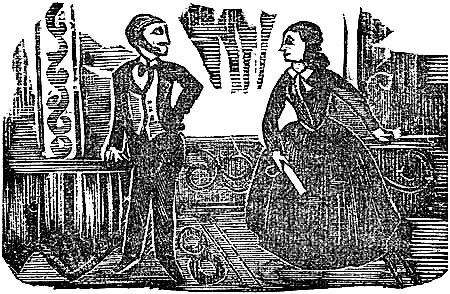
The Secrets Revealed, or the Fashionable Life of Lord & Lady ******.
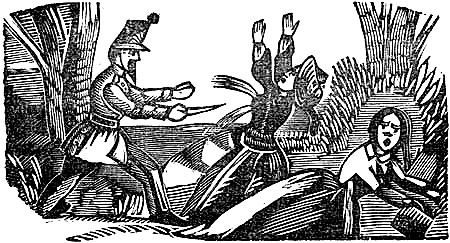
Dreadful Murder by a Soldier, Yesterday Morning.
The LIVERPOOL TRAGEDY.
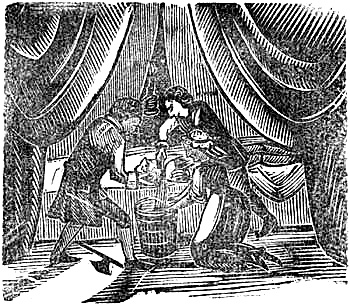
Showing how a Father and Mother barbarously Murdered their own Son.
A few days ago a sea-faring man, who had just returned to England after an absence of thirty years in the East Indies, called at a lodging-house, in Liverpool, for sailors, and asked for supper and a bed; the landlord and landlady were elderly people, and apparently poor. The young man entered into conversation with them, invited them to partake of his cheer, asked them many questions about themselves and their family, and particularly of a son who had gone to sea when a boy, and whom they had long given over as dead. At night the landlady shewed him to his room, and when she was leaving him he put a large purse of gold into her hand, and desired her to take care of it till the morning, pressed her affectionately by the hand, and bade her good night. She returned to her husband and shewed the accursed gold: for its sake they mutually agreed to murder the traveller in his sleep.
In the dead of the night, when all was still, the old couple silently creeped into the bed room of their sleeping guest, all was quiet: the landlady approached the bedside, and then cut his throat, severed his head from his body; the old man, upwards of seventy years of age, holding the candle. They put a washing-tub under the bed to catch his blood, and then ransacking the boxes of the murdered man they found more gold, and many handsome and costly articles, the produce of the East Indies, together, with what proved afterwards, to be a marriage certificate.
In the morning early, came a handsome and elegantly dressed lady, and asked, in a joyous tone, for the traveller who arrived the night before. The old people seemed greatly confused, but said he had risen early and gone away. “Impossible!” said the lady, and bid them go to his bed-room and seek him, adding, “you will be sure to know him as he has a mole on his left arm in the shape of a strawberry. Besides, ’tis your long lost son who has just returned from the East Indies, and I am his wife, and the daughter of a rich planter long settled and very wealthy. Your son has come to make you both happy in the evening of your days, and he resolved to lodge with you one night as a stranger, that he might see you unknown, and judge of your conduct to wayfaring mariners.”
The old couple went up stairs to examine the corpse, and they found the strawberry mark on its arm, and they then knew that they had murdered their own son, they were seized with horror, and each taking a loaded pistol blew out each other’s brains.
Printed by J. Catnach.—Sold by Marshall, Bristol.
Just Published.—A Variety of Children’s Books, Battledores, Lotteries, and a quantity of Popular Songs set to Music. Cards, &c., Printed cheap.
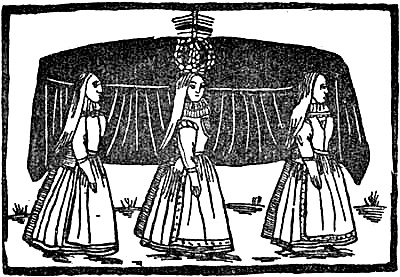
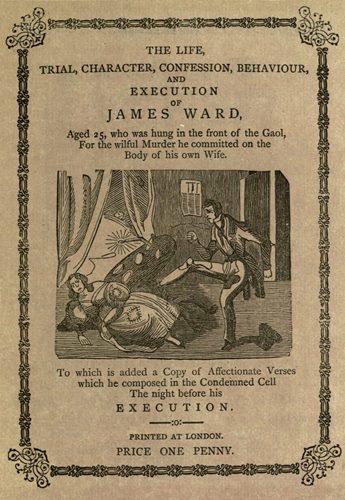
Text of Image
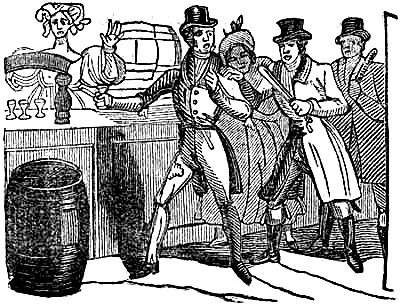
The Arrest of the Prisoner.