THE HISTORY OF THE CATNACH PRESS (continued 2)
Reading edition
After his death, and just at the time when his widow and daughters were sunk in the greatest poverty, his son James, who in after years became so noted in street literature publications, made his way to the metropolis. It appears that this extraordinary man at one time contemplated devoting his life to rural pursuits; in fact, when a youth he served for some time as a shepherd boy, quite contrary to the wish and desire of his parents. Every opportunity he could get he would run away, far across the moors and over the Northumbrian mountains, and, always accompanied with his favourite dog Venus, and a common-place book, in which he jotted down in rhymes and chymes his notions of a pastoral life.[5] Thus he would stay away from home for days and nights together.
This project, however, was abandoned, and he commenced to serve as a printer in the employment of his father. It is rather remarkable that he and Mr. Mark Smith
were both bound on the same day as apprentices to Mr. John Catnach, and that they afterwards worked together as “improvers” in their trade with:—
Joseph Graham, Printer, Alnwick.
Mr. Hugo, in the Supplement to his “Bewick Collector,” pp. 256 (5137), says:—“This very beautiful Cut was done by Thomas Bewick, sometime about the year 1794, for a well-known Alnwick printer.”

“Death made no conquest of this man, For now he lives in fame, though not in life.”
At the time James—or, as he afterwards was popularly called “Jemmy,” or, “Old Jemmy” Catnach commenced business in Seven Dials it took all the prudence and tact which he could command to maintain his position, as at that time “Johnny” Pitts,[6] of the Toy and Marble Warehouse, No. 6, Great St. Andrew street, was the acknowledged and established printer of street literature for the “Dials” district; therefore, as may be easily imagined, a powerful rivalry and vindictive jealousy soon arose between these “two of a trade”—most especially on the part of “Old Mother” Pitts, who is described as being a coarse and vulgar-minded personage, and as having originally followed the trade of a bumboat woman at Portsmouth: she “wowed wengeance” against the young fellow in the court for daring to set up in their business, and also spoke of him as a young “Catsnatch,” “Catblock,” “Cut-throat,” and many other opprobrious terms which were freely given to the new comer. Pitts’ staff of “bards” were duly cautioned of the consequences which would inevitably follow should they dare to write a line for Catnach—the new cove up the court. The injunction was for a time obeyed, but the “Seven Bards of the Seven Dials” soon found it not only convenient, but also more profitable to sell copies of their effusions to both sides at the same time, and by keeping their own counsel they avoided detection, as each printer accused the other of obtaining an early sold copy, and then reprinting it with the utmost speed, which was in reality often the case, as “Both Houses” had emissaries on the constant look-out for any new production suitable for street-sale. Now, although this style of “double dealing” and competition tended much to lessen the cost price to the “middle-man” or vendor, the public in this case did not get any of the reduction, as a penny broadside was still a penny, and a quarter-sheet still a halfpenny to them, the “street-patterer” obtaining the whole of the reduction as extra profit.
The feud existing between these rival publishers, who have been somewhat aptly designated as the Colburn and Bentley of the “paper” trade, never abated, but, on the contrary, increased in acrimony of temper, until at last not being content to vilify each other by “Words! words!! words!!!” alone, they resorted to printing off virulent lampoons, in which Catnach never failed to let the world know that “Old Mother Pitts” had been formerly a bumboat woman, while the Pitt’s party announced that:—
“All the boys and girls around, Who go out prigging rags and phials, Know Jemmy Catsnatch!!! well, Who lives in a back slum in the Dials. He hangs out in Monmouth Court, And wears a pair of blue-black breeches, Where all the “Polly Cox’s crew” do resort To chop their swag for badly printed Dying Speeches.”
But however, in spite of all the opposition and trade rivalry, Catnach persevered; he worked hard, and lived hard, and was fitted to the stirring times. The Peninsular wars had just concluded, politics and party strife ran high, squibs, lampoons, and political ballads were the order of the day, and he made money. But he had weighty pecuniary family matters to bear up with, as thus early in his career, his father’s sister also joined them, and they all lived and huddled together in the shop and parlour of No. 2, Monmouth-court. He did a small and very humble trade as a jobbing master, printing and publishing penny histories, street-papers, and halfpenny songs, relying for their composition on one or two out of the known “Seven Bards of the Seven Dials,” and when they were on the drink, or otherwise not inclined to work, being driven to write and invent them himself.
The customers who frequented his place of business were for the most part of the lowest grades of society:—those who by folly, intemperance, and crime, had been reduced to the greatest penury. Anyone with a few coppers in his pockets could easily knock out an existence, especially when anything sensational was in the wind.
The great excitement throughout the country caused by the melancholy death of the Princess Charlotte, on the sixth day of November, 1817, was an event of no ordinary description. It was, indeed, a most unexpected blow, the shining virtues, as well as the youth and beauty of the deceased, excited an amount of affectionate commiseration, such as probably had never before attended the death of any royal personage in England.
The Seven Dials Press was busily engaged in working off “papers” descriptive of every fact that could be gleaned from the newspapers, and that was suitable for street sale. Catnach was not behind his compeers, as he published several statements in respect to the Princess’s death, and made the following lines out of his own head! And had, continued our informant—a professional street-ballad writer—“wood enough left for as many more”:—
“She is gone! sweet Charlotte’s gone! Gone to the silent bourne; She is gone, She’s gone, for evermore,— She never can return. She is gone with her joy—her darling Boy, The son of Leopold, blythe and keen; She Died the sixth of November, Eighteen hundred and seventeen.”
The year 1818, proved a disastrous one to Catnach, as in addition to the extra burden entailed on him in family matters, he had, in the way of his trade, printed a street-paper reflecting on the private character and on the materials used in the manufacture of the sausages as sold by the pork butchers of the Drury-lane quarter in general, and particularly by Mr. Pizzey, a tradesman carrying on business in Blackmore-street, Clare-market, who caused him to be summoned to the Bow-street Police Court to answer the charge of malicious libel, when he was committed to take his trial at the next Clerkenwell Sessions, by Sir Richard Burnie, where he was sentenced to six months’ imprisonment in the House of Correction, at Clerkenwell, in the County of Middlesex.

During Catnach’s incarceration his mother and sisters, aided by one of the Seven Dials bards, carried on the business, writing and printing off all the squibs and street ballads that were required. In the meanwhile the Johnny Pitts’ crew printed several lampoons on “Jemmy Catnach.” Subjoined is a portion of one of them that has reached us, vivâ voce, of the aforesaid—John Morgan—professional street-ballad writer:—
“Jemmy Catnach printed a quarter sheet— It was called in lanes and passages, That Pizzy the butcher, had dead bodies chopped, And made them into sausages. “Poor Pizzey was in an awful mess, And looked the colour of cinders— A crowd assembled from far and near, And they smashed in all his windows. “Now Jemmy Catnach’s gone to prison, And what’s he gone to prison for? For printing a libel against Mr. Pizzey, Which was sung from door to door. “Six months in quod old Jemmy’s got, Because he a shocking tale had started, About Mr. Pizzey who dealt in sausages In Blackmore-street, Clare-market.”
Misfortunes are said never to come singly, and so it proved to the Catnach family, for while Jemmy was doing his six months in the House of Correction at Clerkenwell, we find in the pages of the Weekly Dispatch for January 3, 1819, and under Police Intelligence, as follows:—
Circulating False News.—At Bow-street, on Wednesday, Thomas Love and Thomas Howlett, were brought to the office by one of the patrole, charged with making a disturbance in Chelsea, in the morning, by blowing of horns, with a tremendous noise, and each of them after blowing his horn, was heard to announce with all the vociferation the strength of his lungs would admit of:—“The full, true, and particular account of the most cruel and barbarous murder of Mr. Ellis, of Sloane-street, which took place, last night, in the Five Fields, Chelsea.” The patrole, knowing that no such horrid event had taken place, had them taken up. The papers in their possession, which they had been selling at a halfpenny each, were seized and brought to the office with the prisoners. But what is most extraordinary, the contents of the papers had no reference whatever to Mr. Ellis! They were headed in large letters, “A Horrid Murder,” and the murder was stated to have been committed at South-green, near Dartford, on the bodies of Thomas Lane, his wife, three children, and his mother. The murderer’s conduct was stated very particularly, although, in fact, no such event occurred. The magistrate severely censured the conduct of the whole parties. He ordered the prisoners to be detained, and considered them to be very proper subjects to be made an example of. On Thursday these parties were again brought before the magistrate, together with Mrs. Catnach [the mother] the printer of the bills, which gave a fictitious statement of the horrid murder said to be committed at Dartford. She was severely reprimanded. The two hornblowers were also reprimanded and then discharged.
The busy year of 1820 was a very important one to Catnach, in fact the turning point in his life. The Duke of Kent, fourth son of George III., and father to Queen Victoria, died on the 23rd of January—the event was of sufficient consequence to produce several “Full Particulars,” for street sale. Just six days after his death, viz., on the 29th of January, 1820, George III. died, and that event set the “Catnach Press” going night and day to supply the street papers, containing “Latest particulars,” &c.
“Mourn, Britons mourn! Your sons deplore, Our Royal Sovereign is now no more,”
was the commencement of a ballad written, printed, and published by J. Catnach, 2, Monmouth-court, 7 Dials. Battledores, Lotteries, and Primers sold cheap. Sold by Marshall, Bristol, and Hook, Brighton.
The royal body was committed to the family vault in St. George’s Chapel at Windsor, on the 16th of February, amidst a concourse of the great and the noble of the land. The usual ceremony of proclamation and salutation announced the accession of George IV. and another important era commenced.
Immediately following these events came the Cato-street conspiracy. On the 24th of February the newspapers contained the startling intelligence that, on the previous evening, a party of eleven men, headed by Arthur Thistlewood, who was already known as a political agitator, had been apprehended at a stable in Cato-street, an obscure place in the locality of Grosvenor-square, on the charge of being the parties to a conspiracy to assassinate the greater part of the King’s Ministers. The truth of the intelligence was soon confirmed by the proceedings which took place before the magisterial authorities; and in due course all the parties were put on their trial at the Old Bailey, on a charge of high treason, Arthur Thistlewood, the leader, being the first tried on the 17th of April; the Lord Chief Justice Abbott presiding. The names of the other prisoners were—William Davidson, a man of colour; James Ings, John Thomas Brunt, Richard Tidd, James William Wilson, John Harrison, Richard Bradburn, James Shaw Strange, and Charles Cooper, of whom the first four, together with Thistlewood, were executed as traitors on May 1st.
The Cato-street conspiracy proved a rich harvest to all concerned in the production of street literature. Catnach came in for a fair share of the work, and he found himself with plenty of cash in hand, and in good time to increase his trade-plant to meet the great demand for the street-papers that were in a few months to be published daily, and in reference to the ever-memorable trial of Queen Caroline; then it was that his business so enormously increased as at times to require three or four presses going night and day to keep pace with the great demand for papers, which contained a very much abridged account of the previous day’s evidence, and taken without the least acknowledgment from an early procured copy of one of the daily newspapers.
Great as was the demand, the printers of street literature were equal to the occasion, and all were actively engaged in getting out “papers,” squibs, lists of various trade deputations to the Queen’s levées, lampoons and songs, that were almost hourly published, on the subject of the Queen’s trial. The following is a selection from one which emanated from the “Catnach Press,” and was supplied to us by John Morgan, the Seven Dials bard, and who added that he had the good luck—the times being prosperous—to screw out half-a-crown from Old Jemmy for the writing of it. “Ah! sir,” he continued, “it was always a hard matter to get much out of Jemmy Catnach, I can tell you, sir. He was, at most times, a hard-fisted one, and no mistake about it. Yet, sir, somehow or another, he warn’t such a bad sort, just where he took. A little bit rough and ready, like, you know, sir. But yet still a ‘nipper.’ That’s just about the size of Jemmy Catnach, sir. I wish I could recollect more of the song, but you’ve got the marrow of it, sir:—
‘And when the Queen arrived in town, The people called her good, sirs; She had a Brougham by her side, A Denman, and a Wood, sirs. ‘The people all protected her, They ran from far and near, sirs, Till they reached the house of Squire Byng, Which was in St. James’s-square, sirs. ‘And there my blooming Caroline, About her made a fuss, man, And told how she had been deceived By a cruel, barbarous, husband.’”
Street papers continued to be printed and sold in connection with Queen Caroline’s trial up to the date of her death, in the month of August, 1821.
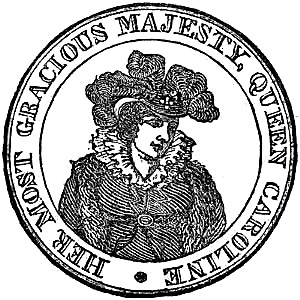
A Copy of Verses in Praise of Queen Caroline.
“Ye Britons all, both great and small, Come listen to my ditty, Your noble Queen, fair Caroline, Does well deserve your pity. Like harmless lamb that sucks its dam, Amongst the flowery thyme, Or turtle dove that’s given to love: And that’s her only crime. Wedlock I ween, to her has been A life of grief and woe; Thirteen years past she’s had no rest, As Britons surely know. To blast her fame, men without shame, Have done all they could do; ’Gainst her to swear they did prepare A motley, perjured crew. Europe they seek for Turk or Greek, To swear her life away, But she will triumph yet o’er all, And innocence display. Ye powers above, who virtue love, Protect her from despair, And soon her free from calumny, Is every true man’s prayer.”
J. Catnach, Printer, 2, Monmouth Court, 7 Dials.

Immediately following the Queen’s death, there were published a whole host of monodies, elegies, and ballads in her praise. Catnach made a great hit with one entitled—“Oh! Britons Remember your Queen’s Happy Days,” together with a large broadside, entitled “An Attempt to Exhibit the Leading Events in the Queen’s Life, in Cuts and Verse. Adorned with Twelve splendid Illustrations. Interspersed with Verses of Descriptive Poetry. Entered at Stationers’ Hall. By Jas. Catnach, Printer, 7 Dials. Price 2d.” A copy is preserved in the British Museum. Press Mark. Tab. 597, a, 1-67, and arranged under Catnach, from which we select two pieces as a fair sample of Jemmy’s “poetry-making!”—Which please to read carefully, and “Mind Your Stops!” quoth John Berkshire.
An Elegy on the Death of the Queen.
Curs’d be the hour when on the British shore, She set her foot—whose loss we now deplore; For, from that hour she pass’d a life of woe, And underwent what few could undergo: And lest she should a tranquil hour know, Against her peace was struck a deadly blow; A separation hardly to be borne,— Her only daughter from her arms was torn! And next discarded—driven from her home, An unprotected Wanderer to roam! Oh, how each heart with indignation fills, When memory glances o’er the train of ills, Which through her travels followed everywhere In quick succession till this fatal year! Here let us stop—for mem’ry serves too well, To bear the woes which Caroline befel, Each art was tried—at last to crush her down, The Queen of England was refus’d a crown! Too much to bear—Thus robb’d of all her state She fell a victim to their hate! “They have destroy’d me,”—with her parting breath, She died—and calmly yielded unto death. Forgiving all, she parted with this life, A Queen, and no Queen—wife, and not a wife! To Heaven her soul is borne on Seraph’s wings, To wait the Judgment of the KING of Kings; Trusting to find a better world than this, And meet her Daughter in the realms of bliss.
CAROLINE
THE INJURED
QUEEN
OF ENGLAND.
Beneath this cold marble the “Wanderer” lies, Here shall she rest ’till “the Heavens be no more,” ’Till the trumpet shall sound, and the Dead shall arise, Then the perjurer unmask’d will his sentence deplore. Ah! what will avail then? Pomp, Titles, and Birth, Those empty distinctions all levell’d will be, For the King shall be judg’d with the poor of the earth, And perhaps, the poor man will be greater than he. Until that day we leave Caroline’s wrongs, Meantime, may “Repentance” her foes overtake; O grant it, kind POWER, to whom alone it belongs. AMEN. Here an end of this Hist’ry we make. Quod. JAS. C-T-N-H, Dec. 10th, 1821.

In the early part of the year 1821, the British public were informed through the then existing usual advertising mediums that there was about to be published, in monthly parts, “Pierce Egan’s Life in London; or, the Day and Night Scenes of Jerry Hawthorn, Esq., and his elegant friend Corinthian Tom, accompanied by Bob Logic, the Oxonian, in their Rambles and Sprees through the Metropolis. Embellished with Scenes from Real Life, designed and etched by I. R. and G. Cruikshank, and enriched with numerous original designs on wood by the same Artists.”
And on the 15th of July, the first number, price one shilling, was published by Messrs. Sherwood, Neely, and Jones, of Paternoster Row. This sample, or first instalment, of the entire work was quite enough for society to judge by. It took both town and country by storm. It was found to be the exact thing in literature that the readers of those days wanted. Edition after edition was called for—and supplied, as fast as the illustrations could be got away from the small army of women and children who were colouring them. With the appearance of numbers two and three, the demand increased, and a revolution in our literature, in our drama, and even in our nomenclature began to develope itself. All the announcements from Paternoster Row were of books, great and small, depicting life in London; dramatists at once turned their attention to the same subject, and tailors, bootmakers, and hatters, recommended nothing but Corinthian shapes, and Tom and Jerry patterns.[7]
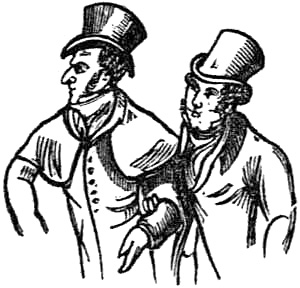
Tom and Jerry.
“Of Life in London, Tom, Jerry and Logic I sing.” To the Strand then I toddled—the mob was great— My watch I found gone—pockets undone: I fretted at first, and rail’d against fate, For I paid well to see “Life in London.”
As may be readily conceived; the stage soon claimed “Tom and Jerry.” The first drama founded upon the work was from the pen of Mr. Barrymore, and produced—“in hot haste,” at the Royal Amphitheatre, on Monday, Sept. 17, 1821. The second dramatic version was written for the Olympic Theatre, by Charles Dibden, and first played on Monday, Nov. 12, 1821.
Mr. Moncrieff appeared as the third on the list of dramatists, and it was announced at the Adelphi Theatre in the following style:—“On Monday, Nov. 26th, 1821, will be presented for the first time, on a scale of unprecedented extent (having been many weeks in preparation under the superintendence of several of the most celebrated Artists, both in the Ups and Downs of Life, who have all kindly come forward to assist the Proprietors in their endeavours to render the Piece a complete out-and-outer), an entirely new Classic, Comic, Operatic, Didactic, Aristophanic, Localic, Analytic, Panoramic, Camera-Obscura-ic Extravaganza-Burletta of Fun, Frolic, Fashion and Flash, in three acts, called ‘Tom and Jerry; or Life in London.’ Replete with Prime Chaunts, Rum Glees, and Kiddy Catches, founded on Pierce Egan’s well-known and highly popular work of the same name, by a celebrated extravagant erratic Author. The music selected and modified by him from the most eminent composers, ancient and modern, and every Air furnished with an attendant train of Graces. The costumes and scenery superintended by Mr. I. R. Cruikshank, from the Drawings by himself and his brother, Mr. George Cruikshank, the celebrated Artists of the original Work.
“Corinthian Tom, Mr. Wrench; Jerry Hawthorn, Mr. John Reeve; Logic, Mr. Wilkinson; Jemmy Green, Mr. Keeley; Dusty Bob, Mr. Walbourn; African Sal, Mr. Sanders; Billy Waters, Mr. Paulo; Kate, Mrs. Baker; Sue, Mrs. Waylett, &c., &c.
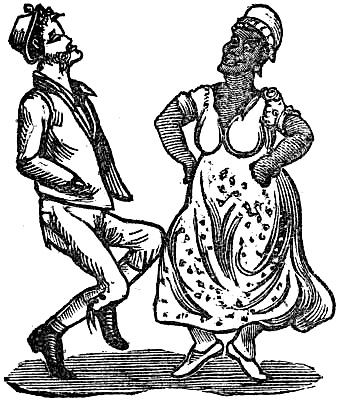
Black Sal and Dusty Bob.
Besides the authors already mentioned, Tom Dibden, Farrell, and Douglas Jerrold, each produced dramas upon the popular theme, and during the seasons of 1821-2, “Life in London” was performed with éclat, at ten theatres in and around the metropolis, to overflowing houses. But Pierce Egan at length became tired of the successes of the playwrights in using his book, and resolved to try his own hand at a dramatic version—or, as he termed it, to “take a leaf out of his own book,”—and the Author’s Piece was “got up” and performed for the first time at Sadler’s Wells, under the management of Mr. Egerton, on Monday, April 8, 1822, with most decided success.
It was thus announced by Mrs. Egerton, in the address written for the occasion by T. Greenwood, Esq.:—
“To-night my friends, this modern taste to meet, We show you Jerry at his country seat: Then up to town transport the rustic beau, And show him ‘Life in London,’ HIGH and LOW.”
At length Tom and Jerry had been repeated so often in the Metropolis, that the performers, notwithstanding the great applause they nightly received in the above piece, absolutely became tired and worn-out with the repetition of their characters, when the following piece of satire, written by T. Greenwood, Esq., was published, entitled, “The Tears of Pierce Egan, Esq., for the Death of ‘Life in London;’ or, the Funeral of Tom and Jerry, dedicated to Robert and George Cruikshank, Esqs. Price Two Shillings, with an engraving by George Cruikshank.”
“Beat out of the Pit and thrown over the Ropes, Tom and Jerry resign’d their last breath, With them, too, expired the Managers’ hopes, Who are left to deplore their sad death! “Odd and various reports of the cause are about, But the real one was this, I opine: They were run to a standstill, and, therefore, no doubt, That the cause was a rapid decline. “When Death showed his Nob, out of Time they were beat, And neither would come to the scratch; They hung down their heads and gave up the last heat, Not prepared with the Spectre to match. “All wept at the Funeral! the Fancy and all— Some new, but a great many mended: And Egan, while Cruikshank and Bob held the pall, As Chief-Mourner in person attended!!! “Their Sprees and their Rambles no more shall amuse, Farewell to all nocturnal parleys: The Town felt regret as the bell tolled the news, And no one rejoiced—but the Charleys! “A monument, too, their kind Patrons will raise, Inscribed on—‘Here lies TOM and JERRY, Who, departing the stage to their immortal praise, ONE THOUSAND NIGHTS made the Town Merry!!!’ “May their souls rest in peace, since they’ve chosen to flit, Like other great heroes departed; May no mischief arise from the sudden exit, Nor Pierce Egan die—broken-hearted!”
In reference to the above, Pierce Egan states in “The Finish to the Adventures of Tom, Jerry, and Logic,” that Catnach, in less than twelve hours after the publication, produced a pirated edition for street sale, for twopence.
Mr. Pierce Egan, in his “Finish,” states that he reckoned no less than sixty-five separate publications, which he enumerates in extenso, all derived from his own work, and adds, with his usual amount of large and small Capitals and italics—“We have been pirated, COPIED, traduced; but unfortunately, not ENRICHED by our indefatigable exertions; therefore NOTORIETY must satisfy us, instead of the smiles of FORTUNE.”
Jemmy Catnach, true to his line of life, soon joined what Pierce Egan designates as the “Mob of Literary Pirates,” and brought out a “whole sheet” for street-sale, entitled “Life in London,” with twelve woodcuts, which are reduced and very roughly executed copies of the centre figures of the original plates by the Brothers Cruikshank—but all in reverse. The letter-press matter consists of a poetical epitome of the plot and design of the original work of “Life in London.” And taking it as it stands, and from whence it emanated, rather a creditable performance, particularly when we take into consideration—as duly announced by the street-patterer, that it was “Just printed and pub—lish—ed, all for the low charge of twopence.”
On the rarity of this Catnachian and pirated edition of “Life in London” it is superfluous to enlarge, and it is easy to account for this circumstance, if we reflect that the broadside form of publication is by no means calculated for preservation; hundreds of similar pieces printed for street-sale must have perished. The more generally acceptable a broadside or street ballad became, and was handed about for perusal, the more it was exposed to the danger of destruction. No copy of Catnach’s version is preserved in the British Museum, therefore, and for the reason above stated, it must be considered as a great “Literary Rarity.”[8]
CUT I.—Jerry in Training for a Swell.
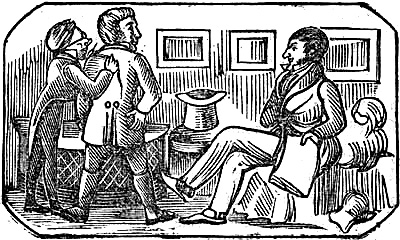
Now Jerry must needs be a swell, His coat must have a swallow-tail, And Mr. Snip, so handy, O, Soon rigg’d him out a Dandy, O.
CUT II.—Tom and Jerry among the Ladies.
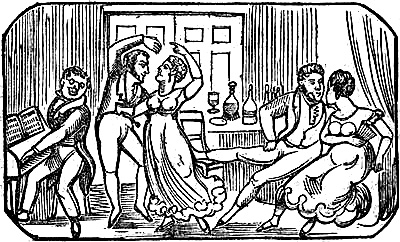
Ladies, your most humble servants, Tom and Jerry stand before you. Our blood is thrilling, you’re so killing; At once we love you and adore you.
CUT III.—Jerry Loses at Play.
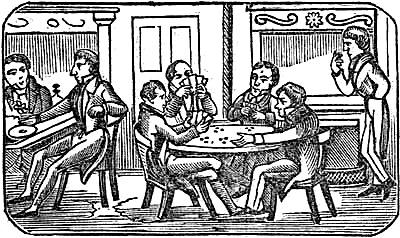
At St. James’s they dine, when, flushed with new wine, To the Gaming Tables they reel, Where blacklegs and sharps, often gammon the flats, As their pockets do presently feel.
CUT IV.—Jerry Learning to Spar.
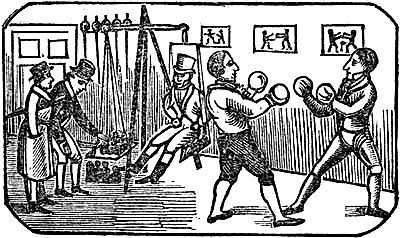
Now Jerry’s become a Fancy blade, To Jackson’s he often goes, And to shew his skill in the milling trade, He crack’d poor Logick’s nose.
CUT V.—Tom and Jerry at a Fortune-Teller’s.
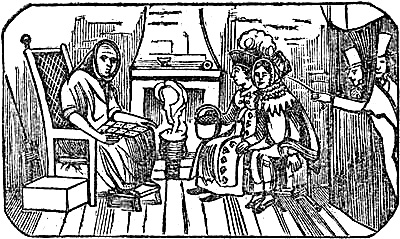
Here lives a Fortune-Telling Gipsy, Wrinkled, crabbed, grim and old; And Tom and Jerry’s fancy ladies Are gone to get their Fortunes told.
CUT VI.—Beggar’s Opera. Tom, Jerry, and Logick among the Cadgers in the Holy Land.
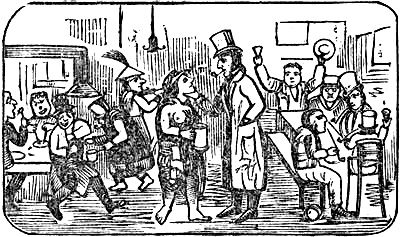
Now to keep up the spree, Tom, Jerry and Logick, Went disguis’d to the Slums in the Holy Land; Through each crib and each court, they hunted for sport, Till they came to the Beggar’s Opera so named.
CUT VII.—Night Scene.—Tom and Jerry upsetting the Charleys.
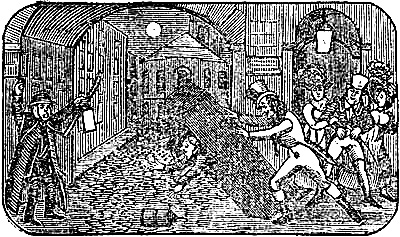
Hark! the watchman springs his rattle, Now the midnight lark’s begun; Boxes crashing, lanthorns smashing, Mill the Charleys—oh! what fun.
CUT VIII.—Brought before the Magistrates.
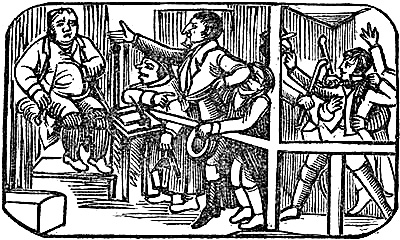
An’ please your Worship here’s three fellows Been hammering of us all about; Broke our boxes, lanthorns, smellers, And almost clos’d our peepers up.
CUT IX.—Tom, Jerry, and Logick in a Row.
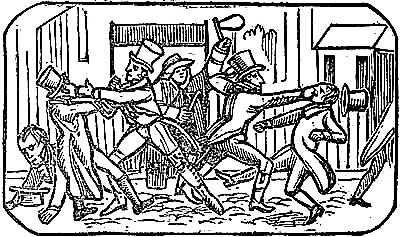
Mercy! what a din and clatter Breaks the stillness of the night, Lamps do rattle—’tis a battle, Quick, and let us see the sight.
CUT X.—Scene in a Gin-shop.
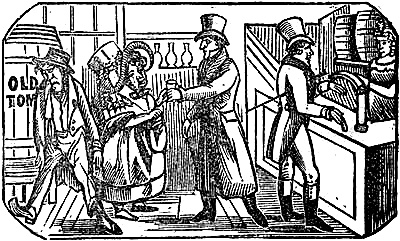
Here some are tumbling and jumping in, And some are staggering out; One’s pawn’d her smock for a quartern of gin, Another, her husband’s coat.
CUT XI.—Poor Logick in the Fleet.
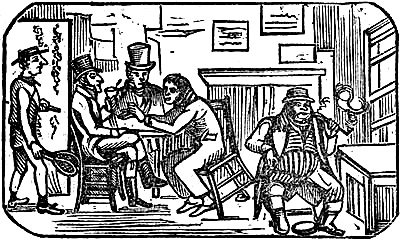
All in the Fleet poor Logick’s moor’d His swaggering’s now at an end!
CUT XII.—Jerry Going Back to the Country.
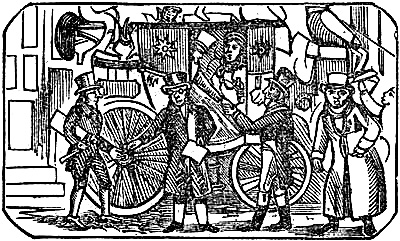
Three merry boys were Logick, Tom and Jerry, And many funny larks they have seen; Farewell, gay London, the country calls me home again, The coach moves on—the play is done—Goodbye, Goodbye. Quod. JAS. C-N-H, March 23, 1822.
How delightful Pierce Egan’s book was to the youths of England, and how eagerly all its promised feasts of pleasure were devoured by them, Thackeray has told us in his “Roundabout Papers—De Juventute” in the “Cornhill Magazine” for October, 1860.
Mr., afterwards Sir William Cubitt, of Ipswich, erected a treadmill at Brixton Gaol, and soon afterwards in other large prisons. A street ballad on the subject was issued from the “Catnach Press” and had a most unprecedented sale, keeping the pressmen and boys working for weeks—
“And we’re all treading at fam’d Brixton Mill.”
The treadmill—that “terror to evil doers”—excited much attention, and the inventor’s name gave rise to many jokes on the subject among such of the prisoners as could laugh at their own crimes, who said they were punished by the cubit!.
The Treadmill.
This Brixton Mill’s a fearful ill, And he who brought the Bill in, Is threat’n’d by the cribbing coves, That he shall have a milling. They say he shew’d a simple pate, To think of felons mending; As every step which here they take They’re still in crime ascending. Tom, Jerry, Logic, three prime sprigs, Find here they cannot come it, For though their fancy soars aloft, They ne’er will reach the summit. Corinthian Kate and buxom Sue Must change their warm direction, For if they make one false step more They’ll have Cold Bath Correction.
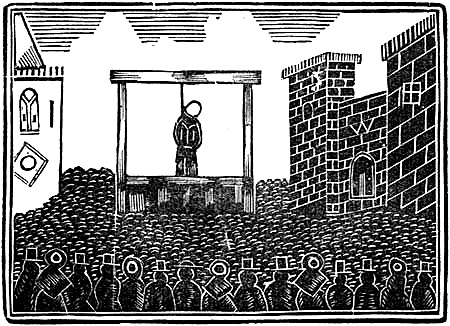
“The gallows does well: But how does it well? it does well to those that do ill.”—Hamlet, Act v., sc. i.
There can be little doubt that Jemmy Catnach, the great publisher of the Seven Dials, had his mind mostly centred upon the chronicling of doubtful scandals, fabulous duels between ladies of fashion, “cooked” assassinations, and sudden deaths of eminent individuals, apochryphal elopements, real or catch-penny account of murders, impossible robberies, delusive suicides, dark deeds, and—though last, not least, in his love—public executions, vulgo “Hanging Matches,” to which was usually attached the all-important and necessary “Sorrowful Lamentations,” or “Copy of Affectionate Verses,” which according to the established custom, the criminal composed in the condemned cell the night before his execution, after this manner:—
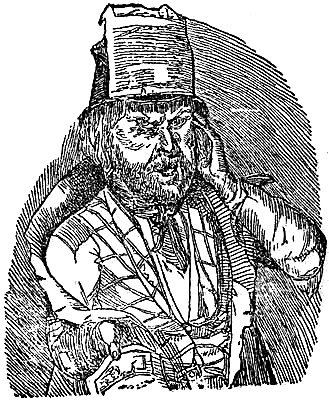
The Flying Stationer, otherwise Patterer.
“All you that have got feeling, I pray you now attend To these few lines so sad and true, a solemn silence lend; It is of a cruel murder, to you I will unfold—— The bare recital of the tale must make your blood run cold.” “Mercy on earth I’ll not implore, to crave it would be vain, My hands are dyed with human gore, none can wash off the stain, But the merits of a Saviour, whose mercy alone I crave; Good Christians pray, as thus I die, I may His pardon have.”
A mournful and affecting COPY OF VERSES on the death of Who was barbarously and cruelly murdered by her sweetheart, W. JONES, near Wirksworth, in Derbyshire, July, 1823.

William Jones, a young man aged 20, has been fully committed to Derby gaol for the murder of his sweetheart, under circumstances of unheard of barbarity. The poor victim was a servant girl, whom under pretence of marriage he seduced. On her proving with child the villain formed the horrid design of murdering her, and carried his diabolical plan into execution on Monday evening last. The following verses are written upon the occasion, giving a complete detail of this shocking affair:—
Come all false hearted young men And listen to my song, ’Tis of a cruel murder, That lately has been done On the body of a maiden fair The truth I will unfold, The bare relation of this deed Will make your blood run cold. Near Wirksworth town in Derbyshire, Ann Williams she did dwell, In service she long time had lived, Till this to her befel. Her cheeks were like the blushing rose All in the month of May, Which made this wicked young man Thus unto her did say: Nancy, my charming creature, You have my heart ensnared, My love is such I am resolved To wed you I declare. Thus by his false deluding tongue Poor Nancy was beguil’d, And soon to her misfortune, By him she proved with child. Some days ago this damsel fair Did write to him with speed, Such tenderness she did express Would make a heart to bleed. She said, my dearest William, I am with child by thee; Therefore, my dear, pray let me know When you will marry me. The following day at evening, This young man did repair, Unto the town of Wirksworth, To meet his Nancy there. Saying, Nancy dear, come let us walk, Among the flowery fields, And then the secrets of my heart To you I will reveal. O then this wicked young man A knife he did provide, And all unknown to his true love Concealed it by his side. When to the fatal spot they came, These words to her did say: All on this very night I will Your precious life betray. On bended knees she then did fall, In sorrow and despair, Aloud for mercy she did call, Her cries did rend the air; With clasped hands and uplift eyes She cried, Oh spare my life, I never more will ask you To make me your wedded wife. O then this wicked young man said, No mercy will I show; He took the knife all from his side, And pierced her body through. But still she smiling said to him While trembling with fear, Aä! William, William, spare my life, Think on your baby dear. Twice more then with the bloody knife He ran her body through, Her throat was cut from ear to ear, Most dreadful for to view; Her hands and arms and beauteous face He cut and mangled sore, While down upon her milk white breast The crimson blood did pour. He took the shawl from off her neck, And round her body tied, With pebble stones he did it fill, Thinking the crime to hide. O then into the silver stream He plunged her straightway, But with her precious blood was stained Which soon did him betray. O then this young man taken was, And into prison sent, In ratling chains he is confin’d His crime for to lament, Until the Assizes do come on When trembling he must stand, Reflecting on the deed he’s done; Waiting the dread command. Now all you thoughtless young men A timely warning take; Likewise ye fair young maidens, For this poor damsel’s sake. And Oh beware of flattering tongues, For they’ll your ruin prove; So may you crown your future day, In comfort, joy, and love.
Or take another and stereotyped example, which from time to time has served equally well for the verses written by the culprit—Brown, Jones, Robinson, or Smith:
“Those deeds I mournfully repent, But now it is too late, The day is past, the die is cast, And fixed is my fate. I see the hangman before me stand, Ready to seize me by the law’s command; When my life is ended on the fatal tree, Then will be clear’d up all mystery.”
Occasionally the Last Sorrowful Lamentation contained a “Love Letter”—the criminal being unable, in some instances, to read or write, being no obstacle to the composition—written according to the street patterer’s statement: “from the depths of the condemned cell, with the condemned pen, ink, and paper.” This mode of procedure in “gallows” literature, and this style of composition having prevailed for from sixty to seventy years.
Then they would say: “Here you have also an exact likeness of the murderer, taken at the bar of the Old Bailey by an eminent artist!” when all the time it was an old woodcut that had been used for every criminal for many years. The block! opposite, to our own knowledge, served as the counterfeit presentment of all popular murderers for upwards of forty years.
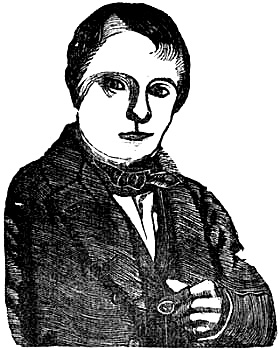
Likeness of the Murderer.
“There’s nothing beats a stunning good murder after all,” said a “running patterer” to Mr. Henry Mayhew, the author of “London Labour and London Poor.” It is only fair to assume that Mr. James Catnach shared in the sentiment, for it is said that he made over £500 by the publication of:—
“The Full, True and Particular Account of the Murder of Mr. Weare by John Thurtell and his Companions, which took place on the 24th of October, 1823, in Gill’s Hill-lane, near Elstree, in Hertfordshire:—Only One Penny.”
There were eight formes set up, for old Jemmy had no notion of stereotyping in those days, and pressmen had to re-cover their own tympans with sheep-skins. But by working day and night for a week they managed to get off about 250,000 copies with the four presses, each working two formes at a time.
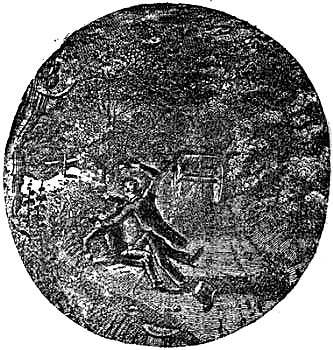
Thurtell Murdering Mr. Weare.
As the trial progressed, and the case became more fully developed, the public mind became almost insatiable. Every night and morning large bundles were despatched to the principal towns in the three kingdoms.
One of the many street-ballads on the subject informed the British public that:—
“Thurtell, Hunt, and Probert, too, for trial must now prepare, For that horrid murder of Mr. William Weare.”
The circumstances immediately attending the murder are so fully and so well detailed in the proper channels that we need not here say more than that the trial took place at Hertford on the 5th January, 1824.
The prisoners who stood indicted were John Thurtell and Joseph Hunt. The latter was at the time well known as a public singer and was somewhat celebrated for the talent which he possessed. Both prisoners were found guilty, but Hunt was reprieved and subsequently ordered to be transported for life. Thurtell, who fully confessed to the crime, was executed in front of Hertford gaol on Friday, the 9th of January, 1824.
As before observed, Catnach cleared over £500 by this event, and was so loth to leave it, that when a wag put him up to a joke, and showed him how he might set the thing a-going again, he could not withstand it; and so, about a fortnight after Thurtell had been hanged, Jemmy brought out a startling broad-sheet, headed, “WE ARE ALIVE AGAIN!” He put so little space between the words “WE” and “ARE” that it looked at first sight like “WEARE.” Many thousands were bought by the ignorant and gullible public, but those who did not like the trick called it a “catch penny,” and this gave rise to this peculiar term, which ever afterwards stuck to the issues of the “Seven Dials’ Press,” though they sold as well as ever.
Probert, who had been mixed up in the affair, was admitted as King’s evidence and discharged at the rising of the Court. He subsequently met the fate he so richly deserved, for, having been found guilty at the Old Bailey of horse stealing, he was executed there on the 20th of June, 1825.

THE CONFESSION AND EXECUTION OF JOHN THURTELL On Friday, the 9th of January, 1824.

THE EXECUTION.
Hertford, half-past twelve o’clock.
This morning, at ten minutes before twelve, a bustle among the javelin-men stationed within the boarded enclosure on which the drop was erected, announced to the multitude without that the preparations for the execution were nearly concluded. The javelin-men proceeded to arrange themselves in the order usually observed upon these melancholy but necessary occurrences. They had scarcely finished their arrangements, when the opening of the gate of the prison gave an additional impulse to public anxiety
When the clock was on the stroke of twelve, Mr Nicholson, the Under-Sheriff, and the executioner ascended the platform, followed on to it by Thurtell, who mounted the stairs with a slow but steady step. The principal turnkey of the gaol came next, and was followed by Mr Wilson and two officers. On the approach of the prisoner being intimated by those persons who, being in an elevated situation, obtained the first view of him, all the immense multitude present took off their hats.
Thurtell immediately placed himself under the fatal beam, and at that moment the chimes of a neighbouring clock began to strike twelve. The executioner then came forward with the rope, which he threw across it. Thurtell first lifted his eyes up to the drop, gazed at it for a few moments, and then took a calm but hurried survey of the multitude around him. He next fixed his eyes on a young gentleman in the crowd, whom he had frequently seen as a spectator at the commencement of the proceedings against him. Seeing that the individual was affected by the circumstance, he removed them to another quarter, and in so doing recognised an individual well known in the sporting circles, to whom he made a slight bow.
The prisoner was attired in a dark brown great coat, with a black velvet collar, white corduroy breeches, drab gaiters and shoes. His hands were confined with handcuffs, instead of being tied with cord, as is usually the case on such occasions, and, at his own request, his arms were not pinioned. He wore a pair of black kid gloves, and the wrists of his shirt were visible below the cuffs of his coat. As on the last day of his trial, he wore a white cravat. The irons, which were very heavy, and consisted of a succession of chain links, were still on his legs, and were held up in the middle by a Belcher handkerchief tied round his waist.
The executioner commenced his mournful duties by taking from the unhappy prisoner his cravat and collar. To obviate all difficulty in this stage of the proceedings, Thurtell flung back his head and neck, and so gave the executioner an opportunity of immediately divesting him of that part of his dress. After tying the rope round Thurtell’s neck, the executioner drew a white cotton cap over his countenance, which did not, however, conceal the contour of his face, or deprive him entirely of the view of surrounding objects.
At that moment the clock sounded the last stroke of twelve. During the whole of this appalling ceremony, there was not the slightest symptom of emotion discernible in his features; his demeanour was perfectly calm and tranquil, and he behaved like a man acquainted with the dreadful ordeal he was about to pass, but not unprepared to meet it. Though his fortitude was thus conspicuous, it was evident from his appearance that in the interval between his conviction and his execution he must have suffered much. He looked careworn; his countenance had assumed a cadaverous hue, and there was a haggardness and lankness about his cheeks and mouth, which could not fail to attract the notice of every spectator.
The executioner next proceeded to adjust the noose by which Thurtell was to be attached to the scaffold. After he had fastened it in such a manner as to satisfy his own mind, Thurtell looked up at it, and examined it with great attention. He then desired the executioner to let him have fall enough. The rope at this moment seemed as if it would only give a fall of two or three feet The executioner assured him that the fall was quite sufficient. The principal turnkey then went up to Thurtell, shook hands with him, and turned away in tears. Mr Wilson, the governor of the gaol, next approached him. Thurtell laid to him, “Do you think, Mr Wilson, I have got enough fall?” Mr Wilson replied, “I think you have, Sir. Yes, quite enough.” Mr Wilson then took hold of his hand, shook it, and said, “Good bye, Mr Thurtell, may God Almighty bless you.” Thurtell instantly replied, “God bless you, Mr Wilson, God bless you.” Mr Wilson next asked him whether he considered that the laws of his country had been dealt to him justly and fairly, upon which he said, “I admit that justice has been done me—I am perfectly satisfied.”
A few seconds then elapsed, during which every person seemed to be engaged in examining narrowly Thurtell’s deportment His features, as well as they could be discerned, appeared to remain unmoved, and his hands, which were extremely prominent, continued perfectly steady, and were not affected by the slightest tremulous motion.
Exactly at two minutes past twelve the Under-Sheriff, with his wand, gave the dreadful signal—the drop suddenly and silently fell—and
John Thurtell was launched into Eternity.
On the 10th of September, 1824, Henry Fauntleroy, of the firm of Marsh, Stracey, Fauntleroy, and Graham, bankers, in Berners-street, was apprehended in consequence of its being discovered that in September, 1820, £10,000 3 per cent stock, standing in the names of himself, J. D. Hume, and John Goodchild, as trustees of Francis William Bellis, had been sold out under a power of attorney, to which the names of his co-trustees and some of the subscribing witnesses were forged. It was soon ascertained that the extent to which this practice had been carried was enormous, no less than £170,000 stock having been sold out in 1814 and 1815 by the same fraudulent means.
Every exertion was used by Mr. Fauntleroy’s counsel, his case being twice argued before the Judges, but both decisions were against him; and on the 30th of November, 1824, his execution took place. The number of persons assembled was estimated at nearly 100,000.
The station in society of this unfortunate man, and the long-established respectability of the banking-house, in which he was the most active partner, with the vast extent of the forgeries committed, gave to his case an intensity of interest which has scarcely ever been equalled, and during the whole time it was pending afforded plenty of work for the printers and vendors of street literature. Catnach’s advanced position, which was now far beyond all his compeers, caused him to get the lion’s share. Every incident in the man’s character, history, and actions was taken advantage of. The sheets, almost wet from the press, were read by high and low; by those who lived and revelled in marble halls and gilded saloons, as well as by those who thronged our large towns and centres of industry.
The parliamentary election of 1826, for the county of Northumberland, the principal seat of which was at Alnwick, gave early promise of being severely contested. There were four candidates in the field, namely, Henry Thomas Liddell, afterwards first Earl of Ravensworth, of Ravensworth Castle, county Durham; Mr. Matthew Bell, of Woolsingham, Northumberland; Mr. Thomas Wentworth Beaumont, and Lord Howick, afterwards Henry the third Earl Grey, K.G. The nomination of the candidates took place on Tuesday, June 20th, 1826, and the polling continued till July 6th, when the result was as follows:—
Liddell 1562
Bell 1380
Beaumont 1335
Howick 997
This contest was the greatest political event in the history of the county. It is estimated that it cost the candidates little short of £250,000.
Now, as we have before observed, Mr. Mark Smith—who till the time of his death, on the 18th of May, 1881, aged 87—carried on the business of printer and bookseller at Alnwick—and James Catnach, were fellow apprentices, both being bound to learn the art of printing to the elder Catnach on the same day. This early-formed acquaintanceship continued throughout the remaining portion of Catnach’s life, and whenever Mr. Mark Smith came to London in after years, he always visited Jemmy’s house.
It was in consequence of the continued friendship existing between Mr. Mark Smith and Jemmy Catnach that the latter had often expressed a desire to serve his fellow-apprentice, should circumstances occur to render it necessary. The Alnwick election of 1826 promised to be a good one as regarded printing, and Mr. Smith anticipating a difficulty in getting through his work, applied to Catnach to know if he could render him any assistance. The result was that Jemmy at once proffered to go to Alnwick and take with him a small hand-press. After his arrival he seldom went out of the house, as all hands worked early and late, for, besides addresses, squibs, &c., they had to get out the state of the poll every afternoon, shortly after four o’clock. The number of addresses and squibs, in prose and verse, during this memorable election was enormous. The whole, when collected together, forms four good-sized volumes. The principal printers in Alnwick at this time, and who were engaged by the candidates, were Smith, Davison, and Graham. But there was a great deal of printing done at Newcastle, Gateshead, North Shields, Morpeth, and other towns.
There can be but little doubt that all who were professionally engaged at this election made a good thing out of it. The money spent upon printing alone must have been very great. And nearly all the public-houses in Alnwick were made “open houses,” as well as most of those in the principal towns throughout the county. Old people talk to this day, with a degree of pride of “those good old times” that existed at the Parliamentary elections previous to the passing of the Reform Bill of 1832. As far as Catnach was concerned, he merely went to help to pay off a deep debt of gratitude owing by him to the Smith family for many past favours to his own family when they were in dire distress in auld lang syne. Besides, Jemmy was now getting towards that state known as being “comfortably well-to-do,” and the trip was a change of air—a bit of a holiday, and a visit to the town of his birth. And as he had buried his mother in London during the early part of the year, he took the opportunity to erect in the parish churchyard, that which at once stands as a cenotaph and a tombstone, bearing the following inscription:—
“John, Son of John Catnach, Printer, died August 27th, 1794, Aged 5 years & 7 months. JOHN CATNACH died in London, 1813, Aged 44. Mary, his wife died Jany. 24th, 1826, Aged 60 years, Also John, Margaret, and Jane Catnach, lie here.”[9]
During Catnach’s absence from London on the Alnwick election, his old rivals—the Pitts family—were, as usual, concocting false reports, and exhibiting lampoons, after the following manner:—
“Poor Jemmy with the son of Old Nick, Down to Northumberland he’s gone; To take up his freedom at Alnwick, The why or the wherefore’s known to none. “Before he went, he washed in soap and sud, The Alnwick folks they found the fiddle; Then they dragged poor Jemmy through the mud, Two foot above his middle.
The above was in allusion to the old ceremony of being dragged through the dirty pool to be made a Freeman of the town of Alnwick. But, as far as Catnach was concerned, there is no truth whatever in the matter, it was simply “a weak invention of the enemy.” It was in the latter part of June and the beginning of July in the same year, that Catnach was at Alnwick, and the ceremony of making freemen always took place on St. Mark’s Day, April 25th, or at least two months earlier.
Thus the statement of the Pitts’ party was—
“As false As air, as water, as wind, as sandy earth, As fox to lamb, as wolf to heifer’s calf, Pard to the hind, or step-dame to her son.”
Catnach, as the high priest of the literature of the streets, surrounded by trade rivals, “stood like a man at a mark with a whole army shooting at him,” but he was as firm as a rock and with the strength of a giant, and, as Hyperion to a Satyr, defied them all.
The destruction of the Royal Brunswick Theatre, Well-street, Wellclose-square, East London, on the 29th of February, 1828, by the falling in of the walls, in consequence of too much weight being attached to the heavy cast-iron roof, made a rare nine-day’s wonder for the workers of street-papers. Fortunately the catastrophe happened in the day-time, during the rehearsal of “Guy Mannering,” and only fifteen persons perished, viz:—
Mr. D. S. Maurice, a master printer, of Fenchurch-street, one of the Proprietors,
Mr. J. Evans Bristol Observer
Miss Mary A. Feron Actress,
Miss Freeman Corps de ballet,
Mr. E. Gilbert Comedian,
Mr. J. Blamire Property Man,
Mr. G. Penfold Doorkeeper,
Miss Jane Wall Visitor,
Mr. J. Purdy Blacksmith,
Messrs. J. Miles, W. Leader, A. W. Davidson, M. Miles, and J. Abbott Carpenters,
J. Levy, A Clothesman (accidentally passing).
“Oh yes, sir! I remember well the falling of the Brunswick Theatre, out Whitechapel way. It was a rare good thing for all the running and standing patterers in and about ten miles of London. Every day we all killed more and more people—in our “Latest Particulars.” One day there was twenty persons killed, the next day thirty or forty, until it got at last to be worked up to about a hundred, and all killed. Then we killed all sorts of people, Duke of Wellington, and all the Dukes and Duchesses, Bishops, swell nobs and snobs we could think of at the moment.”
ATROCIOUS MURDER OF A YOUNG WOMAN IN SUFFOLK.
SINGULAR DISCOVERY OF THE BODY FROM A DREAM.
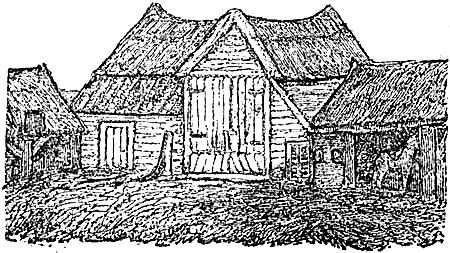
The Red Barn.
THE SCENE OF THE MURDER, AND WHERE THE BODY OF MARIA MARTEN WAS FOUND CONCEALED.
Four years after the Thurtell and Weare affair, namely, in the month of April, 1828, another “sensational” murder was discovered—that of Maria Marten, by William Corder, in the Red Barn, at Polstead, in the county of Suffolk. The circumstances that led to the discovery of this most atrocious murder, were of an extraordinary and romantic nature, and manifest an almost special interposition of Providence in marking out the offender. As the mother of the girl had on three several nights dreamt that her daughter was murdered and buried in Corder’s Red Barn, and as this proved to be the case, an additional “charm” was given to the circumstance. The “Catnach Press” was again set working both day and night, to meet the great demand for the “Full Particulars.” In due course came the gratifying announcement of the apprehension of the murderer! and the sale continued unabatingly in both town and country, every “Flying Stationer” making great profits by the sale.
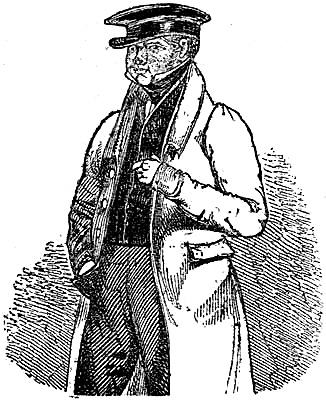
Likeness of William Corder.
The trial of Corder took place at Bury St. Edmonds, on the 7th of August, 1828, before the Lord Chief Baron (Anderson). The prisoner pleaded “Not Guilty,” and the trial proceeded. On being called on for his defence, Corder read a manuscript paper. He declared that he deeply deplored the death of the unfortunate deceased, and he urged the jury to dismiss from their minds all that prejudice which must necessarily have been excited against him by the public press, &c. Having concluded his address, the Lord Chief Baron summed up, and a verdict of “Guilty” was returned. The Last Dying Speech and Confession had an enormous sale—estimated at 1,166,000, a fac-simile copy of which with the “Lamentable Verses,” said to have been written by Old Jemmy Catnach will be found on the next page.
CONFESSION AND EXECUTION OF THE MURDERER OF MARIA MARTEN.

Since the tragical affair between Thurtell and Weare, no event has occurred connected with the criminal annals of our country which has excited so much interest as the trial of Corder, who was justly convicted of the murder of Maria Marten on Friday last.
THE CONFESSION.
“Bury Gaol, August 10th, 1828.—Condemned cell. “Sunday evening, half-past Eleven.
“I acknowledge being guilty of the death of poor Maria Marten, by shooting her with a pistol. The particulars are as follows:—When we left her father’s house, we began quarrelling about the burial of the child: she apprehended the place wherein it was deposited would be found out. The quarrel continued about three quarters of an hour upon this sad and about other subjects. A scuffle ensued, and during the scuffle, and at the time I think that she had hold of me, I took the pistol from the side pocket of my velveteen jacket and fired. She fell, and died in an instant. I never saw her even struggle. I was overwhelmed with agitation and dismay:—the body fell near the front doors on the floor of the barn. A vast quantity of blood issued from the wound, and ran on to the floor and through the crevices. Having determined to bury the body in the barn (about two hours after she was dead). I went and borrowed a spade of Mrs Stow, but before I went there I dragged the body from the barn into the chaff-house, and locked the barn. I returned again to the barn, and began to dig a hole, but the spade being a bad one, and the earth firm and hard, I was obliged to go home for a pickaxe and a better spade, with which I dug the hole, and then buried the body. I think I dragged the body by the handkerchief that was tied round her neck. It was dark when I finished covering up the body. I went the next day, and washed the blood from off the barn-floor. I declare to Almighty God I had no sharp instrument about me, and no other wound but the one made by the pistol was inflicted by me. I have been guilty of great idleness, and at times led a dissolute life, but I hope through the mercy of God to be forgiven. William Corder.”
Witness to the signing by the said William Corder,
John Orridge.
Condemned cell, Eleven o’clock, Monday morning, August 11th, 1828.
The above confession was read over carefully to the prisoner in our presence, who stated most solemnly it was true, and that he had nothing to add to or retract from it—W. Stocking, chaplain; Timothy R. Holmes, Under-Sheriff.
THE EXECUTION.
At ten minutes before twelve o’clock the prisoner was brought from his cell and pinioned by the hangman, who was brought from London for the purpose. He appeared resigned, but was so weak as to be unable to stand without support; when his cravat was removed he groaned heavily, and appeared to be labouring under great mental agony. When his wrists and arms were made fast, he was led round towards the scaffold, and as he passed the different yards in which the prisoners were confined, he shook hands with them, and speaking to two of them by name, he said, “Good bye, God bless you.” They appeared considerably affected by the wretched appearance which he made, and “God bless you!” “May God receive your soul!” were frequently uttered as he passed along. The chaplain walked before the prisoner, reading the usual Burial Service, and the Governor and Officers walking immediately after him. Tho prisoner was supported to the steps which led to the scaffold; he looked somewhat wildly around, and a constable was obliged to support him while the hangman was adjusting the fatal cord. There was a barrier to keep off the crowd, amounting to upwards of 7,000 persons, who at this time had stationed themselves in the adjoining fields, on the hedges, the tops of houses, and at every point from which a view of the execution could be best obtained. The prisoner, a few moments before the drop fell, groaned heavily, and would have fallen, had not a second constable caught hold of him. Everything having been made ready, the signal was given, the fatal drop fell, and the unfortunate man was launched into eternity. Just before he was turned off, he said in a feeble tone, “I am justly sentenced, and may God forgive me.”
The Murder of Maria Marten.
BY W. CORDER.
Come all you thoughtless young men, a warning take by me, And think upon my unhappy fate to be hanged upon a tree; My name is William Corder, to you I do declare, I courted Maria Marten, most beautiful and fair. I promised I would marry her upon a certain day, Instead of that, I was resolved to take her life away. I went into her father’s house the 18th day of May, Saying, my dear Maria, we will fix the wedding day. If you will meet me at the Red-barn, as sure as I have life, I will take you to Ipswich town, and there make you my wife; I then went home and fetched my gun, my pickaxe and my spade, I went into the Red-barn, and there I dug her grave. With heart so light, she thought no harm, to meet him she did go He murdered her all in the barn, and laid her body low; After the horrible deed was done, she lay weltering in her gore, Her bleeding mangled body he buried beneath the Red-barn floor. Now all things being silent, her spirit could not rest, She appeared onto her mother, who suckled her at her breast, For many a long month or more, her mind being sore oppress’d, Neither night or day she could not take any rest. Her mother’s mind being so disturbed, she dreamt three nights o’er, Her daughter she lay murdered beneath the Red-barn floor; She sent the father to the barn, when he the ground did thrust, And there he found his daughter mingling with the dust. My trial is hard, I could not stand, most woeful was the sight, When her jaw-bone was brought to prove, which pierced my heart quite; Her aged father standing by, likewise his loving wife, And in her grief her hair she tore, she scarcely could keep life. Adieu, adieu, my loving friends, my glass is almost run, On Monday next will be my last, when I am to be hang’d, So you, young men, who do pass by; with pity look on me, For murdering Maria Marten, I was hang’d upon the tree.
Printed by J Catnach, 2 and 3, Monmouth Court.—Cards, &c., Printed Cheap
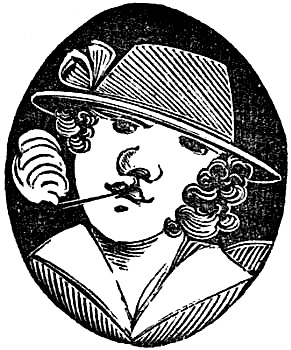
“Oh, she lives snug in the Holy Land, Right, tight, and merry in the Holy Land, Search the globe round, none can be found So accommodating! as Old Mother Cummins—of the Holy Land.”
Catnach, like many others connected with the getting up of news broadsides and fly-sheets, did not always keep clear of the law. The golden rule is a very fine one, but, unfortunately, it is not always read aright; in some cases injured innocence flies at extremes. Jemmy Catnach for a long time had been living upon unfriendly terms with a party connected with the management of one of Mother Cummins’s lodging-house establishments in the immediate neighbourhood, so out of spite printed a pamphlet, purporting to be the “Life and Adventures of Old Mother Cummins.” Here Catnach had reckoned without his host, by reason of his not taking into consideration the extensive aristocratic and legal connection Mother Cummins had for her friends and patrons. The moment she was made acquainted with the “dirty parjury” that Jemmy Catnach had printed and caused to be publicly circulated, she immediately gave instructions to her Attorney General to prosecute the varmint, when a warrant was applied for and obtained to search the premises of the Seven Dials printer. But Catnach got the news of the intended visit of the Bow Street Runners, and naturally became alarmed from having a vivid recollection of the punishment and costs in the case of the Drury-lane sausage makers, so the forme containing the libellous matter was at once broken up—“pied,” that is, the type was jumbled together and left to be properly distributed on a future occasion. What stock of the pamphlets remained were hastily packed up and carried off to the “other side of the water” by John Morgan, one of Catnach’s poets! while another forme, consisting of a Christmas-sheet, entitled “The Sun of Righteousness,” was hurriedly got to press, and all hands were working away full of assumed innocence when the officers from Bow Street arrived at Monmouth-court, when, after a diligent search, they had very reluctantly to come to the conclusion that they were “a day behind the fair,” and that the printer had been a little too sharp for them this time. But Mother Cummins did not mean to be so checkmated by Catnach and Co., and vowed to pursue him and his dirty blackguards to the end of the world and back again, and instructed her lawyers to serve him with several notices of action for libel, defamation of character, and, more particular, as she expressed it, for “parjury.” Then Catnach became somewhat alarmed by her known vindictive disposition and long purse, that he consulted his own solicitor in the matter, who took “counsel’s opinion” when an instant compromise at all costs, together with an ample apology, was recommended as the only safe way out of the dilemma; a course which was ultimately agreed to by both sides. An apology was drawn up and approved of, with the understanding that Catnach was, after paying all costs incurred to print the apology and publish the same on three several places in front of his business premises in Monmouth Court for fourteen clear days. All this—and more—Jemmy promised steadfastly to observe. Yet in effect, he evaded the conditions by printing the apology in small pica type and sticking the three copies so high up on the premises, that it would have required Sam Weller’s “pair of double million magnifying gas microscopes of hextra power” to have been able to read the same.
Immediately after Mother Cummins’s death and funeral, March, 1828, the following announcement appeared:—
Published this Day, Price Sixpence, embellished with a humorous Coloured Plate.
THE LIFE AND ADVENTURES OF
MOTHER CUMMINS,
The celebrated Lady Abbess of St. Giles’s; with a curious Description, Regulations, &c., of her singular Establishment. An account of her Funeral, &c. Interspersed with numerous Anecdotes of Living Characters, Visitors of Mother Cummins’s Nunnery,—Capt. Shiels and the Forty-four Nuns—Poll Hankey and Sir Charles Stanton,—Jane Sealey and an Illustrous Person, &c.—With an Account of some of the principal Nuns of the Establishment; particularly Mrs. Throgmorton and Lord Al...n..y—Bell Chambers and the D... of Y...,—Miss Wilkinson and Captain Featherstone—Marianne Hempstead, the Scotch Beauty—Miss Weltern Davis and the Rev. Mr. H...l..y Be..rs..d—Mary Thomas, the Female Chimney-Sweep, and Captain T...t...s, &c.
THE TRIAL, SENTENCE, FULL CONFESSION, AND EXECUTION OF BISHOP & WILLIAMS,
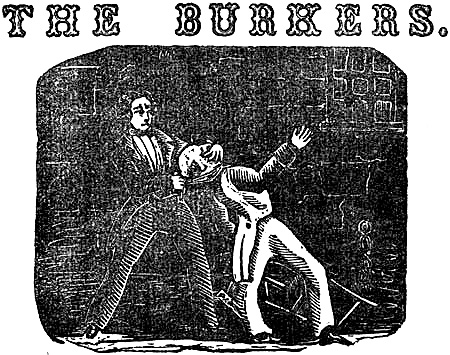
BURKING AND BURKERS.
The month of November, 1831, will be recorded in the annals of crimes and cruelties as particularly pre-eminent, for it will prove to posterity that other wretches could be found base enough to follow the horrid example of Burke and his accomplice Hare, to entice the unprotected and friendless to the den of death for sordid gain.
The horrible crime of “Burking,” or murdering the unwary with the intention of selling their bodies at a high price to the anatomical schools, for the purpose of dissection, has unfortunately obtained a notoriety which will not be soon or easily forgotten. It took its horrifying appellation from the circumstances which were disclosed on the trial of the inhuman wretch Burke, who was executed at Edinburgh in 1829, for having wilfully and deliberately murdered several persons for the sole purpose of profiting by the sale of their dead bodies.
APPREHENSION OF THE BURKERS.
On Tuesday, November 8th, four persons vis., John Bishop, Thomas Williams, James May, and Michael Shield, were examined at Bow Street Police Office on the charge of being concerned in the wilful murder of an unknown Italian boy. From the evidence adduced, it appeared that May, alias Jack Stirabout, a known resurrection-man, and Bishop, a body-snatcher, offered at King’s College a subject for sale, Shield and Williams having charge of the body in a hamper, for which they demanded twelve guineas. Mr Partridge, demonstrator of anatomy, who, although not in absolute want of a subject, offered nine guineas, but being struck with its freshness sent a messenger to the police station, and the fellows were then taken into custody, examined before the magistrates, when Shield was discharged and the others ultimately committed for trial
THE TRIAL.
Friday, December 2nd, having been fixed for the trial of the prisoners charged with the murder of the Italian boy, the Court was crowded to excess so early as eight o’clock in the morning.
At nine o’clock the Deputy Recorder, Mr Serjeant Arabin, came into the court, when the prisoners severally pleaded “Not Guilty.”
The Jury were then sworn, and at ten o’clock Chief Justice Tindal, Mr Baron Vaughan, and Mr Justice Littledale entered the Court, with the Lord Mayor and Sheriffs.
The Bench was crowded with persons of rank, amongst whom was the Duke of Sussex.
Mr Bodkin having opened the case, Mr Adolphus proceeded to state to the Jury the leading facts, as they were afterwards stated in the evidence produced. The case for the prosecution having closed, the prisoners were called upon for their defence.
The prisoner Bishop in his defence stated that he was thirty-three years of age, and had followed the occupation of carrier till the last five years, during which he had occasionally obtained a livelihood by supplying surgeons with subjects. He most solemnly declared that he had never disposed of any body that had not died a natural death.
Williams’ defence briefly stated that he had never been engaged in the calling of a resurrectionist, but had only by accident accompanied Bishop on the sale of the Italian boy’s body.
May, in his defence, admitted that for the last six years he had followed the occupation of supplying the medical schools with anatomical subjects, but disclaimed ever having had anything to do with the sale of bodies which had not died a natural death. That he had accidentally met with Bishop at the Fortune of War public house on the Friday on which the body was taken for sale to Guy’s Hospital.
At eight o’clock the jury retired to consider their verdict and on their return they found the prisoners were Guilty of Murder.
The Recorder then passed the awful sentence upon them. “That each of them be hanged on Monday morning, and their bodies be delivered over for dissection and anatomization.”
The prisoners heard the sentence as they had the verdict, without any visible alteration. May raised his voice, and in a firm tone said, “I am a murdered man, gentlemen.”
THE FULL CONFESSION OF BISHOP AND WILLIAMS.
On Saturday morning Williams addressed a note to Mr Wontner, stating that he and Bishop wanted particularly to see him and Dr. Cotton, the Ordinary. In the course of the interview which immediately followed, both prisoners made a full confession of their guilt, both exculpating May altogether from being party to any of the murders. Having received the confessions, Mr Wontner immediately waited upon Mr Justice Littledale and Baron Vaughan, and upon communicating to them the statements, they said they would at once see the Home Secretary on the subject.
On Sunday morning the Sheriffs visited all three of the prisoners in succession, and with the Under-Sheriffs were engaged between three and four hours in taking down the statements of the convicts. The result of all these investigations was that the same afternoon a respite during his Majesty’s pleasure arrived at Newgate for May, and his sentence will be commuted to transportation for life.
THE EXECUTION.
During the whole of Sunday crowds of persons congregated in the Old Bailey, and the spot on which the scaffold was to be erected was covered with individuals conversing on the horrid crimes of the convicts, and in the course of the day strong posts were erected in the Old Bailey and at the ends of Newgate street Giltspur street, and Skinner street, for the purpose of forming barriers to break the pressure of the crowd.
At half-past twelve o’clock the gallows was brought out from the yard, and drawn to its usual station opposite the Debtor’s door. The crowd, as early as one o’clock amounting to several thousand persons, continued rapidly increasing.
By some oversight three chains had been suspended from the fatal beam, and this led the crowd to suppose that May had not been respited. Mr. Wontnor, on hearing of the mistake, directed that one of the chains should be removed. The moment this was done an exclamation of “May is respited,” ran through the crowd, and, contrary to the expected tokens of indignation, distinct cheers were heard amongst the crowd on witnessing this token that mercy had been shown to May.
At half-past seven the Sheriffs arrived in their carriage, and in a short time the press-yard was thronged with gentlemen. The unhappy convicts were now led from their cells. Bishop cams out first, and after he was pinioned he was conducted to a seat, and the Rev. Mr. Williams sat alongside of him, and they conversed together in a low tone of voice.
Williams was next introduced, and the wonderful alteration two days had effected in his appearance astonished everyone who was present at the trial. All the bold confidence he exhibited then had completely forsaken him, and he looked the most miserable wretch it is possible to conceive. He entered the room with a very faltering step, and when the ceremony of pinioning him commenced, he was so weak as to be scarcely able to stand.
Everything being ready, the melancholy procession moved forward. Bishop was then conducted to the scaffold, and the moment he made his appearance the most dreadful yells and hootings were heard among the crowd. The executioner proceeded at once to the performance of his duty, and having put the rope round his neck and affixed it to a chain, placed him under the fatal beam. Williams was then taken out, and the groans and hisses were renewed. The dreadful preparations were soon completed, and in less than five minutes after the wretched men appeared on the scaffold the usual signal was given, the drop fell, and they were launched into eternity. Bishop appeared to die very soon, but Williams struggled hard. Thus died
THE DREADFUL BURKERS OF 1831
Printed in London for the Venders.
It may be remarked, en passant, that Mr. Corder, with Paragalli and Colla, the two Italian witnesses, who gave evidence as to the identity of the body, said to be that of the Italian boy, at the trial of Bishop, Williams, and May, appeared at Bow Street, in consequence of doubts being entertained by a portion of the public as to the body being that of Carlo Ferrari, to re-assert their former evidence. Mr. Corder afterwards published a statement in the “Times” newspaper, which gave scarcely the possibility of doubt that the body offered at King’s College must have been that of Ferrari notwithstanding the murderer’s assertion to the contrary. On December the 10th, a Post-obit prosecution of Williams, the Burkite murderer, took place in the Court of Excise, where he was charged, on information, with having carried on an illicit factory for making glass at No. 2, Nova Scotia Gardens, Bethnal Green. An officer proved the seizure of goods used in the manufacture of glass, at the house of the person charged, and that Bishop was at the time in company. The Court condemned the goods seized.
A drama on the subject of the “Burkers” was produced at an unlicensed theatre, designated The Shakespeare, in the Kingsland Road, and not far from Shoreditch Church, and for a time was specially attractive. In the young actor, who played Carlo Ferrari, the Italian boy, might now be recognised an eminent tragedian.[10]
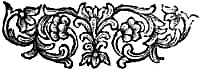
Street-ballads on political subjects, though not regarded as of great interest by the whole body of the people, are still eventful among certain classes, and for such the street author and ballad singer cater. The measure of Reform by Earl Grey’s administration, was proposed in the House of Commons by Lord John Russell, 1st March, 1831. On the first division, second reading 22nd March, there stood for it, 302; against it, 301. Ultimately, the Bill for that session was abandoned, and Parliament dissolved. The Reform Bill of 1832 was read for the third time on the 23rd of March, when the numbers stood thus:—for the Bill, 355; against it, 239—majority for it, 116. In the Lords, the Bill was carried through the Committee on the 30th of May, and read a third time on the 4th of June. For the Bill, 106; against, 22—majority, 84.
During the whole of the time the Reform Bills of 1831-2 were before the Houses of Parliament, the “Catnach Press,” in common with other printing offices that produced street-literature, was very busy in publishing, almost daily, songs and papers in ridicule of borough-mongering and of the various rotten boroughs then in existence, but which were entirely swept away by the passing of this Bill; fifty-six boroughs in England being disfranchised, while thirty were reduced to one member only; twenty-two new boroughs were created to send two members, and twenty to send one member; other important changes were also made. Songs upon the subject were sung at every corner of the streets, to the great delight of the multitude.
The Reform Bill.
As William and Bill are the same, Our King, if he “weathers the storm,” Shall be called in the annals of fame, The Glorious BILL of Reform!
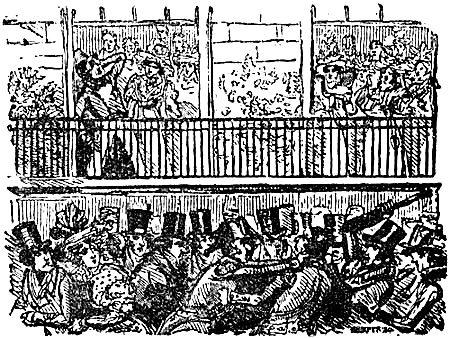
ATTACK ON KING WILLIAM IV. AT ASCOT HEATH,
On Tuesday, the 19th of June, 1832.
The Ascot Races for 1832 will be rendered memorable in the history of this country by reason of a stone thrown at his Majesty while on the grand stand at Ascot Races, which hit him on the forehead. The man by whom it was thrown was immediately secured, and proved to be Dennis Collins, a seaman with only one leg, formerly a pensioner of Greenwich Hospital, from whence he had been dismissed for ill-conduct. On his examination he confessed he committed the outrage in revenge because no notice had been taken of petitions which he had sent to the Lords of the Admiralty and the King. He was committed to Reading gaol to take his trial, which took place at Abingdon, on August 22nd. The jury returned a verdict of guilty on the fifth count, that of intending some bodily harm to his Majesty, but not guilty of the intent to kill.
Mr. Baron Gurney passed sentence on the prisoner, that he be drawn on a hurdle to the place of execution, and being hung by his neck until dead, his head be afterwards severed from his body, and his body divided into four pieces, and disposed of as his Majesty should think fit. His sentence was afterwards respited.
Nothing better than the above circumstance could have suited the producers and workers of street-literature. King William and Queen Adelaide were very popular at the time. “Yes, sir, we all did well out of that job of the wooden-legged sailor and old King Billy. It lasted out for months. We had something fresh nearly every day. We killed old Billy five or six times; then we made out that the sailor-chap was a love-child of the Sailor King and Madame Vestris; then that he was an old sweetheart of Queen Adelaide’s, and that he was jealous and annoyed at her a jilting of him and a-marrying of old King Billy, and so on. But it was an awful sell, and a robbery to us all, because they didn’t hang and cut the chap up into four quarters—that would have been a regular Godsend to us chaps, sir. But I think old Jemmy Catnach, as it was, must have cleared pretty nigh or quite fifty pounds for himself out of the job. A-talking about Madame Vestris, sir, reminds me that once we had a song about her, and the chorus was:—
“‘A hundred pounds reward For the man that cut the legs above the knees Belonging to Madame Vestris.’”

The year 1837 produced two sensational murders and executions. The first case—that of Pegsworth—made a great stir, particularly in the east part of London. It was on the evening of the 9th of January, 1837, that a most atrocious and cold-blooded murder was committed in Ratcliff Highway. The individual who suffered was Mr. John Holliday Ready, who for some time carried on the trade of a tailor, draper, and milliner. John Pegsworth, was a messenger in the tea department of St. Katherine’s Docks, he had formerly kept a small tobacconist’s shop in the same street, and had contracted a debt of £1 with Mr. Ready, who being unable to obtain payment, took out a summons against him in the Court of Requests, Osborne-street, Whitechapel. The court gave judgement against Pegsworth for the full amount and costs, which he was ordered to pay by instalments. On the evening of the same day Pegsworth proceeded to a cutler’s shop in Shadwell, where he bought a large pig-knife, armed with which he immediately repaired to the house of Mr. Ready for the purpose of executing his diabolical intention. He entered the shop, and having spoken to Mrs. Ready, passed on to the parlour and got into conversation with Mr. Ready. Pegsworth, although pressingly asked to do so, declined taking a seat, and after he had been talking about ten minutes in a calm and collected manner on the subject of the debt and the misfortunes he had met with in business, he pointedly asked Mr. Ready if he intended to enforce the payment of the debt? Ready said he should be compelled to issue an execution against his goods if the money was not paid. The words had scarcely left the lips of the unfortunate man than Pegsworth uttered some exclamation which is supposed to have been “Take that!” and plunged the knife with great force into his breast up to the hilt. Ready called out to his wife, “O, I am stabbed!” fell back in his chair, and almost immediately expired. Mrs. Ready, who saw Pegsworth move his arm, but was not aware her husband was stabbed until she saw him fall back, screamed aloud for assistance, and several of her neighbours rushed into the shop for the purpose of securing the murderer, who did not make the least attempt to escape, but having completed his purpose, withdrew the knife from the body of his victim, laid it on the table, and calmly awaited the arrival of the police.
Pegsworth was tried at the Central Criminal Court of London on the 12th of February, and found guilty of wilful murder, and was executed in front of the debtor’s door in the Old Bailey on the 9th of March following.
During the whole of the time that was occupied in the trial and execution of Pegsworth, a circumstance took place which excited an extraordinary sensation throughout the metropolis and its neighbourhood—namely, the discovery near the Pine Apple Gate, Edgware Road, of the trunk of a human being, tied up in a sack, dismembered of the arms, legs, and head.
The utmost vigilance was exercised to trace out the murderer, but for several days no light was thrown upon the transaction. At length, on the 6th of January, as a barge was passing down the Regent’s Canal, near Stepney, one of the eastern environs of London, the bargeman, to his unspeakable horror, fished up what proved to be a human head. Proper notice of this circumstance was forwarded to the police. It was now very generally supposed the head would prove to belong to the body found in the Edgware road, although at a distance of nearly five miles, and this conjecture proved to be correct.
On the second of February the remaining portions of the human being was discovered in a sack in an osier bed, near Cold Harbour Lane, Camberwell. These mutilated remains were carefully matched together, and at length recognised as those of a Mrs. Brown, and suspicion fell, and justly so, upon James Greenacre and his paramour Sarah Gale.
In respect to the last two murders we have cited, Mr. Henry Mayhew received from an old “running patterer” the following statement—“Pegsworth was an out-and-out lot. I did tremendous with him, because it happened in London, down Ratcliff Highway—that’s a splendid quarter for working—there’s plenty of feeling—but, bless you, some places you go to you can’t move nohow, they’ve hearts like paving stones. They wouldn’t have ‘the papers’ if you’d give them to ’em—especially when they knows you. Greenacre didn’t sell so well as might have been expected, for such a diabolical out-and-out crime as he committed; but you see he came close after Pegsworth, and that took the beauty off him. Two murderers together is no good to nobody.”
In the Greenacre tragedy Catnach did a great amount of business, and as it was about the last “popular murder” in which he had any trade concern, we give a statement in respect to the sale of “Execution Papers,” of the chief modern ‘popular’ murders, thus:—
Of Rush murder 2,500,000 copies.
Of the Mannings 2,500,000 "
Of Courvoisier 1,666,000 "
Of Greenacre 1,650,000 "
Of Corder (Maria Marten) 1,166,000 "
Of the Five Pirates (Flowery Land) 290,000 "
Of Müller 280,000 "
So that the printers and publishers of “Gallows” Literature in general, and “The Catnach Press” in particular must have reaped a golden harvest for many a long day, even when sold to the street patterers at the low rate of 3d. per long dozen.

LIFE, TRIAL, CONFESSION, & EXECUTION OF JAMES GREENACRE, FOR THE EDGEWARE ROAD MURDER.
On the 22nd of April, James Greenacre was found guilty of the wilful murder of Hannah Brown, and Sarah Gale with being accessary after the fact. A long and connected chain of evidence was produced, which showed, that the sack in which the body was found was the property of Mr. Ward; that it was usually deposited in a part of the premises which led to the workshop, and could without observation have been carried away by him; that the said sack contained several fragments of shavings of mahogeny, such as were made in the course of business by Ward; and that it contained some pieces of linen cloth, which had been patched with nankeen; that this linen cloth matched exactly with a frock which was found on Greenacre’s premises, and which belonged to the female prisoner. Feltham, a police-officer, deposed, that on the 25th of March he apprehended the prisoners at the lodgings of Greenacre; that on searching the trowsers pockets of that person, he took therefrom a pawnbroker’s duplicate for two silk gowns, and from the fingers of the female prisoner two rings, and also a similar duplicate for two veils, and an old-fashioned silver watch, which she was endeavouring to conceal; and it was further proved that these articles were pledged by the prisoners, and that they had been the property of the deceased woman.—Two surgeons were examined, whose evidence was most important, and whose depositions were of the greatest consequence in throwing a clear light on the manner in which the female, Hannah Brown, met with her death. Mr. Birtwhistle deposed, that he had carefully examined the head; that the right eye had been knocked out by a blow inflicted while the person was living; there was also a cut on the cheek, and the jaw was fractured, these two last wounds were, in his opinion, produced after death; there was also a bruise on the head, which had occurred after death; the head had been separated by cutting, and the bone sawed nearly through, and then broken off; then were the marks of a saw, which fitted with a saw which was found in Greenacre’s box. Mr. Girdwood, a surgeon, very minutely and skilfully described the appearances presented on the head, and showed incontestibly, that the head had been severed from the body while the person was yet alive; that this was proved by the retraction, or drawing back, of the muscles at the parts where they were separated by the knife, and further, by the blood-vessels being empty, the body was drained of blood. This part of the evidence produced a thrill of horror throughout the court, but Greenacre remained quite unmoved.
After a most impressive and impartial summing up by the learned Judge, the jury retired, and, after the absence of a quarter of an hour, returned into court, and pronounced a verdict of “Guilty” against both the prisoners.
The prisoners heard the verdict without evincing the least emotion, or the slightest change of countenance. After an awful silence of a few minutes, the Lord Chief Justice said they might retire, as they would be remanded until the end of the session.
They were then conducted from the bar, and on going down the steps, the unfortunate female prisoner kissed Greenacre with every mark of tenderness and affection.
The crowd outside the court on this day was even greater than on either of the preceding; and when the result of the trial was made known in the street, a sudden and general shout succeeded, ans continued huzzas were heard for several minutes.
THE EXECUTION.
At half past seven the sheriff arrived in his carriage, and in a short time the press-yard was thronged with gentlemen who had been admitted by tickets. The unhappy convict was now led from his cell. When he arrived in the press-yard, his whole appearance pourtrayed the utmost misery and spirit-broken dejection; his countenance haggard, and his whole frame agitated; all that self-possesion and fortitude which he displayed in the early part of his imprisonment, had utterly forsaken him, and had left him a victim of hopelessness and despair. He requested the executioner to give him as little pain as possible in the process of pinioning his arms and wrists; he uttered not a word in allusion to his crime; neither did he make any dying request, except that his spectacles might be given to Sarah Gale; he exhibited no sign of hope; he showed no symptom of reconciliation with his offended God! When the venerable ordinary preceded him in the solemn procession through the vaulted passage to the fatal drop, he was so overcome and unmanned, that he could not support himself without the aid of the assistant executioner. At the moment he ascended the faithless floor, from which he was to be launched into eternity, the most terrific yells, groans, and cheers were vociferated by the immense multitude surrounding the place of execution. Greenacre bowed to the sheriff, and begged he might not be allowed to remain long in the concourse; and almost immediately the fatal bolt was withdrawn, and, without a struggle he became a lifeless corse.—Thus ended the days of Greenacre, a man endowed with more than ordinary talents, respectably connected, and desirably placed in society; but a want of probity, an absolute dearth of principle, led him on from one crime to another, until at length he perpetrated the sanguinary deed which brought his career to an awful and disgraceful period, and which has enrolled his name among the most notorious of those who have expiated their crime on the gallows.
On hearing the death-bell toll, Gale became dreadfully agitated; and when she heard the brutal shouts of the crowd of spectators, she fainted, and remained in a state of alternate mental agony and insensibility throughout the whole day.
After having been suspended the usual time, his body was cut down, and buried in a hole dug in one of the passages of the prison, near the spot where Thistlewood and his associate were deposited.
Catnach received a very indifferent education, and that little at the establishment of Mr. Goldie, in Alnwick, where his attendance was very irregular, and this drawback assisted very much in blunting his relish for the higher walks of literature. The father had not carried out the heavenly injunction so much practised in Scotland, by giving to his son the best of blessings—“a good education.”
Jemmy had a tenacious love of money, and this propensity he retained throughout life. As a man of business he was rough and brusque in his manners, but this mattered little, as his trade lay amongst a class who were low and insensitive in their habits and modes of living.
The productions issued at the “Catnach Press” were not destined to rank high in the annals of literature; and they bear a sorry appearance when placed alongside of several works of a similar kind, which were printed at the same period in many parts of the kingdom. In this respect Jemmy Catnach was very unlike his father, for, whilst the former had a niggardly turn in all his dealings, the latter was naturally inclined to the reverse.
One class of literature which Jemmy Catnach made—by reason of greater mechanical skill and a larger capital than his rivals—almost his own, was children’s farthing, halfpenny, and penny books. Among the great many that he published we select from our own private collection, those that follow as a fair sample.
Many other nursery books of a similar kind might be mentioned as some of the chief attractions that emanated from the “Catnach Press,” and which, to the juvenile population, were more eagerly welcomed than the great sensational three-volume novels are by many in our day.
“THE CATNACH PRESS.”

A
COLLECTION
OF
JUVENILE BOOKS.
Printed and published by
JAMES CATNACH,
LATE OF
MONMOUTH COURT,
SEVEN DIALS,
LONDON.
Larger Image
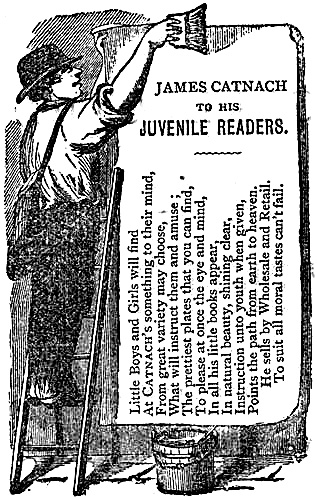
Text of Image
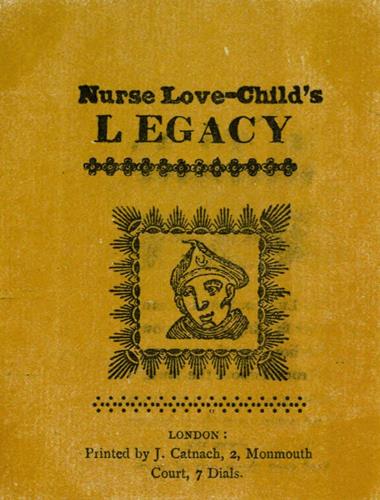
2
The Lion and the unicorn, Were fighting for the crown, The lion beat the unicorn, All round about the town, Some gave them white bread And some gave them brown, Some gave them plum cake And sent them out of town.
3
NURSE LOVECHILD’S LEGACY.
What is the news of the day, Good neighbour I pray, They say the balloon, Is gone up to the moon.
4
NURSE LOVECHILD’S LEGACY.
The little mouse Doth skip and play, He runs by night, And sleeps by day.
5
NURSE LOVECHILD’S LEGACY.
This is the Cat That killed the Cock, For waking her At five o’clock.
6
NURSE LOVECHILD’S LEGACY.
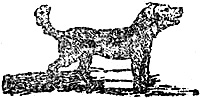
And this is the Dog That bit the thief, For stealing all His master’s beef.
7
NURSE LOVECHILD’S LEGACY.
Who comes here A Grenadier, What do you want A pot of beer, Where’s your money I’ve forgot. Get you gone You drunken sot.