Chapter VIII · (continued 2)
Reading edition
"Hunting itself has something cruel in the practice; it is a species of war which we wage with brute animals for their spoils; but if ever it can be considered as excusable, it is in these savage nations, who have recourse to it for their subsistence. They are active, bold, and dexterous in all these exercises, to such a degree, that none of the wild animals they attack have the smallest chance of escape. Their parties generally consist of almost all the youth of
"The Saukies had been long at war with the Iroquese, a powerful tribe of North Americans, in the interest of the French. The Iroquese had received intelligence of the situation of the Saukies' encampment, and determined to surprise them. For this purpose a thousand warriors set out by a secret march through the woods, and travelled with silence and celerity, which are peculiar to all these nations. When they had nearly approached the hunting-grounds of their enemies, they happened to be discovered upon
"While they were in this uncertainty, I considered the nature of their situation, and had the good fortune to find out a resource, which, being communicated to my friend and chief, and adopted by the nation, was the means of their safety. I observed that the passage to the Saukie camp, for the Iroquese, lay along a narrow slip of land which extended for nearly a mile between two lakes. I therefore advised the Saukies to cast up a strong barrier at the end of the passage, which I showed them how to strengthen with ditches, palisades, and some of the improvements of the European fortification. Their number of warriors amounted to about four hundred; these I divided into equal parts, and, leaving one to defend the lines, I placed the other in ambuscade along the neighbouring woods. Scarcely were these dispositions finished before the Iroquese appeared, and, imagining they were rushing upon an unguarded foe, entered the defile without hesitation. As soon as the whole body was thus imprudently engaged, the other party of the Saukies started from their hiding-places, and, running to the entrance of the strait,
"These, gentlemen (with the exception of one adventure, when I was attacked by three desperate-looking fellows, two of whom I killed, and the other fled), are the most important and interesting events of my life; and as I have already trespassed too long upon your patience, I shall now hasten to draw my story to a conclusion. After this I was employed in various parts of America and the West Indies during the rest of the war. I suffered
Here the Highlander finished his story, and all the company were affected by the recital of his distresses. They all endeavoured to comfort him with the kindest expressions and promises of assistance; but Miss Simmons, after she had with some difficulty composed herself enough to speak, asked the man if his name was not Andrew Campbell? The Highlander answered, with some surprise, it was. "Then," said she, "you will find that you have a friend, whom, as yet, you are not acquainted with, who has both the ability and the will to serve you. That friend," added she, seeing all the company astonished, "is no other than my uncle. That Colonel Simmons, whom you have described with so much feeling and affection, was brother to my father, and consequently uncle to myself. It is no wonder that the memory of such a man should be venerated by his relations. I have often heard my uncle speak of his untimely death as the greatest misfortune which ever happened to our family; and I have often seen him read, with tears in his eyes, many of his brother's letters, in which he speaks with the greatest affection of his faithful Highlander, Andrew Campbell."
At these words the poor Highlander, unable to repress the strong emotions of his mind, sprang forward in a sudden transport of joy, and, without consideration of circumstances, caught Miss Simmons in his arms, exclaiming at the same time, "Praised be to God for this happy and unexpected meeting! Blessed be my shipwreck itself, that has given me an opportunity
And now, the company being separated, Tommy, who had listened with silent attention to the story of the Highlander, took an opportunity of following Mr Barlow, who was walking out; and when he perceived they were alone, he looked at him as if he had some weighty matter to disclose, but was unable to give it utterance. Mr Barlow, therefore, turned towards him with the greatest kindness, and taking him tenderly by the hand, inquired what he wished. "Indeed," answered Tommy, almost crying, "I am scarcely able to tell you. But I have been a very bad and ungrateful boy, and I am afraid you no longer have the same affection for me."
Mr Barlow.—If you are sensible of your faults, my little friend, that is a very great step towards amending them. Let me therefore know what it is, the recollec
Tommy.—Oh sir! your speaking to me with so much goodness hurts me a great deal more than if you were to be very angry; for when people are angry and passionate, one does not so much mind what they say; but when you speak with so much kindness, it seems to pierce me to the very heart, because I know I have not deserved it.
Mr Barlow.—But if you are sensible of having committed any faults, you may resolve to behave so well for the future that you may deserve everybody's friendship and esteem; few people are so perfect as not to err sometimes, and if you are convinced of your errors, you will be more cautious how you give way to them a second time.
Tommy.—Indeed, sir, I am very happy to hear you say so. I will, then, tell you everything which lies so heavy upon my mind. You must know then, sir, that although I have lived so long with you, and during all that time you have taken so much pains to improve me in everything, and teach me to act well to everybody, I had no sooner quitted your sight than I became, I think, a worse boy than ever I was before.
Mr Barlow.—But why do you judge so severely of yourself as to think you were become worse than ever. Perhaps you have been a little thoughtless and giddy; and these are faults which I cannot with truth say you were ever free from.
Tommy.—No, sir; what I have been guilty of is in
Mr Barlow.—You frighten me, my little friend. Is it possible you can have committed actions that deserve so harsh a name?
Tommy.—You shall judge yourself, sir, for, now I have begun, I am determined to tell you all. You know, sir, that when I first came to you, I had a high opinion of myself for being born a gentleman, and a very great contempt for everybody in an inferior station.
Mr Barlow.—I must confess you have always had some tendency to both these follies.
Tommy.—Yes, sir; but you have so often laughed at me upon the subject, and shown me the folly of people's imagining themselves better than others, without any merit of their own, that I was grown a little wiser. Besides, I have so often observed, that those I despised could do a variety of things which I was ignorant of, while those who are vain of being gentlemen can do nothing useful or ingenious; so that I had begun to be ashamed of my folly. But since I came home I have kept company with a great many fine young gentlemen and ladies, who thought themselves superior to all the rest of the world, and used to despise every one else; and they have made me forget everything I learned before.
Mr Barlow.—Perhaps, then, I was mistaken when I taught you that the greatest merit any person could have is to be good and useful. These fine young gentlemen and ladies may be wiser, and have
Tommy.—No, sir, no; I never thought them either good or wise, for they know nothing but how to dress their hair and buckle their shoes; but they persuaded me that it was necessary to be polite, and talked to me so often upon the subject, that I could not help believing them.
Mr Barlow.—I am glad to hear that; it is necessary for everybody to be polite; they therefore, I suppose, instructed you to be more obliging and civil in your manners than ever you were before. Instead of doing you any hurt, this will be the greatest improvement you can receive.
Tommy.—No, sir, quite the contrary. Instead of teaching me to be civil and obliging, they have made me ruder and worse behaved than ever I was before.
Mr Barlow.—If that is the case, I fear these fine young gentlemen and ladies undertook to teach you more than they understood themselves.
Tommy.—Indeed, sir, I am of the same opinion myself. But I did not think so then, and therefore I did whatever I observed them do, and talked in the same manner as I heard them talk. They used to be always laughing at Harry Sandford, and I grew so foolish that I did not choose to keep company with him any longer.
Mr Barlow.—That was a pity, because I am convinced he really loves you. However, it is of no great consequence, for he has employment enough at home; and however ingenious you may be, I do not think that he will learn how to manage his land, or
Tommy.—Oh, sir! I did not think you could be so cruel. I love Harry Sandford better than any other boy in the world; and I shall never be happy till he forgives me all my bad behaviour, and converses with me again as he used to do.
Mr Barlow.—But then, perhaps, you may lose the acquaintance of all those polite young gentlemen and ladies.
Tommy.—I care very little about that, sir. But I fear I have behaved so ill that he never will be able to forgive me, and love me as he did formerly.
Tommy then went on, and repeated with great exactness the story of his insolence and ingratitude, which had so great an effect upon him, that he burst into tears, and cried a considerable time. He then concluded with asking Mr Barlow if he thought Harry would be ever able to forgive him?
Mr Barlow.—I cannot conceal from you, my little friend, that you have acted very ill indeed in this affair. However, if you are really ashamed of all your past conduct, and determined to act better, I do not doubt that so generous and good-natured a boy as Harry is, will forgive you all.
Tommy.—Oh, sir! I should be the happiest creature
Mr Barlow.—Softly, Tommy, softly. What is Harry to come here for? Have you not insulted and abused him without reason; and at last proceeded so far as to strike him, only because he was giving you the best advice, and endeavouring to preserve you from danger? Can you imagine that any human being will come to you in return for such treatment, at least till you have convinced him that you are ashamed of your passion and injustice, and that he may expect better usage for the future?
Tommy.—What, then, must I do, sir?
Mr Barlow.—If you want any future connection with Harry Sandford, it is your business to go to him and tell him so.
Tommy.—What, sir! go to a farmer's, to expose myself before all his family?
Mr Barlow.—Just now you told me you were ready to do everything, and yet you cannot take the trouble of visiting your friend at his own house. You then imagine that a person does not expose himself by acting wrong, but by acknowledging and amending his faults?
Tommy.—But what would everybody say if a young gentleman like me was to go and beg pardon of a farmer's son?
Mr Barlow.—They would probably say that you have more sense and gratitude than they expected. However, you are to act as you please. With the sentiments you still seem to entertain, Harry will certainly be a very unfit companion, and you will do much better to cultivate the new acquaintance you have made.
Mr Barlow was then going away, but Tommy burst again into tears, and begged him not to go; upon which Mr Barlow said, "I do not want to leave you, Tommy, but our conversation is now at an end. You have asked my advice, which I have given you freely. I have told you how you ought to act, if you would preserve the esteem of any good or sensible friend, or prevail upon Harry to excuse your past behaviour. But as you do not approve of what I suggested, you must follow your own opinion."
"Pray sir, pray sir," said Tommy, sobbing, "do not go. I have used Harry Sandford in the most barbarous manner; my father is angry with me, and, if you desert me, I shall have no friend left in the world."
Mr Barlow.—That will be your own fault, and therefore you will not deserve to be pitied. Is it not in your own power to preserve all your friends by an honest confession of your faults? Your father will be pleased, Harry Sandford will heartily forgive you, and I shall retain the same good opinion of your character which I have long had.
Tommy.—And is it really possible, sir, that you should have a good opinion of me after all I have told you about myself?
Mr Barlow.—I have always thought you a little vain and careless, I confess, but at the same time I imagined you had both good sense and generosity in your character; I depended upon first to make you see your faults, and upon the second to correct them.
Tommy.—Dear sir, I am very much obliged to you; but you have always been extremely kind and friendly to me.
Mr Barlow.—And therefore I told your father
Tommy.—Oh, sir! I will go directly and entreat Harry to forgive me; I am convinced that all you say is right. But will you not go with me? Do pray, sir, be so good.
Mr Barlow.—Gently, gently, my young friend, you are always for doing everything in an instant. I am very glad you have taken a resolution which will do you so much credit, and give so much satisfaction to your own mind; but, before you execute it, I think it will be necessary to speak to your father and mother upon the subject; and, in the mean time, I will go and pay a visit to farmer Sandford, and bring you an account of Harry.
Tommy.—Do, sir, be so good; and tell Harry, if you please, that there is nothing I desire so much as
Mr Barlow commended Tommy very much for dispositions so full of gratitude and goodness; and, taking leave of him, went to communicate the conversation he had just had to Mr Merton. That gentleman felt the sincerest pleasure at the account, and entreated Mr Barlow to go directly to prepare Harry to receive his son. "That little boy," observed he, "has the noblest mind that ever adorned a human being; nor shall I ever be happy till I see my son acknowledging all his faults, and entreating forgiveness; for, with the virtues that I have discovered in his soul, he appears to me a more eligible friend and companion than noblemen or princes."
Mr Barlow therefore set out on foot, though Mr Merton would have sent his carriage and servants to attend him, and soon arrived at Mr Sandford's farm. It was a pleasant spot, situated upon the gentle declivity of a hill, at the foot of which winded along a swift and clear little stream. The house itself was small, but warm and convenient, furnished with the greatest simplicity, but managed with perfect neatness. As Mr Barlow approached, he saw the owner himself guiding a plough through one of his own fields, and Harry, who had now resumed the farmer, directed the horses. But when he saw Mr Barlow coming across the field, he stopped his team, and, letting fall his whip, sprang forward to meet him with all the unaffected eagerness of joy. As soon as
Harry.—Indeed, sir, I am very sorry for it myself. But I do not know that I have given Master Merton any reason to change his sentiments about me; and though I do not think he has treated me as well as he ought to do, I have the greatest desire to hear that he is well.
Mr Barlow.—That you might have known yourself had you not left Mr Merton's house so suddenly, without taking leave of any one, even your friend Mr Merton, who has always treated you with so much kindness.
Harry.—Indeed, sir, I should be very unhappy if you think I have done wrong; but be so good as to tell me how I could have acted otherwise. I am very sorry to appear to accuse Master Merton, neither do I bear any resentment against him for what he has done; but since you speak to me upon the subject, I shall be obliged to tell the truth.
Mr Barlow.—Well, Harry, let me hear it; you know I shall be the last person to condemn you, if you do not deserve it.
Harry.—I know your constant kindness to me, sir, and I always confide in it; however, I am not sensible that I am in fault. You know, sir, that it was with unwillingness I went to Mr Merton's, for I thought there would be fine gentlemen and ladies
Mr Barlow.—Do you wonder at that, Harry, considering the difference there is in your rank and fortune?
Harry.—No, sir, I cannot say I do, for I generally observe that those who are rich will scarcely treat the poor with common civility. But, in this particular case, I did not see any reason for it; I never desired Master Merton to admit me to his company, or invite me to his house, because I knew that I was born, and in a very inferior station. You were so good as to take me to your house, and if I was then much in his company, it was because he seemed to desire it himself, and I always endeavoured to treat him with the greatest respect.
Mr Barlow.—That is indeed true, Harry; in all your little plays and studies I have never observed anything but the greatest mildness and good nature on your part.
Harry.—I hope, sir, it has never been otherwise. But though I had the greatest affection for Master Merton, I never desired to go home with him. What sort of a figure could a poor boy like me make at a gentleman's table, among little masters and misses that powder their hair, and wear buckles as big as our horses carry upon their harness? If I attempted to speak, I was always laughed at; or if I did anything, I was sure to hear something about clowns and rustics! And yet, I think, though they were all gentlemen and
Mr Barlow.—Well, Harry, but if you did not like their conversation, you surely might have borne it with patience for a little while: and then I heard something about your being quarrelsome.
Harry.—Oh, sir! I hope not. I was, to be sure, once a little passionate, but that I could not help, and I hope you will forgive me. There was a modest, sensible young lady, who was the only person that treated me with any kindness, and a bold, forward, ill-natured boy affronted her in the grossest manner, only because she took notice of me. Could I help taking her part? Have you not told me, too, sir, that every person, though he should avoid quarrels, has a right to defend himself when he is attacked?
Mr Barlow.—Well, Harry, I do not much blame you, from the circumstances I have heard of that affair; but why did you leave Mr Merton's family so abruptly, without speaking to anybody, or thanking Mr Merton himself for the civilities he had shown you? Was that right?
Harry.—Oh dear, sir, I have cried about it several times, for I think it must appear very rude and ungrateful to Mr Merton. But as to Master Tommy, I did not leave him while I thought I could be of any use. He treated me, I must say, in a very unworthy manner; he joined with all the other fine little gentlemen in abusing me, only because I endeavoured to
Mr Barlow.—Well, Harry, I can inform you that Mr Merton is perfectly satisfied on that account. But there is one circumstance you have not mentioned, my little friend, and that is your saving Tommy's life from the fury of the enraged bull.
Harry.—As to that, sir, I hope I should have done the same for any human creature. But I believe that neither of us would have escaped, if it had not been for the poor courageous Black that came to our assistance.
Mr Barlow.—I see, Harry, that you are a boy of a noble and generous spirit, and I highly approve of everything you have done; but are you determined to forsake Tommy Merton for ever, because he has once behaved ill?
Harry.—I, sir! no, I am sure. But though I am poor, I do not desire the acquaintance of anybody that despises me. Let him keep company with his gentlemen and ladies, I am satisfied with companions in my own station. But surely, sir, it is not I that forsake him, but he that has cast me off.
Mr Barlow.—But if he is sorry for what he has done, and only desires to acknowledge his faults and obtain your pardon?
Harry.—Oh dear, sir, I should forget everything in an instant. I knew Master Tommy was always a little passionate and headstrong, but he is at the same time generous and good-natured; nor would he, I am sure, have treated me so ill if he had not been encouraged to it by the other young gentlemen.
Mr Barlow.—Well, Harry, I believe your friend is thoroughly sensible of his faults, and that you will have little to fear for the future. He is impatient till he sees you, and asks your forgiveness.
Harry.—Oh, sir, I should forgive him if he had beaten me a hundred times. But though I cannot leave the horses now, if you will be so kind to wait a little, I daresay my father will let me go when he leaves off ploughing.
Mr Barlow.—No, Harry, there is no occasion for that. Tommy has indeed used you ill, and ought to acknowledge it, otherwise he will not deserve to be trusted again. He will call upon you, and tell you all he feels on the occasion. In the mean time I was desired, both by him and Mr Merton, to inquire after the poor negro that served you so materially, and saved you from the bull.
Harry.—He is at our house, sir, for I invited him home with me; and when my father heard how well he had behaved, he made him up a little bed over the stable, and gives him victuals every day, and the poor man seems very thankful and industrious, and says he would gladly do any kind of work to earn his subsistence.
Mr Barlow then took his leave of Harry, and after having spoken to his father, returned to Mr Merton's.
During Mr Barlow's absence Mr Simmons had arrived there to fetch away his niece; but when he had heard the story of the Highlander, he perfectly recollected his name and character, and was touched with the sincerest compassion for his sufferings. On conversing with the poor man he found that he was extremely well acquainted with agriculture, as well as truly industrious, and therefore instantly proposed to settle him in a small farm of his own which happened to be vacant. The poor man received this unexpected change in his fortune with tears of joy, and every mark of unaffected gratitude; and Mr Merton, who never wanted generosity, insisted upon having a share in his establishment. He was proposing to supply him with the necessary implements of agriculture, and a couple of horses, to begin the culture of his land, just at the moment when Mr Barlow entered, who, when he had heard with the sincerest pleasure the improvement of the poor man's circumstances, begged permission to share in so benevolent an action. "I have an excellent milch-cow," said he, "which I can very well spare, whose milk will speedily recruit the strength of these poor children; and I have half-a-dozen ewes and a ram, which I hope, under Mr Campbell's management, will soon increase to a numerous flock." The poor Highlander seemed almost frantic with such a profusion of unexpected blessings, and said "that he wished nothing more than to pass the remainder of his days in such a generous nation, and to be enabled to show, at least, the sentiments which such undeserved generosity had excited."
At night Mr Merton, who was desirous by every method to support the good impressions which had now taken possession of Tommy's mind, proposed that Miss Simmons should favour them with the conclusion of the story which she had begun the night before. The young lady instantly complied, and then read them
The Conclusion of the Story of Sophron and Tigranes.
"'I left Arabia, with a heart penetrated with gratitude and admiration for its virtuous and benevolent inhabitants. They dismissed me with every mark of kindness and hospitality, guided me over their dreary deserts, and at parting presented me with one of those
"'Having therefore collected the remainder of my effects, and with them purchased a little farm and vineyard in a beautiful and solitary spot near the sea, I soon afterwards married a virtuous young woman, and in her society enjoyed, for several years, as great a degree of tranquillity as generally falls to the lot of man. I did not disdain to exercise with my own hands the different employments of agriculture; for I thought man was dishonoured by that indolence which renders him a burthen to his fellow-creatures, not by that industry which is necessary to the support of his species. I therefore sometimes guided the plough with my own hands, sometimes laboured in a
"'Amidst my other employments I did not entirely forget the study of philosophy, which had charmed me so much in my early youth. I frequently observed, with admiration, the wisdom and contrivance which were displayed in all the productions of nature, and the perfection of all her works. I used to walk amid the coolness and stillness of the evening, feeding my mind with pleasing meditations upon the power and wisdom which have originally produced and still support this frame of things. I turned my eyes upon the earth, and saw it covered with innumerable animals, that sported upon its surface, and found, each according to his nature, subsistence adapted to his wants. I saw the air and water themselves teeming with life and peopled with innumerable swarms of insects. I saw that, throughout the whole extent of creation, as far as I was capable of observing it, nothing was waste or desolate—everything was replete with life and adapted to support it. These reflections continually excited in my mind new gratitude and veneration for that mysterious Being, whose goodness presides over such an infinite variety of beings. I endeavoured to elevate my thoughts to contemplate His nature and qualities; I however found my faculties too bounded to comprehend the infinite perfections of His nature; I therefore con
"'Nor did I confine myself to these speculations, however sublime and consolatory to the human heart. Destined as we are to inhabit this globe of earth, it is our interest to be acquainted with its nature, and the properties of its productions. For this reason, I particularly examined all the vegetables which are capable of becoming the food of man, or of the various animals which contribute to his support. I studied their qualities, the soil in which they delighted, and the improvements which might be made in every species. I sometimes wandered among the neighbouring mountains, and wherever the fall of rocks, or the repeated violence of torrents had borne away the soil, I considered with silent admiration the various substances which we call by the common name of earth. These I used to collect and mingle with the mould of my own garden, by which means I frequently made useful discoveries in fertilising the soil and increasing the quantity of food.
"'I also considered the qualities of the air, which surrounds and sustains all living animals; I particularly remarked the noxious or salutary effects it is able to produce upon their constitutions; and, by these means, was frequently enabled to give useful counsels to all the neighbourhood. A large tract of ground had been formerly deluged by the sea; and the waters, finding no convenient vent, spread themselves all around, and converted a large extent of soil into a filthy marsh. Every year, when the heat of summer prevailed, the atmosphere was filled with putrid ex
"'Amidst these tranquil and innocent employments my life flowed gently away like a clear and even stream. I was a stranger to avarice or ambition, and to all the cares which agitate the bulk of mortals. Alternate labour and study preserved the vigour both of body and mind; our wants were few and easily gratified; we chiefly subsisted upon the liberal returns of the earth, and seldom polluted our table with the bodies of slaughtered animals. One only child, the unfortunate girl who owes her preservation to the courage of this young man, was granted to our prayers; but in her we found enough to exercise all the affections of our minds; we hung with ecstasy upon her innocent smiles, and remarked her opening graces with all the partiality of parental fondness. As she grew up, her mother instructed her in all the arts and employments of her sex; while I, who already saw the tempest gathering, which has since burst with such fatal fury upon my country, thought it necessary
"'As soon as Selene (for that was her name) was sufficiently advanced in strength to be capable of the lighter labours of husbandry and gardening, I employed her as my constant companion, and she soon acquired a dexterity in all the rustic employments, which I considered with equal pleasure and admiration. If women are in general feeble both in body and mind, it arises less from nature than from education; we encourage a vicious indolence and inactivity which we falsely call delicacy; instead of hardening their minds by the severer principles of reason and philosophy, we breed them to useless arts, which terminate in vanity and sensuality. In most of the countries which I had visited, they are taught nothing of a higher nature than a few modulations of the voice, or useless postures of the body; their time is consumed in sloth or trifles, and trifles become the only pursuit capable of interesting them. We seem to forget that it is upon the qualities of the female sex that our own domestic comforts and the education of our children must depend. And what are the comforts or the education which a race of beings, corrupted from their infancy, and unacquainted with all the duties of life, are fitted to bestow? To touch a musical instrument with useless skill, to exhibit their natural or affected graces to the eyes of indolent and debauched young men, to dissipate their husbands' patrimony in riotous and unnecessary expenses—these are the only arts cultivated by women in most of the polished nations
"'But Selene's education was regulated by different views, and conducted upon severer principles—if that can be called severity which opens the mind to a sense of moral and religious duties, and most effectually arms it against the inevitable evils of life. With the rising sun she left her bed, and accompanied me to the garden or the vineyard. Her little hands were employed in shortening the luxurious shoots of fruitful trees that supplied our table with wholesome and delicious fruits, or in supporting the branches of such as sunk beneath their load. Sometimes
"'But such a life was too unchecquered with misfortune to last. The first stroke which attacked and almost destroyed my hopes of good was the untimely loss of my dear and virtuous wife. The pestilential heats of autumn overpowered her tender frame, and raised a consuming fever in her veins; for some time she struggled against the disease, but at length her pure and innocent spirit forsook this earth for ever, and left me comfortless and forlorn to mourn her loss!
"'I will not, my worthy hosts, attempt to describe the inexpressible distress which seized my soul at seeing myself thus deserted. There are some philosophers who aspire to triumph over human feelings, and consider all tender affections as disgraceful weaknesses; for my part, I have never pretended to that degree in insensibility. I have, indeed, opposed as criminal that habitual acquiescence in sorrow which renders us unfit for the discharge of our duties; but while I have endeavoured to act, I have never blushed at feeling, like a man. Even now, that time has mitigated the keenness of the smart, I feel the habitual anguish of an incurable wound. But let me rather hasten to relate the few remaining events of a uniform unvaried life than detain you with a useless repetition of my sorrows.
"'Scarcely had time afforded me a feeble comfort, when the recollection of past misfortunes was almost extinguished by the new ones which overwhelmed my country. The fertile plains of Syria abounded in all the necessaries and conveniences of life; the vine seemed to grow spontaneously in every valley, and offer its luxuriant produce to every hand; the industrious insect which spins the wonderful substance called silk out of its bowels, though lately introduced into that part of Asia, seemed to receive new vigour from the mildness of the climate; corn and oil, the noblest fruits and the most salubrious herbs, were found in the garden of every peasant; and the herds of cattle and horses, which wandered over our luxuriant pastures, equalled or surpassed all I had observed in other countries. But this profusion of blessings, instead of being attended with any beneficial effects,
"'In such a state of things, it was not long to be expected that my countrymen would be permitted to hold the riches they abused, and wanted firmness to defend. A warlike tribe of barbarians burst forth from the northern mountains of Asia, and spread themselves over our fertile plains, which they laid waste like a consuming tempest. After a few ineffectual skirmishes, which only served to expose their weakness to the contempt of their enemies, they yielded without opposition to the invader; in this, indeed, more wise than to irritate him by a fruitless resistance; and thus, in a few weeks, the leader of an obscure tribe of barbarians saw himself become a powerful monarch, and possessor of one of the richest provinces of Asia.
"'I was sitting one evening at the door of myArsaces, I should be with pleasure Chares.' He then departed, but ordered me to attend him the next day at the camp, and gave strict orders that none of the soldiers should molest or injure my humble residence.
"'I attended the great Arsaces at the time he had appointed, and traversed the encampment of his troop with admiration and regret. This people was a tribe of that mighty empire which is called Scythia, whose inhabitants have so often issued from their deserts for the conquest and destruction of their neighbours.
"'This country extends to an unknown length behind the most fertile districts of Europe and Asia. The climate is cold in winter, and the earth for several months covered with snow; but in summer it feels the enlivening influence of the sun, and for that reason is possessed of an amazing degree of fertility. But as the inhabitants live remote from the sea, and possess few navigable rivers, they are little acquainted with agriculture, or the arts of life. Instead of trusting to the increase of their fields for food, they raise prodigious herds of cattle and horses in the luxuriant pastures which everywhere abound. The Scythians, like the Arabians, wander over these immense spaces without a fixed or permanent residence. By the side of lakes and rivers, where the verdure is most constant, and the vegetation stronger, they generally encamp, until the heats of the summer compel them to ascend the mountains, and seek a cooler residence. Their houses are composed of slender poles covered with
"'This is the simple and uniform life of all the Scythians; but this simplicity renders them formidable to all their neighbours, and irresistible in war. Unsoftened by ease or luxury, unacquainted with the artificial wants of life, these nations pass their lives in manly exercises and rustic employments; but horsemanship is the greatest pride and passion of their souls; nor is there an individual who does not at least possess several of these noble animals, which, though small in size, are admirably adapted for the fatigues of war and the chase, and endowed with incomparable swiftness. As to the Scythians themselves, they excel all other nations, unless it be the Arabs, in their courage and address in riding; without a saddle, or even a bridle, their young men will vault upon an unbacked courser, and keep their seats, in spite of all his violent efforts, till they have rendered him tame and obedient to their will. In their military expeditions they neither regard the obstacles of nature nor the inclemency of the season; and their horses are accustomed to traverse rocks and mountains with a facility that is incredible. If they reach
"'Darius, one of the greatest kings which the vast empire of Persia ever obeyed, once attempted the exploit, and had nearly perished in the attempt. He advanced with a powerful army, but ill prepared for such an expedition, into the Scythian wastes. The inhabitants, well acquainted with the most effectual methods of defence, transported their families and herds into the interior parts of the country, and mounting their fleetest horses, seemed to fly before
"'Nor was the expedition of Lysimachus, another powerful king, against this people, less memorable or less unfortunate. His army was defeated, and he himself taken prisoner; but, instead of meeting with that cruelty which we are accustomed to expect from barbarians, he experienced the greatest moderation and humanity from his conquerors. The general of the Scythians invited his captive to a solemn festival, in which he took care to assemble every circumstance of luxury and magnificence which prevailed in polished nations. The most exquisite meats were served up to table, and the most generous wines sparkled in golden bowls of the exactest workmanship. Lysimachus was equally delighted with the elegance of the repast and the politeness of the entertainer; but he was extremely surprised that, instead of sharing in the feast or even sitting down at table, the Scythian leader reposed in the corner of a tent, upon the bare ground, and satisfied his hunger with the most coarse and ordinary fare, prepared with all the simplicity of his country's manners. When the entertainment was finished, he asked Lysimachus which method of life appeared to him the most agreeable. Lysimachus could not conceal his preference of the more refined and luxurious dainties, or his dislike of the Scythian diet. 'If therefore,' replied his generous host, 'you feel so great a contempt for what this country produces, and so strong a preference for the productions of your own, what but madness, O king, can have tempted you to come so far in order to subdue men that live in a manner you despise? Is it not much greater wisdom to be contented with those advantages which you prize so highly, than to
"'Such was the nation which had invaded Syria, and easily triumphed over the efforts of an effeminate and unwarlike people. As I passed through the camp, I was astonished at the order and regularity which prevailed among these barbarians. Some were exercising their horses in the mimic representation of a battle; part fled with incredible speed, while the rest pursued, and darted blunted javelins at their antagonists. Yet even those who fled would frequently turn upon their pursuers and make them repent their rashness. Some, while their horses were running in full speed, would vault from off their backs to others that accompanied them; some would gallop by a mark erected for their arrows, and, when they had passed it a considerable way, turn themselves round upon their horses and transfix it with
"'At length I reached the royal tent, which scarcely differed from the rest in its structure or simplicity; and was immediately introduced to the great Arsaces. He received me with a courtesy which had nothing of the barbarian in it; seated me familiarly by his side, and entered into a long conversation with me upon the laws, and manners, and customs of the different nations I had seen. I was surprised at the vigour and penetration which I discovered in this untutored warrior's mind. Unbiassed by the mass of prejudices which we acquire in cities, even from our earliest childhood, unencumbered by forms and ceremonies which contract the understanding while they pretend to improve the manners, he seemed to possess a certain energy of soul which never missed the mark; nature in him had produced the same effects that study and philosophy do in others. But, what amazed me more than all, was toour manners, as if he had passed his life in Greece or Syria, instead of the plains and forests of his own domain. He entertained a rooted contempt for all the arts which softened the body and mind, under the pretence of adding to the elegancies of life; these, he said, were more efficacious agents to reduce men to slavery, than the swords and arrows of their enemies.
"'One day I remember that some of our principal men, judging of the mind of their conqueror by their own, brought to him a celebrated dancer; who, at that time, engaged the whole attention of our city, and seemed to interest it much more than the loss of liberty. This man, who did not doubt that he should enchant the soul of a Scythian barbarian, by the same arts which had enraptured his refined audiences at home, exerted himself with an agility that extorted the loudest applause from all the spectators but Arsaces. At length one of our countrymen took the liberty of asking the monarch what he thought of this extraordinary performance? 'I think,' replied he, coldly, 'that it would gain him great credit among a nation of monkeys.' Another time he was present at the exhibitions of a celebrated musician, who was reputed to possess unrivalled skill in playing soft and melting tunes upon the lyre. All the audience seemed to feel the influence of his art, by their inarticulate murmurs of admiration, and the languishing postures of their bodies. When the exhibition was finished, the musician advanced, amid the united plaudits of the audience, as if to receive the just tribute of approbation from Arsaces; but he,
"'After I had conversed some time with this barbarian chief, who heard me with the greatest attention, the hour of refreshment for the army approached, and I was preparing to retire; but the general stopped me with a smile, and told me, I had already entertained him with the greatest hospitality, and that therefore it was just that I should stay and taste the Scythian food. A bit of dried flesh, which I afterwards found was that of a horse, some sour coagulated milk, with an infusion of certain herbs, thickened with a coarse kind of flour, were then brought in and placed upon the ground. I had learned, during my travels in different countries, to discard the false antipathies which so many nations entertain against
"'After we had eaten some time, Arsaces asked me what I thought of the Scythian method of living? 'To speak my sentiments,' said I, 'it is more formidable to your enemies than agreeable to your friends.' He smiled at my sincerity, and I departed; but from this hour he distinguished me with marks of peculiar favour, and admitted me to all his councils.
"'This envied mark of distinction gave me no other pleasure than as it sometimes enabled me to be useful to my unhappy countrymen, and mitigate the rigour of their conquerors. Indeed, while the
"'Such was the pleasing prospect of affairs, when an unexpected disease, the consequence of unremitted exertions, put an end to the glorious life of our conqueror; and with him perished all hopes of safety or happiness of the Syrians. His authority alone was capable of restraining so many needy chieftains, so many victorious barbarians; the spirit of rapine and plunder so long represt, began now to spread through all the army; every officer was an independent tyrant, that ruled with despotic authority, and punished as rebellion the least opposition to his will. The fields were now ravaged, the cities plundered, the industrious peasants driven away like herds of cattle, to labour for the caprice of unfeeling masters, or sold in distant regions as slaves. Now it was that the miserable and harassed Syrians began to find that the riches which they so much esteemed, were but the causes of their ruin, instead of being instrumental to their safety. The poor, accustomed to hardship, have little to fear amid the vicissitudes of life; the
"'To increase the weight of our misfortunes, new tribes of barbarians, attracted by the success of their countrymen, issued from their deserts, and hastened to share the spoil. But rapine admits not faith or partnership; and it was not long before the vanquished beheld their conquerors animated by implacable rage against each other, and suffering in turn the violence and cruelties they had inflicted.
"'At length one of the principal officers of Arsaces, who is said originally to have descended from the mountain which you inhabit, was raised to empire by the successful efforts of his soldiers. He has already attacked and destroyed all his competitors, and assembled under his banners the remainder of their forces. Tigranes (for thus he is named) possesses all the courage and activity of Arsaces, but he is destitute of his generosity and clemency. His ambition is vast and boundless; he grasps at universal empire, and rejoices to scatter ruin and destruction in his way; he has already subjected all the maritime cities that derive their origin from Greece, together with the fertile plains of Syria. These mountains, inhabited by a bold and hardy race of men, now present a barrier to his enterprising spirit; and I am assured he already meditates the conquest. His soldiers are drawn together from every part, and nothing can escape their fury. In vain did I think myself safe in the humble obscurity of my cottage, and the reputed favour of the great Arsaces. Yester
"Such was the history of Chares, which Sophron and his family listened to with fixed attention. When he had finished, the father of Sophron again embraced the venerable stranger, and assured him of all the safety which their mountains could bestow. 'But,' added he, 'if so imminent a danger is near, it behoves us to consult for the general safety; let us assemble all our friends and neighbours, that they may consider whether life is of more consequence than liberty; and if they determine to retain that freedom which they have received from their ancestors, by what means it maybe best defended.' Sophron then immediately went out, and ascending a neighbouring rock, thus shouted out, in a voice that echoed over the neighbouring valleys: 'Arm, O ye inhabitants of Lebanon, and instantly meet in council; for a powerful invader is near, and threatens you with death or slavery!' This sound was instantly repeated by all who heard it; so that in a short time the intelligence was dispersed to the very confines of the country.
"It was not long before a numerous assembly was convened. The aged appeared with all the majestic dignity of wisdom and experience; their countenances, indeed, indicated the ravages of time, but temperance and exercise had preserved them from the loathsome diseases which grow on luxury and
"When these measures had been resolved upon, the assembly dispersed, and Sophron was left alone with Chares. It was then the stranger thus accosted him with a deep sigh:—'Did success, O virtuous Sophron, depend entirely upon the justice of the cause, or upon the courage and zeal of its defenders, I should have little doubt concerning the event of the present contest, for I can truly say, that in all the various countries I have visited, my eyes have never seen a more martial race than I have this day beheld assembled; nor can I doubt that their sentiments correspond to their appearance; all, therefore, that can be effected by patience, activity, and dauntless courage, will be achieved by your countrymen in defence of their liberty; but war, unfortunately, is a trade where long experience frequently confers advantages which no intrepidity can balance. The troops which are now approaching have been for years inured to the practice of slaughter; they join to a courage which defies every danger, a knowledge of every fraud and subtility which can confound or baffle an adversary. In bodily strength, in numbers, your countrymen are superior; even in courage, and the contempt of danger, they are probably not inferior to their enemies; but such are the fatal effects of military skill and discipline, that I dread the event of a combat with such an army and such a leader.'
"'Alas!' answered Sophron, 'how well do the mature reflections of your wisdom accord with my presaging fears! I know that my countrymen will perform everything that can be effected by men in
"'Hear me, then,' replied Chares. 'The virtues of your friends, my own obligations to yourself, and the desire I feel to oppose the career of mad ambition, conspire to wrest from me a dreadful secret, which I have hitherto buried in my own bosom, and had determined to conceal from the knowledge of mankind. I have already told you that much of my life has been dedicated to the acquisition of knowledge, and the investigation of the laws of nature. Not contented with viewing the appearance of things as they strike our senses, I have endeavoured to penetrate into the deeper recesses of nature, and to discover those secrets which are concealed from the greater part of mankind. For this purpose I have tried innumerable experiments concerning the manner in which bodies act upon each other; I have submitted the plants, the stones, the minerals, which surround us, to the violence of all-consuming fires; I have examined their structure, and the different principles which compose them, with the patient labour and perseverance of a long life. In the course of these inquiries I have made many curious and important discoveries, but one above the rest, which I will now impart under the promise of eternal and inviolable secrecy. Know, then, that I have found out an easy and expeditious combination
"Sophron said everything to Chares which such an unexpected mark of confidence deserved, and instantly received his orders, and prepared to execute them with the greatest alacrity. Chares, meanwhile, was indefatigable in the execution of his project; and it was not long before he had prepared a sufficient quantity to provide for the common defence.
"Tigranes now approached with the rage and confidence of a lion that invades a flock of domestic animals. He had long forgotten all the ties which attach men to the place of their birth; and neither time nor distance had been able to extinguish the
"When the ambassador returned, and reported the fixed determination of Sophron and his countrymen, he was inflamed with rage, and ordered his army to advance to the attack. They marched without opposition till they entered the mountainous districts, where all the bravest inhabitants were ranged in arms to meet the invader. Then arose the noise of arms; then man encountered man, and wounds and death were seen on every side. The troops of Tigranes advanced in close array with long protended spears; the inhabitants of Lebanon were more lightly armed, and, with invincible courage, endeavoured to break the formidable battalion of their enemies. They rushed with fury upon the dreadful range of weapons, and, even wounded and dying, endeavoured to beat down their points, and open a way to their companions.
"Sophron was seen conspicuous in every part of the field, encouraging his companions with his voice, and more by his actions. Wherever he turned his steps he was followed by the bravest youth of his party, and there the efforts and the slaughter were always greatest. Five times, covered with blood and dust, he made a desperate charge upon the troops of Tigranes, and five times did he force his bravest soldiers to give ground. At length the superiority of discipline and experience began to prevail over the
"This was the decisive moment which Chares had foreseen and provided for; in an instant the bands of Lebanon retreated, by the orders of Sophron, with a precipitation bordering upon flight. Tigranes, supposing himself certain of victory, orders his troops to advance, and decide the fortune of the battle; but while they are rashly preparing to obey, a sudden noise is heard that equals the loudest thunders; the earth itself trembles with a convulsive motion under their feet, then bursts asunder with a violence that nothing can resist! Hundreds are in an instant swallowed up, or dashed against rocks, and miserably destroyed! Meanwhile all nature seems to be convulsed around; the rocks themselves are torn from their solid base, and, with their enormous fragments, crush whole bands of miserable wretches beneath! Clouds of smoke obscure the field of battle, and veil the combatants in a dreadful shade, which is from time to time dispelled by flashes of destructive fire! Such a succession of horrors daunted even the most brave; scarcely could the troops of Lebanon, who had been prepared to expect some extraordinary interposition, maintain their post, or behold the spectacle of their enemy's ruin; but the bands of Tigranes were struck with the wildest consternation, and fled with trembling steps over the field. And now these prodigies were succeeded by an awful interval of quiet; the peals of bursting thunder were no longer heard, the lightnings ceased to flash, the mists that darkened the
"Among the thickest dead was found the breathless body of Tigranes, miserably shattered and disfigured, but still exhibiting evident marks of passion and ferocity. Sophron could not behold, without compassion, the friend of his early years, and the companion of his youthful sports. 'Unhappy man,' said he, 'thou hast at length paid the price of thy ungovernable ambition! How much better would it have been to have tended thy flocks upon the mountains, than to have blazed an angry meteor, and set for ever amid the curses of thy country.' He then covered the body with a military vest, and ordered it to be honourably burned upon a mighty funeral-pile which was prepared for all the dead.
"The next day an immense quantity of spoil was collected, that had been abandoned by the troops of
"From this time Sophron was universally honoured by all as the most virtuous and valiant of his nation. He passed the rest of his life in peace and tranquillity, contented with the exercise of the same rural employments which had engaged his childhood. Chares, whose virtues and knowledge were equally admirable, was presented, at the public expense, with a small but fertile tract of land, sufficient to supply him with
When Miss Simmons had finished, Tommy expressed his astonishment at the latter part of the story. "Is it possible," said he, "there can be anything of so extraordinary a nature as to burst the very rocks asunder, and destroy an army at once?" "Have you, then, never heard the explosion of a gun, or are you ignorant of the destructive effects of the powder with which they charge it?" said Mr Barlow.
Tommy.—Yes, sir; but that is nothing to what Chares did in the story.
Mr Barlow.—That is only because it is used in very inconsiderable portions; but were you to increase the quantity, it would be capable of effecting everything which you heard Miss Simmons describe. When nations are at war with each other, it is now universally the agent of destruction. They have large tubes of iron, called cannons, into which they ram a considerable
Tommy.—That is true, indeed; and I declare Chares was a very good and sensible man. Had it not been for him, these brave inhabitants of Lebanon must have been enslaved. I now plainly perceive that a man may be of much more consequence by improving his mind in various kinds of knowledge, even though he is poor, than by all the finery and magnificence he can acquire. I wish, with all my heart, that Mr Barlow had been so good as to read this story to the young gentlemen and ladies that were lately here; I think it would have made a great impression upon their minds, and would have prevented their feeling so much contempt for poor Harry, who is better and wiser than them all, though he does not powder his hair or dress so genteelly.
"Tommy," said Mr Merton, with a kind of contemptuous smile, "why should you believe that the hearing of a single story would change the characters of all your late friends, when neither the good instructions you have been so long receiving from Mr Barlow, nor the intimacy you have had with Harry, were sufficient to restrain your impetuous temper, or prevent you from treating him in the shameful manner you have done?"
Tommy appeared very much abashed with his father's rebuke. He hung down his head in silence a considerable time; at length he faintly said, "Oh,
Tommy now entered the room, but with a remarkable change in his dress and manner. He had combed the powder out of his hair, and demolished the elegance of his curls; he had divested his dress of every appearance of finery; and even his massy and ponderous buckles, so long the delight of his heart and the wonder of his female friends, were taken from his shoes, and replaced by a pair of the plainest form and appearance. In this habiliment he appeared so totally changed from what he was, that even his mother, who had lately become a little sparing of her observations, could not help exclaiming, "What, in the name of wonder, has the boy been doing now? Why, Tommy, I protest you have made yourself a perfect fright, and you look more like a ploughboy than a young gentleman."
"Mamma," answered Tommy, gravely, "I am now only what I ought always to have been. Had I been contented with this dress before, I never should have imitated such a parcel of coxcombs as you have lately had at your house, nor pretended to admire Miss Matilda's music, which, I own, tired me as much as Harry, and had almost set me asleep; nor should I have exposed myself at the play and the ball; and, what is worst of all, I should have avoided all my shameful behaviour to Harry at the bull-baiting. But from this time I shall apply myself to the study of nothing but reason and philosophy, and therefore I have bid adieu to dress and finery for ever."
It was with great difficulty that the gentlemen could refrain from laughing at Tommy's harangue, delivered with infinite seriousness and solemnity; they, however, concealed their emotions, and encouraged him to persevere in such a laudable resolution; but as the night was now pretty far advanced, the whole family retired to bed.
The next morning early, Tommy arose, and dressed himself with his newly-adopted simplicity, and, as soon as breakfast was over, prevailed with Mr Barlow to accompany him to Harry Sandford's; but he did not forget to take with him the lamb, which he had caressed and fed with constant assiduity ever since he had so valiantly rescued him from his devouring enemy. As they approached the house, the first object which Tommy distinguished was his little friend at some distance, who was driving his father's sheep along the common. At this sight his impetuosity could no longer be restrained, and, springing forward with all his speed, he arrived
"Harry," said Mr Barlow, "I bring you a little friend who is sincerely penitent for his offences, and comes to own the faults he has committed." "That I am indeed," said Tommy, a little recovered, and able to speak; "but I have behaved so ill, and been such an ungrateful fellow, that I am afraid Harry will never be able to forgive me." "Indeed, indeed," said Harry, "there you do me the greatest injustice, for I have already forgotten everything but your former kindness and affection." "And I," answered Tommy, "will never forget how ill, how ungratefully I have used you, nor the goodness with which you now receive me." Tommy then recollected his lamb, and presented it to his friend, while Mr Barlow told him the story of its rescue, and the heroism exerted in its defence. Harry seemed to receive equal pleasure from the restoration of his favourite, and the affection Tommy had shown in its preservation; and, taking him by the hand, he led him into a small but neat and convenient house, where he was most cordially welcomed by Harry's family.
In a corner of the chimney sat the honest Black, who had performed so signal a service at the bull-baiting. "Alas!" said Tommy, "there is another instance of my negligence and ingratitude; I now
When dinner was ready he sat down with the rest; and as it was the custom here for everybody to wait upon himself, Tommy insisted upon their suffering him to conform to the established method. The food, indeed, was not very delicate, but it was wholesome, clean, and served up hot to table,—an advantage which is not always found in elegant apartments. Tommy ate with a considerable appetite, and seemed to enjoy his new situation as much as if he had never experienced any other. After the
"Master," replied the Black, "it is not in my own country that I have learned to manage these animals. There I have been accustomed to several kinds of hunting much more dangerous than this; and considering how much you white people despise us blacks, I own I was very much surprised to see so many hundreds of you running away from such an insignificant enemy as a poor tame bull."
Tommy blushed a little at the remembrance of the prejudices he had formerly entertained concerning blacks and his own superiority; but not choosing now to enter upon the subject, he asked the man where then he had acquired so much dexterity in taming them?
"I will tell you, master," replied the Black. "When I lived a slave among the Spaniards at Buenos Ayres, it used to be a common employment of the people to go into the woods to hunt cattle down for their subsistence. The hunter mounts his fleetest horse, and takes with him a strong cord of a considerable length; when he sees one of the wild
"That you may form a more clear idea of what a man is capable of executing with courage and address, I will relate a most extraordinary incident to which I was witness during my residence in that part of the world. A certain man, a native of the country, had committed some offence, for which he was condemned to labour several years in the galleys. He found means to speak to the governor of the town, and besought him to change the nature of his punishment. 'I have been brought up,' said he, 'a warrior, and fear dishonour, but not death. Instead of consuming my strength and spirits in such an ignominious employment, let me have an opportunity of achieving something worthy to be beheld, or of perishing like a brave man in the attempt. In a few days a solemn feast is to be celebrated, at which you will not fail to be present, attended by all your people. I will there, in the presence of the whole city, encounter the fiercest bull you can procure. I desire no assistance but my horse, no weapons but this cord; yet, thus prepared, I will meet his fury, and take him by the head, the horns, the feet, as you shall direct. I will then throw him down, bridle him, saddle him, and vault upon his back; in this situation you shall turn out two more of the fiercest bulls you can find, and I
"When the appointed day arrived the inhabitants of the city assembled, and took their seats in a vast building which surrounded a considerable open space destined for this amazing combat. The brave American then appeared alone on horseback, armed with nothing but his cord; and after riding round the place and saluting the company, he waited intrepidly for his enemy. Presently an enormous bull was let loose, who, as soon as he beheld the man, attacked him with all his fury. The American avoided his shock with infinite dexterity, and galloped round the bull, who, in his turn, betook himself to flight. The valiant horseman pursued his flying enemy; and while he was thus engaged, he desired the governor to direct where he would have him seized. He replied it was a matter of indifference to him; and the American, instantly throwing his noose, which he held ready all the time, caught the bull in his flight by one of his hinder legs; then, galloping two or three times round the animal, he so enveloped him in the snare, that, after a few violent efforts to disengage himself, he fell to the earth. He then leaped lightly from his horse; and the animal who had been perfectly trained up to this kind of combat, stood still, and kept the cord extended; while his master advanced to the bull, and put him to death in an instant, by stabbing him with his dagger behind the horns.
"All the assembly uttered a shout of admiration;
"I protest," said Tommy, "this is the most wonderful story I ever heard. I do not believe all the fine gentleman I have ever seen, put together, would dare to attack such a bull."
"Master," replied the Black, "the talents of mankind are various; and nature has, in every country, furnished the human species with all the qualities necessary for their preservation. In this country, and many others which I have seen, there are thousands who live, like birds in cages, upon the food provided by others, without doing anything for themselves. But they should be contented with the happiness they enjoy (if such a life can be called happiness), and not despise their fellow-creatures, without whose continual assistance they could not exist an instant."
"Very true, indeed," answered Tommy; "you seem to be a very honest sensible man, though a negro; and since I have given myself up to the improvement of my mind, I entertain the same opinions. But let us hear how this brave man succeeded in his next attempt."
"When the champion perceived this second enemy approach, he waited for him with the same intrepidity he had discovered before, and avoided his formidable shock by making his horse wheel nimbly round the bull. When he had thus baffled his fury, and put
"The creature all this time did not cease to bellow with every expression of rage, which had not the least effect upon the mind of this valiant man; on the contrary, coolly taking a knife, he cut the cord which bound him to the stake, and restored him to perfect liberty. The creature, thus disengaged, exerted every effort of strength and fury to throw his rider, who kept his seat undaunted in spite of all his violent agitation. The gates of the torillo were then thrown open, and two other furious bulls rushed out, and seemed ready to attack the man; but at the instant they perceived the manner in which he was mounted, their rage gave way to terror, and they fled precipitately away. The other bull followed his companions, and bore his rider several times round the amphitheatre in this extraordinary chase. This spec
Tommy expressed the greatest admiration at this recital; and now, as the evening began to advance, Mr Barlow invited him to return. But Tommy, instead of complying, took him by the hand, thanked him for all his kindness and attention, but declared his resolution of staying some time with his friend Harry. "The more I consider my own behaviour," said he "the more I feel myself ashamed of my folly and ingratitude; but you have taught me, my dear sir, that all I have in my power is to acknowledge them, which I most willingly do before all this good family, and entreat Harry to think that the impressions I now feel are such as I shall never forget." Harry embraced his friend, and assured him once more of his being perfectly reconciled; and all the family stood mute with admiration at the condescension of the young gentleman, who was not ashamed of acknowledging his faults even to his inferiors.
Mr Barlow approved of Tommy's design, and took upon him to answer for the consent of Mr Merton to his staying some time with Harry; then, taking his leave of all the company, he departed.
But Tommy began now to enter upon a course of life which was very little consistent with his former habits. He supped with great cheerfulness, and even found himself happy with the rustic fare which was set before him, accompanied, as it was, with unaffected civility and a hearty welcome. He went to bed early, and slept very soundly all night; however, when Harry came to call him the next morning at five, as he had made him promise to do, he found a considerable difficulty in rousing himself at the summons. Conscious pride, however, and the newly-acquired dignity of his character, supported him; he recollected that he should disgrace himself in the eyes of his father, of Mr Barlow, and of all the family with which he now was, if he appeared incapable of acting up to his own declarations; he therefore made a noble effort, leaped out of bed, dressed himself, and followed Harry. Not contented with this, he accompanied him in all his rustic employments; and as no kind of country exercise was entirely new to him since his residence with Mr Barlow, he acquitted himself with a degree of dexterity that gained him new commendations.
Thus did he pass the first day of his visit, with some little difficulty indeed, but without deviating from his resolution; the second, he found his change of life infinitely more tolerable, and in a very little space of time he was almost reconciled to his new situation. The additional exercise he used improved his health and strength, and added so considerably to his appetite that he began to think the table of farmer Sandford exceeded all that he had ever tried before.
By thus practising the common useful occupations of life, he began to feel a more tender interest in the
"You are now," said Mr Barlow, one day, "beginning to practise those virtues which have rendered the great men of other times so justly famous. It is not by sloth, nor finery, nor the mean indulgence of our appetites, that greatness of character, or even reputation, is to be acquired. He that would excel others in virtue or knowledge, must first excel them in temperance and application. You cannot imagine that men, fit to command an army, or to give laws to a state, were ever formed by an idle and effeminate education. When the Roman people, oppressed by their enemies, were looking out for a leader able to defend them, and change the fortune of the war, where did they seek for this extraordinary man? It was neither at banquets, nor in splendid palaces, nor amid the gay, the elegant, or the dissipated; they turned their steps towards a poor and solitary cottage, such as the meanest of your late companions would consider with contempt; there they found Cincinnatus (whose virtues and abilities were allowed to excel all the rest of his citizens) turning up the soil with a pair of oxen, and holding the plough himself. This great man had been inured to arms and the
"What would all your late friends have said, to see the greatest men in England, and the bravest officers of the army, crowding round the house of one of those obscure farmers you have been accustomed to despise, and entreating him in the most respectful language to leave his fields and accept of the highest dignity in the government or army? Yet this was actually the state of things at Rome; and it was characters like these, with all the train of severe and rugged virtues, which elevated that people above all the other nations of the world. And tell me, my little friend, since chance, not merit, too frequently allots the situation in which men are to act, had you rather, in a high station, appear to all mankind unworthy of the advantages you enjoy, or, in a low one, seem equal to the most exalted employments by your virtues and abilities?"
Such were the conversations which Mr Barlow frequently held with Tommy, and which never failed to inspire him with new resolution to persevere. Nor could he help being frequently affected by the comparison of Harry's behaviour with his own. No cloud seemed ever to shade the features of his friend, or alter the uniform sweetness of his temper; even the repeated provocations he had received were either totally obliterated or had made no disagreeable impressions. After discharging the necessary duties of the day, he gave up the rest of his time to the amusement of
During the evening, too, Tommy frequently conversed with the honest negro concerning the most remarkable circumstances of the country where he was born. One night that he seemed peculiarly inquisitive, the Black gave him the following account of himself:—
"I was born," said he, "in the neighbourhood of the river Gambia in Africa. In this country people are astonished at my colour, and start at the sight of a black man, as if he did not belong to their species; but there everybody resembles me, and when the first white men landed upon our coast, we were as much surprised with their appearance as you can be with ours. In some parts of the world I have seen men of a yellow hue, in others of a copper colour; and all have the foolish vanity to despise their fellow-creatures as infinitely inferior to themselves. There, indeed, they entertain these conceits from ignorance, but in this country, where the natives pretend to superior reason, I have often wondered they could be influenced by such a prejudice. Is a black horse thought to be inferior to a white one in speed, in strength, or courage? Is a white cow thought to give more milk, or a white dog to have a more acute scent in pursuing the game? On the contrary, I have generally found, in almost every country, that a pale colour in animals is considered as a mark of weakness and inferiority. Why then should a certain race of men imagine themselves superior to the rest, for the very circumstance they despise in other animals?
"But, in the country where I was born, it is notman that differs from what we see here, but every other circumstance. Here, for a considerable part of the year you are chilled by frosts and snows, and scarcely behold the presence of the sun, during that gloomy season which is called the winter. With us, the sun is always present, pouring out light and heat, and scorching us with his fiercest beams. In my country we know no difference between the length of nights and days; all are of equal length throughout the year, and present not that continual variety which you see here; we have neither ice, nor frost, nor snow; the trees never lose their leaves, and we have fruits in every season of the year. During several months, indeed, we are scorched by unremitting heats, which parch the ground, dry up the rivers, and afflict both men and animals with intolerable thirst. In that season you may behold lions, tigers, elephants, and a variety of other ferocious animals, driven from their dark abodes in the midst of impenetrable forests, down to the lower grounds and the sides of rivers; every night we hear their savage yells, their cries of rage, and think ourselves scarcely safe in our cottages. In this country you have reduced all other animals to subjection, and have nothing to fear, except from each other. You even shelter yourselves from the injuries of the weather, in mansions that seem calculated to last for ever, in impenetrable houses of brick and stone, that would have scarcely anything to fear from the whole animal creation; but, with us, a few reeds twisted together, and perhaps daubed over with slime or mud, compose the whole of our dwelling. Yet the innocent negro would sleep as happy and
"It was in one of these cottages that I first remembered anything of myself. A few stakes set in the ground, and interwoven with dry leaves, covered at top with the spreading leaves of the palm, composed our dwelling. Our furniture consisted of three or four earthen pipkins, in which our food was dressed; a few mats woven with a silky kind of grass to serve as beds; the instruments with which my mother turned the ground, and the javelin, arrows, and lines which my father used in fishing or the chase. In this country, and many others where I have been, I observe that nobody thinks himself happy till he has got together a thousand things which he does not want, and can never use; you live in houses so big that they are fit to contain an army; you cover yourselves with superfluous clothes that restrain all the motions of your bodies; when you want to eat, you must have meat enough served up to nourish a whole village; yet I have seen poor famished wretches starving at your gate, while the master had before him at least a hundred times as much as he could consume. We negroes, whom you treat as savages, have different manners and different opinions. The first thing that I can remember of myself, was the running naked about such a cottage as I have described, with four of my little brothers and sisters. I have observed your children here with astonishment; as soon as they are born, it seems to be the business of all about them to render them weak, helpless, and unable to
"This, I remember, was my own case. Sometimes I used to go with my mother to the field, where all the women of the village were assembled to plant rice for their subsistence. The joyful songs which they used to sing, amid their toils, delighted my infant ear, and when their daily task was done, they danced together under the shade of spreading palms. In this manner did they raise the simple food which was sufficient for themselves and their children; yams, a root resembling your potato, Indian corn, and, above all, rice: to this were added the fruits which nature spontaneously produced in our woods, and the produce of the chase and fishing. Yet with this we are as much contented as you are with all your splendid tables, and enjoy a greater share of health and strength. As soon as the fiery heat of the sun declined, you might behold the master of every cottage reposing before his own door, and feasting upon his mess of roots or fruits, with all his family around him. If a traveller or stranger happened to come from a distant country, he was welcome to enter into every house, and share the provisions of the family; no door was barred against his entrance, no surly servant insulted him for his poverty; he entered wherever he pleased, set himself down with the
"I have described to you the building of our houses; simple as they are, they answer every purpose of human life, and every man is his own architect. A hundred or two of these edifices compose our towns, which are generally surrounded by lofty hedges of thorns, to secure us from the midnight attacks of wild beasts, with only a single entrance, which is carefully closed at night"——
"You talk," said Tommy, "of wild beasts; pray, have you many in your country?"
"Yes, master," said the Black, "we have them of many sorts, equally dreadful and ferocious. First, we have the lion, which I daresay you have heard of, and perhaps seen. He is bigger than the largest mastiff, and infinitely stronger and more fierce; his paws alone are such that, with a single blow, he is able to knock down a man, and almost every other animal; but these paws are armed with claws so
"What a dreadful kind of hunting must this be!" said Tommy; "but I suppose if any one meets a lion alone, it is impossible to resist him."
"Not always," answered the Black: "I will tell you what I once was witness to myself. My father was reckoned not only the most skilful hunter, but one of the bravest of our tribe; innumerable are the wild beasts which have fallen beneath his arm. One evening, when the inhabitants of the whole village were assembled at their sports and dances, a monstrous lion, allured, I suppose, by the smell of human flesh, burst unexpectedly upon them, without warning them of his approach by roaring, as he commonly does. As they were unarmed, and unprepared for defence, all but my father instantly fled, trembling, to their huts; but he, who had never yet
"This exploit appeared so extraordinary that it spread my father's fame throughout the whole country, and gave him the name of the undaunted hunter, as an honourable distinction from the neighbourhood. Under such a parent it was not long before I was taught every species of the chase. At first my father only suffered me to pursue stags and other feeble animals, or took me in his canoe to fish. Soon, however, I was intrusted with a bow and arrows, and placed with many other children and young men to defend our rice-fields from the depredations of the river-horse. Rice (it is necessary to observe) is a plant that requires great moisture in the soil; all our plantations, therefore, are made by the side of rivers, in the soft fertile soil which is overflowed in the rainy season. But when the grain is almost ripe, we are forced to defend it from a variety of hurtful animals, that would otherwise deprive us of the fruits of our labours; among these one of the
"But this animal, though so large and strong, is chiefly an inhabitant of the river, where he lives upon fish and water-roots. It is sometimes a curious but a dreadful sight, when a boat is gliding over a smooth part of the stream of unusual depth and clearness, to look down and behold this monstrous creature travelling along the bottom several yards below the surface. Whenever this happens, the boatman instantly paddles another way; for such is the strength of the creature, that he is able to overset a bark of moderate size by rising under it, or to tear out a plank with his fangs, and expose those who are in it to the dangers of an unexpected shipwreck. All the day he chiefly hides himself in the water, and preys upon fish; but during the gloom of night he issues from the river, and invades the fields of standing corn, which he would soon lay desolate, were he not driven back by the shouts and cries of those who are stationed to defend them.
"At this work I had assisted several successive nights, till we were almost wearied with watching. At length one of the most enterprising of our young men proposed that we should no longer content ourselves with driving back the enemy, but boldly attack him, and punish him for his temerity. With this
"Fear instantly seized upon our company; all involuntarily retreated, and seemed inclined to quit the unequal combat; all but myself, who, inflamed with grief and rage for the loss of my companion, determined either to revenge his death or perish in the attempt. Seeing, therefore, that it was in vain to attack the animal in the usual manner, I chose the sharpest arrow, and fitted it to the bowstring; then, with a cool unterrified aim, observing him moving nimbly into the river, I discharged it full at his broad and glaring eye-ball with such success, that the, and the monster fell expiring to the ground.
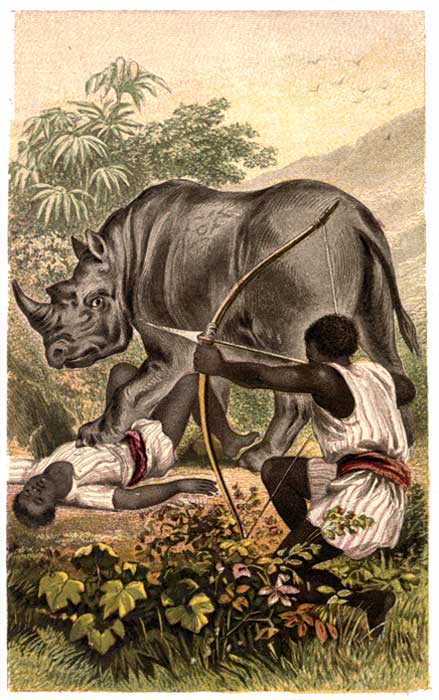
"I discharged it full at his broad and glaring eye-ball with such success, that the barbed point penetrated even to his brain."P. 523.
"This action, magnified beyond its deserts, gained me universal applause throughout the hamlet; I was from that time looked upon as one of the most valiant and fortunate of our youth. The immense body of the monster which I had slain was cut to pieces, and borne in triumph to the village. All the young women received me with songs of joy and congratulations; the young men adopted me as their leader in every hazardous expedition; and the elders applauded me with such expressions of esteem as filled my ignorant heart with vanity and exultation.
"But what was more agreeable to me than all the rest, my father received me with transport, and, pressing me to his bosom with tears of joy, told me that now he could die with pleasure, since I had exceeded his most sanguine expectations. 'I,' said he, 'have not lived inactive or inglorious; I have transfixed the tiger with my shafts; I have, though alone, attacked the lion in his rage, the terror of the woods, the fiercest of animals; even the elephant has been compelled to turn his back and fly before my javelin; but never, in the pride of my youth and strength, did I achieve such an exploit as this.' He then went into his cabin and brought forth the bow and fatal arrows which he was accustomed to use in the chase. 'Take them, take them,' said he, 'my son, and rescue my weaker arm from a burthen which it is no longer destined to sustain. Age is now creeping on; my blood begins to cool, my sinews slacken, and I am no longer equal to the task of supporting the glories of our race. That care shall now be
Such was the account which the negro gave to Tommy, in different conversations, of his birth and education. His curiosity was gratified with the recital, and his heart expanded in the same proportion that his knowledge improved. He reflected, with shame and contempt, upon the ridiculous prejudices he had once entertained; he learned to consider all men as his brethren and equals; and the foolish distinctions which pride had formerly suggested were gradually obliterated from his mind. Such a change in his sentiments rendered him more mild, more obliging, more engaging than ever; he became the delight of all the family; and Harry, although he had always loved him, now knew no limits to his affection.
One day Tommy was
Tommy returned his father's caresses with genuine warmth, but with a degree of respect and humility he had once been little accustomed to use. "I will accompany you home, sir," said he, "with the greatest readiness; for I wish to see my mother, and hope to give her some satisfaction by my future behaviour. You
"But, sir," added he, "I hope you will not object to my detaining you a little longer, while I return my acknowledgments to all the family, and take my leave of Harry." "Surely," said Mr Merton, "you can entertain no doubt on that subject; and to give you every opportunity of discharging all your duties to a family to which you owe so much, I intend to take a dinner with Mr Sandford, whom I now see coming home, and then to return with you in the evening."
At this instant, farmer Sandford approached, and very respectfully saluting Mr Merton, invited him to walk in. But Mr Merton, after returning his civility, drew him aside, as if he had some private business to communicate. When they were alone, he made him every acknowledgment that gratitude could suggest, "but words," added Mr Merton, "are very insufficient to return the favours I have received, for it is to your excellent family, together with the virtuous Mr Barlow, that I owe the preservation of my son. Let me therefore entreat you to accept of what this pocket-book contains, as a slight proof of my sentiments, and lay it out in whatever manner you please for the advantage of your family."
Mr Sandford, who was a man both of sense and humour, took the book, and examining the inside, found that it contained bank-notes to the amount of some hundred pounds. He then carefully shut it up again, and, returning it to Mr Merton, told him that
"And what," replied the honest farmer, "is it but these conveniences of life that are the ruin of all the nation? When I was a young man, Master Merton (and that is near forty years ago), people in my condition thought of nothing but doing their duty to God and man, and labouring hard; this brought down a blessing upon their heads, and made them thrive in all their worldly concerns. When I was a boy, farmers did not lie droning in bed, as they do now, till six or seven; my father, I believe, was as good a judge of business as any in the neighbourhood, and turned as straight a furrow as any ploughman in the county of Devon; that silver cup which I intend to have the honour of drinking your health out of to-day at dinner—that very cup was won by him at the great ploughing-match near Axminster. Well, my father used to say that a farmer was not worth a farthing that was not in the field by four; and my poor dear mother, too, the best-tempered woman in the world, she always began milking exactly at five; and if a single soul was to be found in bed after four in the summer, you might have heard her from one end ofsquinting Dick the
Mr Merton began to be convinced that, whatever other qualities good Mr Sandford might have, he did not excel in brevity, and therefore endeavoured in still stronger terms to overcome the delicacy of the farmer, and prevail upon him to accept his present.
But the good farmer pursued his point thus: "Thank you, thank you, my dear sir, a thousand times for your goodwill; but, as to the money, I must beg your pardon if I persist in refusing it. Formerly, sir, as I was saying, we were all happy and healthy, and our affairs prospered, because we never thought about the conveniences of life; now, I hear of nothing else. One neighbour (for I will not mention names) brings his son up to go a-shooting with gentlemen; another sends his to market upon a blood-horse with a plated bridle; and then the girls—the girls; there is fine work indeed!—they must have their hats and feathers and riding habits; their heads as big as bushels, and even their hind-quarters stuck out with cork or pasteboard; but scarcely one of them can milk a cow, or churn, or bake, or do any one thing that is necessary in a family; so that, unless the government will send them all to this new settlement, which I have heard so much of, and bring us a cargo of plain, honest housewives, who
Mr Merton laughed very heartily at this sally, and told him that he would venture to assert it was not so at his house. "Not quite so bad indeed," said the farmer; "my wife was bred up under a notable mother, and though she must have her tea every afternoon, is, in the main, a very good sort of woman. She has brought her daughters up a little better than usual, but I can assure you she and I have had many a good argument on the subject. Not but she approves their milking, spinning, and making themselves useful, but she would fain have them genteel, Master Merton; all women now are mad after gentility; and, when once gentility begins, there is an end of industry. Now, were they to hear of such a sum as you have generously offered, there would be no peace in the house. My wenches instead of Deb and Kate, would be Miss Deborah and Miss Catherine; in a little time they must be sent to boarding-school to learn French and music, and wriggling about the room; and when they come back, who must boil the pot, or make the pudding, or sweep the house, or serve the pigs? Did you ever hear of Miss Juliana, or Miss Harriet, or Miss Carolina, doing such vulgar
Mr Merton was very much struck with the honest farmer's method of expressing himself, and could not help internally allowing the truth of his representations; yet he still pressed him to accept his present, and reminded him of the improvement of his farm.
"Thank you, again and again," replied the farmer; "but the whole generation of the Sandfords have
Mr Merton then seeing the fixed determination of the farmer, and feeling the justice of his coarse but strong morality, was obliged, however reluctantly, to desist; and Mrs Sandford coming to invite them to dinner, he entered the house, and paid his respects to the family.
After the cloth was removed, and Mr Sandford had twice or thrice replenished his silver mug, the only piece of finery in his house, little Harry came running in, with so much alacrity and heedlessness that he tore Miss Deborah's best apron, and he had nearly precipitated Miss Catherine's new cap into the fire, for which the young ladies and his mother rebuked him with some acrimony. But Harry, after begging pardon with his usual good-
Presently he returned, in equal admiration, with his son. "Master Merton," said he, "I did not think you had been so good a judge of a horse. I suppose they are a new purchase, which you want to have my opinion upon; and I can assure you they are the true Suffolk sorrels—the first breed of working-horses in the kingdom; and these are some of the best of their kind." "Such as they are," answered Mr Merton, "they are yours; and I cannot think, after the obligations I am under to your family, that you will do me so great a displeasure as to refuse."