Chapter V
Reading edition
Lost in the Snow—Jack Smithers' Home—Talk about the Stars—Harry's pursuit of The Will-o'-the-Wisp—Story of the Avalanche—Town and Country compared—The Power of the Lever—The Balance—The Wheel and Axle—Arithmetic—Buying a Horse—History of Agesilaus—History of Leonidas.
Some few days after this conversation, when the snow had nearly disappeared, though the frost and cold continued, the two little boys went out to take a walk. Insensibly they wandered so far that they scarcely knew their way, and therefore resolved to return as speedily as possible; but unfortunately, in passing through a wood, they entirely missed the track, and lost themselves. To add to their distress, the wind began to blow most bitterly from the north, and a violent shower of snow coming on, obliged them to seek the thickest shelter they could find. They happened fortunately to be near an aged oak, the inside of which gradually decaying, was worn away by time, and afforded an ample opening to shelter them from the storm. Into this the two little boys crept safe, and endeavoured to keep each other warm, while a violent shower of
Tommy.—But what if the weather should not clear up at all?
Harry.—In that case we must either endeavour to find our way through the snow, or stay here, where we are so conveniently sheltered.
Tommy.—But oh! what a dreadful thing it is to be here all alone in this dreary wood! And then I am so hungry and so cold; oh that we had but a little fire to warm us!
Harry.—I have heard that shipwrecked persons, when they have been cast away upon a desert coast, have made a fire to warm themselves by rubbing two pieces of wood together till they caught fire; or here is a better thing; I have a large knife in my pocket, and if I could but find a piece of flint, I could easily strike fire with the back of it.
Harry then searched about, and after some time found a couple of flints, though not without much difficulty, as the ground was nearly hidden with snow. He then took the flints, and striking one upon the other with all his force, he shivered them into several pieces; out of those he chose the thinnest and sharpest, and telling Tommy, with a smile,
"Why," answered Tommy, a little disconcerted at the observation of his crying, "it cannot be expected that gentlemen should be able to bear all these inconveniences as well as the poor." "Why not," answered Harry, "is not a gentleman as much a man as the poor can be? and if he is a man, should he not accustom himself to support everything that his fellow-creatures do?"
Tommy.—That is very true; but he will have all the conveniences of life provided for him; victuals to eat, a good warm bed, and a fire to warm him.
Harry.—But he is not sure of having all these things as long as he lives. Besides, I have often observed the gentlemen and ladies in our neighbourhood riding about in coaches, and covered from head to foot, yet shaking with the least breath of air, as if they all had agues, while the children of the poor run about barefooted upon the ice, and divert themselves with making snow-balls.
Tommy.—That is indeed true; for I have seen my mother's visitors sitting over the largest fire that could be made, and complaining of cold, while the labourers out of doors were stripped to their shirts to work, and never minded it in the least.
Harry.—Then I should think that exercise, by which a person can warm himself when he pleases, is an infinitely better thing than all these conveniences you speak of; because, after all, they will not hinder a person from being cold, but exercise will warm him in an instant.
Tommy.—But then it is not proper for gentlemen to do the same kind of work with the common people.
Harry.—But is it not proper for a gentleman to have his body stout and hardy?
Tommy.—To be sure it is.
Harry.—Why, then, he must sometimes labour and use his limbs, or else he will never be able to do it.
Tommy.—What! cannot a person be strong without working?
Harry.—You can judge for yourself. You very often have fine young gentlemen at your father's house, and are any of them as strong as the sons of
Tommy.—Indeed, I believe that is true, for I think I am become stronger myself since I have learned to divert myself in Mr Barlow's garden.
As they were conversing in this manner, a little boy came singing along, with a bundle of sticks at his back; and as soon as Harry saw him, he recollected him, and cried out, "As I am alive, here as I am is Jack Smithers, the little ragged boy that you gave the clothes to in the summer! He lives, I dare say, in the neighbourhood, and either he or his father will now show us the way home."
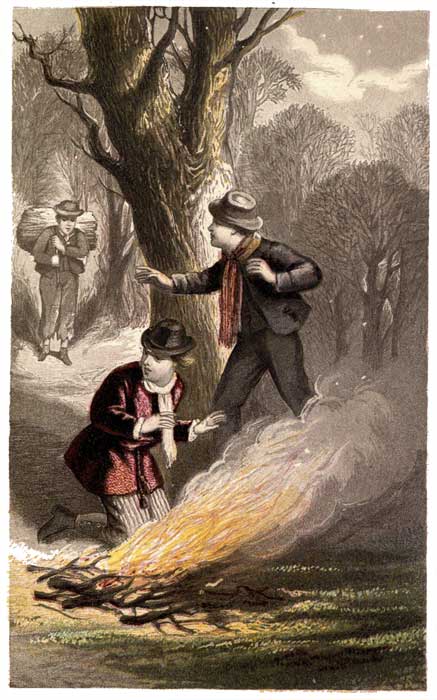
"As I am alive, here is Jack Smithers, the little ragged boy that you gave the clothes to in the summer!"P. 202.
Harry then spoke to the boy, and asked him if he could show them the way out of the wood. "Yes, surely I can," answered the boy; "but I never should have thought of seeing Master Merton out so late in such a tempestuous night as this; but, if you will come with me to my father's cottage, you may warm yourself at our fire, and father will run to Mr Barlow to let him know you are safe."
Tommy accepted the offer with joy, and the little boy led them out of the wood, and in a few minutes they came to a small cottage which stood by the side of the road, which, when they entered, they saw a middle-aged woman busy in spinning; the eldest girl was cooking some broth over the fire; the father was sitting in the chimney-corner, and reading a book, while three or four ragged children were tumbling upon the floor, and creeping between their father's legs.
"Daddy," said the little boy, as he came in, "here is Master Merton, who was so good to us all
The man upon this arose, and with much civility desired the two little boys to seat themselves by the fire, while the good woman ran to fetch her largest faggot, which she threw upon the fire, and created a cheerful blaze in an instant. "There, my dear little master," said she, "you may at least refresh yourself by our fire, and I wish I had anything to offer you that you could eat; but I am afraid you would never be able to bear such coarse brown bread as we poor folks are obliged to eat." "Indeed," said Tommy, "my good mother, I have fasted so long, and I am so hungry, that I think I could eat anything." "Well, then," answered the woman, "here is a little bit of gammon of bacon which I will broil for you upon the embers, and if you can make a supper you are heartily welcome."
While the good woman was thus preparing supper the man had closed his book, and placed it with great respect upon a shelf, which gave Tommy the curiosity to ask him what he was reading about. "Master," answered the man, "I was reading the Book which teaches me my duty towards man, and my obligations to God; I was reading the Gospel of Jesus Christ, and teaching it to my children."
Tommy.—Indeed, I have heard of that good Book; Mr Barlow has often read part of it to me, and promised I should read it myself. That is the Book they read at church; I have often heard Mr Barlow read it to the people; and he always reads it so well and so affectingly that everybody listens, and you may hear even a pin drop upon the pavement.
The Man.—Yes, master, Mr Barlow is a worthy servant and follower of Jesus Christ himself; he is the friend of all the poor in the neighbourhood; he gives us food and medicines when we are ill, and he employs us when we can find no work; but what we are even more obliged to him for than the giving us food and raiment, and life itself, he instructs us in our duty, makes us ashamed of our faults, and teaches us how we may be happy, not only here, but in another world. I was once an idle, abandoned man myself, given up to swearing and drinking, neglecting my family, and taking no thought for my poor wife and children; but since Mr Barlow has taught me better things, and made me acquainted with this blessed book, my life and manners, I hope, are much amended, and I do my duty better to my poor family.
"That indeed you do, Robin," answered the woman; "there is not now a better and kinder husband in the world; you have not wasted an idle penny or a moment's time these two years; and, without that unfortunate fever, which prevented you from working last harvest, we should have the greatest reason to be
"Have we not the greatest reason now," answered the man, "to be not only contented, but thankful for all the blessings we enjoy? It is true that I, and several of the children, were ill this year for many weeks; but did we not all escape, through the blessing of God, and the care of good Mr Barlow and this worthy Master Sandford, who brought us victuals so many days, with his own hands, when we otherwise should perhaps have starved? Have I
"Six shillings a-week! six shillings a-week!" answered Tommy in amazement; "and is that all you and your wife and children have to live on for a whole week!"
The Man.—Not all, master; my wife sometimes earns a shilling or eighteenpence a-week by spinning, and our eldest daughter begins to do something that way, but not much.
Tommy.—That makes seven shillings and sixpence a-week. Why, I have known my mother give more than that to go to a place where outlandish people sing. I have seen her and other ladies give a man a guinea for dressing their hair; and I know a little miss, whose father gives half-a-guinea a time to a little Frenchman, who teaches her to jump and caper about the room.
"Master," replied the man, smiling, "these are great gentlefolks that you are talking about; they are very rich, and have a right to do what they please with their own; it is the duty of us poor folks to labour hard, take what we can get, and thank the great and wise God that our condition is no worse."
Tommy.—What! and is it possible that you can thank God for living in such a house as this, and earning seven shillings and sixpence a-week?
The Man.—To be sure I can, master. Is it not an act of His goodness that we have clothes and a warm house to shelter us, and wholesome food to
Tommy, who had hitherto enjoyed all the good things of this life, without reflecting from whom he had received them, was very much struck with the piety of this honest and contented man; but as he was going to answer, the good woman, who had laid a clean, though coarse, cloth upon the table, and taken up her savoury supper in an earthen plate, invited them to sit down; an invitation which both the boys obeyed with the greatest pleasure, as they had eaten nothing since the morning. In the meantime the honest man of the house had taken his hat and walked to Mr Barlow's, to inform him that his two pupils were safe in the neighbourhood.
Mr Barlow had long suffered the greatest uneasiness at their absence, and not contented with sending after them on every side, was at that very time
The little boys rose up to meet Mr Barlow, and thanked him for his kindness, and the pains he had taken to look after them, expressing their concern for the accident which had happened, and the uneasiness which, without designing it, they had occasioned; but he, with the greatest good-nature, advised them to be more cautious for the future, and not to extend their walks so far; then, thanking the worthy people of the house, he offered to conduct them, and they all three set out together in a very cold, but fine and star-light evening.
As they went home Mr Barlow renewed his caution, and told them the dangers they had incurred. "Many people," said he, "in your situation, have been surprised by an unexpected storm, and, losing their way, have perished with cold. Sometimes, both men and beasts, not being able to discern their accustomed track, have fallen into deep pits filled up and covered with the snow, where they have been found buried several feet deep, and frozen to death." "And is it impossible," said Tommy, "in such a case to escape?" "In general it is," said Mr Barlow; "but there have been some extraordinary instances of persons who have lived several days in that condition, and yet have been taken out alive; to-morrow you shall read a remarkable story to that purpose."
As they were walking on, Tommy looked up at the sky, where all the stars glimmered with unusual brightness, and said, "What an innumerable number of stars is here! I think I never observed so many before in all my life!" "Innumerable as they appear to you," said Mr Barlow, "there are persons that have not only counted all you now see, but thousands more, which are at present invisible to your eye." "How can that be?" inquired Tommy, "for there is neither beginning nor end; they are scattered so confusedly about the sky, that I should think it as impossible to number them, as the flakes of snow that fell to-day while we were in the wood."
At this Mr Barlow smiled, and said, that he believed Harry could give him a different account, although perhaps he could not number them all. "Harry," said he, "cannot you show your companion some of the constellations?" "Yes," answered Harry, "I believe I remember some that you have been so good as to teach me." "But pray, sir," said Tommy, "what is a constellation?"
"Those," answered Mr Barlow, "who first began to observe the heavens as you do now, have observed certain stars, remarkable either for their brightness or position. To these they have given a particular name that they might the more easily know them again, and discourse of them to others; and these particular clusters of stars, thus joined together and named, they call constellations. But come, Harry, you are a little farmer, and can certainly point out to us Charles' Wain."
Harry then looked up to the sky, and pointed out
Tommy.—Indeed, sir, I do not think I can.
Mr Barlow.—Do you not think, then, that you can find them again?
Tommy.—I will try, sir. Now, I will take my eye off, and look another way. I protest I cannot find them again. Oh! I believe, there they are. Pray, sir (pointing with his finger), is not that Charles' Wain?
Mr Barlow.—You are right; and, by remembering these stars, you may very easily observe those which are next to them, and learn their names too, till you are acquainted with the whole face of the heavens.
Tommy.—That is indeed very clever and very surprising. I will show my mother Charles' Wain the first time I go home; I daresay she has never observed it.
Mr Barlow.—But look on the two stars which compose the hinder wheel of the waggon, and raise your eye up towards the top of the sky; do you not see a very bright star, that seems to be almost, but not quite, in a line with the two others?
Tommy.—Yes, sir; I see it
Mr Barlow.—That is called the Pole-star; it never moves from its place, and by looking full at it, you may always find the north.
Tommy.—Then if I turn my face towards that star, I always look to the north.
Mr Barlow.—You are right.
Tommy.—Then I shall turn my back to the south.
Mr Barlow.—You are right again; and now cannot you find the east and the west?
Tommy.—Is it not the east where the sun rises?
Mr Barlow.—Yes; but there is no sun to direct you now.
Tommy.—Then, sir, I cannot find it out.
Mr Barlow.—Do not you know, Harry?
Harry.—I believe, sir, that if you turn your face to the north, the east will be on the right hand, and the west on the left.
Mr Barlow.—Perfectly right.
Tommy.—That is very clever indeed; so then, by knowing the Pole-star, I can always find north, east, west, and south. But you said that the Pole-star never moves; do the other stars, then, move out of their places?
Mr Barlow.—That is a question you may learn to answer yourself, by observing the present appearance of the heavens, and then examining whether the stars change their places at any future time.
Tommy.—But, sir, I have thought that it would be a good contrivance, in order to remember their situation, if I were to draw them upon a bit of paper.
Mr Barlow.—But how would you do that?
Tommy.—I would make a mark upon the paper for every star in Charles' Wain; and I would place the marks just as I see the stars placed in the sky; and I would entreat you to write the names for me;
Mr Barlow.—That would be an excellent way, but you see a paper is flat; is that the form of the sky?
Tommy.—No; the sky seems to rise from the earth on every side, like the dome of a great church.
Mr Barlow.—Then if you were to have some round body, I should think it would correspond to the different parts of the sky, and you might place your stars with more exactness.
Tommy.—That is true, indeed, sir; I wish I had just such a globe.
Mr Barlow.—Well, just such a globe I will endeavour to procure you.
Tommy.—Sir, I am much obliged to you, indeed. But of what use is it to know the stars?
Mr Barlow.—Were there no other use, I should think there would be a very great pleasure in observing such a number of glorious glittering bodies as are now above us. We sometimes run to see a procession of coaches, or a few people in fine clothes strutting about. We admire a large room that is painted, and ornamented, and gilded; but what is there in all these things to be compared with the sight of these luminous bodies that adorn every part of the sky?
Tommy.—That's true, indeed. My Lord Wimple's great room that I have heard all the people admire so much, is no more to be compared to it than the shabbiest thing in the world.
Mr Barlow.—That is indeed true; but there are some, and those very important, uses to be derived from an acquaintance with the stars. Harry, do you
Harry.—You must know, Master Tommy, that I have an uncle who lives about three miles off, across the great moor that we have sometimes walked upon. Now, my father, as I am in general pretty well acquainted with the roads, very often sends me with messages to my uncle. One evening I went there so late, that it was scarcely possible to get home again before it was quite dark. It was at that time in the month of October. My uncle wished me very much to stay at his house all night, but that was not proper for me to do, because my father had ordered me to come back; so I set out as soon as I possibly could, but just as I had reached the heath, the evening grew extremely dark.
Tommy.—And were not you frightened to find yourself all alone upon such a dismal place?
Harry.—No; I knew the worst that could happen would be that I should stay there all night, and as soon as ever the morning shone, I should have found my way home. But, however, by the time that I had reached the middle of the heath, there came on such a violent tempest of wind, blowing full in my face, accompanied with such a shower, that I found it impossible to continue my way. So I quitted the track, which is never very easy to find, and ran aside to a holly-bush that was growing at some distance, in order to seek a little shelter. Here, I lay, very conveniently, till the storm was almost over; then I rose and attempted to continue my way, but unfortunately I missed the track, and lost myself.
Tommy.—That was a very dismal thing indeed.
Harry.—I wandered about a great while, but still to no purpose. I had not a single mark to direct me, because the common is so extensive, and so bare either of trees or houses, that one may walk for miles and see nothing but heath and furze. Sometimes I tore my legs in scrambling through great thickets of furze; now and then I plumped into a hole full of water, and should have been drowned if I had not learned to swim; so that at last I was going to give it up in despair, when, looking on one side, I saw a light at a little distance, which seemed to be a candle and lantern that somebody was carrying across the moor.
Tommy.—Did not that give you very great comfort?
"You shall hear," answered Harry, smiling. "At first I was doubtful whether I should go up to it; but I considered that it was not worth anybody's pains to hurt a poor boy like me, and that no person who was out on any ill design, would probably choose to carry a light. So I determined boldly to go up to it, and inquire the way."
Tommy.—And did the person with the candle and lantern direct you?
Harry.—I began walking up towards it, when immediately the light, which I had first observed on my right hand, moving slowly along by my side, changed its direction, and went directly before me, with about the same degree of swiftness. I thought this very odd; but I still continued the chase, and just as I thought I had approached very near, I tumbled into another pit full of water.
Tommy.—That was unlucky indeed.
Harry.—Well, I scrambled out, and very luckily on the same side with the light, which I began to follow again, but with as little success as ever. I had now wandered many miles about the common; I knew no more where I was than if I had been set down upon an unknown country; I had no hopes of finding my way home, unless I could reach this wandering light; and, though I could not conceive that the person who carried it could know of my being so near, he seemed to act as if he was determined to avoid me. However, I was resolved to make one attempt, and therefore I began to run as fast as I was able, hallooing out, at the same time, to the person that I thought before me, to entreat him to stop.
Tommy.—And did he?
Harry.—Instead of that, the light, which had before been moving along at a slow and easy pace, now began to dance as it were before me, ten times faster than before, so that instead of overtaking it, I found myself farther and farther behind. Still, however, I ran on, till I unwarily sunk up to the middle in a large bog, out of which I at last scrambled with a very great difficulty. Surprised at this, and not conceiving that any human being could pass over such a bog as this, I determined to pursue it no longer. But now I was wet and weary; the clouds had indeed rolled away, and the moon and stars began to shine. I looked around me, and could discern nothing but a wide, barren country, without so much as a tree to shelter me, or any animal in sight. I listened, in hopes of hearing a sheepbell, or the barking of a dog; but nothing met
Tommy.—Indeed, then, the knowledge of the Pole-star was of very great use to you. I am determined I will make myself acquainted with all the stars in
Harry.—When I came home, my father told me it was what the common people called a Jack-o'-the-lantern; and Mr Barlow has since informed me that these things are only vapours, which rise out of the earth in moist and fenny places, although they have that bright appearance; and therefore told me that many people, like me, who have taken them for a lighted candle, have followed them, as I did, into bogs and ditches.
Just as Harry had finished his story, they arrived at Mr Barlow's; and after sitting some time, and talking over the accidents of the day, the little boys retired to bed. Mr Barlow was sitting alone and reading in his parlour, when, to his great surprise, Tommy came running into the room, half undressed, and bawling out, "Sir, sir, I have found it out! they move! they move!" "What moves?" said Mr Barlow. "Why, Charles' Wain moves," answered Tommy; "I had a mind to take one peep at the sky before I went to bed, and I see that all the seven stars have moved from their places a great way higher up the sky." "Well," said Mr Barlow, "you are indeed right. You have done a vast deal to-day, and to-morrow we will talk over these things again."
When the morrow came, Tommy put Mr Barlow in mind of the story he had promised him about the people buried in the snow. Mr Barlow looked him out the book, but first said, "It is necessary to give you some explanation. The country where this
"It was in the neighbourhood of these prodigious mountains, which are called the Alps, that, on the 19th of March 1755, a small cluster of houses was entirely overwhelmed by two vast bodies of snow that tumbled down upon them from a greater height. All the inhabitants were then within doors, except one Joseph Rochia, and his son, a lad of fifteen, who were on the roof of their house clearing away the snow, which had fallen for three days incessantly. A priest going by to church advised them to come down, having just before observed a body
"Five days after, Joseph, being perfectly recovered, got upon the snow, with his son and two of his wife's brothers, to try if he could find the exact place where his house stood; but, after many openings made in the snow, they could not discover it. The month of April proving hot, and the snow beginning to soften, he again used his utmost endeavours to recover his effects, and to bury, as he thought, the remains of his family. He made new openings, and threw in earth to melt the snow, which on the 24th of April was greatly diminished. He broke through ice six English feet thick, with iron bars, thrust down a long pole and touched the ground; but evening coming on, he desisted.
"The next day the brother of his wife, who had heard of the misfortunes of the family, came to the house where Joseph was, and after resting himself a little, went with him to work upon the snow, where they made another opening, which led them to the house they searched for; but, finding no dead bodies in its ruins, they sought for the stable, which was
"Some days after, the magistrate of the place came to visit them, and found the wife still unable to rise from bed, or use her feet from the intense cold she had endured, and the uneasy posture she had been in. The sister, whose legs had been bathed with hot wine, could walk with some difficulty, and the daughter needed no further remedies.
"On the magistrate's interrogating the women, they told him that, on the morning of the 19th of March, they were in the stable with a boy of six years old, and a girl of about thirteen. In the same stable were six goats, one of which having brought forth two dead kids the night before, they went to carry her a small vessel of rye-flour gruel;
"Very fortunately the manger was under the main prop of the stable, and so resisted the weight of the snow. Their first care was to know what they had to eat. The sister said she had fifteen chestnuts in her pockets; the children said they had breakfasted, and should want no more that day. They remembered there were thirty-six or forty cakes in a place near the stable, and endeavoured to get at them, but were not able for the snow. They called often for help, but were heard by none. The sister gave the chestnuts to the wife, and ate two herself, and they drank some snow-water. The ass was restless, and the goats kept bleating for some days, after which they heard no more of them. Two of the goats, however, being left alive and near the manger, they felt them, and found that one of them
"The second day, being very hungry, they ate all the chestnuts, and drank what milk the goat yielded, being very near two quarts a-day at first, but it soon decreased. The third day they attempted again, but in vain, to get at the cakes; so resolved to take all possible care to feed the goats; for just above the manger was a hay-loft, where, through a hole, the sister pulled down hay into the rack, and gave it to the goats as long as she could reach it, and then, when it was beyond her reach, the goats climbed upon her shoulders and reached it themselves.
"On the sixth day the boy sickened, and six days after desired his mother, who all this time had held him in her lap, to lay him at his length in the manger. She did so, and taking him by the hand felt it was very cold; she then put her hand to his mouth, and finding that cold likewise, she gave him a little milk; the boy then cried, 'Oh, my father is in the snow! Oh father! father!' and then expired.
"In the meanwhile the goat's milk diminished daily, and, the fowls soon after dying, they could no longer distinguish night from day; but according to their reckoning, the time was near when the other goat would kid; this she accordingly did soon, and the young one dying, they had all the milk for their own subsistence; so they found that the middle of April was come. Whenever they called this goat, it
"This was the account which these poor people gave to the magistrate of their preservation."
"Dear heart!" said Tommy, when Mr Barlow had finished this account, "what a number of accidents people are subject to in this world." "It is very true," answered Mr Barlow; "but as that is the case, it is necessary to improve ourselves in every manner, that we may be able to struggle against them."
Tommy.—Indeed, sir, I begin to believe it is; for when I was less than I am now, I remember I was always fretful and hurting myself, though I had two or three people constantly to take care of me. At present I seem as if I was quite another thing; I do not mind falling down and hurting myself, or cold, or weariness, or scarcely anything which happens.
Mr Barlow.—And which do you prefer; to be as you are now, or as you were before?
Tommy.—As I am now, a great deal, sir; for then I always had something or another the matter with me. Sometimes I had a little cold, and then I was obliged to stay in for several days; sometimes a little headache, and then I was forced to take physic; sometimes the weather was too hot, then I must stay within, and the same if it was too cold; I used to be tired to death, if I did but walk a mile, and I was always eating cake and
Mr Barlow.—The people who inhabit that country are of a different opinion, and prefer it to all the countries in the world. They are great travellers, and many of them follow different professions in all the different countries of Europe; but it is the only wish of almost all to return, before their death, to the mountains where they were born and have passed their youth.
Tommy.—I do not easily understand that. I have seen a great many ladies and little misses at our house, and whenever they were talking of the places where they should like to live, I have always heard them say that they hated the country of all things, though they were born and bred there. I have heard one say the country is odious, filthy, shocking, and abominable; another, that it is impossible to live anywhere but in London; and I remember once seeing a strange lady, who wrote down her observations in a book, and she said the country was all full of barbarians, and that no person of elegance (yes, that was her word) could bear it for a week.
Mr Barlow.—And yet there are thousands who bear to live in it all their lives, and have no desire to change. Should you, Harry, like to leave the country, and go to live in some town?
Harry.—Indeed, sir, I should not, for then I must leave everything I love in the world. I must leave my father and mother, who have been so kind to me; and you, too, sir, who have taken such pains to improve me, and make me good. I am convinced that I never shall find such friends again as long as
Tommy.—And have you ever been in any large town?
Harry.—Once I was in Exeter, but I did not much like it; the houses seemed to me to stand so thick and close, that I think our hog-sties would be almost as agreeable places to live in; and then there are little narrow alleys where the poor live; and the houses are so high, that neither light nor air can ever get to them, and the most of them appeared so dirty and unhealthy, that it made my heart ache to look at them. And then I walked along the streets, and peeped into the shops—and what do you think I saw?
Tommy.—What?
Harry.—Why, I saw great hulking fellows, as big as our ploughmen and carters, with their heads all frizzled and curled like one of our sheep's tails, that did nothing but finger ribbons and caps for the women! This diverted me so, that I could not help laughing ready to split my sides. And then the gentlewoman, at whose house I was, took me to a place where there was a large room full of candles, and a greater number of fine gentlemen and ladies, all dressed out and showy, who were dancing about as if they were mad. But at the door of this house there were twenty or thirty ragged, half-starved women and children, who stood shivering in the rain, and begged for a bit of bread; but nobody gave it to them, or took any notice of them. So
Tommy.—That is indeed true. Had I been there I should have relieved the poor people; for you know I am very good-natured and generous; but it is necessary for gentlemen to be fine and to dress well.
Harry.—It may be so; but I never saw any great good come of it, for my part. As I was walking along the streets one day, and staring about, I met two very fine and dressy young gentlemen, who looked something as you did, Master Tommy, when you first came here; so I turned off from the foot-way to let them pass, for my father always taught me to show civility to people in a higher station; but that was not enough, it seems, for just as they passed by me they gave me such a violent push, that down I came into the kennel, and dirtied myself all over from head to foot.
Tommy.—And did they not beg your pardon for the accident?
Harry.—Accident! it was no accident at all; for they burst out into a fit of laughter, and called me a little clodpole. Upon which I told them, if I was a clodpole they had no business to insult me; and then they came back, and one of them gave me a kick, and the other a slap on the face; but I told them that was too much for me to bear, so I struck them again, and we all three began fighting.
Tommy.—What! both at once? That was a cowardly trick.
Harry.—I did not much mind that; but there came up a fine smart fellow, in white stockings and powdered hair, who it seems, was their servant, and he was going to fall upon me too; but a man took my part, and said, I should have fair play, so I fought them both till they did not choose to have any more; for, though they were so quarrelsome, they could not fight worth a farthing; so I let them go, and advised them not to meddle any more with poor boys who did nothing to offend them.
Tommy.—And did you hear no more of these young gentlemen?
Harry.—No; for I went home the next day, and never was I better pleased in my life. When I came to the top of the great hill, from which you have a prospect of our house, I really thought I should have cried with joy. The fields looked all so pleasant, and the cattle that were feeding in them so happy; then every step I took I met with somebody or other I knew, or some little boy that I used to play with. "Here is little Harry come back," said one. "How do you do; how do you do?" cried a second. Then a third shook hands with me; and the very cattle, when I went to see them, seemed all glad that I was come home again.
Mr Barlow.—You see by this that it is very possible for people to like the country, and be happy in it. But as to the fine young ladies you talk of, the truth is, that they neither love, nor would be long contented in any place; their whole happiness consists in idleness and finery; they have neither learned to employ themselves in anything useful, nor to improve their minds. As to every kind ofcountry, where they find neither employment nor amusement. They wish to go to London, because there they meet with infinite numbers as idle and frivolous as themselves; and these people mutually assist each other to talk about trifles, and waste their time.
Tommy.—That is true, sir, really; for, when we have a great deal of company, I have often observed that they never talked about anything but eating or dressing, or men and women that are paid to make faces at the playhouse, or a great room called Ranelagh, where everybody goes to meet his friends.
Mr Barlow.—I believe Harry will never go there to meet his friends.
Harry.—Indeed, sir, I do not know what Ranelagh is; but all the friends I have are at home; and when I sit by the fireside on a winter's night, and read to my father and mother, and sister, as I sometimes do, or when I talk with you and Master Tommy upon improving subjects, I never desire any other friends or conversation. But, pray sir, what is Ranelagh?
Mr Barlow.—Ranelagh is a very large round room, to which, at particular times of the year, great numbers of persons go in their carriages to walk about for several hours.
Harry.—And does nobody go there that has not several friends?
Mr Barlow smiled at this question, and answered, "The room is generally so crowded, that people have little opportunity for any kind of conversation. They walk round the room in a circle, one after the other, just like horses in a mill. When persons meet that know each other, they perhaps smile and bow, but are shoved forward, without having any opportunity to stop. As to friends, few people go to look for them there; and if they were to meet them, few would take the trouble of speaking to them, unless they were dressed in a fashionable manner, and seemed to be of consequence."
Harry.—That is very extraordinary, indeed. Why, sir, what can a man's dress have to do with friendship? Should I love you a bit better if you were to wear the finest clothes in the world; or should I like my father the better if he were to put on a laced coat like Squire Chase? On the contrary, whenever I see people dressed very fine, I cannot help thinking of the story you once read me of Agesilaus, king of Sparta.
Tommy.—What is that story? Do let me hear it.
Mr Barlow.—To-morrow you shall hear it; at present we have read and conversed enough; it is better that you should go out and amuse yourselves.
The little boys then went out, and returned to a diversion they had been amusing themselves with for several days, the making a prodigious snowball. They had begun by making a small globe of snow with their hands, which they turned over and over, till, by continually collecting fresh matter, it grew so large that they were unable to roll it any farther.
Tommy was extremely surprised at this, and said, "How can this be? We are not a bit stronger than we were before; and yet now we are able to roll this snowball along with ease, which we could not even stir before." "That is very true," answered Harry, "but it is owing to these sticks. This is the way that the labourers move the largest trees, which, without this contrivance, they would not be able to stir." "I am very much surprised at this," said Tommy; "I never should have imagined that the sticks would have given us more strength than we had before."
Just as he had said this, through a violent effort, both their sticks broke short in the middle. "This is no great loss," observed Tommy, "for the ends will do just as well as the whole sticks."
They then tried to shove the ball again with the truncheons which remained in their hands; but, to the new surprise of Tommy, they found they were unable to stir it. "That is very curious indeed," said Tommy; "I find that only long sticks are of any use." "That," said Harry, "I could have told you before, but I had a mind you should find it out
They then went up to the men who were at work, but here a new subject of admiration presented itself to Tommy's mind. There was a root of a prodigious oak tree, so large and heavy, that half-a-dozen horses would scarcely have been able to draw it along; besides, it was so tough and knotty, that the sharpest axe could hardly make any impression upon it. This a couple of old men were attempting to cleave in pieces, in order to make billets for Mr Barlow's fire.
Tommy, who thought their strength totally disproportionate to such an undertaking, could not help pitying them; and observing, that certainly Mr Barlow "did not know what they were about, or he would have prevented such poor weak old men from fatiguing themselves about what they never could perform." "Do you think so?" replied Harry; "what would you then say, if you were to see me, little as I am, perform this wonderful task, with the assistance of one of these good people?" So he took up a wooden mallet—an instrument which, although much larger, resembles a hammer—and began beating the root, which he did for some time, without making the least impression. Tommy, who imagined that, for this time, his friend Harry was caught, began to smile, and told him, "that he
"Say you so?" answered Harry, smiling; "then I believe I must try another method;" so he stooped down, and picked up a small piece of rough iron, about six inches long, which Tommy had not before observed, as it lay upon the ground. This iron was broad at the top, but gradually sloped all the way down, till it came to a perfect edge at bottom. Harry then took it up, and with a few blows drove it a little way into the body of the root. The old man and he then struck alternately with their mallets upon the head of the iron, till the root began to gape and crack on every side, and the iron was totally buried in the wood.
"There," said Harry, "this first wedge has done its business very well; two or three more will finish it." He then took up another larger wedge, and, inserting the bottom of it between the wood and the top of the former one, which was now completely buried in the root, began to beat upon it as he had done before. The root now cracked and split on every side of the wedges, till a prodigious cleft appeared quite down to the bottom. Thus did Harry proceed, still continuing his blows, and inserting new and larger wedges as fast as he had driven the former down, till he had completely effected what he had undertaken, and entirely separated the monstrous mass of wood into two unequal parts.
Harry then said, "here is a very large log, but I think you and I can carry it in to mend the fire; and I will show you something else that will surprise you." So he took a pole of about ten feet long,
As they were walking in this manner, Mr Barlow met them, and seeing poor Tommy labouring under his burthen, asked him who had loaded him in that manner. Tommy said it was Harry. Upon this, Mr Barlow smiled, and said, "Well, Tommy, this is the first time I ever saw your friend Harry attempt to impose upon you; but he is making you carry about three times the weight which he supports
Mr Barlow then led Tommy into the house, and showed him a stick of about four feet long, with a scale hung at each end. "Now," said he, "if you place this stick over the back of a chair, so that it may rest exactly upon the middle, you see the two scales will just balance each other. So, if I put into each of them an equal weight, they will still remain suspended. In this method we weigh every thing which is bought, only, for the greater convenience, the beam of the scale, which is the same thing as this stick, is generally hung up to something else by its middle. But let us now move the stick, and see what will be the consequence." Mr Barlow then pushed the stick along in such a manner, that when it rested upon the back of the chair, there were three feet of it on one side, and only one on the other. That side which was longest instantly came to the ground as heaviest. "You see," said Mr Barlow, "if we would now balance them, we must put a greater weight on the shortest side; so he kept adding weights, till Tommy found that one pound on the longest side would exactly balance three on the shortest; for, as much as the longer
"This," said Mr Barlow, "is what they call a lever, and all the sticks that you have been using to-day are only levers of a different construction. By these short trials, you may conceive the prodigious advantage which they are of to men; for thus can one man move a weight which half-a-dozen could not be able to do with their hands alone; thus may a little boy, like you, do more than the strongest man could effect who did not know these secrets. As to that instrument by which you were so surprised that Harry could cleave such a vast body of wood, it is called a wedge, and is almost equally useful with the lever. The whole force of it consists in its being gradually narrower and narrower, till at last it ends in a thin edge, capable of penetrating the smallest chink. By this we are enabled to overthrow the largest oaks, to cleave their roots, almost as hard as iron itself, and even to split the solid rocks." "All this," said Tommy, "is wonderful indeed; and I need not ask the use of them, because I see it plainly in the experiments I have made to-day."
"One thing more," added Mr Barlow, "as we are upon this subject, I will show you." So he led them into the yard, to the bottom of his granary, where stood a heavy sack of corn. "Now," said Mr Barlow, "if you are so stout a fellow as you imagine, take up this sack of corn, and carry it up the ladder into the granary." "That," replied Tommy, laughing, "is impossible; and I doubt, sir, whether youwheel and axle. You see this wheel, which is not very large, turns round an axle which goes into it, and is much smaller; and at every turn, the rope to which the weight is fixed that you want to move, is twisted round the axle. Now, just as much as the breadth of the whole wheel is greater than that of the axle which it turns round, so much greater is the weight that the person who turns it can move, than he could do without it." "Well," said Tommy, "I see it is a fine thing indeed to acquire knowledge, for by these means one not only increases one's understanding, but one's bodily strength. But are there no more, sir, of these ingenious contrivances, for I should like to understand them all?" "Yes," answered Mr Barlow, "there are more, and all of them you shall be perfectly acquainted with in time; but for this purpose you should be able to write, and comprehend something of arithmetic."
Tommy.—What is arithmetic, sir?
Mr Barlow.—That is not so easy to make you
Tommy.—Yes, sir.
Mr Barlow.—Can you count how many there are?
Tommy.—There are just five-and-twenty of them.
Mr Barlow.—Very well. Here is another parcel; how many grains are there?
Tommy.—Just fourteen.
Mr Barlow.—If there are fourteen grains in one heap, and twenty-five in the other, how many grains are there in all? or, how many do fourteen and twenty-five make?
Tommy was unable to answer, and Mr Barlow proposed the same question to Harry, who answered, that, together, they made thirty-nine. "Again," said Mr Barlow, "I will put the two heaps together, and then how many will there
Tommy.—Thirty-nine.
Mr Barlow.—Now, look, I have just taken away nineteen from the number; how many, do you think, remain?
Tommy.—I will count them.
Mr Barlow.—And cannot you tell without counting? How many are there, Harry?
Harry.—Twenty, sir.
Mr Barlow.—All this is properly the art of arithmetic, which is the same as that of counting, only it is done in a much shorter and easier way, without the trouble of having the things always before you. Thus, for instance, if you wanted to know how many barley-corns were in this sack, you would perhaps be a week in counting the whole number.
Tommy.—Indeed, I believe I should.
Mr Barlow.—If you understood arithmetic you might do it in five minutes.
Tommy.—That is extraordinary, indeed; I can hardly conceive it possible.
Mr Barlow.—A bushel of corn weighs about fifty pounds; this sack contains four bushels; so that there are just two hundred pounds weight in all. Now, every pound contains sixteen ounces, and sixteen times two hundred makes thirty-two hundred ounces. So that you have nothing to do but to count the number of grains in a single ounce, and there will be thirty-two hundred times that number in the sack.
Tommy.—I declare this is curious indeed, and I should like to learn arithmetic. Will Harry and you teach me, sir?
Mr Barlow.—You know we are always ready to improve you. But before we leave this subject, I must tell you a little story. "There was a gentleman who was extremely fond of beautiful horses, and did not grudge to give the highest prices for them. One day a horse-courser came to him, and showed him one so handsome, that he thought it superior to all he had ever seen before. He mounted him, and found his paces equally excellent; for, though he was full of spirit, he was gentle and tractable as could be wished. So many perfections delighted the gentleman, and he eagerly demanded the price. The horse-courser answered, that he would bate nothing of two hundred guineas; the gentleman, although he admired the horse, would not consent to give it, and they were just on the point of parting. As the
Tommy.—This fellow must have been a very great blockhead, to ask two hundred guineas, and then to take a few farthings for his horse.
Mr Barlow.—The gentleman was of the same opinion; "however, the horse-courser added:—'I do not mean, sir, to tie you down to this last proposal, which, upon consideration, you may like as little as the first; all that I require is, that if you are dissatisfied with your bargain, you will promise to pay me down the two hundred guineas which I first asked.' This the gentleman willingly agreed to, and then called the steward to calculate the sum, for he was too much of a gentleman to be able to do it himself. The steward sat down with his pen and ink, and, after some time, gravely wished his master joy, and asked him, 'in what part of England the estate was situated that he was going to purchase.' 'Are you mad?' replied the gentleman; 'it is not an estate, but a horse, that I have just bargained for; and here is the owner of him, to whom I am
Tommy.—This is quite incredible, that a farthing just doubled a few times, should amount to such a prodigious sum; however, I am determined to learn arithmetic, that I may not be imposed upon in this manner, for I think a gentleman must look very silly in such a situation.
Thus had Tommy a new employment and diversion for the winter nights—the learning arithmetic. Almost every night did Mr Barlow, and Harry, and he, amuse themselves with little questions that related to numbers; by which means Tommy became, in a short time, so expert, that he could add, subtract, multiply, or divide almost any given sum, with little trouble and great exactness. But he did not for this forget the employment of observing the heavens, for every night when the stars appeared bright, and the sky was unclouded, Harry and he observed the various figures and positions of the constellations. Mr Barlow gave him a little paper globe, as he had promised, and Tommy immediatelyCassiopeia's Chair, and this, in a short time, was added to the collection.
One night as Tommy was looking up to the sky in the southern part of the heavens, he observed so remarkable a constellation that he could not help particularly remarking it; four large and shining stars composed the ends of the figure, which was almost square, and full in the middle appeared three more placed in a slanting line and very near each other. This Tommy pointed out to Mr Barlow, and begged to know the name. Mr Barlow answered that the constellation was named Orion, and that the three bright stars in the middle were called his belt. Tommy was so delighted with the grandeur and beauty of this glorious constellation, that he could not help observing it, by intervals, all the evening; and he was surprised to see that it seemed to pass on in a right line drawn from east to west, and that all the stars he had become acquainted with moved every night in the same direction.
But he did not forget to remind Harry one morning of the history he had promised to tell him of Agesilaus. Harry told it in the following manner:—
"HISTORY OF AGESILAUS."
"The Spartans (as I have before told you, Master Tommy) were a brave and hardy people, who des
Tommy.—Stop, stop!—I don't exactly understand that. I thought a king was a person that dressed finer and had less to do than anybody else in the world. I have often heard my mamma and the ladies say that I looked like a prince when I had fine clothes on; and therefore I thought that kings and princes never did anything but walk about with crowns upon their heads, and eat sweetmeats all day long.
Harry.—I do not know how that may be, but in Sparta the great business of the kings (for they had two) was to command them when they went out to war, or when they were attacked at home—and that, you know, they could not do without being brave and hardy themselves. "Now it happened that the Spartans had some dear friends and allies that lived at a distance from them across the sea, who were attacked by a great and numerous nation called the Persians. So when the Spartans knew the danger of their friends, they sent over to their assistance Agesilaus, one of their kings, together with a few thousands of his countrymen; and these they judged
Here Tommy interrupted the story, to inquire what a shield was. "Formerly," answered Mr Barlow, "before men were acquainted with the pernicious effects of gunpowder, they were accustomed to combat close together with swords or long spears, and for this reason they covered themselves in a variety of ways, to defend their bodies from the weapons of their enemies. The shield was worn upon their left arm, and composed of boards fixed together, and strengthened with the hides of animals, and plates of iron, sufficiently long and broad to cover almost the whole body of a man. When they went out to battle, they placed themselves in even rows or ranks, with their shields extended before them, to secure them from the arrows and weapons of their enemies. Upon their heads they wore a
"When Pharnabazus (for that was the name of the Persian general) observed that his troops were never able to stand against the Spartans, he sent to Agesilaus, and requested that they might have a meeting, in order to treat about terms of peace. This the Spartan consented to, and appointed the time and place where he would wait for Pharnabazus. When the day came, Agesilaus arrived first at the place of meeting with the Spartans; but not seeing Pharnabazus, he sat down upon the grass with his soldiers, and, as it was the hour of the army's making their repast, they pulled out their provisions, which consisted of some coarse bread and onions, and began eating very heartily. In the middle of them sat King Agesilaus himself, in nowise distinguished from the rest, neither by his clothing nor his fare; nor was there in the whole army an individual who more exposed himself to every species of hardship, or discovered less nicety than the king himself, by which means he was beloved and reverenced by all the soldiers, who were ashamed of appearing less brave or patient than their general.
"It was not long that the Spartans had thus reposed before the first servants of Pharnabazus arrived, who brought with them rich and costly carpets, which they spread upon the ground for their master to recline upon. Presently arrived another troop, who began to erect a spacious tent, with silken hangings, to screen him and his train from the heat of the sun. After this came a company of cooks and confectioners with a great number of loaded horses, who carried upon their
"As he approached nearer, and beheld the simple manners of the Spartan king and his soldiers, he could not help scoffing at their poverty, and making comparisons between their mean appearance and his own magnificence. All that were with him seemed to be infinitely diverted with the wit and acute remarks of their general, except a single person, who had served in the Grecian armies, and therefore was better acquainted with the manners and discipline of these people. This man was highly valued by Pharnabazus for his understanding and honesty, and, therefore, when he observed that he said nothing, he insisted upon his declaring his sentiments, as the rest had done. 'Since, then,' replied he, 'you command me to speak my opinion, O Pharnabazus, I must confess that the very circumstance which is the cause of so much mirth to the gentlemen that accompany you is the reason of my fears. On our side, indeed, I see gold, and jewels, and purple, in abundance, but when I look for men, I can find nothing but barbers, cooks, confectioners, fiddlers, dancers, and everything that is most unmanly and unfit for war; on the Grecian side, I discern none of the costly trifles, but I see iron that forms their weapons, and composes impenetrable arms. I see men who have been brought up to
"Pharnabazus was so struck with the truth and justness of these remarks, that, from that very hour he determined to contend no more with such invincible troops, but bent all his care towards making peace with the Spartans, by which means he preserved himself and country from destruction."
"You see by this story," said Mr Barlow, "that fine clothes are not always of the consequence you
"Alas!" said Harry, "what a dreadful picture do you draw of the fate of those brave men who suffer so much to defend their country. Surely those who employ them should take care of them when they are sick, or wounded, or incapable of providing for themselves."
"So indeed," answered Mr Barlow, "they ought to do; but rash and foolish men engage in wars without either justice or reason, and when they are over they think no more of the unhappy people who have served them at so much loss to themselves."
Harry.—Why, sir, I have often thought, that, as all wars consists in shedding blood and doing mischief to our fellow-creatures they seldom can be just.
Mr Barlow.—You are indeed right there. Of all
Harry.—I then have thought (though I pity poor soldiers extremely, and always give them something if I have any money in my pocket) that they draw these mischiefs upon themselves, because they endeavour to kill and destroy other people, and, therefore, if they suffer the same evils in return, they can hardly complain.
Mr Barlow.—They cannot complain of the evils to which they voluntarily expose themselves, but they may justly complain of the ingratitude of the people, for whom they fight, and who take no care of them afterwards.
Harry.—Indeed, sir, I think so. But I cannot conceive why people must hire others to fight for them. If it is necessary to fight, why not fight for themselves? I should be ashamed to go to another boy and say to him, "Pray go and venture your life or limbs for me that I may stay at home and do nothing."
Tommy.—What if the French were to come here, as they said they were about to do; would you go out to fight them yourself?
Harry.—I have heard my father say that it was every man's duty to fight for his country, if it were attacked; and if my father went out to fight, I would go out with him. I would not willingly hurt anybody, but if they attempt to hurt me or my countrymen, we should do right to defend ourselves; should we not, sir?
Mr Barlow.—This is certainly a case where men have a right to defend themselves; no man is bound to yield his life or property to another that has no right to take it. Among those Grecians, whom you were talking of, every man was a soldier, and always ready to defend his country whenever it was attacked.
Harry.—Pray, dear sir, read to Master Tommy the story of Leonidas, which gave me so much pleasure; I am sure he will like to hear it.
Mr Barlow accordingly read
"THE HISTORY OF LEONIDAS, KING OF SPARTA."
"The king of Persia commanded a great extent of territory, which was inhabited by many millions of people, and not only abounded in all the necessaries of life, but produced immense quantities of gold and silver, and every other costly thing. Yet all this did not satisfy the haughty mind of Xerxes, who, at that time, possessed the empire of this country. He considered that the Grecians, his neighbours, were free, and refused to obey his imperious orders, which he foolishly imagined all mankind should respect; he therefore determined to make an expedition with a mighty army into Greece, and to conquer the country. For this reason he raised such a prodigious army, that it was almost impossible to describe it; the number of men that composed it seemed sufficient to conquer the whole world, and all the forces the Grecians were able to raise would scarcely amount to a hundredth part. Nevertheless, the Grecians held public councils to consult about their
"In the mean time Xerxes was continually marching forward, and at length entered the territory of Greece. The Grecians had not yet been able to assemble their troops or make their preparations, and therefore they were struck with consternation at the approach of such an army as attended Xerxes. Leonidas was at that time king of Sparta, and when he considered the state of affairs, he saw one method alone by which the ruin of his country, and all Greece, could be prevented. In order to enter the more cultivated parts of this country, it was necessary for the Persian army to march through a very rough and mountainous district, called Thermopylæ. There was only one narrow road through all these mountains, which it was possible for only a very small number of men to defend for some time against the most numerous army. Leonidas perceived that, if a small number of resolute men would undertake to defend this passage, it would retard the march of the whole Persian army, and give the Grecians time to collect their troops; but who would undertake so desperate an enterprise, where there was scarcely any possibility of escaping alive? For this reason, Leonidas
"With this design he assembled the chief persons of Sparta, and laid before them the necessity of defending the pass of Thermopylæ. They were equally
"As they marched through the city, all the inhabitants attended them with praises and acclamations; the young women sang songs of triumph, and scattered flowers before them; the youths were jealous of their glory, and lamented that such a noble doom had not rather fallen upon themselves;
"In a short time Xerxes approached with his innumerable army, which was composed of various nations, and armed in a thousand different manners, and, when he had seen the small number of his enemies, he could not believe that they really meant to oppose his passage; but when he was told that this was surely their design, he sent out a small detachment of his troops, and ordered them to take those Grecians alive and bring them bound before him. The Persian troops set out and attacked the Grecians with considerable fury; but in an instant they were routed, the greater part slain, and the rest obliged to fly. Xerxes was enraged at this misfortune, and ordered the combat to be renewed with greater forces. The attack was renewed, but always with the same success, although he sent the bravest troops in his whole army. Thus was this immense army stopped in its career, and the pride of their monarch humbled by so inconsiderable a body of Grecians, that they were not at first thought worthy of a serious attack. At length, what Xerxes, with all his troops was incapable of effecting, was performed by the treachery of some of the Grecians who inhabited that country. For a great reward they undertook to lead a chosen body of the Persians
"As soon as day arose, Leonidas perceived that he had been betrayed, and that he was surrounded by the enemy; nevertheless, with the same undaunted courage, he took all necessary measures and prepared for the fate which he had long resolved to meet. After praising and thanking the allies for the bravery with which they had behaved, he sent them all away to their respective countries; many of the Spartans, too, he would have dismissed under various pretences; but they, who were all determined rather to perish with their king than to return, refused to go. When he saw their resolution, he consented that they should stay with him and share in his fate. All day, therefore, he remained quiet in his camp; but when evening approached, he ordered his troops to take some refreshment, and, smiling, told them 'to dine like men who were to sup in another world.' They then completely armed themselves, and waited for the middle of the night, which Leonidas judged most proper for the design he meditated. He saw that the Persians would never imagine it possible that such an insignificant body of men should think of attacking their numerous forces; he was therefore determined, in the silence of the night, to break into their camp, and endeavour, amid the terror and confusion which would ensue, to surprise Xerxes himself.
"About midnight, therefore, this determined body
"But now the morning began to appear, and the Persians, who had discovered the small number of their assailants, surrounded them on every side, and without daring to come to a close engagement, poured in their darts and other missive weapons. The Grecians were wearied even with the toils of conquest, and their body was already considerably diminished; nevertheless, Leonidas, who was yet alive, led on the intrepid few that yet remained to a fresh attack; again he rushed upon the Persians, and pierced their thickest battalions as often as he could reach them. But valour itself was vain against such inequality of numbers; at every charge the Grecian ranks grew thinner and thinner, till at length they were all destroyed, without a single man having quitted his post or turned his back upon the enemy."
"Really," said Tommy, when the history was finished, "Leonidas was a brave man indeed. But what became of Xerxes and his army after the death of this valiant Spartan? was he able to overcome the Grecians, or did they repulse him?" "You are now able to read for yourself," replied Mr Barlow, "and therefore, by examining the histories of those countries, you may be informed of everything you desire."